News Tidbits 9/19/15: It’s A Numbers Game

19 09 2015

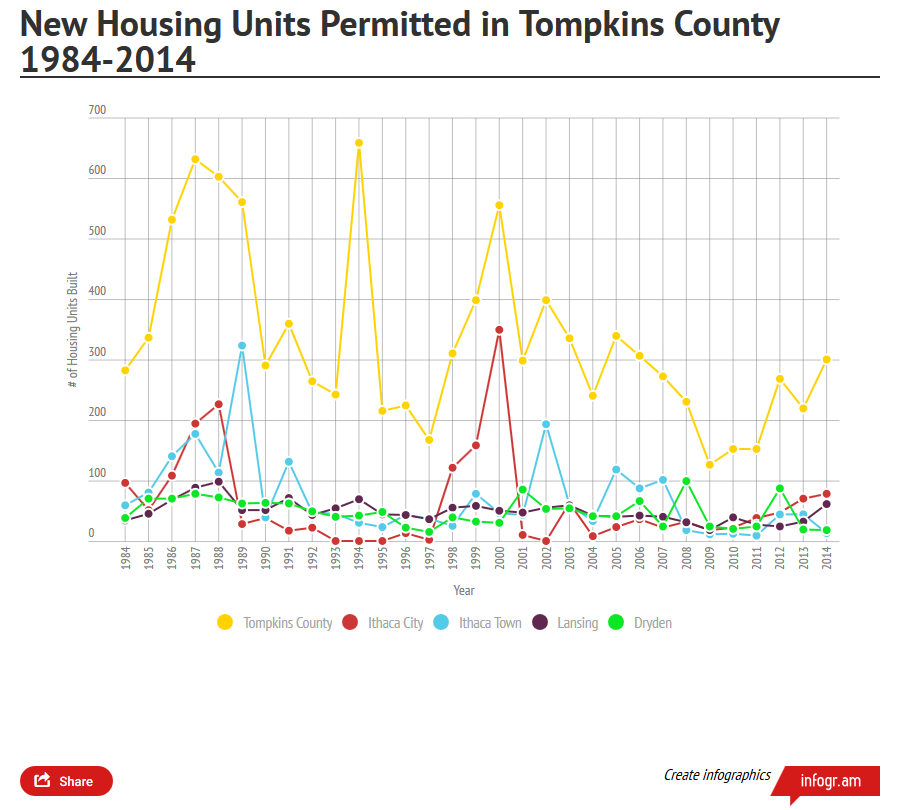
tc_housing_permits_1984_2014

tc_housing_permits_pies_19904_20104

1. Readers might have noticed that there was no Monday night (Tuesday) piece this week. The piece that was originally scheduled evolved into the building permits analysis that was a featured article on the Voice (link here). The initial intent was to run a mirror of the piece on the same day, but things got a little delayed, and eventually I just scrapped running it as the topic-of-the-week.

The reaction was generally favorable (if maybe less traffic than hoped; math-y pieces typically aren’t big traffic generators), but there’s a couple of quick criticisms that came in that I want to address. Namely that I didn’t include proposed projects, and that I left out non-residential construction.

Truthfully, there is no reliable long-term record of non-residential construction. HUD doesn’t break it down in their SOCDS database, and the county doesn’t have complete data on non-residential construction (for their reports, they also rely on the HUD SOCDS database). Related to that, HUD data for 2015 is very preliminary, relying on imputed values. Finalized and corrected 2015 data won’t be available for use until March 2016.

That being said, residential permits are an effective gauge for a few reasons – one, residential is the largest individual construction sector nationwide; two most recent local construction is residential or institutional, and three, many of the projects built in Ithaca are “mixed-use” meaning they have commercial and residential components. although the commercial components aren’t kept in track, the residential construction permits are available, and are showing up in the city’s SOCDS data.

For proposed projects, it’s not prudent to “count your chickens before they’ve hatched”. This passage was originally in the piece, but was pulled before the final version was published:

“As mentioned earlier, news sources like us here the Voice are guilty are promoting the misconceptions. We try and keep tabs on all the big projects – when they get proposed, approved and underway. The thing is, not all projects go from proposed to built. Some never receive approvals. Some get approved, but wait years to get construction financing, if ever. So it seems like there’s more than there is.”

Without having hard evidence in front of me, I’d argue that if one were to somehow include office and retail, the area still isn’t booming if we’re looking in a historical timeframe – you’d have large spikes in retail during the mid 1970s when the mall was built, and from about 1997-2004 in Southwest Ithaca and Lansing for big box retail. For office space, there would be a peak in the late 1980s/early 1990s for the Cornell business park by the airport; there’s circumstantial evidence that the office market today is pretty weak, TFC’s HQ being the odd project out. Industrial space would have peaked with Borgwarner’s construction in the early 1980s, but in recent years it’s been minimal or even negative growth (due to the Emerson shutdown). Hotels might be the only category that shows a “boom” at present.

The point of the article remains that

1. If we look at available building permit data, Tompkins has seen an uptick in construction, but not a construction “boom”, and
2. It feels like a boom because the region’s coming off of a very low period of activity, and there’s more construction in the highly visible urban areas of Ithaca city, vs. the suburban and rural development that has been more prevalent in previous years.
20150829_121852 20150829_121855

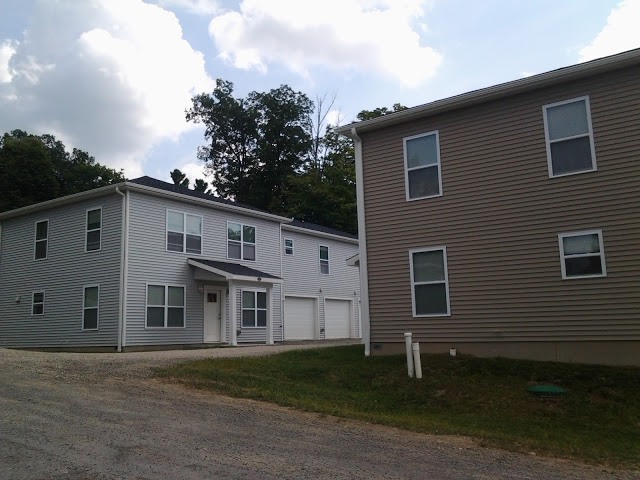
2. It’s time for a semi-regular house-of-the-week feature. I’ve been meaning to update on this for a while, but I keep missing the turn off Route 79. Local developer Chris Petrillose of Petrillose Properties (possibly related to Bob Petrillose, the founder of the Hot Truck) recently finished his second and third duplex  off of Wiedmeier Court in the town of Ithaca. Like the first duplex that was finished last year, each building consists of a 4-bedroom unit and 2-bedroom unit.

According to county records, the Wiedmeiers began to develop the land in the mid-2000s, building 2 duplexes of their own before deciding to sell the other lots (Petrillose bought the lots for the duplexes in 2012). The rest of the land, 12.34 acres, is currently for sale, so perhaps this won’t be the last visit.

3. Previously reported here and on the Voice, the city is studying whether or not to sell fire station No. 9, located in the heart of Collegetown at 309 College Avenue, to an interested private developer. We now know the consultant the city hired to perform the study.

Kingsbury Architecture, a small local firm, is investigating whether it would be worth the city’s investment to build a new station elsewhere on East Hill and sell the aging station, or invest in repairs and long-term maintenance for the current 1968 structure. Kingsbury has little presence online, but in an example of how small of a world this is, they were the initial firm used to plan St. Catherine of Siena’s new parish center, the project discussed in last week’s news update. However, according to church newsletter, the congregation amicably ended the partnership because of cost issues. The church staff went architect shopping, and that’s how Richard McElhiney Architects came into the project. Some of Kingsbury’s work can be found on the church’s webpage here. Kingsbury also appears to have done some interior renovation work at Cornell, and roof replacement at the Cascadilla Boathouse.
state_st_triangle_v5_1

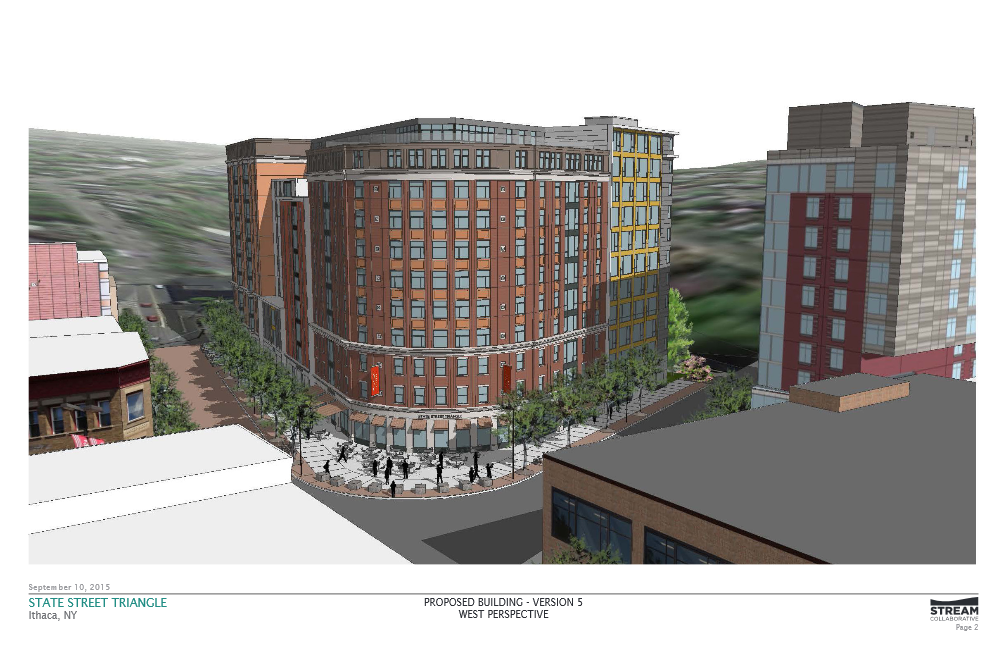
4. New documents from Campus Advantage give insights on the tenant mix and parking situation in downtown Ithaca.

First, my personal disclaimer – Even though part of their market research cites work I’ve written for the Voice about the housing crisis, my work was done impartially.

The new information comes as part of Campus Advantage’s official response to the city planning board’s request for more specific values on resident population, parking utilization and bus capacity, among other details. The documents are provided as part of the planning board’s materials here.

Updated figures indicate the proposed building has gone on a diet – the number of bedrooms has dropped from 620 to 582, the number of units from 240 to 232, and the square footage from 288,845 SF to 216,434 SF, a 25% reduction in mass. The maximum height remains the same at 11 stories at 116 feet. The slimming down comes in response to unfavorable review of the previous design as “too massive”, especially on the side facing East State Street.

sst_stats_1

According to an internal study by Campus Advantage, the Texas developer forecasts that, of the 582 tenants when at full capacity, 77.8% (431) will be students, and 22.2% (123) non-students. Of those students, 78.4% (338) will be undergraduates. Cornell students would comprise 64% (276) of the student population, Ithaca College 32% (138), and TC3 4% (17). A quick glance at the details behind these projections shows that CA assumes 95% occupancy, studios and other smaller units will be half or majority non-student, and that undergrads will be more inclined towards shared 4-bedrooms and 5-bedroom units. CA conducted online surveys with student groups to gather information for their study.
sst_stats_2

The parking demand from residents is predicted to be 191-219 spaces, taken from a study conducted by third-party traffic engineering firm SRF Associates. A further 64 parking spaces will be required for commercial retail tenants on the first floor (57 customer spaces, 7 employee spaces), for a grand total of 283 parking spaces. The 2012 Randall/West Collegetown parking study used as reference looked at student and non-student vehicle ownership in the Collegetown neighborhood, and the higher end (or “more conservative”, as SRF calls it) 219-space figure comes from a calculation the Urban Land Institute, a non-profit urban planning think-tank. Given that Randall/west focused on Collegetown, the more conservative figure is the safer bet.

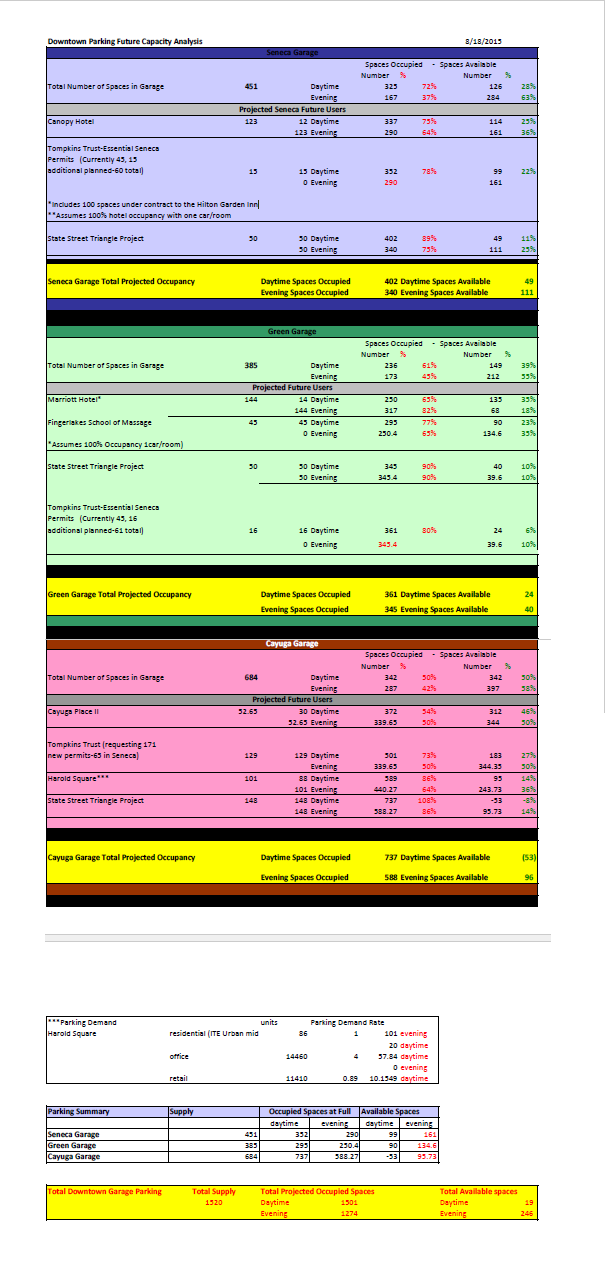
It’s not clear whether the parking garage study above is CA’s or the city’s, but the application itself states that the city’s Parking Director, Frank Nagy, has confirmed that enough parking is available, and a letter from TCAT’s Doug Swarts states that TCAT has the capacity for State Street Triangle’s potential tenants. Looking at the above study, though, it appears that if built, and if all the other approved and likely projects (i.e. don’t include 130 East Clinton) are built, the parking garages will be nearly full.

Since the new drawings were presented at the public open house on September 10th, there do not appear to have been revisions – what was shown then will be shown at the planning board meeting next Tuesday (links to those drawings here). However, the planning board will be looking to schedule a design review committee meeting, where board members provide suggestions and guidance on design features for the new building. In other words, this probably isn’t the building’s final design.

Also included in the attachment are two opposition letters – one from Historic Ithaca saying the building’s still too tall and massive, the other from former planning board and councilwoman Jane Marcham, who takes the unusual if debatable tact by saying that students living downtown deprives the colleges of campus life. Students comprise 40% of the market-rate downtown rental market, so there’s a few to interview for opinions should anyone be interested.

As always, the project is likely to inspire some debate at the planning board meeting. We’ll see if the changes are to the board’s liking.
815_s_aurora_1

5. Wrapping up this short but informative week, here’s a look at the Planning Board agenda for next week:

A. State Street Triangle – Public Hearing, City Environmental Quality Review (CEQR) discussion, and scheduling a Design Review Committee meeting. CEQR is they city’s more in-depth take on SEQR, where a project’s environmental impacts are considered, and a negative declaration (acceptance) is given only when adverse factors have been mitigated in a way the board sees fit. Design Review Committee pretty much is as it sounds – the board makes suggestions on the building design as a quality control / quality assurance measure.

B. 215-221 Spencer Street, Determination of Environmental Significance and Recommendation to the BZA – the board has decided to recommend approval of the parking variance (parking within the rear yard setback), given the site’s steep topography.

C. Site improvements, 416-418 East State Street416-418 East State Street is currently home to an underused 7,600 SF office and a connected manufacturing/storage building. The house dates from the 19th century, with various additions as recent as the 1970s. According to plans filed with the city, an LLC linked to Argos Inn architect Ben Rosenblum has plans to convert the old manufacturing space into a bar and storage space, with renovated offices and a 2 bedroom apartment in the original house. The project will include an accessory parking lot, revised landscaping and handicap access. Area and setback deficiencies have resulted in the need for a zoning variance, but a parking variance won’t be required because the bar will have after hours parking across the street at Gateway Plaza. The building itself won’t change dimensions, but the change in use triggers the city zoning laws.

There have been substantial concerns expressed about this project – neighbors are vociferously opposed to a bar, citing noise problems and concerns about smokers, and the county planning department is not a fan of the traffic and parking arrangement. The city will need to examine this project carefully.

Scott Whitham is serving as a consultant, and local architect Jason Demarest is designing the renovation.

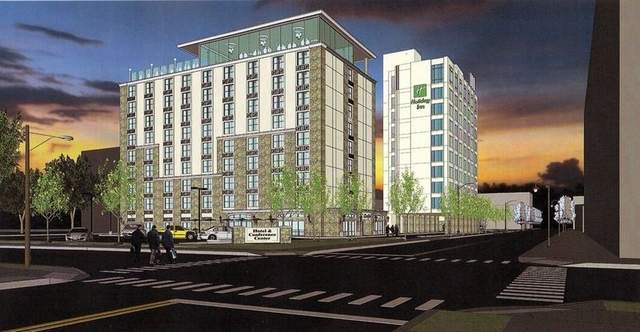
D. Hotel Ithaca – Amended declaration of environmental significance. Backstory and plans here.

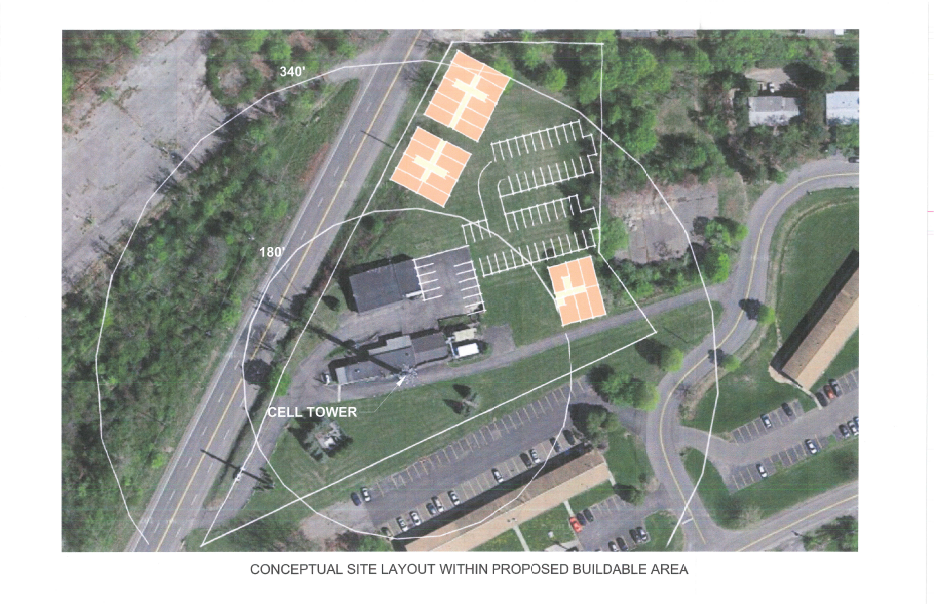
E. “Sketch Plan – 815 South Aurora Street, 87 unit housing project” – See conceptual design above, full backstory here. To recapitulate the salient details, local developer Todd Fox of Modern Living Rentals would like to build apartments on vacant land at 815 South Aurora Street, but can’t because the vast majority of the property is within the “fall zone” of a cell tower, which the city defines as twice the height of the tower. The 170′ tower creates a 340′ radius of no-man’s land (outer circle above), making the parcel virtually undevelopable. Fox had two private engineering companies (TAITEM Engineering and Spec Consulting) analyze the case, and they determined that an appropriate fall zone is the height of the tower plus 10 feet for a little wind/bounce – so 180′ total. With this info in hand, Fox tried to get the city to refine the zoning to allow the decrease in fall zone and therefore permit the land to be open for development. But when Fox and project architect Noah Demarest approached the BZA, they said they wouldn’t consider the 815 South Aurora Street application unless the law was amended, or Fox and Demarest go through the sketch plan and review process, and submit a formal application for a zoning variance.  So now we’re at the point of having a sketch plan to present. Regardless of design, the project will need an area variance issued by the BZA for the cell phone tower issue. At 87 units, this will be a pretty sizable project, and given Fox’s previous work (he’s been rather busy lately), it will likely be rentals, perhaps with Ithaca College students as the target market.

3 of the 5 projects above (SST, 215-221 West Spencer, and 815 South Aurora) have Noah Demarest/STREAM Collaborative as a lead or consulting architect. None of them have the same developer. Talk about having your fingers in many pots.



News Tidbits 6/27/15: A Bad week for YIMBYs

27 06 2015

cornell_novarr_1

cornell_novarr_2 cornell_novarr_3

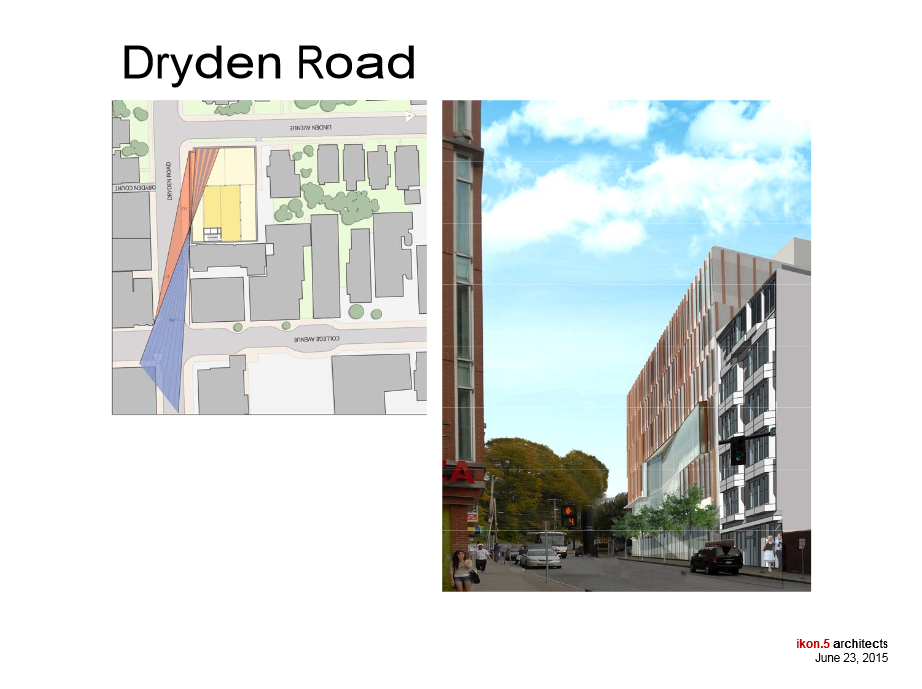
1. Starting this off with least controversial news-maker this week – John Novarr’s 209-215 Dryden Road project, which I wrote about for the Voice here and with site plan details and SPR/render links here. The first article’s a little helter-skelter as a write-up because there was a lot of frantic 11:30 PM fact-checking going on in an effort to get the news out.

The $12 million, 12,000 sq ft proposal is smaller than Collegetown Dryden, but more importantly, the project isn’t residential; it’s classroom and office space for Cornell’s MBA program, three floors for each of those uses. That definitely brings something different to Collegetown and its mostly residential focus. With assurances given that the property will be kept on the tax rolls, the initial opposition appears to mostly be related to the design, which to be honest, is rather avant-garde and an acquired taste (not one I’ve acquired, to be honest). However, bringing 200 staff and a few hundred professional students into Collegetown would be a real asset for businesses struggling to stay open amid the neighborhood’s 32/36-week profit window.

209-215 Dryden Road is within the MU-2 zoning from the looks of it, so a trip to the Board of Zoning Appeals (BZA) seems unlikely at the moment. We’ll see what happens moving forward, this one could be a fairly smooth approvals process.

2. For a smaller developer, Ithaca-based Modern Living Rentals has been pretty busy this year. Along with 707 East Seneca Street and 902 Dryden, they have a modular duplex (3 bedrooms each, 6 total) currently under construction at 605 South Aurora Street in Ithaca city. A construction permit was issued back in 2014, according to the city planning report. The orientation is a little odd in that the new duplex is being built in front of the old home on the property, since the house is longitudinally centered but set back on its lot. Taking a guess, the intended market is likely IC students. The new units look like they’ll be ready for occupancy in time for the fall semester.

3. Here’s an interesting piece of news, courtesy of the Tompkins County Government Operations Committee – plans to sell a vacant lot to non-profit housing developer INHS. In its May minutes, the committee announced intent to sell a vacant, foreclosed parcel in Freeville for affordable housing. The property is described as a 1.72 acre parcel on Cook Street in the village, which through a little deductive searching, turns up the lot in the map above, just north of the Lehigh Crossing Senior Apartments. The minutes state that INHS is in the process of drafting up an acquisition offer for the county attorney.
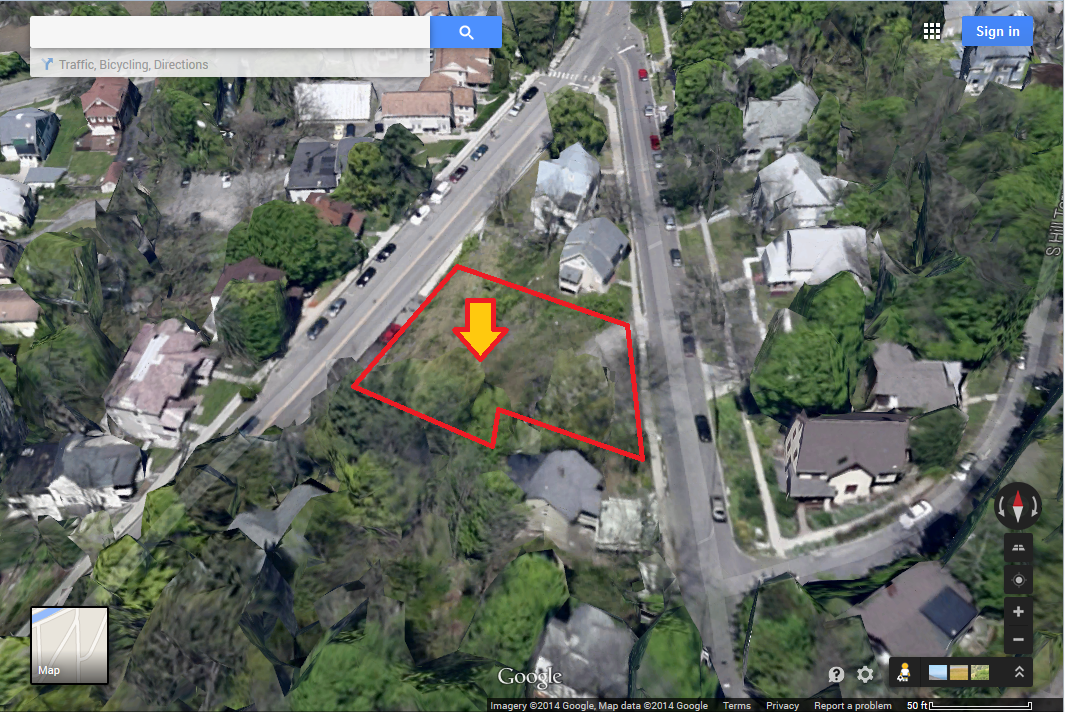
Freeville is outside of INHS’s usual realm of Ithaca city and town, but INHS expanded its reach when it merged with its county equivalent, Better Housing for Tompkins County (BHTC) last December.  This might be the first new rural project post-merger. The Lehigh Crossing Apartments have 24 units on 2.3 acres, so if INHS were to build at the same density, this site would be looking at something around 18 units. Not big, but not inconsequential, especially for a 520-person village.

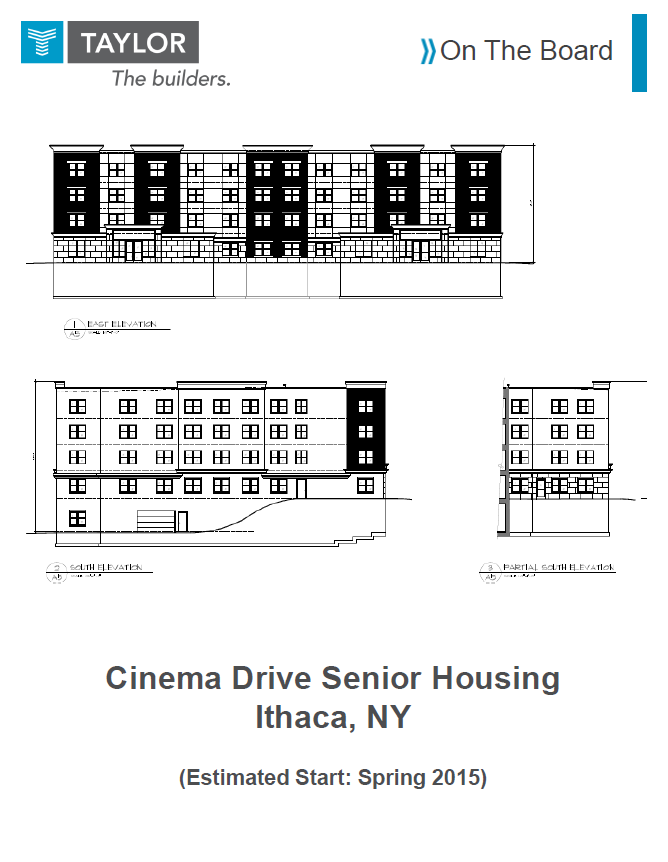
cinema_drive_1

4. A decision to decrease sewer hookup costs in Lansing village also shares some details about a senior housing project in the works. The news comes from the Lansing Star, where the village voted to decrease its sewer hookup fee from $2,350 per unit to $1,000 for the first unit and $500 for each additional unit. Apparently the high fee was the result of the lack of a permitting process in the 1990s.

The article notes that the developer of a mixed-use request had requested a fee waiver because it would have cost $138,650 for their “59 units of senior housing”. Now it will be $30,000. Not as good as a waiver, but still pretty good. Lansing village only has one project that meets the description provided, the 87,500 sq ft Cinema Drive project covered here previously. The semi-educated guess back in May was 51 units, so the ballpark estimate wasn’t too shabby.

327_eddy_rev3_1

5. It’s official, 327 Eddy is under construction. Asbestos removal has been completed and the Club Sudz building is coming down. The Fontanas hope to have the building completed and ready for occupancy by next August. In replacement of Club Sudz’ and Pixel’s 7 units and 2,500 sq ft of commercial space, the new 5-story building will bring 1,800 of retail space and 22 new units with 53 bedrooms to the market.

Eagle-eyed readers might recall the building was originally going to be six floors, but a floor was lopped off since it was approved.

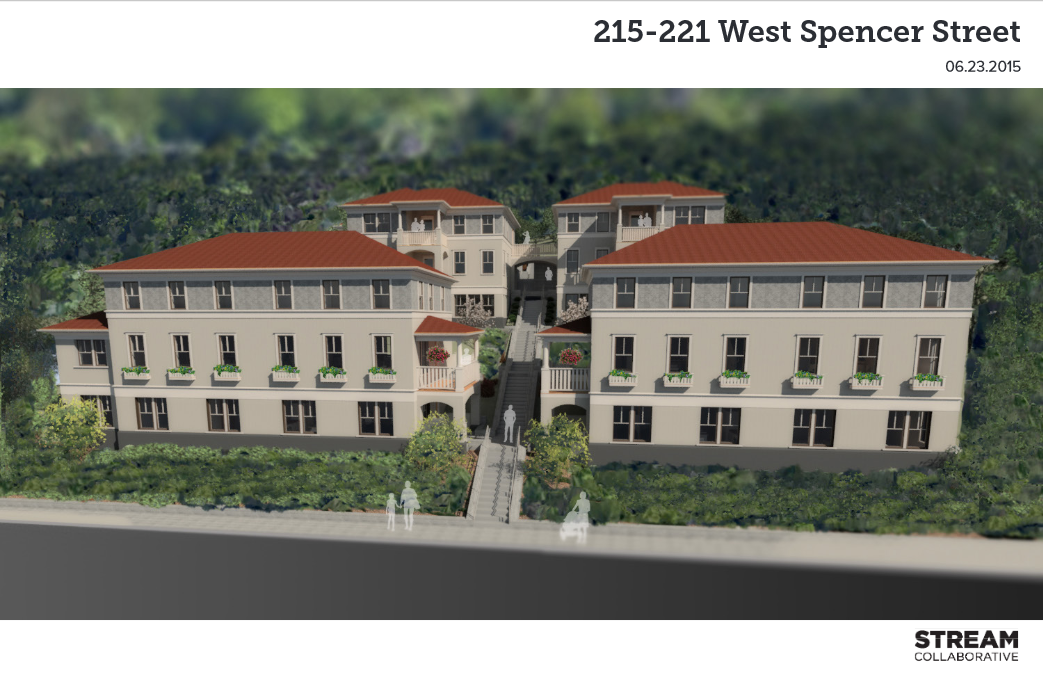
215-221_spencer_v3_1

215-221_spencer_v3_2

6. Updated renders for 215-221 West Spencer Street, coming right up. A little more detail on the facades, some window updates from the last version, and…well, honest personal opinion…it’s a very attractive design. Materials could underwhelm it, but as presented, it appears to be a lovely addition to South Hill. Good work STREAM Collaborative.

The 12-unit, 26-bed project plans to start construction next year. The project replaces an informal (dirt) parking lot.

oldlibe_franklin_proposal

travis_hude_libe_libe_v3

7. Touching on the Old Library decision briefly, a public meeting on the two proposals will be held Monday June 29th at 6:308:30pm at Greenstar’s “The Space” (700 West Buffalo Street). Douglas Sutherland will represent Franklin Properties (first image) and Frost Travis will be presenting for Travis Hyde. Should the County Legislature decide to take another vote to see if the stalemate will be broken, the next chance will be at their July 7th meeting.

EDIT: The public meeting scheduled for the 29th has been cancelled .

state_st_triangle_v2_1

8. Onto the thornier topics – Not sure what was worse this week, the reaction to the State Street Triangle project, or the INHS Hancock Street opposition. The objective, non-partisan write-up about the State Street project is on the Voice here. This and news piece #9 are opinion pieces, feel free to ignore them.

At least the State Street objections (latest renders here), I can understand the initial shock and recoil; there’s this perception that Ithaca is a small town, and this doesn’t jive with that. Regardless, by Ithaca standards it is massive, 11 stories with 289,000 sq ft of space and 620 bedrooms; if this was, say, a four-story building with an 11-story tower on the closest third to the Commons, the reaction would probably be less vitriolic (people would still hate it, but let’s entertain this thought exercise).

But that probably won’t happen. Not with this developer, or with any developer that purchases the Trebloc site. Here’s my theory why, and it goes a little more in-depth than “they want maximum profit”.

In December, Jason Fane’s 130 East Clinton project was rejected for tax abatements, and one of the reasons cited was that market-rate housing wasn’t enough of a community benefit. State Street Triangle is mostly apartments – it contains only a modest amount of retail space, with less than 13,000 sq ft it’s not even 5% of its usable space. If it were to apply for an abatement, it would likely be rejected for the same reason.

Arguably, they could try commercial office or even industrial “maker spaces”. But the market demand for office space doesn’t seem to be growing much, and industrial uses don’t tend to be a good fit in heavily populated areas. A developer could even try condos, but if developers knowledgeable with the area are hesitating, than a bank won’t hesitate to hold off on financing (aside on that – if the Old Library goes condo, other developers and financiers will view it as an experiment, or more positively, a pioneer; until it’s clear that the project is successful, don’t expect more condos in Ithaca).

However, nothing changes the fact that building downtown is quite expensive. So, being a for-profit company, if you want to build in an expensive area, you have two options to ensure return on your $40 million investment and get the construction loans you need – build as much as possible, and/or make your units as expensive as possible. If you’re a company that specializes in student housing, you’re not going to push the latter because there’s a lower ceiling on what students can afford. That would be my guess on how State Street Triangle came to be.

There are a few possibilities that might make the project more palatable to community members, such as free bus passes for tenants or a 10% affordable housing requirement within the tower (if the INHS project oppositions are any clue, this is going to be the only way to go from here on), but given the costs, those ideas just might kill the project completely. Which is exactly what some folks are looking for.

At the very least, let’s let the Planning Board do their work. If they can help change this:
hampton_new_1

to this:

canopy_hampton_rev4_1

Let’s see what they and the developer can negotiate here.

9. Now for 210 Hancock. Here is a project that’s been transparent, incredibly transparent, throughout their whole planning process. At first, there was little opposition. Now, it threatens the proposal, apartments, townhomes and all.

A wise man once told me in when I was preparing a piece, “There’s no point in talking about this with you, the public’s going to have issues with it either way”. At this point, I’m inclined to believe him.

I’ve read the petition, and I’ve read the facebook comments. It’s regrettable, to say the least.

A lot of the comments just seem to be misinformed. People saw the petition, thought that INHS was only building the apartments, and signed it. The petition was worded with charged and selective language. I’d like to take a few minutes out to refute and argue some of the commentary.

“there must be a safe place for children to play…”

“People need access to green space, yards and the ability to get outside directly from their living space.”

“I want my 3 year old to grow up in a neighborhood where he can safely ride a bike, play sports and walk his dog.”

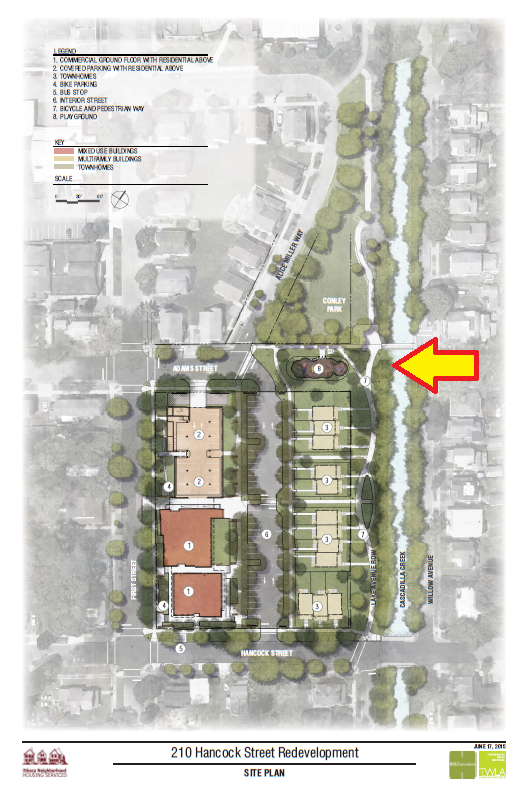
You’re right. That’s why the project, as proposed by INHS and tweaked by the city Planning Board, builds a playground that blends into Conley Park without the threat of vehicular traffic (shown in the plan below). Adams Street and Lake Avenue would be removed, allowing kids living in the apartments and townhomes to go the playground without crossing any street.

inhs_pride_playground

“I’m a lifelong resident, and I’m frankly getting tired of seeing all these areas getting bulldozed and developed…especially when we have dozens of empty/condemned houses and buildings just sitting around!”

The rental vacancy rate is 0.5%. A healthy market is 3-5%. Further to that, if there are dozens of homes, even if they were for sale, it’s still not enough to handle the demand, which is in the few thousands.

“inadequate parking planned.”

“The parking issue is already a problem. This will only make it worse.”

“I am a Fall Creek resident and do not want this area in our neighborhood to resemble Collegetown in density or difficulty in parking.”

84 parking spaces are required by zoning, 64 are proposed. However, only 22 spaces are expected to be used by the 53 apartments. In the parking study of INHS tenants, 41% of apartment tenants have 1 car, 12% of those have two. One of the reasons why INHS’s parking utilization is so low is that many of its apartments are rented by seniors – for example, Breckenridge Place is 60% seniors on fixed incomes. With limited mobility and/or income, many don’t maintain personal cars.

In a sense, although the Cornerstone project for affordable senior housing wasn’t selected by the Old Library site, the INHS project on Hancock Street may serve in some ways as a reasonable alternative.

“We don’t owe any developer a profit on their development.”

INHS is a non-profit community developer. The townhouses sold at Holly Creek over the past year were in the $105-$120k range. For comparison’s sake, the townhomes in the Belle Sherman Cottages sold for double that, and those aren’t even considered high-end (high-end would be the $410,000 townhomes in Lansing’s Woodland Park).

The reason why construction won’t start until Fall 2016/Fall 2017, with the apartments finishing up in Fall 2017/Fall 2018, is that they are completely reliant on government grants and donations from community supporters. The townhouses won’t start for a couple of years (their time frame is 2018-2020) because funding for purchasable units is more difficult to get. Just like with the condominium debate, the government is more likely to disburse a grant if it knows there are buyers waiting in the wings. And for low and moderate-income households, far more are capable of renting versus buying. As for the rent-to-own option suggested by the petition writer, it’s speculative, complicated, and NYS/federal HUD will not provide grants for that type of property acquisition. INHS couldn’t do it if they wanted to.

“[need]assurance mixed income will be there”

It will. As I wrote in March:

“210 Hancock will have 53 apartments – the 3 bedrooms have been eliminated and split into 1 and 2 bedroom units, so the number of units has gone up but the total number of bedrooms remains the same (64). The units are targeted towards renters making 48-80% of annual median income (AMI). The AMI given is $59,150 for a one-bedroom and $71,000 for a two-bedroom. The one-bedroom units will be rent for $700-1,000/month to those making $29,600-$41,600, and the two-bedroom units will rent for $835-$1300/month to individuals making $34,720-$53,720. Three of the units will be fully handicap adapted.”

“A 54 apartment high-rise is not the appropriate place for children to grow up, low income or not.”

“It is too dense and not suited to Fall Creek or Northside.”

“I moved to Ithaca and settled in Fall Creek to live in a small town.”

For starters, it’s harder to make housing affordable if there are fewer units on the a plot of land. Secondly, because the INHS project takes lead on the city’s right-of-way (ROW) on Lake Avenue and Adams Street, the calculated density per acre is 23.6 units per acre. Cascadilla Green, one block to the north, is 20 units per acre. Also note that units are 1 and 2 bedrooms per unit; most of the houses on blocks in Northside and Fall Creek are 3 bedrooms per unit.

What probably bothers me the most are some of the comments in the online petition for INHS.

“Shame on you “Ithaca Neighborhood Housing” for even thinking of creating something that will breed trouble…”

“This is an uncivilized proposal…”

“if all on welfare, this will invite crime…”

One of the reasons I harp on affordable housing is that I grew up in affordable housing. This 147-unit mixed-income complex in suburban Syracuse. Apartment 28E. I shared a bed with one of my brothers until I was 10, and even after my mother was finally able to buy a small ranch house, we shared a bedroom until he graduated and went to college two years before I did (by that point, we had moved on up to bunk beds). My mother did what she could. We were never more than working class, but she worked hard (still does) and made sure her kids worked hard.

At least some of the comments are kind enough to be “I want affordable housing but”. Others really make it sound like that those in need of affordable housing are a contamination of the community. Those statements aren’t worth debating. They’re just hurtful.

Anyway, this might be the longest news update I’ve done, so I’m going to wrap this up and detach from the computer for a while. There may or may not be a photo update Monday night, we’ll see.


News Tidbits 6/6/15: I Give This Week A Frowny Face

6 06 2015

215-221_spencer_v2_2

1. I’m thinking there is a genuine lull in the pipeline at the moment. The city’s projects memo, which is the document that city departments receive and comment on before the actual Planning Board meeting, doesn’t have much for consideration for this upcoming month. The one projects that is being “newly” considered is the 12-unit, 26-bedroom PPM Homes proposal at 215-221 W. Spencer Street. That project is expected to receive declaration of lead agency (in other words, the planning board formally agrees to review it) at the June meeting. Being carried over from the previous months are the two duplexes for 804 E. State Street, the Tompkins Financial HQ, INHS’s 210 Hancock project and the Maguire Fiat/Chrysler expansion. None of those are up for final approval.

Smaller projects and subdivisions will often first show up in the memo ahead of the meeting, but not this month. What will be, will be.

tfc_v2_1

2. On the other end of the scale, this looks to be a busy month for the Ithaca Landmarks Preservation Council. Most of their agenda focuses on window repairs and other minor details, but they will be reviewing the Tompkins Financial HQ and the new drive-thru across the street. Although neither is within a historic district, I suppose it’s being reviewed for the sake of feedback and the possibility of a visual impact on the skyline as seen from historic districts.

Cayuga-Meadows-Shot

3. In Old Library news, a decision was expected last Tuesday…but, the decision was postponed. After committee members started sharing their differences in opinion. Pardon my cynicism, but that’s a perfect microcosm of those whole process. Frequently delayed and bound to infuriate someone come decision time.

In a perfect world, all three of those would be built in the city, because they all address different housing needs in Ithaca, and they would all likely be successful. But of course, there can only be one. We’ll find out next Tuesday morning.

4. The Ithaca town Planning Committee is verifying two things already noted in previous news round-ups. One, the 68-unit Cayuga Meadows project hopes to begin construction in the very near future, and two, the Troy Road housing project is dead.

The committee also brought up the possibility of a moratorium for certain parts of town – two areas described as having significant student populations. One is almost certainly the area of South Hill next to IC, the other is not stated (but likely has to do with Cornell). This is part of a larger conversation to keep IC students from living off-campus in student rentals. Students aren’t a protected class, so whatever extra bureaucracy or laws the town wants to adopt are technically fair game. I would imagine, however, it would much easier to do that to IC’s undergrads than the professional and doctoral students attending Cornell. Looking at the numbers, one has been increasing much more than the other, and it’s not the undergrads. This, I suspect, is where potential laws become problematic.

Anyway, the moratorium is seen as a last-ditch effort. But the possibility of it should be enough to raise eyebrows.

815_s_aurora_1

5. Time for some more unhappy – the city Board of Zoning Appeals isn’t touching the 815 South Aurora Street application.  To recapitulate the salient details, local developer Todd Fox would like to build apartments on the land but can’t because the vast majority of the property is within the “fall zone” of a cell tower, which the city defines as twice the height of the tower. At 815 South Aurora, a 170′ tower creates a 340′ radius of no-man’s land (outer circle above), making the parcel virtually undevelopable. Fox had two private engineering companies (TAITEM Engineering and Spec Consulting) analysis the case and they determined that an appropriate fall zone is the height of the tower plus 10 feet for a little wind/bounce – so 180′ total. With this info in hand, Fox is trying to get the city to refine the zoning to allow the decrease in fall zone and therefore permit the land to be open for development.

The BZA said it was acting on the city attorney’s advice that the committee can’t override a council-approved law. Which means that Noah Demarest, the architect appearing on behalf of Todd Fox, will either have to go to the Council to have the law amended, or he and Fox will have to go through a full sketch plan and review process, and apply for an area variance for whatever firm plans they have proposed. Meeting with the BZA was seen as way to avoid having to shell out all that time and money and risk still being rejected because of the cell tower issue. There’s a risk with moving forward at this point, and it’ll depend on just how much risk the developer is willing to take on this potential project.

6. We’ll wrap up with something positive – FormIthaca, the citizen group advocating for form-based zoning, is doing their design charettes this week. I’m writing this on Thursday night since I will be doing 5-year Cornell reunion stuff on Friday, but I do plan on being in attendance Friday afternoon meeting and am looking forward to seeing/hearing what ideas the presenters have to share.

I can assure a certain town of Ithaca board member that I have a personal preference to small street setbacks, and it sure as hell isn’t because they’re “hipper”.


News Tidbits 5/23: Cast A Discerning Eye

23 05 2015

1. Starting off this week’s round-up, here are some new renders of PPM Homes’s apartment project proposed for 215-221 West Spencer Street just south of downtown.

215-221_spencer_v2_1

215-221_spencer_v2_2

215-221_spencer_v2_3

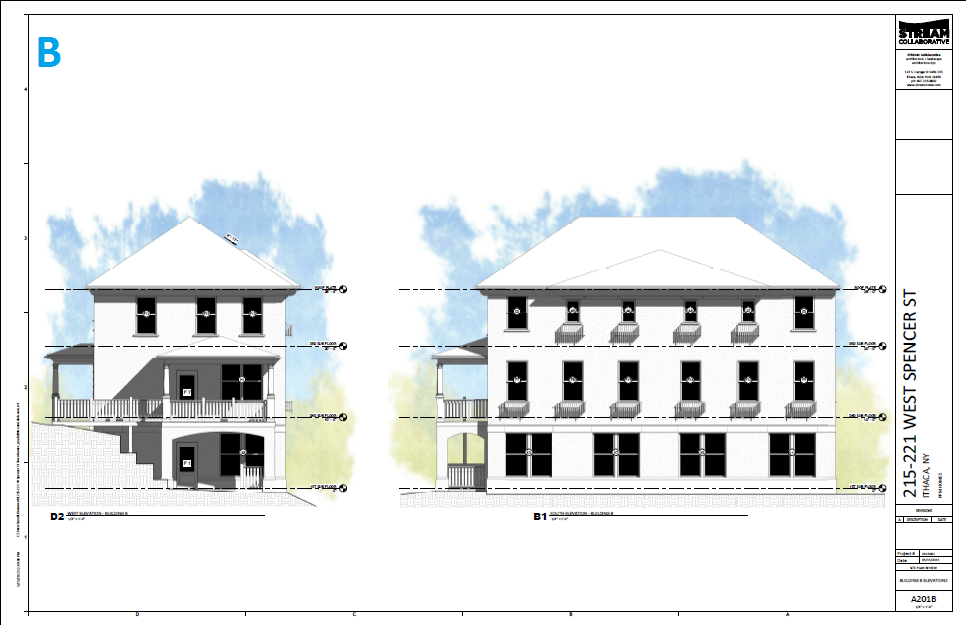
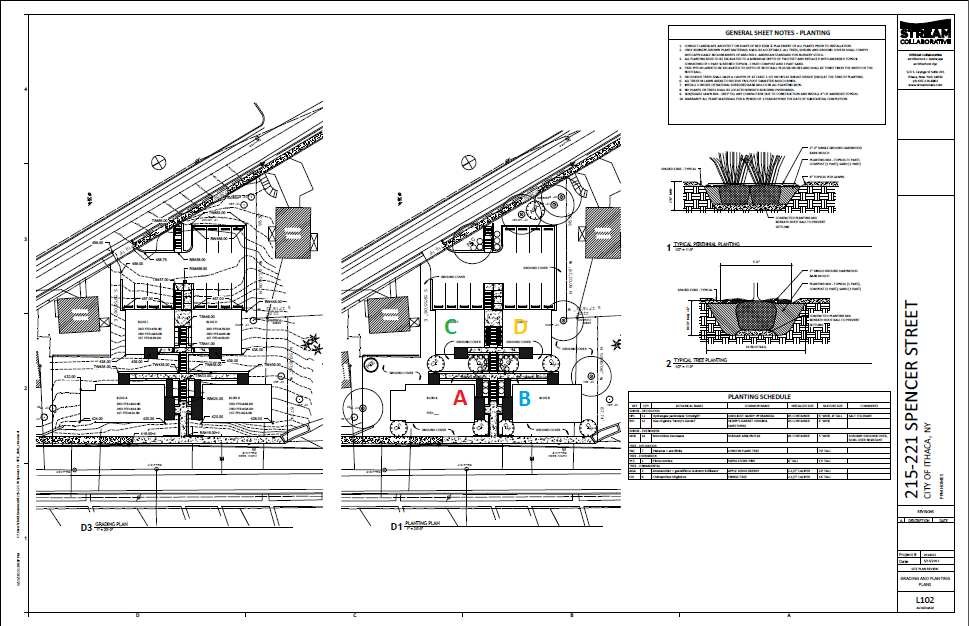
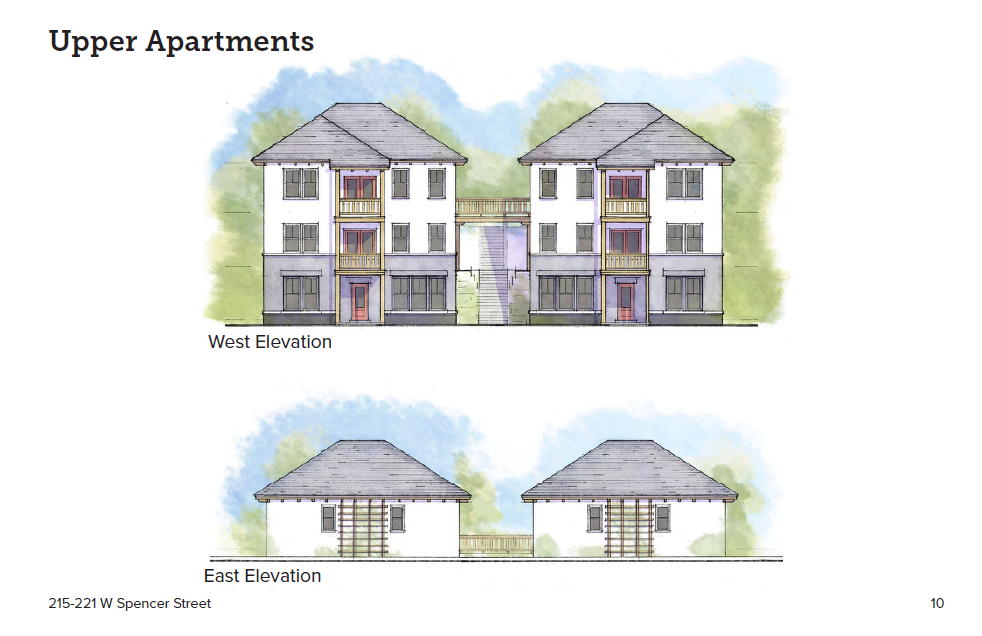
Note that C & D are the same design, but mirrored. The general forms are pretty much the same as the original sketch plan, but the porch and windows have been altered and the rooflines have been tweaked on A and B to give the Spencer Street facade a little more visual interest.

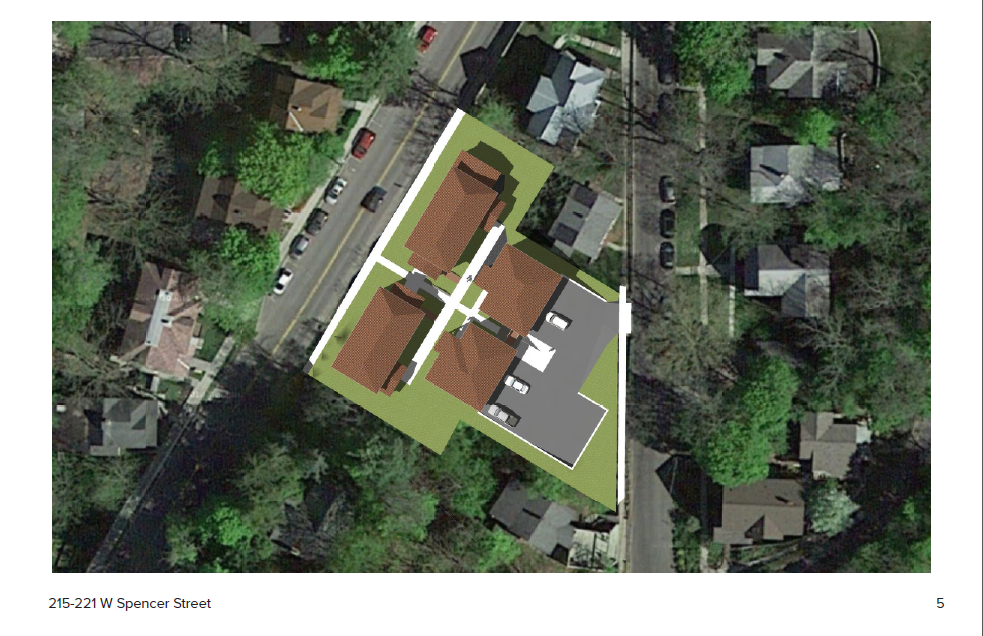
The 12-unit, 4-building project is being described as a “pocket neighborhood”. The two upper buildings closest to West Cayuga will have three two-bedroom units here, and the lower buildings facing West Spencer have a combined four two-bedroom units and two three-bedroom units, for a total of 26 bedrooms in the project. 12 parking spaces are provided as required by zoning. The owner is looking into remote net-metering of an off-site solar panel installation to provide all of the project’s electricity needs. The site will launch into the formal planning board review process next month.

The steeply-sloped 0.47 acre parcel has been vacant for several years, and currently sees use as an informal 12-space parking lot. The property was originally marketed for affordable housing projects only, but received no purchase bids. Once the affordable stipulation was removed, the parcel was marketed once again, and Ed Cope bought the parcel for $110,000 on March 6th.

The building designs are the work of local architect Noah Demarest of STREAM Collaborative.

215-221_spencer_v2_4

Random aside, I just found out that PPM’s Ed Cope is a Cornell biologist. And here I thought writing this blog and being an air quality scientist was an interesting contrast.

2. There might have been a day in not-too-distant past where someone said, “You know what Ithaca needs? Mini-golf.” Apparently someone heard those wishes. the Town of Ithaca’s Planning Committee will be looking at a possible zoning modification down near the intersection of Elmira Road and Seven Mile Drive that would allow a mini-gold establishment to move forward.

Stretching my memory here a bit, I seem to recall a mini-golf place up by Trumansburg, but if my google search is any indication, it closed a couple of years ago. I suppose there’s a niche to be filled.

Now comes the question of, “Does this fit with the town’s new Comprehensive Plan?” Here’s the description the town proposes for the Inlet Valley Gateway, including the area in question:

The Inlet Valley Gateway district is intended to be a setting for a mix of office, small-scale retail, hospitality, and tourism and agritourism uses, with low-impact light industrial, artisanal industrial, and skilled trade uses.
The scale, architecture and landscaping of future development will need to be carefully designed and articulated.

This area should retain a semi-rural character, with deep setbacks from arterial streets, wide spacing between uses, landscaped front yards, and vehicle parking sited on the side and/or rear of structures. Shared curb cuts will reduce potential conflicts with highway traffic. Sidewalks should follow streets, with connections to adjacent areas planned for residential development. Architectural design, landscaping, and site planning regulations should apply to all uses in this area, including industrial uses. Agglomeration of mechanical commercial uses, and incremental expansion of commercial zoning resulting in strip commercial development, will be strongly discouraged.

It sounds like that if the site is designed right, it could be a good fit. Probably a better fit than the Maguire’s dealership/HQ plan that was shelved a few months ago.

20150516_141049 20150516_141110

3. Here’s a couple of photos of the new duplex being built at 514 Linn Street. Each unit will be 3 bedrooms, and the apartments will be completed this summer. The building is being built on the foundation of the previous home that existed on the site, which dated from the late 1800s and was a near-copy of the peach-colored house next door. 514 Linn is being developed by the Stavropoulos family, who run the State Street Diner.

texas_roadhouse_v3_1

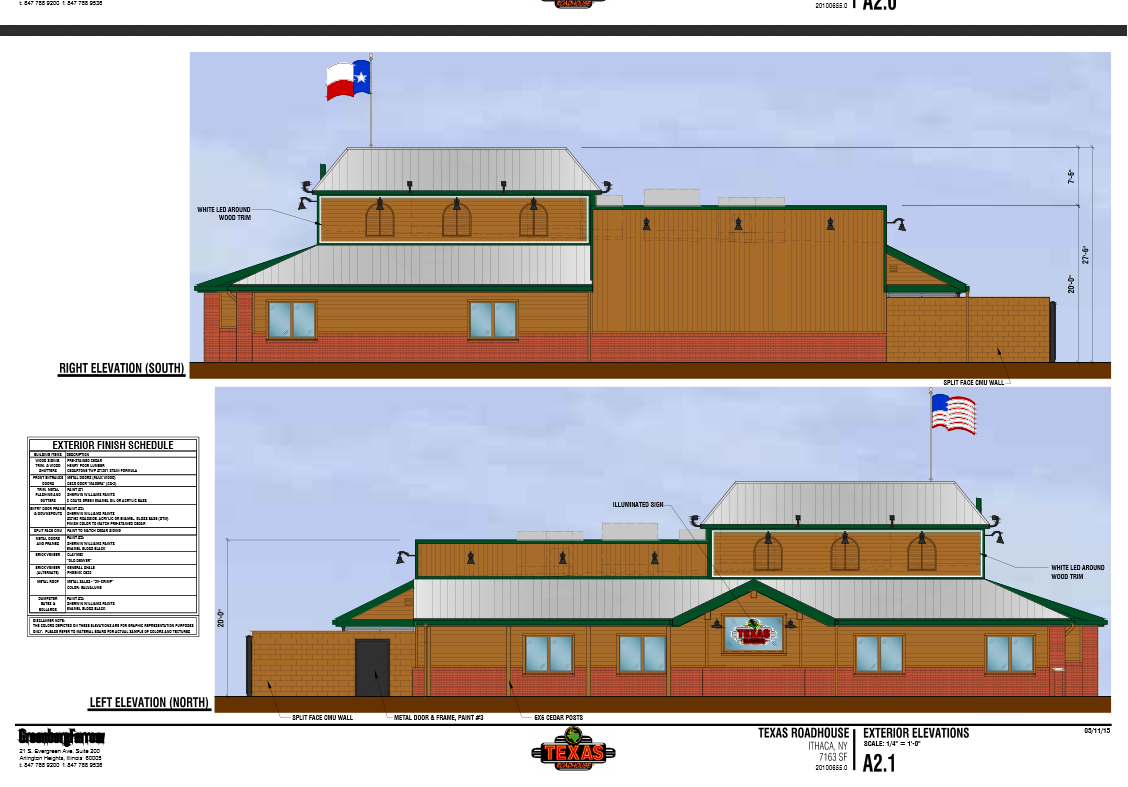
4. In an effort to win over the city, Texas Roadhouse is tweaking their proposed restaurant off of S. Meadow/13. Latest render here. Members of the planning board have previously expressed concerns that the original design had the entrance facing northward into the parking lot rather than the street, and that not enough attention was being placed on the street-facing west side. If the render is any indicator, the modified proposal still has a primary entrance on the north side of the building, but the street-facing side has a handicapped entryway, and the landscaping has been spruced up. Dunno if it’s what the board quite wanted, but they’ll decide if it’s good enough during their meeting next week.

dryden_south_rev_1

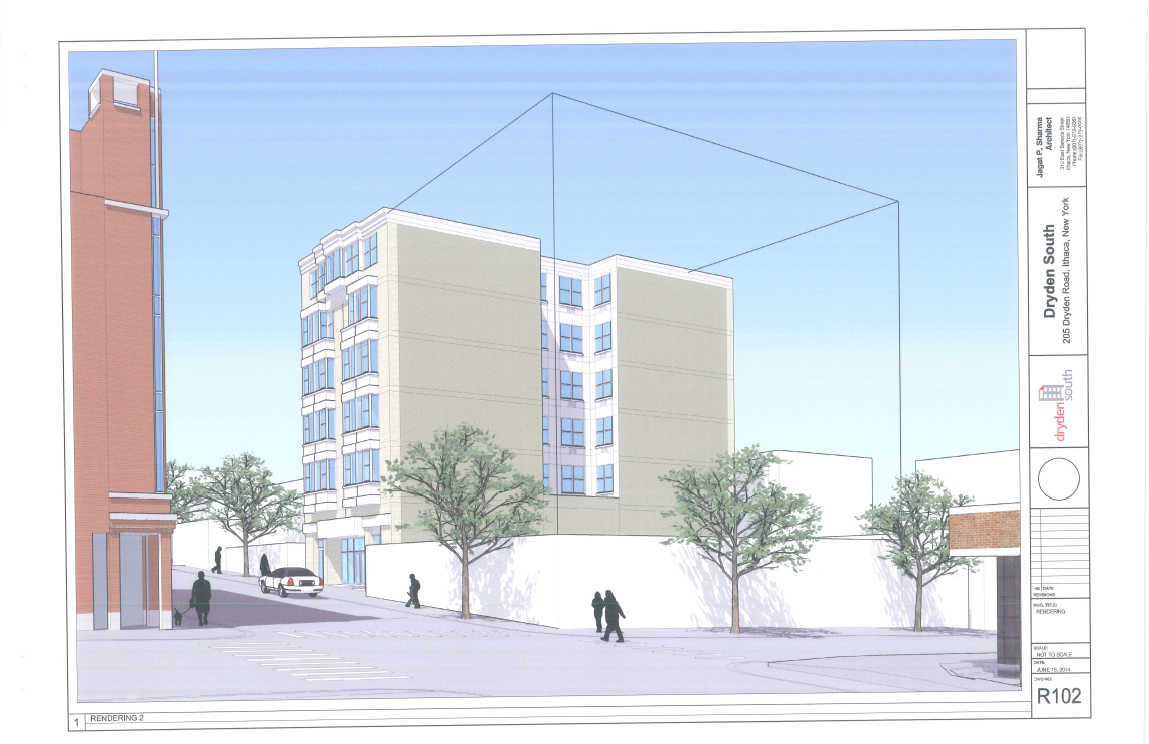
5. Looks like Pat Kraft’s Dryden South project (205 Dryden) has a website up and running. The 10-unit, 40 bedroom project will start site clearing in a few weeks, with excavation/foundation work going through the summer (according to an interview conducted by the Sun, Kraft hopes to have structural steel rising by the time students get back in late August). The 6-story, 65′ building will house Kraftee’s on its first floor, with two units of four bedrooms each on each floor above. units will be available for rent starting next August.

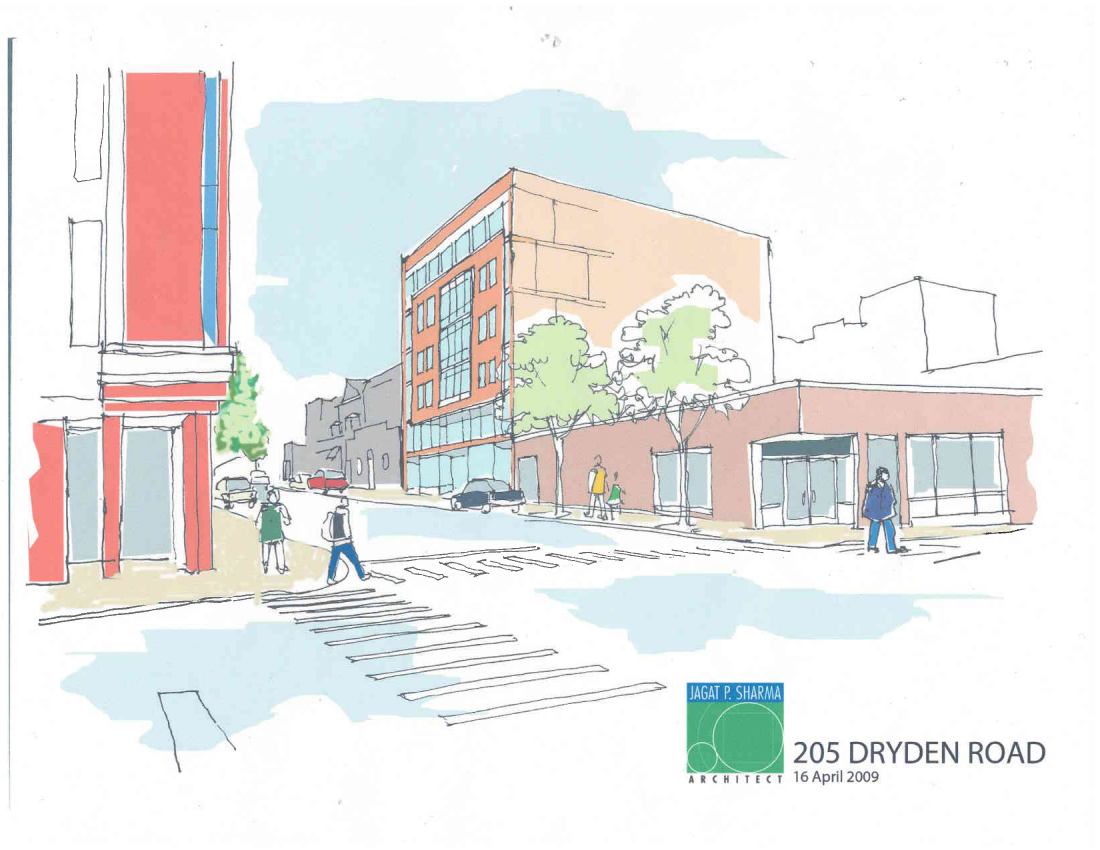
Dryden_south_2009_sketch

A neat little detail from the site is this old conceptual sketch done by Jagat Sharma for the site. Note the April 2009 date at lower right; this project has been in the planning stages for years, even though it only hit the Planning Board last Spring. On a personal note, I’m glad this hulking box didn’t end up being the final design.

simeons_v2_1 simeons_v2_2

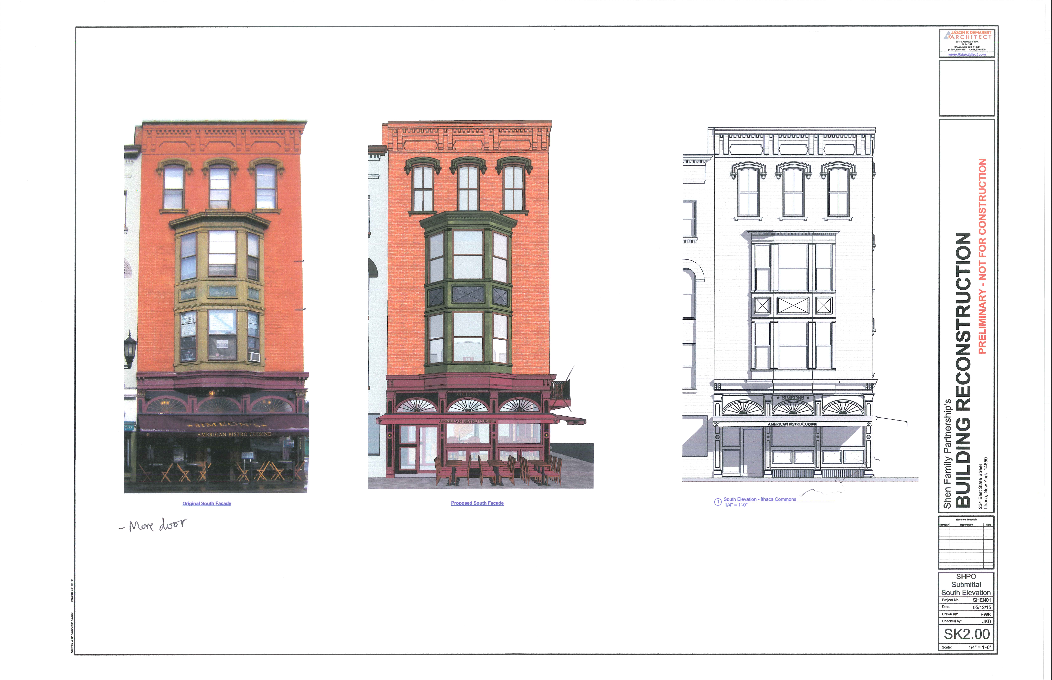
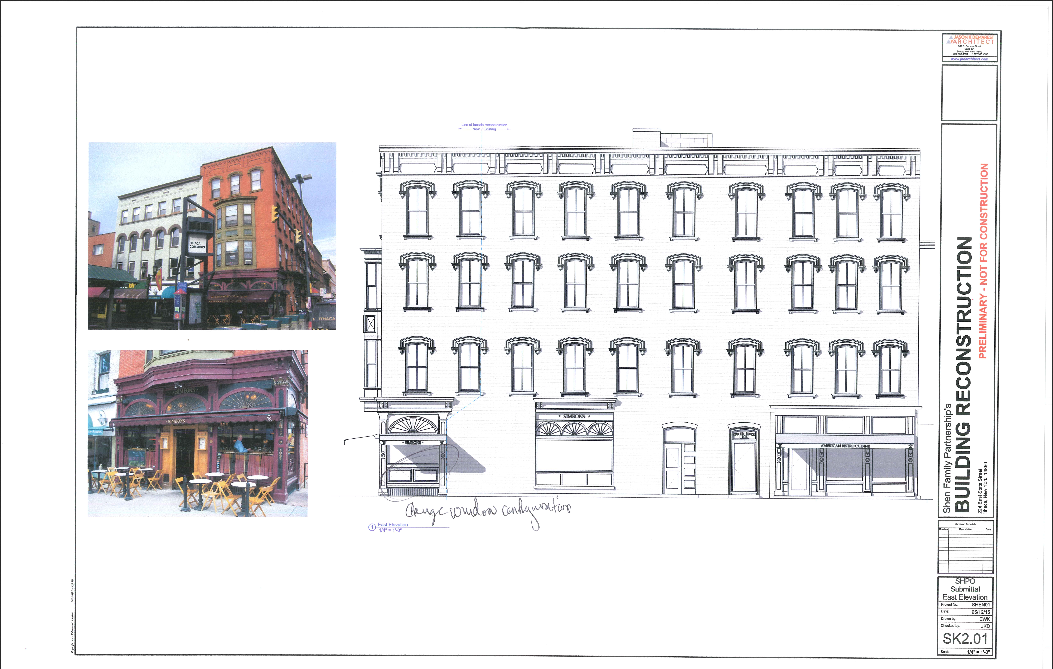
6. For those interested in what’s going on with Simeon’s, here’s an updated sketch design of the rebuild, courtesy of the Ithaca Landmarks Preservation Council (ILPC). The somewhat controversial side balcony/overhang is gone. About the only major difference between the original entrance and the rebuild is the location of the front door, which is now on the left (west) side instead of being in the center.

7.. Looks to be a quieter meeting for the planning board this month. No new sketch plans, and only one project, Texas Roadhouse, is being considered for approval. Here’s what’s up for discussion at Tuesday’s meeting:

IA. A minor subdivision to create a new home lot a 212 Hook Place on West Hill.

IB. A minor subdivision to divide a property on Hector Street on West Hill. The sisters applying for the subdivision are splitting the land among themselves but intend to keep both lots “Forever Wild”.

IIA. 210 Hancock gets its public hearing and possibly its Determination of Environmental Significance (which if okayed means that the project can be considered for prelim approval in June). I’m hearing there might be opposition mobilizing against the project. Given how transparent the whole design process has been, and that this is affordable housing in an urban area that struggles with housing costs, I’m going to be very, very disappointed if this happens.

B. Texas Roadhouse is up for Determination of Env. Signif. and possible Prelim/Final Site Plan Approval

C. Tompkins Financial’s new HQ will be reviewing parts of its Environmental Assessment Forms; no decisions expected

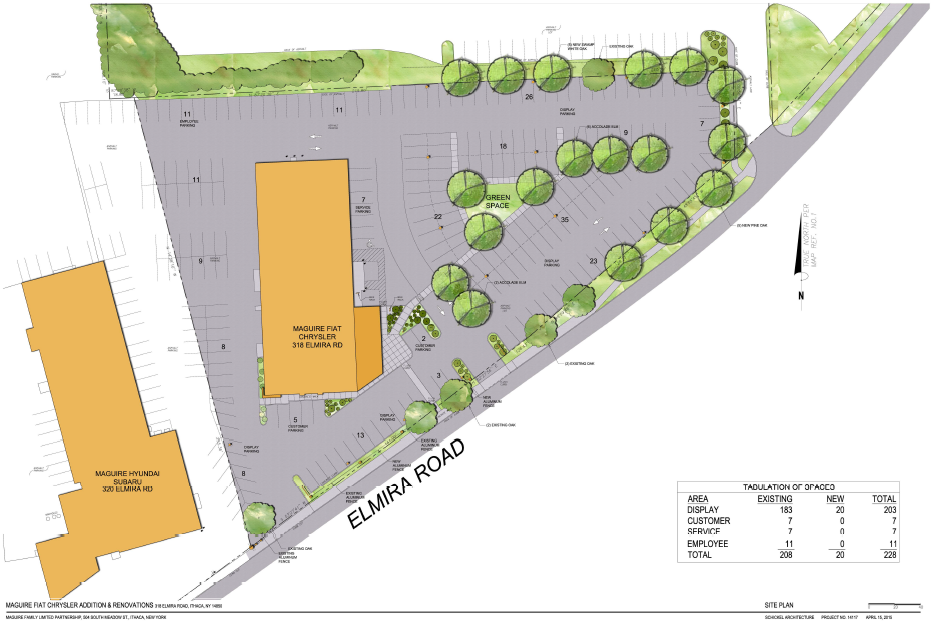
D. Declaration of Lead Agency (Planning Board agrees to conduct review) for the Maguire Fiat addition.

The board will also be conducting a review of State Environmental Quality Review (SEQR) forms used in determining environmental significance.


Apartments Planned for 215-221 W. Spencer Street

6 04 2015

I owe a big thanks to Charles Pyott with the city of Ithaca for getting a copy of the sketch plans for 215 West Spencer. I had initially thought nothing was presented at the March Planning Board meeting, but the March PDB meeting minutes said otherwise. I made an inquiry, and he was able to obtain a copy of the sketch plan from the applicant. So a big kudos to you Charles.

A copy has been uploaded to the City of Ithaca website here.

***

215-221_spencer_v1_2

At its March meeting, the city planning board reviewed a sketch plan for a proposed apartment building at 215-221 West Spencer Street, just south of Six Mile Creek and a few blocks from downtown Ithaca.

The steeply-sloped 0.47 acre parcel has been vacant for several years, and currently sees use as an informal 12-space parking lot. The lot is in a R-3a residential zone that allows for a 40′ structure with 35% lot coverage.

Previously, a dilapidated apartment building stood on the site. The building and land were purchased by the city for $530,000 in 2003, and sometime after the building was demolished, the land was turned over to the Ithaca Urban Renewal Agency in 2013.

The property was originally marketed for affordable housing projects only, but received no purchase bids. Once the affordable stipulation was removed, the parcel was marketed once again, and found a buyer – local developer Edward Cope, the owner of local rental agency PPM Homes, bought the parcel for $110,000 on March 6th.

215-221_spencer_v1_1

In the sketch plan presented by local architect Noah Demarest of STREAM Collaborative, four apartment buildings are presented in a terraced hillside layout, all connecting to a staircase that bisects the north and south buildings. The upper buildings have three floors of windows on the west side, and one floor on the east side. The lower buildings have three floors of windows on the west side, and two floors on the east side.

215-221_spencer_v1_3

According to the Planning Board minutes, each building consists of a ground floor unit and “two side-by-side townhomes above it” – it’s not clear if that means two units per floor, or two units total on the upper floors. It could be 20 units or 12 units, pending clarification. The 12 parking spaces on the Cayuga Street side of the property would be maintained and paved.

215-221_spencer_v1_4

215-221_spencer_v1_5

In the sketch plan document, two versions are presented – the aerial renderings show a different design than the site elevations. It’s not clear which is the current iteration, though the site sections show much greater detail (I suspect they are the more accurate of the two).


215-221_spencer_v1_6

Expect some revisions moving forward – planning board members expressed a desire for a more prominent connection between Spencer and Cayuga Streets (a “grand formal stairway”) and reworking the Spencer Street facade to make it more visually interesting.


News Tidbits 3/21/15: Imagine If It Was Trader Joe’s…

21 03 2015

texas_roadhouse_1 texas_roadhouse_2

texas_roadhouse_3

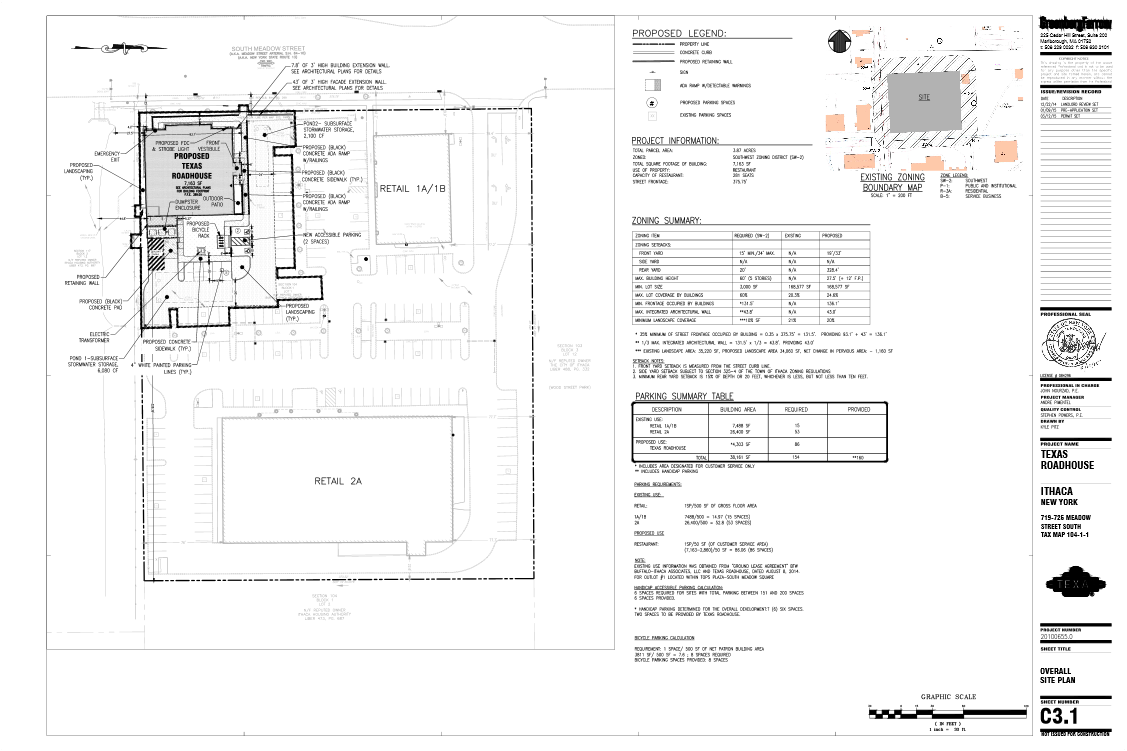
1. Yet another chain restaurant entering the Ithaca scene, this time Louisville, Kentucky-based Texas Roadhouse. There’s 24 separate documents on the city website, and I’ll link to the most useful ones here – the Building Application here, the elevation drawings here, the Full  Environmental Assessment Form (FEAF) here and overall site plan here. I wrote about this for the Voice, and I’ll recapitulate the salient details here-

-The site location is 719 South Meadow Street, the northern end of big-box land. The site was previously home to a Cellular One and a 1980s one-story masonry building that was demolished in 2013, leaving the current vacant lot.

-The construction time period is expected to be from September 2015 to Spring 2016. The project will begin the PDC review process in April. The construction cost is pegged at $1.35 million, including landscaping and parking improvements.

-About 30 construction jobs and 40 permanent (albeit food service) jobs will be created, according to the application. Jeff Stein at the Ithaca Voice says that an email from Texas Roadhouse corporate expects 170 permanent jobs, so I’m not sure which figure is correct.

-The 7,163 sq ft store looks to be the standard corporate design theme for the 430-restuarant chain.

One of the things that continues to amaze me is that, here on the blog, news like this is not a big attention-getter, it’s worth a blurb and not much more. On the Voice, where the audience is more general, people go nuts when they hear about new chain places moving into Ithaca. The lovers and the haters, and sometimes even attacking each other in the comments. In the first 24 hours after the Roadhouse article was published, it was shared 300 times on facebook, and had 2600 likes. Any other real estate or business article would be lucky to get 1/20th of those figures. I never cease to be surprised.

troy_rd_rev1_1

2. Looks like another town of Ithaca project is hitting the dustbin. The 68 acres involved in Rural Housing Preservation Associates Troy Road project have been put up for sale. Originally proposed in February 2014 as a 216-unit project, the original design met with stiff resistance from neighbors and town officials. In November, a smaller, 130-unit plan (shown above) that included on-sire orchards and clustered housing was much better received, and the town planning board declared itself Lead Agency for site plan review, but the project never progressed further. In consideration of other dead mutil-family projects (such as NRP’s Cayuga Trails and Holochuck Homes’ 106-unit townhome development), the town is having a difficult time providing new housing, partly due to developer problems and partly due to local opposition and red tape.

Kendal_1

3. The writers over at the Ithaca Times have an article up this week about the Kendal at Ithaca expansion currently underway. In order to stay on schedule, Kendal had to do their groundbreaking in January, with the intent of finishing in January 2016. Even with the appalling winter we’ve had this year, the director of Kendal claims the project is only three days behind schedule.

The Kendal expansion will add 24 senior apartments and 13 skilled patient care beds to the current 212 apartment and 35 beds on-site. The $29.3 million project is expected to add about 20 jobs when complete. Local architecture firm Chiang O’Brien is handling the design of the building additions.

4. More bad news from Cornell, at least for this blog’s sake. From a Cornell Daily Sun writeup about a town hall-style budget meeting conducted by outgoing President David Skorton:

“Cornell can also cut costs further by reducing campus construction, a step Skorton recommends the University take. 

‘Much of the construction you’ve seen on campus over the last 20 years has been supported by debt,” Skorton said. “We are at the point now, for at least a few years, where we need to very, very seriously reduce construction of new space.'”

I could imagine a couple impacts from this. First off, this probably won’t affect projects with permits in hand and funding in place, like the Gannett addition or Upson Hall’s renovation. But through the rest of the decade, there could be a serious curtailing of new construction. This would hurt the local construction industry, for whom Cornell is a good chunk of their work. Skorton’s explanation also works as a reason to not build any new dorms, and that’s worrisome. The rapidly increasing student population has not only been crunched by tight supply, it’s spreading into adjacent neighborhoods and raising rents for permanent residents, and contributing to strains in town-gown relations.

One thing is clear. The impacts of Cornell’s latest budget issue will be felt throughout the community.

215_221_wspencer

5. Looking ahead at the agenda for next week’s city Planning and Development Board meeting, here’s what to expect:

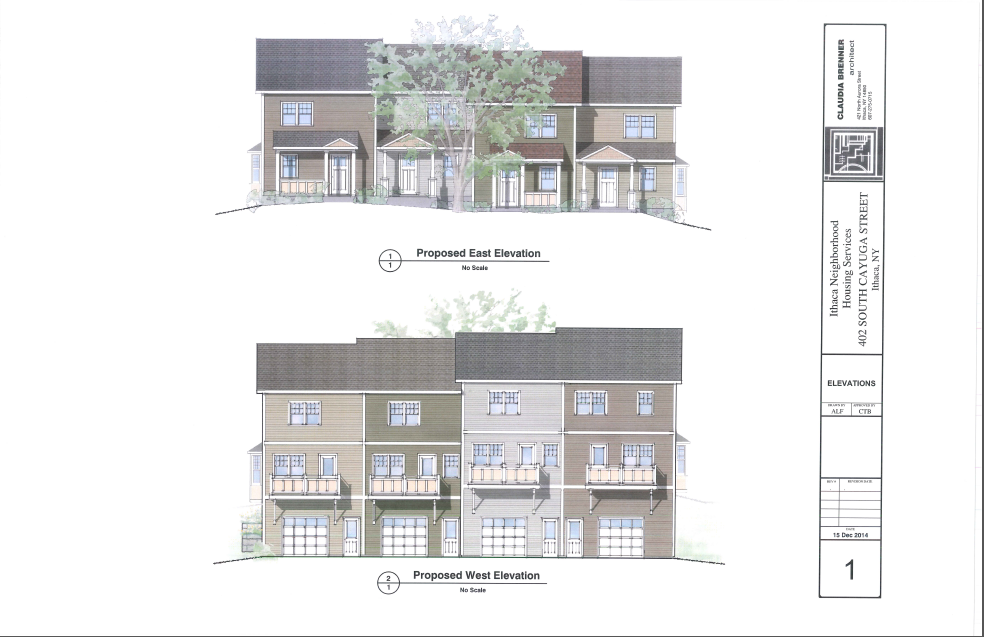
A. Final Site Plan Approval for the 4-unit, 9-bedroom INHS affordable housing project at 402 Sough Cayuga Street

B. Public Hearing and possible approval for the Lake Street Bridge Replacement

C. Discussion (no actions expected) on INHS’s 210 Hancock development – some minor tweaks have been worked into the plan, such as moving the new Lake Avenue north of the playground and adding a crosswalk.

D. Sketch Plan for 215 W. Spencer Street by Noah Demarest of STREAM Collaborative. This should be interesting. Readers of the blog will know I’ve mentioned this site a couple of times – it was a vacant lot that was sold by the IURA to local rental developer PPM Homes a couple weeks ago, and apparently they’re wasting no time with getting their plans in motion.

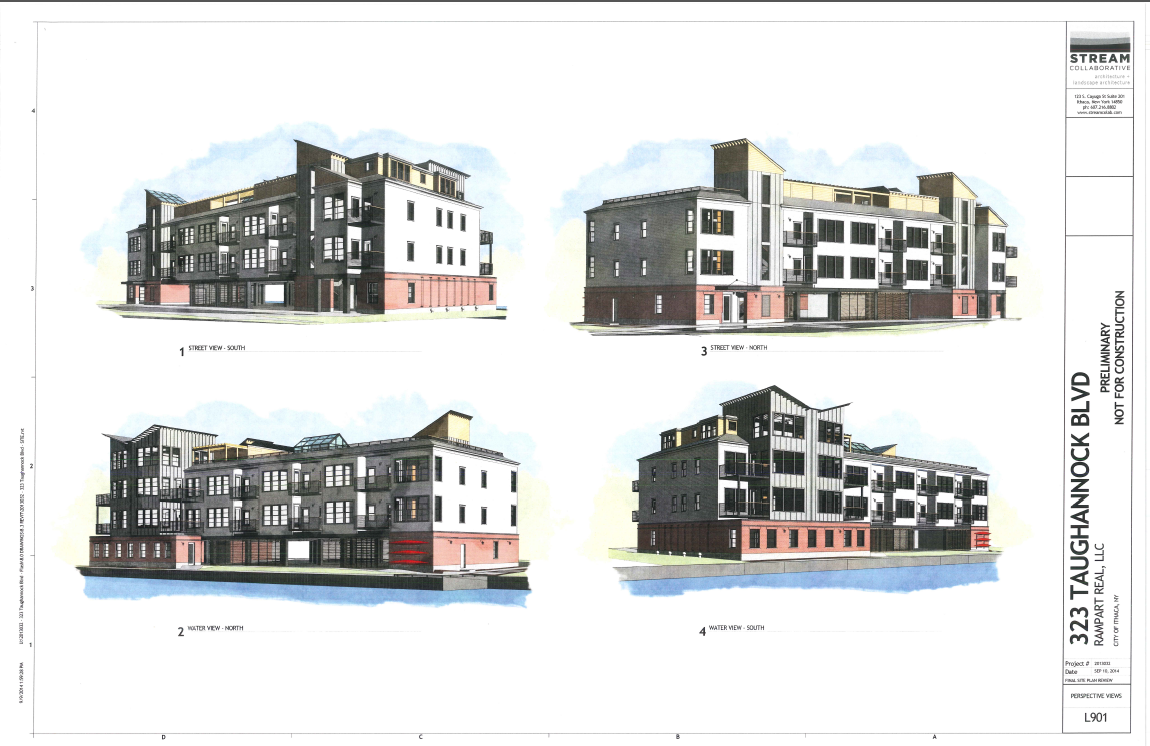
A 0.47 acre parcel (shown above), 215-221 West Spencer is in an R-3a zone that allows for a 40′ structure with 35% lot coverage. That’s a max theoretical buildout of 28,662 sq ft (which if you give 20,000 sq ft for the housing units, and 1,000 sq ft per unit, we get a hypothetical 20 units), but whatever does get proposed will likely be somewhat smaller. STREAM Collaborative is a local architecture firm with a few other projects under its belt, including the 21-unit 323 Taughannock project on Inlet Island, and the Franklin/O’Shae proposal for the Old Library site (the proposal that reuses the Old Library Building). STREAM Collaborative was also responsible for the design of the Troy Road project mentioned earlier, so at least they won’t be going without work anytime soon. Noah Demarest has done pretty good work previously, so I have high hopes for this project.

Along with these four discussion topics, the PDB will review a minor subdivision to create a new home lot at 104 Campbell Avenue on West Hill, a review of application materials to see if any revisions are desired, and discussion of the Planning Board Annual Report, 2014 Edition.

318_pleasant_1

6. It’s that time of the year for building new student rentals for 2015/16. Here we have a Craigslist posting for 318-320 Pleasant Street on South Hill. The rear portion (left) is an addition, a duplex with 3 bedrooms each. The owners of the 105-year old house are members of the Stavropoulos family, who run the Renting Ithaca rental company and the State Street Diner.


News Tidbits 3/14/15: A Spring Thaw and A Warming Housing Market

14 03 2015

215_221_wspencer

1. This past Friday the 6th, the city IURA (Ithaca Urban Renewal Agency) sold off a vacant city-owned property at 215-221 West Spencer Street to Edward Cope for $110,000. The name might not sound familiar, but a quick address check of the sales documents reveals an association with PPM Homes, a local rental company with a few hundred bedrooms in dozens of properties scattered around the city, most of them subdivided homes. Edward Cope also bought a vacant privately-owned lot at nearby 228 West Spencer Street for $15,000 on February 19th. 228 West Spencer, a small, steep site with tight zoning restrictions, was approved last year for one custom house design with 1536 sq ft. of space (the design plans came with the sale). As for 215-221 West Spencer, it was noted in July of last year that the city was selling the parcel (though I was under the impression it had already sold) and the buyer was intending multi-family housing. The 0.47 acre site has the potential for a medium-sized apartment building (20 units), but that’s a simple calculation using the zoning. With topography and neighbor considerations, the reality will be smaller.

In short, keep an eye on these properties, because PPM has the money to make the house and the apartment building happen.

holiday_inn_expansion_1

2. From the March IURA Agenda, a few good notes from the attached February minutes:

A. The Hotel Ithaca conference center is still actively trying to move forward.

B. The IURA received an inquiry about vacant land in the Cherry Street industrial park, from a business seeking to relocate into the city.

C. The city is making progress on taking over the state-owned parcel at 508 Taughannock Boulevard, previously used by the U.S. Coast Guard.

D. The former Ithaca Gun site is virtually entirely cleaned up, which will allow the apartment project proposed for the site to move forward with the planning and approvals process.

All things to keep an eye on in the upcoming months.

titus_wood_1

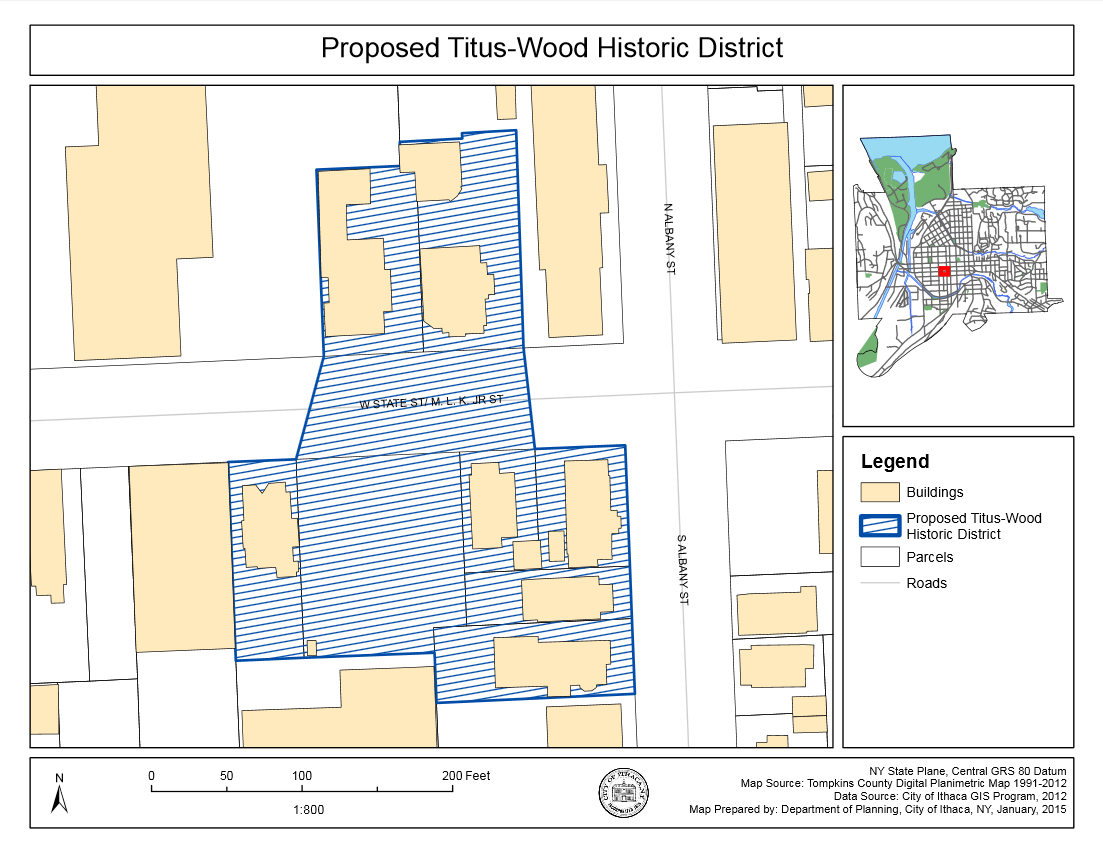
3. Looking at the city’s Planning and Economic Development Committee Agenda, there was quite a pushback from locals and the county for the proposed Titus-Wood historic district. The city fire department objected to landmarking their parking lot, the county wrote a letter opposing landmarking 317 W. State (and 315 W. State, which is not a registered address but could be the parking lot) because it was felt neither was historic enough and that it impeded urban infill, and the owner of 110 S. Albany, Ian Shapiro of Taitem Engineering, protested because his previous experience with the ILPC has been very frustrating, and that the ILPC gives applicants a really hard time over energy conservation efforts such as solar panels.

For the record, he’s not wrong about that. Some ILPC members have not been a fan of solar panels (examples here, here, here and here), and it has been at times a months-long process to get installation approval. It boils down to a dispute of alternative energy use vs. historic preservation, both things that Ithacans love, but can conflict with each other in cases like these.

Regardless of the opposition, the PEDC passed the historic district resolution with a unanimous vote, and the resolution now goes on to the Common Council, who will likely approve the new historic district.

4. Over in Lansing, concerned citizens looks like they can put their fears to rest regarding development of the Kingdom Farm property. The 528.1-acre property sold to a Cayuga County dairy farmer on March 10th for the hefty price of $2.8 million (in other words, $5,302/acre). The farm has been in the possession of the Watchtower Bible and Tract Society (the business branch of Jehovah’s Witnesses) for several decades, and the owners even pitched a 500-unit development for the site in the late 2000s. Back in October when the tax-exempt land went up for sale for $3 million, the Lansing Star reported that some more activist local residents wanted the town to step in and help a farmer buy the land so they could keep the property agricultural. There hasn’t been any news of the town taking that step, and it appears the problem resolved itself without the need of taxpayer dollars. Also, it means the property, assessed at $2.2 million, goes back onto the tax rolls. This might be one of the few cases where everything appears to have been worked out and all can go home happy.

5. 514 Linn Street has come down for a new duplex now under construction. Each apartment unit will have 3 bedrooms and be completed this summer. Although the predecessor building dated from the late 1800s, it was also an early “cookie-cutter” home; 512 Linn was the same design. Fall Creek is mostly developed, but Linn Street is no stranger to new builds – 514 follows a few years after 516 Linn, which was a new home built on a vacant lot.

amabel_v2_1 amabel_v2_2

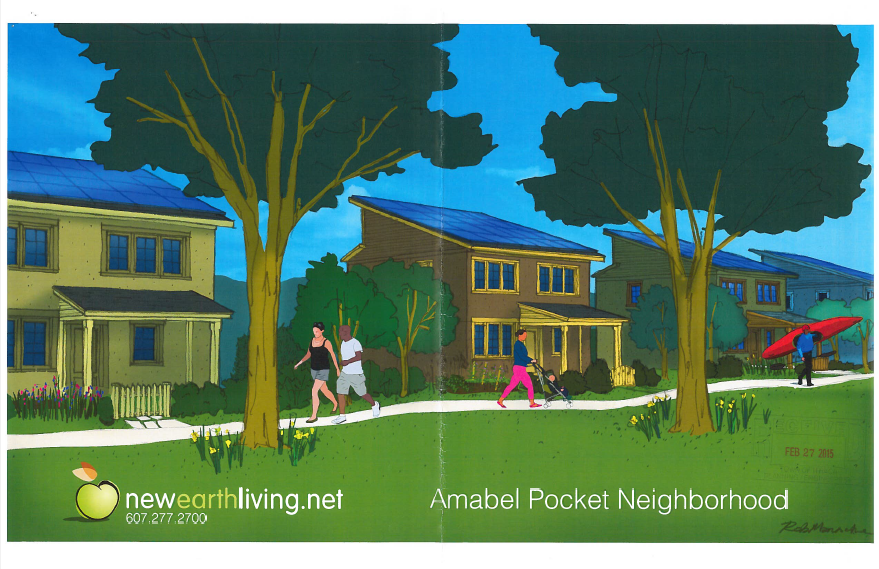
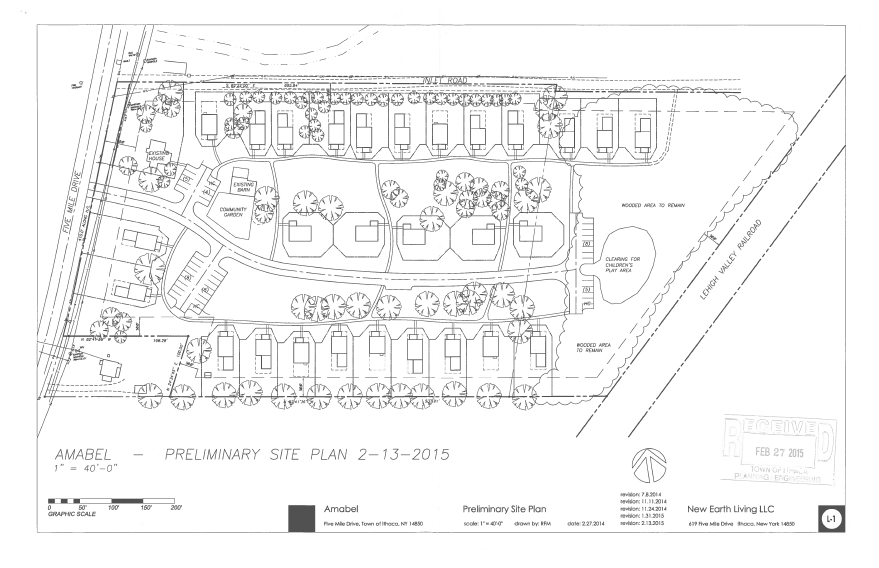
6. Lastly, it looks like the town of Ithaca’s planning board finally has a few things to work on, after having no meeting since early January. For their Tuesday meeting, the town will review plans for more luxury tents at La Tourelle, a new municipal water tank near Sapsucker Woods, and revised plans for the Amabel project off of Five Mile Drive. The number of units has been reduced to 28, and since November, two units were added to the far west portion of the parcel bordering Five Mile Drive (and as it turns out, those center units aren’t duplexes). Contrary to the example render, six different home designs will be available. Developer Sue Cosentini of New Earth Living LLC hopes to begin sales this summer.

Get connected:

Have comments or questions about these projects for your local government? Contact info below:

Town of Ithaca Planning Board: Use the form here – http://www.town.ithaca.ny.us/contact-us

Ithaca Common Council: http://www.cityofithaca.org/341/Common-Council – click on your councilperson’s name, their email is on the subsequent page.