Hotel Ithaca Construction Update, 4/2016

27 04 2016

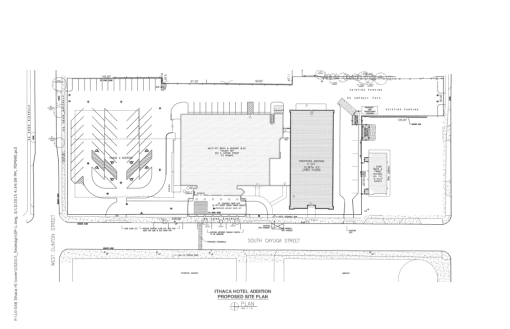
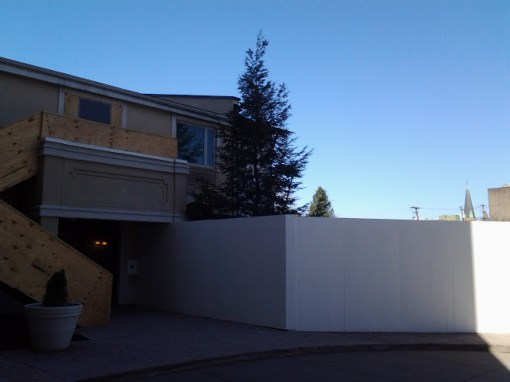
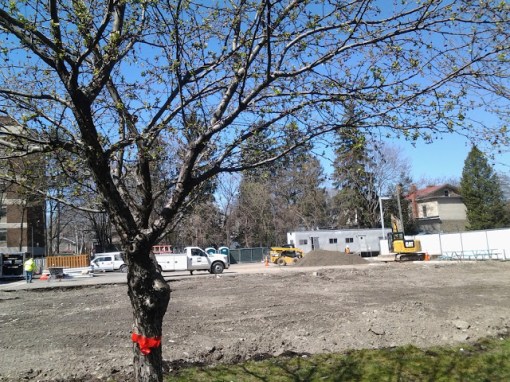
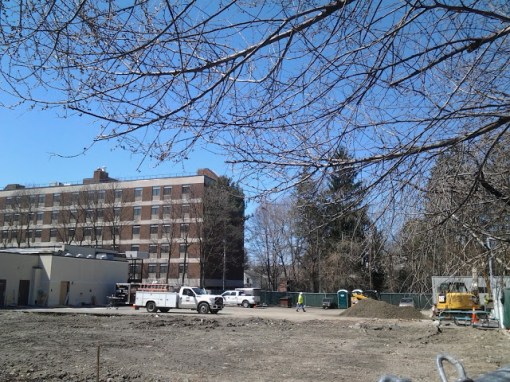
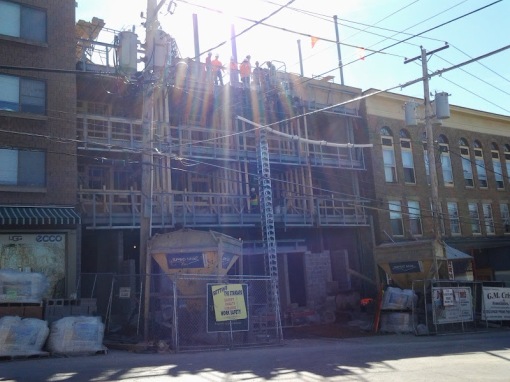
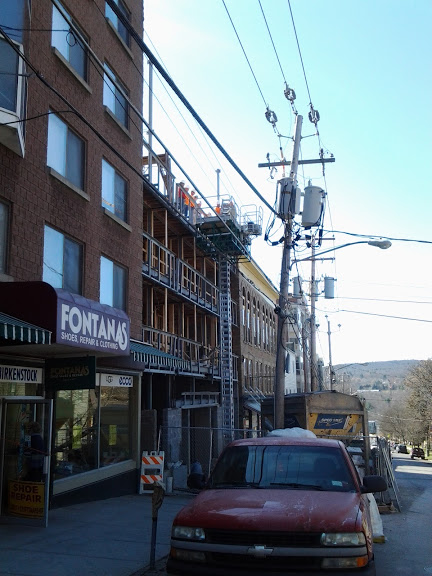
Demolition and site preparation are the task du jour at the Hotel Ithaca at 222 South Cayuga Street. The north wing of hotel rooms is being demolished now, and the west wing of hotel rooms will be demolished once the new building is complete.

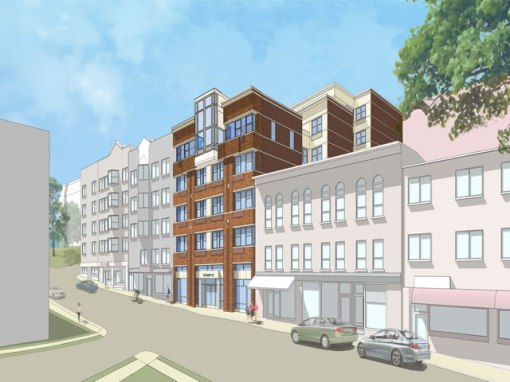
The new 30,000 SF, 5-story wing will contain 90 rooms, 2,900 SF of additional meeting space, breakout rooms, and a new fitness center. 100 hotel rooms are being taken offline and demolished, reducing the number available at the hotel from 180 to 170. But, the primary goal of the project is to modernize the Hotel’s offerings, and stay competitive with newer hotels downtown, including the Marriott currently underway, and the Canopy Hilton due to start later this year.  The project applied for, an received a 7-year tax abatement under the CIITAP program, making it the only project that has pursued the 7-year option over the more common 10-year enhanced option. CIITAP may not be popular from a P.R. standpoint, but as shown on Ithaca Builds, the high property tax rate downtown plays a large role in the program’s necessity.


Photo from C. Hadley Smith Collection

Photo from C. Hadley Smith Collection

The Hotel Ithaca originally opened in 1972 as part of the city’s urban renewal plans, initially operating as a Ramada. At the time, it only consisted of the two-story wings, as seen in the 1973 photo above; the 10-story “Executive Tower” was added in 1984/85. The hotel was rebranded as a Holiday Inn until the start of 2014, when it switched to an independent operation as the “Hotel Ithaca”. The Hotel Ithaca was also the working name of the Marriott project early on, so the two projects are easy to mix up. As part of the change, the hotel carried out $2.4 million in renovations (phase one) to the tower rooms and utlities.

holiday_inn_expansion_1

Early plans called for a $17.8 million, 140,000 SF addition with a 9-story, 115-room hotel, restaurant and conference center designed by Buffalo-based Roberts, Shackleton and Boy Architects. The conference center was very well received by local officials and business leaders, and is seen as really crucial to Ithaca’s business interests – the city lacks the ability to host mid-size conferences and conventions (midsize meaning about 500 attendees), which sends conventioneers elsewhere. Currently, the lack of meeting space limits conferences to about 250 guests. The addition of a convention facility is seen as a major benefit to downtown retail, as well as other hotels that would handle overflow guest traffic. Convention traffic typically happens during weekdays, when regular tourist traffic is lowest. The plan was later revised to 8 stories and 97 hotel rooms, and then that didn’t move forward due to financial difficulties.

hotel_ithaca_phase_1 hotel_ithaca_phase_2
The current project was proposed last September, and as the project had evolved, the tax abatement had to be re-voted (and passed 6-1). A potential third phase calls for a 3-story addition to the 5-story wing, and the coveted conference center, on the corner of W. Clinton and S. Cayuga Streets.

The $15 million second phase is aiming for a completion in May 2017. About 21 new jobs are expected to be created, most of those service positions near or a little above minimum wage.

Hart Hotels of Buffalo, founded by David Hart in 1985 and operating locally under the name Lenroc L.P., is the project developer. Krog Corporation, also of Buffalo and a favorite of Hart Hotels, is the general contractor. NH Architecture of Rochester, another frequent partner of Hart Hotels, is the project architect.


20160414_115147 20160414_115217 20160414_115246 20160414_115357

hotel_ithaca_final_1


409 College Avenue (Student Agencies eHub) Construction Update, 4/2016

26 04 2016

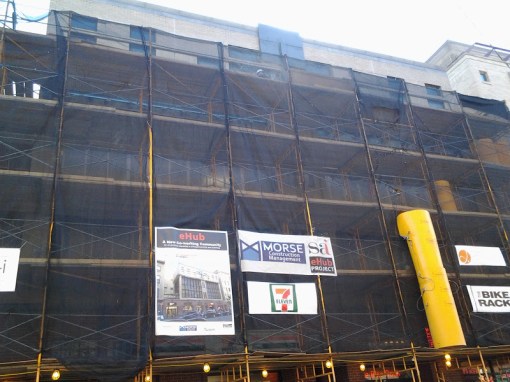
Not a new construction, but a major renovation. scaffolding is up as the Student Agencies Building at 409 College Avenue undergoes major interior and exterior renovations to its second and third floors. As previously reported on the Voice, 9.660 SF is being renovated to make way for eHub, a co-working and business incubator space for startups founded by Cornell affiliates – students, faculty and staff. The project is part of a collaboration with the Entrepreneurship at Cornell program (eShip), and for its part, Cornell renovated about 5,000 SF of space in the Ag Quad’s Kennedy Hall to complement Student Agencies’ plans.

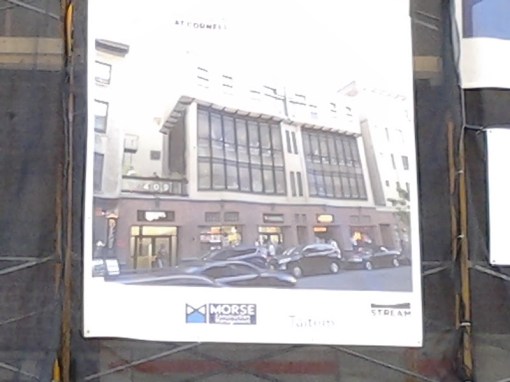
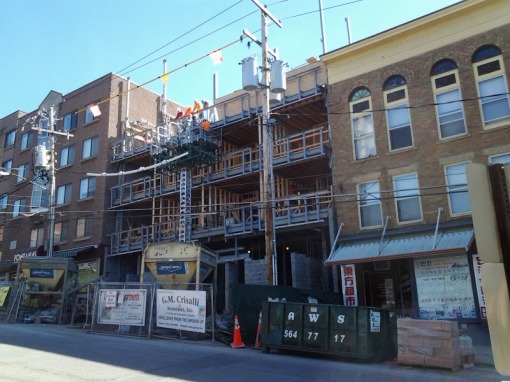
As part of the renovations, 409, which was built in 1985, gets a major facadectomy – out with the brick and its punch-out windows, in with the glass curtain walls of fixed-frame window units with metal and granite detailing. The renovations will also add a rooftop patio space to the second floor. The project had to go through Design Review since it’s a major exterior change to an MU-2 building in Collegetown, and it ended up being one of the rare cases where the planning board encouraged a bolder design. The original design can be found here. The posters on the netting are the only copies of seen of the approved final design.

The Bike Rack, 7-Eleven, and Student Agencies will remain option while the renovations are underway.

STREAM Collaborative and Taitem Engineering designed the renovations (project design and energy efficiency improvements), and Morse Construction Management is the general contractor. All three firms are based out of Ithaca. The total cost for 409’s renovation is about $2.8 million.

Plans call for a May opening.

20160415_101744 20160415_101813 20160415_101819 20160415_101834

409_college_avenue


307 College Avenue (Collegetown Crossing) Construction Update, 4/2016

25 04 2016

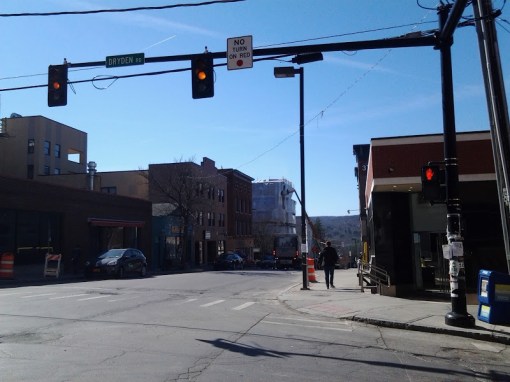
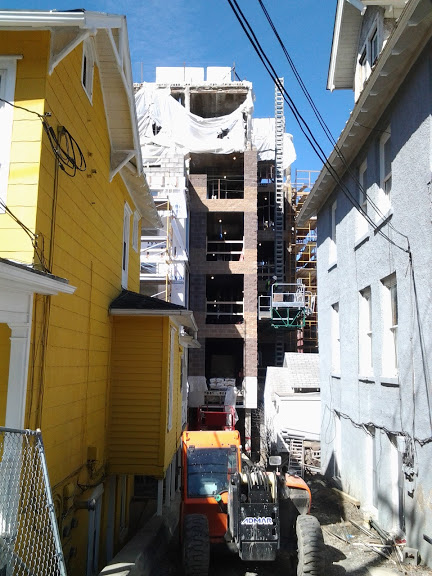
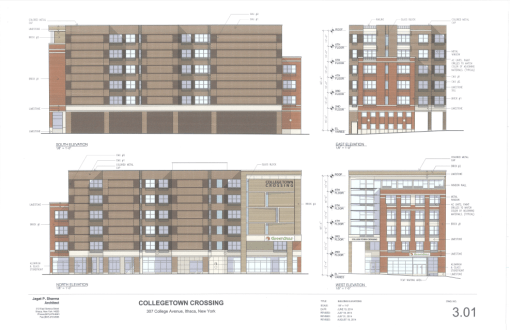
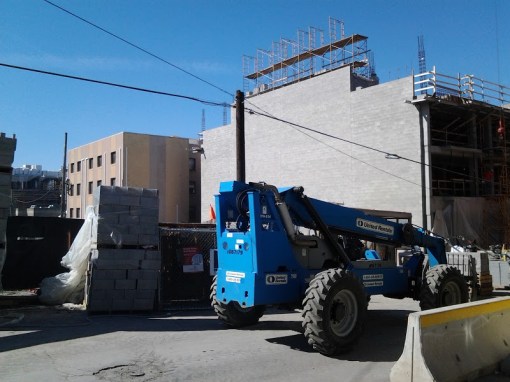
Collegetown Crossing is starting to show its face. Windows are being installed, and the CMU walls are on display. The mostly glass front facade has yet to go on, and brickwork will eventually go over the Tyvek housewrap on the 4-story, CR-4 portion of the portion. As mentioned in the Voice piece, a construction worker on-site said that interior work is focused on interior wall framing, sheet-rock hanging, and electric rough-ins at the moment.

According to building developer Josh Lower of Urban Ithaca, the project is being included as a part of a city grant application related to public transit, though it’s not something I’ve heard much about. It definitely fits the bill – designated internal bus shelter and pull-off space for up to two buses, a pedestrian through-fare and pocket park that connects College Avenue and Linden Avenue, ample bike racks (12 spaces required, 24 being provided), 3,200 SF grocery store on the first floor and Ithaca Carshare is but a couple hundred feet away.

There are a couple smaller retail spaces included as part of the project, but there hasn’t been any indication as to whether they have tenants lines up.

Like Dryden South and the Dryden Eddy Apartments, Collegetown Crossing plans to open in time for the fall semester. Ithaca’s Jagat Sharma is the architect, and Hayner Hoyt Corporation out of Syracuse is in charge of the build-out.

20160415_102004 20160415_102109 20160415_102141 20160415_102216 20160415_102337 20160415_102359 20160415_102450 20160415_102754 20160415_104451

307_college_site_plan_final 307college_rev2_1

ctown_crossing_rev2_1


205 Dryden Road (Dryden South) Construction Update, 4/2016

25 04 2016

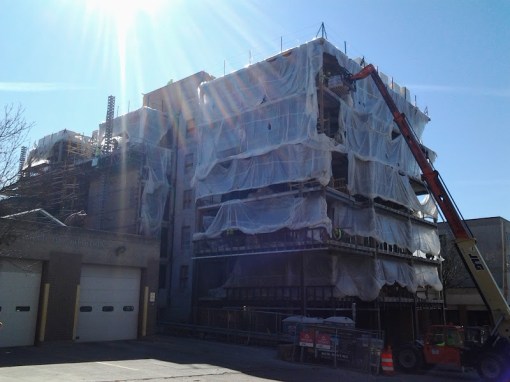
Another project in the mad dash for a summer completion (7/7/2016) is Pat Kraft’s mixed-use building at 205 Dryden Road, the “Dryden South” apartments. Workers under the direction of Rochester’s LeChase Construction are building up the reinforced concrete frame, and you can see steel rebar poking out of the fourth floor, which will be wrapped in wood forms and encased in concrete, with enough rebar poking out at the top to tie-in to future sections. The construction crane comes from C.P. Ward, a construction contractor in suburban Rochester. On the outside, the CMU walls are being assembled; not a whole lot of aesthetic effort is being put into the appearance of the east wall because it will be hidden by the 209-215 Dryden project within months of completion, although the renders show slit-windows on the building’s east face.

Kraftee’s was slated to occupy the first floor retail space, but the space is now being retooled. The project is in MU-2 zoning, and is legally obligated to have “active use” commercial on the 2,400 SF first floor: hotel, bank, theater, retail, and/or food service.

It looks Dryden South’s website has been overhauled. Apparently, if the building isn’t ready by August 1st, Kraft will refund renters twice the daily rent until the building is issued a certificate of occupancy. Rents range from $1190-$1350 per month, per bedroom, which is quite expensive, but this is also Inner Collegetown, which has the highest real estate values in the city.

20160415_101517 20160415_101531 20160415_101610 20160415_101703 20160415_101958

dryden_south_rev_2


327 Eddy Street (Dryden Eddy Apts) Construction Update, 4/2016

25 04 2016

Here are the latest photos for Steve Fontana’s mixed-use project at 327 Eddy Street. Work is up to the fourth floor in the front, and it looks like interior wall framing is underway on the lower floors, along with utilities rough-ins on the lowest levels. The rear section is further behind, steel is rising but workers have yet to move beyond the first floor. Progress should be happening fairly quickly from here on out, as the building needs to be ready for occupancy by the start of the fall semester. According to Fontana’s website (conveniently linked with the shoe store), unit prices range from $930 to $1250 per bedroom. The website doesn’t give any indication on how many units have been reserved.

There seems to be a slight discrepancy as to whether the project has 53 or 56 bedrooms in its 22 units. Counting on the webpage didn’t help, and the floor plans on the city’s website date from the 6-story, 64-bedroom version. A quick check shows my source was a Cornell Sun article from February 2015, no longer online. If anyone knows which number is accurate, please chime in.

A little more info can be found in last week’s Voice round-up here.

20160415_103153 20160415_103222 20160415_103243 20160415_104011
327_eddy_rev4_1


209-215 Dryden Road Construction Update, 04/2016

25 04 2016

The overview came as part of the Ithaca Voice roundup last week, but the number of photos that can be included is rather limited for two reasons. One, the labyrinthine picture portfolio in the Voice’s storage eats up space, and two, the general readers of the Voice mostly only care to see a couple of photos per location.

Work is well into the excavation phase of construction. The building’s basement (“lower level”) will hold a 90-space large group instruction classroom, a commons area for dining and mingling, some business offices, utilities and storage space. The large atrium area is meant to give some feeling of connectivity and openness with the upper six floors.

Side note, looks like Collegetown’s graffiti artists have had a field day with the fencing.

Because of the tight situation, construction staging is taking place on land that used to be a boarding house at 238 Linden, and into the public right of way on Linden Avenue and Dryden Road. After the building is completed in 2017, don’t be surprised if 238 receives a housing replacement consistent with CR-4 zoning.

Local businessmen John Novarr and Philip Proujansky are spearheading the project, with Cornell as sold tenant. Syracuse’s Hayner Hoyt is the general contractor.

20160415_101058 20160415_101135 20160415_101213 20160415_101255 20160415_101320 20160415_101355

209-215_basement

209-215_2.png


News Tidbits 4/26/16: Blips and Trends

23 04 2016

6-29-2014 162

1. In case you missed it, the Times’ Josh Brokaw did a pretty excellent feature this week on the Collegetown student rental market. He’s got Anagnost, Fane, Novarr, Lambrou…most of the major players have been covered.

A few details worth noting:
– The Avramis project planned for 302-306 College Avenue is being called “Avenue 102”.

– There have been rumors going around of a slight softening of the student rental market. No one’s really concerned about it, but the softening has been touched on, most recently at the city’s Rental Housing Advisory Commission meetings. In comparison to typical annual gains of +200 in the past decade, Cornell actually saw a slight decrease in the number of students in Ithaca from FA14 to FA15 (from 20,951 to 20,933), so the evidence is there. The key question is whether it’s a blip, or the start of a trend.

– Lambrou has a couple of smaller buildings (given previous work, 20-50 bedrooms) in the early planning stages. One of those might be 313-317 College Avenue talked about a while back.

If I do have any qualms with the piece, it’s that it implies Cornell’s West Campus was new housing. However, it was replacement housing for the U-Halls. There hasn’t been any net increase in beds on Cornell’s campus in fifteen years, since work on North Campus dorms finished in 2001.

2. In a separate piece, Brokaw mentions that 215 College Avenue, a 5,500 SF, 16-bedroom boarding house dating from the late 1800s, will likely come down after the 2016-2017 academic year. Readers might remember this property as the one that John Noarr paid an eye-popping $5.3 million for last August. 215 College Avenue falls under MU-1 zoning, which is Collegetown’s second-densest type of zone. MU-1 allows new buildings to be 5 stories and 70 feet tall (with a minimum of 3 stories and 30 feet), and no parking is required on site.

3. Last week, it was mentioned that Lifelong planned on selling the office building that it owned at 121 West Court Street in downtown Ithaca. Here’s the listing, which seems to be under the purview of local realtor Brent Katzmann. $439,000 gets you 4,518 SF in a former mid-19th century residence-cum-office. 8 offices, a conference room and amenities on the first level, and a three-bedroom, 2213 SF unit on the second level. The building lies just outside the DeWitt Park Historic District, although any imminent threats would probably send the city into panic mode and a rushed historic designation. Lifelong was gifted the building in 1996, and previously it was used as a doctor’s office. The county has the property assessed at $330k.

20160414_121932

108_E_state_1

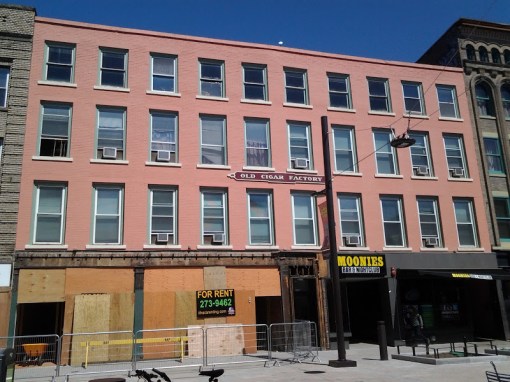
4. A substitution for House of the Week – since there are apartments on the upper levels, it’s fair game. The “Old Cigar Factory” at 108-114 East State Street is undergoing first-floor renovation to its retail spaces. The revised storefronts will have granite bases, a new wood-framed cornice, and existing cast-iron elements will be repaired.

Historically, this was known by the less cancerous and more PC name of “the Grant Block” and “the Floros Block”, with the building dating back to 1851. The “Grant’s Coffee House” in the render is an interesting throwback, sharing the name with a shop that operated on the site in the early 1800s. At other times, the building served as a cigar maker (natch), confectionery. and the Normandie Restaurant in the 1940s and 1950s.

The old vestibules and entries have been removed and covered with plywood while interior work is underway. The project underwent Design Review in March. Ithaca’s John Snyder Architects is in charge of design.

519_elm_st_ext

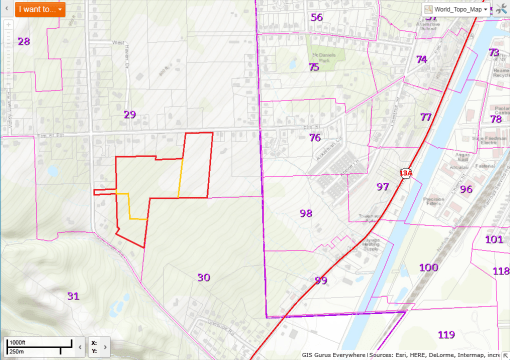
5. A small note for the West Hill folks, local home-and-landowners are planning an 8-lot subdivision at 519 Elm Street Extension, just west of the city-town line. The owners, David and Sarah Locke Mountin, plan to subdivide four vacant parcels totaling 20 acres into six lots of 1-2 acres with access to Elm Street Extension, and 2 5-acre lots towards Coy Glen Road. The project will go to the town board because the Mountins are seeking exemption from public sewer for the two 5-acre properties. The land is zoned Medium-Density Residential, and marked as low-density residential in the 2014 Comprehensive Plan.

201_college_v2_3
6. A big, interesting agenda for the city Planning Board next week. Here’s the rundown.

1. Agenda review
2. Floor Privilege
3. Special Presentation the Brindley Street Bridge Replacement

4. Subdivision Review
A. Tax Parcel #20.-2-3.1 (N. Taylor Place between Campbell and Westwood Knoll, two single-family)
B. 511-13 Dryden Road (one single-family)
C. 312-314 Old Elmira Road (two duplexes).

5. Site Plan Review
A. Chain Works District, 620 South Aurora Street – Consideration of closing the public hearing for the DGEIS, and extending the public comment period. Currently, it’s expected to close May 10th.

B. Parking-lot expansion, 310 Taughannock (Island Health) – 17-space addition on part of the bio-retention area with porous pavement (13 spaces) and re-striping (4 spaces). Nearly the whole gamut here except sketch plan – Declaration of Lead Agency, Public Hearing, Determination of Environmental Significance, and Consideration of Preliminary & Final Approval.

C. Cherry Artspace, 102 Cherry Street- Consideration of Preliminary & Final Site Plan Approval with Conditions. Conditions being, Common Council has to sign off since the project is in the Waterfront TM-PUD.

D. 201 College Ave, Apartment Building – Project Update & Discussion. It doesn’t sound like any decisions are being made on Visum Development’s 5-story, 44-unit apartment building, which did sketch plan last month. With the stepped down corners and revised entrance, it seems most of the PB’s suggestions have been incorporated by architect Noah Demarest. Neil Golder will take a few verbal whacks at his potential neighbor, but it doesn’t seem like there are too many concerns with this project.

maplewood_site_plan_concept_v2

E. Maplewood Redevelopment Project, Veteran’s Avenue, Concurrence of Lead Agency – basically, this is the city agreeing that the town planning board will take charge on Cornell’s new mini-neighborhood. Makes sense, since 97% of the project is in the town.

F. SKETCH PLAN: 201-207 N. Aurora St. — Mixed-Use Project. So I’ve dedicated a little bit of ink to this one before, when Todd Fox, Charlie O’Connor and Bryan Warren purchased the property last July. This is CTB’s downtown location. The ILPC started discussing designated the block in late March, including 201-207 North Aurora, to which its owners were less than pleased. The building dates from 1901, but the June 1986 filing of the East Hill Historic District with the state says on page 2 that many Aurora Street buildings were substantially altered after their period of significance (1870-1920) and “no longer possess the level of integrity that characterizes the district”. So the ILPC’s approach here reads as more of a reactive thought process rather than a proactive one.

Regardless of whether or not the building’s historic, development here needs to be really sensitive to the neighbors, several of whom expressed great concerns in the week or so after the property was purchased. I spoke with Fox about it back in October after seeing the building listed on Modern Living Rentals’ webpage with 60 units coming in 2018, and he said that “we have planned to include the surrounding neighbors in an open discussion”. If I was a betting man, and given that Fox and O’Connor like to hire STREAM Collaborative to do their projects, I’d wager that they’re involved with this one as well.

I don’t think there’s any way to totally avoid controversy, but an overbuild like the Carey Building might be more palatable to the planning board and community than a complete tear-down and replacement. Zoning is CBD-60; 5 floors, no parking required, 60 feet max height. We’ll see how things look next week.

G. SKETCH PLAN: 107 Albany St. — Apartments. This is probably 107 South Albany Street, since the county occupies where 107 North would be located. Currently, the site is a two-story professional building, dating from the early 1900s as a house. In 2013, the property was rezoned as part of the State Street Corridor’s southern edge, increasing zoning to CBD-60 (once again, 5 floors, no parking required, 60 feet max height). In August 2015, it was picked up by the Stavropoulos family, who own the State Street Diner. They’ve done a couple other small apartment buildings, too small for Planning Board review – 514 Linn and 318-20 Pleasant Street offhand. Haven’t heard anything here, but once again, keep an eye out next week.

elm_street_1

H.    SKETCH PLAN: 203-209 Elm St. — Apartments, Demolition & Reconstruction. Also recently covered, 203-209 is a 12-unit affordable apartment building partially intended to replace deteriorated housing that has became un-rentable due to settling issues. It would replace a house, a 4-unit building, and a 9-unit building. All units would be 1-bedroom.

Originally, 301 East State, the Trebloc / State Street Triangle was on the agenda. Then it was pulled within hours.


A Look Inside HOLT Architects’ New HQ

22 04 2016

Most of my photos are from the outside, so it’s pretty cool when I get a chance to inside.

HOLT moved into their new digs at 619 West State Street a few weeks ago, a few minutes’ drive away from their old location at 217 North Aurora Street (a building that used to be Ithaca College’s gym). First walking in, one of the first things that stood out was that there was little street noise coming in from West State, even though several large windows front the road; the secretary said that even she was surprised with how quiet it is.

I like that HOLT displayed not just their latest work, but also several older building models in their reception area. Among the projects on display were the Educational Opportunity in Center in Buffalo; the Peggy Ryan Williams Center at Ithaca College; the Roy H. Park Building downtown, and a campus setting I didn’t quite recognize. The Roy H. Park Building was done in the early 1990s, so the Strand Theatre was still standing when the model was produced.

The spaces are pretty wide open; it was explained that this was purposely done to make it easy to exchange ideas between staff, who are often split into groups according to the projects they’re working on. Some of the desks are sitting, others are standing-enabled. The principals have personal offices on the east side of the building, the left side of the first photo below. The southern space / rear section is a miniature shop area to assemble models of projects.

I did get a chance to speak with a few of the architects on staff while visiting; one was Tom Covell, a long-time architect who recently joined the company from Rochester’s SWBR. SWBR was involved in the Cornerstone proposal for the Old Library project, but Covell said he was not a part of that work. Another architect who was nice enough to take out some time to chat was Andrew Gil, who specializes in architectural design of lab spaces; this led me off on some tangent about my primary employer, who is a major stakeholder/tenant in plans for a new building, and all of our senior research staff are essentially like kids in a candy store, while the architect is like the babysitter whom the parents only gave so many dollars to work with. Andrew, if you read this, thanks for tolerating my babbling.

Briefly, a few younger staff also introduced themselves – one was from the West Coast, another went to school in the region, and the third immigrated to the United States. It was definitely a mix of background, which hopefully translates to a variety of ideas.

The building is designed to be net-zero – the energy that goes in is equal to the amount of energy the building produces, so on the balance it has no impact on the power grid. This includes automated lighting systems, solar panels, and roof and building envelope improvements among other things. More info about the green features and the construction progress can be found in the blog’s “HOLT Architects” entries here. More about HOLT and their interest in the West End of Ithaca on the Voice here.

For the sake of acknowledgement, there were a few of their latest projects on the tables; but that wasn’t the point of the visit. They’ll hit the blog pages when they’re ready.

A big, big thanks to HOLT’s Maria Livingston for the tour!

20160415_162947 20160415_162954 20160415_163015 20160415_163022 20160415_163048

619_w_state_st_1

20160319_144734


210 Hancock Construction Update, 4/2016

21 04 2016

So far, not so good. When it first came out that INHS was dropping its contractor, Hayner-Hoyt of Syracuse, due to Hayner-Hoyt’s settlement in a government fraud of disabled veterans’ funds, my assumption was that alternatives had already been arranged and it would be just a token piece to fill out my writing quota.

Then came the interview with INHS’ Paul Mazzarella. And the words “in limbo”. That set a grim mood for the rest of our conversation.

At that point, there was some mental debate about passing the piece to someone else on the Voice staff, but given the complexity of the situation, there was a good chance it wouldn’t be done properly, or another news outlet would pick it up and miss some of the nuances. INHS didn’t know what was going on, since the investigation and negotiation were under seal. A check with the North New York District Court verified it. A bad situation that was in many ways beyond INHS’s control.

Dropping Hayner-Hoyt saved face, but also put the non-profit developer in a bind, since they were not just the general contractor, they were the construction manager, meaning that this was a design-build and everything had been priced out with Hayner-Hoyt’s help. Another contractor could have different, higher prices, which would put the project in jeopardy.

On the bright side, it looks like the project will move forward. Speaking face-to-face with Scott Reynolds last week, he described it as “more of a hiccup” at this point. Hayner Hoyt helped them locate new potential contractors, and there is likely a new firm who will take on construction manager duties. Hopefully, the Voice will have an article on that when INHS is ready to make the formal announcement.

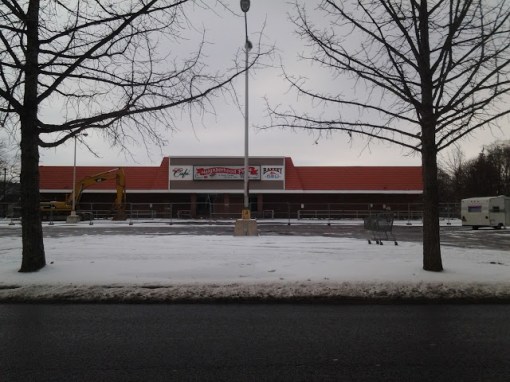
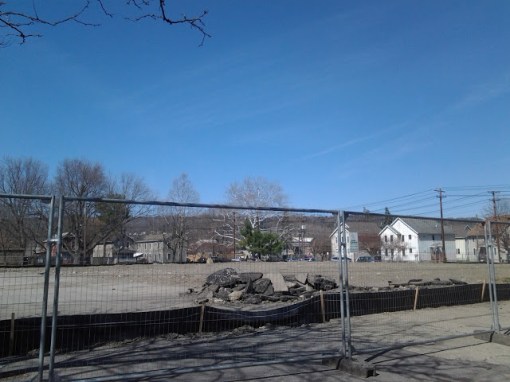
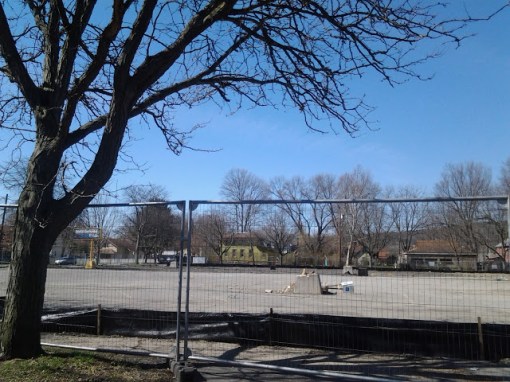
Turning to the project itself, the ca. 1957 grocery store, and one-story 1970s office building, are gone. Demolition is complete, and there’s a pause in work “while the contractors get organized”. Further site work is expected to commence no later than late May, with pile installation occurring over a one-month period at a rate of about six per day, between the hours of 8 AM and 4 PM. The before photo was taken in late February, the weekend before they started tearing down Neighborhood Pride, and the latest photos are from this past weekend.

The store was previously a P&C Foods, before P&C went bankrupt and the Ithaca stores were bought by Tops in 2010. The original builder of the grocery store, Tony Petito, launched a new independent grocery store called “Neighborhood Pride” in February 2013, which came with a $100,000 loan from the IURA. However, the store was unable to compete with other nearby grocers (Aldi’s, Wegman’s), and shut down at the end of the year. INHS acquired the property for $1.7 million in June 2014. Community meetings to develop a housing plan were held during the fall and winter of 2014/15, and the 210 Hancock proposal received planning board approval last year, after an unexpectedly heated debate. Originally, build-out was expected to start in September of this year, but the project was one of the very rare few that managed to get affordable housing funding from the state on the very first funding try (meaning that Ithaca has a well-documented need, and that it was a very good application).

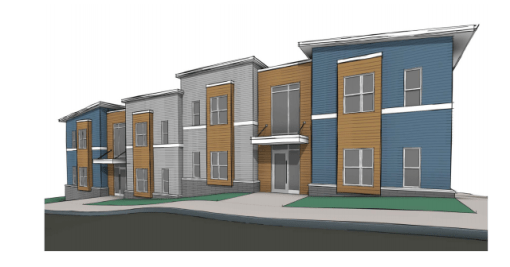
If built on schedule, 210 Hancock will bring 54 apartments and 12 moderate-income townhouses to market in July 2017. 7 of the townhouses will be for-sale units. Total construction cost is anticipated to be about $13.8 million.

The 54 apartment units (42 1-bedroom, 12 2-bedroom) are targeted towards renters making 48-80% of annual median income (AMI), defined by the HUD as $54,000 for a one-bedroom and $61,750 for a two-bedroom. The one-bedroom units will rent for $700-1,000/month to those making $25,950-$43,250, and the two-bedroom units will rent for $835-$1300/month to individuals making $29,640-$49,400. Three of the units will be fully handicap adapted. The project also includes two commercial spaces, one of which will host a daycare program run by TCAction for lower income families. The building would seek LEED Certification.

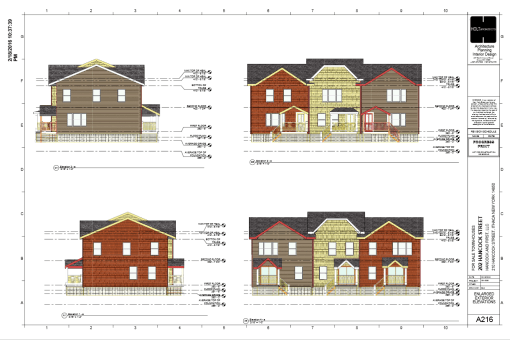
The two-story wood frame townhouses would also be LEED Certified. Of the seven for-sale units, five two bedroom units (1,147 SF) would be sold for about $114,000, and the two three-bedroom units (1,364 SF) for $136,000, available to those making 60-80% of local AMI, or $37,050-$49,400/year per the March 2016 IURA document. The townhouses would be a part of the Community Housing Trust (CHT), keeping them affordable even as they are sold to others in later years. The anticipated construction period is November 2016 – June 2017. The five rental units (4 2-bedroom, 1 3-bedroom) would be built at the same time as the apartment building.

To get on the waitlist for the affordable units, contact INHS here.

20160219_142643 20160415_105959 20160415_110003

inhs_pride_design_v5_3 inhs_pride_v3_elevations_1202_hancock_1 202_hancock_2


The Chain Works District DGEIS, Part One: Introduction

20 04 2016

chain_works_rev3_3

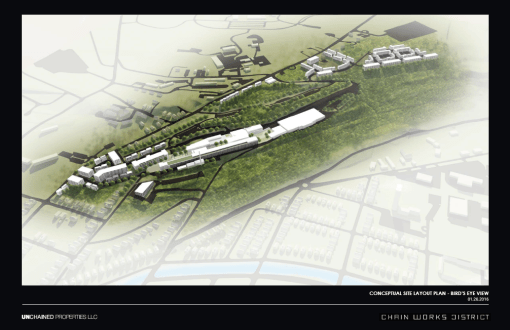
Chain Works is, without a doubt, the single largest project currently being considered in the Ithaca area. It’s a very large project in terms of square footage, in terms of cost, in terms of length of build-out. Being such a large and important, it needs to be examined carefully – it could help propel Ithaca’s economy and ambitions to a higher quality of life, or it could serve as 95 acres of dead weight.

Between March 29th and May 10th, the city is receiving public comments on the Draft Generic Environmental Impact Statement, the DGEIS. The city’s website appears to be outdated, but the Chain Works District website is up to date – any comments readers might have, any questions or concerns, are submitted to the City of Ithaca Planning Board as lead agency for environmental review. UnChained Properties LLC, the developer, offers a blank form here, or if one prefers, comments can be sent directly to Ithaca senior planner Lisa Nicholas at lnicholas@cityofithaca.org.

What a DGEIS does is evaluate the potential impacts of growth on local resources and facilities, such as traffic, water supply systems, utilities infrastructure, social and aesthetic impacts. The DGEIS, which will need to be finalized, is part of New York State’s Enviromental Quality Review (SEQR, pronounced “seeker”) and a necessary precursor to any planned/contemplated construction and development of the site.

So, the DGEIS main body is 422 pages, with about 3 GB’s worth of appendices. Although 45 days is allotted for public comment, not a whole lot of people want to read through 422 pages, but the table of contents allows people to jump around if there’s one or two thing they’re more keen to read about. A link to the DGEIS is offered by project partner Fagan Engineers here, but you might need to submit an email and name before being able to see it.

chain-works-map

So, basic details, per the “Description of Action”:

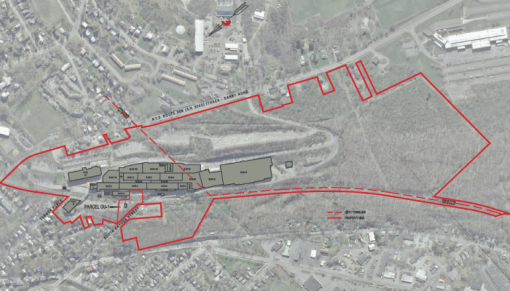
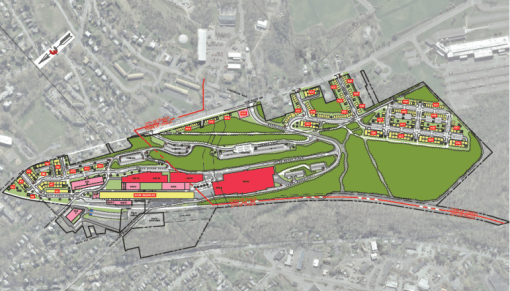
Chain Works District Project is a proposed mixed-use development consisting of residential, office, commercial, retail, restaurant/café, warehousing/distribution, manufacturing, and open space within the existing 95-acre Site which traverses the City and Town of Ithaca’s municipal boundary . Completion of the Project is estimated to be over a seven-to-ten year period. The first phase, referred to henceforth as Phase I, will consist of redeveloping four buildings generally located at the northernmost and southernmost ends of the complex of existing buildings. These first four buildings are approximately 331,450 square-feet (SF), and will house office, a mix of office and residential, and industrial uses. Subsequent phases of development will be determined as the Project proceeds and will include new structures to complete a full build-out of 1,706,150 SF.

So, just based off that, anything that gets developed, is as the market and NYS Dept. of Environmental Conservation (DEC) allows. If the market isn’t amenable or the cleanup plan isn’t approved, don’t expect the plans to move forward all that fast, if at all. If the market is good and the DEC signs off on plans, expect the build-out to be on the shorter end of the 7-to-10 year time-scale.
chainworks-before-771x441

chainworks-after-771x441

Related infrastructure work for the Project will include: (1) removing select buildings to create courtyards and a network of open spaces and roads; (2) creating pedestrian, bicycle, and vehicular connections through the Site from South Hill to Downtown Ithaca; (3) improving the existing roads within the Site while creating new access points into the Site; (4) mitigating existing environmental impacts from historic uses; (5) fostering the development of a link, the Gateway Trail, to the Black Diamond Trail network; and (6) installing stormwater management facilities, lighting, utilities, and plantings.

No big surprises – some buildings in the interconnected complex will come down, shared road concepts will dominate the internal transportation system of the neighborhood, the site will be more fully integrated into South Hill and trails, and usual site details like stormwater plans and landscaping are going to be incorporated into the project.

Given its complexity, the project team is pretty broad – eleven organizations, from the Ithaca, Elmira, Corning and Rochester areas. Local firms include STREAM Collaborative, which helped draw up the design standards and rezoning, Randall + West for more rezoning work, and Brous Consulting, which is handling public outreach. UnChained Properties is headed by David Lubin of Horseheads (suburban Elmira). From what I’ve been told, project development to-date has cost somewhere around $2 million dollars.

Likewise on the approvals – the project will need something like fifteen approvals from a dozen different government groups and agencies.

chain_works_history

Let me share an introduction and summary comparable but maybe more approachable than theirs – a background primer on why this is happening can be found on the Voice in my introduction article here, and Mike Smith’s summary article here.

Much of Chain Works reuses what was once the Morse Chain / Emerson Power Transmission (EPT) factory, which employed thousands from the 1900s, up until the last workers were let go and the facility shut its doors in 2011. During the mid 20th century, industrial processes used chemicals and compounds that are known to be toxic – Trichloroethylene (TCE) being the best known, but also heavy metals and oils. These not only affect the site and its building, they’re also in the soil and groundwater of South Hill.

chain_works_contamination

The site is classified as Class 2 Superfund site, which the DEC describes as “a significant threat to public health and/or the environment and requiring action”. While EPT is responsible for clean-up, they’re only responsible for the bare minimum (the industrial standard, what can be safely exposed to for 8 hours) unless otherwise specified by a proposed reuse, in which case they have to clean to a higher standard like residential use.

So that leaves us at present – a vacant 95.93 acre, 800,000 SF industrial site split between municipalities and with varied terrain and conditions. One of the most basic goals of CWD is to get the city and town to rezone the land to allow a mix of uses – PUD/PDZ, which give flexibility in site development based off of standards the developer, the city/town, and in this case NYSDEC mutually agree to.


chain_works_form_districts_1

So, in the PUD/PDZ, one of the broad takeaways is that each of the four form code has its own design standards – height, width, window-spacing, setbacks and most physical details, even signage. Unlike typical zoning, it’s the appearance that is more thoroughly managed, not the use. Those can be found in detail here. The design standards utilize what’s called LEED ND (Neighborhood Development), design standards created for large-scale green, well-integrated and sustainable development. A gated community it ain’t.

The goal of these design standards is to mitigate some of the adverse impact the new and renovated buildings will have on the community – promoting alternate transit reduces traffic, limiting floors and floor heights reduces visual impacts, and so on.

Build-out falls under four general form zones: (1) CW1- Natural Sub-Area, 23.9 acres of old woodland to be limited to passive recreation. (2) CW2- Neighborhood General Sub-Area, 21.2 acres of townhouses, stacked flats and similar moderately-dense development, mostly in Ithaca town; (3) CW3- Neighborhood Center Sub-Area, 39.7 acres of mixed-use, in a combination of renovated and new buildings towards the northern end of the property in the city, and (4) CW4, Industrial Sub-Area, a 10.3 acre zone for industrial uses in existing buildings at the Emerson site. The site borders Route 96B, single-family and multi-family homes, natural areas and steep terrain.

About 0.91 acres will be subdivided off and maintained by Emerson for active groundwater treatment. The other 95.02 acres would be sold to UnChained Properties.

chain_works_form_districts_2

The re-development is fairly multifaceted. Some buildings will be renovated, a few will come down, a couple will receive additions, an quite a few others, like those in the all-residential CW2 zone, will be brand-new. Specifically in Phase One, four buildings – 21, 24, 33 and 34, will be renovated.

In Part Two, we’ll take a closer look at the neighborhood design standards and detailed plans for Phase One.