The Government Campus

3 09 2016

5-1-2012 120

The idea of a government campus in Ithaca is very intriguing. It offers big opportunities, and potential pitfalls.

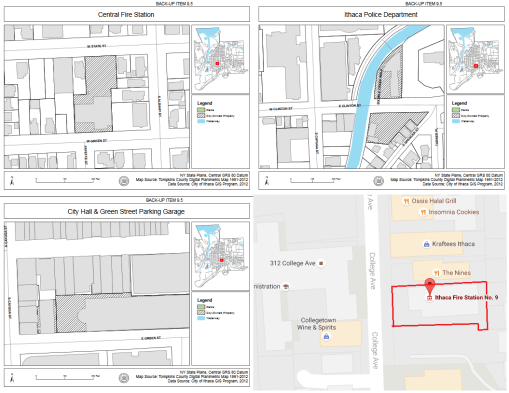
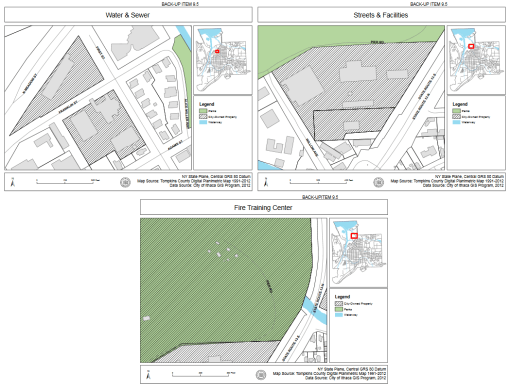
A copy of the funding request can be found here. The $150,000 study comprises two components – the first would combine the Collegetown Fire Station (No. 9), Central Fire Station at 310 W. Green Street, the Police Headquarters on E. Clinton and City Hall into one site on the property of the Central Fire Station. The second combines DPW Streets and Facilities and DPW Water and Sewer into one location.

Given the very profound impact this would have on the city, there’s been relatively little news about it. I cued my colleague Mike Smith in to it, and he did an interview with Planning Director JoAnn Cornish, which led to two articles. The spark notes are that the current condition of some of these properties is poor, so the city is looking at which to consolidate and/or build new, and which to renovate. The money is left over from the study looking into moving Station No. 9 and designing a replacement (apparently, it only cost $80,000 of the $500,000 allotted), so this is the planning department’s shout of carpe diem. The Common Council has given strong support to doing the consolidation study.

Let’s make it clear – there is no commitment anything will happen. Nothing may change at all, Station No. 9 may still move to Maple Avenue while everything else is left as is, or the consolidation plan might actually get carried out. But if they have the money and time, it’s worth exploring the possibilities.
consolidation_study_1

Study one, the “government campus”, involves a space needs assessment for programming and staff, concept site plans, and cost estimates for new facilities. The study will also offer appraisals for existing buildings and discussion of selling these properties:

  • City Hall and the adjacent parking lot to its east
  • The Collegetown Fire Station
  • The Police HQ, but not the Courts Building
  • The Western 1/3rd of the Green Street Garage

Each has its opportunities. The western third of the Green Street Garage has some of Ithaca’s most accommodating zoning for urban projects – CBD-140, a 140-foot building with no parking requirement. When the garage was rebuilt several years ago, only the central section was structurally redone. The western section is nearing 50 years old, so without major renovation, it will be nearing the end of its safe useful life. The early plans for Cayuga Green called for a larger garage on Green Street, so another floor or two on the remaining two thirds is not impossible.

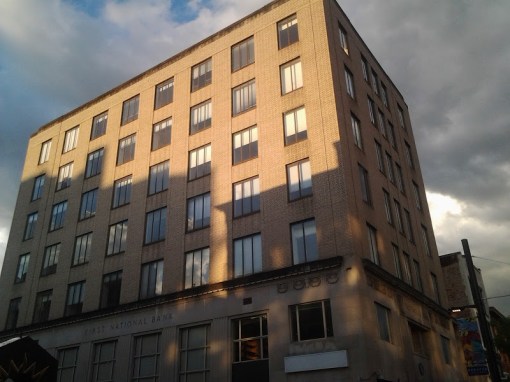
Meanwhile, Ithaca has never been particularly attached to its city hall – the building was built for NYSEG in 1939, and the city bought the building in 1964, demolishing its old city hall for the Seneca Street Garage not long after. In the mid 1980s, the city attempted to sell city hall so that it could be bought by a private owner and leased out to the county, all part of an effort to keep the Department of Social Services downtown – the city failed to persuade the county legislature, which moved DSS out to West Hill until the Human Services Building opened on the 300 block of West State in 1998. Demolition would face significant opposition, but conversion to housing could be a safe option for a hypothetical new owner.

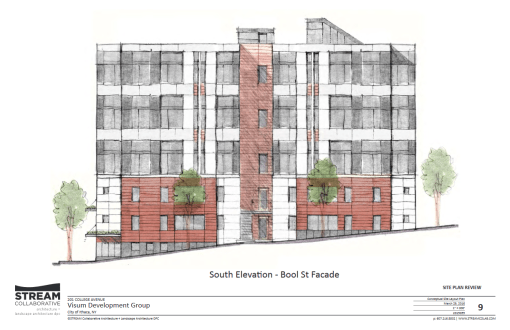
The Collegetown Fire Station is prime real estate. It’s MU-2 zoning (six floors, no parking) in the heart of Collegetown at 309 College Avenue. Given that 201 College sold for $2.65 million, and 215 College sold for $5.3 million, there’s little doubt the city could fetch a multi-million price here. An RFP would have to be cognizant of the fact that the site itself is best-suited to student housing, because not only would its price be limited by other means, non-students may not be comfortable living in a location that’s 95+% students. There could be a provision for housing fund payments or off-site affordable housing at an appropriate location.

The city police station is a question mark. The zoning for the Police HQ and Courts building is B-1a, and the police parking lot is R-3b. R-3b is 4 floors, 40% lot coverage, a parking space for every unit or three bedrooms, whichever is greater. B-1a is nearly the same, but with 50% lot coverage, but the Courts Building could make selling a tough prospect.

Now comes the question of the Central Fire Station redevelopment, which occupies much of its site on West Green. A back-of-the-envelope for the police HQ, fire station No. 9 and City Hall is about 48,000 SF (assuming police uses make up half of the courts complex). The Central Fire Station occupies 17,000 SF. So you’re asking for a sizable multi-story building on top of what’s there, and not counting impacts like parking. The city would need to be careful, as South Side is one of the more affordable areas and the risk for displacement of low-income households is considerable. Any project would also have to go through ILPC consideration since it borders historic properties.
consolidation_study_2

Study #2, the DPW consolidation, also offers opportunities. The study calls for a consolidation at a new location in Southwest Ithaca down by the box stores. It involves a space needs assessment for programming and staff, concept site plans, and cost estimates for new facilities. The city says it may also consider a shared facility with the town of Ithaca, or the county. In such a move, the city frees up space that it could sell on the North Side, and opportunities that could enhance redevelopment efforts on the Waterfront. The Northside area is also one of the new parts of the city where affordable housing is feasible and accommodated by neighbors, so mixed-uses with market-rate and affordable housing is plausible. The Pier Road area has high water tables which could drive up foundation (construction) costs, but Form Ithaca highlighted redevelopment potential at the site during their charettes.

Anyway, this is a lot of handwaving. Any work would be far, far off, probably well into the 2020s. A lot can happen between now and then – the economy tanks, priorities change, the sale of any property ends up a big debacle like the county’s Old Library redevelopment. It could make the city a lot of money in sale and taxes and help continue the downtown renaissance, or if done wrong it could end up being a burden that hurts taxpayers as well as lower-income households. But it’s certainly an interesting topic to explore.



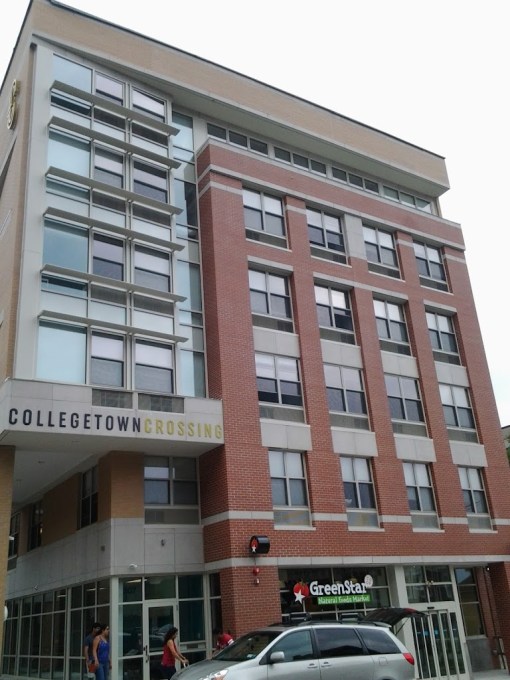
307 College Avenue (Collegetown Crossing) Construction Update, 8/2016

24 08 2016

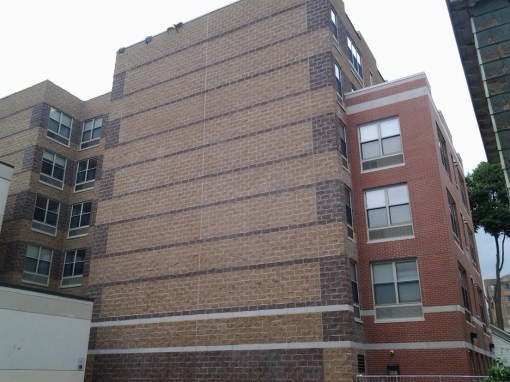
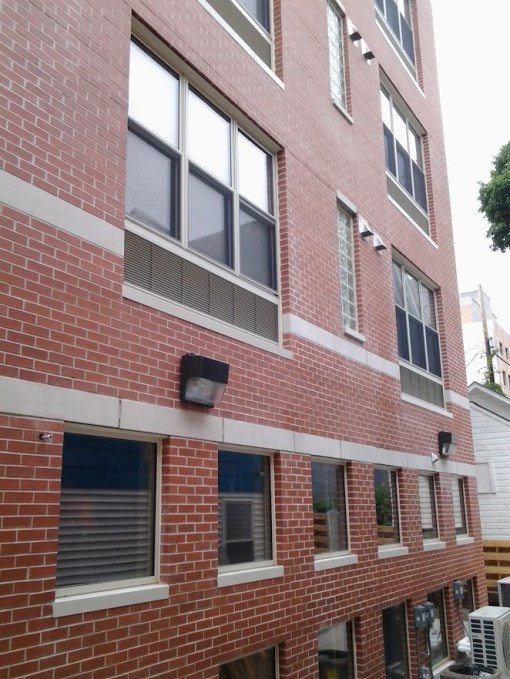
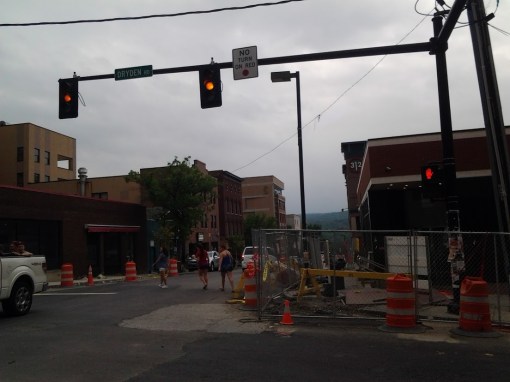
Although Greenstar had yet to open this weekend when these photos were taken (it opened Tuesday), it’s safe to say that this project is complete. The plantings and outdoor benches for the pedestrian walkway are seeking the planning board’s approval for tweaks (straight benches vs. curvy benches, large shrubs in place of trees), and assuming they’re granted, those will be installed and rooted in a few weeks.

We could look at this project as a lot of numbers. Four years of planning. Six floors. $10.5 million construction loan. 46 units. 96 bedrooms. $1,000/month rent. 3,200 SF grocery store. 14 living-wage jobs created by said store. Two bus pull-off spaces. One parking space for delivery. Zero parking spaces for residents.
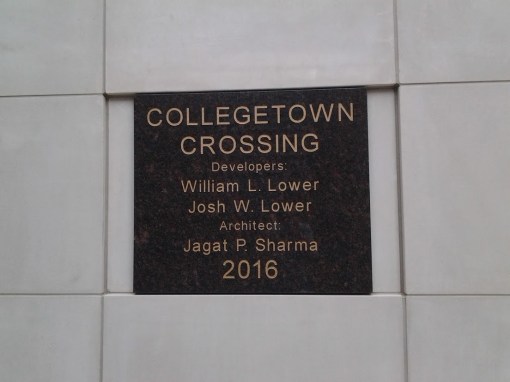
We could also get qualitative with it. Collegetown Crossing really was the pioneer of the new urban movement that has become more popular in recent years, both from livability and walkability standpoints as well as the financial perspective. Students have trended away from vehicle ownership in the past 15 or so years, from 50% in 2000 to 27% in 2012. Concurrently, there’s been a bigger emphasis on denser, mixed-use neighborhoods – malls and suburban apartment complexes are less popular than they were, and street-front shops with apartments above are making a resurgence, as the Commons and downtown Ithaca are demonstrating. Collegetown Crossing really helped to catalyze the conversation already underway, and no doubt had an influence on Collegetown’s hybrid form-based zoning code that did away with parking in the valuable core of the neighborhood. So the other new apartment buildings with active-use ground floors, Cornell’s Breazzano Center, and whatever else comes forth, they owe a hat tip to Collegetown Crossing and its developer, Josh Lower.
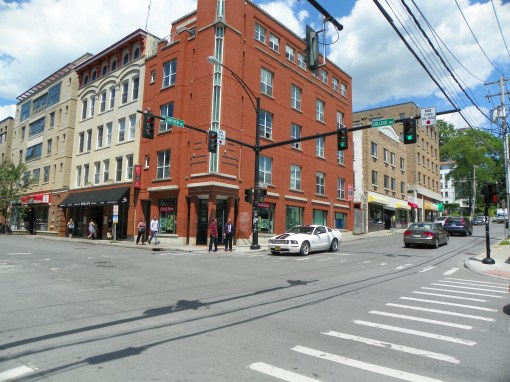
And speaking of hat tips, for all of the problems Hayner Hoyt has had this year, they deserve a big round of applause for finishing this project within its tight deadline, even with the other construction and logistical issues currently plaguing Collegetown. Jagat Sharma also deserves recognition for a project that looks pretty nice. When I was writing about the Collegetown delays in the Voice and speaking with Lower on the phone, he asked what I thought, and I said it came out better than I expected. Cue the awkward phone pause. What I meant was that the flat-looking perspective drawing doesn’t do the building justice, the built product is much more interesting to look at.

It looks good, the grocery and pedestrian alley enhance the quality of life for neighborhood residents, it replaces an unappealing two-story building, and it helps build the tax base. This project is a big positive.

Before:
12-29-2011 077

After:

20160821_104102 20160821_104245 20160821_104314 20160821_104339 20160821_104354 20160821_104602 20160821_104653 20160821_104721 20160821_104728 20160821_104854 20160821_105050

ctown_crossing_rev2_1


News Tidbits 8/6/16: Big Ideas and Small Additions

6 08 2016

20160701_200523
1. Some of you might remember that Chemung Canal Trust Company was embroiled in a legal battle with Ithaca Renting (Jason Fane) over the terms of their lease of 12,000 SF on the first floor of Bank Tower on the Commons. Welp, the courts have issued their decision, and it looks like Chemung Canal lost. The Elmira-based bank had to revise their quarterly earnings report after losing the dispute with their former landlord. The terms of the payout have yet to be determined, but Fane was seeking $4 million, which is in the same ballpark as the cost of Fane’s renovation of the top floors into 32 apartments. CCTC is still looking into an appeal.

119_125_college_avenue_2

119_125_college_avenue

2. It hasn’t been a secret that the price of real estate in Collegetown is getting enormously expensive. First John Novarr dropped $5.3 million on 215 College Avenue. Then Todd Fox forked over $2.65 million in June for 201 College Avenue. Now it’s Novarr’s turn again, handing over $4.75 million on the 2nd for 119, 121 and 125 College Avenue (or more specifically, an LLC filed to an address used by Novarr for his many LLCs). The three houses are collectively worth about $1.655 million, per the county assessor. Here’s a tip for readers – if you’re looking at a built property that’s recently sold, if it was purchased for more than double the existing tax assessment, the property was most likely sold based on its development potential. Less than that but still well above assessment, and it’s more likely major renovations/gentrification/Fall Creek/not being torn down.

Anyway, we already have an idea what’s planned – Novarr wants to do 50-60 units of faculty townhouses on the site, a 3-4 story, $10 million project.

1015_dryden_1

3. The other big sale this week (using that term subjectively, since someone just paid $1.25 million for a Cayuga Heights mansion) was 1015 Dryden Road out in Varna. Modern Living Rentals (Todd Fox/Charlie O’Connor) has had this 5-unit rental property on the market for a little while now, initially for $650,000, then $599,000.  The buyer “Finger Lakes Wrestling Club Inc.”, agreed to purchase the property on August 2nd for $555,000. MLR purchased the property for $425,000 in 2014. The wrestling club is listed as a non-profit serving youth training and competing in wrestling, and their plans for the property are unknown – the sale comes with plans for a pair of duplexes (4 units total), and the triplex designed by STREAM Collaborative shown above. I’ve heard of non-profits renting out real estate assets to fund their endeavors, so maybe that’s the plan.

109_dearborn

109_dearborn_v2

4. A pair of housing newsbits. Per the ILPC, the former Paleontological Research Institute  at 109 Dearborn is ready for its next phase of renovation into a rather swanky two-family residence. Background on the property from last August here. Long story short, it’s a gut renovation of a non-contributing structure of a historic district, the commission didn’t have much to say when it presented last year. This time around, the applicant wants to trade out the lower-level shingles for stucco, and the west entrance bump-out has been eliminated; anecdotal evidence says the ILPC won’t be excited, but it’s probably acceptable, since non-contributing buildings generally have an easier go with the commission.

A little further south on East Hill, local landlord Nick Lambrou wants to subdivide the large lot of 125 Eddy Street in order to build a new two-family residence. Jagat Sharma is the architect-of-record for the proposed 123 Eddy Street, which is a part of the East Hill Historic District and would have to go through ILPC approval. It will also need to pay a visit to the BZA because it’s proposed without parking (although the CPOZ was removed last year, an East Hill property still requires a parking space every 3 bedrooms) and will need a variance. Offhand, the Planning Board likely won’t be roped in on this one, since one-and-two family homes usually only need to be approved by planning department staff. Lambrou and Sharma are frequent contributors, and have faced the ILPC together before, for the reconstruction of 202 Eddy Street after it was destroyed by a fire in early 2014. The focus right now is just getting the subdivision approved, the ILPC presentation and vote will come at a later date.

215-221_spencer_v3_1

render4
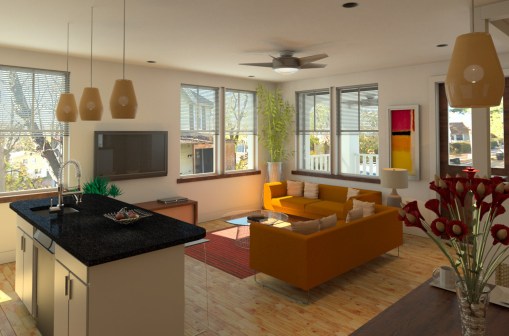
5. STREAM Collaborative sent out their bi-annual newsletter, and there are a couple of interesting pieces worth re-sharing. There were brief items about the “Urban Cottage” at 228 West Spencer, Tiny Timbers and 409 College Avenue, as well as some info about 215-221 West Spencer. STREAM writes that Ed Cope has broken ground on the STREAM-designed 12-unit, 26-bedroom condominium complex. This must have been fairly recent, as the hillside was undisturbed during a site check a couple weeks ago. Anecdotally, a condo project in Ithaca needs 50% pre-sales (i.e. 6 units) in order to secure a construction loan, but there isn’t any loan on file with the county yet, so I can’t say with any certainty what the funding arrangement looks like. On the fully revamped webpage are some nifty interior renders, including the image above. Anyone interested in the 1-3 bedroom condos can contact Ed Cope at PPM’s website here.

Buttermilk+VIllage

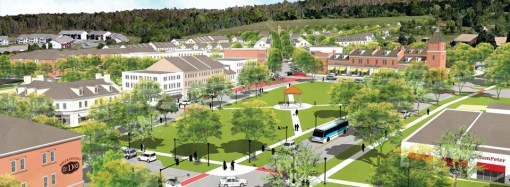
Also in the newsletter was an image from the latest set of Form Ithaca charrettes. “Buttermilk Village”, a working title for the South Hill neighborhood plan. The render above is looking northeast from the intersection of 96B and East King Road, with Ithaca College’s Circle Apartments to the upper left. Among the design features are a walkable town square, 2-4 story buildings, complete streets, and mixed uses with less dense residential further from the main roads. Some of the businesses like Sam Peter and Dolce Delight are in there to give that sense of familiarity. Most of this land is owned by Evan Monkemeyer, who’s still fuming from the College Crossings debacle. But rumor has it he’s working with another developer on a plan. It would be quite a feather in Form Ithaca’s cap if it looked something like this.


News Tidbits 6/11/16: Summer’s Heated Discussion

11 06 2016

Image Property of HOLT Architects

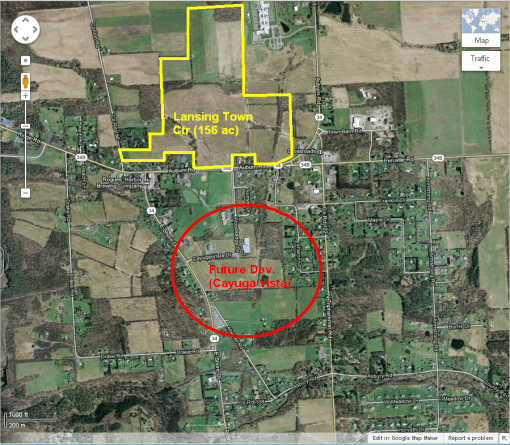
1. We’ll start this off out in Lansing. The 153 acres of land for the Lansing town center is once again in the news. The Lansing Star is reporting that the town is once again serious about selling the land.

So begins yet another chapter in the 20-year saga of the town center land. The town bought the land from the state in 1993 for $100,000, and at the time the land was deed-restricted to recreational use. In 2012, the town paid an additional $294,800 to remove the recreational deed restriction. An article about it was published here in August 2012 (original map below; dunno where why offhand it says 156 acres vs. the 153 reported now). HOLT Architects and TWMLA were hired to draw up some overarching design themes, a Request for Proposals was issued, and three developers responded.

lyc2

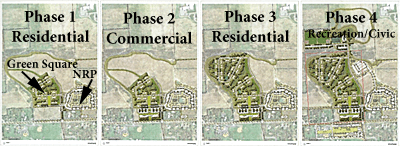
Calamar Enterprises’ Buffalo office submitted a proposal for a $17.4 million, 110-unit market-rate senior apartment building on 13.5 acres, and Cleveland-based NRP Group submitted plans for 80 one-story patio homes on about 15.5 acres. Calamar later re-sited their project at the town’s wish to the northern part of the land, and increased the number of units to 124. Green Square, led by David Taub and HOLT Principal Graham Gillespie, proposed 60 units of housing and 23,000 square feet of retail in 2-3 story arrangements, and civic and recreational space. Altogether, the value of the three would have approached $50 million.

gs_phases

However, all of this was contingent on a sewer being built, which did not happen. The developers agreed to do a package plant that would service just the town center, there was discussion of an IDA-backed tax incentive zone, and the town stood to make a hefty return on investment, but…to quote the Star, “However, the deals fell through.  Actually it seemed more like they just faded away. At least one of the developers had signed paperwork saying they intended to purchase acreage from the Town.  The Town didn’t seem in any hurry to sell the land, even with clearly interested developers.  When the developers disappeared there was no reported effort by the town to pursue the deals.”

Since then, the town continues to get a steady stream of interest, but no real idea on how they want to move forward. Like Ithaca city and town, they’re looking at the possibility of Form-Based zoning for the site, and the town hopes to issue a more specific RFP than before, incorporating revised assessment values. The most intensive approach involved the Form-Based Code and a specific RFP, the least specific is just putting up a for-sale sign ans seeing what happens. Whatever the case, the lax approach the town has taken the past few years may no longer be feasible, with the ticking tax time time bomb of the possible power plant closure looming over the town and schools’ budgets.

old_library_thp_v4

2. Speaking of long processes, the Old Library project has formally filed paperwork here to begin the application process for the Certificate of Appropriateness from the Ithaca Landmarks Preservation Commission. The meeting is scheduled for city hall at 5:30 Tuesday the 14th. Although it says early design review, a lot of the legwork has already been done at this point, since the Planning Board and ILPC have been conducting joint meetings with the project team over the past several months to create a design that they’re all comfortable with. However, the ILPC is likely to refine some details moving forward.

old_library_thp_v4_2
At this point, the unit mix consists of 22 1-bedroom units with about 700 SF each, 25 2-bedrooms with about 900 SF each, and 10 2-bedrooms with 1200 SF each, the extra space intended as a den or home office. The building also includes a 1,800 SF community room to be administered by Lifelong, and 3,750 SF of first floor commercial space. The total facility size comes out to about 85,600 SF, and parking for 25 cars and at least 12 bikes, and another 34 bike spaces for the community room. Exterior materials include brick, limestone, and a couple forms of fiber cement, including wood-textured fiber cement.

Southeast+Rendering

3. The STREAM Collaborative House at 228 West Spencer is up for sale. The house has its own website here. The 1,152 SF, 2-bedroom net-zero energy house is listed at a price of $305,000. For more info on the house, Noah Demarest was kind enough to give a construction tour of the house while it was underway, and the blog post I wrote up afterwards can be found here.

evergreen_dryden_1
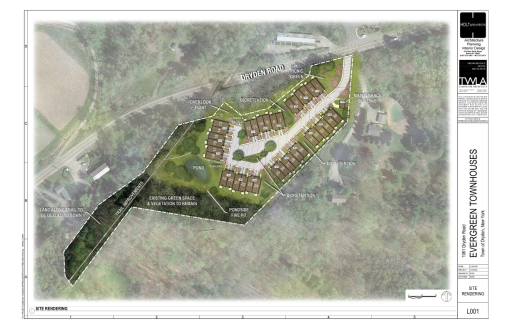
4. It’s pretty clear at this point that the Evergreen Townhouses project at 1061 Dryden is evolving into the next hot-button development issue out in Varna. The Times has their interview with the angry neighbor here, and more info can be found in the town of Dryden’s April planning board meeting minutes here. So far, the only image of the townhouses themselves has been a perspective that only shows massing – 2 stories, gabled roofs.

Also of note is the town of Dryden Planning Department’s recommendation to the town board (and the planning board’s approval) for an increase in density in certain areas. The change in code affects parcels zoned rural residential, with municipal water and sewer access. The density would be increased from 2 units per acre to 6 per acre. Looking at the zoning map and the sewer map, that would primarily affect the corridor from Varna to the 13/366 intersection, and a rural swath just north of Dryden village near TC3. What this would do is allow 1061 Dryden Rd to withdraw PUD application, and apply for a special use permit (SUP), which are generally easier to obtain.

On a side note, googling Tiny Timbers brings up a Times editorial, written by the Times, that argues against Tiny Timbers for not fitting in with the appearance of Varna. Actually, it kinda takes everyone to task, from developers to town government to residents. But, to make one counter-point regarding mixed-use, commercial services need a certain amount of traffic (not necessarily vehicular) to thrive. If the population base within a certain radius isn’t there, the risk is too great for someone to put their money on the line and hope that they can somehow draw in customers. If Varna wants a mixed-use center with shops and cafes, they’re going to need the population to support it. Some think that will include 1061, some (probably more) think Tiny Timbers, but if there’s no “push”, the ball won’t be rolling.

201_college_v3_1

5. A couple of minor things to note in sales. The 4,200 SF former “Imperial Buffet” property next to the Shoppes at Ithaca Mall has sold to a Syracuse-bsed LLC (Watersprite LLC, established 2004) for $590,000 on Friday the 10th. I personally will always remember this place as being the only place my mother was comfortable with eating in Ithaca because she hates eating out, and felt everything else was “snobby and expensive”.

Meanwhile, the 12-bedroom, 2,837 SF house at 201 College Avenue, the property subject to a heated debate between Neil Golder and Todd Fox, sold for $2.65 million on Friday the 10th, which seems outrageous except that it’s becoming the norm for inner Collegetown transactions – Novarr picked up 5,500 SF 215 College for $5.3 million last year. There will be no delving into that debate again this week, but the city uploaded 580 pages of documentation here, and my colleague Mike Smith is preparing a story for the Voice.

20160522_143925 20160522_143949

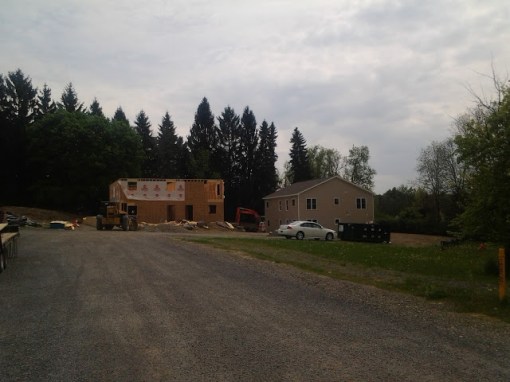
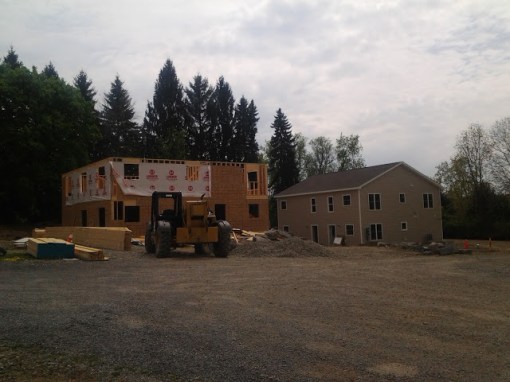
6. Houses of the week. This pair of duplexes are being built on Birdseye View Drive near Ithaca College. Each house has a 4-bedroom unit and a 2-bedroom unit; recent advertisements on Craigslist (since expired, so no link, sorry!) have them $750/bedroom. The developer is the owner of Mahogany Grill downtown, who also happens to be a part of the business team renovating the former Lucatelli’s into a new restaurant, a Tapas and pasta restaurant called Mix Social Dining after the chef’s wife.

These photos are a couple weeks old now, but the one on the right looks nearly complete, while the one on the left was still in the (wood) framing and sheathing stage. Based off the rough window and door openings, they are not exactly the same, but expect them to look similar.


News Tidbits 5/28/16: A Battle Between Neighbors

28 05 2016

201_college_v2_3

1. It seems the Planning Board had something of a philosophical crisis at their meeting, per the Times’ Josh Brokaw. The cause of the crisis is Neil Golder, Todd Fox and 201 College Avenue. Here’s the backstory.

201 College is a 2.5 story, 12-bedroom house on the corner of College and Bool. Local developer Todd Fox has a proposal on the boards for a 5-story apartment building (shown above). Neil Golder lives next door at 203. He moved into 203 in 1972 when he was a grad student at Cornell, bought the place in the early ’90s, lived there with his partner Kathy until she passed a couple of years ago. He still lives there, and rents out spare bedrooms.

201 and 203 were rezoned as part of the 2014 Collegetown rezoning to MU-1. This came only after years of debate, and Neil was one of the residents who pushed to have the properties rezoned in 2009 with a payment in lieu of parking scheme that upset a lot of the landlords, who mounted a significant legal challenge that prevented the rezoning from happening – more about that can be found in this Voice explainer.

For the record, Golder has never been much of a fan of development in Collegetown. His two big things have been that density is bad (but he seems to have mellowed on this issue since the parking push in 2009), and that Collegetown needed a grocery store. He was supportive of Collegetown Crossing because the developer (the Lowers) live next door at 205 and Greenstar will be opening a grocery store on the ground floor.

So, back to the zoning. There are nine MU-1 properties. The four between Catherine and Cook belong to Novarr – he has not expressed any intent to redevelop them. The other five are 215, 209, 205, 203 and 201 College Avenue. Novarr has expressed intent to redevelop 215 starting in late 2017. 209 is Grandview House, a historic landmark, and pretty much untouchable. 205 is Lower’s house, 203 is Golder, and then you have 201.

201 is the southernmost of the nine, and therefore most likely to stand out. The thing is, zoning consistent, when development happens organically, it means the parcel most likely to stand out isn’t necessarily the last one to get developed, nor will it necessarily be the smallest. In this case, the physical transition is from 2.5-3.5 story houses, to 5-story apartment, to 2.5 story house, and then a 3.5 story house and 5-story boarding house.

As of right, Todd Fox can build up to 5 floors and 70 feet tall as an average height. The site slopes slightly, so the building is shorter on the north side than the south side. The design fits the zoning – but it has to go to the BZA for a couple of minor area variances, one for entrances off of Bool, and the other, the board requested the project incorporate – the building was moved northward slightly to allow for street trees and a wider sidewalk on College Avenue. The May agenda noted that the Board had no concerns with either variance.

Golder has sent letters to the Times and the Voice (directly to my colleagues Mike and Jolene but not to me, interestingly), he has been stopping people on the street to sign his petition, he’s tried the ILPC, Planning Board, Historic Ithaca, friends in city government, even the city forester, everything and everyone he can to try and halt the current plans, but there has yet to be a compelling, objective counter-argument.

Countering some of the claims in his many letters, the individual pine trees at the front are not historic landmarks or city-owned, the city has to review and approve of construction plans anyway, and the traffic issue had already been discussed back during the rezoning. The developer has agreed to push the building back, which will give more visibility to Golder’s driveway, and a curb bump-out at the corner is proposed as part of the project. So that leaves the aesthetic argument of “I don’t like it”, which puts the Planning Board in a really difficult spot because as long as the form districts say the design is fine, that argument won’t stand up to a legal challenge.

There is a strong argument with his solar panels, which have been a part of broader discussion within the city. 201’s height would marginalize Golder’s solar panels, so in that case the project causes non-subjective hardship; this could be mitigated if 201 has solar panels (they are being considered) and shares electric, or by other compensation. Although, it might depend on when the panels went in, before or after rezoning. If people start rushing to put up solar panels as a back-door method to thwart development, the city’s going to step in.

So here’s the essence of the issue – after years of fighting over zoning, and finally settling on a compromise in 2014, the city is faced with a development that is legal, but it’s vehemently opposed by a venerable and high-profile neighbor, where the objections can be effectively mitigated, but not necessarily the way he wants them to be. A planning board member has to find the balance between allowing everyone to have their say, and acknowledging valid issues that should be addressed, without letting individuals exert too much control over their neighbors and infringing on property rights.

waterfront_foreclosure_parcels_0516

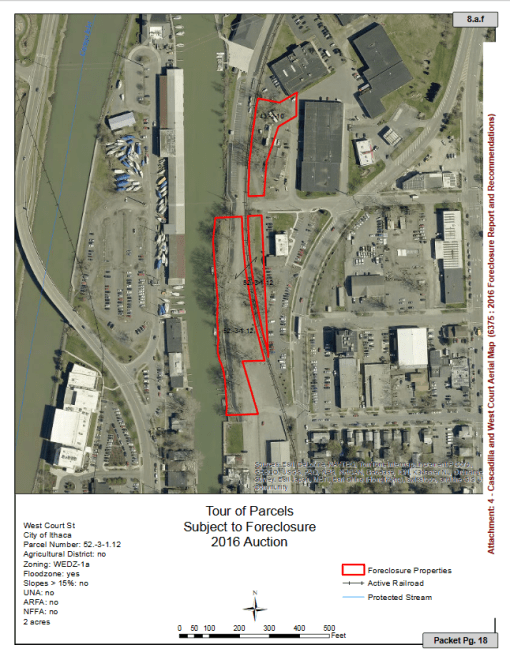
2. Okay, onto other things. The city might be acquiring a couple of sizable West End/Waterfront parcels from the county. The properties, which consist of a pier/boardwalk, informal parking and vacant land, are located at the end of West Court and Cascadilla Streets, and are being seized as a tax foreclosure. The county is looking at selling them to the city in exchange for the $42,844 in back taxes. The larger one is 2 acres, the smaller 0.6 acres, and in total they’re valued at $630,000. The owner, an LLC, picked them up for $156,625 in 1999.

If the city picks them up, they’ll be filed into the IURA’s holdings for potential sale down the line. As it is, the parcels have issues – the railway, accessibility, and soils down here are known for being difficult to build on. But in the long term, there’s potential for water-focused amenities, private development, or a combo of the two. It looks like a good investment given the city’s still-in-the-works plan to encourage redevelopment of the West End and Waterfront, so this is worth keeping an eye on as things move forward.

402_s_cayuga_st_boggsfernandez

3. The IURA reviewed funding proposals for affordable housing earlier this Spring, and the minutes are now online. the duplex at 622 West Clinton, and the affordable unit with the 4-unit 402 South Cayuga project were not funded. The IURA is encouraging 622’s applicant to re-submit for next year, and the minutes note that 402 is likely to still go forward, but without the affordable unit.

It’s also been noted that there is some discontent with INHS because the cost of their projects are coming in high, and that they would like more diversity in applying entities. However, the seven townhomes at 202 Hector and the single-family house at 304 Gector (all for-sale housing) are fully funded. The Habitat for Humanity duplex on the 200 Block of Third Street is also fully funded.

rumble_seat_1

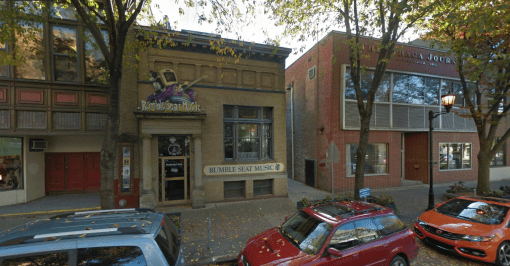
4. Another piece of news from the IURA – the new occupant for the Rumble Seat Music building. It appears to be a drink bar called “Watershed Union“, serving coffee and juice by day and adult beverages by night. Five or six living wage jobs would be created. There might be some grumbling over the moral evils of alcohol, but the business plan has the support of neighboring businesses and the Downtown Ithaca Alliance.

Also, the Canopy Hilton is still moving forward. But are doing a minor LLC ownership change to allow another Patel family member to be a part of the ownership team.

5. Hitting the market this week, for all those big-potato investors out there – the Belmont Townhouses at 324 Spencer Road. The listing from local realtor Brent Katzmann has the price set at $2,595,000, for a 14-unit complex that opened in 1995. The posting mentions the possibility of a 1031 Exchange, which allows an individual to sell a currently-owned investment property, and buy a new investment property of equal or greater value while avoiding capital gains taxes – continuity of investment locks up the profit gained from sale.

20160522_160150 20160522_160211
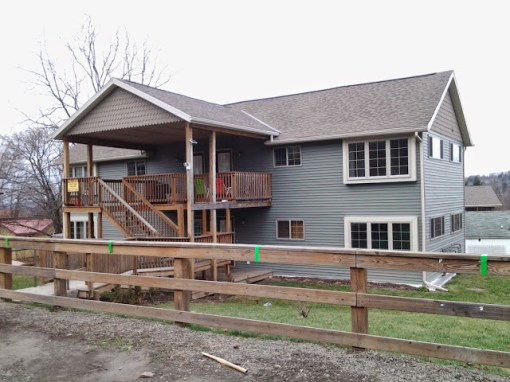
6. House of the week. This house is on the 100 Block of Campbell Avenue on Ithaca city’s portion of West Hill. This home is being built by Carina Construction, an Ithaca-based modular home specialist. The foundation and garage were poured and the pieces were probably craned on and locked together sometime in the past few weeks – a little bit of siding has started to show up on the front. The process is a lot like the one Carina used to assemble the Belle Sherman Cottages across town.

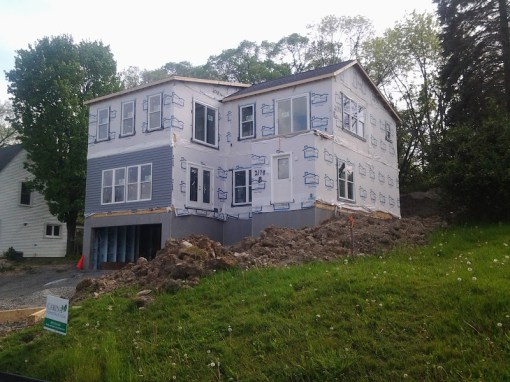
Color me impressed, the design is unique, and once exterior details like the porch and second-level deck go on, I imagine it’ll look really nice. Tompkins Trust lent $280,000 back in April, and the construction permits were issued not long thereafter (the total project cost is in the $320k range, per the permit filing). The land was created in a lot subdivision last year, and sold for $35,000 last August.


New Tidbits 5/14/16: A Land Subdivided

14 05 2016

6-29-2014 162

1. This week, the city rolled out a strategy memo for “Design Guidelines” for Collegetown and Downtown. The city held focus meetings back in March with Winter & Company, a Boulder-based urban design and planning firm with experience in cities and college towns from coast to coast. No specific individuals are mentioned as being part of the focus groups, but the focus group meetings consisted of “residents, property owners, developers, architects, design professionals, Planning and Development Board members, Common Council members, and City staff.” The memo is meant to help guide continued discussion of design standards, and to identify key issues in each area that could arise with planning and implementation.

The feedback from the focus groups shouldn’t come as a surprise – use high quality materials, respect historic character but don’t emulate it, recognize that development costs in Ithaca are very high, promote walkability and active street use, encourage parking lot infill, define transition areas between smaller-scale neighborhoods and denser cores, and so forth.

One of the major components being reviewed is whether design guidelines should be mandatory or just a set of recommendations. The city has a design review process that comes into play for certain projects like those on the Commons, but otherwise it’s non-binding unless the BZA or planning board mandates it as part of approval. Regardless, more meetings are expected as the guidelines are fleshed out.

al-huda_1

2. The Ithaca Times is checking in with the Al-Huda Islamic Center plan for Graham Road in Lansing. Fundraising is still underway for the 4,828 SF mosque, which according to a member of the Al-Huda board of Trustees, is expected to cost between $650,000 and $1 million, per contractor estimates.

Fun fact of the day, Islamic law prohibits mosques being paid for with funds that collect interest (tainted by usury). Everything must be paid for up-front and in full.

The village of Lansing has already signed off on the mosque plans, and the vacant land at 112 Graham Road is bought and paid for. Pretty sure the above drawing is outdated, but I haven’t seen an image of the latest plan available online. The Times has an interior shot of the current plan to accompany their story.

20141227_134549

3. The town of Ithaca passed the nine-month moratorium on two-family dwellings by unanimous vote at its meeting this week. Anyone seeking to build a duplex in the town of Ithaca will now have to wait until February 2017 for a building permit, unless “unnecessary hardship” is demonstrated by the law’s imposition. The law was driven by the construction of multiple 2-6 unit student-oriented structures east of Ithaca College in the Kendall/Pennsylvania avenue area, which they felt was undermining the neighborhood’s character. Earlier versions of the law called for a year’s length, but the town received numerous complaints that a year would actually hit two construction seasons, 2016’s and 2017’s.

100_1281

4. Also in lawmaking, the bike lanes proposed for the 300 and 400 blocks of Tioga Street in downtown have been shot down in favor of sharrows, 3-2. This comes after strong advocacy by city bicyclists and some planning and sustainability groups, and strong opposition from some elderly and disabled advocacy groups, suburban neighborhood residents and the town of Ithaca’s town board.

benderson_1

5. One of the many issues that faces large-scale planning and development in Tompkins County is that, over the many decades, land has been heavily subdivided and sold off between many different owners, with the properties often passed down or even traded, leaving records piecemeal. With so many owners, some untraceable, it can become logistically difficult, especially if not everyone is on board with a plan.

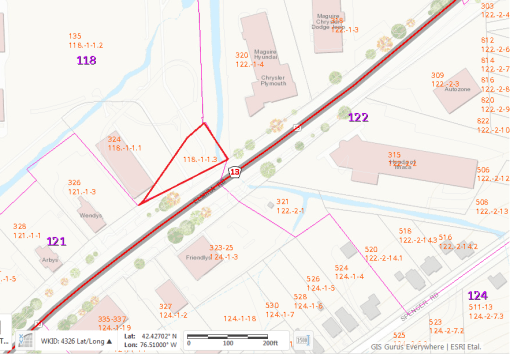
In front of Moe’s down in big box land, the county owns a 0.3 acre parcel of land previously a part of the flood relief channel. Since 2005, Benderson Development has rented the land as part of its shopping complex – now they just want to simplify things and buy the land from the county. With an offer of $112,500, which is $17,500 over the county’s assessment, and with the county’s 2005 confirmation and 2016 re-affirmation that they have no public use for that slice of land anymore (much of the channel’s land has already been incorporated into other parcels), they’re planning to finalize the sale at the Legislature’s meeting next week.

6. If you glanced at the Voice, you know there’s a plan cooking for 36 townhouse units east of Varna. But according to Dryden’s town planner, that’s not the only project that’s been brought forth to the town. A different applicant brought forth a plan for 20 single-family homes on 9 acres near the intersection of Route 13 and Mineah Road, a rural stretch between Varna and the village of Dryden. The units, expected to be rentals, are allowed as of right in Dryden’s mixed-use zoning – if it’s under 4 units/acre, it doesn’t need a special use permit, or even site plan review. A check of property records reveals several parcels owned by Ryszard Wawak, a Lansing businessman who picked up the land a number of years ago and has already built a duplex (2-bedrooms each) and a 5-bedroom house on subdivided parcels.

If you happen to start seeing houses popping up between Dryden and Varna, it’s probably this project slipping under the radar.

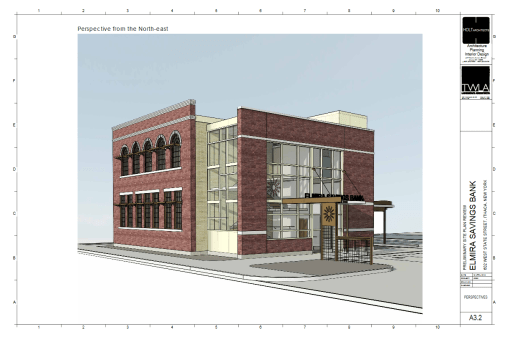
elmira_savings_v2

7. Taking a glance at the Ithaca Projects Review committee meeting agenda, the Elmira Savings Bank and 201 College Avenue projects will be undergoing review before heading to the planning board meeting later this month, and the subdivision/reconfiguration to build two two-family houses at 312-314 Old Elmira Road will also be reviewed. There are also a boatload of zoning variances being sought for various projects – Marriott signage, an apartment reconfiguration on Farm Street, a basement home salon on Center Street, a home addition on Cobb Street, parking variances for 121 West Court and a area variance for an existing carport on Grandview Avenue that was apparently never approved by the city when built in 1973. In total, there are nine. It’s times like this that the city would benefit from a simplified zoning code.


News Tidbits 4/30/16: Sticking to the Plan

30 04 2016

chapter_house_v4_1

1. So, let’s start off with the bad news. Chapter House might not be happening. Josh Brokaw at the Ithaca Times had the scoop, though not for a lack of trying on the Voice’s part – rumors had arrived in the inbox well before the Collegetown construction roundup article. I’ve reached out to Jerry Dietz, the building manager for the Chapter House project, four times over the past couple of weeks, without response. One of those was an in-person visit that went un-received. My Voice editor and colleague Jolene Almendarez has also been trying to do her share of contacting relevant parties, to no avail.

Anyway, personal discontent aside, The co-proprietor of the Chapter House (and the only one willing to say anything on record) says that he believes a sale of the 400-404 Stewart Avenue property is imminent, with the potential buyer being the next door neighbor of the also-destroyed 406 Stewart Avenue. The claim is that a more cost-efficient plan would be put forth, which could eliminate the Chapter House from its plans.

One thing to keep in mind is that the property is on the edge of the East Hill historic district – the Ithaca Landmarks Preservation Commission can control just about every aspect of the exterior, but they don’t have say over use any more than zoning permits. They can stipulate the extra expense of appropriate material and image, but they can’t stipulate a bar (and a lot of commission members would be uncomfortable with that anyway). Dunno how much the insurance money was, but the finances just may not work. It would be unfortunate, but as they do in golf, they’ll play the ball where it lies.

college_crossing_2

plan-1

2. Noting, briefly. Evan Monkemeyer, the developer behind the cancelled College Crossing project, might be partnering with another developer to create and put forward a plan for the corner of Route 96 and East King Road. This is according to the town of Ithaca’s planning staff. Monkemeyer has not hidden his discontent after his suburban-style mixed-use project became the subject of heavy debate because the site plan, originally approved in 2007, no longer meshed with the town’s interests, which had evolved to more New Urbanist formats put forth by the 2014 Comprehensive Plan and the Form Ithaca charrettes. Monkemeyer owns about 64 acres on the northeast side of the intersection, and more than 15 acres as part of Springwood on the southeast side of the corner. In other words, virtually all the divvied up land and conceptual buildings on the lower right side of the charrette image. This could be something to keep in eye on over the coming months.

maplewood_v3_2

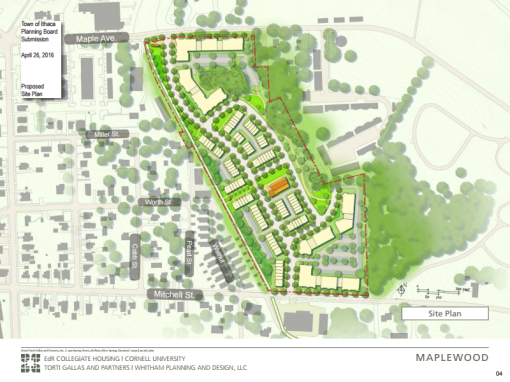
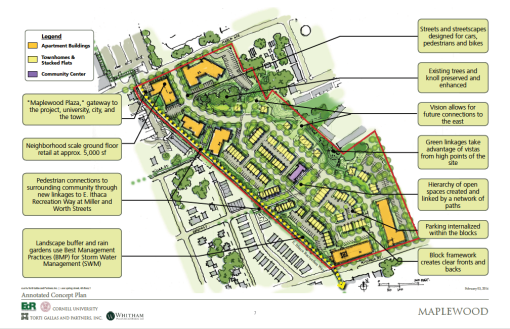
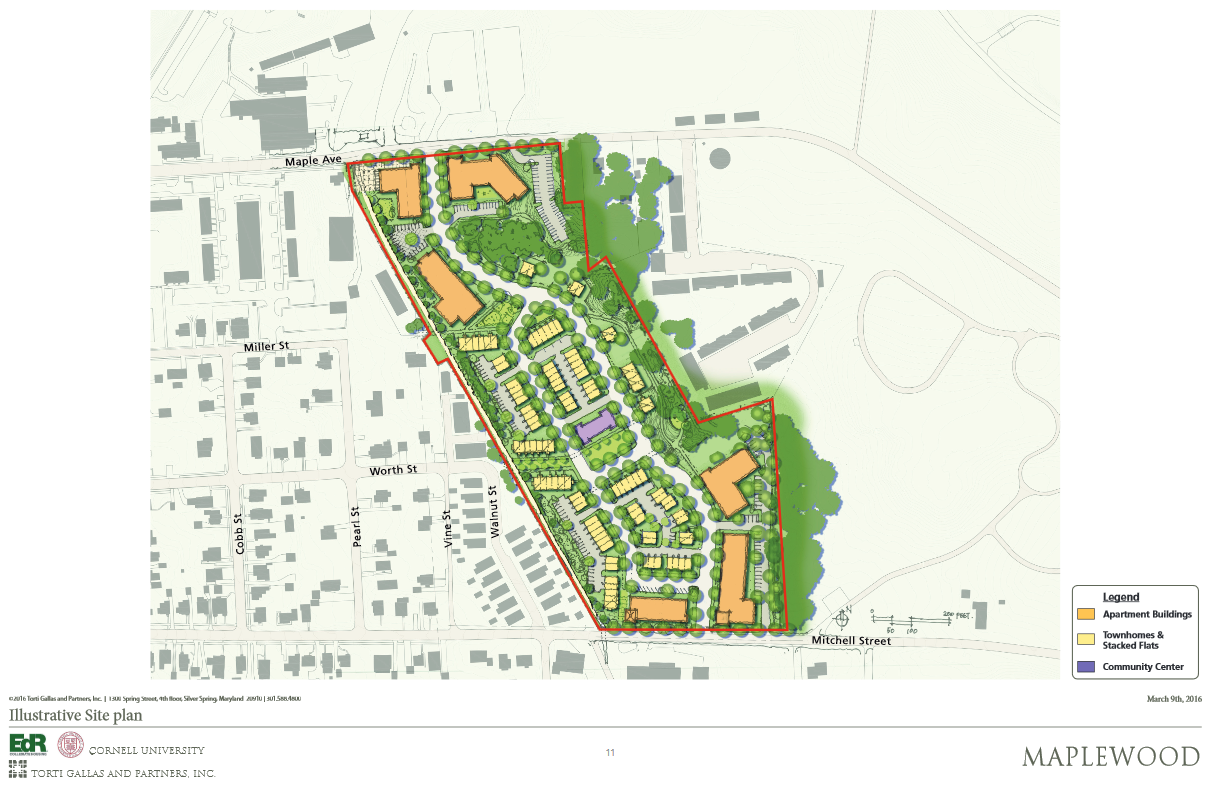
3. Here’s the latest iteration of the Maplewood Park site plan. A lot of changes from the previous version. To sum up the changes, the apartment buildings, 3-4 stories, have been pulled back from existing homes, the townhouses and stacked flats have are more centralized and closely clustered, and mixed-use retail/apartment planned for the city is now in the town, all the city has in its portion is green space and perhaps a small service area/ bus shelter.

Also note the secondary road that terminates right at the edge of the Maple Hill property. Chances are very good that would feed into a phase II that redevelops the Maple Hill property.

The large parking lot in the southeast corner doesn’t seem to jive with the rest of the plan, previous versions had the parking more dispersed. Since Cornell has an idea of the number of residents it wants for the project to be feasible to build and affordable on grad student stipends (850-975, centering around 925 beds in 500 units), if housing is decreased in one part of the parcel, they’re going to have their development team make up for it somewhere else. One of the bigger points of contention seems to be Cornell trying to avoid drawing traffic in by keeping larger buildings further out, while neighbors from various angles try and push the units as far away from them as possible.

maplewood_v3_3

Maplewood has a website up sharing meeting notes and presentation materials here. Future meeting information will also be posted to the Maplewood website. The project will be filling out an Environmental Impact Statement (EIS) not unlike Chain Works, because of the project size and potential for adverse impacts (and therefore the need for proper mitigation before plans can be approved). The scoping document for the EIS, which is an outline that says what will be written about where, is on the town’s website here.

maplewood_v3_4

Just for the record, the print version of a recent Maplewood write-up on the Times claimed to have a quote from me. It was not. The online version of the piece has the corrections. The quote wasn’t even something I would say, because I don’t think Cornell attempting to house a greater number of its graduate and professional students is an “unsustainable development goal”. Quite the opposite, it’s crucial they do that to relieve some of the pressure on the rest of the local housing market.

202_hancock_1

4. Looks like some of the IURA’s recommended funding Action Plan is out. Habitat for Humanity gets the full $75,000 request, as does INHS with the $100,000 requested for their new single-family build at 304 Hector Street. Most of the 202 Hancock project, the seven for-sale townhouses, was recommended for funding – $530,000 of $567,000, ~93.5% of the request.

815_s_aurora_4 815_s_aurora_1

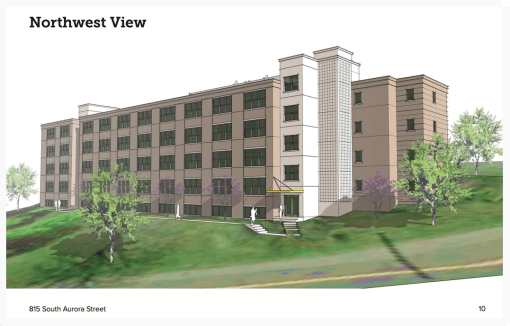
5. At the Common Council meeting next Wednesday, the city is set to vote on reducing the fall-zone radius for cell phone towers, from double the tower’s height (200% of tower height), to 120% of the tower’s height. The move will potentially allow an iteration of Modern Living Rentals’s 815 South Aurora project to move forward with further planning and review. The 87-unit project was planned on the assumption of 100% tower height plus ten feet, so in the case of the 170-foot South Hill cell tower in question, the law would call for a 204 ft. radius, not 180 ft. as the developer hoped. But still, it’s a lot less than the 340 ft. it currently is. The developer may seek a smaller project, build taller, a greatly-revised footprint, or other options. We’ll see how it plays out.

20160414_114709 20160414_114818

201_w_clinton_1

5. House of the week. Back in March, it wasn’t certain whether 201 West Clinton’s “sawn-and-batten wood” would be left unpainted, or painted yellow. Looks like the former is correct, based on the east face of the 1-bedroom carriage house. The ZIP panels were still exposed on the other faces when I shot these photos, but based off what could be seen through the windows, interior work is progressing nicely, and the garage door has been attached. Local architect Zac Boggs and partner Isabel Fernández are building the 520 SF addition atop an existing 1960s garage.


The Chain Works District DGEIS, Part One: Introduction

20 04 2016

chain_works_rev3_3

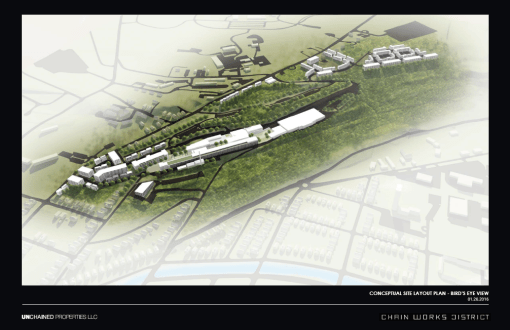
Chain Works is, without a doubt, the single largest project currently being considered in the Ithaca area. It’s a very large project in terms of square footage, in terms of cost, in terms of length of build-out. Being such a large and important, it needs to be examined carefully – it could help propel Ithaca’s economy and ambitions to a higher quality of life, or it could serve as 95 acres of dead weight.

Between March 29th and May 10th, the city is receiving public comments on the Draft Generic Environmental Impact Statement, the DGEIS. The city’s website appears to be outdated, but the Chain Works District website is up to date – any comments readers might have, any questions or concerns, are submitted to the City of Ithaca Planning Board as lead agency for environmental review. UnChained Properties LLC, the developer, offers a blank form here, or if one prefers, comments can be sent directly to Ithaca senior planner Lisa Nicholas at lnicholas@cityofithaca.org.

What a DGEIS does is evaluate the potential impacts of growth on local resources and facilities, such as traffic, water supply systems, utilities infrastructure, social and aesthetic impacts. The DGEIS, which will need to be finalized, is part of New York State’s Enviromental Quality Review (SEQR, pronounced “seeker”) and a necessary precursor to any planned/contemplated construction and development of the site.

So, the DGEIS main body is 422 pages, with about 3 GB’s worth of appendices. Although 45 days is allotted for public comment, not a whole lot of people want to read through 422 pages, but the table of contents allows people to jump around if there’s one or two thing they’re more keen to read about. A link to the DGEIS is offered by project partner Fagan Engineers here, but you might need to submit an email and name before being able to see it.

chain-works-map

So, basic details, per the “Description of Action”:

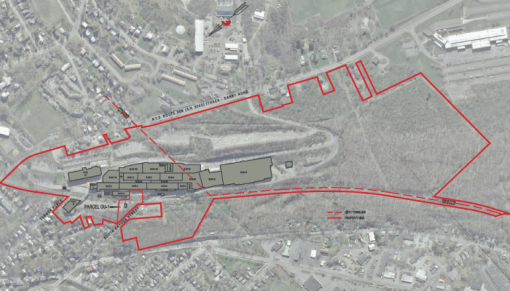
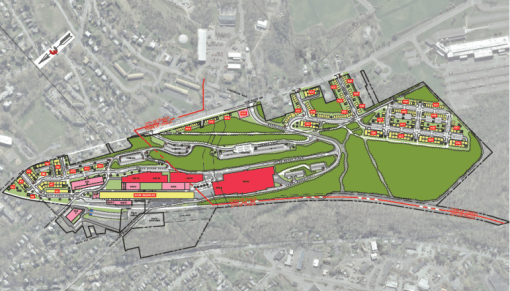
Chain Works District Project is a proposed mixed-use development consisting of residential, office, commercial, retail, restaurant/café, warehousing/distribution, manufacturing, and open space within the existing 95-acre Site which traverses the City and Town of Ithaca’s municipal boundary . Completion of the Project is estimated to be over a seven-to-ten year period. The first phase, referred to henceforth as Phase I, will consist of redeveloping four buildings generally located at the northernmost and southernmost ends of the complex of existing buildings. These first four buildings are approximately 331,450 square-feet (SF), and will house office, a mix of office and residential, and industrial uses. Subsequent phases of development will be determined as the Project proceeds and will include new structures to complete a full build-out of 1,706,150 SF.

So, just based off that, anything that gets developed, is as the market and NYS Dept. of Environmental Conservation (DEC) allows. If the market isn’t amenable or the cleanup plan isn’t approved, don’t expect the plans to move forward all that fast, if at all. If the market is good and the DEC signs off on plans, expect the build-out to be on the shorter end of the 7-to-10 year time-scale.

chainworks-before-771x441

chainworks-after-771x441

Related infrastructure work for the Project will include: (1) removing select buildings to create courtyards and a network of open spaces and roads; (2) creating pedestrian, bicycle, and vehicular connections through the Site from South Hill to Downtown Ithaca; (3) improving the existing roads within the Site while creating new access points into the Site; (4) mitigating existing environmental impacts from historic uses; (5) fostering the development of a link, the Gateway Trail, to the Black Diamond Trail network; and (6) installing stormwater management facilities, lighting, utilities, and plantings.

No big surprises – some buildings in the interconnected complex will come down, shared road concepts will dominate the internal transportation system of the neighborhood, the site will be more fully integrated into South Hill and trails, and usual site details like stormwater plans and landscaping are going to be incorporated into the project.

Given its complexity, the project team is pretty broad – eleven organizations, from the Ithaca, Elmira, Corning and Rochester areas. Local firms include STREAM Collaborative, which helped draw up the design standards and rezoning, Randall + West for more rezoning work, and Brous Consulting, which is handling public outreach. UnChained Properties is headed by David Lubin of Horseheads (suburban Elmira). From what I’ve been told, project development to-date has cost somewhere around $2 million dollars.

Likewise on the approvals – the project will need something like fifteen approvals from a dozen different government groups and agencies.

chain_works_history

Let me share an introduction and summary comparable but maybe more approachable than theirs – a background primer on why this is happening can be found on the Voice in my introduction article here, and Mike Smith’s summary article here.

Much of Chain Works reuses what was once the Morse Chain / Emerson Power Transmission (EPT) factory, which employed thousands from the 1900s, up until the last workers were let go and the facility shut its doors in 2011. During the mid 20th century, industrial processes used chemicals and compounds that are known to be toxic – Trichloroethylene (TCE) being the best known, but also heavy metals and oils. These not only affect the site and its building, they’re also in the soil and groundwater of South Hill.

chain_works_contamination

The site is classified as Class 2 Superfund site, which the DEC describes as “a significant threat to public health and/or the environment and requiring action”. While EPT is responsible for clean-up, they’re only responsible for the bare minimum (the industrial standard, what can be safely exposed to for 8 hours) unless otherwise specified by a proposed reuse, in which case they have to clean to a higher standard like residential use.

So that leaves us at present – a vacant 95.93 acre, 800,000 SF industrial site split between municipalities and with varied terrain and conditions. One of the most basic goals of CWD is to get the city and town to rezone the land to allow a mix of uses – PUD/PDZ, which give flexibility in site development based off of standards the developer, the city/town, and in this case NYSDEC mutually agree to.


chain_works_form_districts_1

So, in the PUD/PDZ, one of the broad takeaways is that each of the four form code has its own design standards – height, width, window-spacing, setbacks and most physical details, even signage. Unlike typical zoning, it’s the appearance that is more thoroughly managed, not the use. Those can be found in detail here. The design standards utilize what’s called LEED ND (Neighborhood Development), design standards created for large-scale green, well-integrated and sustainable development. A gated community it ain’t.

The goal of these design standards is to mitigate some of the adverse impact the new and renovated buildings will have on the community – promoting alternate transit reduces traffic, limiting floors and floor heights reduces visual impacts, and so on.

Build-out falls under four general form zones: (1) CW1- Natural Sub-Area, 23.9 acres of old woodland to be limited to passive recreation. (2) CW2- Neighborhood General Sub-Area, 21.2 acres of townhouses, stacked flats and similar moderately-dense development, mostly in Ithaca town; (3) CW3- Neighborhood Center Sub-Area, 39.7 acres of mixed-use, in a combination of renovated and new buildings towards the northern end of the property in the city, and (4) CW4, Industrial Sub-Area, a 10.3 acre zone for industrial uses in existing buildings at the Emerson site. The site borders Route 96B, single-family and multi-family homes, natural areas and steep terrain.

About 0.91 acres will be subdivided off and maintained by Emerson for active groundwater treatment. The other 95.02 acres would be sold to UnChained Properties.

chain_works_form_districts_2

The re-development is fairly multifaceted. Some buildings will be renovated, a few will come down, a couple will receive additions, an quite a few others, like those in the all-residential CW2 zone, will be brand-new. Specifically in Phase One, four buildings – 21, 24, 33 and 34, will be renovated.

In Part Two, we’ll take a closer look at the neighborhood design standards and detailed plans for Phase One.


News Tidbits 4/9/16: A Slippery Situation

9 04 2016

maplewood_site_plan_concept

maplewood_site_plan_concept_v2

1. The town of Ithaca had their first substantive meeting about Cornell’s Maplewood Park Redevelopment, and later this month, the city of Ithaca will have their take on the 4.5% that sits within their boundaries (picture a line up Vine Street – that’s the city line). According to documents filed with the city, approvals from them will only be needed for one building. Application/SPR here, cover memo from Whitham Planning and Design here, Part I of the Full Environmental Assessment Form here, and narrative/drawings here.

From the SPR, the schedule as already been shifted slightly to an August 2018 completion rather than July – they also threw out a $3.67 million construction cost that doesn’t make much sense offhand. Edit: It looks like it’s just a basic estimate of 4.5% of the total project cost of $80 million.

The biggest change so far is a revision of the site plan. In response to community meetings, Cornell shifted smaller 2-3 story stacked flats and townhouses closer to the Belle Sherman Cottages, pulled back a couple of the larger apartment buildings, and added a new large apartment building to the southeast flank. Cornell has its goal of housing at least 850 in the redevelopment, so all design decisions revolve around accommodating those students with their families, while coming up with a design the community can live with.

The city will vote at its April meeting to defer Lead Agency to the Town of Ithaca, which will leave them with the ability to provide input, but the town board will be the ones voting on it.

2. It’s not often that a project gets undone by a single public commenter at a meeting. But the Journal’s Nick Reynolds got to experience such a momentous occasion at the town of Ithaca’s planning board meeting. He documents it on his Twitter account.

Someone that I didn’t cover because it wasn’t especially news-worthy is Cornell’s plan to replace the Peterson Parking Lot at the intersection of Tower and Judd Falls Roads with a cutting-edge 100% porous paved lot and a Cornell-created soil designed to promote rapid growth of trees in high traffic areas (a new island would be built in the middle of the lot). Basically, an eco-friendly, less-invasive parking lot, if there ever could be a thing.

Then Bruce Brittain, the Forest Home community historian, completely undid the plan with a contour map. Generations ago, the property was filled with debris and garbage, even old construction trucks. And while there may be a parking lot on it now, a porous lot, which would be heavier when watered, is liable to collapse right onto the Plantations below. Meaning, no porous lot, no green showcase. Back to the drawing board Cornell.

201_college_1

201_college_v2_1

3. Here’s a little more information on the 5-story, 44-unit/76-bedroom apartment proposal for 201 College Avenue. SPR Application here, FEAF here, project narrative here, BZA worksheet here, drawings here , letter of discontent from Neil Golder here. Looking at the drawings, there have been some slight revisions, mostly with the College Avenue entrance and the materials and fenestration at street level. The SPR gives us a $6 million construction cost, and a proposed construction time frame of July 2016 – August 2017. Units will be a mix of 1 to 4 bedrooms (24 1-BD, 12 2-BD, 4 3-BD, 4 4-BD). While the project falls into the Collegetown Form District, an area variance will be required for a front yard setback from College Avenue, which the board feels will help the street be more like a boulevard.

The city planning board is expected to Declare itself Lead Agency for environmental review at the April meeting. Developer Todd Fox hopes to have approval by the end of the June meeting. STREAM Collaborative is the project architect.

902_dryden_final

4. This week’s eye candy comes courtesy of Noah Demarest and Todd Fox (yes, they seem to be getting a lot of mentions this week). It had occurred to me that while an image of the revised 902 Dryden townhouses had been presented at the meeting where it was approved, the town never uploaded the copy. Noah and Todd were kind enough to send me a copy of the image presented at the meeting, and gave their permission to share it here. 8 new units, 26 new bedrooms. The duplex building in the middle already exists, but two new units will be built opposite a shared wall. Two three-unit clusters will be built on the east side of the parcel.

Cayuga-Meadows-Shot

5. It’s official as of March 28th. Construction permits have been issued for Conifer LLC’s 68-unit Cayuga Meadows project on West Hill in the town of Ithaca. Expect the first construction update, and a synopsis, when the first construction update comes around, which won’t be until mid-to-late May since West Hill projects get visits during odd-numbered months.

6. Just a couple minor city subdivisions to pass along. One, an application in outer Collegetown at 513-15 Dryden Road to separate the land into two parcels (513 and 515). The lot owner will then build himself a new house on the vacant lot. CR-1 Collegetown Form District, and it looks like no variances will be needed.

The other subdivision is on the city’s portion of West Hill. The property is a vacant lot that borders Westwood Knoll, Taylor Place and Campbell Avenue. The property owners, who live next door on Westwood, want to divide the vacant lot into two vacant lots to sell for single-family home construction. Once again, it looks like no zoning variances will be needed, just regulatory PB approval.

With the consolidation and realignment of 312-314 Spencer Road mentioned last week, this makes three subdivisions scheduled this month. That’s pretty unusual, as the city typically sees only one every 2 or 3 months on average.

7. Looks like someone made a tidy profit. Local landlord Ed Cope picked up 310 and 312 E. Buffalo Street for $885,000 on the 6th. 310 E. Buffalo is a 6-unit apartment building, 312 is a parking lot. The previous owner, a Philadelphia-based company, picked up the properties for $800,000 back in October 2014. So, $85,000 (+10.6%) for 18 months of ownership. The properties are part of the East Hill Historic District, where the Philly-based firm recently had a hell of an experience because the owners before them replaced the windows without notifying the city, and that was a big no-no as far as historic districts and the ILPC are concerned. They mandated the windows all be replaced with more historically-appropriate fittings. Hopefully that came up during the sales negotiations.

For what it’s worth, the parking lot is zoned R-3a – a 4 story building with 35% lot coverage. Since it’s in a historic district, a hypothetical proposal would likely look a lot like its neighbors.

11-24-2012 171

8. And another big sale this week, on Friday – the house at 210 Thurston sold for $2.5 million to the Alpha Chi Omega sorority. The house had been on the market since last November for $2.75 million. This actually sold relatively quick, given its large size and fairly unique nature. The seller purchased the property for $677,500 in December 2011, and renovated the property for use by the Cornell wrestling team.

Alpha Chi Omega has occupied the house at 509 Wyckoff Road for a number of years, but did not own the property – the owner, who picked up the property in 1971, is a business partner of Kimball Real Estate.


Coming Up: Yet Another Round for CIITAP Revisions

9 03 2016

The city is trying yet another approach to CIITAP. This one involves cash payments.

Previously, the city considered a multi-faceted set of revisions, but a number of issues were raised – namely, there isn’t good documentation on stats such as the proportion of local labor typically involved in a CIITAP project. While the IDA voted in February to adopt a labor policy that requires solicitation of bids from local contractors and local labor participation in CIITAP projects, that’s more to provide future guidance after some projects have submitted documentation, and doesn’t achieve any near-term changes in CIITAP as requested from some corners.

So here comes the latest iteration, a lump sum deposit into a “community benefit fund” for general use (hopefully a formalized HOME/CDBG type of disbursement and not just a grab-bag for different programs). The idea was raised at the last PEDC meeting and the IURA explored options.

The overlying theme is to select a plan that doesn’t change affect bottom lines – not to make any easier on developers (the accusations of the current CIITAP being too easy is what brought about this revision in the first place), but to not chase them out to a hay field in Lansing either, costing the city a fund payment, jobs and future tax revenue, not to mention encouraging suburban sprawl. The IURA looked at a bunch of different proposals, shown below.

ciitap_revision_round2

The preferred option goes for a 1% upfront cost and a total abatement on increased property taxes for three years, and then moving to a 70% abatement on new construction for year 4, tapering to full taxation after year 10. This option was determined to have the least impact on a project’s financial feasibility.

ciitap_revision_round2_2

There’s a positive and a negative to this approach. If a developer is proposing a $20 million project, forking over $200,000 to the city right off the bat could be a major obstacle towards getting a loan and bringing an approved project into reality. But it might be overcome if they can effectively explain to an investor or potential lender the tax benefits in the financial analysis. It definitely makes the development picture more complicated, but this might be the only way to keep the current version of CIITAP, which has done a lot to help redevelop downtown. The Common Council members will share their at their Wednesday meeting.