News Tidbits 4/11/15: Not Feasible As Presented

11 04 2015

dpi_libe_0414_end

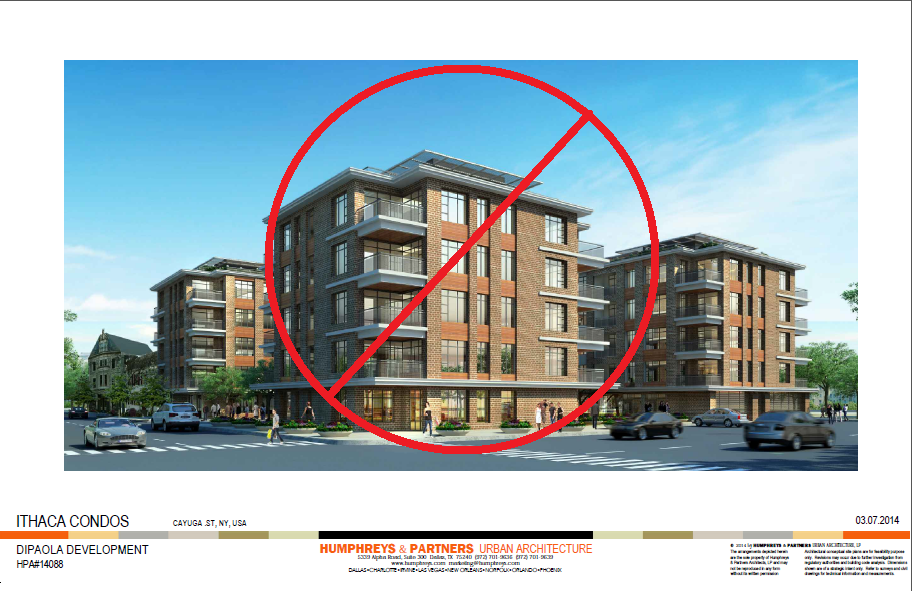
1. If my inbox has been any clue over this past week, there are some folks who are pretty unhappy with the results of the county’s Request for Proposals (RFP) for the Old Library site. One more applicant has dropped out of the process – DPI chose not to respond to the RFP. DPI had proposed 76 condos and 8 apartments for the site, a move that was cheered by some residents who spoke passionately about the new for purchasable housing in the city. That leaves three contenders of the original six:

-The Syracuse-based Franklin Properties project, now called the West Court Lofts and Wellness Collective, would renovate the existing building and include 22 residential condominium units (down from 32 units in the RFEI), medical offices, a café, and community room.

-The Rochester-based Cornerstone Group project, known as the Dewitt Senior Apartments, would build 63 residential units of senior housing (down from 70-80 units in the RFEI), and include community space for nutrition education by Cooperative Extension.

-The Ithaca-based Travis-Hyde Properties project would build 60 residential senior-focused units (up from 48 units in the RFEI), and would include space for Lifelong, professional office, and a community room.

There have been no renderings published as of yet, but there will be a stand-alone post when they show up on the county’s website. The three proposals will be judged against each other over the course of the next couple months. A quick glance at the judgement criteria can be found in the Old Library meeting notes here.

The next meeting of the Old Library committee is scheduled for Thursday, April 30th at 9 AM. 5 PM Meetings will be set up during May for developer presentations to the public. Comments on the proposal can be emailed to Ed Marx, the County Planning Commissioner, at emarx@tompkins-co.org with the subject title “Old Library Property”.

2. Local credit union CFCU (Cornell-Fingerlakes Credit Union) is making some moves by buying a retail commercial strip with an eye towards redevelopment. The property, 501-507 S. Meadow Street, sold for $1,555,550 on March 30th, well above its assessed value of $950,000. According to a statement taken by the Ithaca Journal, “the current intention is to ultimately use the site for credit union-related purposes”.

The one-story, 9,203 sq ft strip buildings date from 1980 and 1990 and previously housed a Thai restaurant and offices for Lama Real Estate, the business of previous owner Robert Lama. The site is currently zoned the suburb-friendly SW-2, but like much of big box land, it has been targeted for urban mixed-use in the city’s Comprehensive Plan. CFCU is currently headquartered in about 30,000 sq ft of office space in two 1990s office buildings at 1030 and 1050 Craft Road in Lansing.

In short, nothing immediate going on here, but definitely a property worth keeping an eye on.

texas_roadhouse__v2_1

3. The proposal for a Texas Roadhouse on in Southwest Ithaca is getting a couple minor revisions. According to a cover letter from the restaurant chain, plantings have been revised to break up the expanse of blank walls, handicap ramps are now present in the new elevations, and signage has been tweaked. All in all, not a big change from the previously-shown drawings. It doesn’t look like this one will have too many issues moving forward.

canopy_hampton_rev4_1

4. At the city’s Planning and Economic Development Committee (PEDC) meeting on the 8th, the city voted to approve the sale of land at 320-324 E. State Street to Lighthouse Hotels LLC for construction of the new Hilton Canopy Hotel. Also up for discussion was the removal of 30′ setbacks on all sides of the special MH-1 zoning at the Nate’s Floral Estates mobile home park on the west side of the city. With the 30′ rear yard setbacks already in place and vegetative buffers installed by the big boxes to the south, it was felt by the city economic developer planner that the additional setback was redundant. The removal would facilitate setbacks reduced to 10′ on one side and 5′ on the other side, if I’m reading this right. According to the notes, the mobile home park has a waiting list of tenants. The proposal looks like it will allow a few more units in the park, though it looks pretty tightly packed as-is.

flatiron_1

5. According to the Ithaca Urban Renewal Agency (IURA) notes from the April 2nd meeting agenda, the board was not impressed with the Flatiron proposal. On page 6, it gives the project low pritority, with the description “not feasible as presented“. On the other hand, the INHS Hancock Street project was well received and given high priority.
402_s_cayuga_st_rev2_1

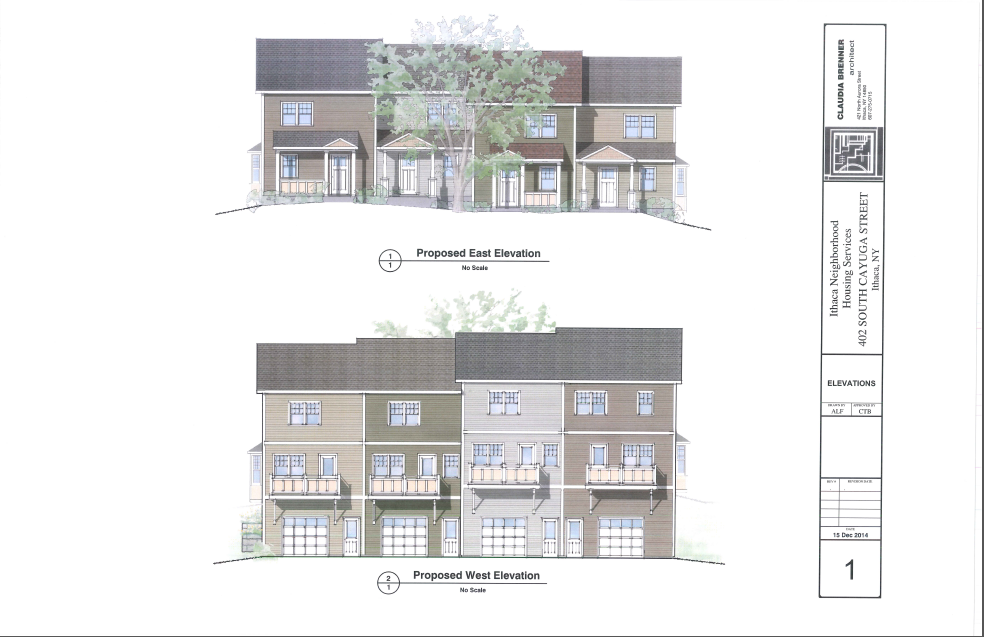
6. Looking at the March Planning and Development Board meeting minutes, 402 S. Cayuga Street has been approved, pending BZA approval of the variance (which was granted this week, if I have my notes right). The 4-unit, 9-bedroom project may be small, but it’s thoughtful infill and will help bring some affordable owner-occupied housing back into the city.

Approvals were also granted for the city project to replace the Lake Street this summer and fall, and refurbish the pocket park to its southeast. 210 Hancock was discussed without any voting, and sketch plans were presented for the TFC HQ downtown, and the 215 West Spencer Street apartment project, which have been written about previously. The board also discussed added additional questions to the CEQR (the city’s version of the SEQR used in project impact analysis), and the revised paperwork will be reviewed at a later meeting.

Oh, and on a more personal note, this totally made my day:

D. 2014 Planning Board Annual Report

[Senior city planner Lisa] Nicholas briefly walked through the annual report, observing it was a very busy year with a considerable number of additional housing units built. [Board member Garrick] Blalock asked if the annual report is publicized. Nicholas replied, no. Blalock replied it should at least be sent to the “Ithacating in Cornell Heights” and “IthacaBuilds” web sites. Nicholas agreed to do so.
I’ll be excited to have a copy. This would make scouting locations where construction photo updates are required a lot easier.

7. Wrapping this up with one final news piece, it looks like Dunkin’ Donuts is moving into the old Johnny O’s space at 406 College Avenue in Collegetown. So there will be one corporate coffee shop next to another corporate coffee shop and sharing a wall with a trendy fro-yo place. There’s probably a sociology thesis to be had in studying the changing retail scene of Collegetown.




News Tidbits 3/28/15: It’s Affordable Housing Week

28 03 2015

The unplanned theme of the week: affordable housing projects.

1. This week and next, the Ithaca Urban Renewal Agency will be holding public hearings as part of the process to determine who will receive money from the Housing and Urban Development (HUD) grants awarded to the city. The 21 applicants ranges from jobs training to community services to the development of affordable housing. In total, $1.78 million has been requested, and there’s $1.215 million available, just a little over two-thirds of the total requested.

Without discounting the value of the other applications, the focus here will be on the real estate development projects. For the record, writing about a project is neither an endorsement or opposition from this blog.

inhs_pride_design_3

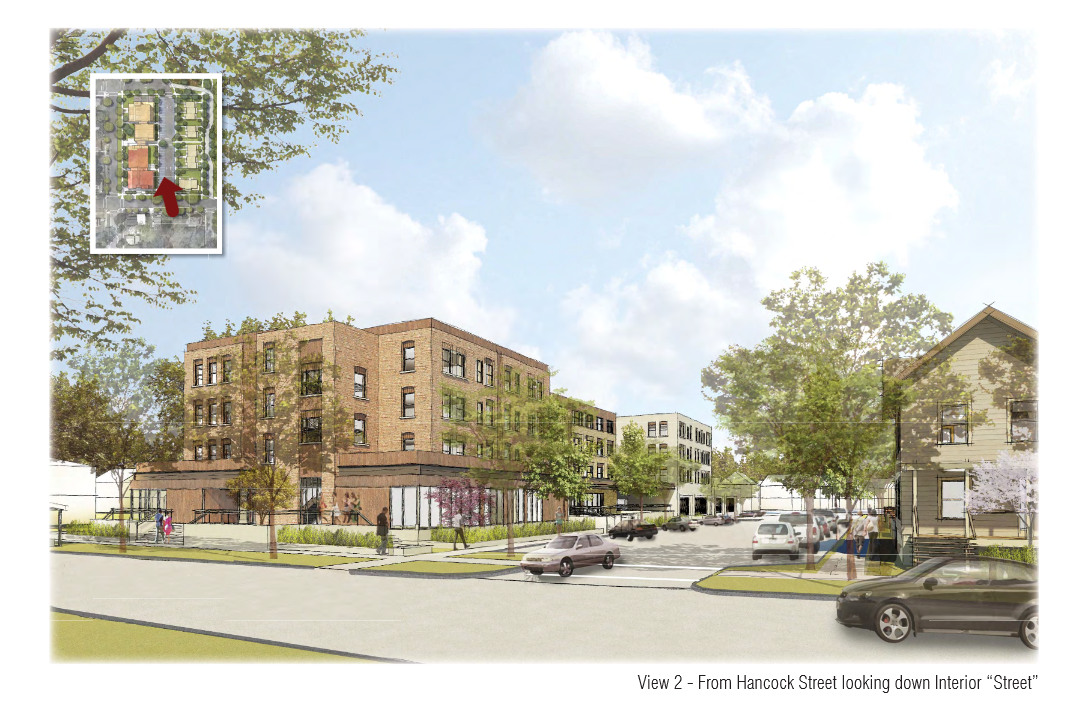
A. INHS is requesting $457,326 dollars for its 210 Hancock Street redevelopment project (also known as the Neighborhood Pride site). The total cost of the project as stated in the application is now up to $17.3 million. The application only applies to the apartment buildings, not the townhouses. The townhouses and apartments are going to be subdivided into separate parcels, because certain affordable housing funds are targeted towards renters and others towards homeowners. Subdividing the Neighborhood Pride parcel into the apartment and owner-occupied parcels will make for a smoother application process, and they’ll be separate projects within the larger framework of the 210 Hancock property.

210 Hancock will have 53 apartments – the 3 bedrooms have been eliminated and split into 1 and 2 bedroom units, so the number of units has gone up but the total number of bedrooms remains the same (64). The units are targeted towards renters making 48-80% of annual median income (AMI). The AMI given is $59,150 for a one-bedroom and $71,000 for a two-bedroom. The one-bedroom units will be rent for $700-1,000/month to those making $29,600-$41,600, and the two-bedroom units will rent for $835-$1300/month to individuals making $34,720-$53,720. Three of the units will be fully handicap adapted.

One of the commercial spaces will be occupied by local social welfare non-profit Tompkins Community Action for use in an early head-start program for approximately 30 children from lower-income households. The other two spaces have strong interest but do not have tenants lined up yet.

flatiron_1

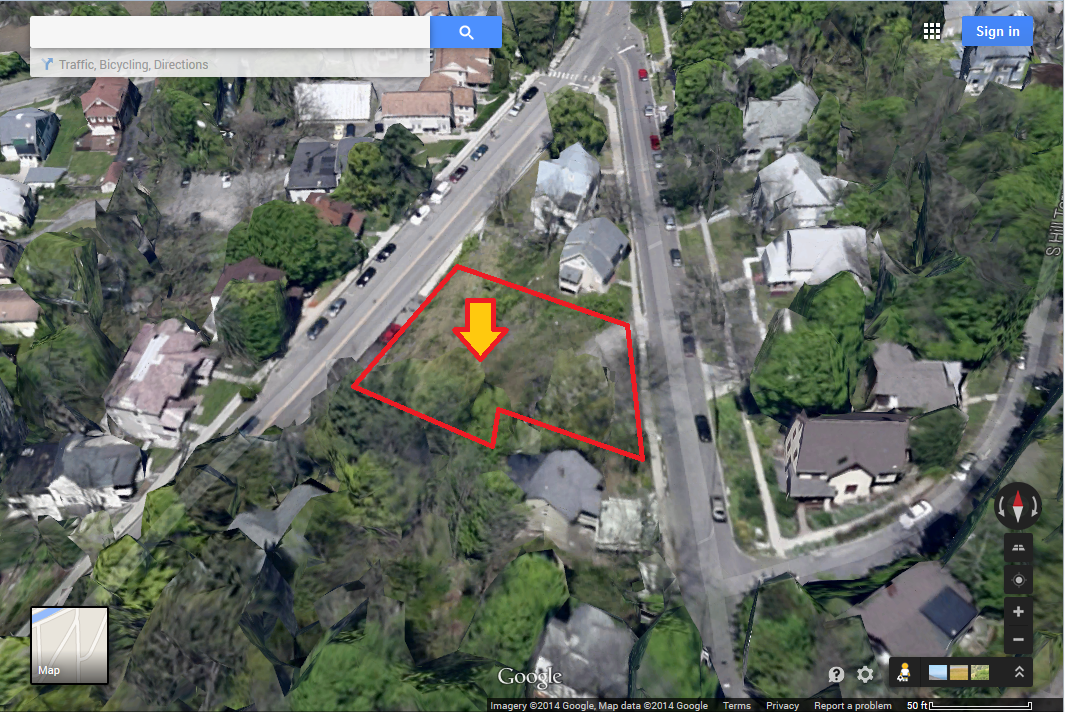
B. This second project is something new. Alpern & Milton LLC (local buisnessman Ishka Alpern and his brother, Franklin Milton) are requesting $250,000 towards a $1,285,000, 12-unit project proposed for Inlet Island called “The Flatiron”. The project seeks a renovation of 4,900 sq ft at 910 W. State/MLK Street (shown above) and a 3,700 sq ft addition onto the neighboring parcel at 912 W. State/MLK. The finished project will resemble the triangular form of the famous Flatiron Building in NYC. the application says “the project will be of a historic nature, but the structure being proposed is not currently, nor will it be, deemed ‘historic’ in terms of housing or building code”. Ten of the units will be available to 30-50% AMI, and the other two will be available to those making 50-80% AMI.

The brothers do have some small projects to their credit, according to the filed paperwork. They handled the renovation of Brookton’s Market and 514-516 W. State/MLK Street. Judging from the google maps dating back to 2012, some renovations have already been done to 910 W. State.

2. In this week’s Journal, there was an article that gave a rundown of recipients of the Tompkins County Affordable Housing fund paid for by a combination of the city of Ithaca, Tompkins County and Cornell. Most of them I recognized – Holly Creek, the Habitat for Humanity duplexes in Groton and Trumansburg, Breckenridge Place and so on.

There was one I didn’t recognize. The Amici House proposal, which is being planned by Tompkins Community Action. I vaguely remember coming across this during the Stone Quarry debate last year, but at the time I couldn’t even verify if it was a real proposal. TCAction is proposing to build approximately 15 units affordable townhouses at 661-665 Spencer Road, just east of the Salvation Army store. There haven’t been any formal plans presented yet, but the project did receive $75,000 from the fund to pay for a pre-development feasibility study.

Farm Pond Site RES'D & LOT s 010414

3. Like single-family home development? Have lots of extra money lying around? The second phase of Lansing’s 21-lot Farm Pond Circle development is up for sale. Jack Jensen, the original developer, passed away last fall. Of the ten lots in phase two, four have already been reserved; there are also two lots left in phase one. The second phase is being offered for $155,000.

The Farm Pond Circle development is fairly stringent. Current deed restrictions limit the size of each housing unit to 2600 sq ft, vinyl or aluminum siding isn’t allowed, and only very specific subsections of the lots can be developed. Buyers aren’t limited to green energy, but there is a strong push in that direction. Also, at least four of the lots are earmarked for affordable housing (single-family or duplexes, buyers muse make  less than 80% of median county income of $53k)). The affordable units, at least two of which have already been built, are being developed in partnership with Jack Jensen’s non-profit, Community Building Works!.

4. It’s back again. The county’s Old Library committee will be meeting next Friday the 3rd at 9 AM in the legislature chambers. The goal of this meeting will be to review the formal proposals received for the Old Library site, which is likely the same four remaining from the RFEI, but in theory it could one or a hundred. Whereas the RFEI submissions were general, the proposals get into the nitty-gritty – site plan, architectural details, funding, time frame, proponents, all of it. Expect revisions to the previous four designs as a result of commentary from the public and legislators.

Since most folks can’t make Friday meetings, if anyone has general comments, conflicts or concerns about the proposals, I’ll just leave the committee’s contact info here: Legislature@tompkins-co.org. Use “Old Library” as the subject.


Ithaca Jobs Numbers Revised – Vindication Feels Good

19 03 2015
I predicted between 69,600 and 70,100. Looks like I’m right, for now.
***
March is an important month for the Bureau of Labor Statistics; it’s the month where the previous three years’ of data are revised. For Ithaca, it’s yielded some very interesting results.

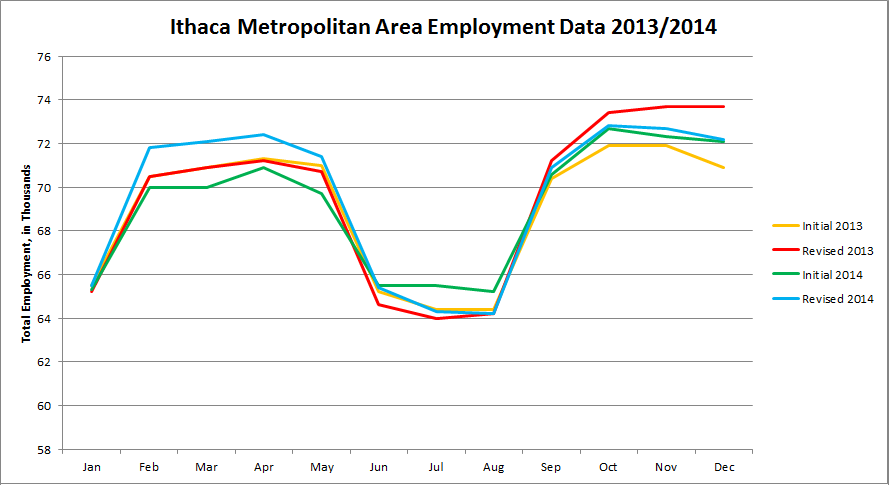
First off, the 2013 numbers have been revised from a yearly average of 69,000 to an average of 69,400, a 2.8% increase or 1,900 jobs more than the 2012 averaged job total of 67,500. The 2012 data were not changed.

Secondly, the 2014 total job numbers have also been revised upward, from an initial estimate of 69,150 jobs, to 69,650 in the Ithaca area in 2014. The gain seems paltry compared to 2013’s gains. 250 jobs, a 0.4% increase.

Looking at the data more closely, the 2014 data is, at a glance, alarming – November 2014 lost 1,000 jobs when compared to November 2013. December 2014 lost 1,500 jobs when compared to December 2013.

However, these results aren’t the result of changes in 2014. The Voice looked at archived reports of the initial jobs numbers for 2013 and 2014, which we’ve included below (values shown are in thousands – for example, 69.0 equals 69,000 jobs).

ith_initial_1314

Now here are the revised 2013 numbers and 2014 numbers:

ith_revised_1314

For visual reference, here’s a line plot and bar plot of the numbers.
ith_initial_1314_line
ith_initial_1314_bar

The large drop last Spring has been erased. The drop of 1300 jobs last May is now a gain of 700. Pretty big difference. Spring 2013 job numbers decreased slightly in the revision.Summer employment values were also decreased in both years, which means there is more seasonality to the Ithaca employment cycle than previously estimated.

Fall 2013, by the BLS’s account, had tremendous job growth, with November and December 2013 now tied at 73,700 jobs, the record employment figures in the Ithaca metro. A revision such as December 2013’s, where 2800 more jobs were added, is highly unusual. It is because of this revision that the 2014 numbers look so poorly – compared to the initial fall 2014 values, they were actually increased a little bit, just not as much as 2013’s were.

So what can we expect from the 2014 numbers moving forward? Being the “freshest” data, there is a very good chance they will be revised again next March. For the sake of example, the 2013 numbers were initially 68,000 at the end of 2013, then 69,000 in the March 2014, and now 69,400. We will need to wait and see if the fall 2014 figures are adjusted, and by now much.


News Tidbits 3/14/15: A Spring Thaw and A Warming Housing Market

14 03 2015

215_221_wspencer

1. This past Friday the 6th, the city IURA (Ithaca Urban Renewal Agency) sold off a vacant city-owned property at 215-221 West Spencer Street to Edward Cope for $110,000. The name might not sound familiar, but a quick address check of the sales documents reveals an association with PPM Homes, a local rental company with a few hundred bedrooms in dozens of properties scattered around the city, most of them subdivided homes. Edward Cope also bought a vacant privately-owned lot at nearby 228 West Spencer Street for $15,000 on February 19th. 228 West Spencer, a small, steep site with tight zoning restrictions, was approved last year for one custom house design with 1536 sq ft. of space (the design plans came with the sale). As for 215-221 West Spencer, it was noted in July of last year that the city was selling the parcel (though I was under the impression it had already sold) and the buyer was intending multi-family housing. The 0.47 acre site has the potential for a medium-sized apartment building (20 units), but that’s a simple calculation using the zoning. With topography and neighbor considerations, the reality will be smaller.

In short, keep an eye on these properties, because PPM has the money to make the house and the apartment building happen.

holiday_inn_expansion_1

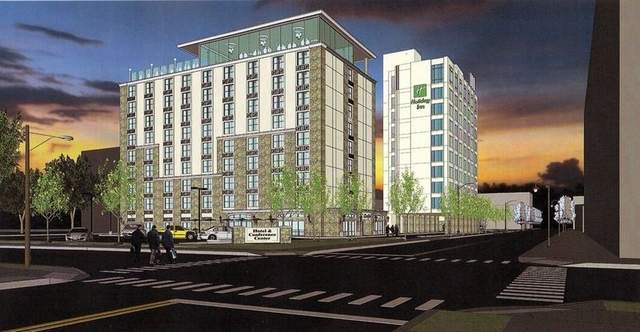
2. From the March IURA Agenda, a few good notes from the attached February minutes:

A. The Hotel Ithaca conference center is still actively trying to move forward.

B. The IURA received an inquiry about vacant land in the Cherry Street industrial park, from a business seeking to relocate into the city.

C. The city is making progress on taking over the state-owned parcel at 508 Taughannock Boulevard, previously used by the U.S. Coast Guard.

D. The former Ithaca Gun site is virtually entirely cleaned up, which will allow the apartment project proposed for the site to move forward with the planning and approvals process.

All things to keep an eye on in the upcoming months.

titus_wood_1

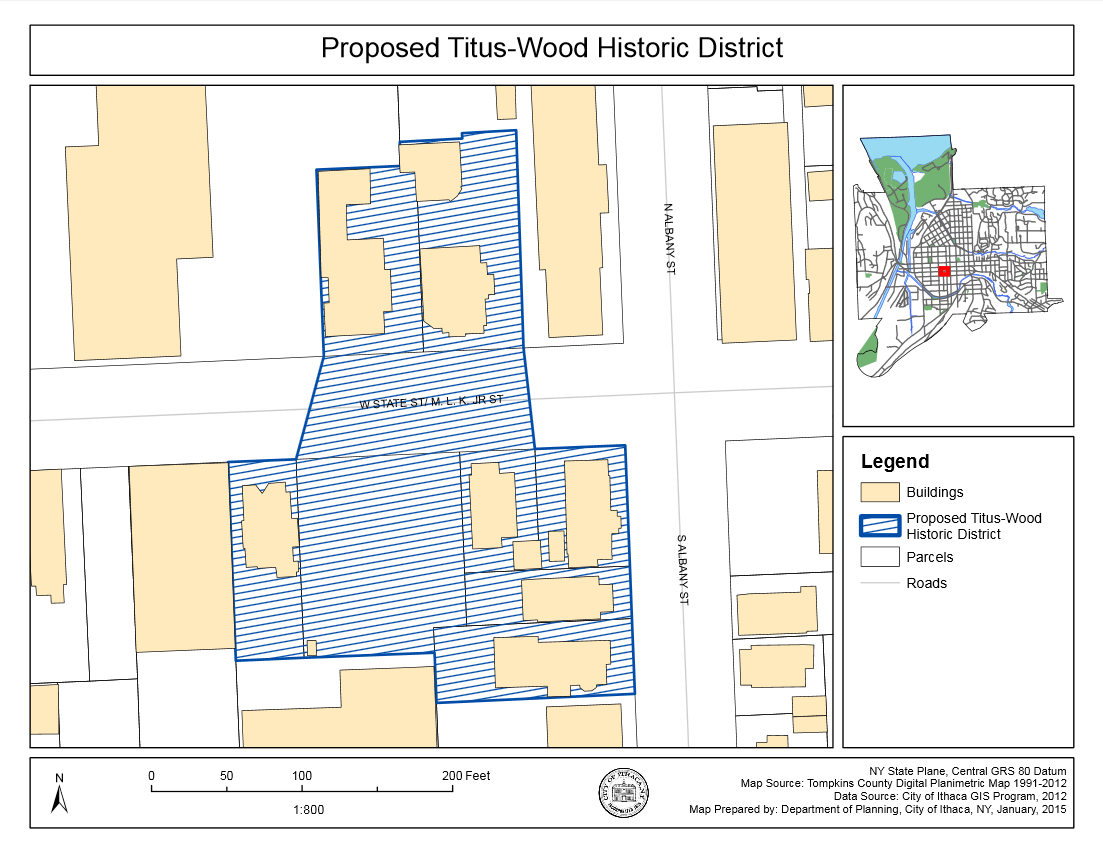
3. Looking at the city’s Planning and Economic Development Committee Agenda, there was quite a pushback from locals and the county for the proposed Titus-Wood historic district. The city fire department objected to landmarking their parking lot, the county wrote a letter opposing landmarking 317 W. State (and 315 W. State, which is not a registered address but could be the parking lot) because it was felt neither was historic enough and that it impeded urban infill, and the owner of 110 S. Albany, Ian Shapiro of Taitem Engineering, protested because his previous experience with the ILPC has been very frustrating, and that the ILPC gives applicants a really hard time over energy conservation efforts such as solar panels.

For the record, he’s not wrong about that. Some ILPC members have not been a fan of solar panels (examples here, here, here and here), and it has been at times a months-long process to get installation approval. It boils down to a dispute of alternative energy use vs. historic preservation, both things that Ithacans love, but can conflict with each other in cases like these.

Regardless of the opposition, the PEDC passed the historic district resolution with a unanimous vote, and the resolution now goes on to the Common Council, who will likely approve the new historic district.

4. Over in Lansing, concerned citizens looks like they can put their fears to rest regarding development of the Kingdom Farm property. The 528.1-acre property sold to a Cayuga County dairy farmer on March 10th for the hefty price of $2.8 million (in other words, $5,302/acre). The farm has been in the possession of the Watchtower Bible and Tract Society (the business branch of Jehovah’s Witnesses) for several decades, and the owners even pitched a 500-unit development for the site in the late 2000s. Back in October when the tax-exempt land went up for sale for $3 million, the Lansing Star reported that some more activist local residents wanted the town to step in and help a farmer buy the land so they could keep the property agricultural. There hasn’t been any news of the town taking that step, and it appears the problem resolved itself without the need of taxpayer dollars. Also, it means the property, assessed at $2.2 million, goes back onto the tax rolls. This might be one of the few cases where everything appears to have been worked out and all can go home happy.

5. 514 Linn Street has come down for a new duplex now under construction. Each apartment unit will have 3 bedrooms and be completed this summer. Although the predecessor building dated from the late 1800s, it was also an early “cookie-cutter” home; 512 Linn was the same design. Fall Creek is mostly developed, but Linn Street is no stranger to new builds – 514 follows a few years after 516 Linn, which was a new home built on a vacant lot.

amabel_v2_1 amabel_v2_2

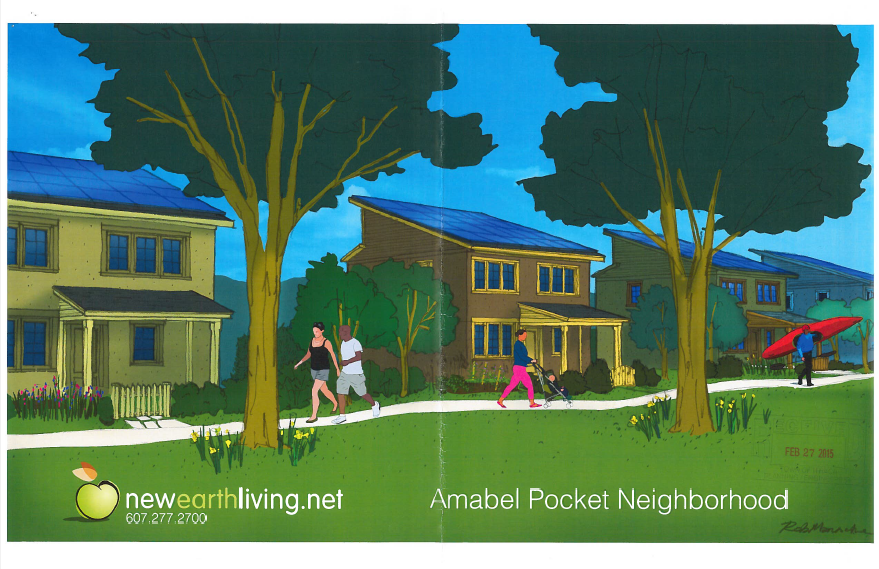
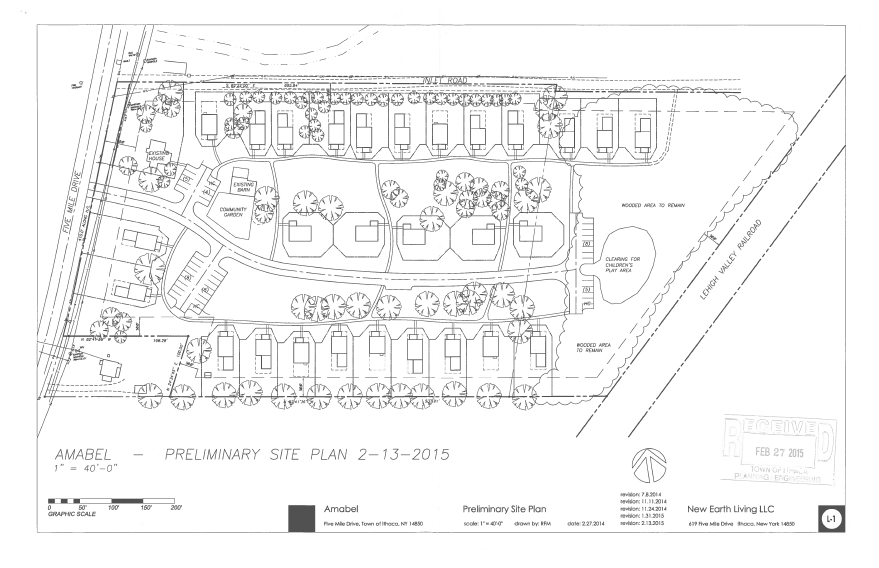
6. Lastly, it looks like the town of Ithaca’s planning board finally has a few things to work on, after having no meeting since early January. For their Tuesday meeting, the town will review plans for more luxury tents at La Tourelle, a new municipal water tank near Sapsucker Woods, and revised plans for the Amabel project off of Five Mile Drive. The number of units has been reduced to 28, and since November, two units were added to the far west portion of the parcel bordering Five Mile Drive (and as it turns out, those center units aren’t duplexes). Contrary to the example render, six different home designs will be available. Developer Sue Cosentini of New Earth Living LLC hopes to begin sales this summer.

Get connected:

Have comments or questions about these projects for your local government? Contact info below:

Town of Ithaca Planning Board: Use the form here – http://www.town.ithaca.ny.us/contact-us

Ithaca Common Council: http://www.cityofithaca.org/341/Common-Council – click on your councilperson’s name, their email is on the subsequent page.


Poking At the Jobs Numbers, Again

9 03 2015

11-24-2012 195

Talk about doom and gloom. One look at the Journal’s webpage and the pessimists are in for a treat. It’s no secret that Binghamton, Elmira and to a lesser extent Syracuse and Utica-Rome have suffering, declining economies. Upstate was the factory of the nation a hundred years ago. Now, for a number of reasons, manufacturing has shifted to the south, or more commonly, overseas. Ithaca’s neighboring metros are suffering.

I’m personally not a fan of the way the article is presented. It’s the highlighted piece of the Journal. But the title doesn’t really apply to Ithaca, and they acknowledge that if one reads the article. A lot of folks will only glance at the title, think it applies to Ithaca, and think that the Ithaca economy is tanking. Question dear reader, how many times have you read an article online, scrolled down to the comments and clearly see the comment of someone who read only part of the article, if any of it at all?

Here’s the Ithaca excerpt, which they title the “Ithaca Oasis”:

“Ithaca is the sole economic oasis in central New York. Since the recession, Ithaca’s private-sector jobs have grown by 10 percent. Only New York City has done better in the state, with nearly 15 percent more private-sector jobs in the same period.

“We have come back in terms of jobs in this most recent recovery,” said Elia Kacaypyr, who follows Tompkins County conditions as an economics professor at Ithaca College. “Things are better here than many of our neighbors.”

The reason for Ithaca’s resilience: an economy heavily dependent on education services and far less reliant on manufacturing. Education and health services alone added 6,800 jobs in the Ithaca region over the past 10 years, with 4,600 of those since the recession in 2008.

But that belies some underlying weakness, Kacaypyr said, notably in housing and retail sales.

Median home prices in Ithaca declined slightly in 2014 compared to 2013, and 2014 retail sales increased just slightly ahead of a 1.6 percent inflation rate. Also, the pace of Ithaca’s job growth is slowing.”

I guess if it was me, I’d have pushed for “Ithaca An Economic Oasis in Sputtering Upstate Economy”, or “Upstate Economy Suffers, Ithaca Rare Exception”. But what do I know; I’m a blogger, not a professional journalist.

Anyway, that last paragraph stands out to me – the IJ ran an article about that a couple of days ago, here. The report, prepared by Elia Kacapyr of Ithaca College, is mostly disappointing news, 0% growth in the local economy with most indicators staying steady with inflation. But I do want to make a couple of contrasting points to some of the data.

The jobs number stated in the article, which seems to be a major swaying factor in the ecnomic report, is a net gain of 100 jobs in 2014 (a 2013 annual average of 69,000, and a 2014 annual average of 69,150, which is rounded down). The data comes from the Federal BLS website here. I don’t fault working with the data in it current form, but I will note that the numbers are suspect.

All of the year-over-year job losses are in a period of February to May 2014. I’ve written about this before. This was covered on the Voice. You can darn well bet that a loss of 1300 jobs like the one reported last May would make the news. Then the Voice ran reaction articles from city officials and county officials.

The BLS numbers are up for revision. And because the numbers are generated via random sampling, that for a small community like Ithaca, may not be statistically significant, and the potential for misleading data is large. In Spring 2012, initial reports of a 4,100 job loss were revised to a gain of 1,100, a nearly 10 percent change to the overall total (I made note of the steep drop that time as well). Revisions to the 2014 data haven’t been fully implemented yet, and there’s still no evidence of large layoffs in the education and healthcare sector. Latest numbers from Cornell’s factbook show the university added 73 faculty and staff from November 2013 to November 2014 (1% growth), and Ithaca College’s headcount decreased by 18 (1% loss). No large layoffs in the Ithaca area were noted in the state’s WARN act database.

My honest expectation is that when the numbers are completely final, the number of jobs averaged out over 2014 will come out between 69,600 and 70,100. It still won’t be as much growth as 2012-13, but it’s a roughly 1% increase for the year. I could be wrong, but we’ll see.

The report suggests 400 jobs will be gain in 2015, and economic growth of 0.3%. I think that with Cornell’s recent budget issues, and the resulting slowdown in hiring it may cause, that’s a fair estimate.


News Tidbits 3/7/15: All is Not Well on East Hill

7 03 2015

hsrqev1

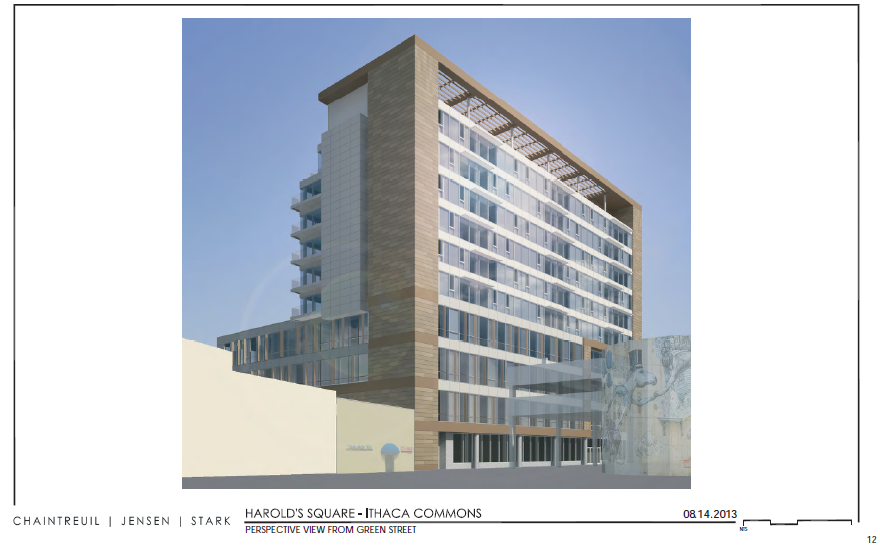
1. Leading off this week with a note of optimism – David Lubin, the developer of the proposed Harold’s Square mixed-used building in downtown Ithaca, says that plans for the 11-story building are still underway, according to a comment he made to the Ithaca Journal. Lubin says he’s currently in the process of lining up investors to finance the construction of the project, a challenging process once one tells investors that the project is in upstate New York. It’s not impossible to have a private project financed in Ithaca (if the Marriott underway down the street is any indication), but for a project costing $38 million, it’s no surprise that it’s taking a while. It’s easy to think that this one has slipped into the dustbin, but fortunately it has not.

Meanwhile, Ithaca Builds woke from its winter slumber to give an update regarding Lubin’s other big project, the Chain Works District for the old Emerson site on South Hill. Currently, the Chain Works District is in the process of writing up its Draft Generic Environmental Impact Statement (DGEIS). A DGEIS is part of the State Envrionmental Quality Review (SEQR), where the leading agency looks at a project, determines if any adverse project impacts are properly mitigated, and if so, issues a statement giving a negative declaration (approval). In this case, the NYS DEC also needs to be on board, approving the contaminated site for residential use. This is a pretty complicated project. There’s 800,000 sq ft of space to be removed or re-purposed, in an environmentally compromised site split between two political entities who are conducting joint meetings with their planning boards in an effort to try and move this project forward (the town of Ithaca board deferred to the city of Ithaca for lead agency; and both have rezoned the site to their respective specialized mixed-use zones). According to IB, the Phase I and Phase II Environmental Site Assessments (ESAs) contain about 60,000 pages of paperwork. The official timeline (already behind schedule, according to city docs) hopes to have the DGEIS submitted shortly, with a declaration of significance sometime in the Spring. In theory, Phase I site prep could start this year, but who knows if that will happen in practice.

franklin_libe_0414 travhyde_libe_0414 roccorner_libe_0414 dpi_libe_0414

2. The ILPC (Ithaca Landmarks Preservation Council) had a chance to review the four proposals for the Old Library site. Perhaps no surprise, the favored proposal was the Franklin/O’Shae proposal at top, which keeps the 1960s library and its “intrinsic historic value”. Members did, however, express some concern with the current building’s environmental contamination (asbestos). As for the other proposals, council members generally liked the Travis Hyde plan, and felt the Cornerstone and DPI projects were insensitive to the site (although one member expressed appreciation that at least the Cornerstone plan had affordable housing). It sounds like there will be some major tweaks to the building renders in the full proposals due later this month, so it’ll be best to hold off on judgment until those revised plans are published.

100_3080

3. Now for some bad news- Cornell is running into major financial problems, to the tune of a $55 million deficit. About half of that, $27.5 million, is expected to be reconciled with budget cuts (the other half will be covered by tuition increases). Considering the very large role Cornell plays in the local economy, this could have a chilling effect on local businesses that depend on Cornell or its employees. There are shades of 2009 here, when a projected $150 million deficit over 5 years resulted in 432 voluntary retirements, and hundreds of jobs lost.  The cut from 2008 to 2009 was a 5% reduction for the 2009-10 fiscal year, while the cut to go into effect for 2015-16 is estimated at 2-2.3%. Quoting an interview the Sun did with Skorton:

“[In the 2008 financial crisis,] We froze everybody’s salary for a year, paused construction, slowed down on hiring, developed a voluntary staff retirement incentive and 8 percent of the staff force was reduced … and [we had] a couple hundred layoffs, which is very, very hard to do,” Skorton said. “So that’s how the University acted in the worst crisis that ever happened. And so that’s a predictor of how it’s going to happen in this case.”

An article in the Sun a couple of days later notes that faculty employment is at an all time high. With 1,652 faculty in Fall 2014, Cornell has now passed 2007’s 1,647. – but one observant commenter, who I will happily buy a drink if I ever meet in person, notes that Cornell’s total enrollment is up 2,050 students since 2007. Devil’s in the details, folks – Cornell could use this “all-time high” as an excuse to not hire more faculty during its latest financial crisis, even though the student-faculty ratio have been increasing for years. Let’s not forget that faculty-student ratios are a crucial part of college rankings.

All of this is rather disconcerting news, especially in a time where the national economy has been picking up. Cornell has real potential to not only cause a localized recession, but also fall behind its peer institutions.

4. On a somewhat brighter note, even with this appalling winter, the construction of Klarman Hall is only nine days behind schedule, according to the Sun. Atrium glass installation should begin in April, and East Avenue will be reopened to two-way traffic around that same time. Although this project is well underway towards a December 2015 completion, one has a right to wonder if it is wise for Cornell to pursue the Gannett expansion and Upson renovation (valued at over $100 million combined) during these perilous financial times.

village_solars_3

village_solars_2

5. The town of Lansing’s planning board is set to review some slight changes to the massive Village Solars apartment project at its Tuesday meeting.

First, a quick primer – while the whole plan is for about 300 units, the approved phases account for only 174 units, and are being built in phases. The photo updates I’ve previously featured here on the blog show the first phase underway, buildings “A”, “B” and “C” on the right (south), with 36 units total. There are four phases, with two sub-phases in phase 2. Phase 2 consists of D, E, G and H with their 41 approved apartment units, and phase 2A is building F, which has the community center as well as 10 more units.

The revised plan calls for moving 6 units from buildings G and H to building M, which is in phase 4. G and H are combined into one apartment building (G/H), leaving 35 units in Phase 2. There are a couple reasons cited for this change – when working with NYSEG to lay out the utilities, it was decided to make phase 2 all electric services, due to concerns that Lansing may not be able to provide gas service if the tense situation with the gas pipeline proposal on West Dryden Road doesn’t go in the town’s favor. One of the results of the utility infrastructure change was a difference in utilities layout, and it was deemed prudent to shirt the walkway northward. This impacted the site design, which is why the Lucentes are seeking to revise the PDA (planned development area, similar to the city’s PUD and the town’s PDZ).

The change isn’t huge, and isn’t likely cause too much consternation among board members. This is actually the first site plan I’ve seen for the project, since it was approved before the town uploaded supplemental docs to its webpage. More importantly, it’s much clearer how future phases could build out – if the ~300-unit project takes 8-10 years as projected, then estimating the construction of phase 2 and 2A from summer 2015-16 seems reasonable.

simeons_1

6. Planning board members had mixed reviews about the Simeon’s rebuild, according to the Ithaca Times. While some members were excited about the rebuild, others expressed concern with the proposed addition of a second-floor balcony, seen in the above render by architect Jason Demarest. The project is eligible for state tax credits designed to renovate historic buildings, but if the credits are granted, then the balcony would not be built. If the credits are not granted, the building owners are looking not only at a balcony, but the possibility of widening the bay windows a little (it turns out the bay windows were an early renovation to the original Griffin Building, and larger bay windows would benefit a planned expansion of Simeon’s to the second floor). Regardless, cast-iron ornamentation that was salvaged before demolition will be incorporated into the rebuild.

During the same meeting, the planning board accepted revised signage for the Marriott, and there was further discussion about the Canopy Hilton. Nearby residents expressed concerns that a downtown hotel will increase traffic, and complaints were made about the ingress/egress plan for both the hotel and the CSMA next door. No word on the land swap CSMA wants, but it doesn’t seem like they’re budging on their property’s all-important utility easement quite yet.


The Dark Days of Dryden

3 03 2015

100_6855

In the 1990s, Dryden had a reputation for being the “Village of the Damned“.

That unpleasant moniker was received about fifteen years ago, when the town was afflicted with heinous, blood-chilling crimes. It’s like something Stephen King would have conjured up, as if Dryden was just down the road from Castle Rock. A description of the crimes in Dryden from 1989-1999 would be enough to fill a sordid crime novel. Needless to say, long-time residents of the town don’t take too kindly to the name.

Sometimes the moniker is applied to the Ellis Hollow murders of December 1989, to which I’m just going to supply the New York Times summary:

…a gunman tied up four members of a suburban family on Dec. 22, put pillowcases over their heads, shot them two or three times in the head and then set their bodies on fire.

After the state police rushed into a home on Feb. 7 to arrest two people in connection with the slayings, there was an initial sense of relief, mental health experts in the area said. But because the prime suspect, Michael Kinge, 33, was killed by the police in a shootout, many county residents now feel they will never learn why the Harris family was singled out.

A more explicit New York Times article can be found here. Making the event even worse, an investigator planted Kinge’s mother’s fingerprints at the crime scene, and she was in jail for 2.5 years until she was exonerated. She later sued the state, although the judge only awarded $250k of the requested $500 million because she was guilty of using the Harris family’s credit cards. The details and aftermath of the Ellis Hollow murders could fill a book.

The New York Times noted that it was part of a series of untimely deaths at the start of the 1990s – 9 fatalities in 3 months, 7 of which were homicides. The Ellis Hollow murders were the only cases in Dryden, and are separated from the other killings by a few years.

Dryden’s dark days began in earnest during the mid 1990s. Nothing I write will surpass E. Jean Carroll’s “The Cheerleaders,” a piece detailing Dryden’s suffering in those years, and well worth the read. But I’ll offer a quick rundown here.

– On December 29, 1994, 19-year old J.P. Merchant, angry at his ex-girlfriend, breaks into her family home and shoots her father dead. After the rest of the family escapes his attempt to kill them, he drives to a cemetery and shoots himself. Although in Cortland County, the children attended Dryden High, where the father was a football coach.

– On September 10, 1996, high school senior Scott Pace dies in a car accident. His brother Billy had died in a car crash the previous year.

– On October 4, 1996, High school juniors Jennifer Bolduc and Sarah Hajney are kidnapped, murdered and dismembered by the Hajney family’s next door neighbor, John Andrews. Although he was eventually caught, Andrews hung himself in his jail cell.

– On June 11, 1999, a drunk driving accident claims the life of 19-year old Katie Savino, a classmate of Bolduc and Hajney. Three months later, former classmate Mike Vogt commits suicide.

There’s nothing about Dryden that made it any more or less likely to suffer these crimes and losses; just an unfortunate series of events. The constant loss must have taken quite a toll on the town’s morale. By the end of the 1990s, it’s hard to imagine Dryden had much left in community spirit. Yet, life has gone on, and time has healed the wounds of the 1990s; the scars remain, but today the town is known more for its anti-fracking stance than for tragedies. Today, a memorial garden, scholarships, and a fundraising walk serve as reminders to a dark time the town has thankfully moved past.


News Tidbits 2/14/15: Zoning Out

14 02 2015

cpoz_1

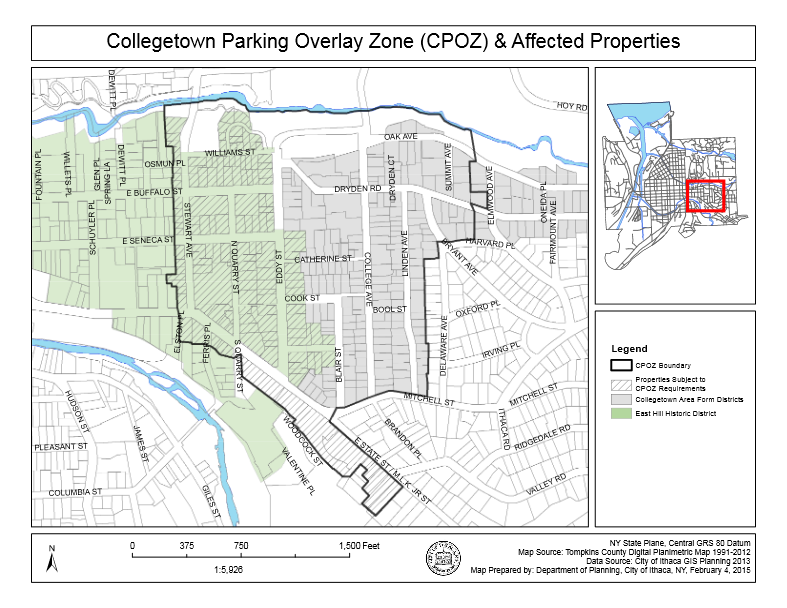
1. Leading off for the week, here’s an interesting piece of news: the city is set to repeal the Collegetown Parking Overlay Zone (CPOZ). The CPOZ was enacted in 2000 as a way to control the parking needs of Collegetown – essentially, it mandated more parking spaces per unit than was standard for a parcel’s zoning. For example, an apartment building of 6 occupants, zoned R-3a, would require 2 off-street parking spaces in Fall Creek, one for every three residents. But on East Hill, that same building would require 3 parking spaces, since the CPOZ mandates 1 off-street space for every 2 residents.

At the time, it made sense; East Hill tends to have more students, who bring their cars to school. But in the past 15 years, the proportion of students bringing cars has declined substantially – a study by Randall/West indicated that in 2000, 49% of Cornell students owned a car; by 2012, it was 27%, a change attributed to the rise of alternative transportation (car share, Cornell-subsidized bus passes), economic and cultural changes. At this point, there’s more parking than there is necessary.

It may seem at first glance that the CPOZ was eliminated with the Collegetown Form Zoning enacted last year, but the two maps don’t match up completely- there are 145 properties that weren’t affected by the new form zoning, but are still covered by the CPOZ parking requirement (see map above). Nearly all of these parcels are a part of the East Hill Historic District (the rest being Collegetown Terrace). A few recent cases, one with Collegetown Terrace and a couple of smaller projects, have highlighted the point that parking requirements have become excessive.

A change to the parking requirements could have a couple of desirable effects – one, less parking would be more historically accurate, and helps to preserve green space in the neighborhood. Two, it opens the idea of replacing a couple of the current parking lots with new housing, which would be designed to fit in closely with the current building stock since the properties are located in the East Hill Historic District (I know, landlords will never give up the money from renting spaces, but perhaps a new small apartment house might be more lucrative than a parking lot; looking at the tax maps, there are a few possible sites, including subdivisions). One mixed effect would be that it’s easier to convert a current single-family lot to student rentals, but the rental would now be less visually intrusive with fewer parking spaces. It’ll be interesting to see what comes forth as a result of this zoning repeal.

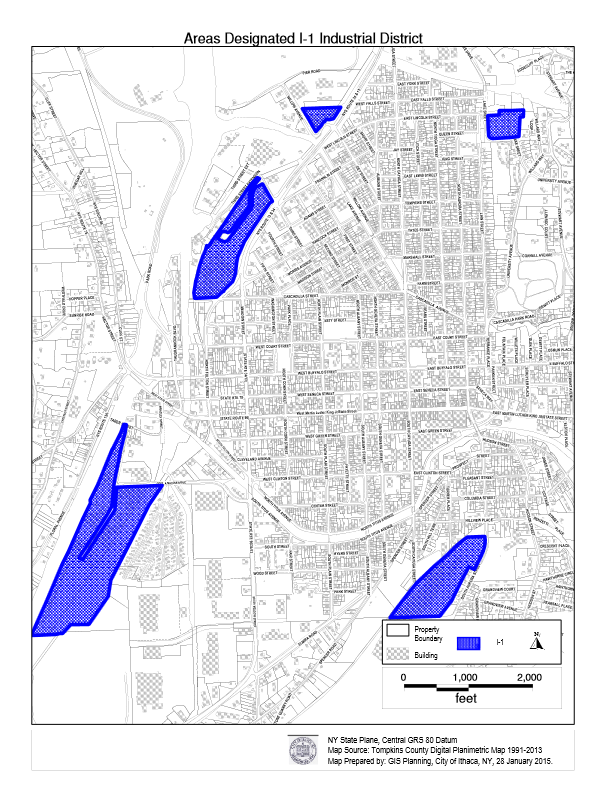
industrial_zones_1

2. Among other zoning changes being considered is a change to industrial zones (the city has just a few). Commercial buildings can be built in industrial zones, but the city wants to raise the minimum number of floors for new commercial buildings in these zones to increase from 1 to 2 floors, a nod to the paucity of undeveloped land in the city (and perhaps the painful attraction of suburban big box stores). There are five sites on the map above, but it might as well be three – Emerson (lower right) is becoming a planned development zone, and the Ithaca Gun site (upper right) is expected to be rezoned from industrial to medium-density residential, in preparation for an apartment project still in the works.

canopy_hampton_rev4_1

3. What is up with the proposed hotels constantly delaying their schedules? First the Marriott pushed back its opening from Spring 2016 to Q3 (July-September) 2016. Now the Canopy Hilton is pushing their schedule back, from a construction start this Spring to an autumn start, which makes it difficult if not impossible to realize the cost savings from reusing the crane for the Carey Building. The tax abatements aren’t going to take that long to obtain, maybe another month or two before the county takes its vote.

Presumably, the project would open in autumn 2016 if the construction schedule is similar. But I feel like these delays send a message of incompetence, and that’s the last thing a project needs.

inhs_pride_design_6

4. Maybe the article I wrote about the new INHS project will have run in the Voice by the time this auto-publishes. But here’s a render that I decided to leave out of the final article to minimize space. The city uploaded the initial application Friday morning (sketch plan will be presented this month), and I’ll write a follow-up article, based on the application paperwork (so it will be different from the Voice article), and post it here on Ithacating in the next few days.

Cayuga-Meadows-Shot

5. Staying on the topic of affordable housing, these agenda notes from IURA Neighborhood Investment Committee reminded me of another affordable housing project that totally slipped off the radar- Cayuga Meadows, a 62-unit apartment building for seniors that was approved by the town of Ithaca for a site near Overlook at West Hill in late 2012. On page 52, it’s noted that the project is supposed to open in November 2015. That would imply that it should be starting construction soon if site prep hasn’t started already (I haven’t visited the site in over a year, so I have no clue). The pipeline document is dated from February 2014, so I have no idea if that’s still accurate. I emailed its developer, Conifer LLC, to see if the project was active, but received no response. Still, it’s something to keep an eye on.


Village Solars Apartments Construction Update, 2/2015

11 02 2015

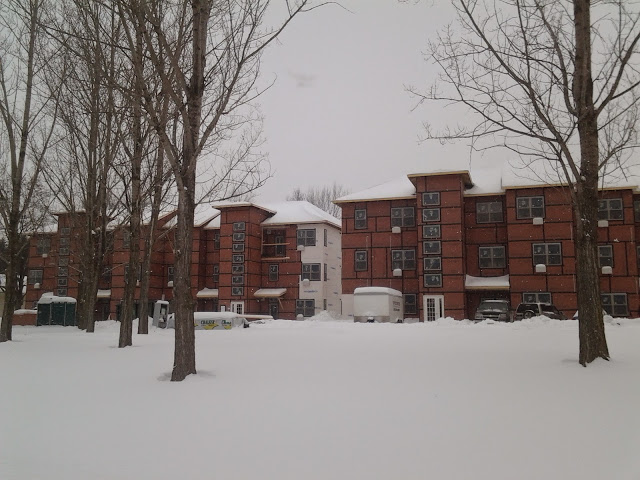
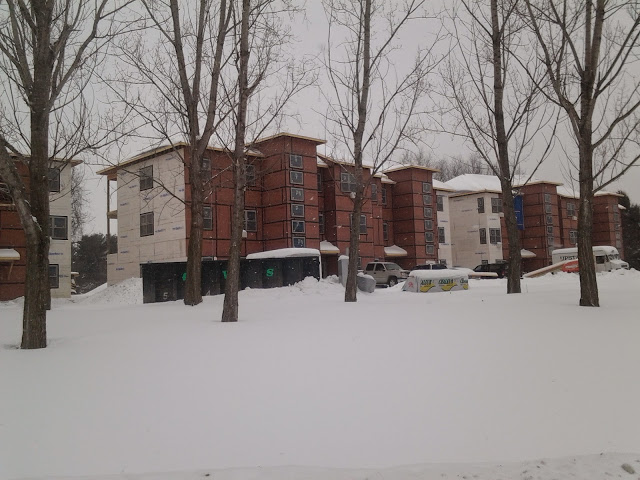
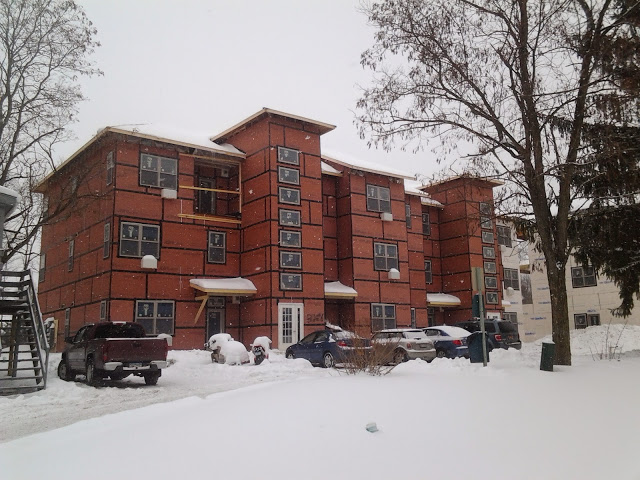
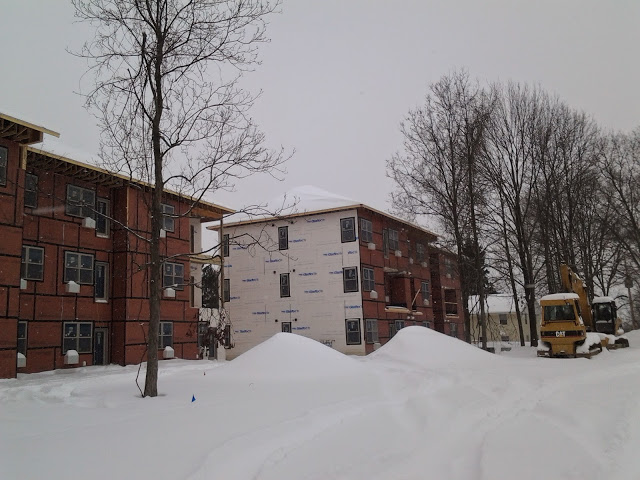
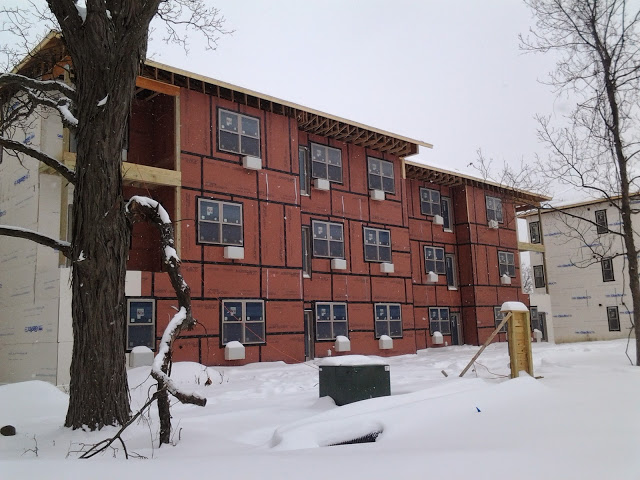
The first three apartment buildings of the Village Solars apartment project in Lansing are fully framed, sheathed (I’m assuming the red panels are sheathing material), roofed, and windows and doors have been installed in most locations. The light-colored material might be a breathable wrap for weather/moisture resistance. It will be a little while before exterior finishes are applied and balconies are installed. When I visited last Saturday, the site was buzzing with the sounds of construction workers busy with tasks inside (probably rough-ins for things like plumbing and electrical), and ’80s hair metal streaming from a radio somewhere from within. Nothing like installing pipes while rocking out to Twisted Sister.

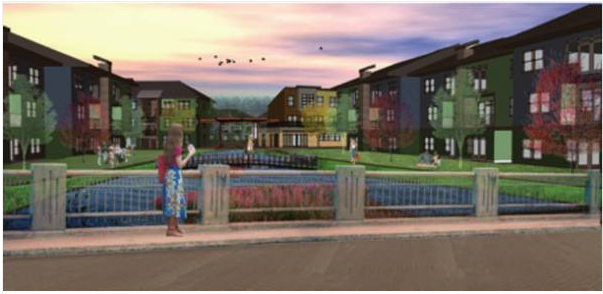
The Village Solars get their name from what the craigslist sales pitch calls “their passive solar design and energy saving features”. As far as I’m aware, they won’t have solar panels. According to Thomas Bobnick, the rental agent for the apartments, the first phase shown here will consist of 36 units (the final buildout will be close to 300 units). The design of the complex calls for at least eight, maybe ten buildings to surround a new pond that will be dug out of the undeveloped middle of the property – the advertisements call it “waterfront”, which it is, technically.

From the craigslist advertisements, one-bedroom units will rent for $1050-$1145 and be ready for occupancy by June 1st, two-bedroom units will rent for $1235-$1369 and be ready for tenants on May 1st, and three-bedroom units will rent for $1565-$1600 and be available on June 1st. These dates are pushed back a little from initial plans, which called for March and April occupancy; no doubt the severe winter has complicated the schedule. Looking at the photos, the two buildings under construction on the west and east ends look to be one style (balconies in the middle), while the center building is a different layout and design (end balconies). The price range for the two bedrooms is a little above the average two-bedroom unit in Ithaca ($1,165), but after accounting for the premium on new construction, the developer seems to be pricing for the middle tier of the market.

The Village Solars are being developed by local company Lifestyle Properties. Lifestyle is run by Steve Lucente of the Lucente family, who have been major builder/developers in Ithaca since the 1950s. No one word on the architect. Upstate Contractors of Syracuse appears to be handling the construction work.

20150207_131607 20150207_131610 20150207_131613 20150207_131646 20150207_131715 20150207_132225 20150207_132231 20150207_132320 20150207_132335 20150207_132338

village_solars


Boiceville Cottages Update, 2/2015

8 02 2015

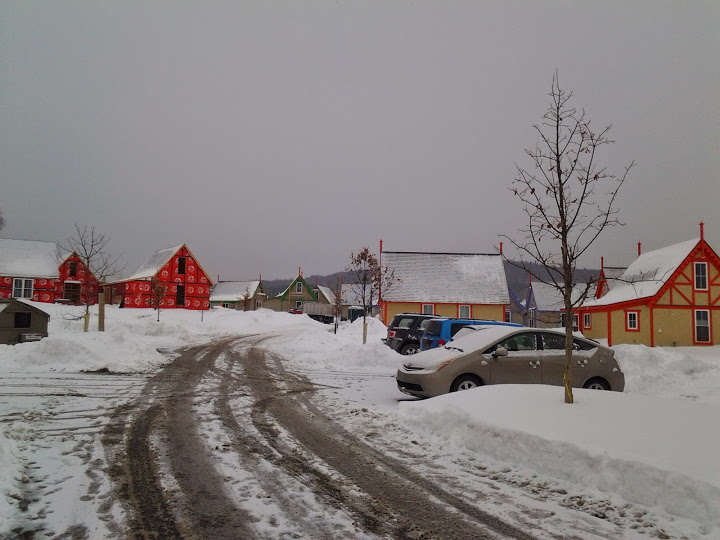
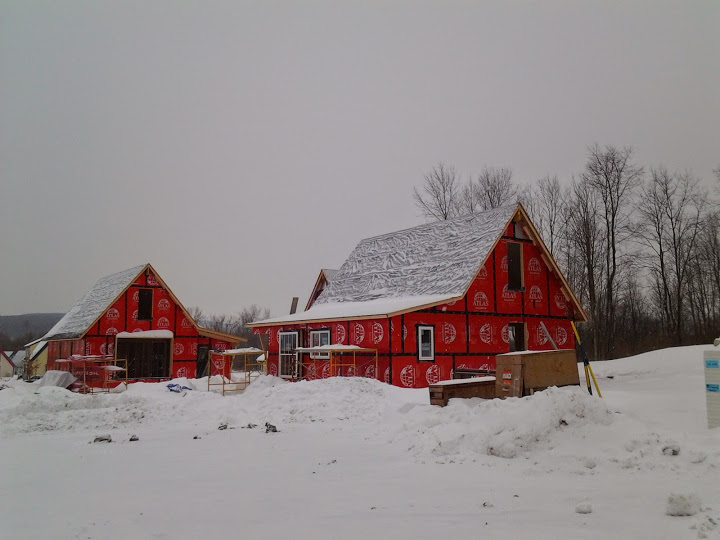
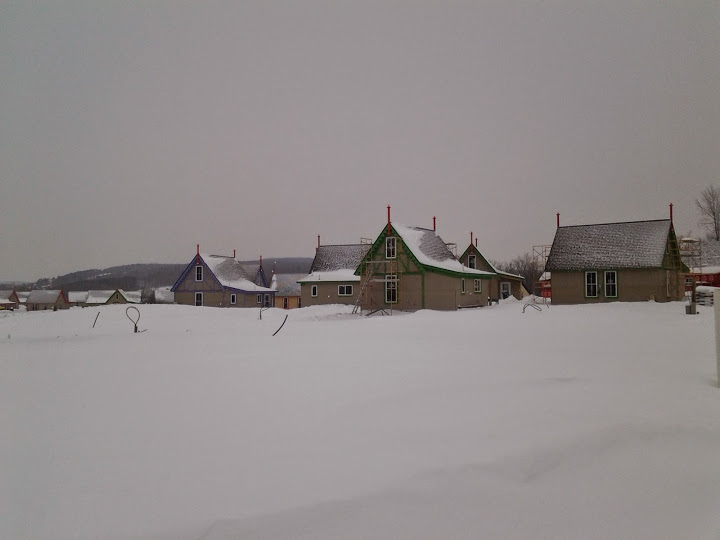
It’s been about 2.5 months since my last trip through the Boiceville Cottages, but given that it’s winter (and a particularly cold and severe winter since the jet stream reconfigured in January), there has only been slow if steady progress with its 75-unit expansion. Since December, the timber homes with purple trim have been completed, four houses that were undergoing exterior build-out have now progressed to exterior detailing and interior finishing (the ones with green timber trim), and windows are being fitted into three homes that have sprouted from their slab foundations since the previous visit.

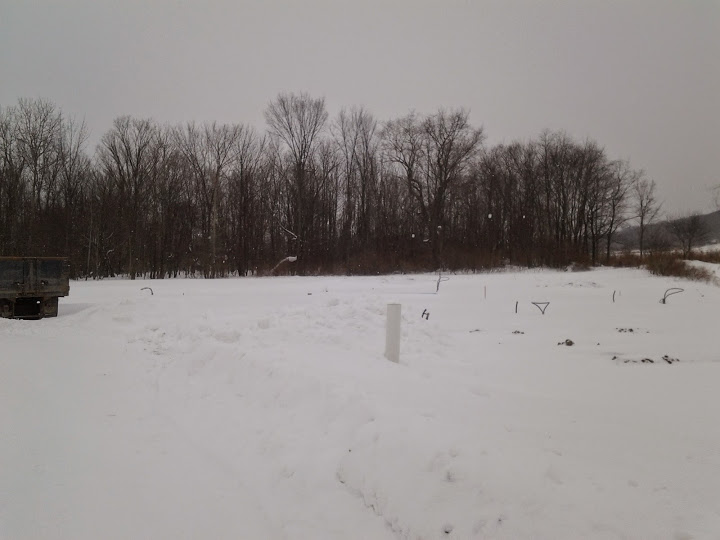
One of the things that stood out on this visit was that it’s now possible to walk all the way through the new phase thanks to the construction. Looking around at the snow on the ground, edges of the blue waterproof covering (which might be the covering of cement board being used to protect the slab insulation) could be seen poking out among the drifts. Using the (gas utility?) loops coming out from the foundations as a guide, there are perhaps a dozen poured concrete foundations, ready for construction as time and weather provide. There were approximately 25 units that were built in 2014, and with probably 10 complete by the end of March, 2015 looks to be on the same construction pace, maybe even greater. It might even be possible that the expansion will be completed this year. Inquiring minds would like to know if Bruno Schickel has any other expansions or colorful villages planned.

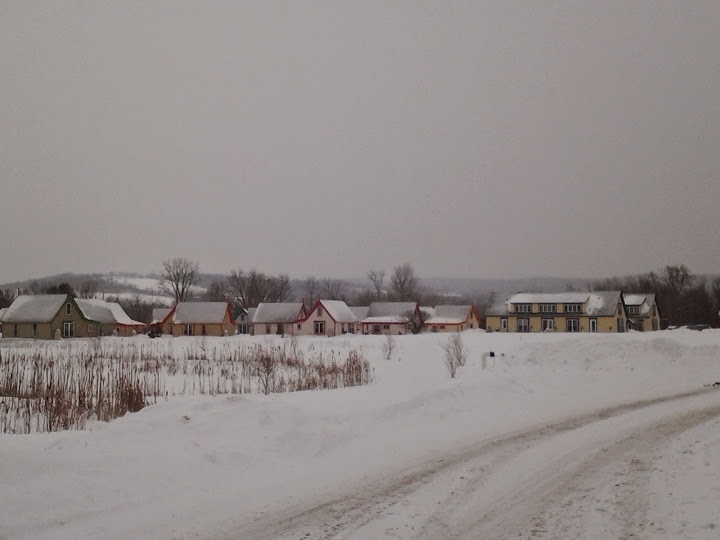
The Boiceville Cottages, built and managed by the Schickel family, are rather unusual as apartment complexes go. For one thing, there are the bright paint jobs, a sort of hallmark of the cottage units since the first set of 24 houses was built in 1996/97. The bright paint and the ornate woodwork have led to a nickname, “The Storybook Cottages“, which holds some weight, according to an article in Life in the Finger Lakes:

“Schickel said he was inspired to build his colorful cottages by a children’s book he read to his daughters almost 20 years ago. The book, Miss Rumphius, by Barbara Cooney, tells of a girl who, at her grandfather’s urging, travels to faraway lands seeking adventure. Later she moves to a cottage by the sea and works to make the world more beautiful by spreading seeds of blue and purple lupine. An illustration by the author shows the Lupine Lady’s house on a hill overlooking the sea. The small cottage is replete with finial and gingerbread. Seeing that illustration was the eureka! moment, Schickel recalled. “I said, ‘I’ve got to design something like this!’”

Since the initial 24 units were built, a further phase of 36 units was undertaken pre-recession, and in the past couple of years the town of Caroline signed off on the next phase, a group of 75 that would more than double the size of the complex. The cottages have been built out at a steady pace, and at completion of this current phase, 135 units will be present on the Boiceville property. Most of the units are 1 and 2-bedroom cottages, built in clusters of three, although a few “gatehouse” rowhouses offer studios and 3-bedroom units. The Boiceville complex may be the largest population center in the 3,300 person town.
20150207_124102 20150207_124139 20150207_124147 20150207_124213 20150207_124234 20150207_124303 20150207_124308 20150207_124336 20150207_124344 20150207_124416 20150207_124421 20150207_124434  20150207_124553 20150207_124836 20150207_124847 20150207_125032