Carey Building Construction Update, 9/2015

7 09 2015

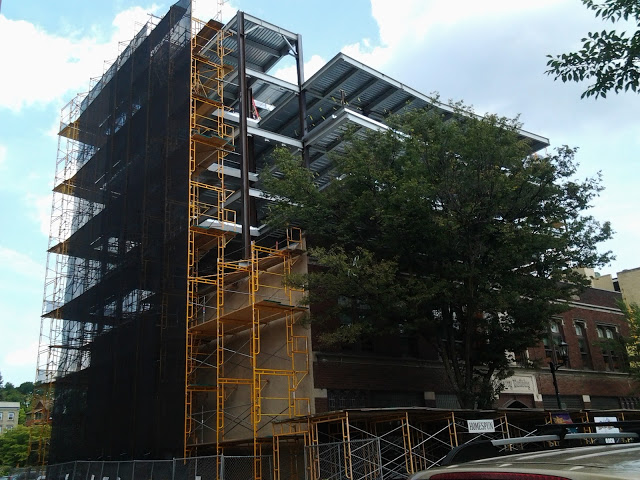
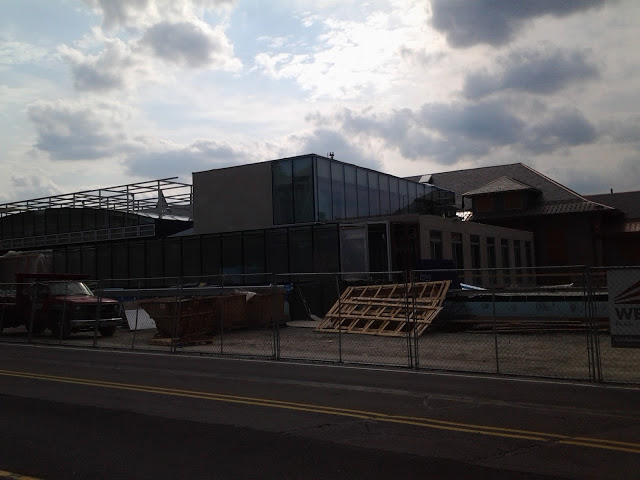
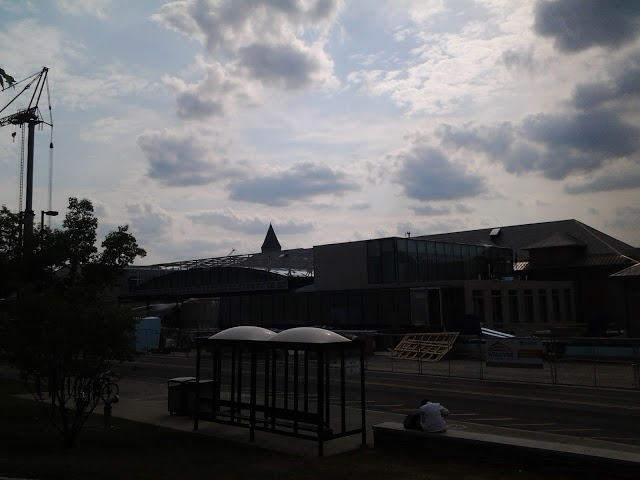
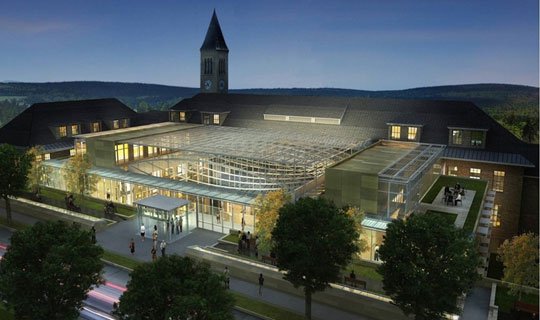
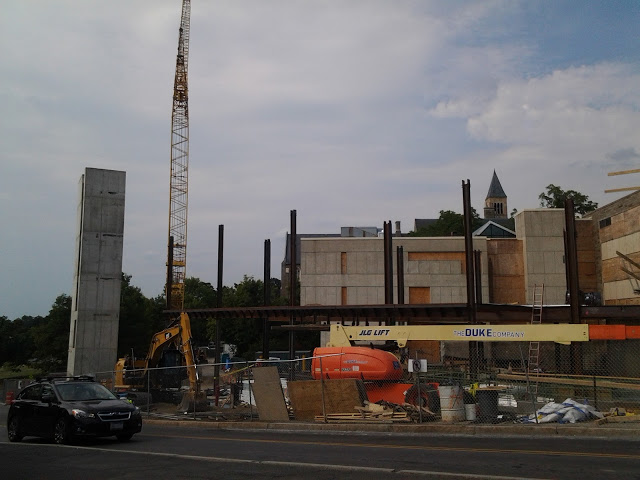
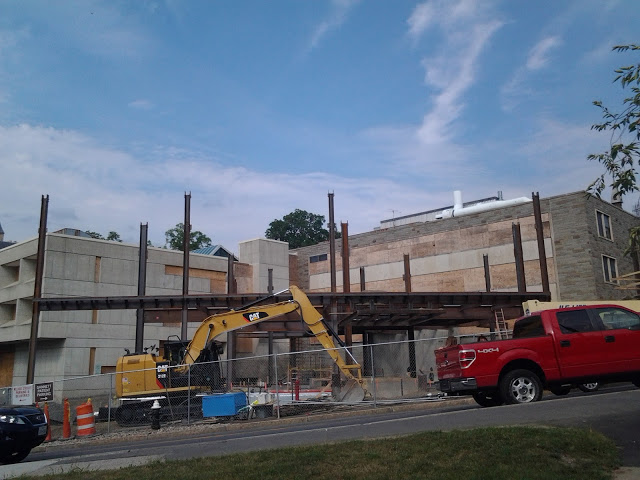
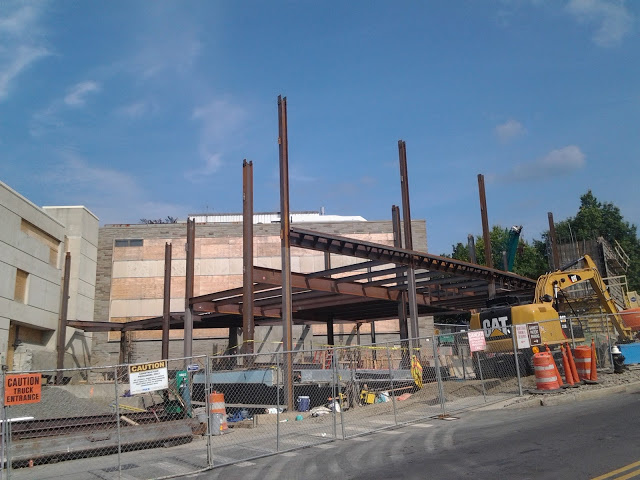
Just a quick update on the Carey Building addition at 314-320 East State Street in downtown Ithaca. As of the end of the month, structural steel has reached the top floor of the five-story addition, though it has yet to fully build out. The lower floors have been decked with corrugated sheet metal, and concrete floor pours might already be underway on the lower levels.

Paperwork filed with the county last Friday indicates that Tompkins Trust is providing the construction loan, with a value of $4,736,000, of which the very precise figure of $4,642,554.46 is going towards “hard” construction costs. Hard construction costs leave out legal fees, permit fees, and other costs not directly related to construction. The paperwork indicates a February 2017 completion date, but that’s more of a legal date than an actual date. The addition is likely to completed early next year.

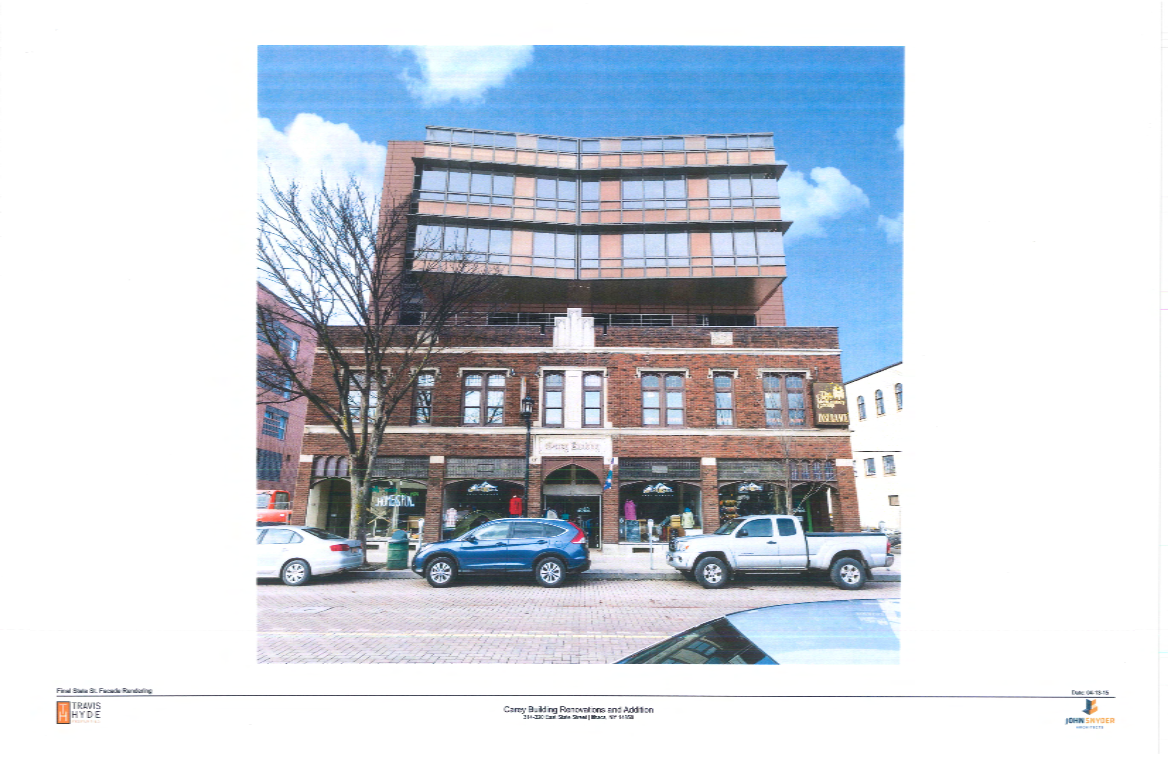
The Carey Building addition will add a third floor and 4,200 SF to the Rev business incubator (nearly doubling it from 4,500 SF to 8,700 SF), and on floors 4-7, there will be 20 apartments, most of which are studios. Local firm Travis Hyde Companies is developing, John Snyder Architects penned the design, and LeChase Construction is the general contractor.

20150829_125735 20150829_125801 20150829_125827

carey_rev5_1 carey_rev5_2 carey_rev5_3


News Tidbits 9/5/15: Ithaca the Diva

5 09 2015

cornell_novarr_1

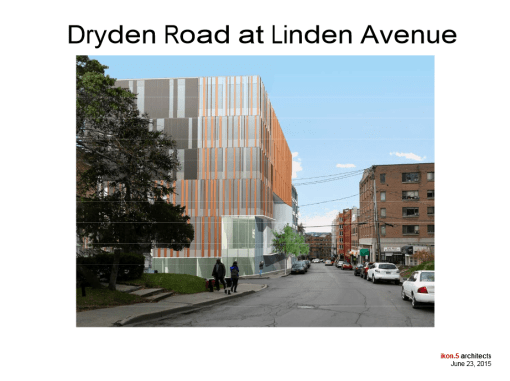
1. John Novarr’s project at 209-215 Dryden Road has been given the green light. The city of Ithaca’s Planning and Development Board approved the $12 million project at their August meeting. With approvals in hand, Novarr is free to start construction as soon as he has his construction loans, which should be no problem given that Cornell’s MBA program has agreed to occupy the whole building (though only about 70% of the space will actually be used at initial completion; the MBA program will fill out the building as their needs require). Conveniently, Novarr won’t have to worry about site demolition and asbestos removal because he cleared the site in May.

The 6-story, 73,000 SF building will begin construction in “four months” per the end-of-August Sun article, or November if the Site Plan Review (SPR) paperwork is still accurate. Completion of the building is anticipated for the second quarter of 2017. ikon.5 of Princeton, New Jersey is the project architect.

When filled out, the building will house 250 employees of the university, and 450 students of the Executive MBA program, who only attend classes in Ithaca during traditionally slow periods of the year (winter break and summer break; during the rest of the year, students attend weekend classes in the town of Palisades in Rockland County). To that effect, the project would go a long way in easing the strongly cyclical consumer traffic that makes it hard to do business in the largely-student neighborhood. Students also stay at the Statler while on campus, and staff and students will walk over from Cornell faculty/staff parking to get to the building.

Last month, the Tompkins County IDA approved a 50-year tax abatement for the project, in the form of a PILOT agreement. With the other option of Cornell buying the property and making it tax-exempt, the county has decided that something is better than nothing.

The project joins a slew of mostly residential projects under construction in the Collegetown neighborhood. 205 Dryden, 327 Eddy and 307 College are all underway, and several smaller projects were recently completed. The new investments total over $36 million, and with the exception of Novarr’s project, all the other projects will be taxed at full value.

902_dryden_2

902_dryden_1

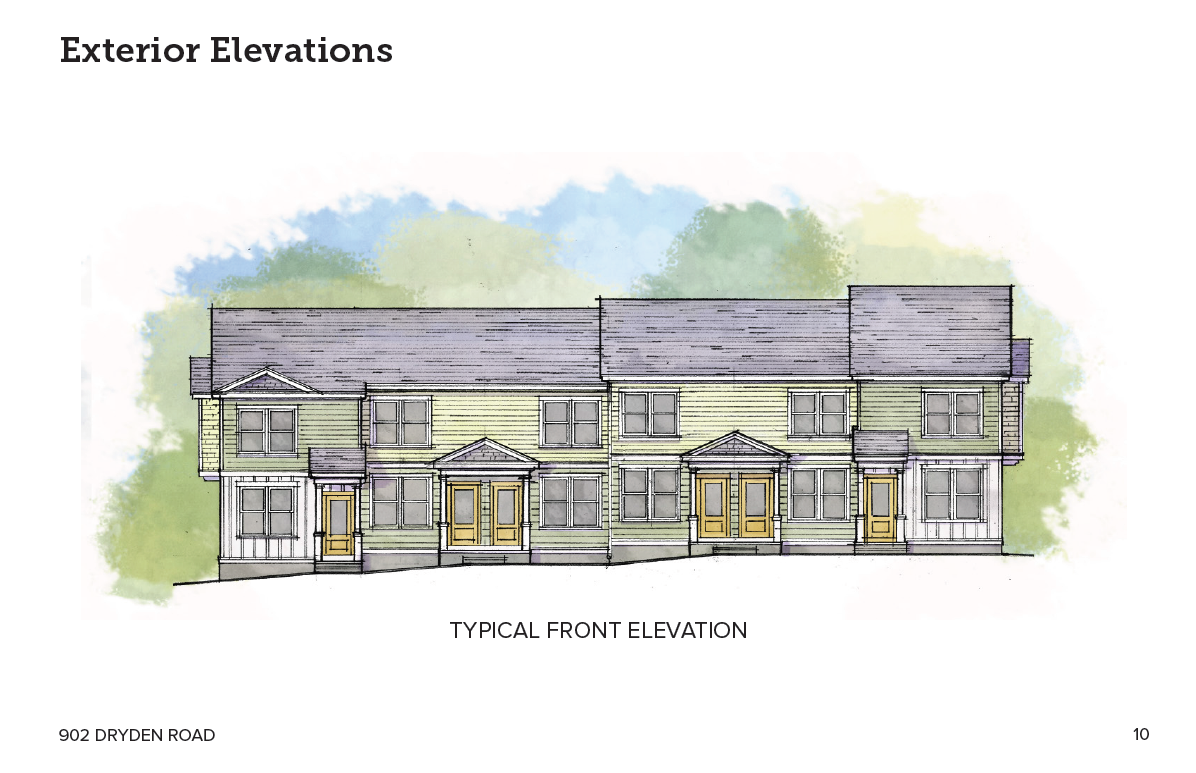
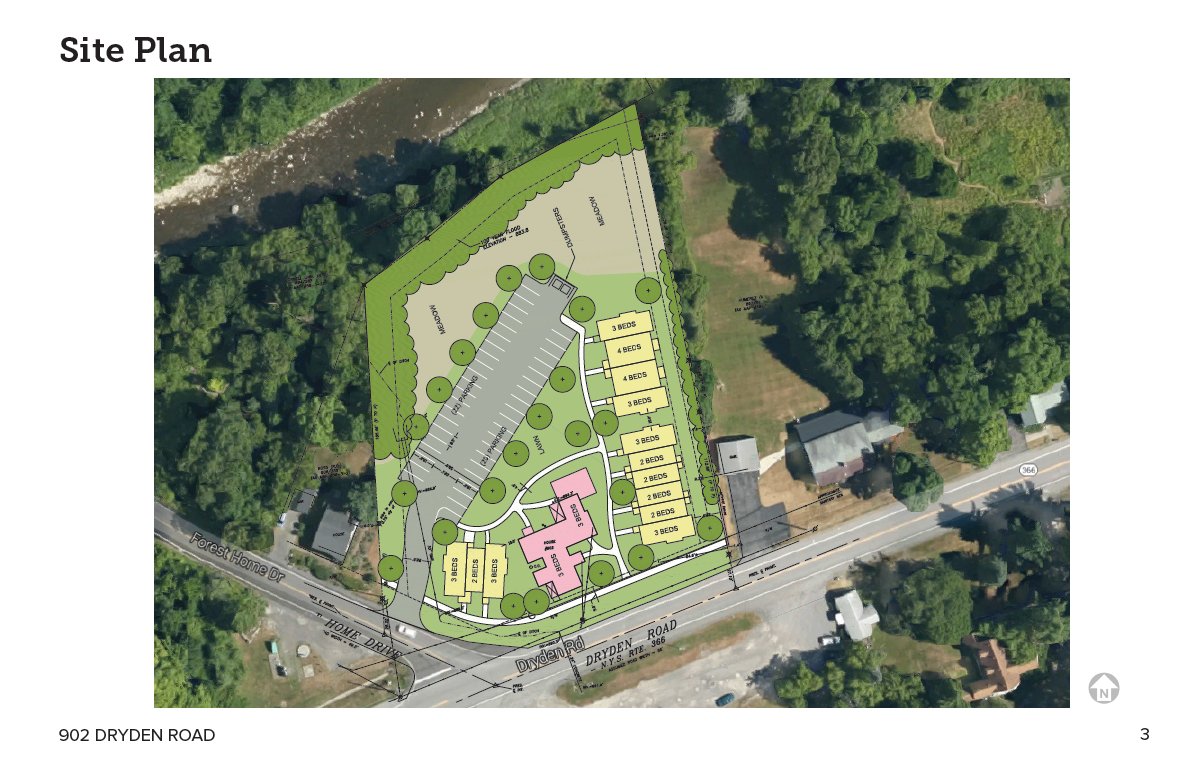
2. Meanwhile, there have some mild hang-ups with another project. The solar-powered townhomes in Dryden are seeing some resistance, mostly from the nearby Cornell Plantations, and from neighbors opposed to rental housing in Varna. The Ithaca Times piece uses this dandy of a line:

“Resident Cheryl Humerez, whose family and in-laws both own homes that neighbor the proposed project, was disgusted by the thought of a rental development, which might attract college students, becoming her neighbor.”

Going beyond the “disgusted” comment, most of the students that would live this far from Cornell’s campus would be graduate and professional students. Undergrads are less likely to have cars and tend to live in the neighborhoods immediately adjacent to Cornell’s core (Collegetown, Cornell Heights and parts of East Hill). Graduate and professional students tend to be like any other 20 or 30-something living on modest wages. The chances of a “keggers on Tuesday” kinda place are virtually nil. Also worth pointing out, Dryden’s town supervisor called Humerez out on that comment, saying she was saddened that renters were being described as a problem.

Cornell Plantations, as represented by Todd Bittner, has more legitimate concerns about litter, the driveway location and stormwater drainage; but glancing at the town minutes, it looks like the “I know we need development, just not in this neighborhood” argument also makes an appearance.

The town board (in Dryden, it seems the town board oversees public hearings of the planning board’s agenda) is taking a more level approach; acknowledging that it’s a decent project, community input is important for good development, and by incorporating mitigation measures to assuage worried neighbors, this has the potential to be a worthy community asset. Expect this project to evolve as we go through the next couple of months.

Also noted in the town minutes are plans for a 78,000 SF storage facility next to NYSEG at 1401 Dryden Road. Plans from a Cornell startup named “Storage Squad” call for “high quality, attractive self-storage” with 400 storage units in the first phase. The project will need site plan review.

402_s_cayuga_st_rev2_1

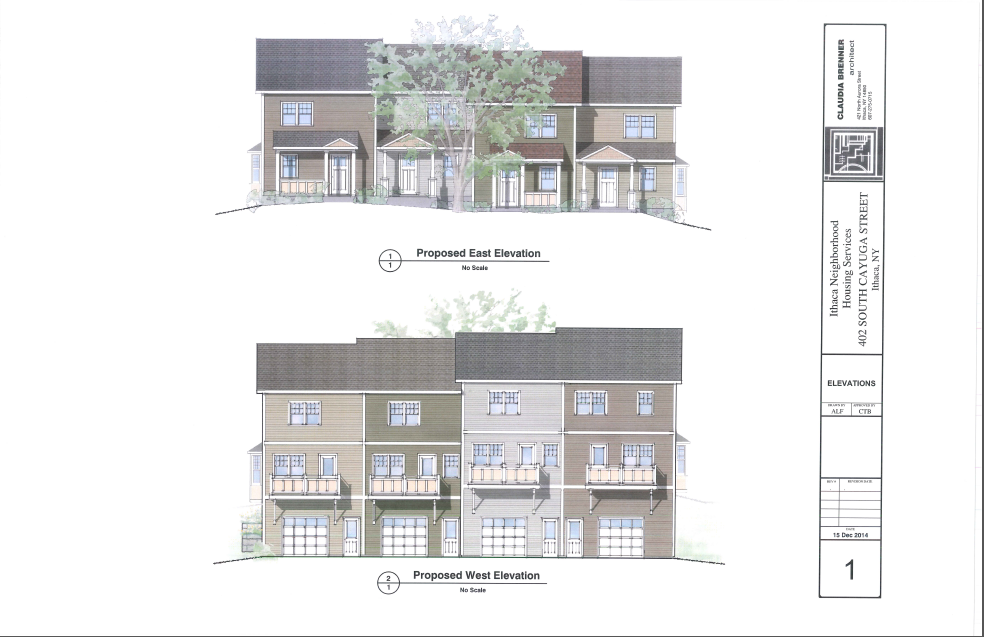
3. To anyone who’s passed by the vacant lot at 402 South Cayuga Street and wondered when INHS will start those for-sale townhomes: I’ve taken the liberty of checking. INHS director Paul Mazzarella stated in an email that “[t]he project is out to bid for a general contractor. The bids will be due next week. If the numbers are OK, we will start as soon as possible.” So barring any nasty shocks in the bids, the four-unit project (1 3-bedroom, 3 2-bedroom) will start in just a few weeks. As with other INHS projects, the units will be sold to qualified first-time homebuyers with modest incomes (anecdotally, that means the $40k-$50k range…it seems like half the buyers in the past year or so have been teachers in the ICSD).

4. In a rare bit of bad economic news in Ithaca, Ithaca College has announced its intent to slash about 40 staff positions from its workforce. This follows 47 job cuts in academic year 2014-2015, 39 of which were vacancies.

The cuts are part of an effort to bring tuition costs and help the college stabilize enrollment numbers, which have been sliding down lately. No faculty positions will be eliminated as part of the layoffs. IC currently has about 1,070 staff and 730 faculty, about 200 more than they employed a decade ago.
harolds_square_taylor

5. The rumor mill said that a reporter from the New York Times was in town last Friday, and apparently they liked what they saw; the piece in the NYT takes a very positive and gracious approach with Ithaca and its recent urban developments. If you haven’t read it already, the link is here.

[What follows is a spark-notes version of the Voice piece – I’ll update with links after the weekend holiday.]

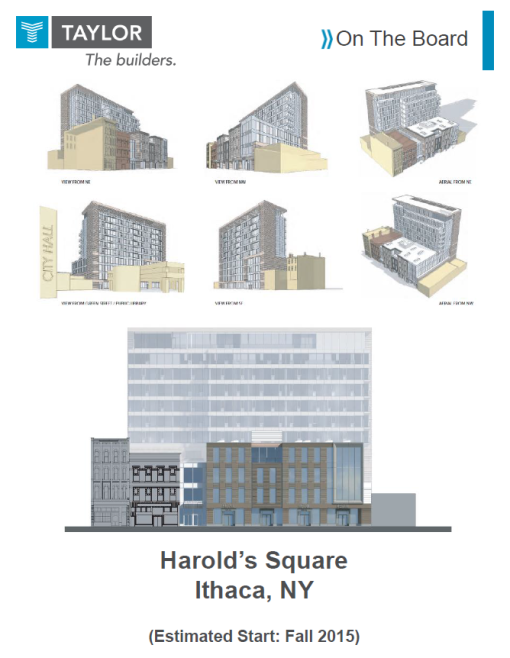
More importantly are some useful details in the piece – one of which is that we now know the revised mix of uses for the 11-story Harold’s Square project calls for 86 apartments, up from 46 when it was first approved in 2013. The apartment units will be a mix of 1-bedroom and 2-bedrooms. Readers may recall that the project dropped two floors of office space in favor of two floors of apartments. The project also includes about 11,000 SF of retail on the Commons.

In a phone conversation with developer David Lubin, the current plan is to start construction of the $38 million project in early 2016:

“Rev will be out at the end of September. We’ll probably begin demolition after the first of the year, after the holiday shopping season, we don’t want to be a nuisance to Christmas shoppers. We’ll have pop-up store space available during the holidays. They’re not solid, but those are out plans. We’ll see how it goes”.

Also, the project will be going back to the planning board.

“The planning board re-approved the current design [last month]. However, there will be changes to the design, as we’ve changed the office space to apartments and they have different needs, window placement, things like that. When we’re ready, we’ll present those to the planning board. Not September and probably not the October meeting, but before the end of the year.”

The project was originally approved in August 2013, with a CIITAP tax abatement package approved two months later. However, putting a financial package together has been a task.

“These things take time,” Lubin stressed. “The Marriott, that needed 3 or 4 years before they started. It can be a slow process.”
 

simeons_1

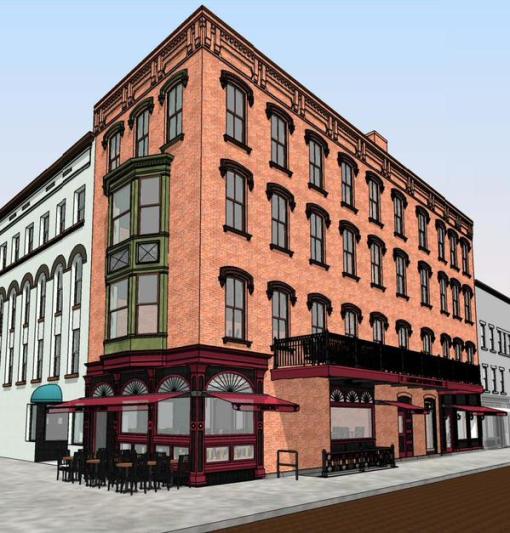
6. For those keeping an eye on the Simeon’s reconstruction, expect to see some progress in the next couple of weeks. That’s according to an interview the Sun conducted with Simeon’s co-owner Rich Avery. The timeline has yet to be finalized, but the new restaurant space and luxury apartments are anticipated for completion by late next summer, with the resturant re-opening as early as February.
maplewood

7. Gosh, it’s nice to have the Sun back in session. Also from the Sun, incoming Cornell president Elizabeth Garrett has formally announced plans for new student housing, among other graduate student initiatives. From the Sun:

“Following her discussion on maintaining and promoting diversity among graduate students, Garrett announced the creation of new graduate student housing.

“My team and I are committed to working with the GPSA to create an inclusive and rewarding [graduate and] professional student living environment,” she said. “Most immediately, I am working now with my team to work on critical housing needs.”

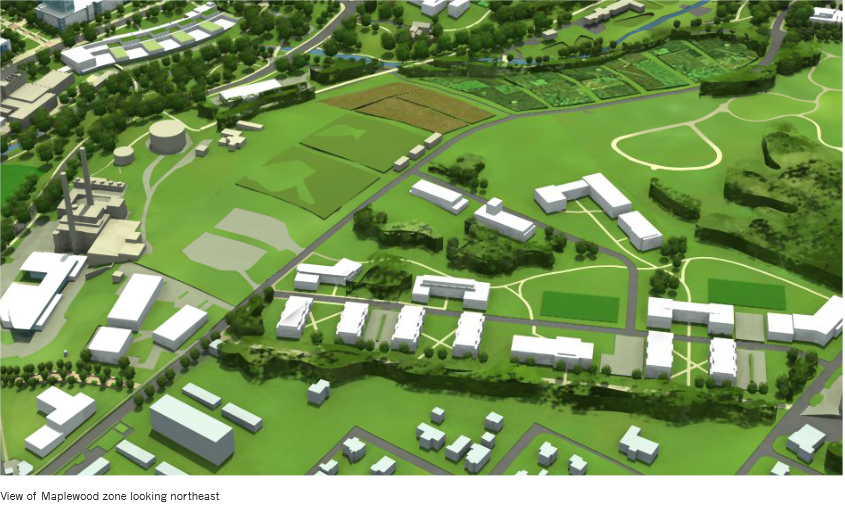
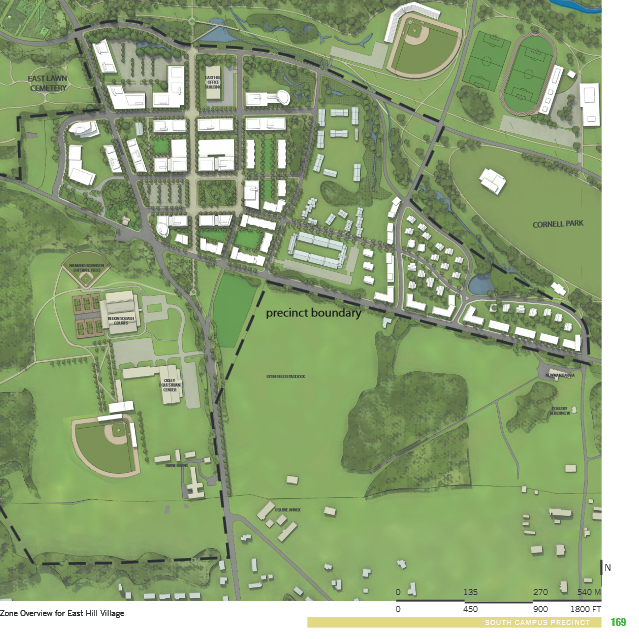
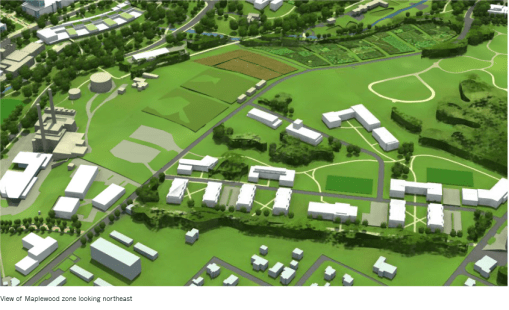
According to Garrett, since the University’s Maplewood Park Apartments — a graduate student housing facility located near the Veterinary School — is closing, the University is currently collaborating with private partners to create new graduate-student housing at the Maplewood site and to develop additional housing in the East Hill Village.”

Heads up folks, East Hill Village isn’t even a thing a yet, it’s just a concept from the master plan. Anyway, this goes along with Ithaca town supervisor Herb Engman’s comments to the county that Cornell is engaging with consultants to bring a plan forward. There’s nothing else known about the plans, and it’ll be a few years before any students start moving in to new Cornell-sponsored digs, but everything has to start somewhere, and Cornell’s created quite a deficit for itself when it comes to providing adequate amounts of graduate housing.

Also, note the “collaborating with private partners” bit – these may or may not be tax-exempt, we shall see what happens.
state_st_triangle_v3_3

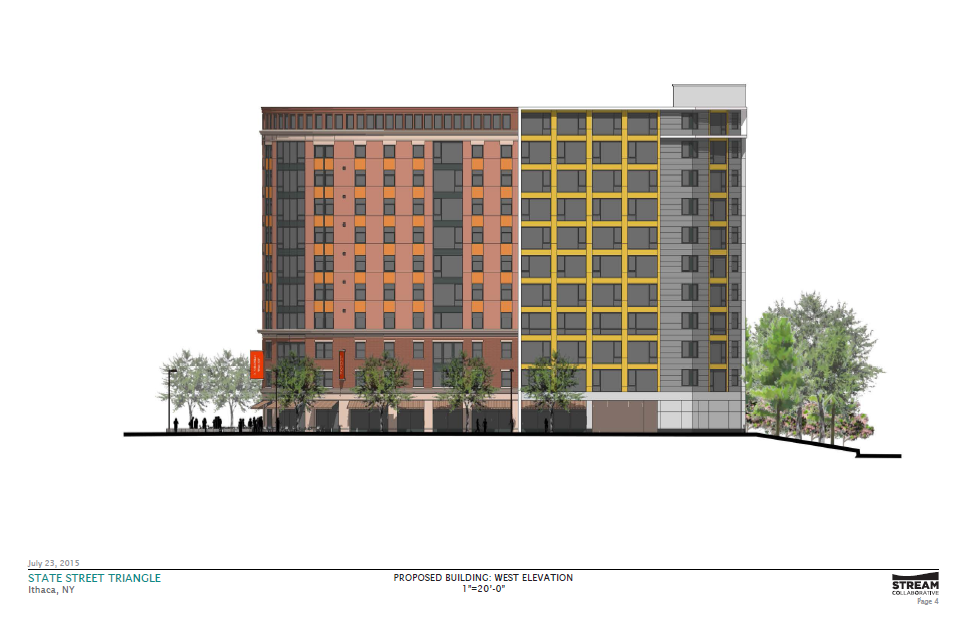
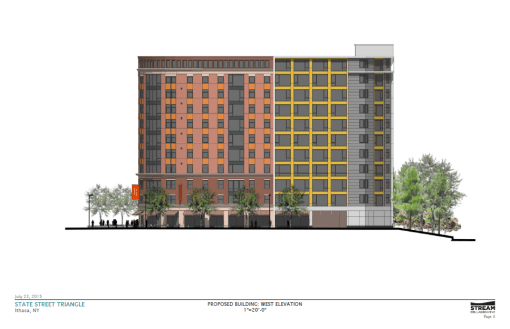
8. Here’s the latest update on State Street Triangle, courtesy of the Ithaca Times. I have to admit, although I technically compete for eyeballs via the Voice, I like Josh Brokaw’s writing, he tends to be a bit of a wiseass and it’s entertaining.

The big hang-up is massing. Not height, not tenant mix. A couple of ideas floated or suggested include height setbacks or overall reductions, and a redesign of the facade to make it appear more like separate buildings built next to each other.

According to Brokaw’s piece, some landlords are even questioning the need for new units, saying that all these new units could drive prices down.

Captain Obvious just arrived into port. By the way, given the recent growth in general and student populations and corresponding increase in demand for living space, if a landlord is having trouble filling their units right now, it’s probably not the city’s fault.

Campus Advantage has already spent $500,000 on the project, but it doesn’t seem like they’re going to throw in the towel just yet. They were probably hoping for an approvals process as easy as their Pittsburgh apartment tower, but…live and learn.


206 Taughannock Boulevard Construction Update, 9/2015

4 09 2015

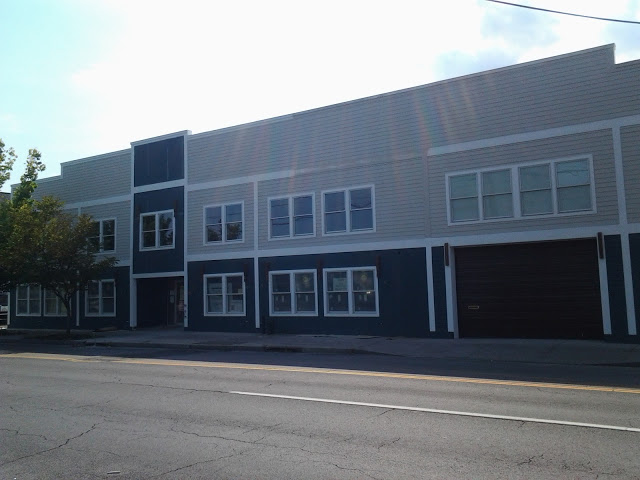
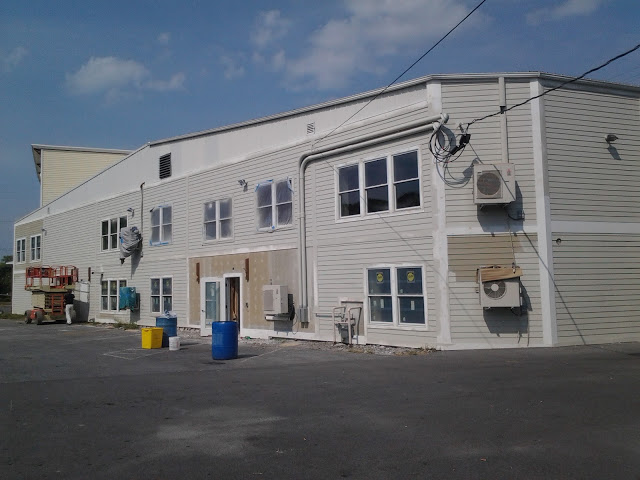
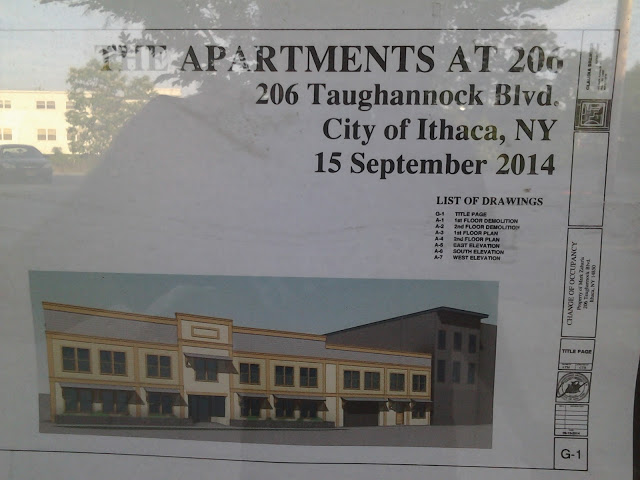
Over on Inlet Island, another project is in the home stretch towards completion. “The Apartments at 206”, Mark Zaharis’s mixed-use project at 206 Taughannock Boulevard, is mostly completed on the outside, with minor cement-board trim installation and painting ongoing. There might be some further exterior work planned with sunscreens and such, but it’s difficult to be sure since the built design doesn’t match the rendering.
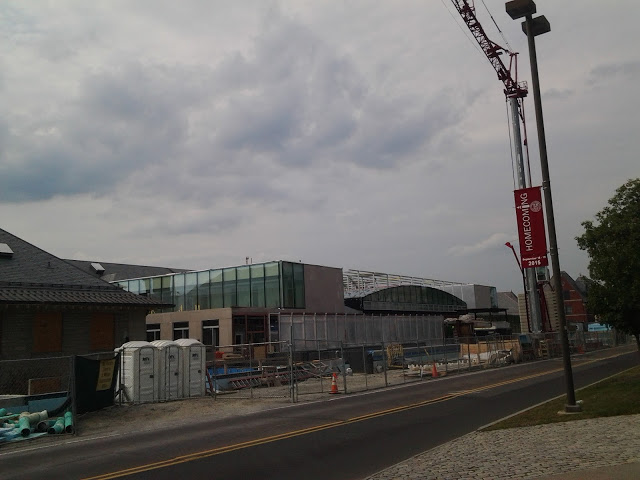
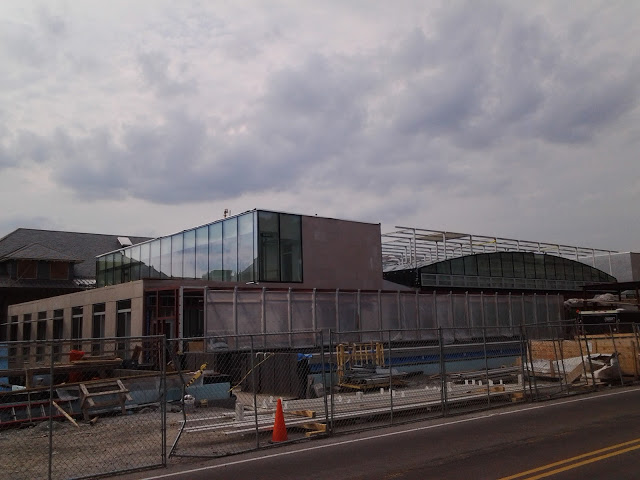
A peek through the back door showed drywall being hung on the wood framing, and some utilities rough-in still going in. The project is a gut renovation of a former furniture store and warehouse, so the owners had quite a task with rebuilding the interior.

According to an older gentleman working on the site, the apartments “should be ready in two or three months, keep an eye out.” There will be four one-bedroom and three two-bedroom units, along with office space on the first floor.

Local architect Claudia Brenner penned the design of the renovated building. Last year, Brenner designed the renovation of the Lehigh Valley House next door into a mixed-use building with ground-floor commercial space, donated space for the recently-opened branch office of the IPD, and six condominiums. The Zaharises, who owned and managed the furniture store before it closed in Spring 2014, are the developers-in-charge.

20150829_152045 20150829_152023 20150829_152005 20150829_151952 20150829_151906 20150829_151901

20150613_191931


Ecovillage Construction Update, 9/2015

3 09 2015

The last stages of work are underway at Ecovillage on Ithaca’s West Hill off of Mecklenburg Road on Rachel Carson Way. Construction on the single-family homes in Ecovillage’s third neighborhood, “TREE” (Third Residential Ecovillage Experience, following its first two, FROG and SONG) has been complete for a little while now, but the 15-unit Common House has yet to be completed. The exterior has been finished, with attractive wood-frame balconies swaddling the building, but interior work (drywall boarding and painting, from the looks of it) is still taking place.

The 15 apartments range from 450 SF studios to 1,400 SF three bedroom units. Rental prices for the apartment units have not been posted. According to Ecovillage Executive Director Liz Walker, “The current goal is October 1st for completion. There will still be inspections after that, so it will be perhaps the end of October or November before people are able to move in.”

Construction is being handled by a local company, AquaZephyr, which received an award from the U.S. Dept. of Energy for a “zero energy ready” home constructed as part of TREE. The designs of the Common House and houses are the work of California architect Jerry Weisburd, with local firm STREAM Collaborative handling the permitting process and design tweaks after Weisburd’s retirement.

20150829_153323 20150829_153359 20150829_153429 20150829_153529 20150829_153629 20150829_153648


Cornell Veterinary School Expansion Construction Update, 9/2015

2 09 2015

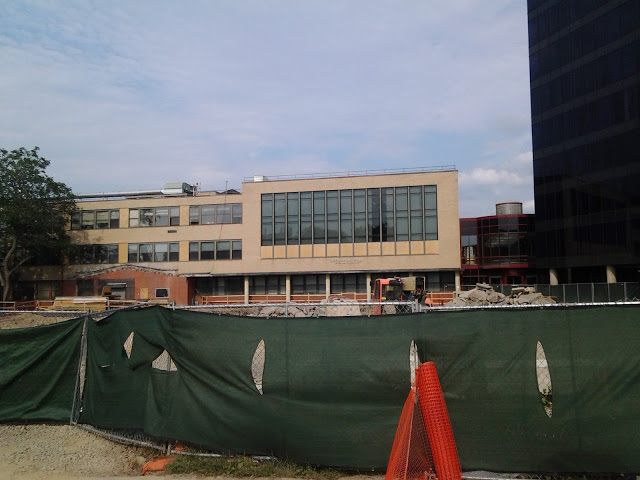
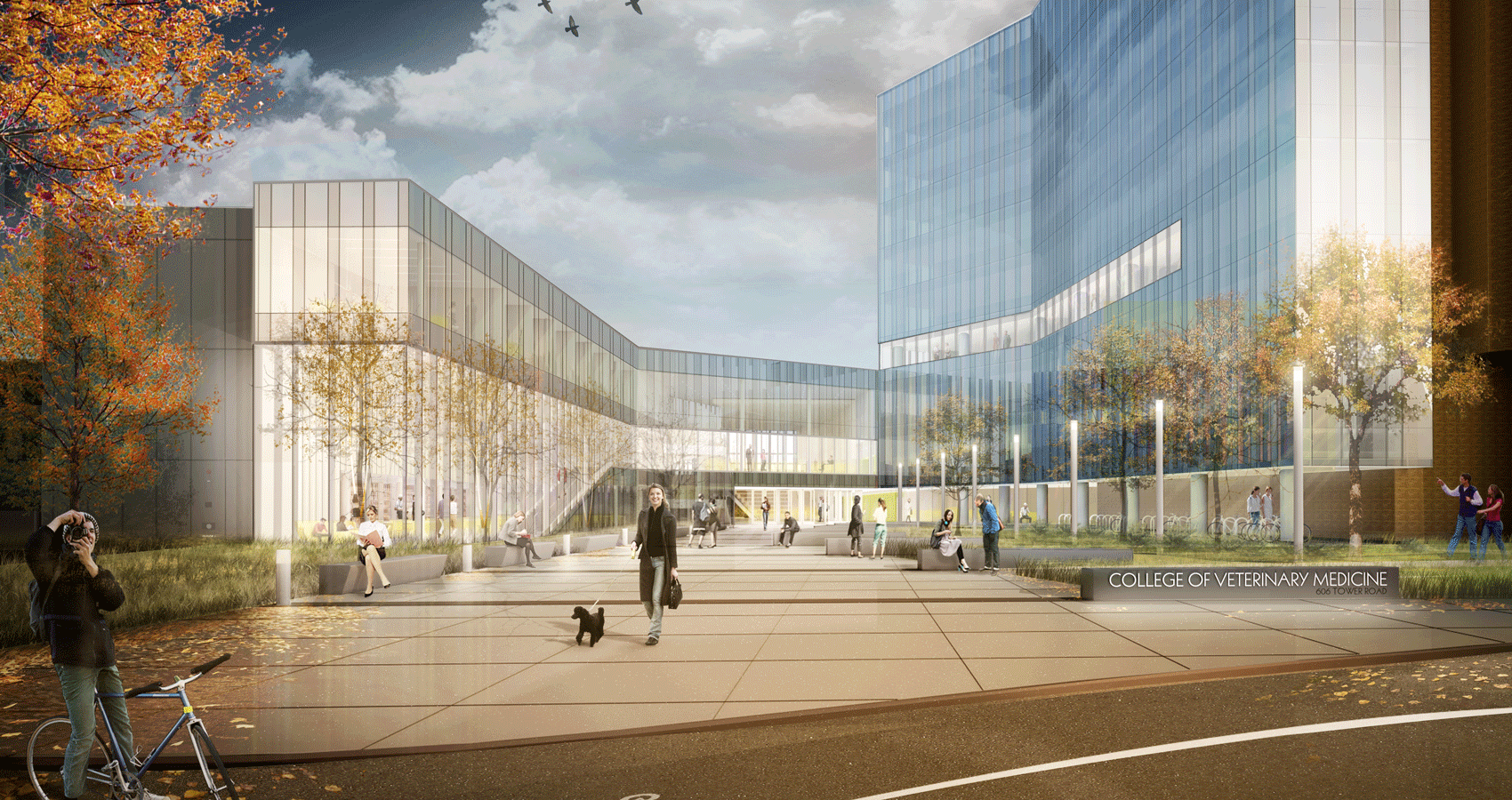
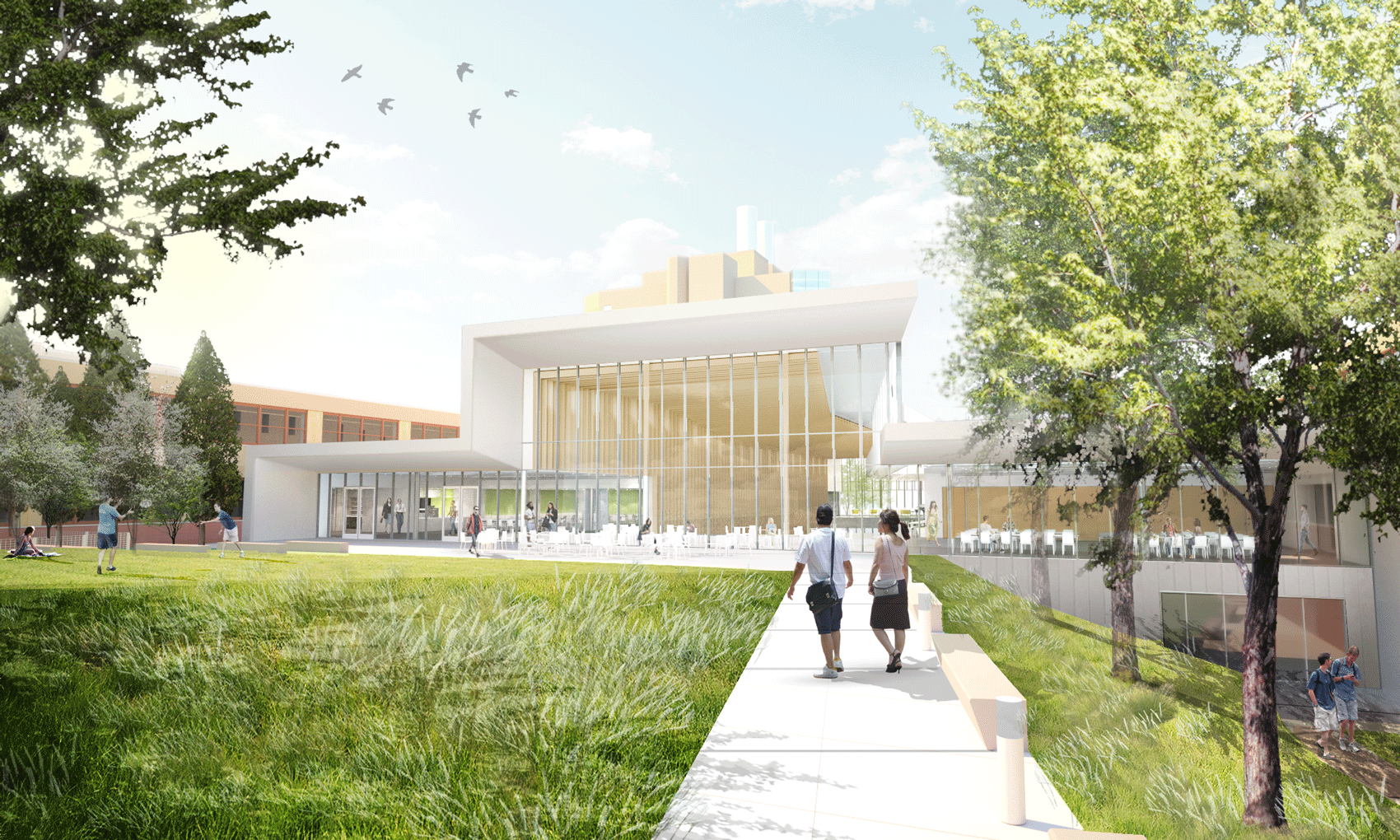
In an attempt to avoid the correct but lengthy word jumble this is, I’m just going to refer to this as the Vet School Expansion. Even then, in terms of physical square footage, expansion is something of a misnomer. The plan calls for the demolition of 68,000 SF of space, the addition of 65,000 SF of space, and the renovation of 33,000 SF. In sum, 3,000 SF less space than which the vet school started with.

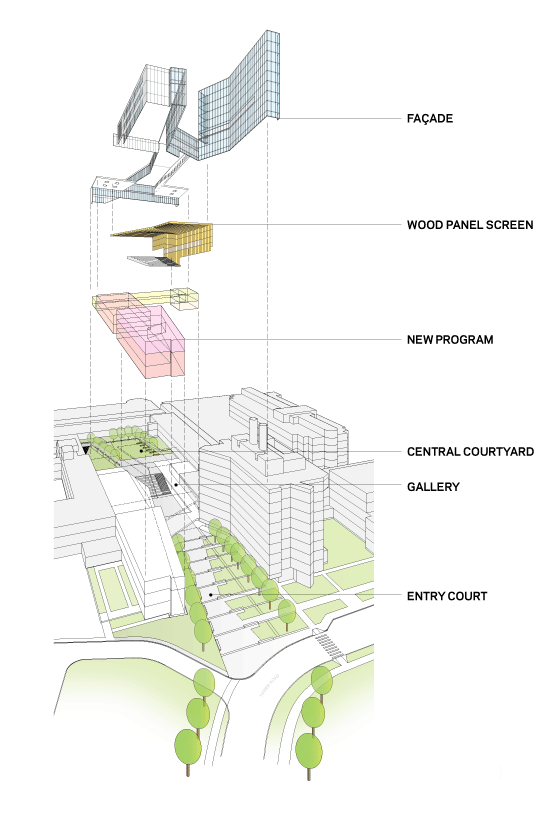
However, it’s less about space and more about efficiency. The plans include renovation and expansion of classrooms, teaching laboratories, cafeteria, locker rooms and shower facilities, and a combined Tower Road entrance. In the photos below, the entry plaza and the James Law Auditorium have been torn down. In its place will rise a new three-story addition that will house the vet school’s Flower-Sprecher Library. Parts of Schurman Hall will also be demolished and replaced with a new 2.5 story gallery/courtyard space. Extensive interior renovation will cluster classrooms, labs and service space, improving circulation through the numerous interconnected buildings that comprise the Vet School. The Vet Research Tower will be reclad in lighter, more transparent glass to match the new additions. The design of the expansion is a product of NYC firm Weiss/Manfredi, a Cornell favorite.

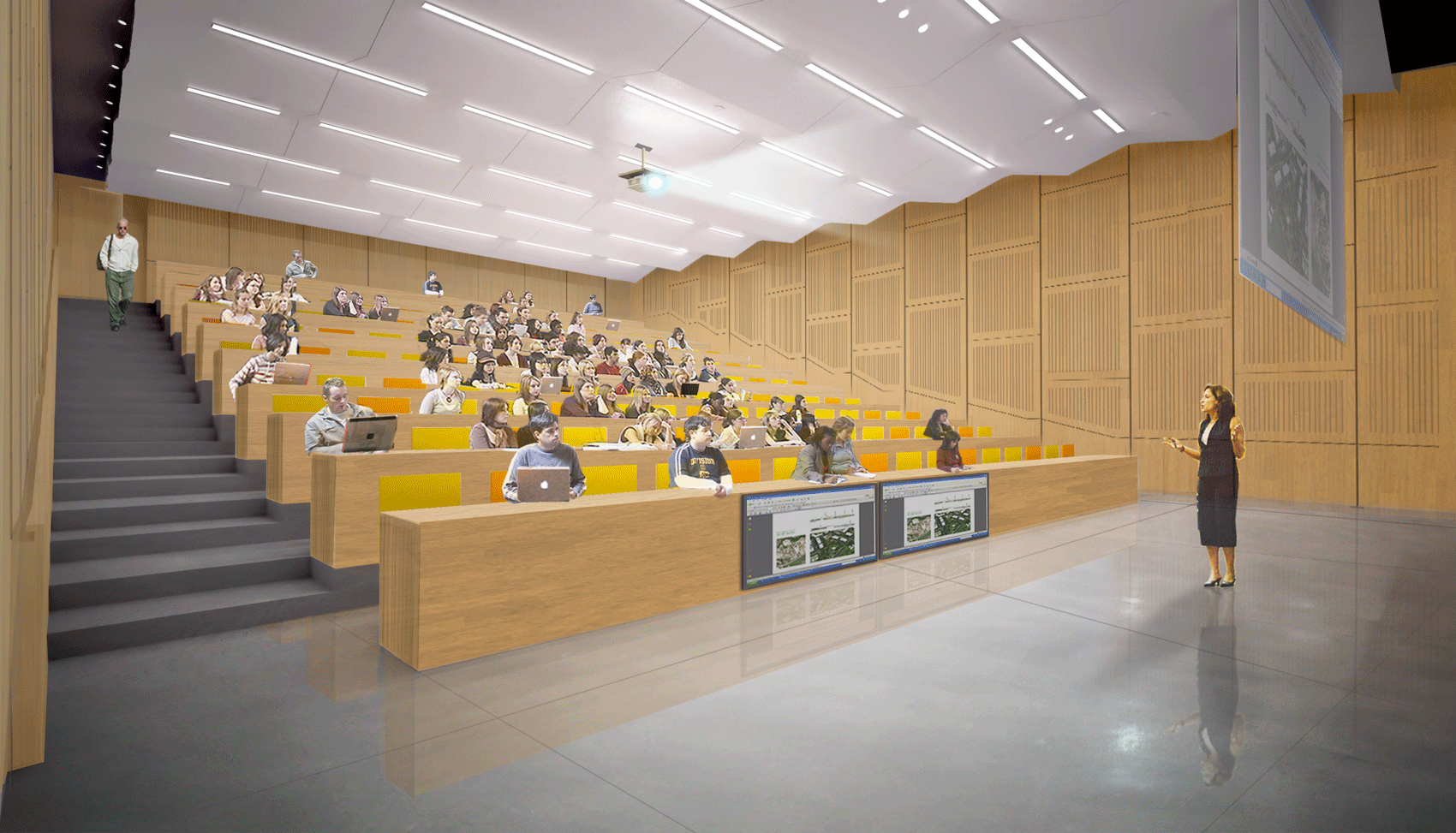
Renovations will increase the class size from 102 DVM students to 120 DVM students. Since a DVM degree takes four years, that means an additional 72 students.

Phase one for the vet school expansion is well underway, having a roughly January 2015- January 2016 time frame. The second phase will pick up immediately after the first and run from January 2016 to June 2017.

The budget for both phases is $74.1 million, with funds coming from the SUNY Construction Fund and private sources.

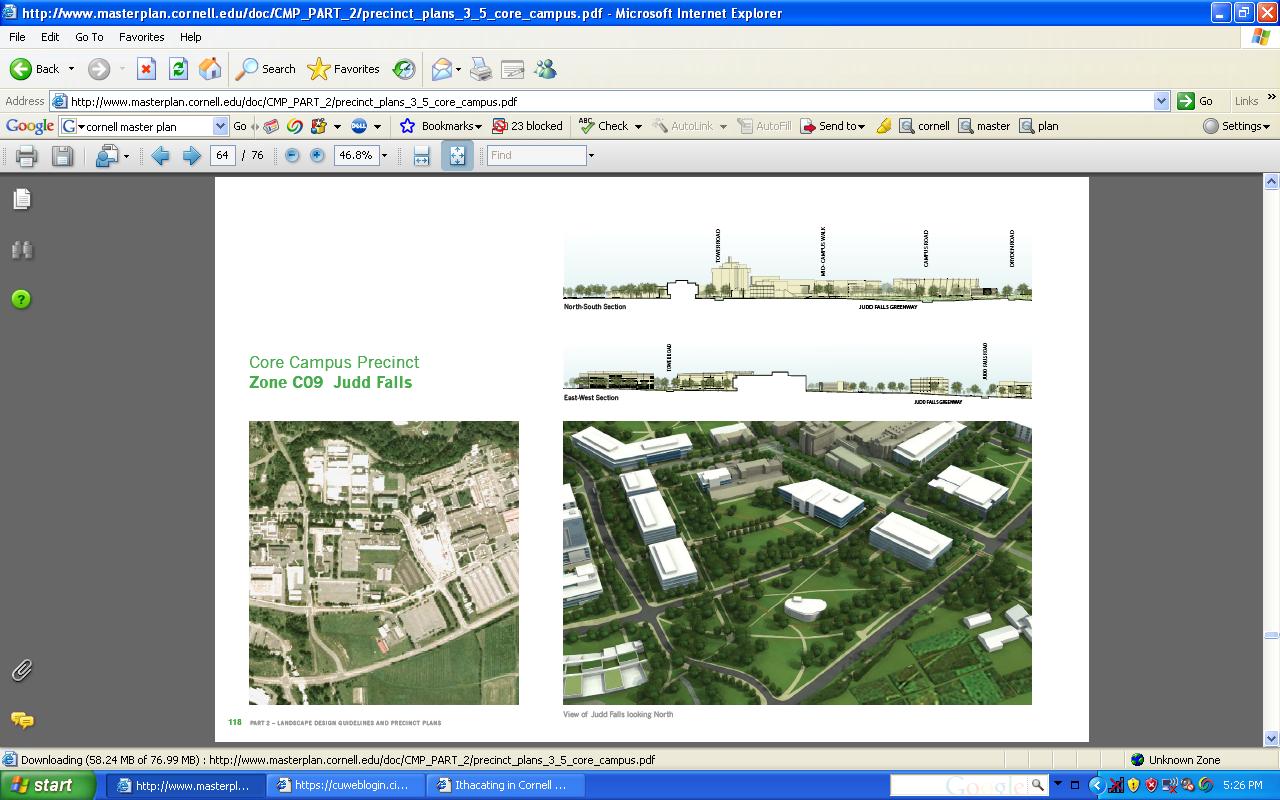
On a humorous note, while going through the project page on the architect’s website, I found an image of a lecture hall with some token presentation slides (last image). The placeholder image is a screenshot I had taken of the Cornell Master Plan back in 2008. Surprise surprise. For the record, I’m totally okay with it (even though I hate the screenshot, dating from the days before I thought to crop images).

20150829_162541 20150829_162526 20150829_162517

cad048742a281097e5667382eced4233

LibraryReadingRoom10-2

8f098b7e26544f579eb7411b9a1716aa

eea787361994de9625f74b19aa50d91e

655113b60367a0343c31545937948d57


Klarman Hall Construction Update, 9/2015

1 09 2015

Klarman Hall is entering the home stretch now, just a few months from its anticipated January 2016 completion (and a few weeks behind the December 2015 date initially planned). Montour Falls-based Construction firm Welliver is busy sealing up the building’s exterior, while putting up drywall, painting and finishing-out the interior lower floors, and wrapping up services rough-in in the upper level offices.

From the looks of it, most if not all of the sandstone exterior wall panels have been installed. The vestibule has been framed out but has yet to be glazed (window installation), and while the atrium has been glazed, the glass-paneled roof above the atrium has not. Concrete stairs have been poured on the slope, and the rest of the landscaping will follow after the building has been completed and the warm, snowless weather of spring comes around. Construction progress of the project can be followed through aerial photos shared by Landmark Images here.

The 33,250 sq ft building was designed by Koetter | Kim & Associates, and is named for billionaire hedge fund manager Seth Klarman ’79. The building will be the first new humanities building on Cornell’s campus since Goldwin Smith Hall was built onto the old dairy science building in 1906. Just like Cornell did with Goldwin Smith over a century ago, the new building will be combined with the old building through hallways and commons areas. Klarman Hall will contain classrooms, faculty and graduate student offices, and in its the north section, a 350-seat auditorium. The large interior atrium makes use of the rotunda of Goldwin-Smith Hall for open-layout seating, a food/cafe area, and ingress/egress. Cornell is aiming to have the building achieve LEED Platinum certification.

The cost of the new building, which began construction in May 2013, is estimated at $61 million.

20150829_160955

20150829_161038 20150829_161058 20150829_161120 20150829_161151 20150829_161227 20150829_161250

klarman_1


Gannett Health Center Construction Update, 9/2015

31 08 2015

It wouldn’t be Cornell if they didn’t have at least a few construction projects underway on their campus, and this summer has been no exception. Here are some photos of the Gannett Health Center expansion taken last weekend.

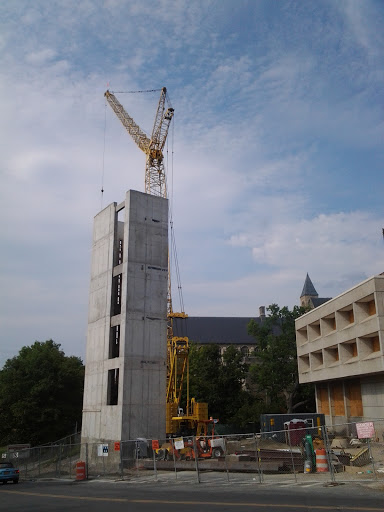
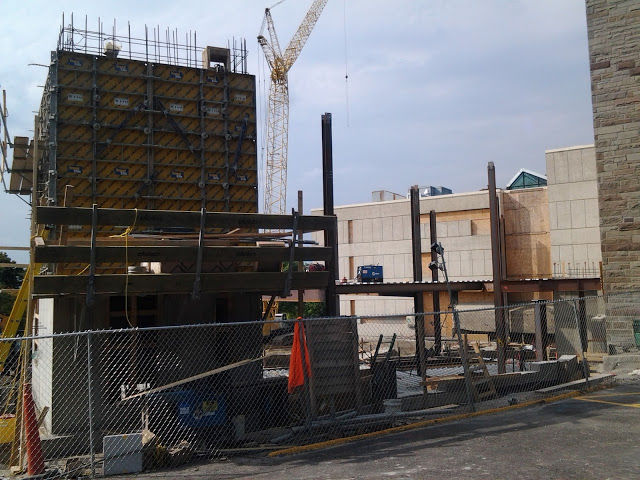
The poured concrete stairwells are probably the first thing passersby notice, given that they’re the tallest structures on-site (construction cranes notwithstanding). The western stairwell has been fully poured and topped out, while the eastern stairwell is currently underway. Look closely and you’ll see the wooden forms used on the concrete. These forms provide stability and shape while the concrete hardens, and they provide support to the reinforcing rods embedded in the concrete. They will move further up the stairwell as more concrete is poured and cured.

Between the stairwells, structural steel beams and joists are being hoisted by crane into plane, and corrugated steel decking for the floors is being laid down as the steel framing is built out. The new addition will continue to rise as the new building, the first phase of three, moves towards its July 2016 completion. Phase II focuses on renovations to the old building, and Phase III a reconstructed Ho Plaza entrance. The whole project is anticipated to be completed by August 2017. Construction firm Welliver is the general contractor for the project.

The building design is by local architecture firm Chiang O’Brien, with landscaping by Trowbridge Wolf Michaels Landscape Architects. There will be two additions to Gannett, a four-story, 55,000 square-foot building, and an additional 18,600 square foot addition that replaces the northeast side of the current building. The project also includes a new entrance and substantial renovations to the original 1956 structure (22,400 square feet of the existing 35,000), as well as landscaping, site amenities, and utilities improvements. The projected cost is $55 million.

20150829_160417 20150829_160443 20150829_160451 20150829_160456

20150829_160616

20150829_160517

gannett5


News Tidbits 8/29/15: Stirring Pots and Stewing Minds

29 08 2015

210_hancock_62015

Short set this week. Things are relatively quiet for this week’s round-up.

1. Leading off this week, Ithaca Neighborhood Housing Services’ (INHS) 210 Hancock development has finally received initial approvals, after a months-long, contentious debate. With the zoning variances granted, it was up to the planning board to issue preliminary approval, and compared to previous meetings, the discussion and decision was brief and uncontested. The plan is to have the project start construction in its phase (the commercial space, 53 apartments and the five rental townhouses) next May, wrapping up the following year. Initially, the time-frame was next fall, but getting approvals now has allowed INHS to move up the time-frame a few months. The seven for-sale townhouses will be built at a later date, with funding separate from the rental units.

The project isn’t necessarily a 100% sealed deal (and really, no project is until it’s complete). INHS has to submit an application for low-income tax credits as part of its financing package, and those are due in by October 6th. Only about 30% of applications receive funding (recipients will be announced in January 2016), but INHS has a pretty strong track record to go on.

After the feud over the Stone Quarry Apartments, INHS made an effort to be transparent about the planning process with the Hancock project and openly engage with the community. Unfortunately, it backfired. It’s looking like INHS’s next major proposal will end up out in Freeville, so apart from one or two houses that may end up in the pipeline over the next year or so, INHS isn’t likely to propose any further affordable housing development in Ithaca for a while.

state_st_triangle_v3_1

2. One controversy subsides, another heats up. The Planning Board was not amused with State Street Triangle at the latest meeting. Now, given the wide spectrum of opinions that runs through the area, the folks that serve on the board tend to be fair and even-keeled. Not gung-ho about all projects, but definitely not a part of the “I oppose anything that makes Ithaca look different” commentary that comes out of some quarters. So this week’s comments tend to be about as harsh as it gets without saying no outright.

I personally don’t like the “It doesn’t look like Ithaca” comment used for the Ithaca Voice headline, because a city isn’t a static object – buildings are built or replaced, homes are painted and renovated, and retailers change. The Ithaca of 50 years ago, or even 20 years ago, isn’t like the Ithaca of today or 20 years from now. Subjective comments are prone to pitfalls.

But that doesn’t change the fact that the size of this proposal makes a lot of people uncomfortable. The building can be built as-of-right (but board approval is still required before permits can be issued), but there might be a substantial benefit if Campus Advantage were accommodating of the concerns, especially with the tax abatement being pursued. For the sake of example, INHS was very receptive to incorporating suggestions in its 210 Hancock project, which really helped during the approvals process. A little more flexibility on CA’s part could make all the difference, assuming they can still make a decent return on investment. I’ve heard that there are further design revisions underway (whether they’re minor tweaks or major changes is not clear), and hopefully those will be put forth for review sometime soon.

east_hill_master_plan

3. Here’s a detail worth noting from the County’s last Legislature meeting – the following is a line from Herb Engman, the town supervisor of Ithaca, addressing the legilslature as he announced his intent to retire at the end of the year:

“Cornell is moving on its consultant to plan the first phase of redevelopment of the East Hill area”.

The wording is a little odd, but my impression is that the consultant is moving forward with planning the first phase of the “East Hill Village“, or whatever Cornell’s planning staff are calling it these days. Actual plans are probably still several months or a year out, not to mention the months of trying to get approval, and then financing/construction. But given the rapid rise in enrollment at the university, any movement towards accommodating more students and reducing the strain on municipalities is welcome.

ith_family_cost_1

4. There will be a full-fledged article on this in the Voice next week, but for those looking to kill time, here’s a “family budget calculator” from the Economic Policy Institute think-tank. There are several ways to calculate affordable housing, but many don’t take childcare into account, so it’s worth seeing just how much affordability changes when children enter the picture.

Word to the wise though – EPI’s data has some flaws. If you compare this to AFCU’s living wage calculation for adults with and without children, you’ll find some sizable differences.


The DeWitt House Senior Apartments

25 08 2015

travis_hude_libe_libe_v3

Most of the time, writing up initial project pages is mostly background details, along with whatever scant details were included in the sketch plan. It usually makes for an exciting post, though occasionally lacking in details.

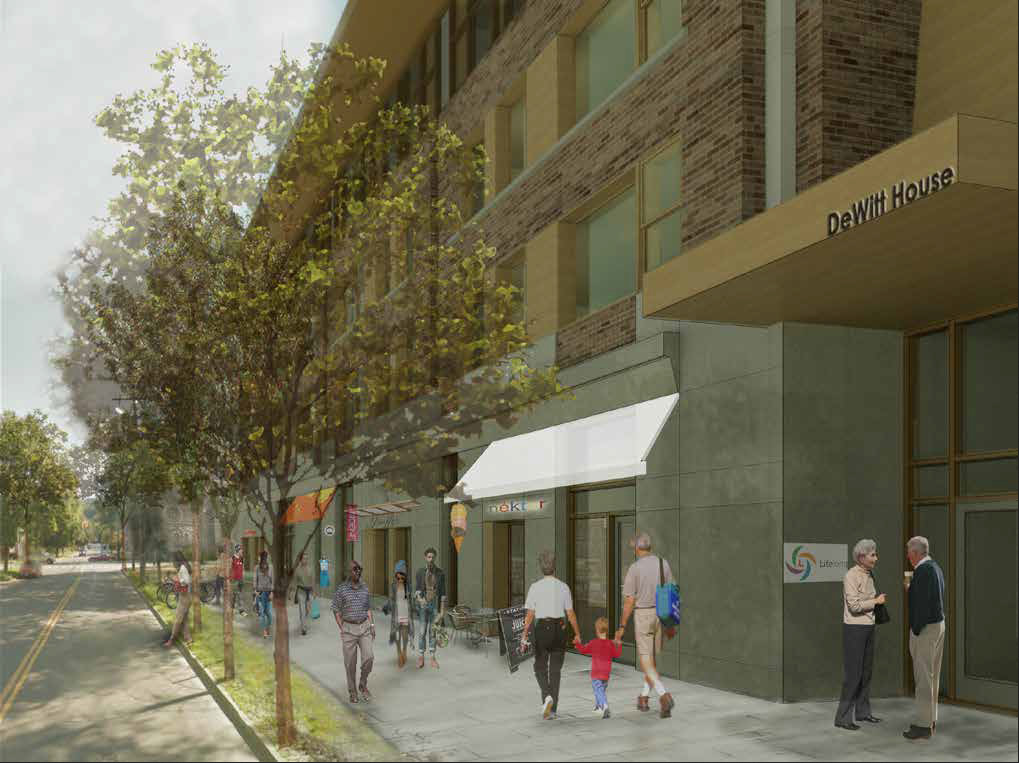
Now here we have the total opposite – a project where many of the details have already been gone over with a fine-toothed comb. Here we have the county legislature’s preferred development for the Old Library site at 310 North Cayuga Street, the DeWitt House Senior Apartments. It has a website, a completed Site Plan Review (SPR) application (here), and the county is heavily involved with the approvals process.

I’m not going into the debate between this and the Franklin proposal with this piece. It’s intended more as a project summary.

Plans call for a mixed-use, 4-story, 72,500 SF building. On the upper three floors are 39 1-bedroom and 21 2 -bedroom apartments aiming for the middle of the rental market, and serving renters aged 50 and older. Approximately 40 parking spaces will be provided, as well as CarShare and a shuttle. Along with the apartments, there will be community space on the southeast corner of the first floor (2,000 SF), new digs for senior services non-profit Lifelong on the west side (6,500 SF), and office/retail space facing Court Street (4,000 SF).

dewitt_house_5

The building will deconstruct the old library, and there are plans to reuse much of the foundation, steel, and possibly the brick from the 1967 structure. The one-story Lifelong building at 119 West Court Street, which dates from the 1950s, would also be taken down. The Lifelong annex building at 121 West Court Street, which dates from the late 1800s, would be renovated into a guest house for those visiting friends and family living in the apartments.

dewitt_house_2

HOLT Architects, which is among a few local firms to have accepted the Architecture 2030 Challenge, has designed the building to be carbon-neutral. Solar panels, rainwater collection from the roof, and a Combined Heat and Power system (CHP) are some of the green features.

dewitt_house_3

The project is being developer by local developer Travis Hyde Properties, and the design is the work of local design firm HOLT Architects. Contact info for both is provided here. TWMLA Landscape Architects, Esther Greenhouse, T.G. Miller Surveyors & Civil Engineers, Elwyn & Palmer Structural Engineers, and Delta Engineering are also providing services.

The SPR application indicates that the $14,000,000 building is aiming to launch construction in June 2016, and finishing up 12 months later. However, the timeline in the SPR says construction wouldn’t start until February or March of 2017, with completion in summer 2018. The renovation of the Lifelong Annex would be completed by the end of 2018.

The DeWitt House project will need not only approvals from the city Planning and Development Board, but also the Ithaca Landmarks Preservation Council (ILPC), since the land is a part of the DeWitt Park Historic District.

dewitt_house_4


News Tidbits 8/22/15: Throwing Fuel on the Fire

22 08 2015

state_st_triangle_v3_1

1. Campus Advantage has released revised parking numbers for its 11-story State Street Triangle project. According to newly-released documents here, parking will be handled with a “four-point program”:

I. The primary component is that CA is negotiating a deal for 250 parking spaces in the upper levels of the Cayuga Street garage. The document notes an average surplus of 300 parking spaces per day.

II. The city is willing to let CA reserve up to 100 parking spaces in the Seneca Street garage.

III. CA has identified 75 underused spaces in the Green Street garage, but no formal deal is planned yet.

IV. Surface parking lots near Cornell and in other parts of the city that could handle parking for those who only need vehicles on weekends or for holiday trips.

Given typical student vehicle ownership rates of about 27% (27% of 620 = 167 spaces), point I will probably be enough to handle resident traffic. Commercial traffic, estimated to be about 64 spaces in the SRF Associates traffic study, would more likely be taken care of by point II or III. So the parking situation appears to be better thought out at this point. CA is also planning a bike share and an Ithaca carshare location. Whether it’s enough to please city staff, we’ll see.

The revised document notes construction traffic would enter the site from E. Green Street, and exit via Seneca Way and East Seneca Street.

Regardless, some of the reactions from city officials have been quite strong – the following quote comes from a report from 3rd Ward councilwoman Ellen McCollister from last month’s IURA meeting:

“Common Council may end up concluding it made a mistake when it re-zoned that part of the city without examining the issue more contextually and architecturally.”
State Street Triangle will be undergoing a public hearing at Tuesday’s city Planning Board meeting, and the committee will be going over the project’s City Environmental Quality Review forms. CEQR is the city’s more stringent version of SEQR, and is used to assess project impacts – basically, mitigating the issues created by the project, and making sure it’s a net positive for the community. No voting is expected.
State Street Triangle has also applied for CIITAP tax abatements, but the IDA meeting has yet to be scheduled.
100_1466

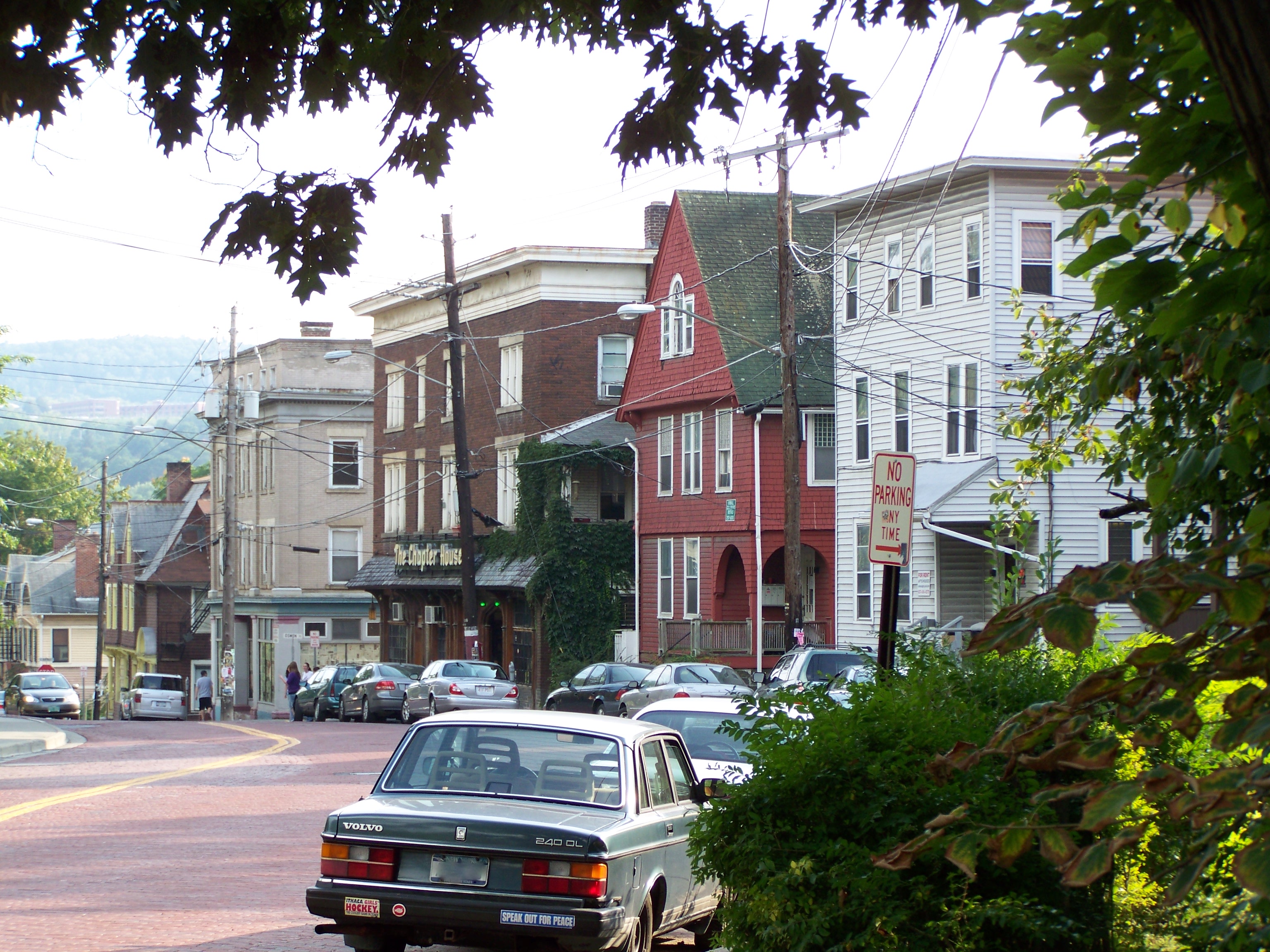
2. Quick update on 406/408 Stewart – a copy of the Ithaca Landmarks Preservation Council (ILPC) from last month indicates that council members are across the spectrum when it comes to 408 Stewart (bluish-white building above) still being historic, and if a new apartment building will be built on just the site of 406 Stewart (red building, destroyed by the Chapter House fire), or on the site of both 406 and 408. Members had to stress to themselves to look at historic value and reconstruction separately, and the purpose of the site visit was to help figure out a decision. There’s been no news yet, but we’ll see what happens.

3. Over in the village of Groton, a small development project is stirring debate of its own.

The project, proposed by Rick Uhl of Genoa, calls for four duplexes and four single-family homes, for twelve units total. The temptation is there to approach this with urban condescension, but for Groton, population 2,400, it’s a big deal.

The homes would be built on several already-subdivided lots on a new road coming off of Elm Street on the eastern boundary of the village. The original plan called for duplexes on the west side of the street and closer to the village center, while single-family homes would be built on the lots on the east side of the street.

The debate lies with proposed zoning changes in Groton – a zoning change currently being considered by the village would downzone parts of the town to single-family homes only. That includes the lots the duplexes are slated for.

The zoning has been a source of debate among homeowners in Groton, because a number of them own larger homes that they’ve turned into duplexes, living in one unit and renting out the other. Although the law grandfathers in current buildings, they worry it could be a hassle in the future. The county’s planning department has also expressed issues with the plan, saying that it creates numerous non-conforming lots and that it goes against the county’s comprehensive plan.

A compromise had been reached between the developer and planning board last spring, where duplexes would be built on the new street’s east side and single-family homes on the west side (so as to keep apartment dwellers from mixing with family homes), but more recently the village has made moves toward an all single-family plan anyway, which is creating some consternation since it tosses the compromise out the figurative window.

The Times notes that a decision on the zoning, and the compromise by extension, is expected at the September meeting of Groton village’s Board of Trustees.

4. Looks like there’s going to be a lull in activity in the town of Ithaca for the next few weeks. The Planning Board meeting for the start of September has been cancelled. The Planning Committee, which is comprised of the town board members and planning department staff, will be discussing a “family entertainment facility concept” for the intersection of Elmira Road and Seven Mile Drive, and modifications to the Planned Development Zone for the South Hill Business Campus (SHBC), an industrial and office park that reuses the old NCR headquarters.

A quick email with SHBC manager Linda Luciano says that the meeting will be to expand the business types allowed under the PDZ, because they were uncertain who would be interested when they first renovated the facility, and they wish “to support a more wide array of possibilities”. No expansion plans are on the table, although rough plans have been around for a while.

Readers might recall that Maguire dealership chain proposed a HQ and expanded facilities along Elmira Road and Seven Mile Drive, but the plan was dropped last December due to differences in opinion on appropriate zoning for the site. A mini-golf plan was also floated a few months ago, but later dropped from consideration.

5. Here’s something worth a short note – a vacant 2.01 acre commercial property in Dryden Village sold for $31,500 on Wednesday the 19th, well below its $150,000 assessment. The buyer is an LLC called “NBN Properties”, registered in July 2014. A separate document identifies the members of the LLC, one of whom is the president of John C. Lowery Inc., an Ithaca construction company.

At a glance, this story had appeared much more interesting – the P.O. Box NBN Properties is using once belonged to Ed LaVigne, who’s running for Lansing town supervisor. But LaVigne stopped using the P.O. Box in 2014, which allowed NBN to reserve it.

Regardless of who runs “NBN Properties”, the site is a potentially good location – Poet’s Landing was built just a few minutes’ walk away to the west, and the DOT has been aiming for a move next door on an adjacent 10.8 acre parcel to the north.  The county has paid for a feasibility study, now underway, for moving the DOT from the city waterfront to the location off Enterprise Drive in Dryden village (costs have delayed the move for years). This part of Dryden village has seen some other new businesses in the past few years, including a microbrewery and a Dollar General. If anything interesting comes along, expect a follow-up.

harolds_square_taylor

6. Nothing “new new” coming up at Tuesday city Planning and Development Board meeting, but plenty to talk about. Here’s the agenda, a rundown of what to expect.

A. Subdivision – continued from last month, a subdivision at 106-108 Madison Street on the northside. The applicant seeks to create a lot for a new single-family home

B. 1. Harold’s Square, 123-129 East State Street

The project was approved two years ago this month, but no building permits have been filed. Under that circumstance, an approval is only good for two years. The applicant is looking for a re-approval with no changes. A contractor associated with the Cornerstone Old Library proposal estimated construction on the 11-story, mixed-use project would begin this fall. Harold’s Square developer David Lubin is seeking to bring retail, office space, and 46 apartments to the market.

2. INHS’s 210 Hancock Street affordable housing proposal is up for preliminary and final approval

3. Final approval for the Dibella’s proposed in Southwest Ithaca

4. Discussion on State Street Triangle, see above

5. Public hearing and possible prelim and final approval for John Novarr and Cornell’s 209-215 Dryden Road academic/office building

6. Sketch Plan – Old Library proposal, Travis Hyde. Not exactly new, but I’ll give it the standard project summary next week.