Texas Roadhouse Construction Update, 1/2016

20 01 2016

Another project just getting off the ground in big box land is the Texas Roadhouse restaurant. This is one of those projects where people either love it, or they hate it, reinforcing my belief that at the typical Ithaca family’s Thanksgiving table, the topics to avoid discussing are religion, politics and restaurant preferences.

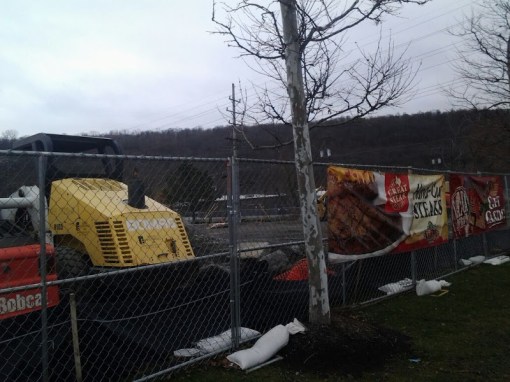
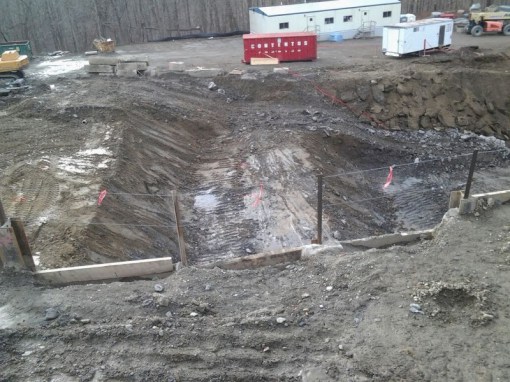
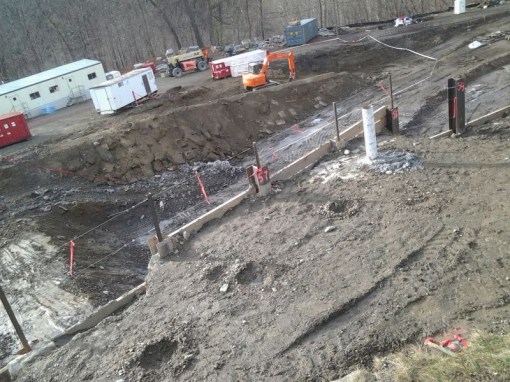
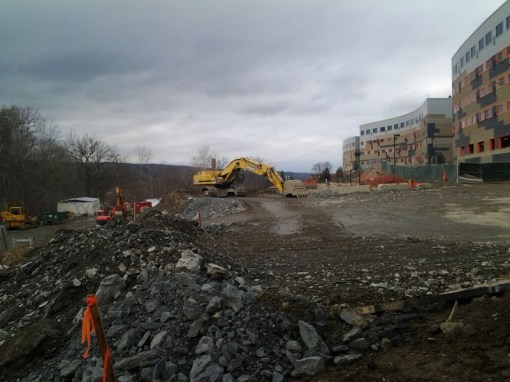
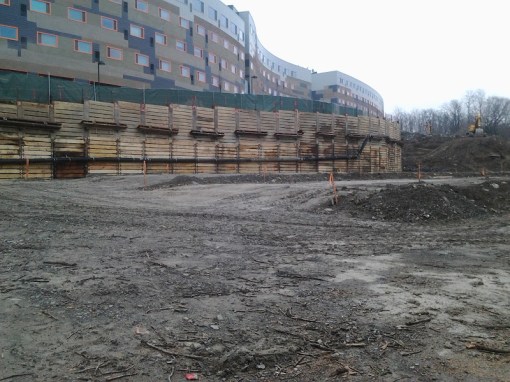
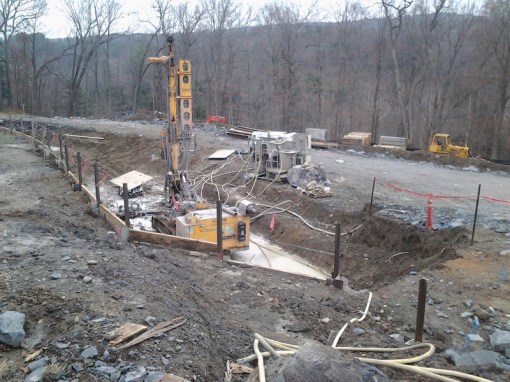
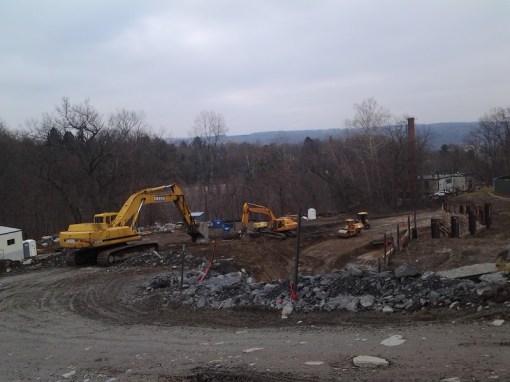
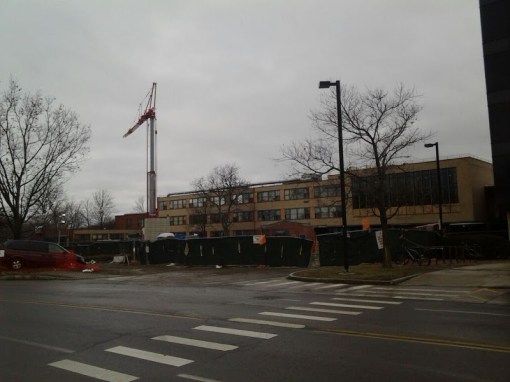
At the moment, the site is being prepped and graded, with a telehandler, skid steer, drill machine, excavators, and other equipment taking care of the pre-foundation work. About 575 cubic yards of fill is being added to the site (not 100% sure if feet or yards, the FEAF reads “575′ CY fill”), since the existing soil at the site is prone to excessive settling and compacting – in the county’s NYSDOT study, it was noted that the slab foundation of the previous building on-site was subject to chronic foundation problems. The added fill will help compact the soil and limit further problems.

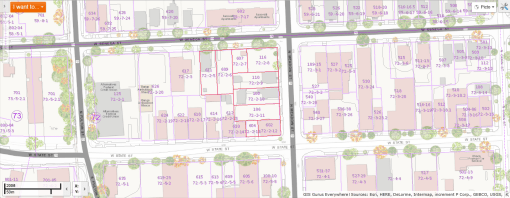
The $1.35 million project at 719 South Meadow Street was formerly home to Cellular One, a 1990s one-story masonry building that was demolished in 2013, leaving a vacant lot until now. The 7,163 sq ft store looks to be the standard corporate design theme for the 430-restuarant chain. Expect a Summer 2016 opening.

Texas Roadhouse corporate is developing the site, leasing the land from plaza owner DDR Corp. of Ohio. GreenbergFarrow of suburban Chicago is serving as an architectural consultant for the project.

20160109_140227 20160109_140244 20160109_140313

texas_roadhouse_v3_1


Holiday Inn Express Construction Update, 1/2016

19 01 2016

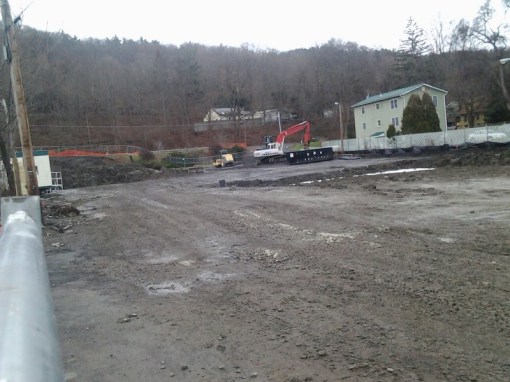
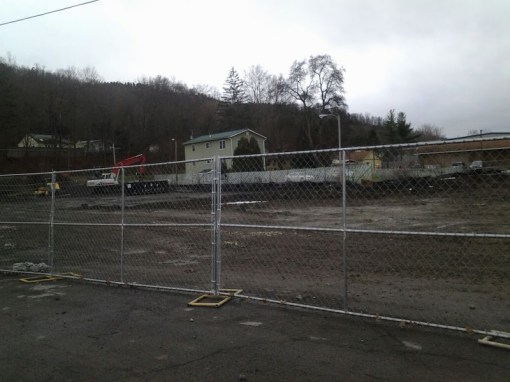
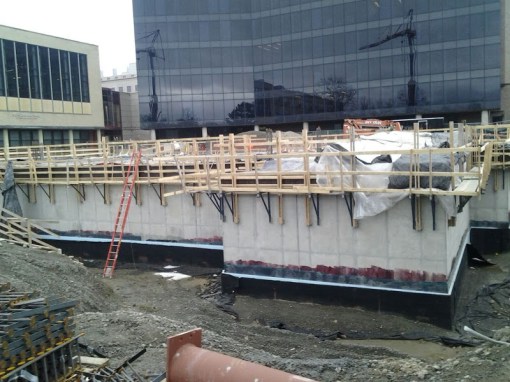
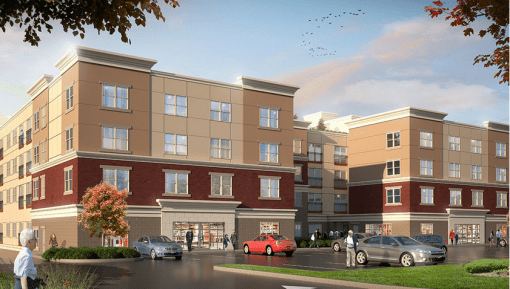
Nothing too exciting underway yet at the Holiday Inn Express at 371 Elmira Road, but the site is being cleared and prepped for construction. The site combined two tax parcels, one of which held a 7,556 SF 1970s office building, and the other a 960 SF engine repair shop. Both have which have been demolished to make way for the new 11,769 SF, 79-room hotel. Eventually, a retaining wall will be built on the back end (east side) of the parcel, to hold back the slope soil from what will be the hotel’s parking lot. A staircase and sidewalk will connect Spencer Road to the parking lot and Elmira Road.

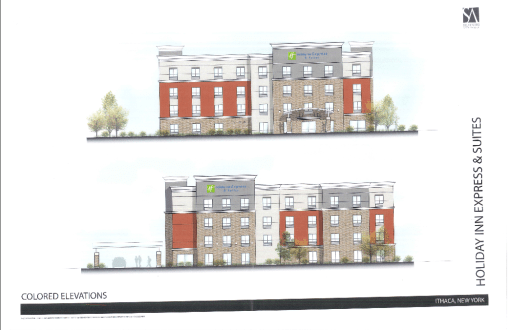
For those who aren’t especially big fans of chain hotels and corporate architecture, this one appears to have a relatively unique design, while following the standard materials and color scheme (called “Formula Blue“) for new Holiday Inn Expresses. Standard for the HI Express line, the hotel’s lobby will serve as a “great room”, there will be free high-speed internet, and while there will not be any full-service dining, a breakfast bar will be included.

Rudra Management and Rosewood Hotels (Jayesh Patel) of suburban Buffalo is the developer, while Silvestri Architects and Optima Design & Engineering, also of Buffalo, are in charge of design. The project is being financed with a $5.98 million loan from S&T Bank, a regional bank in Western Pennsylvania. The project required a little bit of time to obtain financing, having received approval in March 2014, but now receiving the construction loan until this past October. Another Rudra/Rosewood project just up the road at 339 Elmira Road was not so lucky. A Summer 2016 opening is planned.

20160109_141040 20160109_141046 20160109_141057

holiday_inn_express_v2

holiday-inn-express-original-1


Collegetown Terrace Construction Update, 1/2016

17 01 2016

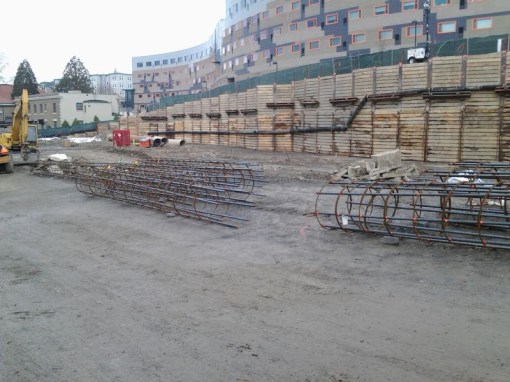
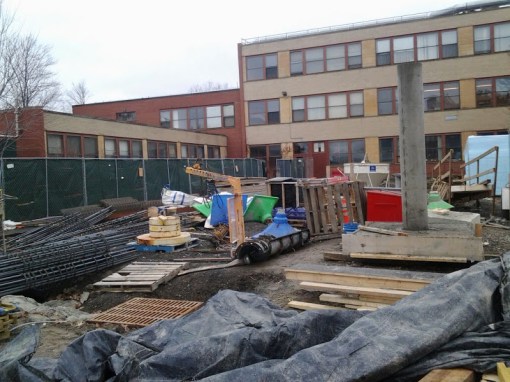
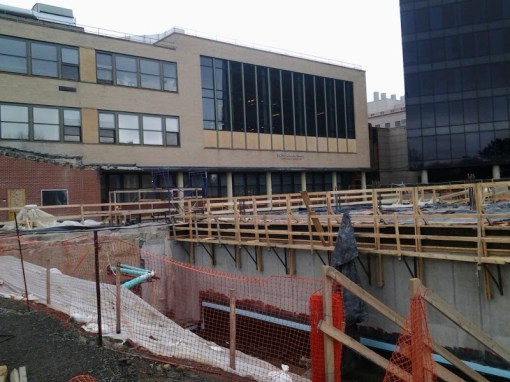
Being a 247-unit, 344-bed project means a lot of earth has to be moved before anything starts to rise from the ground. As a result, the project is undergoing the necessary if not exactly glamorous step of excavation for Building 7. All three phases combines have an estimated construction cost in the range of $70 million. The impression I’m getting from here is that when the time comes, foundation forming and pouring will begin from the west side and slowly make its way east, and so the west side of the curvaceous apartment building will be further along the east side at a given time during construction (similar to how it played out with Buildings 5 and 6 during the previous phase). Local development company Novarr-Mackesey plans to have the apartment building ready for tenants by August 2017.

20160109_132637 20160109_132711 20160109_132725 20160109_132743 20160109_133206 20160109_133401 20160109_133413 20160109_133535 20160109_133627

From December 2015:

20151205_091839 20151205_091917 20151205_092046 20151205_094226 20151205_094229 20151205_094237


News tidbits 1/16/2016: The Not-So-Best Laid Plans

16 01 2016

elmira_savings_1

1. It isn’t exactly a shock that Elmira Savings Bank is pursuing plans for the $1.7 million in properties it just acquired on the west 100 block of Meadow Street between West State and West Seneca Streets. That being said, sending out 30-day eviction notices wasn’t a very good idea from a public relations standpoint.

Technically, it’s all above the law – the three tenants affected were on month-to-month leases, according to Nick Reynolds over at the Journal, and one had an expired lease and was in the process of relocating. The bank wasn’t interested in renting out the properties and decided to clear them out. That is plausible, if a little brusque – even if they had put forth a proposal for something at the next Planning Board meeting, approval would take months, in which case they could eased the tenants out of the current property. But instead, they ended up with a petition that, while mostly reading like a speech from the Politburo, does make the valid point that this was conducted poorly. Then it hit the airwaves, and the bank has gone into major damage control mode, giving the tenants until the end of March and reimbursing them $1,000 for the trouble.

Looking at some of the comments on the Voice, there is a lot of outcry against gentrification, but there’s not a whole lot the city can do to prevent that – even if Elmira Savings Bank didn’t build a thing and sold the buildings to someone else, the rapidly rising property values around the city would push the renters out, albeit more subtly, and the city can’t make a law that says someone can’t move in. Plus, as seen during the 210 Hancock, Stone Quarry and Cayuga Ridge debates, there’s a lot of pushback locally against affordable housing. Arguably the best solution going forward is to work an inclusionary zoning ordinance into law so that when Elmira Savings Bank does decide to build (and it’s more of a when than an if), that a few of the units be made available to those on more modest incomes.

Just to touch on that real quick, according to the Journal, the old Pancho Villa building at 602 West State Street will become a bank branch for ESB in the short-term, and plans are being considered for a mixed-use project at some point down the line (two months, two years, who knows). The zoning is WEDZ-1a, allowing for a five story, 65′ building, but there might be tweaks to that depending on the inclusionary zoning ordinance.

tmpud_waterfront_1

2. Keeping a focus on the west side of the city, the Planning and Economic Development Committee voted to circulate a proposal for a “Temporary Mandatory Planned Urban Development” (TM-PUD) over the waterfront. The reason for this is one part proactive, and one part reactive.

What the TM-PUD does is, for an 18-month period starting the day of Common Council approval, it gives the Common Council the right to oversee and if necessary vote down projects that it thinks will not be appropriate for the waterfront. The study area is currently a mix of zones: Waterfront (WF-1, WF-2), Southwest Mixed-Use (SW-2), Park (P-1) and Industrial (I-1). When the Comprehensive Plan was passed in 2015, it promoted a more walkable, dense, mixed-use waterfront. Therefore, some of the zones are outdated.

The city’s planning department is still in the process of drawing up specifics for how to implement the Comprehensive Plan’s walkable urban waterfront, but in the meanwhile, some of the zones don’t match up with the direction the city wishes to proceed. Take, for example, the industrial space on Cherry Street and Carpenter Circle. By zoning, residential uses aren’t allowed, although the city would like to see mixed-uses with condos and apartments in their vicinity. The planning department needs time to figure out the what and where on zoning so that those uses can be proposed without a developer spending extra months in front of the Planning Board and BZA, which can drive up costs and make construction financing more uncertain.

So that’s the proactive, benign part – the city needs time to plan out the zoning laws for the dense waterfront they want. Now comes the reactive, cynical part.

It’s a not-so-secret secret at this point that the Maguires are looking hard at Carpenter Circle for their car dealership headquarters and multiple sales outlets. Since Carpenter Business Park is zoned industrial, and Ithaca city zoning allows commercial uses in industrial space so long as they’re two floors, there’s a good chance they could build dealerships without the need of the BZA, and it would be an uncomfortable position for the planning board to have to debate a project that is totally legal but is something the city and much of the community doesn’t really want. So as a way to stall for time, the city’s pursuing this TM-PUD and giving the Common Council the authority to shoot down any unwelcome plans should they arise.

For comparison’s sake, there’s a similar scenario that is playing out in Ithaca town. The College Crossings project on South Hill was welcomed under the zoning and previous iterations had been approved, but after the town passed its 2014 Comprehensive Plan and attended the Form Ithaca charettes last summer, the planning board realized that a shopping center with a couple apartments above and in the middle of a large parking lot wasn’t something they really wanted anymore. While the project has been withdrawn, the process and debate has created a lot of discomfort, confusion and uncertainty, which is rather problematic given the area’s housing shortage. The town hopes to have some form-based zoning code ready this year.

So, looking back to the city, the occupants of 108 E. Green Street want things that are still illegal in much of the study area, but they don’t want a full-on moratorium because some spots like the Waterfront zones actually do accommodate what the city and many of its constituents want. The TM-PUD is an attempt to stave off the legal but undesirable projects until the revised West End zoning can go into effect.

Worth pointing out, at the meeting the boundary was changed to midway through the Meadow Street and Fulton Street blocks, rather than along Fulton Street. It may or may not affect Elmira Savings Bank’s parcels as mentioned above, but those long-term plans are in alignment with the city’s, so probably not.

south-hill-area

3. On a related note, the town is holding workshop sessions for those interested in designing a ped-friendly, mixed-use community for South Hill. The meetings are planned for 6:30 p.m. to 8 p.m. Jan. 26 to 28 at the Country Inn and Suites hotel at 1100 Danby Road in Ithaca. An open office has also been scheduled for 12 p.m. to 1 p.m. Jan. 27. Form Ithaca will be in attendance at the sessions to help formulate the form-based character code proposed for the neighborhood.

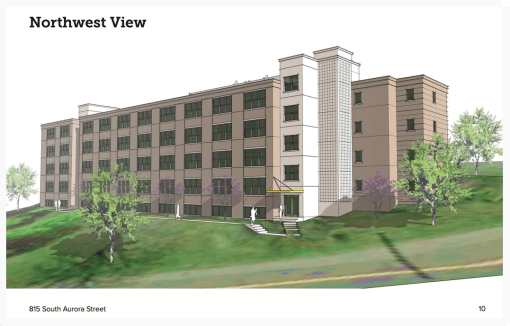
815_s_aurora_4 815_s_aurora_1

4. A revision to the cellphone tower law has taken one step closer to becoming reality. The city’s Planning and Economic Development Committee voted 4-1 to circulate a revised law that would reduce the size of the tower’s fall zone, where construction of any structures is prohibited. A revision to the current city law, which is twice the height of a tower, could potentially allow the 87-unit 815 South Aurora apartment project to proceed with planning board reviews and other BZA variances if necessary. Developers Todd Fox and Charlie O’Connor of local company Modern Living Rentals have been pushing for a fall zone radius of 180 feet for the 170-foot tall tower, rather than the 340 feet as the current law mandates.

From the discussion, it sounds like the concern has less to do with this parcel, and more to do with the possibility of cell phone companies pursuing towers on open land in the northern part of the city where spotty reception has to be weighed against the aesthetics of the lake shore. Anyway, we’ll be hearing more about possible changes to this law in a month, but for back reading, here’s the Voice article from a few months back.

5. In quick news, CBORD’s move to the South Hill Business Campus looks like a go. A $2.45 million construction loan was extended on the 8th by Tompkins Trust Company. CBORD, a software company founded in Ithaca in 1975, will move 245 employees into 41,000 square feet of freshly renovated SHBC space from the Cornell Business Park later this year. The project, which totals $3.7 million, was granted $296,000 worth of sales tax abatements.
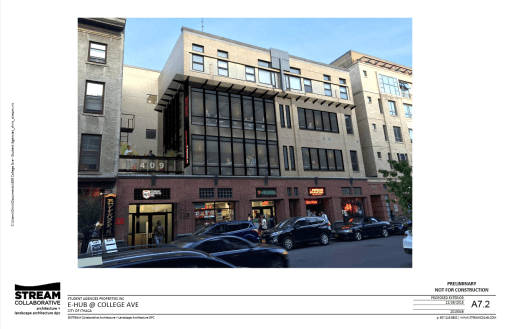
409_college_avenue

ehub_1

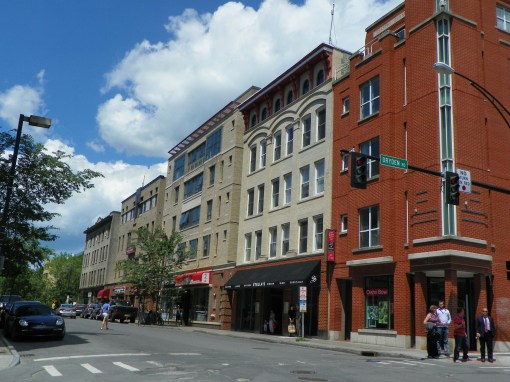
6. From the city’s Project Review Agenda next Tuesday, plans for a facadectomy of the 1980s Student Agencies Building at 409 College Avenue. Student Agencies, in collaboration with Cornell, plans on dropping $183k on the facade work, as well as the $2.8 million or so for the interior renovations of the second and third floors for the new eHub business incubator space. Prolific local architecture firm STREAM Collaborative is in charge of the design work, including the 9,660 SF of interior space. The work would go from January to April (the loan is already approved and most of the work is interior).

6-29-2014 163

If I may play armchair architecture critic, which I have no credentials to do, I think the patio area is great, but I’m opposed to the brise-soleil, the wing like feature that serves as a sunscreen. I feel like that its location above the third floor throws off the rhythm of the block, by being lower than the cornices on adjacent structures. It might be fine over the glass curtain wall alone, but as is it feels a little out-of-place. Just one blogger’s opinion.

20160109_135258 20160109_135338


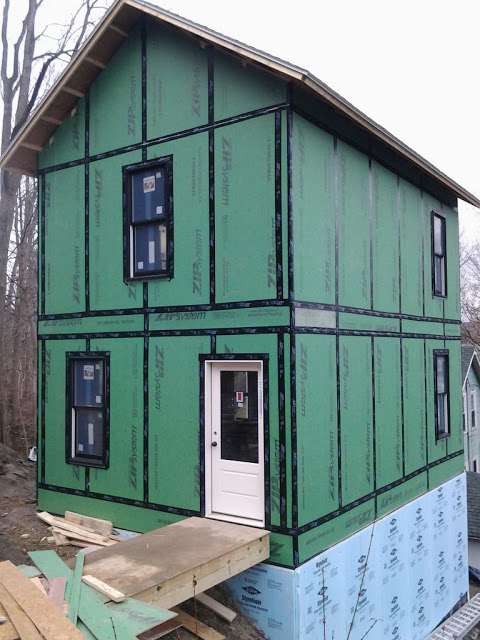
228_w_spencer_1

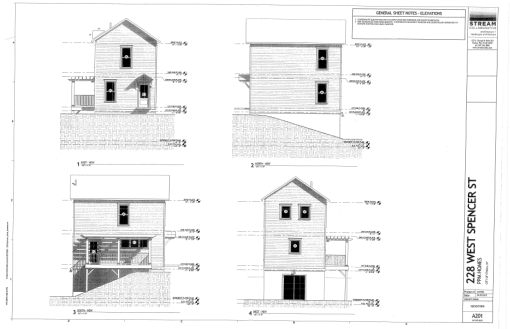
7. House of the week. 228 West Spencer Street in the city of Ithaca. Zero energy new construction, 2-bedrooms, on a rather difficult site. In the above photos from last weekend, the house has been framed and sheathed with Huber ZIP System plywood panels, the roof has been shingled, and doors and windoes have been fitted. The blue material on the concrete basement wall is Dow Styrofoam Tongue and Groove Insulation which protects against moisture and helps keep the heat loss to a minimum. The house should blend in nicely with its neighbors.

Ed Cope of PPM Homes is the developer, and Noah Demarest of STREAM Collaborative is the architect.


Gannett Health Center Construction Update, 1/2016

14 01 2016

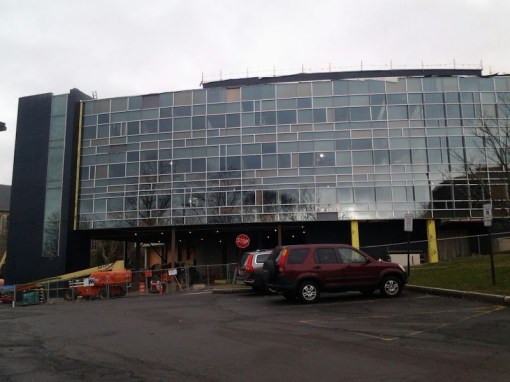
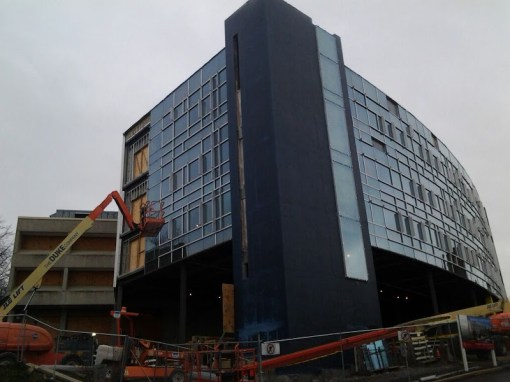
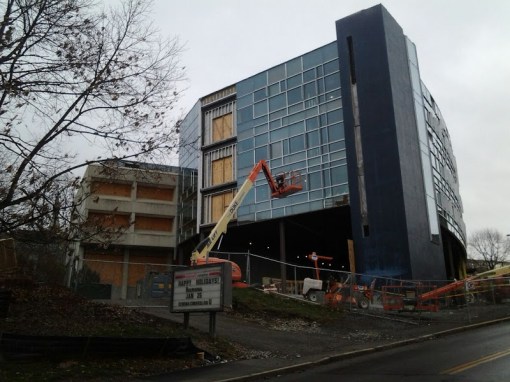
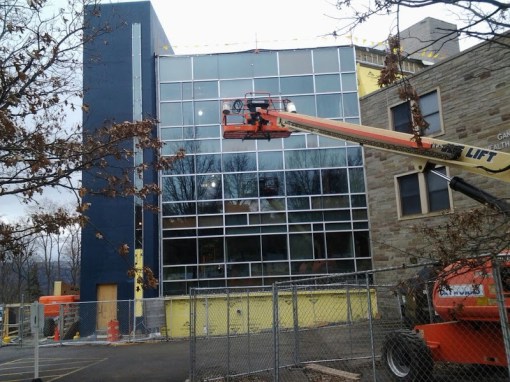
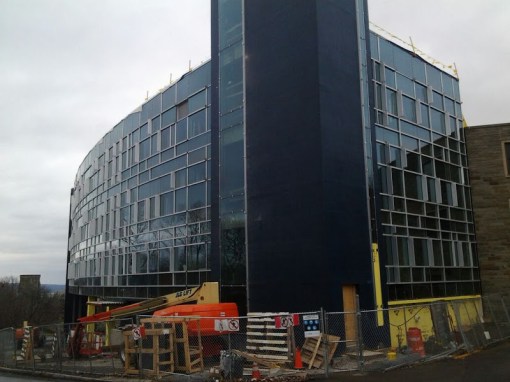
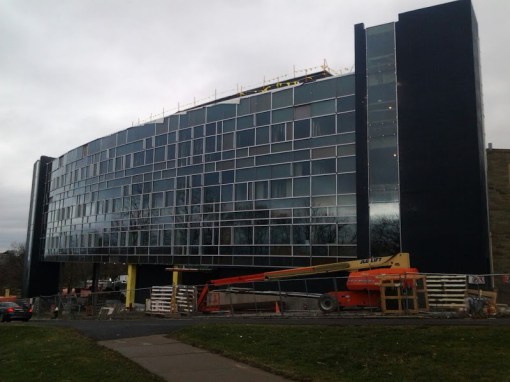
Maybe it’s just the grey January skies, but the multi-colored glazing on the outside of the new Gannett Health Center is more subtle than the renders would suggest. Work is continuing on Phase I of the $55 million project, which is planning to open this summer. Once it does, Gannett’s services will shift over into the new structure, so that phase II, renovations to the original 1956 building and the 1979 addition can take place. The building project is expected to wrap up in August 2017, and a phase III focusing on the Ho Plaza entrance and landscaping will be underway from June to October of 2017, after which the project will finally be completed. The project will increase Gannett’s size from 35,000 SF to 96,000 SF.

Most of the windows have been installed, although some yellow DensGlass gypsum sheathing and metal exterior wall studs can still be seen from many angles. According to the Site Plan Review docs, the curtain wall “suggests an abstracted quilt pattern” meant to conjure up images of care-giving and recovery. Other exterior cladding materials, including a native bluestone veneer and limestone panels, have yet to be installed.

Organizations working on the design include local architecture firm Chiang | O’Brien Architects, TG Miller P.C.Engineers and Surveyors, and Ryan Briggs Structural Engineers. The Pike Company is serving as the general contractor.
20160109_123831 20160109_123902 20160109_123930 20160109_124003 20160109_124038 20160109_124057 20160109_124136 20160109_124210 20160109_124230 20160109_124331

gannett5 gannett3

gannett2

Gannett-Health-Services-Building-SPR


Upson Hall Construction Update, 1/2016

13 01 2016

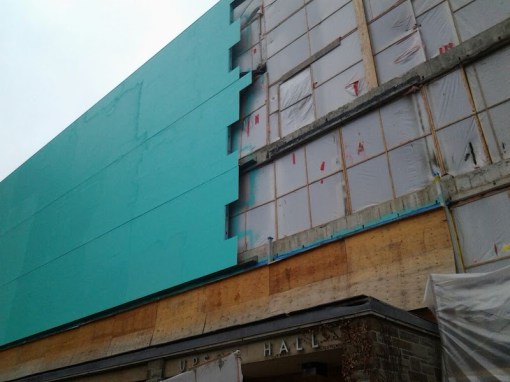
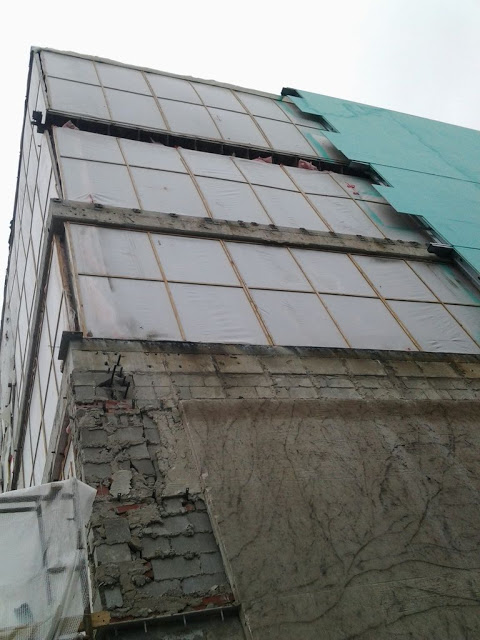
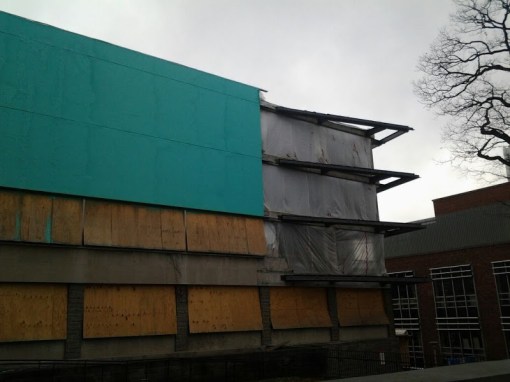
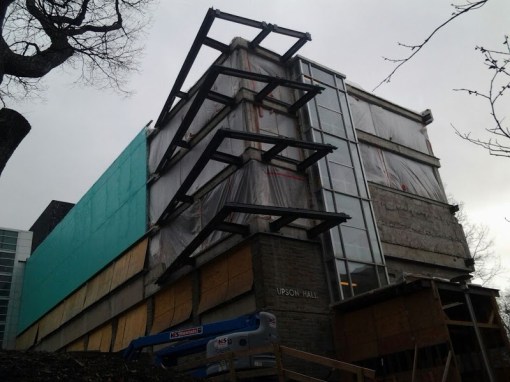
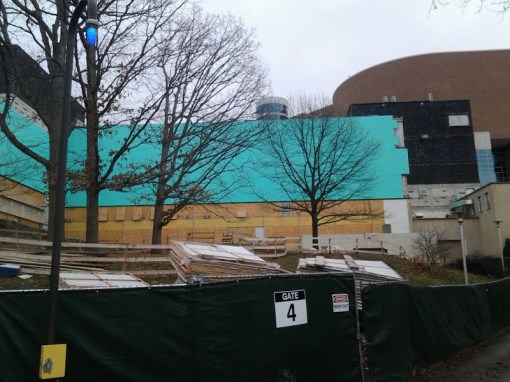
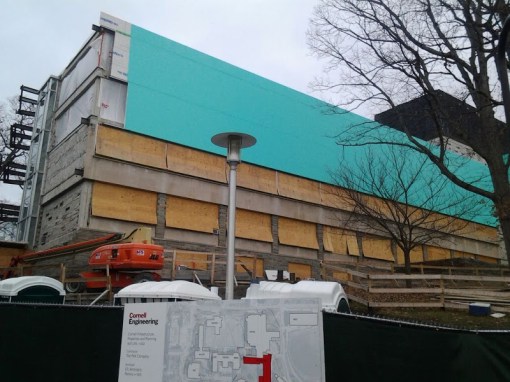
Upson Hall’s bright turquoise walls stand out among the winter greys. Students and staff can thank (or curse) the spray-on moisture barrier for the splash of color. To see what the sheathing looks like without the barrier, photo #9 below shows a little bit of the white gypsum board in the upper left, near the southwest corner of Upson.

The unsheathed, unsprayed section on the northeast corner remains uncovered so that the new structural steel for the bump-out can be erected, while the steel for the northwest bump-out has already been assembled and installed. The plastic is still up over the exterior walls, keeping the winter winds at bay.

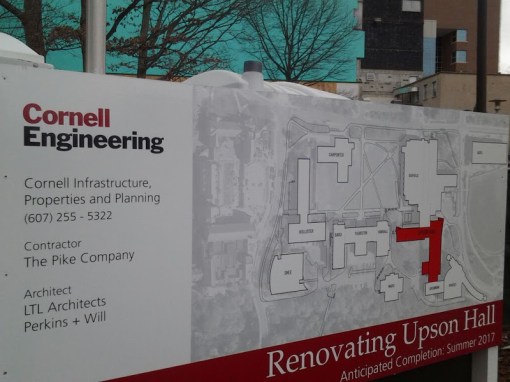
According to the project website, general contractor The Pike Company (Rochester office) is cutting/coring shafts through the first floor to the fifth floor, and demolition activities are underway in the basement. The shafts not only serve as ingress/egress, they’re designed to serve as social spaces and integrate the floors of the building. Utilities rough-ins, framing and drywall installation are underway on the upper three floors where interior work is further along, while work on the first and second floors won’t begin major work until August 2016. Part of the basement will be finished in the first year of construction, and the rest of the basement in the second year. Basically, half the building is still occupied at any given time during construction.

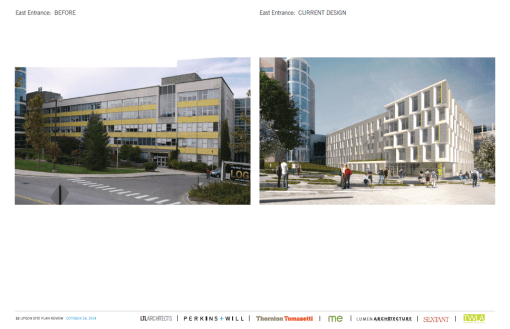
The $74.5 million dollar project is part of a larger series of renovations to the Engineering Quad that will result in $300 million in improvements over a decade. While the project will only add about 4,000 SF to the 156,000 SF building, the renovation are expected to help the engineering school adapt to changing academic space needs and technology, and make the building much more energy efficient. The college is paying for the project with a mix of philanthropy and operating funds. A full FAQ is available on Cornell Engineering’s website here.

Along with Cornell’s internal project management team, the project is designed by New York City firms LTL Architects, Perkins+Will, and Thornton Tomasetti.

20160109_123031 20160109_123105 20160109_123129 20160109_123259 20160109_123309 20160109_123338 20160109_123417 20160109_123504 20160109_123509 20160109_123516 20160109_123528

upson_3 upson_2


Cornell Veterinary School Expansion Construction Update, 1/2016

12 01 2016

Over at the Vet School, it looks like the expansion project is now at surface level. With the foundation completed, the only direction for the project to go is up, which the Manitowoc Potain self-erecting crane should help with. Phase I interior renovations should be completed by this time, and the Phase II new construction will be moving ahead to a June 2017 completion. Like Klarman Hall, Welliver is the general contractor of this $74.1 million construction project.

20160109_121541 20160109_121607 20160109_121617 20160109_121646 20160109_121718 20160109_121739 20160109_121743 20160109_121756 20160109_121825


Klarman Hall Interior Photos

11 01 2016

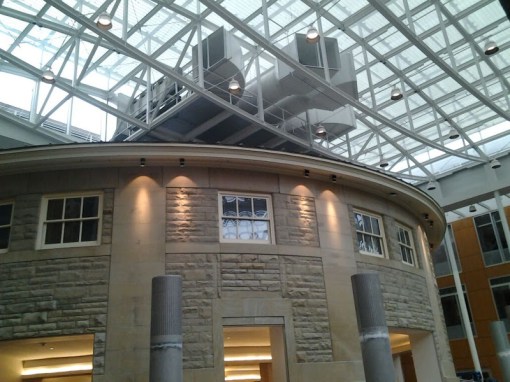
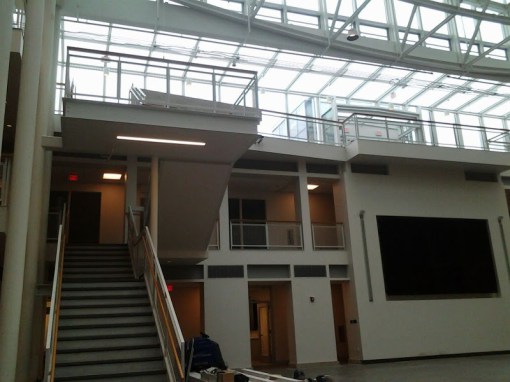
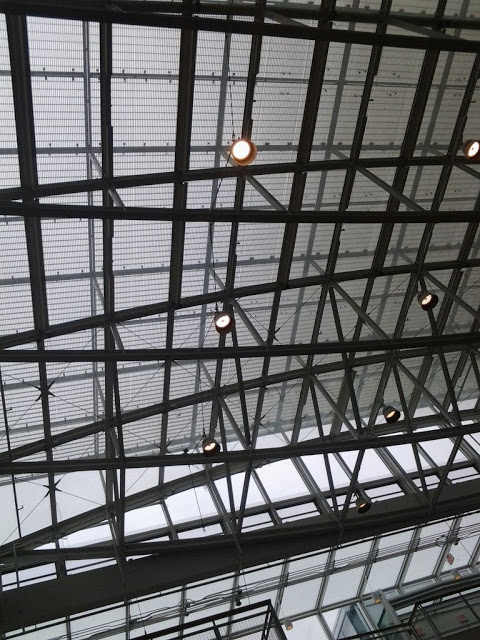
Otherwise known as what $61 million gets you. Wrapping up the Klarman Hall updates with some interior shots of the nearly-finished building. Some staff and classroom spaces have already been occupied, as is the new Temple of Zeus cafe. While inside, I struck up a conversation with the one other person present, an employee of sub-contractor Cook Painting doing touch-ups, and he told me all about how he’s worked on multiple Cornell buildings and Klarman was his favorite so far, and that although he was disappointed the roof had an opaque cover, he’d seen the sun come through the sides in the morning and “the whole place just lights up like a Christmas tree”.  Unfortunately, it was cloudy a little after noon when these photos were taken, so no such effect here.

In Klarman’s 33,250 SF of usable space, Cornell will host spaces and meeting rooms for approximately 200 faculty and staff, a 350-seat auditorium, and the 7,700 SF glass atrium, which is arguably the centerpiece of the new structure. Accordingly to the friendly painter, Cornell will do a formal event to celebrate Klarman Hall’s completion later this year. No doubt its namesake, billionaire hedge fund manager Seth Klarman ’79, will be in attendance. The Groos family, multi-generational Cornellians, were also significant donors to the project.

Klarman was due to be complete in December 2015 when the project first began construction in summer 2013, so all in all Cornell and the contractors did a pretty good job staying close to schedule, even with the last couple cold and stormy winters. Hats off to the construction workers and for making that happen.

Boston-based Koetter | Kim and Associates is the building architect (they also did the recently-built Physical Sciences Building), and Welliver served as general contractor. Klarman Hall is seeking LEED Platinum certification, which is the highest level possible.

20160109_124823 20160109_124828 20160109_124844 20160109_124855 20160109_124910 20160109_124937 20160109_124957 20160109_125023 20160109_125032 20160109_125037 20160109_125128 20160109_125137 20160109_125218 20160109_125224

20160109_125246

20160109_125303 20160109_130220 20160109_130248 klarman_atrium_render


News Tidbits 1/9/2016: Better Late Than Never

9 01 2016

Call it the big news round-up. This is what I get for not writing my weekly roundup last week.
339-Elmira-Road-cancel

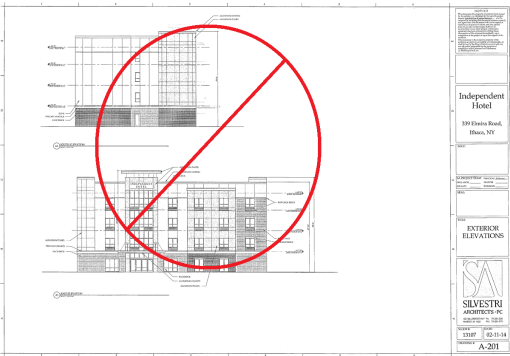
1. We’ll start off with some bad news. The plans for a boutique hotel at 339 Elmira are very likely done and over with. The 37-room, 6,468 SF hotel announced in February 2014 was planned for the 0.59 acre former Salvation Army property on the Southwest side of the city. For whatever their reasons were, the developer, (Rudra Management and Rosewood Hotels of Buffalo, decided put the property up for sale for $395,000. After several months, it finally sold at the discounted price of $300,000 to its next door neighbor, Arizona-based Amerco Real Estate, the parent company of U-Haul. Discounted is a relative term, by the way – Rudra had acquired the vacant property for $143,000 in a land auction in 2013. Back when Salvation Army was still there in 2009, the site sold for $175,000.

So with that sale to Amerco, it’s likely the property will be used for an expanded U-Haul parking lot. It’s unfortunate, but them’s the breaks. For what it’s worth, Rudra has commenced work with the other hotel they had planned, the 79-room Holiday Express at 371 Elmira Road, just down the street.

2. In modest but notable projects, the William George Agency in Dryden received a $2 million construction loan to conduct renovations and roof repairs to its cafeteria area. The non-profit residential treatment center for adolescents had secured building material sales tax abatements from the county to help cover their expenses (the project has originally been planned to start in Q1 2015). The agency, established in the 1890s, employs over 340, making it one of the larger private employers in Tompkins County.

20150613_194544

3. Thanks to Nick Reynolds over at the Journal for reminding readers that not every construction project is private. Noted in his writeup of projects that the city intends to fund this year – $430k in road repair projects, another $407k for parking stations, $1.3 million to replace Cass Park rink’s roof, $214k for design work for the new North Aurora street bridge, and $735k for design work for city dam reconstructions.

Perhaps most interesting to readers here will be the $500k that the city intends to spend on design and planning the new Station No. 9. With the awarding of funding from the Upstate Revitalization Initiative, the city can formally explore the possibility of a new fire station on a Cornell parking lot at 120 Maple Avenue. Once a new station is complete, the city could then sell the current Station No. 9, nearly 50 years old and in need of major renovations, to a private developer for redevelopment (the developer who expressed interest in the site is still unknown, but given Collegetown’s expensive real estate market, they must have really deep pockets).
biggs_2

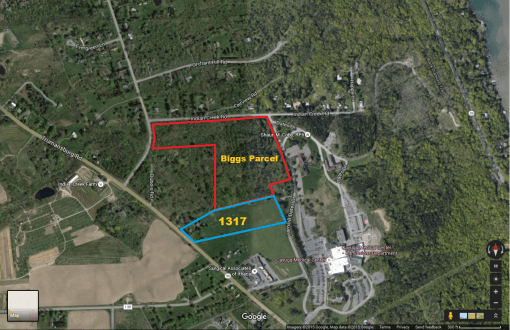
4. More talk of the Biggs Parcel. Jaime Cone at the Ithaca Times provides more details regarding neighbor Roy Luft’s proposal to build for-sale senior housing using the site. Luft is arguing his project is more environmentally friendly than the NRP project, it would take two to three years to come to fruition, that the units would be 700-1,000 SF, and he’s serious about building the senior housing, which is an under-served market. The Indian Creek Neighborhood Association, which has actively fought any sale, seems to at least be open to the idea, if not necessarily a fan of it.

For the record, since the ICNA doesn’t clarify it in their blog post, the county didn’t develop the NRP project. The county put out a request for proposals (RFP) just like they do with every other large development study or offering. Better Housing for Tompkins County and NRP happened to think they had a good project idea and responded to the RFP. It’s been made clear, multiple times, that the county has approached neighbors, Cayuga Medical, INHS and others for months, shopping the land around, and no one has made offers. To be completely honest, even if this land hit the real estate listings, it’s not as if anyone is clamoring to snatch this up; there’s demand to live in and near Ithaca, but land still takes several months to sell on average, and it’s not a stretch to think that developers would avoid this one after the NRP flaying. The county plans to start the listing process later this month if the ICNA doesn’t make an offer by the 15th.

Just a thought, but if $340,000/25.52 acres = $13,333/acre, and the acreage closest to Dates Road is probably developable, than shouldn’t that allow a ballpark fair-value estimate? I know NRP was to pay $500,000, but that had some transit and pedestrian cotingencies attached. Has the ICNA contacted NRP to ask how extensive the wetlands were, is the information on file with the county?

1317 Trumansburg is 10.17 acres, The Biggs parcel 25.52. Combined, they would be 35.69 acres. From the sound of it, Luft would like to reform the parcel boundaries to let his project, however big it may be, to move forward. The site is zoned low-density residential, which means a cluster subdivision can be 2.3 units/acre at maximum. Each structure can have up to 6 units. Taking a guess here, but Luft may be looking at more than 20 units, because anything less than 20 could be done with a subdivision of his current property. For comparison’s sake, the BHTC/NRP project was 58 units.

There is at least the potential that the county gets additional tax dollars from Luft’s project, and the woods would be protected, and there would be a happy ending to this story. But that’s dependent on both sides’ goodwill. Given the years of acrimony, that’s a big leap of faith.

5. For the restaurant-goers out there – Fine Line Bistro’s old spot at 404 West State has a new tenant called “The Rook” opening this month. Mark Anbinder provides the foodie rundown at 14850.com. Mid-tier American bistro/pub fare.

More importantly to this blog is the economic rundown, provided thanks to their application for a loan courtesy of the Ithaca Urban Renewal Agency (IURA). The three co-owners, all local restaurateurs, are seeking a $40,000 loan (3.5% interest, 6 year length) to complement their own dollars and a private loan. 8 hired staff (cooks/servers/dishwasher), but none living wage. With cash flow statements, restaurant plans, the menu, loan filings and resumes of the owners, this looks like a Cornell Hotelie’s senior class project.

It’s the IURA’s decision make, but at least it’s nice to know that good restaurant space in Ithaca is in strong demand.

Pg-3-Rendering

6. Out for bid, Cornell’s Ag Quad renovations. The bid filing estimates the budget at $6.6-6.8 million, and a construction timetable of late March 2016 to Summer 2017. Quoting the first write up from October:

“The $9.6 million project will be broken down into two phases, one that focuses on infrastructure, and one phase on landscape improvements (and being that much of the infrastructure is underground utilities, phase one could be described as churning up the ground, and phase two is making the upturned dirt pretty again). The renovations, which are set to start next summer and run through 2017, will include additional emergency phones, a rain garden, and outdoor gathering spaces in front of Mann Library and Roberts Hall (upper right and lower left in the above render).”

state_st_triangle_v5_1

7. Folks love a good rumor, and the Times’ Josh Brokaw had an interesting one to report in his 2016 futurecast regarding State Street Triangle

“Don’t think that the Austin-based developer is abandoning Ithaca, though a look at their previous projects shows this sort of downtown, mixed-use development is a new frontier for a company accustomed to building student housing mostly in green fields in the South and Midwest. CEO Mike Peter was spotted downtown at Mercado in December talking to consultant Scott Whitham; it wouldn’t surprise if the company came back this year with something conceptually similar—lots of rooms, ground-floor retail—but a much different look.”

Brokaw makes a reference to the inclusionary zoning slated for discussion next month, which is rumored to mandate affordable units in return for a larger footprint (rundown of how that works here). I also wonder if it will make reference to the “pillar” that Myrick mentioned previously – a taller, skinnier building, not as massive and perhaps only 3-4 floors over most of the site, and maybe a quarter of the site has a taller tower that’s 12 or 13 floors, whatever is permitted by the inclusionary zoning (strictly hypothetical, just one guess of many). Campus Advantage has plenty of time since they missed their original start date, but maybe later this year in the spring.

8. It’s always a brow-turner when a real estate listing is advertised as “a large corner lot ideal for a multi-unit development. In this case, it’s a 0.2 acre double lot at 404 Wood Street in Ithaca’s South Side neighborhood. The listing offers the ca. 1938 house and lot for $250,000 (tax rolls say the property is assessed at $125,000; the current owner picked it up for just $34,000 in 1993).

Playing with some numbers a little bit, there are a couple of options if a buyer wanted to build something. The first and probably easier option would be to subdivide the lot and build on the vacant corner parcel. That would give, per R-3b zoning regulations of 40% lot coverage and 4 floors, about 1400 SF per floor. That gives 5600 SF, and if one assumes 15% off for circulation/utilities and 850 SF per unit, you get a 5 or 6 unit building at theoretical maximum.

If one were more brazen and tear down the 1938 house, one gets about 3,485 SF per floor, 13,940 SF at max height. That allows about 14 units using the same figures as above. But that might be tougher for neighbors to swallow. Anyway, if it sells and it looks like there’s a possibility, it’ll get a followup in a future news post.
morris_avenue_2

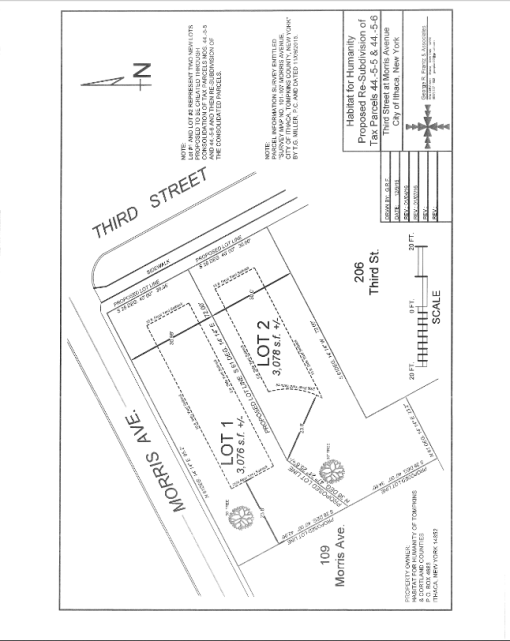
9. Nothing to exciting on municipal planning agendas this week. The town of Lansing cancelled their meeting, and all the town of Ithaca had was a cell phone tower on West Hill. The city has a little more interesting. The duplex at 424 Dryden is examining unusual parking arrangements to save trees, and Habitat for Humanity is planning an affordable-housing owner-occupied duplex for vacant lots at 101-107 Morris Avenue in the city’s North Side neighborhood.
morris_avenue_1

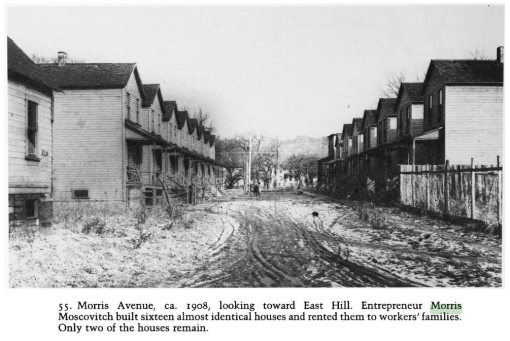
Morris Avenue has always had a focus on worker housing. As described in Ithaca’s Neighborhoods by Carol Sisler (1988), local businessman Morris Moscovitch built 16 nearly identical houses in 1908 to house worker’s families. But, with the effects of urban decay and urban renewal, only one of those 812 SF houses (109 Morris) is still standing today.

What Habitat for Humanity is proposing is to take the vacant lots at 101-105 Morris and 107 Morris (total 0.138 acres), combine them and create two new lots that will face Third Street. The new lots would need a zoning variance since they’re not wide enough (30′ and 30.98′, 35′ required). Being Habitat, these might take a little while to build and they probably won’t wow anyone design-wise, but there’s a lot of value to be placed in their “sweat equity” approach, and affordable owner-occupied housing is in severe need in Ithaca. Planner George Frantz is handling the application.

hotel_ithaca_final_1

10. Lastly, for what is a very long post, the Hotel Ithaca’s revised CIITAP application to the Tompkins County IDA. Now that the project is approved by the city, they can work on a revised tax deal. According to the project memo, the sales, mortgage and property tax abatements will total $1.781 million on the $15 million project. The property tax abatement is the standard 7-year abatement, and will generate almost $1 million in new tax revenue during the abatement period. The project would retain 71 positions and create 21 new jobs, most of which appear to be less than living wage. The application does note, perhaps ominously, that non-approval would result in functional obsolescence – the hotel shuts down. The IDA plans to examine the application at their meeting in the county office building next Thursday.



News Tidbits 12/19/15: So New Even the Pavement Shines

19 12 2015

cayuga_view_1

1. We’ll start off this week with some eye candy. Over in Lansing village, the planning board is hammering out details regarding signage and covenants related to the Cinema Drive senior housing project. But it also gives the project a new name – from C.U. Suites to “Cayuga View Senior Living“. Lo and behold, one types that into Google and up comes the following partially-finished website. The name sounded familiar, and as it turns out there’s a good reason for that – Cayuga View is also the name of a portion of the Linderman Creek apartment complex in the town of Ithaca.

According to the website, the 55+ (“55 and BETTER”, as they tout on the page) apartment building at 50 Cinema Drive will contain 48 2-bedroom units and 12 1-bedroom units with four different four plans. The 4-story apartment building will have retail space on the first floor, “and will offer underground parking and storage, wireless internet, cable, business center, fitness center, rooftop garden, and scenic views. A companion dog or cat under 30 pounds will be allowed.”

No word on the project architect, but the project is being developed by the Thaler family, and Taylor the Builders out of suburban Rochester is the general contractor. The site was originally conceived as an office building several years ago, and then around 2012 it was proposed as a 39-unit mixed-use apartment building with an eye towards graduate students.

amabel_v4_1

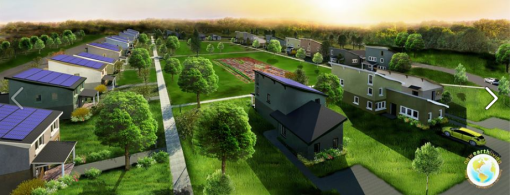
2. Sticking with residential development and fancy renders, here’s the latest render for New Earth Living LLC’s Amabel housing development, courtesy of their Facebook page. Final approval was granted just this week by the town of Ithaca. The 31-unit eco-friendly housing development (consisting of one standing farmhouse and 30 new homes facing inward from a loop road) will be located on undeveloped grass/woodland behind 619 Five Mile Drive. In the project literature, the site is said to be designed around a “pocket neighborhood” concept, with the houses facing towards each other for interaction, and away from the street for privacy. The houses may not be everyone’s cup of tea, but are designed for net-zero efficiency. Houses range from 1-3 bedrooms and 1,200-2,100 SF. No specific prices yet, but expect marketing to begin sometime early next year.

3. For the aspiring developer who wants to get a head start on planning – the 11.71 acre Bella Vista site at 901-999 Cliff Street in the city’s West Hill neighborhood is for sale for $395,000. As the advertisement on Homefinder notes, the project has received approvals for a 44-unit apartment or condo building (what it doesn’t say is that those would have to be renewed via a reaffirming vote by the planning board, since the project was approved more than two years ago). The property is currently assessed for $210,000.

w592-h-q

Primary Developers Inc., a company founded by local businessman Mauro Marinelli, purchased the land for $175,000 in 2002 and received approvals for the 44-unit Bella Vista project in 2007, and the units were marketed by local realtors as condominiums. But as the recession set in, sales foundered and the project never moved forward. Primary Developers Inc. sold the medical office building on the adjacent southern parcel and two other neighboring parcels of land to another local real estate company for $945,000 earlier this year.

chapter_house_materials

4. Some minor tweaks to the Chapter House project since its November sketch plan presentation to the Ithaca city planning board, which looks to mostly be a slightly lighter brick color and a little more detail on the rear wall. From top to bottom, the Chapter House reconstruction proposes Rheinzink zinc shingles, white trim of unknown material, a Redland Brick Heritage SWB bricks, Inspire Roofing Aldeora Slate Coachman (790) simulated slate shingles over the first floor bump-out, SDL (Simulated Divided Lites) transom windows with LePage Morocco textured glass glazing over the picture windows, Sherwin Williams “Tricorn Black” paint on the Chapter House bar exterior trim, and genuine bluestone not unlike the famous Llenroc bluestone used in many of Ithaca’s historic buildings. As far as they look online, they appear to be attractive, premium finishes.

The owner, Sebastian Mascaro of Florida and represented by Jerry Dietz of CSP Management, hopes to start construction in late January or early February for an August 2016 opening.

cornell_novarr_6

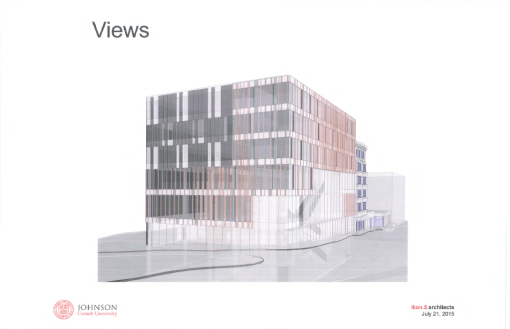
5. Note that there was ever much doubt, but it looks like local developers John Novarr and Philip Proujansky have secured the construction loan(s) needed to build 209-215 Dryden Road in Collegetown, a six-story academic and office building in which Cornell has committed to occupy 100% of the space for use in its Executive MBA program. According to loan documents filed with the county, there were two loans, one for $6,482,295.33 and the other for $9,430,528 (for a total of $15,912,823.33). Wells Fargo Northwest was the lender, and it looks like some of the funds are going through a “pass-through” trust.

The 73,000 SF building will host about 420 Cornell MBA students and staff when it opens in late Spring 2017, later increasing to 600 as Cornell fills out the rest of the square footage. Hayner Hoyt Corporation of Syracuse will be the general contractor. Ikon.5 of Princeton is the project architect.

20151205_094944 20151205_094957

6. Going to do a double-feature for house of the week this week, mostly because I have a backlog of images. Here’s number one.

The last house is underway at the Belle Sherman Cottages. After not hearing anything about it, I had presumed they had just decided not to build Lot #9, which is smaller than the other lots and was going to have a unique “cottage” design. Well, color me surprised. The town of Ithaca issued a permit in early November, and by the 5th of this month, the CMU block foundation was excavated and poured. Looking at builder Carina Construction’s facebook page, the modular units have since arrived and have been hoisted onto the foundation, assembled and secured. Custom interior finishes, porch framing, siding, backfilling and landscaping will follow as the house moves towards completion.

No renders for the finished house, unfortunately, although I suppose STREAM Collaborative might have something on file. Agora Home LLC of Skaneateles is the developer of the Belle Sherman Cottages, which includes 18 other single-family homes and 10 townhouses, all of which have been completed and sold.

20151205_095437 20151205_095453 20151205_095528

424_dryden_rd_1

7. Now for House of the Week #2. 424 Dryden Road’s subdivision earlier this year turned the rear parking lot into a second lot, and the owners, William and Angie Chen of Lansing, decided to build a duplex on the land, which has been bestowed the address of 319 Oak Avenue.

It seems a little odd that the trim already seems to be applied to the house when the windows haven’t been fitted yet. The standard Huber ZIP System sheathing is being covered with a mahogany-colored vinyl siding. Wooden wall studs can be seen from the rough window openings and there appears to be electrical wiring on the rear of the house, so it’s a fair guess that utilities rough-ins are probably underway.
Local architect Daniel R. Hirtler of Flatfield Designs penned the design, and according to the construction loan agreement on file with the county, Tompkins Trust Company lent the Chens $400,000 to help bring their duplex from the drawing board to reality.
416_e_state_v2_1

8. For those hoping for something new and exciting in next week’s Planning Board agenda, it’s going to be a downer month. Here’s what’s planned.
A. Revisions to the internal sidewalk plans at 804 East State Street to allow stripped asphalt vs. concrete.
B. Tweaks to the signage for the downtown Marriott currently under construction.
C. The “Printing Press” bar debate at 416-18 E. State Street, again.
D. Final approval for Tompkins Financial Corporation’s new HQ.

The agenda also includes a couple zoning variance reviews for house additions at 105 First Street in North Side, and 116 West Falls Street in Fall Creek. The board is planning a joint meeting with the ILPC to review and comment on the Travis Hyde plan for the Old Library site, tentatively scheduled for January 12th.