Cornell Veterinary School Expansion Construction Update, 11/2015

12 11 2015

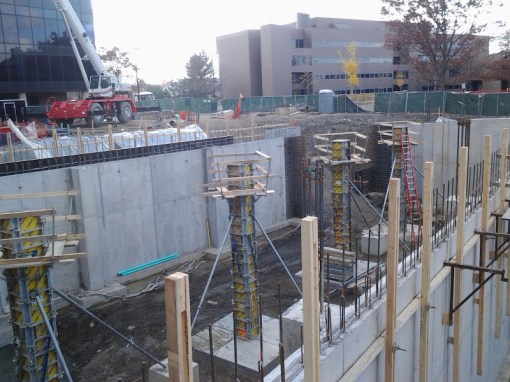
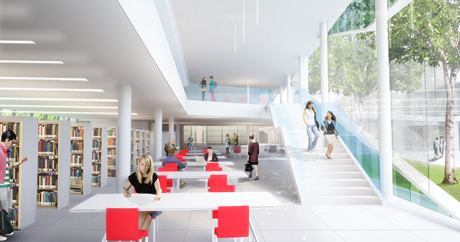
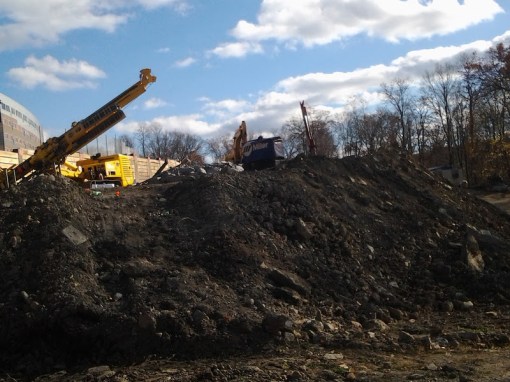
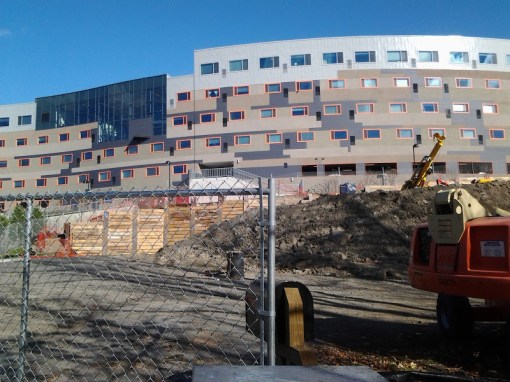
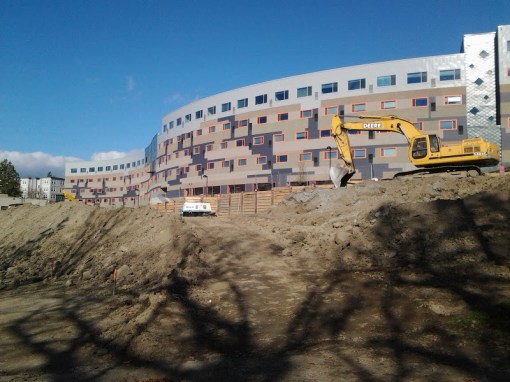
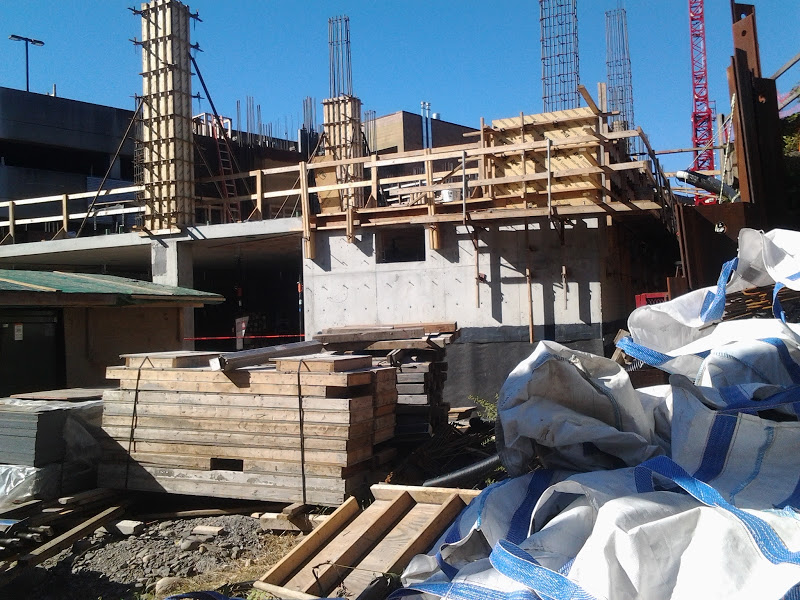
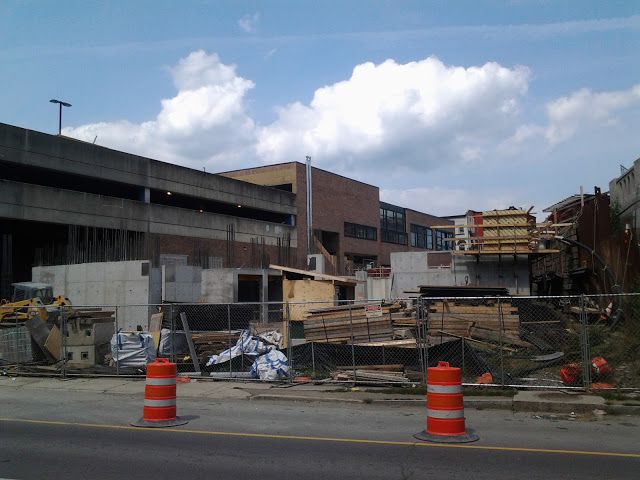
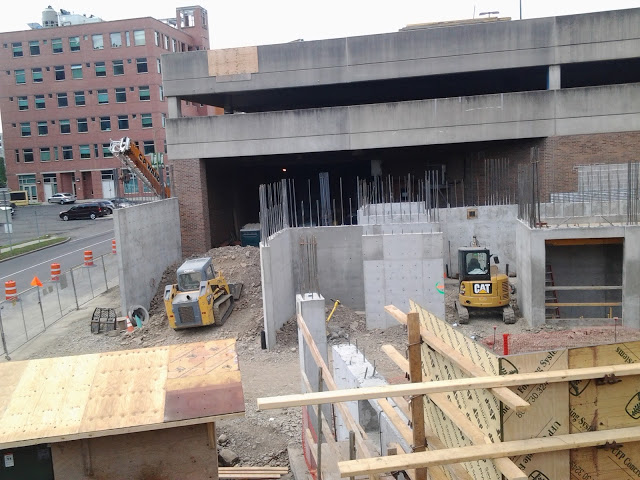
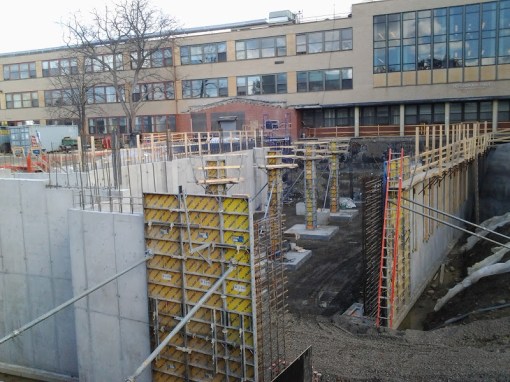
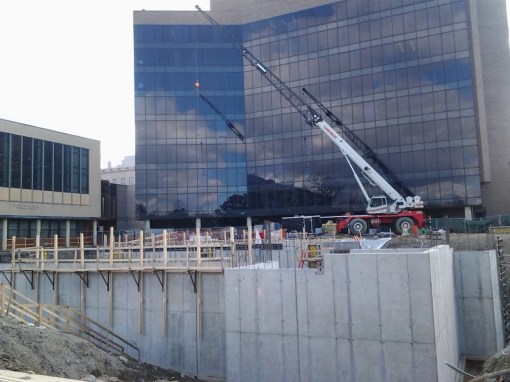
The site of the future west wing of the Cornell Veterinary School expansion has been excavated and the foundation is being poured for what will be a 3-story building with the new Flower-Sprecher Library, and additional program space. Look along the outer edge of the newest foundation section and you’ll see wooden forms pressed against the concrete. These forms provide stability and shape while the concrete hardens, and they provide support to the reinforcing rods embedded in the concrete. They will move further along the perimeter as pouring continues.

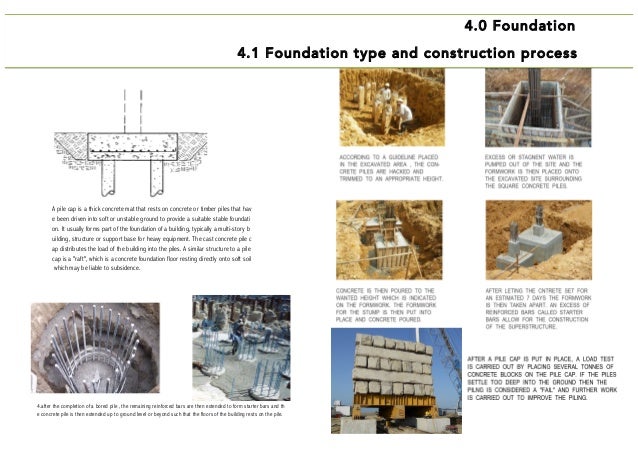
Without being all that knowledgeable about deep foundations, the structures in the middle of the excavated foundation might be pile caps. Piles are driven into the ground, trimmed to a predetermined height, formwork is set up around the piles and the concrete is poured and left to cure. So the piles are underneath the caps, and columns extend from the base of the cap. The load of the structure’s will be transferred to the pile caps and distributed to the piles below, providing stability for the building.

EDIT: Quoting commenter Drill Deep, who is knowledgeable about foundations: “No deep foundations at this one. Just very wide spread footers. East Hill and the Cornell campus usually has ground that can be made to do the job. The basement here is very tall and something like a hangar. Lots of headroom to run utilities.”

More information on the background and details of the expansion can be found in the September update here.

NYC-based architecture firm Weiss/Manfredi designed the expansion, and regional construction firm Welliver is the general contractor.

20151108_122245 20151108_122249 20151108_122256 20151108_122317 20151108_122355 20151108_122421 20151108_122457

cad048742a281097e5667382eced4233

LibraryReadingRoom10-2


1325 Taughannock Boulevard Construction Update, 11/2015

11 11 2015

Single-family homes tend to be more of a featurette on Ithacating, rather then full-fledged posts of their own. Then again, most homes aren’t multi-million dollar lakeside mansions.

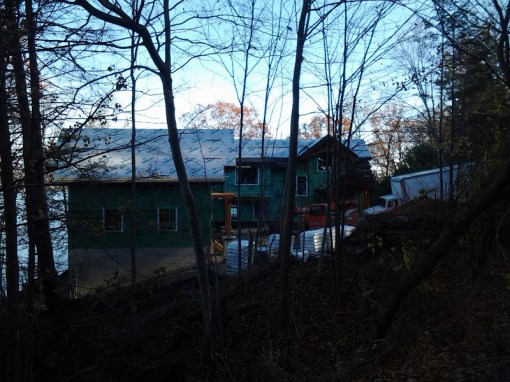
Looking at the house underway at 1325 Taughannock Boulevard in the town of Ulysses (pulling off of the road is a bit harrowing, given that it’s a 55 MPH zone on a narrow road with marginal visibility), the roof has been sheathed but not shingled, and Kingspan Green Guard Raindrop 3D housewrap drapes the exterior of the building. The black material on the roof looks like felt paper (also known as tar paper), which helps protect the roof from water that may get under the shingles form ice melt of gusty winds, and protects the asphalt shingles from resins in the wood decking. Felt paper also increases a roof’s fire rating and helps keep the house dry in case of rain during the construction period. Windows have been fitted, and masonry work on the chimney is underway. The timber frames stand out against the housewrap, but the actual finishing materials (wood, with wood and concrete or stone trim) should complement the timber frames nicely.

As previously reported, a construction loan for $2.25 million was filed on August 13th, with Tompkins Trust Company providing the financing. The property was previously home to two smaller lakeside cottages. the two small houses once on the properties have been demolished. The homeowner is a New York senior investment banker with ties to Cornell. The house is expected to be completed by May 2016.

New Energy Works, the project architect, specializes in timber frame structure, with offices in suburban Rochester and Portland, Oregon (the Pacific Northwest and the Appalachians are two of the most popular parts of the country for timber frame homes; in New York, it’s often coterminous with “Adirondack Style“). Locally, New Energy Works designed the Namgyal Buddhist monastery on South Hill, and the Ithaca Foreign Car (Ithaca Volvo) building on West State Street.

20151108_144426 20151108_144456  20151108_144530

20151108_144517


Collegetown Terrace Construction Update, 11/2015

10 11 2015

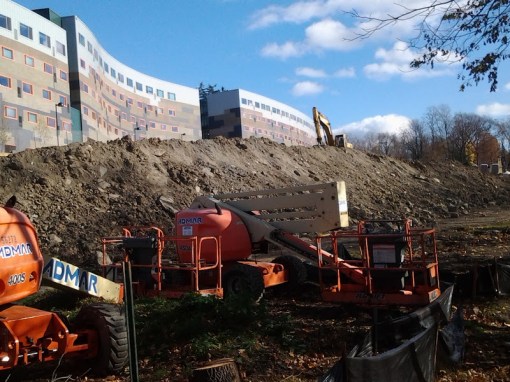
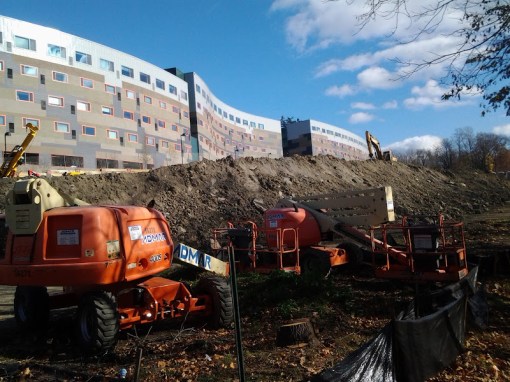
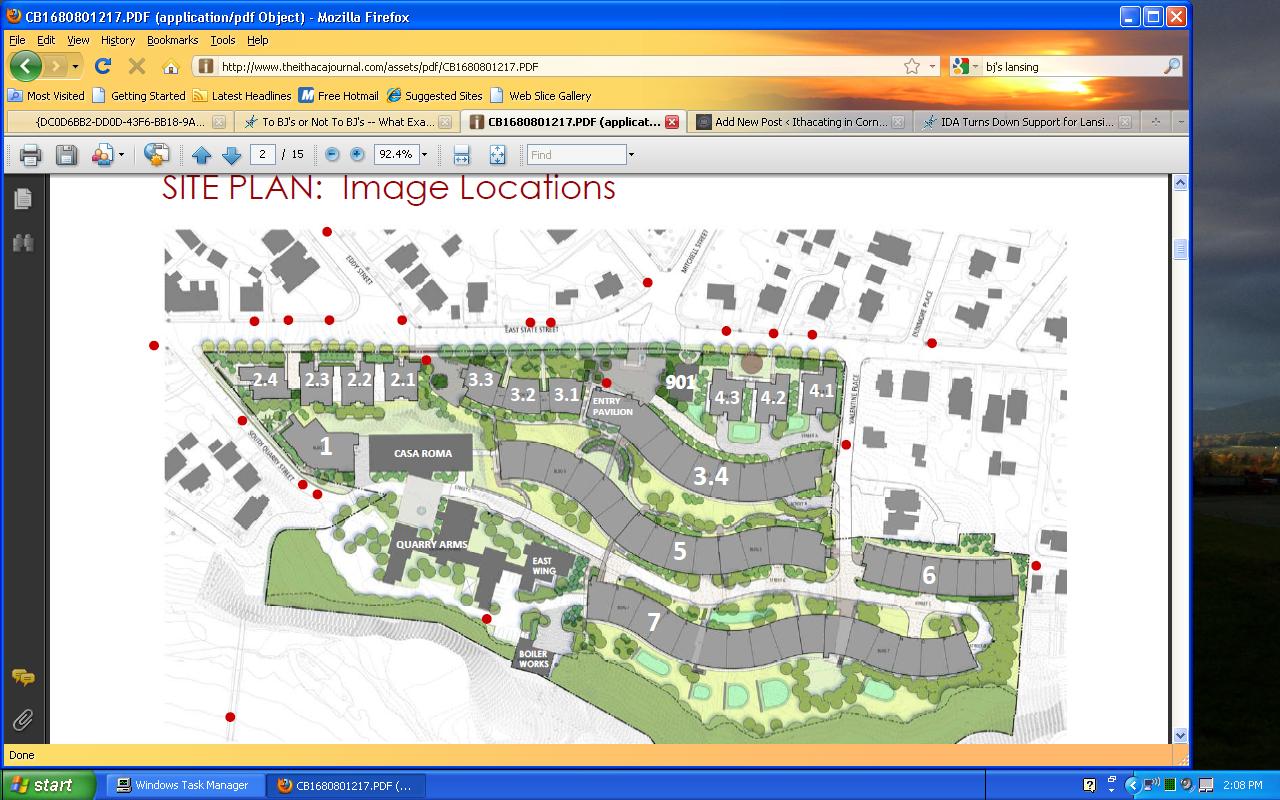
Well, this one can finally be counted as “underway”. Site prep has begun for the last building at the Collegetown Terrace site, on the 900 Block of East State Street south of Collegetown. Being just a few weeks underway (work commenced in late October), the primary tasks in the short-term are clearing the site and building shoring walls (the steel H-beams with wood lagging). The H-beams are drilled or driven in at regular intervals, and hold the soil back while the foundation is excavated. This building is going to have a deep foundation and a large footprint, so foundation work is likely to take a while, we’ll be well into 2016 before steel starts to rise from the ground.

The last phase of Collegetown Terrace (Phase III) is expected to be completed by August 2017. Phase III will focus on the construction on the last building, #7 (formally known as 120 Valentine Place), a long, curving building very similar to  the completed Building #5. Funding for the new building comes from part of a $50 million loan extended to developer Novarr-Mackesey in 2013 by Pittsburgh-based PNC Bank, and revised in December 2014. As this project demonstrates, even though a proposal might be approved, it can take years for something to actually get off the ground — if ever. Initial approvals were granted all the way back in 2011.

Building 7 is expected to have 247 units, and 344 bedrooms once it’s completed. About 80 of the units will be set up “dormitory-style”, where all tenants get their own bedroom and bathroom, but share kitchens and community lounge spaces. Novarr-Mackesey had found after the previous phases were completed that parking was only being utilized by 50% of tenants, so rather than build a floor of parking that would more than likely go unused, the firm applied to the city Board of Zoning Appeals for a parking variance (652 spaces for the whole complex, which is 51 less than required by zoning) to change one floor of parking planned for Building 7 into the “dorm-style” living space. The variance was granted by the BZA in Spring 2014. The dorm-style units are expected to rent at half to two-thirds of the cost of a studio unit, and to appeal to graduate and professional students on a budget. The current layout calls for parking on the first floor, then the dorm floor, then regular studio-3 bedroom units on floors 3-6.

With this project underway, it’s the single-largest residential building under construction in Tompkins County. Hopefully, one that will make a dent in the city and county’s housing crunch.

20151108_131029 20151108_131142 20151108_131223 20151108_131447 20151108_131708 20151108_131713 20151108_131746 20151108_131750 20151108_131756 20151108_131944 20151108_132024 20151108_132033 20151108_132045 20151108_132141 20151108_132223 20151108_132236 20151108_132320

ctown_terr_phase3


Boiceville Cottages Construction Update, 11/2015

9 11 2015

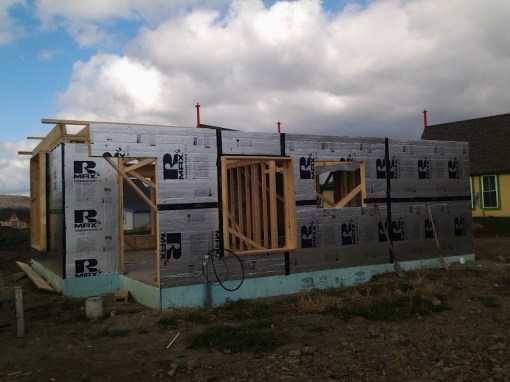
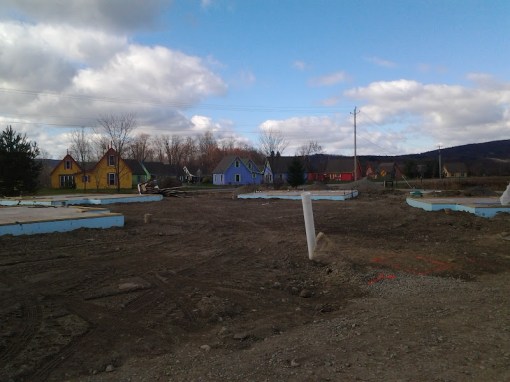
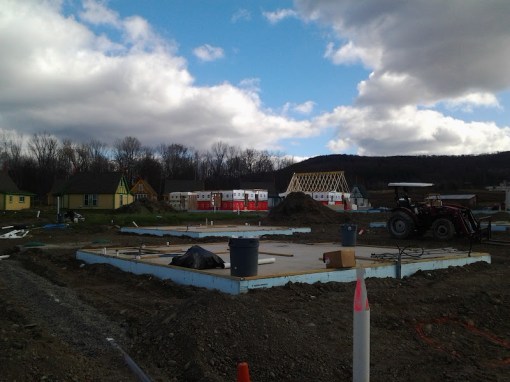
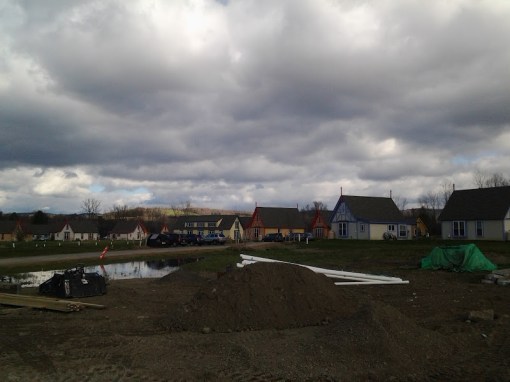
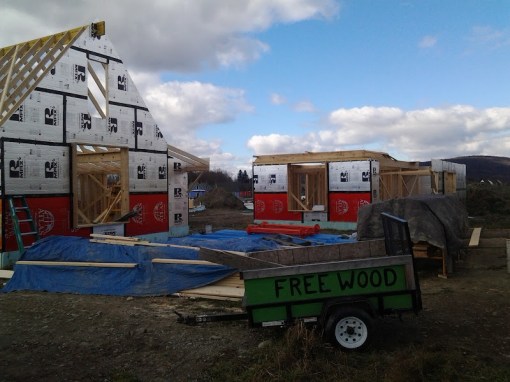
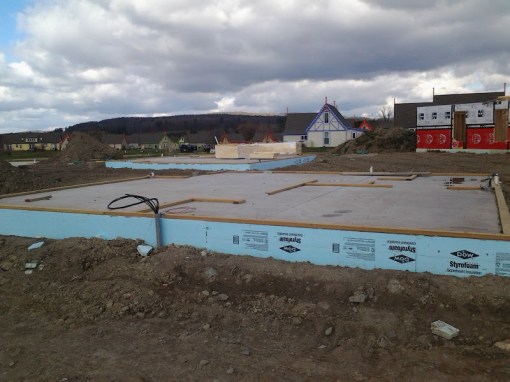
It looks like construction has started in earnest on the last phase of the Boiceville Cottages. All the concrete slab-on-grade foundations have been poured, with the blue exterior insulation to be covered later by a little backfill. Atop the foundations are utility connections and wood sill plates, which is where the wood stud walls will go. From a quick walk-through, it looks like rough framing and sheathing has begun on at least three of the cottages, and that all the units to be built in this final phse will be stand-along cottages. According to the Boiceville Cottages facebook page, the last septic tank was installed last week.

Without knowing too much about Caroline’s tax base, this is arguably the largest residential tax-contributor to the town, if not the largest tax-contributor to Caroline period. The current phase calls for 17 units at a cost of $2.2 million, $2,098,479 of which goes towards hard construction costs (materials/labor). The cottages are part of the 75 unit addition approved by the town of Caroline back in 2012. Altogether, those 75 units have hard construction costs of $7,477,671, according to construction loan documents filed with the county. The 2015 assessed value for the property was $10.3 million for 122 units in 2015, and that number is likely to climb a couple million higher in the next year or so.

The Boiceville Cottages began with a first phase of 24 units in 1996/1997, with a second phase of 36 units ten years later. Now, a few things have been tweaked along the way, because the build-out no longer matches the 2012 construction documents – some triplet cottage clusters on the engineer’s map have been replaced with “gatehouses” and quadruplet cottage clusters during build-out. For the longest time, I’ve been using 135 units as the total (24+36+75), but given this statement from their facebook page, it looks like the final count will actually be 140 units. The Boiceville Cottages expansion will finally wrap up its years of construction next summer.

Apart from some early concerns about site drainage, there haven’t been too many objective issues with the project. Subjectively, some love the bright colors, others can’t stand them. Heck, even Simon St. Laurent gives them a little appreciation on the “Living in Dryden” blog.

For those interested in visiting the cottages, they sit on 37.7 acres on either side of 300-334 Boiceville Road, just west of the hamlet of Slaterville Springs. Rents range from $1,050 for a studio to $1,750 for a three-bedroom gatehouse unit. Most of the units are 1 and 2-bedroom cottages, built in clusters of three, with a few “gatehouse” rowhouses that offer studios and 3-bedroom units. The cottages fall in the 850-1050 SF range.

Schickel Construction is headed by Bruno Schickel of Dryden, following in the footsteps of generations of Schickels living and building in Ithaca. In some circles, Bruno Schickel is better known as the husband of the famous columnist Amy Dickinson.

20151108_115800 20151108_115832 20151108_115849 20151108_115928 20151108_120036 20151108_120046 20151108_120056 20151108_120131 20151108_120156 20151108_120223 20151108_120232 20151108_120411 20151108_120421


News Tidbits 11/7/15: All the Small Things

7 11 2015

chapter_house_v2_1

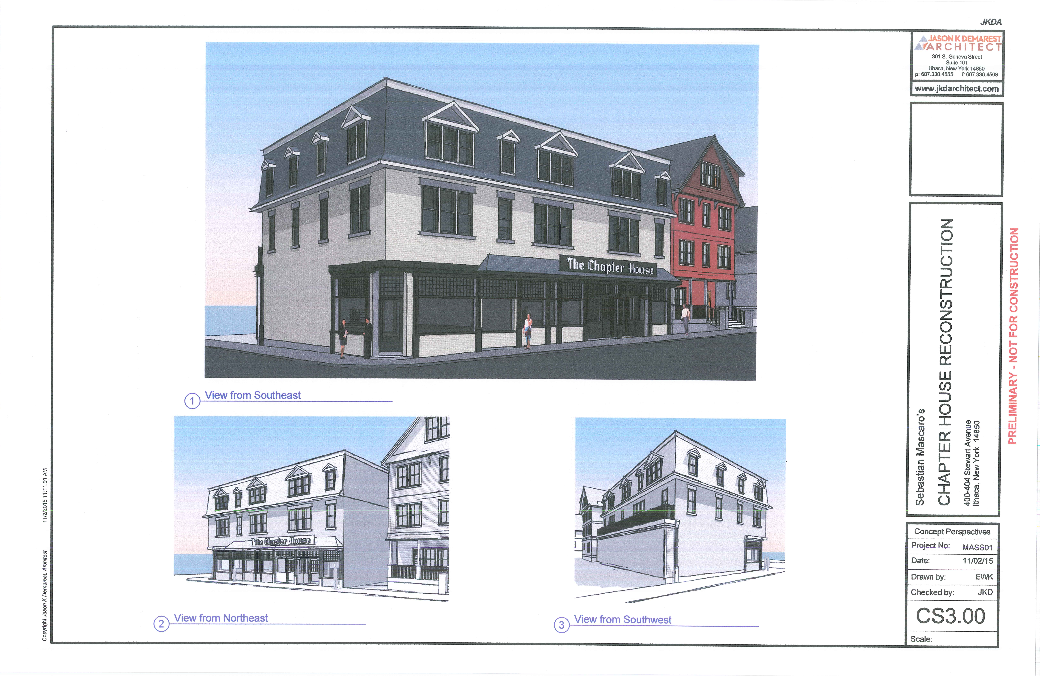
1. The Chapter House project is finally beginning the first stages of design review with the ever-stringent (or picky, pending your view) Ithaca Landmarks Preservation Council. As seen in the render above, gone is the fourth floor, and gone for now are plans to build a new structure at 408 Stewart, after some members of the ILPC expressed opposition to a tear-down, even though the exterior has been butchered and the architect called it a “fire trap”.

The committee also had disagreements over which version of the Chapter House is more historic, the original ca. 1903 design evoked above, or the 1920s renovation that everyone remembers. The September minutes showed intent towards the four story design seen previously, but the design shown above is three floors – whether that be to the committee’s persuasion, or concerns over a zoning variance isn’t clear. It might be in October’s minutes, but those haven’t been approved, and are therefore not available yet.

Also at Tuesday’s meeting, the committee is planning “Property Condition Review and Potential Action” for the decayed carriage house at 312 West State Street. The board was also set to provide “Early Design Review” for a project at 315 North Cayuga Street, probably some kind of renovation/restoration of the First Presbyterian Church, but the item has since been pulled.
11-24-2012 171

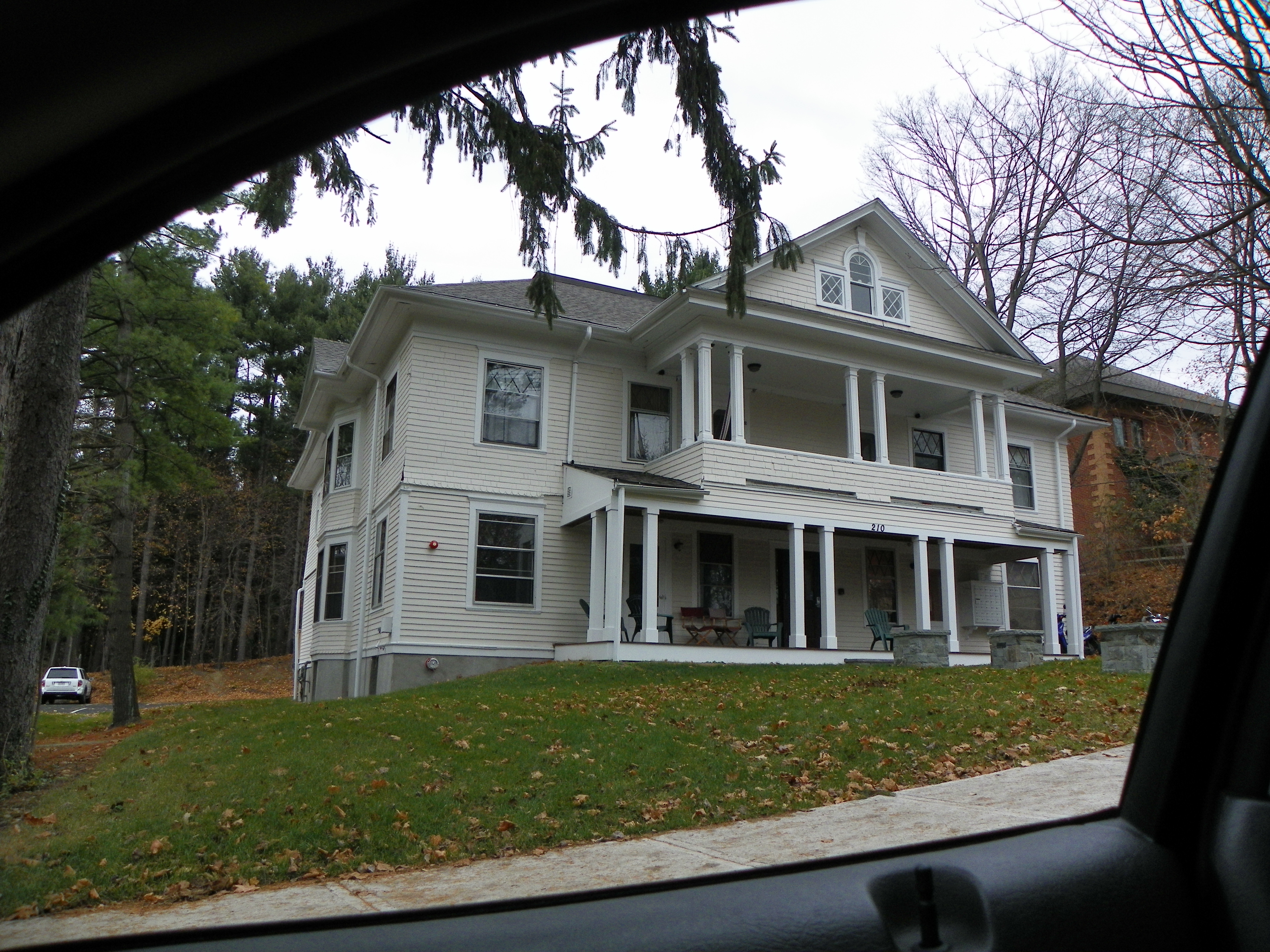
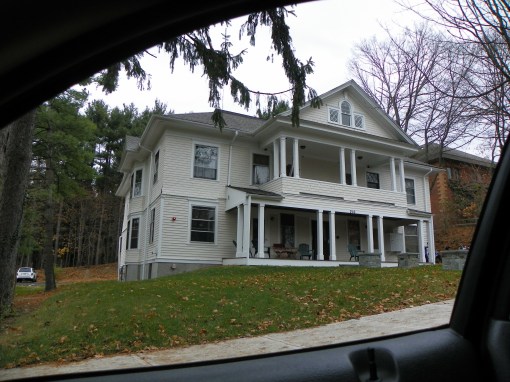
2. Wait long enough and history repeats itself. In March 2009, I did a post called “Warren Real Estate Tries to Sell a Frat House“. It looked at 210 Thurston Avenue in Cornell Heights, when it was on the market for $950,000. The house has historically been a Cornell fraternity house, built around 1900, re-purposed not long thereafter for the Delta Sigma Phi fraternity until WWII, when the brothers left for service and the chapter never reopened. It was then used by other GLOs over the decades (Alpha Omicron Pi in the 1940s, Sigma Alpha Mu from the late 1940s to early 2000s, and Phi Delta Theta’s annex in the late 2000s).

After sitting on the market for a couple of years, the house sold in December 2011 for $677,500 to an LLC representing the wealthy parent of a Cornell wrestler, who had the house renovated for the team in 2011/12. The legal occupancy increased from 33 to 40 persons as a result of the reno.

So now it’s on the market again, this time for $2,750,000. That must have been quite a renovation. An open house will be held 1-3 PM this Sunday.

I’d recommend it to the Phi Mu ladies given their recent rejection by Cayuga Heights’ zoning board, but the asking price is almost four times the house they were looking at 520 Wyckoff. The house on Wyckoff was also intended for 16 occupants rather than 40. Oh, and I suppose those urinals the owners installed would be a bit out of place.

We’ll see what happens. This one could be on the market for a while. Again.

3. Also new to the market this week, two parcels in the town of Ithaca that have the potential for development.

The first, 1564 Slaterville Road. The sale includes four parcels – 1564 Slaterville Road itself, a 19th century home on 1.52 acres, and the other three are vacant parcels with frontage on Slaterville Road and Park Lane, which serves as an entrance to the Eastern Heights neighborhood, and has seen a number of higher-end single-family homes in the past several years (there have been plans for a 16-lot housing development on the adjacent land to the north, but nothing has been approved). Altogether, the sale comprises 9.2 acres of land, on the market for $995,000. The properties are valued at $297,300 total, so if the owner is asking such a high price, either they’re delusional, or purposely going after developers. The land currently falls under Ithaca town’s Medium-Density Residential (MDR) zoning, which is single-family homes and duplexes only. The Comprehensive Plan calls for “Established Neighborhood” use, with an average of 2-4 units/acre, either homes, townhomes or apartments (sensitive to neighboring uses), and the possibility of low-intensity commercial (home office). Expect any potential form-based code to accommodate those details.

The other parcel up for sale is 969 East Shore Road, one of the few properties in the town’s lakeshore exclave. This one is also asking a huge premium, $1.45 million for a 2.09-acre property assessed at $300,000. The property was used as the headquarters for the John C. Lowery construction company until they moved to Freeville; it had been built in the 1960s for a chemical company. The seller, the CEO of a local manufacturer, picked up the property for $300,000 in December 2013.

Although it falls under the town’s Lakefront Commercial (LC) zoning, which in itself says only marinas and wind turbines are okay, special use permits allow for mixed-use, hotel, and other non-water options. Like the Slaterville parcel, this one also falls under the “Established Neighborhood” use guidelines.

If they sell, and it bears mentioning, it’ll be mentioned in a later news roundup.

20151011_142719 20151011_142734 20151011_142746

424_dryden_rd_1

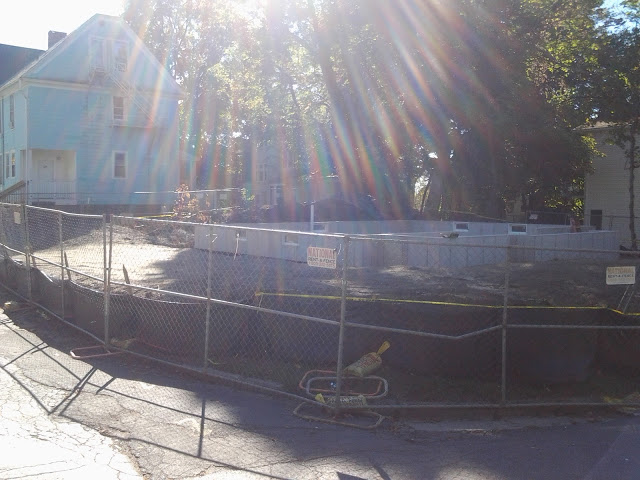
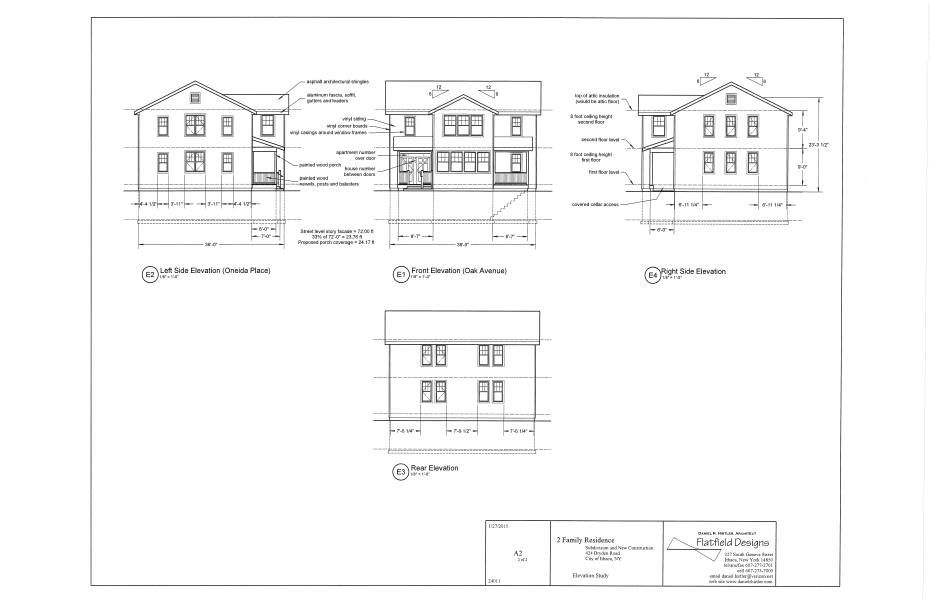
4. It’s house of the week. This week, 319 Oak Avenue in Collegetown. The lot was created by a subdivision of the existing lot, 424 Dryden Road, in February of this year. What was once a parking lot is now the foundation for a duplex with 3-bedrooms each. Foundation and stem walls have been poured and cured, and given that this photo is a couple weeks old, the foundation has probably been backfilled already, and rough framing may even be underway.

The site falls into the CR-2 Zone of the Collegetown Form District, meaning 2-3 floors, and pitched roofs and porches are required. The architect is Daniel Hirtler of Ithaca, and the developers are William and Angie Chen, also of Ithaca.

5. It’s a quiet week. The city of Ithaca’s projects memo has absolutely nothing new (not even new attachments to the three projects subject to review), and the town of Lansing has nothing interesting either. So we’ll wrap this up with some economic news:

A Lansing technology firm will be seeking sales tax abatements this month as part of a planned expansion project.

Advanced Design Consulting USA (ADC), located in a 15,000 SF facility at 126 Ridge Road in the town of Lansing, has submitted an application to the Tompkins County Industrial Development Authority (TCIDA) for review at their November 12th meeting.

The company is applying for a one-time sales tax abatement on the cost of construction materials, and is valued at $54,880.

ADC specializes in the design and manufacture of high-precision scientific instruments, especially those used in physics research. The firm states in their IDA application that their small size has limited their ability to gain large contracts, and it is necessary for them to expand in order to expand their business. The 5,000 SF expansion is valued at $910,000, and would retain 14 jobs and create 7 additional jobs in their Lansing facility, with a median salary of $40,000. If approved, the expansion project would be completed by June 2016. With the expansion, ADC’s revenues are predicted to increase from the current $2 million, to $2.7 million in three years. The company did not commit to local construction labor in their application.

In an interview in 2014, ADC President Alexander Deyhim explained that the company declined a business incentive to move to Oak Ridge, Tennessee because of Tompkins County’s high quality of life, and proximity to Cornell’s nano-fabrication facilities.

For ADC, which was founded in Tompkins County in 1995, it will be the third expansion in twelve years. The company had previously applied for and received tax abatement approvals for a larger, 20,000 SF expansion project, but according to the current application, the firm reassessed its needs and decided to go with a smaller plan for the time being. The original abatement was never utilized. Supplemental documents indicate the town of Lansing has approved the physical plans for the expansion.

***
So does one force the company to use local labor, or does one risk turning the company down and sending the whole operation to Tennessee? Tax abatements are hardly ever a black-and-white decision.


Carey Building Construction Update, 10/2015

22 10 2015

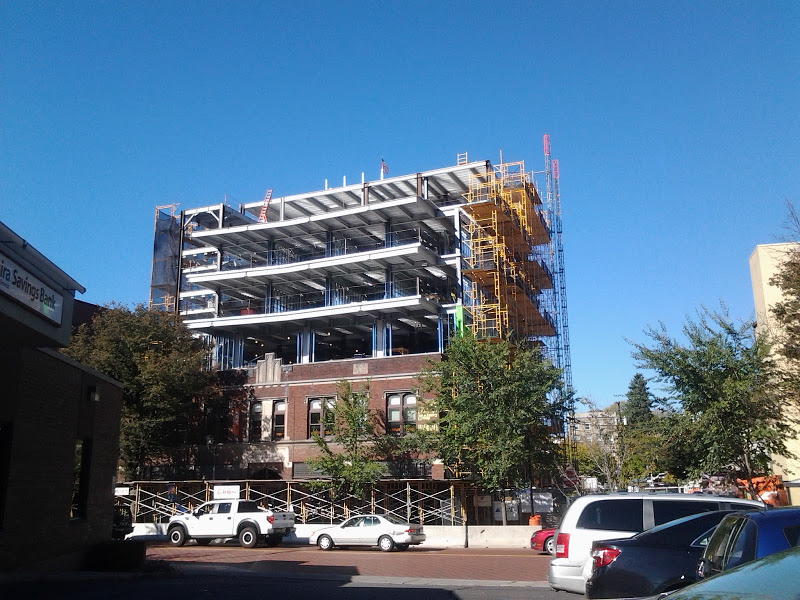
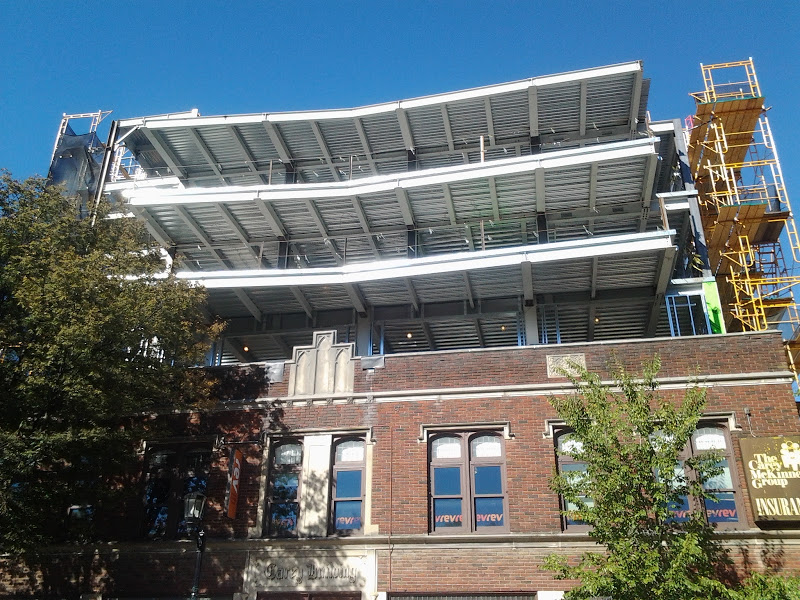
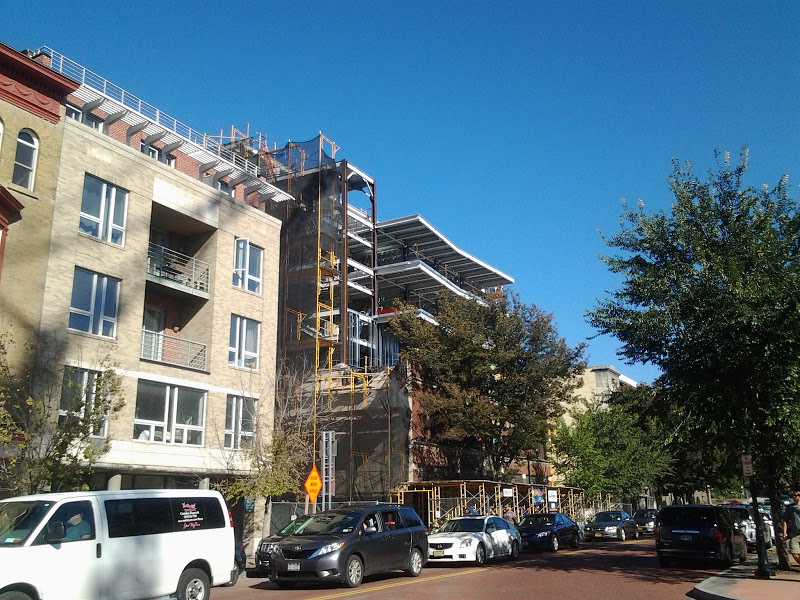
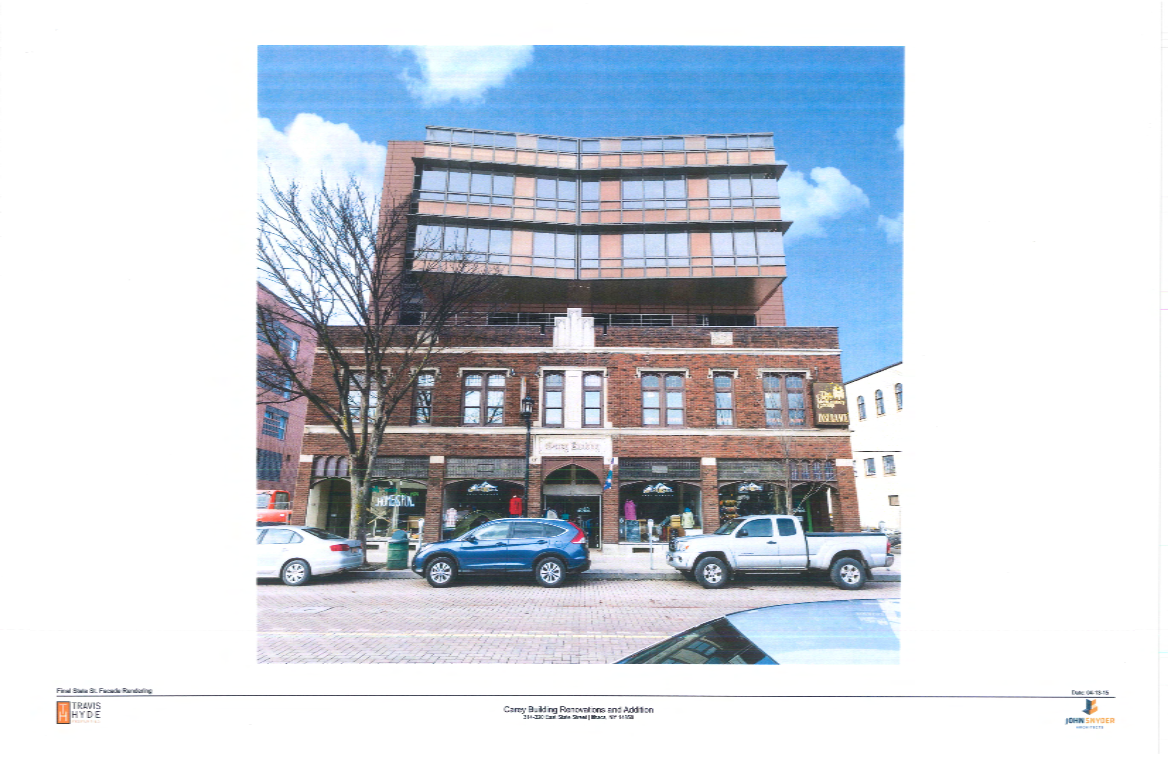
It looks like the Carey Building overbuild has topped out. Corrugated metal decking now covers all five floors of the addition. Interior metal stud walls have been roughed-in on the third through fifth floors, and some fiberglass-mat gypsum sheathing is even starting to show up on the exterior metal stud walls of the third floor. Look closely and you can see the window openings.
Looking at the Rev Business Incubator’s photo from the 19th, plastic sheeting now covers the front of the addition, and a little more progress has been made on those stud walls. Like the Lofts project, they project may end up looking like it’s trapped in a plastic bubble as the cool air gets frostier, and the need to keep those chilly winds at bay becomes more urgent. They also help in water proofing.

From October 11th:

20151011_144907 20151011_144931 20151011_145025 20151011_145410 20151011_145530 20151011_145603 20151011_145623

From Rev, October 19th:

carey_rev5_2 carey_rev5_3


Ithaca Marriott Construction Update, 10/2015

21 10 2015

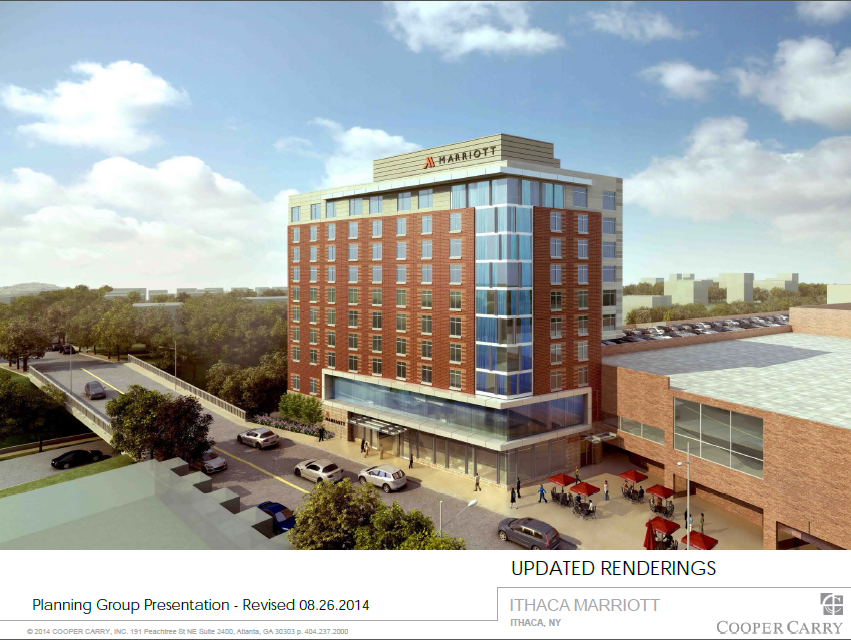
Over at the site of the new downtown Ithaca Marriott, the foundation has been dug and set, and the project is now about level with North Aurora Street. The rebar (reinforcing steel bars) that sticks out of the concrete footings will be used to tie-in the hotel’s walls as they’re constructed. Wooden forms are in place to provide rigidity and shape while newly-poured concrete hardens, and they give support to the rebar rods embedded in the concrete. The forms will move further upward as more concrete is poured and cured. On the side closer to the commons, caisson tubes, massive open pipes, encase the rebar up to 30 feet below ground level. These will transfer the heavy load of the upper floors down to the bedrock below, providing structural stability for the future 10-story hotel. Some of the materials have been supplied by UFP Concrete Forming Systems.

The foundation walls vary in thickness depending on the weight they’re designed to hold. The newly-poured section next to the Green Street garage will hold the elevator shaft, stairwell and space for utilities.

Contractor William H. Lane of Binghamton has a crane on site, and steel erection above the foundation walls will start fairly soon from the looks of it. The 159-room hotel should open next summer if all stays to schedule.

20151011_144642 20151011_144705 20151011_144743 20151011_144806

20151011_145109 20151011_145117 20151011_145131

From August 29th:

20150829_125449 20150829_125520 20150829_125630 20150829_125637

marriott_rev1_1


804 East State Street Construction Update, 10/2015

20 10 2015

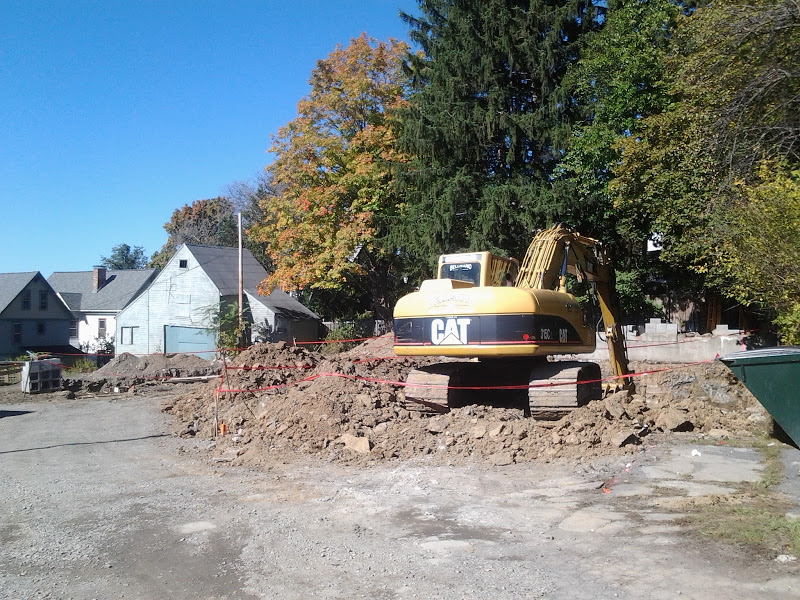
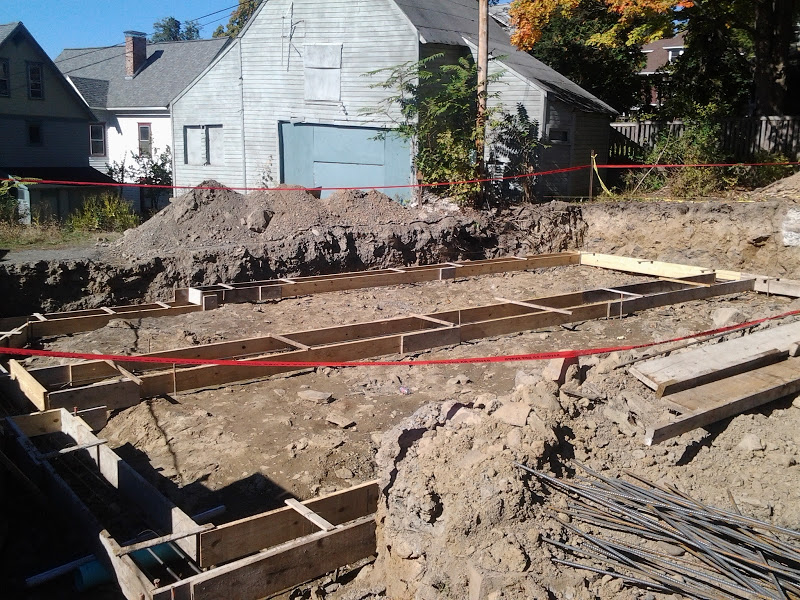
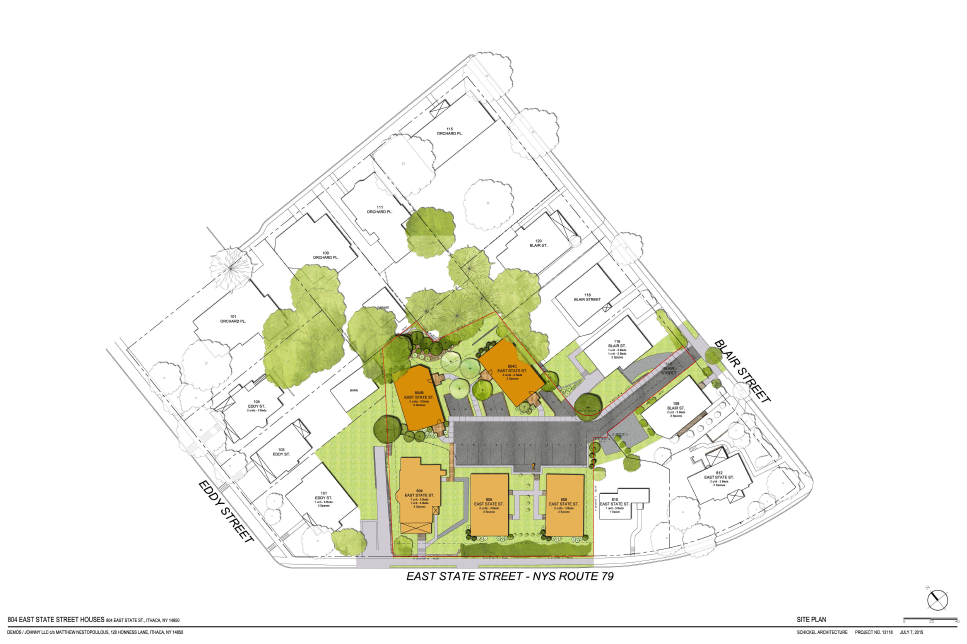
A new, small project to add to the list of projects underway, 804 East State has started construction on the fringe of Collegetown. The owners of the site, the Nestopoulos family of Ithaca, are building two modular duplexes, 4 units total, with 3 bedrooms each (12 total).

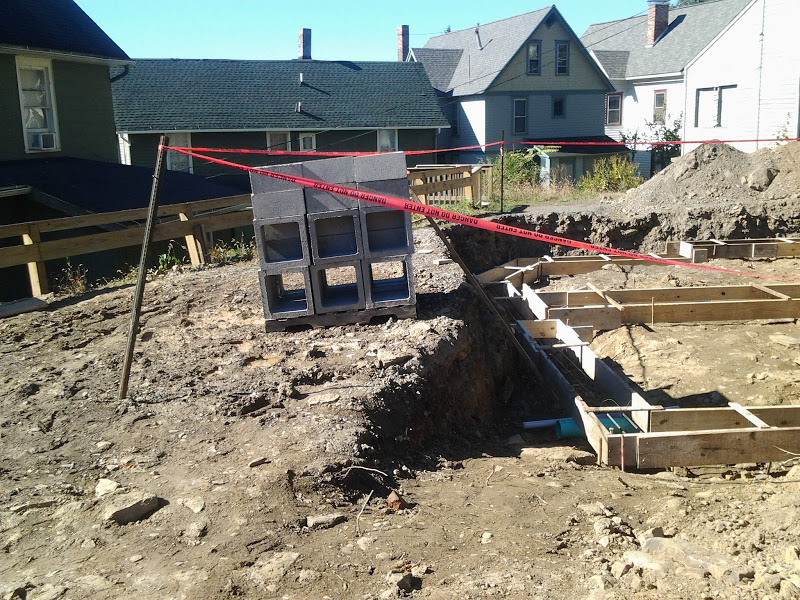
The foundations have been dug for both duplexes, and form boards have been placed in the footprints of the west building. The concrete foundation gets poured into the form boards, and the boards help the concrete hold its shape while it cures. Looking closely, you can see a few steps in the wood forms, since the site is sloped, the concrete foundation will be stepped. The small wood sticks on top of the forms are spreaders, to provide extra stiffness.

Once the forms are squared and levelled, the concrete will be poured in, levelled off and smoothed over. After a day or so, the forms can be removed, leaving the newly-finished foundation. Once the foundation is ready, the builders can begin erecting the concrete masonry unit (CMU) walls, the hollow concrete blocks seen in the photos. The modular pieces will then be brought in, hoisted into place and sealed together, not unlike the process at the Belle Sherman Cottages.

The plan is to have these completed by December 2015, with new occupants (likely students) moving in the following month. The project replaces a gravel parking lot. In an effort to appease neighbor opposition about the homes simple (and perhaps bland) design, the number of houses was reduced from three to two, they were oriented to minimize visual impact, parking was moved from below the units to surface lots, and extensive landscaping with an “outdoor room” is planned.

20151011_135439 20151011_135455 20151011_135513 20151011_135533 20151011_135556

112_blair_v4_2 112_blair_v4_1


205 Dryden Road (Dryden South) Construction Update, 10/2015

19 10 2015

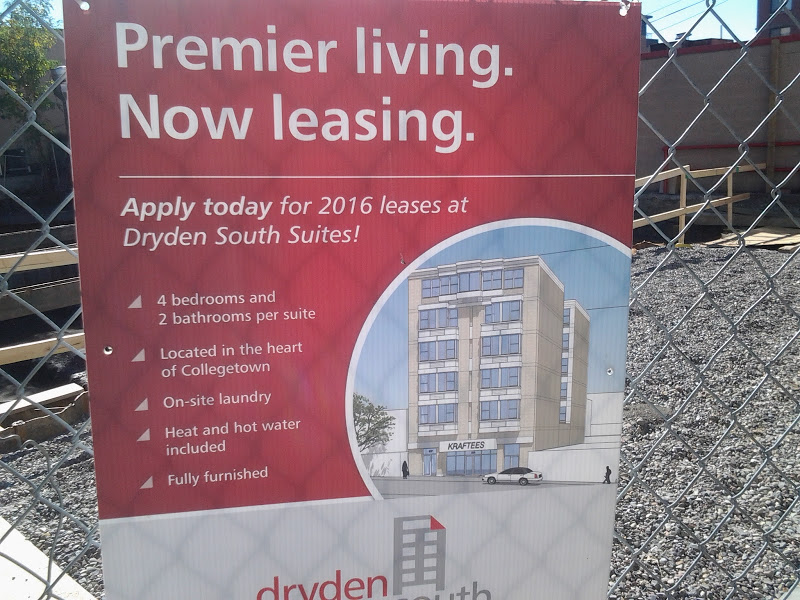
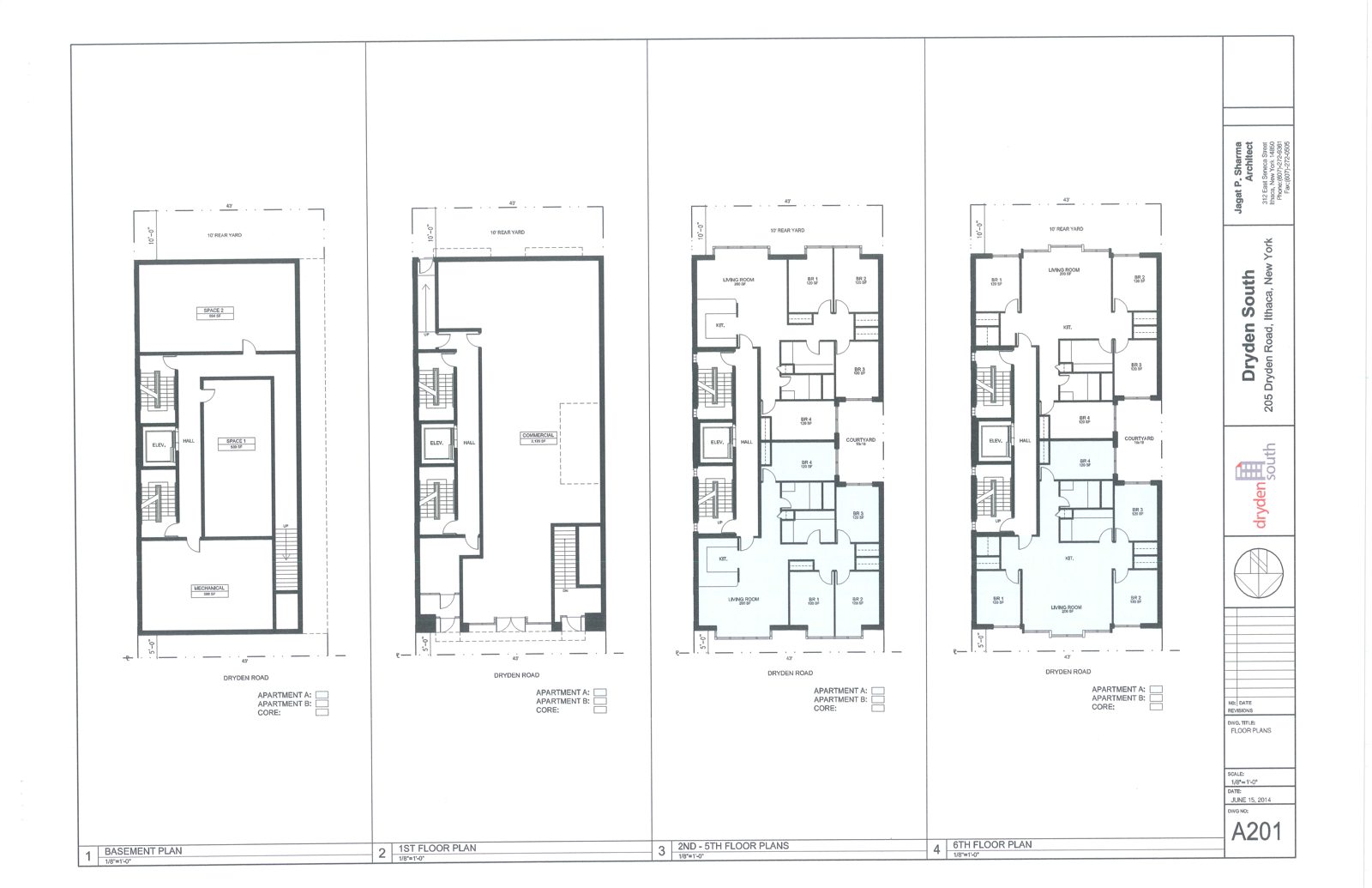
Turning the corner from 307 College, 205 Dryden (“Dryden South” for marketing purposes) is the third of Collegetown’s midrise apartment buildings under construction. The basement has been excavated and sheet metal piles keep the surrounding soil from spilling back in. The basement will contain the mechanical room and storage space. Structural steel has been erected up to street level. In the second image, the outlines of future interior basement walls and the base of the future elevator shaft can be seen.
In what’s sure to stoke a few tempers, prices for Dryden South have been priced at $1350/bedroom per month, meaning $5400/month for each 4-bedroom unit. Incredibly expensive, but not especially surprising given the astronomically high land values in central Collegetown. Owner Pat Kraft, who also runs Kraftee’s book store, has actively marketed the apartments on Facebook, Craigslist and its own website.

When completed in July/August 2016, the 6-story, 65-foot structure will house Kraftee’s in 2,400 SF of retail space on its ground floor, and 2 4-bedroom apartments on each of the upper five floors, for a total of 10 units and 40 bedrooms.

As you can tell from the first photo, apart from the demolition earlier this summer, work has yet to begin on John Novarr’s Collegetown Dryden project next door. But with approvals in hand, that six-story research/office building will be starting something in the next month, if the site plan review document is still accurate. The $6.4 million project was designed by Ithaca architect Jagat Sharma and Rochester-based LeChase Contruction is in charge of the build-out.

20151011_141022 20151011_141041 20151011_141053 20151011_141111


307 College Avenue (Collegetown Crossing) Construction Update, 10/2015

18 10 2015

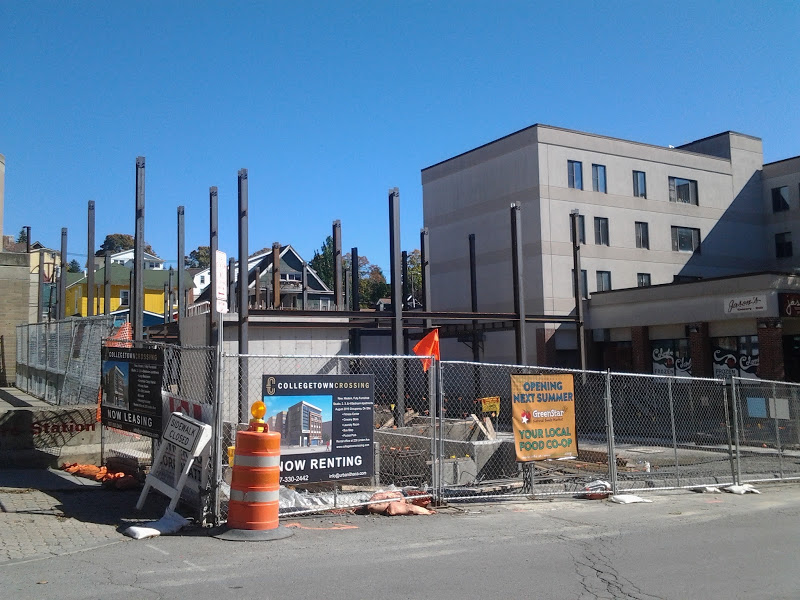
The largest of the apartment projects under way in Collegetown, Urban Ithaca (the Lower family’s) project at 307 College Avenue, the “Collegetown Crossing” development, has made significant progress in the past few months.

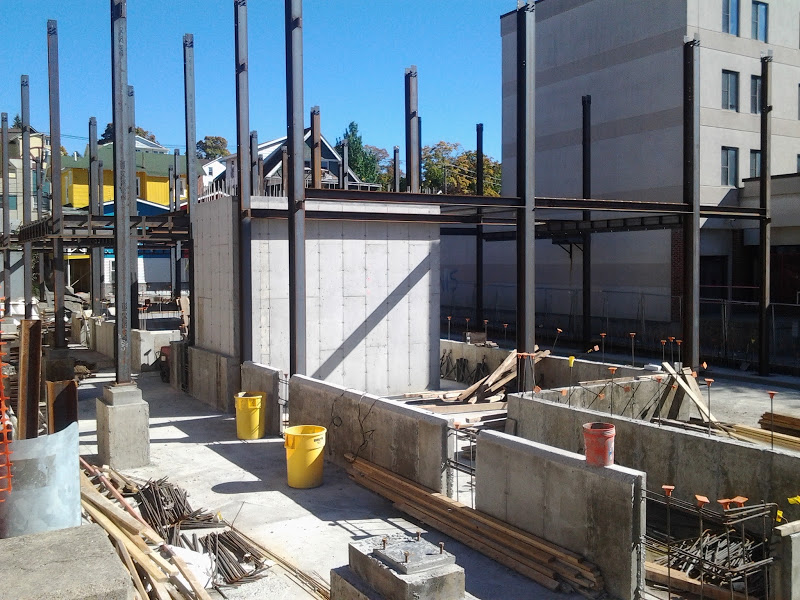
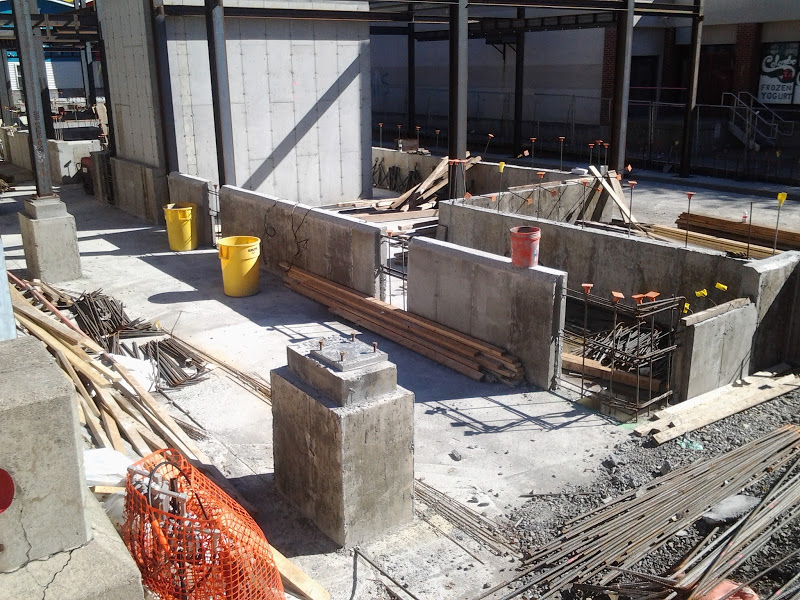
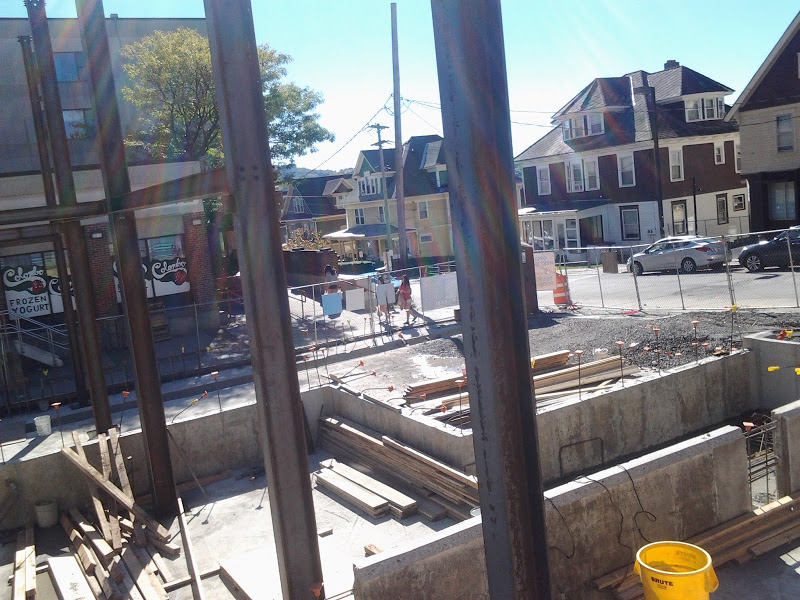
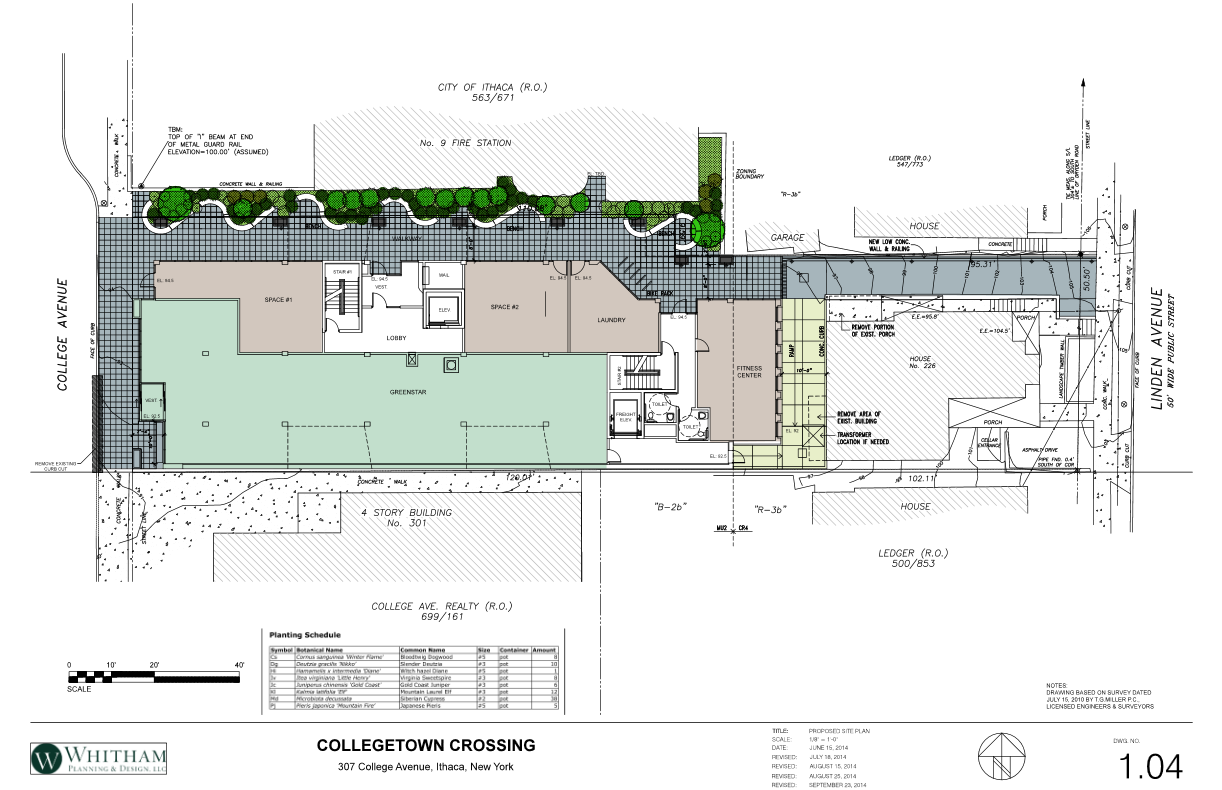
Structural steel columns have risen to the height of the building’s second floor, and some cross beams have been erected. The concrete area where the buckets are sitting in the second image is the future pedestrian walkway connecting College and Linden Avenues. A year from now, those pillars will support the second through sixth floors, while a vegetated pocket park and walkway will lead past the main lobby for the apartments, one of the commercial spaces, and the laundry area, before a kink in the path takes it past the entrance to rear stairs and a fitness center, and then out towards Linden Avenue.

Also, don’t let the perspective fool you – the fire station’s concrete pad (where the photos were taken from) is a little higher than the walkway, so the walkway’s height is greater than it looks.

Notice the three concrete boxes? The closest concrete box to where I’m standing is the lobby’s stairwell. The one a little further behind it is for the lobby elevator, and the third one, furthest back in the photo, is for the freight elevator and rear stairwell. One of the two smaller storefronts will be in front of the elevator shaft towards the street, its outline clearly visible in the poured concrete of the second photo. All three of these will rise with the rest of the building as it moves skyward.

The project will bring 96 bedrooms to market in 46 units, as well as a 3,200 SF full-service branch of the Greenstar Co-Op grocery store. Two other commercial spaces and an indoor TCAT bus stop are planned, but no tenant announcements have been made for the other retail spaces. Apartment rents are expected to be in $950-$1250/bedroom range. Everything should be open for occupancy by August 2016.

According to construction loan documents recently filed with county, the project’s cost is about $10.5 million. Collegetown favorite Jagat Sharma is the designer, and Hayner Hoyt Corporation out of Syracuse will be in charge of construction.

In case anyone’s wondering, the “harlequin house” behind 307 College, 226 Linden Avenue, is another Lower property. Just like 205 College.

20151011_140746 20151011_140800 20151011_140803 20151011_140821 20151011_140834

307college_rev2_1

307_college_site_plan_final

ctown_crossing_rev2_1