205 Dryden Road (Dryden South) Construction Update, 10/2015

19 10 2015

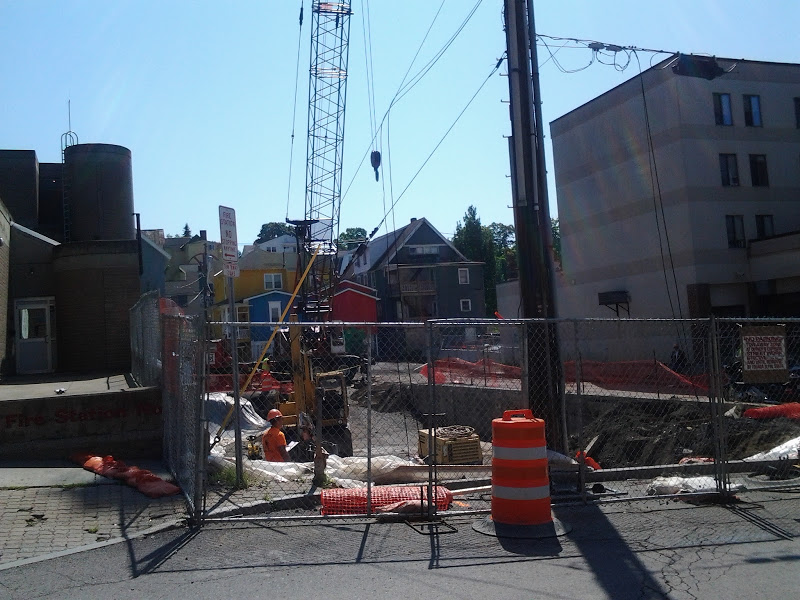
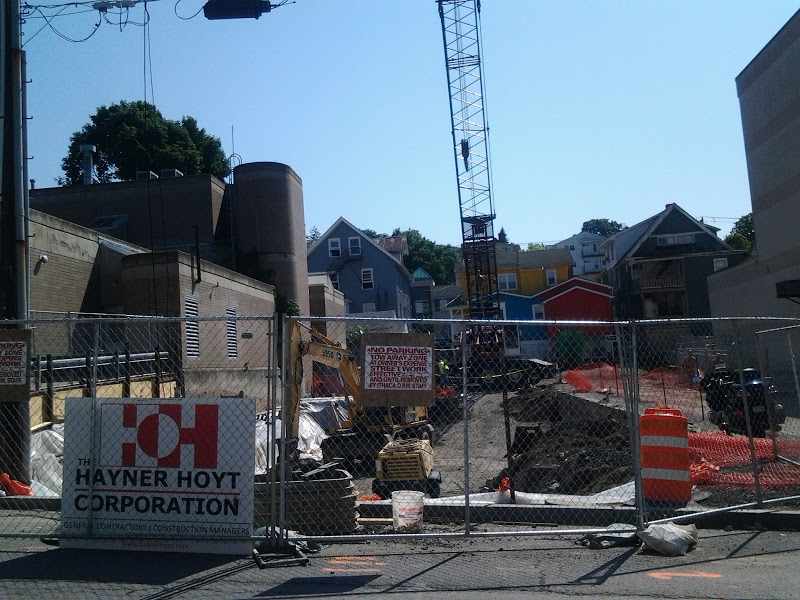
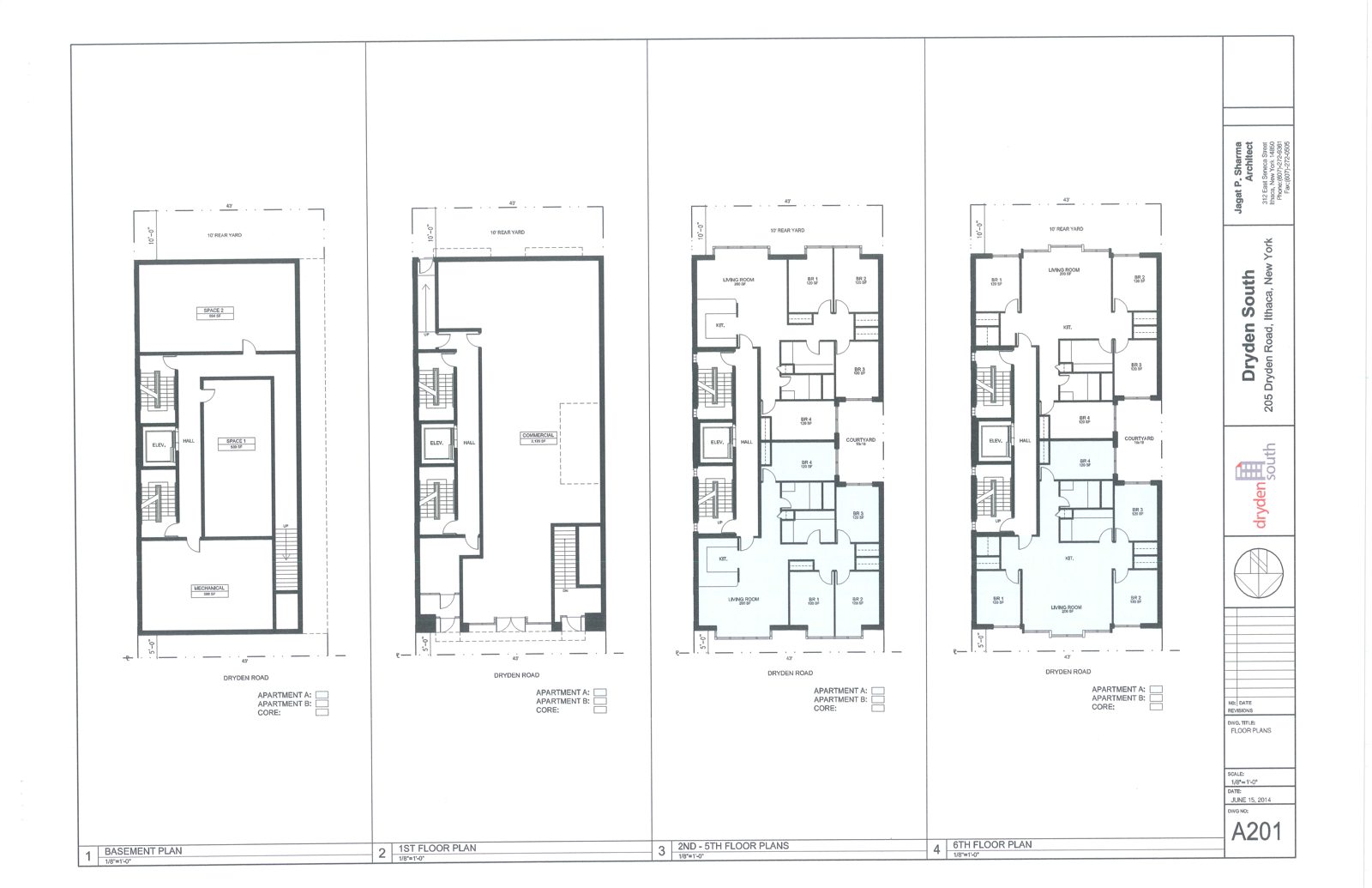
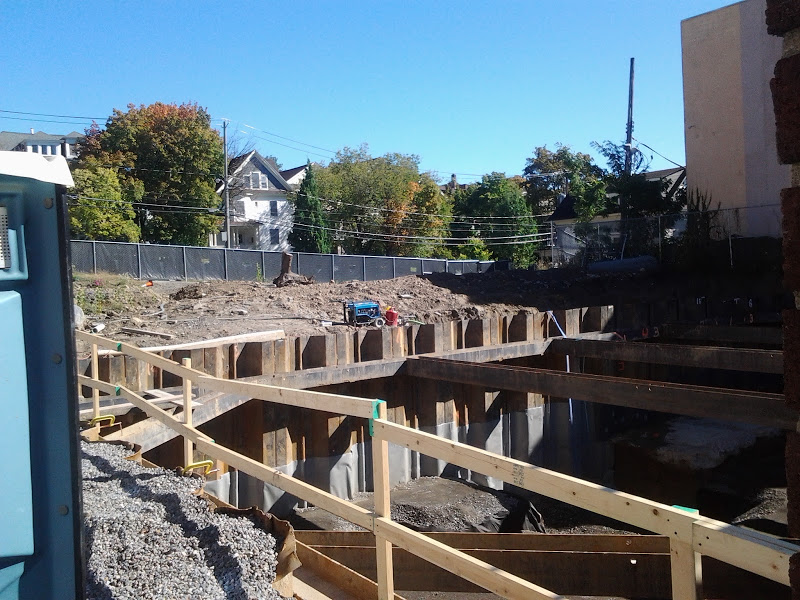
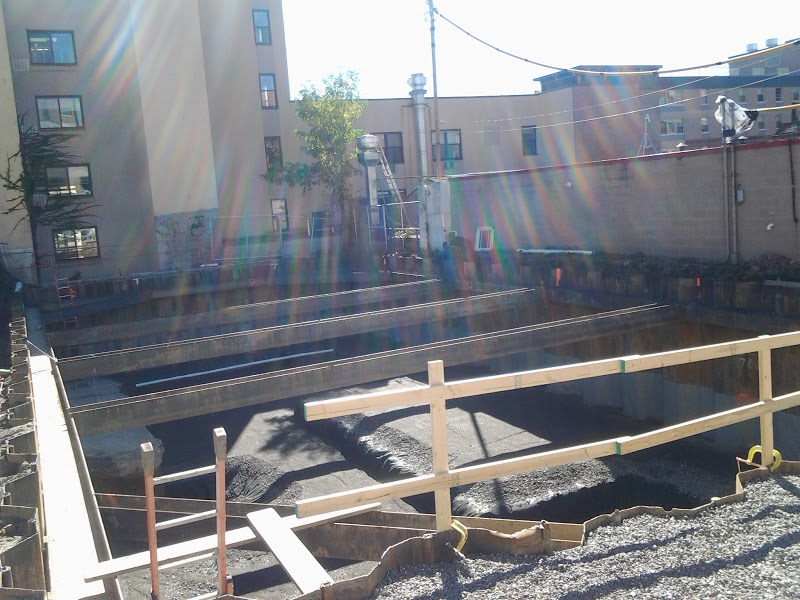
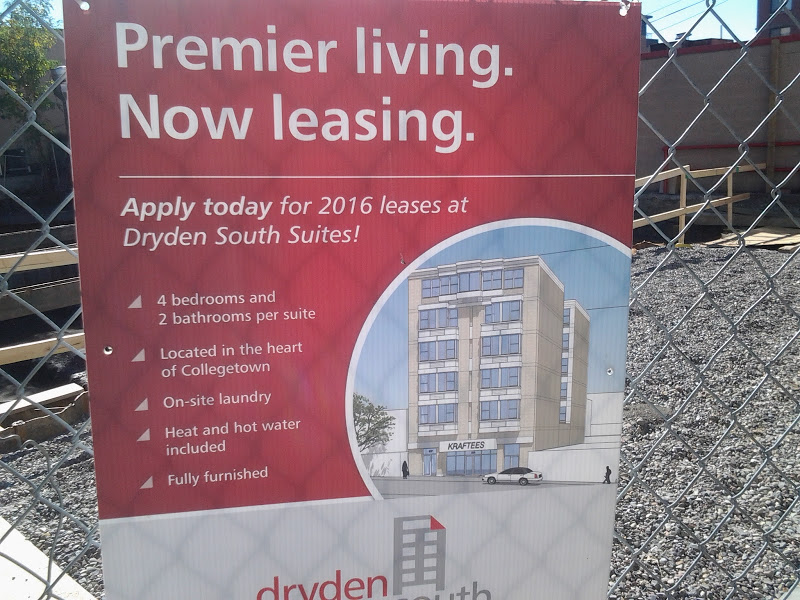
Turning the corner from 307 College, 205 Dryden (“Dryden South” for marketing purposes) is the third of Collegetown’s midrise apartment buildings under construction. The basement has been excavated and sheet metal piles keep the surrounding soil from spilling back in. The basement will contain the mechanical room and storage space. Structural steel has been erected up to street level. In the second image, the outlines of future interior basement walls and the base of the future elevator shaft can be seen.

In what’s sure to stoke a few tempers, prices for Dryden South have been priced at $1350/bedroom per month, meaning $5400/month for each 4-bedroom unit. Incredibly expensive, but not especially surprising given the astronomically high land values in central Collegetown. Owner Pat Kraft, who also runs Kraftee’s book store, has actively marketed the apartments on Facebook, Craigslist and its own website.

When completed in July/August 2016, the 6-story, 65-foot structure will house Kraftee’s in 2,400 SF of retail space on its ground floor, and 2 4-bedroom apartments on each of the upper five floors, for a total of 10 units and 40 bedrooms.

As you can tell from the first photo, apart from the demolition earlier this summer, work has yet to begin on John Novarr’s Collegetown Dryden project next door. But with approvals in hand, that six-story research/office building will be starting something in the next month, if the site plan review document is still accurate. The $6.4 million project was designed by Ithaca architect Jagat Sharma and Rochester-based LeChase Contruction is in charge of the build-out.

20151011_141022 20151011_141041 20151011_141053 20151011_141111


307 College Avenue (Collegetown Crossing) Construction Update, 10/2015

18 10 2015

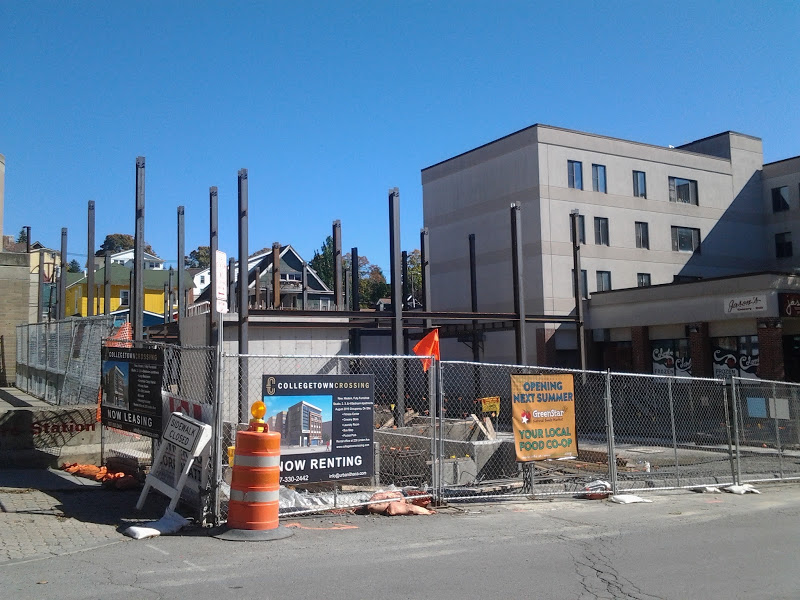
The largest of the apartment projects under way in Collegetown, Urban Ithaca (the Lower family’s) project at 307 College Avenue, the “Collegetown Crossing” development, has made significant progress in the past few months.

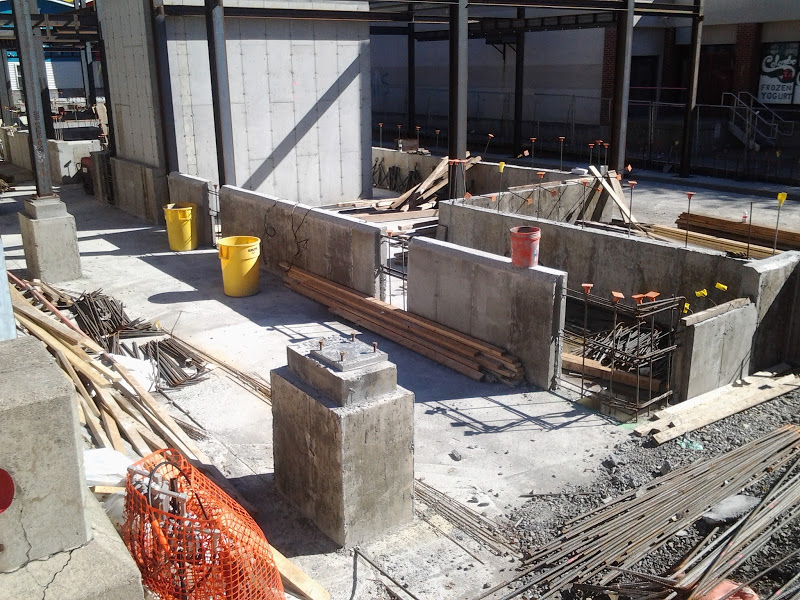
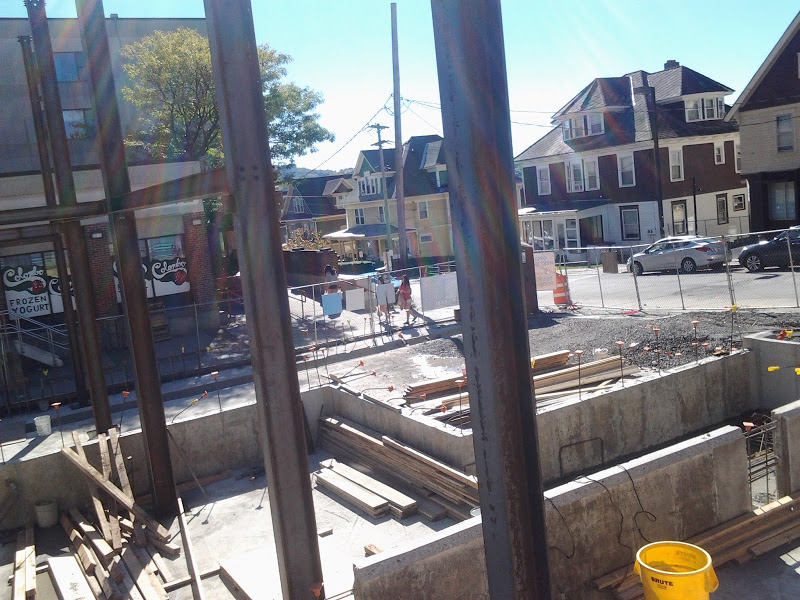
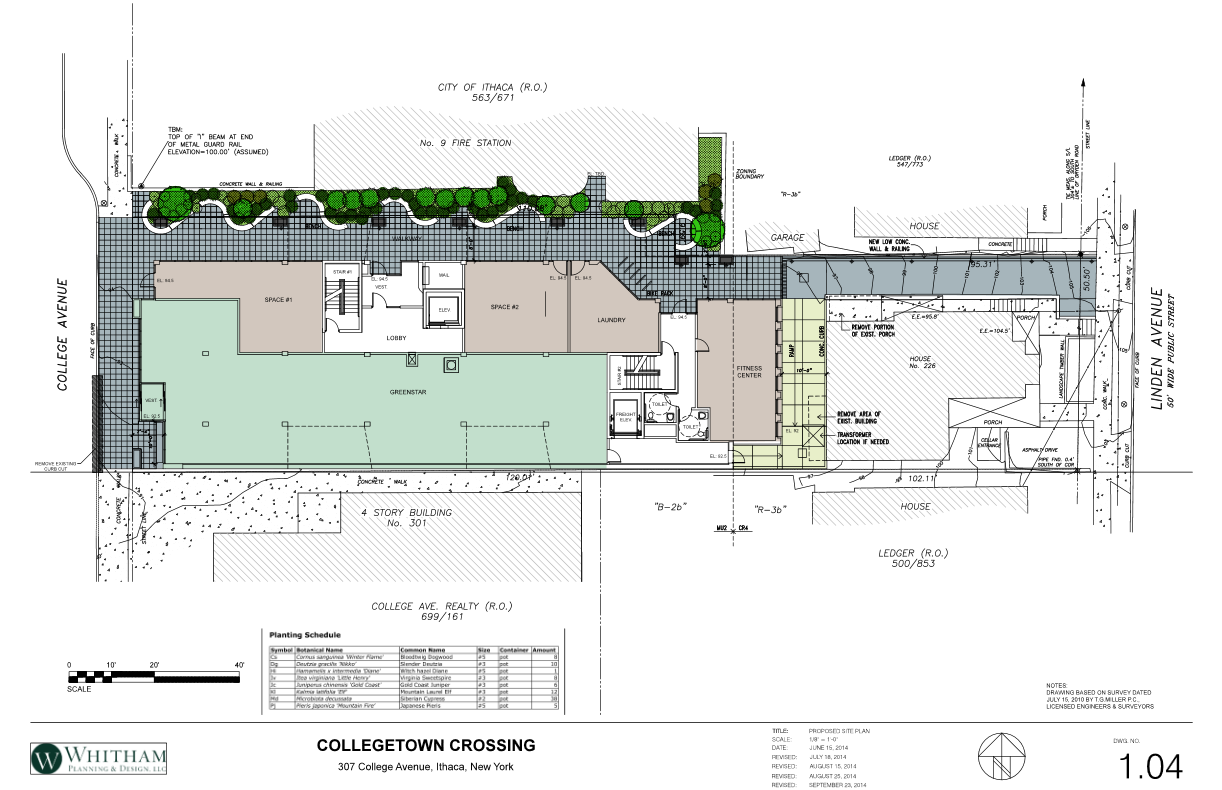
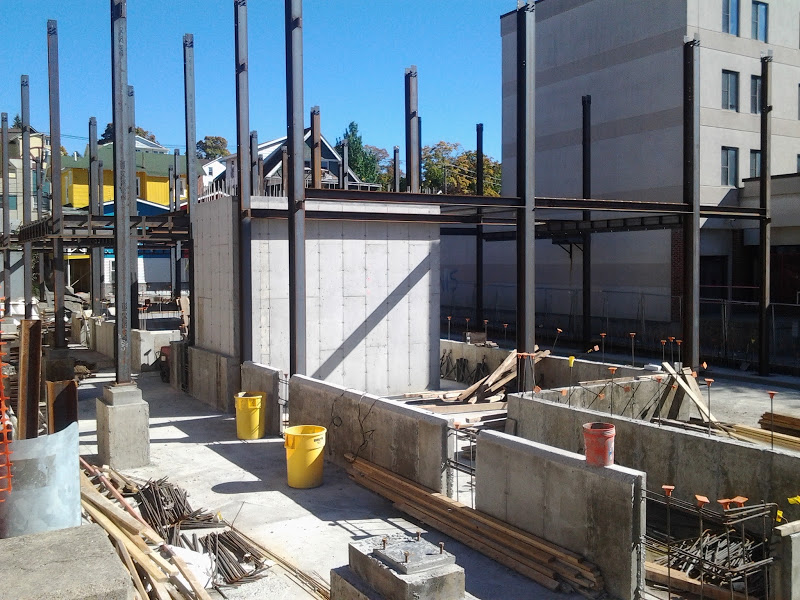
Structural steel columns have risen to the height of the building’s second floor, and some cross beams have been erected. The concrete area where the buckets are sitting in the second image is the future pedestrian walkway connecting College and Linden Avenues. A year from now, those pillars will support the second through sixth floors, while a vegetated pocket park and walkway will lead past the main lobby for the apartments, one of the commercial spaces, and the laundry area, before a kink in the path takes it past the entrance to rear stairs and a fitness center, and then out towards Linden Avenue.

Also, don’t let the perspective fool you – the fire station’s concrete pad (where the photos were taken from) is a little higher than the walkway, so the walkway’s height is greater than it looks.

Notice the three concrete boxes? The closest concrete box to where I’m standing is the lobby’s stairwell. The one a little further behind it is for the lobby elevator, and the third one, furthest back in the photo, is for the freight elevator and rear stairwell. One of the two smaller storefronts will be in front of the elevator shaft towards the street, its outline clearly visible in the poured concrete of the second photo. All three of these will rise with the rest of the building as it moves skyward.

The project will bring 96 bedrooms to market in 46 units, as well as a 3,200 SF full-service branch of the Greenstar Co-Op grocery store. Two other commercial spaces and an indoor TCAT bus stop are planned, but no tenant announcements have been made for the other retail spaces. Apartment rents are expected to be in $950-$1250/bedroom range. Everything should be open for occupancy by August 2016.

According to construction loan documents recently filed with county, the project’s cost is about $10.5 million. Collegetown favorite Jagat Sharma is the designer, and Hayner Hoyt Corporation out of Syracuse will be in charge of construction.

In case anyone’s wondering, the “harlequin house” behind 307 College, 226 Linden Avenue, is another Lower property. Just like 205 College.

20151011_140746 20151011_140800 20151011_140803 20151011_140821 20151011_140834

307college_rev2_1

307_college_site_plan_final

ctown_crossing_rev2_1


327 Eddy Street (Dryden Eddy Apts) Construction Update, 10/2015

16 10 2015

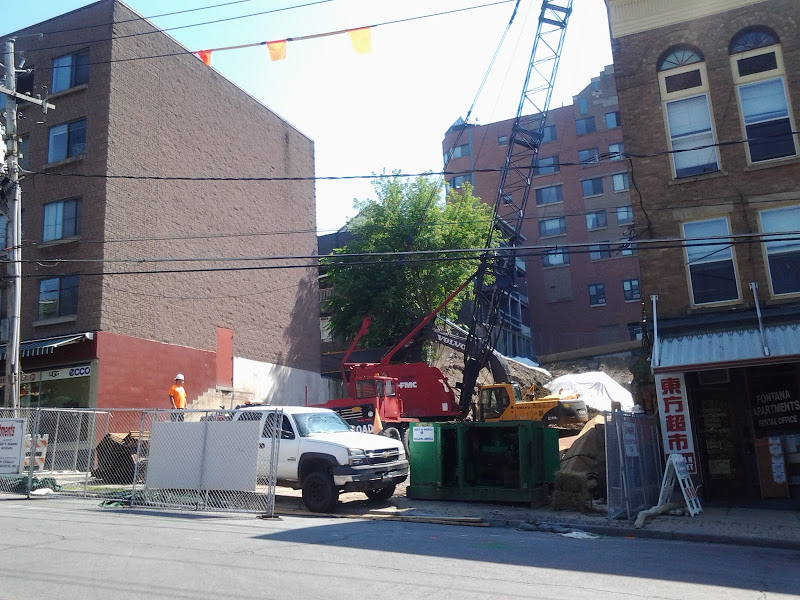
Of the three major Collegetown apartment projects currently underway, 327 Eddy is probably the least “impressive” to look at because it has yet to begin putting up structural steel. But this isn’t to say there isn’t work underway.

The site has been excavated and the base of the building has been established. A steel rebar grid mesh can be seen at the base of the upper tier, with utility lines feeding through. The rebar mesh is a reinforcement for the concrete when it gets poured, helping to prevent cracks that may from in the concrete from spreading throughout the foundation and causing major damage. The lower building tier have yet to receive the rebar mesh, but given the elevation render, it might be filled out first with the “flowable fill” referenced in the last update. Rimming the base are steel sheet piles, which lock together to form a wall designed to keep spoil and water from neighboring properties from spilling onto the construction site.

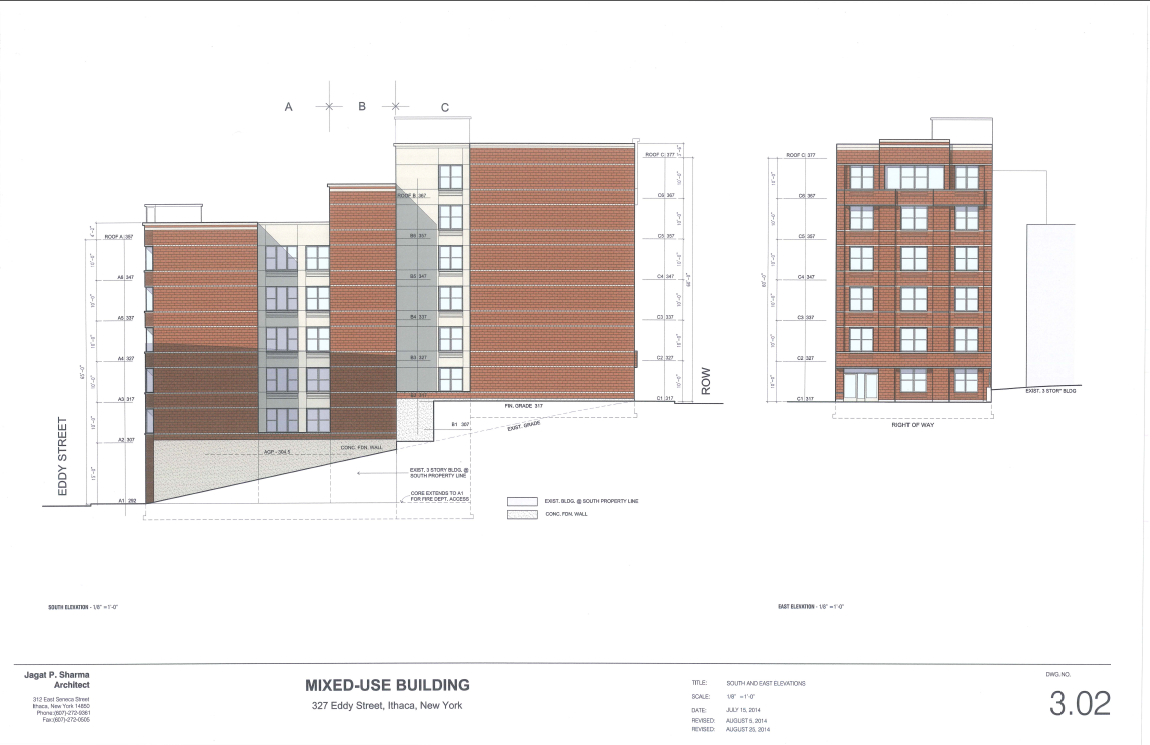
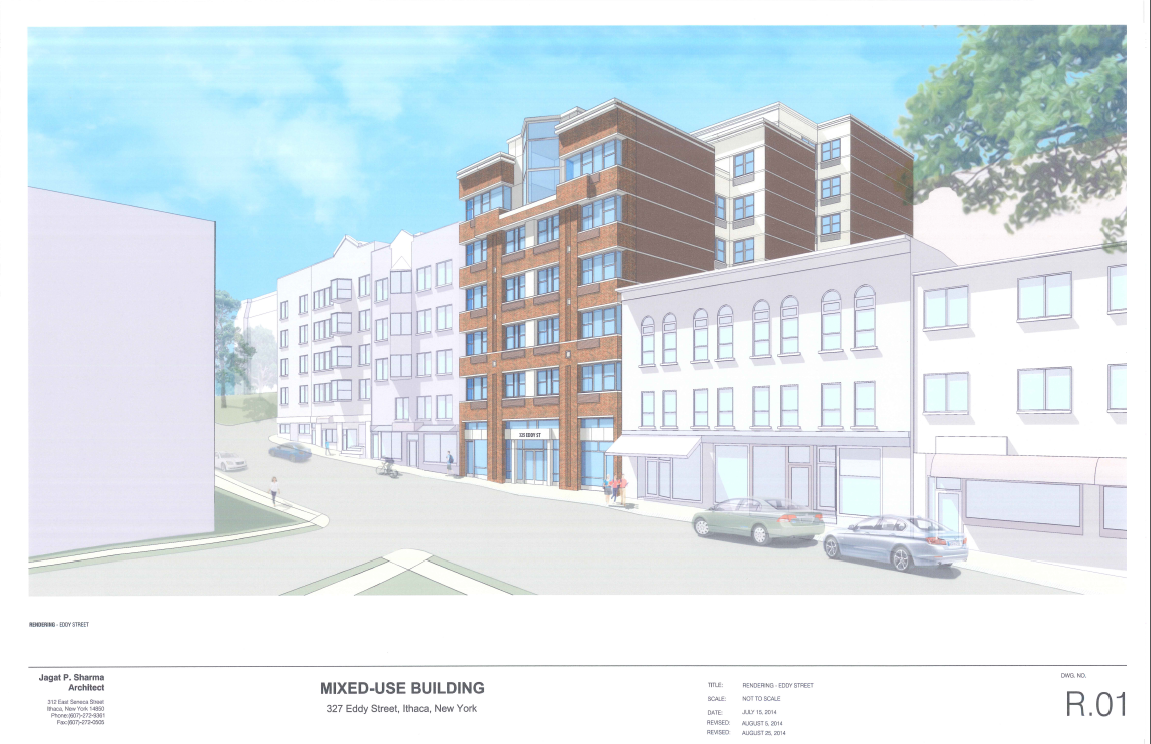
Plans call for a new 5-story building split into “steps” on the steeply-sloped site. The mixed-use building will bring 1,800 SF of retail space and 22 new apartment units with 53 bedrooms to the market in August 2016. Longtime Collegetown landlord Steve Fontana (of the Fontana’s Shoes family) is the developer, Jagat Sharma is the architect, and GM Crisalli & Associates of Syracuse will be overseeing construction. A construction loan of $4,824,000 is being provided by Tompkins Trust Company.

Note in the elevation drawing below, the building is six stories. It was reduced to five, and the decorative crown was reworked after approval was granted.

20151011_140231 20151011_140257 20151011_140309

327_eddy_rev4_1 327_eddy_rev2_3


The 160-foot Hurdle at 815 South Aurora Street

23 09 2015

815_s_aurora_2

Developer Todd Fox has big plans brewing for Ithaca’s South Hill, but a cell phone tower stands in the way.

Fox, one of the owners of local rental company Modern Living Rentals (MLR), shared preliminary plans for an 87-unit apartment building at 815 South Aurora Street at the Planning and Development Board meeting Tuesday evening.

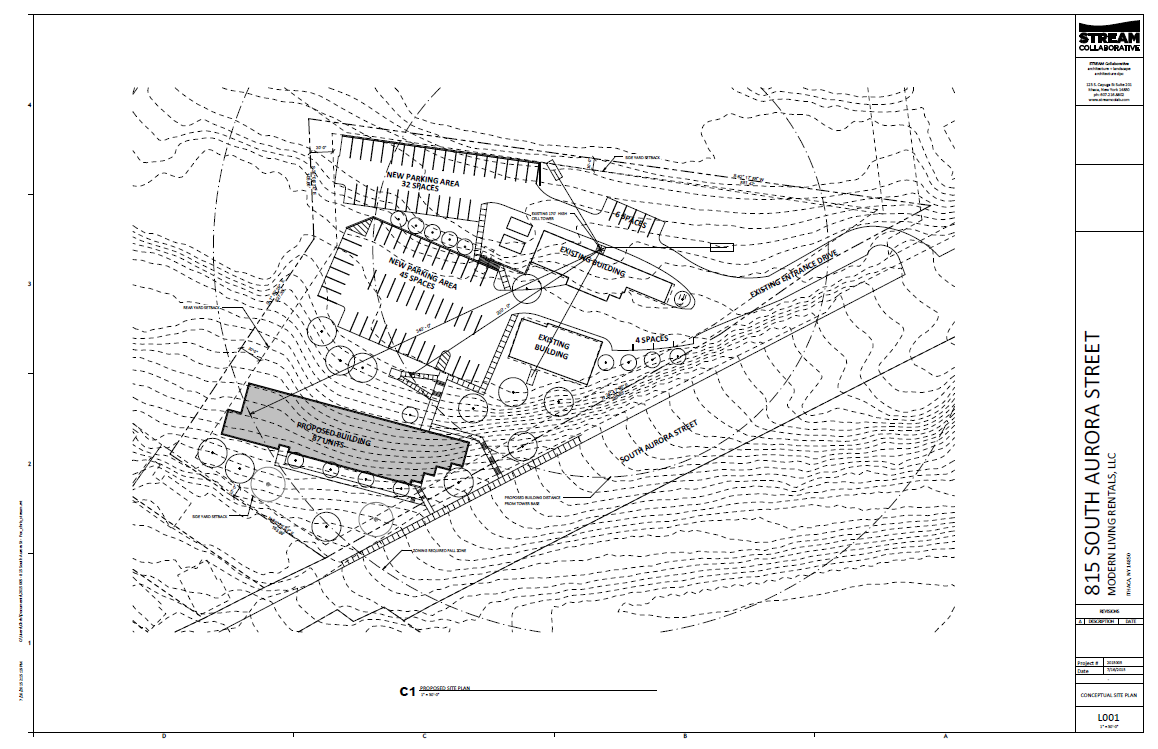
Fox’s plans call for a multi-story apartment building built into the hillside, a block from Ithaca College and near Rogan’s Corner. The design, created by Ithaca-based architecture firm STREAM Collaborative, is reminiscent of nearby Emerson Power Transmission, with design cues from the former factory incorporated into the new apartment building. All 87 units would be studio apartments (i.e. no formal bedroom space). 87 parking spaces are also planned.

The building site at 815 South Aurora Street is currently a sloping grass field on the north side of a 2.5 acre lot. Two other buildings on the same property would be unaffected.

Compared to other projects that have come before the board in the past couple of years, 815 South Aurora has a unique obstacle. A cell phone tower, and a city law by extension.

815_s_aurora_1

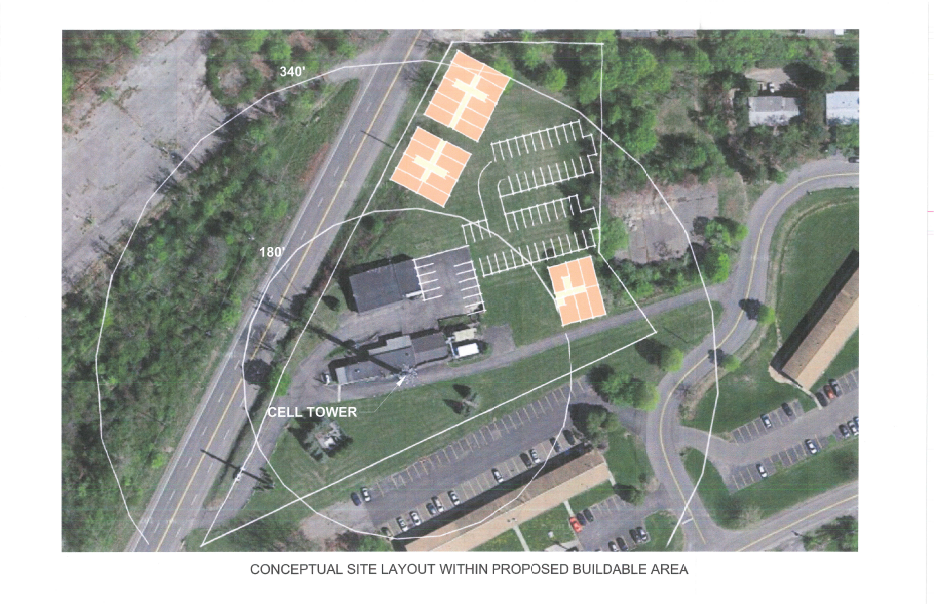
The current city ordinance states that buildings can’t be built within a radius equal to double the height of a communications tower. In this particular case, the tower stands 170 feet tall, meaning nothing can be built within 340 feet of the tower. Two apartment buildings in the Hudson Heights Studio Apartments complex, and the current buildings on site are grandfathered in; they were built before the law was enacted.

To help make his case, Fox hired two private engineering companies (Ithaca’s TAITEM Engineering and Groton’s Spec Consulting) to analyze the case, and their findings determined that an appropriate fall zone is the height of the tower plus 10 feet for a little wind/bounce – so 180 feet total. With this info in hand, Fox is trying to get the city to refine the zoning to allow the decrease in fall zone and therefore permit the land to be used for the proposed apartment building.

Previously in June, Fox had approached the Board of Zoning Appeals (BZA) asking for a modification from the law. However, the BZA said it would not consider the application. The city attorney advised the BZA that they can’t override a council-approved law outright. However, the BZA could make a consideration on a case-by-case basis, which meant that Fox and architect Noah Demarest would have to present a firm plan for the site, and then apply for a code variance before any decision could be made. Which leads us to the present; a project on the table, with a 160-foot hurdle.

In an email, Fox wrote “[a] fall zone of twice the height is an arbitrary safety distance. The ordinance was created at a time when Cell towers first began being constructed and there was not much knowledge about them at that time. We also contacted as many municipalities in Central New York that we could and everyone that we talked to had the fall zone being just the height of the cell tower plus several feet, give or take for debris throw off. ”

815_s_aurora_3

When asked how his project would be compatible with the rest of the neighborhood, Fox replied “[w]e feel like our project helps serve as a gateway into Ithaca. One of the things that we found very enticing about this project was the opportunity to pull Ithaca College students out of the South Hill neighborhood.”

“One of the constant complaints and desires of long-term residents is to try and see a shift away from the growing student population in the neighborhood. I don’t see the multifamily properties getting converted back to owner occupied anytime soon. But I do see the ability of single-family homes that are currently rentals, being sold back to families. The only way this is going to happen is if new developments are built that can support this transition. We need space for the students and we need space for families, and we think that our development helps create an opportunity for both of those demographics.”

Demographics or not, the project still doesn’t conform with the law. It will be up to the planning board and the BZA to decide whether or not the project site is safe, and if the proposed apartment building is a good fit with the South Hill community.


News Tidbits 9/19/15: It’s A Numbers Game

19 09 2015

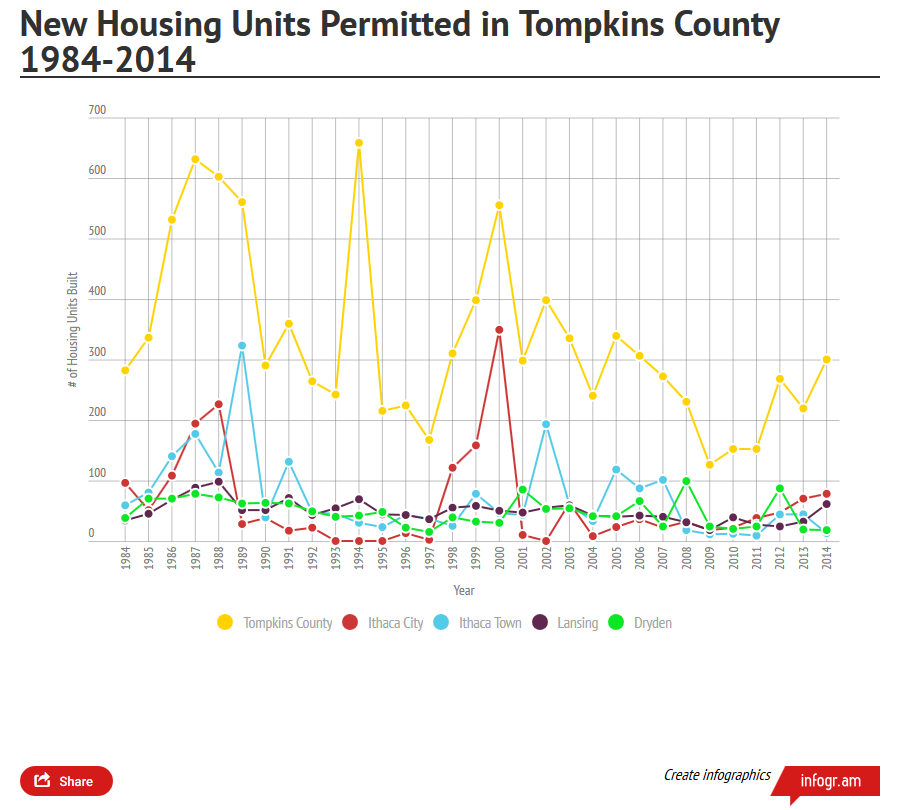
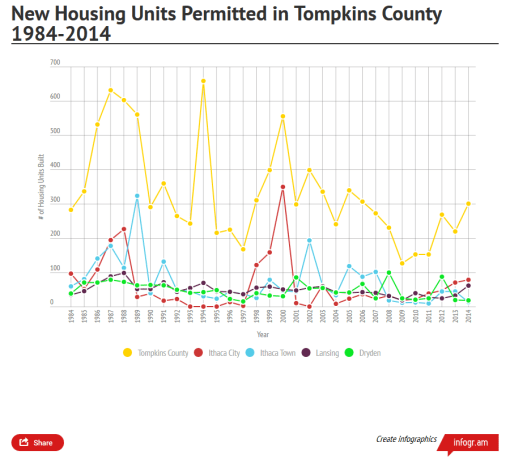
tc_housing_permits_1984_2014

tc_housing_permits_pies_19904_20104

1. Readers might have noticed that there was no Monday night (Tuesday) piece this week. The piece that was originally scheduled evolved into the building permits analysis that was a featured article on the Voice (link here). The initial intent was to run a mirror of the piece on the same day, but things got a little delayed, and eventually I just scrapped running it as the topic-of-the-week.

The reaction was generally favorable (if maybe less traffic than hoped; math-y pieces typically aren’t big traffic generators), but there’s a couple of quick criticisms that came in that I want to address. Namely that I didn’t include proposed projects, and that I left out non-residential construction.

Truthfully, there is no reliable long-term record of non-residential construction. HUD doesn’t break it down in their SOCDS database, and the county doesn’t have complete data on non-residential construction (for their reports, they also rely on the HUD SOCDS database). Related to that, HUD data for 2015 is very preliminary, relying on imputed values. Finalized and corrected 2015 data won’t be available for use until March 2016.

That being said, residential permits are an effective gauge for a few reasons – one, residential is the largest individual construction sector nationwide; two most recent local construction is residential or institutional, and three, many of the projects built in Ithaca are “mixed-use” meaning they have commercial and residential components. although the commercial components aren’t kept in track, the residential construction permits are available, and are showing up in the city’s SOCDS data.

For proposed projects, it’s not prudent to “count your chickens before they’ve hatched”. This passage was originally in the piece, but was pulled before the final version was published:

“As mentioned earlier, news sources like us here the Voice are guilty are promoting the misconceptions. We try and keep tabs on all the big projects – when they get proposed, approved and underway. The thing is, not all projects go from proposed to built. Some never receive approvals. Some get approved, but wait years to get construction financing, if ever. So it seems like there’s more than there is.”

Without having hard evidence in front of me, I’d argue that if one were to somehow include office and retail, the area still isn’t booming if we’re looking in a historical timeframe – you’d have large spikes in retail during the mid 1970s when the mall was built, and from about 1997-2004 in Southwest Ithaca and Lansing for big box retail. For office space, there would be a peak in the late 1980s/early 1990s for the Cornell business park by the airport; there’s circumstantial evidence that the office market today is pretty weak, TFC’s HQ being the odd project out. Industrial space would have peaked with Borgwarner’s construction in the early 1980s, but in recent years it’s been minimal or even negative growth (due to the Emerson shutdown). Hotels might be the only category that shows a “boom” at present.

The point of the article remains that

1. If we look at available building permit data, Tompkins has seen an uptick in construction, but not a construction “boom”, and
2. It feels like a boom because the region’s coming off of a very low period of activity, and there’s more construction in the highly visible urban areas of Ithaca city, vs. the suburban and rural development that has been more prevalent in previous years.

20150829_121852 20150829_121855

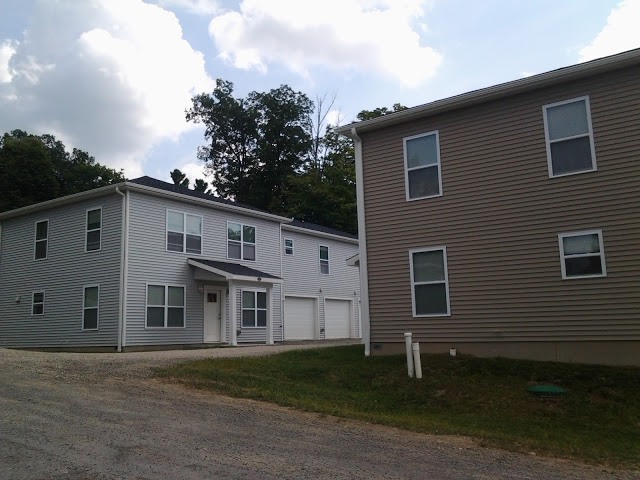
2. It’s time for a semi-regular house-of-the-week feature. I’ve been meaning to update on this for a while, but I keep missing the turn off Route 79. Local developer Chris Petrillose of Petrillose Properties (possibly related to Bob Petrillose, the founder of the Hot Truck) recently finished his second and third duplex  off of Wiedmeier Court in the town of Ithaca. Like the first duplex that was finished last year, each building consists of a 4-bedroom unit and 2-bedroom unit.

According to county records, the Wiedmeiers began to develop the land in the mid-2000s, building 2 duplexes of their own before deciding to sell the other lots (Petrillose bought the lots for the duplexes in 2012). The rest of the land, 12.34 acres, is currently for sale, so perhaps this won’t be the last visit.

3. Previously reported here and on the Voice, the city is studying whether or not to sell fire station No. 9, located in the heart of Collegetown at 309 College Avenue, to an interested private developer. We now know the consultant the city hired to perform the study.

Kingsbury Architecture, a small local firm, is investigating whether it would be worth the city’s investment to build a new station elsewhere on East Hill and sell the aging station, or invest in repairs and long-term maintenance for the current 1968 structure. Kingsbury has little presence online, but in an example of how small of a world this is, they were the initial firm used to plan St. Catherine of Siena’s new parish center, the project discussed in last week’s news update. However, according to church newsletter, the congregation amicably ended the partnership because of cost issues. The church staff went architect shopping, and that’s how Richard McElhiney Architects came into the project. Some of Kingsbury’s work can be found on the church’s webpage here. Kingsbury also appears to have done some interior renovation work at Cornell, and roof replacement at the Cascadilla Boathouse.

state_st_triangle_v5_1

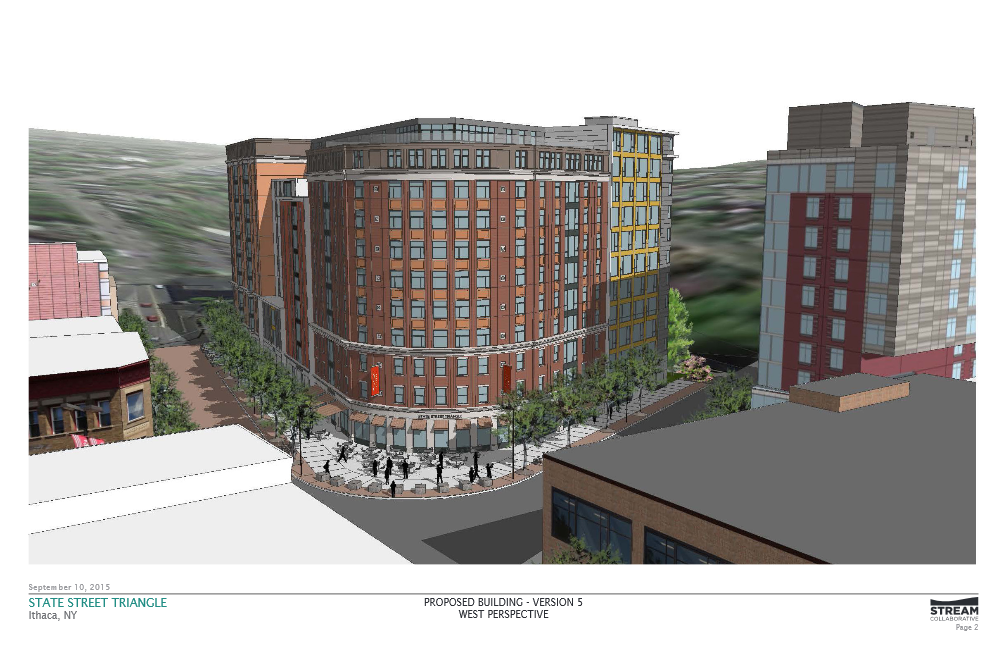
4. New documents from Campus Advantage give insights on the tenant mix and parking situation in downtown Ithaca.

First, my personal disclaimer – Even though part of their market research cites work I’ve written for the Voice about the housing crisis, my work was done impartially.

The new information comes as part of Campus Advantage’s official response to the city planning board’s request for more specific values on resident population, parking utilization and bus capacity, among other details. The documents are provided as part of the planning board’s materials here.

Updated figures indicate the proposed building has gone on a diet – the number of bedrooms has dropped from 620 to 582, the number of units from 240 to 232, and the square footage from 288,845 SF to 216,434 SF, a 25% reduction in mass. The maximum height remains the same at 11 stories at 116 feet. The slimming down comes in response to unfavorable review of the previous design as “too massive”, especially on the side facing East State Street.

sst_stats_1

According to an internal study by Campus Advantage, the Texas developer forecasts that, of the 582 tenants when at full capacity, 77.8% (431) will be students, and 22.2% (123) non-students. Of those students, 78.4% (338) will be undergraduates. Cornell students would comprise 64% (276) of the student population, Ithaca College 32% (138), and TC3 4% (17). A quick glance at the details behind these projections shows that CA assumes 95% occupancy, studios and other smaller units will be half or majority non-student, and that undergrads will be more inclined towards shared 4-bedrooms and 5-bedroom units. CA conducted online surveys with student groups to gather information for their study.
sst_stats_2

The parking demand from residents is predicted to be 191-219 spaces, taken from a study conducted by third-party traffic engineering firm SRF Associates. A further 64 parking spaces will be required for commercial retail tenants on the first floor (57 customer spaces, 7 employee spaces), for a grand total of 283 parking spaces. The 2012 Randall/West Collegetown parking study used as reference looked at student and non-student vehicle ownership in the Collegetown neighborhood, and the higher end (or “more conservative”, as SRF calls it) 219-space figure comes from a calculation the Urban Land Institute, a non-profit urban planning think-tank. Given that Randall/west focused on Collegetown, the more conservative figure is the safer bet.

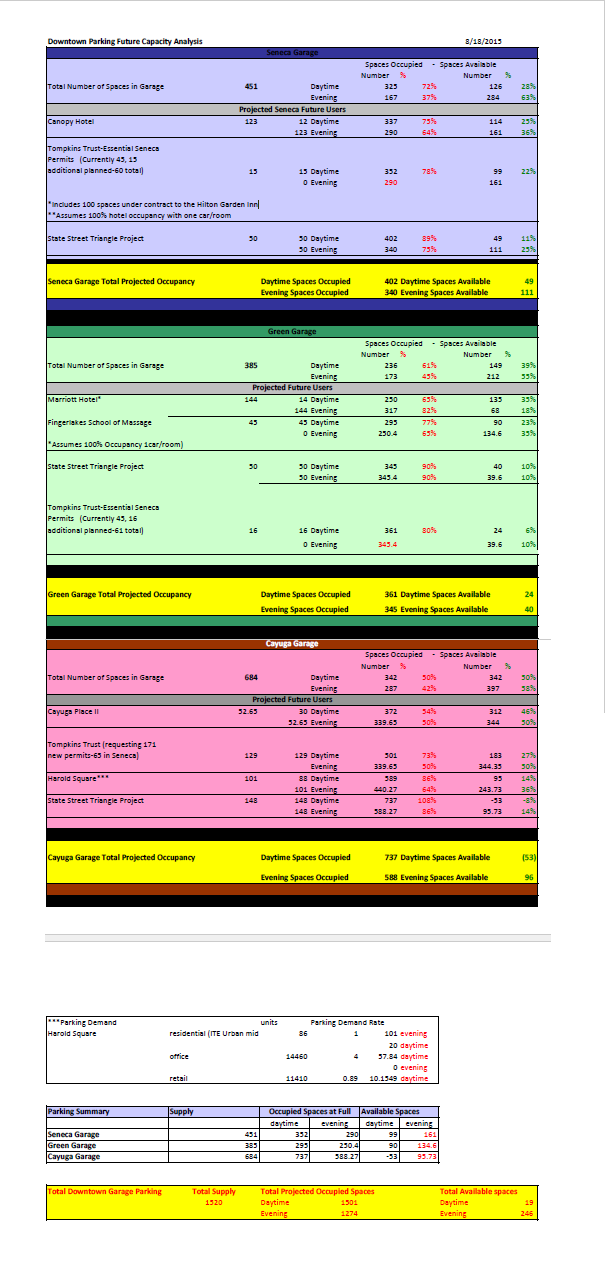
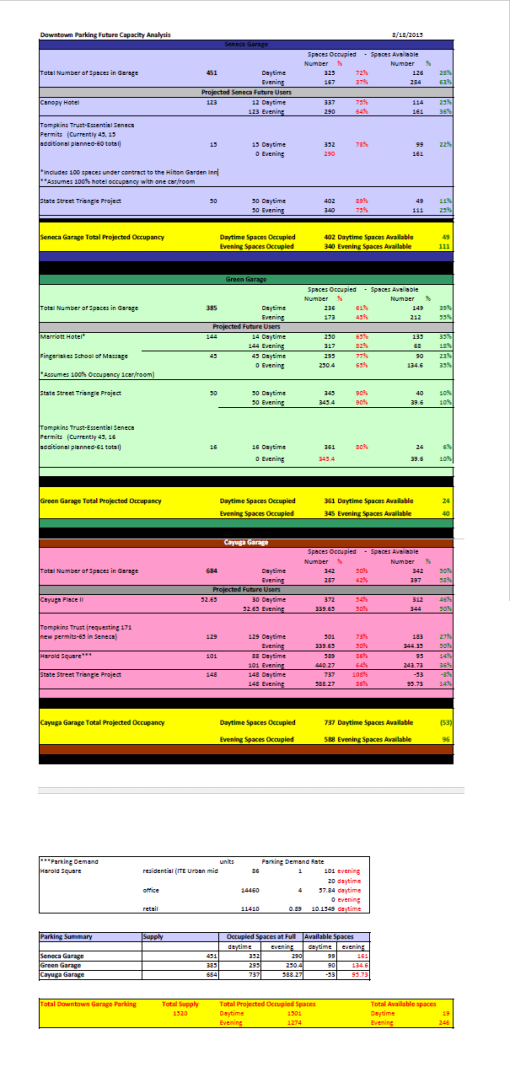
It’s not clear whether the parking garage study above is CA’s or the city’s, but the application itself states that the city’s Parking Director, Frank Nagy, has confirmed that enough parking is available, and a letter from TCAT’s Doug Swarts states that TCAT has the capacity for State Street Triangle’s potential tenants. Looking at the above study, though, it appears that if built, and if all the other approved and likely projects (i.e. don’t include 130 East Clinton) are built, the parking garages will be nearly full.

Since the new drawings were presented at the public open house on September 10th, there do not appear to have been revisions – what was shown then will be shown at the planning board meeting next Tuesday (links to those drawings here). However, the planning board will be looking to schedule a design review committee meeting, where board members provide suggestions and guidance on design features for the new building. In other words, this probably isn’t the building’s final design.

Also included in the attachment are two opposition letters – one from Historic Ithaca saying the building’s still too tall and massive, the other from former planning board and councilwoman Jane Marcham, who takes the unusual if debatable tact by saying that students living downtown deprives the colleges of campus life. Students comprise 40% of the market-rate downtown rental market, so there’s a few to interview for opinions should anyone be interested.

As always, the project is likely to inspire some debate at the planning board meeting. We’ll see if the changes are to the board’s liking.

815_s_aurora_1

5. Wrapping up this short but informative week, here’s a look at the Planning Board agenda for next week:

A. State Street Triangle – Public Hearing, City Environmental Quality Review (CEQR) discussion, and scheduling a Design Review Committee meeting. CEQR is they city’s more in-depth take on SEQR, where a project’s environmental impacts are considered, and a negative declaration (acceptance) is given only when adverse factors have been mitigated in a way the board sees fit. Design Review Committee pretty much is as it sounds – the board makes suggestions on the building design as a quality control / quality assurance measure.

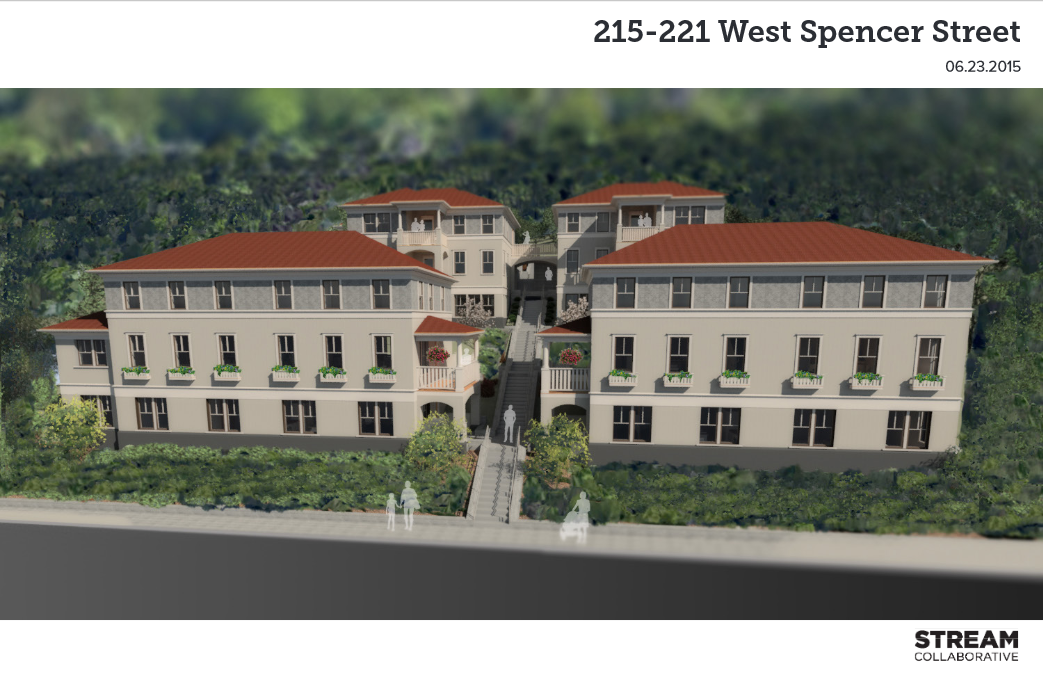
B. 215-221 Spencer Street, Determination of Environmental Significance and Recommendation to the BZA – the board has decided to recommend approval of the parking variance (parking within the rear yard setback), given the site’s steep topography.

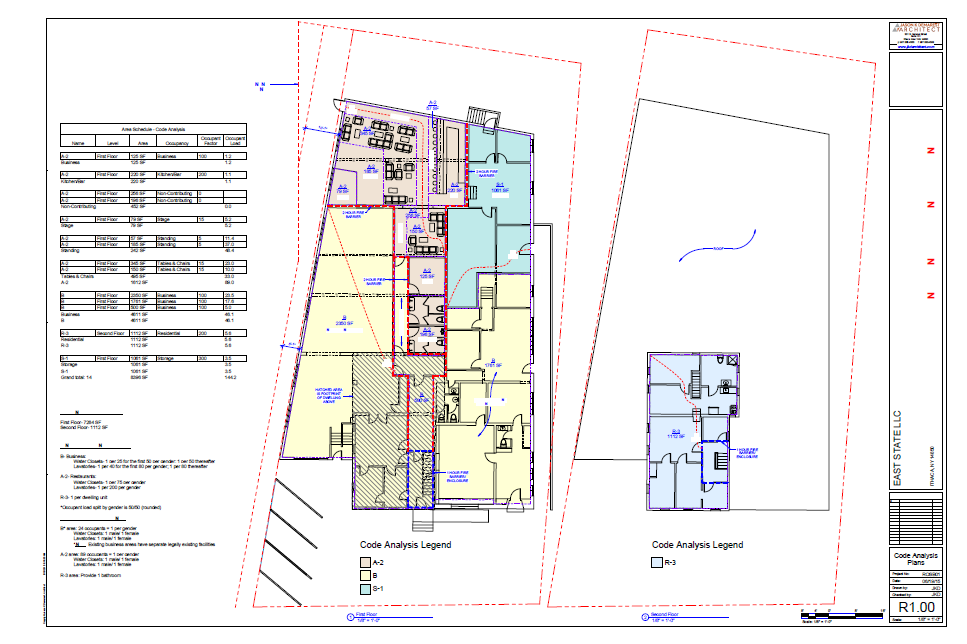
C. Site improvements, 416-418 East State Street416-418 East State Street is currently home to an underused 7,600 SF office and a connected manufacturing/storage building. The house dates from the 19th century, with various additions as recent as the 1970s. According to plans filed with the city, an LLC linked to Argos Inn architect Ben Rosenblum has plans to convert the old manufacturing space into a bar and storage space, with renovated offices and a 2 bedroom apartment in the original house. The project will include an accessory parking lot, revised landscaping and handicap access. Area and setback deficiencies have resulted in the need for a zoning variance, but a parking variance won’t be required because the bar will have after hours parking across the street at Gateway Plaza. The building itself won’t change dimensions, but the change in use triggers the city zoning laws.

There have been substantial concerns expressed about this project – neighbors are vociferously opposed to a bar, citing noise problems and concerns about smokers, and the county planning department is not a fan of the traffic and parking arrangement. The city will need to examine this project carefully.

Scott Whitham is serving as a consultant, and local architect Jason Demarest is designing the renovation.

D. Hotel Ithaca – Amended declaration of environmental significance. Backstory and plans here.

E. “Sketch Plan – 815 South Aurora Street, 87 unit housing project” – See conceptual design above, full backstory here. To recapitulate the salient details, local developer Todd Fox of Modern Living Rentals would like to build apartments on vacant land at 815 South Aurora Street, but can’t because the vast majority of the property is within the “fall zone” of a cell tower, which the city defines as twice the height of the tower. The 170′ tower creates a 340′ radius of no-man’s land (outer circle above), making the parcel virtually undevelopable. Fox had two private engineering companies (TAITEM Engineering and Spec Consulting) analyze the case, and they determined that an appropriate fall zone is the height of the tower plus 10 feet for a little wind/bounce – so 180′ total. With this info in hand, Fox tried to get the city to refine the zoning to allow the decrease in fall zone and therefore permit the land to be open for development. But when Fox and project architect Noah Demarest approached the BZA, they said they wouldn’t consider the 815 South Aurora Street application unless the law was amended, or Fox and Demarest go through the sketch plan and review process, and submit a formal application for a zoning variance.  So now we’re at the point of having a sketch plan to present. Regardless of design, the project will need an area variance issued by the BZA for the cell phone tower issue. At 87 units, this will be a pretty sizable project, and given Fox’s previous work (he’s been rather busy lately), it will likely be rentals, perhaps with Ithaca College students as the target market.

3 of the 5 projects above (SST, 215-221 West Spencer, and 815 South Aurora) have Noah Demarest/STREAM Collaborative as a lead or consulting architect. None of them have the same developer. Talk about having your fingers in many pots.

News Tidbits 8/22/15: Throwing Fuel on the Fire

22 08 2015

state_st_triangle_v3_1

1. Campus Advantage has released revised parking numbers for its 11-story State Street Triangle project. According to newly-released documents here, parking will be handled with a “four-point program”:

I. The primary component is that CA is negotiating a deal for 250 parking spaces in the upper levels of the Cayuga Street garage. The document notes an average surplus of 300 parking spaces per day.

II. The city is willing to let CA reserve up to 100 parking spaces in the Seneca Street garage.

III. CA has identified 75 underused spaces in the Green Street garage, but no formal deal is planned yet.

IV. Surface parking lots near Cornell and in other parts of the city that could handle parking for those who only need vehicles on weekends or for holiday trips.

Given typical student vehicle ownership rates of about 27% (27% of 620 = 167 spaces), point I will probably be enough to handle resident traffic. Commercial traffic, estimated to be about 64 spaces in the SRF Associates traffic study, would more likely be taken care of by point II or III. So the parking situation appears to be better thought out at this point. CA is also planning a bike share and an Ithaca carshare location. Whether it’s enough to please city staff, we’ll see.

The revised document notes construction traffic would enter the site from E. Green Street, and exit via Seneca Way and East Seneca Street.

Regardless, some of the reactions from city officials have been quite strong – the following quote comes from a report from 3rd Ward councilwoman Ellen McCollister from last month’s IURA meeting:

“Common Council may end up concluding it made a mistake when it re-zoned that part of the city without examining the issue more contextually and architecturally.”
State Street Triangle will be undergoing a public hearing at Tuesday’s city Planning Board meeting, and the committee will be going over the project’s City Environmental Quality Review forms. CEQR is the city’s more stringent version of SEQR, and is used to assess project impacts – basically, mitigating the issues created by the project, and making sure it’s a net positive for the community. No voting is expected.
State Street Triangle has also applied for CIITAP tax abatements, but the IDA meeting has yet to be scheduled.
100_1466

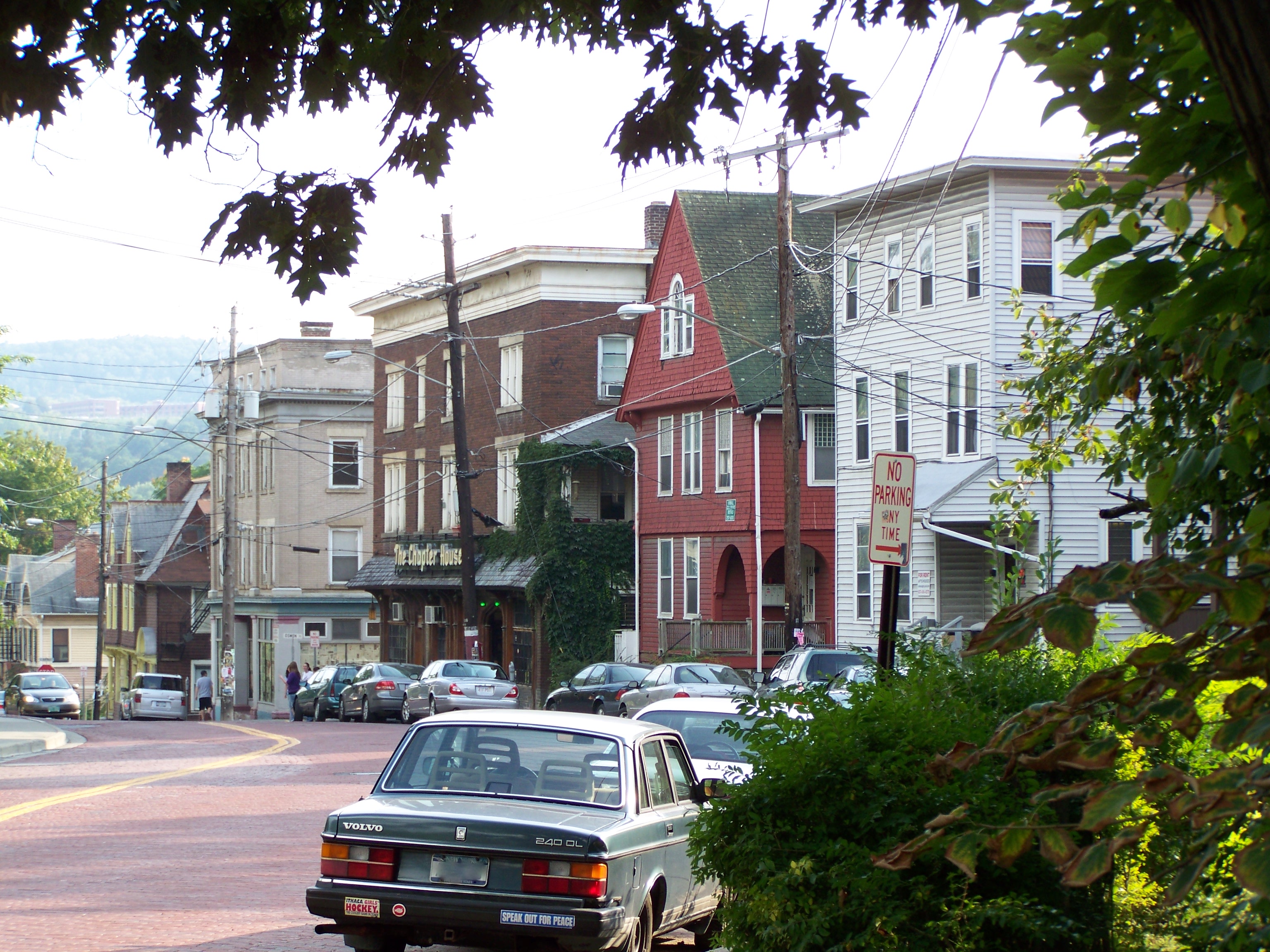
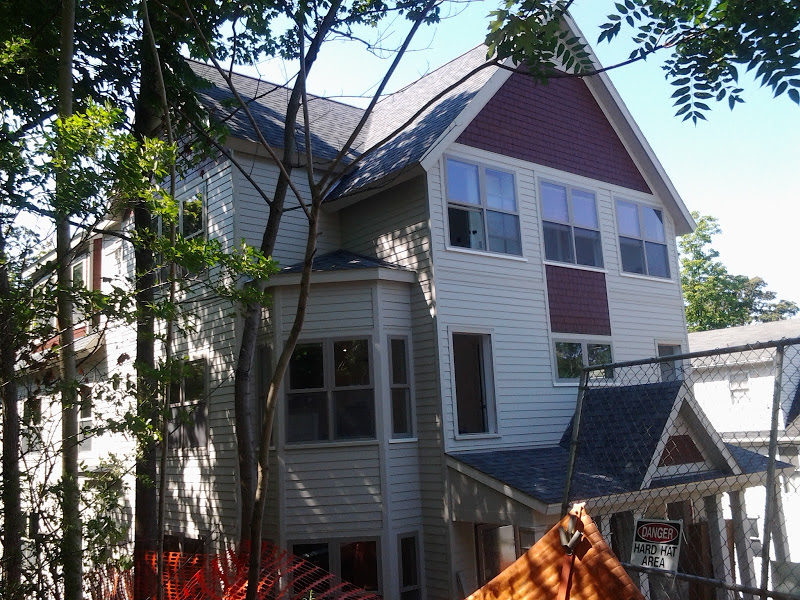
2. Quick update on 406/408 Stewart – a copy of the Ithaca Landmarks Preservation Council (ILPC) from last month indicates that council members are across the spectrum when it comes to 408 Stewart (bluish-white building above) still being historic, and if a new apartment building will be built on just the site of 406 Stewart (red building, destroyed by the Chapter House fire), or on the site of both 406 and 408. Members had to stress to themselves to look at historic value and reconstruction separately, and the purpose of the site visit was to help figure out a decision. There’s been no news yet, but we’ll see what happens.

3. Over in the village of Groton, a small development project is stirring debate of its own.

The project, proposed by Rick Uhl of Genoa, calls for four duplexes and four single-family homes, for twelve units total. The temptation is there to approach this with urban condescension, but for Groton, population 2,400, it’s a big deal.

The homes would be built on several already-subdivided lots on a new road coming off of Elm Street on the eastern boundary of the village. The original plan called for duplexes on the west side of the street and closer to the village center, while single-family homes would be built on the lots on the east side of the street.

The debate lies with proposed zoning changes in Groton – a zoning change currently being considered by the village would downzone parts of the town to single-family homes only. That includes the lots the duplexes are slated for.

The zoning has been a source of debate among homeowners in Groton, because a number of them own larger homes that they’ve turned into duplexes, living in one unit and renting out the other. Although the law grandfathers in current buildings, they worry it could be a hassle in the future. The county’s planning department has also expressed issues with the plan, saying that it creates numerous non-conforming lots and that it goes against the county’s comprehensive plan.

A compromise had been reached between the developer and planning board last spring, where duplexes would be built on the new street’s east side and single-family homes on the west side (so as to keep apartment dwellers from mixing with family homes), but more recently the village has made moves toward an all single-family plan anyway, which is creating some consternation since it tosses the compromise out the figurative window.

The Times notes that a decision on the zoning, and the compromise by extension, is expected at the September meeting of Groton village’s Board of Trustees.

4. Looks like there’s going to be a lull in activity in the town of Ithaca for the next few weeks. The Planning Board meeting for the start of September has been cancelled. The Planning Committee, which is comprised of the town board members and planning department staff, will be discussing a “family entertainment facility concept” for the intersection of Elmira Road and Seven Mile Drive, and modifications to the Planned Development Zone for the South Hill Business Campus (SHBC), an industrial and office park that reuses the old NCR headquarters.

A quick email with SHBC manager Linda Luciano says that the meeting will be to expand the business types allowed under the PDZ, because they were uncertain who would be interested when they first renovated the facility, and they wish “to support a more wide array of possibilities”. No expansion plans are on the table, although rough plans have been around for a while.

Readers might recall that Maguire dealership chain proposed a HQ and expanded facilities along Elmira Road and Seven Mile Drive, but the plan was dropped last December due to differences in opinion on appropriate zoning for the site. A mini-golf plan was also floated a few months ago, but later dropped from consideration.

5. Here’s something worth a short note – a vacant 2.01 acre commercial property in Dryden Village sold for $31,500 on Wednesday the 19th, well below its $150,000 assessment. The buyer is an LLC called “NBN Properties”, registered in July 2014. A separate document identifies the members of the LLC, one of whom is the president of John C. Lowery Inc., an Ithaca construction company.

At a glance, this story had appeared much more interesting – the P.O. Box NBN Properties is using once belonged to Ed LaVigne, who’s running for Lansing town supervisor. But LaVigne stopped using the P.O. Box in 2014, which allowed NBN to reserve it.

Regardless of who runs “NBN Properties”, the site is a potentially good location – Poet’s Landing was built just a few minutes’ walk away to the west, and the DOT has been aiming for a move next door on an adjacent 10.8 acre parcel to the north.  The county has paid for a feasibility study, now underway, for moving the DOT from the city waterfront to the location off Enterprise Drive in Dryden village (costs have delayed the move for years). This part of Dryden village has seen some other new businesses in the past few years, including a microbrewery and a Dollar General. If anything interesting comes along, expect a follow-up.

harolds_square_taylor

6. Nothing “new new” coming up at Tuesday city Planning and Development Board meeting, but plenty to talk about. Here’s the agenda, a rundown of what to expect.

A. Subdivision – continued from last month, a subdivision at 106-108 Madison Street on the northside. The applicant seeks to create a lot for a new single-family home

B. 1. Harold’s Square, 123-129 East State Street

The project was approved two years ago this month, but no building permits have been filed. Under that circumstance, an approval is only good for two years. The applicant is looking for a re-approval with no changes. A contractor associated with the Cornerstone Old Library proposal estimated construction on the 11-story, mixed-use project would begin this fall. Harold’s Square developer David Lubin is seeking to bring retail, office space, and 46 apartments to the market.

2. INHS’s 210 Hancock Street affordable housing proposal is up for preliminary and final approval

3. Final approval for the Dibella’s proposed in Southwest Ithaca

4. Discussion on State Street Triangle, see above

5. Public hearing and possible prelim and final approval for John Novarr and Cornell’s 209-215 Dryden Road academic/office building

6. Sketch Plan – Old Library proposal, Travis Hyde. Not exactly new, but I’ll give it the standard project summary next week.


707 East Seneca Street Construction Update, 8/2015

14 08 2015

By the time I had taken updated photos of the apartment building under construction at 707 East Seneca Street, most of the exterior work had been completed (looking at the photos closely, those might be some trim boards leaning next to the first-floor doorway). The work has shifted mostly to finishing out the interior, and then when the vast majority of work on the building is completed, landscaping and paving will follow. Everything looks to be on schedule for tenant move-in later this month.

For a look at interior progress photos, Modern Living Rentals has been posting occasional updates on their facebook page.

The building will have 6 3-bedroom units, 18 beds total. Todd Fox and Charlie O’Connor of Ithaca’s Modern Living Rentals are the developers, and the design of the building, heavily influenced by its location in the East Hill Historic District, is the work of local firms Schickel Architecture and STREAM Collaborative.

20150727_105957 20150727_110035 20150727_105910


114 Catherine Street Construction Update, 8/2015

13 08 2015

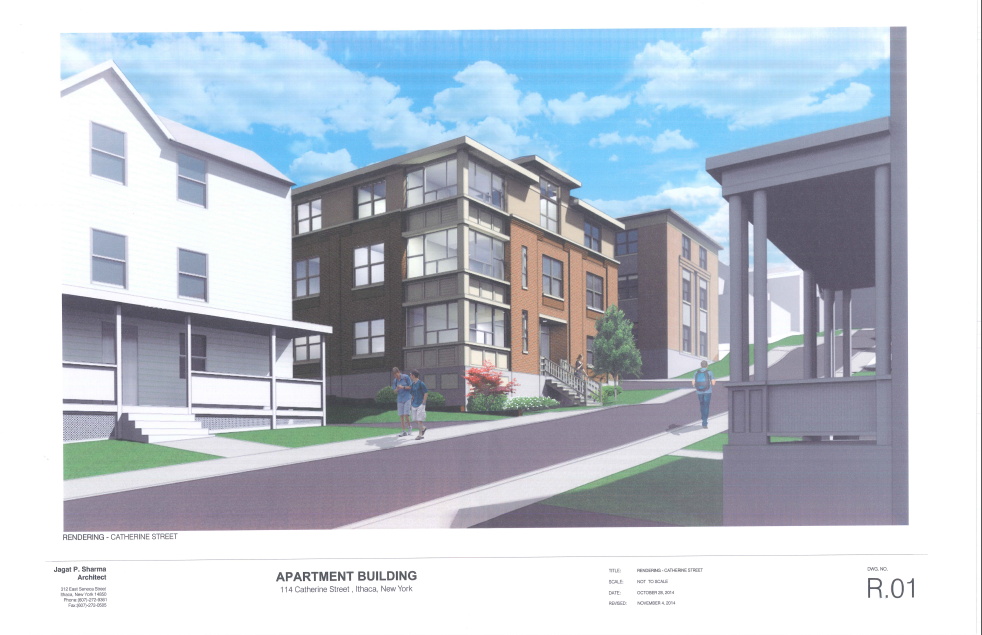
One of the “secrets” of Jagat Sharma’s success in Collegetown is that he designs unobtrusive, good-looking projects on a restrained budget. Sharma can probably add 114 Catherine Street to his list of successes.

The next few entries are more or less just to clear out my portfolio and keep the blog updated with separate entries to make searches for individual projects easier. If you’ve been reading the Voice, you won’t see anything “new”, but you will get more photos and more information.

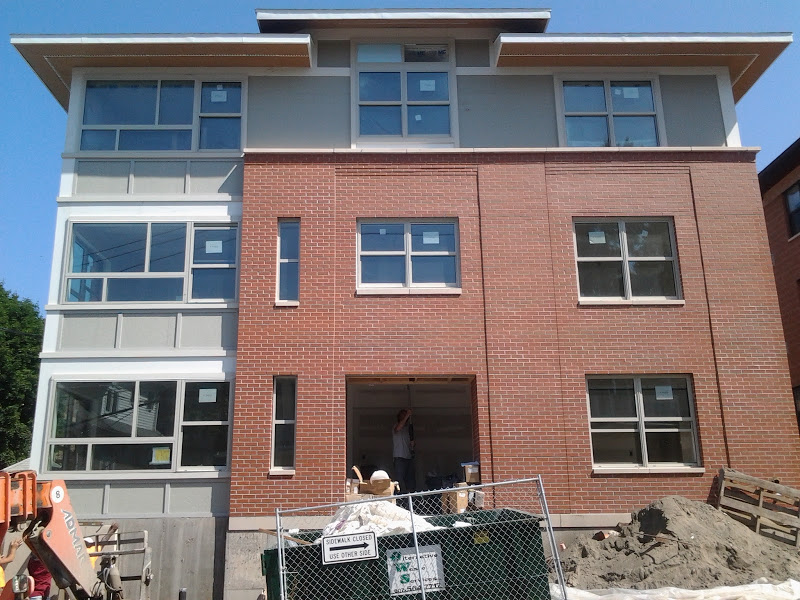
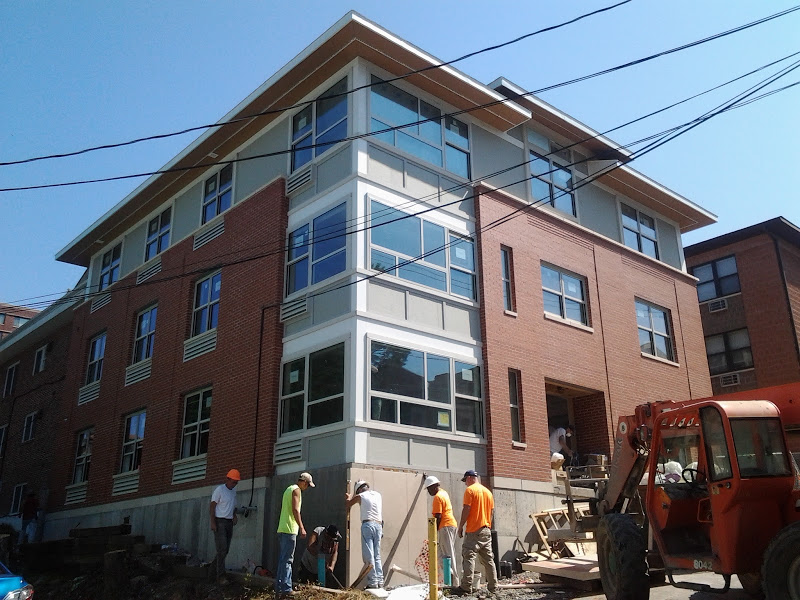
In these photos from the end of July, the work is nearly complete. A few workers were assembled around the concrete foundation, where the most visible corner will have an imprinted rectangular pattern for the sake of visual interest. The render I included this post was what I thought the version of 114 Catherine that was going to be built, but the corner windows aren’t as big, and the A/C units appear to be missing from the southward (front-facing) windows, and were moved to the side instead.

Workers are also busy with finishing out the interior, and the front door and stairs will be installed once it’s convenient. Landscaping will follow, and from there it’ll be ready for tenant occupancy later this month.

The building is being developed by Nick Lambrou of Lambrou Real Estate. Plans call for a 3-story, 4,180 sq ft structure with a 5-bedroom apartment on the first floor and a 6-bedroom apartment on the second floor and on the third floor. The building replaces a surface parking lot.

20150727_104740 20150727_104755 20150727_104816 20150727_104835

114_catherine_rev4_1


307 College Avenue (Collegetown Crossing) Construction Update, 8/2015

11 08 2015

The last in the Collegetown trio of midrise apartment buildings underway, and the biggest, is Josh Lower’s Collegetown Crossing project at 307 College Avenue. Like 205 Dryden and 327 Eddy, it’s time to give this building its first progress report.

A telescoping boom crane looms overhead as work continues on the foundation of the new building. An excavator is at work digging down to the appropriate level for foundation piling. The two-story concrete masonry unit (CMU) box that previously stood on-site has been demolished. Apart from the murals, there won’t be much missed about the ca. 1980 structure. 307 College had been home to a branch of Kinney Drugs up until about 2006, and afterwards, its commercial space was partially occupied by Ithaca Carshare. The second floor contained several apartments. The Lower family, who run the Urban Ithaca rental company in Collegetown, bought the property for $1.725 million in 2007.
Plans for the property were first announced back in 2009, but with parking requirements still in place, the project would have needed a zoning variance of 57 parking spaces, which the city was uncomfortable with. The project stalled and was unable to move forward with further review until the city passed revised zoning codes for Collegetown in March 2014. There were actually two notable impacts as a result of the zoning code update – one, that it could be built in the first place; and two, that the rear portion, which had been six stories like the rest of the building, had to be chopped down to 4 stories since it fell into a different zone (the building straddles two lots; the rear one is part of the new CR-4 zoning, which only allows four floors, and the front portion is MU-2). This reduced the number of bedrooms from 103 to 98, and later, 96. The final plans were approved last September, and the groundbreaking ceremony was just last month.

Collegetown Crossing will have 46 apartments with 96 bedrooms when it opens in August 2016. Along with those units, the project will host a 3,200 SF branch of local grocery co-op Greenstar on its ground floor. Two smaller commercial spaces are also included. A heated bus shelter and a narrow “pocket park” traversing College Avenue to Linden Avenue will also be available for public use. With a true grocery store coming to Collegetown, residents have generally been in favor of the project.

There’s no construction loan on file, but the FEAF estimated $5 million to build. The grapevine says it actually might be more in the line of $7-8 million. Also a plus, there were no tax breaks requested or given.

Local architect Jagat Sharma can put another feather in his cap, as this project is another of his designs. Syracuse-based Hayner Hoyt Corporation will be in charge of construction.
20150727_104229

20150727_104247

20150727_104304

ctown_crossing_rev2_1


327 Eddy Street (Dryden Eddy Apts) Construction Update 8/2015

10 08 2015

Another Collegetown construction project is getting its first real progress report. This time, it’s 327 Eddy Street in Collegetown, also known as the “Dryden Eddy Apartments”.

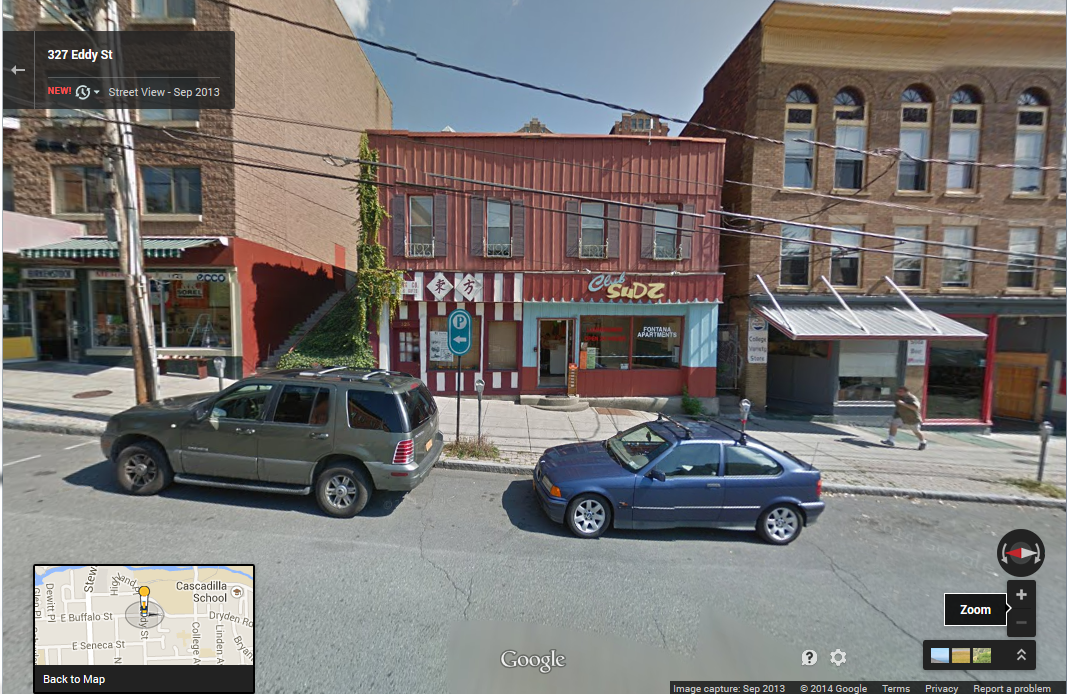
Excavation has been underway for a little while now, since the old Club Sudz/Tung Fong Grocery came down earlier this summer. The Club Sudz building had been built around 1910 as a 3-story building, but the structure was partially destroyed by a fire in 1970, and only the bottom two floors were rebuilt.

These photos are nearing two weeks old now, but a more recent photo taken by Mark Anbinder shows steel sheet piles on site. The project will use “flowable fill” to a depth of three feet in its foundation. Flowable fill is an alternative to concrete and is often used in roadwork or as retaining wall backfill.

What comes in its place is a 5-story building broken into three stepped sections. As elevation increases going eastward, the building steps back to another five-story section. Initial plans approved in 2014 called for a 6-story building with a different crown treatment (which looked better, in my opinion). Somewhere along the way, the building lost a floor, and then very shortly before construction began, the crown was changed from a triangular prism to a glass box. Presumably, this doesn’t affect the appraisal for the crown projecting into the city’s right-of-way.

The new 5-story building will bring 1,800 SF of retail space and 22 new units with 53 bedrooms to the market in August 2016. Longtime Collegetown landlord Steve Fontana (of the Fontana’s Shoes family) is the developer, Jagat Sharma is the architect, and GM Crisalli & Associates of Syracuse will be overseeing construction. A construction loan of $4,824,000 is being provided by Tompkins Trust Company.

20150727_105349 20150727_105330

327_eddy_3

327_eddy_rev4_1