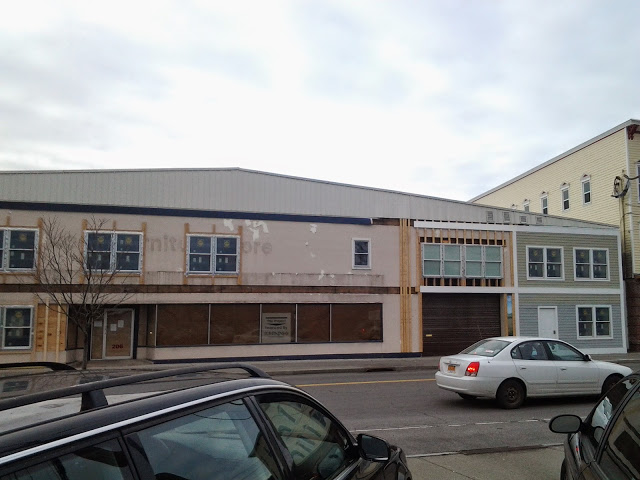
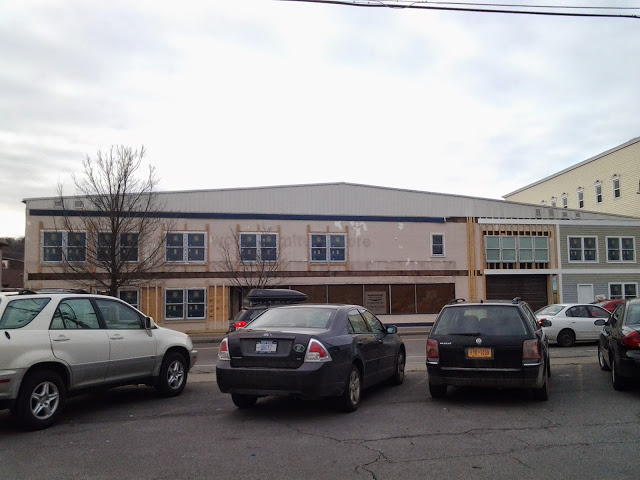
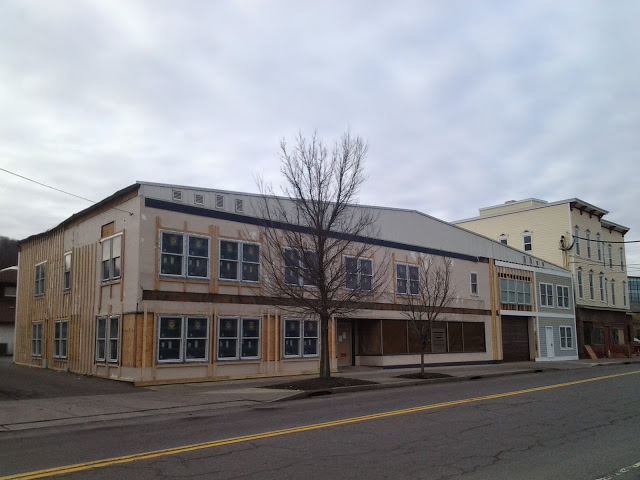
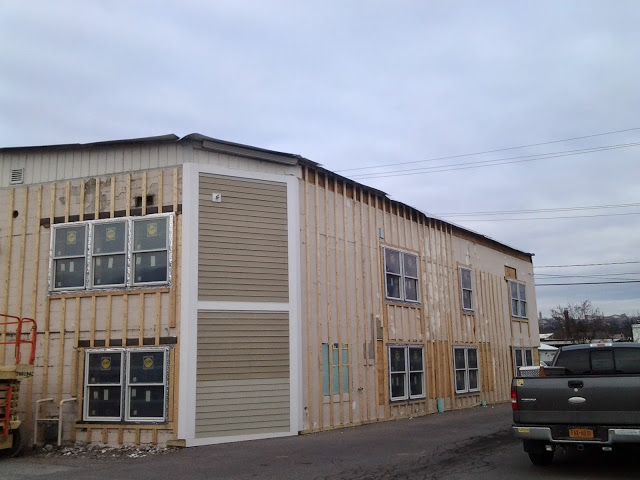
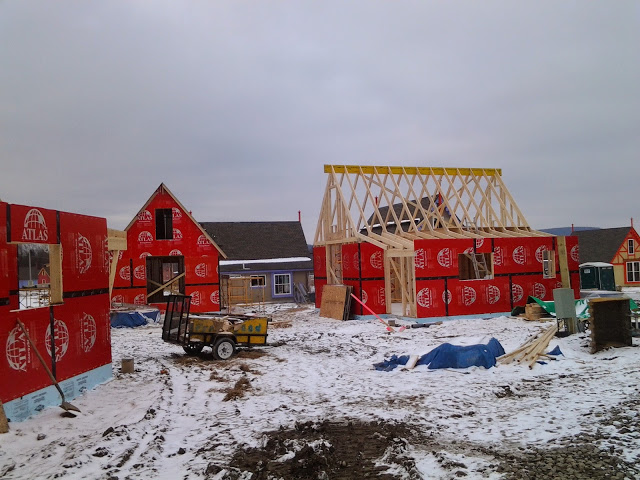
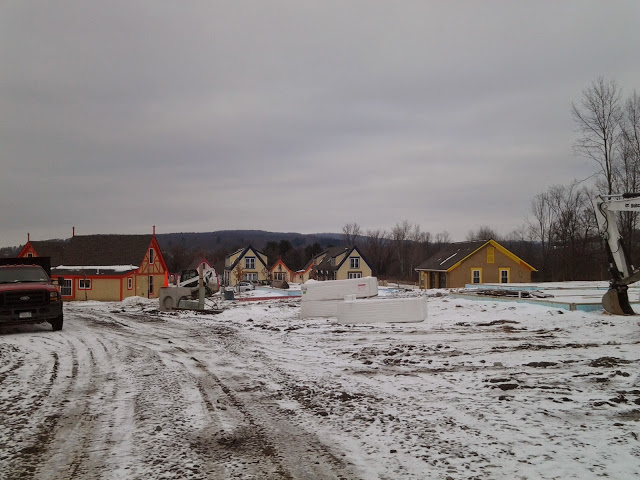
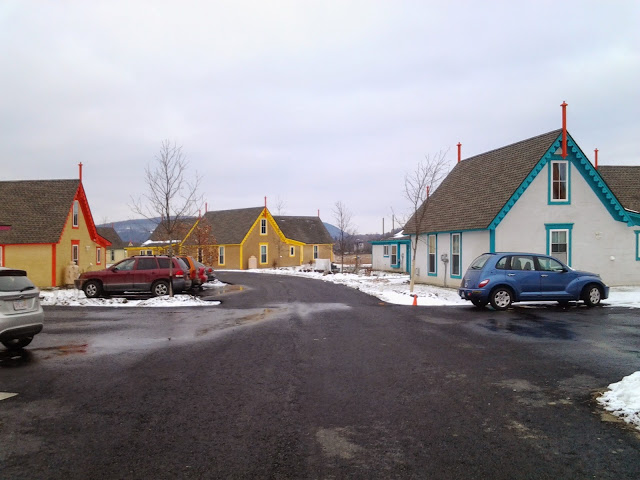
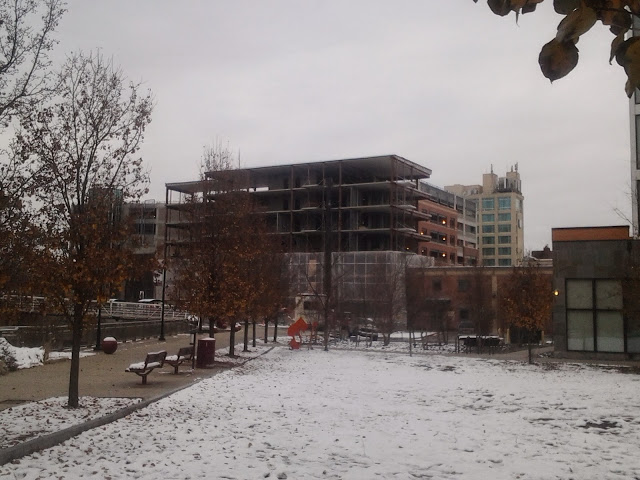
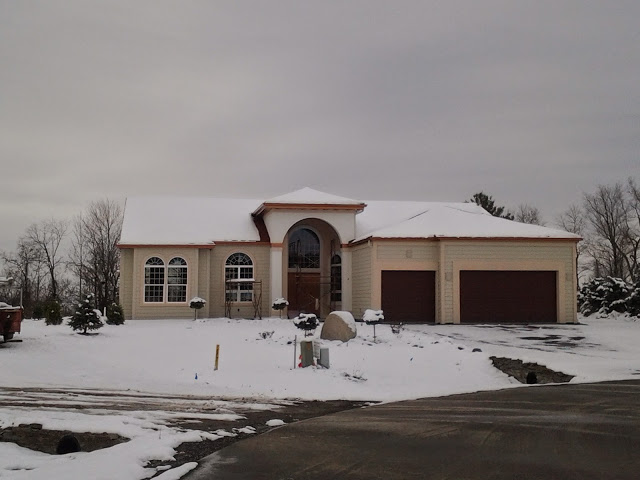
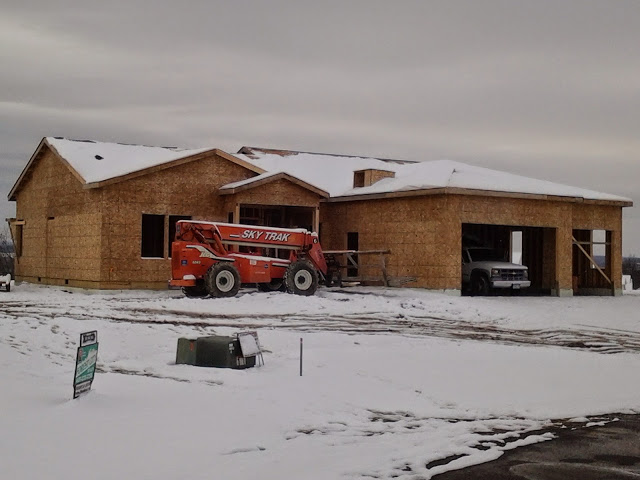
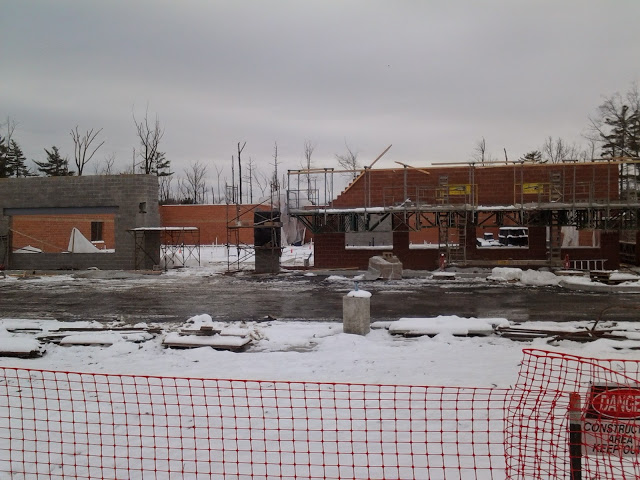
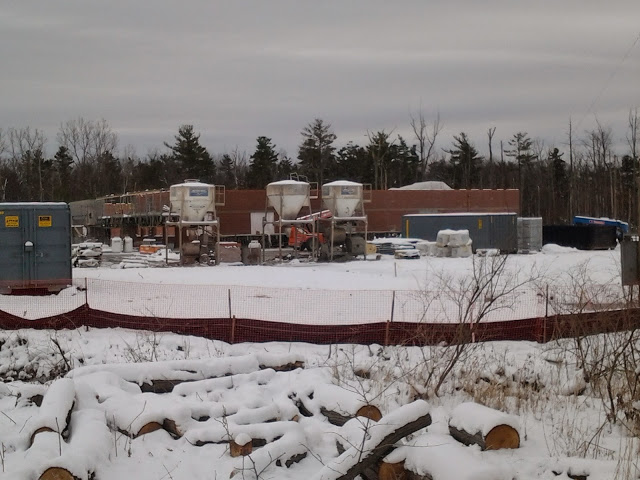
206 Taughannock Boulevard Construction Update, 12/2014

30 12 2014

Okay, I’ll be completely honest – I don’t know what’s going in here. I don’t know what the mix of uses is, or many residential units there are. Here’s what I do know.

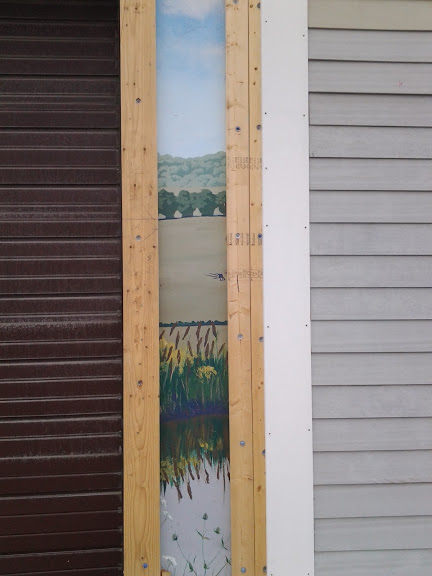
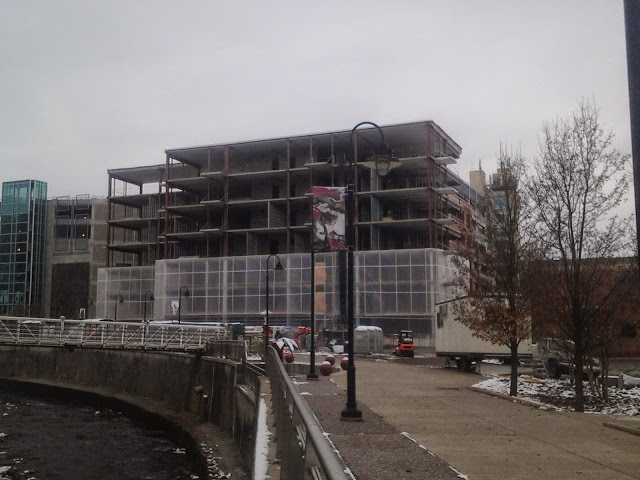
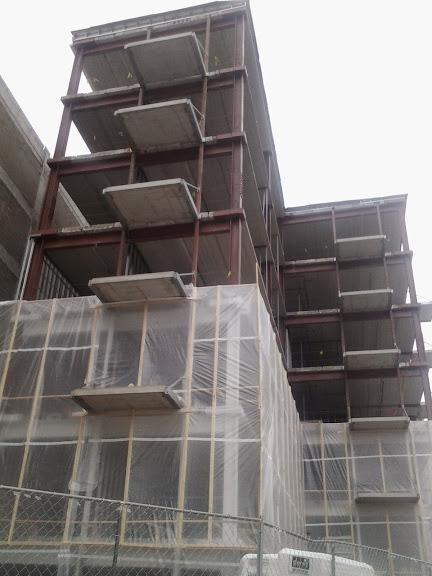
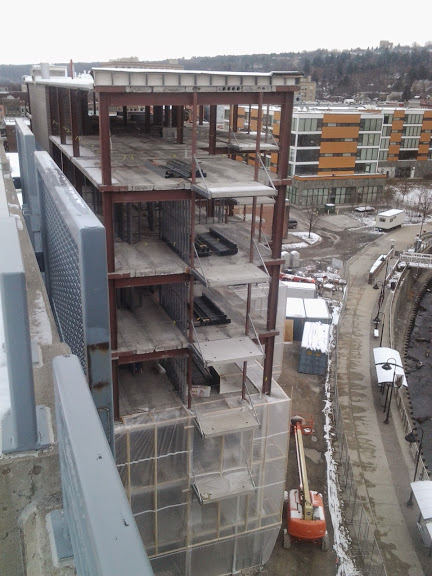
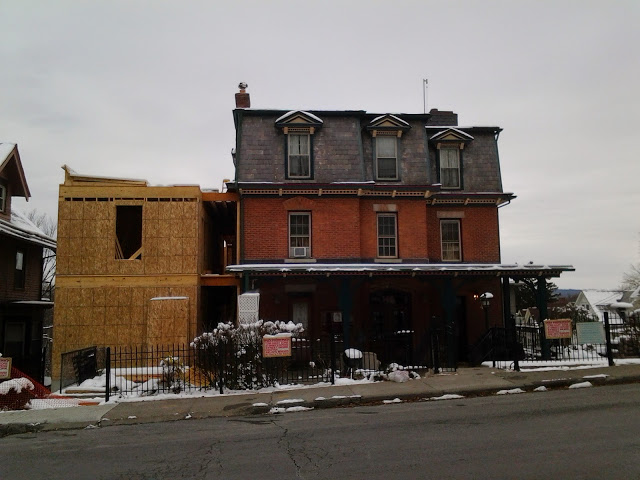
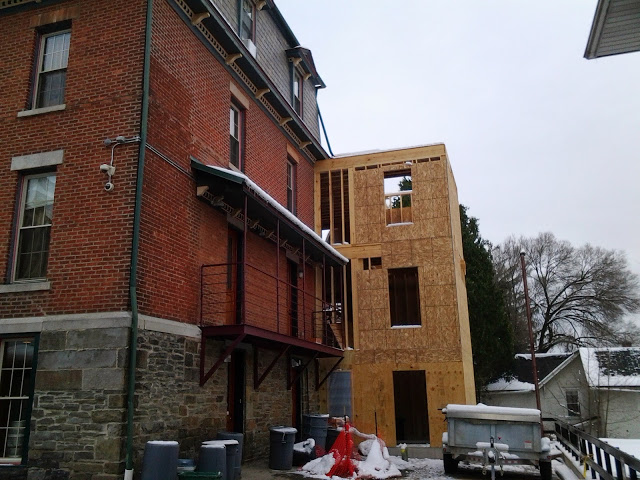
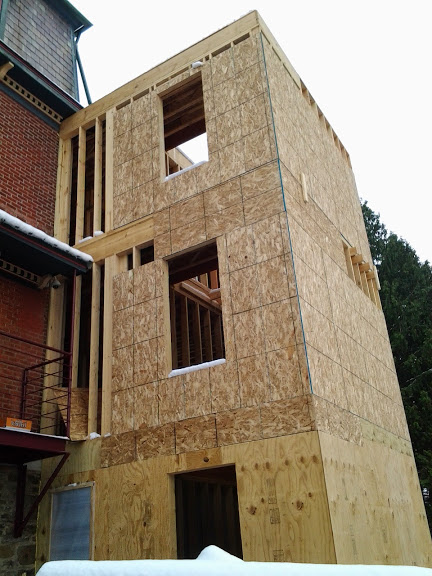
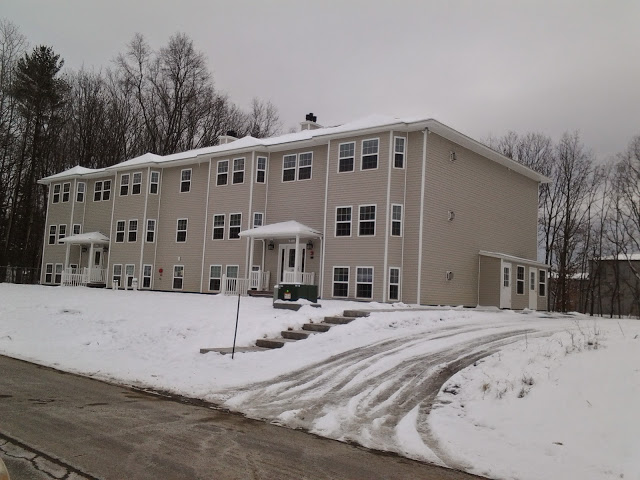
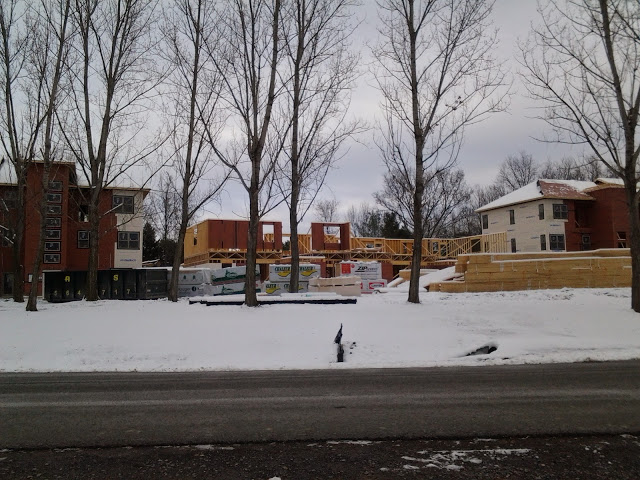
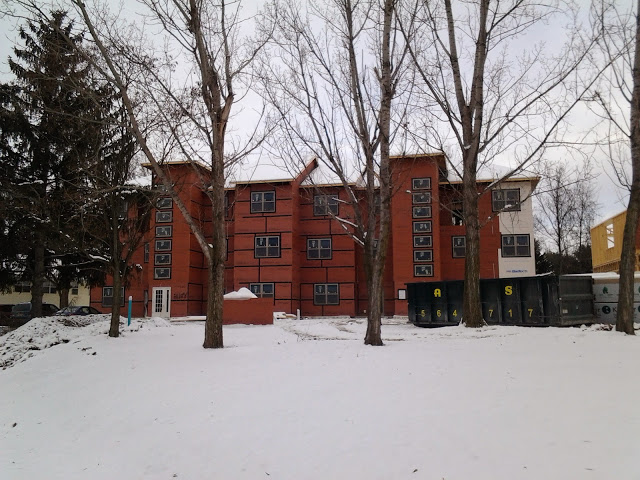
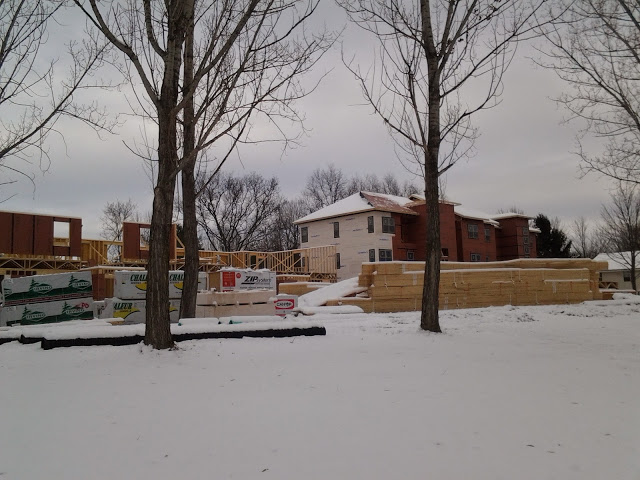
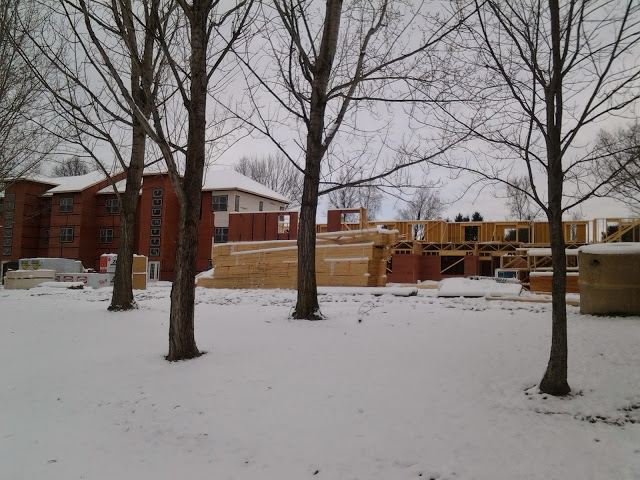
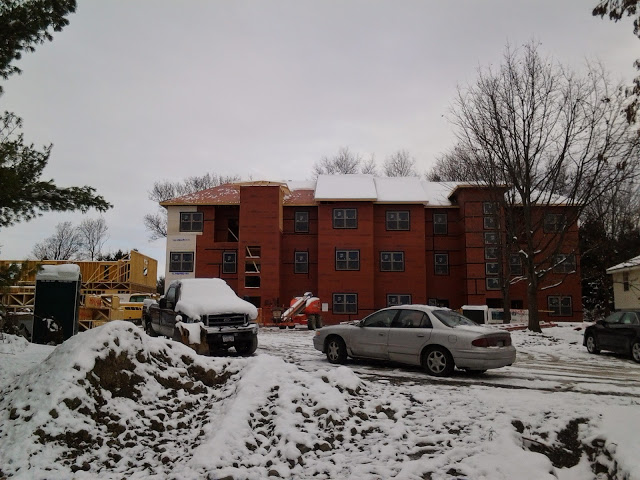
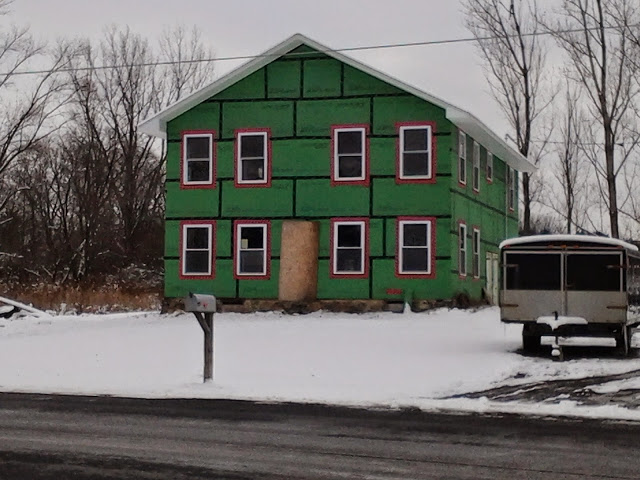
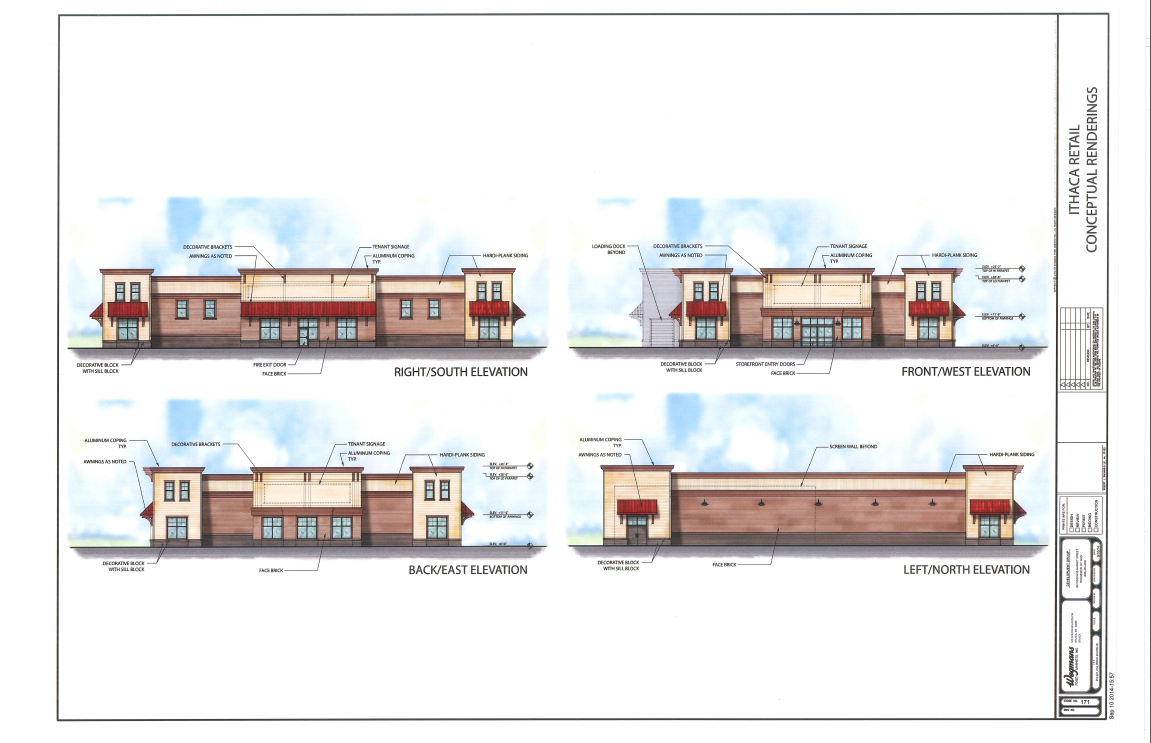
206 Taughannock was until earlier this year the site of the Unfinished Furniture Store (otherwise called the “Real Wood Furniture Store“) owned and operated by the Zaharis family. From the county records, the building itself is a 9,156 sq ft structure originally used for retail and warehouse space and dated to sometime in the 1970s. The store closed in April when its owners retired, and a building permit shown in a ground-floor window was issued in July to the Zaharises. I ran this past IB’s Jason on Twitter, and his guess was about as good as mine; residential units on top and maybe some of the bottom, with a reduced retail space. Photos of the store before renovation can be seen here at Ithaca Builds – the Lehigh Valley House next door is being renovated by its owner (Tim Ciaschi) into 6 condos and ground-floor commercial space. With the 323 Taughannock project approved just up the road, Inlet Island has been seeing increased interest from both current owners and prospective developers. Perhaps the biggest loss is the removal of a rather attractive mural from the front of the structure.

The work itself looks like a complete gutting of the original two-story building, with new windows punched into the walls and sedate exterior (fiber cement?) siding attached to the more complete exterior sections.

I reached out to the owners but have yet to hear a reply; if anyone has some info to share, feel free to reply to this post or send an email. These projects are the most fun for me, because they go without fanfare, but are just as important as any other project of equal size; they lie in wait for discovery and publication.

20141227_144617 20141227_144631 20141227_144707 20141227_144748 20141227_144755 20141227_144900


Stone Quarry Construction Update, 12/2014

28 12 2014

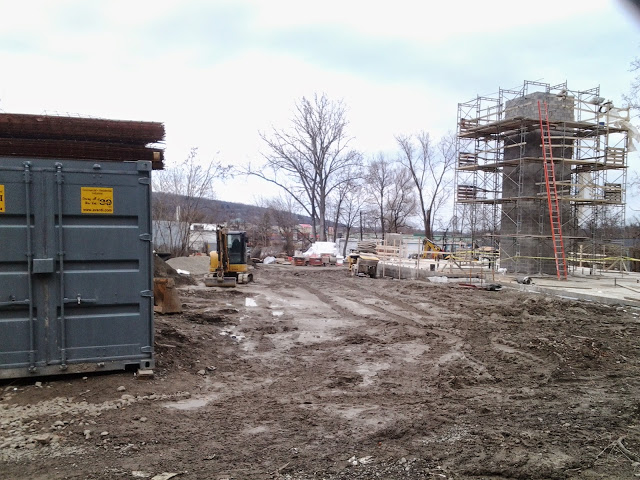
Like it or not, construction is well underway at the site of the future Stone Quarry Apartments on South Hill’s Spencer Road. Foundation walls and pilings are visible at the site of the townhomes, and the cinder block wall for the elevator shaft and stairwell of the apartment building is clearly visible from the street. A closer inspection of the apartment building shows that a concrete slab foundation has been poured. I’m not sure if the white slabs in the last photo are some type of insulated concrete form like the Fox Blocks used at the Thurston Avenue Apartments earlier this year, or something else (Ithaca Builds’ Jason Henderson is far more knowledgeable about these types of things than I am).

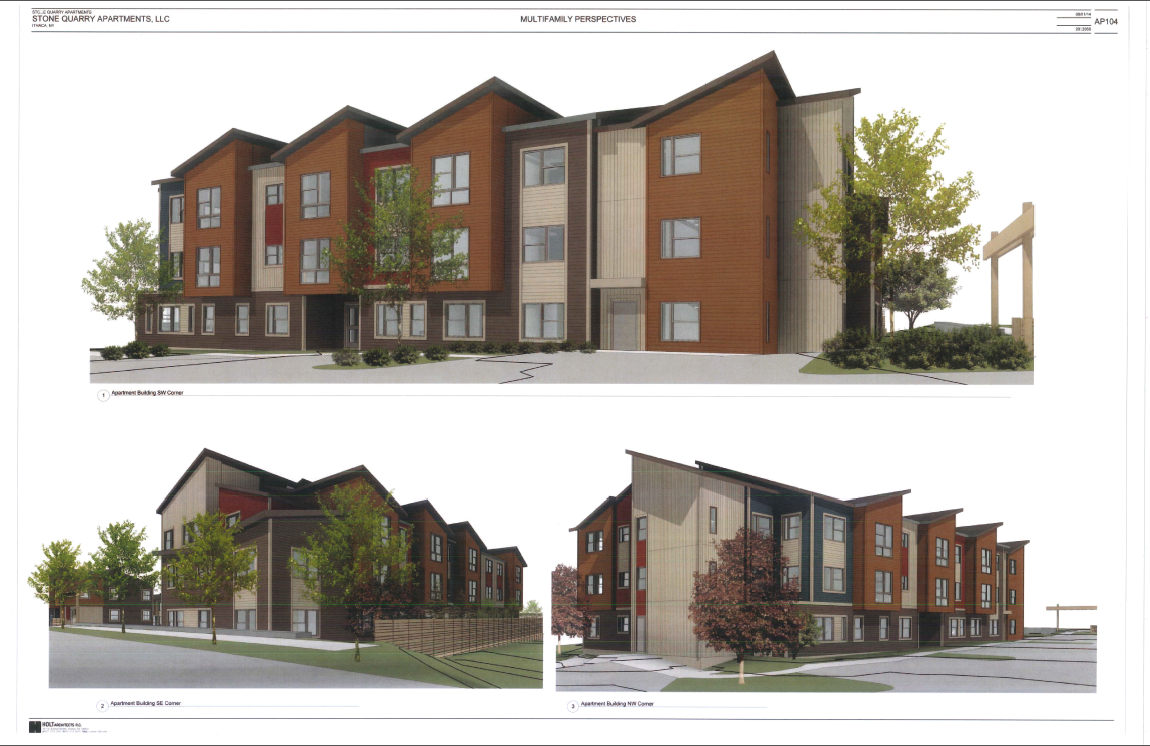
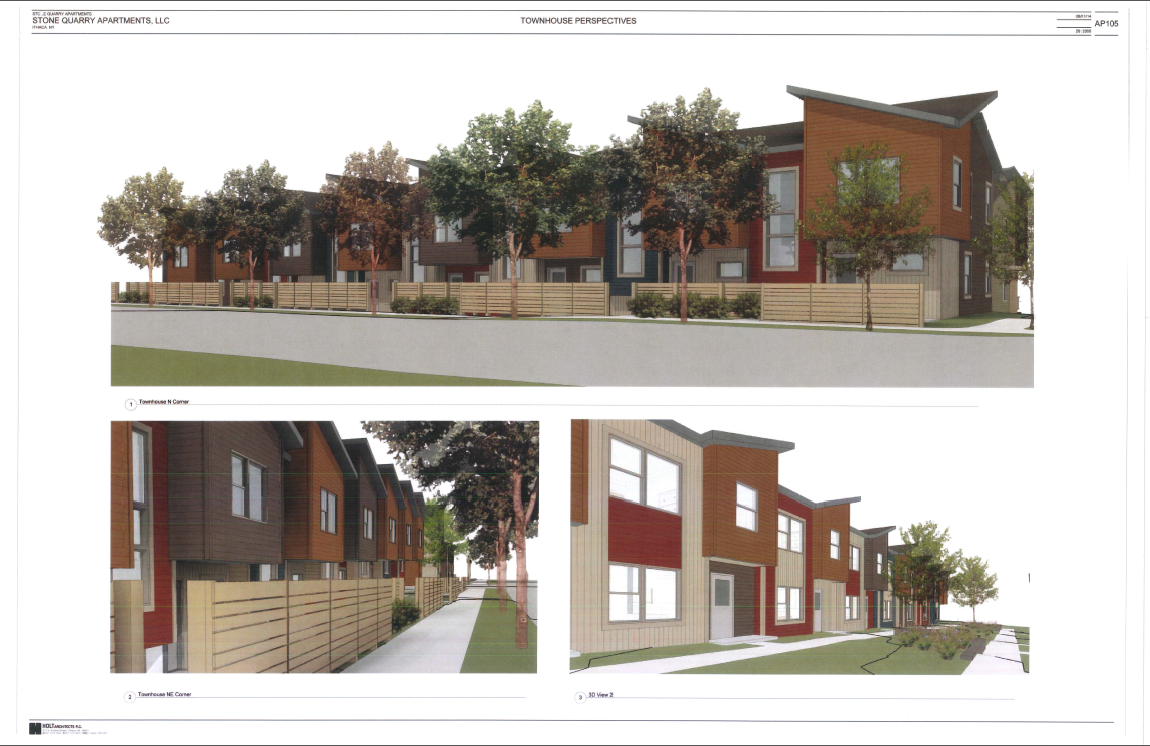
The Stone Quarry project consists of 16 two-story townhouses (2 rows, 8 each), and a 19-unit, 3-story apartment building on the northern third of the property. Specifically, the breakdown of unit sizes is follows:

16 three-bedroom Townhouses
2 three-bedroom Apartments
11 two-bedroom Apartments
6 one-bedroom Apartments

As with all projects by INHS, the units are targeted towards individuals with modest incomes, with rents of $375-$1250/month depending on unit size and resident income. While affordable housing is generally welcome and sorely needed, Stone Quarry had a number of complaints due to size, location and lingering environmental concerns.

With a theoretical capacity of 82 residents (assuming one per bedroom), the project is the largest non-student oriented project currently under construction in the city (Lofts @ Six Mile has more units with 45, but with 3 studios, 21 1-bedroom, and 21 2-bedrooms, for a theoretical max of 66 residents). The apartments are expected to be completed in October 2015. The buildout is being handled by LeCesse Construction, a nationwide contractor with an office in suburban Rochester.

20141227_143254

20141227_143318 20141227_143352 20141227_143407

inhs_stone_quarry_rev_3 inhs_stone_quarry_rev_4

400-Spencer-Road-INHS-Revised-Site-Plan-Drawings-06-16-14_Page_05-1280x828


Boiceville Cottages Update, 12/2014

23 12 2014

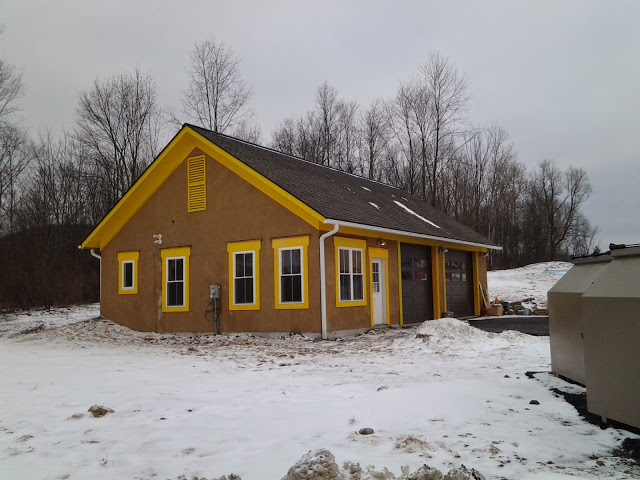
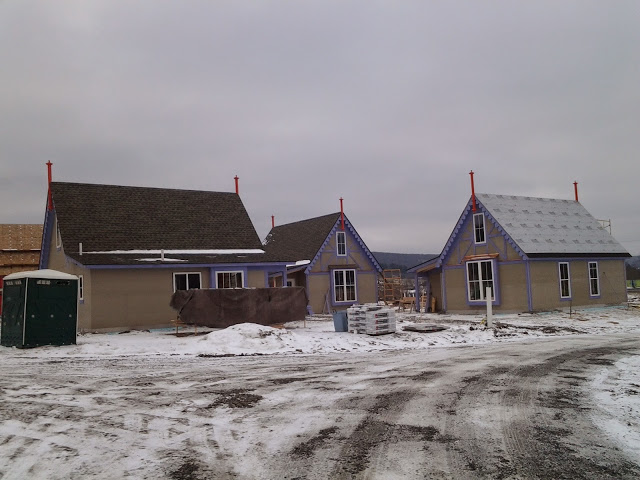
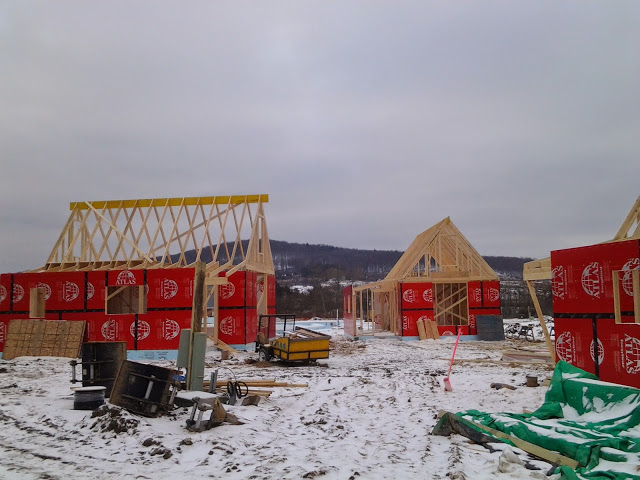
Work continues out in Caroline at the site of the Boiceville Cottages apartment complex. Passing through Ithaca’s southeastern commuter town on the 21st, it appeared that a large number of apartments were underway – three were undergoing interior work and exterior detailing, four were being framed, and the concrete slab foundations of at least nine more had been poured, their wooden forms still in place. Since my last visit in September, a maintenance garage and three more cottages have been completed. It would appear from my photos that about 25 units (15 cottages and 2 5-unit gatehouses) have been completed so far in 2014.

The Boiceville Cottages, built and managed by the Schickel family, are rather unusual as apartment complexes go. For one thing, there are the bright paint jobs, a sort of hallmark of the cottage units since the first set of 24 houses was built in 1996/97. The bright paint and the ornate woodwork have led to a nickname, “The Storybook Cottages“, which holds some weight, according to an article in Life in the Finger Lakes:

“Schickel said he was inspired to build his colorful cottages by a children’s book he read to his daughters almost 20 years ago. The book, Miss Rumphius, by Barbara Cooney, tells of a girl who, at her grandfather’s urging, travels to faraway lands seeking adventure. Later she moves to a cottage by the sea and works to make the world more beautiful by spreading seeds of blue and purple lupine. An illustration by the author shows the Lupine Lady’s house on a hill overlooking the sea. The small cottage is replete with finial and gingerbread. Seeing that illustration was the eureka! moment, Schickel recalled. “I said, ‘I’ve got to design something like this!’”

Since the initial 24 units were built, a further phase of 36 units was undertaken pre-recession, and in the past couple of years the town of Caroline signed off on the next phase, a group of 75 that would more than double the size of the complex. The cottages have been built out at a steady pace, and at completion of this current phase, 135 units will be present on the Boiceville property. Most of the units are 1 and 2-bedroom cottages, built in clusters of three, although a few “gatehouse” rowhouses offer studios and 3-bedroom units. The Boiceville complex may be the largest population center in the 3,300 person town.

20141221_143524 20141221_143538 20141221_143600 20141221_143616 20141221_143630 20141221_143653 20141221_143702 20141221_143730 20141221_143736

20141221_143855 20141221_143903 20141221_143951 20141221_144032


Lofts @ Six Mile Creek (Cayuga Place) Update, 11/2014

5 12 2014

As much as I hate to entertain the currently-fashionable use of prepositions in project names, and the “@” symbol to make it modern and hip, that is the official name for what was the condo portion of Cayuga Green. More notably, the project website describes these as apartments rather than condos as initially planned. Apartment projects are easier to get financing for since it’s generally easier to find renters vs. buyers, but given some of the discussion about the need for owner-occupied units that has come up lately (the Old Library redevelopment comes to mind), this is a mild disappointment.

The 7-story, 45-unit, 49,244 GSF apartment building topped out on October 2nd. The concrete floors were poured and the balcony pads were craned into place and secured throughout the fall. Peering into the building from the parking garage, some steel wall frames have been erected on the upper floors, while rough interior work seems to be underway on the lower floors. The plastic sheathing is to break the winter winds and keep the space above freezing.

Developer Bloomfield/Schon + Partners planned to release leasing/pricing details last month, but I haven’t heard anything yet. Completion for the project is set for late Spring 2015, which according to their facebook, is a little later than intended due to material supply delays created by the rough November weather (curse you, polar jet stream). If the last photo is any indicator, the upper-floor units are going to have some fantastic northeast views.

As noted before, this project makes the completion of 15 years of planning and construction. At 45 apartment units, It’s also one of the largest non-student-related projects slated for a 2015 completion – the 35-unit Stone Quarry Apartments and the 21-unit 323 Taughannock are also pegged for 2015 completions.

20141129_135747 20141129_135859 20141129_135828 20141129_135807 20141129_140005 20141129_140241 20141129_140308


Collegetown Construction Updates, 11/2014

3 12 2014

Next stop, Collegetown.

20141129_132947

20141129_133109 20141129_133122

140College_2

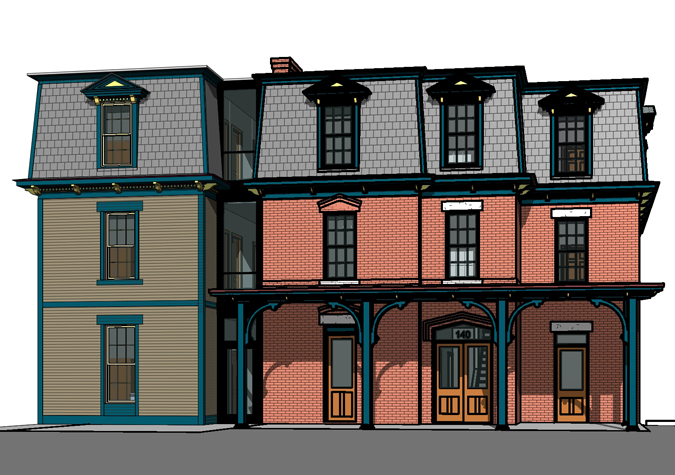
Over at 140 College Avenue, framing is underway on a 3,800 sq ft, 12-bedroom addition to the historic John Snaith House. The project is designed by local architect Jason Demarest and developed by Po Family Realty, a smaller Collegetown landlord.

20141129_132913 20141129_133016 20141129_133029

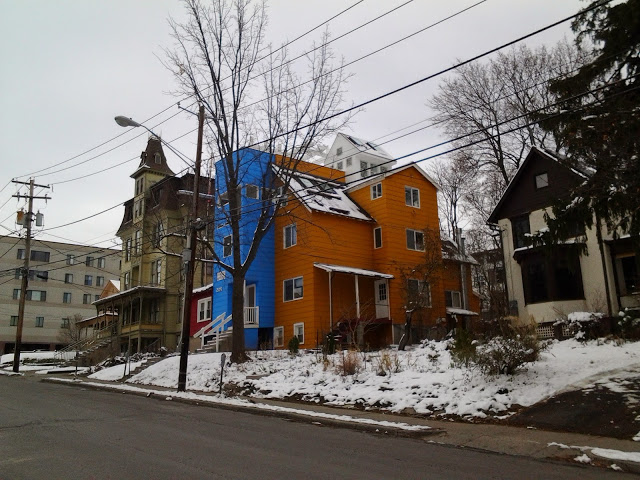
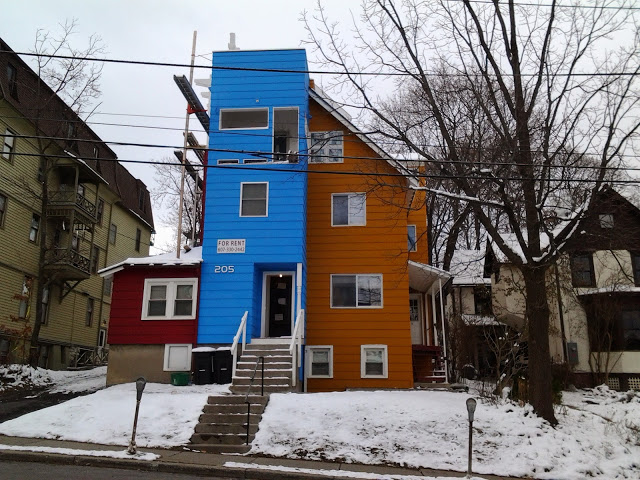
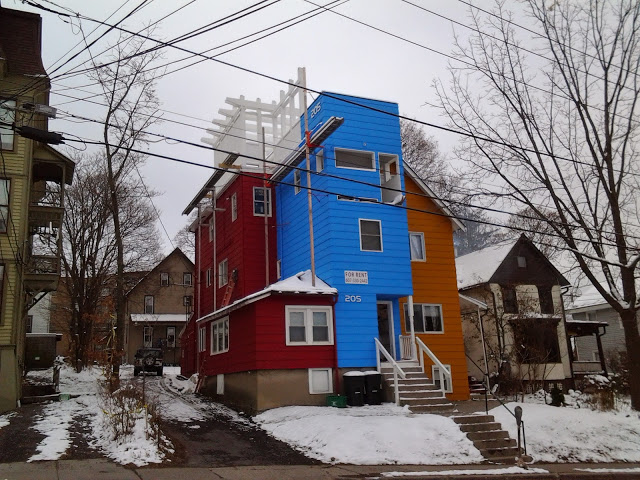
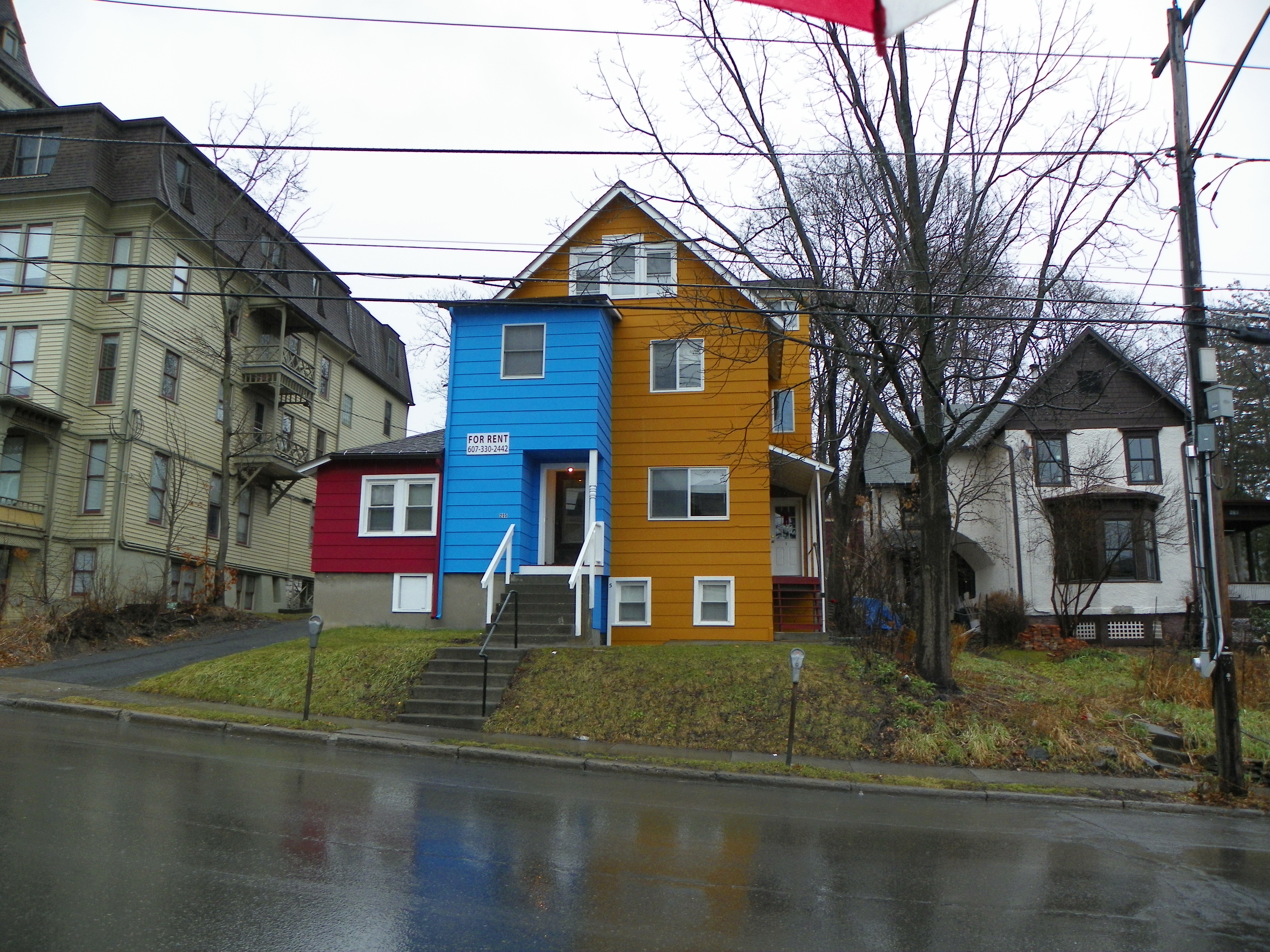
This house at 205 College Avenue seems confused. Before the extremely vivid paint job and mix-and-match additions, it looked like this, and a photo from January 2014, with the paint but without the additions, is included below. I really don’t know what to make of it. I dunno how long the Lowers have been sitting on permits for this one, but I didn’t see anything go through the city boards.

1-2-2014 331


Lansing/Dryden Construction Updates, 11/2014

1 12 2014

Normally, I use a full-fledged DSLR camera for these construction tours, I accidentally forgot my camera and had to use my phone instead. The resolution isn’t as great, but they still came out better than I expected. These photos were taken on the 28th.

20141129_120035

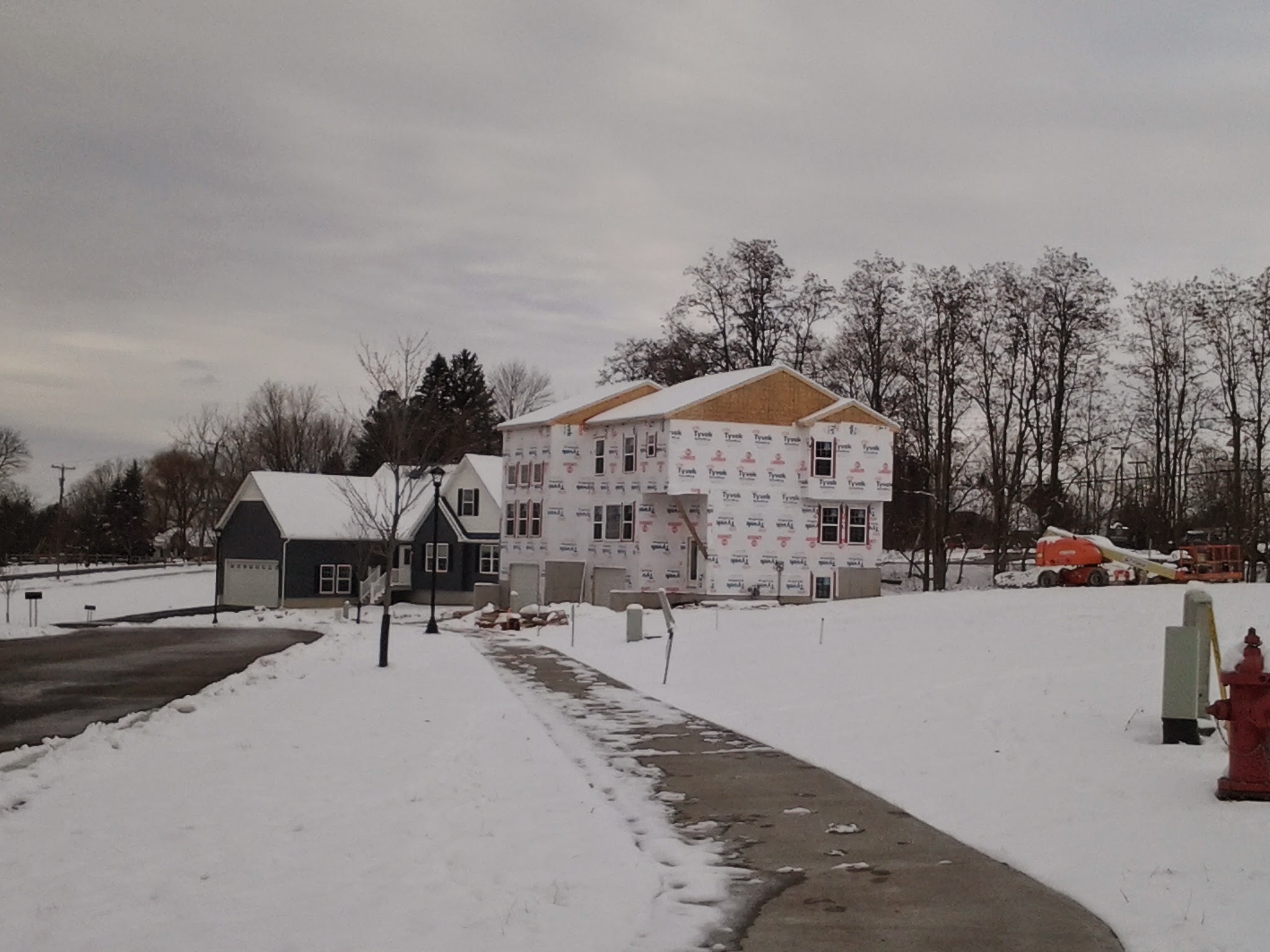
Here we have what looks like a pair of townhomes going up in the Maple Ridge development just east of Dryden village. Maple Ridge was dreamed up as a multi-phase 50-unit housing development when it began in 2008/09, but the recession deflated those plans. Only four homes have been completed so far; the blue house with the very large garage was built earlier this year.

20141129_121915 20141129_121956 20141129_121939

Going over to Lansing, two more oddly Florida-like homes are underway at the Heights of Lansing development off of Bomax Drive. One is virtually complete with only exterior detailing left on the to-do list, the other home is but a shell, still in the rough framing stage. No new townhomes, but a third home lot was sold a few weeks ago, so another single-family home will likely start construction sometime in the near-future. The development is slated for about 80 units when complete, and since inception in 2006, has completed two homes and 17 townhouses (another project that was hit by the recession; not that there’s too much demand for high-end townhomes in Lansing anyway).

20141129_122833 20141129_122808

20141129_122722

This building underway at 720 Warren Road is for the “Northeast Dairy and Food Testing Center” I wrote about back in August. Work on the exterior shell continues for the 17,000 sq ft structure by Syracuse-based Dalpos Architects, moving towards a Spring 2015 completion.

20141129_125221 20141129_125556 20141129_125613 20141129_125616 20141129_125458 20141129_125439

This was arguably the biggest surprise. These four apartment buildings are part of the Village Circle Apartments in Lansing, the later three are likely part of the Village Solars project. The first one has been mostly complete for a year or so, and looks to be readying itself for occupancy. The last three comprise what I would guess to be 36 units; two are topped out and have house wrap on them, the middle one is still undergoing initial framing. This one went under the radar since it was approved in Spring 2013; the Village Solars project seeks to over 300 units off of Warren Road over the next 10 years.

20141129_124516
Before heading into town, I drove around to check out a couple of other projects in Ithaca’s suburbia. The Woodland Park development sold one of its pricey single-family homes and work was finishing up on a second; I chose not to stop due to a large number of construction workers at work on the site. I spied three complete sets of townhomes in the gated section as I drove past. No new homes underway in Whispering Pines, but I did see this home under construction near the intersection of Triphammer and Horvath Drive.


News Tidbits 9/29/14: Thinking Inside the Box

29 09 2014

This is a little later than usual. I didn’t want to post anything before now was because I was hoping the Ithaca Gun sketch plan would be posted to the city website by Friday. It still has not, meaning that it either wasn’t discussed at the Planning Board meeting, or someone in city hall is taking their time with the uploads. My plan to write that up and get that out Friday while in Dulles airport was a no-go, and only now have I had the time to execute Plan B. So here we are.

1. Down in big box land, Wegman’s is planning yet another big box, with maybe a couple more to follow. The site plan dates from 1999, When Wegmans received approvals for three outparcels (satellite little boxes to their big box) with a total of ~36,000 sq ft of retail space. Wegmans wants to move forward on that plan, but change up the individual parcels (the completed total would still be 36,000 sq ft). The first phase is for a one-story, 15,700 sq ft building with 88 parking spaces, to be built on a section ot the current parking lot. Cover letter to the city here, Full Envrionmental Assessment Form (FEAF) here, Site Plan Review (SPR) application here, SPR renderings here, and color rendering here. The first building is planned for construction from April to October 2015, with an estimated $4,000,000 cost. Fake second floor? You got it. Cutesy little awnings and brackets to suggest Main Street USA imagery? You get that too.

wegmans_1

wegmans_2

There’s a pretty good chance that, as Jason at IB covered this past spring, this is a new Wegmans-owned wine and liquor store, which they have at several of their NYS locations (for those unfamiliar with state law, grocery stores can’t sell wine or liquor, unless it’s a wholly separate part of a building with its own entrance, or it’s in another building completely).

2. Collegetown Crossing is finally, finally approved. Familiar readers will recall that this project has been held up for years due to its need for a parking variance under the old zoning plan. The new plan did away with the parking requirement, but since the building straddles two parcels with different form guidelines, part of the rear portion was reduced. With approvals in hand, developer Josh Lower can focus on getting financing and construction loans (being in Collegetown with its captive and lucrative rental market, that probably won’t be a big hurdle). Over time, the retail spaces on the first floor have been consolidated to three, a 3,200 sq ft small grocery store (a planned Greenstar branch) and two smaller spaces. 46 apartments with 96 bedrooms will fill out the second to sixth floors. The tentative opening of the store, and first occupancy for those apartments, is summer 2016 (July/August). 2015/2016 will see a lot of steel going up in Collegetown, with 327 Eddy and 205 Dryden on similar timeframes. To my pleasant surprise, a number of residents spoke in favor of the project, citing the appeal of a small grocery store in walking distance.

307college_rev2_1

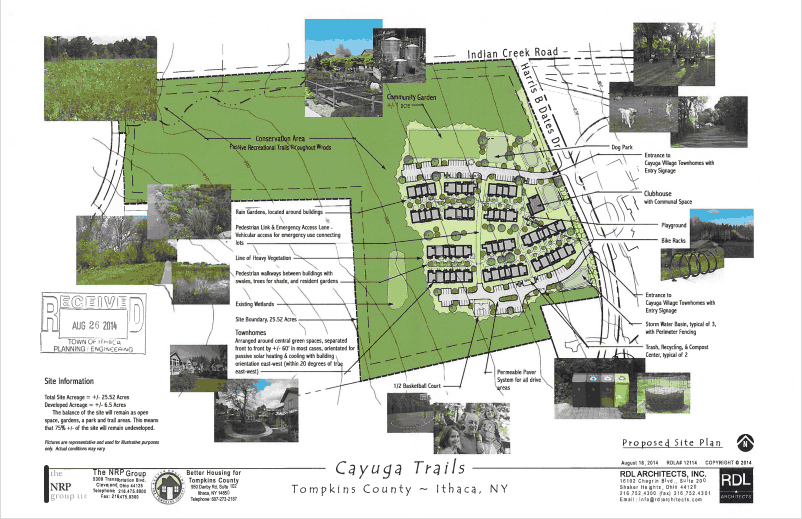
3. One project moves forward, another bites the dust – NRP is calling off its Cayuga Trails development over on West Hill. Although the 58-unit project was opposed by neighbors due to concerns about traffic and for being lower-income housing, the reason the project is being called off has nothing to do with either of those. When the full environmental review was conducted, the wetlands on site are much larger than anyone anticipated, and developing wetlands is an extremely complicated and expensive process – they usually have to be replaced in order to get permission to build. Most developers, affordable or otherwise, will not touch wetlands because of the permissions process and high costs (this recently was an issue in Lansing because an undeveloped site being marketed for office space was found to be wetlands). So the project is halting and it is unlikely anything will be built on the site. Unfortunately, this also results in the county trying to rid itself of a parcel they don’t want and can’t be developed – not a great situation for their budget, but alas, not much they can do.

cayugatrails_1

4. Another setback, this one economic – Sears is closing its location up at the mall, putting 37 people out of work, including 13 long-term full timers. When it closes in December, 55,000 sq ft of big box space will hit the market. For those taking this as a sign that the economy is doomed, it’s not. Sears and its sister brand KMart have been dropping like flies all over the country, with several dozen closing in the past year. In Albany, the Sears store shrank by 50%, giving up space to expensive supermarket Whole Foods.

While Ithaca’s market is too small to be on Whole Foods’s radar, I’m not worried about the future of the space. 55,000 sq ft is middle-of-the-road for the big boxes, and like with the Ithaca Kmart that closed in 2011 and was replaced with Hobby Lobby, this has significant redevelopment potential. I’m no fan of suburban malls, but I like empty storefronts even less.

5. Here, let me stress that again – there are many issues in Ithaca’s market, but a weak economy is not one of them. At the moment. A 1.7% increase in jobs year-over-year is pretty good. I’m not happy that the gains were completely in education and healthcare, but since these are summer numbers, these are more likely to be full-time staff positions, rather than seasonal positions which are typically service-oriented (and lower-paying).


Another Project for Collegetown: 114 Catherine Street

24 09 2014

114_catherine_1

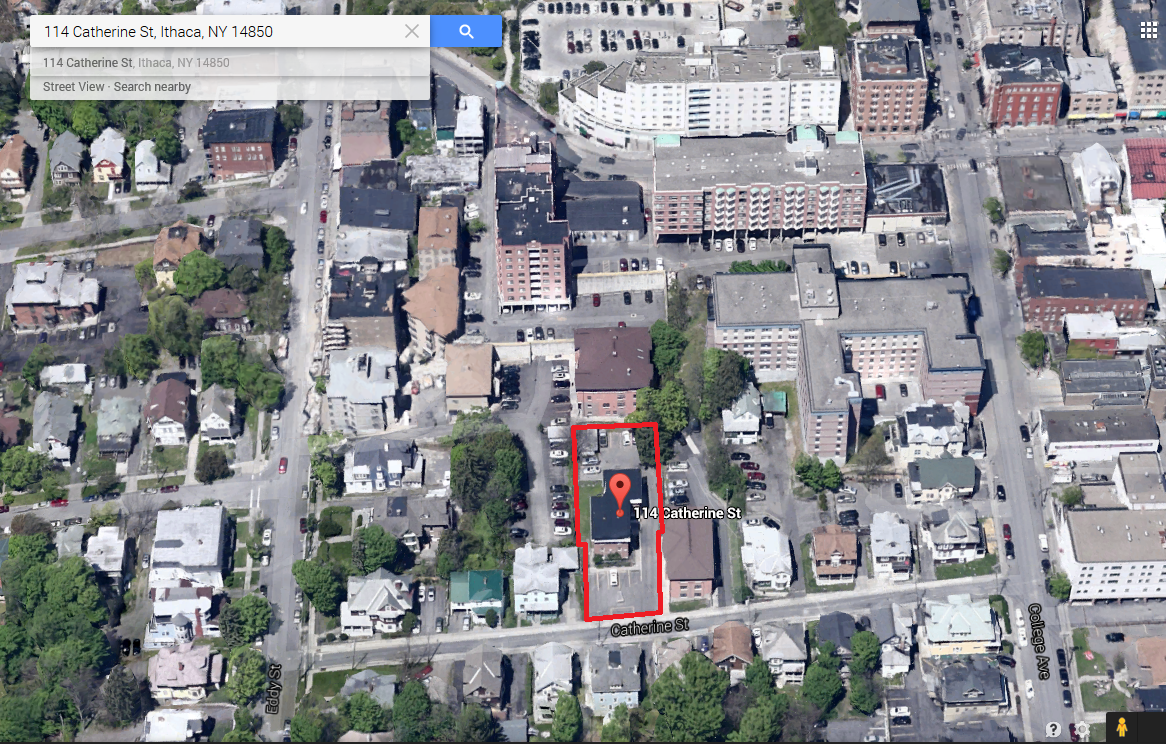
Yet another project slated for Collegetown and its construction boom. In this case, it’s 114 Catherine Street. I discussed the background of the parcel in my last post, but I’ll do a one-sentence rehash – it’s a 10-bedroom apartment building in a CR-4 zone where parking isn’t required.

114_catherine_2

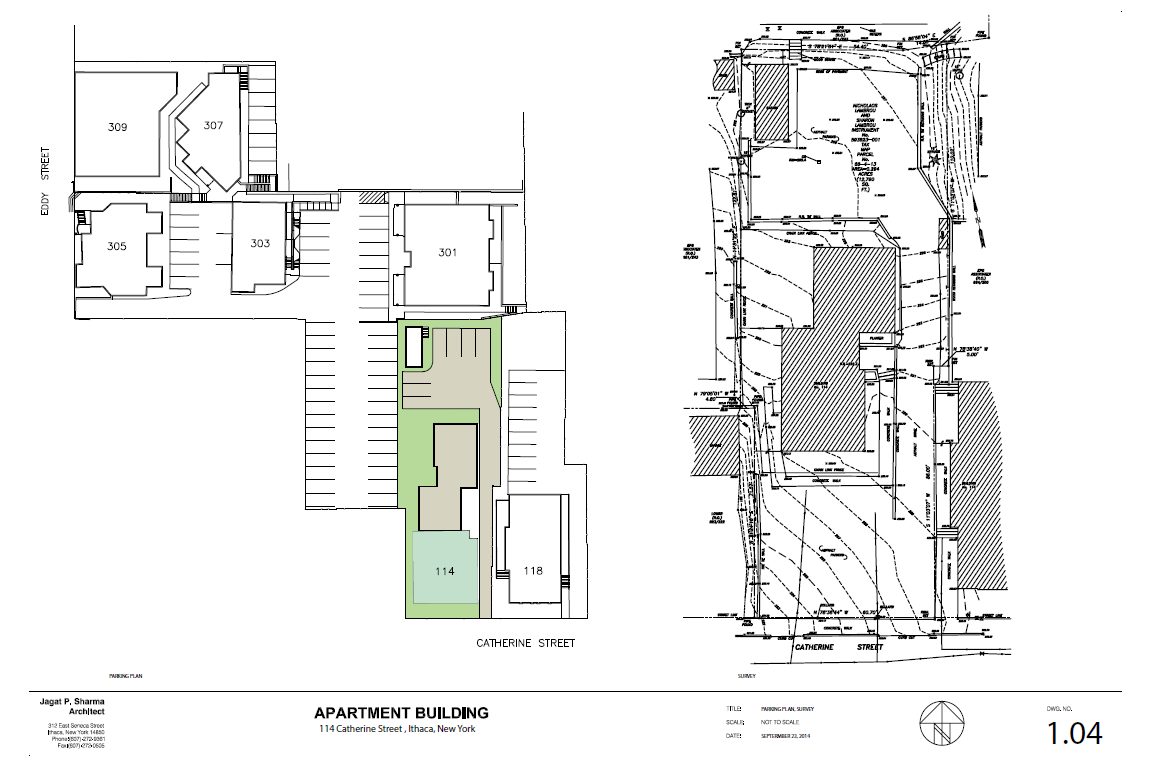
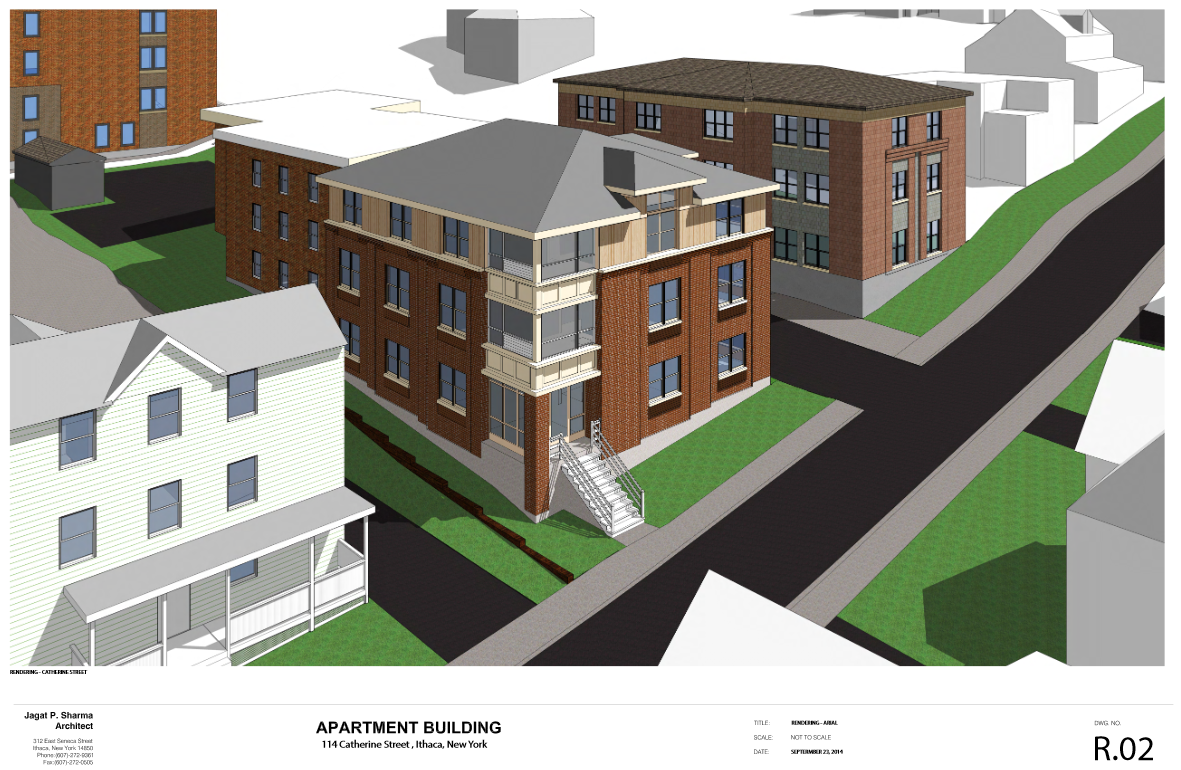
Now we have a design. Renders and sketch plan details here. Perhaps somewhat surprising, the new building doesn’t tear down the whole apartment building and take advantage of the full lot. the new 3-story, 4,180 sq ft, 17-bedroom addition will be placed in the front of the current building, replacing the street-abutting parking lot (hooray for that). There is one 5-bedroom unit on the first floor and a 6-bedroom unit on the second floor and the third floor. The design is by the prolific Collegetown firm Sharma Architecture. If they wanted to, they could probably add another floor, but in terms of length and width, this is pretty much it once you account for required lot setbacks and maximum permitted lot coverage.

114_catherine_3

114_catherine_4

Is the design going to win awards? Probably not. It’s not bad, though, and it’s certainly better than a parking lot. Since CR-4 doesn’t require parking, this parcel will lose 6 spaces of the current 14, and have only 8 spaces on the property. The old zoning would’ve required 18 parking spaces. Extra spaces would be available for rent in the parking lot northwest of the new building, on an adjacent parcel also owned by developer Lambrou Real Estate.


Belle Sherman Cottages Update, 9/2014

9 09 2014

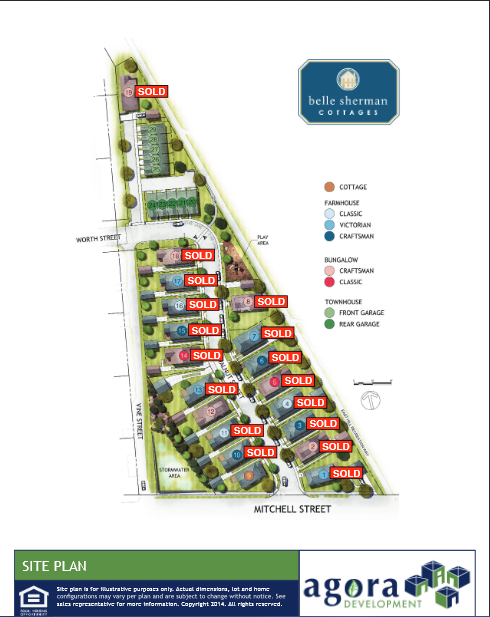
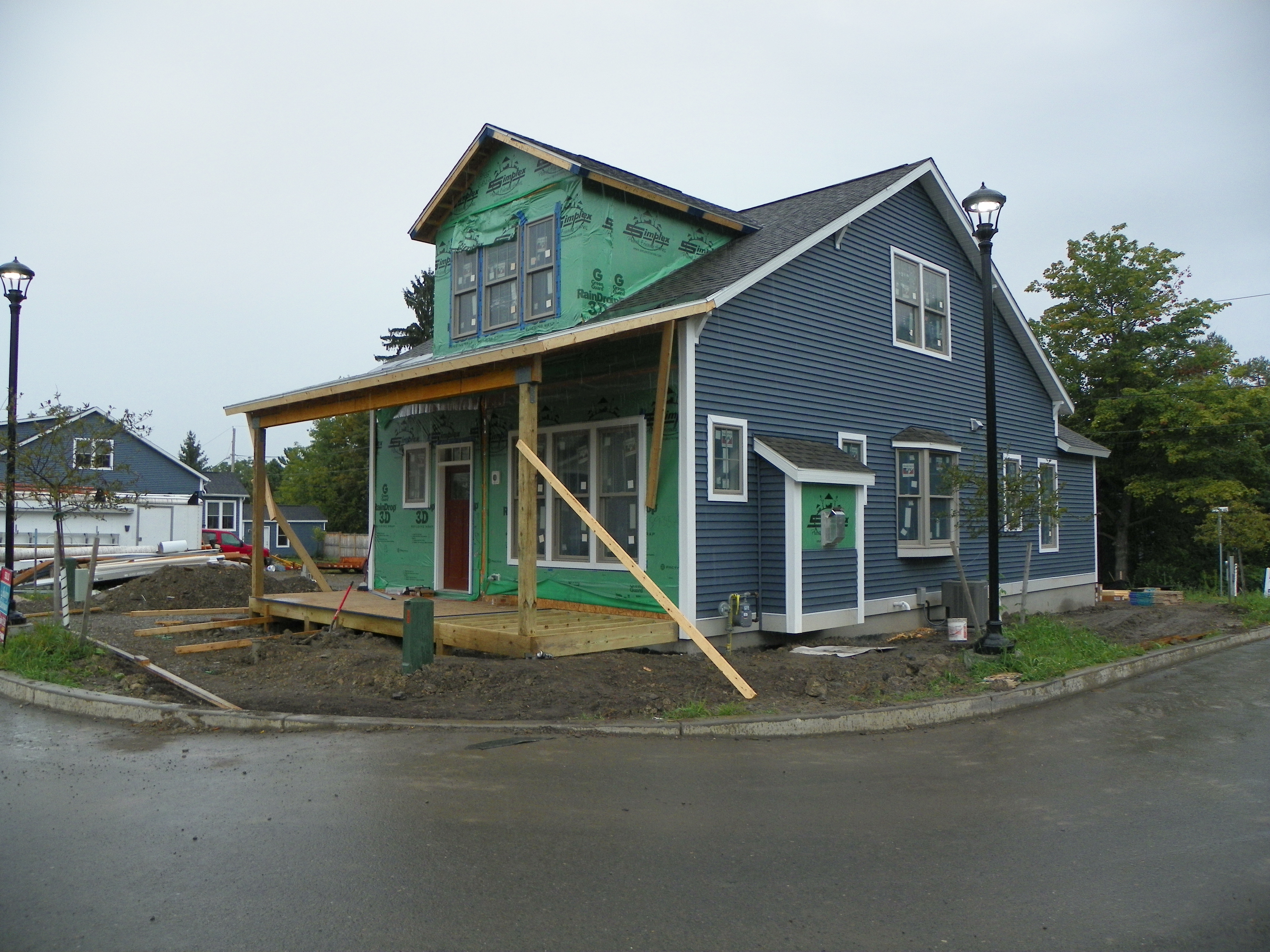
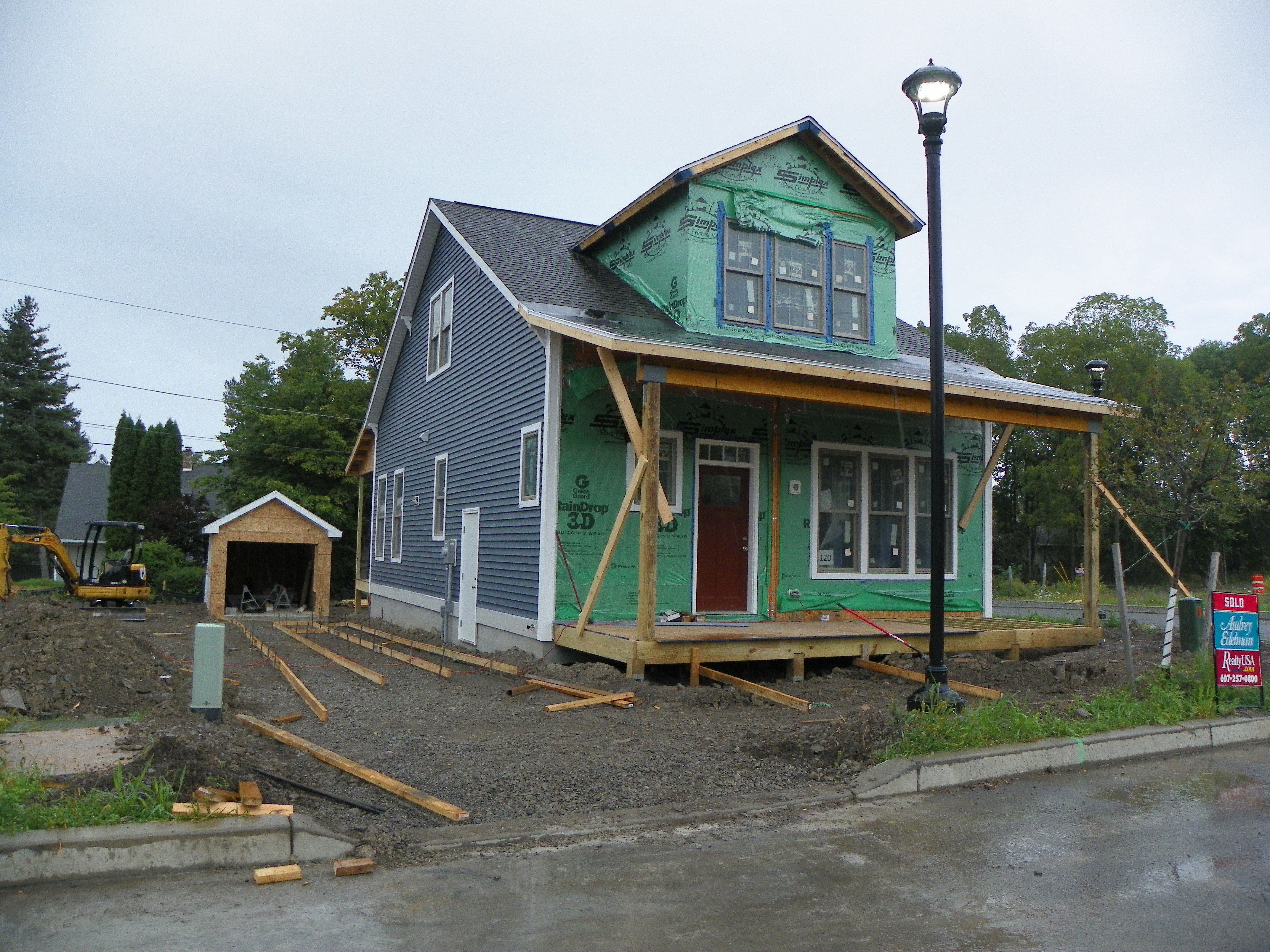
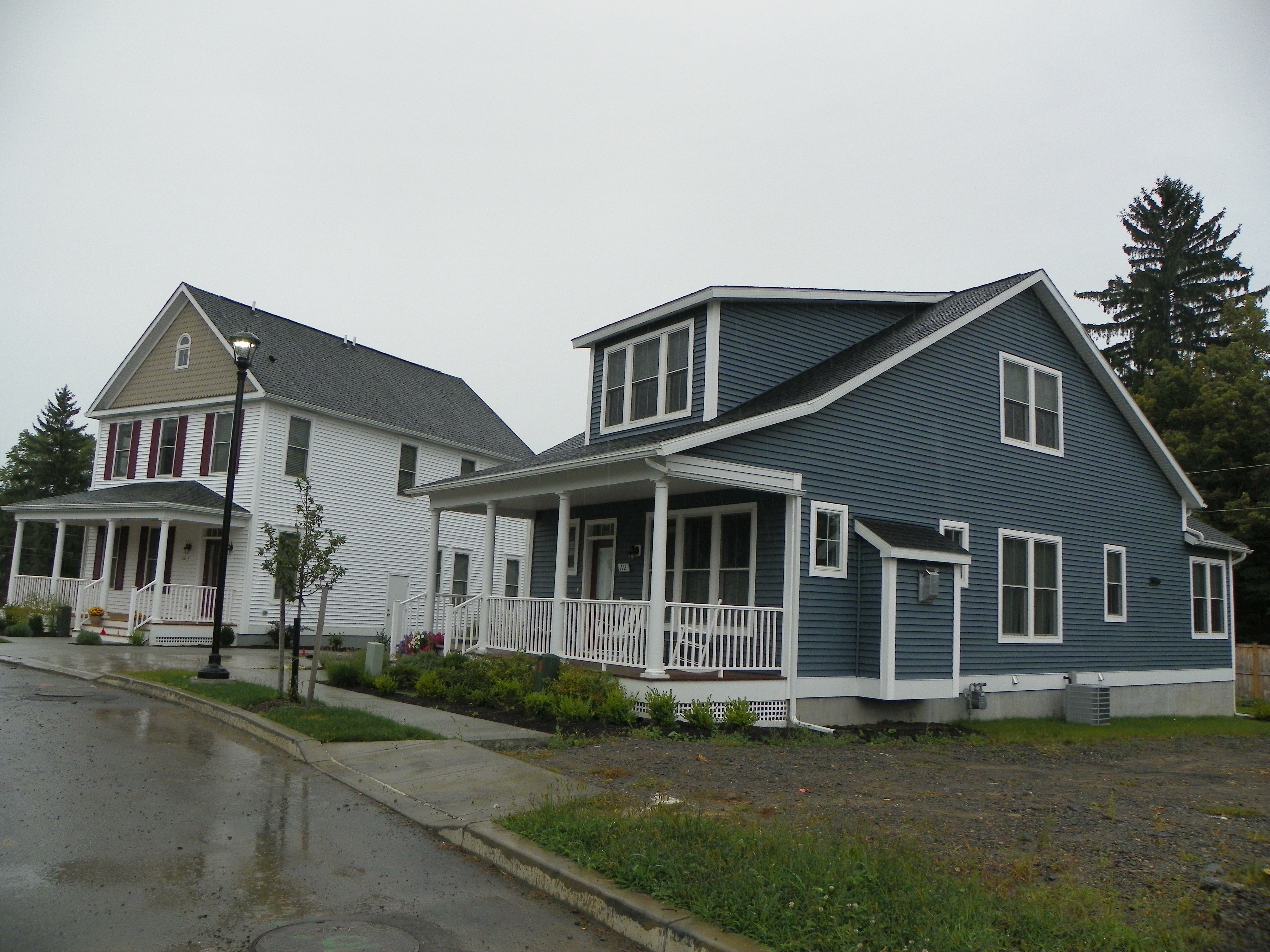
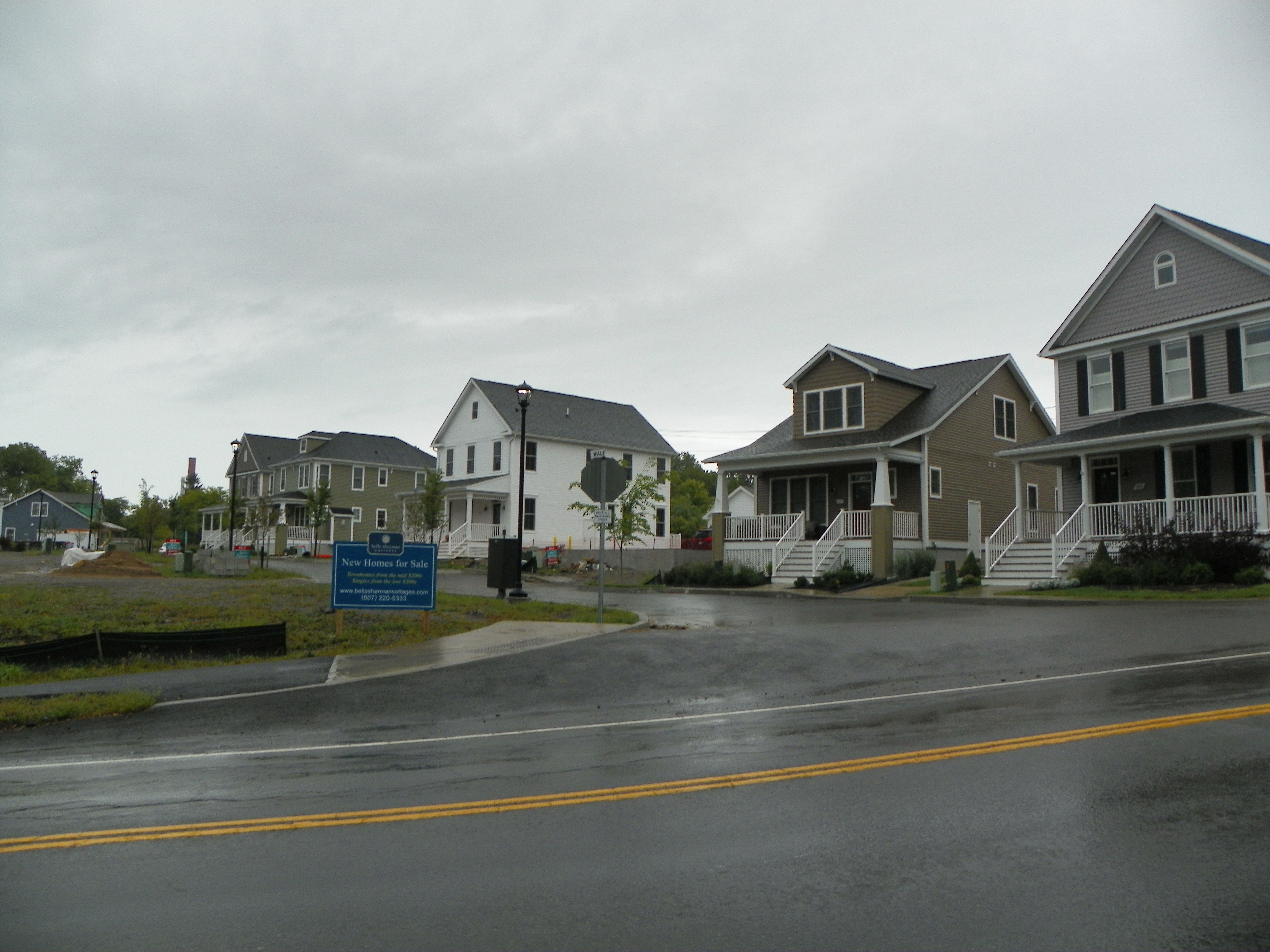
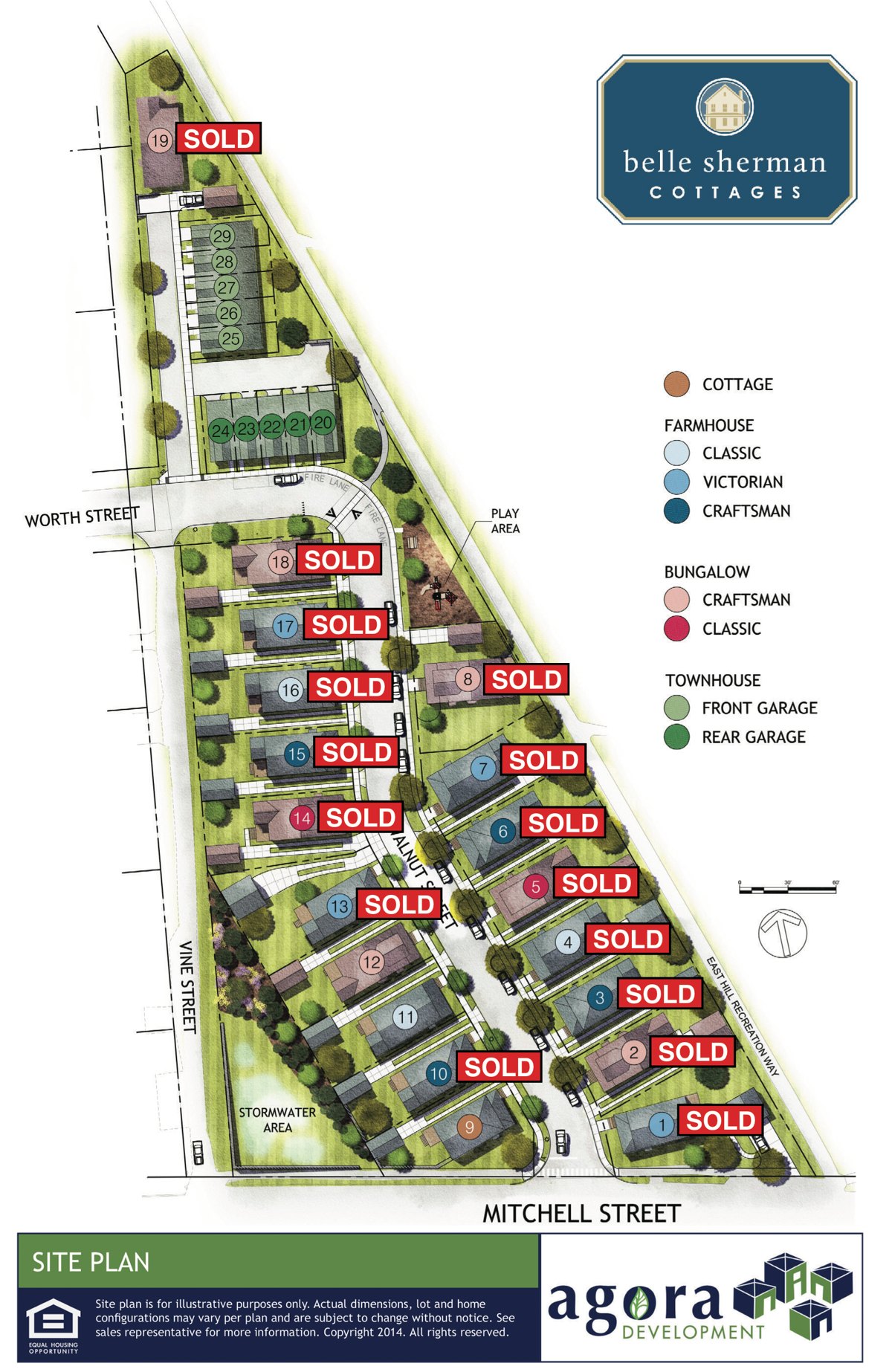
Agora Development‘s Belle Sherman Cottages project continues to build out. Some observant readers might have caught the piece from Buffalo development blog Buffalo Rising, which featured the project as an example of smart infill development (Buffalo Rising is rather fond of Ithaca). Since the early August update from Jason at Ithaca Builds, lots 4 and 6 have been completed and lot 18, a craftsman bungalow, is substantially complete. Meanwhile, work has begun at lot 3, a craftsman farmhouse. Given the previous rate of progress, I expect 18 will be complete by the end of the month, and lot 3 by early November. I don’t think it would be remiss to think another home will start before winter sets in. Of the 19 lots for single-family homes, only two lots are left, lot 12 (another craftsman bungalow) and lot 9, a new design that has yet to be published.

belle_sherman_cottages_071814

belle_sherman_cottages_071814_2

101_4882 101_4885 101_4887 101_4889 101_4890 101_4891 101_4893 101_4894 101_4897


Redefining Collegetown

2 09 2014

Article number four in the Collegetown history series.

I think one of the more enduring themes of Collegetown has been the desire to redevelop it. It’s a theme that comes up pretty consistently, starting in the post-war period, when urban renewal had become the planning concept du jour. Thankfully, we can find some of these plans in online archives.

And they are terrifying.

Here we have one from the Cornell Daily Sun archives, published April 22, 1959.

ctown_plan_1959

Someone’s channeling a little Le Corbusier here. This was one of seven designs conjured by about 40 junior architecture students in spring 1959, under the direction of Professor Thomas Canfield. The project called for the capacity of 4,000 residents in a 0.25 sq mi area (the population in the area in 1959 was about 1,100). They were told to plan for 4,000 residents because “there is a tremendous market for housing that is now unavailable. The site would attract many non-suitable if it offered suitable amenities.” All models were supposed to have a hotel, bank, theater, and parking for 2,700 cars (the capacity at the time was 500).

6 of the 7 proposals called for high-rise buildings, and virtually all of Collegetown from Eddy to Summit Ave, and Seneca to the gorge would have been demolished. A few proposals saved the Luthern Church on Oak Avenue, and one saved Sheldon Court. A bunch of isolated towers seems awful from the new urban standpoint that’s increasingly popular today, but in the late 1950s, this is what was in vogue. Demolish all the old, towers in the park, superblocks. massive freeways, seas of parking, it was the wave of the future. Ask Boston, Syracuse, Chicago, or any number of cities how that future turned out.

If you’re feeling really bored today, here’s a letter of protest against the design of Olin Library, also from the same issue. Olin was under construction at the time. I’m inclined to agree with the writer’s sentiments.

By November 1965, real plans were set into motion – under Ithaca’s Urban Renewal program, 62 acres of Collegetown was set for “selective demolition”, because the fire department determined that a high density of wood buildings was a fire hazard. Multi-story parking garages were also proposed, and a new bridge over Cascadilla Gorge. The work was supposed to begin in 1969, after a long process of Planning Board approval, Common Council approval, and state and federal government approval. Ithaca would only foot 12.5% of the nearly $5 million bill.

The urban renewal plan continued to evolve over the years. A lot of downtown businessmen, and later the operators of Pyramid Mall (now the Shops at Ithaca Mall), were not pleased with the idea of a business district in Collegetown that would isolate students from their properties. In 1969, 80,000 sq ft of office space and 200,000 sq ft of retail space was proposed in Collegetown – to put that in perspective, the mall in Lansing is 600,000 sq ft, and the token office building Cornell has at East Hill Plaza is 60,000 sq ft of office space. The plan also called for non-student low-income housing and industrial space at various times. By 1971, the plan was becoming more modest, focusing on an area bounded by Dryden Road, College Avenue, Eddy Street and Cascadilla Gorge. The Sheldon/Cascadilla block had received a large urban renewal grant in the spring of 1969, but issues arose with how to use it. Plans to tear down Cascadilla were met with protests, and with all the financial issues the city and university had in the 1970s, redevelopment gained little traction.

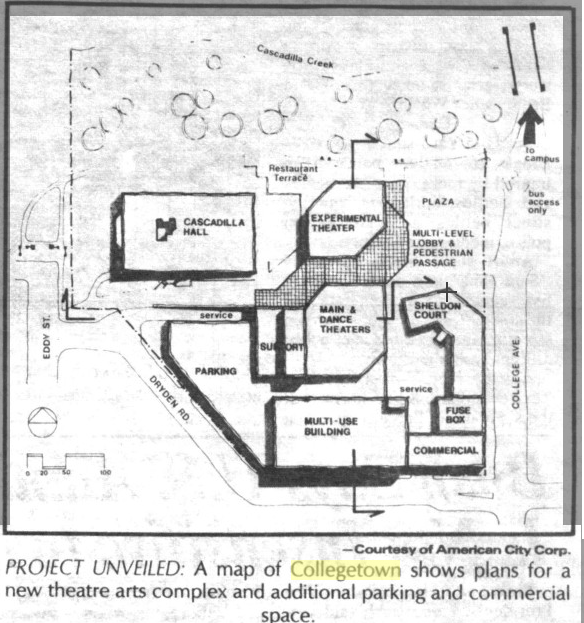
By the early 1980s, the plans were finally being fleshed out – with Cornell preparing to fundraise and build a new performing arts center, the university and the city partnered with an urban planning firm to build and renovate the parcels north of the 100 Block of Dryden Road and west of College Avenue, at a cost of $40 million ($115.6 million today). The plan called for 700 new units, 20 businesses, office space, and a 350-space garage (a mock-up from the 4/13/1981 issue of the Sun is included below). Funding for the project from state and federal sources was scarce, however. The city eventually sold their land to local developer Travis Hyde, who built Eddygate in 1985-86, and the proceeds helped cover the cost of the Dryden Road parking garage. Other lands in the initial plan were never purchased (the Avramis and Papp properties on the 400 Block of College Avenue, discussed previously here). Cornell fulfilled its commitments after years of fundraising and some tweaking of designs, with the renovation of Sheldon Court in 1981 (adding the top floor), Cascadilla Hall’s renovation in 1983-84 (adding the top two floors and 276 residents) and the Schwartz Performing Arts Center opening in 1989.
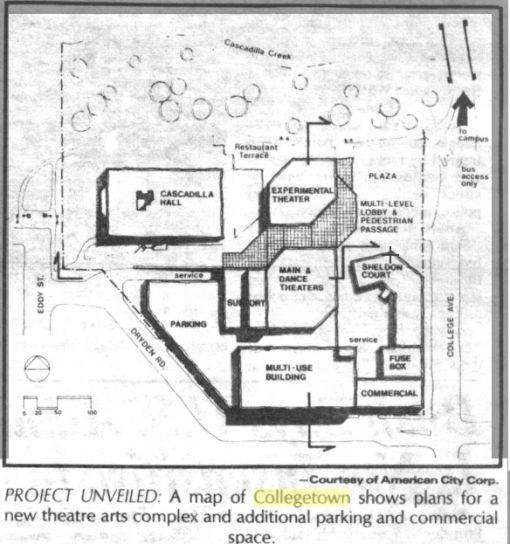
college_dryden_plan_1981

After that, the next substantial Collegetown redevelopment plans were the Form District debates of the past several years, click the links if you’re interested, but I’m going to avoid rehashing old entries this time around. As more structures go up and technology and social concerns evolve, I’m sure there will one day be more redevelopment plans for Collegetown.