News Tidbits 6/11/16: Summer’s Heated Discussion

11 06 2016

Image Property of HOLT Architects

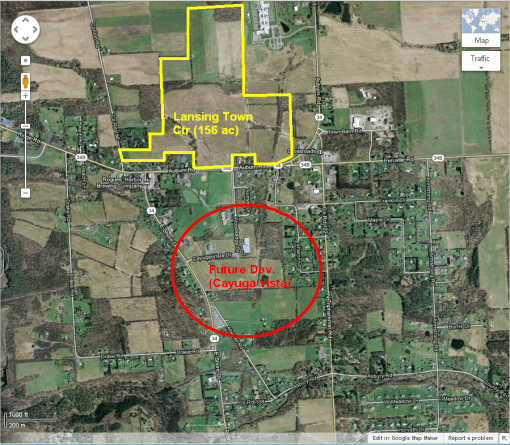
1. We’ll start this off out in Lansing. The 153 acres of land for the Lansing town center is once again in the news. The Lansing Star is reporting that the town is once again serious about selling the land.

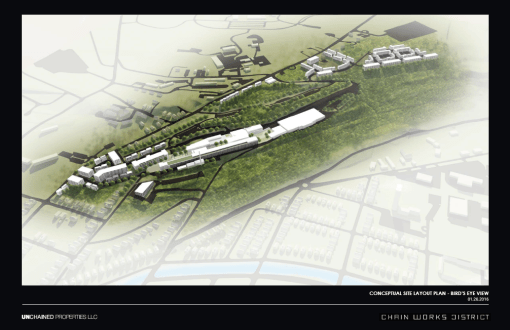
So begins yet another chapter in the 20-year saga of the town center land. The town bought the land from the state in 1993 for $100,000, and at the time the land was deed-restricted to recreational use. In 2012, the town paid an additional $294,800 to remove the recreational deed restriction. An article about it was published here in August 2012 (original map below; dunno where why offhand it says 156 acres vs. the 153 reported now). HOLT Architects and TWMLA were hired to draw up some overarching design themes, a Request for Proposals was issued, and three developers responded.
lyc2

Calamar Enterprises’ Buffalo office submitted a proposal for a $17.4 million, 110-unit market-rate senior apartment building on 13.5 acres, and Cleveland-based NRP Group submitted plans for 80 one-story patio homes on about 15.5 acres. Calamar later re-sited their project at the town’s wish to the northern part of the land, and increased the number of units to 124. Green Square, led by David Taub and HOLT Principal Graham Gillespie, proposed 60 units of housing and 23,000 square feet of retail in 2-3 story arrangements, and civic and recreational space. Altogether, the value of the three would have approached $50 million.
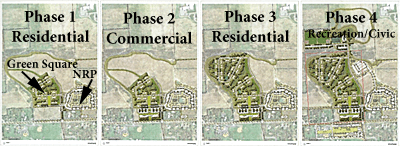
gs_phases

However, all of this was contingent on a sewer being built, which did not happen. The developers agreed to do a package plant that would service just the town center, there was discussion of an IDA-backed tax incentive zone, and the town stood to make a hefty return on investment, but…to quote the Star, “However, the deals fell through.  Actually it seemed more like they just faded away. At least one of the developers had signed paperwork saying they intended to purchase acreage from the Town.  The Town didn’t seem in any hurry to sell the land, even with clearly interested developers.  When the developers disappeared there was no reported effort by the town to pursue the deals.”

Since then, the town continues to get a steady stream of interest, but no real idea on how they want to move forward. Like Ithaca city and town, they’re looking at the possibility of Form-Based zoning for the site, and the town hopes to issue a more specific RFP than before, incorporating revised assessment values. The most intensive approach involved the Form-Based Code and a specific RFP, the least specific is just putting up a for-sale sign ans seeing what happens. Whatever the case, the lax approach the town has taken the past few years may no longer be feasible, with the ticking tax time time bomb of the possible power plant closure looming over the town and schools’ budgets.

old_library_thp_v4

2. Speaking of long processes, the Old Library project has formally filed paperwork here to begin the application process for the Certificate of Appropriateness from the Ithaca Landmarks Preservation Commission. The meeting is scheduled for city hall at 5:30 Tuesday the 14th. Although it says early design review, a lot of the legwork has already been done at this point, since the Planning Board and ILPC have been conducting joint meetings with the project team over the past several months to create a design that they’re all comfortable with. However, the ILPC is likely to refine some details moving forward.

old_library_thp_v4_2
At this point, the unit mix consists of 22 1-bedroom units with about 700 SF each, 25 2-bedrooms with about 900 SF each, and 10 2-bedrooms with 1200 SF each, the extra space intended as a den or home office. The building also includes a 1,800 SF community room to be administered by Lifelong, and 3,750 SF of first floor commercial space. The total facility size comes out to about 85,600 SF, and parking for 25 cars and at least 12 bikes, and another 34 bike spaces for the community room. Exterior materials include brick, limestone, and a couple forms of fiber cement, including wood-textured fiber cement.

Southeast+Rendering

3. The STREAM Collaborative House at 228 West Spencer is up for sale. The house has its own website here. The 1,152 SF, 2-bedroom net-zero energy house is listed at a price of $305,000. For more info on the house, Noah Demarest was kind enough to give a construction tour of the house while it was underway, and the blog post I wrote up afterwards can be found here.
evergreen_dryden_1
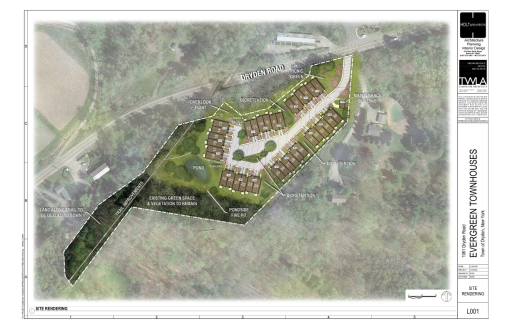
4. It’s pretty clear at this point that the Evergreen Townhouses project at 1061 Dryden is evolving into the next hot-button development issue out in Varna. The Times has their interview with the angry neighbor here, and more info can be found in the town of Dryden’s April planning board meeting minutes here. So far, the only image of the townhouses themselves has been a perspective that only shows massing – 2 stories, gabled roofs.

Also of note is the town of Dryden Planning Department’s recommendation to the town board (and the planning board’s approval) for an increase in density in certain areas. The change in code affects parcels zoned rural residential, with municipal water and sewer access. The density would be increased from 2 units per acre to 6 per acre. Looking at the zoning map and the sewer map, that would primarily affect the corridor from Varna to the 13/366 intersection, and a rural swath just north of Dryden village near TC3. What this would do is allow 1061 Dryden Rd to withdraw PUD application, and apply for a special use permit (SUP), which are generally easier to obtain.

On a side note, googling Tiny Timbers brings up a Times editorial, written by the Times, that argues against Tiny Timbers for not fitting in with the appearance of Varna. Actually, it kinda takes everyone to task, from developers to town government to residents. But, to make one counter-point regarding mixed-use, commercial services need a certain amount of traffic (not necessarily vehicular) to thrive. If the population base within a certain radius isn’t there, the risk is too great for someone to put their money on the line and hope that they can somehow draw in customers. If Varna wants a mixed-use center with shops and cafes, they’re going to need the population to support it. Some think that will include 1061, some (probably more) think Tiny Timbers, but if there’s no “push”, the ball won’t be rolling.

201_college_v3_1

5. A couple of minor things to note in sales. The 4,200 SF former “Imperial Buffet” property next to the Shoppes at Ithaca Mall has sold to a Syracuse-bsed LLC (Watersprite LLC, established 2004) for $590,000 on Friday the 10th. I personally will always remember this place as being the only place my mother was comfortable with eating in Ithaca because she hates eating out, and felt everything else was “snobby and expensive”.

Meanwhile, the 12-bedroom, 2,837 SF house at 201 College Avenue, the property subject to a heated debate between Neil Golder and Todd Fox, sold for $2.65 million on Friday the 10th, which seems outrageous except that it’s becoming the norm for inner Collegetown transactions – Novarr picked up 5,500 SF 215 College for $5.3 million last year. There will be no delving into that debate again this week, but the city uploaded 580 pages of documentation here, and my colleague Mike Smith is preparing a story for the Voice.
20160522_143925 20160522_143949

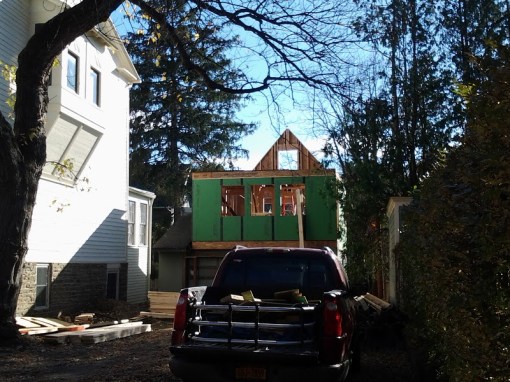
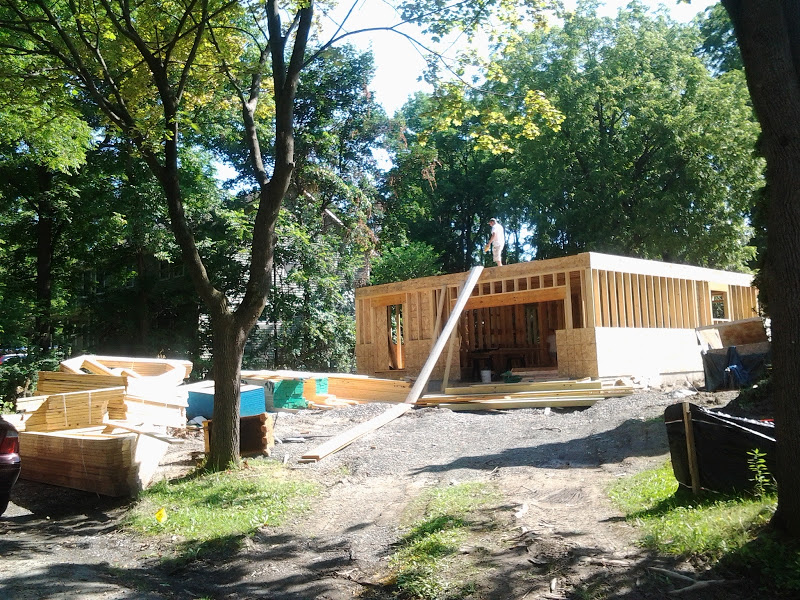
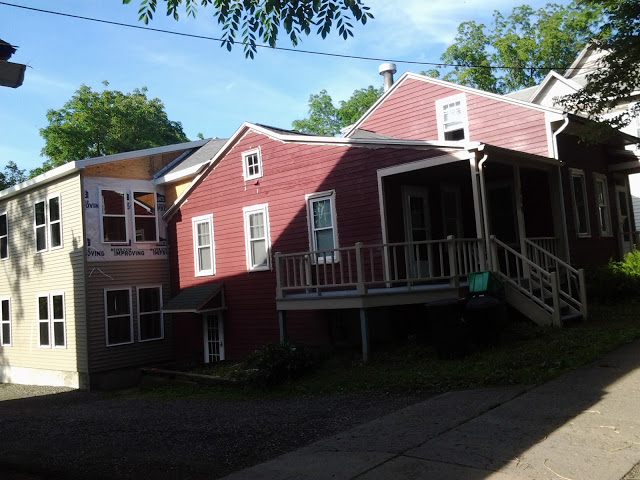
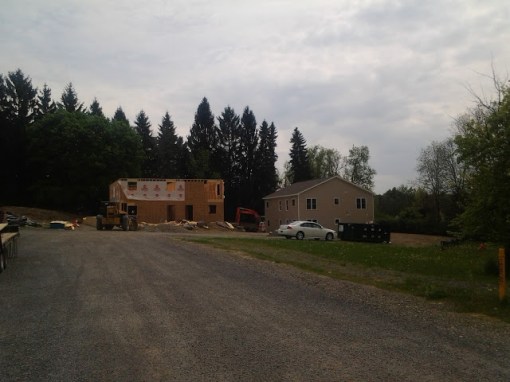
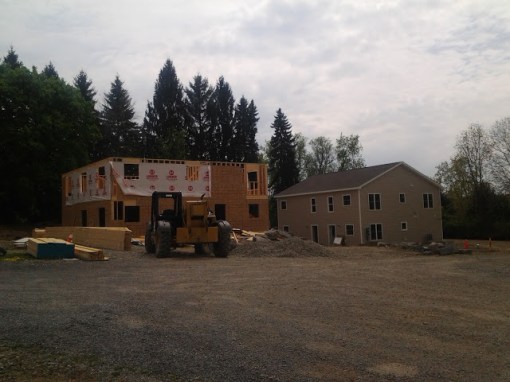
6. Houses of the week. This pair of duplexes are being built on Birdseye View Drive near Ithaca College. Each house has a 4-bedroom unit and a 2-bedroom unit; recent advertisements on Craigslist (since expired, so no link, sorry!) have them $750/bedroom. The developer is the owner of Mahogany Grill downtown, who also happens to be a part of the business team renovating the former Lucatelli’s into a new restaurant, a Tapas and pasta restaurant called Mix Social Dining after the chef’s wife.

These photos are a couple weeks old now, but the one on the right looks nearly complete, while the one on the left was still in the (wood) framing and sheathing stage. Based off the rough window and door openings, they are not exactly the same, but expect them to look similar.



News Tidbits 4/16/16: The Real Estate Shopping Spree

16 04 2016

old_libe_thp_holt_v4

1. On Monday, the county’s Old Library Committee received an update from Travis Hyde Properties about the redevelopment. Perhaps the biggest development is that Lifelong is no longer moving into the building. Instead, they will sell keep their office at 119 W. Court Street, sell the historic building at 121 W. Court Street, and have free use of DeWitt House’s community room for classes and workshops. Lifelong would also be the administrator of the community room, so rental fees for use of the room by other organizations will be paid to Lifelong instead of Travis Hyde. Lifelong’s treasurer claims this arrangement will save them $50,000 vs. the original proposal.

According to the Ithaca Journal piece by Andrew Casler, law firms have expressed interest in the 121 West Court Street property, although other business and housing isn’t out of the question. 121 is just outside the DeWitt Park Historic District.

The number of units is down from 60 to 55 (though some of those are now 3-bedroom units…the Tines is reporting 57 units total), and parking spaces are down from 30 to 25, all internal to the building since Lifelong is no longer moving in. Frost Travis is quoted as saying he might be looking into expanding the age range of possible tenants (currently proposed as 55+), but that seems liable to garner significant blow-back from neighbors if pursued.

The current plan is to have approval by September, sale of the property by October, and after any final site plan approval tweaks, construction may begin next Spring.

20150727_145000

2. The Ithaca City PEDC had another crack at incentive zoning this past Wednesday. And the consensus is, everybody dislikes it for one reason for another. Some of the development community feels it doesn’t go far enough, while some local activists feels it goes way too far. Sounds like the plan is striking a good compromise if it’s ticking the stakeholders off for not being more like their way of thinking. But, proof would be in practice, and seeing if any developer would actually be interested in pursuing a plan that utilizes the incentive zoning.

On a related note, Svante Myrick deserve a laurel – when asked at the meeting why there’s a housing shortage in Ithaca, he pretty much nailed it – the growing economy, increasing student and retiree populations, and a renewed interest towards urban environments are driving demand higher than in decades past.

201_college_v2_3
3. For this week’s eye candy, here’s a perspective drawing of the multistory apartment building proposed at 201 College Avenue. One thing that stands out here that doesn’t in the elevations (the latest of which can be found here) is that the corners are stepped down, so the bulk of the building is lessened. The planning board is expected to agree to be the lead agency for environmental review at its April meeting.

4. So I’m mostly leaving this to my colleague and editor Jolene Almendarez, because she is much more familiar with the Elmira Savings Bank situation than I am. But it’s worth noting that Steven Wells, the Massachusetts man who sold ESB the properties, was on a buying spree this week. On Tuesday, Wells paid $224,000 for 508 West State Street (the old Felicia’s Atomic Lounge), $884,638 for 622 Cascadilla Street where Zaza’s is located, and $1.5 million for 402-410 Third Street, a commercial plaza home to Finger Lakes Physical Therapy.  Felicia’s was noted here on the blog when it went up for sale last August for $350k.

ith_big_plan_map_v2

They all have different owners, and they’re in varying physical conditions. The only thing that unites these three properties is all that are in areas the city as ripe for redevelopment for urban mixed-use in the Comprehensive Plan. Felicia’s was upzoned in June 2013 to CBD-60, permitting a 60-foot tall building, no parking required. 622 Cascadilla is WEDZ-1a, allowing for five floors and no off-street parking requirement. Lastly, 402-410 Third Street is B-4, 40′ max and 50% lot coverage, but allows virtually any kind of business outside of adult entertainment. Those are some of the city’s more accommodating zoning types, so we’ll see what happens moving forward. At the very least, the public relations game will be starting from behind the proverbial eight ball.

5. Out in Dryden, the William George Agency is seeking county legislature approval to issue $2.7 million in bonds to finance construction of a new 24-bed residence hall. The facility will affect about 1 acre, be about 15,000 square feet, and start construction this Spring, taking about one year to build.

As the county deems appropriate, they can approve the issuance of tax-exempt municipal bonds to finance construction projects. First the planning committee signs off on it, and then the general legislature takes it up for a vote. The non-profit residential treatment center secured a $2 million construction loan this past January to fund roof repairs and renovations to cafeteria area. The agency, established in the 1890s, employs over 340, making it one of the larger private employers in Tompkins County.


News Tidbits 3/5/16: Here Comes the Papierkrieg

5 03 2016

chapteR_house_reconst_v4_2chapter_house_v4_1
1. Let’s start off with something that led to a couple of worked up messages and emails to the Voice inbox – a potentially controversial revision to the Chapter House proposal that would replace the north eave of the building with a wall (bottom image). In the documentation, there’s no written explanation as to why the change is being requested from the approved plan (top image); but I wonder if it has to do with fire safety regulations or zoning issues between the Chapter House and the rebuild being prepared for 406 Stewart next door. Architect Jason Demarest is working on both projects for their respective owners (400-404 Stewart’s Sebastian Mascaro and 406 Stewart’s Jim Goldman), so he’ll be representing both projects at the Landmarks meeting next Tuesday the 8th at 5:30 PM. Also on the agenda are a couple of minor renovations, discussion about potential work to The Nines at 311 College Avenue, and discussion of an expansion to the East Hill Historic District.  This might just be for the Orchard Place properties that are locally historic but not nationally recognized, but we’ll find out for certain next week.

1401_dryden_1

2. Some of your might be wondering what happened with the 902 Dryden vote. Well, the vote still has yet to be taken. Moldern Living Rentals was still work on the last details of the Stormwater Pollution Prevention Plan for runoff (SWPPP), so the town of Dryden won’t be taking a vote until their March meeting, which has yet to be posted to their website (most likely it’s Thursday the 10th, or Thursday the 17th). The next-door neighbors still took time out to call the 40% downsized project a travesty and that it wasn’t shown in the 2012 Comprehensive Plan. Veering into editorial territory, my original comment from last month still stands:

“[A] master plan is not an exact thing; if it shows for three sets of five townhouses on a parcel, that’s not what may necessarily may happen. It just indicates the kind of density and scale of development the plan deems appropriate. 902 Dryden isn’t drawn on the master plan, but the plan welcomes the idea of townhouses on Forest Home Drive, which 902 abuts. So a vote in favor of the 8 new townhouses is, indirectly, a vote of support in the Varna Master Plan.”

I would give more weight to Todd Bittner’s objective concerns about stormwater than subjective comments of character, especially when they’re from someone who said they were disgusted by the thought of rentals. When Bittner checks out the revised SWPPP, if it looks acceptable, I think the project should be approved.

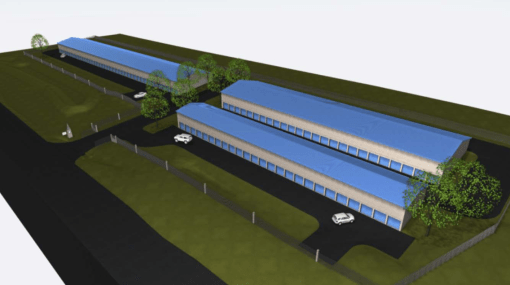
On another note, 1401 Dryden, the Storage Squad project (pictured above), seems to have lost a lot of its charm after getting caught in red tape last fall. The owners had to squeeze into a smaller area to satisfy the revised, expensive SWPPP. They’re hoping to hide most of it with landscaping.

dewitt_house_v3_1 dewitt_house_v3_2

3. Just a quick update on the Travis Hyde Properties Old Library proposal. The ILPC and Planning Board had their joint meeting, project team partners HOLT Architects and TWMLA landscape architects have incorporated their comments, and here is the current product. Sorry, no renderings, just site plans. Previous plan here. Overall, the site layout hasn’t changed too much, a courtyard and green space will be next to the DeWitt Park Inn, and the building is set back to maintain rhythm with its neighbors. The exterior is supposed to have more projections and recesses, the top floor set back 6 feet, and incorporation of balconies on the upper floors (not sure how this will affect the plan for the inverted roof). Unit count is 21 1-bedroom, 24 2-bedroom, and 9 3-bedroom, 54 instead of the original 60 (39 1-bedroom, 21 2-bedroom). The addition of 3-bedrooms is surprising for senior apartments; from what I’ve been told, typically the large majority of demand is with 1 and 2-bedroom units. The Planning Board and ILPC have another shared meeting at City Hall on the 8th.

chain_works_rev3_3

4. The Chain Works review process is chugging along. At its meeting on the 8th, the Planning Board’s special meeting will decide whether the Draft Generic Environmental Impact Statement is ready for public review (not expected to be controversial). Then on the 9th, Cornish et al. will be giving a report to the Common Council’s Planning Committee about the timeline and current status. Another staff progress report will be presented at the Planning Board meeting on the 22nd, and the next day on the 23rd, the city CC and town board Planning Committees will meet review proposed draft PUD zoning for the massive mixed-use project. With adequacy being agreed upon, the project can begin project review 15 or so days later; first public meeting is tentatively scheduled for March 29th.

The city just uploaded the comments of reviewers on the DGEIS – most are relevant, some are pretty good suggestions and critiques. Then there’s “Reviewer 3”, most of whom’s comments were put aside as they’re not relevant to adequacy. Those are but a preview of the potential flare-ups to expect at the public meeting.

12366349_10153784612864664_8478297861508040090_n

5. Stumbled on this by chance, but it seems to verify initial suspicions from a few months back; a project proposal goes with the sale of multiple parcels of land totaling 9.2 acres off Park Lane and Slaterville Road in the town of Ithaca. The property, for sale at $995,000, is being marketed by Carol Bushberg Real Estate, which doesn’t have the render on their listing page or their Youtube video, but they do on facebook. The conveyed plans call for a 26-lot subdivision, and given the proposed lot lines, it doesn’t look like it would be affected by the town’s moratorium on 2-unit structures, because each unit has its own lot even though some of them share a wall. It also meshes with the town’s Comprehensive Plan, which calls for 2-4 units per acre in this area (in the site plan, it’s just under 3 per acre). So to all you would-be home developers, here’s an opportunity.

20151108_154213

6. Speaking of the 2-unit moratorium in the town of Ithaca, it looks like that’s going forward to the Town Board to schedule a public hearing. The Planning Committee decided it was a good idea. The documentation says it would last at least a year, by which time the town hopes to have its new form-based, anti-student special zoning in place. Editorializing again, I still oppose this proposed law not because of the issue with low-end student housing, but because it’s too broad, affecting the whole town. The last 2-unit approved in Ithaca town wasn’t a student special – it was a 3-bedroom house with an accessory 1-bedroom apartment off Calkins Road. The husband and wife building the house will be living in the larger unit. I don’t think the whole town should be subject to a law that’s only been written to address a South Hill issue (the law’s language claims it’s a concern in East Ithaca as well, but I haven’t seen or heard of a new student-oriented rental in East Ithaca in at least the past few years). Anyway, whether for or against it, comments can be sent to Town Clerk at townclerk@town.ithaca.ny.us. The town meeting will be at the town hall on Monday the 7th at 5:30.

202_hancock_1
7. Here’s a preview of next week’s mid-week post: A look at some of the affordable housing proposals and plans that applied to the city for grant funding this year. INHS applied for their owner-occupied townhouses, the Boggs/ Fernández proposal for 402 South Cayuga is there, Habitat’s duplex, 304 Hector, and a new plan by a private citizen for an owner-occupied affordable duplex behind the house at 622 Center Street in the South Side neighborhood. Keep an eye out for that Monday night or Tuesday morning.

maguire_carpenter_2

8. From the other news outlets now; the Times is reporting that the sketch plan for the Maguire auto dealership proposal for the Carpenter Business Park actually had a warm reception from the Planning Board. In particular, board stalwart John Schroeder was impressed with the sidewalk along 13 (which would help transition the Waterfront and nearby environs to mixed-use) and public amenities. The board is cognizant of the site’s issues and the city’s hopes for the area, so those do play into the thought process – perhaps part of it is that Maguire’s jobs and features could work as a draw for mixed-use development of nearby parcels that don’t have so many issues. The board’s role stops at this point, with the just passed TM-PUD now front and center – unless Common Council okays the project, it won’t be back again. But Maguire did ask for a letter of support if the board was willing; we’ll see.

texas_roadhouse_v3_1

9. Meanwhile, the Journal is reporting that Texas Roadhouse will be opening May 23rd. No doubt the relatively dry and mild winter helped keep this project moving along (February construction update here). The 7,163 SF restaurant expects to hire 170 to 200 employees, of which 80 will be full time. That number astounds me just a bit because I worked at a steakhouse in high school, and although we were maybe half the square footage, we only had a staff of about 40. Even in Ithaca’s crowded restaurant scene, there aren’t many options for the red meat lovers that don’t cost an arm and a leg, and chances are good this will appeal to a different crowd than most, and be something of a draw from the nearby rural areas. Best of luck to them and their staff.

20160219_134003 20160219_134057

201_w_clinton_1

10. Let’s wrap this up with House of the Week. Quick update on Zac Boggs and Isabel Fernández’s 201 West Clinton Street carriage house. Fully shetathed (Huber ZIP system panels), fully roofed and shingled, and fully fitted with windows, the exterior work left will focus on exterior siding attachment and refinishing the original 1960s garage to match the historically-inspired vertical addition. The exterior calls for sawn board-and-batten wood fitting, though it’s unclear if it will be unpainted wood, or painted yellow. The 1 bedroom, 520 SF space looks like it could be ready for occupancy by late spring.


News Tidbits 11/21/15: Building and Rebuilding

21 11 2015

inhs_pride_design_v5_2 inhs_pride_design_v5_3

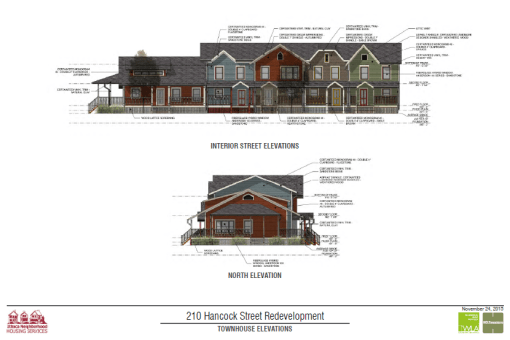
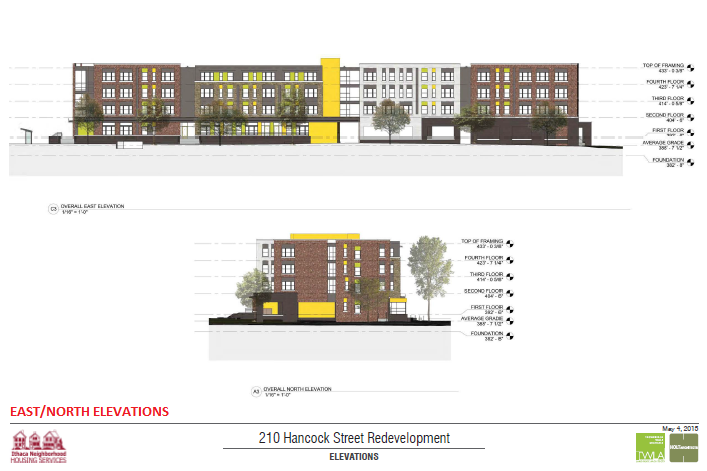
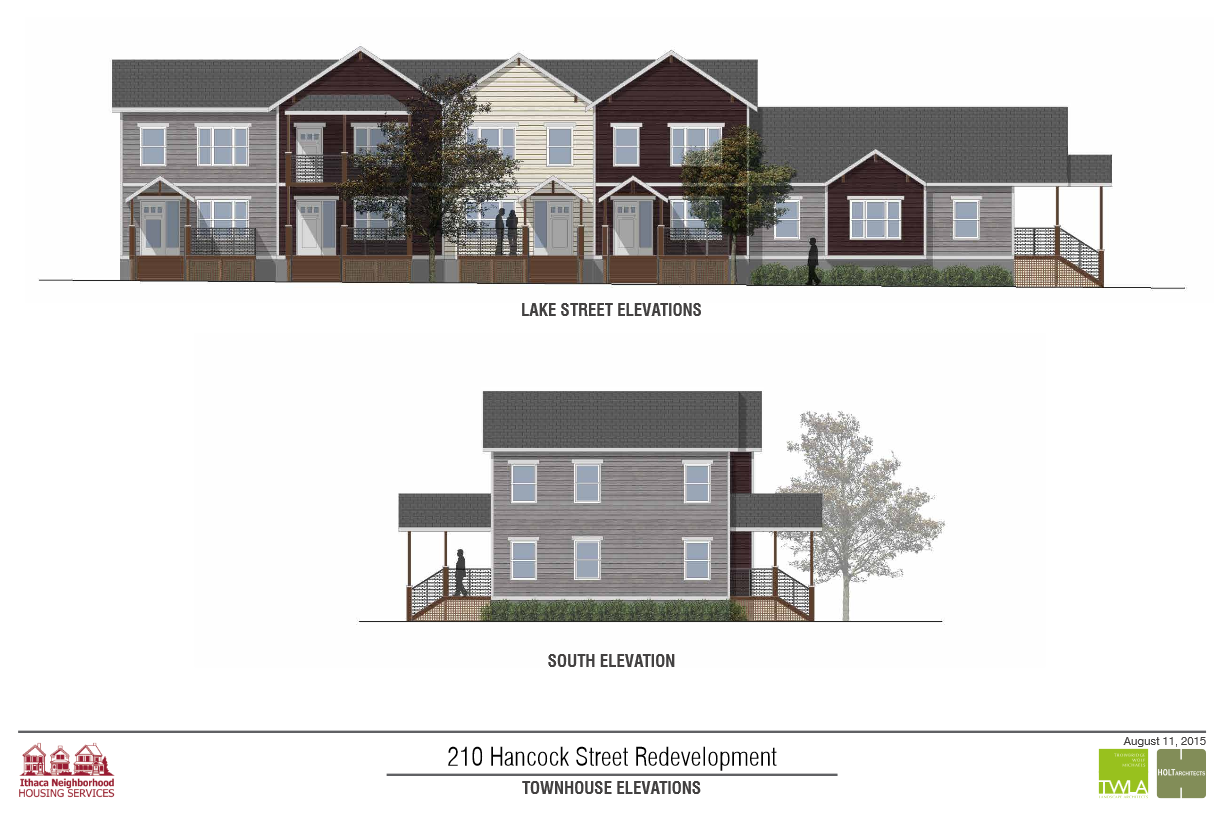
1. Starting off this week with some eye candy, here are some updates renders of the townhouses proposed for INHS’s 210 Hancock project in the city’s North Side neighborhood. Details and project status here. 210 Hancock has been approved by the Planning Board, and Cornell, the city and county do have dedicated funds ($200,000 total) going towards the affordable housing units, but still needs to be seventeen conditions prior to receiving a construction permit, one of which required revised townhouses to better reflect the neighborhood. The Common Council also need to vote to discontinue using the sections of Lake Avenue and Adams Street on which the new greenways and playground will be constructed, which apart from the time needed and paperwork generated, isn’t expected to encounter any obstacles, with formal conveyance to INHS anticipated by March 2016. INHS is shooting for a May construction start.

The Planning Board will be voting on “satisfaction of site plan approval” at its meeting next Tuesday, which should be a fairly smooth procedure, if the paperwork’s all correct.

Personal opinion, the townhouses, with more color and variation in style, appear to be an improvement over the previous version. These five will be rentals, while the other seven will be for-sale units, and built in a later phase (government funding for affordable rentals is easier to obtain than it is for affordable owner-occupied units, so it could take a year or two for those seven to get the necessary funding). The apartments have not had any substantial design changes since approval.

inhs_pride_design_v5_1

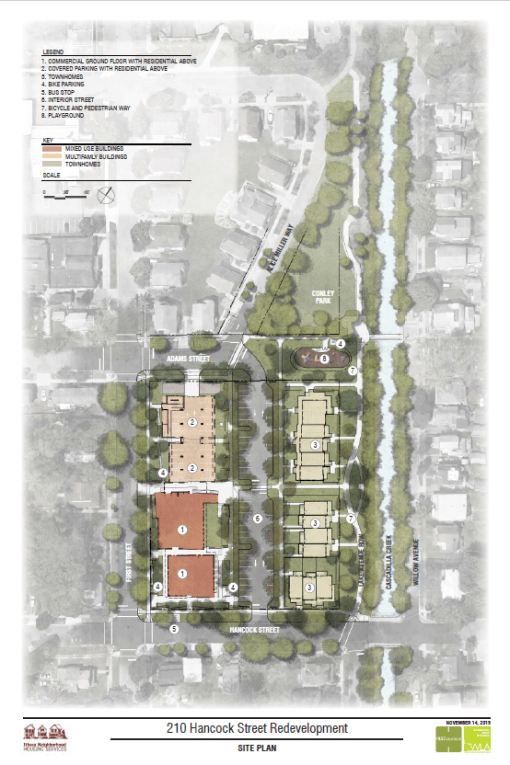
For what it’s worth, here’s the final site plan. The rental townhomes will be on the north corner of the parcel, furthest from Hancock.

2. Turning attention to the suburbs, someone’s put up some sizable chunks of land for sale in Lansing village. The properties consist of four parcels – 16.87 acres (the western parcel) for $500,000, right next to a previously-listed threesome of 28.07 acres (the eastern parcels) for $650,000. The eastern parcel also comes with a house, which the listing pretty much ignores. Lansing has it zoned as low-density residential, and given the prices (the western parcel is assessed at $397,600, the eastern parcels at $561,100 (1, 2, and 3)) and being surrounded by development on three sides, these seem likely to become suburban housing developments, possibly one big 30-lot development if the parcels are merged. For the suburbanites out there, it’s something to monitor.

20151108_133542 20151108_133710

201_w_clinton_1

3. House of the week – or in this case, tiny house of the week. The 1-bedroom, 650 SF carriage house underway at 201 West Clinton Street draws inspiration from 19th century carriage houses, which makes sense given that it’s in Henry St. John Historic District. It and the main house are owned by former Planning Board member Isabel Fernández and her partner, TWMLA architect Zac Boggs. The two of them did a major and meticulous restoration of the main house, which used to house the local Red Cross chapter, a couple of years ago (more info on that here).

Anyway, the framing is underway and some ZIP System sheathing has been applied to the exterior plywood. No roof yet and probably not much in the way of interior rough-ins, but give it a couple of months and that 1960s garage will be given a new life as a tiny house.

travis_hude_libe_libe_v3

4. Time to take a look at the Planning and Development Board agenda for next Tuesday. For reference, here’s what a typical project guideline looks like:

PDB (Sketch Plan) -> PDB (Declaration of Lead Agency) -> PDB (Determination of Env’tal Signif., PDB BZA reccomendation if necessary) -> BZA (if necessary) -> PDB (prelim/final approval).

Here’s the meat of the agenda:

A. 210 Hancock – Satisfaction of Conditions of Site Plan Approval (see above)
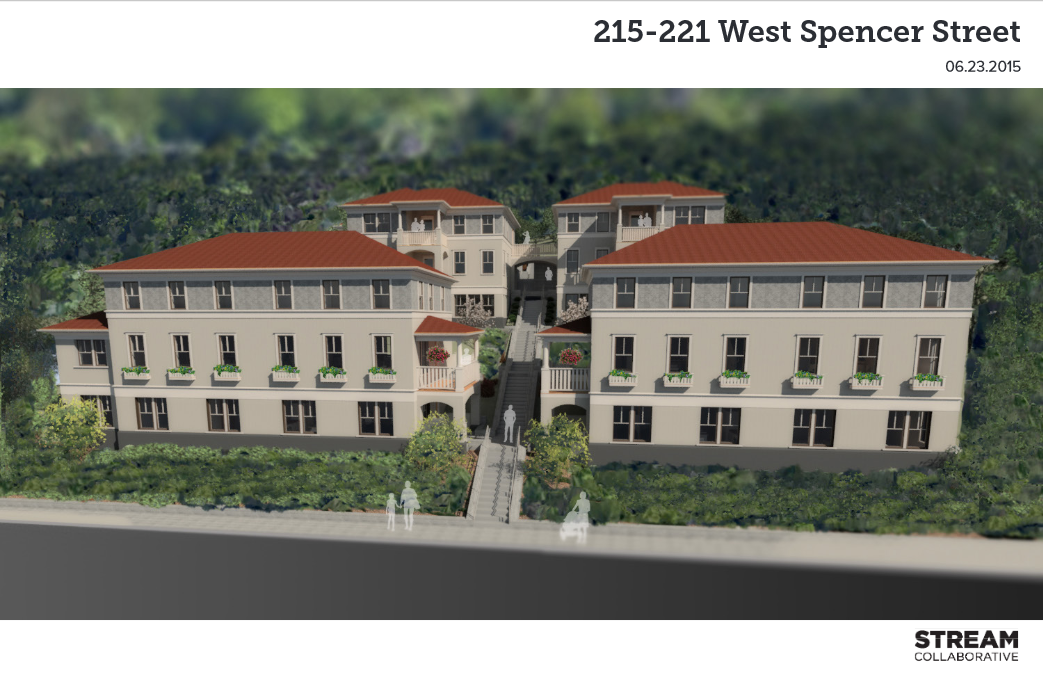
B. 215-221 Spencer St. – Consideration of Prelim/Final Site Plan Approval  – this one was first presented as sketch plan in March, to give an idea of how long this has been in front of the boards
C. 416-418 East State Street – Determination of Environmental Significance and Recommendation to the BZA – “The Printing Press” jazz bar is a proposed re-use for a former printshop and warehouse that has seen heavy neighbor opposition. The bar has changed its emphasis, redesigned the landscape and moved itself to a more internal location to mitigate concerns, but the opposition is still strong, mostly focusing on noise and traffic. The board has simply and succinctly recommended that the BZA grant a zoning variance.
D. 327 Elmira Road – Determination of Environmental Significance and Recommendation to the BZA – The Herson Wagner Funeral Home project. This one’s had pretty smooth sailing so far, only a couple complaints that Elmira Road isn’t appropriate for a funeral home. The Planning Board, however, applauds the proposal, which replaces a construction equipment storage yard, for better interfacing with the residential neighbors at the back of its property. It has been recommended for BZA approval.
E. Simeon’s on the Commons Rebuild – Presentation & Design Review Meeting – Before anyone throws up their arms, this is only to talk about the materials and design of the reconstruction, and to get the planning board’s comment and recommendations.
F. The Chapter House Rebuild – Sketch Plan – The Ithaca Landmarks Preservation Commission (ILPC) must have come to some kind of acceptance on the proposed rebuild if the Chapter House is finally at the sketch plan stage. the Planning Board will have their own recommendations, which will have to be coordinated to some degree with the ILPC (the ILPC is arguably the much stricter of the two). We’ll see how it looks next week.
G. Hughes Hall Renovations – Sketch Plan – more on that in a moment
H. DeWitt House (Old Library Site) – Sketch Plan – originally slated to be seen a couple months ago, but pulled from the agenda. The 60-unit project is not only subject to Planning Board review, but ILPC review since it’s in the DeWitt Park Historic District.

5. So, Hughes Hall. Hughes Hall, built in 1963, has dorm housing and dining facilities for Cornell students attending the law school, but those 47 students will need to find alternative housing once the hall closes in May 2016 (yes, with Maplewood closing as well, Cornell is putting 527 graduate and professional students out on the open market next year…it’s gonna be rough). However, this has kinda been known for a while. Cornell has intended to renovate Hughes Hall since at least 2011, as Phase III of its law school expansion and renovation. The building was used as swing space while Phase I was underway, and then the phases were flipped and Phase II became Hughes Hall’s renovation, while Phase III became Myron Taylor Hall’s renovation. According to Boston-based Ann Beha Architects, who designed the law school addition (Phase I), the Hughes Hall renovation will “house offices, administrative support spaces, academic programs and meeting spaces.” Well see how the renovated digs look at Tuesday’s meeting.


News Tidbits 8/8/15: A Shocker on Cayuga Street

8 08 2015

travis_hude_libe_libe_v3

1. As reported by several news outlets, the Tompkins County Legislature came to the surprise conclusion last Tuesday to give preference to the Travis Hyde proposal for the Old Library site at the corner of West Court and North Cayuga Streets. The final vote was 8-5.

I’ll be honest, I was shocked. I figured the county legislature would just never come to a resolution, or that on the off-chance that it did, it was going to be in favor of the Franklin Properties proposal, which had by far the most vocal support of the three proposals (the third being the unloved Cornerstone proposal for affordable senior housing). If this has been the city’s site to sell, the decision would have gone to Franklin, so I think this ordeal highlights the somewhat differing interests of the city and county. Regardless, I feel either proposal would have been successful for the Old Library site, and I am pleased to see something moving forward.

From here, the project is to move into an SEQR (State Environmental Quality Review) assessment coordinated with the city of Ithaca. The project also needs to go forward to the Ithaca Landmarks Preservation Council (ILPC) for a certificate of appropriateness. It is quite possible that the design will be changed during those reviews. Once those are approved, a sales agreement will be drawn up late this fall, the county authorizes sale around Christmas, and the actual sale of the property to Travis Hyde would happen in January 2016. If the Travis Hyde project can’t move forward and the sale hasn’t happened, then the county can authorize the Franklin proposal, which would also have to negotiate the same processes to arrive at the selling stage. In sum, a big hurdle has been jumped, but there’s a lot more that needs to happen before any shovels hit the dirt.

2. For all you would-be developers out there, here’s this week’s opportunity – since the folks that own Felicia’s Atomic Lounge have decided to focus on a new restaurant in Trumansburg, their Ithaca site is closing and the property is for sale. On the surface, you get a 1-story, 1,500 SF building at 508 West State Street for about $350,000. Dig deeper and zoning permits a 60′ tall building with no parking required. The city and county have designated the West State corridor as the place where they would like to focus denser development, and the zoning was revised in 2013 to reflect those desires. If/when the property sells, if it merits further attention you’ll see a news update here.

chapter_house_1905

3. Demolition of the Chapter House’s fire-damaged walls is taking longer than expected because the owner had to apply for a certificate of appropriateness from the ILPC to approve demolition. For those that are interested in reading about how water and fire damage have structurally comprised the structure, the application bundle can be found here. Apart from the usual applications like window and roof treatments, the ILPC is also set to begin discussion of 406 and 408 Stewart Avenue, where a new apartment building is likely to be built to replace the one totally destroyed by the Chapter House (and which I wrote about here on the Voice). For those interested in attending, the meeting is at 5:30 PM in the 2nd floor conference room at Ithaca City Hall.

tfc_v3_1

4. Looking at the city’s planning board projects memo for the month, August is going to have a lot og big decisions in store. Novarr’s academic building at 209-215 Dryden in Collegetown is up for preliminary approval, as is Tompkins Financial Corporation’s HQ (shown above) and the Dibella’s sub shop in southwest Ithaca. If INHS’s 210 Hancock gets zoning approvals at the Board of Zoning Appeals (BZA) meeting next Tuesday, it will be up for final approval at the August planning board meeting as well. The 12-unit “pocket neighborhood” at 215-221 West Sepncer will complete environmental review and possibly granted permission to face the BZA, and the massive State Street Triangle project will have more public discussion and review, with no decisions expected. A very busy month that will hopefully pane out to a busy construction season in 2016.

5. Looks like there’s a potential site being weighed for a new Collegetown fire station. In minutes from the Board of Fire Commissioners, the location is described as being towards Maple Avenue, on land that would either be donated or bought outright. That would place it up by the Fairview Apartments and Cornell facilities, assuming it’s not further out in Ithaca town (services are shared if I remember right). An unidentified consultant has been chosen to review the costs of selling the land in Inner Collegetown and building a new station vs. renovating the current 47 year-old property.

20150727_102527 20150727_102600

5. Random house of the week turns back to 203 Pearl Street in Ithaca’s Bryant Park/Belle Sherman neighborhood. I spy with my little eye, a large garage opening, a rough-in for a door to its left, a couple of rough window spaces, and lots of roof trusses. It’s supposed to be a 1,276 SF house, but one could be forgiven for thinking the owners are just building a nice garage. The lot was separate when the neighborhood was first plated, but decades ago 201 Pearl bought the land and used it for an in-ground pool. The pool was eventually filled up, and the land subdivided once again this past spring.


News Tidbits 6/20/15: Big and Far, Small and Near

20 06 2015

Cornell Tech Passive Residential Building
1. In something not Ithaca but Ithaca-related, it seems like Cornell’s New York City-based Tech school is having quite a good week. Cornell announced that construction began earlier this month on a $115 million residential building at the Cornell Tech campus. the 26-story, 270′ tower is being built to passive house standards, the largest passive house building in the world.

According to an article in the New York Times –

“That means the building is able to maintain a comfortable interior climate without active heating or cooling systems, through the use of, among other things, an airtight envelope and a ventilator system that exchanges indoor and outdoor air. In climates like that of New York, however, standards allow small heating and cooling systems.

Making the Roosevelt Island tower airtight — creating what is essentially a giant thermos — was one of the biggest challenges, said Blake Middleton, the principal in charge and partner at Handel Architects, the building’s designer.”

The 350-unit, 530-bed building will house mostly graduate students, with some research staff and faculty also living in the tower. The apartments, designed by Handel Architects of NYC, are due to be completed sometime in 2017.

cornell_tech_v2

As noted at Curbed, to celebrate the groundbreaking, partner/developer Forest City Ratner released new renders of “The Bridge“, the tech incubator building on the right that looks like and ice cube cleaved into two pieces. As one might imagine, the new renders come with token florid language and eye-rolling descriptions (“an ecosystem of companies”). The Bridge, designed by New-York based Cornell alums Weiss/Manfredi, is being designed to LEED Silver standards, which is still better than about 99.5% of Ithaca. Construction permits were filed in January.

tech1

Last but not least, the $100 million Bloomberg donation, to name the first building “The Bloomberg Center”. The Bloomberg Center, designed by Thom Mayne of Morphosis Architects, will also open in 2017. To date (i.e. about three years since inception), philanthropy to the tech campus has totaled $685 million – and absolutely none of them care where you think the money would be better spent. Cornell hopes to raise $ 1 billion ($1,000,000,000) for the school by 2021.

For comparison’s sake, all of Cornell, Ithaca campus, Weill and Tech, raised $546.1 million in donations in 2014, and $474.9 million in 2013.

dibellas_v2_2

dibellas_v2_1

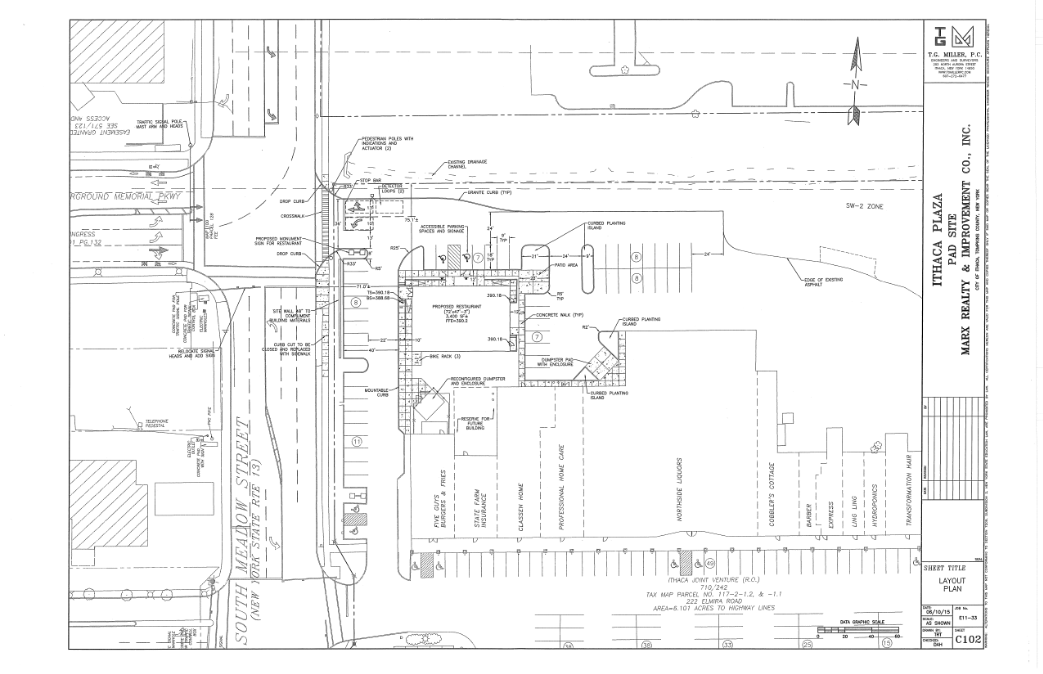
2. Now to go from something big and far away to something small and local.  It’s been a while since we’ve heard about DiBella’s, the Rochester-based sub sandwich chain that had been eying Ithaca last November. They’re back, and the proposal has has some pretty substantial tweaks.

The building itself is still about the same size (~3,400 sq ft), but the design of the building has been reworked to a brick facade with an asymmetrical door/window configuration. The building is now contiguous with the main shopping strip, no longer isolated from the rest of the stores by a driveway. No decisions are expected to be made at the June Planning Board meeting, it’s more of an update for the board as to what’s going on, and to solicit input.

Marx Realty of NYC is developing the pad property, and local architect Jason Demarest (brother of STREAM Collaborative’s Noah Demarest) is handling the design.

3. Shifting out to Dryden now; I don’t tend to write much about Dryden, since a lot of the local development is limited to single-family homes in semi-rural areas (and separately, bad things happen when I write about Dryden).

First, Dryden village. The village has seen quite a jump in population in the past couple of years thanks to the opening of the 72-unit Poet’s Landing affordable housing complex (affordable here meaning that it’s income restricted and rents range from the $600s/month for a 1-bedroom to about $900/month for a 3-bedroom). At least as far back as 2010, a second phase, at the time a 72-unit senior apartment building, was planned by Rochester-based developer Conifer LLC.

Glancing at the village’s outdated webpage, there were meetings in October about phase II. A little searching online shows the negative SEQR determination (meaning no major adverse impacts expected) was issued in February of this year. The determination announcement says that 48 more apartment units are planned for the land directly west of the current complex. The Poet’s Landing facebook page says that funding wasn’t allocated for the expansion this year, but they are hopeful for 2016.

It’s not the best location; affordable housing developments often vie for land outside of developed areas simply because the land is cheaper, but the trade-off is that residents are often isolated, especially if they don’t have money to maintain a car. Here at least the village’s main drag is close enough that residents aren’t totally isolated. And any affordable housing in Tompkins County is welcome.

4. Meanwhile, in Dryden town, there are a couple of projects going on. One involves the construction of 8 duplexes (16 units) at a 5 acre parcel on Asbury Road. Working with that piece of information, there was only one parcel that met the provided description – a property just east of the Lansing-Dryden town line that sold for $30k last August to “SDM Rentals”. Scott Morgan is given as the developer in the town documents.

SDM Rentals does have at least one other recently-developed property, the Meadowbrook Apartments, a set of at least 7 duplexes at 393 Peruville Road in Lansing for which he received a $1,000,000 construction loan in 2013 (2 were built in 2010), and rent for $995/month. The ones on Asbury Road will probably look similar.

The town notes that although the SEQR is still being prepared, the site was already being prepped with dirt fill, resulting in not one but two stop work orders. Looking online, it appears Morgan has a history of being a problem for local government, including a case in Lansing town where he was using a broken-down school bus for a pig barn.

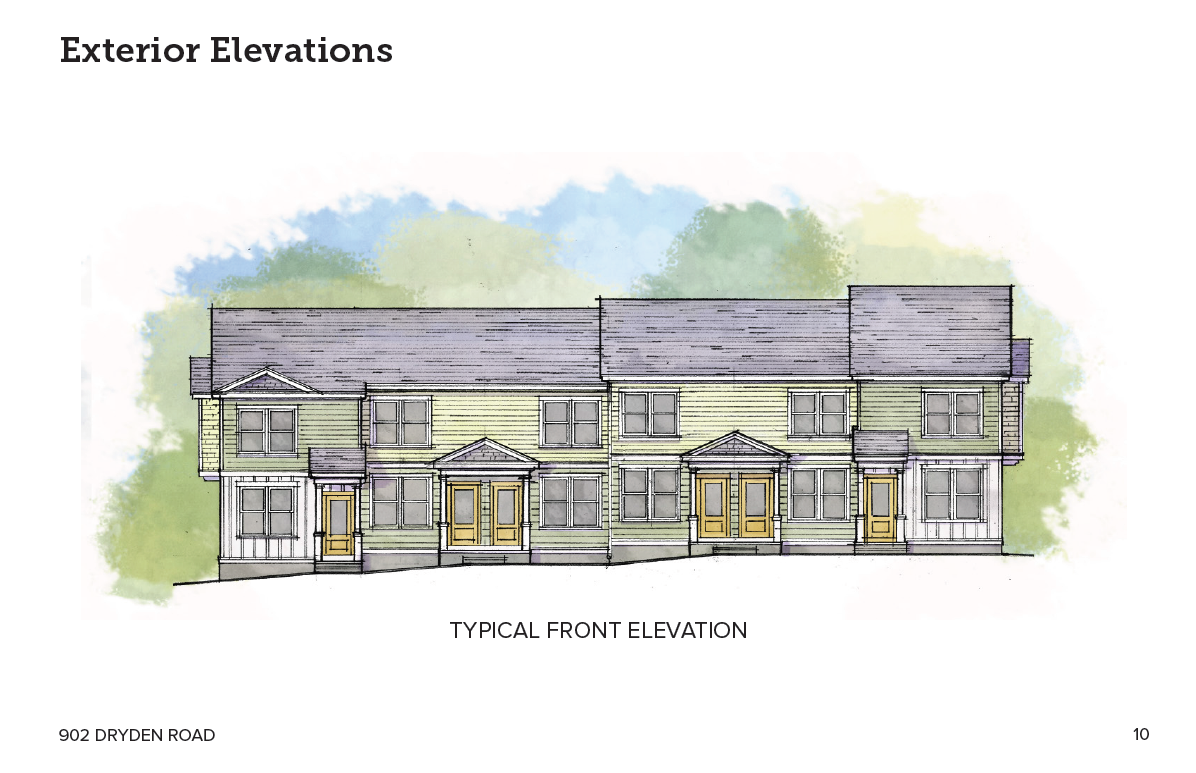
5. Now for project two, a multi-unit project at 902 Dryden Road. I’m just going to link to the Ithaca Voice article in an effort to save time. 15 units, (2 renovated, 13 new), 42 beds, and a $1.5 million investment.

902_dryden_2

I plan on touching on a couple of other minor Modern Living Rental projects at some point, but we’ll save those for a slower week.

20150613_180636 20150613_180659

6. This week’s house of the week feature is 318-320 Pleasant Street on South Hill. The rear portion (foreground) is an addition, a duplex with 3 bedrooms each. Exterior siding is nearly complete, though some housewrap and plywood is still visible on the south (front) wall of the addition. A peek inside the interior showed that the drywall has been hung-up, but final details like carpeting have yet to be installed (several rolls of neutral-colored carpets lay stacked on the floor).  The owners of the 105-year old house are members of the Stavropoulos family, who run the Renting Ithaca rental company and the State Street Diner.

On a side note, the 200 Block of Pleasant Street must be one of the worst hills in the city. Walking it must be terrifying on icy days.
oldlibe_franklin_proposal

travis_hude_libe_libe_v3

7. The Old Library vote made quite a splash in this week’s news. With a 6-6 hung vote, everything’s up in the air. This is what I feared would happen.

There’s a couple of options to break this. Two legislators, Kathy Luz Herrera (D- District 2, Ithaca City/Fall Creek and Cornell Heights) and Peter Stein (D-District 11, Ithaca Town/East Ithaca), weren’t in attendance, and could call the measure back up for a vote. Herrera’s District is two blocks from the Old Library site, and Stein’s a retired Cornell professor, so although I shouldn’t be guessing people’s judgement, I don’t think it’s a stretch to imagine which of the two projects they’ll be swayed by. But if either one of them decides they dislike all three options, or if they split their votes, then everything will be stuck in limbo. At that point, it’s anyone’s guess – the building could be mothballed, or given that its HVAC and utility systems are at the end of their mechanical lives, it could even be demolished as a long-term cost-saving measure.

If the county does decide in favor of one proposal, it’s still a long road ahead – ILPC approval, Ithaca city planning board approval, and a variety of other measures, which could break the winning proposal. Both projects have potential challenges – with Travis Hyde, ILPC or the Planning Board may try and whittle down its units, removing the density lauded by some legislators, and perhaps the project will no longer be financially feasible. With the condos, one starts with a building that’s had asbestos and air quality issues in the past – one bad surprise in the renovation, and the project could be jeopardized, or at least priced well above the quoted $240-$400k. There are a lot of variables in either equation, and since they can’t all be quantified, both will have their risks.

I’m just going to hope that someone is able to bring new life to the site. I don’t want to see two years go to waste.

state_st_triangle_3

8. Almost to the end. Here’s your monthly look at the Planning Board Agenda for next Tuesday:

– No subdivisions this month, but there will be a 15-minute public comment period on the city’s new Comprehensive Plan.

A. 210 Hancock will be giving an update on its plan and up for recommendation for the Board of Zoning Appeals for parking (64 spaces vs. 84 required) and height variances (46.5 feet vs. the legal 40 feet). Quoting the pre-prepared document, “The Board strongly recommends granting the requested variances.”

B. An update on DiBella’s as described above

C. Tompkins Financial Corp’s Headquarters will be open for public comment, determination of environmental significance (SEQR negative/positive), and preliminary approval for both phases

D. 215-221 W. Spencer will be reviewed for Declaration of Lead Agency (Planning Board agrees to conduct of State Environmental Quality Review)

E. “Collegetown Housing Project at Dryden and Linden – Update”. A.k.a. whatever John Novarr’s planning for that five-building stretch of Dryden and Linden he just deconstructed. Readers might remember this site was part of his Collegetown Dryden project proposed last July, but there’s no indication if it’s a revision of that, or a totally different approach. The one thing that is constant is the zoning – MU-2 for the three properties on Dryden and 240 Linden, and CR-4 for 238 Linden. Neither zone requires parking, MU-2 allows six floors and necessitates mixed-use (often interpreted as ground-floor commercial), and CR-4 does not have mixed-use requirements but the height is limited to four floors. Expect an urban-friendly six-story building fronting Dryden with a four-story setback on Linden.

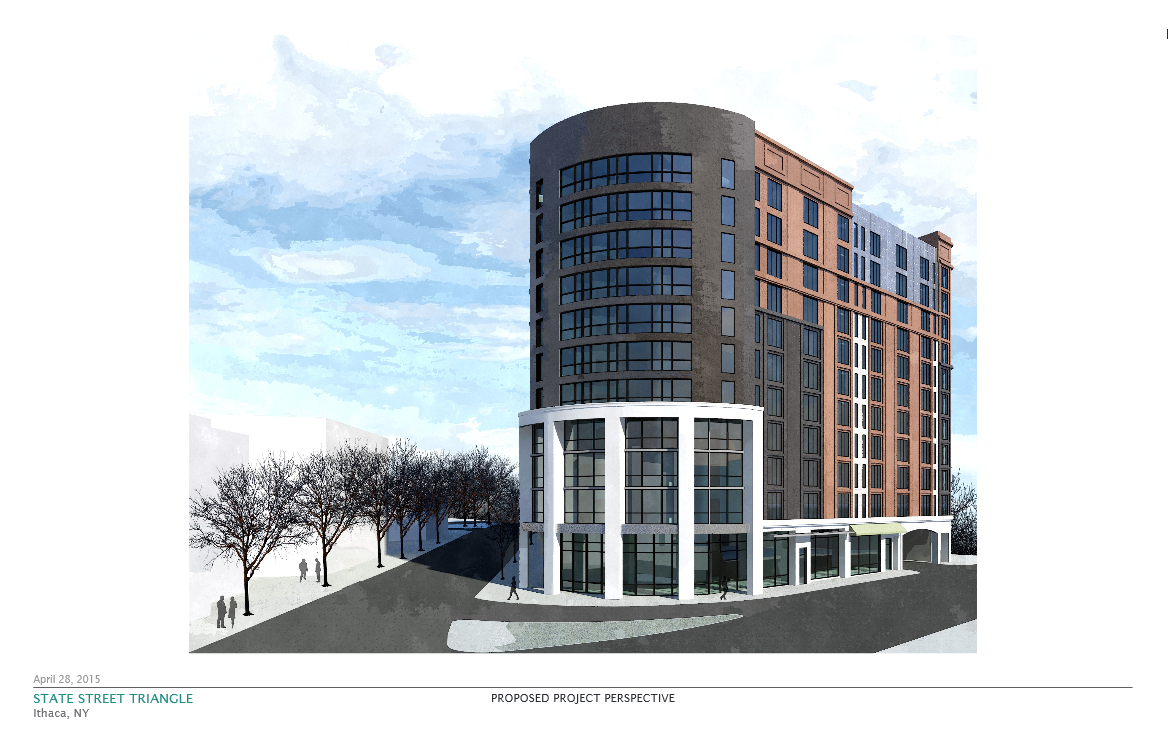
F. “State Street Triangle (Trebloc) Mixed-Use Project – Update” Anything could happen. Height decrease, site redesign, fewer units, major design changes…we’ll just have to wait and see how the 11-story, 600-bedroom tower has evolved given the initial recommendations of the Planning Board.

simeons_v2_1

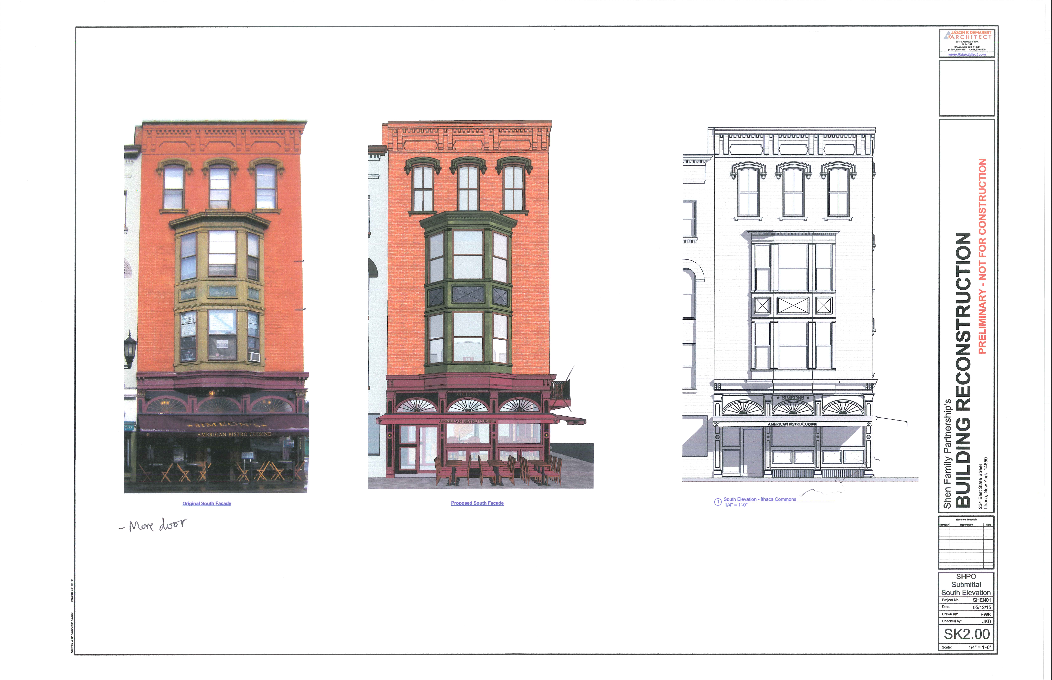
9. We’ll end this week on a happy note. Shen Properties LLC plans on launching their Simeon’s rebuild shortly; first and second floor restaurant space for Simeon’s, and five luxury apartments. The exterior will be a near-replica of the original facade of the Griffin Building, but the interior will be renovated to hold an elevator and a sprinkler system. In a quote to the Journal, property manager Jerry Dietz says to look for a reopening in the very late 2015 or early 2016 timeframe.


News Tidbits 6/13/15: Things that make you go Hmm

13 06 2015

travis_hude_libe_libe_v3

1. We’ll start this week’s round-up with the 800-pound gorilla in the room – the Old Library decision. The general, non-partisan rundown can be found in the article I did for the Voice. Rather than rehash that, I’ll give my own thoughts and opinions here.
In what should be no surprise to anyone, there’s a lot of acrimony flying around. The unavoidable problem here is that everyone has a different expectation for the site. To be honest, I was a little surprised that the Travis Hyde proposal was the winner. The Cornerstone and Franklin proposals were running about even when it came to public sentiment – many of the Voice commenters were stressing the need for affordable senior housing, just like the county did in the RFEI. Others used online petitions to push for the condos and saving the old library, but I personally felt that that was always going to be a stretch simply because the condos are a double-edged sword; they’re a needed commodity, but that “air of elitism” associated with the sale of a public asset for high-end homes would hound the legislators all the way to the voting booth.

The truth is, the RFP was designed to be unattainable, and I called it out for that last fall. There was no way a project was going to incorporate all the things it requested. Franklin couldn’t renovate the building and make their units at the affordable level. Cornerstone was able to make their units affordable but wasn’t as environmentally friendly as the others (it also requested a large PILOT). And I guess Travis Hyde was in the middle. Which on that 0-5 scale they used to score the projects, gives a simplified sort of 5-0 (2.5), 0-5 (2.5), 3-3 (3). With unrealistic expectations, of course the legislators were going to be disappointed, and they set up everyone else to be disappointed too. But the thought of holding onto a vacant building with its mechanical systems at the end of their useful lives, ready to put the county on the hook for hundreds of thousands of dollars in replacement costs, is probably the worst option out there.

TL;DR: There was going to a large contingent angry with the legislature’s decision, whatever it was. It’s times like this I wonder if the county should’ve just sold the site to the highest bidder.

Just for the record, because the three proposals were so different, and I thought all of three of them were good community assets, I honestly didn’t have a favorite. I had a slight preference towards DPI early on, but when they dropped out I became neutral about the whole process. But it’s only the Franklin supporters that are accusing me of subversively undermining them in the Voice write-ups, and it’s making me really cold to their cause.

inhs_pride_v3_elevations_2

2. From the Common Council’s Planning and Economic Development Committee (PEDC) agenda, more talk this week about removing the setbacks from Nate’s Floral Estates (more on that in a moment), and a Memorandum of Understanding that both the city and Cornell will be chipping in $100k from their affordable housing funds to help finance INHS’s 210 Hancock affordable housing project (specifically, the 53 apartments – the 12 for-sale townhomes are being financed separately).

As covered by Jeff in the Voice, concerns have been raised that the site is unfit for new development due to the possibility of environmental contamination. Nate’s is partially on the site of the old city landfill, and has been for 40 years. But concerns raised by Ithaca city councilwoman Cynthia Brock, Ithaca town board member Rich DePaolo, and environmental activist Walter Hang have tabled the zoning change for now until the Department of Health can re-review their previous correspondence on the park’s expansion and determine if the extra 30 feet is safe to build on. The expansion may still happen, and we’ll just have to wait on the DOH’s decision before any zoning changes move forward.

On a separate note, there’s this line from the March minutes, which are rolled into the agenda for approval:

Alderperson Brock would like to see an increase in owner-occupied housing in the City. She does agree that affordable housing is needed, but the need is for “for sale” housing.

The last I checked, Ithaca is the 11th most expensive city in the country for rents as a proportion of income. The city needs affordable housing, for-sale housing, and affordable for-sale housing.

tfc_v3_1

tfc_v3_2

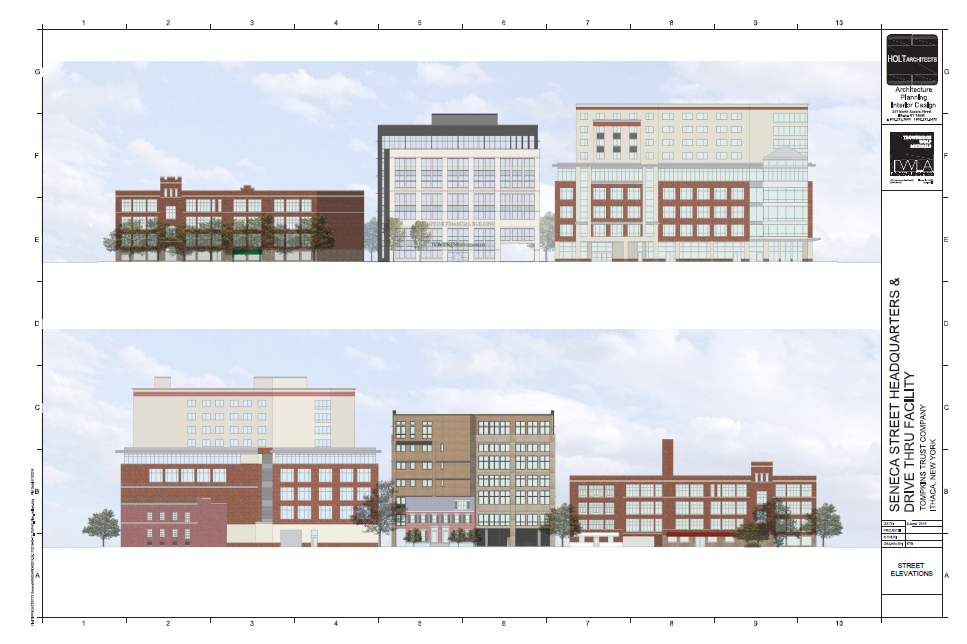
3. Fresh renders of the Tompkins Financial HQ. This one’s had some pretty substantial revisions from the initial bland brick box. A little more character and a more varied use of materials. More drawings here, cover letter here. This project’s just scooting right along, the applicants hope to have preliminary site approval granted at the June 23rd Planning and Development Board meeting. Construction is now expected to start in August and wrap up in February 2017.

A traffic study conducted by SRF Associates of Rochester determined that with only 20 employees moving from the suburbs into downtown, that the impact to the vehicular traffic on East Seneca (thousands of cars per day) will be negligible. A long-term increase in traffic is likely if other entities move into the rented space TFC vacates, but that’s well outside the scope of a traffic study.

The initial work calls for site clearing, demo of the existing drive-thru branch on site, then excavation down to the first sub-floor, thenceforth pile driving shall commence. It’s anticipated the sandy soils will make the pile-driving move along faster, but the other buildings nearby will necessitate temporary support installations during the excavation process.

On a related note, Tompkins Financial has filed an application with the IDA for a 10-year tax abatement. The application for the $35 million project (of which $28 million is for construction of the new building) states that the requested abatement would save the project $4.06 million in property taxes, and $2.112 million in sales taxes. New taxes generated and paid over the same time period would equal $3.782 million.

In the application, TFC states that it would be a few million dollars cheaper to build at “a generic rural site”, and in order to make downtown headquarters more financially acceptable, they decided to apply for tax breaks.

The application only suggests 6 new jobs over the next three years, paying $37k-$84k annually. Given previous estimates of 77 new jobs over 10 years, this lack of major job growth early on forces the later years to pick up the slack.

tfc_v3_3

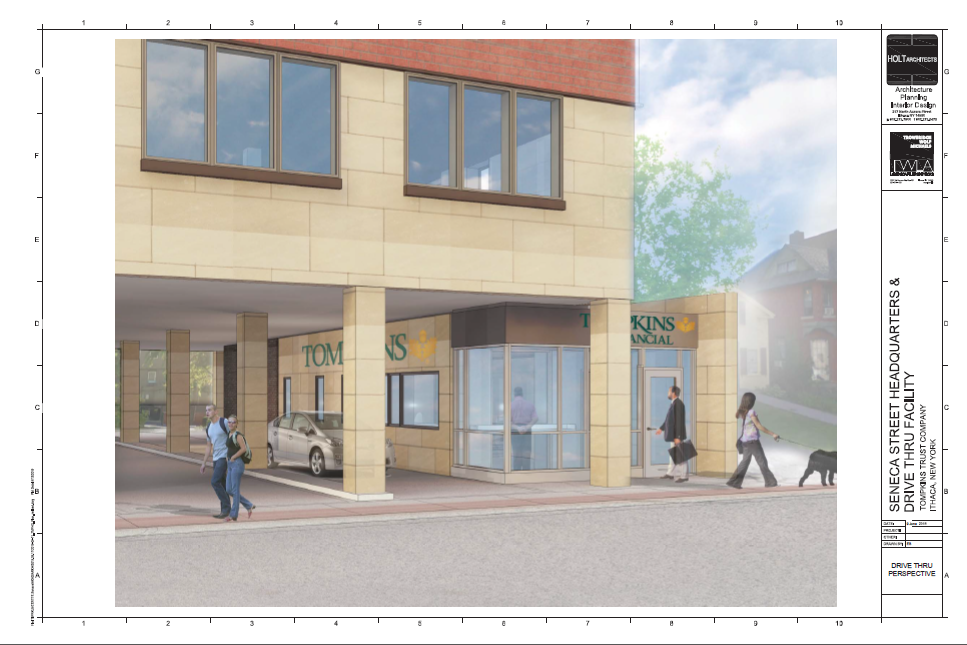
Of course, we also have a render of the new drive-thru across the street, which is nice but not nearly as exciting.

20150607_090520 20150607_090534

4. Sometimes I feel like I should do a random house of the week feature. Here we have a modular home being built on the 200 Block of Eastern Heights Drive in the town of Ithaca. It looks nearly finished at this point; permits for the home were filed back in March, so this one seems to have followed a normal building schedule with no major hangups.

Some modular homes are done on the cheap and look the part; others, like the Belle Sherman Cottages, do a great job with the finishes. This one may not look as great the Belle Sherman project, but it looks like a decent infill home for the Eastern Heights neighborhood. And it has great views to boot.

5. According to the town of Ithaca’s May 11th minutes, a developer has expressed interest in buying fire Station No. 9 at 309 College Avenue in Collegetown. An appraisal has been done and the City has hired a consultant to look into it. Fire Station No. 9 was built in 1968 to replace the original station, which is now The Nines. It sits in Collegetown’s densest zone, MU-2, so a potential replacement could be six floors with no parking requirement. There’s a lot to be looked at here, especially with the potential public safety impacts. But it’s something worth paying attention to over the next several months.

120_brindley_1

6. It’s unusual in Ithaca to see real estate advertisements posted with speculative commercial build-out plans. The above computer drawing is from the online posting for the sale of 120-140 Brindley Street in the West End. The three smaller buildings already exist – the “Aeroplane Factory” on the right and the other two properties comprise ~18,000 sq ft of flex office space. The drawing also shows an unbuilt 3-story office building; I don’t know how serious plans were for it, but it’s probably just conceptual. The real estate ad itself notes that a live/work building is possible, as well as a 6-story building of 25,000 sq ft.  The 2.38 acre site’s for sale for $2.79 million.


The Three Proposals for the Old Library

28 04 2015

Hot off the press release, here are the latest renderings of the three remaining contenders for the Old Library site, along with a few details about each. Feel free to pick your favorite and leave a comment.

oldlibe_cornerstone_proposal oldlibe_cornerstone_proposal_2

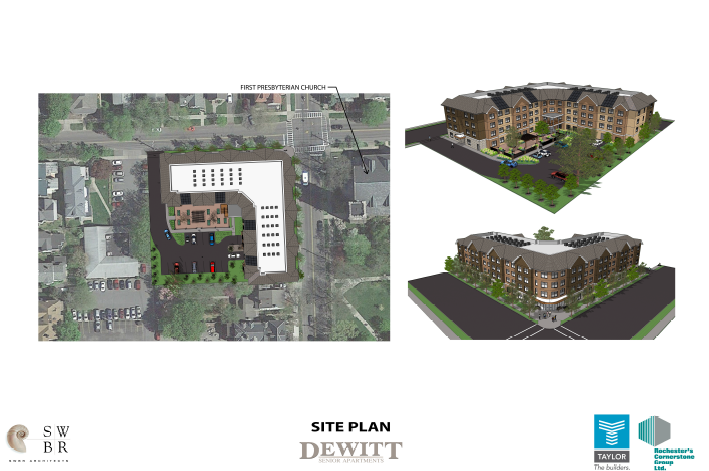
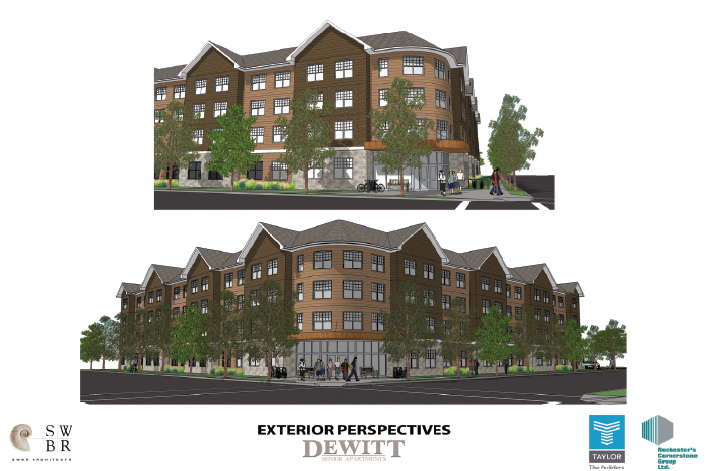
I. The Rochester-based Cornerstone Group proposal, a 73,600 sq ft building called the “Dewitt Senior Apartments” (link here), would buy the library site for $925,000, build 63 residential units of senior housing (3 studios, 54 one-bedrooms, 6 two-bedrooms), and include 700 sq ft of community space for nutrition education by Cornell Cooperative Extension. Cornerstone is a Rochester based non-profit housing developer, and is working in partnership with non-profit group Cayuga Housing Development (CHD). CHD is directed by the same people as the Ithaca Housing Authority, who operate Titus Towers. The building’s design is by SWBR Architects of Rochester.

The Cornerstone proposal is the only one which features affordable senior housing, targeted at seniors making less than 80% of median local income, meaning less than $44k/year for a single person, or less than $50k/year for an elderly couple. Rents would range from $825/month studios to $1,200/month for a 2-bedroom. The developers would seek affordable housing tax credits, and asked for a non-binding letter of interest from the Ithaca Urban Renewal Agency, in which the IURA could offer a loan of up to $200,000 towards the development. The agency preferred a more nuanced approach of possible financial support if the project was selected, rather than supporting the project during the decision process. The proposal includes a 32-year PILOT (Payment In Lieu Of Taxes, like what Cornell uses) to “ensure rental affordability”.

oldlibe_travishyde_proposal oldlibe_travishyde_proposal_2

II. Ithaca based private developer Travis Hyde Properties proposes a 72,500 sq ft building with 60 senior apartments (21 2-bedroom and 39 one-bedroom), and would include space for senior non-profit group Lifelong, professional offices, and a community room (link here). The building uses a butterfly roof for rainwater collection and to keep the height as minimal as possible, and the three-story section is intended to respect the massing of the neighboring church. Lifelong occupies the first two floors of the western wing, with housing on the top floors. Commercial office space faces Court Street, and a one-story eastern wing holds shared space for both Lifelong and a community room. The units are market-rate. and Lifelong’s space at 121 West Court Street is renovated and kept on as an annex property. No purchase price is given, except to say “fair market value”.

Travis Hyde is currently developing the Carey Building addition, built the Gateway Commons apartment building, and further back, developed Eddygate in Collegetown. Travis Hyde teamed up with Ithaca-based HOLT Architects for their proposal. The project has been designed to achieve LEED Silver at a minimum, with LEED Platinum being considered.

What makes this proposal unique is that it’s the only one that includes space specifically for Lifelong.

oldlibe_franklin_proposal oldlibe_franklin_proposal_3

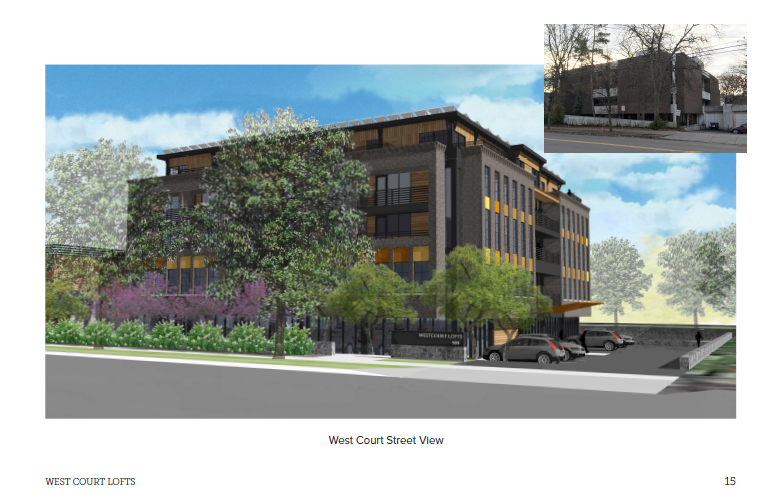
III. Syracuse-based Franklin Properties of Syracuse have teamed with a group of local firms (STREAM Collaborative and Taitem Engineering, among others) to propose a “wellness center” for the library site, called the “West Court Lofts and Wellness Collective” (link here). This proposal is the smallest of the three proposals at 58,000 square feet and has the fewest number of units at 22, along with medical offices, a café, and a small community room. The first floor would have the cafe and some office space, and the second floor would be all medical offices. Senior housing would be built on the upper floors. In a major change from the previous proposal, the units are now intended to be higher-end condos for empty nesters and retirees.

Notably, this proposal is the only one that reuses the original library, although the building would be extensively modified. Members of the ILPC (Ithaca Landmarks Preservation Council) liked this proposal because it keeps the 1967 library and its “intrinsic historic value”. The library site would be purchased for $925,000.

In sum, we have apartments for low and moderate-income seniors, higher-end senior condos, and market-rate senior apartments. Each is going after a different part of the Ithaca market.

Three previous contenders have pulled out of the process – Ithaca Neighborhood Housing Services pulled out when they purchased the Neighborhood Pride site (the 210 Hancock project) and decided to focus on that. Integrated Acquisition and Development (IAD) dropped out next; their “Library Square” proposal was the largest at 90 units. IAD is, however, involved with the recently-proposed State Street Triangle project in downtown Ithaca. DPI Consultants submitted the only original proposal that included owner-occupied housing, but did not respond to the RFP after expressing frustration with the county’s frequent delays in the evaluation process.

The next meeting of the Old Library committee is scheduled for Thursday, April 30th at 9 AM in the county’s legislative chambers. 5 PM Meetings will be set up during May for developer presentations to the public (the first, a meeting for the Cornerstone proposal, will be held on the 1st; the Travis Hyde proposal will be presented to the public on May 8th at 5 PM, and the Franklin Properties proposal on May 12th at 5 PM. All will be in the legislative chambers). For those unable to attend, comments on the proposals can be emailed to the committee at Legislature@tompkins-co.org with the subject title “Old Library Property”.

For reference, here’s a copy of the criteria used to judge the project, and a rough timeline from here on taken from the county’s documents:

1. Staff score criteria identified in RFP including narrative explanation for each score ( Rank on a scale of 0 to 5 where 0 = did not address and 5 = addressed exceptionally well) – April

A. energy efficiency and carbon footprint, including impacts of proposed
demolition/deconstruction and/or remediation, of the project including any attempt to meet Architecture 2030 standards (e.g., 0 – meets current energy code, 5 – meets LEED Platinum or 2030 district standard)

B. quality of the overall program and conceptual design, including its compatibility with the surrounding historic neighborhood and how it addresses traffic, vehicular and pedestrian circulation and parking ( e.g., 0 – meets zoning code, 5 – setbacks and massing sensitive to adjoining property and street, design includes elements to address historic district, incorporates traffic and pedestrian features that will serve building occupants and minimize neighborhood impact)

C. responsiveness to community needs including housing and other uses, such as a community organization (e.g., 0 – does not specifically address a community need, 5 – provides housing addressing an unserved market segment, including a diverse population, includes mixed uses, provides a community amenity and houses a community organization)

D. positive economic/tax base impact (e.g., 0 – no net positive impact as requested subsidies outweigh benefits, 5 – large net positive impact including impact to tax base and downtown economy)

E. capability of the developer or development team to undertake, finance, and manage the project (e.g., 0 – development team experience doesn’t match project scope and financing plan is questionable, 5 – excellent development team with extensive comparable experience developing successful projects and financing plan is sound with little or no uncertainty)

F. demonstrated market feasibility of the proposed program (e.g., 0 – no evidence that market analysis has been conducted or that market for proposed uses is supported by demand, 5 – market well documented by community-wide and developer studies and costs are in line with market)

G. price/lease payments offered for the property (e.g., 0 – NPV does not meet county’s listed price without any rationale, 5 – NPV greatly exceeds county’s listed price)

H. plan for managing neighborhood impacts including noise and air quality during demolition/deconstruction/remediation and construction. (e.g., 0 – no substantive plan presented, 5 – plan presented that minimizes neighborhood impacts to the maximum extent possible both during construction and after project is occupied)

2. Committee reviews staff scoring and either confirms or revises. Post for public review. – April

3. Optional interviews; public comment period/hearing. – May

4. Committee considers proposals, staff scoring, and public comments and recommends a decision to the Legislature. – May/June

5. Legislature considers committee recommendation and makes a final decision. – June/July


News Tidbits 4/11/15: Not Feasible As Presented

11 04 2015

dpi_libe_0414_end

1. If my inbox has been any clue over this past week, there are some folks who are pretty unhappy with the results of the county’s Request for Proposals (RFP) for the Old Library site. One more applicant has dropped out of the process – DPI chose not to respond to the RFP. DPI had proposed 76 condos and 8 apartments for the site, a move that was cheered by some residents who spoke passionately about the new for purchasable housing in the city. That leaves three contenders of the original six:

-The Syracuse-based Franklin Properties project, now called the West Court Lofts and Wellness Collective, would renovate the existing building and include 22 residential condominium units (down from 32 units in the RFEI), medical offices, a café, and community room.

-The Rochester-based Cornerstone Group project, known as the Dewitt Senior Apartments, would build 63 residential units of senior housing (down from 70-80 units in the RFEI), and include community space for nutrition education by Cooperative Extension.

-The Ithaca-based Travis-Hyde Properties project would build 60 residential senior-focused units (up from 48 units in the RFEI), and would include space for Lifelong, professional office, and a community room.

There have been no renderings published as of yet, but there will be a stand-alone post when they show up on the county’s website. The three proposals will be judged against each other over the course of the next couple months. A quick glance at the judgement criteria can be found in the Old Library meeting notes here.

The next meeting of the Old Library committee is scheduled for Thursday, April 30th at 9 AM. 5 PM Meetings will be set up during May for developer presentations to the public. Comments on the proposal can be emailed to Ed Marx, the County Planning Commissioner, at emarx@tompkins-co.org with the subject title “Old Library Property”.

2. Local credit union CFCU (Cornell-Fingerlakes Credit Union) is making some moves by buying a retail commercial strip with an eye towards redevelopment. The property, 501-507 S. Meadow Street, sold for $1,555,550 on March 30th, well above its assessed value of $950,000. According to a statement taken by the Ithaca Journal, “the current intention is to ultimately use the site for credit union-related purposes”.

The one-story, 9,203 sq ft strip buildings date from 1980 and 1990 and previously housed a Thai restaurant and offices for Lama Real Estate, the business of previous owner Robert Lama. The site is currently zoned the suburb-friendly SW-2, but like much of big box land, it has been targeted for urban mixed-use in the city’s Comprehensive Plan. CFCU is currently headquartered in about 30,000 sq ft of office space in two 1990s office buildings at 1030 and 1050 Craft Road in Lansing.

In short, nothing immediate going on here, but definitely a property worth keeping an eye on.

texas_roadhouse__v2_1

3. The proposal for a Texas Roadhouse on in Southwest Ithaca is getting a couple minor revisions. According to a cover letter from the restaurant chain, plantings have been revised to break up the expanse of blank walls, handicap ramps are now present in the new elevations, and signage has been tweaked. All in all, not a big change from the previously-shown drawings. It doesn’t look like this one will have too many issues moving forward.

canopy_hampton_rev4_1

4. At the city’s Planning and Economic Development Committee (PEDC) meeting on the 8th, the city voted to approve the sale of land at 320-324 E. State Street to Lighthouse Hotels LLC for construction of the new Hilton Canopy Hotel. Also up for discussion was the removal of 30′ setbacks on all sides of the special MH-1 zoning at the Nate’s Floral Estates mobile home park on the west side of the city. With the 30′ rear yard setbacks already in place and vegetative buffers installed by the big boxes to the south, it was felt by the city economic developer planner that the additional setback was redundant. The removal would facilitate setbacks reduced to 10′ on one side and 5′ on the other side, if I’m reading this right. According to the notes, the mobile home park has a waiting list of tenants. The proposal looks like it will allow a few more units in the park, though it looks pretty tightly packed as-is.

flatiron_1

5. According to the Ithaca Urban Renewal Agency (IURA) notes from the April 2nd meeting agenda, the board was not impressed with the Flatiron proposal. On page 6, it gives the project low pritority, with the description “not feasible as presented“. On the other hand, the INHS Hancock Street project was well received and given high priority.

402_s_cayuga_st_rev2_1

6. Looking at the March Planning and Development Board meeting minutes, 402 S. Cayuga Street has been approved, pending BZA approval of the variance (which was granted this week, if I have my notes right). The 4-unit, 9-bedroom project may be small, but it’s thoughtful infill and will help bring some affordable owner-occupied housing back into the city.

Approvals were also granted for the city project to replace the Lake Street this summer and fall, and refurbish the pocket park to its southeast. 210 Hancock was discussed without any voting, and sketch plans were presented for the TFC HQ downtown, and the 215 West Spencer Street apartment project, which have been written about previously. The board also discussed added additional questions to the CEQR (the city’s version of the SEQR used in project impact analysis), and the revised paperwork will be reviewed at a later meeting.

Oh, and on a more personal note, this totally made my day:

D. 2014 Planning Board Annual Report

[Senior city planner Lisa] Nicholas briefly walked through the annual report, observing it was a very busy year with a considerable number of additional housing units built. [Board member Garrick] Blalock asked if the annual report is publicized. Nicholas replied, no. Blalock replied it should at least be sent to the “Ithacating in Cornell Heights” and “IthacaBuilds” web sites. Nicholas agreed to do so.
I’ll be excited to have a copy. This would make scouting locations where construction photo updates are required a lot easier.

7. Wrapping this up with one final news piece, it looks like Dunkin’ Donuts is moving into the old Johnny O’s space at 406 College Avenue in Collegetown. So there will be one corporate coffee shop next to another corporate coffee shop and sharing a wall with a trendy fro-yo place. There’s probably a sociology thesis to be had in studying the changing retail scene of Collegetown.


News Tidbits 3/7/15: All is Not Well on East Hill

7 03 2015

hsrqev1

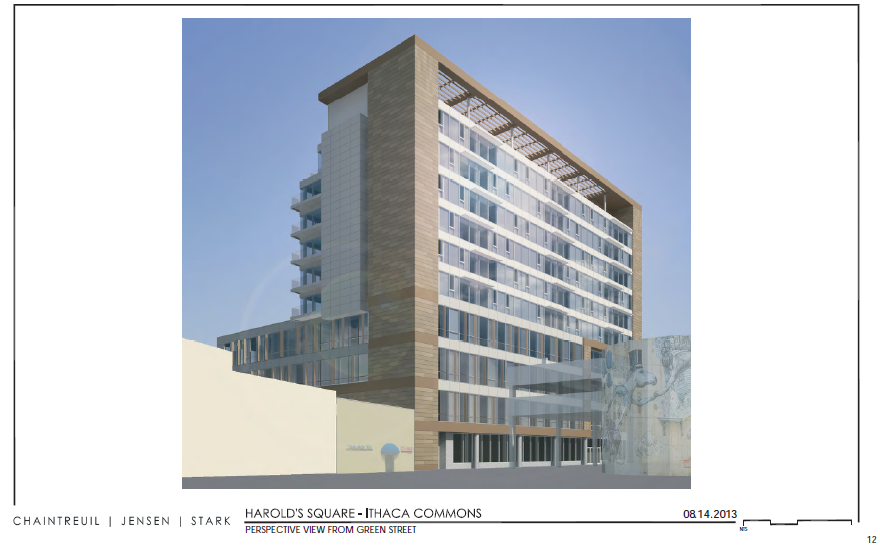
1. Leading off this week with a note of optimism – David Lubin, the developer of the proposed Harold’s Square mixed-used building in downtown Ithaca, says that plans for the 11-story building are still underway, according to a comment he made to the Ithaca Journal. Lubin says he’s currently in the process of lining up investors to finance the construction of the project, a challenging process once one tells investors that the project is in upstate New York. It’s not impossible to have a private project financed in Ithaca (if the Marriott underway down the street is any indication), but for a project costing $38 million, it’s no surprise that it’s taking a while. It’s easy to think that this one has slipped into the dustbin, but fortunately it has not.

Meanwhile, Ithaca Builds woke from its winter slumber to give an update regarding Lubin’s other big project, the Chain Works District for the old Emerson site on South Hill. Currently, the Chain Works District is in the process of writing up its Draft Generic Environmental Impact Statement (DGEIS). A DGEIS is part of the State Envrionmental Quality Review (SEQR), where the leading agency looks at a project, determines if any adverse project impacts are properly mitigated, and if so, issues a statement giving a negative declaration (approval). In this case, the NYS DEC also needs to be on board, approving the contaminated site for residential use. This is a pretty complicated project. There’s 800,000 sq ft of space to be removed or re-purposed, in an environmentally compromised site split between two political entities who are conducting joint meetings with their planning boards in an effort to try and move this project forward (the town of Ithaca board deferred to the city of Ithaca for lead agency; and both have rezoned the site to their respective specialized mixed-use zones). According to IB, the Phase I and Phase II Environmental Site Assessments (ESAs) contain about 60,000 pages of paperwork. The official timeline (already behind schedule, according to city docs) hopes to have the DGEIS submitted shortly, with a declaration of significance sometime in the Spring. In theory, Phase I site prep could start this year, but who knows if that will happen in practice.

franklin_libe_0414 travhyde_libe_0414 roccorner_libe_0414 dpi_libe_0414

2. The ILPC (Ithaca Landmarks Preservation Council) had a chance to review the four proposals for the Old Library site. Perhaps no surprise, the favored proposal was the Franklin/O’Shae proposal at top, which keeps the 1960s library and its “intrinsic historic value”. Members did, however, express some concern with the current building’s environmental contamination (asbestos). As for the other proposals, council members generally liked the Travis Hyde plan, and felt the Cornerstone and DPI projects were insensitive to the site (although one member expressed appreciation that at least the Cornerstone plan had affordable housing). It sounds like there will be some major tweaks to the building renders in the full proposals due later this month, so it’ll be best to hold off on judgment until those revised plans are published.

100_3080

3. Now for some bad news- Cornell is running into major financial problems, to the tune of a $55 million deficit. About half of that, $27.5 million, is expected to be reconciled with budget cuts (the other half will be covered by tuition increases). Considering the very large role Cornell plays in the local economy, this could have a chilling effect on local businesses that depend on Cornell or its employees. There are shades of 2009 here, when a projected $150 million deficit over 5 years resulted in 432 voluntary retirements, and hundreds of jobs lost.  The cut from 2008 to 2009 was a 5% reduction for the 2009-10 fiscal year, while the cut to go into effect for 2015-16 is estimated at 2-2.3%. Quoting an interview the Sun did with Skorton:

“[In the 2008 financial crisis,] We froze everybody’s salary for a year, paused construction, slowed down on hiring, developed a voluntary staff retirement incentive and 8 percent of the staff force was reduced … and [we had] a couple hundred layoffs, which is very, very hard to do,” Skorton said. “So that’s how the University acted in the worst crisis that ever happened. And so that’s a predictor of how it’s going to happen in this case.”

An article in the Sun a couple of days later notes that faculty employment is at an all time high. With 1,652 faculty in Fall 2014, Cornell has now passed 2007’s 1,647. – but one observant commenter, who I will happily buy a drink if I ever meet in person, notes that Cornell’s total enrollment is up 2,050 students since 2007. Devil’s in the details, folks – Cornell could use this “all-time high” as an excuse to not hire more faculty during its latest financial crisis, even though the student-faculty ratio have been increasing for years. Let’s not forget that faculty-student ratios are a crucial part of college rankings.

All of this is rather disconcerting news, especially in a time where the national economy has been picking up. Cornell has real potential to not only cause a localized recession, but also fall behind its peer institutions.

4. On a somewhat brighter note, even with this appalling winter, the construction of Klarman Hall is only nine days behind schedule, according to the Sun. Atrium glass installation should begin in April, and East Avenue will be reopened to two-way traffic around that same time. Although this project is well underway towards a December 2015 completion, one has a right to wonder if it is wise for Cornell to pursue the Gannett expansion and Upson renovation (valued at over $100 million combined) during these perilous financial times.

village_solars_3

village_solars_2

5. The town of Lansing’s planning board is set to review some slight changes to the massive Village Solars apartment project at its Tuesday meeting.

First, a quick primer – while the whole plan is for about 300 units, the approved phases account for only 174 units, and are being built in phases. The photo updates I’ve previously featured here on the blog show the first phase underway, buildings “A”, “B” and “C” on the right (south), with 36 units total. There are four phases, with two sub-phases in phase 2. Phase 2 consists of D, E, G and H with their 41 approved apartment units, and phase 2A is building F, which has the community center as well as 10 more units.

The revised plan calls for moving 6 units from buildings G and H to building M, which is in phase 4. G and H are combined into one apartment building (G/H), leaving 35 units in Phase 2. There are a couple reasons cited for this change – when working with NYSEG to lay out the utilities, it was decided to make phase 2 all electric services, due to concerns that Lansing may not be able to provide gas service if the tense situation with the gas pipeline proposal on West Dryden Road doesn’t go in the town’s favor. One of the results of the utility infrastructure change was a difference in utilities layout, and it was deemed prudent to shirt the walkway northward. This impacted the site design, which is why the Lucentes are seeking to revise the PDA (planned development area, similar to the city’s PUD and the town’s PDZ).

The change isn’t huge, and isn’t likely cause too much consternation among board members. This is actually the first site plan I’ve seen for the project, since it was approved before the town uploaded supplemental docs to its webpage. More importantly, it’s much clearer how future phases could build out – if the ~300-unit project takes 8-10 years as projected, then estimating the construction of phase 2 and 2A from summer 2015-16 seems reasonable.

simeons_1

6. Planning board members had mixed reviews about the Simeon’s rebuild, according to the Ithaca Times. While some members were excited about the rebuild, others expressed concern with the proposed addition of a second-floor balcony, seen in the above render by architect Jason Demarest. The project is eligible for state tax credits designed to renovate historic buildings, but if the credits are granted, then the balcony would not be built. If the credits are not granted, the building owners are looking not only at a balcony, but the possibility of widening the bay windows a little (it turns out the bay windows were an early renovation to the original Griffin Building, and larger bay windows would benefit a planned expansion of Simeon’s to the second floor). Regardless, cast-iron ornamentation that was salvaged before demolition will be incorporated into the rebuild.

During the same meeting, the planning board accepted revised signage for the Marriott, and there was further discussion about the Canopy Hilton. Nearby residents expressed concerns that a downtown hotel will increase traffic, and complaints were made about the ingress/egress plan for both the hotel and the CSMA next door. No word on the land swap CSMA wants, but it doesn’t seem like they’re budging on their property’s all-important utility easement quite yet.