Upson Hall Construction Update, 5/2016

26 05 2016

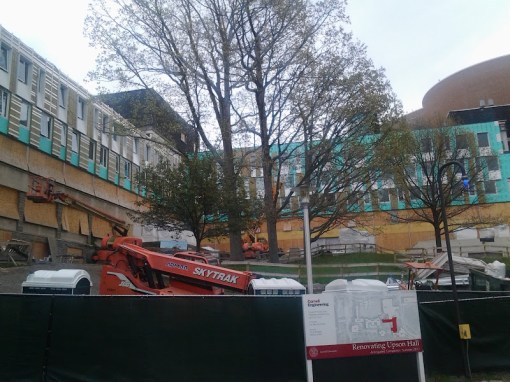
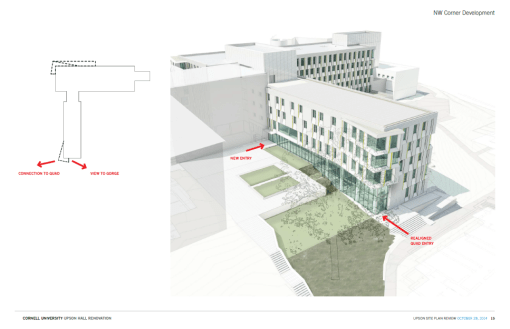
Taking a gander at Upson Hall, it looks like the renovation project is coming along nicely. The bump-outs are built out, sheathed and covered with the turquoise water resistant barrier. It looks like an insulation layer is going on top of the barrier, and then clips for the grey terra cotta panels. Many of the windows have been fitted, and the south windows of the west wing have had white aluminum surrounds installed, but the west face of the west wing is still metal stud walls, and neither of the bump-outs have received glazing.

Note that the building renovation is in two phases – the work set to wrap up this August focuses on floors 3, 4, and 5. Floors 1, 2 and what’s left in the basement will be finished over the following 12 months. There’s a third phase after those two, mostly dealing with enhanced landscaping.

According to Cornell’s project update page, mechanical rough-ins are underway for the rooftop equipment, and then the interior work (rough-ins, drywall, painting, ceiling installation) which is generally further along the farther up in the building one goes.

20160522_133359 20160522_133427 20160522_133517 20160522_133644 20160522_133729 20160522_133818 20160522_133823

upson_4

upson_3


Cornell Veterinary School Expansion Construction Update, 5/2016

25 05 2016

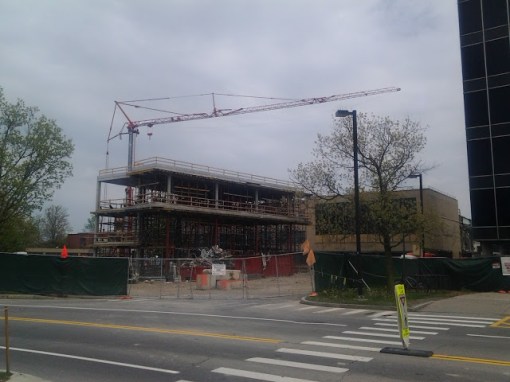
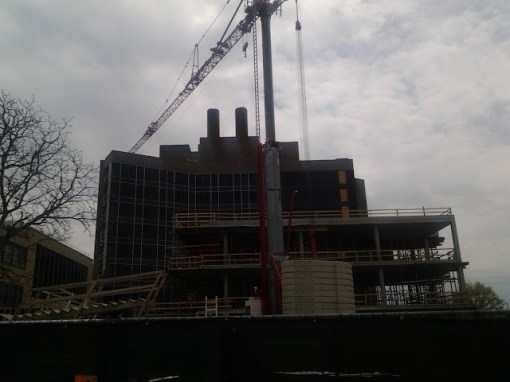
From Tower Road, it doesn’t appear a whole lot has changed since the last construction update in March. Work has shifted away from new construction somewhat, and towards the demolition of underused academic space to make way for the rest of the Vet School reconfiguration and expansion. The reinforced concrete frame of the new library and dean’s wing has advanced a bit, and new curtain wall glazing appears to be going in on the Vert Research Tower. The project is a bit disjointed because of the needs of academic space and surging at various times of the year.

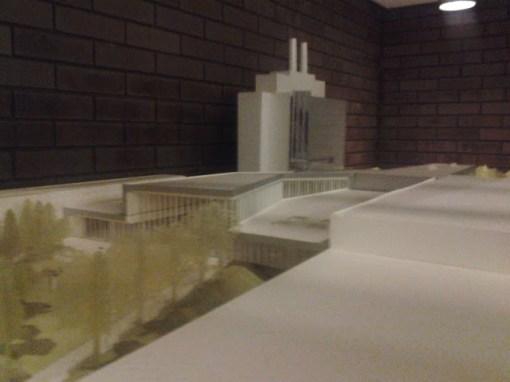
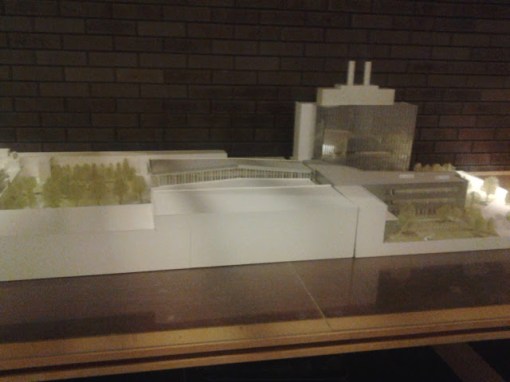
Thanks to the kindness of a woman in blue scrubs, I was able to enter the building. While trying to find a good angle of the new demolition (couldn’t, but there’s a photo on the Vet School website here), I stumbled upon a model and timeline of the project, pictures below. According to the timeline here, the project completion is January 2018, not June 2017 as reported on the website. Dunno which one is more accurate. The model does a great job illustrating the full breadth of the project in relation to the rest of the vet school complex.

20160522_130612 20160522_130756 20160522_130851 20160522_130922 20160522_131344 20160522_131403 20160522_131417 20160522_131428 20160522_131445 20160522_131554 20160522_131846

Looking east from Tower Avenue. Rendering property of Cornell.

Looking east from Tower Avenue. Rendering property of Cornell.

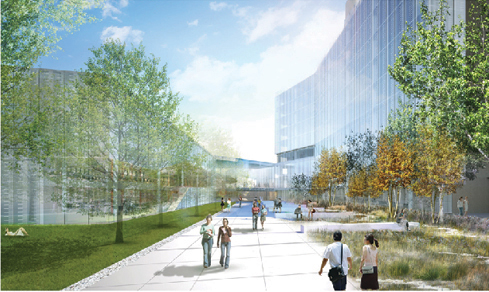
Looking west from new courtyard. Rendering property of Cornell.

Looking west from new courtyard. Rendering property of Cornell.


Holiday Inn Express Construction Update, 5/2016

25 05 2016

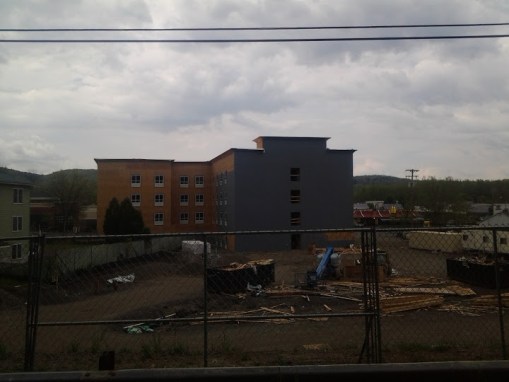
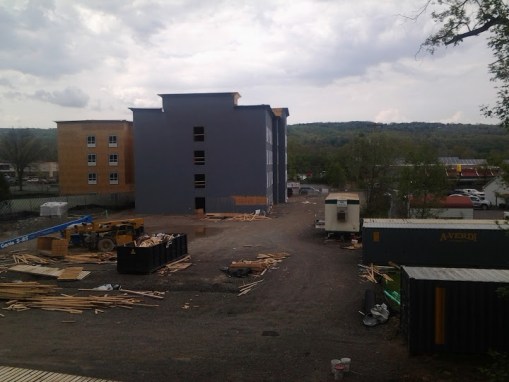
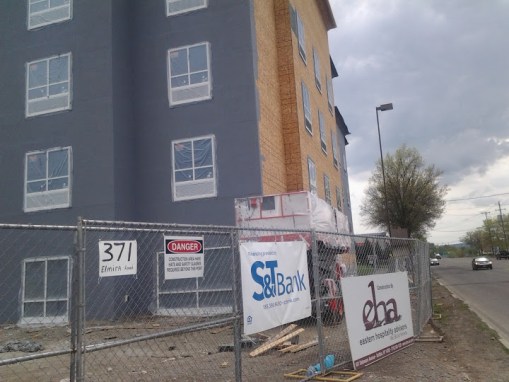
The new Holiday Inn Express at 371 Elmira Road seems to be coming along fairly quickly. Framing was completed a few weeks ago, and at this point most of the windows have been fitted. For those concerned that this is going to be a battleship grey eyesore, fear not. The plywood will be covered with varying colors of an Exterior Insulated Finishing System (EIFS, a synthetic stucco) and stone veneer. The grey is most likely a moisture barrier. Drainage cavities are then built over the barrier to allow water that has penetrated the surface to exit the wall without wrecking it (a big problem with early EIFS systems).

When finished, the hotel should look a lot like this one, with some minor design differences and an updated color scheme:

The project is being financed with a $5.98 million loan from S&T Bank, a regional bank in Western Pennsylvania, and Eastern Hospitality Advisors, a Buffalo contractor specializing in hotel construction, is managing the build-out.

The 4-story, 79-room hotel is expected to open late this summer.

20160522_145118 20160522_145153 20160522_145515 20160522_145542

holiday_inn_express_v2


DiBella’s Construction Update, 5/2016

24 05 2016

One restaurant opens, another is just getting underway. NYC-based Marx Realty, operating as Ithaca Joint Ventures LLC, is finally starting work on the DiBella’s pad building long-planned for the Ithaca Shopping Plaza off Old Elmira Road.

DiBella’s first started planning for an Ithaca location back in November 2014. After a few design iterations, the project was approved by the Planning Board and BZA late last summer. The restaurant replaces what was previously part of the shopping center’s parking lot.

The exterior will be similar to DiBella’s other recent stand-alone restaurant locations – CMU faced with brick and stone veneer, decorative sconces (light fixtures), and a “patina green” patio roof. The size of the building will be about 3,400 square feet, which is typical for the Rochester-based sandwich chain. The interior will be designed with a 1930s/1940s era theme, also standard for the DiBella’s chain. Along with the building comes a revised parking arrangement for 35 cars, bike racks, signage, landscaping and a modest patio area. Early Site Plan Review documents estimate the project cost at $600,000.

As for the construction images, it looks like the foundation’s sub-base is being prepared for the foundation slab. This is going to be concrete slab-on-grade, no basement. The sub-base will give a uniform base from which to build upon, and helps to compact the soil, making it less likely to undergo excessive settling. The soils down in the flats are notoriously difficult to build on, because they are very soft and compressible – the shopping plaza, which was originally built in the 1950s, has had some mild settling issues. I don’t see anything to confirm it, and someone knowledgeable feel free to chime in, but it would seem removal and replacement of existing fill is likely to approach used here, similar to the Texas Roadhouse project. The drum roller in the last photo supports that idea. The turquoise pipes are water-sewer pipes.

The FEAF estimates a seven month construction period, so a late fall opening isn’t out of the question. DiBella’s expect to employ about 25.

A&E Construction of suburban Philadelphia is the project contractor, and the building was designed by Ithaca architect Jason K. Demarest.

20160522_150132 20160522_150306 20160522_150330

DiBellas-Ithaca-NY-rendering-large


Texas Roadhouse Construction Update, 5/2016

23 05 2016

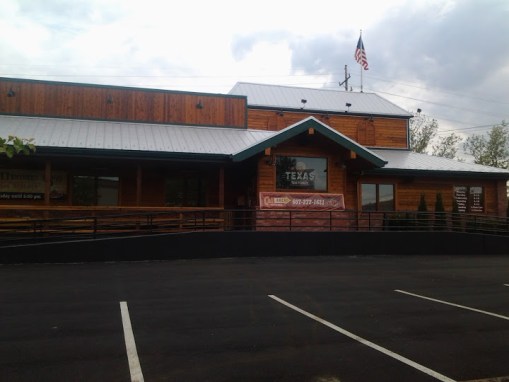
Just a few other photos from this past Sunday. As of 4 PM today, Texas Roadhouse is open. The landscaping is complete, the parking lot is paved and striped. If you love the food, fantastic. If you don’t, well, at least it’s bringing tax money into municipal coffers.

For me personally, it’s been kinda cool to watch this from start to finish – I broke the story on the Voice in March of 2015, and have been keeping tabs on it since. I didn’t realize it was due to open today until taking photos this past weekend, so once again, it became a popular article for the Voice’s website.

The $1.35 million project at 719 South Meadow Street was formerly home to Cellular One, a 1990s one-story masonry building that was demolished in 2013. The restaurant was originally slated to open in Q1 2016, but construction started a little later than anticipated last fall.

Texas Roadhouse corporate developed the site, leasing the land from plaza owner DDR Corp. of Ohio. GreenbergFarrow of suburban Chicago is serving as an architectural consultant for the project. Edger Enterprises of Elmira served as general contractor.

20160522_150027 20160522_150048  20160522_150233 20160522_150237 20160522_150539


News Tidbits 5/21/16: Building Bridges, or Burning Bridges

21 05 2016

209-215_2

1. 209-215 Dryden Road has a name: the Breazzano Family Center for Business Education. Let’s just call it the Breazzano Center for short. The name comes as part of a $25 million donation from Cornell MBA alum David Brezzano ’80, and is named in honor of him and his three sons, all recent Johnson School graduates. According to the Cornell Chronicle, the donation will “substantially support” the building’s construction, which construction loans on file with the county have pegged at $15.9 million. Breazzano is the president of money management and investment firm DDJ Capital Management, and did his undergrad at Union College in Schenectady, where he serves as trustee.

John Novarr is the developer for the 6-story, 76,200 sq ft building, and Cornell will occupy 100% of the structure on a 50-year lease.

chapter_house_v4_1

2. So, something weird is going on. The city BPW is set to discuss an encroachment for the Chapter House reconstruction at their meeting on the 23rd. However, all the paperwork included in the agenda dates from before the sale and refers to the previous owner. So either the new owner is pursuing the encroachment and the information hasn’t been updated, or this is outdated/no longer being pursued and no one’s updated the BPW paperwork. I tried calling the project architect (Jason Demarest) but he’s out of town until Saturday, and this publishes Friday night, so…dunno. Hopefully someone can provide some insight. For the record, the encroachment is for the first-floor roof overhang over the sidewalk, and will cost the developer $33,812.28.

100_1466

Open question, would a brick-for-brick rebuild had to have paid for this encroachment as well? It existed with the original structure, this was designed with heavy ILPC input, and given that project costs seem to be why this is in jeopardy…it just seems like an unnecessary obstacle. I know it’s a new build, but it’s replicating a previous encroachment for the sake of character. It seems like the project is being financially punished for that.

brindley_elevation
3. For this week’s eye candy, the above image appears to be the city’s proposed redesign for the Brindley Street Bridge over on the West End. Pretty similar to existing newer or renovated bridges in the city (Clinton Street, South Aurora Street), with older-style lamp posts and stylized concrete railings.

Alternative 2 calls for a pedestrian bridge to replace the existing Brindley Street Bridge, which was last renovated in 1952. A new bridge for vehicle traffic would be built south from the intersection of Taughannock and West State Streets, over the inlet, and intersecting with Taber Street. The project is expected to go out to bid next year, and completed in 2018.

4. Per the Ithaca Times, the Taughannock Farms Inn out in Ulysses has some expansions and renovations planned since new ownership purchased the property back in February. Along with a bistro for lighter fare, an electric car charging station and a dock, the Times introduced plans for a 2-story, 200-person event center that would be built on the Inn’s property. The purpose of the event center is to provide additional space for events like weddings and formals, and to capture a bit of the mid-week business meeting and convention crowd. The inn itself has 22 guest rooms in five buildings.

The original inn building dates from 1873, when it was a “summer cottage” for John and Molly Jones of Philadelphia. The Joneses also owned Taughannock Falls at the time, though they would eventually deed it over to the state in the mid 1930s to create the park. The current owners are only the fourth in the 143-year history of the property.

5. A couple of big sales in Tompkins County this week. The first one was 308 Eddy Street, a 12-bedroom apartment house in Collegetown. The Lambrou family, one of Collegetown’s medium-sized landlords at ~400 beds, sold the property to the O’Connor family (a smaller landlord family) for $1,225,000 on the 18th. The O’Connor don’t tend to develop their own properties, and 308 Eddy was receently re-roofed anyway, so don’t expect any changes here, but take it as a demonstration of what a captive rental market, high land values and high taxes will do.

The other big sale was outside of Ithaca, at 1038-40 Comfort Road in Danby. A purchaser bought several land and cabin properties being touted as a high end B&B for $1,300,000. The purchases are a couple from Florida, one of which founded the Finger Lakes School of Massage in the 1990s and now heads an aromatherapy institute.

evergreen_dryden_1

6. According to a report from the Dryden town board liaison to their planning board, the Varna Community Association’s reception to “Tiny Timbers” at the corner of Freese and Dryden Roads has been mostly positive, apart from minor traffic concerns to the 16-house project. More lukewarm was the reception to the 36-unit Evergreen Townhouses proposal at 1061 Dryden, where concerns were raised about having enough green space, and whether it was too far outside Varna to be an appropriate location.

The neighbor two doors down has already started to fight the project, and this is probably going to play out like 902 Dryden did over the past several months. Here’s a pro tip when you’re writing up that angry screed – please stop arguing that renters are second class citizens. Just stop.

therm_1

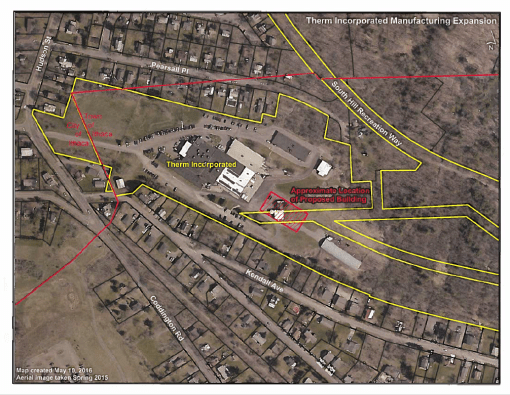
7. Therm Incorporated will be presented plans for a stand-alone 20,000 SF manufacturing facility to the town board next week. The addition will be located at their property at 1000 Hudson Street Extension, between its main building and the quonset huts. In a rarity, the industrial-zoned property won’t need to heard to a zoning board – no variances required. The new building will replaces a 3,434 SF ceramics studio. As previously reported on the Voice, Therm expects to create 10 jobs with the expansion. Therm, located at its current facility since its founding in 1935, specializes in custom machining, primarily for the aerospace and industrial turbine industries.

201_college_v2_3

8. Not a very exciting agenda for the Ithaca city planning board this month.

1. Agenda review
2. Floor Privilege
3. Special Order of Business: Incentive Zoning & Site Plan Review Discussion (Lynn Truame)

4. Subdivision Review
A. Minor Subdivision, 312-314 Spencer Road, Charlie O’Connor (MLR)

5. Site Plan Review
A. Sketch Plan, Two Duplexes at 312-314 Spencer Road

This came up back in March – Charlie O’Connor plans on re-configuring vacant street-facing property behind two houses to build two duplexes near Lucatelli’s. STREAM Collaborative is the architect.

Originally, this was at the end of the agenda as sketch plans usually are, but the agenda was revised so that the sketch plan would be allowed to go first.

B. 201 College Avenue – Declaration of Lead Agency, Public Hearing, Determination of Environmental Significance, recommendation to the BZA

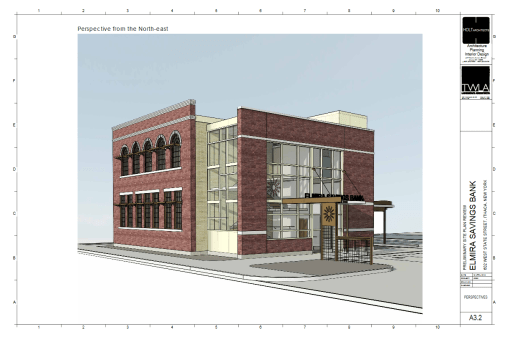
C. Elmira Savings Bank, 602 West State Street – Declaration of Lead Agency, Public Hearing, Potential Determination of Environmental Significance, recommendation to the BZA

D. Brindley Street Bridge, seen above – revised FEAF review (parts 2 and 3), recommendations to lead agency (BPW).

6. Umpteen million zoning appeals, none especially contentious
7. Chain Works DGEIS Review, Update Schedule and Special Meeting Schedule.


The Chain Works District DGEIS, Part Two: Form Codes and Phase One

17 05 2016

For part one, click on this link.

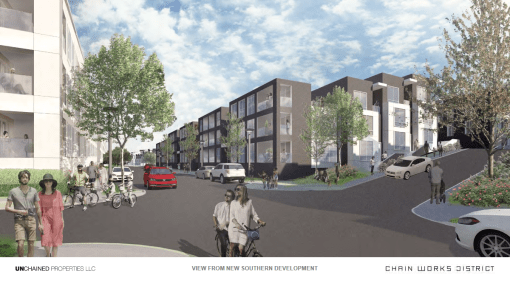
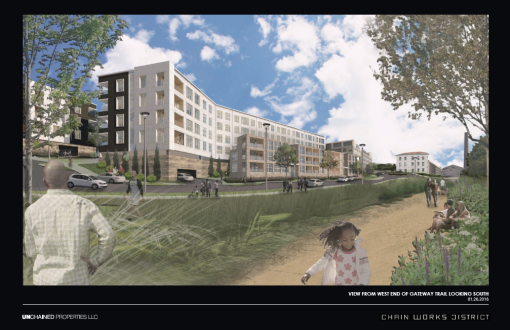
One of the challenges facing the Chain Works District is that it’s a little tough to plan out specifics when the construction timeline goes out over a decade. The renders of new buildings conceptualized as part of the redevelopment project may not look exactly as shown – in a lot of ways, they would best be described as placeholders. But, the zoning code proposed within the project’s PUD gives a pretty good idea of what a potential building would look like. The design standards can be found in Appendix C here.

The goal of the design standards is to establish a walkable, mixed-use neighborhood setting that builds on the existing industrial buildings and surrounding neighborhoods – growing without overwhelming. The design standards handle height, width, setbacks, buffer plantings, blank walls, building projections, the amount and spacing of doors and windows, porches and stoops, sidewalk width, the types of light poles allows, the “design speed” of streets – compared to Euclidean/use-based zoning, the emphasis isn’t on what’s taking place inside, but how it looks on the outside. Some might argue that it allows less creativity for architects, but it offers a lot more predictability for a multi-year development like Chain Works.

Even with the design standards, the project won’t be skipping the approvals process. New buildings and renovations that don’t conform to the initial proposed uses still have to go through Site Plan Review/Approval. Interior renovations not visible from public roads do not have to go through SPR, which is consistent with most of the city’s neighborhoods. But one step that may potentially be avoided by the PUD/PDZ are frequent trips to the Board of Zoning Appeals.

Chantreuil | Jensen | Stark Architects, STREAM Collaborative and Randall + West all played a role in site planning and developing the zoning.

chain_works_form_districts_1

There are four “sub areas” as part of the code – CW1 (Natural Sub Area), CW2 (Neighborhood General Sub Area), CW3 (Neighborhood Center Sub Area), and CW4 (Industrial Sub Area).

CW1, as the Natural Sub Area, is where land is planned to be left unaltered, or allowed to revert to “a natural state”. Some of this is due to technical issues like topography, as some of it is due to environmental features such as the presence of old-growth woods. CW1 is the most restrictive zone, allowing only passive recreational use, trails and stormwater management. New structures can only serve those purposes – sheds, park restrooms, pavilions, gazebos, and at most a visitor’s center, the sum of which may not cover more than 2% of the total area, with no single building over 2,000 SF, and nothing more than one floor / 15 feet.
cwd_cw2


CW2 is the Neighborhood General Sub area, and one of the two zones slated to host the majority of new development. The intent here is detached single-family homes, row-houses and small apartment buildings. Total area coverage of more than 60% is prohibited, and height is limited to 4 floors, except when built on a hill, in which case there may be another 1-2 floors on the downhill side, as long as it’s consistent with CW3. Street trees have to be provided on at least 60% of the length of new and existing streets in CW2, at intervals no more than 40 feet.

Apart from general housing, the CW2 code would allow for senior housing, daycares, home-office, small-scale retail (less than 2,500 SF), nursery schools/day-cares and B&Bs.
chain_works_rev3_4

CW3 is higher-density mixed-use – larger-scale office space, larger-scale retail and the same residential uses allowed in CW2. Most commercial and assembly/factory uses are allowed (but no adult uses – in any zone, in fact). Plazas are allowed along with green space, and the maximum height allowed is 6 floors, with 1 more on the downhill if on a slope, and only 4 floors permitted with 2 floors on the downslope if within 100 feet of Route 96B. Total area coverage is permitted up to 80%, and a vegetation buffer of 30 feet is required if adjacent to residential properties bordering the CWD. The street trees rule in CW2 also applies here.

cwd_cw4

CW4 consists of industrial uses and utilities/storage space, 2-4 floors. 90% area coverage is allowed, and there has to be one shade tree planted and kept healthy for every 10 parking spaces. There is no minimum parking requirement for CW4, or any of the zones.

One issue brought up in review is that the code specifies that any one floor can’t be more than a certain height, but it would be better if they specified a maximum height for the first floor, and then a max height for each subsequent floor. For instance, instead of a max of 18 feet, which could create a 72-foot, 4-story building in CW2, the draft could be improved by saying 18 feet on the first floor, 12 feet on each upper floor.

cwd_street_assembly

Several types of “thoroughfare assemblies” are displayed in the document, specifying what’s permitted in each area. This is where the design speed, sidewalk and pavement widths, and parking and street-scaping details come into play. These include streets, alleys, industrial access roads and even a woonerf.

So that briefly sums up about 33 pages of code details. Most of those won’t come into play until new structures are proposed – the streetscape will be developed as phase one is under construction, and more when further build-out occurs. Speaking of phase one, let’s take a look at that.

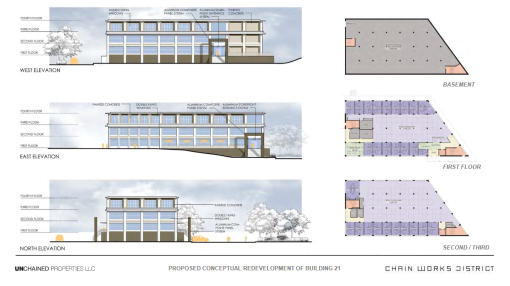
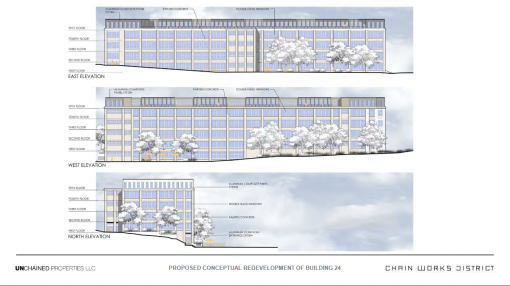
Phase one consists only of renovations to existing buildings, four of them. Buildings 33 and 34 would be renovated for new industrial uses per the CW4 code, and Buildings 21 and 24 would be renovated into an office building, and a mixed-use office and apartment building per the CW3 code.
cwd_bldg21_1

Building 21 becomes a 43,340 SF office building – new glass and a paint job are the biggest exterior changes. Parking would be on adjacent surface lots (page 2-27, DGEIS).
cwd_bldg24_1

Building 24 is the only building that gets an addition in phase one – 18,520 SF of new space on the top floor, a “penthouse addition” to the existing 111,050 SF space. The addition and the existing second to fourth floors would house 70 to 80 residential units in approximately 96,300 SF, in a potential mix of configurations ranging from studio to 4-bedroom units, but mostly it’s intended to be 1-bedroom and 2-bedroom units (page 2-25, DGEIS). The remaining 33,270 SF would be commercial office space. Parking would be on adjacent surface lots.
cwd_bldgs33&34

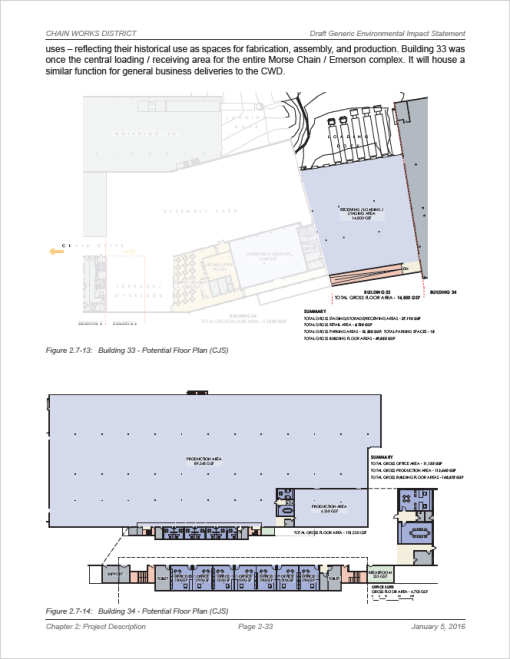
The industrial space envisioned for Buildings 33 and 34 requires minimal renovation, according to the DGEIS (page 2-33). Combined, they offer about 170,600 SF of industrial space, for manufacturing, warehousing, or related uses. Most parking (110 spaces) will be on adjacent surface lots, with a little more (15 spaces) created by the removal of Building 6A, and another 95 overflow spaces shared with CW3 structures. Part of the logic is that since workers and residents use parking spaces at different times (working the 9 to 5, vs. those who do their 9 to 5 in other parts of the city), they can share parking spaces somewhat.

Part 3 will take a look at some of the project impacts.


New Tidbits 5/14/16: A Land Subdivided

14 05 2016

6-29-2014 162

1. This week, the city rolled out a strategy memo for “Design Guidelines” for Collegetown and Downtown. The city held focus meetings back in March with Winter & Company, a Boulder-based urban design and planning firm with experience in cities and college towns from coast to coast. No specific individuals are mentioned as being part of the focus groups, but the focus group meetings consisted of “residents, property owners, developers, architects, design professionals, Planning and Development Board members, Common Council members, and City staff.” The memo is meant to help guide continued discussion of design standards, and to identify key issues in each area that could arise with planning and implementation.

The feedback from the focus groups shouldn’t come as a surprise – use high quality materials, respect historic character but don’t emulate it, recognize that development costs in Ithaca are very high, promote walkability and active street use, encourage parking lot infill, define transition areas between smaller-scale neighborhoods and denser cores, and so forth.

One of the major components being reviewed is whether design guidelines should be mandatory or just a set of recommendations. The city has a design review process that comes into play for certain projects like those on the Commons, but otherwise it’s non-binding unless the BZA or planning board mandates it as part of approval. Regardless, more meetings are expected as the guidelines are fleshed out.

al-huda_1

2. The Ithaca Times is checking in with the Al-Huda Islamic Center plan for Graham Road in Lansing. Fundraising is still underway for the 4,828 SF mosque, which according to a member of the Al-Huda board of Trustees, is expected to cost between $650,000 and $1 million, per contractor estimates.

Fun fact of the day, Islamic law prohibits mosques being paid for with funds that collect interest (tainted by usury). Everything must be paid for up-front and in full.

The village of Lansing has already signed off on the mosque plans, and the vacant land at 112 Graham Road is bought and paid for. Pretty sure the above drawing is outdated, but I haven’t seen an image of the latest plan available online. The Times has an interior shot of the current plan to accompany their story.

20141227_134549

3. The town of Ithaca passed the nine-month moratorium on two-family dwellings by unanimous vote at its meeting this week. Anyone seeking to build a duplex in the town of Ithaca will now have to wait until February 2017 for a building permit, unless “unnecessary hardship” is demonstrated by the law’s imposition. The law was driven by the construction of multiple 2-6 unit student-oriented structures east of Ithaca College in the Kendall/Pennsylvania avenue area, which they felt was undermining the neighborhood’s character. Earlier versions of the law called for a year’s length, but the town received numerous complaints that a year would actually hit two construction seasons, 2016’s and 2017’s.

100_1281

4. Also in lawmaking, the bike lanes proposed for the 300 and 400 blocks of Tioga Street in downtown have been shot down in favor of sharrows, 3-2. This comes after strong advocacy by city bicyclists and some planning and sustainability groups, and strong opposition from some elderly and disabled advocacy groups, suburban neighborhood residents and the town of Ithaca’s town board.

benderson_1

5. One of the many issues that faces large-scale planning and development in Tompkins County is that, over the many decades, land has been heavily subdivided and sold off between many different owners, with the properties often passed down or even traded, leaving records piecemeal. With so many owners, some untraceable, it can become logistically difficult, especially if not everyone is on board with a plan.

In front of Moe’s down in big box land, the county owns a 0.3 acre parcel of land previously a part of the flood relief channel. Since 2005, Benderson Development has rented the land as part of its shopping complex – now they just want to simplify things and buy the land from the county. With an offer of $112,500, which is $17,500 over the county’s assessment, and with the county’s 2005 confirmation and 2016 re-affirmation that they have no public use for that slice of land anymore (much of the channel’s land has already been incorporated into other parcels), they’re planning to finalize the sale at the Legislature’s meeting next week.

6. If you glanced at the Voice, you know there’s a plan cooking for 36 townhouse units east of Varna. But according to Dryden’s town planner, that’s not the only project that’s been brought forth to the town. A different applicant brought forth a plan for 20 single-family homes on 9 acres near the intersection of Route 13 and Mineah Road, a rural stretch between Varna and the village of Dryden. The units, expected to be rentals, are allowed as of right in Dryden’s mixed-use zoning – if it’s under 4 units/acre, it doesn’t need a special use permit, or even site plan review. A check of property records reveals several parcels owned by Ryszard Wawak, a Lansing businessman who picked up the land a number of years ago and has already built a duplex (2-bedrooms each) and a 5-bedroom house on subdivided parcels.

If you happen to start seeing houses popping up between Dryden and Varna, it’s probably this project slipping under the radar.

elmira_savings_v2

7. Taking a glance at the Ithaca Projects Review committee meeting agenda, the Elmira Savings Bank and 201 College Avenue projects will be undergoing review before heading to the planning board meeting later this month, and the subdivision/reconfiguration to build two two-family houses at 312-314 Old Elmira Road will also be reviewed. There are also a boatload of zoning variances being sought for various projects – Marriott signage, an apartment reconfiguration on Farm Street, a basement home salon on Center Street, a home addition on Cobb Street, parking variances for 121 West Court and a area variance for an existing carport on Grandview Avenue that was apparently never approved by the city when built in 1973. In total, there are nine. It’s times like this that the city would benefit from a simplified zoning code.


News Tidbits 5/7/16: Everything’s Political

7 05 2016

815_s_aurora_night

1. Let’s start with government. The city of Ithaca passed revisions to its cell phone tower law reducing the no-build fall radius from 200% of height, to 120% of height. The 120% was decided upon after a check of other municipalities, where it was generally the most common figure.

The change allows development to proceed on the grassy field at 815 South Aurora Street on South Hill, although as mentioned last week, the fall zone revision isn’t as much as developers Todd Fox and Charlie O’Connor had hoped for. But it’s still enough to work with; according to Josh Brokaw at the Times, a revised plan that meets the new guidelines could be going to the planning board for sketch plan review in June, possibly with more units than the 87 studio units initially planned. It was also reported that the local neighborhood group (South Hill Civic Association, SHCA) is comfortable with the initial plan, so this might be a relatively smooth process when the project is ready for review.

2. Meanwhile, while one thing moves forward, Dryden’s been hit with a major setback. The Pinckney Road parcel sale in Dryden was foiled when voters, in a 1188-936 vote, rejected the town’s plans to use recreation reserve funds to purchase the 15 acre property. The town would have spent about $56,800 of a fund that has over $300,000, and the county would have contributed $15,000, so that the town could have turned it into park space in the long-term. The town was prepared to buy the property, but residents opposed to the sale managed to get enough signatures on a petition to force to to go up for a vote.

It sounded like a worthy and reasonable plan. But I get the feeling that there were a lot of folks who figured it would pass by a wide margin, so they just didn’t vote. In a marketing course a while back in college, I remember the professor sharing an interesting statistic – versus feeling neutral, the general public is three times more likely to support an initiative when they really like something, and nine times more likely to vote or speak out when they’re really opposed. People are more driven by aversion than reward, and that’s probably what happened here.

20141227_134402

3. Sticking with local governments, the town of Ithaca is set to vote on a moratorium on duplexes, but with some modifications from the initial proposal. For one, given construction seasons revolving around the warm season, and the time it takes to plan and get permits, it was decided to make it only nine months (January 2017) instead of one year, so that they could limit the possibility of dragging it through two construction seasons. And although the town planning committee chair wasn’t on board with it, an exemption is in place if one of the units will be owner-occupied. If their goal is to revise the approach to student housing, then at least these amendments fix or lessen some of the bigger issues a moratorium would produce.

https://twitter.com/streamcolab/status/657329991827509248
4. Just a wee bit more info on the “Tim Timbers” planned for the corner of Freese and Dryden Roads in Varna. The tiny houses are small though not micro-sized – they’re expected to be about 800 square feet. Local architecture firm STREAM Collaborative is working with businessman Nick Bellisario on the 16-lot subdivision and home development.

waterfront_concept_aerial_1waterfront_concept_mf_th_SP_1

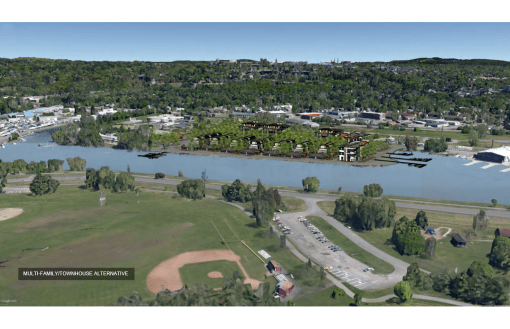
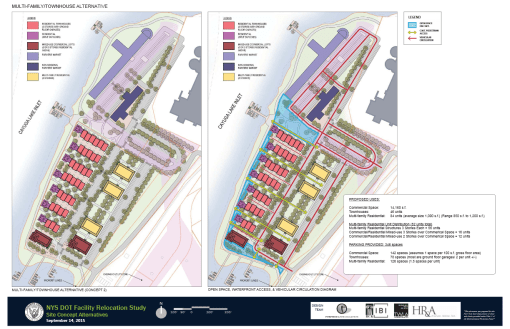
5. So the full 206-page, $78,000 NYS DOT waterfront redevelopment study by Fisher Associates is on the city’s website. The initial results were shared here back in October, but the final product has some additional, very interesting details.

waterfront_concept_timeline

One of those additions is a potential timeline for development. It calls for getting official support and commitments over the next several months, issuing an RFP later this year for the new DOT facility in Dryden, and issue an RFP for the NYSDOT waterfront site later this year, with review in Q1 2017 and developer selection in Q2 2017, assuming this doesn’t end up like the Old Library debate. The DOT would move to Dryden in Q3 2018, and the excess state land would be transferred to the county, sold in Q1 2019, and ready for occupancy by mid-2020.

The other really interesting new section is Appendix 5, stakeholder outreach. This consists of interviews with city officials and nearby property owners – Cornell (who say they have no plans for their waterfront properties), the Farmer’s Market, and some smaller businesses and organizations. The gist of the comments had more to do with Farmer’s Market than the DOT – namely, heavy traffic issues, needs more parking, and needs to physically expand to accommodate a waiting list of vendors and cool-season operations. There are early plans incubating for a nearby indoor market facility, if memory serves right. As for the DOT site, the mixed-use plan was deemed most favorable, and the stakeholders agreed that the site had great potential for redevelopment.

warren_medical_lansing_1

6. Looks like marketing has started for a proposed new medical office building in the village of Lansing. The new one-story building, which appears to be designed by Binghamton-based Keystone Associates, would be off of Warren Road, although it looks like the building would be accessed from a driveway coming off of Uptown Road. The 2.71 acre property is zoned “Human Health Services District” by the village, and borders undeveloped land owned by Cornell, and several other suburban medical office buildings built over the past few decades. The resolution on the attached site plan is too low to determine the square footage, though it looks to be in the low tens of thousands.

The property was purchased by Arleo Real Estate from Cornell for $378,600 in October 2014. Arleo Eye Associates owns and occupies the neighboring building to the south. Arleo built their 7,119 SF optometry office in 2007.


News Tidbits 4/30/16: Sticking to the Plan

30 04 2016

chapter_house_v4_1

1. So, let’s start off with the bad news. Chapter House might not be happening. Josh Brokaw at the Ithaca Times had the scoop, though not for a lack of trying on the Voice’s part – rumors had arrived in the inbox well before the Collegetown construction roundup article. I’ve reached out to Jerry Dietz, the building manager for the Chapter House project, four times over the past couple of weeks, without response. One of those was an in-person visit that went un-received. My Voice editor and colleague Jolene Almendarez has also been trying to do her share of contacting relevant parties, to no avail.

Anyway, personal discontent aside, The co-proprietor of the Chapter House (and the only one willing to say anything on record) says that he believes a sale of the 400-404 Stewart Avenue property is imminent, with the potential buyer being the next door neighbor of the also-destroyed 406 Stewart Avenue. The claim is that a more cost-efficient plan would be put forth, which could eliminate the Chapter House from its plans.

One thing to keep in mind is that the property is on the edge of the East Hill historic district – the Ithaca Landmarks Preservation Commission can control just about every aspect of the exterior, but they don’t have say over use any more than zoning permits. They can stipulate the extra expense of appropriate material and image, but they can’t stipulate a bar (and a lot of commission members would be uncomfortable with that anyway). Dunno how much the insurance money was, but the finances just may not work. It would be unfortunate, but as they do in golf, they’ll play the ball where it lies.

college_crossing_2

plan-1

2. Noting, briefly. Evan Monkemeyer, the developer behind the cancelled College Crossing project, might be partnering with another developer to create and put forward a plan for the corner of Route 96 and East King Road. This is according to the town of Ithaca’s planning staff. Monkemeyer has not hidden his discontent after his suburban-style mixed-use project became the subject of heavy debate because the site plan, originally approved in 2007, no longer meshed with the town’s interests, which had evolved to more New Urbanist formats put forth by the 2014 Comprehensive Plan and the Form Ithaca charrettes. Monkemeyer owns about 64 acres on the northeast side of the intersection, and more than 15 acres as part of Springwood on the southeast side of the corner. In other words, virtually all the divvied up land and conceptual buildings on the lower right side of the charrette image. This could be something to keep in eye on over the coming months.
maplewood_v3_2

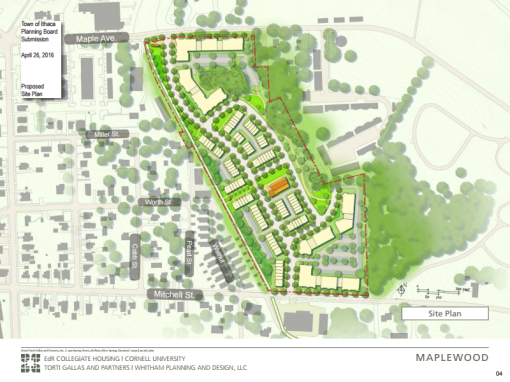
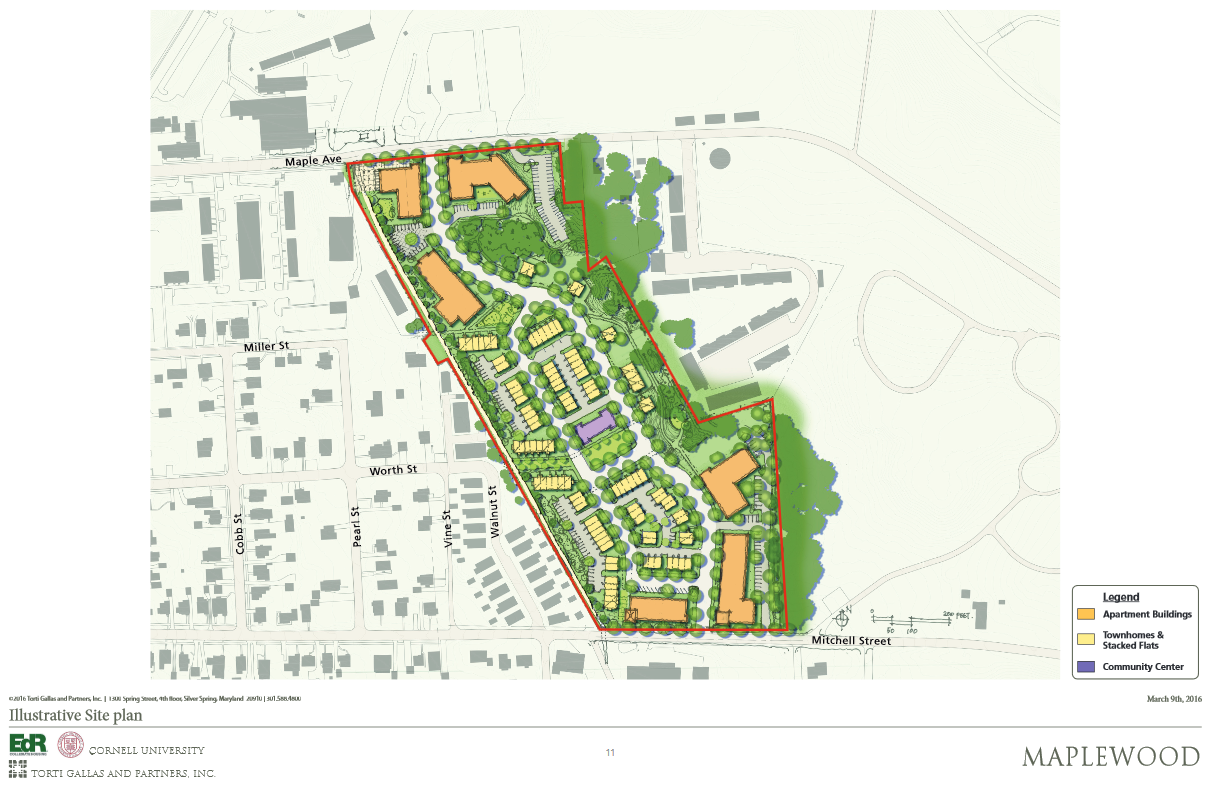
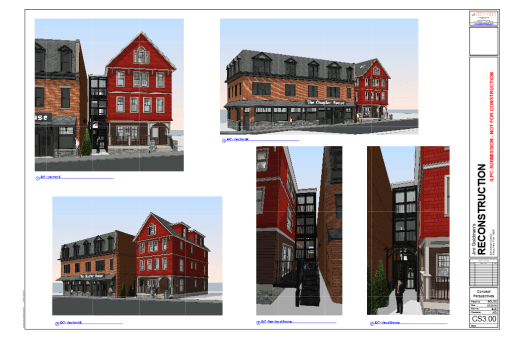
3. Here’s the latest iteration of the Maplewood Park site plan. A lot of changes from the previous version. To sum up the changes, the apartment buildings, 3-4 stories, have been pulled back from existing homes, the townhouses and stacked flats have are more centralized and closely clustered, and mixed-use retail/apartment planned for the city is now in the town, all the city has in its portion is green space and perhaps a small service area/ bus shelter.

Also note the secondary road that terminates right at the edge of the Maple Hill property. Chances are very good that would feed into a phase II that redevelops the Maple Hill property.

The large parking lot in the southeast corner doesn’t seem to jive with the rest of the plan, previous versions had the parking more dispersed. Since Cornell has an idea of the number of residents it wants for the project to be feasible to build and affordable on grad student stipends (850-975, centering around 925 beds in 500 units), if housing is decreased in one part of the parcel, they’re going to have their development team make up for it somewhere else. One of the bigger points of contention seems to be Cornell trying to avoid drawing traffic in by keeping larger buildings further out, while neighbors from various angles try and push the units as far away from them as possible.

maplewood_v3_3

Maplewood has a website up sharing meeting notes and presentation materials here. Future meeting information will also be posted to the Maplewood website. The project will be filling out an Environmental Impact Statement (EIS) not unlike Chain Works, because of the project size and potential for adverse impacts (and therefore the need for proper mitigation before plans can be approved). The scoping document for the EIS, which is an outline that says what will be written about where, is on the town’s website here.

maplewood_v3_4

Just for the record, the print version of a recent Maplewood write-up on the Times claimed to have a quote from me. It was not. The online version of the piece has the corrections. The quote wasn’t even something I would say, because I don’t think Cornell attempting to house a greater number of its graduate and professional students is an “unsustainable development goal”. Quite the opposite, it’s crucial they do that to relieve some of the pressure on the rest of the local housing market.

202_hancock_1

4. Looks like some of the IURA’s recommended funding Action Plan is out. Habitat for Humanity gets the full $75,000 request, as does INHS with the $100,000 requested for their new single-family build at 304 Hector Street. Most of the 202 Hancock project, the seven for-sale townhouses, was recommended for funding – $530,000 of $567,000, ~93.5% of the request.

815_s_aurora_4 815_s_aurora_1

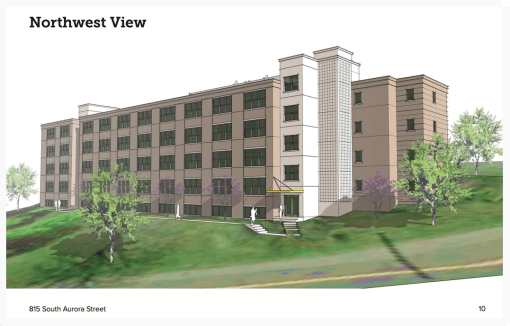
5. At the Common Council meeting next Wednesday, the city is set to vote on reducing the fall-zone radius for cell phone towers, from double the tower’s height (200% of tower height), to 120% of the tower’s height. The move will potentially allow an iteration of Modern Living Rentals’s 815 South Aurora project to move forward with further planning and review. The 87-unit project was planned on the assumption of 100% tower height plus ten feet, so in the case of the 170-foot South Hill cell tower in question, the law would call for a 204 ft. radius, not 180 ft. as the developer hoped. But still, it’s a lot less than the 340 ft. it currently is. The developer may seek a smaller project, build taller, a greatly-revised footprint, or other options. We’ll see how it plays out.

20160414_114709 20160414_114818

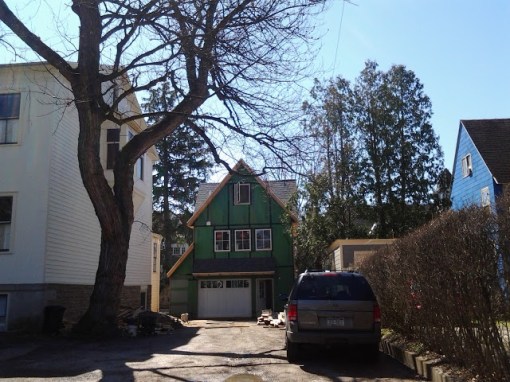
201_w_clinton_1

5. House of the week. Back in March, it wasn’t certain whether 201 West Clinton’s “sawn-and-batten wood” would be left unpainted, or painted yellow. Looks like the former is correct, based on the east face of the 1-bedroom carriage house. The ZIP panels were still exposed on the other faces when I shot these photos, but based off what could be seen through the windows, interior work is progressing nicely, and the garage door has been attached. Local architect Zac Boggs and partner Isabel Fernández are building the 520 SF addition atop an existing 1960s garage.