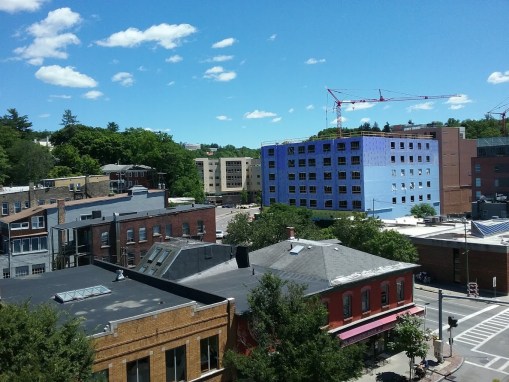
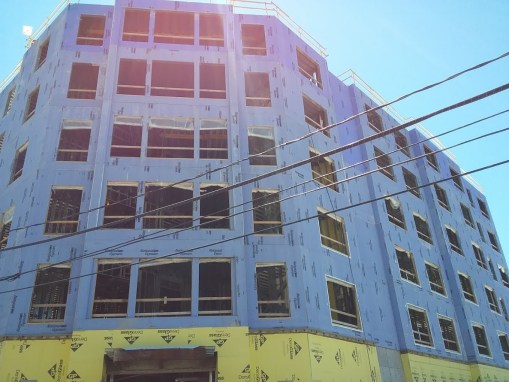
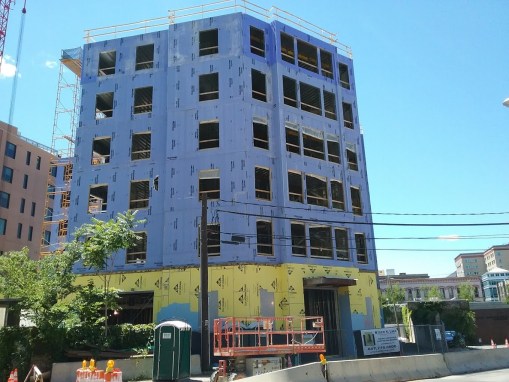
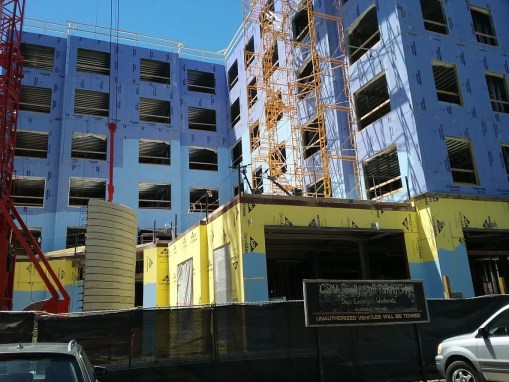
323 Taughannock Boulevard Construction Update, 12/2018

3 12 2018

Some projects have clear, concise histories. This is not one of them.

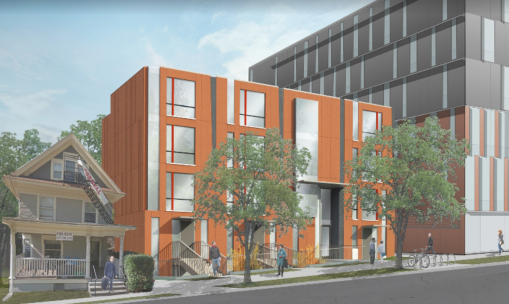
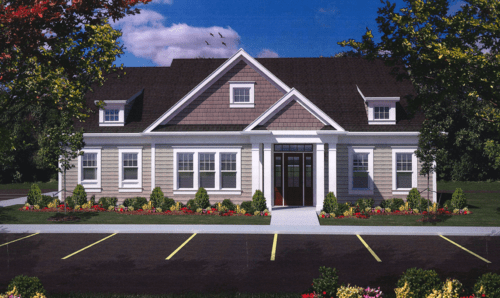
323 Taughannock started off in the summer of 2014 as a $3.5 million, 23,000 SF mixed-use building with ground-level office, 18 covered parking spaces, and 20 apartment units on the three stories above (total of four stories, 50′ height). The firm proposing the building was Rampart Real LLC, managed by local lawyer Steve Flash, who partnered with businesswoman Anne Chernish to develop the plan.

Flash had long had an interest in Inlet Island. He was an original co-owner of the Boatyard Grill restaurant on the island, and is an owner and co-manager of the nearby Finger Lakes Boating Center. In 2007, he sought to build a five-story condo/hotel on Inlet Island, and was shot down. If you think Ithacans are opposed to development now, take a look at the previous link. Current affairs don’t hold a candle to how anti-development the community and many local elected officials were for much of the 2000s. But Flash continue to scout out opportunities where he might be able to do something in time. He picked up the vacant, rundown former bar at 323 Taughannock Boulevard for $280,000 in July 2011.

The apartment plans, which were designed by STREAM Collaborative, were reviewed, revised, and approved by the city. Although the original plan was to build the apartments out from January – August 2015, the project had been unable to move off of the drawing board and into reality due to cost concerns related to “parking, soft soil, and relatively tight space,” according to Flash. Being on the waterfront means that the soils have a high water table and are easily compressed, making multi-story construction difficult. The challenges faced with the apartment building were complicated by the proposed first-floor parking, which posed constraints on the building’s structuring, and raised construction costs beyond feasibility. Long story short, although the approvals were in place, the cost projections became too steep for the developers to follow through, and the site sat quiet.

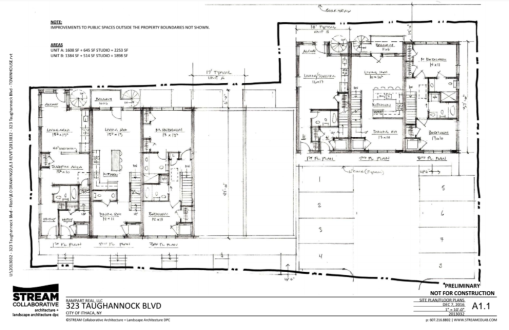
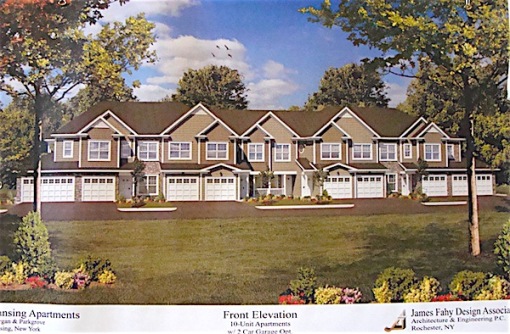
With the original plan no longer feasible, a replacement development plan was submitted in December 2016. This was a proposal for eight for-sale townhouses. Totaling 20,174 SF it’s effectively 16 units in eight townhomes – the first floor will consist of 8 studio type apartments that could also be used as commercial space. The second and third floors, which have separate entrances, will be occupied by 8 townhome style 2-story units. The original idea was that they could be live/work spaces, or that renters would live in the studio units and their rents would help cover the mortgages of the townhouse owners. Offhand, I remember they were to be in the upper 300s to low 400s price range.

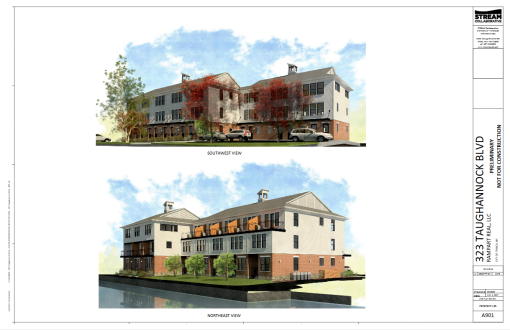
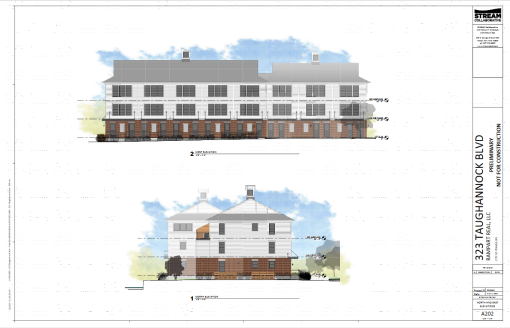
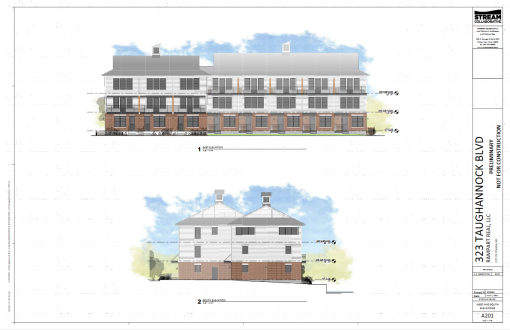
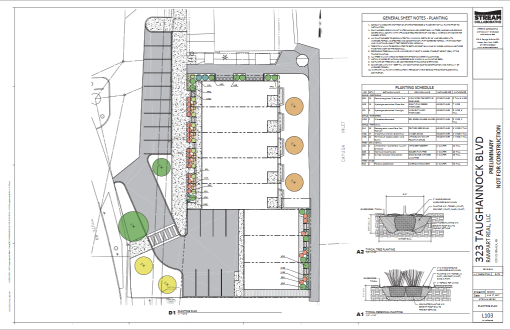
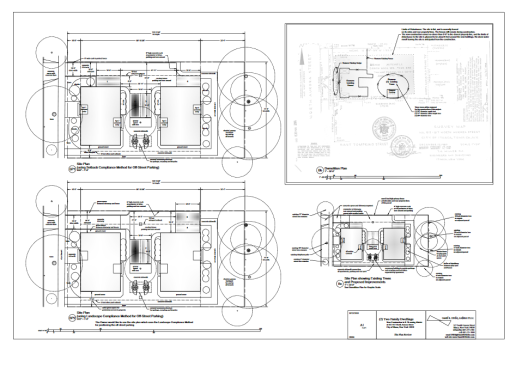
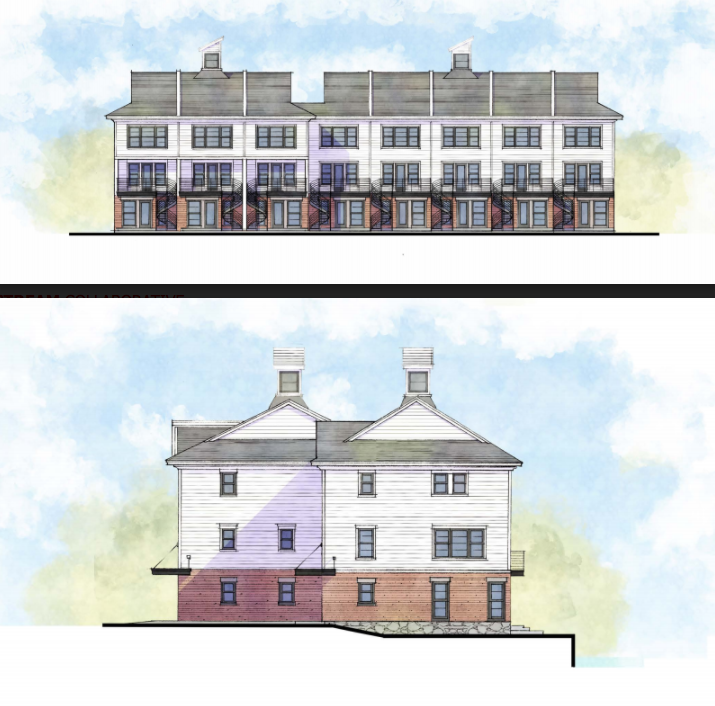
The general aesthetics of the design remained the same – as with the apartments, the for-sale townhouses are being designed by local architecture firm STREAM Collaborative. The facade “features historic and contemporary elements of rustic bricks, steel, traditional clapboard siding, and window casings”, per STREAM’s website. Five of the townhomes are larger – 645 SF studios with 2 bed/2 bath 1,608 SF units above, for a total of 2,253 SF in the “Unit A” townhouses. “Unit B”, with three examples, is a little smaller, with 514 SF studios and 2 bed/2 bath 1,384 SF upper-level units, for a total of 1,898 SF (the IDA application shows slightly different square footages for each unit, probably due to design revisions). Four units will have private elevators. The property will be landscaped and include eight on-site parking spaces with access to nine more next door. The public will have access to the waterfront on a paved promenade.

During this second round of review, 323 Taughannock received some visual tweaks. Gone are the cute sprial staircases leading to the waterfront, and in their place are more standard treatments. The group of five had their balconies moved from the second floor to the third floor. The changes on the front are more subtle, with the window fenestration now centered on each unit, and the front doors rearranged (old version here). Overall, the design was still roughly the same, the changes were only in the details.

The second set of reviews did get drawn out a bit because the project was caught up in the city’s TM-PUD affair, their fight to keep the Maguires from moving forward with their dealership at Carpenter Business Park. But the design fit zoning and was in line with the city’s desire for a more active, denser waterfront. The project was approved in May 2017.

Six months later in November, Flash and Chernish sold a $203,000 stake in 323 Taughannock plan to Arnot Realty of Elmira, who own the Arnot Mall and some commercial and multi-family properties in the Elmira/Horseheads area. As 323T LLC, the new joint venture gave Arnot a 75% stake to Flash and Chernish’s 25%, meaning Arnot is now the primary developer. For Flash and Chernish, it gives them a much bigger partner with experience and connections to contractors; for Arnot, it gives them a toehold in the burgeoning Ithaca market, their first step into the city.

One of the decisions made in this change of ownership was that the units went back to being rentals – very expensive rentals, to the tune of $3,400-3,500/month for the upper-level units. By HUD guidelines, that’s affordable to someone making $140,000/year. The studios will go for $1,400-$1,500/month. Seeking a ten-year tax abatement, sales tax exemptions and mortgage tax exemptions proved to be the most controversial part of this project, and to be fair, it’s a tough sell from a public relations perspective to say your ultra-luxury units deserve a $605,855 tax abatement. But the IDA decided that the long-term property tax increase would be worth it, and the project could potential spur development elsewhere on the island and the West End, and granted the exemptions in January 2018. One of the people who raked the developers and the IDA over the coals was Amanda Kirchgessner, back when she was a well-meaning citizen and before she became a highly controversial state senatorial candidate.

Tompkins Trust Company has lent the development team $4.061 million to finance work on the 16-unit townhouse project on Inlet Island. 323 T LLC partner equity was expected to be $1.153 million at the time of the IDA application, but that may have changed, since the bank loan was only expected to be $3.461 million at the time – total project cost was $4.615 million.

Ithaca’s Taitem Engineering is in charge of mechanical, electrical, plumbing, and structural design services. The builder looks like a newcomer – Benson Woodworking Company, working with applicant contractor D Squared Inc. (Doug Boles and Doug Dake) of Lansing. Benson’s primary work is as a modular and timber-frame builder for properties in and around southern New Hampshire where they’re based. With 323, the wood-frame wall system will actually be framed and sheathed off site by Benson, and transported over to be assembled by D Squared like pieces of a puzzle. The modular approach potentially saves on materials and labor costs makes the construction itself more energy efficient, and may make the logistics of the construction site easier to manage. The plan is to have the project be “nearly net-zero”, meaning it’s efficient in its energy use, and close to having all of its energy needs met by renewable sources (the project will be powered by an off-site solar array). For the record, yes it will use heat pumps.

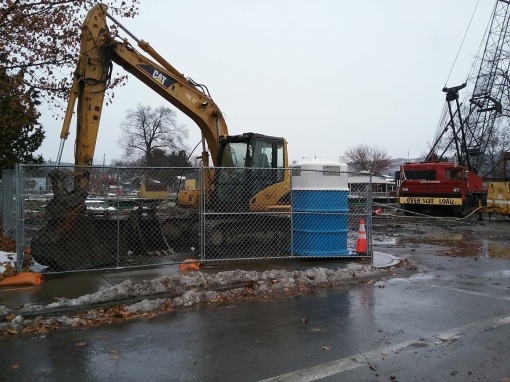
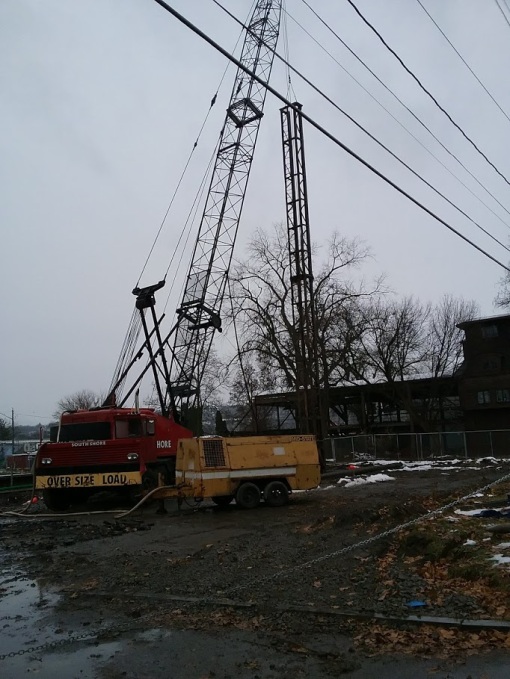
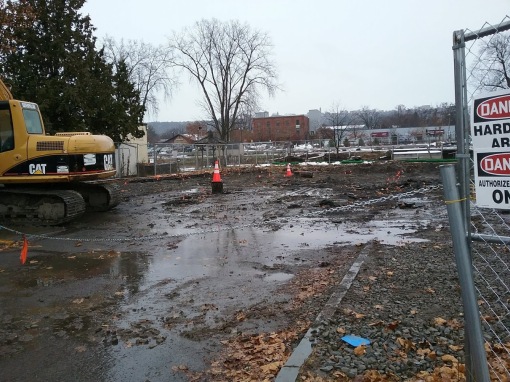
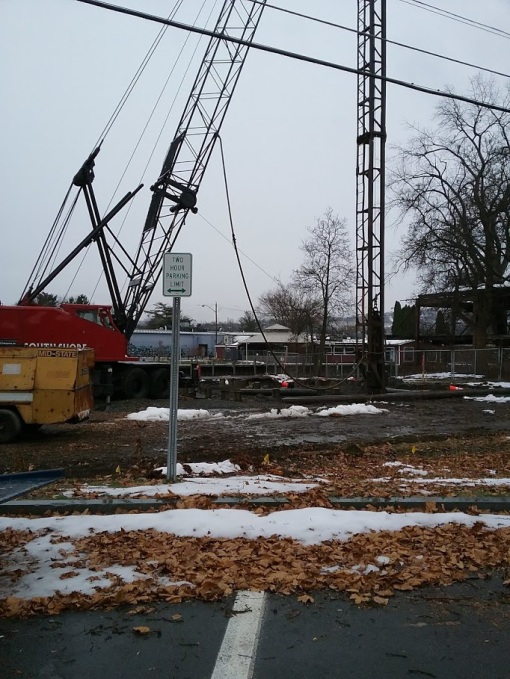
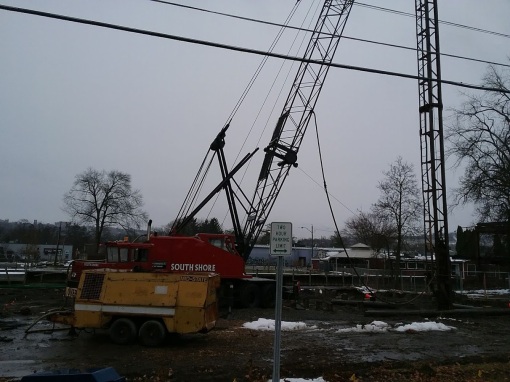
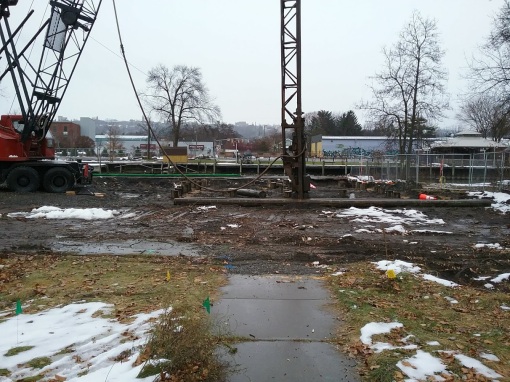
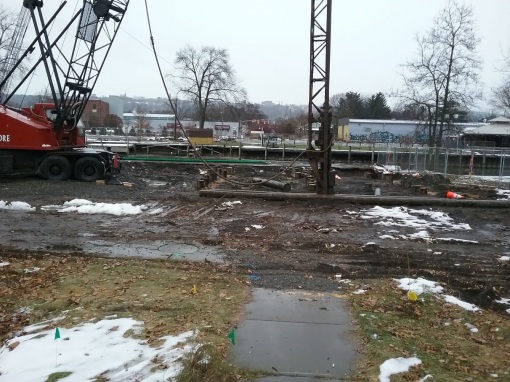
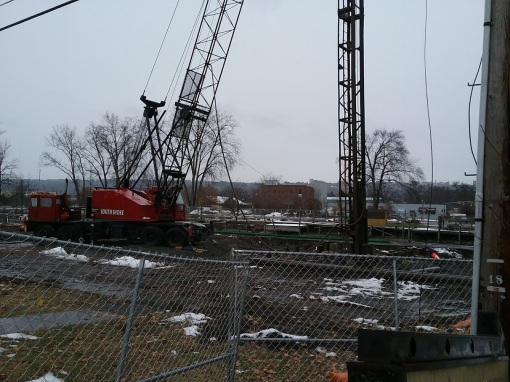
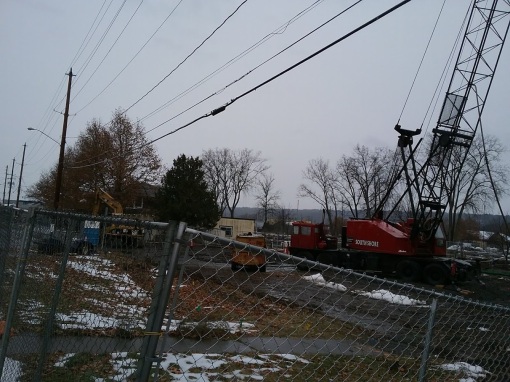
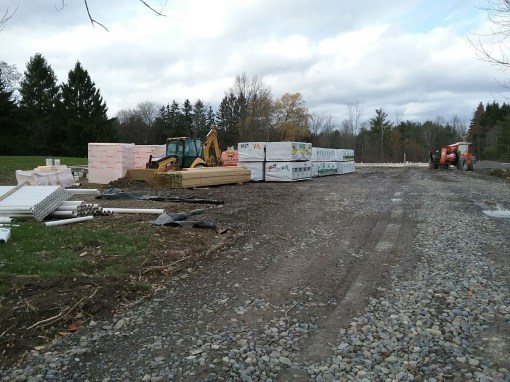
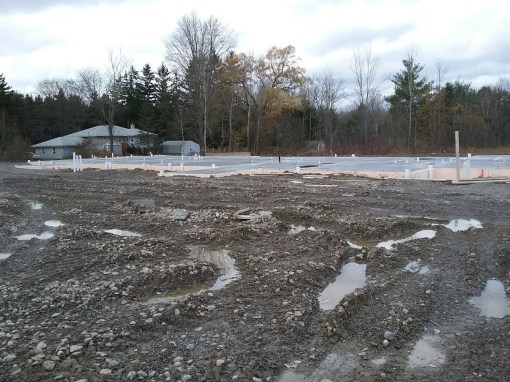
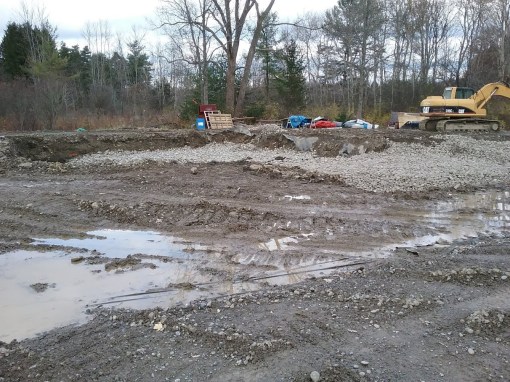
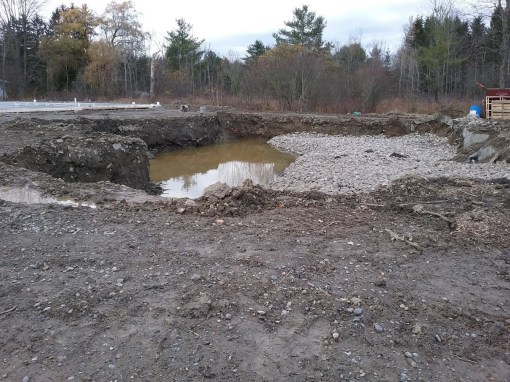
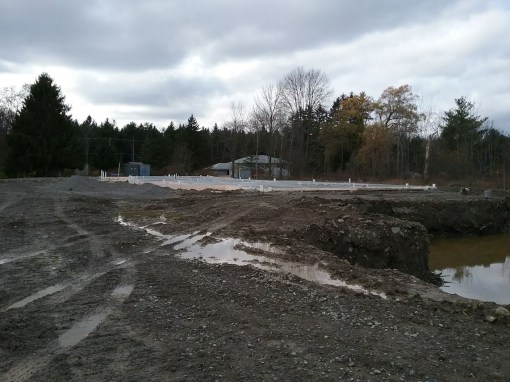
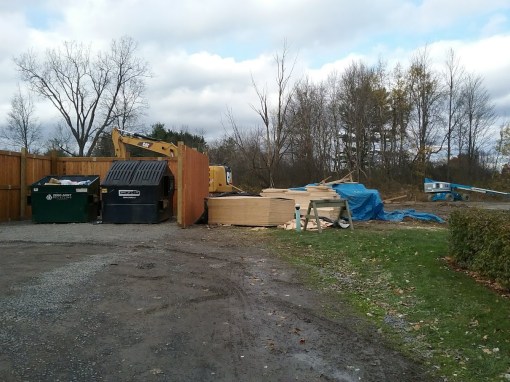
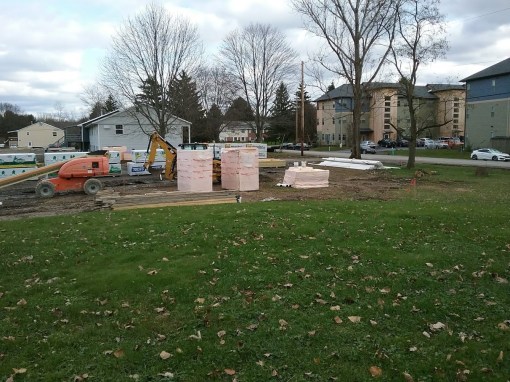
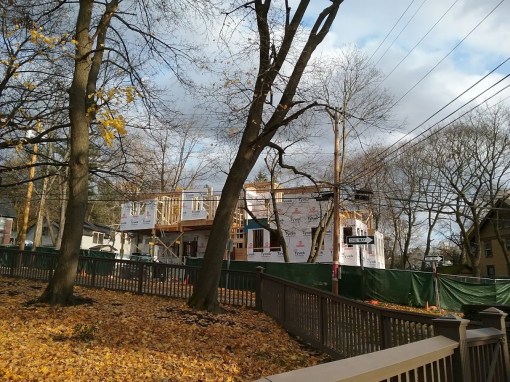
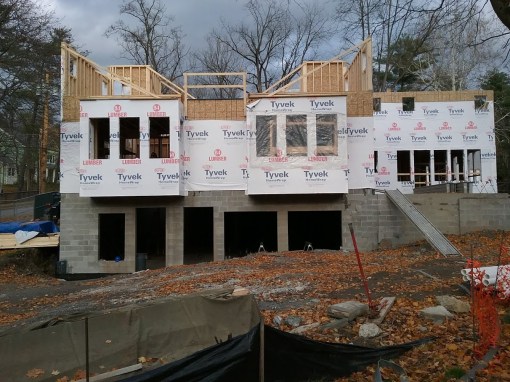
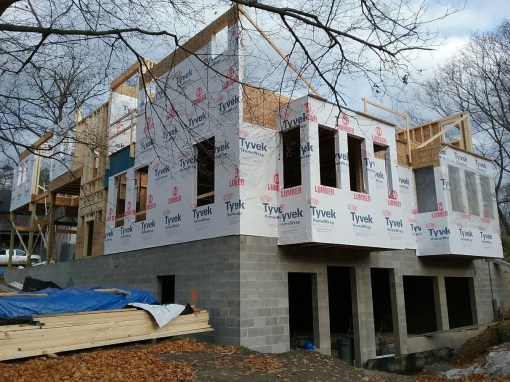
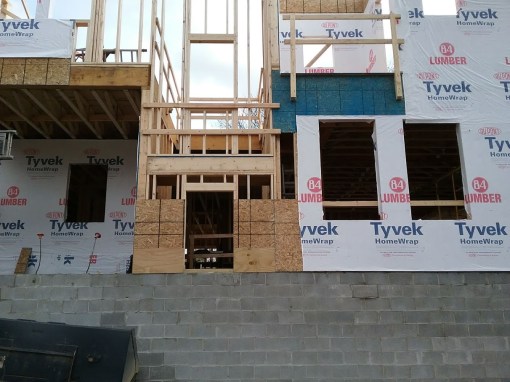
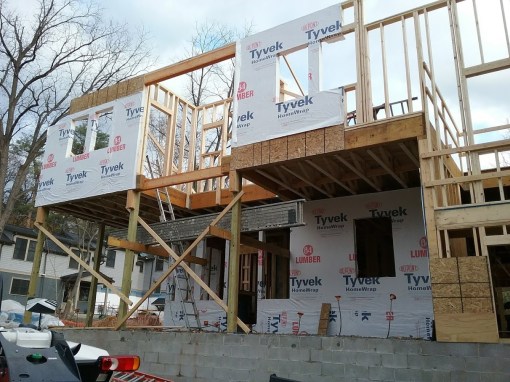
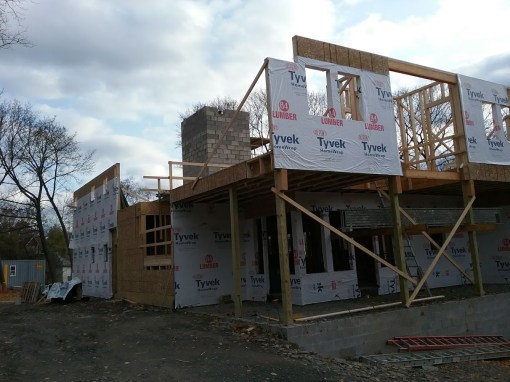
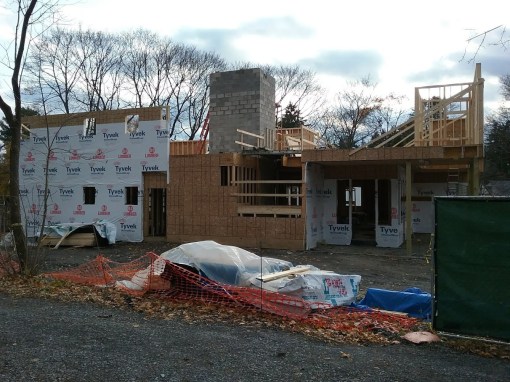
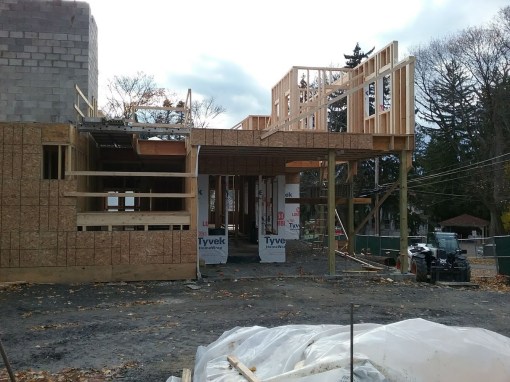
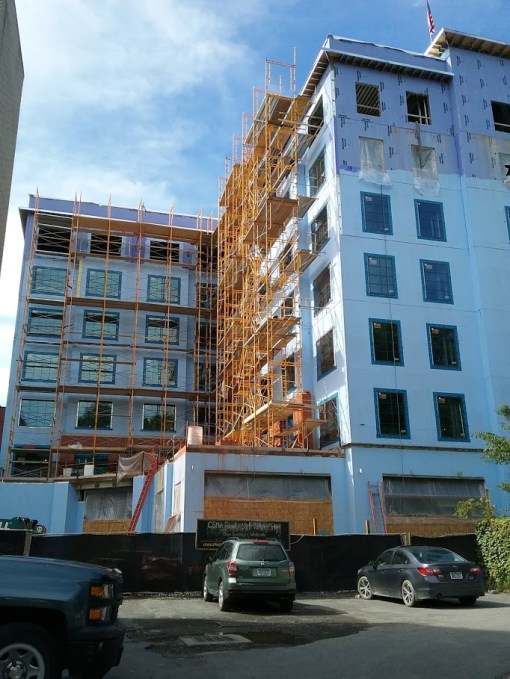
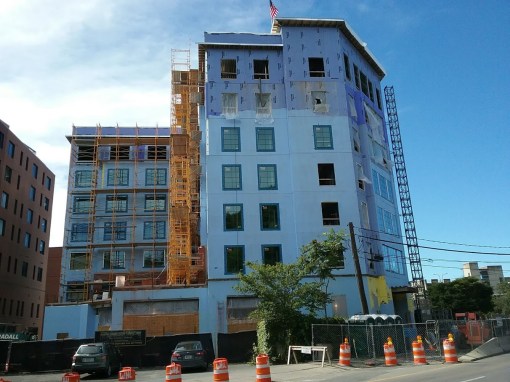
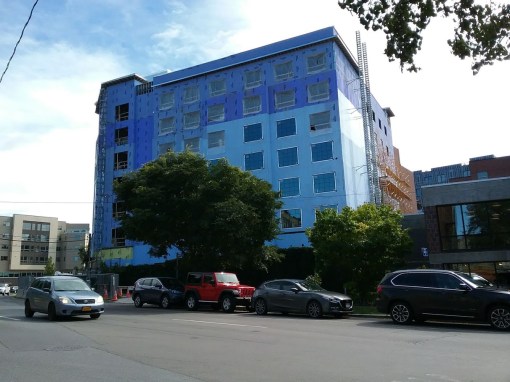
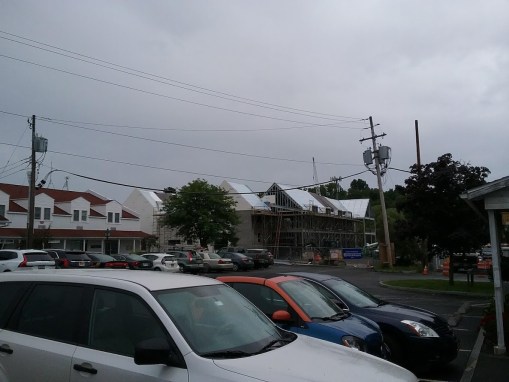
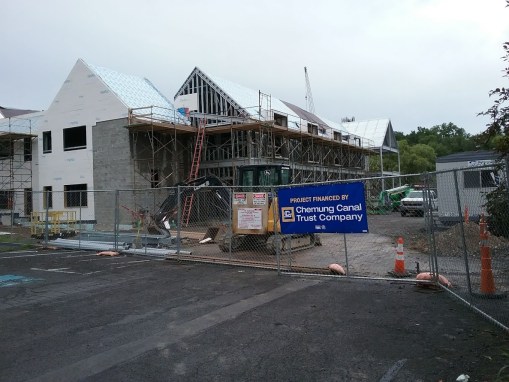
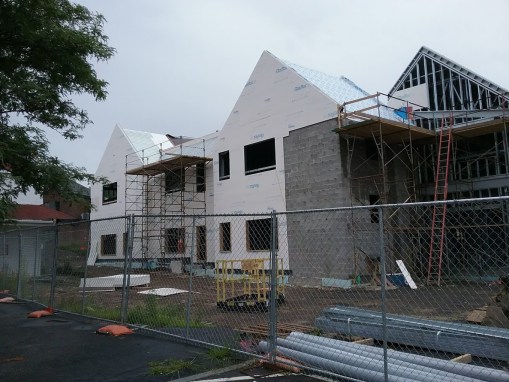
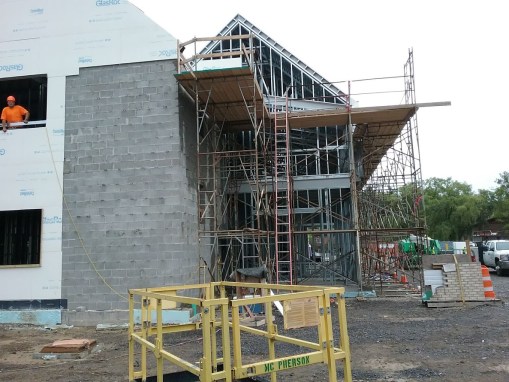
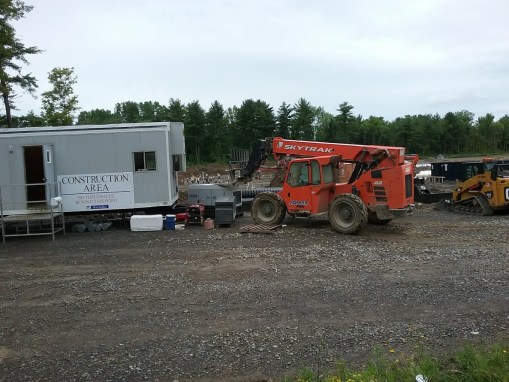
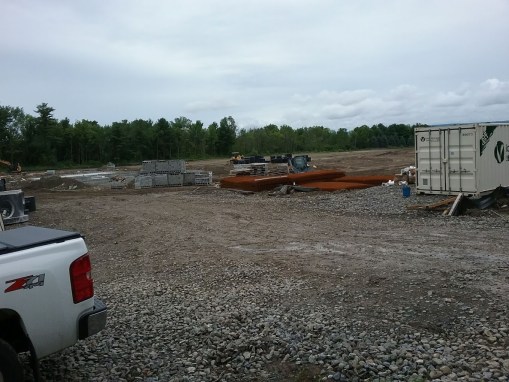
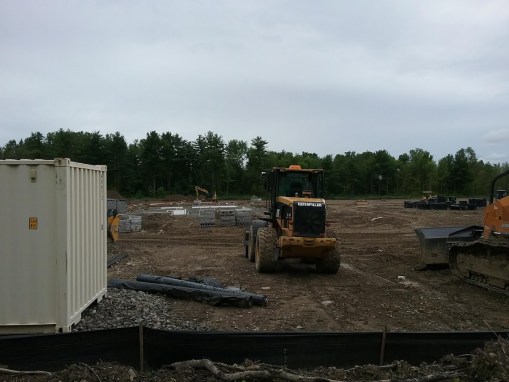
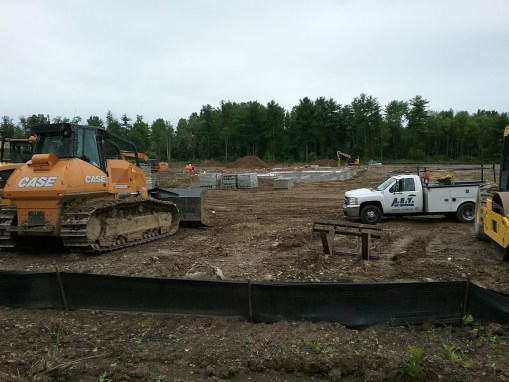
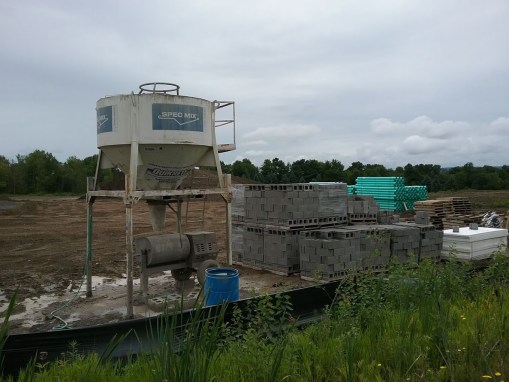
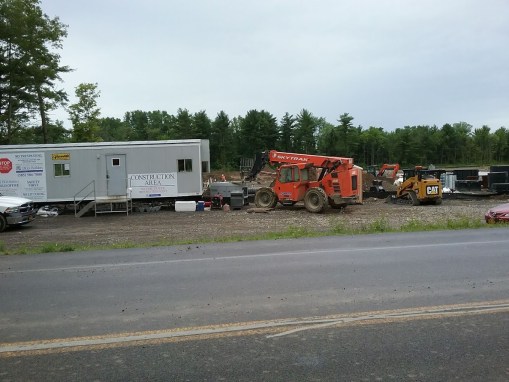
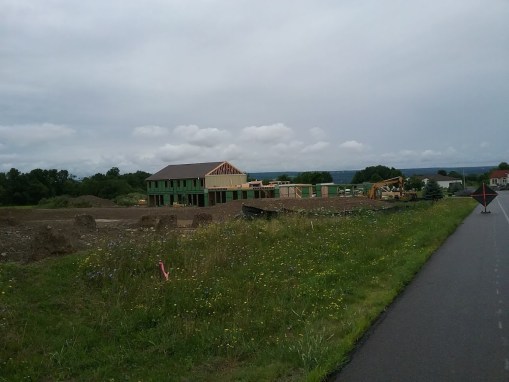
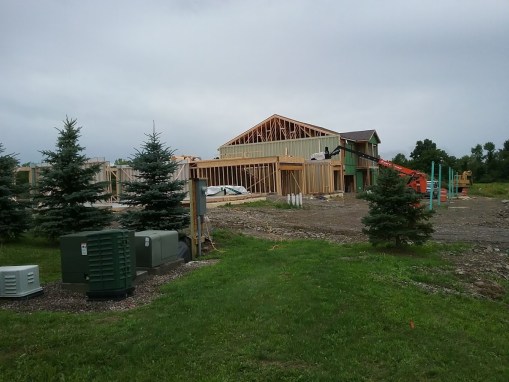
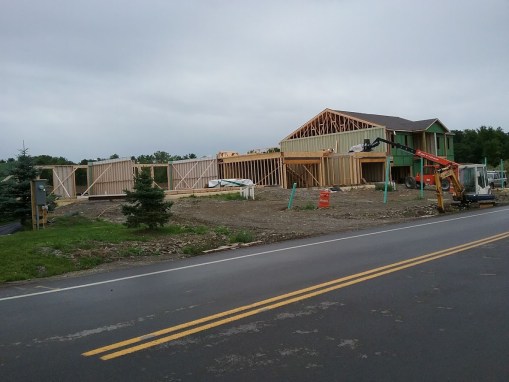
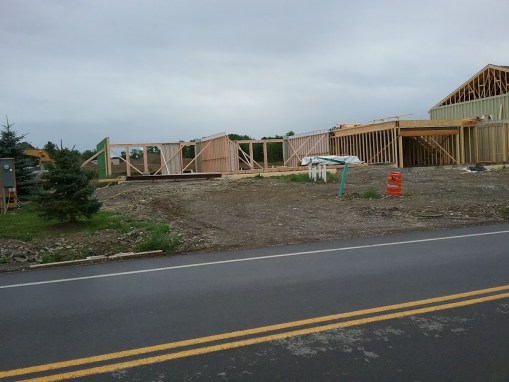
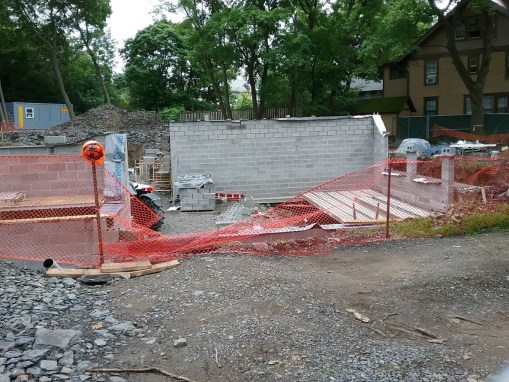
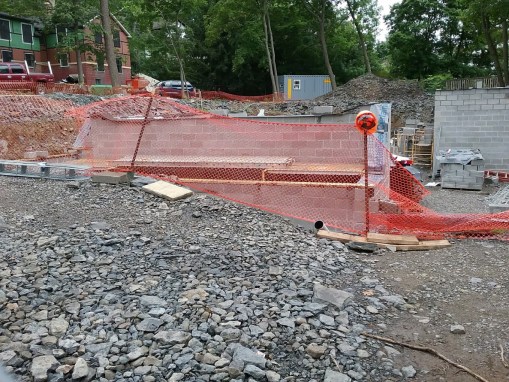
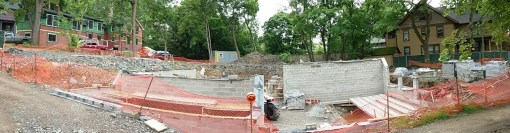
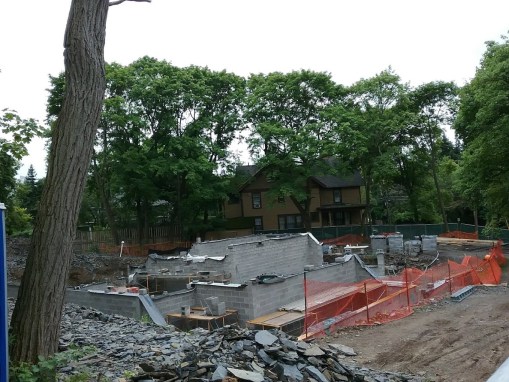
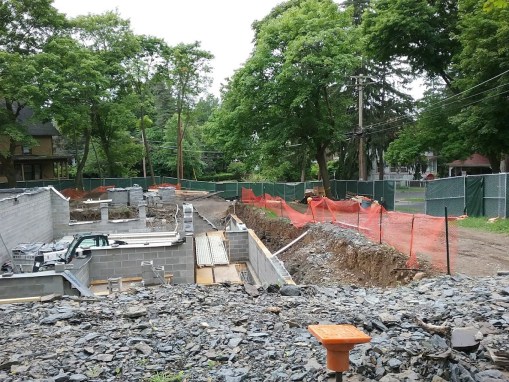
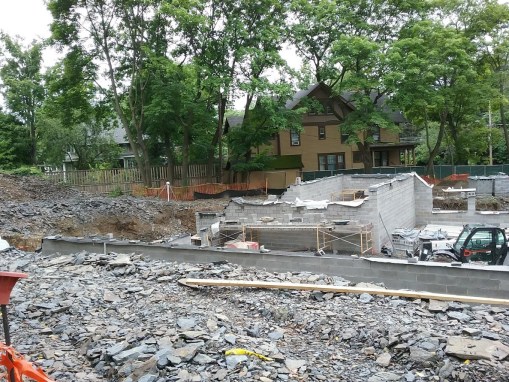
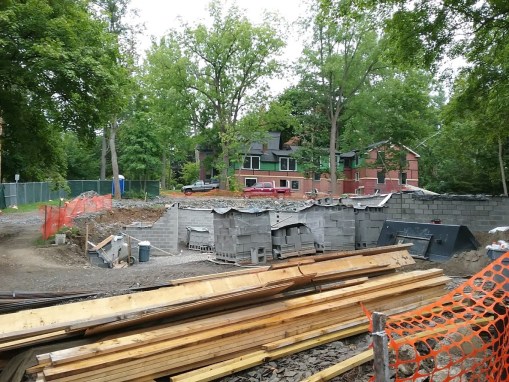
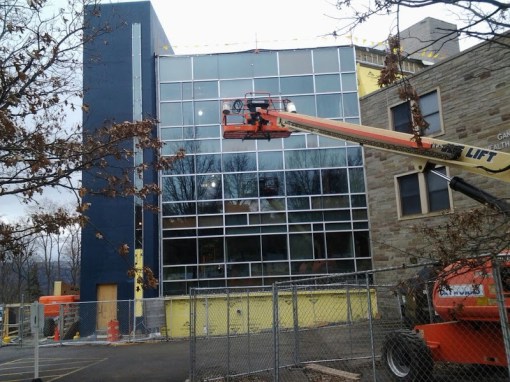
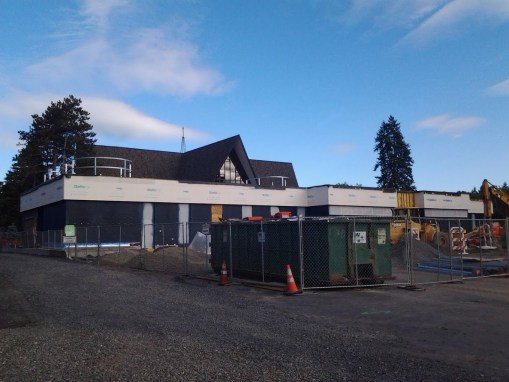
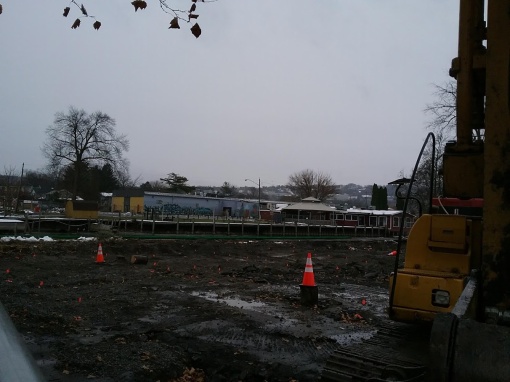
Taitem also designed the rather unusual timber-based pile system deployed at the project site. The project itself is relatively light as building go, but because of the waterlogged soils, a deep foundation is still required for structural stability. Instead of heavy-duty steel, treated timber can do the job for a fairly modestly sized project like this, an affordable, lighter-load alternative. As long as the timber isn’t exposed to high levels of oxygen (open air, there isn’t enough dissolved in groundwater), they can last for hundreds of years. You can see the piles in the photos below, and watch the pile driving process in the embedded Twitter video courtesy of Ithaca second ward councilman Ducson Nguyen. All the piles are in place, and a 6″ concrete slab will be formed and poured over the top.

Construction is expected to take about eight months, roughly placing a timeline for completion at summer 2019.

Before:


https://platform.twitter.com/widgets.js


Village Solars Construction Update, 11/2018
21 11 2018

The Village Solars complex is a development project that never truly stops. Lifestyle Properties (the Lucente family) only builds two or three new apartment buildings each year, but after four years of construction, it has resulted in quite a large development. A visit to the site shows the next buildings are just getting underway – based off the latest site plan, it appears to be Building “L” and Building “K”, which is a little out-of-order in that these two were supposed to built in 2020-2021, after another phase that so far remains unbuilt. Building L’s foundation has been formed and poured, with all the utilities poking out of the concrete, to be routed into the framing as the building goes up; Building “K” looks like it’s still in the excavation stage. The crushed stone helps with drainage, site leveling and preventing cracks in the concrete due to settling. That water will be pumped out before the footers are poured.

Each of the two buildings, which have slightly different designs, is designed to host 24 units – 3 three-bedroom, 6 two-bedroom, 3 one-bedroom, and 12 of the one-bedroom “micro-units”, which are 400-500 square feet. Expect a mid-2019 opening for the pair. Next year’s phase likely involves one more apartment building in Phase “4”, as well as the construction on their mixed-use community center building (Building “F”), which will go in that empty space in the last photo. The town of Lansing’s Village Solars amended PDA law (#6 of 2016, to be technical) says the developers are only allowed one more building to be built before the community center must be constructed, and that the center must be built by the end of 2020.


News Tidbits 11/17/2018

18 11 2018

X. Let’s start this off with a look at a couple of new projects that will be coming forward to the city of Ithaca Planning Board later this month. The first is 815-17 North Aurora Street. Back in June, when the existing property went on the market, I noted that zoning could conceivably allow the dilapidated house currently on the lot to be taken down and redeveloped into two two-family homes. Lo and behold, that is exactly the plan.

Although the listing has been pulled, no sale has been completed, so it’s not clear what kind of premium they are willing to pay for a double-lot development opportunity in trendy Fall Creek. But thanks to the Site Plan Review (SPR) documents, we at least know who the pending owner/developer is – the Stavropoulos family of West Hill, who own the State Street Diner and a growing portfolio of rental units under the name “Renting Ithaca”. The Stavropoli have redeveloped several properties in the past few years, including 1001 North Aurora Street (4 units), 107 South Albany Street (11 units), a two-family home at 514 Linn Street and a two-family unit planned for 209 Hudson Street (they originally applied to build two two-family buildings, but reduced it to one after neighborhood pushback). Their M.O. is basically small-scale rental infill, nothing especially large or ostentatious, and with that they go under the radar for the most part. In short, this R2b-zoned site is a perfect fit for them.

The plan is to tear down the vacant property, and replace it with two two-family structures, four units total. Each will be three bedrooms and 1,290 SF. Their usual architect of choice, Daniel Hirtler, has designed the structures to fit in with the Fall Creek vernacular, with recessed entries and aesthetic details (such as a transition between fiber cement shakes and clapboard siding) for visual interest. The buildings are positioned so that one is in the front of the lot, one at the rear, and only the front structure is visible from most public viewsheds. The site will include four parking spaces with new landscaping and utilities. Heating will come from electric heat pumps, and while the roofs will be capable of hosting solar panels, those aren’t expected to be included as part of the initial build. LED lighting, energy efficient appliances and water heaters, and high-efficiency spray foam insulation are included. This project would very likely meet the new Green Building Policy Requirements if in place. Given recent news in Fall Creek, it should be noted that the old building does contain asbestos (as do most in Fall Creek), but a demolition/deconstruction plan has yet to be filed.

The $627,000 project would be built from January to August 2019, which is a clear nod to having the units ready in time for the next academic year. Fall Creek tends to be less desirable to undergrads at Cornell because of the distance (<1% of total population), but graduate and professional students often rent in the neighborhood (~9% of graduate/professional students at Cornell live in Fall Creek). The planning board is expected to declare itself Lead Agency for project review this month, with approval in December of January, assuming demolition plans, excavation plans and other needed information has been received and approved.

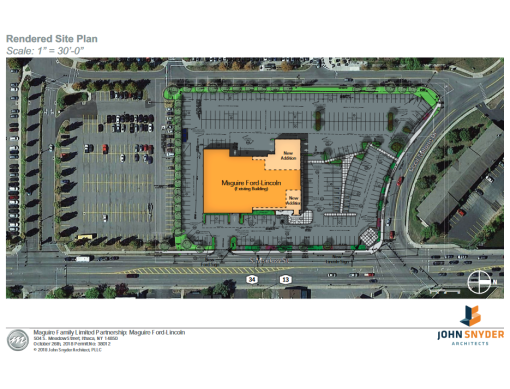
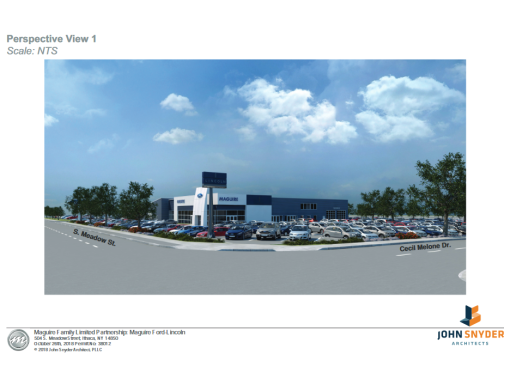
The other new plan to be reviewed this month is for a renovation and expansion of the Maguire Ford Lincoln property at 504 South Meadow Street, just south of Wegmans and the Econo Lodge. Now, for the news savvy, you might be asking, “isn’t Maguire supposed to be moving to Southwest Park?” The answer is two-fold; for one, Ford-Lincoln was not a part of that plan. For two, there hasn’t been much in the way of formal movement on that plan, and the city is hesitant to move forward with a deal because part of the site will serve as a spoils drying area for the inlet dredging, and because of the homeless encampment, which the city would rather not disturb at this time. The evictions didn’t work out so well last time, and members of the Human Services Coalition’s Homeless Task Force are advocating for the city to create a permanent housing solution on-site.

What this all means is that Maguire has to focus on its existing properties to keep them modern and fresh for the time being, both by their own requirements and by Ford’s  – new car dealers must renovate frequently, since carmakers force them to update or risk losing their exclusive rights to sell new vehicles.

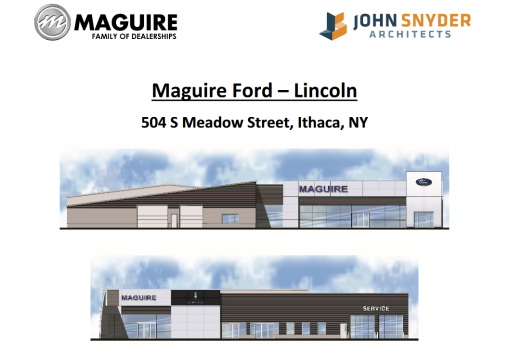
Local firm John Snyder Architects is in charge of design for the $1.5 million project, and while some eco-advocates will kvetch that a car dealer can never be green or sustainable, the building itself is designed to fit Ithaca’s yet-to-be enacted Green Building Policy. The second floor will be expanded with new offices, new customer bathrooms will be installed and the parts and customer waiting areas will be renovated and expanded. The showroom will also be expanded, and it will be slightly closer to Meadow Street than permitted in bib box land, so a zoning variance for front yard setback will be required. As a quick aside, JSA doing a car dealership is an interesting change – usually, car dealership design work has gone to Schickel Architecture.

The additions, which will result in a net increase of 5,610 SF, will be steel-framed, with concrete slab foundations, and faced with a couple variations of aluminum metal panels for a contemporary exterior finish. Apparently, that curved thing at the entrance is called a “foil”. Ithaca’s Elwyn & Palmer is assisting with the structural engineering. While there will be landscaping and circulation improvements, and the amount of green space will be increased from the existing site layout, the project will not meet impervious surface zoning restrictions, and will need a second variance to allow the proposed plan.

It’s not 100% clear what the proposed design is, since the elevation drawings don’t match the renders. Note the second-floor windows near the service area and the differences in the panel colors and elements (vertical ribs vs. rectangular panels) in the render.

The plan is to have approvals by January for a March to September 2019 build-out. Because of a tight corporate deadline from Ford, and since the Board of Zoning Appeals is not having a December meeting, and possibly not a January meeting either (expected lack of quorum?), the project team wants to discuss some sort of bundling of review and zoning variances in the review.

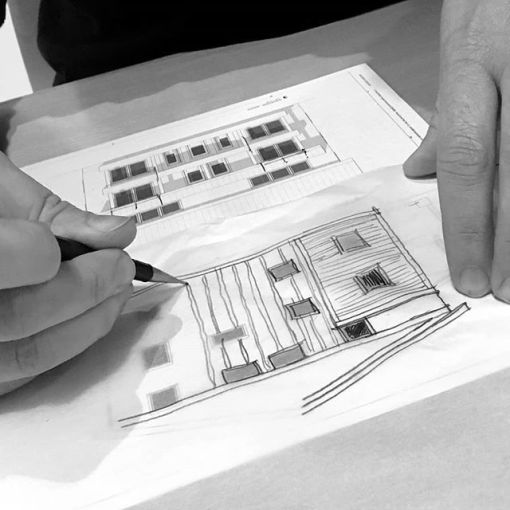
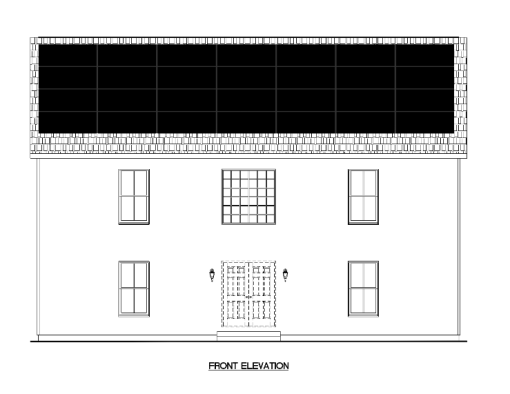
3. Ithaca-based architecture firm STREAM Collaborative is cooking up their latest project design, and posted hints of this “Net Zero” energy building on Twitter. There’s a very high chance this small multi-family Net Zero project is local, given STREAM’s nearly-singular focus on the Tompkins County market. Also, given that it’s a three-story building with what appears to be 4-6 units, I’d take a guess at a more settled, primarily residential urban area. Not Downtown Ithaca, but maybe one of the village centers or one of Ithaca’s more residential inner neighborhoods. If it’s an Ithaca-area rental, given the August-August academic calendar that the local apartment market revolves around, I suspect we’ll see more about this project in the next few months if the developer is aiming for fall 2019 occupancy.

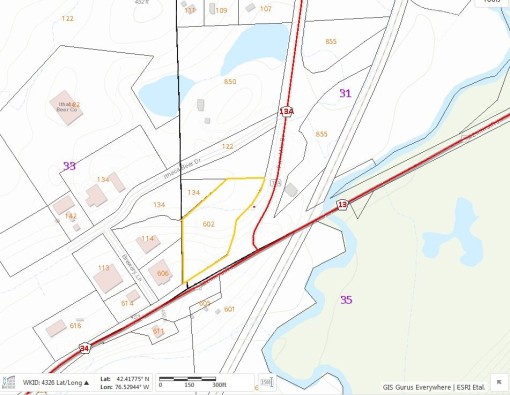
4. Something to keep an eye on for the future. 602 Elmira Road sold for $690,000 on October 24th. Not only was the buyer was a New York-based hotelier, but the price paid is far above assessment – the three-acre parcel was only valued at $150,000, and had sold for $140,000 back in September 2014, from the realtor who subdivided it, to another hotel developer, Guru Hotels LLC. So it’s distinctly possible that Guru Hotels developed a plan, designs and all, but decided to not move forward with it and found another interested hotel developer to take over on the development, which would explain much of the premium on the sales price. Of course, those plans have never been brought forward to the town of Ithaca planning board, so buyer beware.

The location has some desirable factors – along Route 13 just beyond city limits, near Ithaca Beer, and within the town of Ithaca’s proposed Inlet Valley agri-business and tourism Corridor. The town as been a bit scattered on how it sees this swath of land next to 13A – the Comprehensive Plan saw it as natural space, current zoning is light industrial, and the Inlet Valley zoning and design guideline study is okay with either of those, an agriculture-related business or something tourism-focused, which a hotel would fit under. Stylistically though, a typical chain hotel will not e approved here – like with the nearby Sleep Inn project, it will have to embrace the ‘rustic look’ the town wants here.

5. 323 Taughannock has its construction loan. Tompkins Trust Company lent the development team $4.061 million to finance work on the 16-unit townhouse project on Inlet Island. The builder looks like a newcomer – Benson Woodworking Company. The firm normally does business as a modular and timber-frame builder based out of New Hampshire. I suspect given the choice of firms that the townhouse units will actually be framed and sheathed off site, and transported over to be assembled like pieces of a puzzle. It’s an unusual project for a firm that mostly does higher-end vacation homes and cabins, but 323 is a wood-frame structure, and the project has already had issues with the poor on-site soils and spiraling costs – a modular approach would potentially save on costs and make the logistics of the construction site easier to manage.

6. Cayuga Ridge has also received a construction loan, a set of them to finance its renovation plans. Three loans, for $12,558,750, $2,216,250 and $1,500,000, were received from CIBC Bank USA (the U.S. division of Canadian Imperial Bank of Commerce, based out or Toronto with the main U.S. office in Chicago). The fourth loan, for $3 million, came from Metropolitan Commercial Bank out of New York. The owners of Cayuga Ridge are based out of the New York area, so perhaps that would explain the choice of lenders. The loans cover $19.275 million of the $21 million renovation, which will thoroughly update the interior layout with updated utilities and enhanced patient services. The renovation is expected to result in 49 new jobs at the nursing and rehabilitation center, mostly new nurses and nurses’ aides.

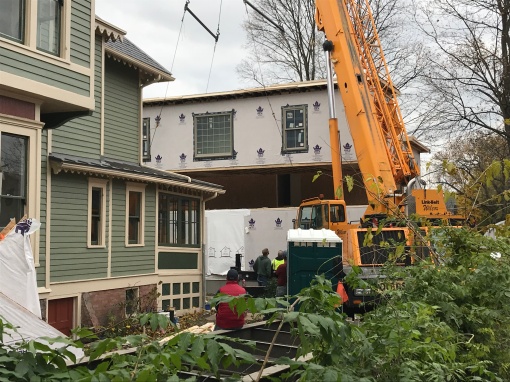
7. It’s a few weeks old now, but the infill housing behind 310 West State Street is coming along. These are the modular pieces of the new six-bedroom rental being craned into place. Also, the renovation of 310 West State is coming along, soon to be a “co-op” for young professionals. The renovation to the existing home is being paid for through a combination of private funds and a RESTORE NY state grant, while the rear infill is all private equity.


105 Dearborn Place Construction Update, 11/2018

12 11 2018

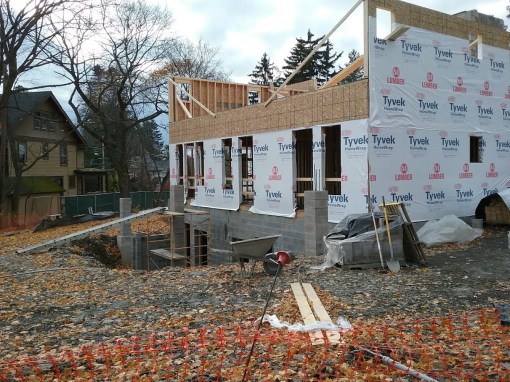
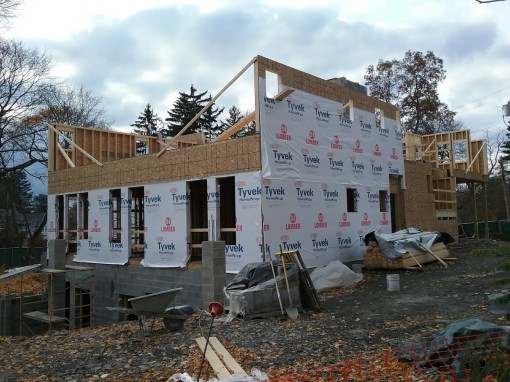
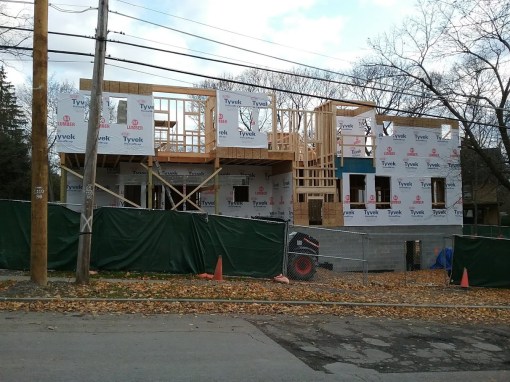
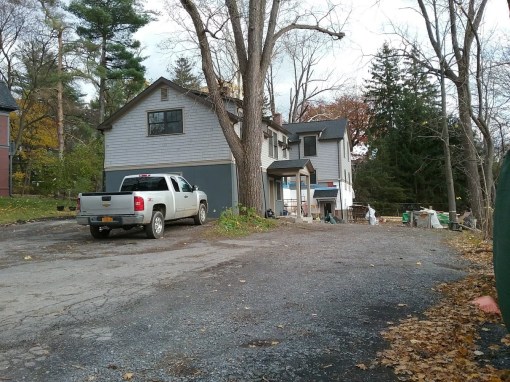
Framing continues on the future 105 Dearborn Place. Being a large Craftsman-style structure, and because rough openings are sometimes covered by housewrap until it’s trimmed and stapled, it can be a bit tricky to see how the built product compares to renders – best advice is to wait until framing is complete to see if there are any design changes. Many contractors have made the switch over to ZIP Panels for sheathing, but it looks like Schickel Construction is using traditional wood sheathing with Tyvek housewrap – each has its pros and cons, so it boils down to what the builder is comfortable with given the needs and budget for a project. Housewrap would arguably offer more flexibility, but it may be a slower process overall, leaving it susceptible to wind damage if not completely fastened.

Most of the structure is wood-framed, but the basement level uses concrete masonry walls, as does the fireproof stairwell. If this were a skilled-care facility (for example, a nursing home), state code would require the whole building would need to be built of fireproof materials like gypsum. But since this is independent living, the presumption is that residents are coherent and mobile, able to recognize danger and escape to safety in the event of a fire emergency. The masonry base will be faced with a cultured stone veneer, and the upper levels will be covered with cedar shakes after the building is fully framed and wrapped. Background info and further details on the 12-bedroom/16-bed  senior living facility can be found here.

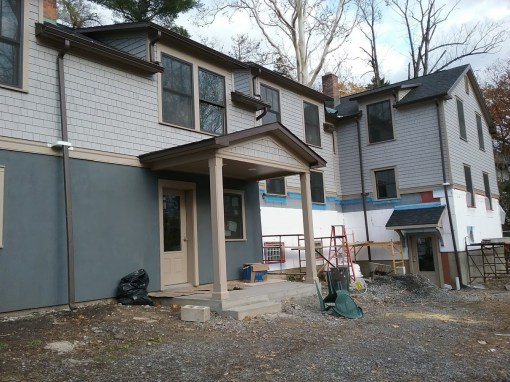
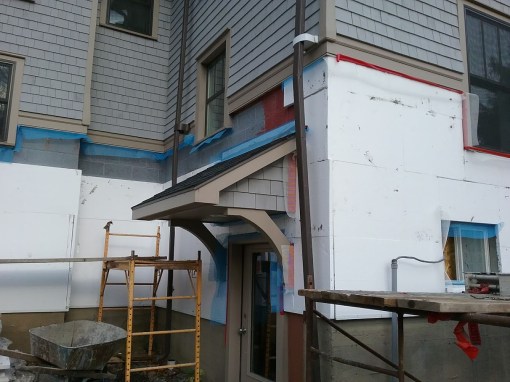
As a bonus to this post, a few photos of 109 Dearborn are included at the end. The new dormers are in and the siding is going on – cedar shakes not unlike those to be used on 105 Dearborn. It looks like the original masonry walls are being sheathed in foam insulation board. Historical note here, 109 Dearborn was a former accessory apartment and storage space being converted into a two-family home, and only the apartment portion may have been insulated. It’s a shame the new ground-floor bump-out was dropped, the first floor seems a little drab when compared to the second floor.


238 Linden Avenue Construction Update, 9/2018

9 10 2018

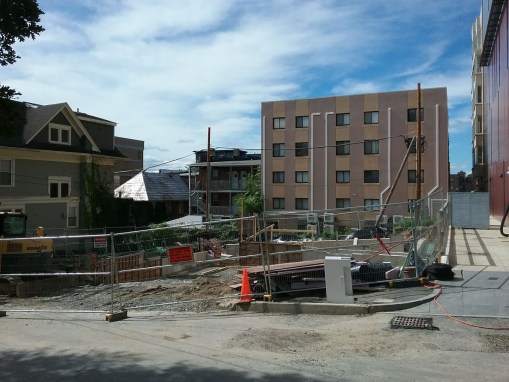
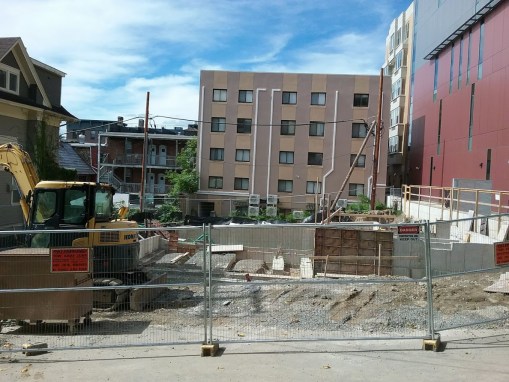
The foundation walls are being poured at Novarr-Mackesey’s 238 Linden Avenue project. The footers and some of the foundation walls are poured and cured, with steel rebar sticking out of the surface, waiting to be tied into the skeleton of the structure as it starts to be assembled. Other concrete walls are still being formed and poured. It looks like wood with steel bracing, my first thought was all wood but a closer look shows the bracing is thin steel, with the plywood from Pacific Wood Laminates and likely procured through a supplier, and the bracing probably from the same supplier. Forms are typically plywood, sometimes aluminum or steel, and are braced to resist the pressure from the concrete as it is poured to make the foundation walls – basically, to keep the walls in shape while they cure. And once the wall is cured and checked for any issues, workers move the forms to the next section until the walls are complete.

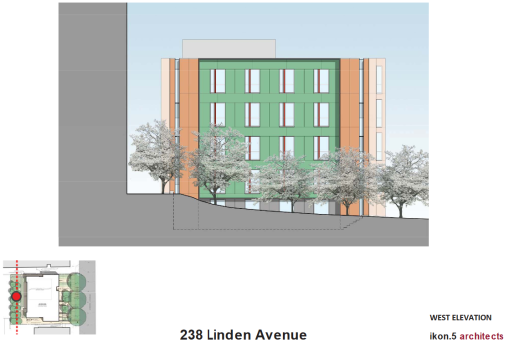
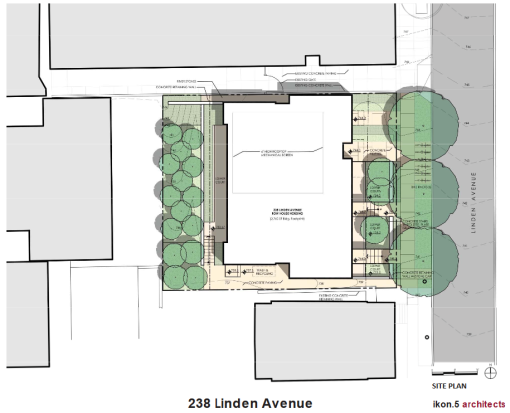
The sloping rear wall is probably not a part of the building foundation. Looking at the footprint of the building, it’s more likely a retaining wall intended to hold back the soil. 238 Linden will have a habitable basement with lower “courts” to let light and air below ground level (offhand, I think the layout is five studio units per floor on the four floors above ground level, and four studio apartments on the basement level, for a total of 24 units). The front retaining wall will have a similar slope as it is built out.


Hilton Canopy Hotel Construction Update, 9/2018

29 09 2018

The past couple of months haven’t been the best for Ithaca development. Apart from the recent lull, most of the high-profile projects have engendered some animosity or involved in a publicly relations mess. In the case of the Hilton Canopy, that would be the incident with the sure-footed construction work on the scaffolding. My goal when reporting it back in August was to be impartial and thorough and I still I don’t know enough about the work environment to make a comment. From the public comments and my emails, it’s not 100% clear if there were violations and how severe they were; there’s some subjectivity in their application (harnesses are to set up in ways that don’t pose other safety concerns or obstacles, for instance, so if it could be proven that it would have been a risk a harness wouldn’t have been required). OSHA is reviewing and will make their judgement calls as they see fit, even if it takes up to six months to hash out.

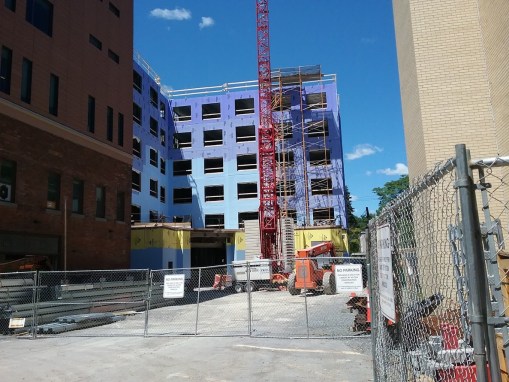
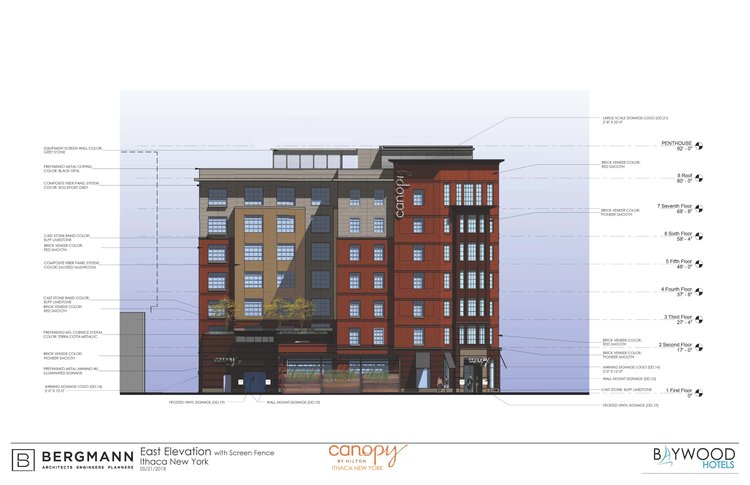
On the bright side, the Hilton is moving along, the warehouse-style windows are being fitted and most of the sheathing has been attached to the exterior steel studs. The water-resistive barrier will prevent moisture seepage from damaging the gypsum sheathing panels. The yellowish Behr paint “applesauce cake” colored fiber cement panels were replaced with a somewhat darker and browner tone, “sauteed mushroom” from rival Glidden. As Glidden Paints says, a “(m)id-toned warm beige, this color makes a statement as an exterior body color as well as an interior accent wall or warm meditation space.” I don’t make these names up, I just report them.

There hasn’t been too much news about the project apart from the scaffolding controversy; the Canopy brand has been touting Ithaca-area attractions on its facebook page and the brand website states a mid-2019 opening.


Cayuga Medical Associates Construction Update, 8/2018

7 08 2018

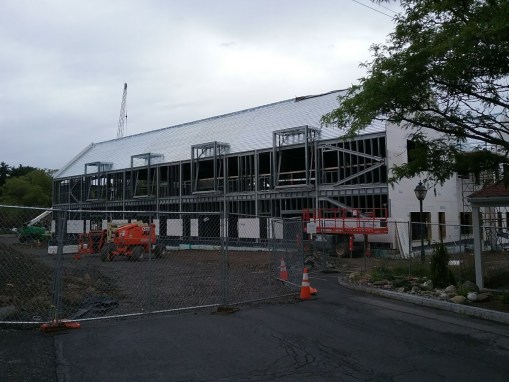
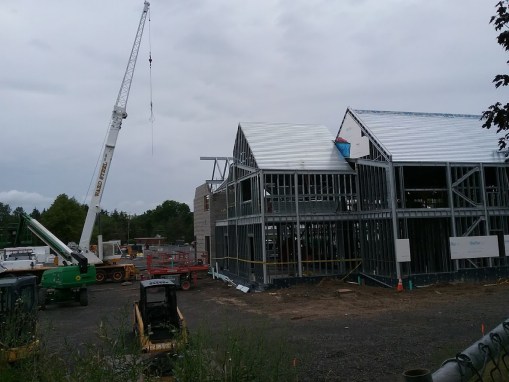
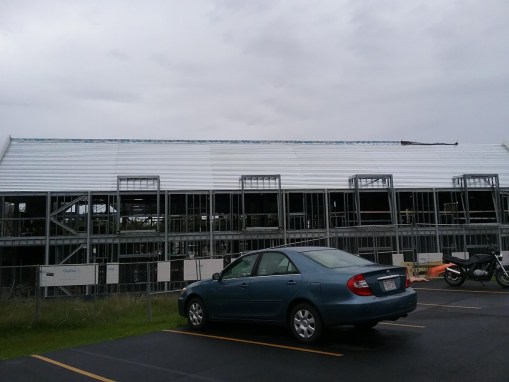
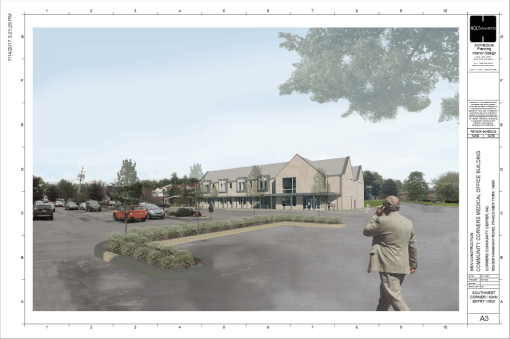
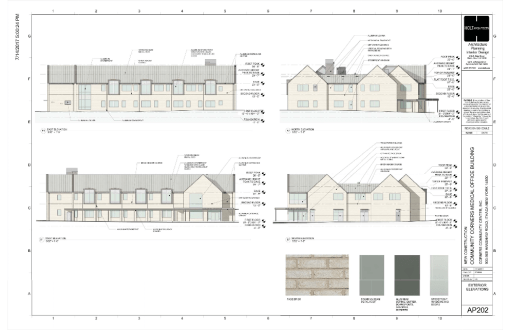
The new Cayuga Medical Associates office building at Community Corners is topped out – I’m a little hesitant to call it fully framed since it appears some minor work remains at the southwest corner of the new 28,000 SF building. Steel stud walls are being sheathed in Saint-Gobain CertainTeed GlasRoc, one of the major suppliers of fiberglass mat gypsum board. True to name, the boards consist of a sheet of woven fiberglass sandwiched between gypsum panels; brands like GladRoc and Georgia-Pacific DensGlass are fairly common for commercial construction where fire-rated walls are a necessity, like medical spaces, offices and hotels, and it does show up in some apartment buildings. The exterior will be finished with an off-white brick veneer, a nod to neighboring structures. Interestingly, the entirety of the gable roof sections appears to be standing seam metal over some kind of base layer. More expensive, but definitely making it such that in the event of fire, there is as minimal ability to spread and put vulnerable individuals at risk. Ward Steel of Liverpool appears to be the subcontractor for the structural steelwork.

The interior work doesn’t seem to be too far along yet, with interior framing underway, and maybe fireproofing of the structural steel or sprinkler installation underway. The construction work hanging out by the rough window opening in the photos below said that they hoped to have the building finished by late fall. McPherson Builders of Ithaca is the general contractor for this project, and Chemung Canal is financing it to the tune of $7.8 million – a better use of funds than the million bucks they had to pay out to Jason Fane when they lost the Bank Tower lawsuit last year.


East Pointe Apartments Construction Update, 8/2018

6 08 2018

No one can say DGA Builders is wasting time. A visit on Friday showed three sets of CMU foundation walls have been assembled and mortared, each for a ten-unit townhouse string. A few crewmen kept an eye on a material placement truck, also known as a stone slinger, as it launched rocks into the footprint encased by the foundation walls. This may be a crushed stone base (hardfill) for a concrete slab pour, given the stacks of rebar with surface rust sitting nearby. A shallow foundation would work fine here because two-story buildings aren’t especially heavy as structures go, and it would be less expensive and time consuming than a deep foundation. Elsewhere around the site one sees PVC sanitation pipes (sea green), water pipes (blue), and pieces for utility junctions.

Meanwhile just a stone’s sling away on Nor Way, Forest City realty continues work on the six-unit string (hexplex?) of townhouses. Two are fully framed and roofed, two have had their first floor framed though not fully sheathed, and the other two are only partially framed on the first floor. As with all the townhouse strings, these will incorporated some unique design features while keeping the general unit layout the same. I know they’re not happy about the East Pointe townhomes, but it could be a good synergy – the price points ($1,400-$2,000/month fr East Pointe, $350k for the Heights of Lansing townhouses) are such that renters who may wish to stay in that neighborhood may look at the Heights townhomes as an option.

A website is now up and running for East Pointe. It’s mostly stock images and bland corporate-speak, but they do have floor plans and some new renders. Here’s the advertising pitch:

“This apartment community is located on 20 acres in Lansing, NY, which is part of the Ithaca, NY, market. This is new construction of 140 state-of-the-art apartments. There will be 36 one-bedroom units, 90 two-bedroom units, and 14 three-bedroom units. The project will include fourteen apartment buildings with 10 units in each building that will be walk-up garden style with private entrances and a community building. All units will have high end finishes and amenities, including stainless finish appliances, microwave, dishwasher, washer and dryer, ice maker, granite counter tops, wood cabinets, vinyl plank flooring and wall-to-wall carpeting, tile showers, high end plumbing fixtures and lighting fixtures. All apartments will include a patio or deck. The community building will include the leasing and maintenance office, Great Room and warming kitchen for gatherings, and a fitness center. The project also includes an outdoor pool with changing rooms and shower.”

I have no idea what a warming kitchen is, but my very Sicilian mother is pretty good at turning kitchens into warming spaces around the holidays. A photo of the community center is included below.

UPDATE: I’m just going to add this here since the timing was ever so slightly off- on Monday the 6th, the construction loan was filed with the county. M&T Bank is lending Park Grove (represented by an LLC) $22.6 million for construction of the East Pointe project.


105 Dearborn Place Construction Update, 8/2018

4 08 2018

It’s no secret that people are living longer. In 2014, residents of Tompkins County could expect to live to 81.21 years, an increase of about 7% from 75.92 years in 1980. It’s also no secret that the population in general is getting older – the Cornell Population and Demographics unit estimates that Tompkins County’s population over the age of 65 has gone from 9,301 in 2000, to 14,454 in 2017, an increase of 55.4%.

From a business perspective, this creates opportunities for various forms of senior housing, housing designed to allow matured individuals to age in place. However, there are cases where specialized, skilled care may become a necessity. This can include specialty facilities like Brookdale (memory care), nursing homes like Beechtree and Cayuga Ridge, and premium personalized care options like Kendal and Bridges Cornell Heights.

Founded in 2001, Bridges Cornell Heights occupies three expansive homes in the historic Cornell Heights neighborhood north of Cornell campus – one was built new in 2005, and the other two are renovations, the last being just a few years ago on Kelvin Place. Each house has sixteen residents or less, and to be frank they could be described as a luxury retirement homes – a high degree of personalized care and a commensurate price tag.

With full occupancy and a waiting list in hand, Bridges has decided to move forward with plans for a fourth house in Cornell Heights, and the second all-new home. The property will be located on the southeast corner of Wyckoff Avenue and Dearborn Place, a small vacant field recently sub-divided from the former Palentological Research Institute next door (which is separately being renovated into a two-family home by Classen Ambrose’s husband). According to the 1928 Cornell Map, the property was once home to the neighborhood school, but the school and its building ceased to be many years ago.

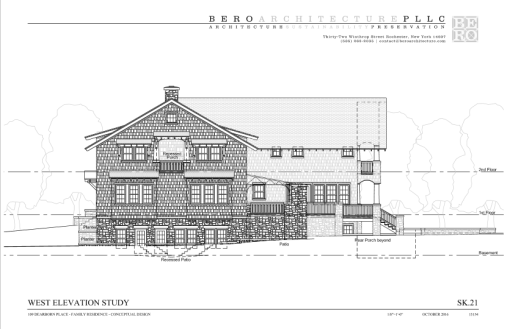
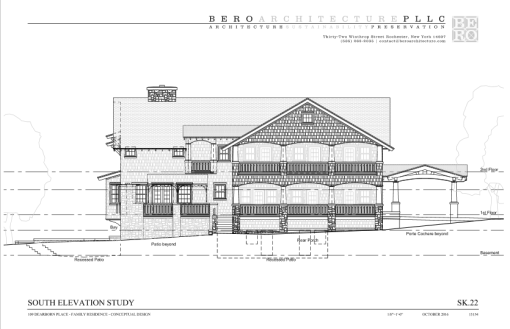
Given that Cornell Heights’ century-old architecture is defined by high-end, visually unique homes, the new property is seeking the same qualifications. Rochester-based Bero Architecture, which specializes in historic design, has been retained and early drawings show an imposing 10,930 SF two-story cultured stone and cedar-shingle Craftsman-style home with 12 bedrooms (four of the bedrooms will be designed for double occupancy for couples). The landscaping will be similarly fitting and designed by Cornell landscape architecture professor Paula Horrigan. Exterior features include a porte cochere, porous driveway and courtyard parking for nine vehicles (all residents, staff are given pre-paid parking off-site at a nearby fraternity and walk over), as well as three patios, walkways and lush plantings (500+ perennials, 127-140 shrubs, and 35 trees).

Since Cornell Heights is a historic district, the Ithaca Landmarks Preservation Commission was required to sign off on any new construction visible from the outside. The design of the house changed very little from start to finish in the approvals process – Bero is good at what they do, and the ILPC was amenable to the design, though some requested tweaks were made to landscaping and parking along the way. They also requested a dated plaque to ensure no one mistakes the new build for an older structure. The project was proposed in May 2017, and approved in October, generally smooth sailing. I can remember when I did the Bridges article for the Voice, Classen Ambrose was very worried about the neighbors reacting negatively. To that credit, some of the full-time neighbors opposed the project, and it’s not often one sees a “senior living operators are converting and destroying the neighborhood” argument. But overall, the opposition was minor. The house is contextual, and the environmental impacts are fairly modest once the mitigation measures (parking off-site, new trees) are considered.

Classen Ambrose has said that the house will programmatically be a little different from the existing trio of homes in that it will be independent living instead of the enhanced assisted living employed at the other homes. That means a lower level of care – residents may receive assistance in housekeeping and cooking, but they are otherwise capable of managing their day-to-day activities. The new facility will also add at least four more staff to Bridges’ payroll, which is in the low/mid 40s and has been seeking living wage certification.

Side note, although it’s been replaced with newer videos, Mack Travis, the founder of Ithaca Rentals and renovations (now Travis Hyde Properties under his son and son-in-law) once did a testimonial in a short video extolling Bridges’ service for his family members. Now years later, Bridges will be providing services to residents of THP’s DeWitt House senior living project.

This is a high-end development where no expense is being spared. Tompkins Trust Company extended a $4.2 million loan, filed with the county on July 20th. Construction is expected to take about a year, with local firm Schickel Construction in charge of the buildout. Alongside with Bero and Horrigan, T. G. Miller P.C. did the civil engineering work for the project.

The project does include a finished basement, and it appears the site has been cleared, excavated, and concrete masonry (cinder block) walls are being assembled at present. Construction will be a traditional wood-frame approach. Note the ZIP panels on the neighbor at 109 Dearborn, as it goes from a dull 1930s office/storage space and becomes a two-family home, also designed by Bero Architects.

Pre-construction (Sep 2017 Google Street View)

August 2018


Drawings:


Hilton Canopy Hotel Construction Update, 7/2018

15 07 2018

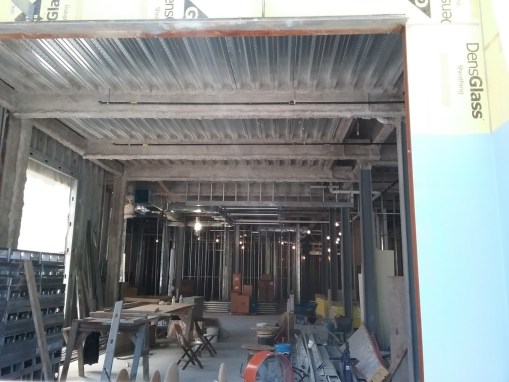
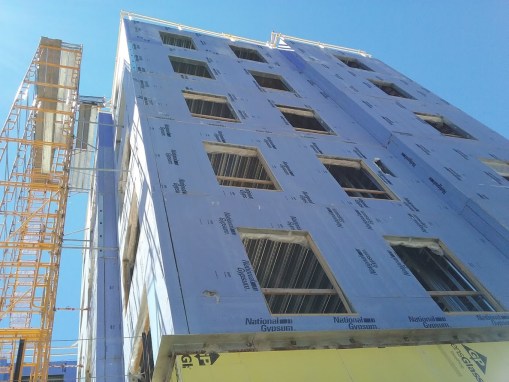
As previously mentioned on the Voice, the new 131-room Canopy by Hilton is one floor short of topping out. Interestingly, the ground level/lobby uses Georgia-Pacific DensGlass fiberglass mat sheathing, while the upper level use National Gypsum eXP boards. I’m not sure why the change – both are fire-rated, mold and water resistant. It probably doesn’t have to do with the exterior finishes (brick veneer is used at both ground level and on some of the wall projections above), but it’s possible it has to do with the construction material. The ground level is composed of poured concrete, while the upper floors are structural steel and accompanying steel stud walls. Regardless of the reason, both are being covered with the same water-resistive barrier. You can see the interior stud walls through the rough window openings, but interior work hasn’t progressed much farther than that on the more recently erected upper floors. The lower floors appear to be undergoing utility rough-ins.

It still isn’t clear what the replacement panel color will be for the yellowish “Applesauce Cake” – not sure if Whitham Planning and the rest of the project team persuaded the city “Dark Ash” grey was okay, or if another color was chosen. If someone knows, feel free to chime in the comments.

Further information on the Canopy hotel can be found here.