Village Solars Construction Update, 4/2016

19 04 2016

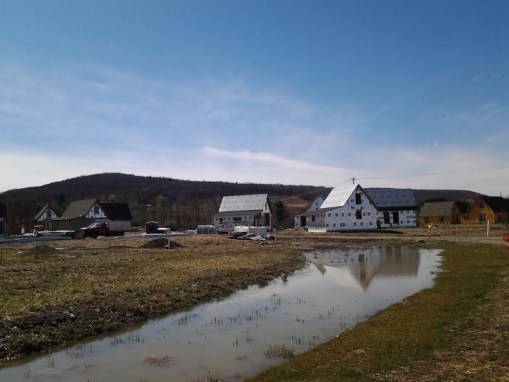
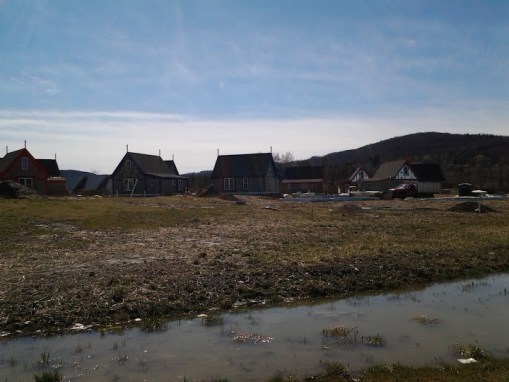
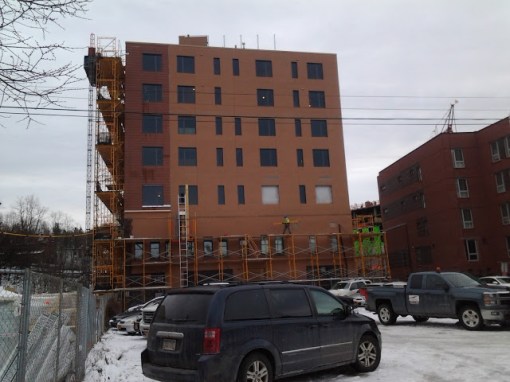
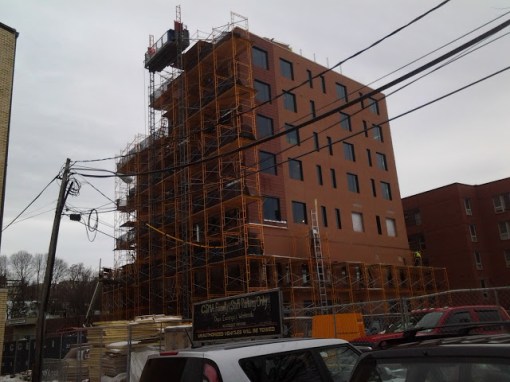
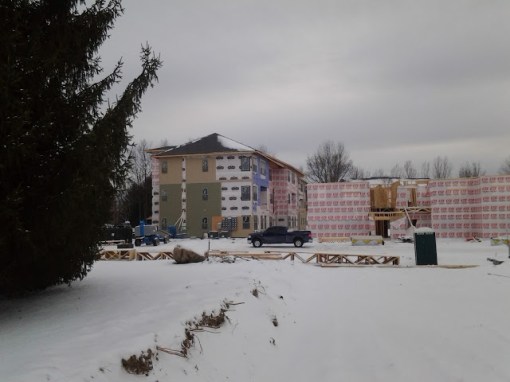
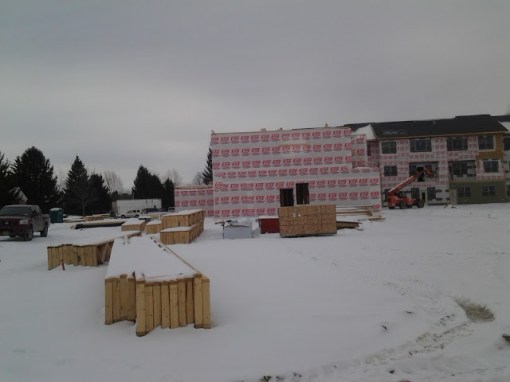
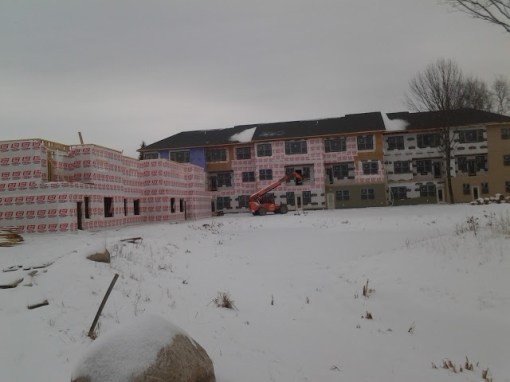
Heading into the spring, it looks like the Village Solars project off of Warren Road in Lansing has made some pretty substantial progress with its second phase.

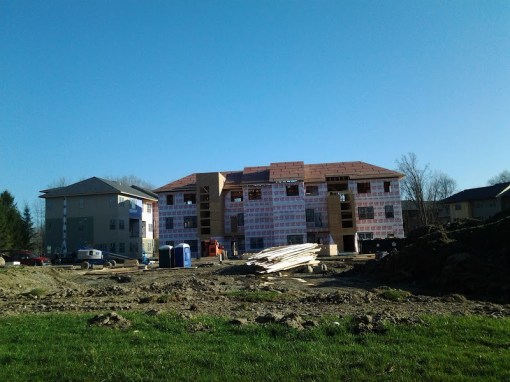
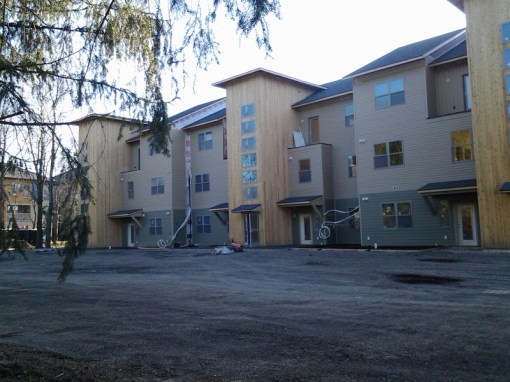
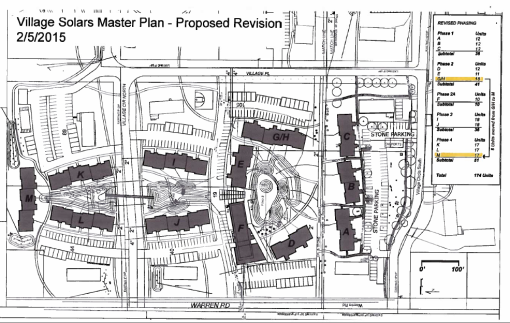
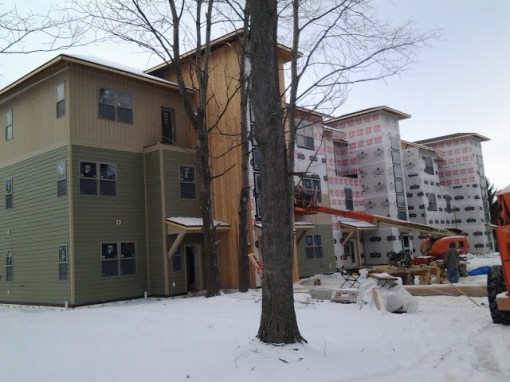
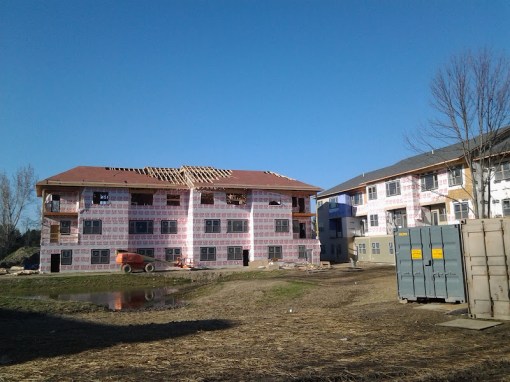
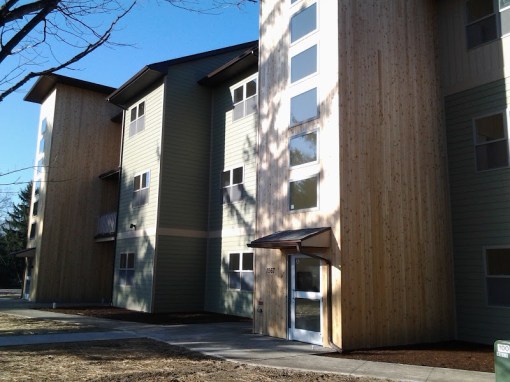
Building “D”, which contains 12 apartments, is essentially complete inside and out, though not yet occupied.

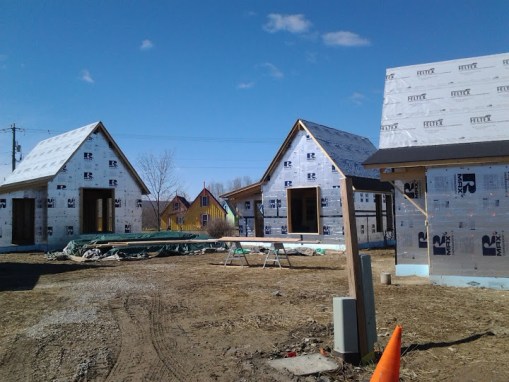
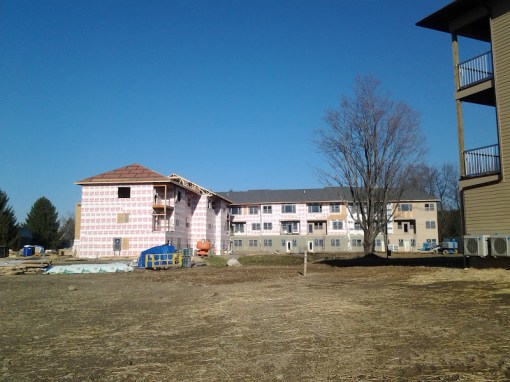
Building “G/H”, which holds 18 units, is fairly far along from the outside – cement boards have been attached to most of the east face, and some more wood siding has been applied to the west face. Exterior details like balcony railings and trim boards have yet to be installed.

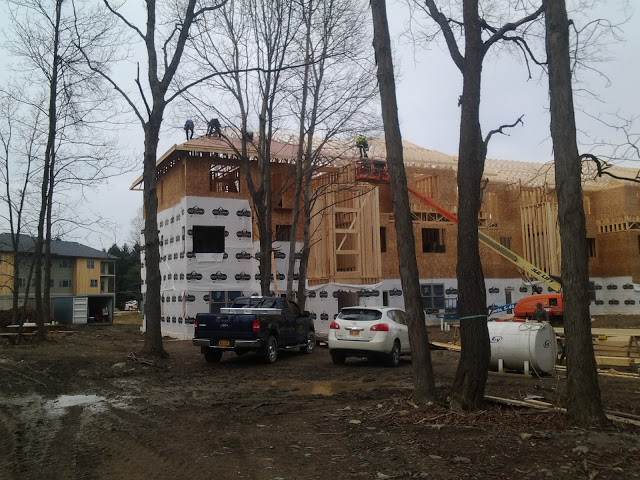
Building “E” is topped out, and the roof rafters are being sheathed with Huber ZIP panels. The stairwells are still being framed out. Windows have been fitted in most of the rough openings on the first and second floors, but have yet to reach the third floor. Housewrap covers most of the plywood walls, with the exception of the stairwells. “E” will have 11 apartments.

From observation, it looks like Lifestyle Properties (the Lucente family) could start renting out Building “D” tomorrow if they wanted, Building “G/H” towards the end of the Spring (possibly Mid-July from the Craigslist posting), and have Building “E” ready for occupancy before the semester starts. Phase two of the 174-unit apartment project is being built with a $6 million loan from Tompkins Trust. Phase one’s 36 units opened last year.

EDIT: From Rocco Lucente the younger – “We will have our first move ins for 1067 Warren Road (Building D) on May 1st. The other two buildings are currently scheduled for June 15th and July 15th completion. We did get our Certificate of Occupancy for Building D around two weeks ago, but with the various cleaning and landscaping work we set our target for May 1st.”

No loans have been secured yet for the three later phases, and plans are still in the works for an addition across Village Place that would bring the total number of new apartments to over 300.

20160414_174742 20160414_174754 20160414_174809 20160414_174852 20160414_174921 20160414_175002 20160414_175115 20160414_175233 20160414_175611 20160414_175618 20160414_175729

village_solars_2 village_solars


A Construction Tour of a Net-Zero Energy House

6 04 2016

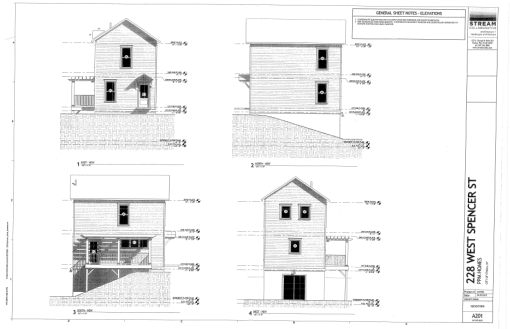
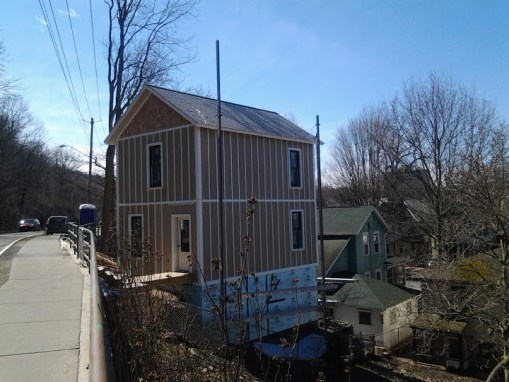
A couple of weeks ago, Noah Demarest was kind enough to give a tour of the new net-zero energy single-family house underway at 228 West Spencer Street in the South Hill neighborhood.

Most readers of the blog will be familiar with Noah Demarest’s name – he’s the head architect of STREAM Collaborative, which has been involved in projects like 902 Dryden Road, 201 College Avenue, State Street Triangle and the Franklin proposal for condos at the Old Library site.

228_w_spencer_1

Noah’s a little more involved in this project than most – he’s in charge of the build-out, and the cost of construction is coming out of his own pocket. Local landlord Ed Cope is a silent partner in the project, having purchased the land from the previous owner for $15,000 last February. The sale came with a different set of house plans, and the unique topography and constraints of the site made it such that the BZA had to approve virtually any new construction proposed on the parcel – Noah drew up plans for a different design, and those were later accepted by the board.

20160319_130922

You can see how that unique site topography plays in here. The framing, sheathing (ZIP system), roofing and panelling of the house was done by local company Ironwood Builders. With much of the exterior work completed, activity has shifted largely to the interior spaces, which Noah is doing with his own construction team.

20160319_130936

My initial impression was that they were going for an exposed wood trim look similar to the framework of Tudor-style houses, but Noah says the trim will be painted the same color as the fiber cement siding. The shingles are a nice, Craftsman-style touch.

20160319_131043 20160319_131055

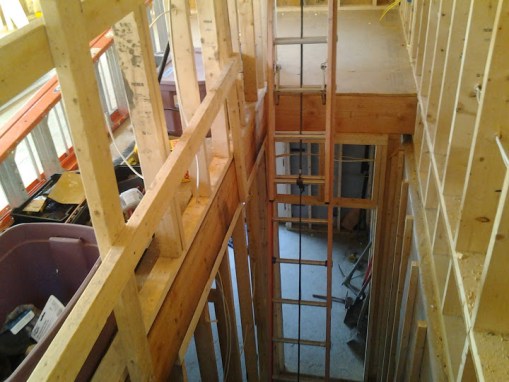
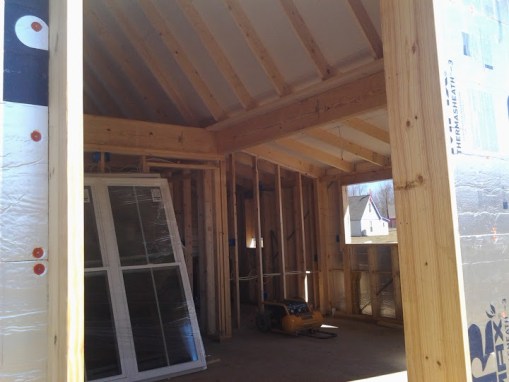
First photo is looking down, second is looking up. The house, just under 1,000 SF, has living space on three levels – the kitchen and living room will be on the second floor, and a bedroom and bathroom are on the first and third floors. This will be put up on the market for sale once it is ready – not a rental. Noah envisions this being the type of house that would be great for a young couple or even a deep-pocketed grad student.

By the way, just mentioning for the sake of acknowledgement – I’m not a fan of ladders.

20160319_131113 20160319_133609

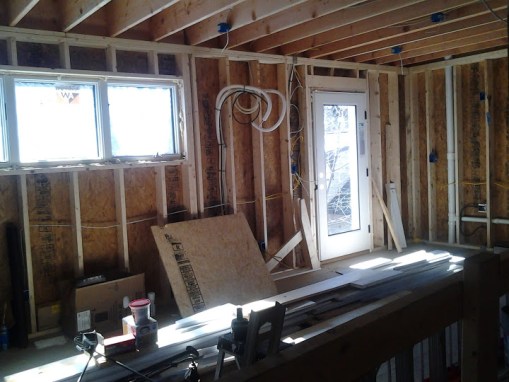
As work moves closer to completion, a porch pergola will be built here.

20160319_133613 20160319_133748

This will be a net-zero energy house, meaning zero net energy consumption – what gets taken from the grid also gets returned to the grid. In the case of this home, an off-site set of solar panels will offset the energy that is taken from the grid. The house will also achieve a very high degree of energy efficiency. One of the ways that’s being accomplished here is the use of an air source heat pump, which transfers heat from outside to inside a building (and vice versa) via a refrigeration compressor and condenser. The system can absorb heat from the outside air and transport it into the home, and can work in reverse during the summer, absorbing heat from inside the home and transporting it outside.

According to Noah, the system tends to be somewhat less efficient in extremely cold weather (-10 F or so; at that point it becomes difficult to extract usable heat energy), but is otherwise very capable for providing heating and cooling needs. Appliances will be all-electric, no gas.

20160319_133939

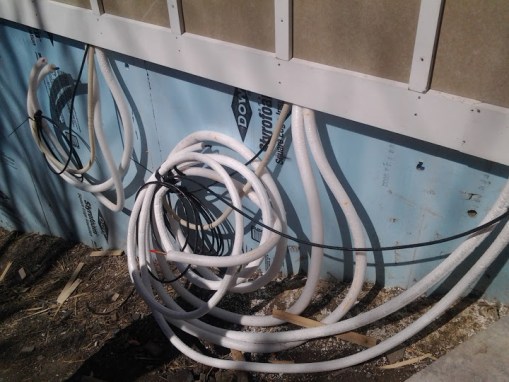
The house is also very heavily insulated – 2.5 inches of foam, with the fiber cement siding on top of that.

20160319_134029 20160319_134056
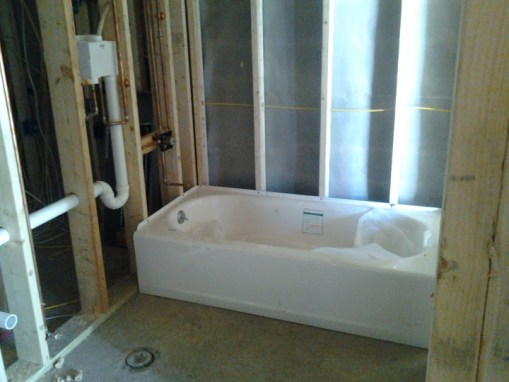
These last couple shots are from the bottom level – bathroom plumbing is in the process of being installed in the basement bathroom unit. The plan is to have the house ready for sale later this year.

One of the things that I personally am looking forward to is that Noah plans on making the costs of construction available to the city, as an example of what construction costs tend to look like for infill on an inner-city parcel. Having more examples to rely on, and a clear description of cost per square foot, gives the city more information to help guide its approach to planning and development. Noah noted during the tour was that the zero net-energy aspect is a relatively minor component in the expenses of the project.


Boiceville Cottages Construction Update, 3/2016

21 03 2016

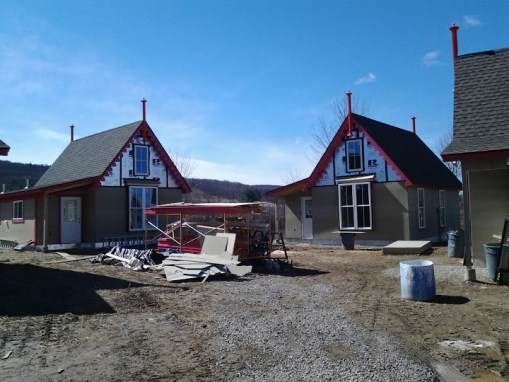
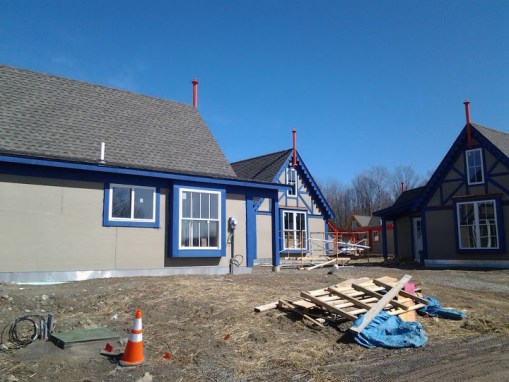
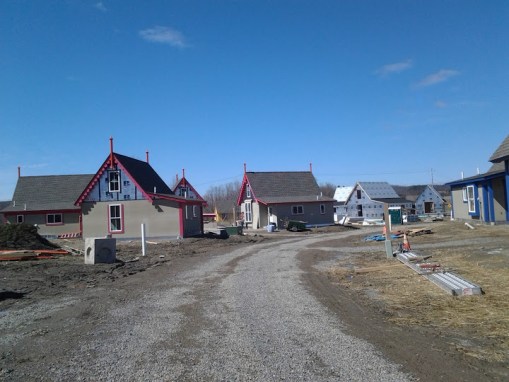
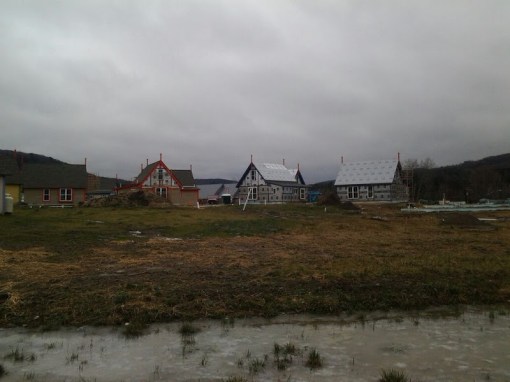
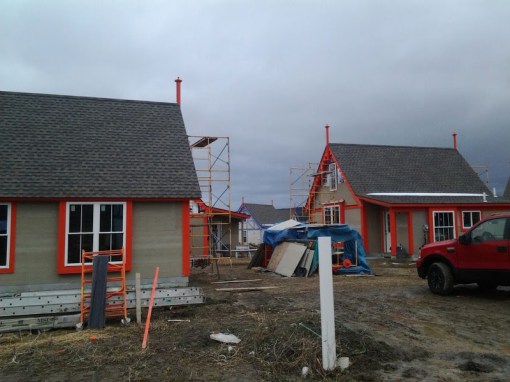
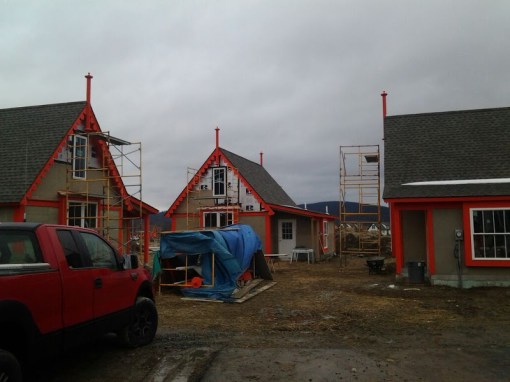
Some good progress has been made with the new cottages over at the Boiceville Cottages site. the cottages with the red-orange trim appear to be fully finished and occupied, while those with the blue trim have some interior finish work left before they can be rented out to tenants.

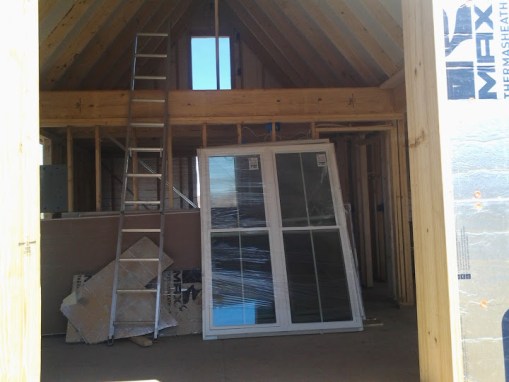
Newly risen since the last visit in January are a set of fuchsia-trimmed cottages that have been framed, sheathed, and partially stucco’d, and a fourth set of cottages that are still at the sheathing stage. Peering inside, you can see the interior stud walls and windows yet to be fitted into their openings.

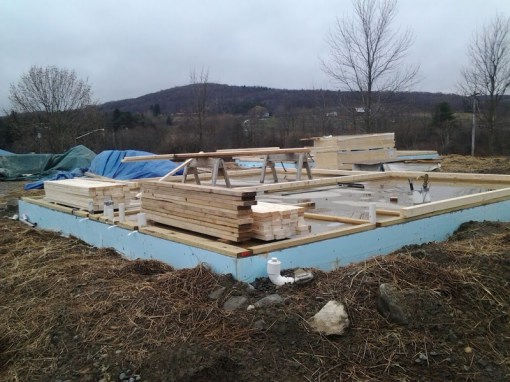
That leaves a fifth and final batch of cottages that remain foundation slabs for the time being, but will likely start construction as we head through spring. Rents for the houses range from $1,095-$1,725/month, depending on the unit.

Bruno Schickel hosted congressman Tom Reed on a visit to the construction site a couple of weeks ago (more about that here and here). The $2.2 million last phase, which consists of 17 cottages, is expected to be completed this summer, bringing the total number of units on the site to 140. The cottages have been built in phases – 36 in 1996/97, 24 in 2006/07, and about 80 in multiple sub-phases since 2012.

Once the project wraps up, Schickel Construction plans to turn their attention to finishing their newly-acquired Farm Pond Circle project in Lansing.

20160319_123813 20160319_123819 20160319_123922 20160319_123930 20160319_123949 20160319_124119 20160319_124140 20160319_124150 20160319_124200 20160319_124228 20160319_124237 20160319_124241 20160319_124319 20160319_124455 20160319_124500

boiceville_1


Carey Building Construction Update, 2/2016

28 02 2016

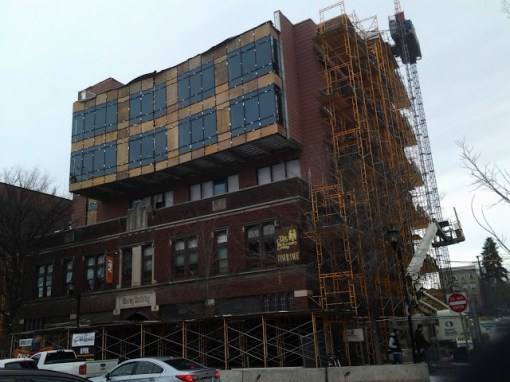
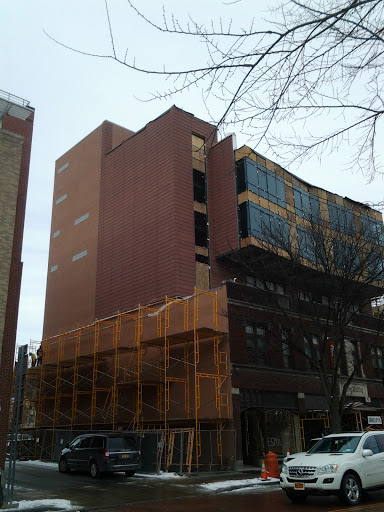
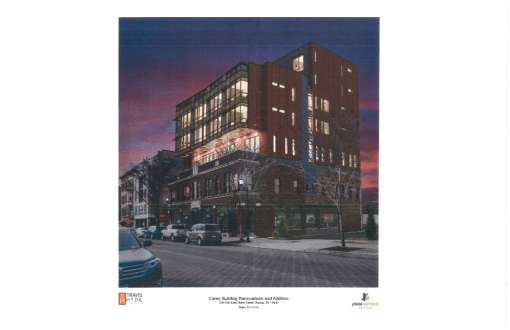
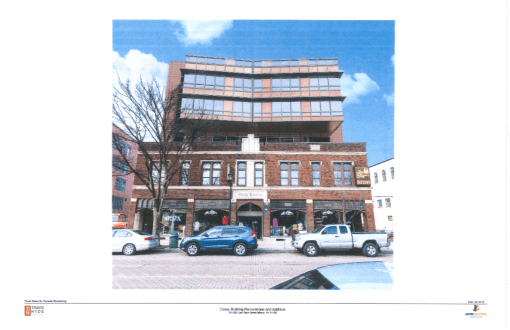
To be 100% honest, I was a little worried about how the building would look before the exterior materials started to go on. But thankfully, those worries seem to have been overblown. The terra cotta that graces the front and side looks good, and being a similar color to the original mid 1920s building allows the new five-story overbuild to pay its respects without mimicking the original brick.  The peach-colored material is NuTech Direct Applied Finishing System (DAFS) stucco. While not as visually interesting perhaps, the rear of the building will be mostly hidden by the new Hilton Canopy hotel when that begins construction later this spring. There have been plans for a mural on the Carey’s western wall as well.

Many of the new windows have been fitted, although in some areas like the third floor, the window openings were more likely to be covered in plastic sheets rather than panes of glass. Someone familiar can correct me if I’m wrong, but the boards on front of the curtain wall are placeholders a brown or dark brown-tinted glass. The small openings on the west face will have a clear, marble-block glass. Roofing still needs to be taken care of, and taking a guess, drywall and interior finishing is underway in the more complete areas (I want to write lower floors, but I wonder if the lower residential floors are actually further along than Rev’s third-floor space), and utilities rough-ins on the floors/spaces that aren’t as far along.

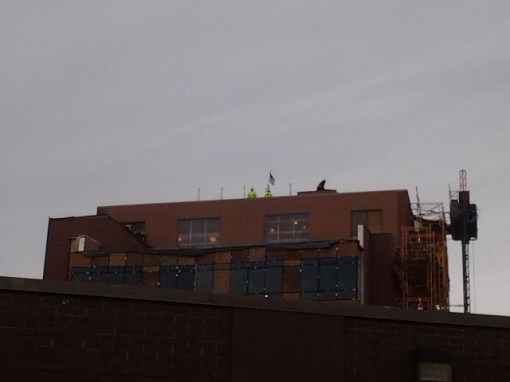
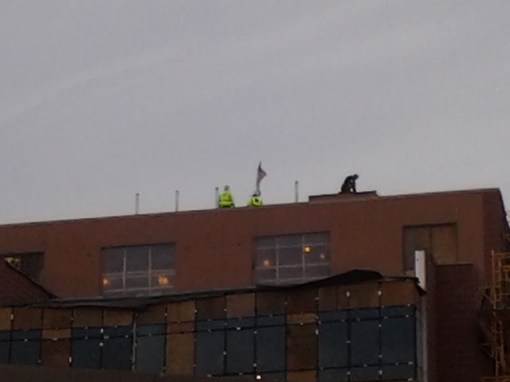
Although it’s a fairly modern shape in a city that loves its historic designs, it looks like it will be a nice addition to the downtown skyline.  Local firm John Snyder Architects penned up the design, Travis Hyde Properties is the developer, and those guys hoisting the Old Glory are either direct or indirect employees of general contractor LeChase Construction.

20160219_135310 20160219_135334 20160219_135410 20160219_135538 20160219_140004 20160219_140039

20160219_135224 20160219_135216

carey_rev5_1 carey_rev5_2 carey_rev5_3


Simeon’s Reconstruction Update, 2/2016

26 02 2016

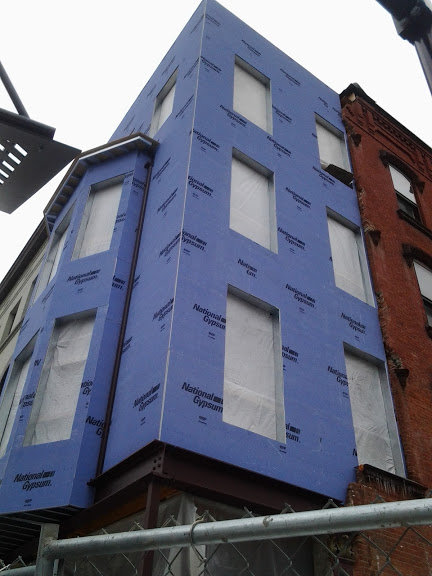
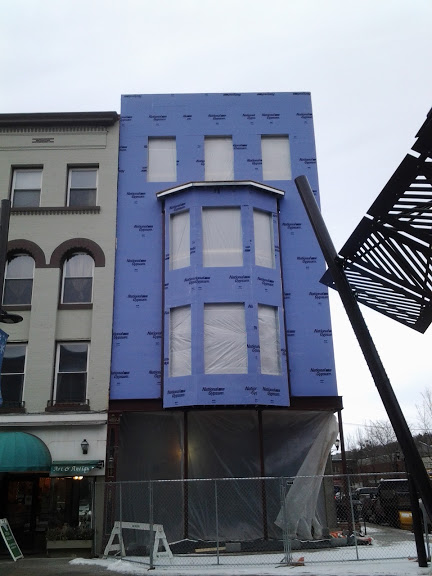
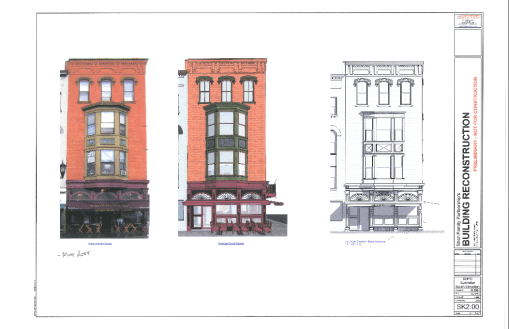
The sheathing is on. Fire-rated Gypsum boards produced by National Gypsum shape the rough openings for the windows, which are covered in plastic sheeting enclosing the interior while work on the new restaurant on the first and part of the second floor, and five new apartments on other part of the second and the third floor. In the original portion of the building, the chute and slide are a sign of major interior renovations.

Seeing the new bay window structures reminds me of an often-overlooked fact. The original Griffin Block building did not have bay windows when it was built in 1871/72. The copper-clad bay windows were installed as part of a 1904 renovation.

Keep an eye out for a late spring opening for Simeon’s (perhaps in time for the very lucrative graduation weekends), and the apartments are expected to be ready for rental by the end of the summer. Important if subtle detail, the reconstruction of the Griffin Block, often called the Simeon’s Building, and Simeon’s reconstruction itself, are two distinct projects occurring at the same time.

The owners of Simeon’s, Richard Avery and Dean Zervos, have applied for a sales tax exemption on building materials and furnishings worth $27,079 by the county IDA’s estimate. Their specific renovation is estimated to cost $660,000, retains 27 jobs when Simeon’s reopens, and provides for 14 new jobs over 3 years.

Local architect Jason K. Demarest is in charge of design for both projects, and Ithaca-based McPherson Builders is the general contractor of the Griffin Block rebuild. Fahs Construction Group of Binghamton is the contractor for Simeon’s restaurant renovation.

Hsueh-Yung and Hsueh-Lang Shen received a $1.3 million building loan from the Tompkins Trust Company to pay for the renovation and reconstruction. The Shens inherited the building from their parents Shan-Fu and Ming-Ming Shen, a Cornell engineering professor and his music-teaching wife who bought the building in 1981, and passed away in 2007 and 2011 respectively.

20160219_135134 20160219_135556 20160219_135620 20160219_135645 20160219_135755 20160219_135809

simeons_v2_2 simeons_v2_1


Village Solars Construction Update, 2/2016

23 02 2016

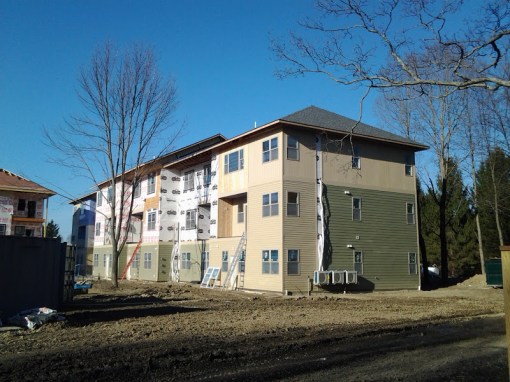
At the Village Solars construction site, 12-unit Building “D” is nearly complete from the outside, with just a couple of small sections of exterior trim yet to be installed.

18-unit Building “G/H”, a new design, is a hodge-podge of materials at the moment. A few exterior wall sections are bare plywood, some have been covered in housewrap (looks like there are two different companies, the Croft Lumber black label and a red label that I did not take close enough photos of to identify), some have had exterior wood and cement board trim attached and for some unknown reason, the northwest corner has gypsum board from National Gypsum. Both are waterproof barriers, although they can vary on details like fireproofing. Windows and doors have been fitted and the plywood roof panels (Huber ZIP system) are now shingled.

11-unit Building “E” is up to the second floor, wrapped but without openings cut for the windows on the second floor (they’re there, just wrapped over) – perhaps the contractor’s using the wrap as something of a wind barrier while the crew puts up the interior stud walls.

Late spring and summer occupancies seem likely. The 41 new units are the $6 million second phase of a 174-unit, multi-phase project (an as-yet unapproved set of phases would bring the total to over 300 units). Phase one, with three buildings and 36 units, opened last year.

20160219_144704 20160219_144707 20160219_144923 20160219_144943 20160219_145014 20160219_145022 20160219_145118 20160219_145138 20160219_145226 20160219_145305 20160219_145347 20160219_145406 20160219_145609

village_solars_2village_solars


Boiceville Cottages Construction Update, 1/2016

15 01 2016

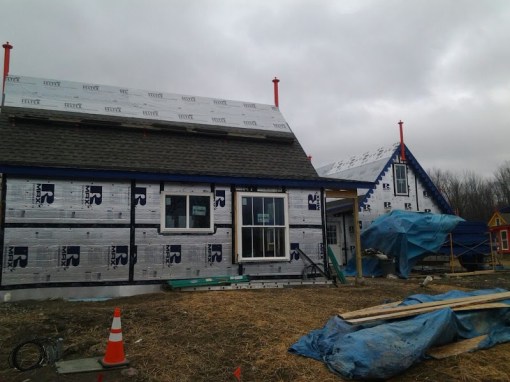
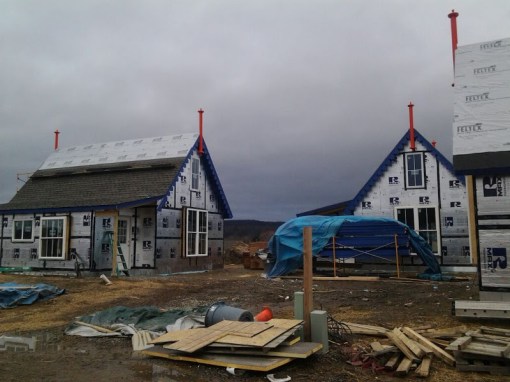
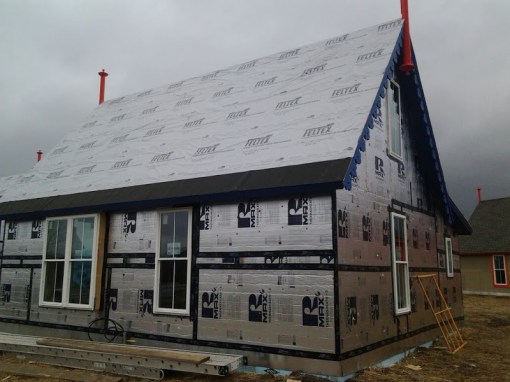
Just a pass through Caroline to check on the latest progress at the Boiceville Cottages. At present, it looks like about six new houses have been framed out – the three furthest along (red-orange trim) are receiving their exterior stucco coats, while the three less further along (cobalt blue trim) look rather like shiny ornaments thanks to the aluminum facer on the Rmax Thermasheath polyiso insulation (previously some red-faced Atlas polyiso was used). Rigid thermal foam plastic insulation board is lightweight, easy to cut, provides decent fire and moisture protection and provides a very high degree of insulation from the elements, greatly limiting the transfer of heat outward. As compared to traditional plywood sheathing however, it’s not as strong, and because the water control is on the outside with the foam sheathing, there are limitations or extra steps that need to be taken before applying many exterior facade materials like wood or fiber cement.

The roof foam boards are covered in Feltex synthetic roof underlayment before the shingles are attached. Compared to traditional asphalt-saturated felt, the synthetic material offers greater moisture resistance, and they’re light-weight and high-strength. However, wicking, where water can be drawn up the roof and promote leaks, can be a big issue with synthetic roof underlayment, so it has to be installed correctly and carefully.

Another set of homes is still at the concrete slab and sill plate stage, but it looks like some wood stud walls will be going up shortly. Schickel Construction is aiming to have all 17 of the new units complete by the end of the summer.
20160109_115011 20160109_115045 20160109_115125 20160109_115158 20160109_115217 20160109_115233 20160109_115309 20160109_115328 20160109_115354 20160109_115414 20160109_115432 20160109_115457 20160109_115503 20160109_115536

boiceville_1


Ithaca Projects Map

5 01 2016

ith_proj_map_01042016

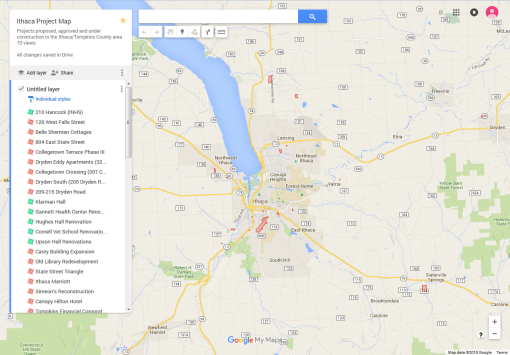
Soft roll-out on this little project, but one that will hopefully be useful. New for 2016, the Ithaca Projects Map. The map can be reached with this link, or by clicking the label next to the Welcome tag at the top of the blog column.

Taking a page from Jason Henderson over at Ithaca Builds, the map is color coded by for-profit (red), not-for-profit (green) and public projects (blue). A couple further details –

~Single family home and duplex sites are not included. There are well over 100 houses under construction in Tompkins County in a given year. Given their number and individually limited impacts, it wouldn’t be a good use of time to try and track them.

~For now, I’m leaving off recently completed projects. I’m also leaving off informal rumors or projects still in the early stages of development. The map only shows formal proposals, approved projects, and projects currently under construction. If a project is confirmed to be cancelled (ex. INHS’s Greenways, Collegetown Crossings on South Hill), it will be removed from the map.

~The information presented when you click on each polygon is a brief project description, the developer, and the project status. Links are provided to background reading on a given project.

~ Disclaimer: While I make an effort to make sure everything is accurate, there are possibilities that renders are outdated (old versions) or something may otherwise be incorrect. If you have questions or comments, leave a comment or shoot an email to ithacating*at*gmail.com.

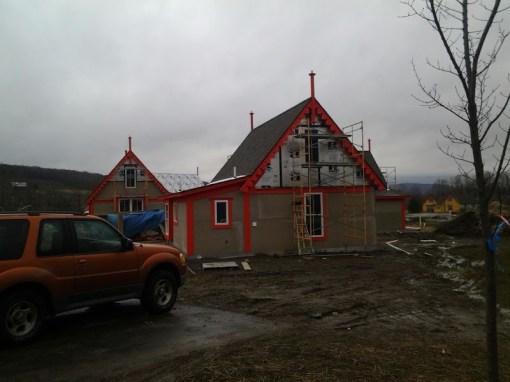
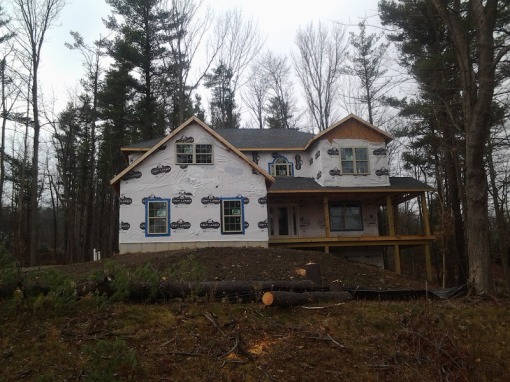
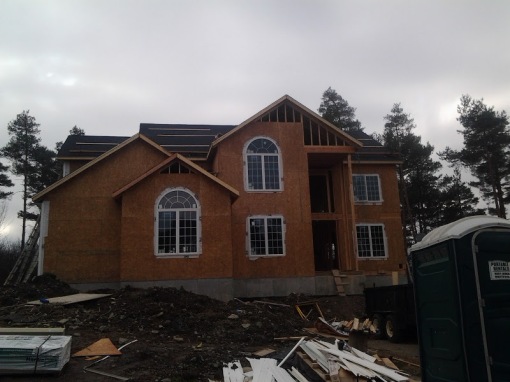
Now for part II – clearing out my photo stash. Sometimes, I end up with photos that I never use, mostly massive single-family homes in established subdivisions. Along with modulars on the fringes of the county and the occasional large-acreage stick-built, these homes make up the large portion of the new single-family home builds in Tompkins County. Not the most environmentally friendly, and questionable urban/land planning, but it’s what zoning allows and what’s easiest to build.

There’s a few for reasons for that – on the builder/developer’s end, the Return on Investment (ROI) tends to be greatest on luxury home builds, and land’s cheaper in rural areas. On the municipal/community end, one-lot single-families don’t need board review unless they require zoning variances, and as a general rule of thumb, smaller projects, more rural projects, and projects targeting wealthier buyers face less neighbor opposition (the wealth effect is somewhat muted with rentals).

20151205_105519

Larisa Lane, Town of Ithaca (Westview Partners LLC)

20151205_111549

Southwoods Drive, Town of Ithaca (Heritage Builders)
20151205_111234

Old Gorge Road, Town of Ithaca (J. Clark Construction)

20151205_105748

Larisa Lane, Town of Ithaca (Westview Partners LLC)

20151205_130716
Blackchin Boulevard, Village of Lansing (Avalon Homes)

20151205_105216
Birdseye View Drive, Town of Ithaca (Birds-Eye View Properties, LLC)

20151205_111044
Southwoods Drive, Town of Ithaca (Heritage Builders)

20151205_110127

Beardsley Lane, Town of Danby (Westview Partners LLC)

20151205_110351
Loomis Court, Town of Danby (Jepsen Romig Development Inc.)
20151205_111422
Eldridge Circle, Town of Ithaca (TRJ Properties LLC)


News Tidbits 12/19/15: So New Even the Pavement Shines

19 12 2015

cayuga_view_1

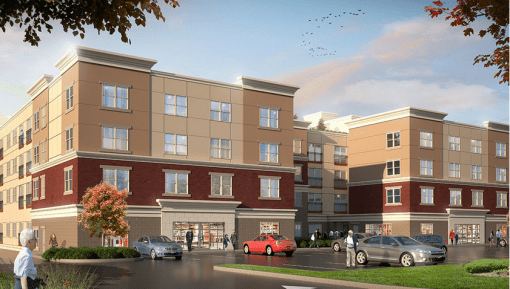
1. We’ll start off this week with some eye candy. Over in Lansing village, the planning board is hammering out details regarding signage and covenants related to the Cinema Drive senior housing project. But it also gives the project a new name – from C.U. Suites to “Cayuga View Senior Living“. Lo and behold, one types that into Google and up comes the following partially-finished website. The name sounded familiar, and as it turns out there’s a good reason for that – Cayuga View is also the name of a portion of the Linderman Creek apartment complex in the town of Ithaca.

According to the website, the 55+ (“55 and BETTER”, as they tout on the page) apartment building at 50 Cinema Drive will contain 48 2-bedroom units and 12 1-bedroom units with four different four plans. The 4-story apartment building will have retail space on the first floor, “and will offer underground parking and storage, wireless internet, cable, business center, fitness center, rooftop garden, and scenic views. A companion dog or cat under 30 pounds will be allowed.”

No word on the project architect, but the project is being developed by the Thaler family, and Taylor the Builders out of suburban Rochester is the general contractor. The site was originally conceived as an office building several years ago, and then around 2012 it was proposed as a 39-unit mixed-use apartment building with an eye towards graduate students.
amabel_v4_1

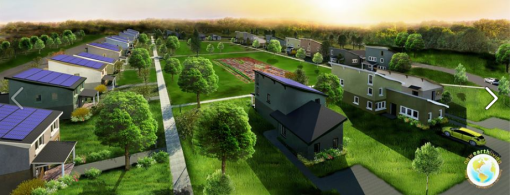
2. Sticking with residential development and fancy renders, here’s the latest render for New Earth Living LLC’s Amabel housing development, courtesy of their Facebook page. Final approval was granted just this week by the town of Ithaca. The 31-unit eco-friendly housing development (consisting of one standing farmhouse and 30 new homes facing inward from a loop road) will be located on undeveloped grass/woodland behind 619 Five Mile Drive. In the project literature, the site is said to be designed around a “pocket neighborhood” concept, with the houses facing towards each other for interaction, and away from the street for privacy. The houses may not be everyone’s cup of tea, but are designed for net-zero efficiency. Houses range from 1-3 bedrooms and 1,200-2,100 SF. No specific prices yet, but expect marketing to begin sometime early next year.

3. For the aspiring developer who wants to get a head start on planning – the 11.71 acre Bella Vista site at 901-999 Cliff Street in the city’s West Hill neighborhood is for sale for $395,000. As the advertisement on Homefinder notes, the project has received approvals for a 44-unit apartment or condo building (what it doesn’t say is that those would have to be renewed via a reaffirming vote by the planning board, since the project was approved more than two years ago). The property is currently assessed for $210,000.

w592-h-q

Primary Developers Inc., a company founded by local businessman Mauro Marinelli, purchased the land for $175,000 in 2002 and received approvals for the 44-unit Bella Vista project in 2007, and the units were marketed by local realtors as condominiums. But as the recession set in, sales foundered and the project never moved forward. Primary Developers Inc. sold the medical office building on the adjacent southern parcel and two other neighboring parcels of land to another local real estate company for $945,000 earlier this year.

chapter_house_materials

4. Some minor tweaks to the Chapter House project since its November sketch plan presentation to the Ithaca city planning board, which looks to mostly be a slightly lighter brick color and a little more detail on the rear wall. From top to bottom, the Chapter House reconstruction proposes Rheinzink zinc shingles, white trim of unknown material, a Redland Brick Heritage SWB bricks, Inspire Roofing Aldeora Slate Coachman (790) simulated slate shingles over the first floor bump-out, SDL (Simulated Divided Lites) transom windows with LePage Morocco textured glass glazing over the picture windows, Sherwin Williams “Tricorn Black” paint on the Chapter House bar exterior trim, and genuine bluestone not unlike the famous Llenroc bluestone used in many of Ithaca’s historic buildings. As far as they look online, they appear to be attractive, premium finishes.

The owner, Sebastian Mascaro of Florida and represented by Jerry Dietz of CSP Management, hopes to start construction in late January or early February for an August 2016 opening.
cornell_novarr_6

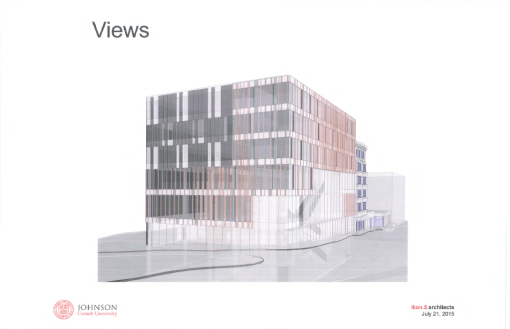
5. Note that there was ever much doubt, but it looks like local developers John Novarr and Philip Proujansky have secured the construction loan(s) needed to build 209-215 Dryden Road in Collegetown, a six-story academic and office building in which Cornell has committed to occupy 100% of the space for use in its Executive MBA program. According to loan documents filed with the county, there were two loans, one for $6,482,295.33 and the other for $9,430,528 (for a total of $15,912,823.33). Wells Fargo Northwest was the lender, and it looks like some of the funds are going through a “pass-through” trust.

The 73,000 SF building will host about 420 Cornell MBA students and staff when it opens in late Spring 2017, later increasing to 600 as Cornell fills out the rest of the square footage. Hayner Hoyt Corporation of Syracuse will be the general contractor. Ikon.5 of Princeton is the project architect.

20151205_094944 20151205_094957

6. Going to do a double-feature for house of the week this week, mostly because I have a backlog of images. Here’s number one.

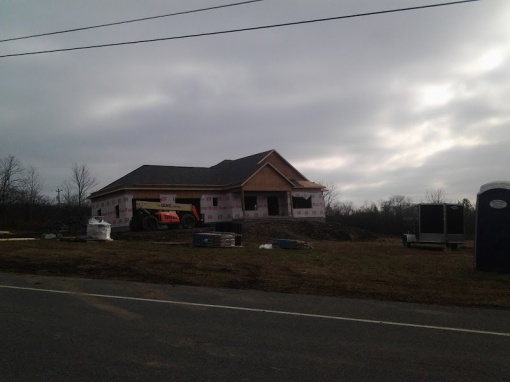
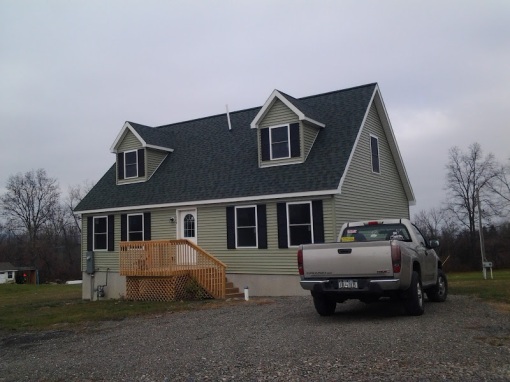
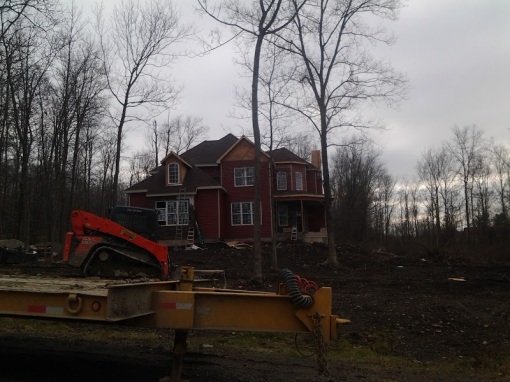
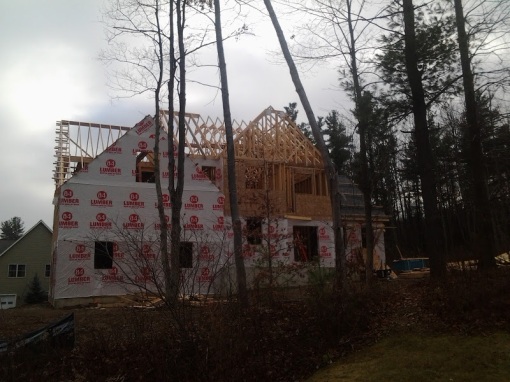
The last house is underway at the Belle Sherman Cottages. After not hearing anything about it, I had presumed they had just decided not to build Lot #9, which is smaller than the other lots and was going to have a unique “cottage” design. Well, color me surprised. The town of Ithaca issued a permit in early November, and by the 5th of this month, the CMU block foundation was excavated and poured. Looking at builder Carina Construction’s facebook page, the modular units have since arrived and have been hoisted onto the foundation, assembled and secured. Custom interior finishes, porch framing, siding, backfilling and landscaping will follow as the house moves towards completion.

No renders for the finished house, unfortunately, although I suppose STREAM Collaborative might have something on file. Agora Home LLC of Skaneateles is the developer of the Belle Sherman Cottages, which includes 18 other single-family homes and 10 townhouses, all of which have been completed and sold.

20151205_095437 20151205_095453 20151205_095528

424_dryden_rd_1

7. Now for House of the Week #2. 424 Dryden Road’s subdivision earlier this year turned the rear parking lot into a second lot, and the owners, William and Angie Chen of Lansing, decided to build a duplex on the land, which has been bestowed the address of 319 Oak Avenue.

It seems a little odd that the trim already seems to be applied to the house when the windows haven’t been fitted yet. The standard Huber ZIP System sheathing is being covered with a mahogany-colored vinyl siding. Wooden wall studs can be seen from the rough window openings and there appears to be electrical wiring on the rear of the house, so it’s a fair guess that utilities rough-ins are probably underway.

Local architect Daniel R. Hirtler of Flatfield Designs penned the design, and according to the construction loan agreement on file with the county, Tompkins Trust Company lent the Chens $400,000 to help bring their duplex from the drawing board to reality.

416_e_state_v2_1

8. For those hoping for something new and exciting in next week’s Planning Board agenda, it’s going to be a downer month. Here’s what’s planned.

A. Revisions to the internal sidewalk plans at 804 East State Street to allow stripped asphalt vs. concrete.
B. Tweaks to the signage for the downtown Marriott currently under construction.
C. The “Printing Press” bar debate at 416-18 E. State Street, again.
D. Final approval for Tompkins Financial Corporation’s new HQ.

The agenda also includes a couple zoning variance reviews for house additions at 105 First Street in North Side, and 116 West Falls Street in Fall Creek. The board is planning a joint meeting with the ILPC to review and comment on the Travis Hyde plan for the Old Library site, tentatively scheduled for January 12th.


Carey Building Construction Update, 12/2015

15 12 2015

Over at the Carey Building on the 300 Block of East State Street, much of the action is hidden behind layers of scaffolding, swaddling the building while construction work continues through this unseasonably warm (but much appreciated) December Ithaca’s having.

Some of the exterior has been furred out, meaning thing metal strips have been attached to the reflective surface cover (Hunter XCI polyisocyanurate exterior insulation) to help with facade installation. Documents filed with the project plans indicate that terra cotta panels will be installed over the gypsum sheathing boards, and in other less prominent sections of the building, NuTech Stucco (DAFS – Direct Applied Finished System) will be used.

Being that it is December, plastic sheeting has been hung over the future glass curtain wall, in an effort to keep winter’s (normally) icy breezes from making their way in. Looking at the backside, the dark material might be some type of waterproofing cover being applied under the exterior insulation. It looks like the new aluminum windows still have yet to be fitted into the vertical addition.

The Carey Building addition will add a third floor and 4,200 SF to the Rev business incubator (nearly doubling it from 4,500 SF to 8,700 SF), and on floors 4-7, there will be 20 apartments, most of which are studios. Local firm Travis Hyde Companies is developing, John Snyder Architects penned the design, and LeChase Construction is the general contractor. Look for a completion date sometime in spring of 2016.

20151204_153437 20151204_153459 20151204_153532 20151204_153601 20151204_153615 20151204_153652 20151204_153803 20151204_153822

carey_rev5_1 carey_rev5_3