Ithaca Marriott Construction Update, 6/2015

14 06 2015

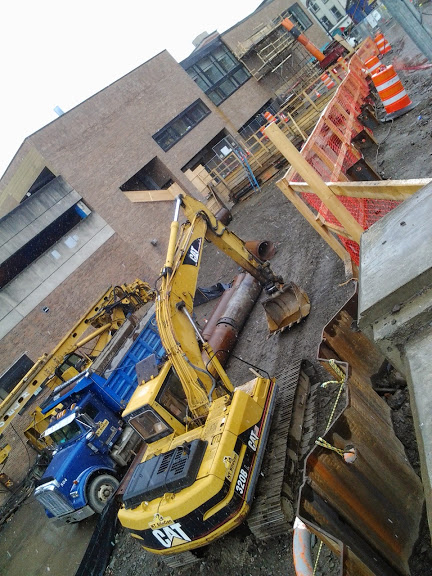
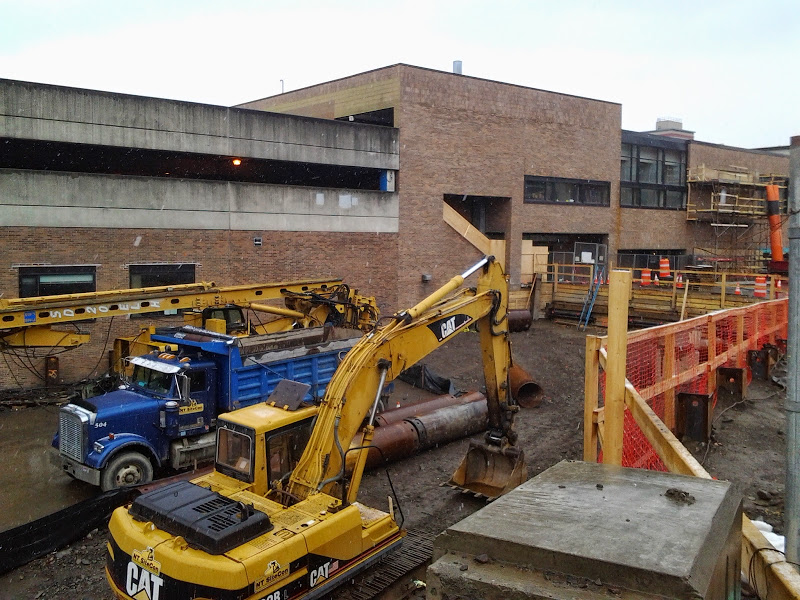
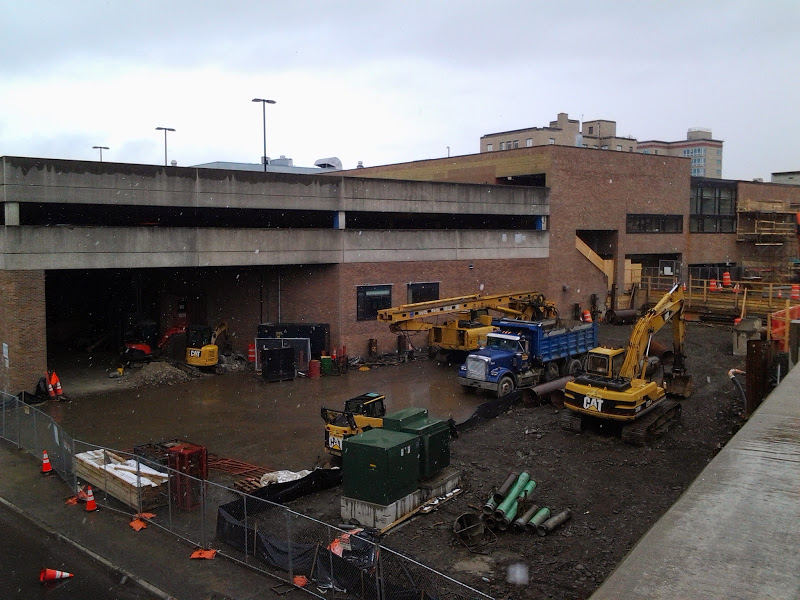
The pile driving work continues at the Marriott project site downtown. Quoting an anonymous source familiar with the project, about 10 more caissons are left to be piled, and grade beams are being built.  Per wikipedia, a grade beam is a reinforced concrete beam that transmits the load from a bearing wall into spaced foundations such as pile caps or caissons; a grade beam spans the the space between the caissons, distributing the weight among the caissons and ensuring the hotel’s structural stability. In image three, you can see the pile driver at work drilling a caisson, using a rotary bore so that it can more easily penetrate deep into the soil. The expectation is that the project will begin to rise starting in just a couple weeks, and builds its way skyward over the course of the summer and fall.

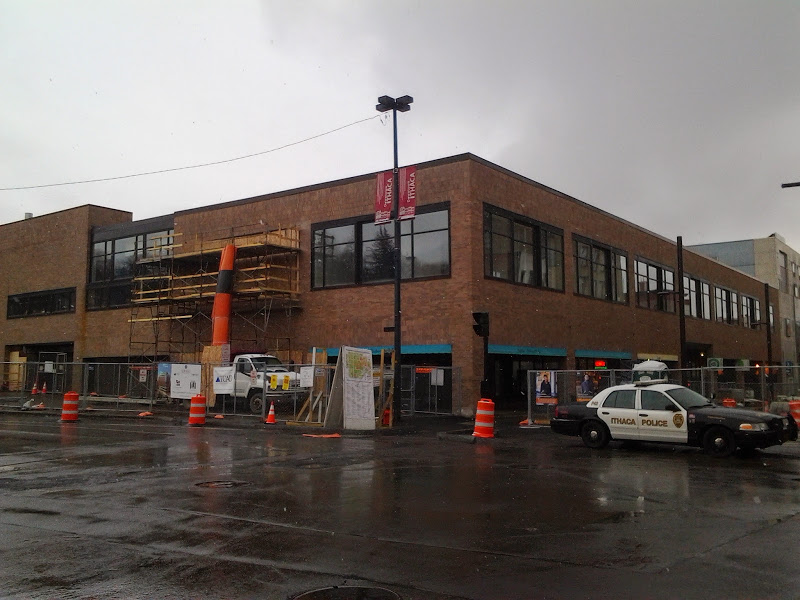
On a side note, check out that new window inserted into the Rothschild Building. Much better than the blank brick wall that was previously there.

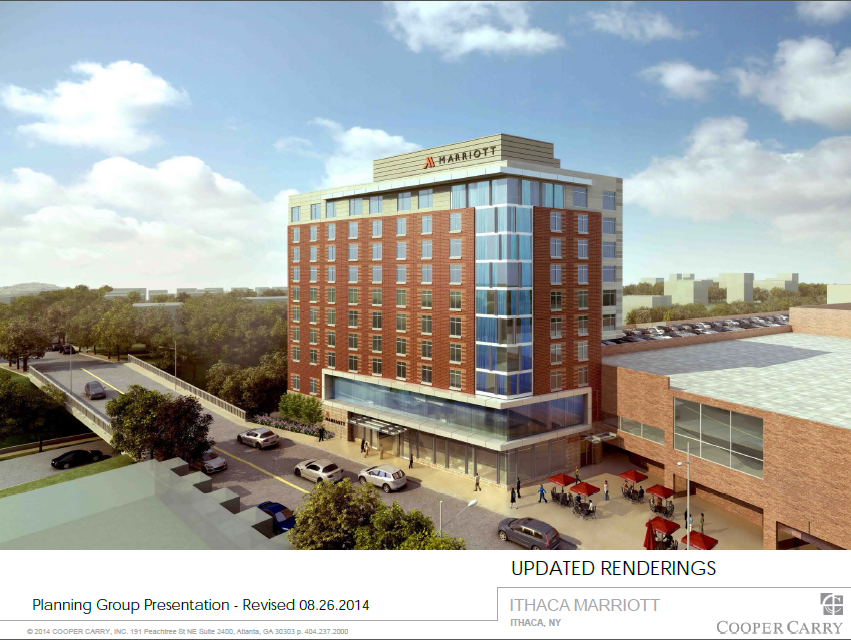
The $32 million, 10-story, 159-room hotel is slated for an opening in Q3 of 2016 (July-September). The hotel will include a fitness center, a restaurant with indoor and outdoor seating, and 3,000 sq ft of meeting space.

The hotel has been designed by Atlanta-based Cooper Carry Architecture and development is a joint venture of Urgo Hotels of Bethesda and Ensemble Hotel Partners, a division of Ensemble Investments. Urgo’s portfolio includes at least 32 other hotels totaling 4,500 hotel rooms. Interior design will be handled by Design Continuum, W.H. Lane of Binghamton is the general contractor, and Rimland Development contributed the land to the joint venture and is a partner. Long Island-based Rimland was the original firm that pitched the project in 2008 as the “Hotel Ithaca”, before the old Holiday Inn downtown went independent.

20150605_114642 20150605_114629 20150605_114501 20150605_114439 20150605_114431 20150605_114345

marriott_rev1_1


News Tidbits 6/13/15: Things that make you go Hmm

13 06 2015

travis_hude_libe_libe_v3

1. We’ll start this week’s round-up with the 800-pound gorilla in the room – the Old Library decision. The general, non-partisan rundown can be found in the article I did for the Voice. Rather than rehash that, I’ll give my own thoughts and opinions here.
In what should be no surprise to anyone, there’s a lot of acrimony flying around. The unavoidable problem here is that everyone has a different expectation for the site. To be honest, I was a little surprised that the Travis Hyde proposal was the winner. The Cornerstone and Franklin proposals were running about even when it came to public sentiment – many of the Voice commenters were stressing the need for affordable senior housing, just like the county did in the RFEI. Others used online petitions to push for the condos and saving the old library, but I personally felt that that was always going to be a stretch simply because the condos are a double-edged sword; they’re a needed commodity, but that “air of elitism” associated with the sale of a public asset for high-end homes would hound the legislators all the way to the voting booth.

The truth is, the RFP was designed to be unattainable, and I called it out for that last fall. There was no way a project was going to incorporate all the things it requested. Franklin couldn’t renovate the building and make their units at the affordable level. Cornerstone was able to make their units affordable but wasn’t as environmentally friendly as the others (it also requested a large PILOT). And I guess Travis Hyde was in the middle. Which on that 0-5 scale they used to score the projects, gives a simplified sort of 5-0 (2.5), 0-5 (2.5), 3-3 (3). With unrealistic expectations, of course the legislators were going to be disappointed, and they set up everyone else to be disappointed too. But the thought of holding onto a vacant building with its mechanical systems at the end of their useful lives, ready to put the county on the hook for hundreds of thousands of dollars in replacement costs, is probably the worst option out there.

TL;DR: There was going to a large contingent angry with the legislature’s decision, whatever it was. It’s times like this I wonder if the county should’ve just sold the site to the highest bidder.

Just for the record, because the three proposals were so different, and I thought all of three of them were good community assets, I honestly didn’t have a favorite. I had a slight preference towards DPI early on, but when they dropped out I became neutral about the whole process. But it’s only the Franklin supporters that are accusing me of subversively undermining them in the Voice write-ups, and it’s making me really cold to their cause.

inhs_pride_v3_elevations_2

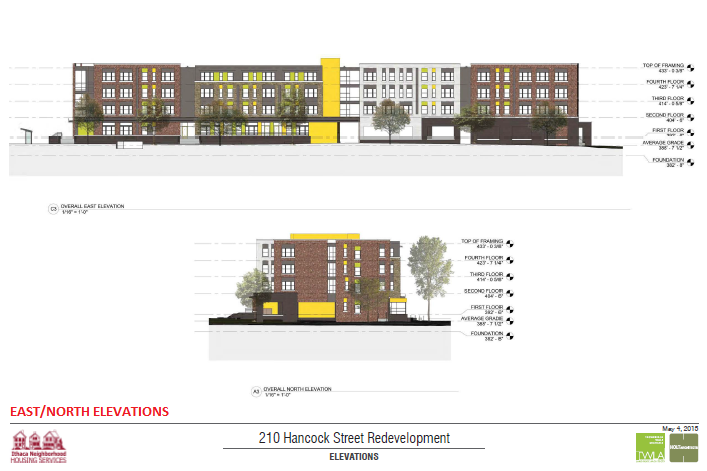
2. From the Common Council’s Planning and Economic Development Committee (PEDC) agenda, more talk this week about removing the setbacks from Nate’s Floral Estates (more on that in a moment), and a Memorandum of Understanding that both the city and Cornell will be chipping in $100k from their affordable housing funds to help finance INHS’s 210 Hancock affordable housing project (specifically, the 53 apartments – the 12 for-sale townhomes are being financed separately).

As covered by Jeff in the Voice, concerns have been raised that the site is unfit for new development due to the possibility of environmental contamination. Nate’s is partially on the site of the old city landfill, and has been for 40 years. But concerns raised by Ithaca city councilwoman Cynthia Brock, Ithaca town board member Rich DePaolo, and environmental activist Walter Hang have tabled the zoning change for now until the Department of Health can re-review their previous correspondence on the park’s expansion and determine if the extra 30 feet is safe to build on. The expansion may still happen, and we’ll just have to wait on the DOH’s decision before any zoning changes move forward.

On a separate note, there’s this line from the March minutes, which are rolled into the agenda for approval:

Alderperson Brock would like to see an increase in owner-occupied housing in the City. She does agree that affordable housing is needed, but the need is for “for sale” housing.

The last I checked, Ithaca is the 11th most expensive city in the country for rents as a proportion of income. The city needs affordable housing, for-sale housing, and affordable for-sale housing.

tfc_v3_1

tfc_v3_2

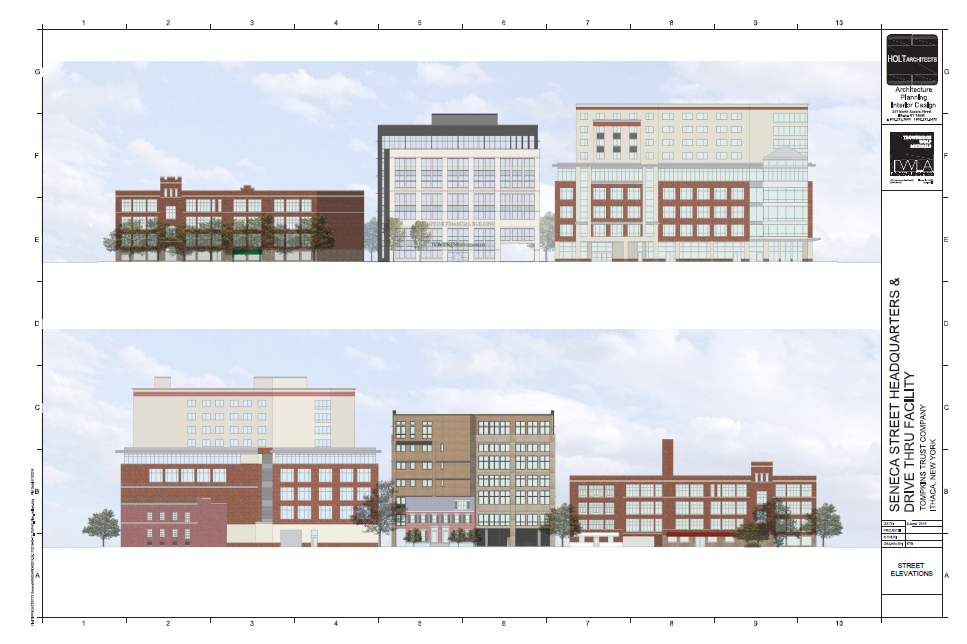
3. Fresh renders of the Tompkins Financial HQ. This one’s had some pretty substantial revisions from the initial bland brick box. A little more character and a more varied use of materials. More drawings here, cover letter here. This project’s just scooting right along, the applicants hope to have preliminary site approval granted at the June 23rd Planning and Development Board meeting. Construction is now expected to start in August and wrap up in February 2017.

A traffic study conducted by SRF Associates of Rochester determined that with only 20 employees moving from the suburbs into downtown, that the impact to the vehicular traffic on East Seneca (thousands of cars per day) will be negligible. A long-term increase in traffic is likely if other entities move into the rented space TFC vacates, but that’s well outside the scope of a traffic study.

The initial work calls for site clearing, demo of the existing drive-thru branch on site, then excavation down to the first sub-floor, thenceforth pile driving shall commence. It’s anticipated the sandy soils will make the pile-driving move along faster, but the other buildings nearby will necessitate temporary support installations during the excavation process.

On a related note, Tompkins Financial has filed an application with the IDA for a 10-year tax abatement. The application for the $35 million project (of which $28 million is for construction of the new building) states that the requested abatement would save the project $4.06 million in property taxes, and $2.112 million in sales taxes. New taxes generated and paid over the same time period would equal $3.782 million.

In the application, TFC states that it would be a few million dollars cheaper to build at “a generic rural site”, and in order to make downtown headquarters more financially acceptable, they decided to apply for tax breaks.

The application only suggests 6 new jobs over the next three years, paying $37k-$84k annually. Given previous estimates of 77 new jobs over 10 years, this lack of major job growth early on forces the later years to pick up the slack.

tfc_v3_3

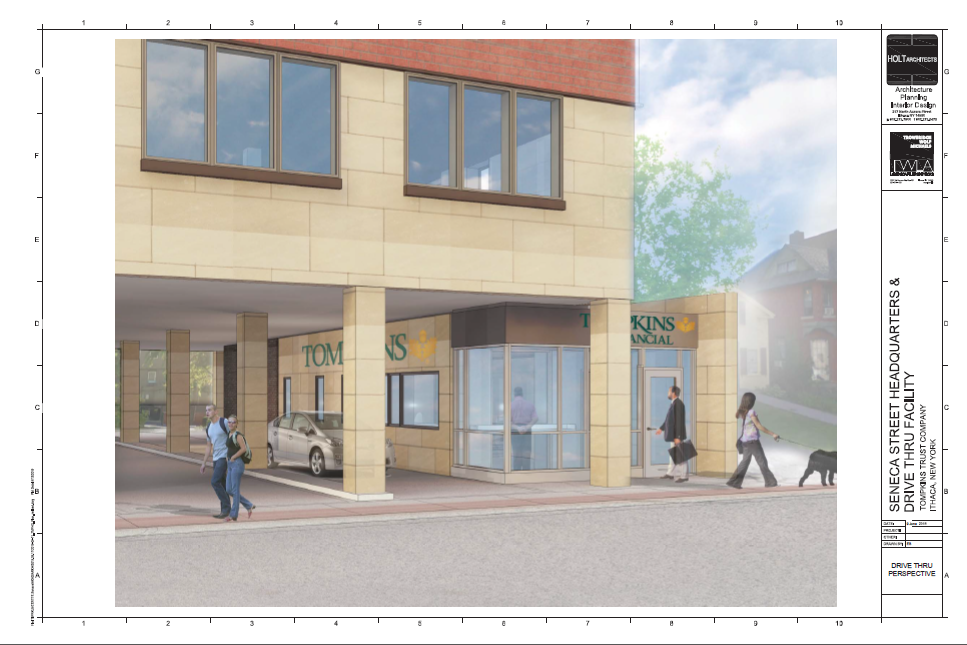
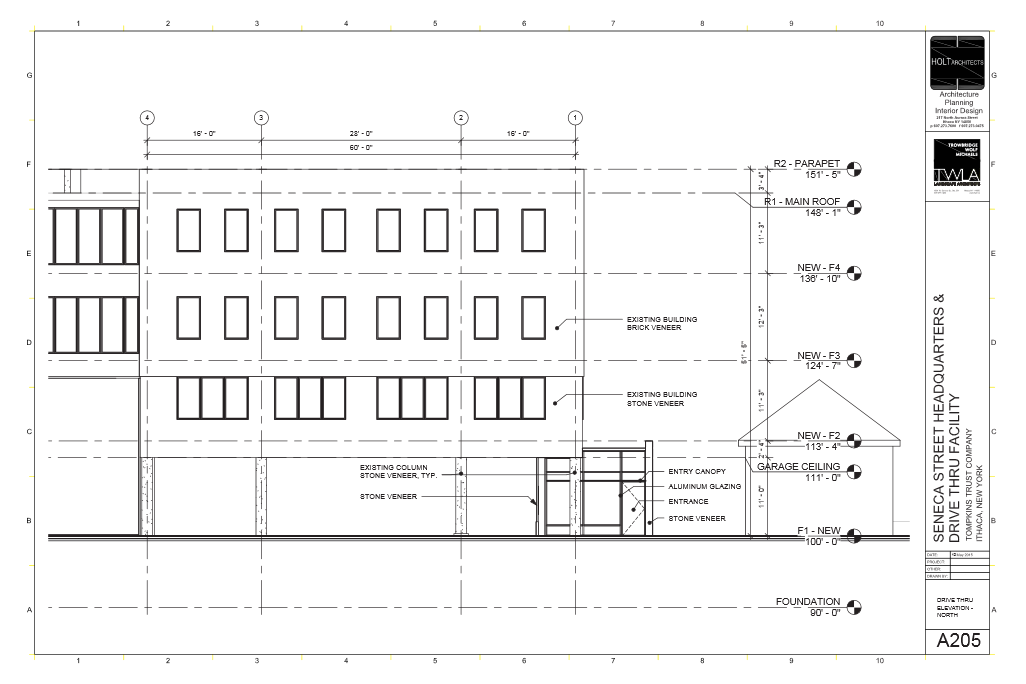
Of course, we also have a render of the new drive-thru across the street, which is nice but not nearly as exciting.

20150607_090520 20150607_090534

4. Sometimes I feel like I should do a random house of the week feature. Here we have a modular home being built on the 200 Block of Eastern Heights Drive in the town of Ithaca. It looks nearly finished at this point; permits for the home were filed back in March, so this one seems to have followed a normal building schedule with no major hangups.

Some modular homes are done on the cheap and look the part; others, like the Belle Sherman Cottages, do a great job with the finishes. This one may not look as great the Belle Sherman project, but it looks like a decent infill home for the Eastern Heights neighborhood. And it has great views to boot.

5. According to the town of Ithaca’s May 11th minutes, a developer has expressed interest in buying fire Station No. 9 at 309 College Avenue in Collegetown. An appraisal has been done and the City has hired a consultant to look into it. Fire Station No. 9 was built in 1968 to replace the original station, which is now The Nines. It sits in Collegetown’s densest zone, MU-2, so a potential replacement could be six floors with no parking requirement. There’s a lot to be looked at here, especially with the potential public safety impacts. But it’s something worth paying attention to over the next several months.

120_brindley_1

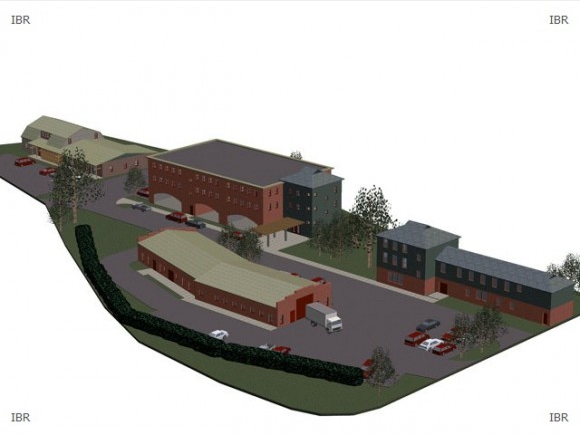
6. It’s unusual in Ithaca to see real estate advertisements posted with speculative commercial build-out plans. The above computer drawing is from the online posting for the sale of 120-140 Brindley Street in the West End. The three smaller buildings already exist – the “Aeroplane Factory” on the right and the other two properties comprise ~18,000 sq ft of flex office space. The drawing also shows an unbuilt 3-story office building; I don’t know how serious plans were for it, but it’s probably just conceptual. The real estate ad itself notes that a live/work building is possible, as well as a 6-story building of 25,000 sq ft.  The 2.38 acre site’s for sale for $2.79 million.


Lofts at Six Mile Creek Construction Update, 6/2015

12 06 2015

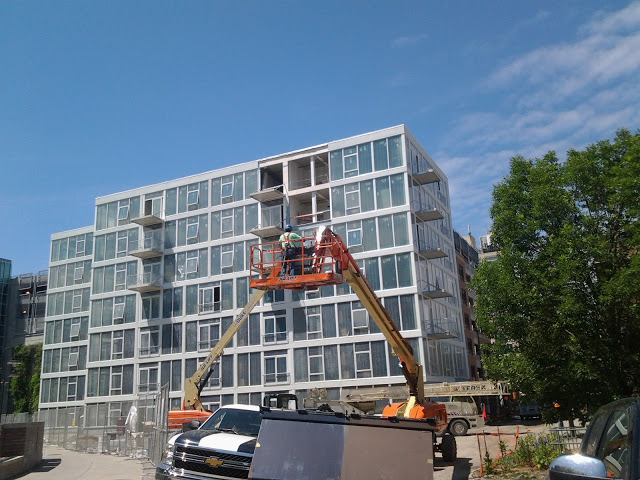
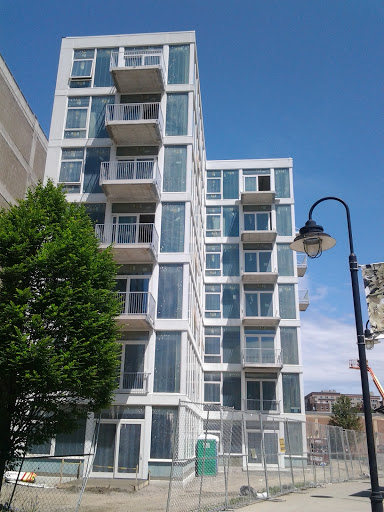
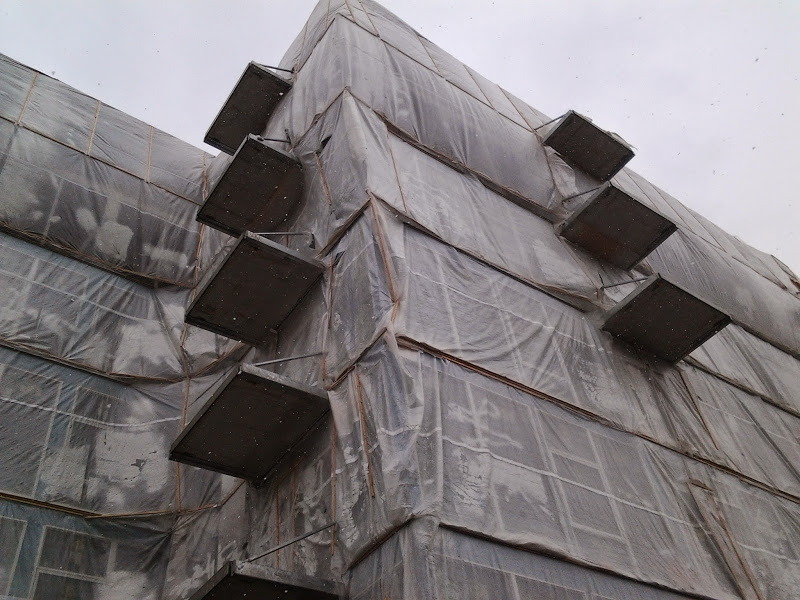
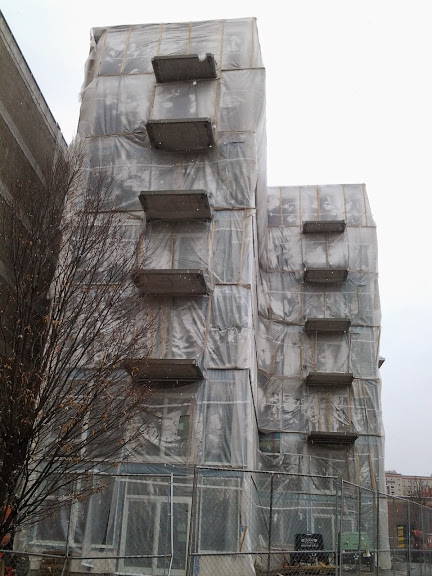
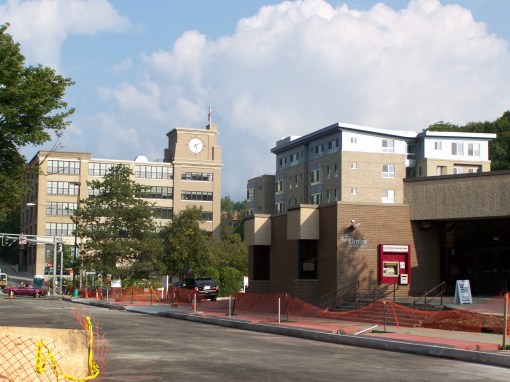
It won’t be long now, this project is in the home stretch. The protective plastic wrap is off and the product is almost ready to hit the market. The work at the “Lofts@Six MileCreek” site is mostly interior finishing at this point. A few of the exterior panels/window glazing had yet to be finished in these photos from last Friday, but a glance at the project’s facebook page shows that the windows have been installed, but the panelling has yet to be hung. Some other exterior finishes, such as balcony railings, are only partially completed as of now. A formal opening by late summer seems likely, thus completing the last phase of a 15-year project.

Looking at the rental agreement, tenants are allowed to have pets (for a $500 refundable fee and a $50 monthly rent surcharge), no more than two tenants may share a bedroom, and income is expect to be three times rent. 12 month leases only, 1 month’s rent as a security deposit.

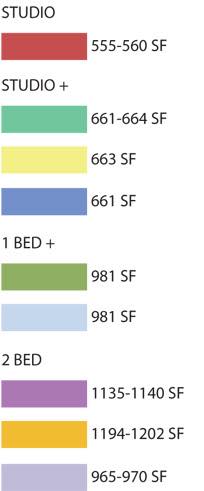
With rents ranging from $1,220/month and up, that means that the minimum a tenant can make and live in the building is $43,920/year. A top end 2-bedroom unit, at $2,655/month, requires $95,580/year. The three studios range from $1,220-$1,460/month, one-bedrooms from $2,160-$2,355/month, and two bedrooms from $2,095-$2,655/month. There’s no doubt these are premium prices, and as discussed in the last update on this project, that’s not necessarily a bad thing for everyone else.

The Lofts at Six Mile Creek project consists of a a 7-story, 49,244 square foot structure that will contain 45 rental apartment units: 3 studios, 21 1-bedroom and 21 2-bedroom units. The building is being developed by Bloomfield/Schon + Partners out of Cincinnati, and construction is being handled by Turnbull-Wahlert Construction, also based in Cincinnati.

Leasing is being handled by CSP Management, and interested readers can apply for an apartment here or call 607-277-6961 if they feel so inclined. Questions can be directed to info@IthacaLofts.com.

20150605_114748 20150605_114809 20150605_114830 20150605_114902 20150605_114923 20150605_115108

cayugaplace_v5


News Tidbits 5/16: Smart Developments, or Sprawl?

16 05 2015

Looks like this is going to be one of those longer roundups. I’m excited and intimidated at the same time.

tfc_v2_1 tfc_v2_2 tfc_v2_3

1. First off, I’m going to lead off with renders of the new Tompkins Financial Corporation. Write-up on the Voice here, more drawings here, traffic study here, cover letter here, Full Environmental Assessment Form (FEAF) here.

Rather than describe it in neutral generalities as I did with the Voice article, I’m going to afford the right to be a little subjective. The design is respectful of its neighbors through the use of brick and stone veneer. There’s no real surprises in the design, and corporate buildings tend to be pretty conservative anyway. At 104 feet (100 to the rooftop, and then 4 feet for the roof parapet), this will make a dent in the Ithaca skyline, but once again, it respects and balances out it neighbors by being a little taller than the DeWitt Mall, and a little shorter than 121′ Seneca Place. On a spectrum, the street front is on the nice side though not fantastic; a bank branch and some offices will engage with the street only modestly, but it’s much, much better than the drive-thru there now. The new building is built to the sidewalk, has an urban form, it’s a multi-million dollar private investment and a lot of other things that most upstate mayors would sell their mothers to get. The project is still shooting for a summer approval and construction starting not long thereafter.

One concern I have is that this will offload tens of thousands of square feet of office space onto the Ithaca market. Office space is one of the weaker sectors of the local market, and this may exacerbate the situation. It could cause some problems come 2017, and maybe with projects still in the pipeline such as Harold’s Square, which is shooting for a fall start after two years of trying to secure financing. I think that in the longer term, a few of the spaces such as the Seneca Building (121 East Seneca) might be ripe for a residential conversion.

With that concern noted, I think the parking situation will be okay. Since most of the jobs are shuffling around downtown, there’s not going to be a huge influx of workers. Offhand, I think the numbers are low double-digits (20 or 30) for transfers from Lansing into the city, and then the 77 brand new jobs created over the next several years.

belle_sherman_townhouses_1

2. And then there were none. With the sale of the last of their townhomes (lots 20-24), the Belle Sherman Cottages have technically sold out. I say technically because Lot 9, the new cottage design on the southwest corner of the parcel, has yet to be marketed let alone sold. I followed up with an email to developer Toby Millman of Agora Home LLC, and he replied that “[w]e are still working on the plans for that home and expect to release if for sale in the next month or so.” So keep an eye out for that.

3. Here’s an interesting piece of news from the Ithaca Urban Renewal Agency – the city recently showed off the 6-acre parcel it owns on Cherry Street to an employer looking to relocate 250 employees to the property, buying the lot and building a one-story “campus setting” over the whole six acres. This may or may not be the same one previous mentioned in the March minutes, regarding an inquiry from a business located outside the city. Since the parcel may have been shown in January or February, it seems that the two are likely the same entity.

This isn’t the first piece of news regarding some potentially major work in this isolated section of Ithaca’s West End – scrap steel mogul Ben Weitsman has also been rumored to have plans, and improved access from the Brindley Street Bridge would aid in redevelopment of this part of the city.

state_st_triangle_3

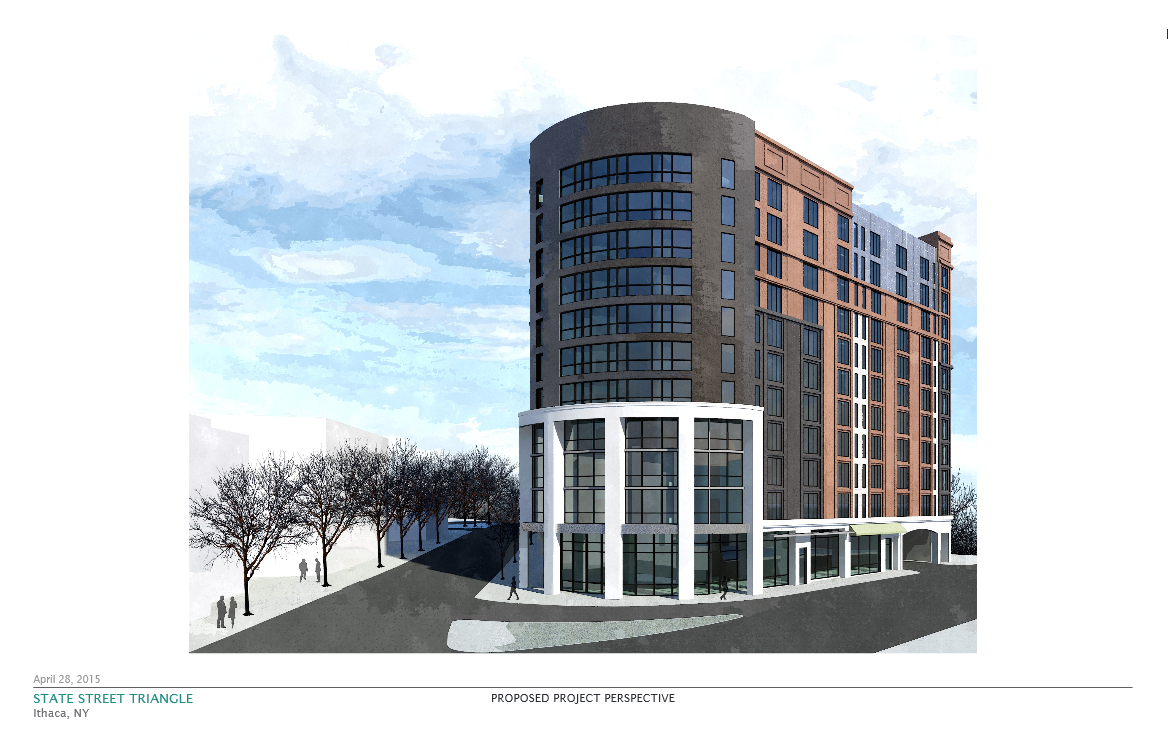
4. The planning board is cautiously enthusiastic about the State Street Triangle development. Per the minutes from the April meeting, they want the building to be as iconic as possible; board member John Schroeder went as fall as to suggest inspiration from the Carson Pirie Scott Building in Chicago:

Another member suggested a decorative crown. If my notes are right, a crown could exceed zoning as long as it’s not habitable space. Some other suggestions include a setback on the upper floors, and looking into incorporating other forms of housing.

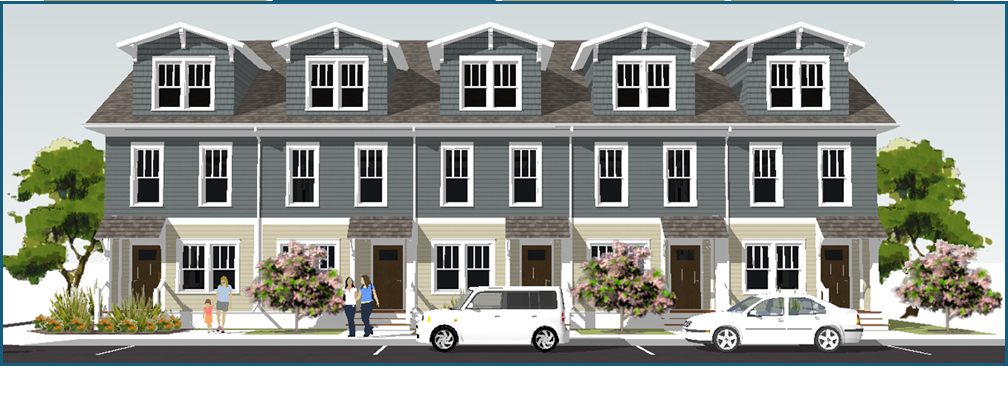
5. A quick follow-up on the proposed removal of some lot setbacks at the Nate’s Floral Estates trailer park – according to a tweet from Ithaca Times writer Josh Brokaw, the removal would allow an extra 18 lots for manufactured housing. The trailer park currently has 112 lots, and it’s been noted to have a substantial waiting list. Nate’s Floral Estates serves as senior housing, so this is one way to make a dent in the affordable housing problem.

815_s_aurora_1

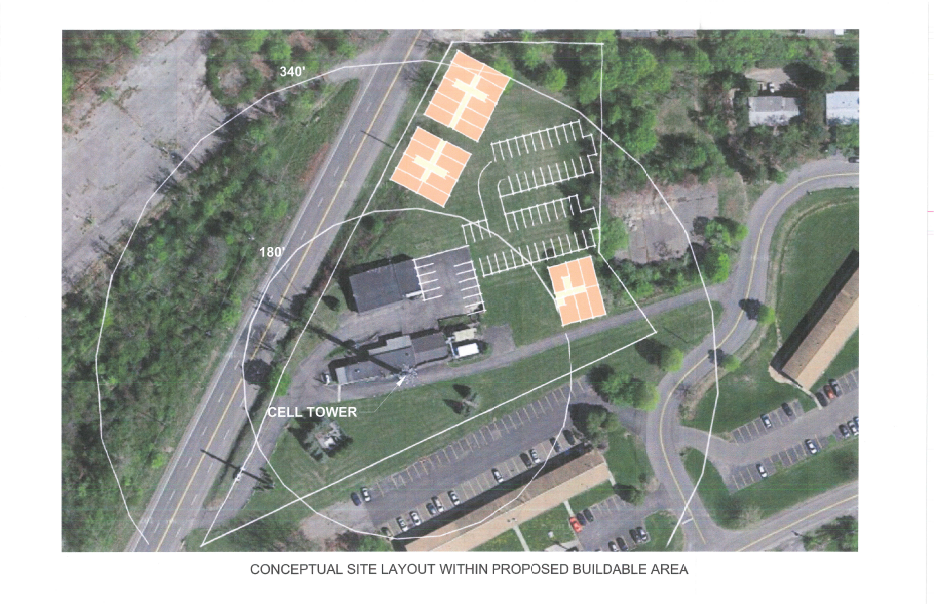
6. It’s not too often you see someone request a zoning interpretation. At 815 South Aurora Street on South Hill, that’s exactly what local architect Noah Demarest of STREAM Collaborative is doing on behalf of developer Todd Fox. Fox would like to develop the land with apartments (and he’s no stranger to South Hill, having built a couple duplexes on Hudson Street a couple years ago), but can’t. The city won’t allow construction in the “fall zone” of cell towers, which they define as twice the height of the tower. At 815 South Aurora, a 170′ tower creates a 340′ radius of no-man’s land (outer circle above), making the parcel undevelopable. The developer got a hold of two private engineering companies (TAITEM Engineering and Spec Consulting), both of whom determined that an appropriate fall zone is the height of the tower plus 10 feet for a little wind/bounce – so 180′ total. With this info in hand, Fox is trying to get the city to refine the zoning to allow the decrease in fall zone and therefore permit the land to be open for development. It’s an interesting case, and the result could be a sizable apartment complex down the pipeline. Stay tuned for the BZA review in June.

228_w_spencer_1

A couple other minor projects are up for zoning variances on parking – a small 2-bedroom house planned for 228 West Spencer is seeking a variance because the builder (Ed Cope of PPM Homes) says there’s no room on the hilly lot, and Todd Fox is requesting a parking variance for a 2-bedroom basement apartment to be built at 108 Ferris Place, saying that its central location and easy bus access should make having a car unnecessary. Coincidentally, architect Noah Demarest is handling both appeal applications.

troy_rd_rev1_1

7. To wrap things up, here’s the latest agenda from Ithaca town. There doesn’t appear to be anything too exciting going on next Tuesday. Cornell is renovating its softball field on East Hill with improved site access, a new restroom and ticket office, and replacing the existing bleaches, dugouts and press box. The 32-unit Clare Bridge assisted senior living project that was discussed last week will be reviewed. There are also sketch plans to be presented for a propane refueling station and sales office to be built on a vacant lot on Elmira Road/Rte. 13.

The planning board will also be reviewing plans to subdivide the Troy Road parcel that was once slated for a major residential project. The seller (Paul Rubin of Florida) apparently has a buyer for the triangular chunk of land south of the power lines (which can be seen in the old render above). With no explicit plans for either plot of land, there’s little reason to deny the subdivision at this time.

Personal opinion, I don’t like the direction this is going. It’s a real shame that the revised 130-road Troy Road project didn’t continue pursuit of approvals, it had really started to coalesce into a decent proposal. But now there’s a possibility where the land gets divvied into multiple chunks with homes scattered on it like bird crumbs. Single-family and duplex homes don’t have to go through board review, so there’s a lot less oversight when the land gets divided among multiple owners and built out in a piecemeal fashion. The last thing the town needs is expensive, sprawling, ecologically insensitive development.


News Tidbits 5/2/15: Oh, The Anticipation

2 05 2015

1. Lansing village is trying to find a happy medium in its zoning. Specifically, commercial zoning. The village is looking to rezone a group of properties along Triphammer Road near the mall from Commercial Low Traffic to Commercial Medium Traffic, a new kind of zone for the village. According to an article in the Lansing Star, the zone would include “low traffic food and beverage establishments [that] might include sit-down restaurants with or without a bar where food is consumed on premises, which may include carry-out or similar service such as [a] bakery or café,” as well as senior living facilities and certain stores under 10,000 square feet in size.

Most of this has to do with two parcels specifically – a vacant strip of land on Oakcrest Road is slated for a dozen units of senior housing that was a stipulation of the BJ’s approval. The senior homes are part of the BJ’s Planned Development Area and not explicitly affected, but are rezoned on technicality. A vacant parcel on the corner of Triphammer and Hickory Hollow Roads next to Ciao Italian Restaurant has received a lot of attention from outside developers, for hotels, liquor stores and general retail, but the current commercial low traffic zoning allows for none of those (CLT reads as limited to office buildings and isolated small shops). The zoning is under review and any changes would only be enacted after a public hearing at a later date.


cinema_drive_1

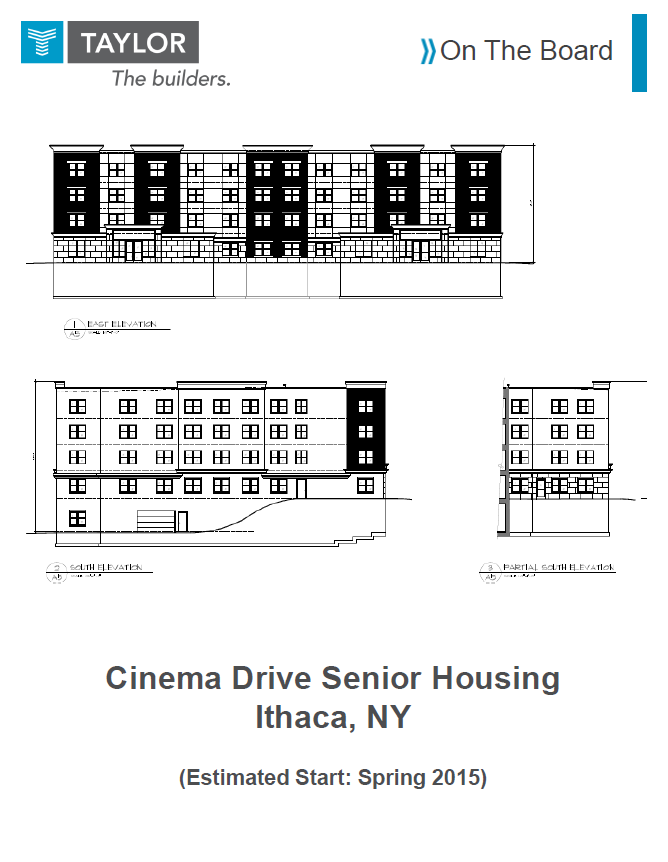
2. Here’s a pleasant surprise: drawings for a project on Cinema Drive in Lansing. My guess is that this is the project planned by the Thaler family, aka “CU Suites”. The CU Suites proposal described a 3-story, 43,000 sq ft building; the one shown here is 4 stories. The CU Suites proposal is also likely to break ground soon, just as this project is planning. I’m not 100% certain the two are the same thing, but if this were another project on that short street, I’d be very surprised.

Strangely, the source of these drawings is the Cornerstone Library proposal. The selected building partner, Taylor General Contractors of Rochester, was using it as an example of work underway.

harolds_square_taylor

3. Then there’s another project Taylor General Contractors is involved in – Harold’s Square. Taylor has done some work for Harold’s Square developer David Lubin in the recent past, so this makes sense. Will it actually start in Fall 2015? Good question, but there’s been no word on if Lubin has closed on financing for his 11-story downtown project.

fine_arts_1

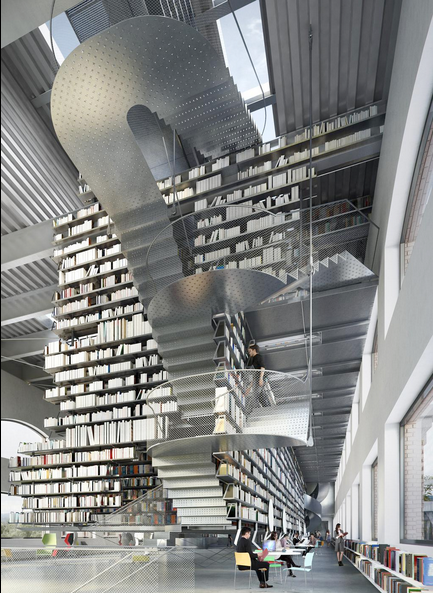
4. No sketch plans have been uploaded to the city’s website just yet, but initial renderings for the new Fine Arts Library in Rand Hall were presented at the Planning Board’s meeting last Tuesday, according to the Cornell Daily Sun. According to AAP Prof. Jon Ochshorn’s blog, Cornell’s been trying to keep the design plans of this project under tight control, which is fairly unusual for a school that often promotes new projects well in advance (Klarman, Gannett, Gates).

So far, the only public release has been an image of an interior staircase, a soaring, unsettling feature that can be found throughout the works of the project architect, Vienna-based Wolfgang Tschapeller ’87.

University architect Gilbert Delgado did his part to sell the project. From the Sun: “[We’re] resetting the clock on this very important building,” he said. “This is the presence that we’re looking for: noble, early 20th century industrial building that’s been repurposed to our higher use which will exhibit one of the world’s greatest book collections.”

Speaking for only myself, I have concerns with how this is being managed. Cornell had planned to demolish Rand in the early 2000s to make way for Milstein Hall (which went through three starchitects before shovels hit the ground), but alumni blowback caused them to renege on that plan. It’s clear that there’s a certain sort of attachment that AAP alums have towards their structural workhorse. My worry, with the lack of details so far, is that Cornell is stymieing the flow of information for ignoble purposes. Students and alumni won’t be able to object and petition against plans they don’t see and hear about until the figurative last second. Plus, AAP hasn’t had good luck with budgets for new buildings – Milstein’s cost more than doubled from $25 million to $55 million during its incubation, while it shrank in size. In a time of fiscal stress for the university, a dramatic, structurally complicated new library may not be prudent. I’m not against this project explicitly, but I do have reservations.

Regardless of my armchair criticism, when renders do finally show up, you’ll see copies hosted here soon after.

Cayuga-Meadows-Shot

5. According to the town of Ithaca’s 2014 Planning Board report, Conifer has secured funding for “Cayuga Meadows“, its approved 68-unit (sometimes given as 62, unsure which is accurate) affordable senior housing building planned for West Hill. With finances in order, the 3-story, 19,520 sq ft building, sited just south of the Overlook at West Hill apartment complex, will likely start construction this year. Per Ithaca Builds, approvals were granted in late 2013 after a years-long planning process that had Cornell involved early on.

Some other projects still gestating include an 18-lot single family subdivision off of Park Lane in Eastern Heights, and Cornell clarifying plans for a large mixed-use project at or near East Hill Plaza.


State Street Triangle (Trebloc Building Site)

29 04 2015

state_st_triangle_3

Downtown Ithaca could be in for a very large addition in the next couple of years, if developer Campus Advantage has its way.

The Texas-based developer is planning an 11-story addition to downtown on the the Trebloc Building property at 301 East State Street/MLK Jr. Street. The building would reach the maximum of the 120-foot zoning allows on the property, and fill up nearly the whole plot of land bounded by East State, South Aurora and East Green Streets.state_st_triangle_1

In the initial sketch plan presented Tuesday night (link here), local architect Scott Whitham, a consultant for the project, showed floor plans for retail on the first floor of the proposed tower, with apartments on the floors above. The retail section includes five general retail spaces and one restaurant space, with sizes ranging from 1,800-2,300 sq ft each. Space for a fitness center and apartment amenities are also included on the first floor.

state_st_triangle_2

Upper floors look out into an interior courtyard on the second floor, and contain a variety of 1 bedroom, 2 bedroom and 4 bedroom units. Each floor would contain about 23 units per floor with 60 bedrooms. Over ten floors, that means that the State Street Triangle building would add 230 units of student-oriented apartments, with 600 bedrooms.

For perspective’s sake, that would make it one of the most populated buildings in the city. Cornell’s largest dorm, Clara Dickson Hall, tops out at around 460 students. The Towers of Ithaca College hold about 300 students each. Collegetown Terrace has the only private buildings that come close to having this many people in one building.state_st_triangle_4

There is no parking on the site. The city’s Central Business District (CBD) zoning does not require it. The CBD zoning allows for nearly full lot coverage as well. The CBD zoning is used only for what planners and officials want to be the densest downtown locations, where parking garages and mass transit are in easy access.

This skyline-altering project stands to have a very large impact on downtown and the city in general. It would be the first student-focused development in the downtown Ithaca area, and 600 students is certainly quite the addition. The project stands to capitalize on both Cornell students and IC students, since the project is within commuting distance of both schools.

There’s much to be debated and sorted out moving forward. More detailed site plans and features are expected to be delivered to the city sometime in May. This summer will be a very exciting one for the Ithaca Planning Board.


News Tidbits 4/25/15: Long Week, Long Reads

25 04 2015

Grab the popcorn and sodas, folks, this will be a long one.

inhs_pride_design_comparo_v1_v3_1

1. Let’s start with some new and updated renders for the evolving 210 Hancock Street development that INHS has planned for the Northside neighborhood.

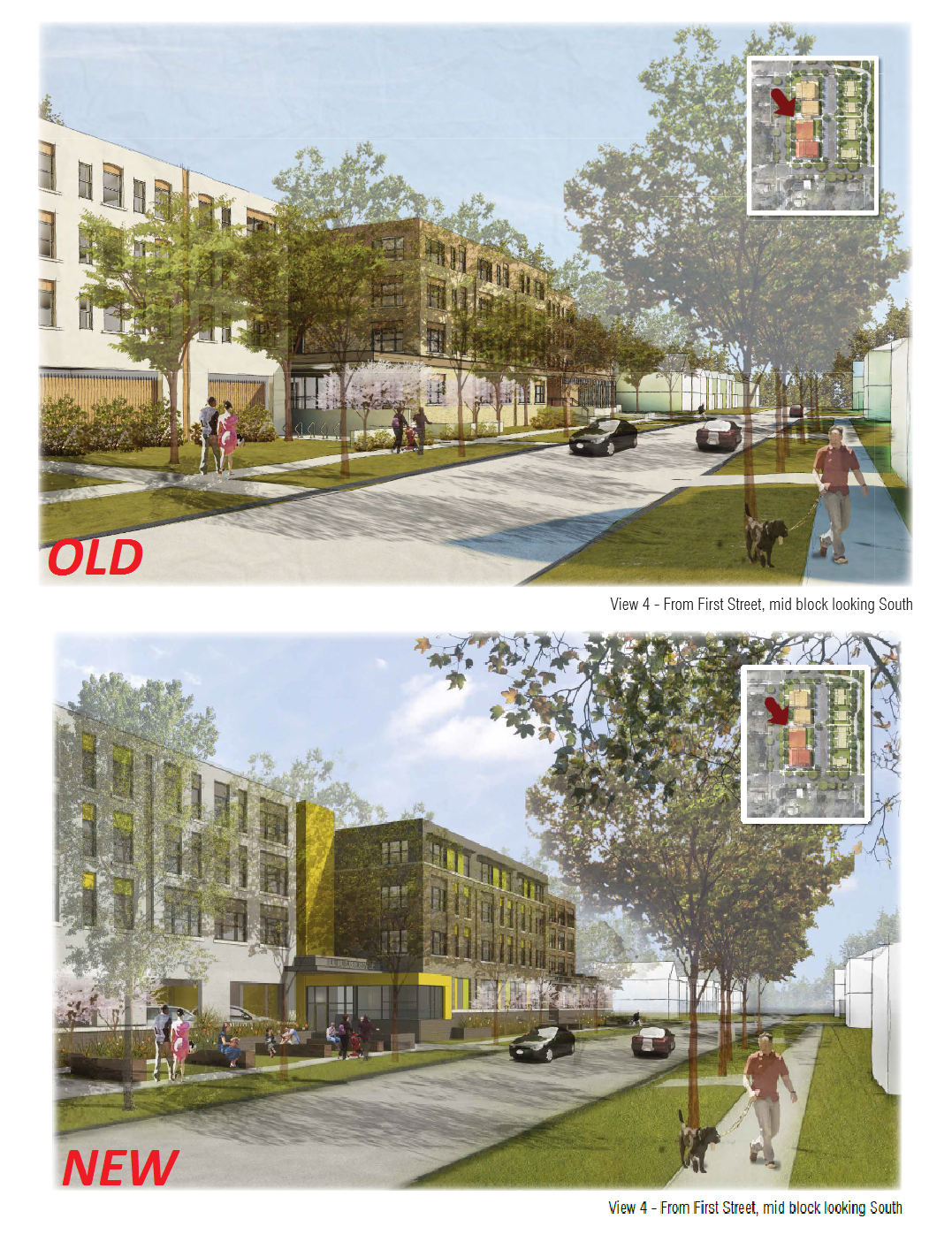
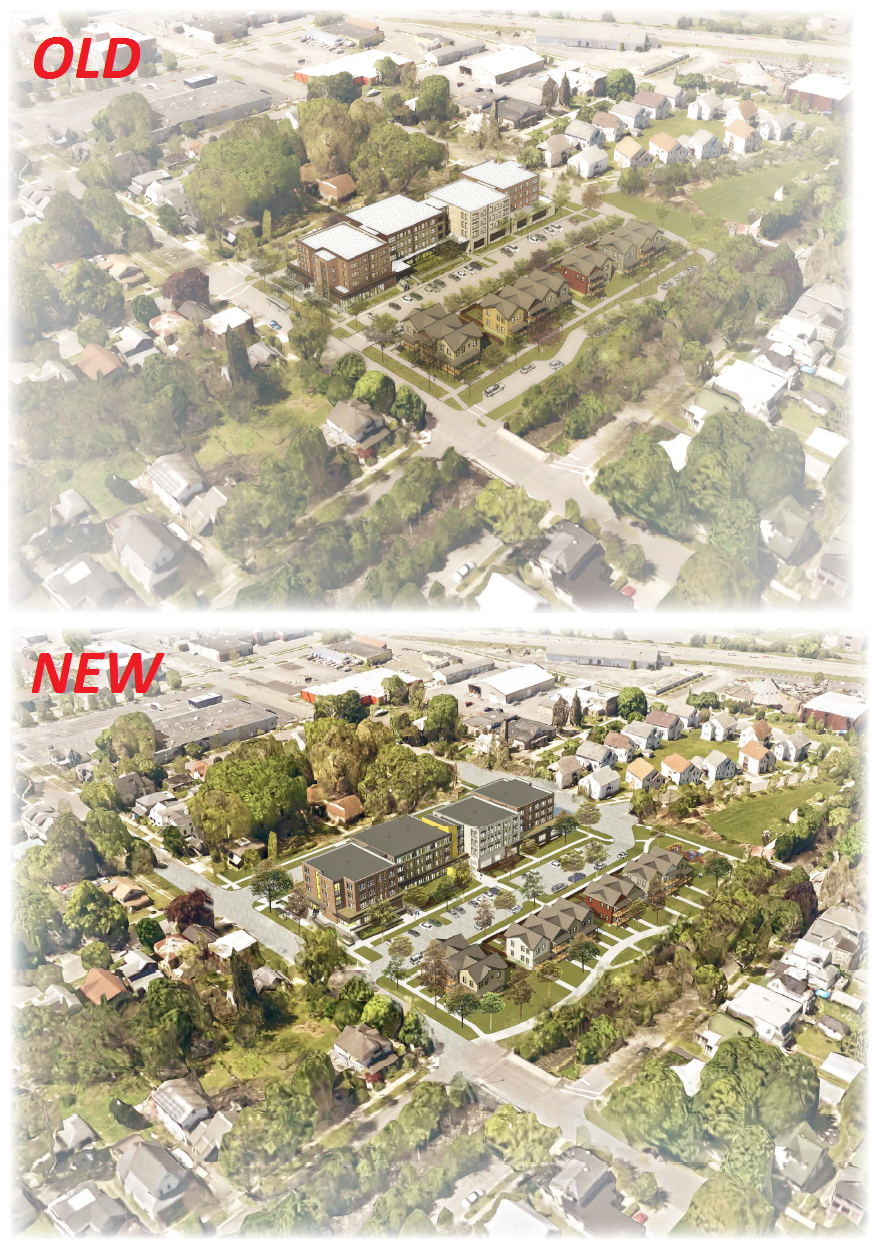
In each image, the top half is the old version, the bottom half the newest version. The lead image, an aerial rendering, shows that the houses haven’t changed much, though at the city and neighborhood’s insistence, Lake Street has now been closed off to all vehicular traffic in the refined proposal. The biggest structural changes have been in the apartment buildings – the color scheme of materials has been changed up quite a bit, and the partitions between the buildings have been re-worked to try and make the buildings appear less connected (one of the complaints raised was that they were too much like a wall; for this same reason, the buildings are slightly offset from each other, so no continuous face is presented towards the street).

inhs_pride_design_comparo_v1_v3_2

inhs_pride_design_comparo_v1_v3_5

Looking closer at the individual apartment buildings themselves, the designs have been pretty thoroughly reworked. Different window layouts, different window sizes, different colors – about the only thing that’s been kept the same is the overall massing of each building. The plan calls for 53 1 and 2-bedroom apartments and about 65,000 square feet of space, of which 7,500 square feet will be covered parking. The included commercial space has been expanded from 8,200 sq ft in the initial proposal, to about 10,000 sq ft now. More renders of the newest iteration can be found here.

inhs_pride_design_v3_7

No real changes yet in the for-sale houses that will be included in the project, apart from a palette change (previous render here – the new one is less bright, with darker earth tones). These are designed to blend in with the surrounding homes, and fall in INHS’s typical 2-3 bedroom, 1,100-1,400 sq ft range. The houses are townhomes in rows of 2-4 units, All sporting one or two-story porches. These will be built in a phase separate from the apartments. Certain affordable housing grants are geared towards owner-occupied units specifically, so the Neighborhood Pride lot will be split up into two parcels, one with the apartment rentals, one for the homeowners.

Questions and comments can be directed to the City Planning Office at dgrunder@cityofithaca.org.

2. Up in Lansing village, it looks like a proposed mixed-use project may finally be moving forward after years of incubation. “CU Suites”, a 3-story, 43,000 square foot project proposed by the Thaler family for a vacant lot on Cinema Drive, is asking the village to waive sewer connection fees. Presumably, this is about getting their finances in order before moving into the construction phase; there has been no news if funding has been secured yet. Something to keep an eye on this summer, certainly.

The Cinema Drive site was previously approved for a project of those parameters in fall 2012, consisting of two commercial spaces and a 39-unit apartment building, but that plan has not been carried out. The CU Suites proposal went before the village for “alterations and possible clarification” last December. No updated renders on the village website, but a site plan of the previously approved plan can be found here.

20150405_141933

3. Here’s some more details on the “not feasible as presented” Flatiron project. Readers might recall the 12-unit affordable housing proposal at 910 West State Street was given low priority for HUD Entitlement Grant funding.

From the presentation notes recently posted online:

“The project application is not fully developed, but probably represents more of an effort to start a conversation about the project. There is a great need for affordable housing in the community. The project was conceived to address the high cost associated with typical renovations to properties which make them unaffordable. The project would be located in an oddly-shaped trapezoidal building which [Ishka Alpern] would like to renovate to match its prior condition. It would be a very nice, unique addition to Inlet Island. Inlet Island has historically been a location for affordable housing and it is important to maintain that, before too many unaffordable projects are built there. Unfortunately, it is difficult to build affordable housing units without some form of funding assistance.”

In the Q&A the committee had with developer Ishka Alpern, no time table was given, and Alpern said he was open to waiting a year to refine it. It was also noted that once a commercial lease on the property expires in four years, an even larger project could be proposed, though it could be limited by the poor soils. While it appears renovating is the most feasible approach, the city was not impressed with the cost of investment per beneficiary – larger projects like 210 Hancock mentioned above have economies of scale going for them, costing less to build per unit. Smaller projects like the Flatiron need proportionately more assistance, making them less attractive for grant money. The city’s looking for the greatest good for the greatest number, in a sense.

In other news from the Ithaca Urban Renewal Agency (IURA), a private developer, Viridius Property LLC, is buying five duplexes with 10 units of affordable housing from non-profit Community Housing of Ithaca with the intent of keeping them low-to-moderate income, but retrofitting the buildings to run on renewable energy sources. Viridius, a company run by computer scientist and tech CEO Stuart Staniford and his wife, was established in early 2014, and has been on a buying spree as of late. They own $1.7 million in rental real estate assets now, these duplexes will raise it $2.7 million, and the goal expressed in a letter to the IURA is $5 million.

Quoting the letter sent to the IURA:

“Viridius is oriented to the “triple-bottom-line.” Although as a privately owned business
we will look to return on investment, we also seek to improve the environment and society. We
are particularly focused on contributing to the solution to climate change by converting the
existing building stock to be appropriate for continued use in the twenty-first century. At each of our properties, Viridius is removing the propane, natural gas, coal, or oil heating systems and replacing these with systems based on renewables. The specifics depends on the particular
building; to date, we have used pellet boilers and air source heat pumps. Viridius is also
developing our first solar panels at one of our buildings, and elsewhere acquires commercial
renewable power for electricity. Also, at our own residence we have deployed geothermal heat
pumps for heating and cooling and have all our electrical needs taken care of by solar panels on site. Viridius is certified as a living wage employer by the Tompkins County Worker’s Center
and has five full time staff at present in addition to the owners.

So it’s eco-friendly and/or affordable housing. Most residents will welcome the new fish into the local pond, even if all the property being acquired is a bit eye-raising.

Lastly from the IURA, the Carpenter Business Park on the north side is on the market for $2.85 million. Four vacant parcels on Third Street and Carpenter Park Road on the north side of the city recently sold for $2.216 million from “Templar LLC” based in Ithaca to “Ithaca Lender LLC” out of New Jersey, in what may have been a foreclosure sale. The address on file is associated with a company called “Kennedy Funding Financial LLC”, which is described as “one of the largest direct private lenders in the country, specializing in bridge loans for commercial property and land acquisition, development, workouts, bankruptcies, and foreclosures.” A google search turns up a legal notice between the two entities a few months ago.

gannett5

4. Construction is gearing up for the Gannett Health Center’s addition on Cornell’s Central Campus. Work on the project officially launched March 30th, according to the Cornell Daily Sun. Expect site clearing, excavation, and pile driving as we move through the spring and into the summer. The project will be broken into phases – Phase I focuses on new construction, Phase II on renovation of the current building, and Phase III concludes the project with reconstruction of the Ho Plaza entrance. About 75% of the material removed from the old building is expected to be recycled.

The architect of record is local architecture/Cornell alumni-filled firm Chiang O’Brien. There will be two additions, the four-story, 55,000 square-foot building featured above, and an additional 18,600 square foot addition that replaces the northeast side of the current building. The project also includes a new entrance and substantial renovations to the original 1950s structure (22,400 square feet of the existing 35,000), as well as landscaping, site amenities, and utilities improvements. The projected cost is $55 million, and the target completion date is October 2017.

The Gannett Health Center expansion has been a long time coming. Initial plans in the late 2000s called for a completely new building on site. HOLT Architects prepared a plan for a 119,000 square foot building, and an all-new building was also included in Cornell’s 2008 Master Plan. But once the Great Recession waged its battle on Cornell’s finances, the Gannett redevelopment was scaled back to its current form. According to a statement given by Gannett Director Dr. Janet Corson-Rikert to the Sun, the earlier plan had a budget of $133 million; the new addition and renovations are expected to cost $55 million.

The project is expected to create about 175 construction jobs and 40 permanent jobs (additional doctors, counselors and support personnel) when completed.

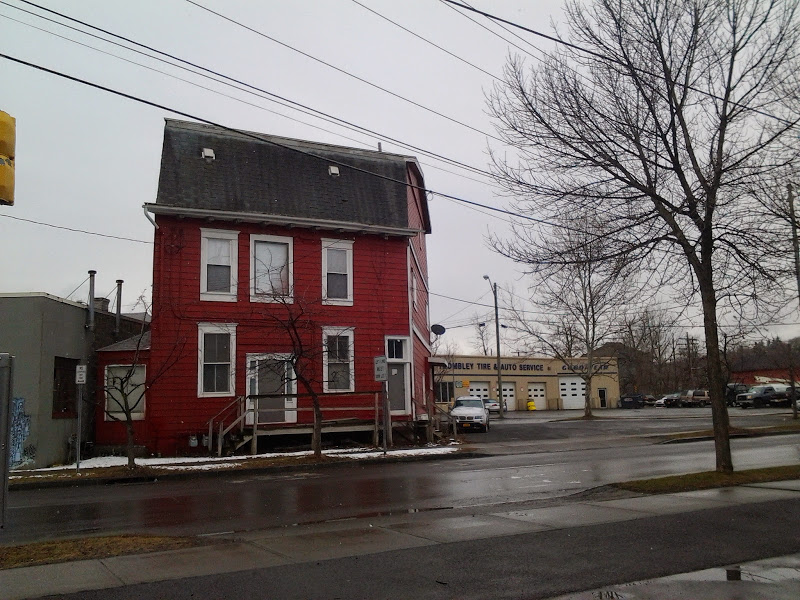
5.  According to next week’s Board of Public Works agenda, the approved 327 Eddy apartment project has been pretty heavily modified.

Here’s the old design:
327_eddy_rev2_1

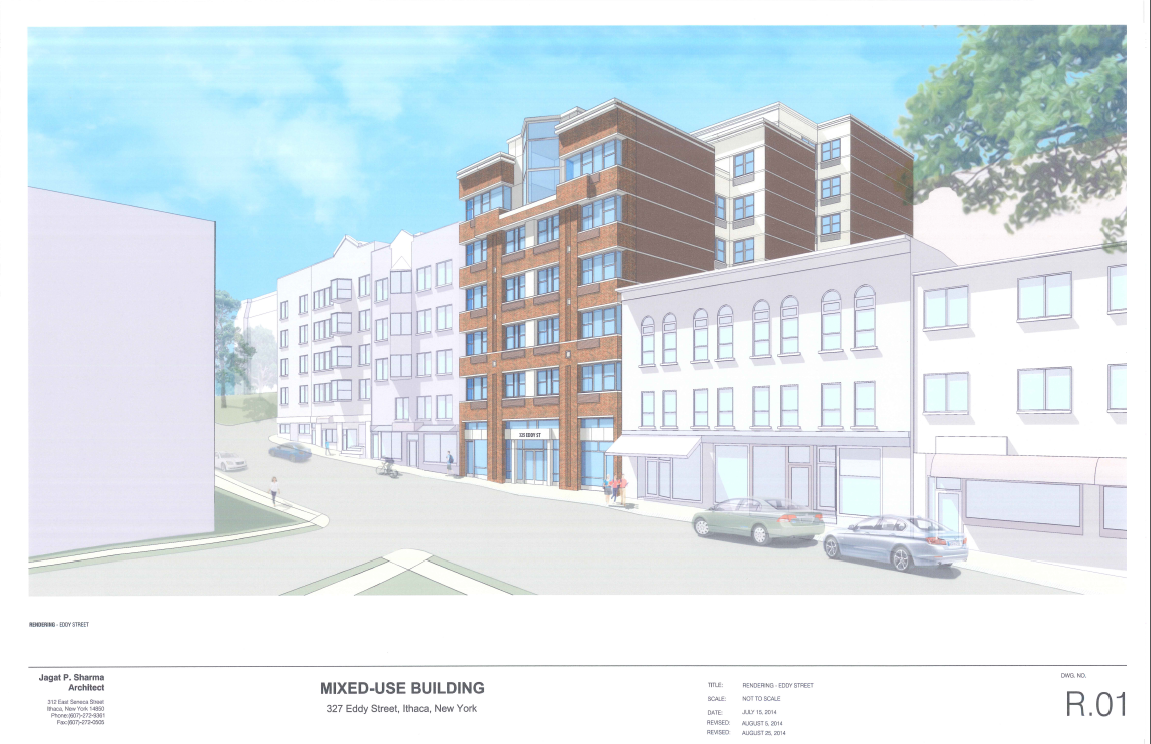
Here’s what the developer is planning to build:

327_eddy_rev3_1

I must have missed something? All the sources I’ve seen have referred to this as a six-story building, not five. The side windows were added late in the approvals process, I think. Anyway, the project is going to the BPW because the developer wants to project the top centerpiece window as a bay window rather than having it set back from the front facade. This would push two feet (2′ x 12′ isoceles triangle) into the city’s right-of-way over Eddy Street,  and the board is recommending to the council that the mayor authorize (he says she should he should, sheesh) the intrusion for an appraised value of $3,073.84, based on an appraisal value from Pomeroy Appraisal Associates in Syracuse.

The decrease in size also comes with a decrease in units and rooms – from 28 units and 64 beds to 22 units and 53 beds. This is a double-edged sword – some might cheer the loss of size or like that the roofline is continuous with its northern neighbor, but it will be harder to stem the tide of single-family home conversion to student apartments if Collegetown’s core isn’t as capable of absorbing Cornell’s student population growth.

The included email in the agenda says the planning board recommended an overhang bay window. Personally, I feel it would make the building look clunky. But that’s just me.

maguire_fiat_1

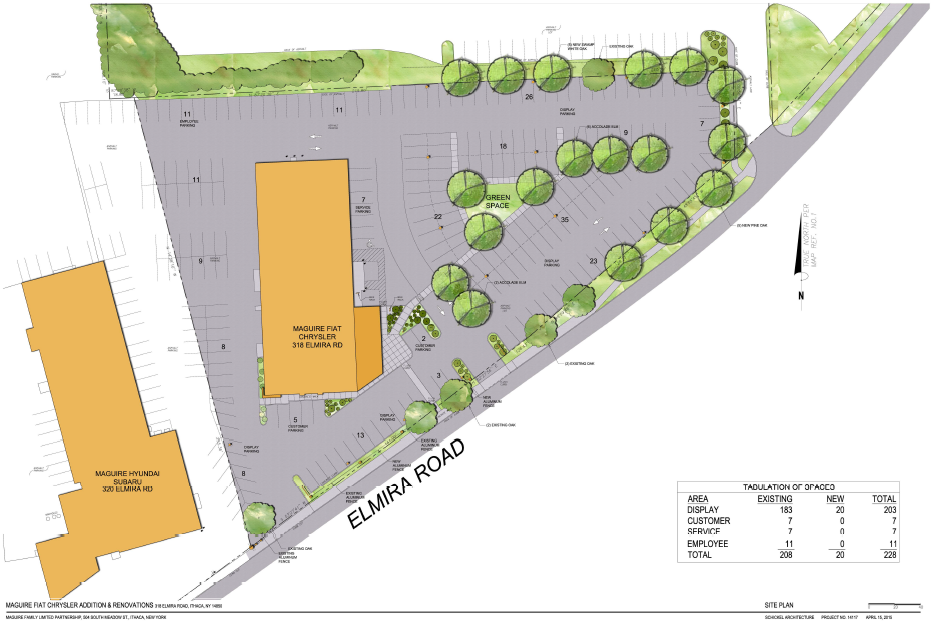
6. Here’s another project being served up to the Planning Board this Spring. Additions and renovations to a car dealership down in southwest Ithaca’s suburbia. Site Plan Review and drawings here. The dealership is Maguire Fiat Chrysler. Plans call for combining two show lots into continuous lot and adding 20 spaces, adding a 1,165 square foot showroom addition, and new landscaping and signage, including a second freestanding sign for Fiat that requires a sign variance (the max allowed by zoning is one freestanding sign). Documents indicate all the work will cost about $360k and run from September to December of 2015.

Observant readers might remember that Maguires proposed a delaership/headquarters compound in Ithaca town late last year; but due to irreconcilable differences regarding standard zoning vs. Planned Development zone, the plan was tabled.
100_1474

7. Woof. Almost to the end. The Ithaca Planning and Development Board is going to have their hands full at next Tuesday’s meeting. Agenda here. Here’s a rundown of what’s in store:

– A minor subdivision to create a new home lot at 201-203 Pearl Street.

A. Approving the adjustment to the Carey Building design discussed earlier this week

B. Enhancements to the pocket park next to the Lake Street bridge (landscaping, paving)

C. Declaration of Lead Agency and discussion on INHS’s 210 Hancock project

D. Declaration of Lead agency, Public Hearing and Determination of Environmental Significance for the proposed Texas Roadhouse on Meadow Street

E. Declaration of Lead agency for the Tompkins Financial HQ – hopefully, we’ll get some detailed renders at the meeting

F. “State Street Triangle Project (Trebloc Building site)” – This will be huge. I cannot stress by excitement enough at seeing the Trebloc Building demolished – I have not hidden my dislike of it, and in nearly seven years of writing this blog, it’s the only building I’ve ever called an “architectural turd“.  Located at 301 East State Street, the Trebloc Building was built in 1974 during the age of Urban Renewal, and was originally supposed to be two floors. The city has been quietly desiring redevelopment of the prominent corner for years, and the site was upzoned from 60 to 120 feet in late spring 2013.

According to some praise-worthy sleuthing by David Hill at the Ithaca Journal, the developer is Robert Colbert in cooperation with Austin Texas-based Campus Advantage, a large-scale developer of student apartments. plans call for a 120-foot building on site, with first floor retail and student-oriented apartments above.

This will be a tremendous project by Ithaca standards. The developer clearly states on its website that it’s only interested in working with sites that will provide at least 100 units of housing. Assuming the Trebloc Building’s footprint of 13,569 sq ft, one story retail followed by eleven floors of apartments yields almost 150,000 square feet of residential space. Figure a loss of 15% for utlities and circulation space, and an average size of about 980 square feet for an average residential apartment unit, and one gets 130 units and an unknown number of beds that could conceivably add a couple hundred students to downtown Ithaca’s population, not to mention millions of dollars of taxable real estate.

There’s a lot that will need to looked at – utility loads, parking, vehicle circulation, aesthetic impacts, and numerous other attributes. But the city’s holding the door open about as wide as it can for this site, and it’ll be an exciting process.

G. “Sketch Plan: Cornell Fine Arts Library – Rand Hall Addition”

Written about previously, it looks like the city will get its first chance to review the project. But someone with a insider’s look has some pretty harsh comments for the plan to renovate Rand hall.

Cornell Architecture professor Jonathan Ochshorn wrote in to tell readers here about the plans for the Fine Arts Library. I’m including a link to his blog post on the project here.

To try and sum up Prof. Ochshorn’s post would do him an injustice, but suffice it to say, the library plans will only keep the brick shell of Rand – the windows will be replaced, and a large “hat” will be placed on the roof. One that bears strong scrutiny from the Planning Board, since there could be significant visual aesthetic impacts on the Arts Quad Historic District.

I’m gonna tie up this post here and sit on the other items until next week. More weeks like this and I’ll need an intern.


Lofts at Six Mile Creek Construction Update 4/2015

22 04 2015

Heading back to downtown again, the “Lofts@SixMileCreek” (no spaces? no spaces…) apartment project is plodding away towards its anticipated late summer completion. From the outside, there’s been progress under all that protective plastic wrap – the first five floors have had their exterior walls framed and glazed (glass wall installation). The top couple of floors should be sealed up in short order.
According to an update from Jason at Ithaca Builds from the start of the month, walls and utility rough-in was underway inside the top floors, and drywall hanging and finish-work was beginning on the lowest floors of the apartment building. The Downtown Ithaca Alliance recently scheduled visits to the unfinished units as part of its Downtown Living Tour last Saturday.

Perhaps the most controversial thing about this project was when the rents were released at the start of the month – prices range from $1,220/month for a studio to $2,655/month for the largest two-bedroom on the upper floors. That got a lot of attention on the Ithaca Voice’s Facebook page, and much of it wasn’t good.

Jeff Stein, the Voice’s editor, followed up with an editorial saying that the criticism misses the point, the best way to alleviate the affordable housing crisis is to bring new units to the market at all income levels, which increases competition among landlords. Although I didn’t have a hand in the editorial, I support every word of it. Rents are high for this project, without a doubt. But the city not only needs units specifically for affordable housing, but units that will create competition for Ithaca’s burgeoning renter population.

With more units to better satisfy demand, landlords won’t be as able to charge premium prices on subpar units – inferior products will more likely be vacant. There would be a market push for owners to either upgrade their units to maintain a certain price point, or downgrade their prices to more affordable segments. Whether or not Ithaca will ever be able to get to that ideal balance between supply and demand is another story.

The Lofts at Six Mile Creek project consists of a a 7-story, 49,244 square foot structure that will contain 45 rental apartment units: 3 studios, 21 1-bedroom and 21 2-bedroom units. The building is being developed by Bloomfield/Schon + Partners out of Cincinnati, and construction is being handled by Turnbull-Wahlert Construction, also based in Cincinnati.

20150405_133449 20150405_133946 20150405_134010 20150405_134051 20150405_134118

cayugaplace_v5

10917333_314783998711665_7443965770647794346_n 10378252_313975992125799_95913780193412415_n


Carey Building Construction Update 4/2015

20 04 2015

Readers living or working in downtown might have noticed the lack of progress on the Carey Building, where a five-story addition is underway on top of the two existing floors.

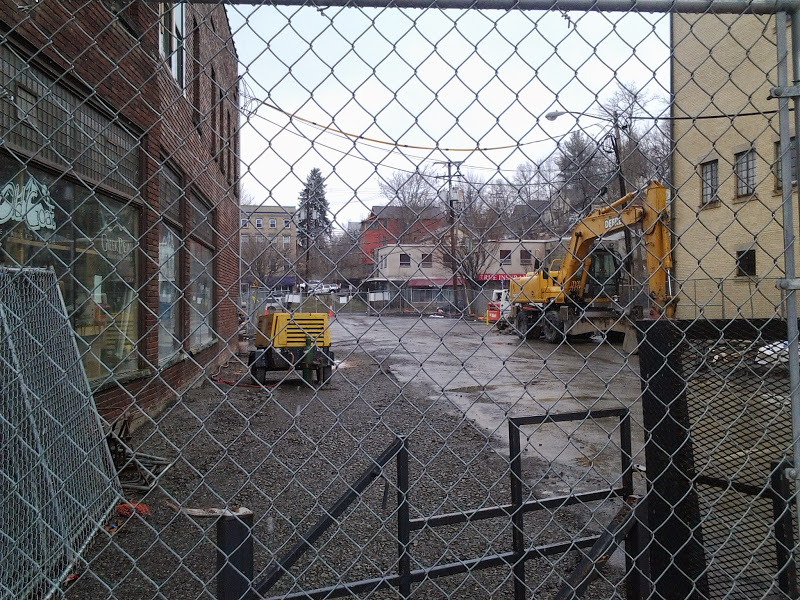
A look at the site shows that the underpinning (foundation-strengthening) process has been completed and covered up, but work doesn’t appear to have moved much farther than that.

20150405_133204 20150405_133217

Well, there’s a reason for that. The building plans can’t move forward as approved.

The currently approved design calls for interstitial space between the second and third floors. Interstitial space is an intermediate space between floors sometimes used for housing mechanical equipment. These type of designs, while expensive, are often employed in multi-floor lab or hospital space, where remodeling or re-purposing of floor space is common. The existing second and new third floors of the Carey Building are used/will be used for business incubator space, where that type of flexibility is a huge asset.

Unfortunately, it also doesn’t comply with code, which no one realized until recently.

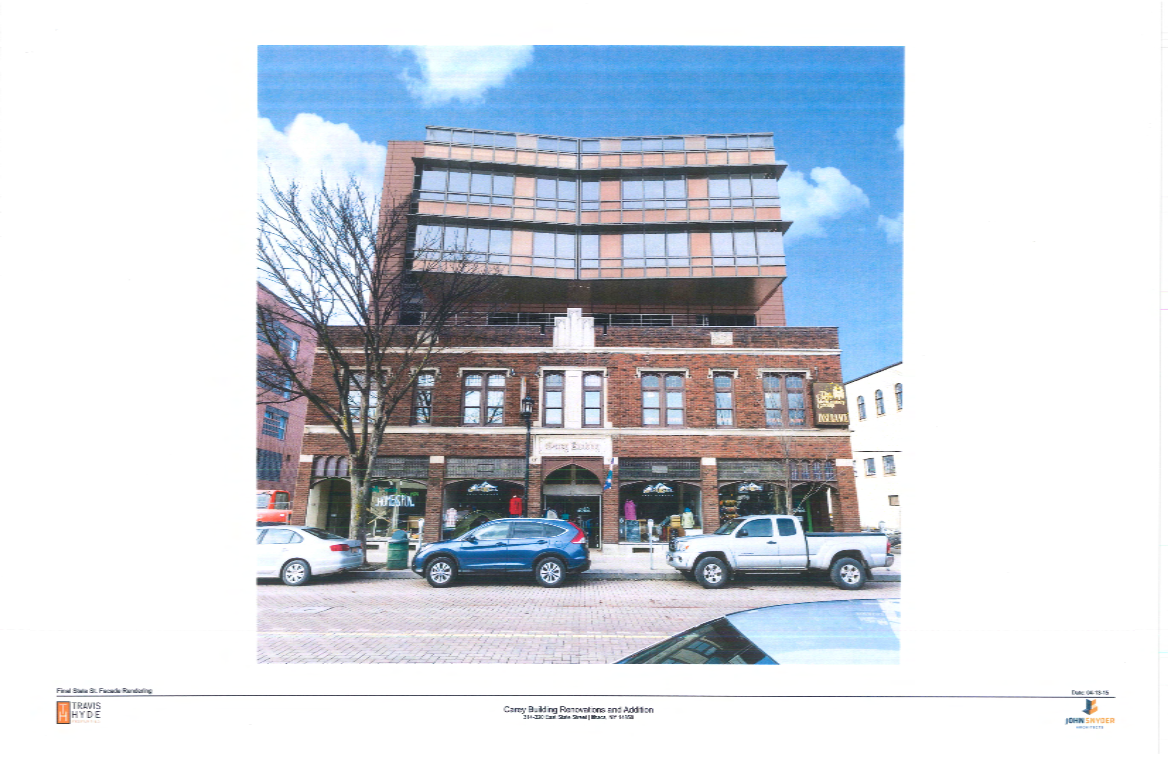
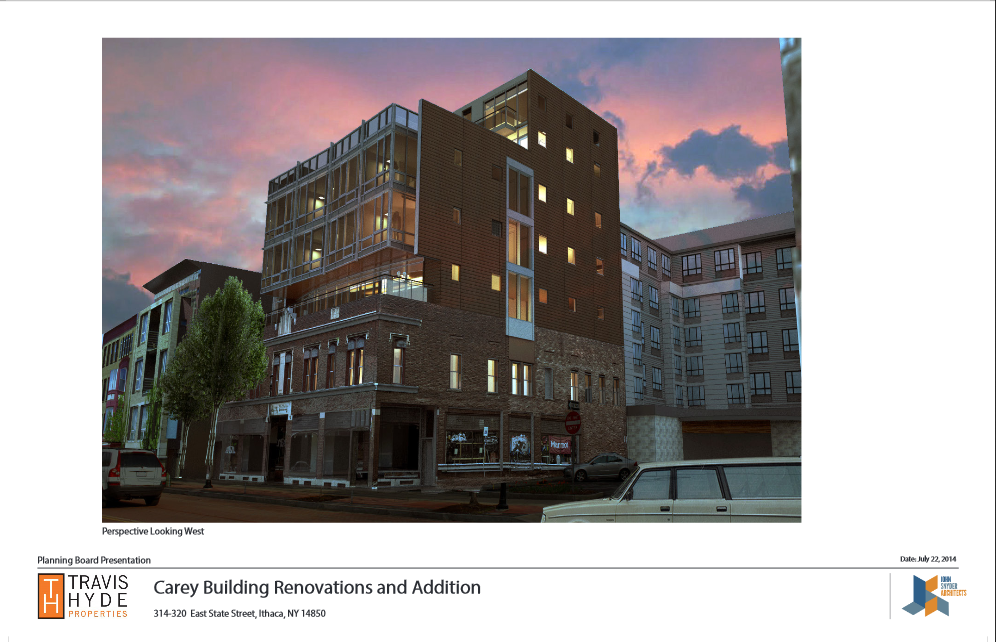
The new plan is to put in what’s called a plenum space between the third and fourth floors. A plenum space is between the structural floor and a dropped ceiling or raised floor, and it’s used to house HVAC, communication cables, or other mechanical equipment. The change in layout will result in an increase in building height from 77 feet 10 inches to 83 feet.

A few other modifications are also planned – a glass railing on the third floor will be changed to metal, and juliet balconies are being removed from the northern facade (back side, facing the new hotel) because the removal of an old chimney during the foundation-strengthening forces the need for an area variance that the developer doesn’t want to pursue. The old chimney encroached on the rear setback, but with it gone, that grandfathered privilege went with it. The top floor southern balcony (front side) may also be removed as a cost-cutting measure down the line. An emergency stairway for the sixth and seventh floor has been moved from the exterior to the interior.

These changes have to be approved by the Planning and Development Board, as well as the Board of Zoning Appeals. The Planning Board is set to review and make its decision later this month; the BZA, probably early May.

Here are some new renders with the proposed revisions (more in the link):

carey_rev5_1

carey_rev5_3 carey_rev5_2

And here are the old ones for reference:

carey_rev4_3 carey_rev4_2 carey_rev4_1
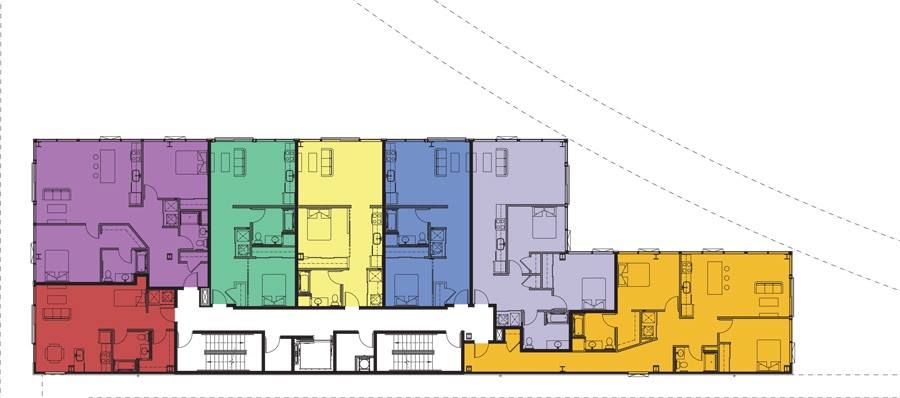
The Carey Building addition will add a third floor and 4,200 sq ft to the Rev business incubator (nearly doubling it to 8,700 sq ft), and on floors 4-7, there will be 20 apartments. Floors 4 and 5 will have 16 studio apartment units that average only 400-500 sq ft, their small size enabling them to be rented at a lower price. The 4 units on floors 6 and 7 will be larger 2-bedroom units. The $4.1 million project is being developed by local firm Travis Hyde Properties and built by LeChase Construction.


Ithaca Marriott Construction Update, 4/2015

16 04 2015

It may not look like a whole lot has happened at the Marriott site downtown, but it is a very complex undertaking. One anonymous reader close to the project wrote in to describe the work being done on site in the past couple months:

“Foundation work is progressing nicely despite the weather. Contractors have installed steel H piles to [the] bedrock along the perimeter. Wood cribbing has been installed within the piles. The wood panels slide into the web of the H. The cribbing is backfilled and remains forever, securing the bridge area once complete. Another contractor is drilling tie backs to hold the cribbing in place. The rods are grouted in place to a depth of 20 feet or more. The rods anchor the wall in place so the structure can be built within the opened area. Caissons will be drilled in a few days. The caissons are massive open pipes that are socketed into bedrock, 25 to 30 feet below grade. The hollow caissons are filled with concrete and rebar. Concrete beams will be formed from the top of each caisson similar to floor joists. Then a few million tons of hotel will be constructed on top. The cantilevered design is impressive and makes for some very difficult design constraints. This building is a big sail that is side heavy.”

To paraphrase, and hopefully I have this right, the bridge is being secured by H-shaped steel bars, wood cribbing and filling material, and steel tiebacks are being used to stabilize the retaining wall. Per wikipedia, grouted tiebacks can be constructed as steel rods drilled through the cribbing out into the soil or bedrock on the other side. Grout is then pumped under pressure into the tieback anchor holes so that the rods can utilize soil resistance to prevent tieback pullout and wall destabilization. With the bridge and retaining wall established, caissons can now be drilled. Caissons are piles drilled to a sufficient depth to allow the weight of the hotel to be transferred from the weak soil above, to the stronger bedrock 25-30 feet below. The weight will be spread out over the piles with concrete beams on top of the caissons, allowing for the hotel above to be stable and secure.

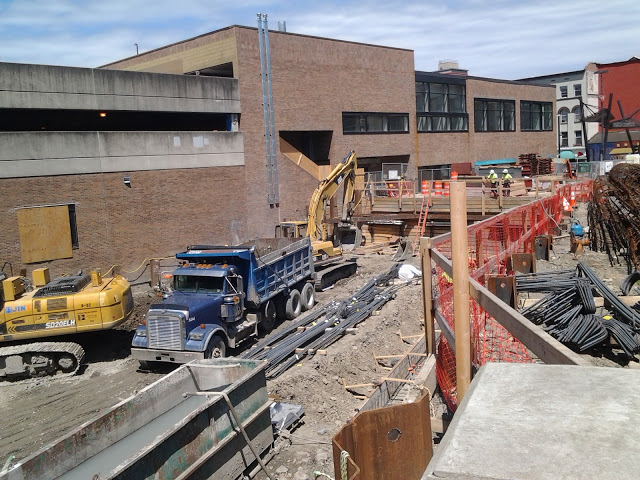
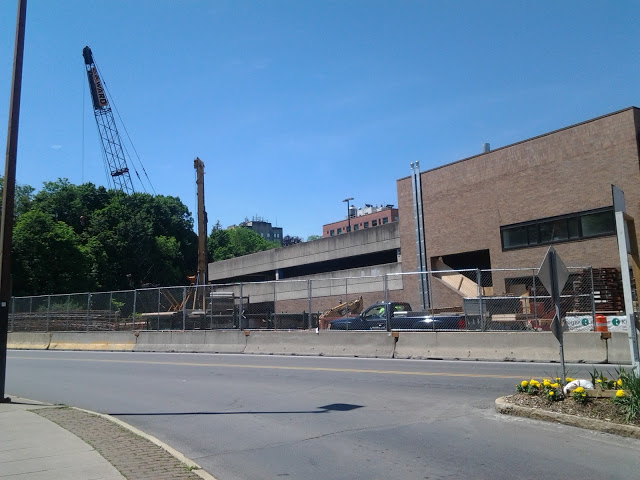
The photos don’t show the level of work involved with building the retaining wall, and as of April 5th it doesn’t look like the caissons were being drilled just yet. But those look like caisson liners next to the excavator, so pile drilling will be underway soon.

The $32 million, 10-story, 159-room hotel is slated for an opening in Q3 of 2016 (July-September). The hotel will include a fitness center, a restaurant with indoor and outdoor seating, and 3,000 sq ft of meeting space.

The hotel has been designed by Atlanta-based Cooper Carry Architecture and development is a joint venture of Urgo Hotels of Bethesda and Ensemble Hotel Partners, a division of Ensemble Investments. Urgo’s portfolio includes at least 32 other hotels totaling 4,500 hotel rooms. Interior design will be handled by Design Continuum, W.H. Lane of Binghamton is the general contractor, and Rimland Development contributed the land to the joint venture and is a partner. Long Island-based Rimland was the original firm that pitched the project in 2008 as the “Hotel Ithaca”, before the old Holiday Inn downtown went independent.

20150405_133412 20150405_133416 20150405_133422 20150405_133513

20150405_133115

marriott_rev1_1