Upson Hall Construction Update, 1/2017

18 01 2017

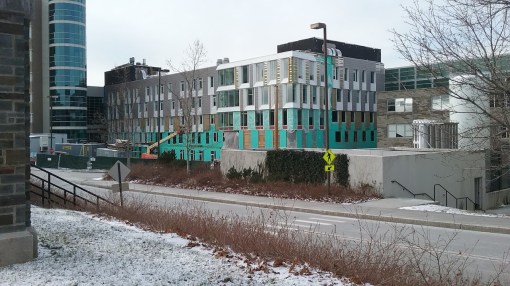
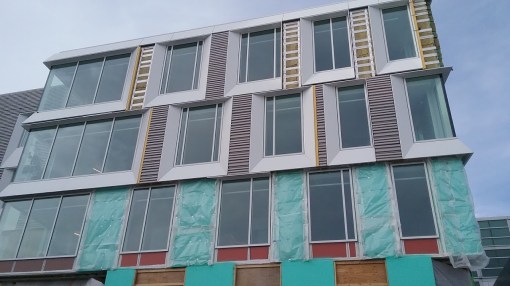
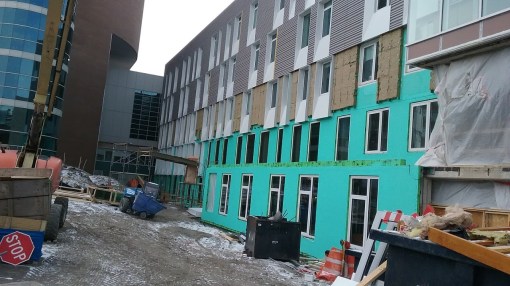
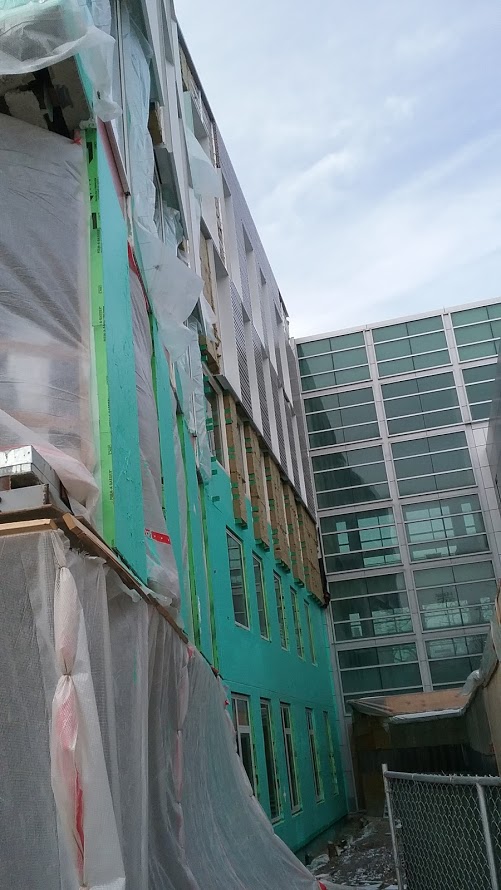
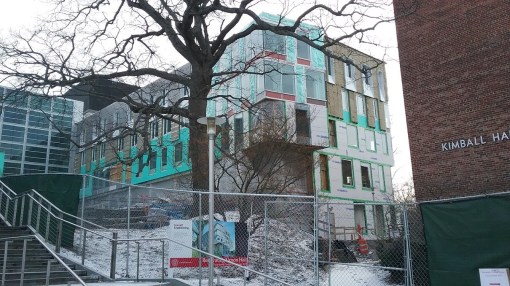
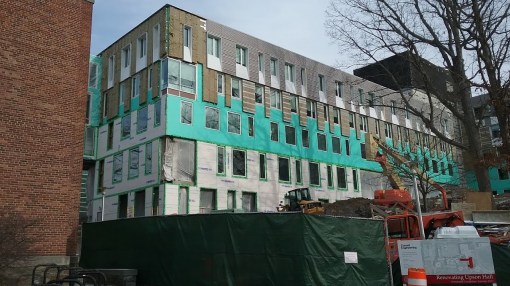
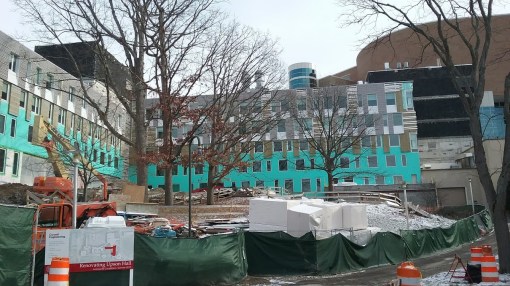
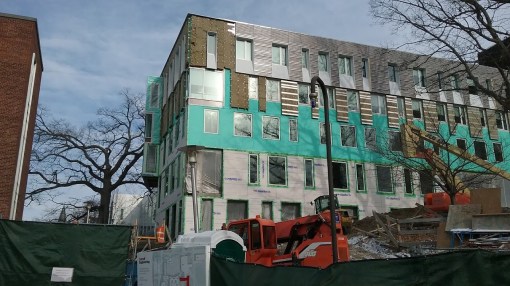
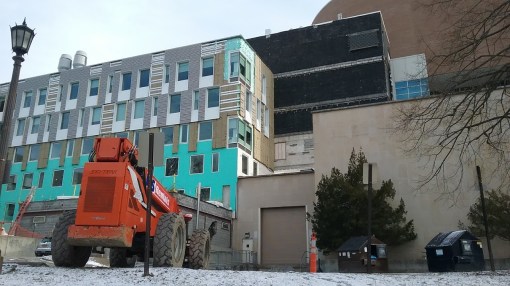
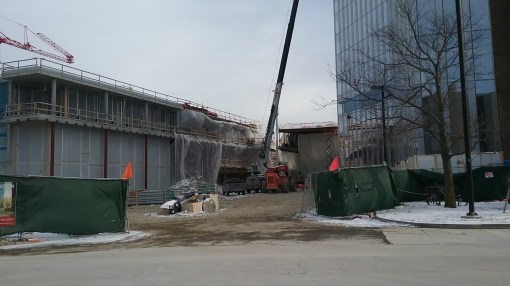
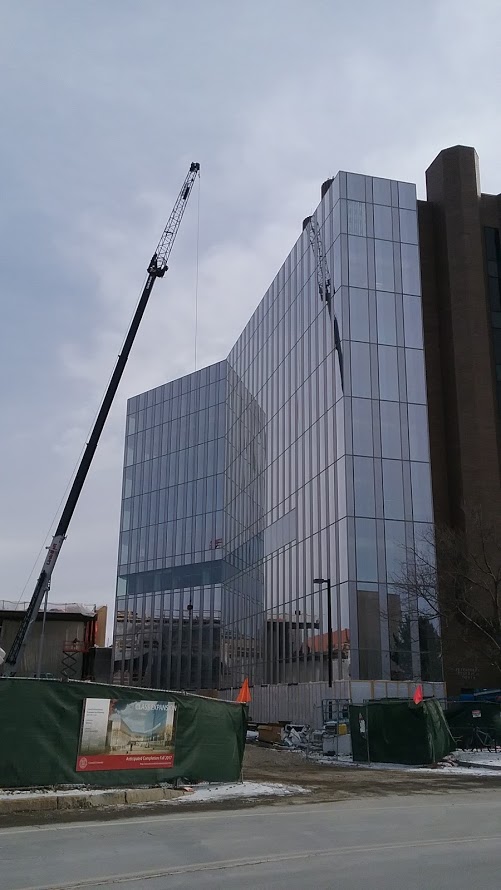
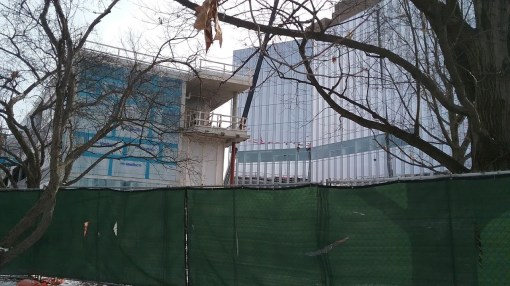
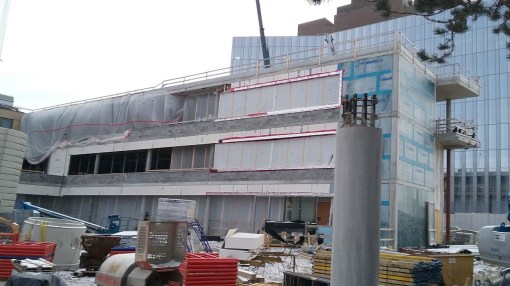
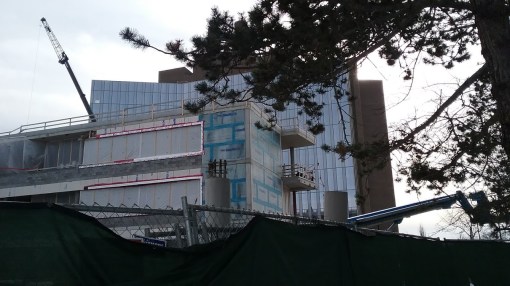
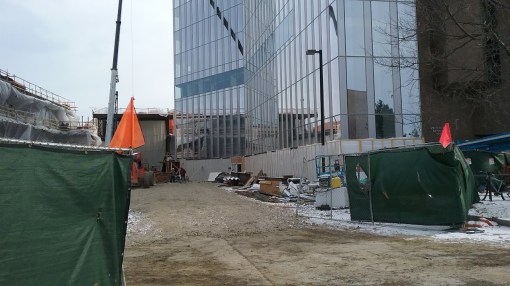
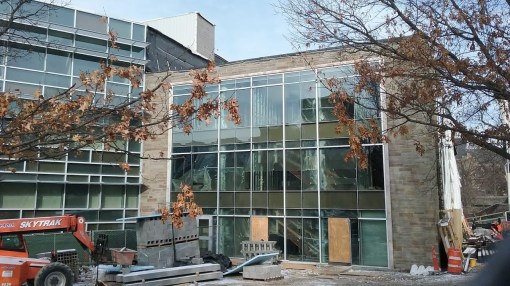
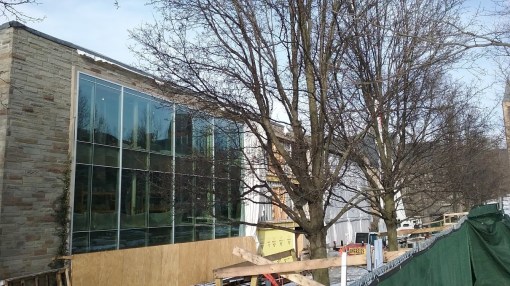
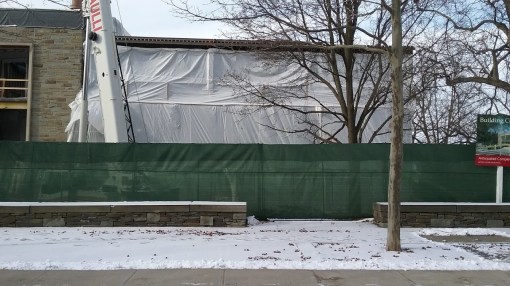
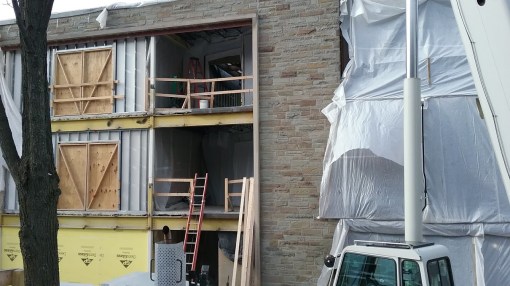
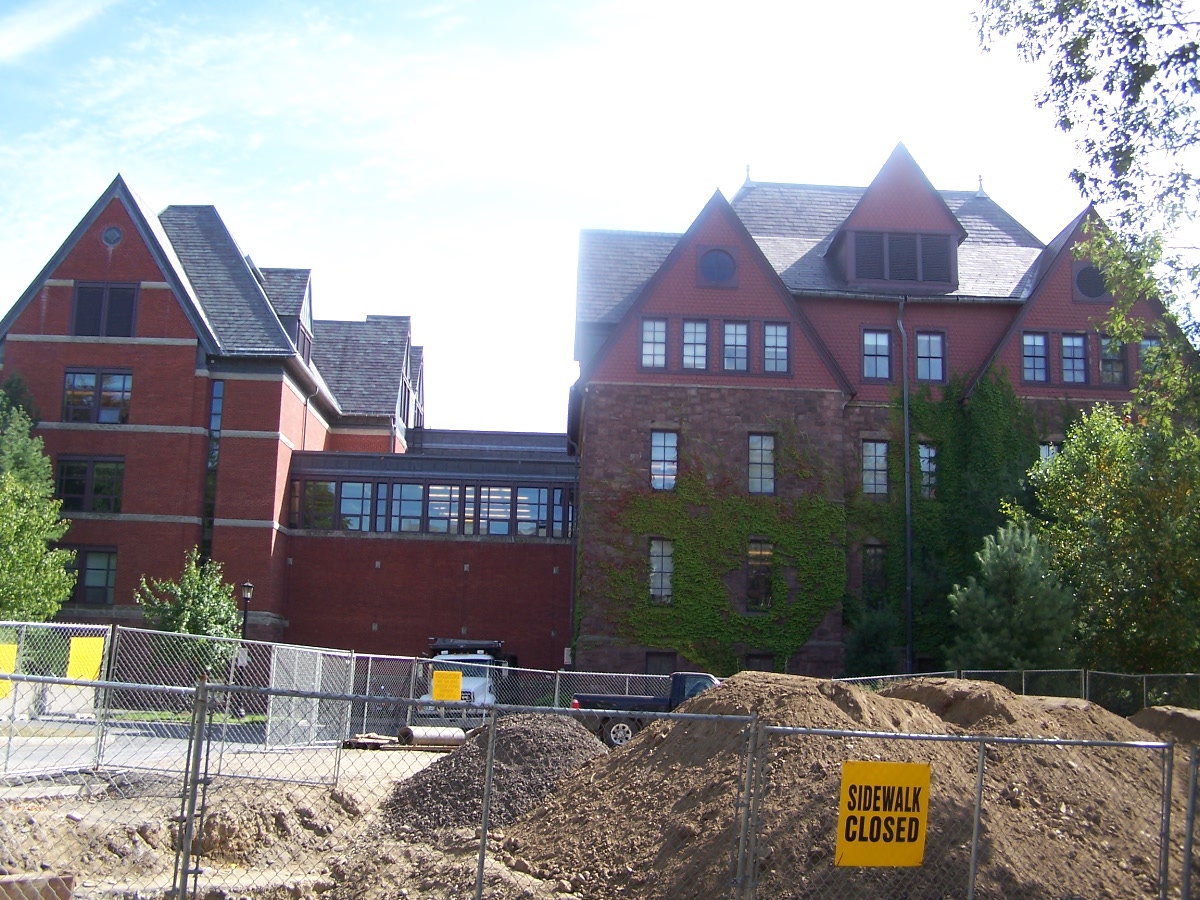
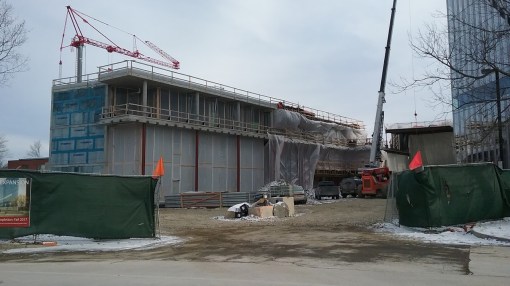
It’s become a little more difficult to shoot photos from certain angles, now that one of the previously-open sidewalks has been closed off. But, it’s not a surprise, they’ve been working on Upson’s new face. The exterior stud framing has been underway on the lowest floors of the west face. Sheathing is being attached, and the rough openings indicate future windows. The lowest floors of the east side, a little further along, have already been coated in turquoise waterproofing material, and are being fitted with windows. On the upper floors, there’s been considerable progress with the terra-cotta and the aluminum surrounds. It doesn’t look like there’s been much progress with attaching new mineral wool and clips, the current work is either finishing up what was well-underway (the upper floors), or getting started with the new exterior (the lower floors), not a whole lot of work going for the in-between stages at the moment.

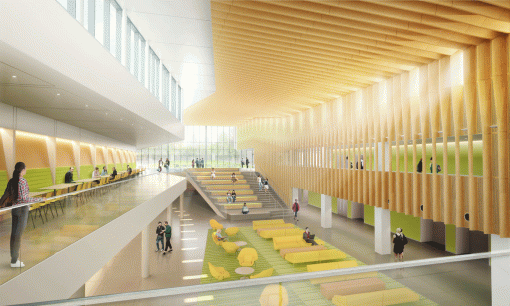
Inside, you can see the new interior framing being built inside the fully-gutted and renovated interior. According to Cornell’s last update in December, interior demolitions are complete, mechanical rough-ins are ongoing in the basement, and electrical and plumbing are underway on the first and second floors.

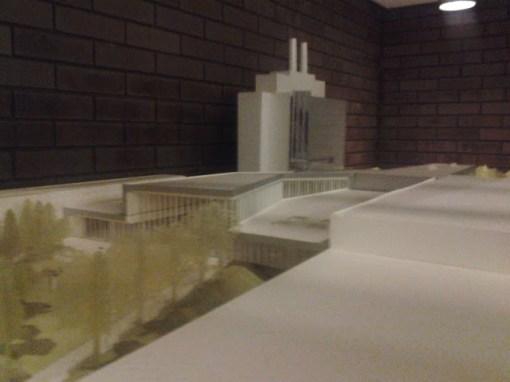
Like Gannett, The Pike Company is the general contractor in charge. LTL Architects and Perkins+Will are in charge of design.

20170107_103946 20170107_104030 20170107_104052 20170107_104055 20170107_104104 20170107_104120 20170107_104139 20170107_104430 20170107_104456 20170107_104540 20170107_104555 20170107_104906 20170107_104910 20170107_104921 20170107_104955


Cornell Law School Renovation Update, 1/2017

17 01 2017

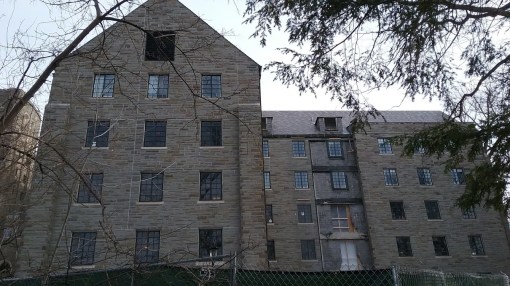
From the outside, it doesn’t look like much is happening. But, given all the steel beams on site, the safe bet is that the former dorms inside are still being gutted to nothing but the load-bearing walls, and those beams will become a part of the new interior partitions, new stud walls for the enhanced faculty office and professional space. This is by and large an interior renovation, but perhaps after the deepest cold of the season passes, we’ll see more progress towards enclosing the loggia and the new stairwell on the west face. The wire mesh over the exposed west wall is for safety reasons.

20170107_105312 20170107_105321 20170107_105342 20170107_105408 20170107_105424 20170107_105432 20170107_105542 20170107_105624

hughes_cornell_4 hughes_cornell_3


Cornell Veterinary School Expansion Construction Update, 1/2017

17 01 2017

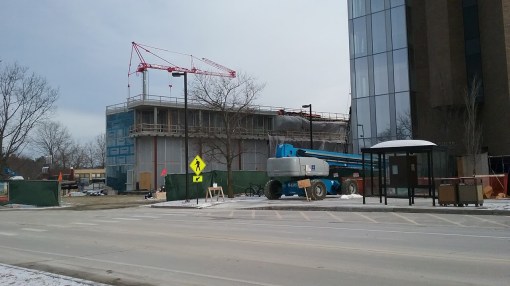
Starting to see more progress on the structural frame of the $74.1 million Vet School additions. The reinforced concrete frame of the new library and administrative offices now extends all the way back to the rest of the Vet School complex; the new section is draped over with plastic sheets. Also, as the new wing gets fleshed out, the rough openings of the windows are taking shape. It doesn’t look like there’s been too much exterior progress on the new atrium.

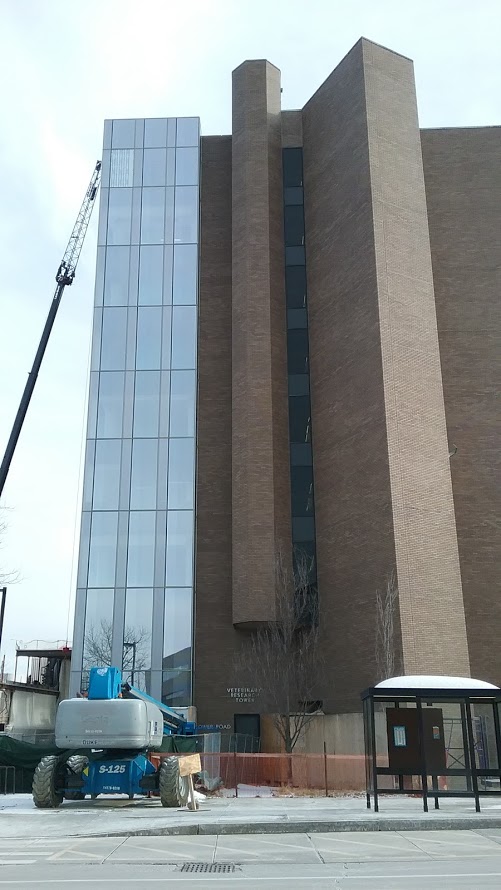
According to the project webpage (last updated two weeks ago), interior framing (metal stud walls probably) is underway, rough-ins are underway, and the new cafeteria is under construction. Welliver will have the new atrium and lecture hall fully closed up by the end of January. Most of the Vet Research Tower work has been completed, but new office layouts are still in the works for the sixth and seventh floors, and that work won’t get underway until this Spring.

The new $7 million ($4.9 million hard cost) Community Practice Service Building is out for bid, with a march demo planned for the Poultry Virus Building currently on site, and a March 2018 opening, about seven months after the bulk of the new Vet School structures. It is a wood-frame 12,000 SF building designed by HOLT Architects, and I still have yet to find an image of the design.

20170107_102456 20170107_102508 20170107_102521 20170107_102540 20170107_102615 20170107_102640 20170107_102646 20170107_102708 20170107_102740 20170107_102838 20170107_102846

cad048742a281097e5667382eced42333f5656954f5a3ef1021519c03b4abe9f

20160522_131445 20160522_131417 20160522_131344

20160522_131403


Gannett Health Center Construction Update, 1/2017

15 01 2017

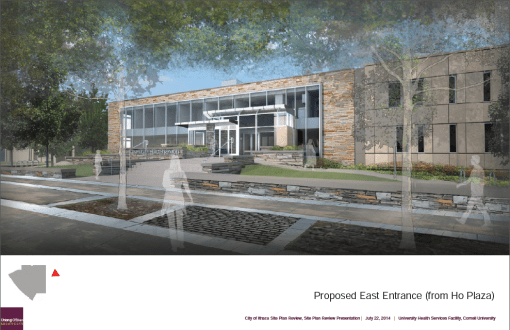
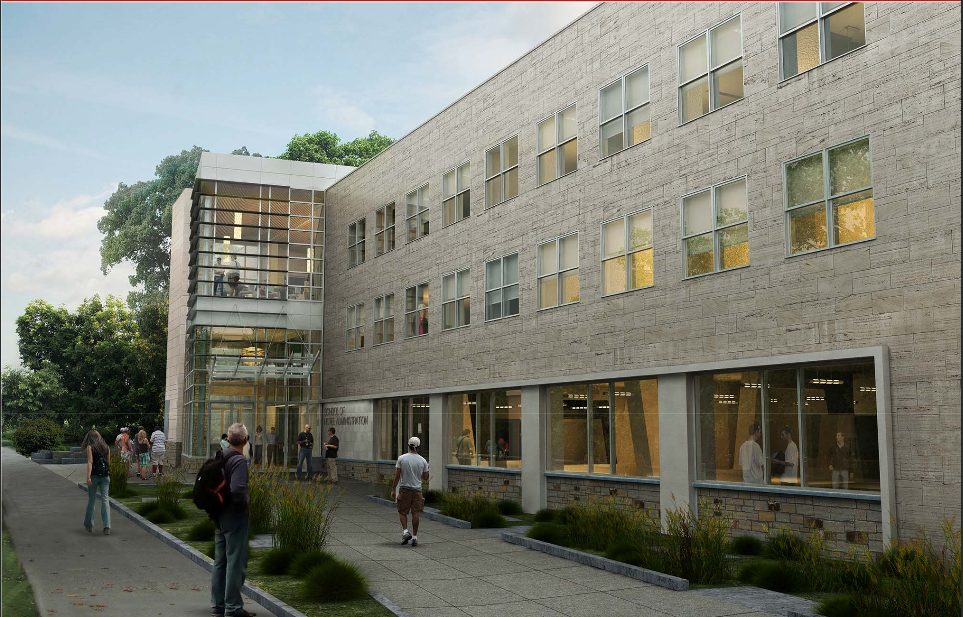
Okay, for as much as I miss the old banded concrete and glass, the large window panes, clear glazing and thin aluminum frames designed by Ithaca’s Chiang O’Brien Architects do have a certain modern chic going. However, this armchair critic still has yet to decide if he likes the offset between the outer and interior frames of the curtain wall. The windows have made their way north along the old east wing. Peering through, you can make out some of the new metal stud walls, so utilities rough-ins for the gutted 1950s structure are underway.

The new entry canopy has yet to be built out. Pike, the contractor, could soon insert the northernmost panes where the old east wing’s interior is exposed, but the curtain wall glazing won’t be finished until the canopy has been constructed.

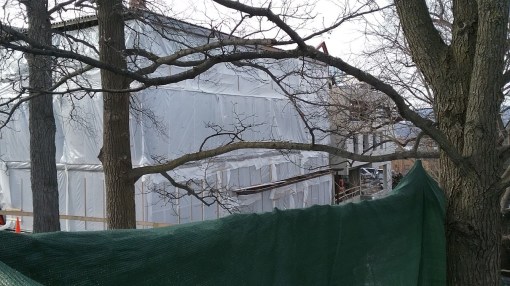
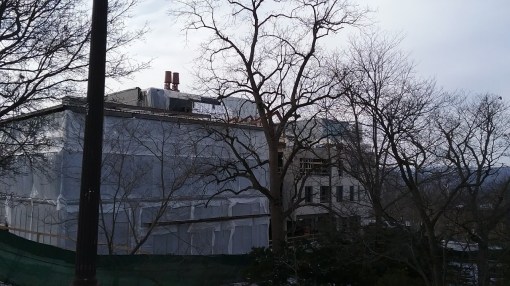
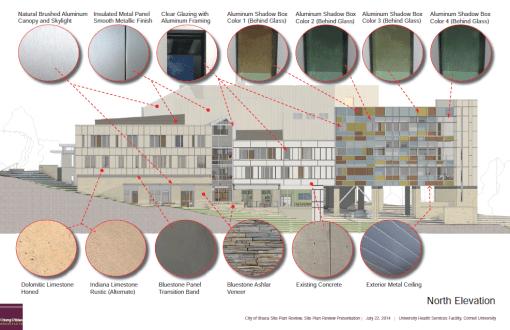
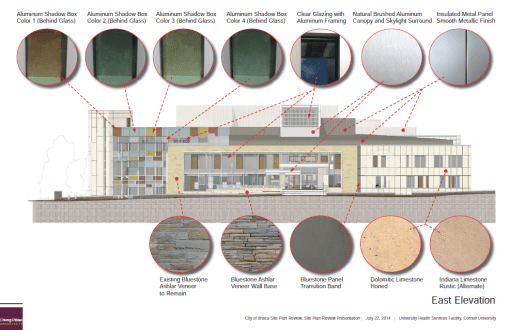
The new three-story 18,000 SF northeast wing, which replaces the former Ho Plaza entry, rose pretty quick – like the Breazzano Center, it’s wrapped up in plastic to limit workers’ exposure to the cold. The outside of the new wing will be faced in a couple types of limestone, with a bluestone transition panel and bluestone veneer at its base – the 1979 west wing is being updated so that the two will look similar, although the 1979 wing will retain its concrete exterior, giving the two wings some visual contrast.

According to Cornell’s revamped project website, the Gannett project is 70% complete. Whether that included the new addition that opened last year is not clear. The entire project should be finished by this fall.

20170107_105817 20170107_105841 20170107_105904 20170107_105908 20170107_105926 20170107_105950 20170107_110000 20170107_110007 20170107_110038 20170107_110100 20170107_110108

gannett_northeast_persp gannett_north_final gannett_eat_persp gannett_east_final gannett4


Yet Another Makeover for Statler Hall

16 12 2013

100_5157

Another makeover is planned for a section of the Statler, this time the circa 1987 PoMo front entrance space. As noted by Ithaca Builds, the addition, at a cost of $2.4 million, calls for a modernized pop-out addition and entrance on the west face of Statler Hall (the side facing East Avenue) with new landscaping and pedestrian features. The project adds a relatively modest 1,619 sq ft to the Statler, with 319 sq ft on the first floor, and 1,300 sq ft on the second floor. The exhaustive summary of the project is included on their website here, with more renderings here. The timeline for construction is a short three months, May to August 2014.

statler1

This is the third renovation in the series, all by Philly-based KSS Architects. The first phase involved the construction of the Beck Center in 2004, which added 36,000 sq ft and renovated 16,000 sq ft on the east wing of Statler Hall. The second phase added 14,000 sq ft on the south face of the Statler, and was completed in 2010. Since the Hotel School is landlocked with little hope of re-purposing nearby property, the procedure with new structures always involves additions and renovations, rather than totally new buildings as we would see in other schools. The Statler was first built in 1949 on what was previously four homes of faculty row (at one point, a few dozen faculty had homes on Cornell campus, other examples include what was once Grove Place on what is now the Engineering Quad, and another cluster of homes where Savage-Kinzelberg Hall stands today). The auditorium was added to the south end in 1956, and further renovations were undertaken in 1959 and 1968. The hotel tower was added along with this front entrance in 1986/87. If history is any indicator, his will not be the last addition or renovation.


A Bigger Vet School

10 10 2013

cropped-100_1794.jpg

I’ve only ever been in the vet school once, to deliver an invitation for a wine and cheese event to an alum of my fraternity house who worked as a researcher at the vet school.  When it came to getting photos, I would just take advantage of my Bradfield perch, take my photos, and that was that.

The vet school is not unlike the rest of the school in that it’s been built in spurts. The original vet school was in James Law Hall, where Ives Hall stands now (and even prior to that, it shared space in the north wing of Goldwin Smith Hall, the old dairy science building). The vet school moved further east with the construction of Schurman Hall in 1957, and expanded with the Vet Research Tower in 1974, the Vet Education Center and Vet Medical Center in 1993 and 1996, and the East Campus Research Facility and Vet Diagnostic Lab in 2006 and 2010 respectively.  Essentially, the vet school is like many human hospitals, a mish-mash of additions and new wings/buildings, incoherent and even incompatible. The completion of the the  VDL building left a large amount of vacant space in Schurman Hall that was difficult to repurpose, hence the approved plan – demolish 68,000 square feet of space, build 65,000 square feet of new space, and renovate 33,000 square feet of existing space, to be done in two phases with a combined cost of $63 million.

Looking east from Tower Avenue. Rendering property of Cornell.

Looking east from Tower Avenue. Rendering property of Cornell.

Given those stats, it seems like a misnomer to call it an expansion, but one of the effects of the reconstruction will be to increase the number of matriculating vet students in a year from 102 to 120 – and given Cornell’s #1 vet school ranking, they will not be lacking in applicants. Over four years, you have 72 more professional students – you’re welcome, Ithaca landlords. Among the details, the old auditorium will be torn down, and in its place comes the new Flower-Sprecher library, two new lecture halls, a new dining hall, large gathering spaces (i.e. yet another open atrium) offices, an expanded anatomy lab, and a green roof. The architects of this plan are New York-based Weiss/Mandfredi, who specialize in hypermodern glassy spaces.

Looking west from new courtyard. Rendering property of Cornell.

Looking west from new courtyard. Rendering property of Cornell.

As for the time frame, Phase I, which comprises the tear-down and new construction, will start in April 2014 and be completed in a 12-month time frame. Phase II, the renovation component, will commence at that time and proceed towards a tentative completion in October 2016. I will already be beyond my 5-year reunion, so that kinda freaks me out.

Straying a bit here, but I’ve heard from my vet school friends that the market isn’t absorbing new grads like it used to, and not at the salaries that it used to. A for-profit school planned for Buffalo was recently cancelled. But, I suppose for the #1 school, these are concerns that the college is reasonably shielded from. Adopting a dog in the next couple years is on my priorities list (if I can ever establish enough of a schedule that makes me feel like I’d have adequate time to love it), so in my totally uneducated opinion, more vets is fine by me.


The Essentials of Campus III: Sage Chapel

29 05 2009

100_0923100_3407

Moving on to yet another fixture of the Cornell Campus, we have the first religious building constructed for the university, Henry Sage Chapel.

So, most Cornellians are at least aware of why the chapel was built- Cornell, being founded as a nonsectarian university, was often attacked by its detractors for its lack of religious emphasis, earning itself the nickname “the heathens on the hill”, or “infidel Cornell”. A.D. White could’ve cared less, as he was enormously proud that the university touted nonsectarianism and voluntary church attendance (White always made the claim that Cornell was the first to have voluntary chapel, but that distinction actually goes to the University of Virginia (140). Regardless of opinion, however, the vast majority of students at the time were church-goers, so Henry Sage, one of the original trustees (and an enormously wealthy benefactor of the university), donated money to construct a chapel so that students may be able to attend church services on campus rather than having to venture down to the various houses of worship in the city.

Lore has it that when Mrs. Sage was looking through the plans for Sage College in 1872, she noticed a small corner of the building was to be set aside for a chapel. Supposedly, she turned to her husband and exclaimed, “is that the only provision in that great university which is made for chapel services?”, and the following day her husband approached A.D. White with the idea of build a proper chapel (193). Look ins back towards the facts, Sage had originally proposed a university chaplain, which White staunchly opposed (194), suggesting a lecture series in Christian ethics (along with other faiths) instead. So when the chapel was first built, it had a lecture series given by both local and well-travelled preachers, but no permanent clergyman.

The original Sage Chapel was completed in 1875, about the same time the first student handbook finally suggested that services were merely voluntary. Over subsequent years, Sage was remodeled and expanded numerous times (1884, 1903, 1939) before the construction of Anabel Taylor in 1953 did away with the need for further expansion. The original Sage looked something like this:

Sage Chapel as it appeared in the late 1870s.

Sage Chapel as it appeared in the late 1870s.

The original construction was less than half the size of the current Sage Chapel, and sat 500 worshipers (194). The house to the right (east) was home to Professor Charles Babcock, who also happened to be the person who designed Sage Chapel. According to Morris Bishop, morning services were usually poorly attended as students preferred churches closer to their boarding houses in the city, but afternoon services were often packed. Electric lights were installed in the belfry of Sage Chapel in 1879, the first in the Ithaca area (a fact that they included in the free agendas you picked up at the registrar—or (202)). The Mortuary Chapel, where John and Jennie McGraw, Mr. and Mrs. Henry Sage, Willard Fiske Ezra Cornell, A.D. White and E. E. Day all lay at rest, was completed in 1884 (all are bodies except Day, who was cremated and had his ashes interred in the chapel in 1951). A.D. White was known for giving much attention to the details of the chapel exterior, so that students would have a good moral impression (236). It should be noted that Fiske, who died seven years after Henry Sage, was interred during a football game with Penn, so hopefully no one would pay much attention (356). This was an epic fail, because Sage’s two sons were a little angry that their father’s enemy was allowed to be interred in the same mortuary room, so they resigned their trustee positions four days later in disgust, and severed all ties to the university.

So, that largely fulfills our little history portion. Cornell has a nice little book out there for those who are interested in some of the finer points of Sage Chapel, but for those of a more casual interest, going inside the ornate chapel is a real treat, especially if you can sit in on a session on the organ.

100_3408

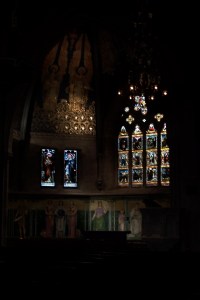
Many of the windows are dedicated in memoriam to those whose lives were cut short. Among examples are students who died during the smallpox outbreak of the late 1800s, and the Cornellian who was killed during the Civil Rights protests, Michael Schwerner ’61 [2].

100_3400

I’ll be honest; as someone who doesn’t regularly attend services here in college but still considers himself a Christian, I do not nor have I ever been greatly comfortable with even taking photos in churches, because to me it feels disrespectful. Hence the relative lack of them.

[1]Morris Bishop, A History of Cornell. Ithaca: Cornell University Press, 1962.

[2]http://en.wikipedia.org/wiki/Mickey_Schwerner


Arts Quad Photos

30 08 2008

Some people suggested that I might consider sharing a little history of a few of the campus buildings for those that are interesting. Well, it’s Friday evening, and I’ve already enjoyed a private 21st birthday celebration for a friend. So, why not?

Rand Hall, built in 1912, was built in the industrial style typical for the time period. The building was donated by Mrs. Henry Lang in honor of her father Jasper Rand [1], and her ubcle and brother of the same surname. The building housed machines shops as part of the Sibley School of Engineering, and eventually was reworked to be the studio for many of the architect student as part of the AAP school.

For those of us who aren’t architects, we rarely see the interior. We do, however, see the designs and phrases bored architects create on the compound windows.  The building has been proposed for demolition in recent years to make room for proposed addition to the AAP school (see the Milstein Hall entry), but the current design proposal for Milstein Hall spares the structure for the current time. The building doesn’t tend to make much news, with the slight exception of a time a peacockfrom a Cayuga Heights home broke into their computer lab a couple of years ago [2].

Lincoln Hall, across the path, has seen a much more varied history than its workhorse neighbor. Lincoln Hall was built in 1888 at the then-cost of $72,603, and housed the Civil Engineering until 1960 (it moved to Hollister Hall). The building was renovated for the music department, and they moved in the following year [3].

Lincoln Hall saw an 18,640 sq. ft., $19 million dollar expansion from 1999-2000 (the addition is on the left side of the photo). The firm that designed the addition also designed Kroch Libe in 1992 and the Law School addition in 1988.
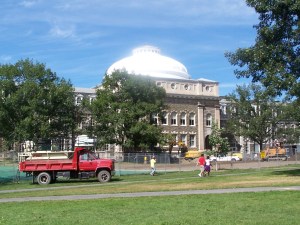
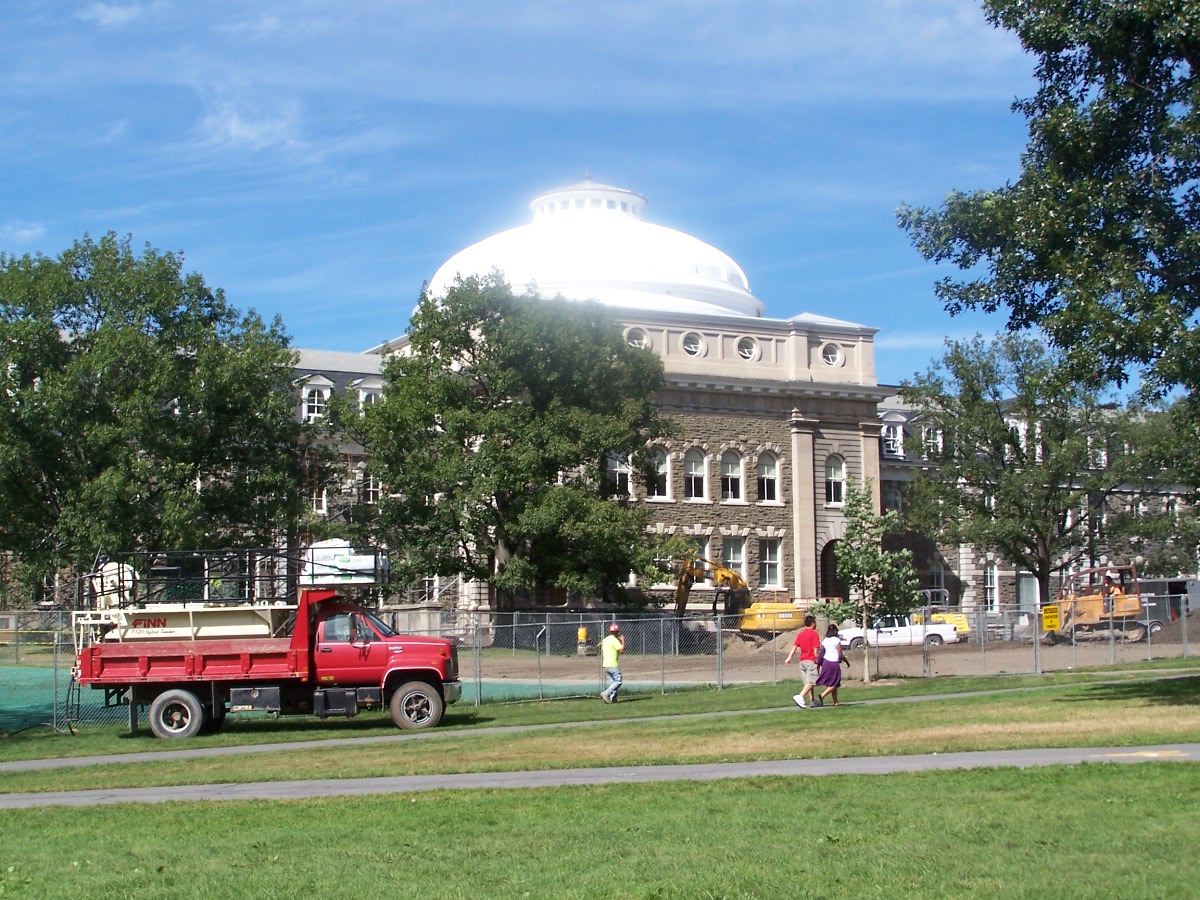
Sibley Hall, namesake of Hiram Sibley, has three seperate wings built at three seperate times. The West Wing began construction in August 1870. The building was dedicated to the “mechanical arts”, as so deemed by Hiram Sibley, an original trustee of the university. Sibley donated the money hinging on A.D. White building himself a president’s house on the campus [4]. The east wing was built in 1894, and the center area, including the photogenic dome, was built in 1902. Although the three portions were designed by three different architects, they form a relatively cohesive single structure that serves as the nucleus of the AAP school. The center area houses the Fine Arts Library.

The construction in the photo is some pipe work, and Sibley underwent minor renovations during the summer to make the building handicap-accessible, and to add more bathrooms to the structure.

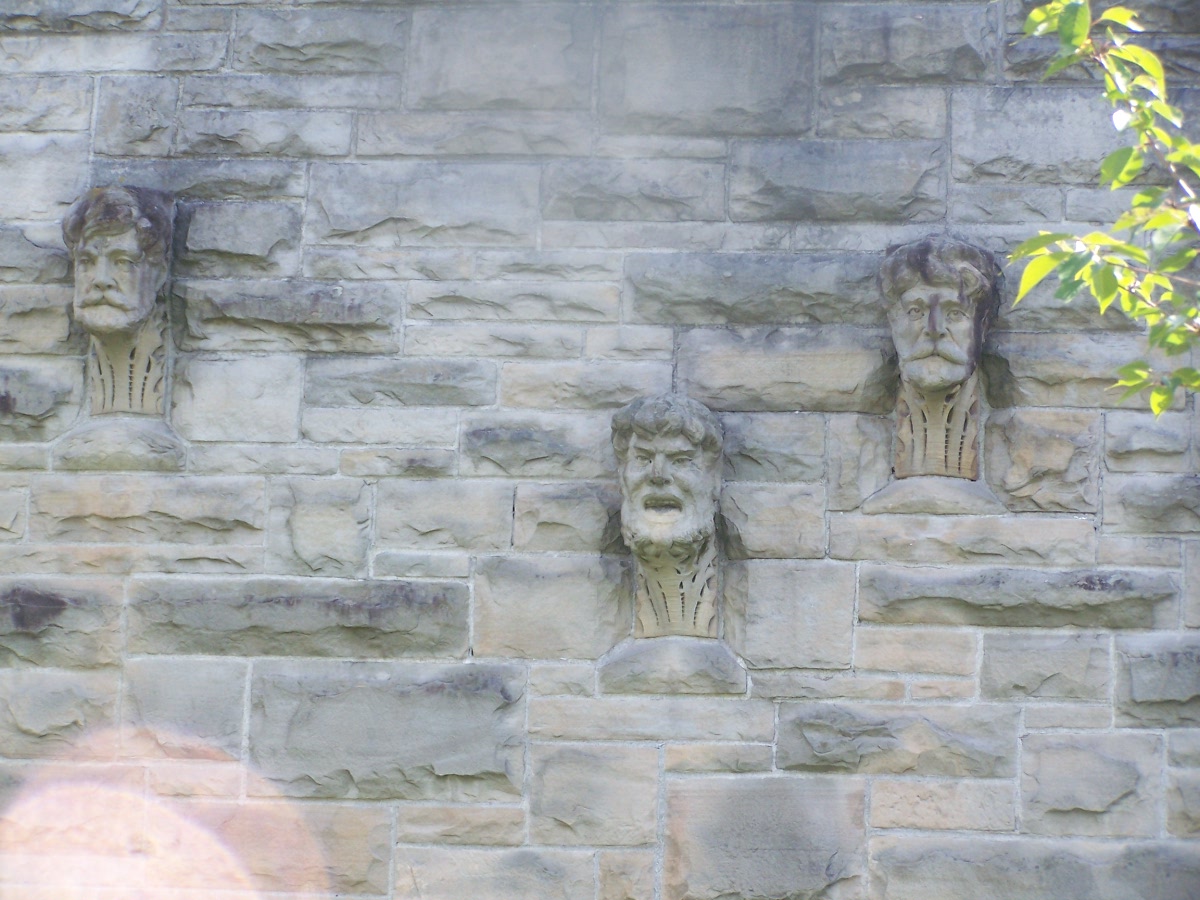
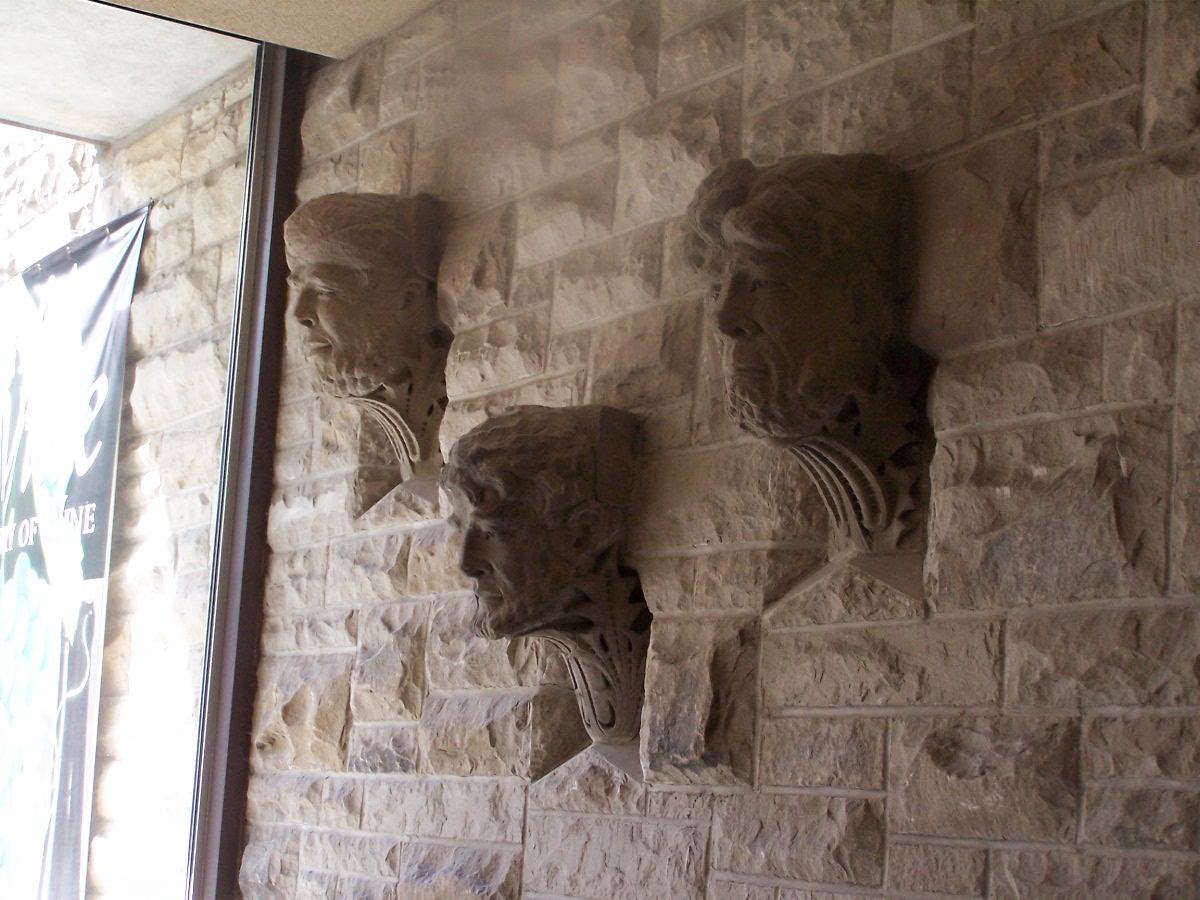
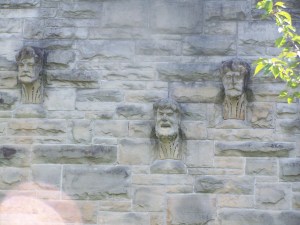
The John M. Olin Library shares the title of being the main library for the Cornell campus. The building was opened in 1961 [5]. To facilitate its 5.66 million dollar construction, the university demolished Boardman Hall (1892), which was the original home of the law school. Boardman was a former dean of the law school. The three stone faces on the outside and the three stone faces next to the interior staircase are artifacts from the exterior of Boardman Hall that were incorporated into Olin’s facade.
The Kroch Libary, largely underground except for four skylights next to Stimson Hall, was constructed in the fall of 1992 at a cost of $25 million dollars (namesake Carl Kroch ’35). For those who are curious, Olin has a utility tunnel to Uris, and Kroch has a utility stairway-tunnel that connects to Stimson, both of which are largely prohibited for non-staff use.

Olin’s entry way and cafe were renovated in 2002. The rest of the building is currently being prepped for a major renovation that will clean the exterior facade and renovate the interior to being it up to safety codes and to make it more conducive for current trends in upper education (think “pollinization spaces” not too unlike those in Duffield and Weill, without the atrium).
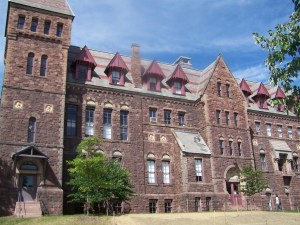
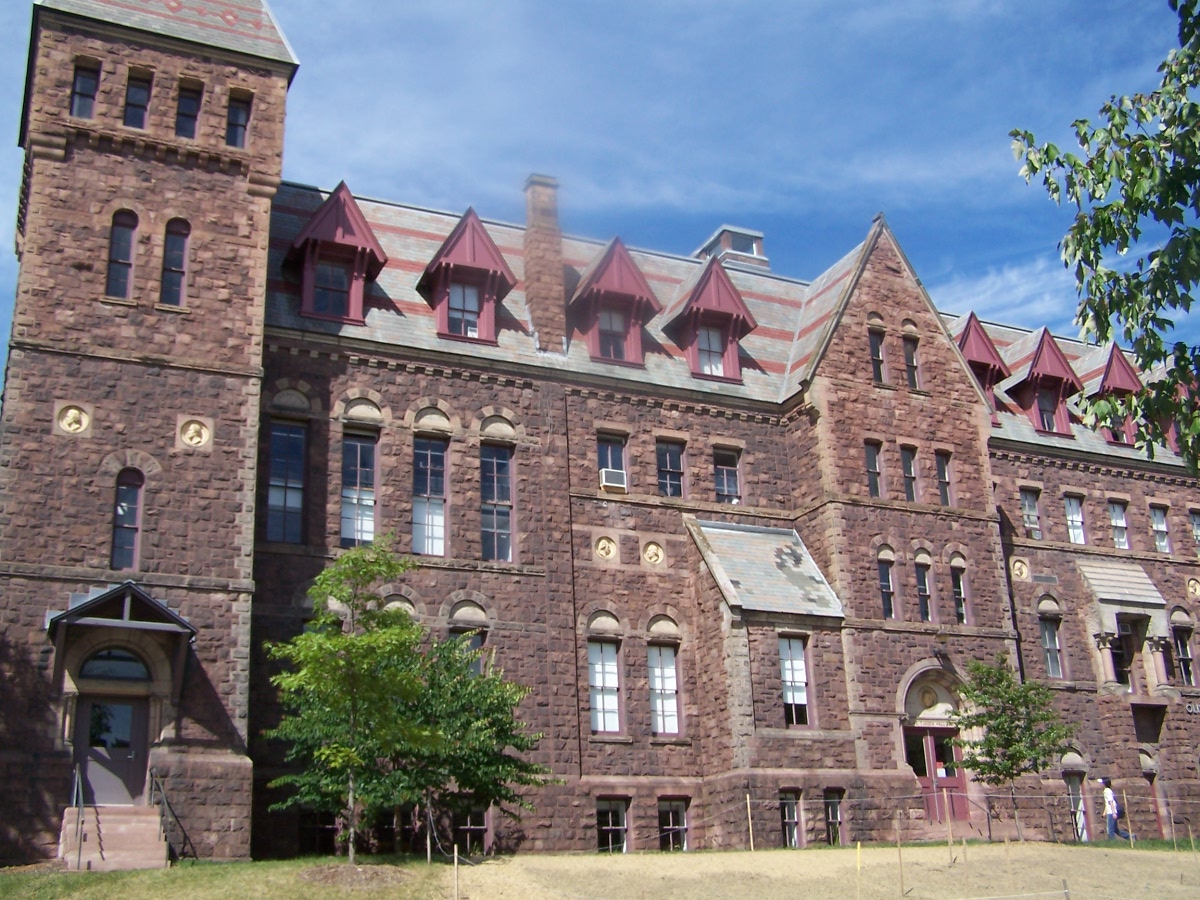
Tjaden was built as a “physical laboratory” in conjunction with West Sibley in 1883. Although $50,000 was budgeted, delays and material shortages drove the costs up to a final tally of $100,923, more than twice than was originally budgeted [6]. This is partially because of A.D, White insistance on the use of stone, and the medallions that decorate the building with the profile of prominent men in the mechanical arts. If you look closely enough, you can see that the window arches still have the names of great discoverers and inventors inscribed into the stone. The building was originally named Franklin Hall, in honor of the great innovator Benjamin Franklin.

The Department of Chemistry originally called the building home until it left for Morse Hall in 1890. The physics department left in 1906, and afterwards the building was incorporated into AAP as the Fine Arts building and workshops. The building was rededicated in 1981 to Olive Tjaden van Sickle ’25, a pioneering woman architect [6]. The building was renovated in 1998, at which time it regianed the hipped roof that I so inconveniently cropped off because I was too lazy to take a few steps back (the original hipped roof was deemed structurally unstable in the 1950s after a lightning strike set it on fire).

[1]http://www.aap.cornell.edu/aap/explore/rand.cfm
[2]http://www.news.cornell.edu/stories/June06/peacock.nabbed.dea.html

[3]http://www.arts.cornell.edu/music/LincolnRen-Exp.html

[4]http://www.aap.cornell.edu/aap/explore/sibley.cfm

[5]http://www.cornell.edu/search/index.cfm?tab=facts&q=&id=541

[6]http://www.aap.cornell.edu/aap/explore/tjaden.cfm