Belle Sherman Cottages Construction Update, 4/2015

12 04 2015

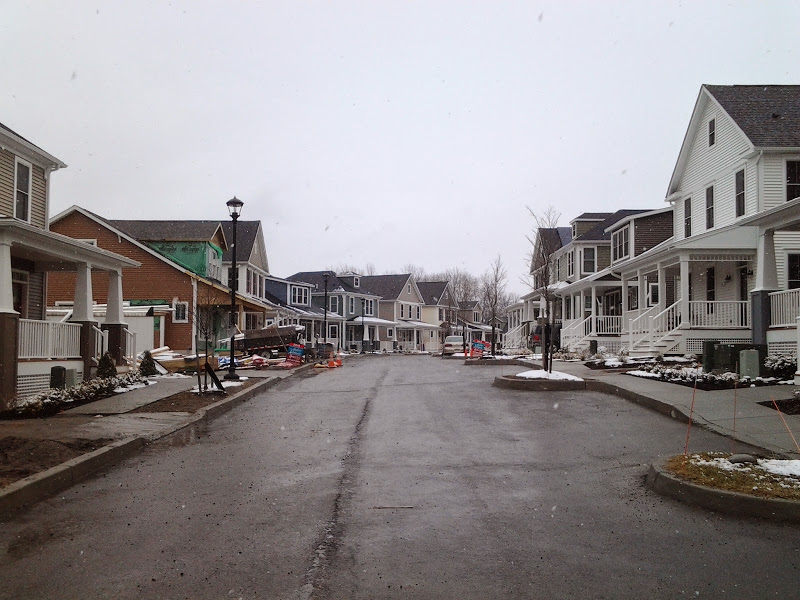
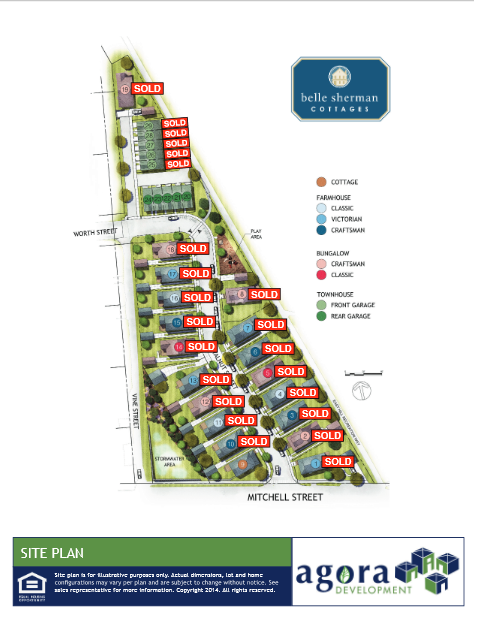
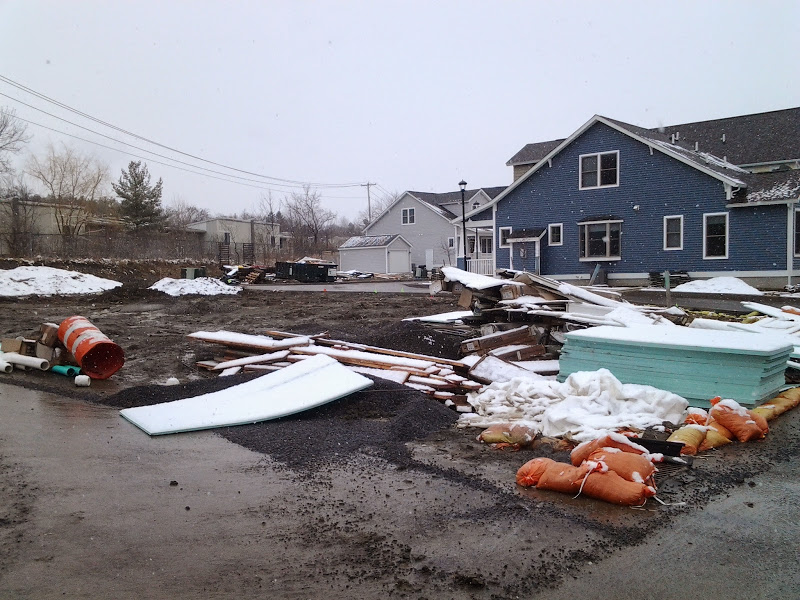
Over at the Belle Sherman Cottages off of Mitchell Street, work is underway on the first set of five townhomes, lots 25-29. The CMU block wall foundations have been assembled and look ready for the Simplex modular pieces to be brought onto the site and fitted. The houses are built using four modules, but the size of the townhouse lots suggests these might have only two modules per unit. The townhouse units sold out fairly quickly, just a few weeks. Sales are underway for the second set of townhomes (lots 20-24), which are expected to be built this year as well.

Elsewhere on the site, the “Classic Bungalow” on lot 12 has been assembled and is undergoing lap siding installation (“Mountain Cedar” color, with a lighter “Savannah Wicker” tan color planned for the dormer). The porch is being assembled and exterior trim is being installed. If you’re interested in learning more about the construction process, there’s a little more info in my previous post here, and on Ithaca Builds here and here. Once completed, there will only be two unbuilt home lots, the already-sold “Autumn Yellowfarmhouse planned for lot 11, and the unsold and un-marketed lot 9.

20150405_123303

20150405_123319 20150405_123326 20150405_123401 20150405_123430 20150405_123512 20150405_123540 20150405_123610 20150405_123621

belle_sherman_townhouses_2

belle_sherman_cottages_102714


News Tidbits 4/11/15: Not Feasible As Presented

11 04 2015

dpi_libe_0414_end

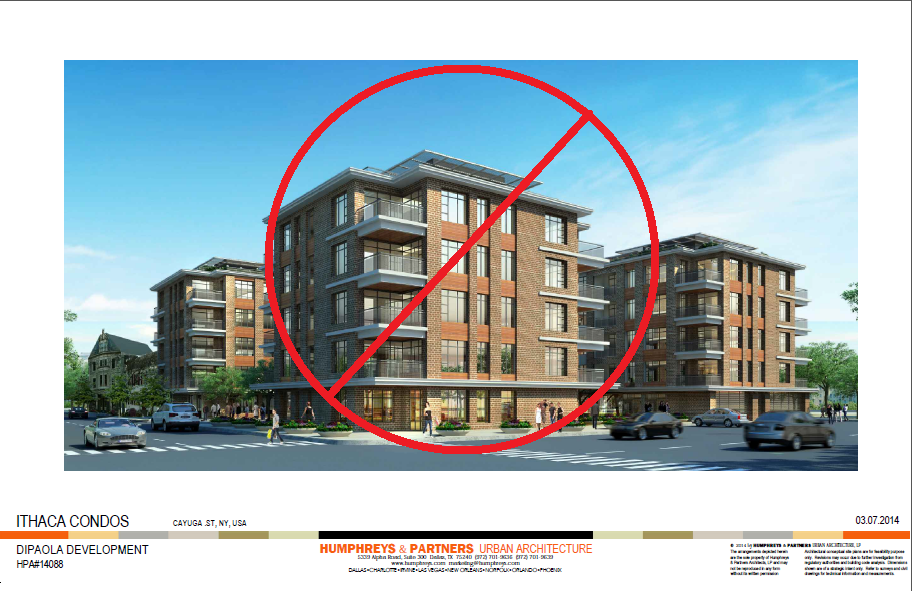
1. If my inbox has been any clue over this past week, there are some folks who are pretty unhappy with the results of the county’s Request for Proposals (RFP) for the Old Library site. One more applicant has dropped out of the process – DPI chose not to respond to the RFP. DPI had proposed 76 condos and 8 apartments for the site, a move that was cheered by some residents who spoke passionately about the new for purchasable housing in the city. That leaves three contenders of the original six:

-The Syracuse-based Franklin Properties project, now called the West Court Lofts and Wellness Collective, would renovate the existing building and include 22 residential condominium units (down from 32 units in the RFEI), medical offices, a café, and community room.

-The Rochester-based Cornerstone Group project, known as the Dewitt Senior Apartments, would build 63 residential units of senior housing (down from 70-80 units in the RFEI), and include community space for nutrition education by Cooperative Extension.

-The Ithaca-based Travis-Hyde Properties project would build 60 residential senior-focused units (up from 48 units in the RFEI), and would include space for Lifelong, professional office, and a community room.

There have been no renderings published as of yet, but there will be a stand-alone post when they show up on the county’s website. The three proposals will be judged against each other over the course of the next couple months. A quick glance at the judgement criteria can be found in the Old Library meeting notes here.

The next meeting of the Old Library committee is scheduled for Thursday, April 30th at 9 AM. 5 PM Meetings will be set up during May for developer presentations to the public. Comments on the proposal can be emailed to Ed Marx, the County Planning Commissioner, at emarx@tompkins-co.org with the subject title “Old Library Property”.

2. Local credit union CFCU (Cornell-Fingerlakes Credit Union) is making some moves by buying a retail commercial strip with an eye towards redevelopment. The property, 501-507 S. Meadow Street, sold for $1,555,550 on March 30th, well above its assessed value of $950,000. According to a statement taken by the Ithaca Journal, “the current intention is to ultimately use the site for credit union-related purposes”.

The one-story, 9,203 sq ft strip buildings date from 1980 and 1990 and previously housed a Thai restaurant and offices for Lama Real Estate, the business of previous owner Robert Lama. The site is currently zoned the suburb-friendly SW-2, but like much of big box land, it has been targeted for urban mixed-use in the city’s Comprehensive Plan. CFCU is currently headquartered in about 30,000 sq ft of office space in two 1990s office buildings at 1030 and 1050 Craft Road in Lansing.

In short, nothing immediate going on here, but definitely a property worth keeping an eye on.

texas_roadhouse__v2_1

3. The proposal for a Texas Roadhouse on in Southwest Ithaca is getting a couple minor revisions. According to a cover letter from the restaurant chain, plantings have been revised to break up the expanse of blank walls, handicap ramps are now present in the new elevations, and signage has been tweaked. All in all, not a big change from the previously-shown drawings. It doesn’t look like this one will have too many issues moving forward.

canopy_hampton_rev4_1

4. At the city’s Planning and Economic Development Committee (PEDC) meeting on the 8th, the city voted to approve the sale of land at 320-324 E. State Street to Lighthouse Hotels LLC for construction of the new Hilton Canopy Hotel. Also up for discussion was the removal of 30′ setbacks on all sides of the special MH-1 zoning at the Nate’s Floral Estates mobile home park on the west side of the city. With the 30′ rear yard setbacks already in place and vegetative buffers installed by the big boxes to the south, it was felt by the city economic developer planner that the additional setback was redundant. The removal would facilitate setbacks reduced to 10′ on one side and 5′ on the other side, if I’m reading this right. According to the notes, the mobile home park has a waiting list of tenants. The proposal looks like it will allow a few more units in the park, though it looks pretty tightly packed as-is.

flatiron_1

5. According to the Ithaca Urban Renewal Agency (IURA) notes from the April 2nd meeting agenda, the board was not impressed with the Flatiron proposal. On page 6, it gives the project low pritority, with the description “not feasible as presented“. On the other hand, the INHS Hancock Street project was well received and given high priority.

402_s_cayuga_st_rev2_1

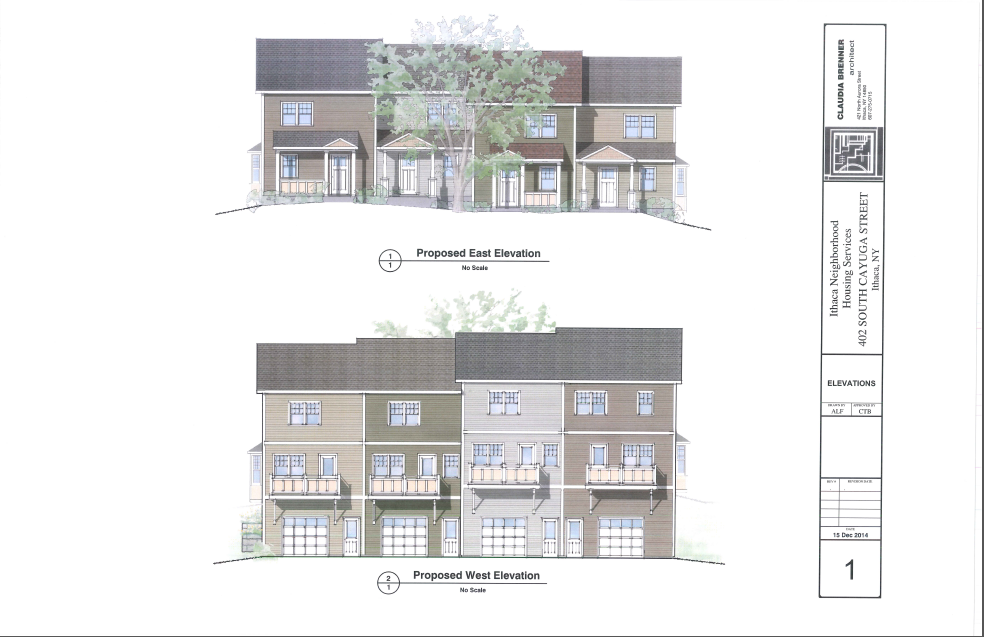
6. Looking at the March Planning and Development Board meeting minutes, 402 S. Cayuga Street has been approved, pending BZA approval of the variance (which was granted this week, if I have my notes right). The 4-unit, 9-bedroom project may be small, but it’s thoughtful infill and will help bring some affordable owner-occupied housing back into the city.

Approvals were also granted for the city project to replace the Lake Street this summer and fall, and refurbish the pocket park to its southeast. 210 Hancock was discussed without any voting, and sketch plans were presented for the TFC HQ downtown, and the 215 West Spencer Street apartment project, which have been written about previously. The board also discussed added additional questions to the CEQR (the city’s version of the SEQR used in project impact analysis), and the revised paperwork will be reviewed at a later meeting.

Oh, and on a more personal note, this totally made my day:

D. 2014 Planning Board Annual Report

[Senior city planner Lisa] Nicholas briefly walked through the annual report, observing it was a very busy year with a considerable number of additional housing units built. [Board member Garrick] Blalock asked if the annual report is publicized. Nicholas replied, no. Blalock replied it should at least be sent to the “Ithacating in Cornell Heights” and “IthacaBuilds” web sites. Nicholas agreed to do so.
I’ll be excited to have a copy. This would make scouting locations where construction photo updates are required a lot easier.

7. Wrapping this up with one final news piece, it looks like Dunkin’ Donuts is moving into the old Johnny O’s space at 406 College Avenue in Collegetown. So there will be one corporate coffee shop next to another corporate coffee shop and sharing a wall with a trendy fro-yo place. There’s probably a sociology thesis to be had in studying the changing retail scene of Collegetown.



707 East Seneca Street Construction Update 4/2015

10 04 2015

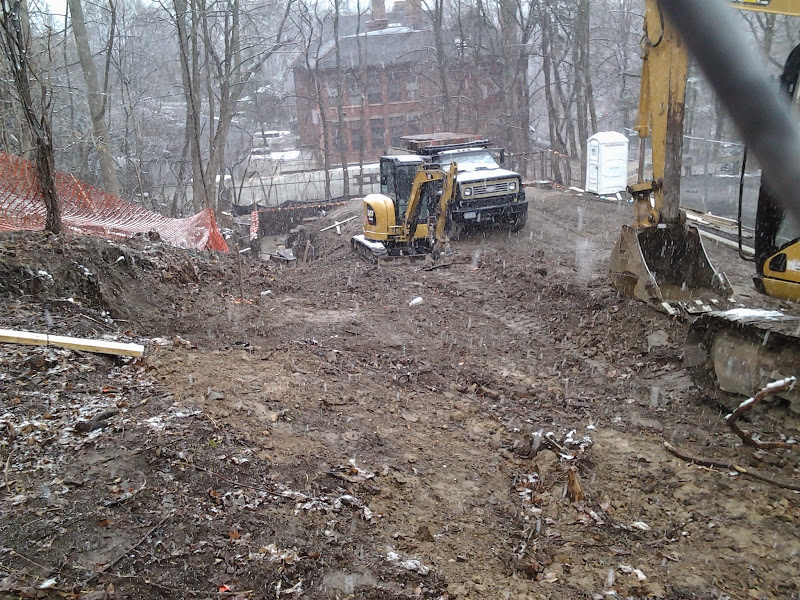
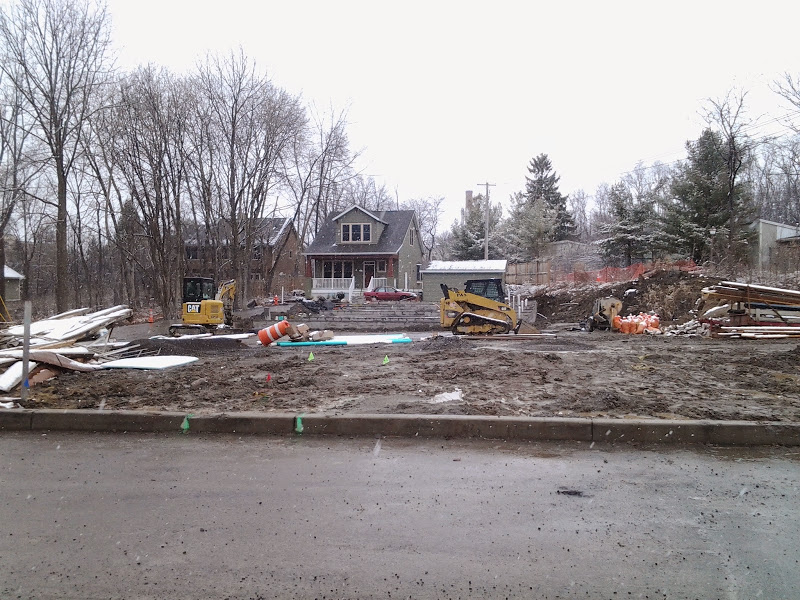
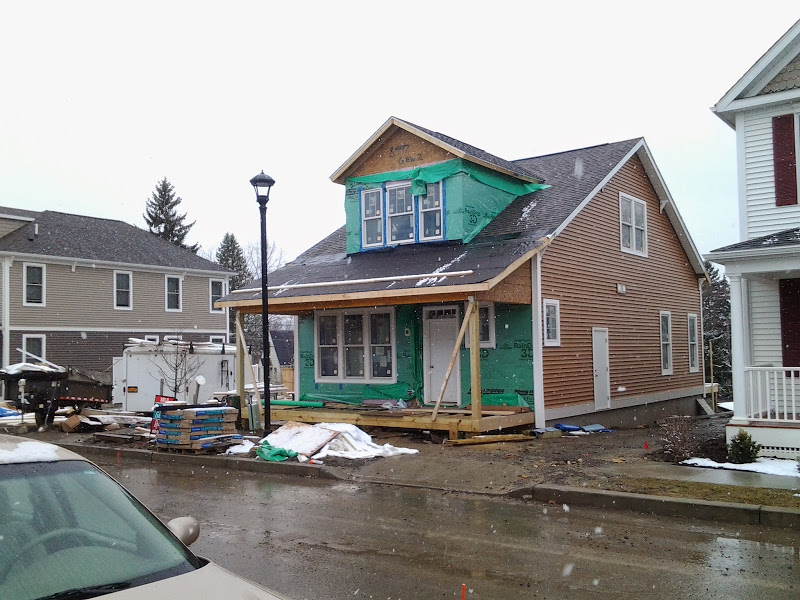
Another infill project is underway in the East Hill Historic District between Downtown and Collegetown. 707 East Seneca, like 202 Eddy Street and 140 College Avenue, had to go through the Ithaca Landmarks Preservation Council for approval, along with getting approval from the planning board and zoning board for an area variance (the lot was too small). After informational and voting meetings by different boards throughout the fall and winter, all the approvals have been granted.
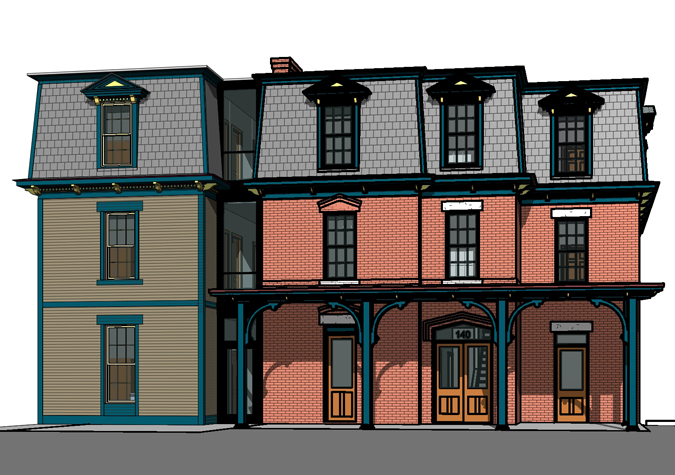
The ILPC-approved design is made to be compatible with the historic homes from the late 1800s and early 1900s that surround the building. 707 East Seneca was originally the playground area for the now-closed East Hill School, and the lot was given to the city in 1982. The property fell into disuse, and the playground into disrepair.  The city voted to put the lot up for sale through the Ithaca Urban Renewal Agency (IURA) last summer, and the lot was sold for $130,000 on December 22nd (the market asking price was $175,000, and the assessed value of the land is $100,000, so the final price looks pretty reasonable).

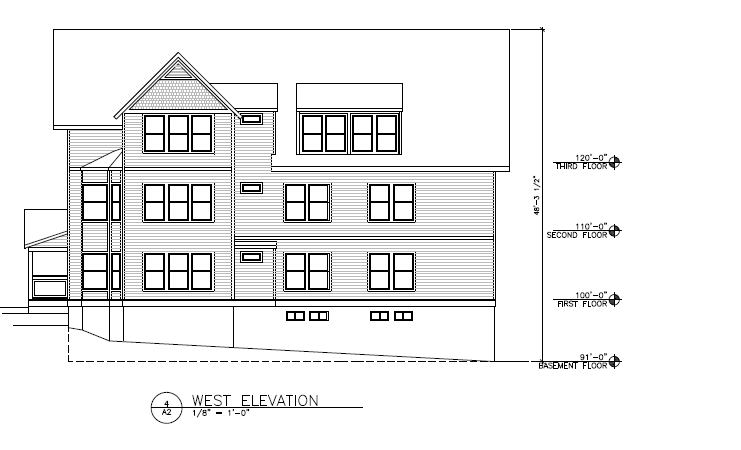
The apartment building planned is a 3-story, 6-unit, 18-bedroom structure with 4 garage parking units in a basement built into the hillside, and five surface parking spaces. According to documents filed with the city, target completion is July of 2015. Note for the included renders, the black-and-white image with the small basement windows is the final design, but the colors are the same as the lead rendering.

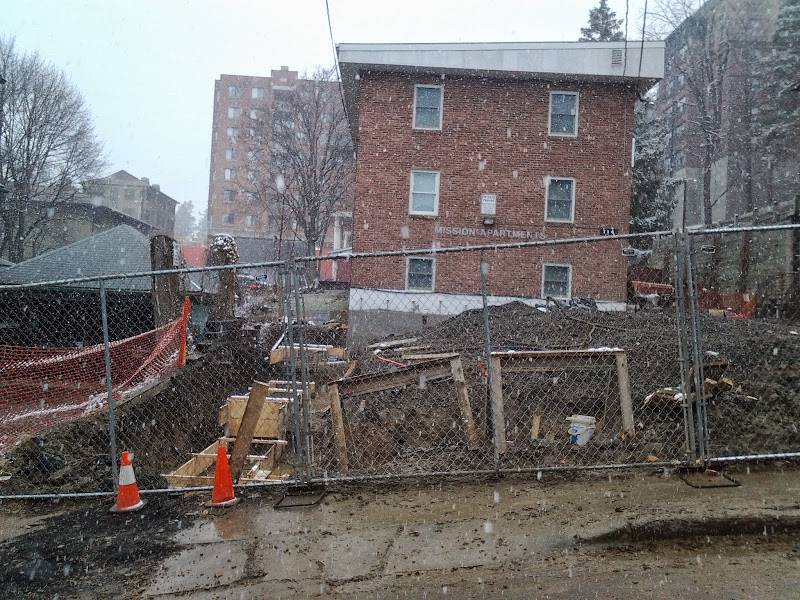
Without getting a good look at the back of the now fenced-off property, it looks like the site has been cleared and excavation is underway for the retaining walls and foundation. Being a sloped site, retaining walls will be built on the west edge of the property (right side of the photos) and for tree wells, and the east portion will use a sloped bank built using fill material. Offhand, I think I remember seeing that the building itself will be assembled from modular pieces, craned into place on the foundation over a day or two, not unlike the method used at the Belle Sherman Cottages.

The design of the building is by Schickel Architecture of Ithaca, and the developer is Ithacan Todd Fox.

20150405_131545 20150405_131553 20150405_131611

707_E_Seneca_2

707_E_Seneca_rev1_1


140 College Avenue Construction Update 4/2015

9 04 2015

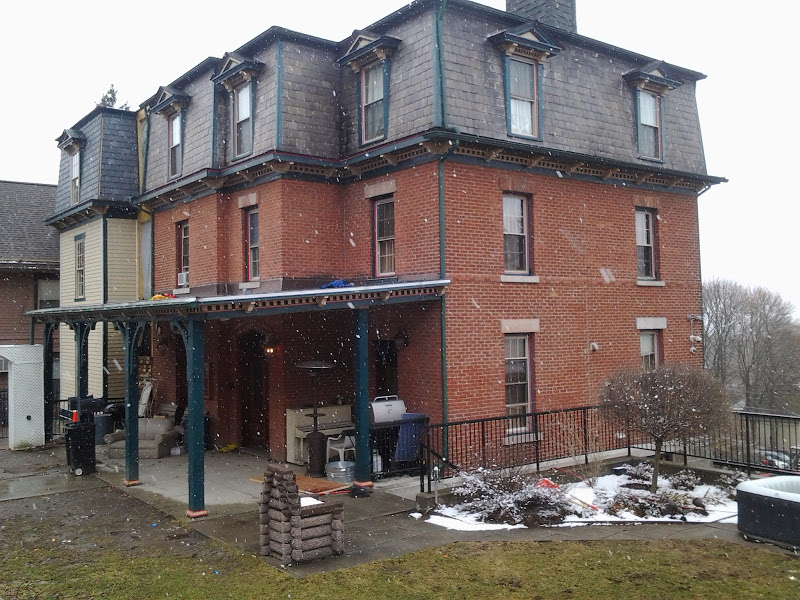
Just up the street from 114 Catherine and a couple blocks from 202 Eddy is 140 College Avenue, also known as the John Snaith House. Since last fall, work has been underway on a 3,800 sq ft, 12-bedroom addition to the 1874 structure.

John Snaith was an English builder, stone cutter and architect who came to Ithaca in 1869 to do work on Ezra Cornell’s Llenroc mansion (under construction at the time) and other buildings for the nascent university. Snaith lived in Ithaca for over a decade. He built the original Ithaca High School (destroyed by fire in 1912) and did work on the Sage Mansion, where he was fired by the ever-impatient Henry Sage.

After Snaith moved to Albany, the house was used as a boarding house, a B&B in the 1980s, and a private single-family home. The house was rented out to a landlady and her boarders when it was partially destroyed by fire in 1894. Snaith rebuilt the home shortly before his passing in 1896, but redesigned the top floor with mansard trusses and added dormer windows. Today, it’s student-oriented housing.

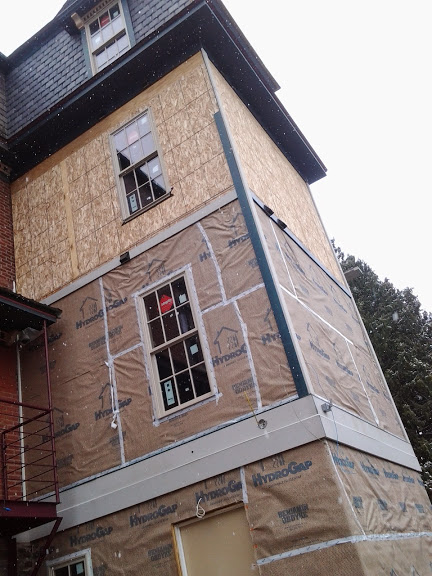
The addition is a sympathetic design approved by the Ithaca Landmarks Preservation Council (the house was designated a historic structure in 2011), separated from the original house by a glass “hyphen” connector. In the photos below, lap siding has been installed on the street-facing east wall, and uncovered plywood and house wrap can be seen in the rear. The slight variation in the mansard roof tiles are a nice touch. Windows have been installed, and I’d venture a guess that interior framing is complete and rough-in (plumbing, electrical) is underway in the addition.

The project is designed by local architect Jason Demarest and developed by Po Family Realty, a smaller Collegetown landlord.

None of the larger projects in Collegetown are underway just yet, but that will likely change when their current tenants’ leases are done June 1st. The following year or so should be very hectic in the neighborhood, with 307 College (96 beds), 327 Eddy (64 beds) and 205 Dryden (40 beds) all expected to start this summer, and Collegetown Terrace expected to start construction of its 300+ bed phase III this year. A quick check of the neighborhood showed that construction has not yet started on two other small projects, the 6-bedroom duplex planned behind 424 Dryden and the 18-bed 3-building project at 804 E. State Street.

20150405_124856 20150405_124921 20150405_124939 20150405_124953 20150405_124841

140College_2


114 Catherine Street Construction Update 4/2015

8 04 2015

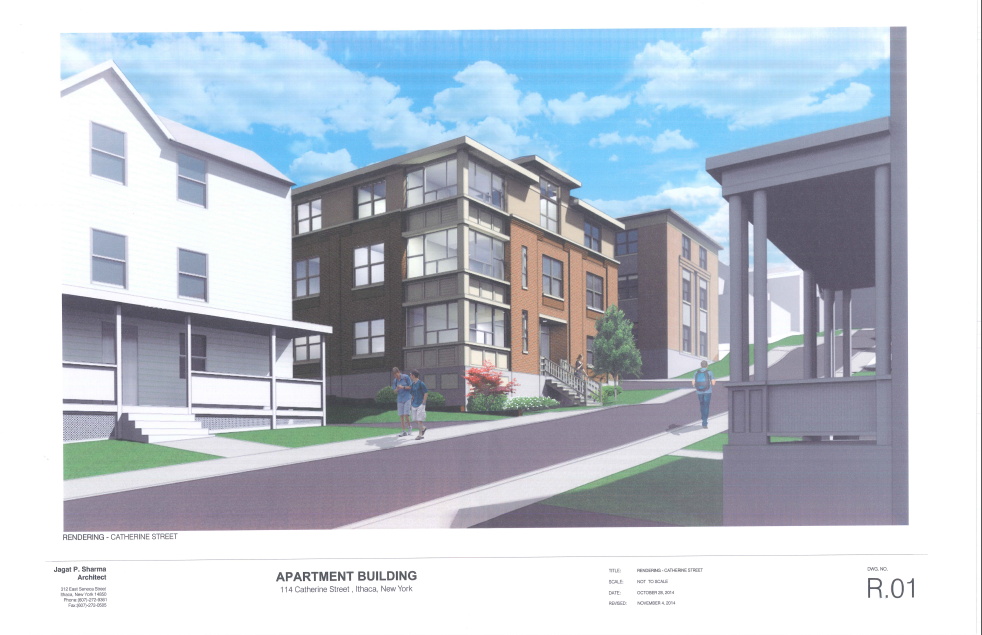
Work has commenced on the foundation for the new 3-unit, 17 bedroom apartment building at 114 Catherine Street in Collegetown. Plans were approved by the city of Ithaca late last year, and with the worst of winter over (though snow in early April definitely makes one second guess that), construction has been able to proceed on the new building.
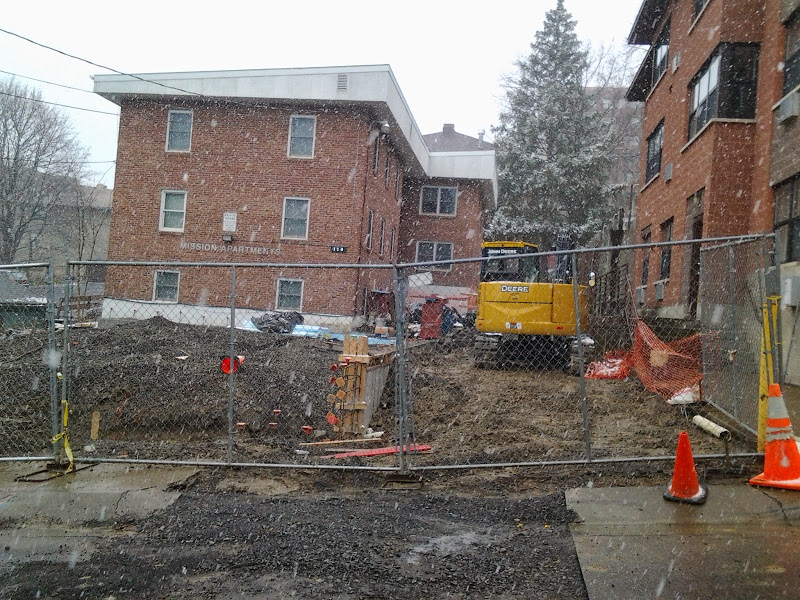
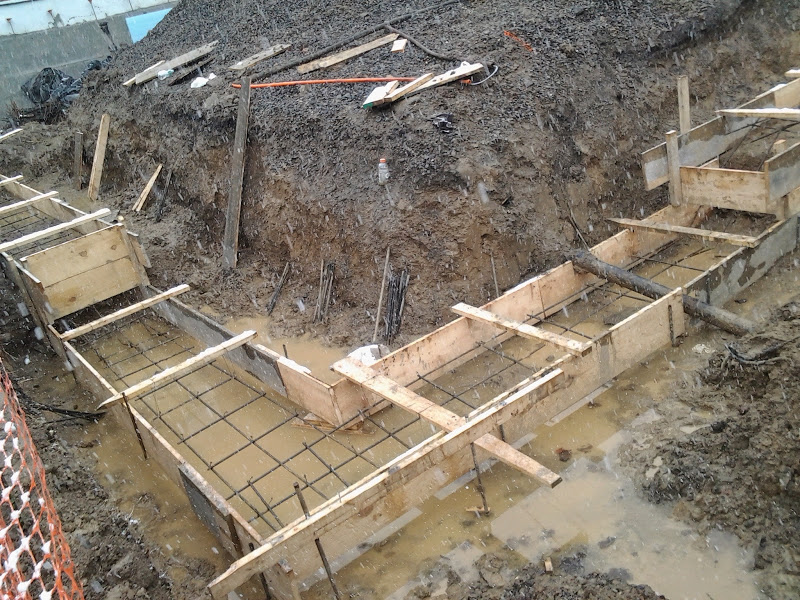
The parking lot that once fronted the street is gone. Wooden forms are in place for holding the concrete once it is poured, and rebar criss-crosses the space between the forms. Rebar is used to strengthen and reinforce concrete, the concrete bonds with the steel bars as it hardens. It looks like the east wall of the foundation has already been poured. A blue waterproof membrane can be seen on the concrete in the last photo.

The architect is a Collegetown favorite, local architectural firm Jagat Sharma. The building is being developed by Nick Lambrou of Lambrou Real Estate. Plans call for a 3-story, 4,180 sq ft structure with a 5-bedroom apartment on the first floor and a 6-bedroom apartment on the second floor and on the third floor. If construction stays to schedule, the building should be completed by August in time for the fall semester.

20150405_130821 20150405_130835 20150405_130845 20150405_130853

114_catherine_rev4_1


202 Eddy Street Construction Update 4/2015

7 04 2015

20150405_125117 20150405_125151 20150405_125203

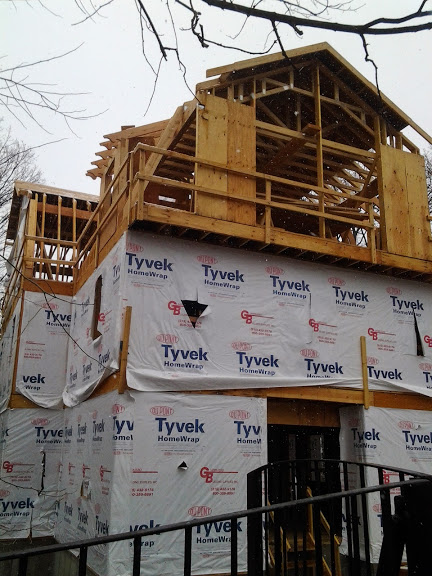
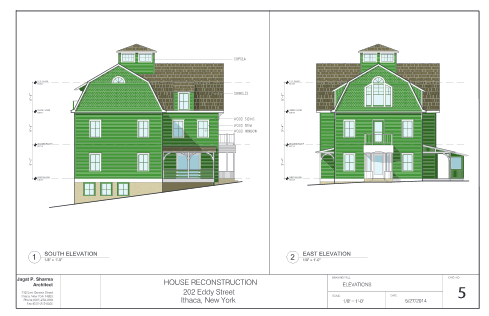
After being destroyed by a fire last March, reconstruction is underway at the site of 202 Eddy Street in Collegetown. Following the disaster, developer Nick Lambrou vowed to rebuild on the site. Being a part of the East Hill Historic District, any new structure needed to be approved by the Ithaca Landmarks Preservation Council. After thorough review, the ILPC approved plans for a new 12-bedroom apartment building that completely replaces the fire-damaged building.
The new structure is a faithful interpretation of the original building, though it’s not an exact copy. An entrance door was repositioned, exterior emergency stairs will be internalized, and a chimney will not be rebuilt, but otherwise, its a close approximation of the original 19th century home. The architect is Ithaca-based Jagat Sharma, who has previous experience from the reconstruction of Sigma Pi’s house when it burnt down in 1995.

In these photos from last Sunday, the concrete foundation has been poured, and the first two floors are framed with plywood and covered in Tyvek house wrap to keep out moisture. Rough framing is underway on the top floor and cupola, and the mansard roof trusses are complete but the roof itself is still in progress. Rough openings in the walls indicate future window locations, although some spots are not as obvious since they’re covered by the house wrap.

Plans call for the new building to be completed and ready for occupancy by August, in time for the fall 2015 semester.

202_eddy


Apartments Planned for 215-221 W. Spencer Street

6 04 2015

I owe a big thanks to Charles Pyott with the city of Ithaca for getting a copy of the sketch plans for 215 West Spencer. I had initially thought nothing was presented at the March Planning Board meeting, but the March PDB meeting minutes said otherwise. I made an inquiry, and he was able to obtain a copy of the sketch plan from the applicant. So a big kudos to you Charles.

A copy has been uploaded to the City of Ithaca website here.

***

215-221_spencer_v1_2

At its March meeting, the city planning board reviewed a sketch plan for a proposed apartment building at 215-221 West Spencer Street, just south of Six Mile Creek and a few blocks from downtown Ithaca.

The steeply-sloped 0.47 acre parcel has been vacant for several years, and currently sees use as an informal 12-space parking lot. The lot is in a R-3a residential zone that allows for a 40′ structure with 35% lot coverage.

Previously, a dilapidated apartment building stood on the site. The building and land were purchased by the city for $530,000 in 2003, and sometime after the building was demolished, the land was turned over to the Ithaca Urban Renewal Agency in 2013.

The property was originally marketed for affordable housing projects only, but received no purchase bids. Once the affordable stipulation was removed, the parcel was marketed once again, and found a buyer – local developer Edward Cope, the owner of local rental agency PPM Homes, bought the parcel for $110,000 on March 6th.

215-221_spencer_v1_1

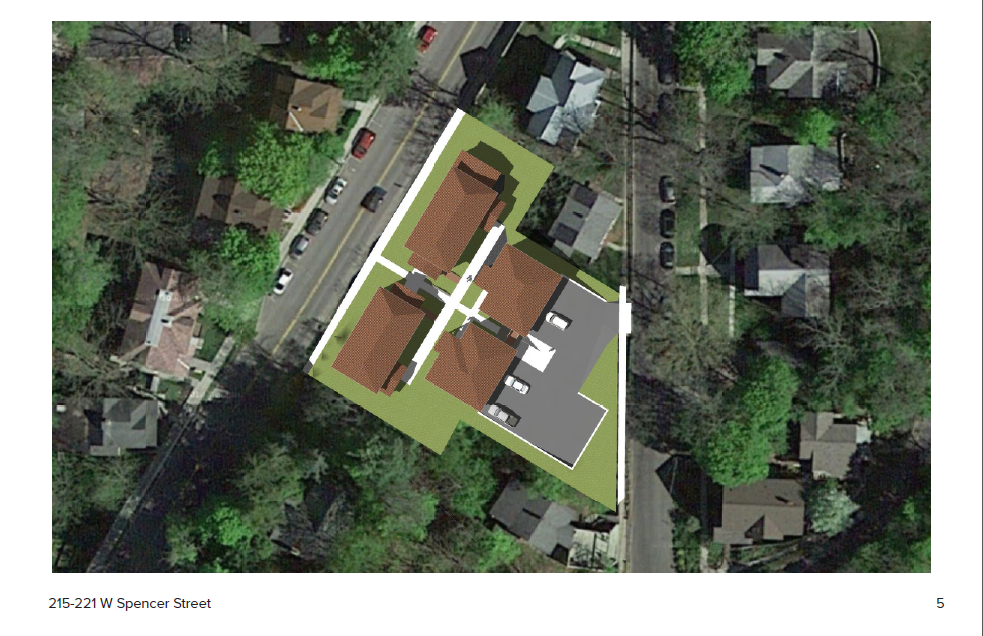
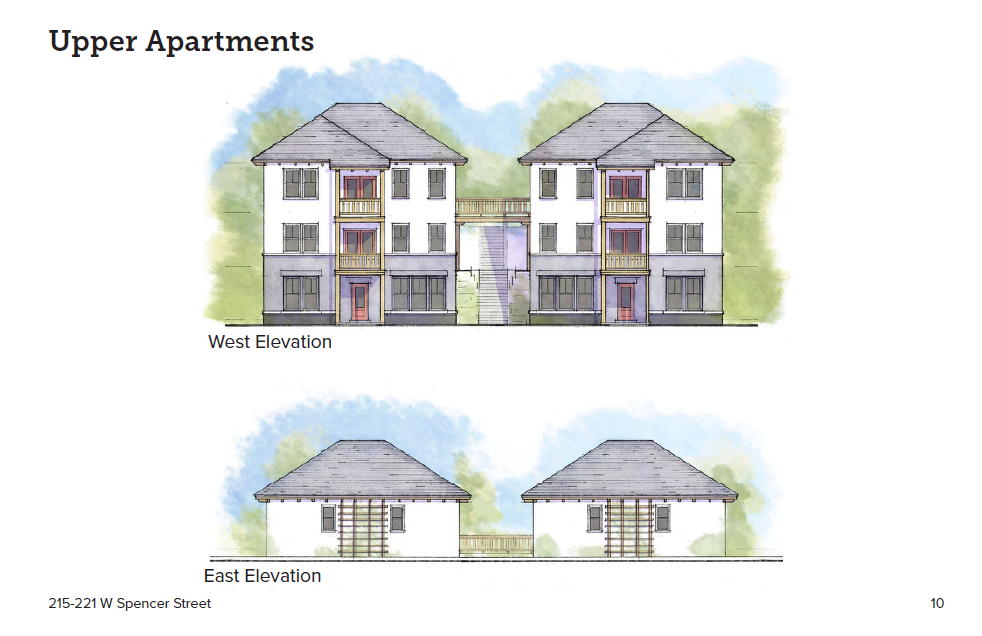
In the sketch plan presented by local architect Noah Demarest of STREAM Collaborative, four apartment buildings are presented in a terraced hillside layout, all connecting to a staircase that bisects the north and south buildings. The upper buildings have three floors of windows on the west side, and one floor on the east side. The lower buildings have three floors of windows on the west side, and two floors on the east side.

215-221_spencer_v1_3

According to the Planning Board minutes, each building consists of a ground floor unit and “two side-by-side townhomes above it” – it’s not clear if that means two units per floor, or two units total on the upper floors. It could be 20 units or 12 units, pending clarification. The 12 parking spaces on the Cayuga Street side of the property would be maintained and paved.

215-221_spencer_v1_4

215-221_spencer_v1_5

In the sketch plan document, two versions are presented – the aerial renderings show a different design than the site elevations. It’s not clear which is the current iteration, though the site sections show much greater detail (I suspect they are the more accurate of the two).


215-221_spencer_v1_6

Expect some revisions moving forward – planning board members expressed a desire for a more prominent connection between Spencer and Cayuga Streets (a “grand formal stairway”) and reworking the Spencer Street facade to make it more visually interesting.


News Tidbits 4/4/15: And They Called It “PlanIthaca”

4 04 2015

cayugaplace_v5

1. According to Ithaca Builds and those on a VIP list-serve, the Lofts @ Six Mile Creek have released tentative rental prices. $1,220/month for a studio to $2,655/month for a top-notch 2 bedroom. Using the affordability rule (30% of monthly income), one gets $48,800-$106,200 year – given the median income in Tompkins County of just over $53,000/yr, these prices could be described as upper-middle tier. I can already hear the grumbling from commenters on the Ithaca Voice if a construction update gets posted.

The 45 units are set to be completed this summer, but those looking to take a sneak peek can sign up for an April 18th tour of the building, courtesy of the Downtown Ithaca Alliance.

inhs_pride_design_v2_1

2. Here’s an updated aerial site rendering of INHS’s 210 Hancock redevelopment. The changes to the affordable housing proposal are largely in site landscaping and layout, the biggest changes being the closure Lake Avenue and moving the playground (which is not rendered in the aerial). Traffic studies, stormwater management plans, and parking studies can be found here (it turns out that compared to the old supermarket, there will be slightly more AM traffic, and a lot less PM traffic), revised site layout here, and about 18 other documents in the April site plan review planning board directory on the city’s website. 210 Hancock will be undergoing review by the city Planning and Development Board at their April meeting.

gways_rev_3

greenways3

greenways1_final

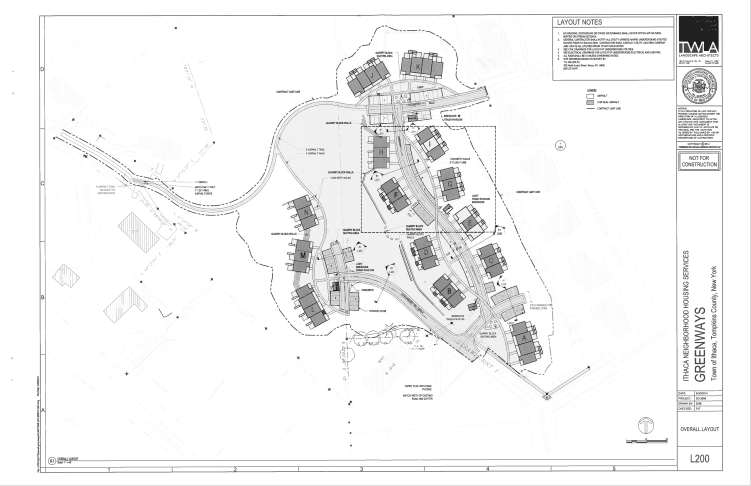
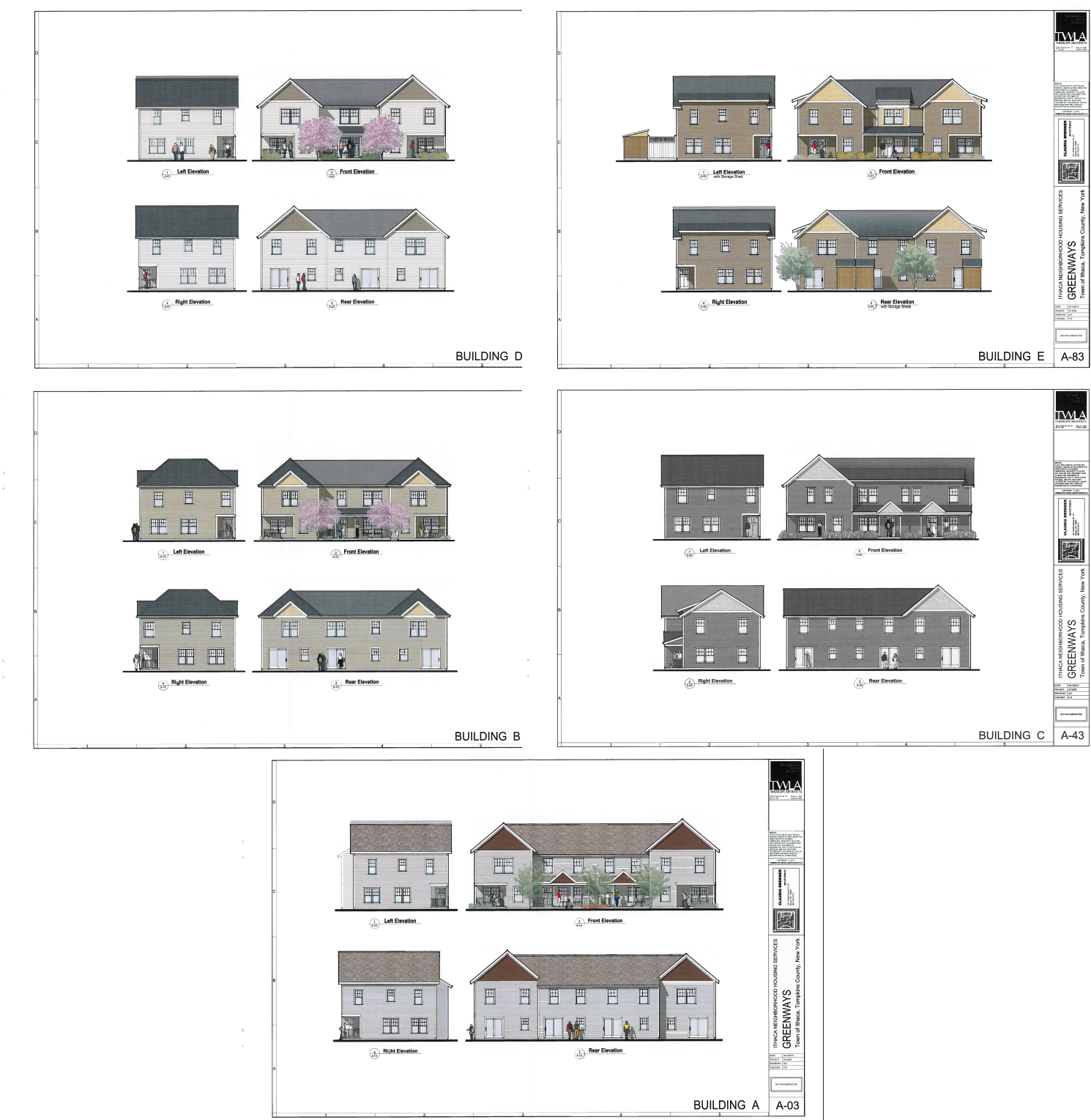
3. Turning to another INHS project, the Greenways development is going for final approval with the town of Ithaca’s Planning Board next Tuesday. The full suite of documents can be found here. The designs above, for buildings A, B, C, D, and E in Phase I, are very nearly final, though Building C looks like it was accidentally uploaded in grey-scale. B-E will have three units each, 2 2-bedroom (1,100 sq ft) and 1 3-bedroom (1,300 sq ft). Building A will have 2 2-bedroom and 2 3-bedroom units. In sum, Phase I has 16 units and 38 bedrooms. Assuming the other units are the same configuration, the final product will have 46 units and 110 bedrooms. Build-out could take 6-8 years according to the docs, and Building K in Phase II interferes with 0.09 acres of wetland, which the Army Corps of engineers requires to be filled in before development (wetlands under 0.1 acres and not contiguous with any other wetland can be filled in without need of replacement).

The designs are by local architect Claudia Brenner. The floorplans are designed with nearly identical layouts to save money, but the varied use of exterior architectural details and colors does a nice job of giving each building a unique appearance.

Readers might recall that these for-sale owner-occupied units are being developed for the affordable housing segment (individuals/families with incomes of $38k-$57k), and that Cornell is giving INHS the property for below market price on the condition that Cornell employees that fall into the income restraints have first dibs on the units as they hit the market. The property also makes use of “woonerfs“, so-called living streets that are shared by bikers, pedestrians and vehicles, and typically have a speed limit of no more than 10-12 MPH.

ith_big_plan_map_v2

4. The city of Ithaca’s draft Comprehensive Plan is now online. The 66-page draft, called “PlanIthaca”, can be looked at here, and the proposed land use map here. Over the past year, the Comprehensive Plan Committee has been busy fleshing out the original 16-page draft document to the full-fledged PlanIthaca document above. The city will be hosting a series of open houses throughout the city during April for interested parties to look through the plan and comment, with the first open house on Monday April 13th from 3:30-5 PM at St. Luke’s in Collegetown. Comments can also be submitted by email to city planner Megan Wilson at mwilson@cityofithaca.org.
I’ll probably expand on the plan in a future post, but readers of the blog won’t be surprised by anything it says. The map appears to be lacking the neighborhood mixed-use zoning, which from reading the plan appears to be an accident. Otherwise it’s the exact same map from last spring’s write-up.  There’s a couple of interesting concepts that will be explored as things move forward beyond the plan – ideas such as city-wide form-based zoning and a transfer of development rights between properties would make for a large departure from current policies.

tfc_1

5. If you’re looking for a little more light weekend reading, feel free to check out the double feature article on the Tompkins Financial HQ plans running the weekend on the Ithaca Voice. Summing up a few salient details here, the total project will cost $26.5 million, add 77 new jobs downtown over the next decade, and run from about June 2015 to January or February 2017. The new headquarters will be about 110,000 square feet in size, 7 stories and 100 feet tall, the maximum allowed by zoning. The first floor will have a 6,600 square foot (66 feet x 100 feet) bank branch, with parking for 20-25 cars behind the first floor and under the overhanging upper floors. A basement floor will also add 6,600 sq ft of space, and floors 2-7 will have 16,300 square feet each. Across the street at 119 East Seneca Street, a new drive-thru will be built underneath the existing building, consisting of revised drive-thru lanes, surface parking, an ATM and a 985 square foot teller building.


Fast Facts: Cornell Enrollment Figures, Part II

31 03 2015

Part I in September 2013 looked at enrollment from 2002-2012. This time, it’s a look over the whole 150 year history of Cornell.

The information and plots included here come courtesy of the Institutional Research and Planning unit at Cornell University, the same unit that maintains the Cornell University Factbook.

cornell_enrollment_1

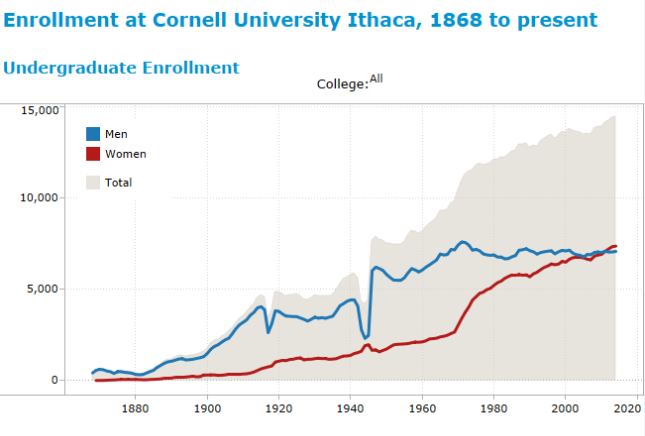
As of Fall 2014, Cornell University enrolled 21,850 students at its Ithaca campus, the latest statistic on the rapid increase in student population since 2005, when the total student population was 19,447.  Many of the ups and downs in the 150 years or Cornell are easy enough to qualify – drops in male enrollment as students went off to fight in World War I and World War II, the Post-WWII GI Bill bringing an enormous increase in enrollment. Then there’s a leveling off in enrollment during the 1970s due to financial constraints, and the rapid rise of women in college starting in the late 1960s, as more and more women sought out education and careers.

Early on, a decline can be seen in enrollment, from 561 in 1876-77 to a low of 384 students in 1881-82. According to Morris Bishop in A History of Cornell, “Various reasons were given for the dwindling enrollment: hard times, increased tuition, stiffened entrance exams, coeducation, Cornell’s reputation for religion. Probably each of these reasons was valid in certain cases (p. 201).” The absence of university president A. D. White while he served as the U.S. Ambassador to Germany from 1879-1881 didn’t help matters. Thankfully for the university’s finances, enrollment rebound and morale increased after White returned.
cornell_enrollment_2_ug

More notably, starting around fall 2011, the number of women enrolled as undergrads exceeded the number of men, the first time ever in Cornell’s history. This reflects national trends – women are now the majority of matriculated students in all self-identifying groups.

cornell_enrollment_3_grad

Perhaps in part due to large increases in research spending in the 1950s and 1960s, grad students more than doubled in population in fifteen years, increasing from 1,528 in 1950 to 3,149 in 1965. The growth since 2000 isn’t as dramatic, but nearly as large in number – 3,918 in 2000 to 5,140 in 2014. The drop off in the 1990s can be attributed to “cuts in federal aid to higher education, especially R1 type institutions”, according to Ithaca College Economics professor Elia Kacapyr.

cornell_enrollment_4_law

Taking a quick look at the law school’s enrollment numbers, there was a tremendous spike in enrollment after World War II, thanks to the GI Bill – 460 students in 1950, more than doubling the 201 reported in 1939. 78 percent of law students in 1950 hailed from other institutions for their undergraduate degrees (Morris Bishop’s A History of Cornell, p. 575). During WWII, the law school accelerated its degree program by a year (Bishop 547), which might explain why the drop was more severe than in other programs. A mere 49 students were enrolled in the law school in Fall 1943.

More recently, Cornell had a spike in law school enrollment, as part of a larger boom in law school education during the recession. The law school went from 583 students in 2008 to 689 in 2009, a remarkable amount of growth for one year. Law school looked like a ticket to a six-figure job during the recession, but after a couple of years of horror stories of law students unable to find high-paying jobs to match their high debts, applications have decreased nationwide and the enrollment numbers at Cornell have eased down just a little bit, to 668. The shrinkdown isn’t nearly as bad as some other schools, however.

cornell_enrollment_5_mba

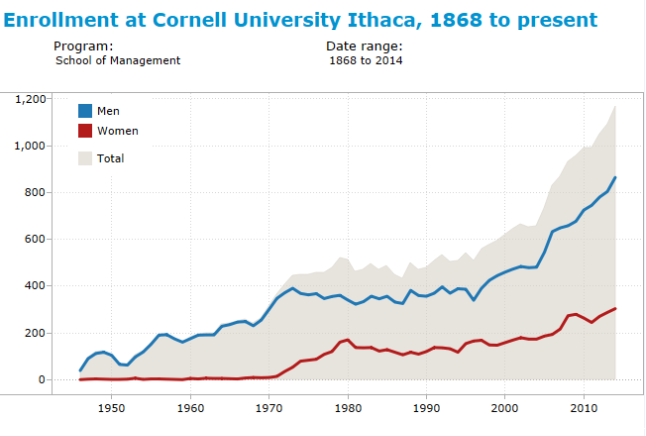
On the other hand, it now seems like MBAs are the go-to for that six-figure job, with a large boost in matriculants nationwide. Whether or not B-school grads have a law school-like meltdown has yet to be seen, but there’s no doubt that MBA student enrollment is growing by tremendous leaps and bounds Far Above Cayuga – the Johnson School of Management has grown from 655 students in 2004 to 1,168 in 2014.

One thing that stands out is that from 1947 (when the business school began teaching students) to 1969, there had never been more than 4 women enrolled at any one time.

cornell_enrollment_6_dvm

Lastly, the Vet School. Morris Bishop has an enlightening anecdote to share about applying to the school in the Post-War era:

“The Veterinary College was distressed by its popularity. The upsurge of interest in the scientific study of animal life and disease overwhelmed the country’s ten veterinary colleges. By 1947 we had 750 applications for entrance, or fifteen for every place. Since our first duty was to New York State boys, out-of-state applicants had one chance in forty of admission. The same situation prevailed elsewhere; a boy who lived in a state without a veterinary school had practically no chance of entering the field. The need led to the creation of a number of new schools, and the pressure upon Cornell gradually eased.” (Bishop 576)

Starting in 1980, women exceeded enrollment of men at the Vet School – today, the breakdown is about 75-25 in favor of women. I have had several vet school friends say that to be a single straight male in the Vet School makes one a very hot commodity. Cornell can expect to see increases in enrollment in the next few years, as part of its plan to enroll 120 in each class (480 total, up from the current 421) by 2017.


News Tidbits 3/28/15: It’s Affordable Housing Week

28 03 2015

The unplanned theme of the week: affordable housing projects.

1. This week and next, the Ithaca Urban Renewal Agency will be holding public hearings as part of the process to determine who will receive money from the Housing and Urban Development (HUD) grants awarded to the city. The 21 applicants ranges from jobs training to community services to the development of affordable housing. In total, $1.78 million has been requested, and there’s $1.215 million available, just a little over two-thirds of the total requested.

Without discounting the value of the other applications, the focus here will be on the real estate development projects. For the record, writing about a project is neither an endorsement or opposition from this blog.

inhs_pride_design_3

A. INHS is requesting $457,326 dollars for its 210 Hancock Street redevelopment project (also known as the Neighborhood Pride site). The total cost of the project as stated in the application is now up to $17.3 million. The application only applies to the apartment buildings, not the townhouses. The townhouses and apartments are going to be subdivided into separate parcels, because certain affordable housing funds are targeted towards renters and others towards homeowners. Subdividing the Neighborhood Pride parcel into the apartment and owner-occupied parcels will make for a smoother application process, and they’ll be separate projects within the larger framework of the 210 Hancock property.

210 Hancock will have 53 apartments – the 3 bedrooms have been eliminated and split into 1 and 2 bedroom units, so the number of units has gone up but the total number of bedrooms remains the same (64). The units are targeted towards renters making 48-80% of annual median income (AMI). The AMI given is $59,150 for a one-bedroom and $71,000 for a two-bedroom. The one-bedroom units will be rent for $700-1,000/month to those making $29,600-$41,600, and the two-bedroom units will rent for $835-$1300/month to individuals making $34,720-$53,720. Three of the units will be fully handicap adapted.

One of the commercial spaces will be occupied by local social welfare non-profit Tompkins Community Action for use in an early head-start program for approximately 30 children from lower-income households. The other two spaces have strong interest but do not have tenants lined up yet.

flatiron_1

B. This second project is something new. Alpern & Milton LLC (local buisnessman Ishka Alpern and his brother, Franklin Milton) are requesting $250,000 towards a $1,285,000, 12-unit project proposed for Inlet Island called “The Flatiron”. The project seeks a renovation of 4,900 sq ft at 910 W. State/MLK Street (shown above) and a 3,700 sq ft addition onto the neighboring parcel at 912 W. State/MLK. The finished project will resemble the triangular form of the famous Flatiron Building in NYC. the application says “the project will be of a historic nature, but the structure being proposed is not currently, nor will it be, deemed ‘historic’ in terms of housing or building code”. Ten of the units will be available to 30-50% AMI, and the other two will be available to those making 50-80% AMI.

The brothers do have some small projects to their credit, according to the filed paperwork. They handled the renovation of Brookton’s Market and 514-516 W. State/MLK Street. Judging from the google maps dating back to 2012, some renovations have already been done to 910 W. State.

2. In this week’s Journal, there was an article that gave a rundown of recipients of the Tompkins County Affordable Housing fund paid for by a combination of the city of Ithaca, Tompkins County and Cornell. Most of them I recognized – Holly Creek, the Habitat for Humanity duplexes in Groton and Trumansburg, Breckenridge Place and so on.

There was one I didn’t recognize. The Amici House proposal, which is being planned by Tompkins Community Action. I vaguely remember coming across this during the Stone Quarry debate last year, but at the time I couldn’t even verify if it was a real proposal. TCAction is proposing to build approximately 15 units affordable townhouses at 661-665 Spencer Road, just east of the Salvation Army store. There haven’t been any formal plans presented yet, but the project did receive $75,000 from the fund to pay for a pre-development feasibility study.

Farm Pond Site RES'D & LOT s 010414

3. Like single-family home development? Have lots of extra money lying around? The second phase of Lansing’s 21-lot Farm Pond Circle development is up for sale. Jack Jensen, the original developer, passed away last fall. Of the ten lots in phase two, four have already been reserved; there are also two lots left in phase one. The second phase is being offered for $155,000.

The Farm Pond Circle development is fairly stringent. Current deed restrictions limit the size of each housing unit to 2600 sq ft, vinyl or aluminum siding isn’t allowed, and only very specific subsections of the lots can be developed. Buyers aren’t limited to green energy, but there is a strong push in that direction. Also, at least four of the lots are earmarked for affordable housing (single-family or duplexes, buyers muse make  less than 80% of median county income of $53k)). The affordable units, at least two of which have already been built, are being developed in partnership with Jack Jensen’s non-profit, Community Building Works!.

4. It’s back again. The county’s Old Library committee will be meeting next Friday the 3rd at 9 AM in the legislature chambers. The goal of this meeting will be to review the formal proposals received for the Old Library site, which is likely the same four remaining from the RFEI, but in theory it could one or a hundred. Whereas the RFEI submissions were general, the proposals get into the nitty-gritty – site plan, architectural details, funding, time frame, proponents, all of it. Expect revisions to the previous four designs as a result of commentary from the public and legislators.

Since most folks can’t make Friday meetings, if anyone has general comments, conflicts or concerns about the proposals, I’ll just leave the committee’s contact info here: Legislature@tompkins-co.org. Use “Old Library” as the subject.