Belle Sherman Cottage Construction Update, 10/2015

15 10 2015

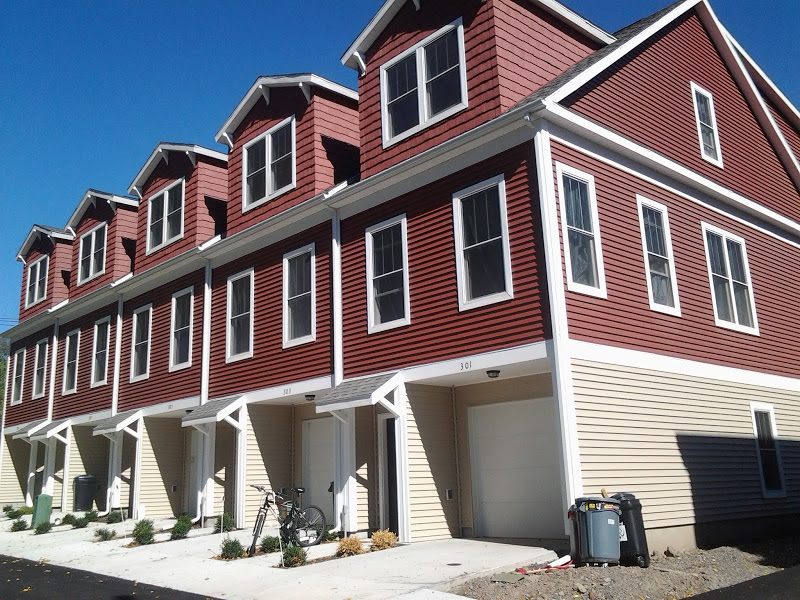
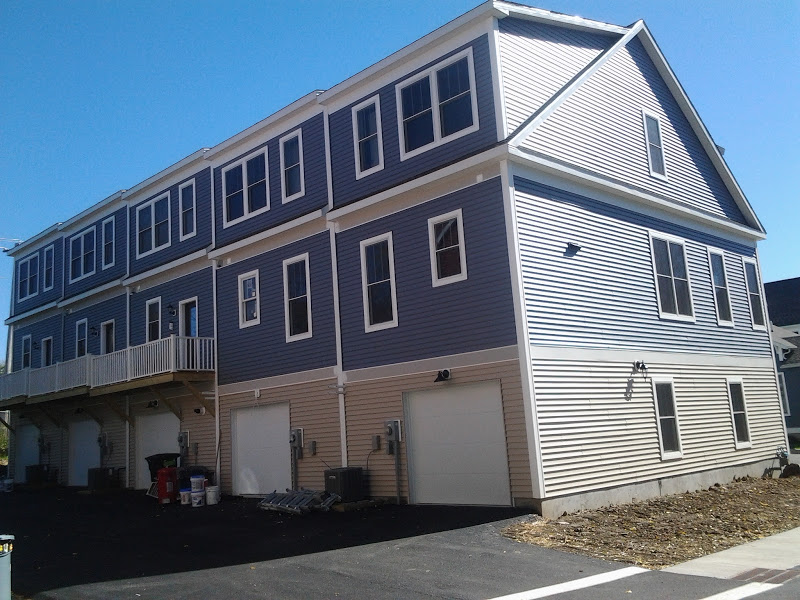
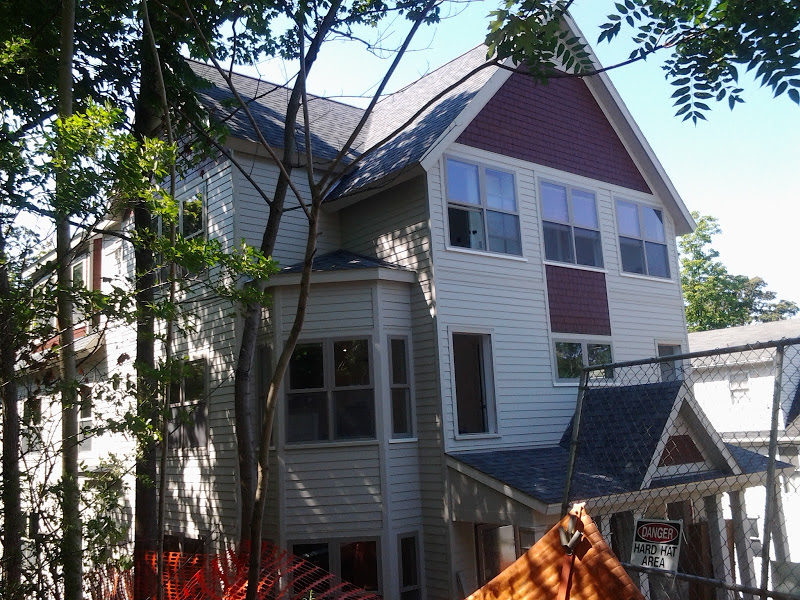
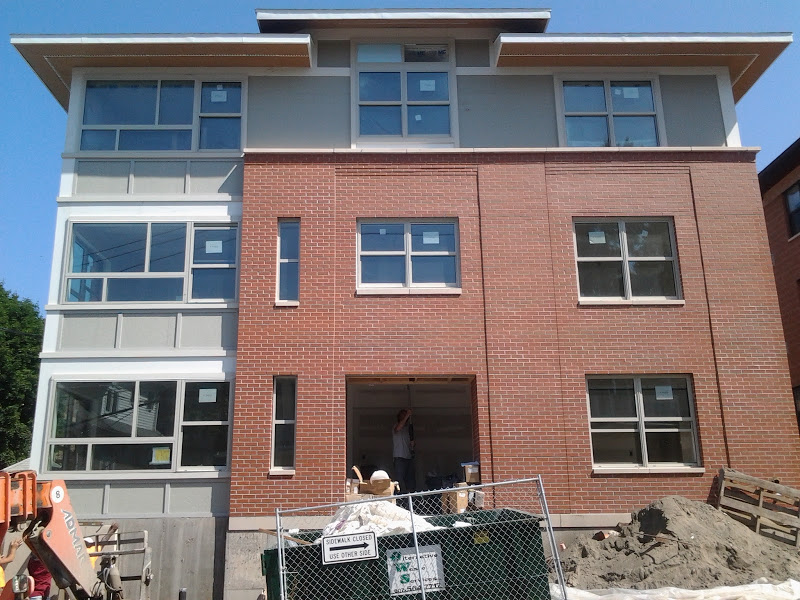
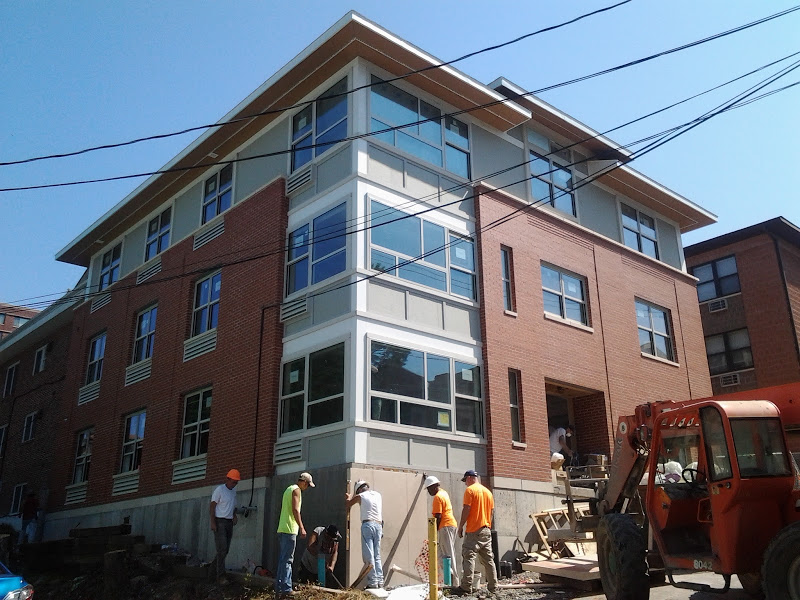
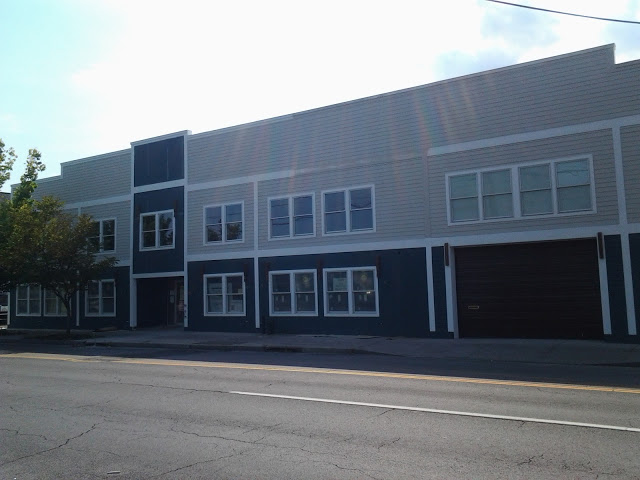
There’s not a whole lot left to say from a construction standpoint for the Belle Sherman Cottages project, located off of the 800 block of Mitchell Street. The townhouses are essentially complete, all that’s left is some landscaping and interior finishing-out. The Simplex modular pieces for the second set of five townhouses arrived on-site in mid-August, two for each townhouse unit. The pieces are then leveled and fitted together with steel plates, and then customized interior work begins for things like fixtures and flooring. On the outside, the foundation is backfilled, siding is attached, decks are built if the buyer chose to have one, and the landscaping is planted. The straw helps to keep the grass seed warm and moist so it can germinate, and it reduces the chance that wind will blow it away.

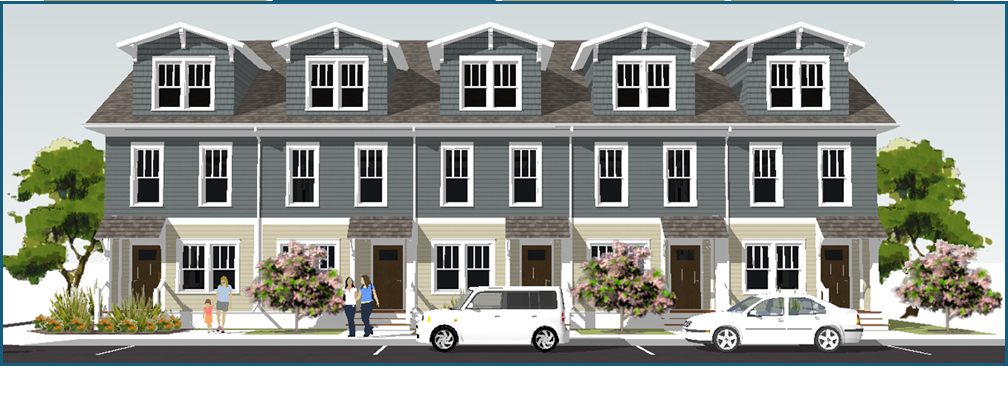
One difference from the computer rendering is that the render has all five townhouses at the same elevation. However, they’re actually staggered slightly, with the elevation dropping a few inches per unit as one moves from east to west. The same staggering effect was used on the first set of townhouses as well, with each unit dropping a few inches in elevation from north to south.

So, from start to finish, this was about…3.5 years? That’s not counting Lot 9, which doesn’t seem likely to happen anytime soon. Most of the new home construction was concentrated in just the past year and half – sales were slow at first, but they took off in early 2014.

The Belle Sherman Cottages project was developed by Agora Development of Skaneateles, and built by Carina Construction of Ithaca. Overall site design was penned by Ithaca-based STREAM Collaborative. The Simplex units were sourced from the company’s facility in Scranton, PA. A video of the construction process can be found on Carina’s Youtube account here.

20151011_134134 20151011_134147 20151011_134221 20151011_134235 20151011_134255 20151011_134324 20151011_134339 20151011_134402

belle_sherman_townhouses_1


Upson Hall Construction Update, 10/2015

12 10 2015

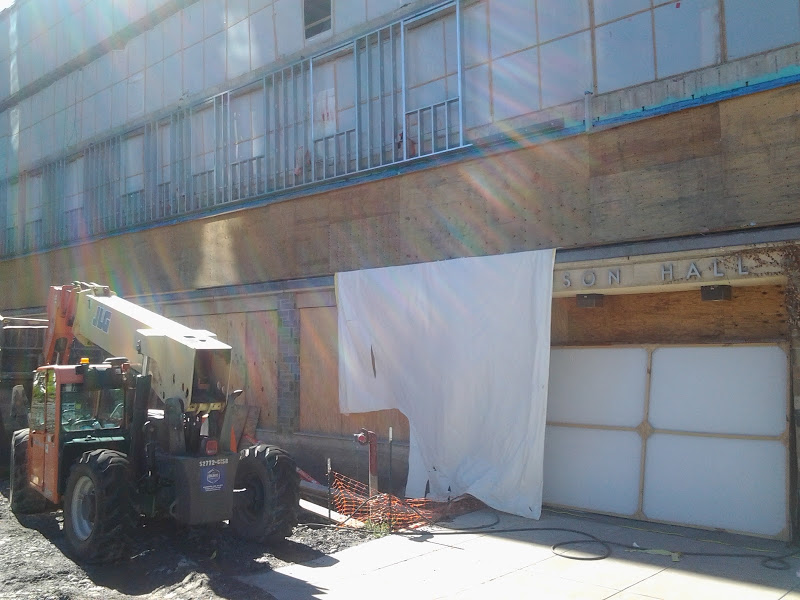
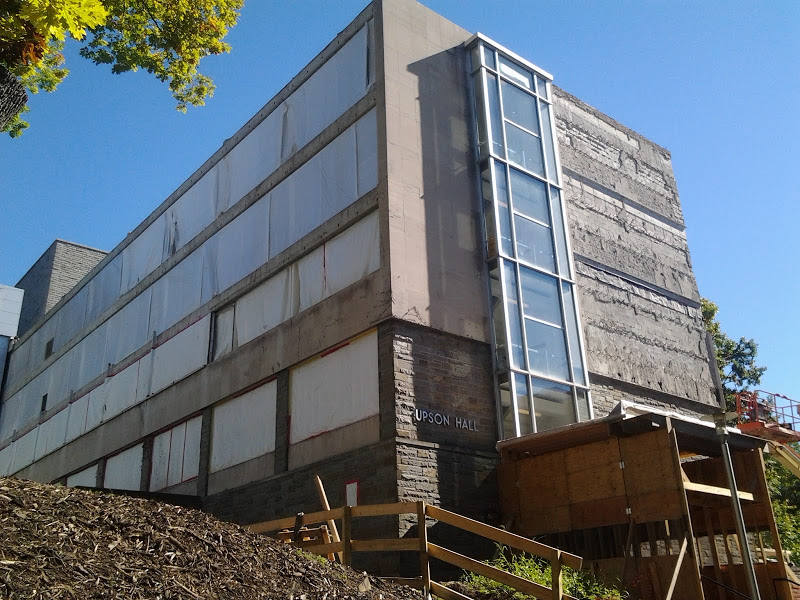
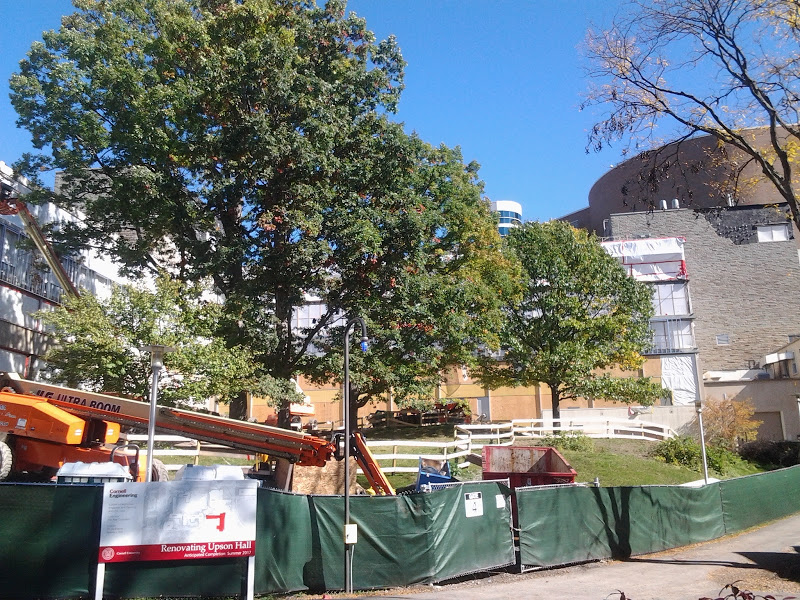
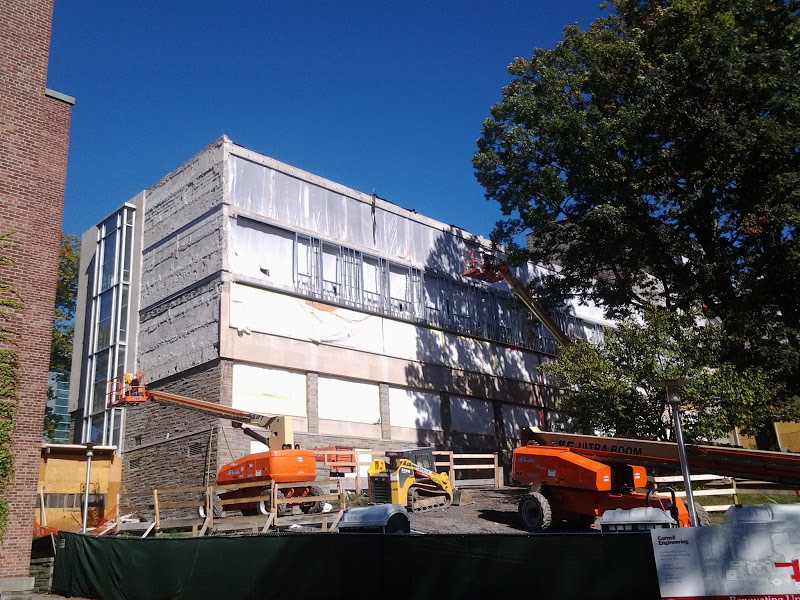
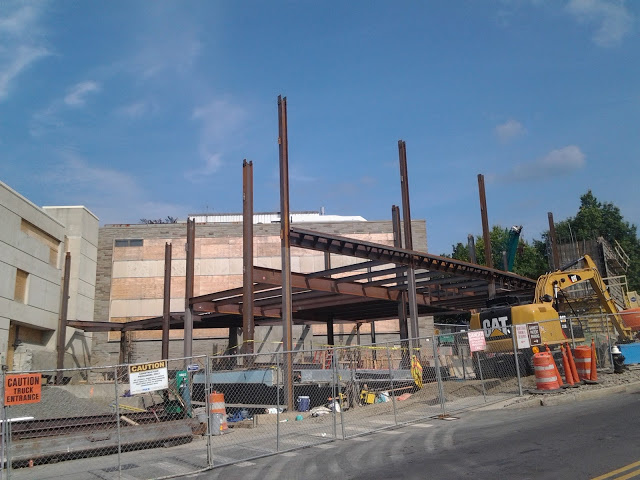
Over on the Engineering Quad of Cornell’s campus, work continues on the gut renovation of Upson Hall. Gone are the original Terra-cotta panels that banded the facade, and the bluestone that faced the building will be removed as the project progresses. Plastic sheeting covers the exterior, working as a vapor and weather barrier. Exterior metal studs, which form the walls, have started to show up on the third floor, with spaces indicating future window openings. These studs will be sheathed (probably with glass-mat gypsum sheet-rock) and later the facade will be put up after the windows have been installed and the building is fully closed in.

Inside the plastic sheets, new telecom rooms are being framed out on the first and second floors, and new drywall is being hung up. Wall framing for new classrooms and offices is underway on the third floor, as well as duct and pipe hanger installation (utilities rough-in). Floors four and five are still undergoing interior demolition – walls are being sandblasted to remove paint, worn-out mechanical, electrical and plumbing systems are being removed, and the old interior walls are being deconstructed so that the space can be re-purposed. New vertical shafts are being cur through the floors, and these will house state-of-the-art electrical and telecom infrastructure.

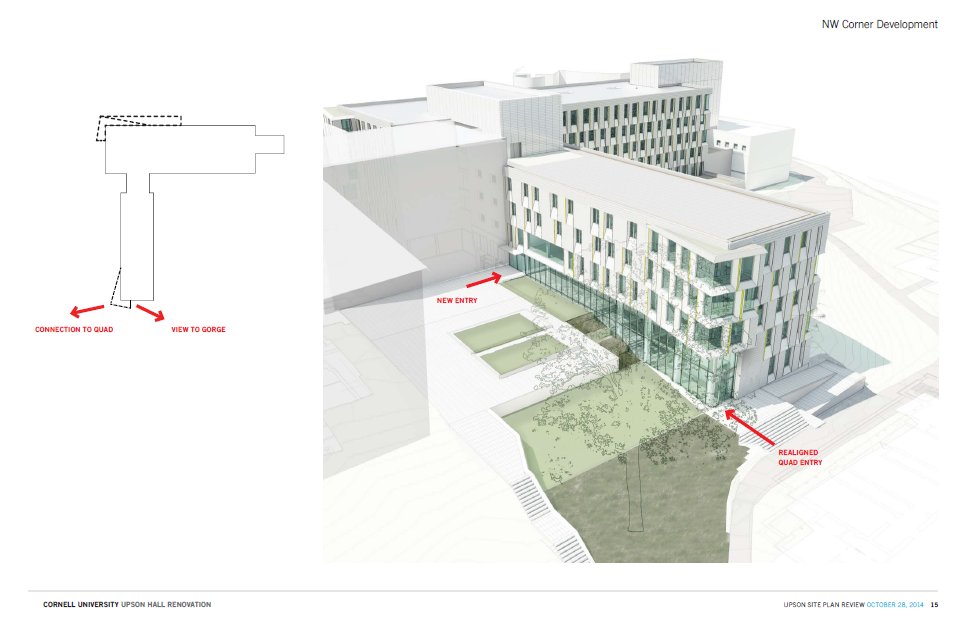
Sometime in the next couple of weeks (target date October 21st), the steel angle installation will begin for the northeast and northwest corners, which will be expanded outward as part of the renovation (the net gain in space will be about 4,000 SF). Steel clips will be attached to the existing structural steel, and then the new steel beams will follow. The entire project is expected to be completed by September 2017, with landscaping work in the second phase.

Upson Hall houses the Mechanical and Aerospace Engineering department, and previously housed labs and offices for computer science until the completion of Gates Hall last year. Built in 1956, the 160,000 SF building is being renovated and modernized at a cost of $63 million.The building will be seeking LEED Gold certification.

The New York office of Perkins + Will, who designed the original building during the height of modern architecture 60 years ago, are also working on the new design, in conjunction with New York-based LTL Architects and engineering firm Thornton-Tomasetti. The Pike Company out of Rochester has been hired on as the general contractor for the multi-million dollar project.

An interview with Robert Goodwin, the design director for Perkins + Will’s role in the project, can be found on the Voice here.

On a personal note, I walked through a spider web while getting photos, and once I got back to my car, found a fingernail-sized sandy-brown spider on my cheek. I quickly grabbed it and flung it onto my umbrella, and shook it out a moment later. Spiders don’t freak me out much, but if that had been a bee on my face, you’d be reading on the Voice that I either died of a heart attack, or drove into a wall.

20151011_132720 20151011_132726 20151011_132752 20151011_132846 20151011_132955 20151011_133005 20151011_133036 20151011_133040

100_2099upson_4


News Tidbits 10/10/15: Meeting With the Stakeholders

10 10 2015

1.There is nothing wrong with a little speculation. In a follow-up of sorts to the Voice piece about parking capacity in Downtown Ithaca, the Times’ Josh Brokaw did an interview of his own with city of Ithaca parking director Frank Nagy. Nagy believes that the 248-car estimate used by State Street Triangle is “way high”, but given that one of the refrains is that there’s not enough parking, they’d rather be safe than sorry.

More importantly, Nagy believes that the Seneca Garage only has about 10 years of life before a new garage will need to be built (the Seneca garage was built in 1972). The structural situation at Green Street is severe enough that the city may have to remove the end pieces and build up the middle section, which was renovated several years ago. The property is being reviewed, and with Tompkins Trust vacating office space on its ground floor as part of the move to its new HQ, the assessment is well-timed.

If the Green Street garage decides to go up rather than out, that leaves two very valuable properties that the city could sell to its benefit (financial, affordable housing, or otherwise). Both ends of the Green Street garage are zoned CBD-140, which offhand is the densest zoning in the entire city, 140 feet maximum height with no parking requirement. A zealous councilperson might try and change that post-SST, but as is, a rebuild of Green Street a few years from now could yield a lot of possibilities for downtown development. Put that in the notebooks for 2020 or so.

100_1281

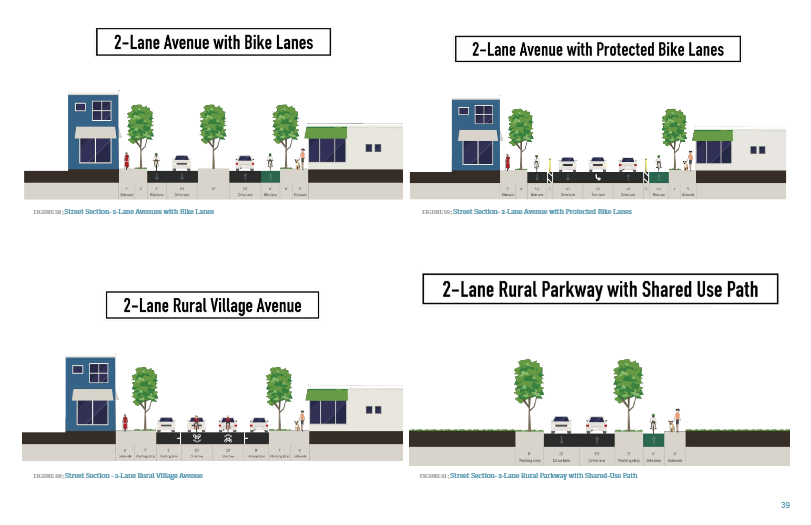
2. Speaking of future plans, we have the bike debate currently raging in the streets. Now, this is only tangential to my usual work, and I am not versed in the topic, so it’s nice to go in without preconceptions.

The city just finished work on Board of Public Works (BPW)-approved bike lanes on North Cayuga Street, specifically an unprotected bike lane on the east side (protected lanes were considered, but not approved). Although meetings gave due public notice, there were no letters sent to Cayuga Street residents informing them of the change, and a number of folks were caught off guard, including members of the city’s Common Council.

In the one corner, you have folks angry about the loss of parking, the inconvenience, and the danger it poses to the elderly. Unfortunately, you also have a council member describing biking-proponents in the same tone one would describe Albany lobbyists. The mayor has come out in favor of the N. Cayuga Street bike lane, although according to the Times, he’s not a fan of “resident-driven infrastructure”. It’s really a fascinating read from a planning perspective. – Times coverage here, Journal here.

bike_lanes_1

For what it’s worth, bike lanes are a major part of walkable communities and reduced ecological impacts (carbon footprints). I feel like I’ve seen this type of argument play out from the perspective of development quite a bit – every new Collegetown or downtown building gets the “Ithaca shouldn’t allow big buildings/they’re ruining Ithaca/where are they going to park” argument, and the “Ithaca is not a small town/it promotes walkable communities/suburban sprawl is destroying Tompkins green space” counter-argument. The key problem with the bike situation seems to be a lack of communication between the BPW and Common Council (and residents by extension). Luckily, the planning board doesn’t quite have this problem – everything they vote on gets publicized, on this blog if not elsewhere.
cornell_novarr_1

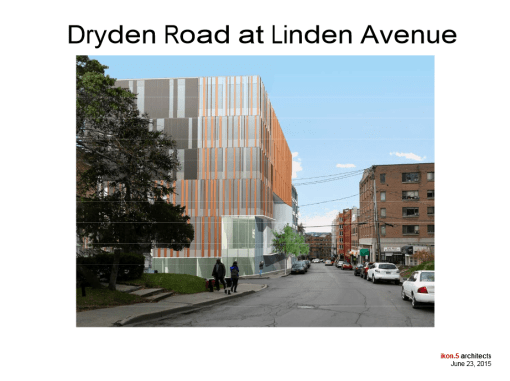
3. The last hurdle for John Novarr’s 215 Dryden Road project has been cleared. The Board of Zoning Appeals approved variances from the Collegetown Form Guidelines – the corner isn’t chamfered or set back enough and the building only has one main entrance (the form-based code mandates an entrance every 60 feet of non-residential space). The owner of the house across Linden from the corner was the lone opposition speaker, and the BZA vote was 4-1, with Marilyn Tebor Shaw opposed. No reason for Shaw’s decision was provided in the article.

With all the approvals tucked away, all that’s needed is for the city to sign off on the building permit. Expect this one to be underway within the next month.

image1 image2

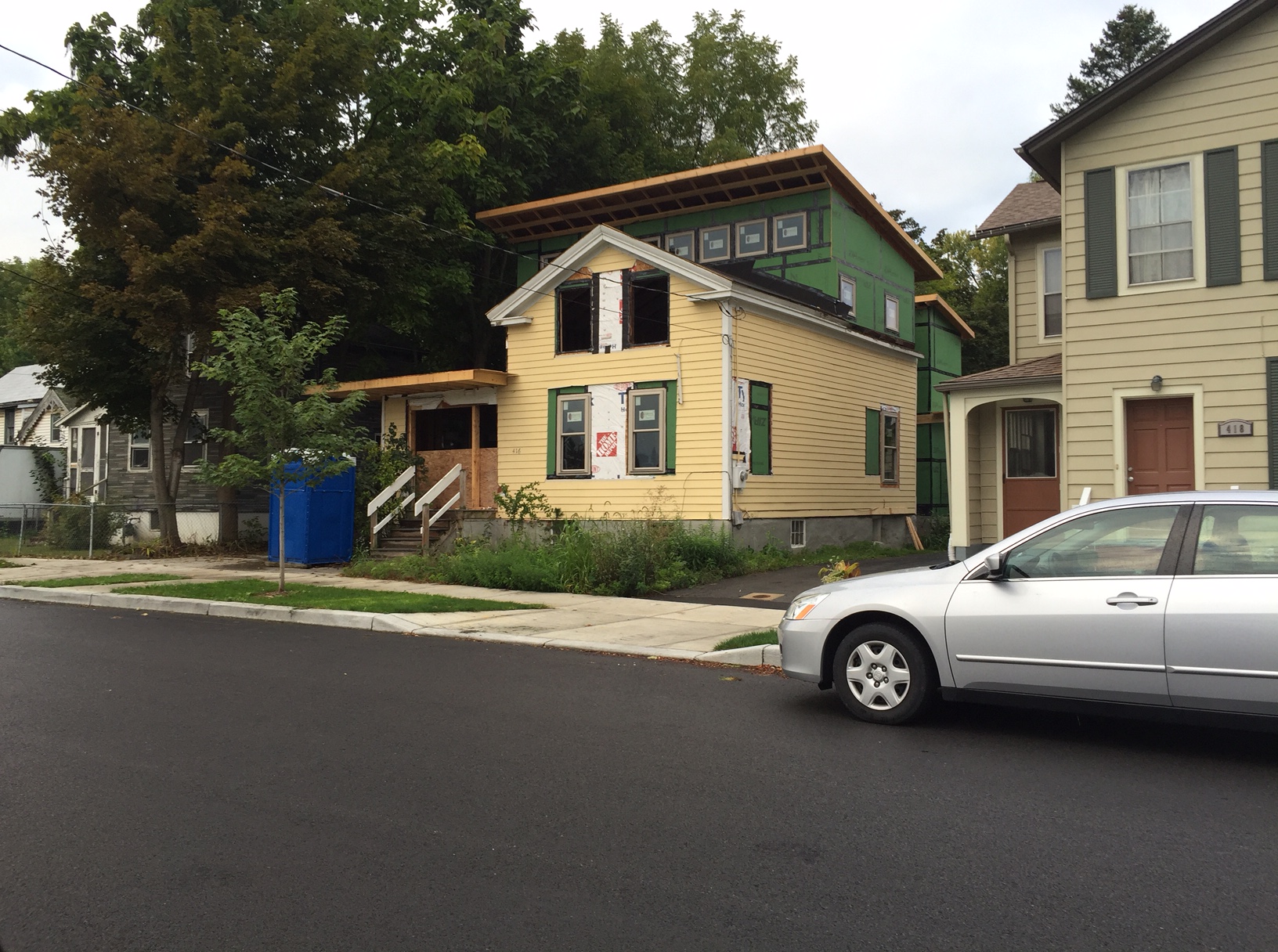
4. Reader submissions are always welcome. The photos for this week’s “House of the Week” featurette come courtesy of Frost Travis. The house receiving the addition is 416 North Plain Street in Ithaca’s Washington Park neighborhood. The current owners brought the property in October 2014. County records give it a 1900 construction date, which is often a default for old and unsure; it appears on an 1889 map of the area, but was not yet built in the 1866 map.

The rear addition looks like it’s been underway for a while – the exterior has been framed and sheathed with plywood Huber ZIP system roof and wall sheathing, which uses seams and tape to save time vs. traditional sheathing such as Tyvek housewrap. There are some windows fitted into the rough openings, but there’s still plenty of work to do with closing up the exterior and interior utilities rough-in. Looking at the original house, the owners appear to be fitting smaller windows in place of the originals – two window cutouts on the north wall have been filled in with sheathing, and a new window has been fitted in a new opening. The front door and adjacent window are gone, one large rough opening in their place. The front roof above the door and window was slanted, but has been dropped to a flat roof as part of the renovation and addition. Presumably, the butter yellow vinyl exterior will be re-finished as construction progresses. With any luck, this one will be finished before winter comes.

Pg-3-Rendering

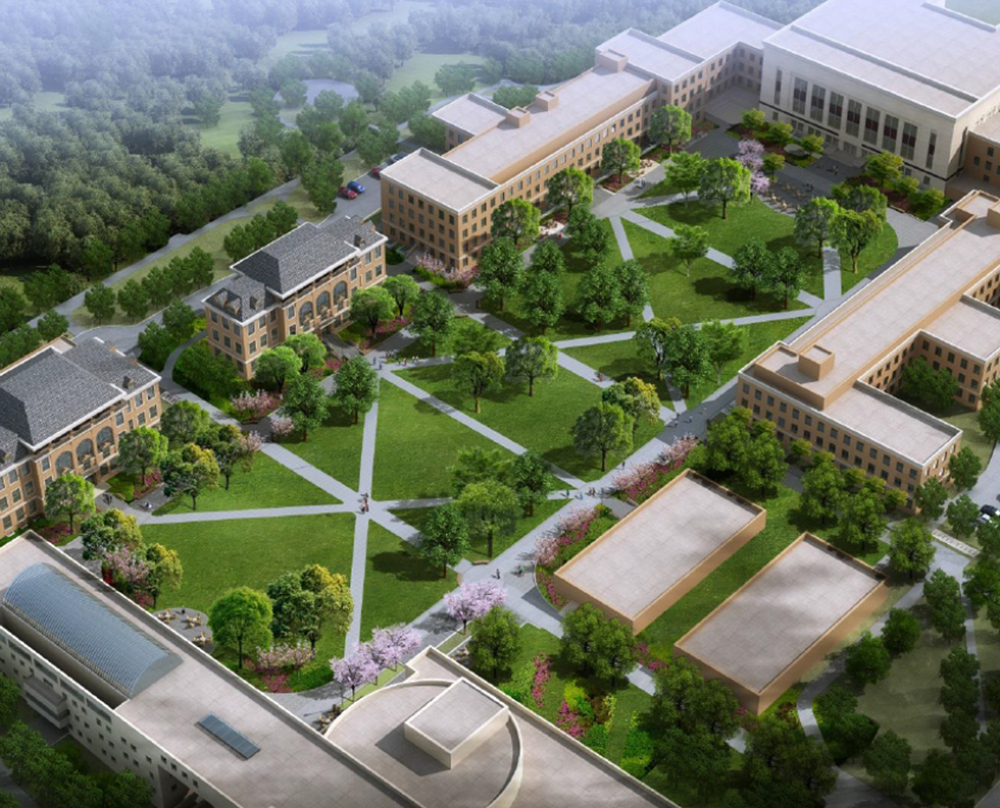
5. What a quick turnaround. The Cornell Daily Sun first made mention of the Ag Quad renovation last week as part of its coverage of the Collegetown Neighborhood Council meeting. Now only a week after Cornell shared a glimpse at the cards in its hand, they’re playing them. The $9.6 million project will be broken down into two phases, one that focuses on infrastructure, and one phase on landscape improvements (and being that much of the infrastructure is underground utilities, phase one could be described as churning up the ground, and phase two is making the upturned dirt pretty again). The renovations, which are set to start next summer and run through 2017, will include additional emergency phones, a rain garden, and outdoor gathering spaces in front of Mann Library and Roberts Hall (upper right and lower left in the above render).

Too bad those temp buildings are still there between Kennedy Hall and Plant Science. If the Southern Tier wins that Upstate Redevelopment competition, I have an idea where the new Plant Science Commericialization Building should go.

6. Plans for 416 E. State have evolved since the bar was first proposed. Originally conceived as a general bar/drinking establishment, developer and Argos Inn architect Ben Rosenblum has faced substantial opposition to the project – neighbors are vociferously opposed to a bar, citing noise problems and concerns about smokers, and the county planning department was not a fan of the traffic and parking arrangement, which had after hours parking across the street at Gateway Plaza. Although the project doesn’t need planning board approval, it does need BZA approval – area and setback deficiencies have resulted in the need for a zoning variance. The building itself won’t change dimensions, but the change in use triggers the city zoning laws.

416_e_state_v2_1

Representatives for Rosenblum and neighbors have met, and the compromise Rosenblum and his associates have proposed involves a lounge-type of establishment they’re calling “The Printing Press”, after one of the previous uses for the late 1940s warehouse. They’ll be going for an industrial/”speakeasy” aesthetic, and targeting the same older, more affluent clientele that patronizes the Bar Argos next door. Signage would be minimal, and exterior work limited largely to an accessory parking lot/handicap access, landscaping and a new coat of paint. Looking at the original plan vs. the revised plan, the bar no longer is in the rear corner, but moved closer to the building center so as to buffer the noise of patrons from disturbing neighbors. Parking will be shared and organized with the Argos Inn’s lot. For more info, cover letter here, renders here, vision statement here.

The new parking arrangement may assuage the county, and the low-key bar located centrally in the interior may be enough to satisfy some of the neighbors. But we’ll have to see the BZA’s reaction and what remaining opposition there is before anything is set in stone.

hotel_ithaca_v3_1

hotel_ithaca_v3_2

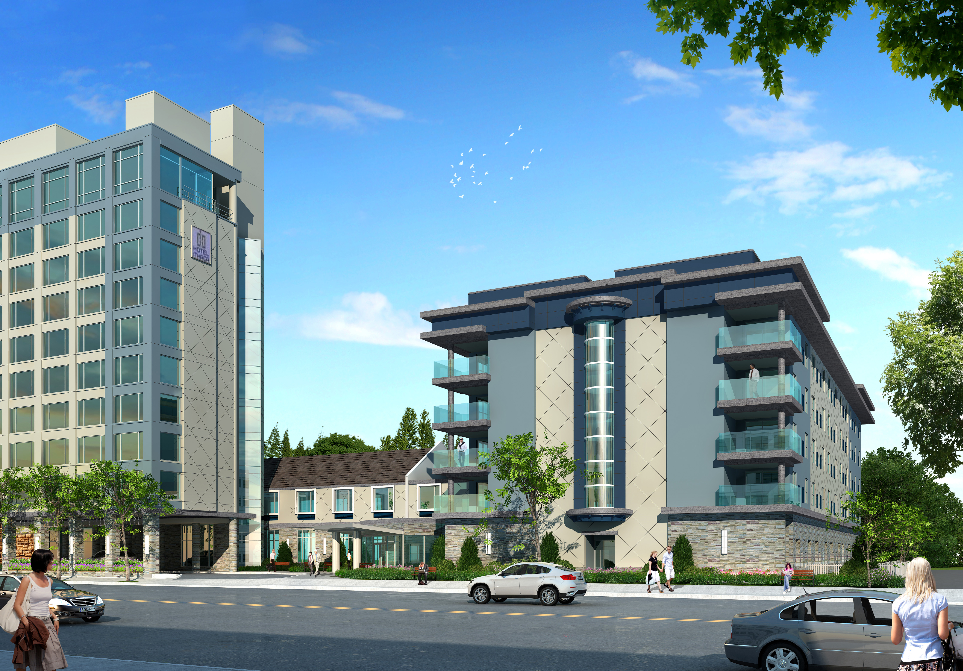
7. The Planning and Development Board has scheduled a Design Review Committee meeting to offer guidance and commentary on the styling of proposed buildings. While State Street Triangle isn’t on the agenda (yet), the Hotel Ithaca addition is. Renders here and here.

I’ve toned down my opinions over the years, but this…well, let’s just so those “sick burns” Nick Reynolds mentioned at the last planning board meeting were pretty well justified. I mean…yikes. The cross-hatched blank walls, the circular glazing, the “tourist trap” aesthetic. There’s an alternative being shown with small windows in place of the circular glazing, and rectangular facade hatching instead of the cross-hatching, but it’s not a great improvement. The board’s going to have a lot to say with this proposal.
215-221_spencer_v3_2

215-221_spencer_v3_1

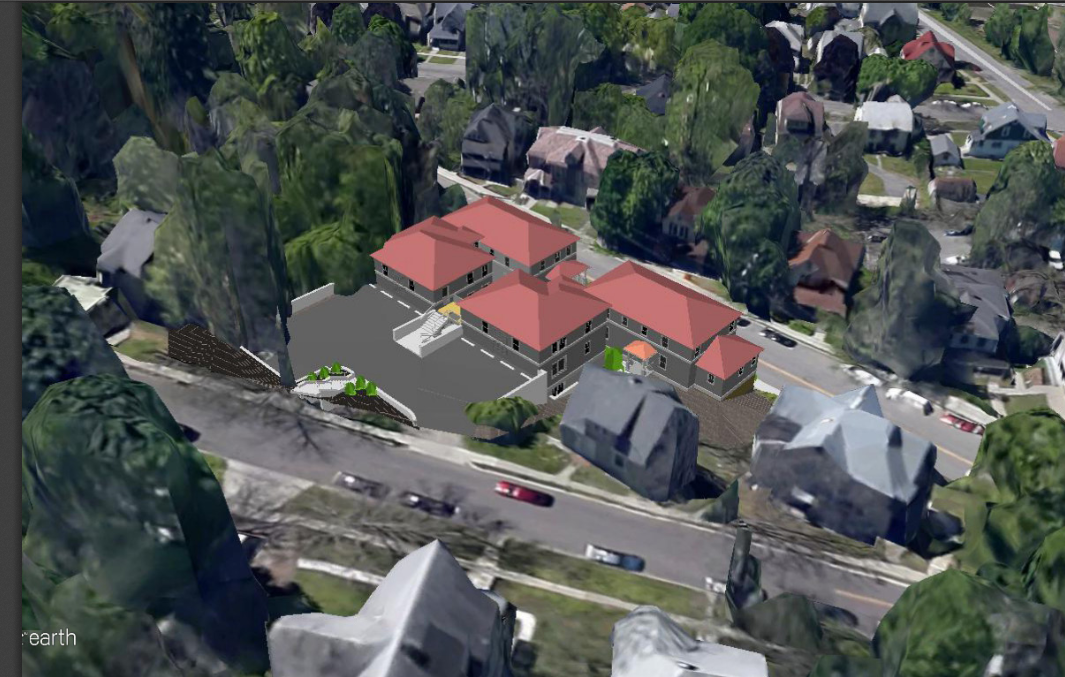
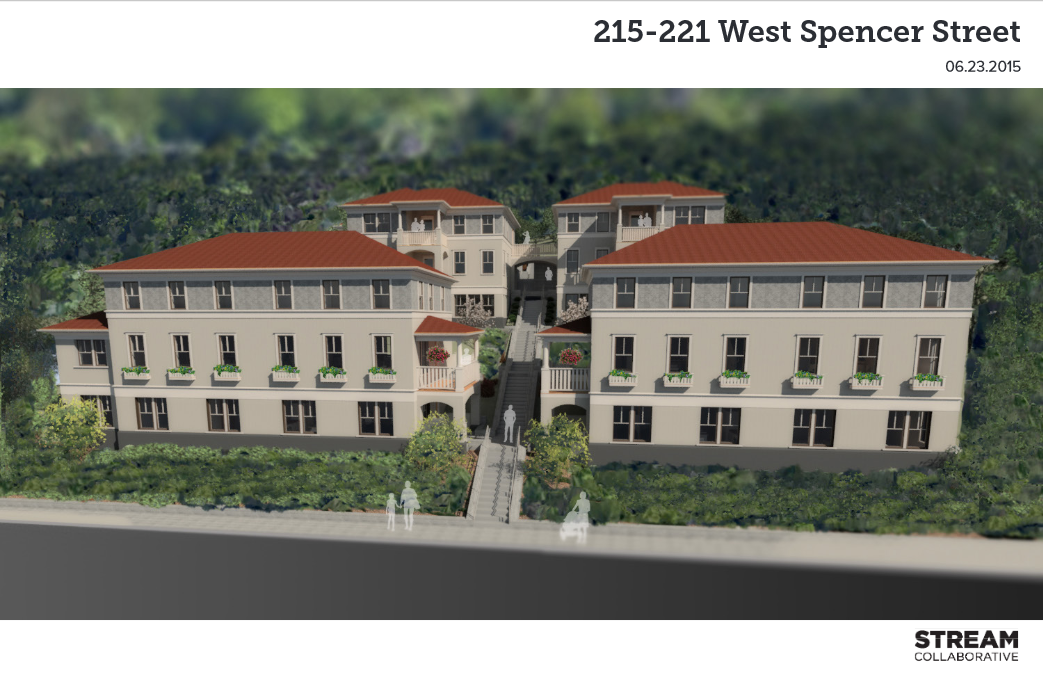
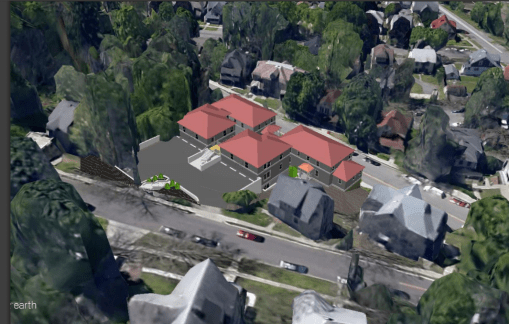
8. I had hopes that for the first time in three years, a major project would go through the boards without complaint or opposition. Hopes dashed. The complainant against the 4-building, 12-unit 215-211 West Spencer Street project cites the loss of the city’s parking lot on the site, the narrow width of S. Cayuga Street (the “rear” road), traffic, and no neighborly interactions because it’s a rental that faces Spencer Street.

215-221_w_spencer_orig

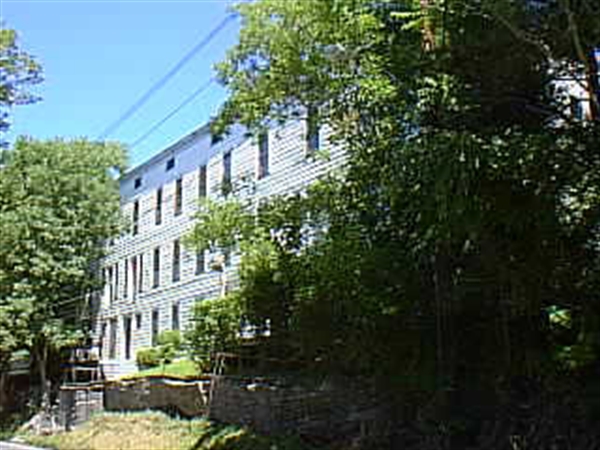
The kicker is, the letter-writer lives in an upscale Lansing subdivision. He rents out his 3-unit Cayuga Street property. The “house” that the letter claims used to be on the site is also misleading. It was a run-down multi-story apartment building (shown above in the photo from county records), demolished 12 years ago by the city, and turned into an informal parking lot that was never meant to be a long-term use. The land was sold by the city to Ed Cope for $110,000 last March.

I’m willing to entertain legitimate arguments and complaints to projects. But this isn’t one of them.


Carey Building Construction Update, 9/2015

7 09 2015

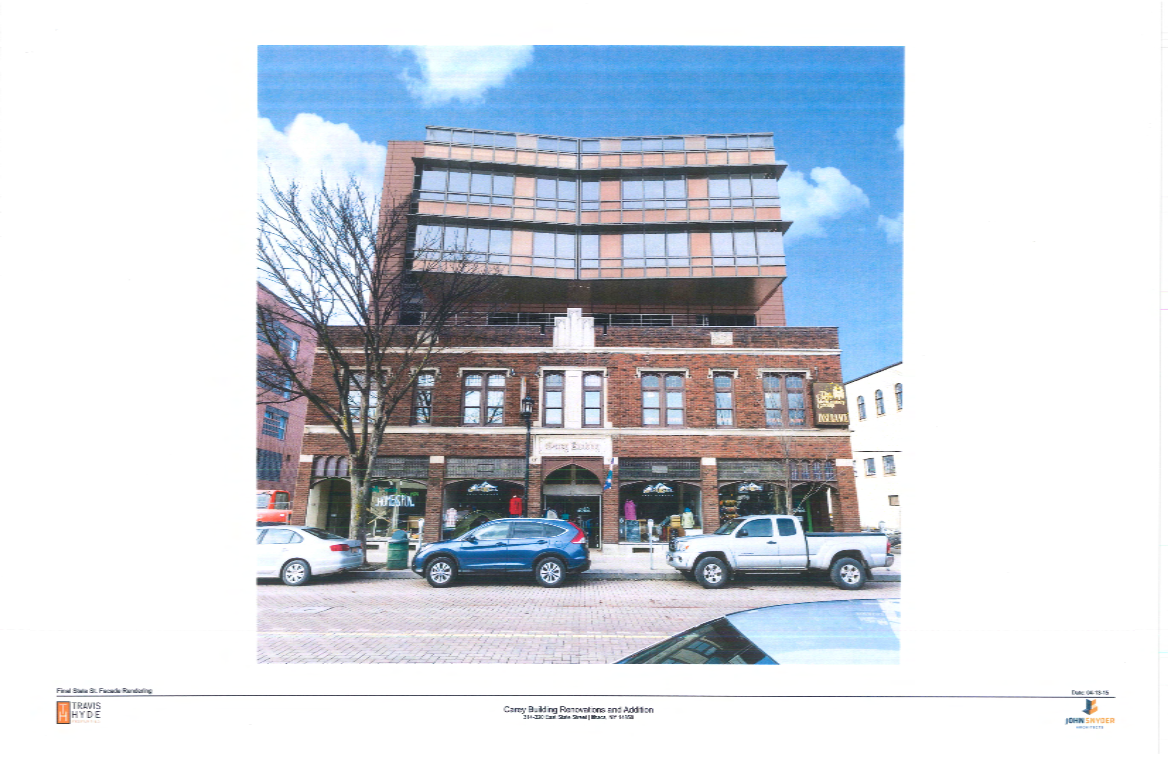
Just a quick update on the Carey Building addition at 314-320 East State Street in downtown Ithaca. As of the end of the month, structural steel has reached the top floor of the five-story addition, though it has yet to fully build out. The lower floors have been decked with corrugated sheet metal, and concrete floor pours might already be underway on the lower levels.

Paperwork filed with the county last Friday indicates that Tompkins Trust is providing the construction loan, with a value of $4,736,000, of which the very precise figure of $4,642,554.46 is going towards “hard” construction costs. Hard construction costs leave out legal fees, permit fees, and other costs not directly related to construction. The paperwork indicates a February 2017 completion date, but that’s more of a legal date than an actual date. The addition is likely to completed early next year.

The Carey Building addition will add a third floor and 4,200 SF to the Rev business incubator (nearly doubling it from 4,500 SF to 8,700 SF), and on floors 4-7, there will be 20 apartments, most of which are studios. Local firm Travis Hyde Companies is developing, John Snyder Architects penned the design, and LeChase Construction is the general contractor.

20150829_125735 20150829_125801 20150829_125827

carey_rev5_1 carey_rev5_2 carey_rev5_3


206 Taughannock Boulevard Construction Update, 9/2015

4 09 2015

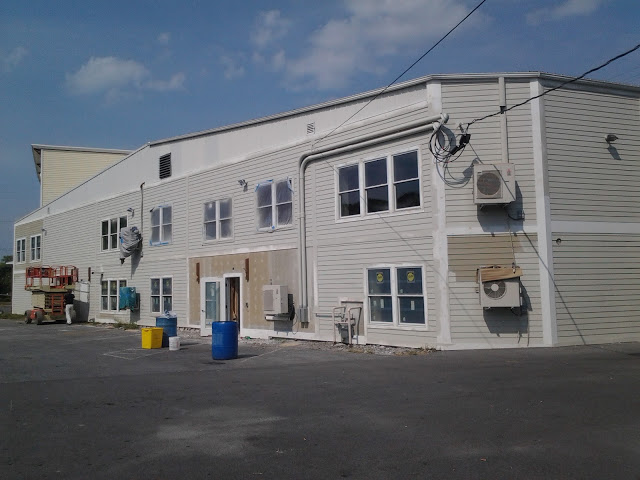
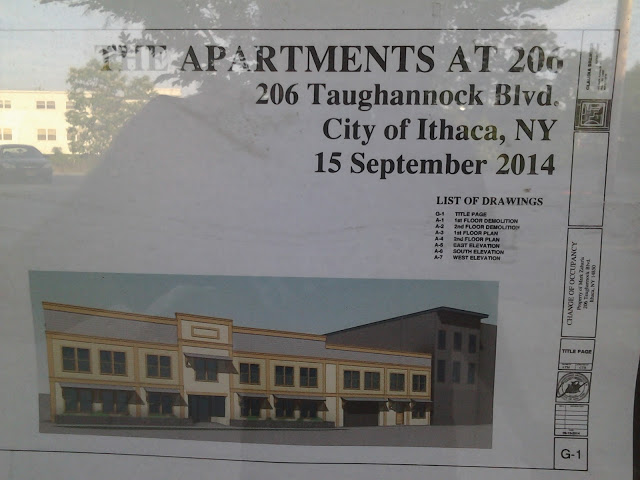
Over on Inlet Island, another project is in the home stretch towards completion. “The Apartments at 206”, Mark Zaharis’s mixed-use project at 206 Taughannock Boulevard, is mostly completed on the outside, with minor cement-board trim installation and painting ongoing. There might be some further exterior work planned with sunscreens and such, but it’s difficult to be sure since the built design doesn’t match the rendering.

A peek through the back door showed drywall being hung on the wood framing, and some utilities rough-in still going in. The project is a gut renovation of a former furniture store and warehouse, so the owners had quite a task with rebuilding the interior.

According to an older gentleman working on the site, the apartments “should be ready in two or three months, keep an eye out.” There will be four one-bedroom and three two-bedroom units, along with office space on the first floor.

Local architect Claudia Brenner penned the design of the renovated building. Last year, Brenner designed the renovation of the Lehigh Valley House next door into a mixed-use building with ground-floor commercial space, donated space for the recently-opened branch office of the IPD, and six condominiums. The Zaharises, who owned and managed the furniture store before it closed in Spring 2014, are the developers-in-charge.

20150829_152045 20150829_152023 20150829_152005 20150829_151952 20150829_151906 20150829_151901

20150613_191931


Ecovillage Construction Update, 9/2015

3 09 2015

The last stages of work are underway at Ecovillage on Ithaca’s West Hill off of Mecklenburg Road on Rachel Carson Way. Construction on the single-family homes in Ecovillage’s third neighborhood, “TREE” (Third Residential Ecovillage Experience, following its first two, FROG and SONG) has been complete for a little while now, but the 15-unit Common House has yet to be completed. The exterior has been finished, with attractive wood-frame balconies swaddling the building, but interior work (drywall boarding and painting, from the looks of it) is still taking place.

The 15 apartments range from 450 SF studios to 1,400 SF three bedroom units. Rental prices for the apartment units have not been posted. According to Ecovillage Executive Director Liz Walker, “The current goal is October 1st for completion. There will still be inspections after that, so it will be perhaps the end of October or November before people are able to move in.”

Construction is being handled by a local company, AquaZephyr, which received an award from the U.S. Dept. of Energy for a “zero energy ready” home constructed as part of TREE. The designs of the Common House and houses are the work of California architect Jerry Weisburd, with local firm STREAM Collaborative handling the permitting process and design tweaks after Weisburd’s retirement.

20150829_153323 20150829_153359 20150829_153429 20150829_153529 20150829_153629 20150829_153648


Klarman Hall Construction Update, 9/2015

1 09 2015

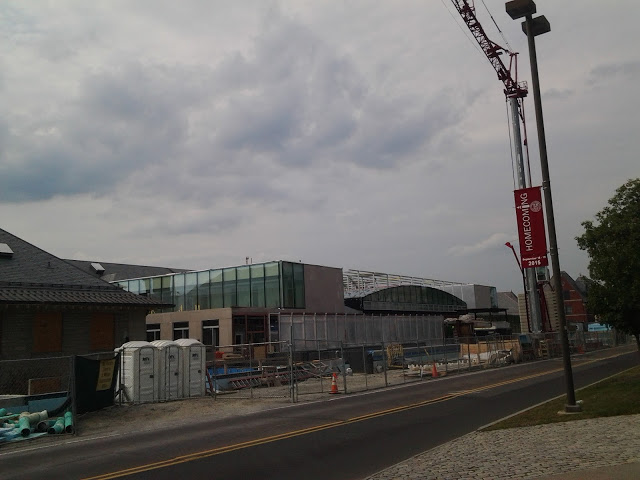
Klarman Hall is entering the home stretch now, just a few months from its anticipated January 2016 completion (and a few weeks behind the December 2015 date initially planned). Montour Falls-based Construction firm Welliver is busy sealing up the building’s exterior, while putting up drywall, painting and finishing-out the interior lower floors, and wrapping up services rough-in in the upper level offices.

From the looks of it, most if not all of the sandstone exterior wall panels have been installed. The vestibule has been framed out but has yet to be glazed (window installation), and while the atrium has been glazed, the glass-paneled roof above the atrium has not. Concrete stairs have been poured on the slope, and the rest of the landscaping will follow after the building has been completed and the warm, snowless weather of spring comes around. Construction progress of the project can be followed through aerial photos shared by Landmark Images here.

The 33,250 sq ft building was designed by Koetter | Kim & Associates, and is named for billionaire hedge fund manager Seth Klarman ’79. The building will be the first new humanities building on Cornell’s campus since Goldwin Smith Hall was built onto the old dairy science building in 1906. Just like Cornell did with Goldwin Smith over a century ago, the new building will be combined with the old building through hallways and commons areas. Klarman Hall will contain classrooms, faculty and graduate student offices, and in its the north section, a 350-seat auditorium. The large interior atrium makes use of the rotunda of Goldwin-Smith Hall for open-layout seating, a food/cafe area, and ingress/egress. Cornell is aiming to have the building achieve LEED Platinum certification.
The cost of the new building, which began construction in May 2013, is estimated at $61 million.

20150829_160955

20150829_161038 20150829_161058 20150829_161120 20150829_161151 20150829_161227 20150829_161250

klarman_1


Gannett Health Center Construction Update, 9/2015

31 08 2015

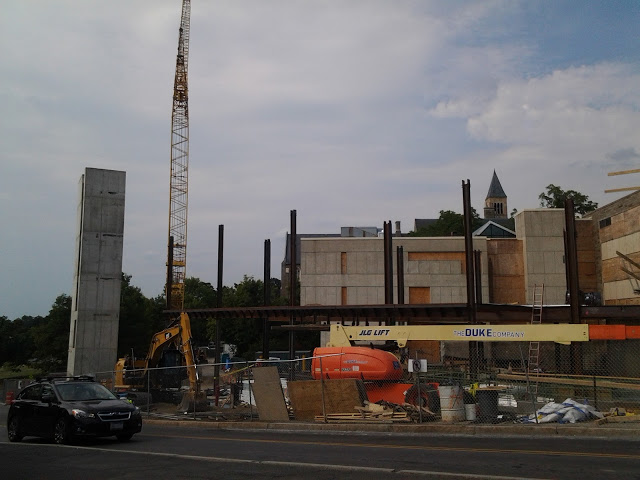
It wouldn’t be Cornell if they didn’t have at least a few construction projects underway on their campus, and this summer has been no exception. Here are some photos of the Gannett Health Center expansion taken last weekend.

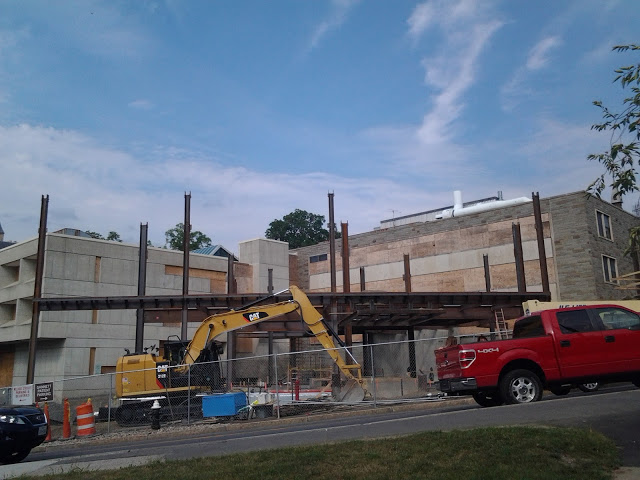
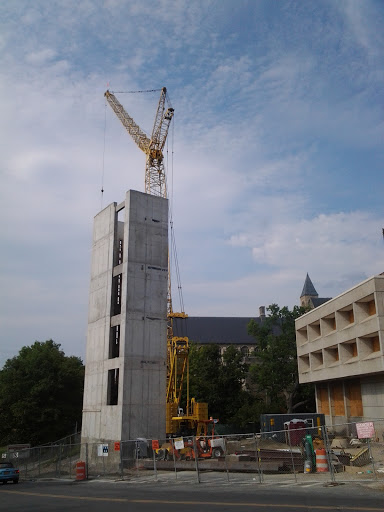
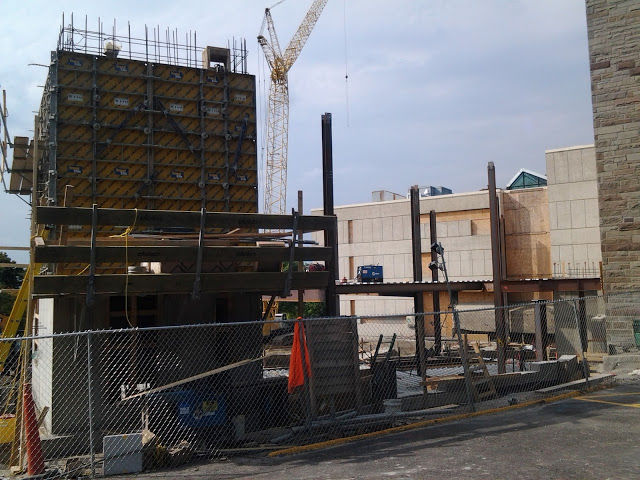
The poured concrete stairwells are probably the first thing passersby notice, given that they’re the tallest structures on-site (construction cranes notwithstanding). The western stairwell has been fully poured and topped out, while the eastern stairwell is currently underway. Look closely and you’ll see the wooden forms used on the concrete. These forms provide stability and shape while the concrete hardens, and they provide support to the reinforcing rods embedded in the concrete. They will move further up the stairwell as more concrete is poured and cured.

Between the stairwells, structural steel beams and joists are being hoisted by crane into plane, and corrugated steel decking for the floors is being laid down as the steel framing is built out. The new addition will continue to rise as the new building, the first phase of three, moves towards its July 2016 completion. Phase II focuses on renovations to the old building, and Phase III a reconstructed Ho Plaza entrance. The whole project is anticipated to be completed by August 2017. Construction firm Welliver is the general contractor for the project.

The building design is by local architecture firm Chiang O’Brien, with landscaping by Trowbridge Wolf Michaels Landscape Architects. There will be two additions to Gannett, a four-story, 55,000 square-foot building, and an additional 18,600 square foot addition that replaces the northeast side of the current building. The project also includes a new entrance and substantial renovations to the original 1956 structure (22,400 square feet of the existing 35,000), as well as landscaping, site amenities, and utilities improvements. The projected cost is $55 million.

20150829_160417 20150829_160443 20150829_160451 20150829_160456

20150829_160616

20150829_160517

gannett5


707 East Seneca Street Construction Update, 8/2015

14 08 2015

By the time I had taken updated photos of the apartment building under construction at 707 East Seneca Street, most of the exterior work had been completed (looking at the photos closely, those might be some trim boards leaning next to the first-floor doorway). The work has shifted mostly to finishing out the interior, and then when the vast majority of work on the building is completed, landscaping and paving will follow. Everything looks to be on schedule for tenant move-in later this month.

For a look at interior progress photos, Modern Living Rentals has been posting occasional updates on their facebook page.

The building will have 6 3-bedroom units, 18 beds total. Todd Fox and Charlie O’Connor of Ithaca’s Modern Living Rentals are the developers, and the design of the building, heavily influenced by its location in the East Hill Historic District, is the work of local firms Schickel Architecture and STREAM Collaborative.

20150727_105957 20150727_110035 20150727_105910


114 Catherine Street Construction Update, 8/2015

13 08 2015

One of the “secrets” of Jagat Sharma’s success in Collegetown is that he designs unobtrusive, good-looking projects on a restrained budget. Sharma can probably add 114 Catherine Street to his list of successes.

The next few entries are more or less just to clear out my portfolio and keep the blog updated with separate entries to make searches for individual projects easier. If you’ve been reading the Voice, you won’t see anything “new”, but you will get more photos and more information.

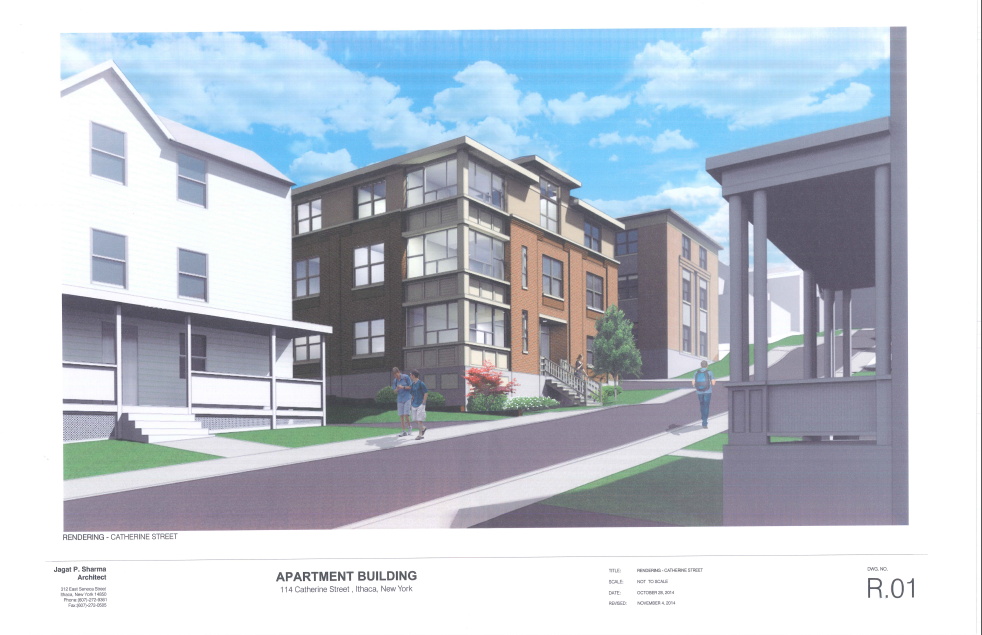
In these photos from the end of July, the work is nearly complete. A few workers were assembled around the concrete foundation, where the most visible corner will have an imprinted rectangular pattern for the sake of visual interest. The render I included this post was what I thought the version of 114 Catherine that was going to be built, but the corner windows aren’t as big, and the A/C units appear to be missing from the southward (front-facing) windows, and were moved to the side instead.

Workers are also busy with finishing out the interior, and the front door and stairs will be installed once it’s convenient. Landscaping will follow, and from there it’ll be ready for tenant occupancy later this month.

The building is being developed by Nick Lambrou of Lambrou Real Estate. Plans call for a 3-story, 4,180 sq ft structure with a 5-bedroom apartment on the first floor and a 6-bedroom apartment on the second floor and on the third floor. The building replaces a surface parking lot.

20150727_104740 20150727_104755 20150727_104816 20150727_104835

114_catherine_rev4_1