News Tidbits 12/20/2014: Many Homes, One Community

20 12 2014

5-8-2012 347

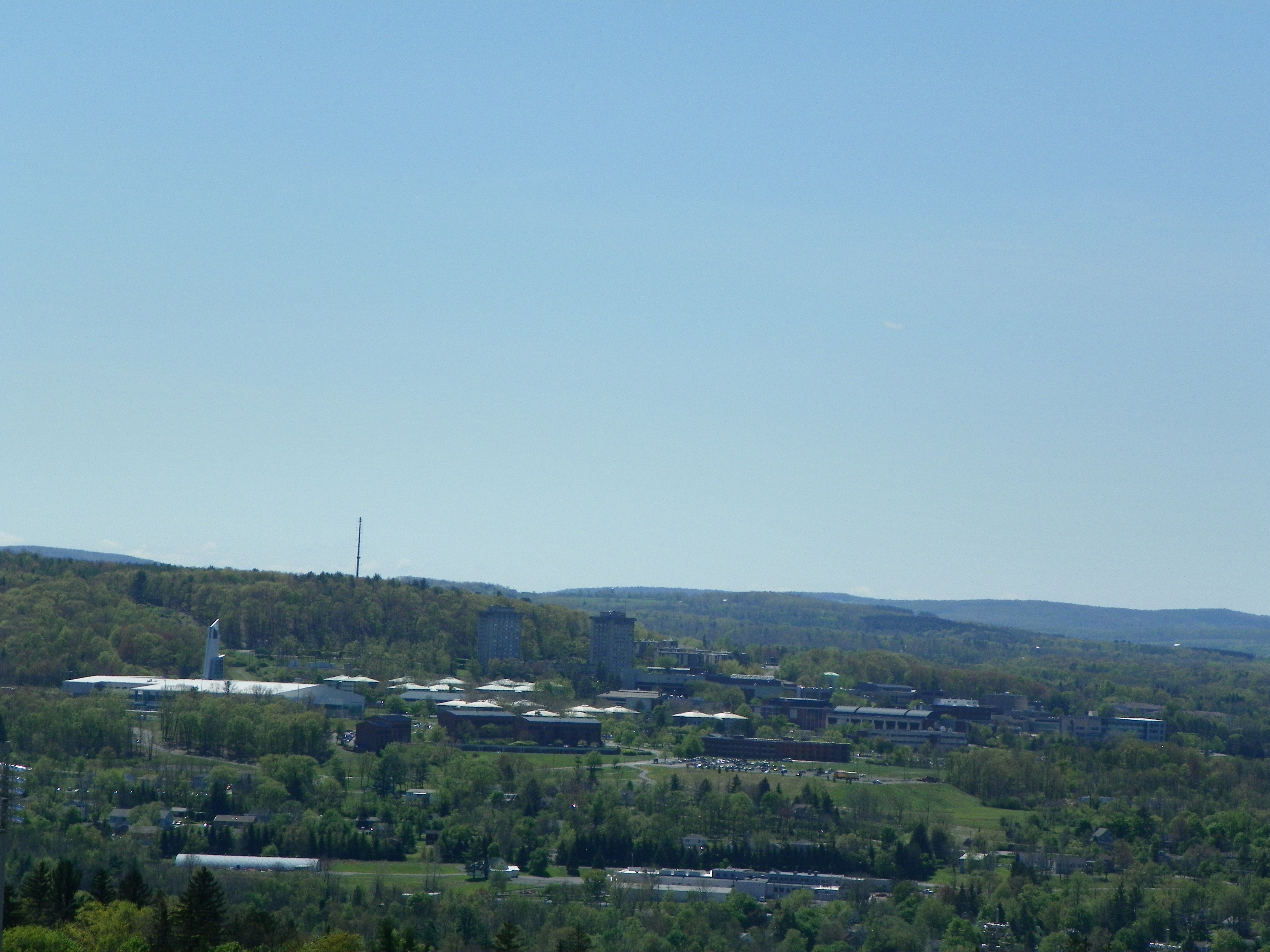
1. Starting things off, here’s an update on Ithaca College’s Master Plan-in-progress, courtesy of the Ithacan. According to a presentation given by representatives of lead planning firm Perkins Eastman, the master plan will include a climate-controlled walkway connecting several buildings from the Gannett Library through the Center for Health Sciences, the removal of the upper and lower dorm quads and replacing them with academic lab/research space, an amphitheater just below the Dillingham Center fountain and a new entrance on Danby Road closer to Ithaca’s downtown.

Now, before residents in South Hill begin to panic that their neighborhood is about to be invaded by students displaced by IC’s decreased housing, I’d like to point out that master plans are rarely built out as designed, but are great for identifying academic needs. I don’t imagine that IC will start tearing down 11 buildings and 1,235 beds unless they really feel like getting into a fight with the town, or throwing up temp housing, neither of which ranks high on the to-do list. At least I get something to write about for a week or two when the new plan comes out this Spring.

2. What is known about Manos Diner’s future occupant: They’re leasing the space from Bill Manos, not buying. It’s a restaurant with owners who already own several restaurants, all outside NYS. It’s not necessarily a chain. It’s apparently a family operation and the food will be Mexican. And whoever it is must have really, really wanted to pry their way into the Ithaca market. I don’t see why they wouldn’t have chosen any number of other sites they could renovate…it seems really strange that an offer so fortuitous would come up that Manos would close his diner with hardly a notice to his employees (which is completely tasteless, for the record). New restaurants in Ithaca aren’t usually big news-makers by themselves, but the entry of this Manos replacement draws more questions than answers.

amabel_rev1_1

amabel_rev1_2

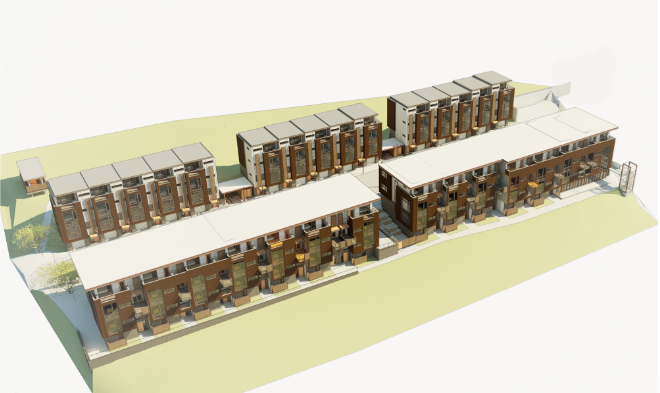
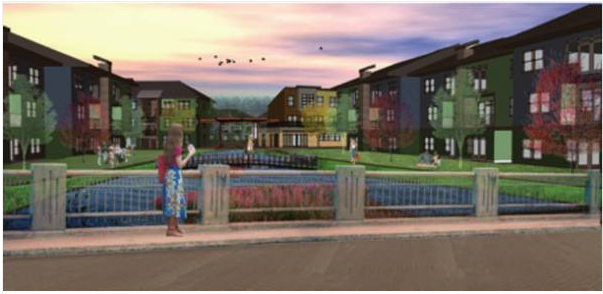
3. Looks like New Earth Living LLC has released some updated site plans and sketches of their approved Amabel project just southwest of the Ithaca city-town line. The houses on the northern two-thirds have been rearranged from the previous site plan, and if it’s still 31 units, then the center buildings must be two-family houses. I’ve been told that there will be six different house designs available, so don’t expect all the houses to look the same as in the concept sketch. One thing that the all designs will share are roof configurations that will allow enough solar panels to result in net zero energy use for each home. The city has approved the sale of its surplus land to the developer, and this project is due to start marketing in summer 2015.

http://public.tableausoftware.com/shared/XKG7RHY5H?:toolbar=no&:display_count=yes

4. Here’s a map, courtesy of real estate website Zillow, that prices out how much it would take to afford the median rent in a given metropolitan area, if paying no more than 30% of monthly income to rent (the federal affordable housing standard). Ithaca/Tompkins County comes in at $32.74 an hour, assuming a 40-hour week and 50-weeks working in a year. In other words, $65,480 ($1,637/month average rent). The number is skewed high from the number of expensive multi-bedroom units in Collegetown, but it’s still high when compared to Elmira ($28.08) or Syracuse ($27.74). For comparison’s sake to Ithaca-type communities, Boulder ($41.72) and Ann Arbor ($34.28) are higher, Charlottesville ($29.24), Madison ($27.54) and Asheville ($22.98) are lower.
village_solars

20141129_125556

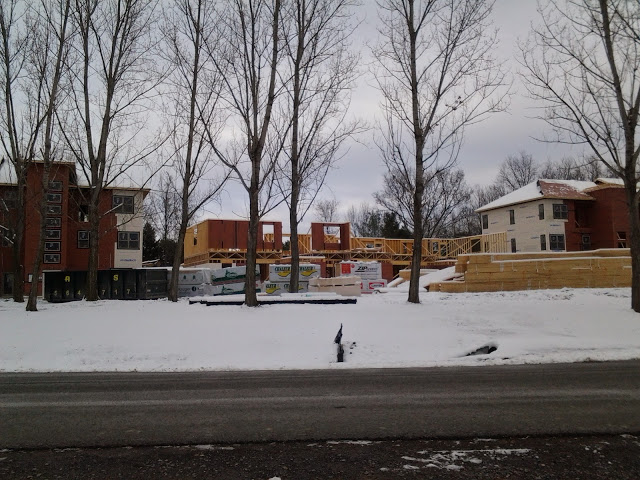
5. Would you believe this is actually the first render I’ve ever seen for the Village Solars project in Lansing? This comes courtesy of their Craigslist ads. The Village Solars take their name from being designed with passive solar design with large amounts of natural light; I don’t know if they will have solar panels. For being a large project, this one has sailed under just about everyone’s radar, partially because it was approved 18 months before construction started. Since there has been so little news about this project, info comes in the form of government and business memos. Depending on the source, final build-out is between 292 and 320 units, which is enormous for the Ithaca area.

Rent’s not cheap with these new units – the minimum is $1235 for a first-floor 2-bedroom, going up to $1369 for a “penthouse” third floor 2-bedroom unit. The Craigslist ad says the first units (36 of them) will be ready for occupancy by March 1st 2015.
402_s_cayuga_st_rev2_1 402_s_cayuga_st_rev2_2

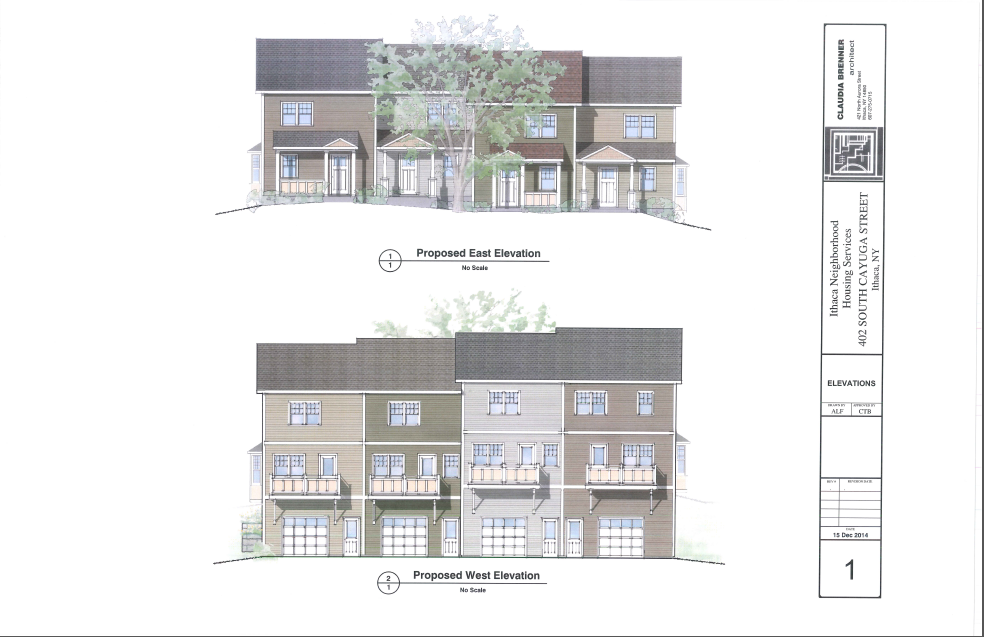
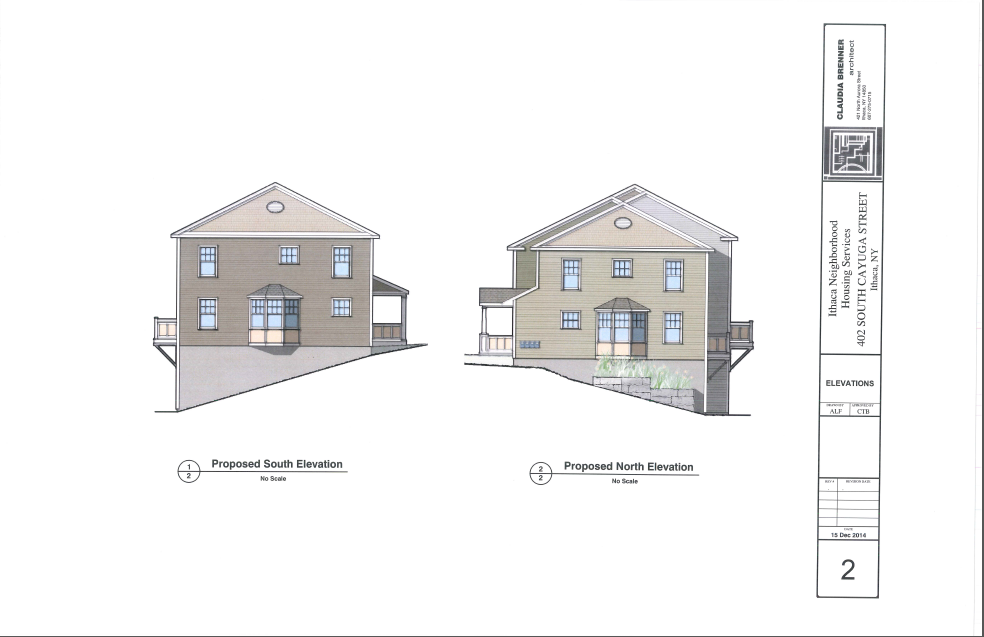
6. Updated doc and drawings for INHS’s 402 South Cayuga Street have been filed with the city. Application, FEAF and project description here, drawings here. According to the docs, the cost of construction will be $740,000 for the four units, and go from Spring 2015 to Spring 2016 (March 2016 in the FEAF). Some slight metal pollution from Emerson/Morse Chain has been noted in soil tests from below the foundation area, due to the Morse Chain subterranean pollution plume (metals, VOCs) that affects much of South Hill. Although the DEC requires no further action at this time, there will be an active sub-slab depressurization system in place as a safeguard. In other words, a fan blows air into the basement, and it gets vented back out.

The design of the townhomes has been revised by architect Claudia Brenner to include more architectural detail – bay windows on the north and south ends, and larger/full porches vs. the stoops of the previous design. The siding has also been changed to all earth-tones. It’s an improvement, but I’d rather see two separate windows above the porches. This project will be presented at the January Planning Board meeting.

707_E_Seneca_1

7. Here are some drawings for 707 E. Seneca. Readers might remember this is the 6-unit building proposed by Todd Fox for a derelict playground recently sold off by the city. The 18-bedroom design by local firm Schickel Architecture has already been critiqued thoroughly by the Ithaca Landmarks Preservation Council, since the site is within a historic district and needs to look the part. I’d say that they’ve done well, it’s a bit bulky but otherwise a tasteful addition. An area variance will be required from the Board of Zoning Appeals. Construction is expected to cost $220,000 and run from April to July 2015. For more info, the application is here, drawings here.

112_blair_1 112_blair_2

8. Since we’re talking about East Hill housing, here‘s the project application and here are the drawings for the duplexes proposed for the parking lot at 112 Blair Street. The Blair Street site will be combined with 804 East State Street, and the duplexes will have State Street addresses. The spartan design of these buildings is also by Schickel Architecture, and will add 12 bedrooms in 4 units. Cost is estimated at $213,000 and construction will start in April for a summer completion. The developer is Matthew Nestopoulos.


News Tidbits 12/13/14: ‘Tis the Season For Development Slowdown

13 12 2014

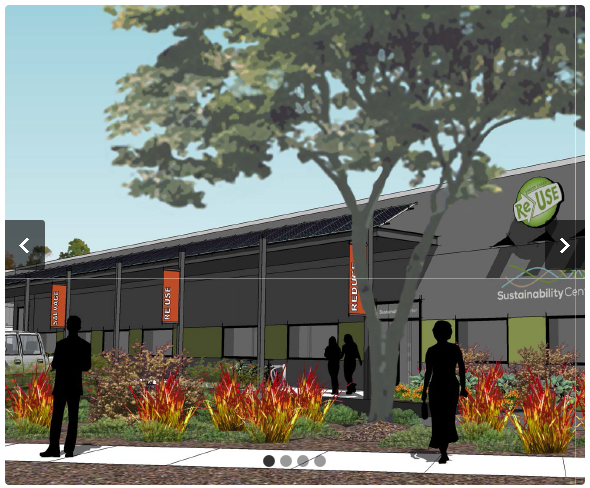
finger_lakes_reuse_ith_1

1. Leading off, the NYS Regional Economic Development Council Awards. In other words, the annual event where the state takes its economic aid money and an impartial committee is supposed to examine and decide who gets more or less money. It’s supposed to be competitive. I’d rather see the taxes not be collected in the first place.

Tompkins County gets placed in the “Southern Tier” category, which has been in the middle of the pack most years (as has its regional neighbor, “Finger Lakes”). Those two were 3rd and 4th this year out of 10, with a little over $80 million each. Most of it is going towards job training programs and studies/plans, but a few funded items stick out:

-$2.8 million for Cornell to expand its vet school classes by 30 students each (120 total). The goal is to “Expand Rural Veterinarians”.

– $1.9 million for Finger Lakes ReUse to “construct two additional buildings”. I suspect one of those is the renovation of 214 Elmira Road for the new HQ (shown above).

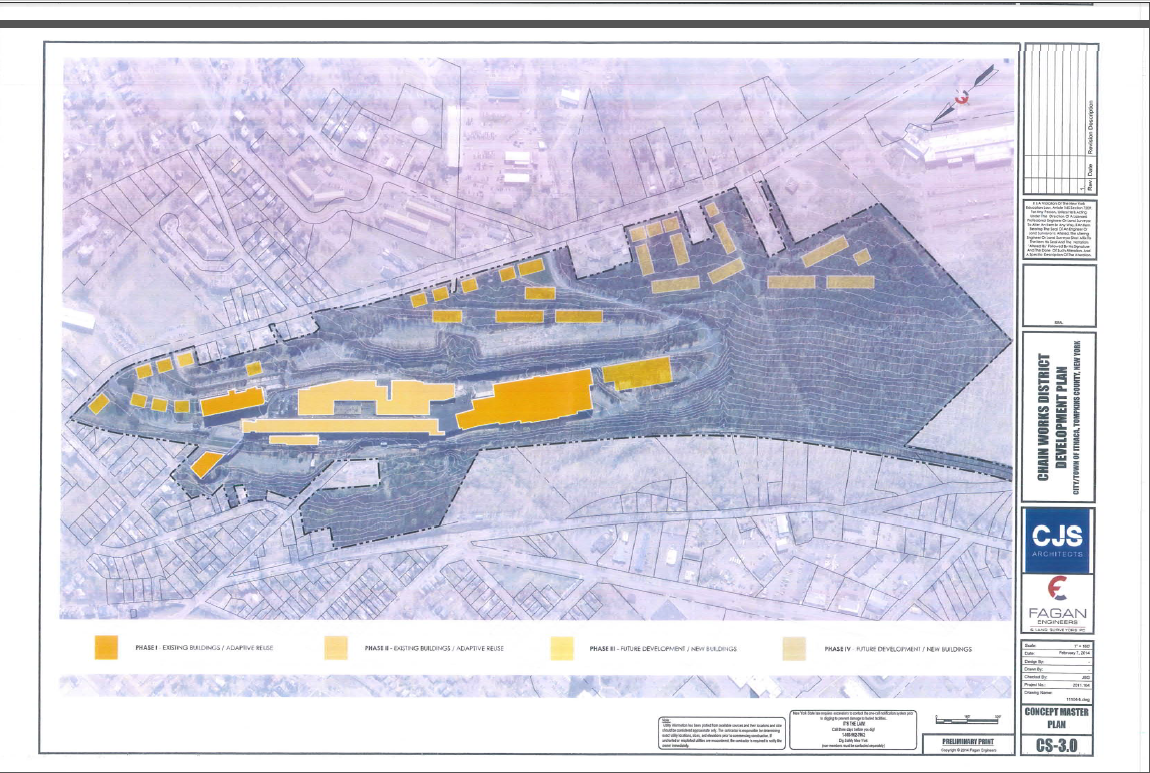
– $250,000 for the Chain Works District to help pay for energy efficiency and feasibility studies for the project.

130eclinton_rev3

2. Am I happy about the decision with 130 E. Clinton? No. This has little to do with mixed-use or steep hillsides. I firmly believe that it became a popularity contest and a referendum of Fane’s character. My concern is that this risks becoming the norm, and has the potential to be a lawyer’s paradise. I also don’t look fondly on frequent and fervent opposition to development when housing costs are spiraling upward.

Opposite side of the coin, it couldn’t have happened to a more deserving person. Other contentious projects – Stone Quarry, the Marriott, Collegetown Terrace, Cayuga Green, just about every other project built in the past 20 years – squeak by at least in part because the developers don’t come across as combative, conniving assholes. Plus, Fane himself is quite wealthy, which doesn’t exactly help an argument for tax breaks.

Well, I’ll move this one into the “mothballed/dead” column. With this and the Maguire proposal hitting a dead end, this has not been a good couple weeks.

carey_rev4_2

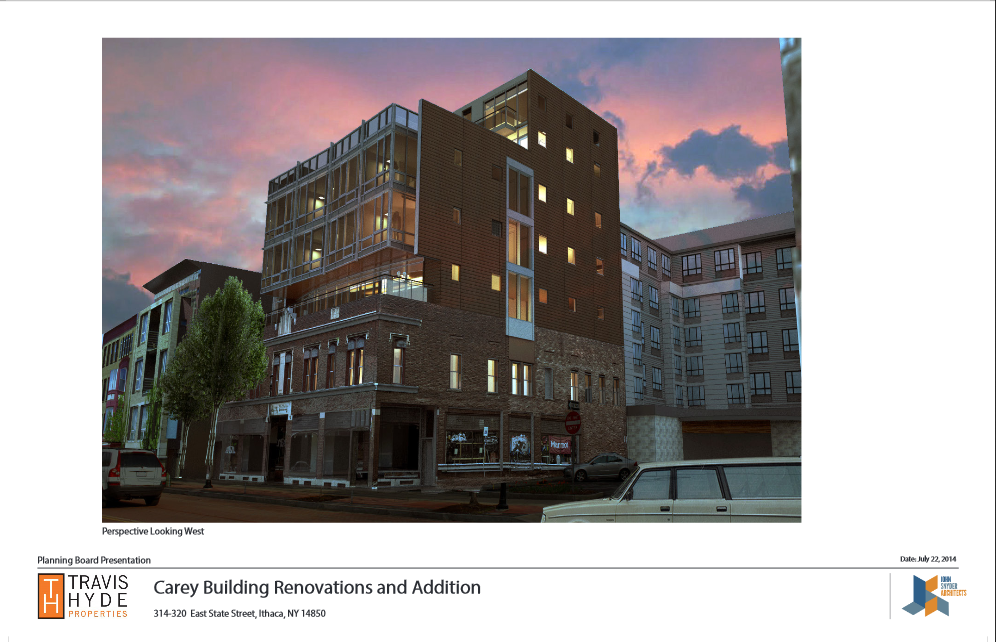
3. On a different note, the Carey Building tax abatement was approved unanimously. At least some developers know how to play nice. Look for the additional REV incubator space and 20 apartment units to start construction shortly and open for renters in August 2015.

4. Down in big box land, the former Kmart space looks to be filling out with new tenants. Discount clothing store chain TJ Maxx has agreed to take 21,770 sq ft of space, and Five Below (a teen retailer specializing in products $5 or less – it sounds like the product of a one-night stand between Dollar Tree and H&M) has agreed to take 8,208 sq ft of space. The old garden center will be replaced with a 16,200 sq ft addition, a revision of the previously-approved 14,700 sq ft. Benderson Development is redoing the front facade for TJ Maxx, and needs a couple of minor area variances. Readers might recall the Ithaca Kmart closed in 2011, and its sister store, Sears, is closing this winter. If this is any indicator, then there’s hope that the Sears space will be re-occupied soon enough.

Not much else of note for zoning trifles from the city’s Planning Board meeting – someone wants to build a new 2-family home at the corner of Oak Avenue and Oneida Place in outer Collegetown, and a house on Heights Court in Cornell Heights is trying to get increased occupancy for unrelated tenants. For the first time in several months, no new sketch plans are due to be presented at a Planning Board meeting; the holiday and earlier-than-usual monthly meeting are probably a big part of that.

5. Not much to report for Ithaca town’s Planning Board meeting either – a proposal for a new duplex at 636 Coddington Road, and an expansion of the East Hill Plaza branch of Collegetown Bagels into adjacent empty retail space. That winter slowdown is in full swing.


News Tidbits 12/10/14: Content Being Contentious

10 12 2014

This one is coming out early this week for the sake of timeliness.

carey_rev4_1130eclinton_rev2

1. Thursday the 11th, the county IDA votes on whether to approve tax abatements for two downtown projects, Travis Hyde’s Carey Building addition and Ithaca Renting/Fane Org’s 130 East Clinton. The $4.1 million Carey Building addition adds 9,000 sq ft of incubator office space and 20 units, 16 of which are 300-450 sq ft studios. 130 East Clinton would add 36 units in three interconnected buildings on a steeply sloped parcel adjacent to the city police HQ, at a cost of $4.4 million. The multi-year tax abatements are in the range of $850k each.
At the public hearing for the two projects, the Carey Building attracted little attention and dissent (which isn’t to say that there hasn’t been any), but Fane’s project attracted much ire. I’m not going to defend Fane’s character. Heck, the man’s been combative through this whole process. But I will side with the trustworthy opinions of Cornish, DeSarno and others that it contributes something to the very tight housing supply and it is a welcome resource. Denying the project by virtue of it being Fane is legally perilous and sets a bad precedent, and saying it’s a bad spot…well, it’s downtown Ithaca, where high-density lot use is expected. If Fane didn’t think he could get the environmental assessment approved he wouldn’t have proposed it. We’ll see what the board decides.

5-8-2012 347

2. Up on South Hill, Ithaca College is holding meetings to flesh out its new master plan. Similar to the plan Cornell published in 2008, the purpose of the master plan (website here) is to determine what the space needs are for different assets and programs of the college, and figuring out where to put them. The master plan is being spearheaded by Perkins Eastman out of NYC. The previous plan by Sasaki Associates was published in 2002 with a refresher in 2010, so to get something out in 2015 would be appropriate. I did a writeup on the old IC plan way back in August 2008. Don’t expect any new plan to be followed to a tee- the athletic center ended up on the complete opposite of IC’s campus than originally planned. But it will provide insight as to what IC wants to build through the rest of the decade and beyond. Key things to looks for – dorm sites in case the college decides to expand its student population, and new program space, which tends to get built sooner or later (for instance, the Business School addition, Athletic Center, and Peggy Williams Center from the 2002 plan).

wegmans_rev1_1 wegmans_rev1_2

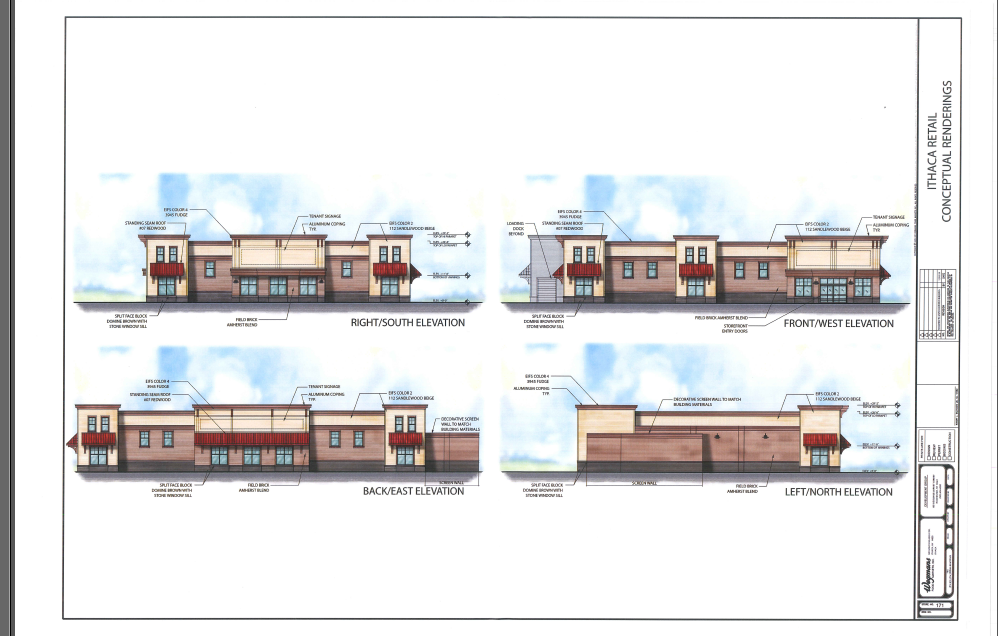
3. The 15,700 sq ft retail pad proposed by Wegmans is up for final review at the December planning board meeting, accordingly to the city projects memo. Compared to the initial design, the building has been rotated on site so that its long axis is now north-south, and the design itself received a number of tweaks, though the overall design theme is still the same as before. There have been some concerns raised by local wine and liquor store owners that it could be home to liquor/wine store, similar to what Wegmans has done at other sites in Johnson City and Buffalo. However, that is one of only a few ideas being floated, and the planning board doesn’t vote on what type of store can be allowed to open in a building, that’s a debate for the Common Council.

maguire_v2_1

4. Looks like the Maguire plan has hit a dead end. According to the Times, the Maguires want the site rezoned rather than a specialized PDZ for the property. Looking at the PDZ regulations, the town’s idea would give more freedom in regards to property use, but it also gives the town the right to regulate the form and layout of the structures on site. I guess the Maguires aren’t fond of that. The town just completed its comprehensive plan and is trying to get its new form-based zoning together, so the Maguires are essentially usurping something the town spent years working on. In conclusion: no dice. The Maguires are still interested in doing something, but it may not be in Ithaca town. Though with as packed as the city is and as questionable as Lansing can be, I’m not sure they have many options.

5. Over in Lansing Village, a mothballed project is getting a revival. “CU Suites” (aka Manley and Richard Thaler, who own the Triphammer Marketplace) proposes a 3-story, 43,000 sq ft building on the west side of Cinema Drive, on a site that is currently a vacant lot. Interestingly, this site was previously approved for a mixed-use structure with those parameters in fall 2012, consisting of two commercial spaces and a 39-unit apartment building, but that plan was never carried out. The proposal before the board seeks “alterations and possible clarification” to the project. No updated renders on the village website, but a site plan of the previously approved plan can be found here. Before the previous plan was approved, the site has been marketed for an office building for two years, to no avail (the market for office space in Ithaca is pretty weak). We’ll see what happens, maybe this one will finally get underway.

707_East_seneca

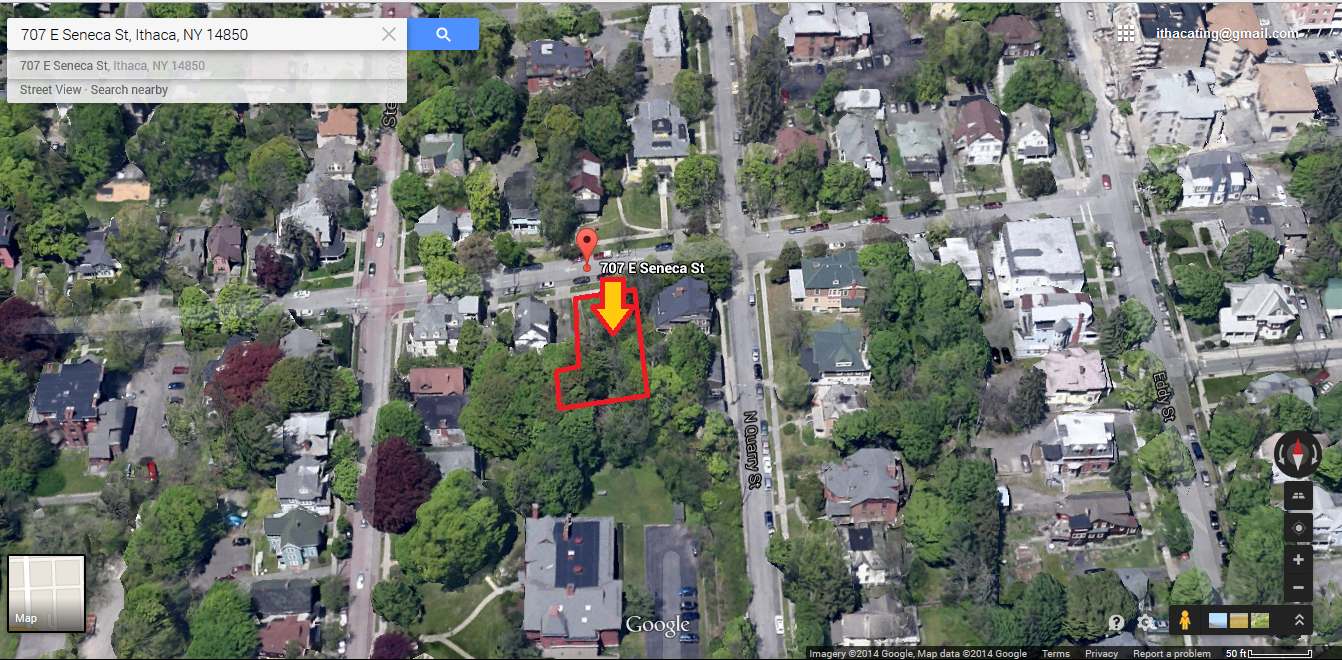
6. For what it’s worth, the proposal at 707 East Seneca appears to be student housing. Applicant Todd Fox (a local developer who’s done a few other small projects in Ithaca and Dryden) wants to build six units with sixteen bedrooms, five 3-bedrooms and a basement 1-bedroom, situated next to four parking spaces tucked into the hillside (four more spaces would be out in the open). I’m not sure how so many units are possible, since I thought the maximum allowed on site was four units. I’d love to see how it looks, but there’s nothing on the city website (which, sidenote, has been “updated” and now has information of three separate websites, the new one, E-govlink and “TSSERR”; the notification emails don’t work and it’s driving me nuts). If something comes up, you’ll find it here sooner or later.


News Tidbits 12/6/14: Looking Forward, Looking Back

6 12 2014

11-24-2012 174

1. Not exactly a development, but this will make things interesting: As reported by the Ithaca Journal, INHS and Better Housing for Tompkins County (BHTC) are merging. Both of them have the same purpose, which is to provide low-to-middle income housing and structural rehab services, but INHS has traditionally focused in Ithaca city, and Better Housing in the rural towns. INHS also holds far greater assets, $24 million including 241 rental units , vs. BHTC’s $3 million and 121 rental units.

Over the past few years, INHS has put a lot of feathers in their cap. $2.13 million in grants has been awarded to the non-profit in just the past few months. Breckenridge Place and Holly Creek are complete and nearly complete respectively (total 74 units), while Stone Quarry and Greenways are prepping for site clearing and construction (total 81 units). Along with Cedar Creek and several single-family and duplex units, INHS has had a hand in over 120 units of housing in the past five years alone. With the Neighborhood Pride site undergoing concept design and the recently-awarded grant money, that number will almost certainly be greater in these next five years.

The story for BHTC has been quite the opposite. The 65-unit Lansing Reserve proposal failed due to neighbor opposition, and the 58-unit Cayuga Trails project for West Hill failed due to wetlands on site being greater than anticipated (and the neighborhood opposition didn’t help). BHTC has five older facilities in Trumansburg, Newfield and Slaterville Springs.  With any hope, the merged non-profit will qualify for larger grants, and BHTC can finally get some shovels in the ground in the hamlets and villages outside Ithaca.

On a separate note, it looks like INHS did its annual website update, formally announcing plans for a single-family home at 304 Hector Street on West Hill. The lot was purchased in late October after a plan to buy and renovate a home in Northside fell through. Stone Quarry will begin occupancy next September, and Greenways hopes to start in 2015.

112_blair_1

2. Here’s the site plan for 112 Blair Street. I’d include renders, if the sketch plan had any. Two buildings with two units each and three bedrooms per unit -> 2 x 2 x 3 = 12 bedrooms. Nothing large, just an infill project tucked away from the street. The design will be created by local firm Schickel Architecture, the same ones doing the Maguire project in Ithaca town. As noted by Planning Board member John Schroeder in a recent Sun article, projects like these won’t alleviate the housing crunch by themselves, but every little bit helps, and all the better if it recaptures living space from an underused parking lot.

canopy_hampton_rev4_1

3. Final design for the proposed Canopy Hotel? Possibly. In comparison to the last design, this latest incarnation adds more windows to the east face. I’m not going to lie, after six or so sets of designs (include three complete re-dos), I’m starting to lose track of the changes. On the upside, the latest project plan from the city’s documents includes some neat context views, renders of what the building would look like from various vantage points in the city.

114_catherine_rev4_1

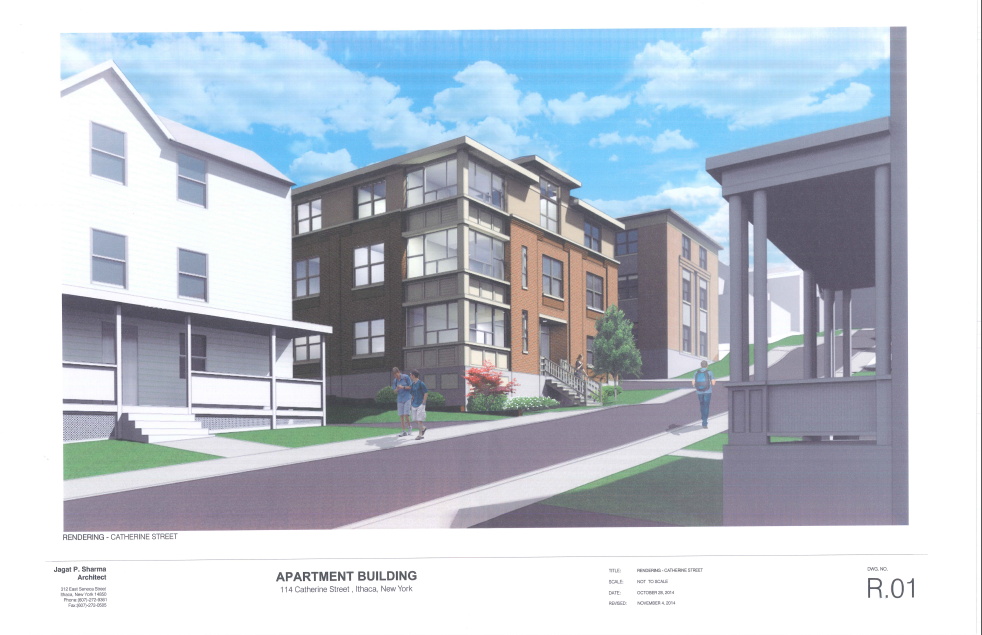
4. 114 Catherine has been approved, its Spring construction date looks good to go. When completed in August 2015, 17 more bedrooms will enter the Collegetown market – a drop in the bucket, but a valuable drop nevertheless.

chain_works_rev2_1

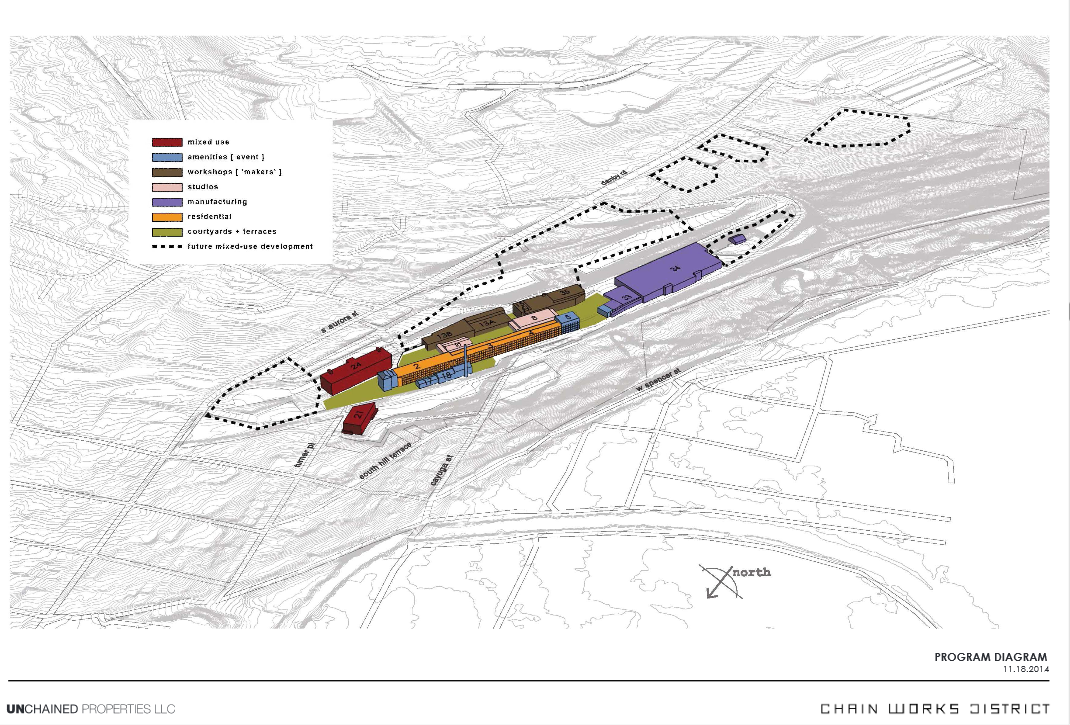
5. Towards South Hill, review of the draft generic environmental impact statement (DGEIS) continues for the massive Chain Works District proposal at the former Emerson Power/Morse Chain site. A scoping document of that DGEIS can be found here. In a nutshell, a DGEIS is part of the State Envrionmental Quality Review (SEQR), where the leading agency looks at a project, determines if any adverse project impacts are properly mitigated, and if so, issues a statement giving a negative declaration (approval). In this case, the NYS DEC also needs to be on board, approving the contaminated site for residential use. This is a pretty complicated project. There’s 800,000 sq ft of space to be removed or re-purposed, in an environmentally compromised site split between two political entities who are conducting joint meetings with their planning boards in an effort to try and move this project forward (the town of Ithaca board deferred to the city of Ithaca for lead agency; and both have been evaluating using their respective specialized mixed-use zones).

So far, there have been no nasty surprises on the polluted site. The site is mostly clean but still needed a little more for residential use, and Emerson will be flipping the bill for that. The comment period on the draft runs through the 10th, and the DGEIS will be finalized on the 16th. According to the project website, developer Unchained Properties LLC hopes to start Phase I, the renovation of four on-site buildings (21, 24, 33 and 34) into mixed-use and manufacturing space, during summer 2015. The mixed-use was initially proposed as office space only; but the developer behind the LLC (David Lubin) has struggled to fill the proposed office space in his Harold Square project, and seems to realize that having less office space would be a better plan for Chain Works as well.

6. The Cornell Daily Sun is reporting that the owner of CTB (Collegetown Bagels) is buying the Rulloff’s property and reopening the restaurant after it abruptly closed over the Labor Day weekend. The property was on the market for $395,000, and it’s fair to say the price was probably close to that figure. The murderous Edward Rulloff lives on.


Lofts @ Six Mile Creek (Cayuga Place) Update, 11/2014

5 12 2014

As much as I hate to entertain the currently-fashionable use of prepositions in project names, and the “@” symbol to make it modern and hip, that is the official name for what was the condo portion of Cayuga Green. More notably, the project website describes these as apartments rather than condos as initially planned. Apartment projects are easier to get financing for since it’s generally easier to find renters vs. buyers, but given some of the discussion about the need for owner-occupied units that has come up lately (the Old Library redevelopment comes to mind), this is a mild disappointment.

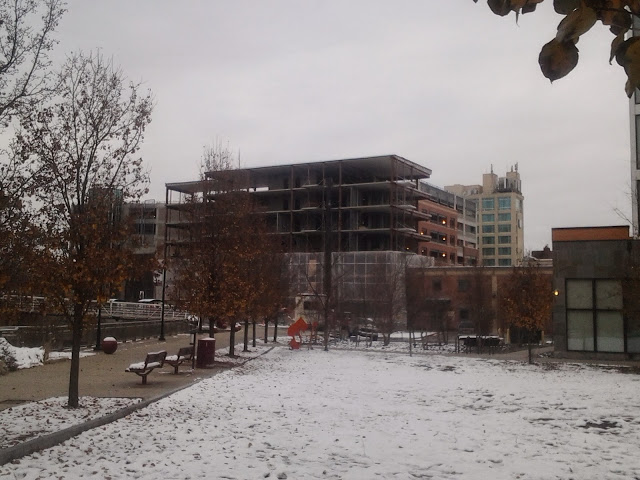
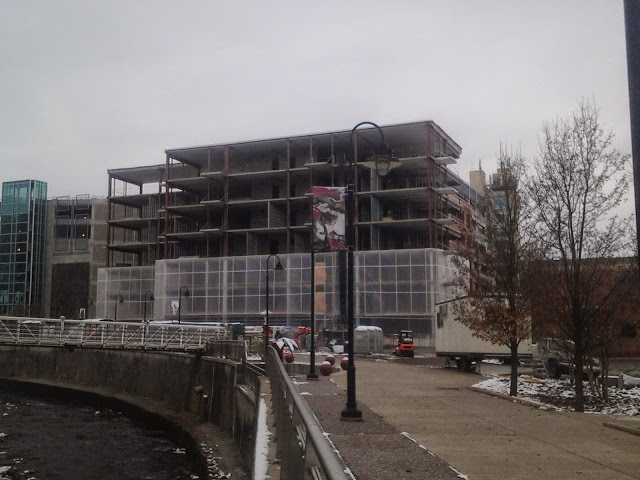
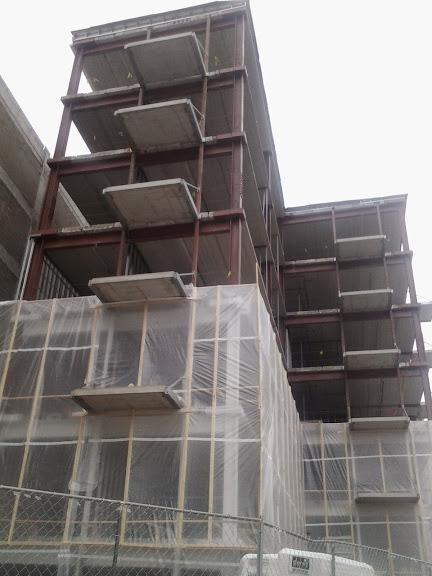
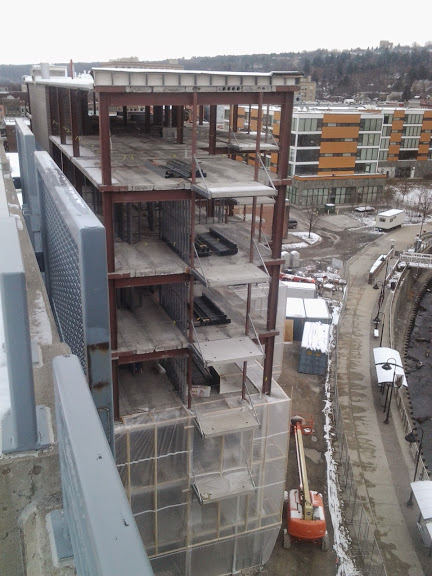
The 7-story, 45-unit, 49,244 GSF apartment building topped out on October 2nd. The concrete floors were poured and the balcony pads were craned into place and secured throughout the fall. Peering into the building from the parking garage, some steel wall frames have been erected on the upper floors, while rough interior work seems to be underway on the lower floors. The plastic sheathing is to break the winter winds and keep the space above freezing.

Developer Bloomfield/Schon + Partners planned to release leasing/pricing details last month, but I haven’t heard anything yet. Completion for the project is set for late Spring 2015, which according to their facebook, is a little later than intended due to material supply delays created by the rough November weather (curse you, polar jet stream). If the last photo is any indicator, the upper-floor units are going to have some fantastic northeast views.

As noted before, this project makes the completion of 15 years of planning and construction. At 45 apartment units, It’s also one of the largest non-student-related projects slated for a 2015 completion – the 35-unit Stone Quarry Apartments and the 21-unit 323 Taughannock are also pegged for 2015 completions.

20141129_135747 20141129_135859 20141129_135828 20141129_135807 20141129_140005 20141129_140241 20141129_140308


News Tidbits 11/22/14: The Quiet of An Early Winter

22 11 2014

maguire_v2_1

1. Here’s the first revision for the Maguire proposal in Ithaca town. With different building sizes and parking layouts, about the only thing that remains the same is the general site configuration. The planning committee packet has its retinue of numbers to help sell the town on the project; 50 new jobs and 100 transferred to the site (average wage $44,300), with an extra $2,000,000 in taxes for the town. The town is being cautious about the project because it relocates a proposed park (Saponi Meadows), and the project doesn’t fit with the just-completed Comprehensive Plan. Zoning would need to be amended, and the trail to Tutelo Park would hinge on a land donation to the town that also seems to involve them taking responsibility for the roads on Ithaca Beer’s property. Observant readers will recall Ithaca Beer is undergoing an expansion of its own.

maguire_v2_2

From SW to NE, you have the Subaru/Hyundai dealership, the Fiat/Alfa Romeo/Maserati dealership (those wealthier Cornellians need to get their GranTurismos and Ghiblis serviced somewhere), the corporate HQ and the Nissan dealership. The dealerships themselves will follow carmaker-approved design language, as the examples included in the packet suggest. Two lots on either side of the corporate office are tagged for future development, and an Audi/Porsche/Jaguar dealership is included in the dealership renderings, but not in the site plan. The project would be LEED certified, have electric car stations, walking trails, a loop road, and a coffee bar/cafe. Unique to the project would be apple and cherry orchards and vineyards – I suppose this is where the “artisanal” moniker comes in. We’ll see how warm the town is to the project after the presentation.

roccorner_libe_0414 travhyde_libe_0414 franklin_libe_0414 dpi_libe_0414

2. In other presentations, this one for the county, the Old Library Committee is recommending that all four of the remaining Old Library proposals be asked to submit formal proposals. Last Friday, the county also opened up a 10-day comment period on the RFP draft document. Personally, I don’t see much to add to it, and most of it consists of things that would be great if one project had it all – but none will. It’s what HR recruiters call a “purple squirrel“, a perfect candidate that has a vanishingly small chance of applying. It requests green building, affordable housing, purchasable units, mixed uses, and a special meeting with the stringent ILPC (Ithaca Landmarks & Preservation Council; I recall notes from a recent meeting where they had an argument on whether solar panels were appropriate for historic buildings and districts). I don’t believe any project on that site can meet all those and still hope for a construction loan from a private entity. Condos (which is what purchasable units means in this case) are hard to get financing for, and affordable housing torpedoes the DPI and Franklin/O’Shae projects because they won’t break even at a lower price point, therefore no loan, no build.  I suspect Travis Hyde would also have the same problem, and the Cornerstone Group, while affordable, doesn’t have mixed use or green building measures. I understand it’ll be a “whatever comes closest” situation, but I feel like the county is setting itself and local residents up for a disappointment in one way or another.

114_catherine_rev4_1

3. Looks like the Times has had a busy week writing about local projects. A piece on 114 Catherine, a piece on 323 Taughannock, an article about the Troy Road project, and a piece on the Chain Works District. Gee, I wonder where they got the idea that local developments make for interesting articles? A fifth entry notes 85 people attended the brainstorming session for the Neighborhood Pride site, which is simply fantastic.

If I’m to recommend any of the four, it would be the piece on the Chain Works/Emerson project, which is in-depth and broad in its review of the site and its environmental issues. The writeup on 323 Taughannock notes that developer Steve Flash originally wanted a taller building on site, but soil conditions combined with the costs for a more substantial foundation made it cost-prohibitive (and unlike the Purity project, this was discovered well before any plans were approved).


4. Compared to much of this year, this month’s Ithaca city planning board meeting looks to be rather quiet. Agenda with all the attachments here. INHS will be giving a description of their “visioning process” for the Neighborhood Pride site, which probably means a rundown of how they’re going to come up with the design (the goal is to present a sketch plan of the project in March or April). The 114 Catherine and 128 West Falls Street infill projects are in the last stages of review, some discussion of the environmental assessment form is scheduled for the Canopy Hotel, and Purity is still trying to amend its previously approved plan. Also in the itinerary, formal review will begin of the 3,400 sq ft DiBella’s planned for big box land. In terms of sketch plans, there’s a review for a new children’s garden at Cass Park, and a pair of duplexes (4 units total) for what is currently a parking lot at 112 Blair Street, behind the houses on the embedded map. 112 Blair is zoned CR-2, meaning parking, vegetative buffers, and hipped roofs are required. It needs to be 2-3 stories and permits a max of 35% lot coverage (it’s a 6,390 sq ft lot, so about 2235-3353 sq ft per duplex, 1117-1676 sq ft per unit). Infill is always welcome, though hopefully they aren’t as plain as their State Street neighbors built a few years ago. News next week will likely be lacking due to the holiday, so the next development roundup will probably be in December.

climod_0101_1120
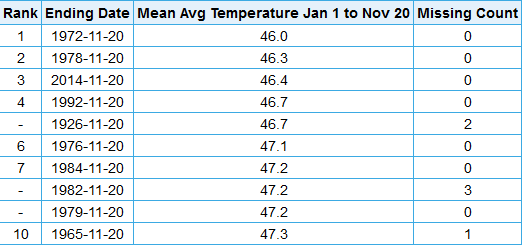
On a final note, we’re averaging the third coldest year since records started in 1893. Damn it, I want my global warming.

Oh wait, here it is. Virtually everywhere else except Ithaca. Sigh.


News Tidbits 11/15/14: For Better Or Worse

15 11 2014

hampton_rev2_2

1. I see the Journal (and Common Council) has touched on what is probably one of the biggest questions when it comes to housing in Ithaca – the affordability issue. As noted over at Ithaca Builds, it’s a complicated problem, and there is no silver bullet. We have a confluence of problems, many of them fortuitous – a growing economy and a desirable place to live, even if it has a dearth of developable land. On the other hand, wages aren’t going up as fast; so the problem gets worse. From 2000 to 2013, average income increased 61%, but home values over the same time increased about 105%.

I become very negative and cynical when I think about this issue. It gets lip service, but no one really wants to do anything about it. Development costs are expensive in Ithaca, so no developer wants to do it on their own dime. There’s also a mentality among some residents that affordable housing equates to ghettos and crime. West Hill is opposed to more affordable housing on their hill, South Hill would be very difficult due to simmering tension left from the Stone Quarry battle, Downtown’s too expensive without tax breaks, and Cornell students price out East Hill. There’s not much space that’s developable in the inner neighborhoods, only rare opportunities like the Neighborhood Pride site. Anything built outside the city is sprawl. I don’t see a solution to this problem. I only see it getting worse.

As for the hotel, the type of business it brings helps define the services offered by nearby retail. They probably won’t visit second-hand clothing stores, laundromats, or the local bank. But they will restaurants and bookstores and novelty shops. The shops will continue to evolve as they’ve always done – for better or worse, depending on who you ask.

marriott_rev1_1

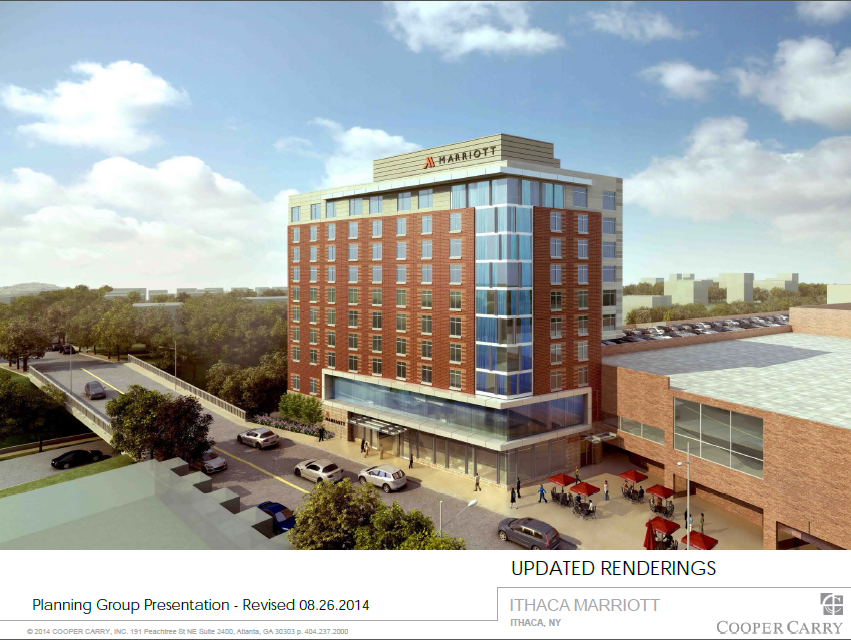
Switching gears but on the topic of hotels, Tompkins County and the city are making a killing on the high demand for hotel rooms, and 2015 is expected to be a banner year thanks to Cornell’s sesquicentennial and other big events. Literally, the report has “cha-ching!” written in the notes. According to the paperwork presented at the October Planning and Economic Development meeting, the city can comfortably accommodate either the Marriott, Canopy or Holiday Inn Express on 13 without a problem (no mention of the smaller hotel approved for 13, although it would be a blip in the market); the city/county can accommodate two of the three with only a minor hiccup. But if all three are built in the next couple years without a new driving force to bring in visitors, an older hotel further out in the county will likely close. My fingers crossed in the hope the Hotel Ithaca convention center gets the construction loans it needs, for that will be a boon to the hospitality market.

2. Looks like the land sale for the Amabel project is in the works after falling a little behind schedule. 617 Five Mile Drive is tentatively selling for the minimum price (the tax assessed value of $16,875), after New Earth Living’s initial bid for $10,000 was rejected. City gets money, land gets sold off and added to tax rolls, and down the line it gets used for housing. Win-win. I win as well, for a correct if easy prediction.

130eclinton_rev3

3. The county’s IDA is reviewing tax abatements for Jason Fane’s 36-unit 130 East Clinton project, and the 20-unit mixed-use Carey Building addition proposed by Travis Hyde Companies. The document for the Carey Building reveals a construction time from of December 2014 to August 2015 for the $4.1 million project, and the number of REV incubator tenants is now up to 9. The reason for the abatement is to take the reduced costs created by the abatement, and move the new units from the upper-end of the rental market to the middle. The applicant writer does a pretty effective job selling it, saying that it will help ameliorate the dearth of affordable rental housing if approved. No new jobs are anticipated, but then, this doesn’t count any company in the incubator. The requested property tax abatement plan, and with sales/mortgage abatements, is valued at $850k over 10 years.

Looking at Fane’s project, the document notes a start and finish date in “2015, hopefully 2015 but most likely completed 2016“. That does not instill confidence. The construction cost is $4.4 million. The property tax abatement isn’t explicitly stated in the document, referring to a spreadsheet that wasn’t included in the upload. However, it says it’s following a standard 7 or 10-year plan, so it’s in the ballpark of several hundred thousand dollars. The sales and mortgage tax abatement is $200k.

maguire_1

4. Here’s a site plan render of those “artisanal” car dealerships proposed by the Maguires. Both budget motels come down, but the “mosquito pond” as one commenter described it will still be there. Apparently, campus-like dealerships look a lot like corporate office parks. Saponi Meadows Park lies to the north of the line of trees, on the property adjacent to the Peachtree Lane homes. Saponi Meadows would be connected via the “Coregonel Remembrance Trail” to Tutelo Park in the upper right. The dealerships would be Subaru, Hyundai, Alfa Romeo, Fiat, Nissan and the corporate office for the Maguires. The developers predict 40-50 new jobs if built out. Local firm Schickel Architecture is responsible for the site plan.

troy_rd_rev1_1

5. It’s back. For the town planning board meeting next week, round two for the Troy Road housing development is about to begin. Some readers might recall this past winter, when it began as a 216-unit proposal. By August, it had entered red-tape hell, because neighbors were opposed to the PDZ it needed.  Details on the newest incarnation here. Now down to 130 units, a PDZ is no longer needed. The project will be comprised of 46 2-4 bedroom single-family homes, and 14 sets of 4-unit 1-2 bedroom townhomes (56 units total) and 14 duplexes (2 units each, 28 total). It seems a little odd to include single-family homes again, since those were cut from the last design because the developers weren’t sure there was a large enough market for them. Compared to the previous design,  this one is less sprawling, has an orchard and farm on-site, and looks to be eschewing the “rural agricultural”-style housing for modern units designed to exceed NYS Energy Code. With fewer units and no need for a PDZ, the project has a much better chance of approval.

6. According to the Syracuse Post-Standard, regional scrap metal magnate Ben Weitsman just bought a former industrial site in Syracuse and plans a retail and hotel development on the site. What does have to do with Ithaca? Nothing, at a glance. But as I noted last month, Weitsman has plans for his Ithaca property, plans that are waiting on the Brindley Street bridge replacement. What exactly those plans are isn’t known quite yet. But now we know he isn’t just interested in expanding scrap yards.

12-29-2011 010

7. Another piece from the IJ, this one a meaty write-up on the Ithaca Gun cleanup progress. This (hoepfully) last round of decontamination should be complete by the start of Spring 2015. IFR Development LLC (Ithaca Falls Residences), a byproduct of Travis Hyde Companies, hopes to present sketch plans for 45 units of clustered townhouses in December. Some will be 2 stories, others 4 stories with upper and lower units stacked on each other.

IFR_v1_1

On a whim, I googled “Ithaca Falls Residences” and this report from September came up, complete with renderings. How close they are to the current product, I don’t know. But I suspect they’re not too far off. Adjusting the timeline numbers, it suggests an early 2017 completion.


Fast Facts: Cornell Students By Major

11 11 2014

As always, all data is taken from the Cornell University Factbook. Numbers used in this entry are for undergraduate enrollments.

Offhand, I can think of two mantras when it comes to first-tier higher education:
– Go into a STEM field.

– If you’re at a really good school for undergrad (Ivy plus), go for business.

The logic in both is fairly sound. STEM fields are in demand and pay well (and as someone in a STEM position, I say that with a very big asterisk). The other is that our most brilliant minds can get the most return on investment by going into financial services such as investment banking, where you work for for a couple years at a place like Goldman Sachs or JPMorgan, go back for a couple years of B-school, and find yourself making $250k at 32 as a vice president of some random business activity. The popularity of that easily earned, highly lucrative business degree is the reason why Cornell started offered a campus-wide minor in business; one-sixth of Cornell’s students go directly the financial sector, which is actually down a little bit from previous years.

There’s also a third mantra, much more negative than the first two: humanities doom you to unfulfilled jobs in coffee shops or years of fruitless grad school labor. Unfair certainly, but the academic stigma, also known as “what are you going to do with that degree?”, is strong for liberal arts majors.

I decided to take the numbers and see if there were any trends in enrollment in certain fields over the years. Below are Cornell’s enrollments from 2002-2013 by CIP, “Classification of Instruction Programs“, which is used by government entities to track enrollments by study.

cip_trend_1

Looking at this, it’s easy to pick out some winners and losers over the past decade. Social Services, English, Family and Consumer Sciences, and Architecture have notable drops. Biological and Biomedical Sciences, Engineering, Agriculture and Business have grown. Liberal Arts shows no strong trend. Computer Science shows an interesting parabolic shape, which can be attributed to the tech bubble bursting in the early 2000s, and taking a few years to recover before entering the current tech boom.

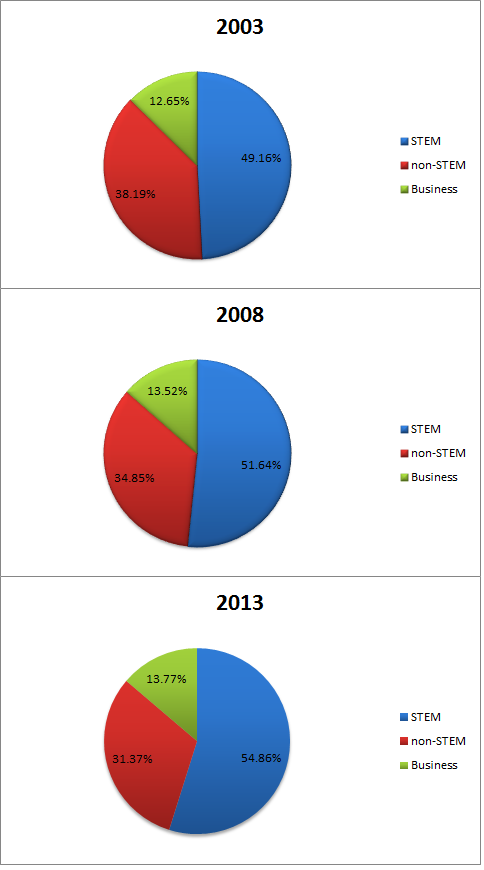
I’m going to take three years – 2003, 2008 and 2013, and split them into “STEM” and “non-STEM” for this next plot. The unknowns and multidisciplinary majors will be removed and I’m going to treat business separately. Non-STEM will be history, performing arts, social sciences, social services, psychology, philosophy, liberal arts, english, family and consumer science, foreign languages, education, personal services, communication, architecture, and area/cultural studies.  STEM will be physical sciences, nutritional science, math, biology, engineering, computer science, natural resources and agriculture. I’ve made an attempt to separate “hard” sciences from “soft” sciences, and I realize there’s plenty of room for debate which categories belong in STEM and non-STEM, but I’ll leave that out for now.

cip_trend_2

Over time, non-STEM is decreasing, while STEM and business are increase their share of the Cornell student population. It could be that there’s genuinely more interest in business and STEM, or Cornell students could simply be more pragmatic these days, choosing things that offer cold hard cash versus the educational enlightenment of the arts and humanities. Feel free to leave your comments.


News Tidbits 11/8/14: Getting the Word Out

8 11 2014

1. Let me start by acting all civic-minded and promote the public meeting INHS is hosting for the Neighborhood Pride site in the Northside neighborhood of the city. November 12th, 4:30-7:30 PM, inside the former grocery at 210 Hancock Street. As Jason at Ithaca Builds noted a few months back, this will likely be the largest development on the north side since the 1950s.

Here’s why your opinion is important. The site has walking access to many local venues, affordable housing is in very high demand, and the site as it currently stands is underutilized and an easy target for vandalism. INHS is looking to avoid a repeat of the battle that happened with Stone Quarry, and is actively engaging with the community to see what will and won’t mesh with neighbors. In theory (under zoning and given some assumptions), the site could host nearly 200 units of housing.  The city has already expressed a strong preference for an owner-occupied housing component, and the city comprehensive plan supports some small-scale commercial uses at the site, with higher-density residential. There have even been reports that the Sciencenter is interested in playing a role. So that’s the sort of framework here; how much housing, what proportion of renters vs. owners, and what sort of mixed uses if any.

chain_works_rev1_1

2. Well, this isn’t good – according to the Ithaca Journal, recent findings by Unchained Properties, the developer for the Chain Works District (a.k.a. the Emerson redevelopment), suggest the site is even more contaminated than previously thought. While the developer has said it remains committed to the project, I dread an Ithaca Gun repeat, where continually-worse pollution causes the project to grind to a standstill. According to the purchase agreement that Unchained Properties has with Emerson (which although it closed up shop in 2010, still owns the site), Emerson pays for all the remediation, which I suppose they’re okay with if it means getting rid of the site from their asset lists. A draft environmental impact statement is due for submission sometime after Christmas, with several city/town/developer meetings and discussions in the meanwhile.

dibellas_2

dibellas_1

dibellas_2

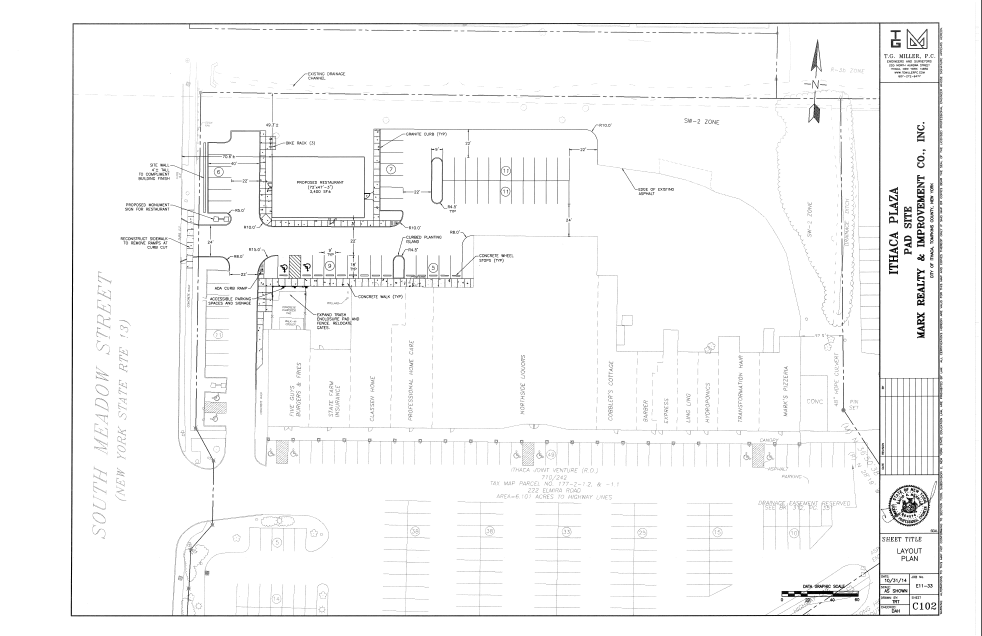
3. Now, I know everyone’s been complaining – we need more more suburban GeneriMerican chain restaurant boxes with ample parking. Your prayers have been answered! This time, the newcomer is DiBella’s, a chain sub sandwich restaurant based out of Rochester with about 43 locations scattered throughout six states in the Northeast and Midwest. Dibella’s “theme” is a vague 1930s/1940s look; the one near my office is just really dimly lit, reminiscent of my dead grandmother’s living room. Snark aside, the chain is looking to build a 3,400 sq ft building on an outparcel pad property at 222 Elmira Road – just north of Five Guys, and behind the Ithaca Shopping Plaza. Follows the “real estate guidelines” on Dibella’s website near-perfectly. Cover letter here, site plan review application here, more drawings and renders here, full environmental assessment form here. The application states that the construction cost will be about $600,000 and the time frame is from February to August 2015. They’ll need a BZA variance for lot coverage, which I don’t foresee being an issue. The plan is by NYC-based Marx Realty. It’s tax money, it’s “5+/-” jobs. Meh.

114_catherine_rev4_1

4. Some minor revisions to 114 Catherine, new renders here. Compared to the previous iteration, it has a little more detailing on the concrete base, and they changed up the panes in those corner windows. here’s the traffic plan, which kinda just states that students have access to buses, bike racks, delivery space and a little parking in the rear, and their own two feet. This one’s pretty much good to go for approval.

libe_0414

5. Friday the 7th, the county has another meeting to discuss the Old Library site, this one to finalize and release the actual RFP. For those interested in going tomorrow, it’s at 3 PM in the Heyman conference room at 125 East Court Street. I have a major concern here – the final choice on developer was supposed to be in March 2015. Now it’s January 2016. The county is putting an additional strain on all the proposals, because labor and material costs are increasing. This has the potential to remove desirable features from projects, or cause developers to simply walk away. The county was very fortunate to have six expressions of interest for the site; two have already walked away. If the county doesn’t get its act together or is perceived to be acting in bad faith, the potential is there for very few or no proposals when the due date comes in March 2015. It will be a very uncomfortable day for the legislature if that happens.

6. This could be interesting – according to the Times, the Maguire family (the ones with all the car dealerships) are proposing a new set of dealerships on the site of the current Rodeway Inn, south of the city on Rte. 13. The inn is looking to move to California (claiming the hotel boom is hurting his business) and the Maguires are proposing the following moves:

>Move sales of their Subaru-Hyundai, Fiat-Alfa Romeo, and Nissan dealerships — from Elmira Road out to the new site in the town. The site is currently vacant land, and the Economy and Rodeway Inns would be removed.

>relocate its Chevrolet Cadillac dealership from Lansing to southwest Ithaca city, where a new building would be built

>renovate its Dodge Chrysler Jeep Ram dealership in front of Wegmans.

It sounds like the only place losing business is Lansing. In a blend in all that is obnoxious and trendy in today’s planning, they’re calling it an “artisanal car dealership”. You sir, get a facepalm. Apparently, artisanal here means “modern architecture and a naturesque, university-style campus”. “Naturesque”. Another facepalm. Regardless of artisanal features, the project requires relocating the town’s proposed Saponi Meadows Park, and doesn’t fit with their comprehensive plan. Any movement on this will be slow (they tell the town they’re shooting for late 2015-2016 for a start date); but when those fancy artisanal renders come up, you’ll see copies of them here.


Fast Facts: Cornell Students By NY County

4 11 2014

Unless otherwise noted, all source data comes from the Cornell University Factbook. For this, I’m only going to focus on the undergraduate population.

When I was a student at Cornell (oh, for those halcyon days of the late 2000s…yes, I am joking), there was a quip that 38% of the students come from New York State, but 90% of them are from New York City and its suburbs. An exaggeration, but the large presence of Westchester and Nassau and the like was forever a source of tension, if only a minor one. With access to Cornell’s enrollment figures, we can see by just how much downstaters dominate the student population.

For anyone from outside of New York, this post probably won’t be a whole lot of interest to you. But for the kids that want to play along at home, here’s a map of the counties of New York, all 62 of them.

map_ny

nys_cornell_county_fa14

nys_cornell_county_fa14_2

In what should be a surprise to absolutely no one, Nassau County on Long Island and Westchester County comprise the largest sources of Cornell undergrads – 654 and 607 students respectively. Given 14,453 undergrads in fall 2014, that means these two counties alone account for 8.72% of the UG population. NYS students number 4,602 of that 14,453, 31.84% of the student body. If we define downstate as Orange, Putnam, and everything south (the definition of where upstate and downstate divide is fraught with contention, so I’m going with a rough middle ground), then downstate comprises 2,971 of those 4,602 students, 64.56%, or just under two-thirds. Only one county has no representation at Cornell – Hamilton, which has only 4,773 residents (2013 estimate), the smallest population for any county in the state.

Now, I can already hear the commentary now – “BC, you misleading and ignorant a–hole, these numbers should be presented per capita.” Way ahead of you, irritable dear reader. I downloaded the 2013 county census estimates and decided to do a little data magic, looking at enrollment per 100,000 residents of a given county.

nys_cornell_county_fa14_3

Tompkins dominates, no surprise there. Westchester is next, showing that living in a county comprised of mostly affluent, tony suburbs with school districts to match is handy for getting into the Ivy Leagues. From there, we see it’s a mix of New York City’s affluent suburbs and counties close to Tompkins – though St. Lawrence, up by the Quebec border. is something of an anomaly.

One more thing I wanted to write up before concluding this post, which really only scrapes the tip of the iceberg. The percentage of NYS students continues to decrease as the enrollment increases, as shown below. In fall 2002, 38.93% of students came from NYS; in fall 2008, that number shrank to 33.85%; and by fall 2014, 31.84%. I have no idea if the state has any sort of minimum number or floor percentage that Cornell must adhere to, but if the trend continues, I could imagine some legislators pushing for one.

nys_cornell_county_fa14_3

In sum – the 38% value hasn’t been accurate since 2002, so that quip was outdated by the time I started my time at the Big Red. The 90% value is also a little high, but there’s definitely a large contingent of NYC suburbanites in the student population, and it doesn’t see, so large when broken down to per capita values.