206 Taughannock Boulevard Construction Update, 12/2014

30 12 2014

Okay, I’ll be completely honest – I don’t know what’s going in here. I don’t know what the mix of uses is, or many residential units there are. Here’s what I do know.

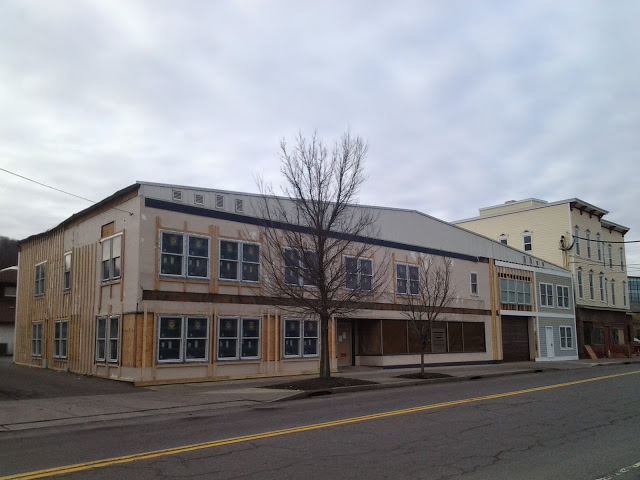
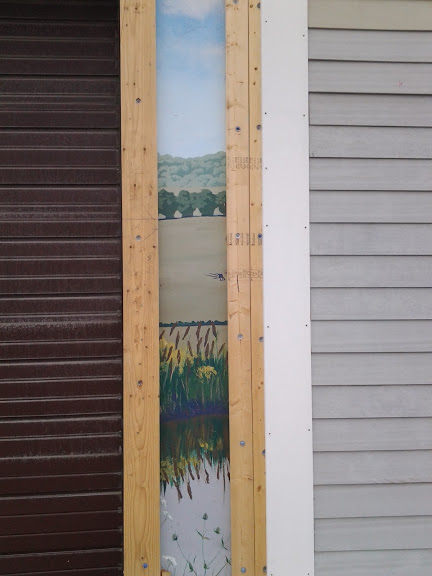
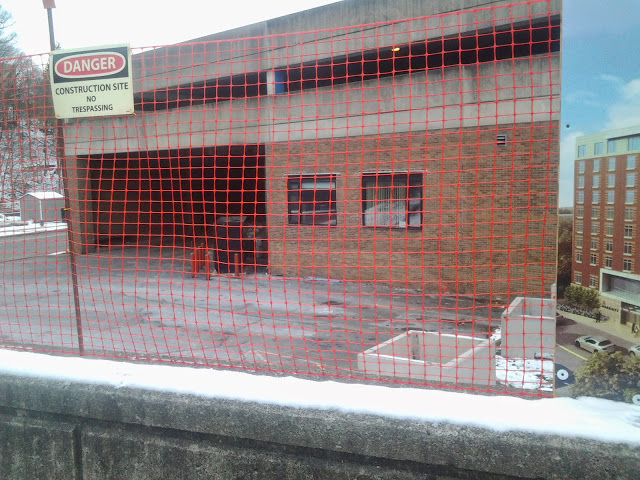
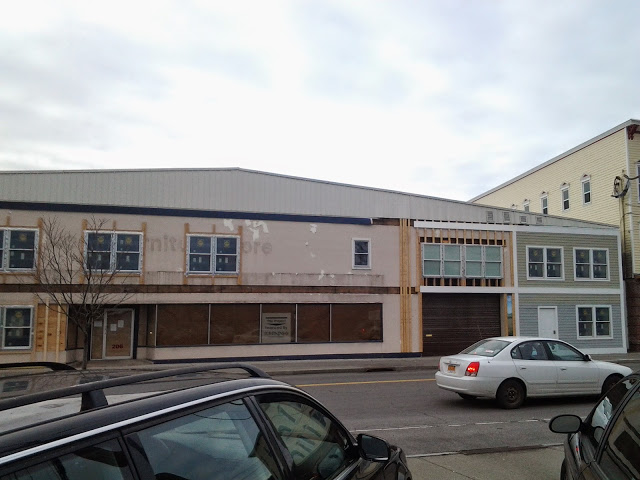
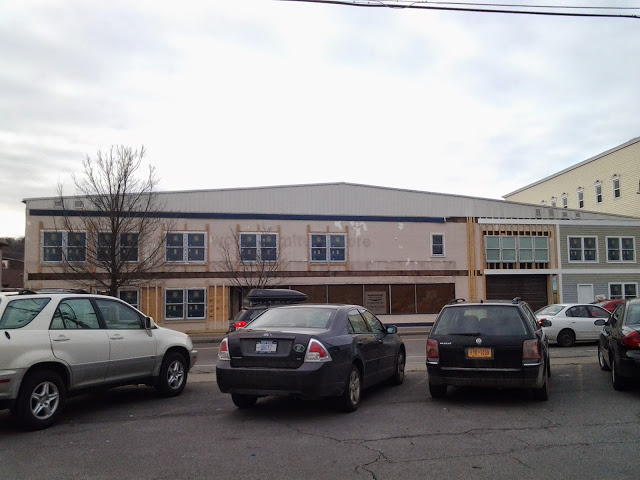
206 Taughannock was until earlier this year the site of the Unfinished Furniture Store (otherwise called the “Real Wood Furniture Store“) owned and operated by the Zaharis family. From the county records, the building itself is a 9,156 sq ft structure originally used for retail and warehouse space and dated to sometime in the 1970s. The store closed in April when its owners retired, and a building permit shown in a ground-floor window was issued in July to the Zaharises. I ran this past IB’s Jason on Twitter, and his guess was about as good as mine; residential units on top and maybe some of the bottom, with a reduced retail space. Photos of the store before renovation can be seen here at Ithaca Builds – the Lehigh Valley House next door is being renovated by its owner (Tim Ciaschi) into 6 condos and ground-floor commercial space. With the 323 Taughannock project approved just up the road, Inlet Island has been seeing increased interest from both current owners and prospective developers. Perhaps the biggest loss is the removal of a rather attractive mural from the front of the structure.

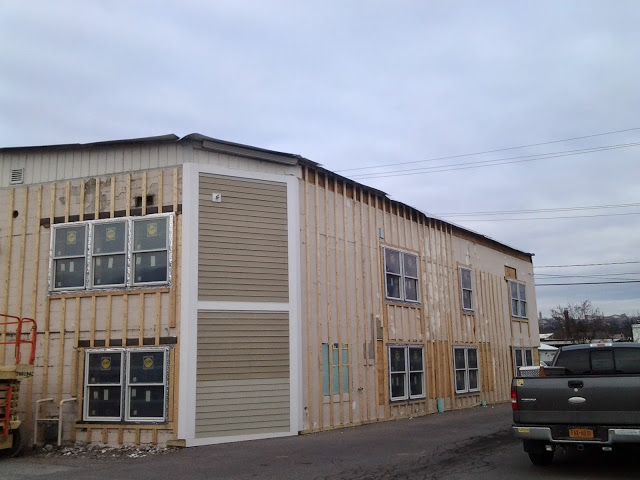
The work itself looks like a complete gutting of the original two-story building, with new windows punched into the walls and sedate exterior (fiber cement?) siding attached to the more complete exterior sections.

I reached out to the owners but have yet to hear a reply; if anyone has some info to share, feel free to reply to this post or send an email. These projects are the most fun for me, because they go without fanfare, but are just as important as any other project of equal size; they lie in wait for discovery and publication.

20141227_144617 20141227_144631 20141227_144707 20141227_144748 20141227_144755 20141227_144900


EcoVillage Construction Update, 12/2014

29 12 2014

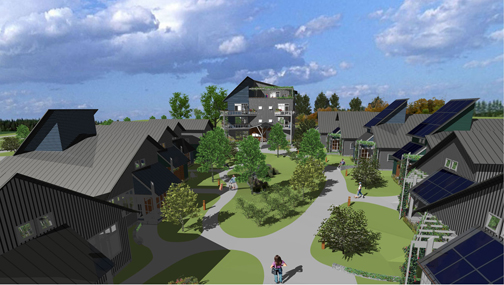
Heading over to West Hill, construction continues slowly but steadily on EcoVillage’s 4-story Common House/apartment building as part of its third neighborhood, TREE (Third Residential Ecovillage Experience, following its first two, FROG and SONG).  I can’t seem to find any specific values for the number of bedrooms in the apartment building, but there are 15 units ranging from studios to 3-bedrooms. However, using a little math and deduction, a rough estimate can be established. EcoVillage claims 160 residents in its first two neighborhoods, which have 30 units each (total 60), and they expect 240 residents when the 40-unit TREE neighborhood is complete. That gives 80 residents in 40 units, of which 25 of those units are houses. Houses tend to have more occupants than apartments (2.1/house vs. 1.7/apartment from the 2010 county census), so I think 25-30 residents is a fair estimate for the apartment building.

Interior work is underway and all the windows and doors are fitted into place. Exterior finishes and balconies have yet to be installed. The houses are all complete and occupied. Construction is being handled by a local firm, AquaZephyr, which received an award from the U.S. Dept. of Energy for a “zero energy ready” home constructed as part of TREE. The apartment building is scheduled to be finished this spring. Setbacks stemming from building code requirements pushed it away from its original fall 2014 completion date.

20141227_150247 20141227_150051 20141227_150040 20141227_150002 20141227_145916 20141227_145843

treenh1


Stone Quarry Construction Update, 12/2014

28 12 2014

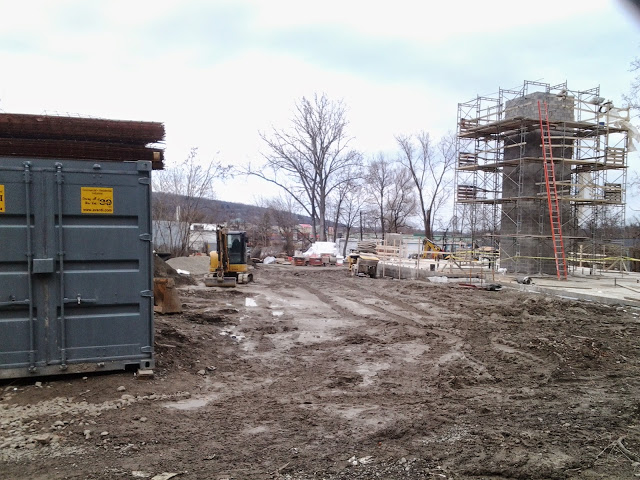
Like it or not, construction is well underway at the site of the future Stone Quarry Apartments on South Hill’s Spencer Road. Foundation walls and pilings are visible at the site of the townhomes, and the cinder block wall for the elevator shaft and stairwell of the apartment building is clearly visible from the street. A closer inspection of the apartment building shows that a concrete slab foundation has been poured. I’m not sure if the white slabs in the last photo are some type of insulated concrete form like the Fox Blocks used at the Thurston Avenue Apartments earlier this year, or something else (Ithaca Builds’ Jason Henderson is far more knowledgeable about these types of things than I am).

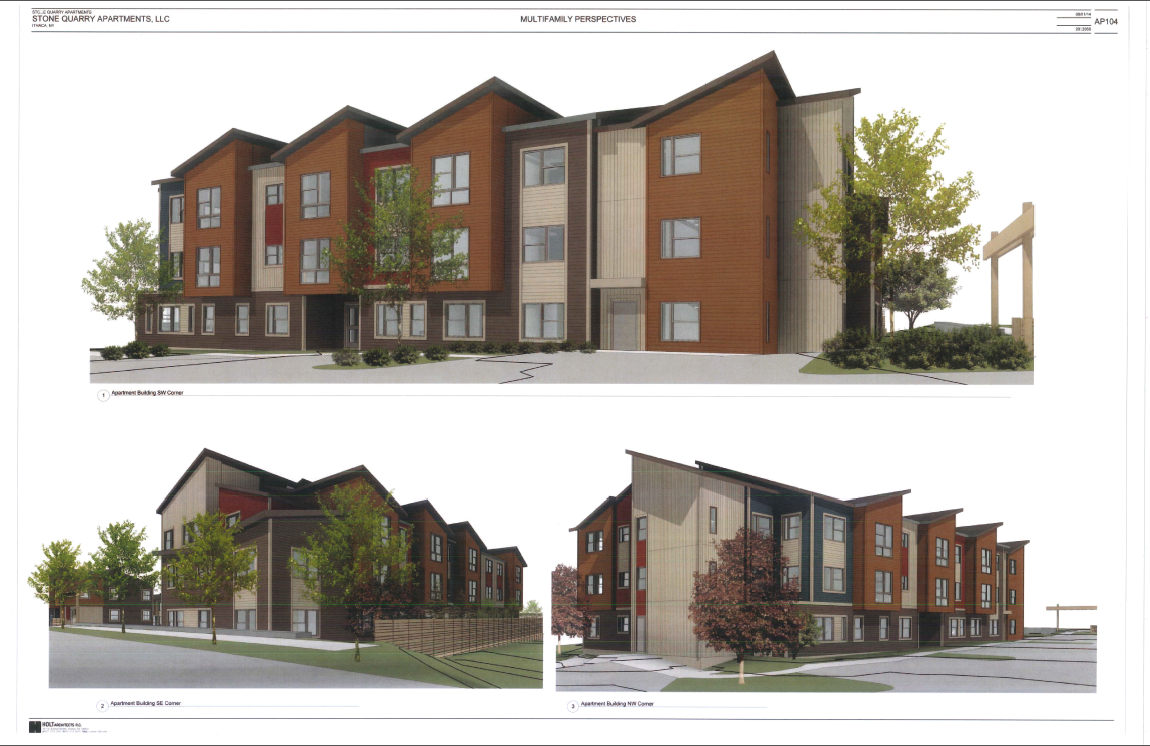
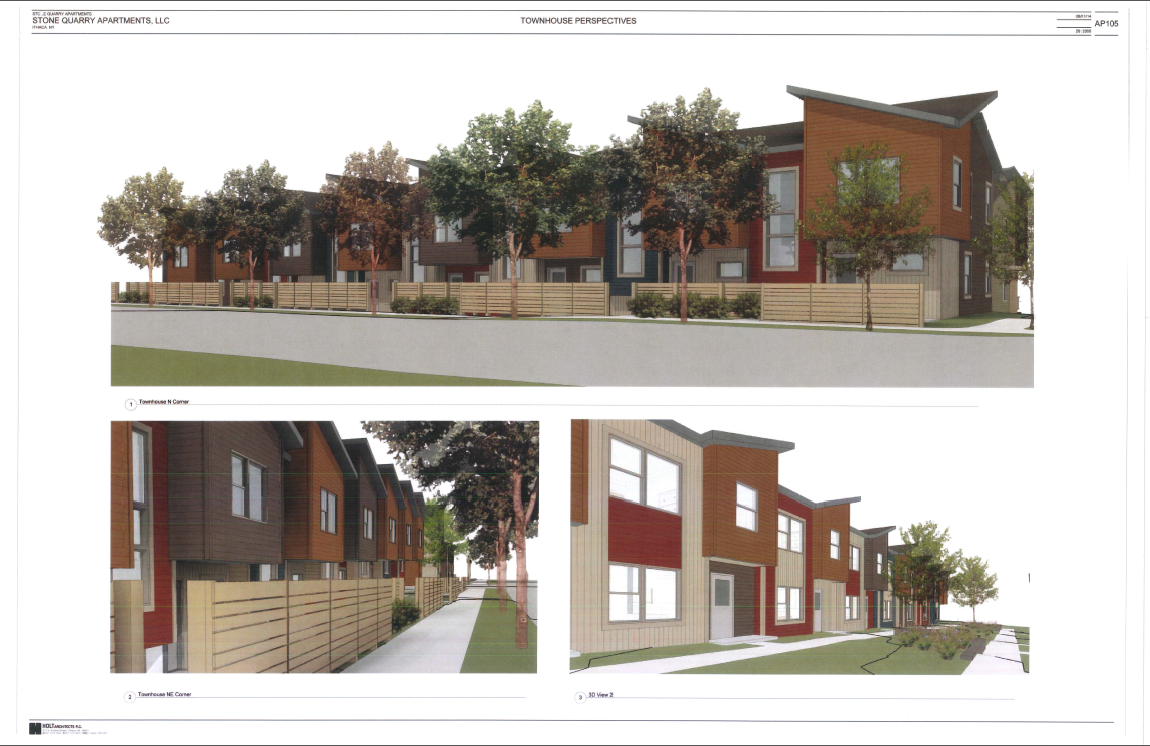
The Stone Quarry project consists of 16 two-story townhouses (2 rows, 8 each), and a 19-unit, 3-story apartment building on the northern third of the property. Specifically, the breakdown of unit sizes is follows:

16 three-bedroom Townhouses
2 three-bedroom Apartments
11 two-bedroom Apartments
6 one-bedroom Apartments

As with all projects by INHS, the units are targeted towards individuals with modest incomes, with rents of $375-$1250/month depending on unit size and resident income. While affordable housing is generally welcome and sorely needed, Stone Quarry had a number of complaints due to size, location and lingering environmental concerns.

With a theoretical capacity of 82 residents (assuming one per bedroom), the project is the largest non-student oriented project currently under construction in the city (Lofts @ Six Mile has more units with 45, but with 3 studios, 21 1-bedroom, and 21 2-bedrooms, for a theoretical max of 66 residents). The apartments are expected to be completed in October 2015. The buildout is being handled by LeCesse Construction, a nationwide contractor with an office in suburban Rochester.

20141227_143254

20141227_143318 20141227_143352 20141227_143407

inhs_stone_quarry_rev_3 inhs_stone_quarry_rev_4

400-Spencer-Road-INHS-Revised-Site-Plan-Drawings-06-16-14_Page_05-1280x828


News Tidbits 12/20/2014: Many Homes, One Community

20 12 2014

5-8-2012 347

1. Starting things off, here’s an update on Ithaca College’s Master Plan-in-progress, courtesy of the Ithacan. According to a presentation given by representatives of lead planning firm Perkins Eastman, the master plan will include a climate-controlled walkway connecting several buildings from the Gannett Library through the Center for Health Sciences, the removal of the upper and lower dorm quads and replacing them with academic lab/research space, an amphitheater just below the Dillingham Center fountain and a new entrance on Danby Road closer to Ithaca’s downtown.

Now, before residents in South Hill begin to panic that their neighborhood is about to be invaded by students displaced by IC’s decreased housing, I’d like to point out that master plans are rarely built out as designed, but are great for identifying academic needs. I don’t imagine that IC will start tearing down 11 buildings and 1,235 beds unless they really feel like getting into a fight with the town, or throwing up temp housing, neither of which ranks high on the to-do list. At least I get something to write about for a week or two when the new plan comes out this Spring.

2. What is known about Manos Diner’s future occupant: They’re leasing the space from Bill Manos, not buying. It’s a restaurant with owners who already own several restaurants, all outside NYS. It’s not necessarily a chain. It’s apparently a family operation and the food will be Mexican. And whoever it is must have really, really wanted to pry their way into the Ithaca market. I don’t see why they wouldn’t have chosen any number of other sites they could renovate…it seems really strange that an offer so fortuitous would come up that Manos would close his diner with hardly a notice to his employees (which is completely tasteless, for the record). New restaurants in Ithaca aren’t usually big news-makers by themselves, but the entry of this Manos replacement draws more questions than answers.
amabel_rev1_1

amabel_rev1_2

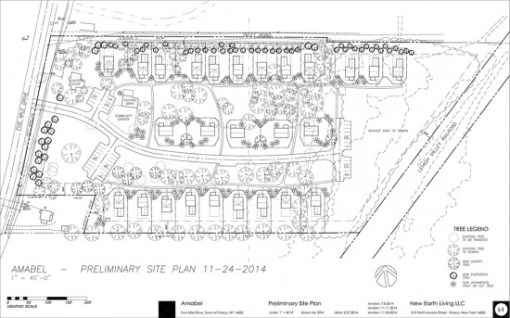
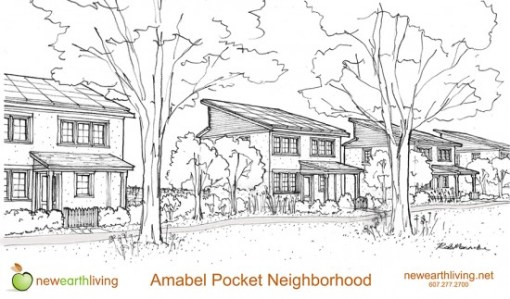
3. Looks like New Earth Living LLC has released some updated site plans and sketches of their approved Amabel project just southwest of the Ithaca city-town line. The houses on the northern two-thirds have been rearranged from the previous site plan, and if it’s still 31 units, then the center buildings must be two-family houses. I’ve been told that there will be six different house designs available, so don’t expect all the houses to look the same as in the concept sketch. One thing that the all designs will share are roof configurations that will allow enough solar panels to result in net zero energy use for each home. The city has approved the sale of its surplus land to the developer, and this project is due to start marketing in summer 2015.

http://public.tableausoftware.com/shared/XKG7RHY5H?:toolbar=no&:display_count=yes

4. Here’s a map, courtesy of real estate website Zillow, that prices out how much it would take to afford the median rent in a given metropolitan area, if paying no more than 30% of monthly income to rent (the federal affordable housing standard). Ithaca/Tompkins County comes in at $32.74 an hour, assuming a 40-hour week and 50-weeks working in a year. In other words, $65,480 ($1,637/month average rent). The number is skewed high from the number of expensive multi-bedroom units in Collegetown, but it’s still high when compared to Elmira ($28.08) or Syracuse ($27.74). For comparison’s sake to Ithaca-type communities, Boulder ($41.72) and Ann Arbor ($34.28) are higher, Charlottesville ($29.24), Madison ($27.54) and Asheville ($22.98) are lower.

village_solars

20141129_125556

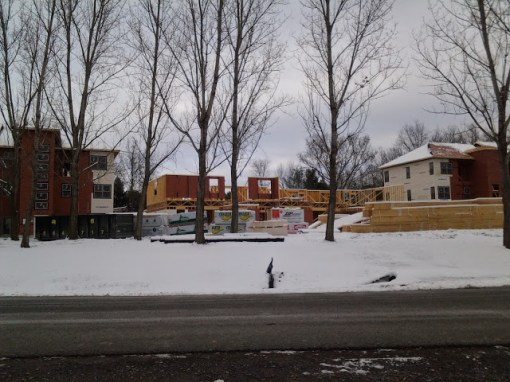
5. Would you believe this is actually the first render I’ve ever seen for the Village Solars project in Lansing? This comes courtesy of their Craigslist ads. The Village Solars take their name from being designed with passive solar design with large amounts of natural light; I don’t know if they will have solar panels. For being a large project, this one has sailed under just about everyone’s radar, partially because it was approved 18 months before construction started. Since there has been so little news about this project, info comes in the form of government and business memos. Depending on the source, final build-out is between 292 and 320 units, which is enormous for the Ithaca area.

Rent’s not cheap with these new units – the minimum is $1235 for a first-floor 2-bedroom, going up to $1369 for a “penthouse” third floor 2-bedroom unit. The Craigslist ad says the first units (36 of them) will be ready for occupancy by March 1st 2015.

402_s_cayuga_st_rev2_1 402_s_cayuga_st_rev2_2

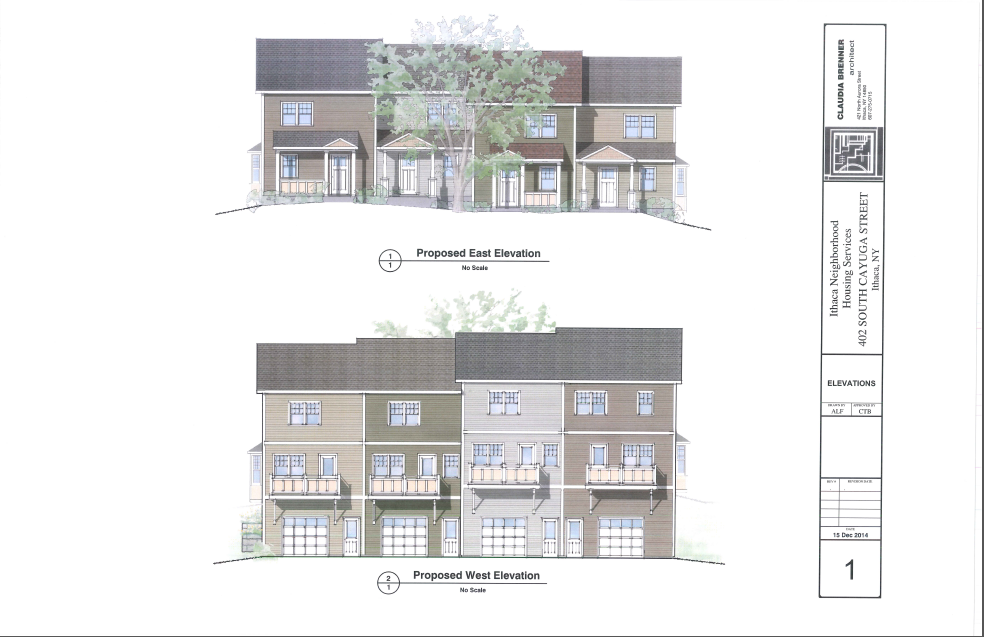
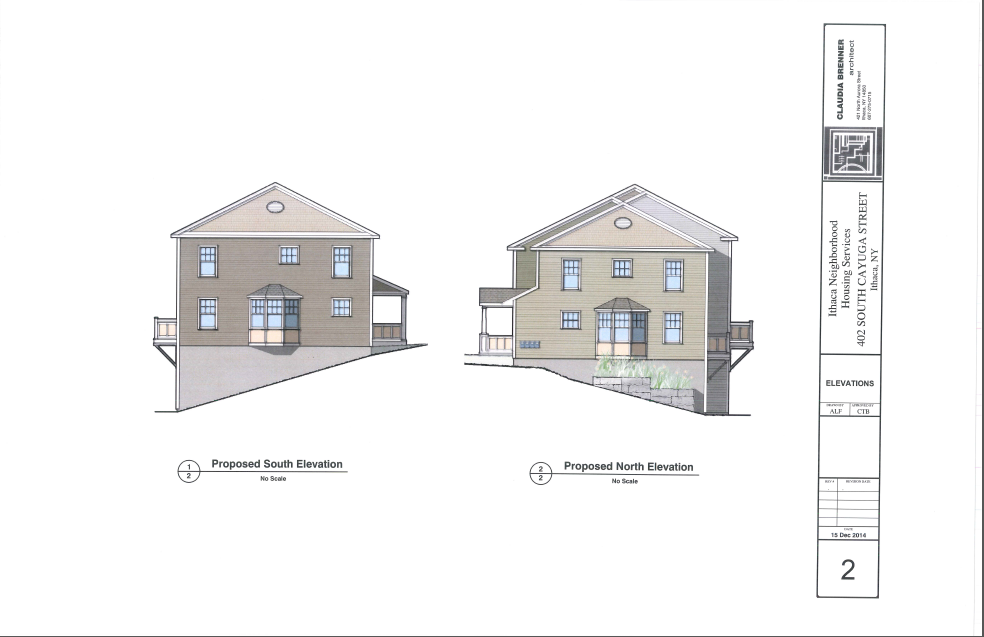
6. Updated doc and drawings for INHS’s 402 South Cayuga Street have been filed with the city. Application, FEAF and project description here, drawings here. According to the docs, the cost of construction will be $740,000 for the four units, and go from Spring 2015 to Spring 2016 (March 2016 in the FEAF). Some slight metal pollution from Emerson/Morse Chain has been noted in soil tests from below the foundation area, due to the Morse Chain subterranean pollution plume (metals, VOCs) that affects much of South Hill. Although the DEC requires no further action at this time, there will be an active sub-slab depressurization system in place as a safeguard. In other words, a fan blows air into the basement, and it gets vented back out.

The design of the townhomes has been revised by architect Claudia Brenner to include more architectural detail – bay windows on the north and south ends, and larger/full porches vs. the stoops of the previous design. The siding has also been changed to all earth-tones. It’s an improvement, but I’d rather see two separate windows above the porches. This project will be presented at the January Planning Board meeting.
707_E_Seneca_1

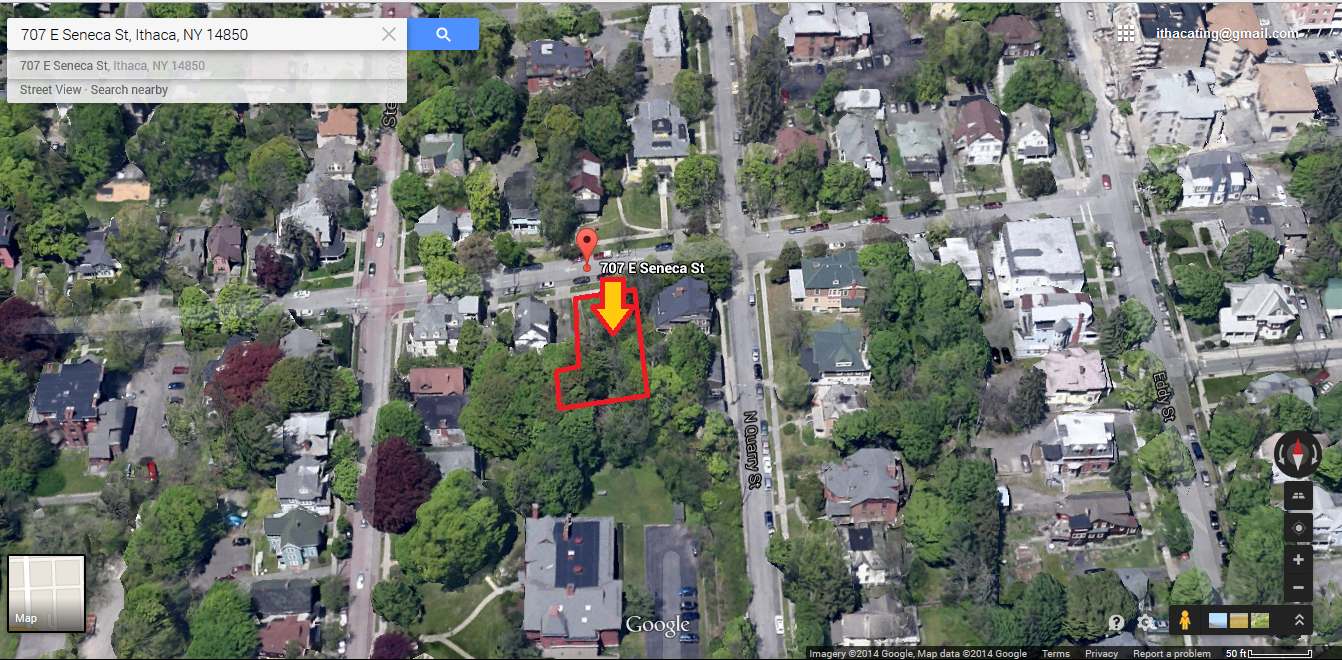
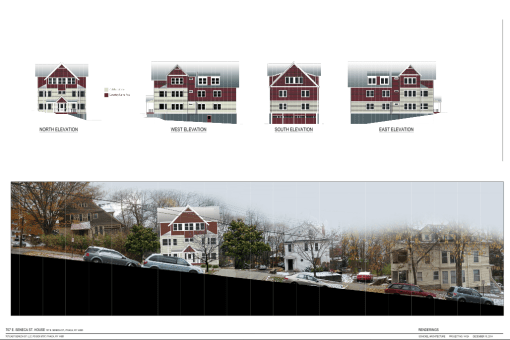
7. Here are some drawings for 707 E. Seneca. Readers might remember this is the 6-unit building proposed by Todd Fox for a derelict playground recently sold off by the city. The 18-bedroom design by local firm Schickel Architecture has already been critiqued thoroughly by the Ithaca Landmarks Preservation Council, since the site is within a historic district and needs to look the part. I’d say that they’ve done well, it’s a bit bulky but otherwise a tasteful addition. An area variance will be required from the Board of Zoning Appeals. Construction is expected to cost $220,000 and run from April to July 2015. For more info, the application is here, drawings here.

112_blair_1 112_blair_2

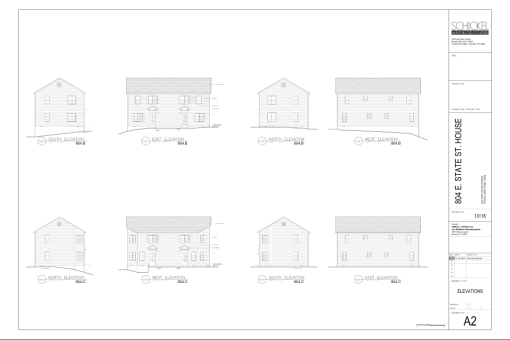
8. Since we’re talking about East Hill housing, here‘s the project application and here are the drawings for the duplexes proposed for the parking lot at 112 Blair Street. The Blair Street site will be combined with 804 East State Street, and the duplexes will have State Street addresses. The spartan design of these buildings is also by Schickel Architecture, and will add 12 bedrooms in 4 units. Cost is estimated at $213,000 and construction will start in April for a summer completion. The developer is Matthew Nestopoulos.


Ithaca’s Sanborn Maps

16 12 2014

This post was inspired by two events – a reader messaging me and asking about historic maps, and another reader telling me about the history of the Cayuga Place/Lofts @ Six Mile Creek site. In both these cases, I ended up looking at Sanborn Maps.

Sanborn Maps were created in the late 19th and early 20th centuries as a way to gauge the amount of fire insurance a site needed. A bunch of things come into play when gauging fire insurance – other structures nearby and their uses, geographic features, width of adjacent streets, fire walls, railroads, building materials, and so on. These maps, as exhaustive of a task as they must have been for surveyors, were crucial in determining the right price for insurance coverage. According to the wikipedia article, agents “relied upon them with almost blind faith”. The company was very successful and produced maps into the 2000s, and Sanborn was an early investment of Warren Buffett in the 1960s. Today, the maps are owned by their successor, Environmental Data Resources Inc.

sanborn_1893

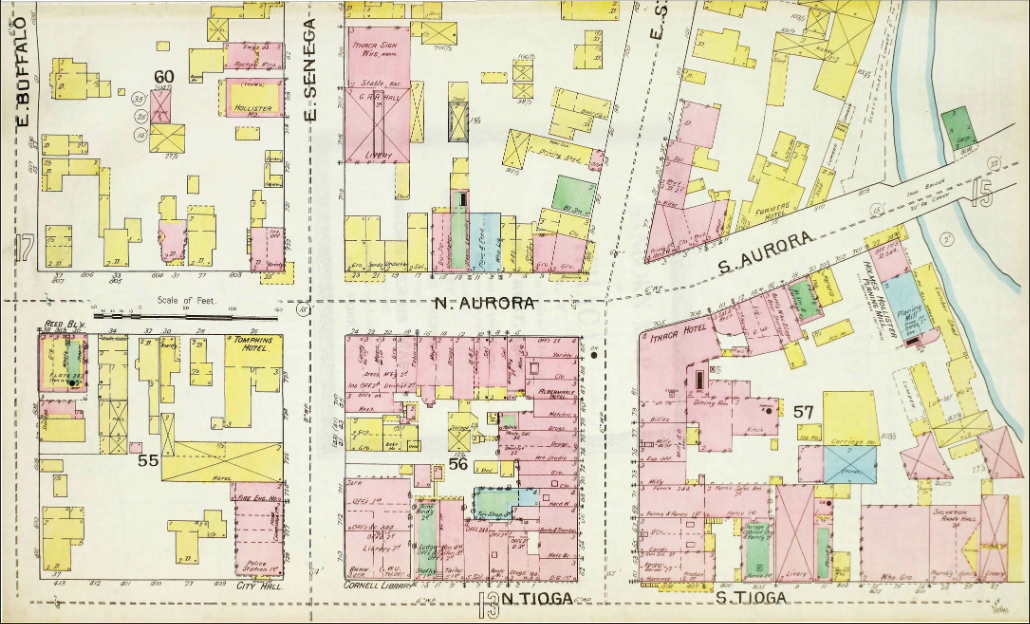
With all that noted, Sanborn Maps are a veritable treasure trove of information. Ithaca and Tompkins County were included in the first Sanborn volume published in 1867, and every few years henceforth. While the 1867 map doesn’t appear online, 1866 maps from a rival publisher can be downloaded from the Tompkins County Public Library here. The 1866 Ithaca map was the same one I used in my “A Walk Down Varick Street” post from last Spring. The other Sanborn volumes listed on TCPL’s website date from 1893, 1904, 1910 and 1919. Between published volumes, updates would be sent out on “slips”, sheets with the updated lot details that one could paste into place on top of the old map. There are also 1888 and 1898 copies, which are proprietary and therefore can’t be linked. The same holds true for any map not published by the government after 1922, which takes out the Sanford Maps from 1929, 1957, 1961 and 1971. These newer maps can still be accessed for academic use at Cornell’s Olin Library.

So for the sake of example, I’m going to use the Lots @ Six Mile Creek site and its surrounding block, since I’m already acquainted with it.

map_1866

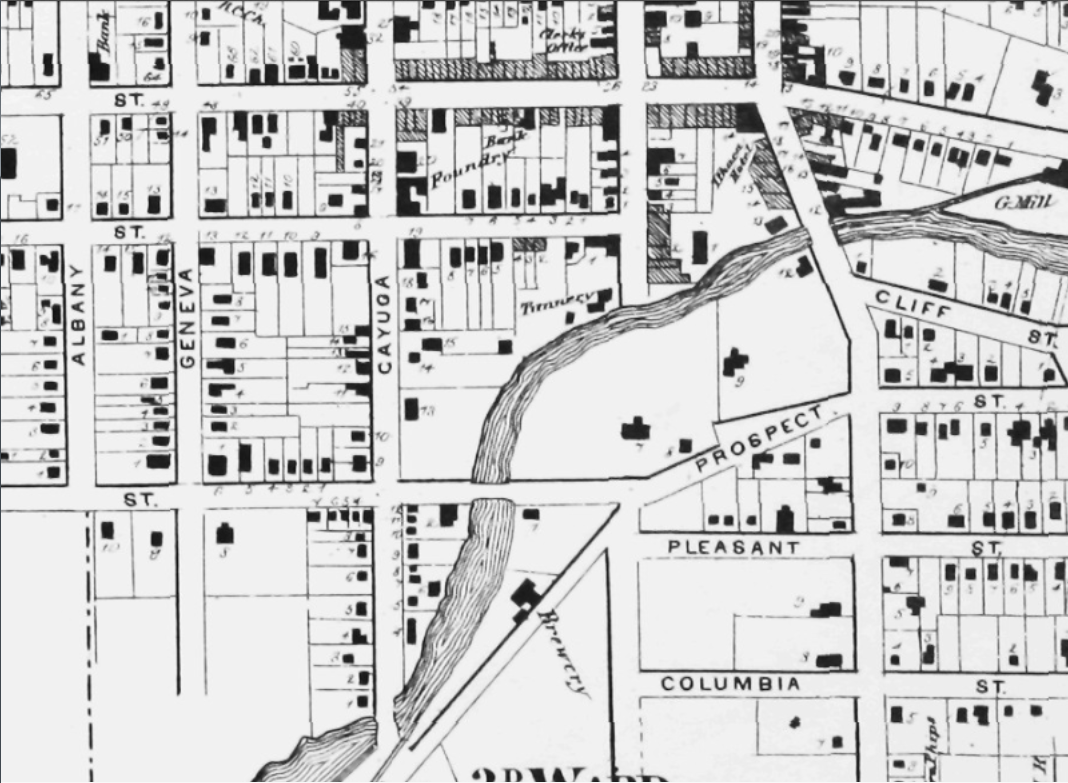
I’ll lead off with the 1866 map. #13 Cayuga is a small hotel, #16 a doctor’s office, #18 a “Select School” and #19 a livery (horse stables). All the others (excluding the one labelled “Tannery”) are homes.

map_1893

Fast forward 27 years to 1893. On the corner of S. Cayuga and E. Clinton are 3-story rowhouses. A carpet maker sits to their north, and the hotel next door has expanded in the past couple decades. The corner Livery is still there, as are most of the homes. A machine shop sits where the doctor’s office used to be, while Reynolds & Lang (a maker of farm equipment) and George Small’s Planing Mill fill out the east end of the block.

map_1904

Now for another jump, 11 years forward to 1904. The hotel is now a “Farmer’s Hitching Shed” with an earth floor, and the small 2-story building next door is the Forest City Hotel. Many liveries filling in what was once open space, and the planing mill and farm equipment factory have updated names as a result of new business partners.

map_1910

Only a few years later in 1910, the planing mill has moved and the Star Theatre and a bowling alley have taken its place. A concrete garage now sits next to the creek, a bicycle shop and a clothing store sit next to the livery on the corner of Green and Cayuga, and the Forest City Hotel has become Mobb’s Hotel.

map_1919

By 1919, it all starts to get a little jumbled. The change in orientation doesn’t help either. The Star Theatre is now a furniture warehouse and the corner livery is a garage.

Without linking to the images of the later maps, I can at least describe what happens. By 1929, Cayuga Street is automobile row, with Hudson-Essex, Nash and Buick dealerships. A large parking garage is built on the east end of the block. Some houses on Green come down for the Cayuga Press printing plant. The 1961 map shows nothing but Cayuga Press and autocentric development, parking garages and car dealerships and gas stations; the corner townhouses are gone, as are most of the other houses. The whole block is levelled for parking lots and a department store by 1971. The vacated store became the library in 2000, the parking garage went up in 2005, and the apartments have followed. But you can read about the recent work here.

For a budding history buff, the Sanborn maps are a great way to kill a few hours. It also makes one realize just how much downtown Ithaca has evolved over the decades.


News Tidbits 12/13/14: ‘Tis the Season For Development Slowdown

13 12 2014

finger_lakes_reuse_ith_1

1. Leading off, the NYS Regional Economic Development Council Awards. In other words, the annual event where the state takes its economic aid money and an impartial committee is supposed to examine and decide who gets more or less money. It’s supposed to be competitive. I’d rather see the taxes not be collected in the first place.

Tompkins County gets placed in the “Southern Tier” category, which has been in the middle of the pack most years (as has its regional neighbor, “Finger Lakes”). Those two were 3rd and 4th this year out of 10, with a little over $80 million each. Most of it is going towards job training programs and studies/plans, but a few funded items stick out:

-$2.8 million for Cornell to expand its vet school classes by 30 students each (120 total). The goal is to “Expand Rural Veterinarians”.

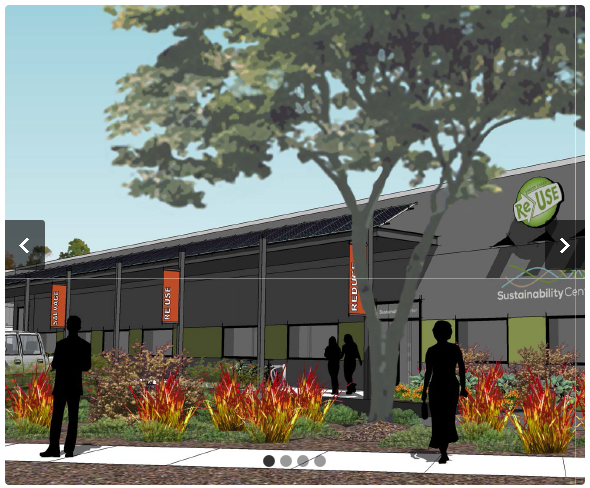
– $1.9 million for Finger Lakes ReUse to “construct two additional buildings”. I suspect one of those is the renovation of 214 Elmira Road for the new HQ (shown above).

– $250,000 for the Chain Works District to help pay for energy efficiency and feasibility studies for the project.

130eclinton_rev3

2. Am I happy about the decision with 130 E. Clinton? No. This has little to do with mixed-use or steep hillsides. I firmly believe that it became a popularity contest and a referendum of Fane’s character. My concern is that this risks becoming the norm, and has the potential to be a lawyer’s paradise. I also don’t look fondly on frequent and fervent opposition to development when housing costs are spiraling upward.

Opposite side of the coin, it couldn’t have happened to a more deserving person. Other contentious projects – Stone Quarry, the Marriott, Collegetown Terrace, Cayuga Green, just about every other project built in the past 20 years – squeak by at least in part because the developers don’t come across as combative, conniving assholes. Plus, Fane himself is quite wealthy, which doesn’t exactly help an argument for tax breaks.

Well, I’ll move this one into the “mothballed/dead” column. With this and the Maguire proposal hitting a dead end, this has not been a good couple weeks.

carey_rev4_2

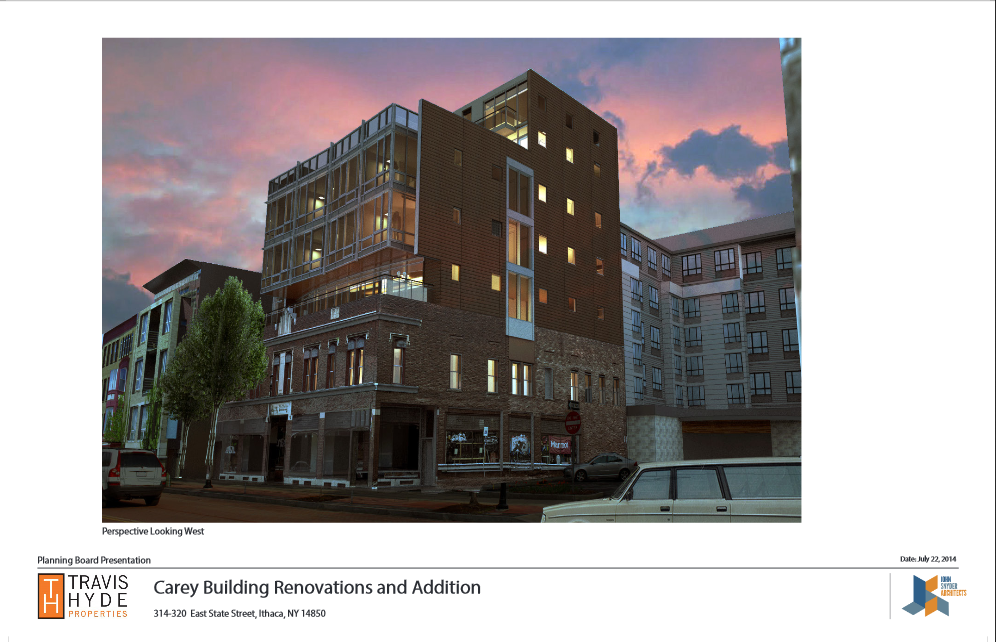
3. On a different note, the Carey Building tax abatement was approved unanimously. At least some developers know how to play nice. Look for the additional REV incubator space and 20 apartment units to start construction shortly and open for renters in August 2015.

4. Down in big box land, the former Kmart space looks to be filling out with new tenants. Discount clothing store chain TJ Maxx has agreed to take 21,770 sq ft of space, and Five Below (a teen retailer specializing in products $5 or less – it sounds like the product of a one-night stand between Dollar Tree and H&M) has agreed to take 8,208 sq ft of space. The old garden center will be replaced with a 16,200 sq ft addition, a revision of the previously-approved 14,700 sq ft. Benderson Development is redoing the front facade for TJ Maxx, and needs a couple of minor area variances. Readers might recall the Ithaca Kmart closed in 2011, and its sister store, Sears, is closing this winter. If this is any indicator, then there’s hope that the Sears space will be re-occupied soon enough.

Not much else of note for zoning trifles from the city’s Planning Board meeting – someone wants to build a new 2-family home at the corner of Oak Avenue and Oneida Place in outer Collegetown, and a house on Heights Court in Cornell Heights is trying to get increased occupancy for unrelated tenants. For the first time in several months, no new sketch plans are due to be presented at a Planning Board meeting; the holiday and earlier-than-usual monthly meeting are probably a big part of that.

5. Not much to report for Ithaca town’s Planning Board meeting either – a proposal for a new duplex at 636 Coddington Road, and an expansion of the East Hill Plaza branch of Collegetown Bagels into adjacent empty retail space. That winter slowdown is in full swing.


News Tidbits 12/10/14: Content Being Contentious

10 12 2014

This one is coming out early this week for the sake of timeliness.

carey_rev4_1130eclinton_rev2

1. Thursday the 11th, the county IDA votes on whether to approve tax abatements for two downtown projects, Travis Hyde’s Carey Building addition and Ithaca Renting/Fane Org’s 130 East Clinton. The $4.1 million Carey Building addition adds 9,000 sq ft of incubator office space and 20 units, 16 of which are 300-450 sq ft studios. 130 East Clinton would add 36 units in three interconnected buildings on a steeply sloped parcel adjacent to the city police HQ, at a cost of $4.4 million. The multi-year tax abatements are in the range of $850k each.
At the public hearing for the two projects, the Carey Building attracted little attention and dissent (which isn’t to say that there hasn’t been any), but Fane’s project attracted much ire. I’m not going to defend Fane’s character. Heck, the man’s been combative through this whole process. But I will side with the trustworthy opinions of Cornish, DeSarno and others that it contributes something to the very tight housing supply and it is a welcome resource. Denying the project by virtue of it being Fane is legally perilous and sets a bad precedent, and saying it’s a bad spot…well, it’s downtown Ithaca, where high-density lot use is expected. If Fane didn’t think he could get the environmental assessment approved he wouldn’t have proposed it. We’ll see what the board decides.
5-8-2012 347

2. Up on South Hill, Ithaca College is holding meetings to flesh out its new master plan. Similar to the plan Cornell published in 2008, the purpose of the master plan (website here) is to determine what the space needs are for different assets and programs of the college, and figuring out where to put them. The master plan is being spearheaded by Perkins Eastman out of NYC. The previous plan by Sasaki Associates was published in 2002 with a refresher in 2010, so to get something out in 2015 would be appropriate. I did a writeup on the old IC plan way back in August 2008. Don’t expect any new plan to be followed to a tee- the athletic center ended up on the complete opposite of IC’s campus than originally planned. But it will provide insight as to what IC wants to build through the rest of the decade and beyond. Key things to looks for – dorm sites in case the college decides to expand its student population, and new program space, which tends to get built sooner or later (for instance, the Business School addition, Athletic Center, and Peggy Williams Center from the 2002 plan).

wegmans_rev1_1 wegmans_rev1_2

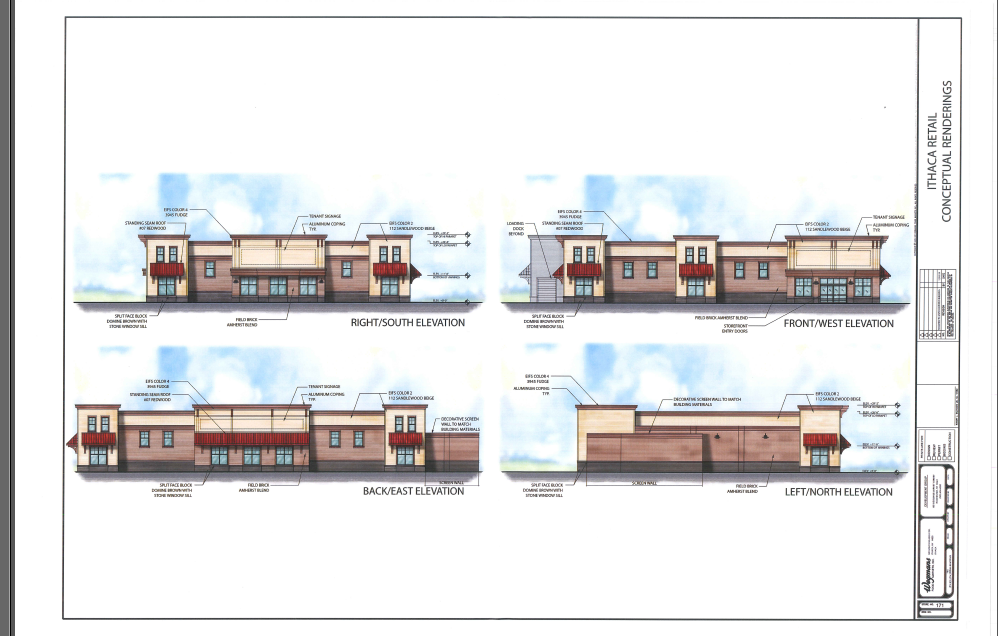
3. The 15,700 sq ft retail pad proposed by Wegmans is up for final review at the December planning board meeting, accordingly to the city projects memo. Compared to the initial design, the building has been rotated on site so that its long axis is now north-south, and the design itself received a number of tweaks, though the overall design theme is still the same as before. There have been some concerns raised by local wine and liquor store owners that it could be home to liquor/wine store, similar to what Wegmans has done at other sites in Johnson City and Buffalo. However, that is one of only a few ideas being floated, and the planning board doesn’t vote on what type of store can be allowed to open in a building, that’s a debate for the Common Council.

maguire_v2_1

4. Looks like the Maguire plan has hit a dead end. According to the Times, the Maguires want the site rezoned rather than a specialized PDZ for the property. Looking at the PDZ regulations, the town’s idea would give more freedom in regards to property use, but it also gives the town the right to regulate the form and layout of the structures on site. I guess the Maguires aren’t fond of that. The town just completed its comprehensive plan and is trying to get its new form-based zoning together, so the Maguires are essentially usurping something the town spent years working on. In conclusion: no dice. The Maguires are still interested in doing something, but it may not be in Ithaca town. Though with as packed as the city is and as questionable as Lansing can be, I’m not sure they have many options.

5. Over in Lansing Village, a mothballed project is getting a revival. “CU Suites” (aka Manley and Richard Thaler, who own the Triphammer Marketplace) proposes a 3-story, 43,000 sq ft building on the west side of Cinema Drive, on a site that is currently a vacant lot. Interestingly, this site was previously approved for a mixed-use structure with those parameters in fall 2012, consisting of two commercial spaces and a 39-unit apartment building, but that plan was never carried out. The proposal before the board seeks “alterations and possible clarification” to the project. No updated renders on the village website, but a site plan of the previously approved plan can be found here. Before the previous plan was approved, the site has been marketed for an office building for two years, to no avail (the market for office space in Ithaca is pretty weak). We’ll see what happens, maybe this one will finally get underway.

707_East_seneca

6. For what it’s worth, the proposal at 707 East Seneca appears to be student housing. Applicant Todd Fox (a local developer who’s done a few other small projects in Ithaca and Dryden) wants to build six units with sixteen bedrooms, five 3-bedrooms and a basement 1-bedroom, situated next to four parking spaces tucked into the hillside (four more spaces would be out in the open). I’m not sure how so many units are possible, since I thought the maximum allowed on site was four units. I’d love to see how it looks, but there’s nothing on the city website (which, sidenote, has been “updated” and now has information of three separate websites, the new one, E-govlink and “TSSERR”; the notification emails don’t work and it’s driving me nuts). If something comes up, you’ll find it here sooner or later.


Ithaca Marriott Construction Update, 11/2014

7 12 2014

Officially, the downtown Ithaca Marriott is underway with site prep. Perhaps because it only just started, there was hardly anything to speak of on its site. An orange plastic construction fence blocks off the perimeter of the property, and there appear to be some pipes and concrete blocks on site. IPD had the parking lot blocked off, presumably to keep the lot closed to downtown patrons, and to use Green Street to meet their monthly ticket quota.

Although multiple sources indicate a Spring 2017 completion, the sign attached to the front of the site displays Spring 2016 as the completion and opening period. Binghamton-based William H. Lane Inc. was selected as contractor for the project, and opened an Ithaca office to oversee the operation. The $32 million, 10-story, 160-room hotel was designed by Cooper Carry Architecture and is being developed by Urgo Hotels out of Bethesda, Maryland. Urgo’s nearest other hotels are the Whiteface Lodge in the Adirondacks, and several in the NYC area, and Ithaca is well outside their normal scope. I suppose the Marriott could be used as an example of how Ithaca is attracting the attention of out-of-town investors and developers.

hotelIthaca_2010

This project really has had quite the drawn-out process, originally proposed as the Hotel Ithaca back in 2008. At that point, it was a 9-story, 102-room hotel with a cost of $17 million, to be developed by Rimland Development and operated by boutique firm Gemstone Hotels. Well, a lot happened along the way. The project was approved, the recession hit, the project stalled due to an inability to get financing, the cost kept going up from $17 million to $25 million to $27 million, and the number of rooms went from 102 to 125 to 140. Then the Marriott version came into play in 2012 with a $19 million price tag, it was approved, it too failed to get financing, and went back to the board with a value-engineered design for the now $32 million project. With money from Ensemble Investments, the project has been able to launch. There have been three separate designs with ballooning price tags. To actually have something underway is a welcome denouement to this saga.

The Marriott is one of only several hotels planned for Ithaca, with the new 123-room Canopy a couple blocks away intending to start construction shortly, and 76-room and 37-room hotels for Elmira Road. With high room rates and low vacancy rates, the market is expected to comfortably absorb at least two of those. All of them might cause an older suburban hotel to be closed.

20141129_135427 20141129_135449 20141129_135451


News Tidbits 12/6/14: Looking Forward, Looking Back

6 12 2014

11-24-2012 174

1. Not exactly a development, but this will make things interesting: As reported by the Ithaca Journal, INHS and Better Housing for Tompkins County (BHTC) are merging. Both of them have the same purpose, which is to provide low-to-middle income housing and structural rehab services, but INHS has traditionally focused in Ithaca city, and Better Housing in the rural towns. INHS also holds far greater assets, $24 million including 241 rental units , vs. BHTC’s $3 million and 121 rental units.

Over the past few years, INHS has put a lot of feathers in their cap. $2.13 million in grants has been awarded to the non-profit in just the past few months. Breckenridge Place and Holly Creek are complete and nearly complete respectively (total 74 units), while Stone Quarry and Greenways are prepping for site clearing and construction (total 81 units). Along with Cedar Creek and several single-family and duplex units, INHS has had a hand in over 120 units of housing in the past five years alone. With the Neighborhood Pride site undergoing concept design and the recently-awarded grant money, that number will almost certainly be greater in these next five years.

The story for BHTC has been quite the opposite. The 65-unit Lansing Reserve proposal failed due to neighbor opposition, and the 58-unit Cayuga Trails project for West Hill failed due to wetlands on site being greater than anticipated (and the neighborhood opposition didn’t help). BHTC has five older facilities in Trumansburg, Newfield and Slaterville Springs.  With any hope, the merged non-profit will qualify for larger grants, and BHTC can finally get some shovels in the ground in the hamlets and villages outside Ithaca.

On a separate note, it looks like INHS did its annual website update, formally announcing plans for a single-family home at 304 Hector Street on West Hill. The lot was purchased in late October after a plan to buy and renovate a home in Northside fell through. Stone Quarry will begin occupancy next September, and Greenways hopes to start in 2015.

112_blair_1

2. Here’s the site plan for 112 Blair Street. I’d include renders, if the sketch plan had any. Two buildings with two units each and three bedrooms per unit -> 2 x 2 x 3 = 12 bedrooms. Nothing large, just an infill project tucked away from the street. The design will be created by local firm Schickel Architecture, the same ones doing the Maguire project in Ithaca town. As noted by Planning Board member John Schroeder in a recent Sun article, projects like these won’t alleviate the housing crunch by themselves, but every little bit helps, and all the better if it recaptures living space from an underused parking lot.

canopy_hampton_rev4_1

3. Final design for the proposed Canopy Hotel? Possibly. In comparison to the last design, this latest incarnation adds more windows to the east face. I’m not going to lie, after six or so sets of designs (include three complete re-dos), I’m starting to lose track of the changes. On the upside, the latest project plan from the city’s documents includes some neat context views, renders of what the building would look like from various vantage points in the city.

114_catherine_rev4_1

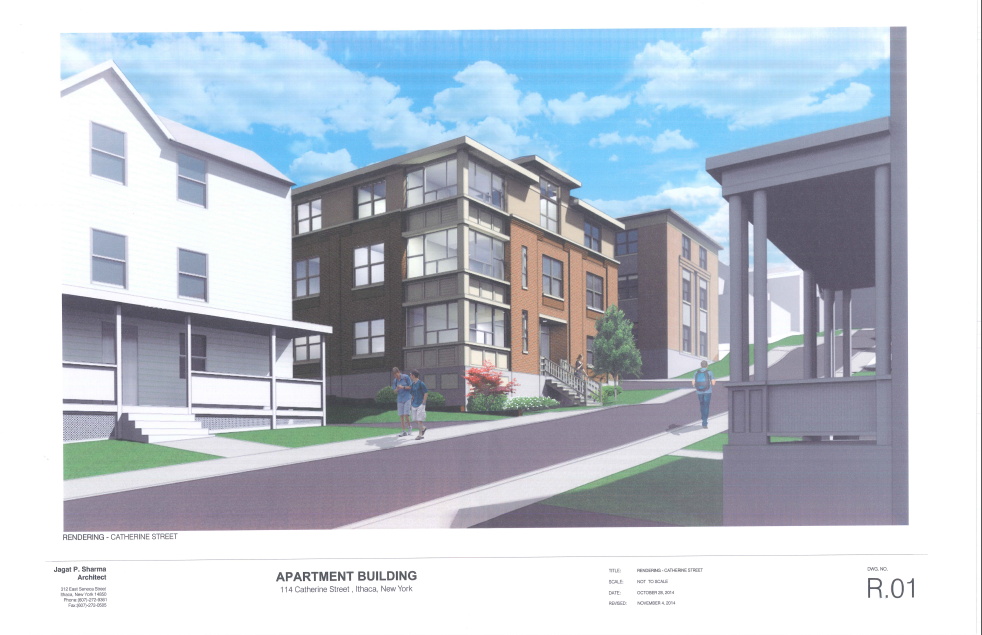
4. 114 Catherine has been approved, its Spring construction date looks good to go. When completed in August 2015, 17 more bedrooms will enter the Collegetown market – a drop in the bucket, but a valuable drop nevertheless.

chain_works_rev2_1

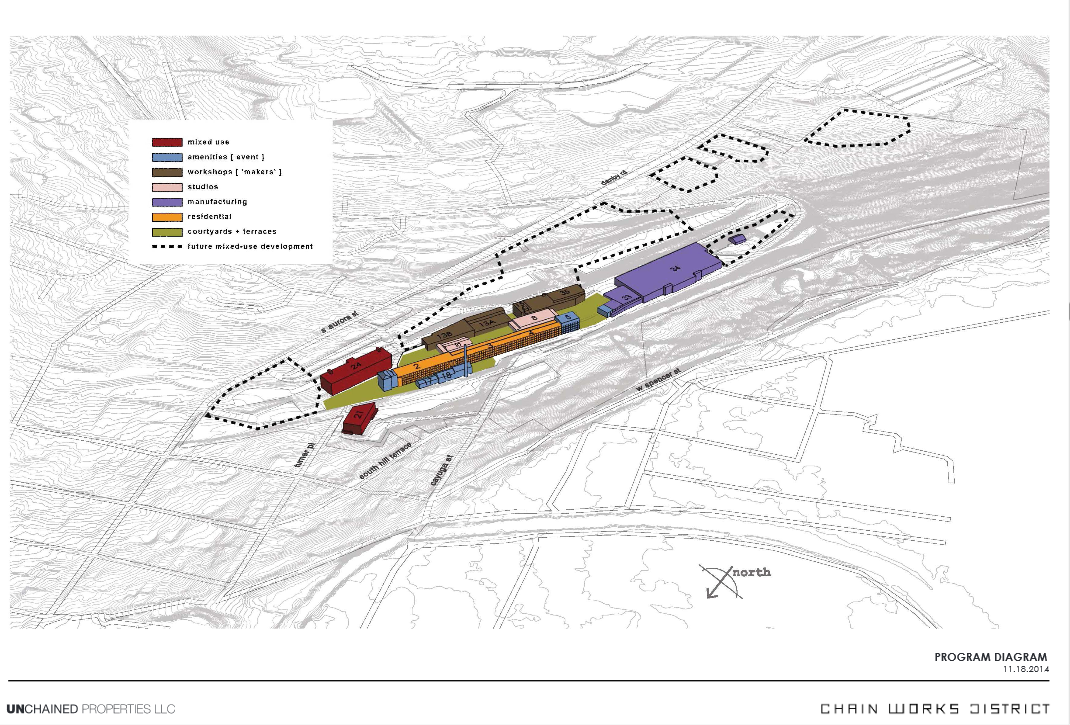
5. Towards South Hill, review of the draft generic environmental impact statement (DGEIS) continues for the massive Chain Works District proposal at the former Emerson Power/Morse Chain site. A scoping document of that DGEIS can be found here. In a nutshell, a DGEIS is part of the State Envrionmental Quality Review (SEQR), where the leading agency looks at a project, determines if any adverse project impacts are properly mitigated, and if so, issues a statement giving a negative declaration (approval). In this case, the NYS DEC also needs to be on board, approving the contaminated site for residential use. This is a pretty complicated project. There’s 800,000 sq ft of space to be removed or re-purposed, in an environmentally compromised site split between two political entities who are conducting joint meetings with their planning boards in an effort to try and move this project forward (the town of Ithaca board deferred to the city of Ithaca for lead agency; and both have been evaluating using their respective specialized mixed-use zones).

So far, there have been no nasty surprises on the polluted site. The site is mostly clean but still needed a little more for residential use, and Emerson will be flipping the bill for that. The comment period on the draft runs through the 10th, and the DGEIS will be finalized on the 16th. According to the project website, developer Unchained Properties LLC hopes to start Phase I, the renovation of four on-site buildings (21, 24, 33 and 34) into mixed-use and manufacturing space, during summer 2015. The mixed-use was initially proposed as office space only; but the developer behind the LLC (David Lubin) has struggled to fill the proposed office space in his Harold Square project, and seems to realize that having less office space would be a better plan for Chain Works as well.

6. The Cornell Daily Sun is reporting that the owner of CTB (Collegetown Bagels) is buying the Rulloff’s property and reopening the restaurant after it abruptly closed over the Labor Day weekend. The property was on the market for $395,000, and it’s fair to say the price was probably close to that figure. The murderous Edward Rulloff lives on.


Lofts @ Six Mile Creek (Cayuga Place) Update, 11/2014

5 12 2014

As much as I hate to entertain the currently-fashionable use of prepositions in project names, and the “@” symbol to make it modern and hip, that is the official name for what was the condo portion of Cayuga Green. More notably, the project website describes these as apartments rather than condos as initially planned. Apartment projects are easier to get financing for since it’s generally easier to find renters vs. buyers, but given some of the discussion about the need for owner-occupied units that has come up lately (the Old Library redevelopment comes to mind), this is a mild disappointment.

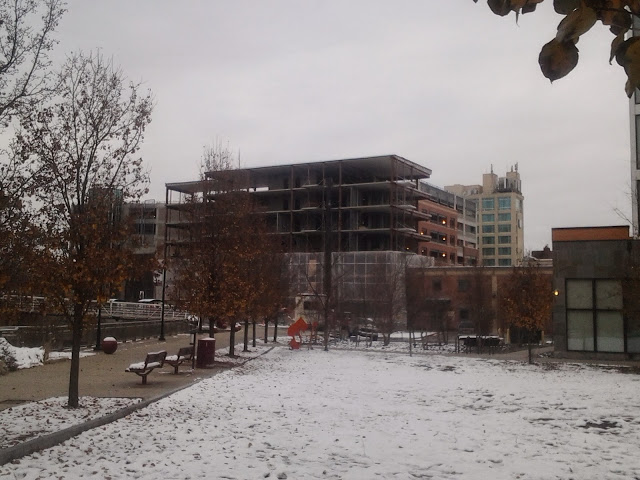
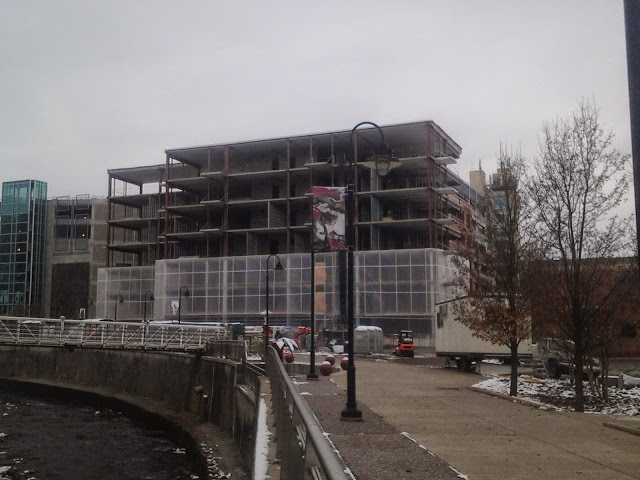
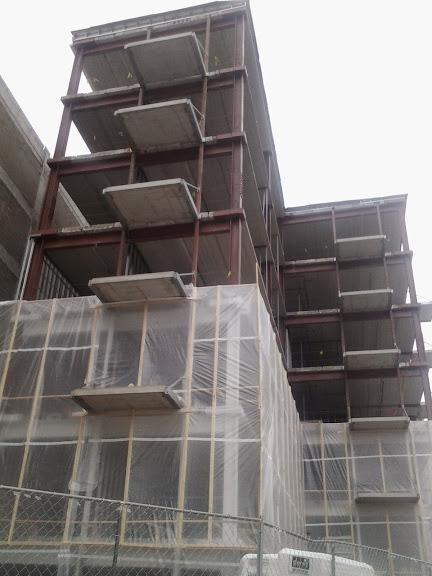
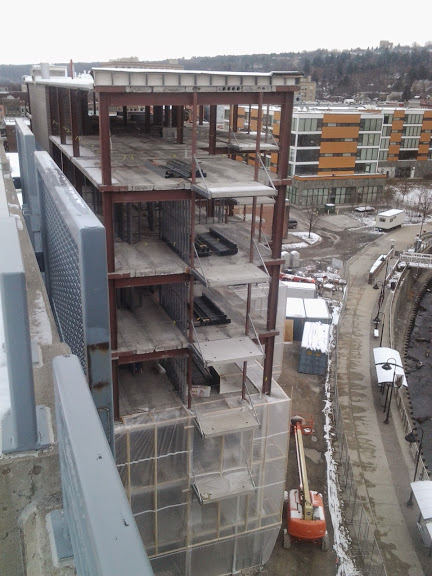
The 7-story, 45-unit, 49,244 GSF apartment building topped out on October 2nd. The concrete floors were poured and the balcony pads were craned into place and secured throughout the fall. Peering into the building from the parking garage, some steel wall frames have been erected on the upper floors, while rough interior work seems to be underway on the lower floors. The plastic sheathing is to break the winter winds and keep the space above freezing.

Developer Bloomfield/Schon + Partners planned to release leasing/pricing details last month, but I haven’t heard anything yet. Completion for the project is set for late Spring 2015, which according to their facebook, is a little later than intended due to material supply delays created by the rough November weather (curse you, polar jet stream). If the last photo is any indicator, the upper-floor units are going to have some fantastic northeast views.

As noted before, this project makes the completion of 15 years of planning and construction. At 45 apartment units, It’s also one of the largest non-student-related projects slated for a 2015 completion – the 35-unit Stone Quarry Apartments and the 21-unit 323 Taughannock are also pegged for 2015 completions.

20141129_135747 20141129_135859 20141129_135828 20141129_135807 20141129_140005 20141129_140241 20141129_140308