Ithaca Marriott Construction Update, 8/2015

4 08 2015

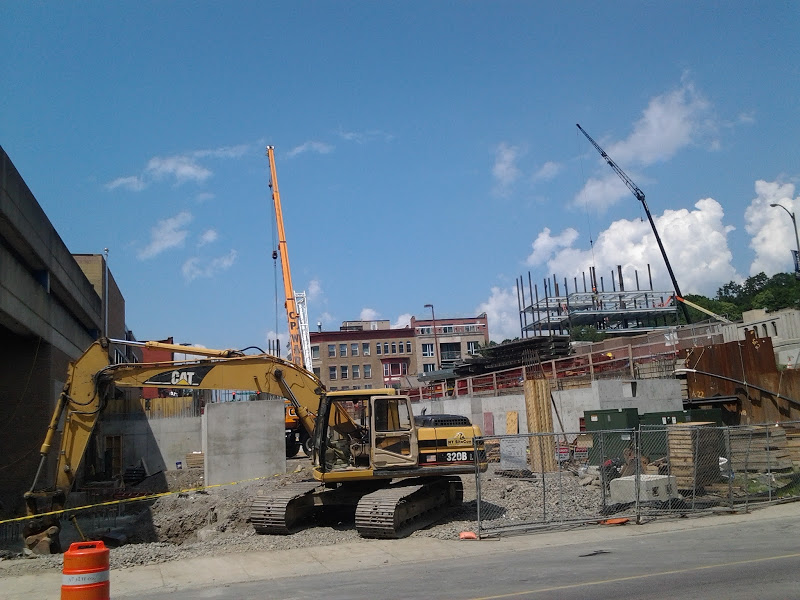
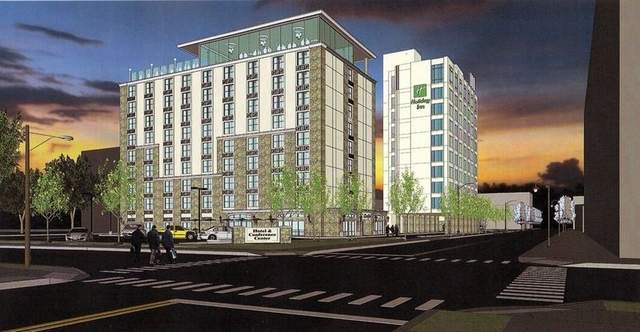
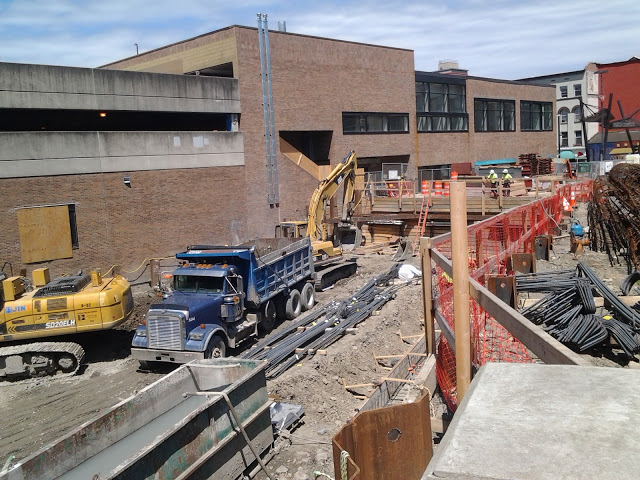
Over at the Marriott Construction site at downtown Ithaca’s 120 South Aurora Street, all of the caissons have been drilled and work is continuing on the foundation of the new 10-story hotel. Concrete foundation footers have been have been set on top of the caisson piles, with rebar sticking out to tie-in the walls as they’re built up. The foundation walls are being poured in a range of sizes, depending on how much weight they’re going to hold. A couple footings with much taller re-bar likely indicates the location of future stairwells, elevator shafts, and utility space.

Note the plywood on the Green Street parking garage in the first photo. As workers were drilling the last caisson, the rig broke, tipped over and smashed into the wall of the garage. Thankfully, that section had already been closed off due to the construction, and no one was hurt.

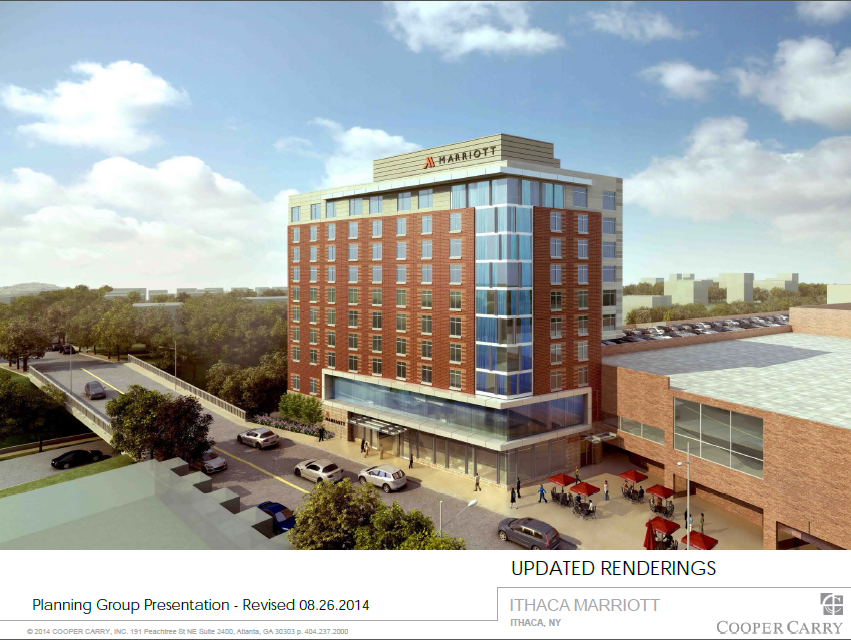
Maryland-based Urgo Hotels plans on opening the $32 million, 159-room hotel during the third quarter of 2016 (July-September time frame). The hotel will include a host of amenities, a fitness center, a restaurant with indoor and outdoor seating, and 3,000 sq ft of meeting space. Atlanta-based Cooper Carry Architecture did the design, and W.H. Lane of Binghamton is the general contractor.

The project, which replaces a small parking lot. could be considered the culmination of an effort to bring a hotel to this site since 2008, when Rimland Development proposed the “Hotel Ithaca”. The previous Hotel Ithaca once stood on part of this site and the Rothschild’s Building, before it (and every other building in its city block) was demolished during 1960s urban renewal.

20150727_142922 20150727_142940 20150727_143035 20150727_143050 20150727_143104

marriott_rev1_1

Ithaca-Hotel-1935


News Tidbits 8/1/15: Tempers As Hot as the Temperatures

1 08 2015

state_st_triangle_v3_3

1. I asked someone familiar with the State Street Triangle how the presentations went this week. “About as well as could be expected” was the diplomatic response received in turn.

The Times, Journal and Voice all devoted coverage to the controversial project this week since its CIITAP application was up for review, as well as revised plans being brought forth to the planning board. The project draws detractors from different angles – some because of size, some because it’s student housing, some because of the tax abatement.

The tax abatement is what confuses me somewhat, for reasons related to the theory I wrote up a few weeks ago, which no longer holds water. My own personal thought was that a sort of economy of scale would kick in with greater site efficiency, negating the need for a tax abatement. That isn’t to say that they still couldn’t try for one, because it meets all the CIITAP requirements, just that they didn’t need it (it would have been proverbial “icing on the cake” if granted). But now they’re saying it’s the only way to move forward. I don’t know the financials and what their necessary ROI is (and probably never will), but I’d happily listen to an explanation.

But the point I made in the piece still holds true – if Jason Fane’s project a couple blocks away was rejected for not having enough of a community benefit, market-rate student housing, even that which generates an extra $7.36 million in taxes over a decade, is going to be a big stretch, unless they plan on using the sheer size of it as a selling factor. The city planning board doesn’t have to worry about the controversy, because the project conforms wholly to a central business district zone. It’s going to be the tax abatement issue that makes or breaks this proposal.

2. As part of its 10th anniversary feature, the Lansing Star did a nice retrospective of what’s changed in the past ten years in Lansing. When it comes to development, it isn’t especially kind:

“Lansing hasn’t changed much in ten years.  While grand plans for the future of the Town have been explored, not many have been realized.”

The article then goes on to detail how after the sewer initiative was defeated by public vote, a few developers banded together to try and fulfill the town center that Lansing was pushing for. Quoting the article, “the town government couldn’t get its act together to make that happen, even though it wouldn’t be footing the bill for the infrastructure (including sewer)”. About the only development initiative that has taken off is the Warren Road corridor, which was spurred mostly by threats of a major employer (Transonic) leaving the town (and Transonic paid for the sewer study). Meanwhile, the Star characterizes the village government as simply existing for “maintenance” purposes.

The paper notes some successes with parks and wildlife initiatives, but the highlight of the piece seems to be that Lansing is routinely failing to achieve its municipal planning and development goals.

3. Back in Ithaca city, plans are underway for the major renovation of a shopping plaza into professional office space for a local architecture firm. According to documents filed with the county, an LLC associated with HOLT Architects is spending $897,500 on the renovation, and another $415,000 for acquisition costs. The renovations will start in late August should be completed by March 2016. Tompkins Trust Company is providing the financing, and local company McPherson Builders is in charge of general construction.

From the press release published late Friday, HOLT chose the West End location for its walk-ability and centralized location. The building will be renovated into a net-zero energy structure for the 30-person architecture firm. No renders yet, but they’ll be included in a future news roundup when they become available.

college_crossings_v3_1

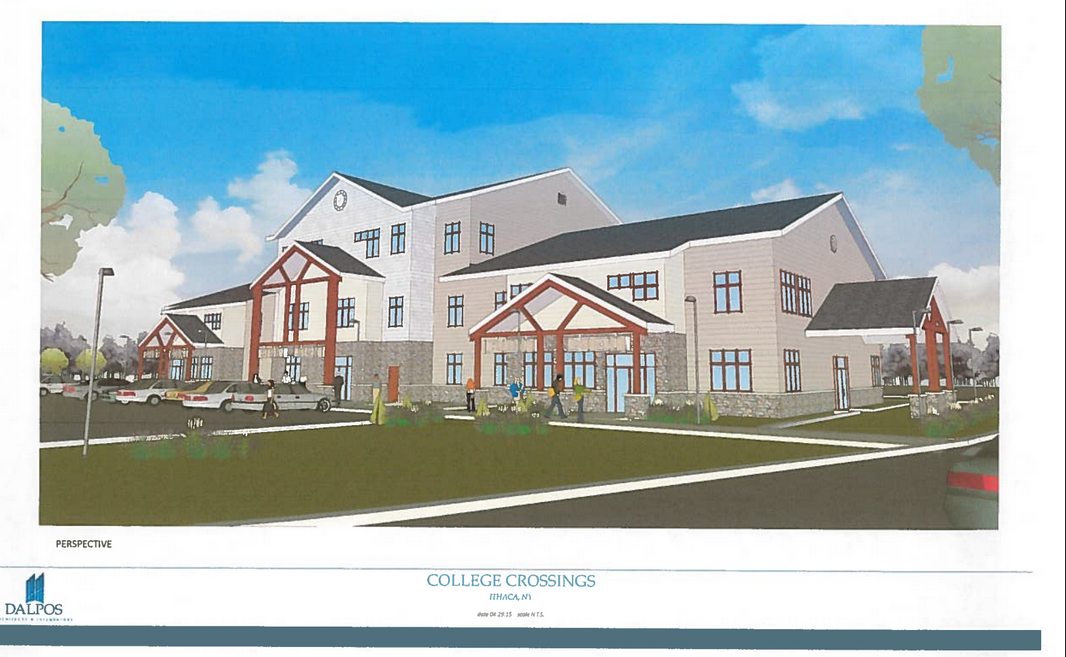
4. As written in the Voice, College Crossings at the corner of East King Road and Rt. 96B in Ithaca town is back to the board for revision number three. This one increases the project by a floor, 13,000 square feet and six more apartments. It’s been no big secret that developer Evan Monkemeyer’s had difficulties getting the project off the ground (he resorted to Craigslist for marketing the retail spaces), and given a total of 18,000 SF spread among 8 apartments (doing the standard 15% deduction for circulation/utilities, one gets over 1,900 square feet per apartment) these units are almost certainly geared towards IC students. A solid market since they’re next door, though not likely to elicit warm fuzzies from the neighbors (although based off the response on the Voice’s facebook, most people just don’t care; if only 210 Hancock had it this easy). Previous plans can be found here.
south-hill-areaplan-1 plan-2

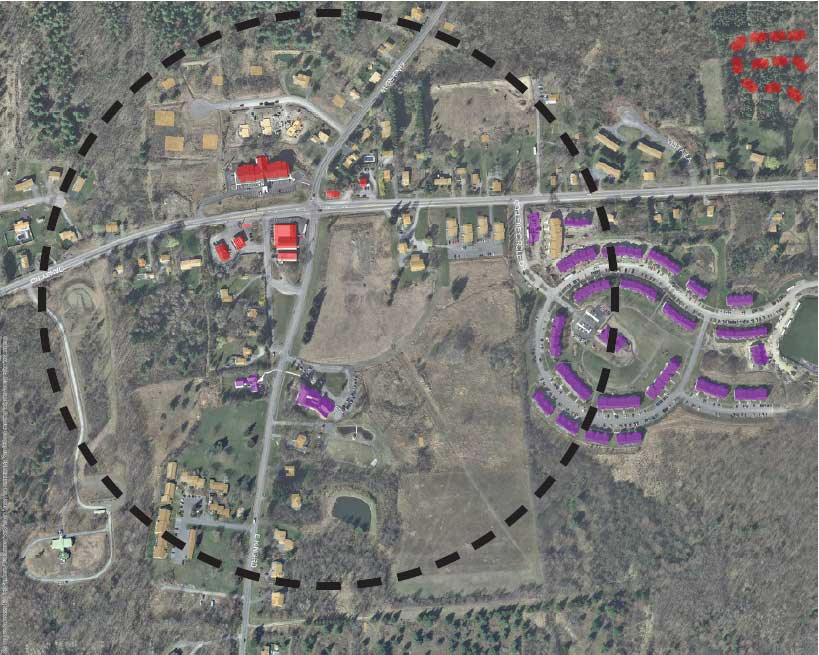
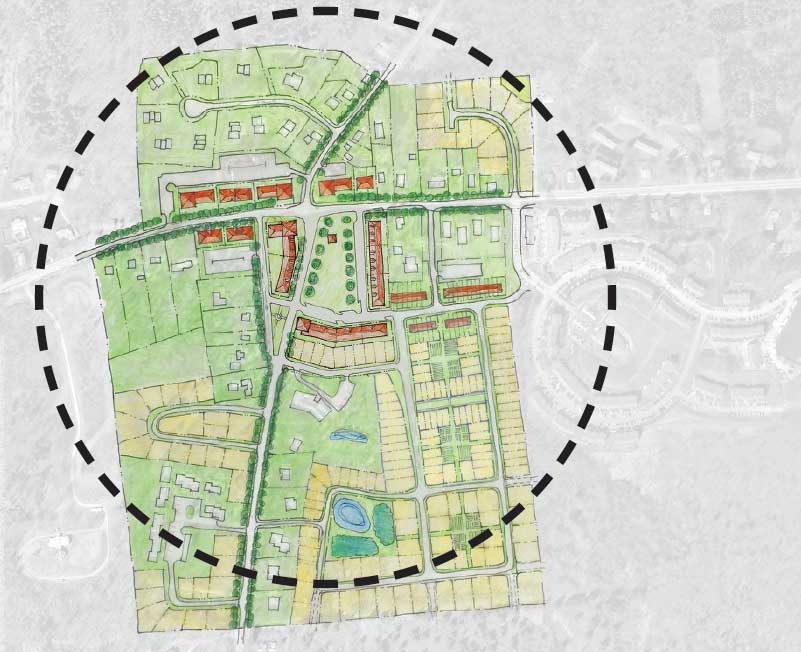
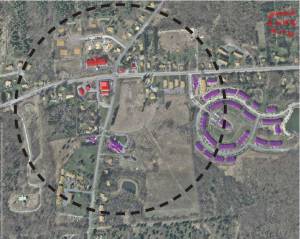
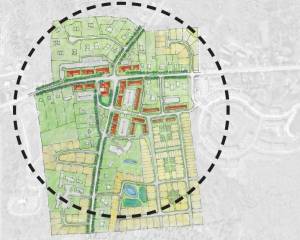
Personal opinion, I’m a little disappointed in the revision. The mixed-use aspect is fine, but I was hoping the developer would tap into some of the ideas presented for the land by Form Ithaca instead of plopping a building in the middle of a 120-space parking lot. Monkemeyer owns a lot of acreage in adjacent land parcels, so this doesn’t bode well for a “walkable center” in Ithaca town.

210_hancock_62015

5. Ithaca Neighborhood Housing Services (INHS) is armed with more 210 Hancock studies and analysis as it prepares to go in front of the city Board of Zoning Appeals next Tuesday. With the commercial loading space question settled, it leaves the height variance of 6.5 feet (40 feet zoned, 46.5 feet requested), and the parking variance of 20 spaces (84 required, 64 given). Original/full application here, new addendum analyses here.

The board requested additional information about pile driving and the parking situation. In response, INHS has conducted further analysis and shown that, 40′ or 46.5′, piles would be required either way. INHS has offered in its application to use a “vibratory oscillating” method of pile driving, where piles are vibrated into the ground rather than driven. This reduces noise (no hammer-like banging) and produces less overall vibration. Further parking studies found that 210 Hancock offers a greater percentage of parking than similar buildings like McGraw House, the Cayuga Apartments and Lakeview on Third Street, INHS’s parking study of its tenants was reiterated, and an analysis of its commercial tenants was given – the occupants will have 16 designated spaces from 7 AM to 5 PM, when the daycare and non-profit offices are in operation. After hours, they’ll serve as potential overflow parking.

It’s frustrating to think that a suburban market-rate project surrounded by a parking lot has no opposition, but a transparent project with affordable housing and a lot of community benefits gets so much grief.

6. For home-builders or those looking to build a palatial estate, here’s your latest opportunity – 5.45 acres at the end of Campbell Avenue in Ithaca city are up for sale. The area’s zoned for single-family homes, and the city is encouraging owner-occupied houses in that area. Previously, the property was seen as a potential 10-lot development in the late 1980s/early 1990s, but the plan was never carried out. The biggest barrier is probably that it’s West Hill, where neighbors have taken to going after their neighbors to keep them from subdividing and building homes.

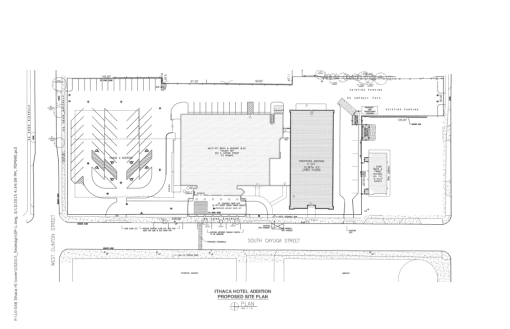
7. Initially, this was going to be a Voice article, but when the revised plans were presented, no renders were included. The Voice’s more general audience wouldn’t be as interested in this piece. But if you’ve read this far, and you read this blog frequently enough, then you won’t mind clickable, expandable site plans (pdf here).
hotel_ithaca_phase_1 hotel_ithaca_phase_2

The Hotel Ithaca is once again seeking to expand its offerings.

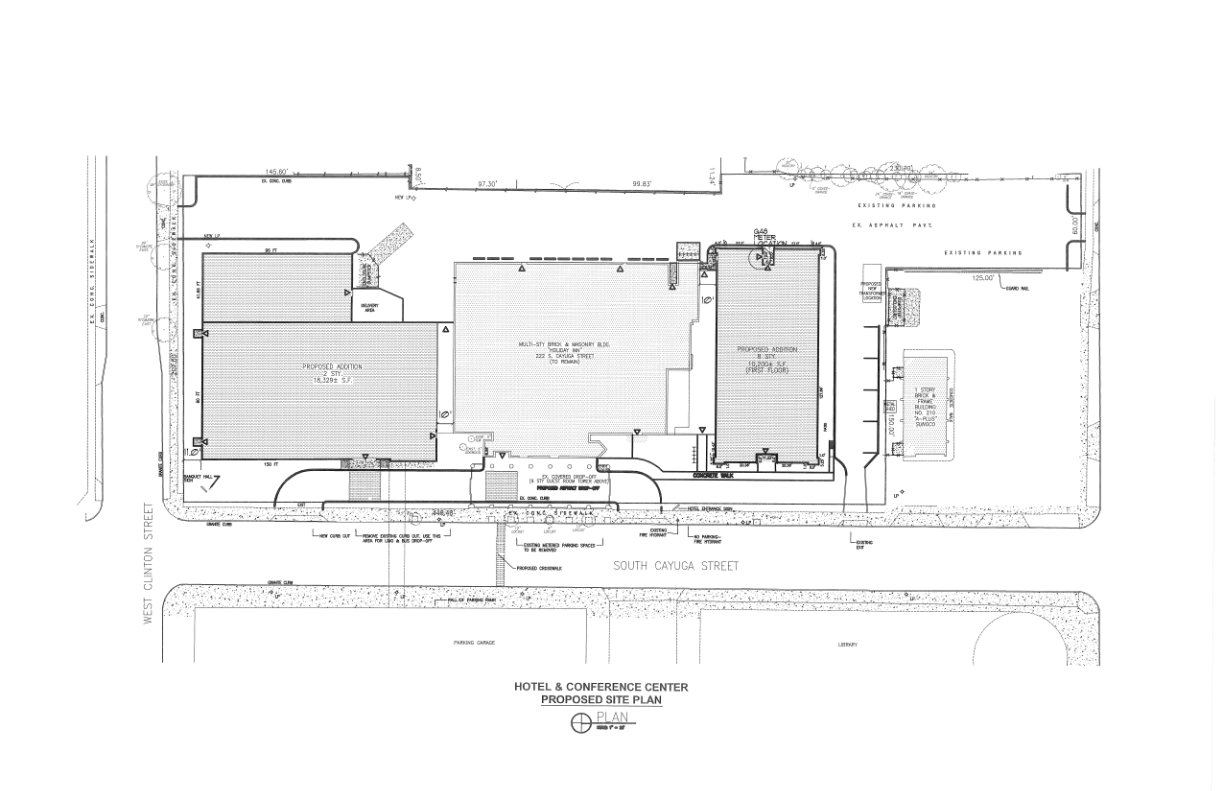
But this time around, it’s proposing to do in phases. Sketch plans presented at the Planning Board last Tuesday evening call for demolition of the two-story wings as before, but then the construction will be broken up into two phases.

The first consists of a five-story, 51,835 SF wing build on the northern side of the property, next to the gas station on the corner; the second phase, at a later, undetermined date, calls for three more floors on the hotel wing (bringing the new wing to eight stories and 81,600 SF), with a two-story, 18,300 SF conference center to be built on the corner of South Cayuga and West Clinton Streets.

The number of rooms in the addition has been unconfirmed, but given previous plans, it is likely to be little to no change from the current hotel, once the two-story wings are demolished. Until phase two is built, a parking lot would sit on the site of the future conference center.

The hotel is operated by Hart Hotels of Buffalo. Like several other Hart Hotels properties throughout the Northeast, the hotel has no chain affiliation, although the property was a Holiday Inn until the end of 2013. The 181-room hotel initially opened as a Ramada Inn in 1972, and the 10-story “Executive Tower” was completed in 1984.

Zoning at the site is CBD-100 (Central Business District), meaning that a proposed structure can be up to 100 feet (two floors at the least) with minimal required setbacks and no required on-site parking.

holiday_inn_expansion_1

Under plans previously presented three years ago, the Hotel Ithaca sought to demolish the two-story wings of the hotel, and in their place the hotel would would build a new 9-story, 115-room tower, a kitchen addition, and a 15,000 SF conference center. The demolition would have resulted in a loss of 100 rooms, so the net gain was a total of 15 hotel rooms.

The then-$18 million project had significant local support from business owners, because Ithaca lacks the ability to host mid-size conferences and conventions (midsize meaning about 500 attendees), which sends conventioneers elsewhere. Currently, the lack of meeting space limits conferences to about 250 guests. The addition of a convention facility is seen as a major benefit to downtown retail, as well as other hotels that would handle overflow guest traffic. Convention traffic typically happens during weekdays, when regular tourist traffic is lowest.

However, the project, which was initially slated to start in November 2012, has failed to obtain financing for construction. The project applied for and received a property tax abatement for the new construction, and the Ithaca Urban Renewal Agency (IURA) even offered the possibility of a $250,000 loan if it would create a financial package that would allow the convention center to be built. But until now, there had been no indication of any plans moving forward.


Lofts @ Six Mile Creek Construction Update, 7/2015

30 07 2015

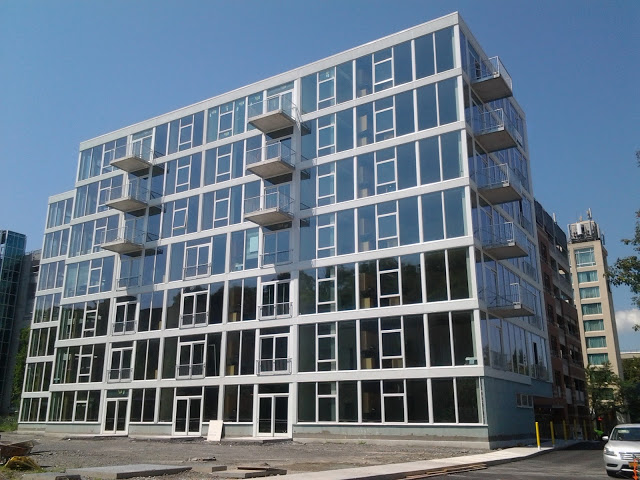
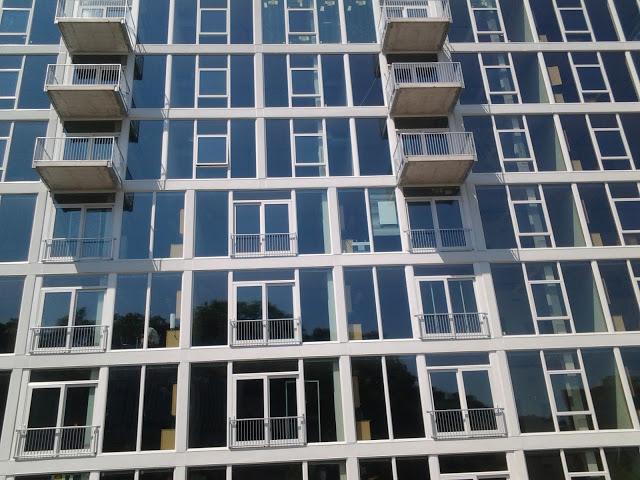
This will probably be the last update written for the Lofts @ Six Mile Creek apartment project; it’s very nearly complete. The lower floors already have their first occupants, while on the upper levels, the Pella windows still have labels on them, indicating that interior finishing is still taking place on the most lofty of the loft units. Outside, workers were busy cleaning off newly-laid sidewalk; exterior landscaping is up next, which will consist of weed-whacking, laying down soil, grass seed and new plantings that will hopefully enhance the Creekwalk.

It’s been nice watching this building go up, through here and on Ithaca Builds. It’s been a long, long time coming, and well-designed additions to the increasingly under-served housing market are welcome.

The Lofts at Six Mile Creek project consists of a a 7-story, 49,244 square foot structure that will contain 45 rental apartment units: 3 studios, 21 1-bedroom and 21 2-bedroom units. The building is being developed by Bloomfield/Schon + Partners out of Cincinnati, and construction is being handled by Turnbull-Wahlert Construction, also based in Cincinnati.

Leasing is being handled by CSP Management, and interested readers can apply for an apartment here or call 607-277-6961 if they feel so inclined. Prices range from $1,220 to $2,655 per month, depending on size and location of the unit.

20150727_113548 20150727_143308 20150727_143405 20150727_143453 20150727_143516

20150727_113404

20150727_145241

cayugaplace_v5


Carey Building Construction Update, 7/2015

28 07 2015

20150727_110454 20150727_110546 20150727_142436 20150727_142541 20150727_142626 20150727_142812 20150727_142830
carey_rev5_3 carey_rev5_1

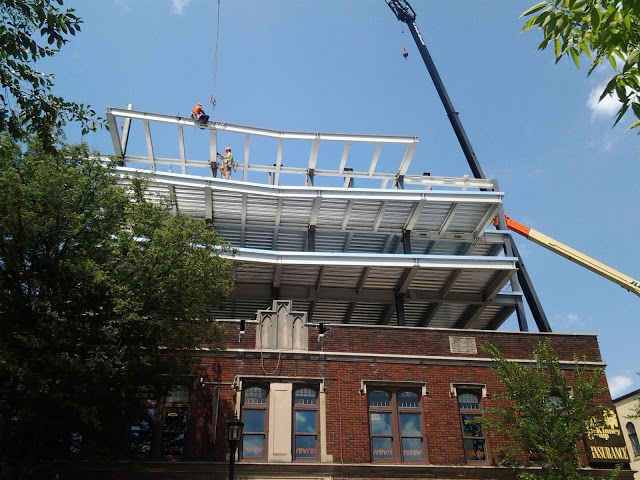
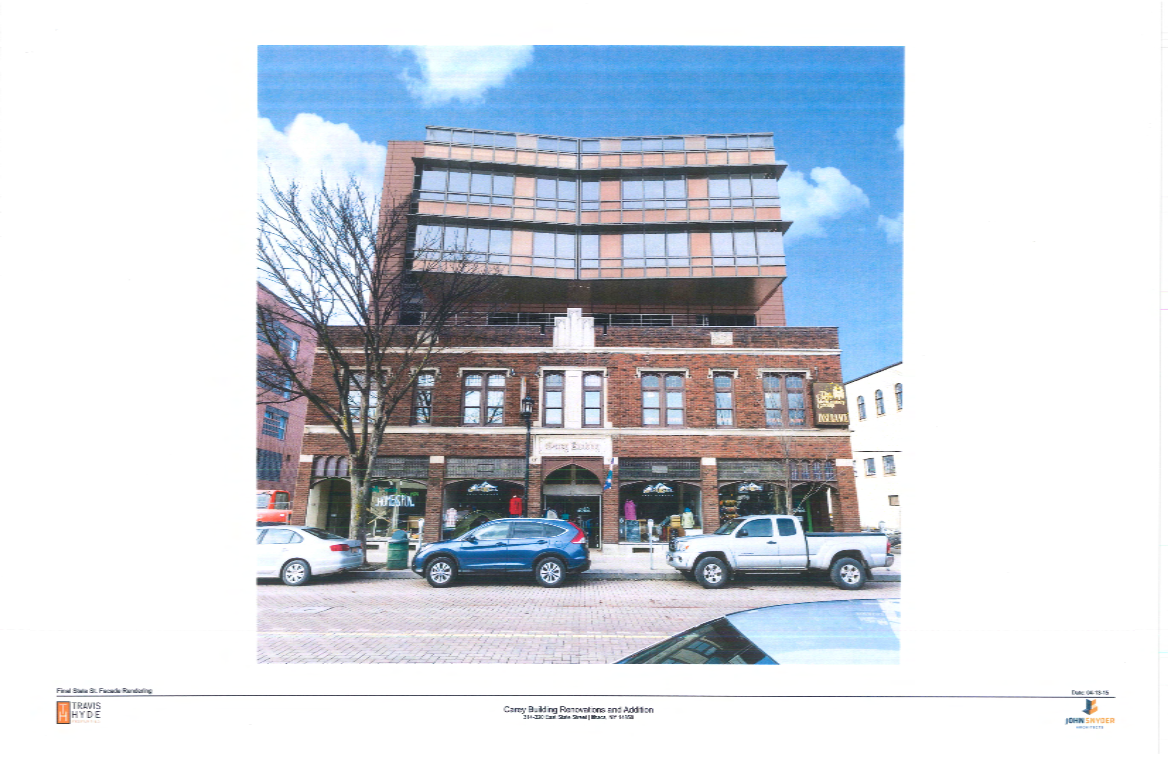
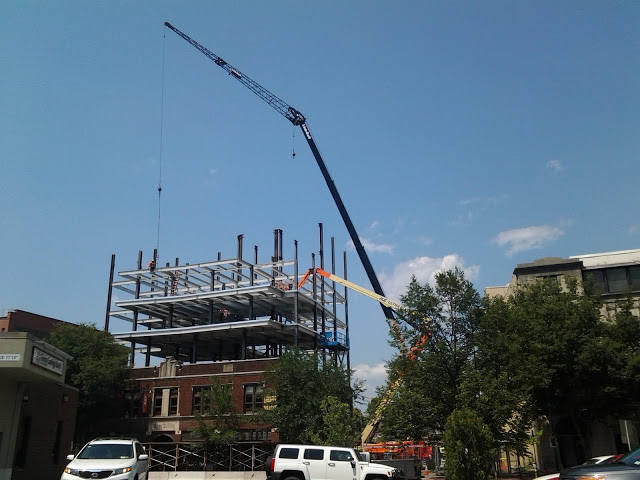
At the Carey Building in downtown Ithaca, work continues on the structural steel beam assembly of the new 5-story vertical addition. It looks like the lowest two floors of the addition have steel decking, and cross beams are being installed on the third floor. The top two floors, which are smaller, have yet to be built, but one can get an impression of their height by looking at the joining plates attached to the vertical steel columns. Note the “kink” in the structural steel above the front entrance, and how it relates to the design of the apartment floors.

The previous estimates of a late summer/early fall completion have been too aggressive, especially since the addition had to sort out fire code issues, as well as anything else that comes up when working on a 90 year-old building. It would seem that late winter or early spring is more likely, but the steel work should be completed by the end of this summer. No word on if the Canopy Hotel developers still plan on sharing the telescoping boom construction crane.

The Carey Building addition will add a third floor and 4,200 SF to the Rev business incubator (nearly doubling it to 8,700 SF), and on floors 4-7, there will be 20 apartments. Floors 4 and 5 will have 16 studio apartment units that average only 400-500 sq ft, their small size enabling them to be rented at a lower price. The 4 units on floors 6 and 7 will be larger 2-bedroom units. The $4.1 million project is being developed by local firm Travis Hyde Companies. LeChase Construction is handling the build-out process.


News Tidbits 7/25/15: To Reuse and Rejuvenate

25 07 2015

travis_hude_libe_libe_v3 oldlibe_franklin_proposal

1. Let’s just outright say it – the Tompkins County Legisltaure’s Old Library decision is a complete mess at this point. As covered last week, there were three separate individual resolutions – one from legislator Mike Lane for the Travis Hyde proposal (first image), and one each from legislators Dooley Kiefer and Leslyn McBean-Clairborne for the Franklin proposal (second image).

They all failed. 8 yes’s are required. The Travis Hyde proposal failed with 5 yes and 7 no’s. The Franklin proposal failed with 5 yes and 7 no’s on Kiefer’s resolution, and 4 yes and 8 no’s on McBean-Clairborne’s resolution. Martha Robertson, a supporter of the Travis Hyde proposal, recused herself because she had received donations from Frost Travis during her failed congressional campaign in 2014. Legislator Glenn Morey, also a supporter of the Travis Hyde proposal, was absent from the meeting.

I don’t see any way this will ever get the eight votes required. Kathy Luz Herrera voted against the proposals because the resolution has a ground lease (meaning the county still owns the land but leases the property), and Dooley Kiefer has stated she refuses to support any of the projects unless they have a ground lease – in other words, these two have mutually exclusive votes. By voting against McBean-Clairborne, Kiefer’s made it clear she will vote against the Franklin project unless it meets her exact specifications. Shinagawa voted against Travis Hyde for not being what the community wanted, but won’t vote for the Franklin proposal unless they guarantee Lifelong’s involved. And Stein has come out in favor of the Travis Hyde proposal. There’s no solution on the horizon.

So now it heads back to the Old Library Committee. Sale to the highest bidder and demolition of the library are real options on the table.

cayugafarms_2

cayuga_farms_1
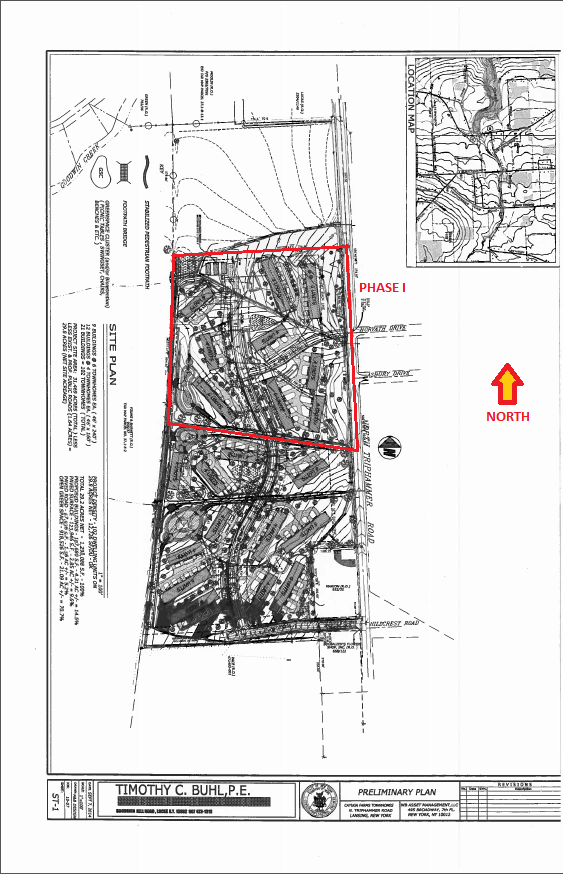
2. Turning to Lansing town, the planning board there has approved plans for the 102-unit Cayuga Farms townhouse project for a 31.4 acre parcel off of North Triphammer Road near Horvath Drive. First reported last Friday by the Lansing Star, the project received negative SEQR determination (meaning that, following the state’s environmental review guidelines, that the planning board decided the project will have no serious detrimental impact on the community) and issued preliminary site plan approval.

However, one issue still remains to be resolved before any shovels hit the dirt – sewer. The project currently has a modular package sewer treatment proposal that would work in place of the voter-defeated municipal sewer, and allow for denser development than the town’s rule on septic tanks. But the DEC’s interest in that type of treatment has been mixed. It could be a while before the situation gets sorted out.

Readers might remember this project because it’s one of the few I’ve openly derided. The 102 units are townhouse-style apartments marketed towards the upper end of the market. They would be built in phases over a period of several years.

cornell_novarr_5 cornell_novarr_6

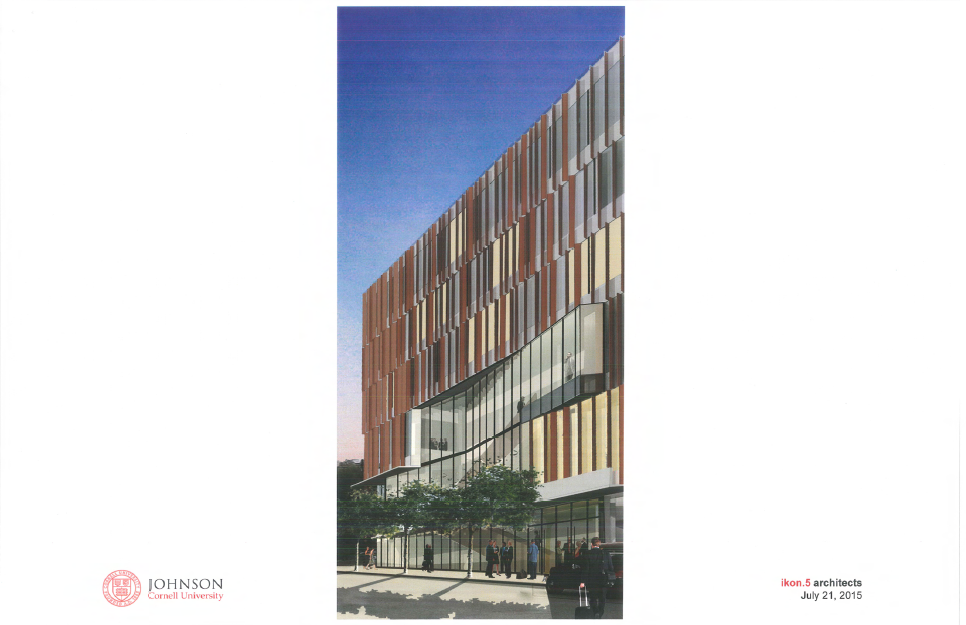
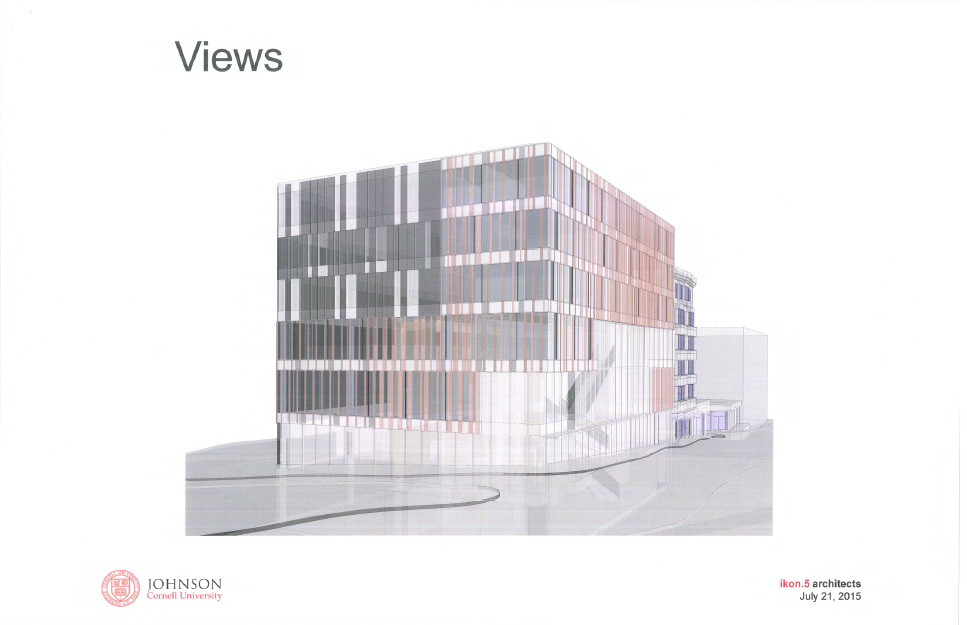
3. Now for some eye candy. Included with this week’s planning board project review committee agenda are additional renderings for John Novarr’s project at 209-215 Dryden Road. Doing a quick visual cross-check with the initial renderings, there don’t appear to be any substantial design changes, and the colorful metal cladding appears to retain the same pattern as before. Getting a little poetic here, the cascading metal bars are reminiscent of water running down a wall.

The city’s Full Environmental Assessment Form doesn’t express many worries about the project; some concerns have been raised about too many pedestrians on the street (the building would add 420 people to Collegetown’s sidewalks at the outset, 600 when fully occupied), but that seems to be about it for now.

The $12 million project is moving right along in an effort to start construction this fall. Declaration of Lead Agency and some CEQR discussion (the city’s more stringent version of SEQR, State Environmental Quality Review) are expected at the July planning board meeting. Plans call for 76,200 SF building with three floors of classrooms and three floors of offices for Cornell’s Johnson School Executive MBA program. The building would be ready for the Big Red’s B-students in April 2017. The property would remain on the tax rolls.

20150605_114431

4. A couple of interesting news notes courtesy of the Ithaca Urban Renewal Agency (IURA) Agenda:

First, popular downtown restaurant Madeline’s is looking to obtain an agency loan as part of a renovation project. The $470,000 project would add three jobs, only one of which pays living wage. The restaurant on the first floor of the Rothschild Building (the two-story building in the above photo) hopes to take advantage of the new hotels going up, and law firm Miller Mayer moving its 60 employees into the Rothschild Building. Previously the firm was in the Chemung Canal Trust Company building further up the Commons.

Second, the Finger Lakes School of Massage has applied for an agency loan to facilitate a move from West Hill to downtown. The school would move its ~34 staff and 75-95 students into 10,804 SF of leased space on the Rothschild Building’s second floor, with a further 1,700 SF on the ground level for a retail store and alumni massage clinic. The space would be renovated at a cost of about $194,300.

Although both projects come with risks (Madeline’s being a restaurant, FLSM having some worrying financial statements), both projects have been recommended for loan approval. The FLSM and Miller Mayer news suggest that most of the office space in the old Rothschild Building, left vacant when Tetra Tech moved to Cornell’s office park in 2010, has now been refilled.

The new window cut out built recently into the Rothschild Building’s east facade is part of the space where FLSM is moving into.

416_e_state_1

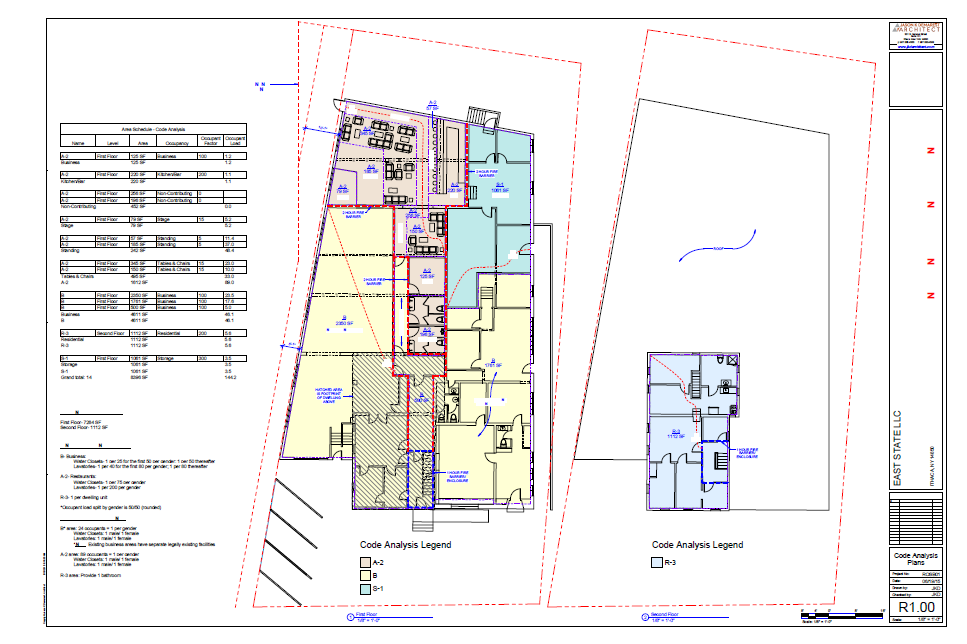
5. And now another reuse project – at 416-418 East State Street, currently home to an underused 7,600 SF office and a connected manufacturing/storage building. The house dates from the 19th century, with various additions as recent as the 1970s. According to plans filed with the city, an LLC linked to Argos Inn architect Ben Rosenblum has plans to convert the old manufacturing space into a bar and storage space, with renovated offices and a 2 bedroom apartment in the original house. The project will include an accessory parking lot, revised landscaping and handicap access. Area and setback deficiencies have resulted in the need for a zoning variance, but a parking variances won’t be required because the bar will have after hours parking across the street at Gateway Plaza. The building itself won’t change dimensions, but the change in use triggers the city zoning laws.

There have been some concerns expressed about this project – at least one neighbor is vociferously opposed to a bar, citing noise problems and concerns about smokers, and the county planning department is not a fan of the traffic and parking arrangement. Offhand, I think a bar is legal in B-4 zoning, but the noise impacts will merit further scrutiny.

The project is definitely something of interest to the Voice’s audience, but in an email, Rosenblum said that details are still being worked out and that he’d prefer to discuss the plan at a later date.

Scott Whitham is serving as a consultant, and local architect Jason Demarest is designing the renovation.

state_st_triangle_v3_1 state_st_triangle_v3_2 state_st_triangle_v3_3

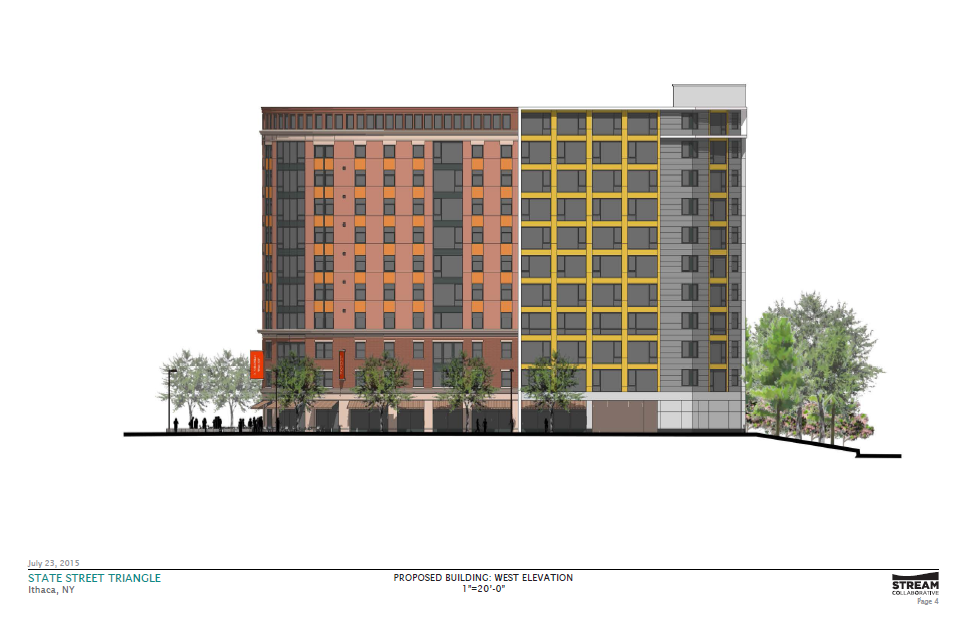
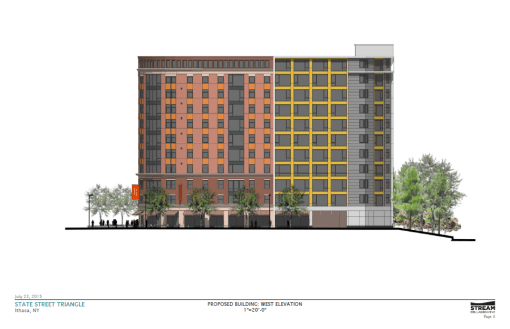
6. Some very substantial changes are in store for Campus Advantage’s $40 million, 240-unit State Street Triangle project at 301 East State Street in downtown Ithaca.

The Texas-based developer has recruited the assistance of Ithaca architecture firm STREAM Collaborative to help redesign the 240-unit project. And there’s clearly been a lot of work since the previous planning board rendition.

In this revision, a much greater emphasis has been placed on the street interaction and active street uses. Gone is the soaring corner, and in its place is a design with a greater use of horizontal elements (like the decorative belt above the third floor) in order to give the building a more human scale – crucial when you’re planning one of the largest buildings in Ithaca.

The developer is also seeking to remove the northbound turning lane from Aurora onto State Street, and replacing it with a pedestrian area with widened sidewalks, outdoor seating and dining spaces. The land would have to be procured from the city, or some other type of collaboration would have to take place with city officials and engineers.

In documents provided in the city’s planning board agenda for next Tuesday, the developer notes that the project remains student-oriented, but in order to play down comments of it being a massive dorm, 10 4-bedroom units were reconfigured into 40 studio apartments that the developer hopes will be appealing to non-student tenants looking for a less expensive, modestly-sized space.

The State Street Triangle project is also exploring LEED certification.

The project still has a lot of details to be addressed – city transportation engineer Tim Logue has expressed concerns that the traffic study underestimates the number of car trips, and has asked for a revised study. The project is also under closer analysis because the potential addition of 600 residents into downtown Ithaca would put a greater stress on utilities and infrastructure.

These and other questions are likely to be topics of discussion at next Tuesday’s meeting.

The State Street Triangle may be pursuing a CIITAP tax abatement (so much for my theory a couple weeks ago), but the city has not uploaded the application at the time of this writing.
7. Looks like a busy meeting next week for the Ithaca city planning board. In order:

1. A subdivision at 106-108 Madison Street on the Northside. The applicant wishes to create a new lot on the east side of the existing lot, for the purpose of building a new-single-family home.

2. A. Declaration of Environmental Significance and BZA recommendation for the Dibella’s sub shop proposed at 222 Elmira Road

B. Declaration of Environmental Significance, BZA recommendation and potential approval for the 1,100 SF addition to the Maguire Chrsyler/Fiat dealership in Southwest Ithaca

C. Declaration of Environmental Significance, and potential approval for the two duplexes proposed at 112 Blair/804 East State Street

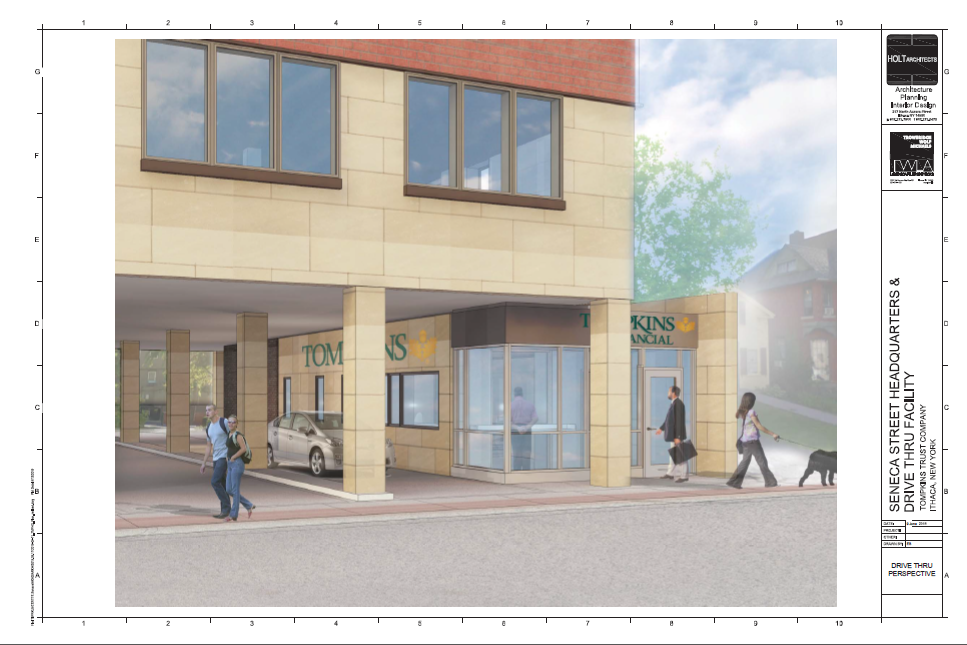
D. Site-plan approval for the first phase of the Tompkins Financial HQ (the new drive-through in the current HQ’s parking lot)

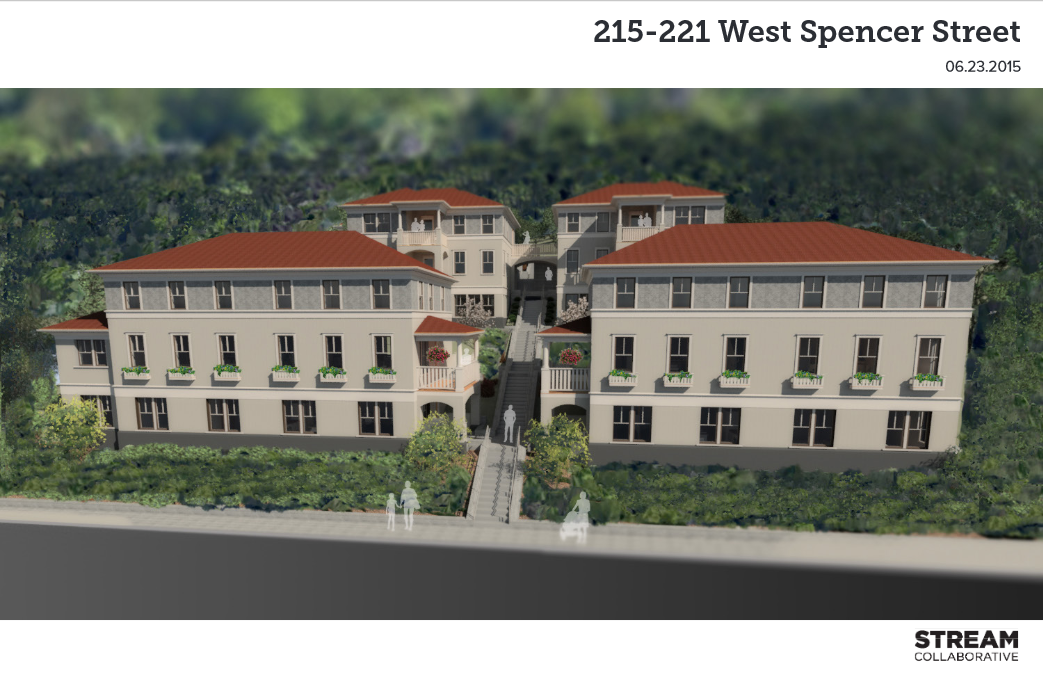
E. CEQR (the city’s version of SEQR) discussion for 215-221 W. Spencer Street

F. Declaration of Lead Agency and CEQR discussion on 209-215 Dryden (the Novarr project noted above)

G. Declaration of Lead Agency and CEQR discussion on State Street Triangle (

noted above)

holiday_inn_expansion_1

H. Sketch Plan – Hotel Ithaca Expansion. Readers might remember a 9-story addition and convention center were approved for the Hotel Ithaca almost two years ago (shown above). Nothing has happened with the expansion plans, for reasons which had been attributed to financing. Dunno what we can expect this time around, but we’ll find out next week.


“Fun Facts” About the Ithaca Workforce

21 07 2015

100_1471

A few weeks ago, I did an article for the Ithaca Voice about how wages in Ithaca are only slightly higher than peer communities in upstate, yet they pay a lot more in rent.

This article isn’t going to focus on that, although I could certainly add a few more pages (or at least fix the embedded graphs issue in the first article). This “topic of the week” piece is intended to be more of a “fun facts” about the Ithaca labor market.

The data comes from the Department of Labor here. All figures date from May 2014.

– The major category that employs the most people in Ithaca is no surprise – “Education, Training and Library Occupations”, with 15.49% of the jobs in the Ithaca metro (the BLS estimates this category to have 7,660 jobs locally, but that would suggest only about 49,430 jobs in the region when their numbers elsewhere say 70,000…make of it what you will). This turns out to be the highest percentage for any metro in the entire country.

This category, which includes professors, teachers, librarians and teaching assistants, averages pay of $80,700/year locally, versus $46,660/year nationally. Not only is Ithaca the metro with the largest percentage of educators and librarians, it’s also the one with the highest wages – Ann Arbor (U. of Michigan) comes in second with $79,500. Ithaca’s quintessential college town vibe is strong.

– The occupational category with the highest average pay is no shocker either – Physicians and surgeons, who employ about 80 people locally and average a pay of just over $233,000/year. The national average is only a little lower at $224,000/year. They are followed by the 40 or so dentists in the region making an average of $205,000/year (national average $167,000/year).
– On the other end of the scale, fast food cooks make the least – the 140 estimated by the BLS make about $18,680 per year. Food prep, delivery drivers and laundry workers all make less than $20,000/year on average, and amount to 1,380 workers. The median salary for all jobs in the Ithaca area is $52,020/year.

– Some other rankings where Ithaca comes in the top 10 of the nation’s 381 metros: professional chefs (8th highest concentration in the nation), microbiologists (7th highest concentration), psychologists (5th) and editors (4th – here’s looking at you, Jeff).

– Now here’s a fun category – location quotient. Basically, how many times more likely a certain type of worker is in a given area versus the national average. For example, my field, atmospheric and space scientists, has a location quotient of 107.36 for the Boulder, Colorado – in other words, atmospheric and space scientists are 107.36 times more common  in Boulder than the national average. This is why we have a joke in my field that Boulder is like Mecca for atmospheric scientists – you have to visit at least once before you die, otherwise you can’t go to Heaven.

So what fields have the highest location quotients in Ithaca? Economics professors (24.53), Physics professors (14,49) and Fundraisers (14.03). And yes, Ithaca has the highest concentration of people in those fields out of any metro area in the country. Now I know why Cornell is so persistent with its donation solicitations.


News Tidbits 7/18/15: Two Steps Forward, Two Steps Back

18 07 2015

oldlibe_franklin_proposaltravis_hude_libe_libe_v3

1. The Old Library conundrum continues. At last Friday’s meeting, the committee was unable to come up with an endorsement. As it also turns out, absent legislators Peter Stein and Kathy Luz Herrera can no longer re-introduce the preferred developer vote because absent legislators can  only re-introduce a resolution for the subsequent county meeting – in other words, they didn’t put it up for a re-vote on the 7th, so that option is no longer available. Stein didn’t make a resolution, and Luz Herrera was once again absent from the meeting.

Now things get a little more haphazard. Individual legislators can introduce resolutions for a preferred developer, which Dooley Kiefer and Leslyn McBean-Clairborne are doing for the Franklin/STREAM proposal (the 22 condos and medical office space, first image), and Mike Lane for Travis Hyde (the 60 apartments with space for Lifelong, second image). Either one would require eight votes in favor. Martha Robertson’s recusal makes the Travis Hyde proposal a little less likely to hit that magic number, but unless anyone’s had a change of heart, if Kathy Luz Herrera and Peter Stein don’t both vote in favor of the Franklin proposal, nothing moves forward. The county gets left with a building they can’t make a decision on and don’t want to keep.
The building needs hundreds of thousands of dollars in renovations at this point, not to mention routine maintenance; the lack of a decision could be a weight on any legislator’s re-election prospects. If there is no decision, what happens next is anyone’s guess; spending money to mothball the building, demolition, or even selling the property on the open market. whatever the case, this is definitely not a comfortable position for the county to be in.

amabel_v3_1

2. Looks like the Amabel housing development in Ithaca town is undergoing some site plan changes once again. Quoting the web page, “[w]e recently came to the conclusion that it is far better to park the cars at each house then to have car parks within the common space, allowing 2 cars per house if needed. This also allowed for more guest parking spaces.” Rather than having a road go through the middle of the housing development, the development is now encircled by the road coming in and out of Five Mile Drive. I asked developer Sue Cosentini of New Earth Living LLC if those were garages facing the driveways, and the reply was “no, [but] they may be carports though.” As a result of the revised site plan, the project would need to go back in front of the Ithaca planning board for re-approvals.
fingerlakes_reuse_v2_1

3. Recently, Finger Lakes ReUse has been working on plans to open a new “downtown” branch and HQ at the site of the former BOCES Building at 214 Elmira Road on the edge of big-box land. The plans for the gut renovation of the ca. 1950 building (Ithaca’s first big-box supermarket) have been in the works for a while, and grants have been awarded to fund the project.

One thing that appears to be a recent addition, though, is a three-story, 20,000 SF office building. The building, described as the “Main Headquarters”, is strictly a conceptual proposal. The grant announced in December funds two new buildings,  the renovation and what could be either be the proposed 5,000 SF warehouse to the west of the existing building, or the “tenant space” occupied by Boris Garage at 210 Elmira.

The office building is an interesting idea, adding density to the often-underutilized Southwest Corridor and showing what future plans might be in store for the non-profit.

tfc_v3_1

4. It seems like there was an unpleasant surprise at this month’s IDA meeting – the motion from committee member Will Burbank to put a moratorium on all tax abatements until a county CIITAP is in place for local labor/construction unions and prevailing wage policy. For those unfamiliar, a moratorium is in this case a temporary prohibition of all new tax abatements. After considerable debate and a split opinion from committee members, the motion was rescinded until next month.

Speaking as a matter of opinion, it might seem like a good idea on the surface, but an all-out moratorium sounds more like a case of “throwing out the baby with the bath water,” as one of my professors used to say. Generally, the policy for businesses to hire the contractor with the best price and a strong record for quality, on-time work. Sometimes that’s a local business with local labor; sometimes it’s a company in Binghamton, Syracuse or Rochester. Hence the debate.

The problem with a moratorium is that it stops everything applying for a tax abatement, including projects that already have plans to use local labor. And to be frank, local governments have a terrible track record with moratoriums, frequently extending them because of bureaucratic red tape. I think the unions support the CIITAP idea, but a moratorium that could place even larger numbers of their membership out of work for 12 or 18 months is undesirable and politically damaging. Local labor is important, but a moratorium isn’t the best approach.

On another note, the IDA did unanimously approve the tax abatement for the Tompkins Financial Headquarters project.The 7-story, 110,000 SF building proposed for 118 East Seneca Street in downtown Ithaca will likely start construction later this year.

ithaca_beer_2 ithaca_beer_1

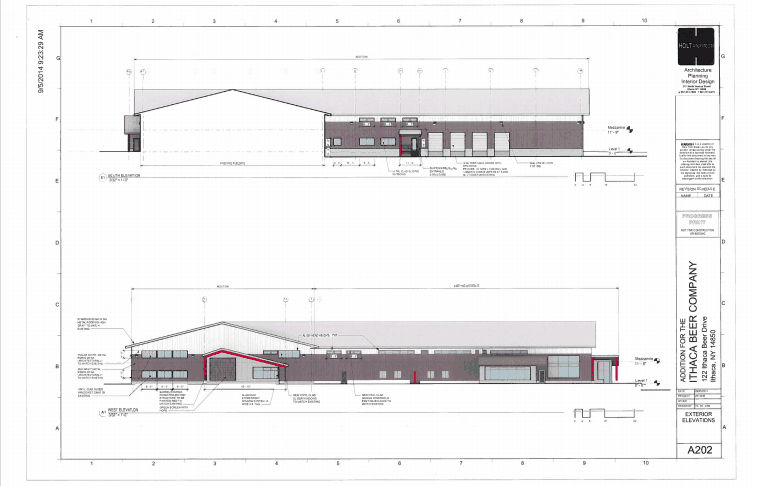
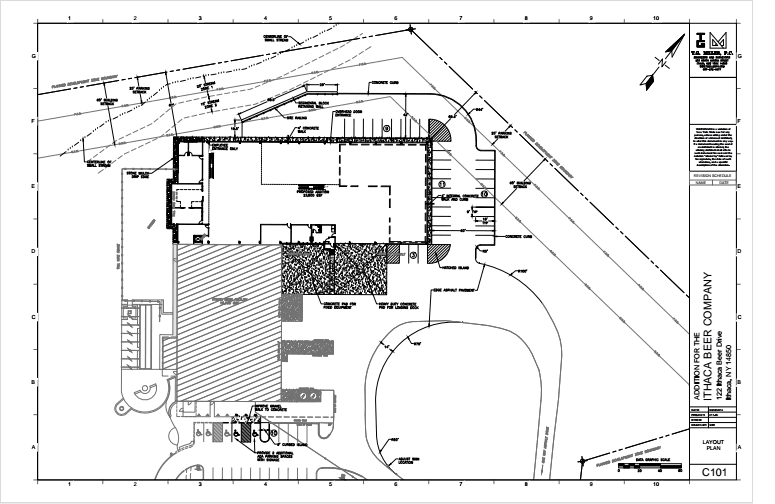
5. In economic news, Ithaca Beer had its informal groundbreaking Thursday the 16th for its expansion. The 23,800 SF addition by HOLT Architects will triple brewing capacity when it is completed in approximately eight months. The expansion at their site in Ithaca town is expected to create 22 new jobs.

clarebridgecrossings_2 clarebridgecrossings_1

6. Also in Ithaca town, a senior living facility is looking to receive final approval on its expansion. Brookdale Senior Living is looking to obtain final site plan approvals for its 32-unit Clare Bridge Crossings expansion at 101 Bundy Drive on West Hill. Brookdale is planning to start construction of the one-story 23,200 SF addition this October, with the first tenants moving in around October 2016. There’s no mention of job creation in the application, but there is a letter of opposition from a Cornell professor concerned that new construction will be detrimental to current residents.

Noted previously here back in May, the Brookdale site is a PDZ that consists of two facilities at the moment – Sterling House is a 48-unit assisted living facility, while Claire Bridge Cottage is a 32-unit facility specializing in memory care (Alzheimer’s and dementia). The new building, “Clare Bridge Crossings”, is designed to bridge the gap between the two – patients who might be in early stages of illness and experiencing mild symptoms, but otherwise still capable of some degree of personal independence. The whole complex is in the process of being renamed to Brookdale of Ithaca.

The new building will be tucked between the other two structures, so it won’t be visible from the street. Along with the new building, there will be updates to parking, landscaping stormwater facilities, and the addition of a couple of courtyards between the buildings. The architect is PDC Midwest, a Wisconsin firm that specializes in memory care facilities.

7. Let’s end off this week on a high note. Chances of a Chapter House rebuild are looking good. The owner’s looking into reusing the walls that remain standing, and even what’s left of the floorplates. The idea is to have the building look like it did before (though perhaps with a modern fire suppression system, one imagines). Looking forward to sharing renderings as they become available.


News Tidbits 7/11/15: Trying to Make A Dent in the Housing Deficit

11 07 2015

affordability_eli_2000 affordability_eli_2013
1. We’ll start this off with a brief data map, courtesy of Curbed NY. The Urban Institute, a DC think tank, quantifies the country’s affordable housing problem with a detailed study that lays out, county by county across the whole United States just how many units are affordable to what it labels “extremely low-income” (ELI) households, who make 30% or less of county median income. In Tompkins County, this means families of four making $23,200 or less during 2013, the latest year for which data is available. The full report comes with an interactive map.

Nationwide, the numbers aren’t very good – in 2013, only 28 of every 100 ELI families could find affordable housing, down from 37 out of every 100 in 2000. In Tompkins County, the situation is even worse – it’s gone from affordable housing being available for 19 out of every 100 ELI households in 2000, to 16 out of every 100 ELI households in 2013. There was only two other counties in the northeast that fared worse – Centre County, PA, home to State College and Penn State, and Monroe County, PA, a far-flung NYC commuter county.

While much of the talk about affordability focuses on the middle class getting priced out, it’s worth noting that the tight housing market and college-centric rental market have had a continued negative impact on what little housing there is for the poorest tiers.

2. Staying on the topic of affordability,  the county is all set to sell a foreclosed vacant lot in Freeville to INHS for the express purpose of affordable housing. This was first mentioned on the blog a couple of weeks ago. The 1.7 acres of land off of Cook Street in Freeville is assessed at $25,000, but the county is generously selling the land to INHS for the low price of $7,320, which is the amount owed on back taxes and “required maintenance”. This project would be next to Freeville’s other affordable housing complex, the 24-unit Lehigh Crossing senior apartments south of the parcel. Those were built in 1991 and are managed by a for-profit developer out of Buffalo (Belmont Management).

As noted previously, the village of Freeville (population 520) is outside of INHS’s usual realm of Ithaca city and town, but INHS expanded its reach when it merged with its county equivalent, Better Housing for Tompkins County (BHTC) last December.  This is likely to be the first new rural project post-merger, and the first new affordable housing development outside of Ithaca in several years. BHTC had a string of failures prior to the merger. For INHS, after the controversy with Stone Quarry and 210 Hancock, taking on a development site that’s likely to have less opposition will be a welcome change of pace.

210_hancock_62015

3. No full decisions from the Board of Zoning Appeals on the 210 Hancock project, but there was plenty of acrimony. Of the three requested variances (height, parking and commercial loading), only the commercial loading variance was granted at Tuesday’s meeting, with the height and parking up in the air until additional information is received about pile driving impacts and winter odd-even parking. INHS has just over two months to submit the additional information.

The same vitriolic sentiment could be applied for the Old Library proposals, where legislator Martha Robertson has been called out for a possible ethics violation, and emails on the Fall Creek Neighborhood Association listserve have turned unpleasant. All in all, it’s been a pretty harsh week for anything related to development in or near Fall Creek.

Some of the 210 opposition is upset that they’re being perceived as “classist”, but when the gentleman leading the opposition posts tweets like this to the #twithaca page for all to see, a negative reaction shouldn’t be a surprise. As for the old library debate, the legislature’s Old Library Committee met on the morning of the 10th, but no endorsements were made.

4. A couple of details worth noting for ILPC’s meeting next Tuesday – “early design guidance” for work planned at 201 W. Clinton Street, and “discussion” about 406 and 408 Stewart Avenue in Collegetown.

201 West Clinton, also known as the Hardy House, was built around 1835, and was previously the home of the local Red Cross chapter from about 1922-2011. After the ARC moved out, it was restored and converted back to a private residence. The house was more recently reviewed/approved for solar panels, and I dunno what’s in store for this next round.

As for 406 and 408 Stewart Avenue, those would be the addresses for the historic (ca. 1898) three-story red-shingled apartment house destroyed during the Chapter House fire last Spring, and the fire-damaged but still-standing apartment house to its north. They are/were operated by CSP Management, the same folks tending to the Simeon’s project. So let’s keep hopes up for a possible rebuild faithful to the original 406.

If you still need your weekly dose of crazy, here’s a rather paranoid screed submitted as part of an application to the ILPC. I can only imagine the committee’s initial reaction to this.

307college_rev2_1

5. Time to move another Collegetown project into the “under construction” column – 307 College Avenue, a.k.a. Collegetown Crossing, will hold a formal groundbreaking on Monday at 10 AM. The 46-unit, 96-bedroom project was approved last September after a years-long debate over parking; the project was only able to move forward when the new Collegetown zoning went into effect last year. Expect a 12-month construction period, with occupancy likely in August 2016. Collegetown Crossing, which also includes a 4,000 sq ft Greenstar grocery store branch, a pocket park and a TCAT transit hub, is being developed by the Lower family and their company Urban Ithaca.

112_blair_v4_1 112_blair_v4_2

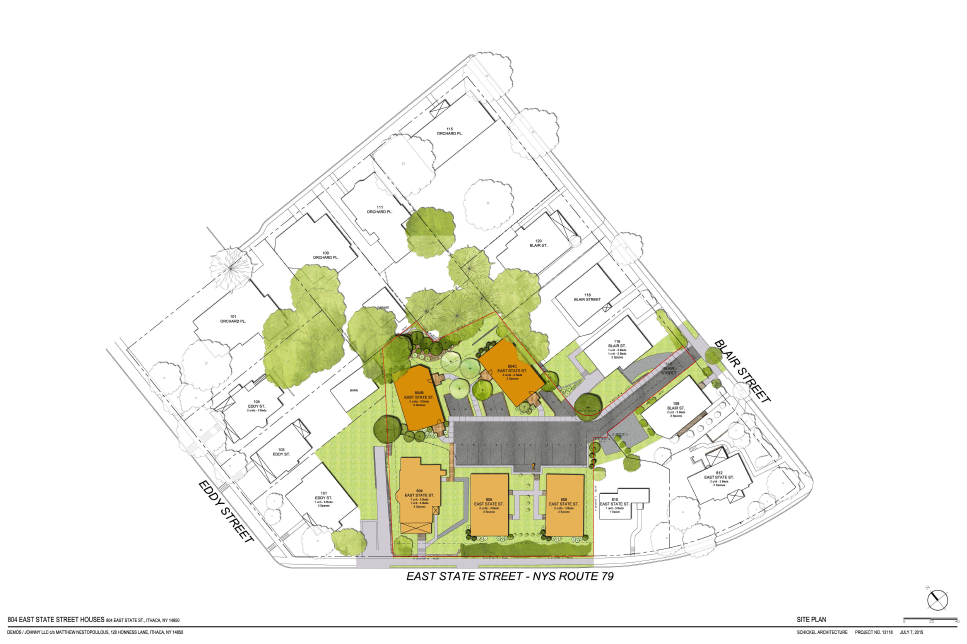
6. Looks like we’re on to another iteration of the proposed pair of duplexes at 112 Blair / 804 East State Street in outer Collegetown. Updated file here, previous plans here. It kinda feels like there’s a disconnect going on – the neighbors basically don’t like the houses for being boring pre-fab duplexes; the developer, Demos/Johnny LLC (Costas Nestopoulos), doesn’t want to change that, but is willing to adjust the site layout and invest in extensive landscaping in an effort to hide them. The two sides have met and they seem close to a compromise.

Rather unusually, the 12-bedroom project (4 units with 3 bedrooms each) will open to student tenants in January 2016, after a construction period of September-December 2015. Being a small project, there will probably be enough intersession shuffling to make it work.

maguire_fiat_v2_1

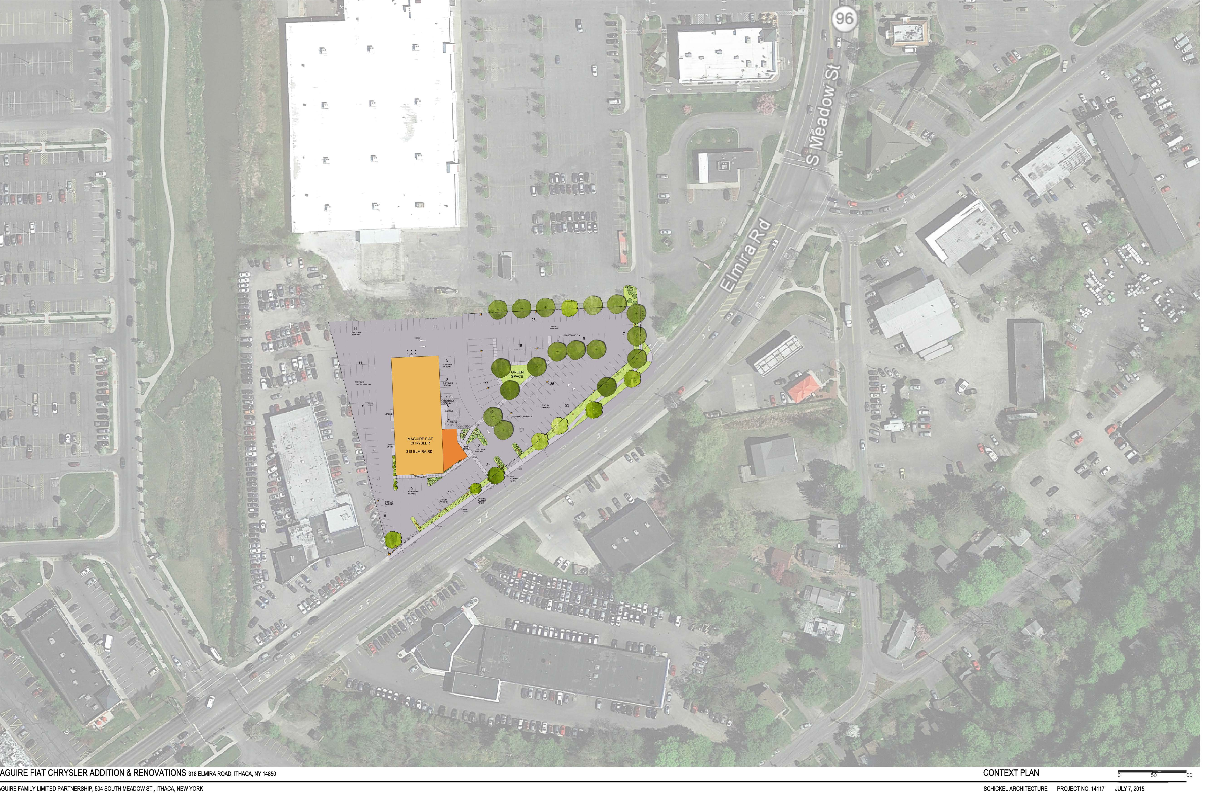
7. Here’s another small project getting a revision – the Maguire Fiat/Chrysler addition down in bog box land. Still adding 20 display spaces, but the addition has grown from 1,165 SF in the last version to 1,435 SF, include a small 418 SF second story intended as a lunch room. This project, which will need an area variance, is also looking at September-December 2015 buildout.


The Case For More Housing

7 07 2015

Last week, Ithaca mayor Svante Myrick and county Legislator Martha Robertson issued an opinion piece on the need for more housing, and especially affordable housing, in the city and county. There were two, fairly simple reactions to the article – readers believed it and agreed there was a housing issue, or they thought it was bunch of lies.

Being a data-driven person, I decided to delve a little deeper into the numbers behind Myrick and Robertson’s claims.

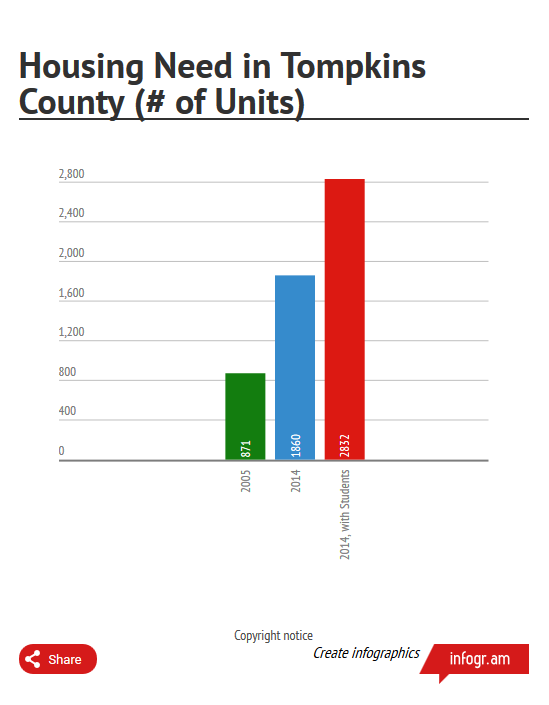
Let’s start with the 2006 housing study that was cited in the article. According to that study, performed by Vermont-based Economic & Policy Resources Inc. (EPR), 2,127 rental units and 1,767 owner-occupied units would be needed by the end of 2014, for a total of 3,894. These numbers were determined using the 2005 housing deficit (871 units), economic trends and population/demographic trends.  Some readers may remember the quote of “4,000 units of housing” cited in news pieces back in the mid-2000s, and this is where it comes from.

permits_tc_2006_2014

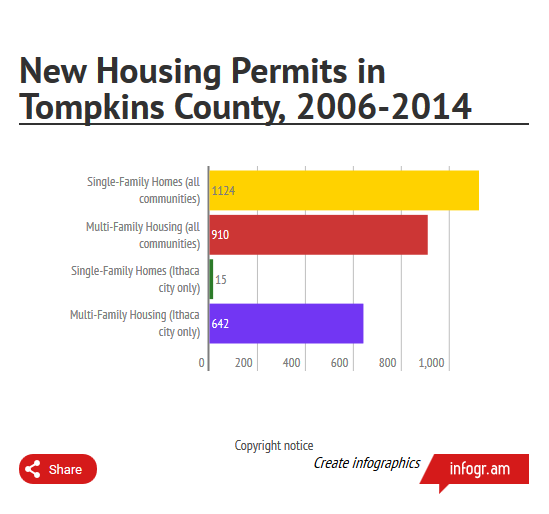
Using data from the U.S. Housing and Urban Development’s State Of the Cities Systems (SOCDS) Database, new housing permits were pulled for the same time period as the study’s projection, 2006 to 2014. From 2006 to 2014, Tompkins County added 1,124 single-family homes and 910 multi-family housing units (apartments and maybe a few co-ops or condos), for a total of 2,034 housing units. In what is a surprise to no one, the majority of multi-family housing was built in the city of Ithaca, and the majority of single-family homes were built in surrounding towns. The county had 40,069 housing units in 2006, so in that nine-year span there was about 5.1% growth in housing units, to 42,103.

The EPR study stated that 3,894 housing units would be required. With 2,034 units actually built, that means only 52% of the housing needs identified by the study were met. Breaking it down further, homeowners, occupying mostly single-family properties, fared a little better – with 1,124 built of the 1,767, that meant 63.6% of the homes that were needed based on 2006-2014 projection were built. However, for rental units, which are mostly multi-family housing, it was only 910 of the 2,127 needed – 42.8%. Not even half.

This wouldn’t be a problem if the economy slowed down or population growth leveled off, but neither of those occurred. Even with the recession a few years ago, job totals have increased quite a bit, with over 6,000 jobs have been added to the county since 2006. The population has also increased – Tompkins County had 99,997 residents in 2006, and in 2014 it was estimated to be 104,691. Rather oddly, the county added 3,049 housing units from 1997-2005, the previous nine-year period, but only 3,482 residents. Population growth has climbed even as housing construction has dropped.

Perhaps most importantly, the 2006 EPR study never accounted for changes in student population. It assumed net zero change for the purpose of the study, which focused on permanent residents. Unfortunately for the housing situation, there’s been a huge growth in student population. Cornell added 2,040 students from 2006 to 2014. Ithaca College added a more manageable 178 students. According to the U.S. Census Bureau, the average rental unit in Tompkins County houses 2.14 people. The county’s staring down 1,036 units it didn’t plan for, and as noted in the opinion article, Cornell plans on increasing its enrollment further.

For the record, IC has added student housing in the period from 2006 to 2014 – an addition to the Circle Apartments south of campus, which opened in 2012 and increased campus housing capacity by 138 beds. While South Hill students are driving up housing demand, the overall impact is minor.

In contrast, when Cornell rebuilt its West Campus Housing during the 2006-2014 time period, there was no net increase in the total number of beds. The Big Red has had no gain in student housing since new dorms opened on North Campus in 2001. With the impending closure of the 480-bed Maplewood Park student housing complex, the situation may get worse. No one can force Cornell to build new housing, but their burgeoning student population does add a substantial strain to the market.

housing need_tc

Given the numbers above, Tompkins County fell 1,860 units short of its 2014 housing goal; add in the unexpected influx of college students, and the number rises to 2,832. It wasn’t good to have some affordability problems when the county was 871 units short of a balanced market in 2005; at the 2014 deficit of 2,832 units, the impacts become much more severe, which is why housing affordability has become such a big issue.

Myrick and Robertson’s column might be an opinion, but the statistics give their opinion a lot of weight.


206 Taughannock Boulevard Construction Update, 6/2015

30 06 2015

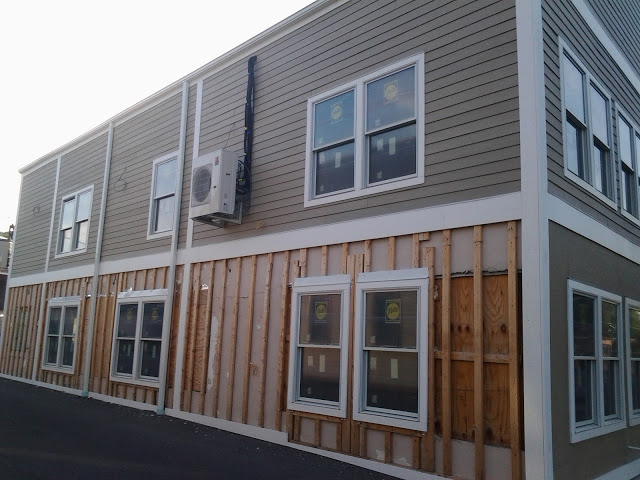
These photos date from the 13th, but they’re still worth sharing (and technically, it’s still June, so calling it a June update is valid). The fiber-cement siding has been attached to most of 206 Taughannock Boulevard, where a 2-story furniture store and warehouse built in the 1970s is being converted into a mixed-use building with 7 apartments (4 1-bedroom, 3 2-bedroom). A few sections still have insulation and (what I think are) wall studs showing.

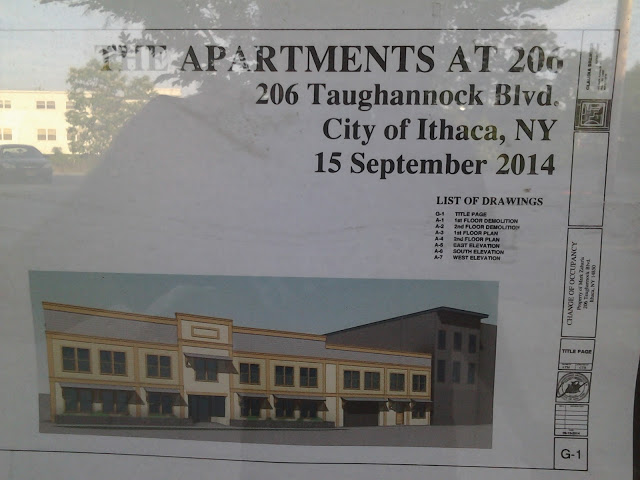
A drawing of the new plans posted in a ground floor window gives more information about the project. “The Apartments at 206”, as the new building will be called, bears only a moderate resemblance to the render provided in the window. The rendering posted, which dates from September 2014, indicates that the residential conversion was designed by local architect Claudia Brenner. Brenner designed the renovation of the Lehigh Valley House next door into a mixed-use building with ground-floor commercial spaces, other active-use (a branch police station), and six condominiums last year. It looks like the work on the Lehigh Valley House’s ground floor is still wrapping up.

Some of the trim boards are missing, the roof-line doesn’t match, and the materials don’t look quite right, especially the seemingly random gray cementboard next to the garage. Dunno what exactly is going on here, but since this didn’t need planning board review (there was no change in square footage, only a re-pruposing of the structure), the regulations aren’t there to make the structure to look like its render. Facade details and the sunscreens will be installed at some point, presumably. The renovation, estimated to cost $350,000, is the work of the Zaharis family, who owned and managed the furniture store before it closed in Spring 2014.

20150613_191809 20150613_191837 20150613_191931 20150613_192042 20150613_192110 20150613_192129 20150613_192154 20150613_192219 20150613_192630 20150613_192800 20150613_192844