The Chain Works District DGEIS, Part Two: Form Codes and Phase One

17 05 2016

For part one, click on this link.

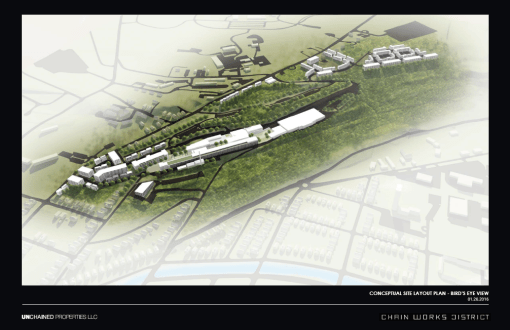
One of the challenges facing the Chain Works District is that it’s a little tough to plan out specifics when the construction timeline goes out over a decade. The renders of new buildings conceptualized as part of the redevelopment project may not look exactly as shown – in a lot of ways, they would best be described as placeholders. But, the zoning code proposed within the project’s PUD gives a pretty good idea of what a potential building would look like. The design standards can be found in Appendix C here.

The goal of the design standards is to establish a walkable, mixed-use neighborhood setting that builds on the existing industrial buildings and surrounding neighborhoods – growing without overwhelming. The design standards handle height, width, setbacks, buffer plantings, blank walls, building projections, the amount and spacing of doors and windows, porches and stoops, sidewalk width, the types of light poles allows, the “design speed” of streets – compared to Euclidean/use-based zoning, the emphasis isn’t on what’s taking place inside, but how it looks on the outside. Some might argue that it allows less creativity for architects, but it offers a lot more predictability for a multi-year development like Chain Works.

Even with the design standards, the project won’t be skipping the approvals process. New buildings and renovations that don’t conform to the initial proposed uses still have to go through Site Plan Review/Approval. Interior renovations not visible from public roads do not have to go through SPR, which is consistent with most of the city’s neighborhoods. But one step that may potentially be avoided by the PUD/PDZ are frequent trips to the Board of Zoning Appeals.

Chantreuil | Jensen | Stark Architects, STREAM Collaborative and Randall + West all played a role in site planning and developing the zoning.

chain_works_form_districts_1

There are four “sub areas” as part of the code – CW1 (Natural Sub Area), CW2 (Neighborhood General Sub Area), CW3 (Neighborhood Center Sub Area), and CW4 (Industrial Sub Area).

CW1, as the Natural Sub Area, is where land is planned to be left unaltered, or allowed to revert to “a natural state”. Some of this is due to technical issues like topography, as some of it is due to environmental features such as the presence of old-growth woods. CW1 is the most restrictive zone, allowing only passive recreational use, trails and stormwater management. New structures can only serve those purposes – sheds, park restrooms, pavilions, gazebos, and at most a visitor’s center, the sum of which may not cover more than 2% of the total area, with no single building over 2,000 SF, and nothing more than one floor / 15 feet.
cwd_cw2


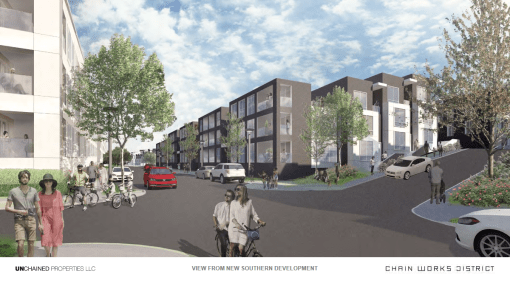
CW2 is the Neighborhood General Sub area, and one of the two zones slated to host the majority of new development. The intent here is detached single-family homes, row-houses and small apartment buildings. Total area coverage of more than 60% is prohibited, and height is limited to 4 floors, except when built on a hill, in which case there may be another 1-2 floors on the downhill side, as long as it’s consistent with CW3. Street trees have to be provided on at least 60% of the length of new and existing streets in CW2, at intervals no more than 40 feet.

Apart from general housing, the CW2 code would allow for senior housing, daycares, home-office, small-scale retail (less than 2,500 SF), nursery schools/day-cares and B&Bs.
chain_works_rev3_4

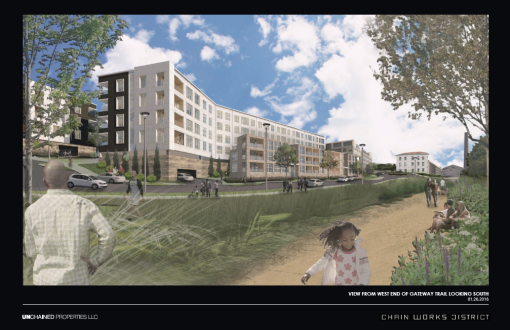
CW3 is higher-density mixed-use – larger-scale office space, larger-scale retail and the same residential uses allowed in CW2. Most commercial and assembly/factory uses are allowed (but no adult uses – in any zone, in fact). Plazas are allowed along with green space, and the maximum height allowed is 6 floors, with 1 more on the downhill if on a slope, and only 4 floors permitted with 2 floors on the downslope if within 100 feet of Route 96B. Total area coverage is permitted up to 80%, and a vegetation buffer of 30 feet is required if adjacent to residential properties bordering the CWD. The street trees rule in CW2 also applies here.

cwd_cw4

CW4 consists of industrial uses and utilities/storage space, 2-4 floors. 90% area coverage is allowed, and there has to be one shade tree planted and kept healthy for every 10 parking spaces. There is no minimum parking requirement for CW4, or any of the zones.

One issue brought up in review is that the code specifies that any one floor can’t be more than a certain height, but it would be better if they specified a maximum height for the first floor, and then a max height for each subsequent floor. For instance, instead of a max of 18 feet, which could create a 72-foot, 4-story building in CW2, the draft could be improved by saying 18 feet on the first floor, 12 feet on each upper floor.

cwd_street_assembly

Several types of “thoroughfare assemblies” are displayed in the document, specifying what’s permitted in each area. This is where the design speed, sidewalk and pavement widths, and parking and street-scaping details come into play. These include streets, alleys, industrial access roads and even a woonerf.

So that briefly sums up about 33 pages of code details. Most of those won’t come into play until new structures are proposed – the streetscape will be developed as phase one is under construction, and more when further build-out occurs. Speaking of phase one, let’s take a look at that.

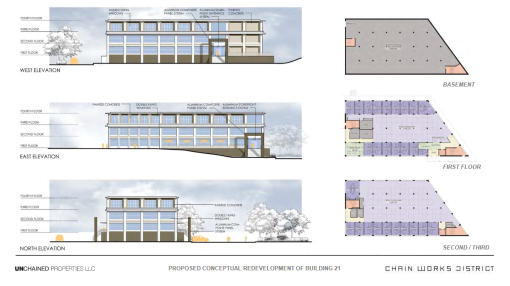
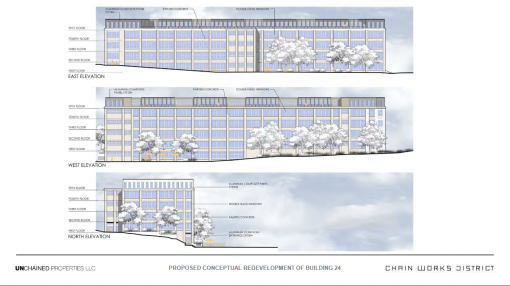
Phase one consists only of renovations to existing buildings, four of them. Buildings 33 and 34 would be renovated for new industrial uses per the CW4 code, and Buildings 21 and 24 would be renovated into an office building, and a mixed-use office and apartment building per the CW3 code.
cwd_bldg21_1

Building 21 becomes a 43,340 SF office building – new glass and a paint job are the biggest exterior changes. Parking would be on adjacent surface lots (page 2-27, DGEIS).
cwd_bldg24_1

Building 24 is the only building that gets an addition in phase one – 18,520 SF of new space on the top floor, a “penthouse addition” to the existing 111,050 SF space. The addition and the existing second to fourth floors would house 70 to 80 residential units in approximately 96,300 SF, in a potential mix of configurations ranging from studio to 4-bedroom units, but mostly it’s intended to be 1-bedroom and 2-bedroom units (page 2-25, DGEIS). The remaining 33,270 SF would be commercial office space. Parking would be on adjacent surface lots.
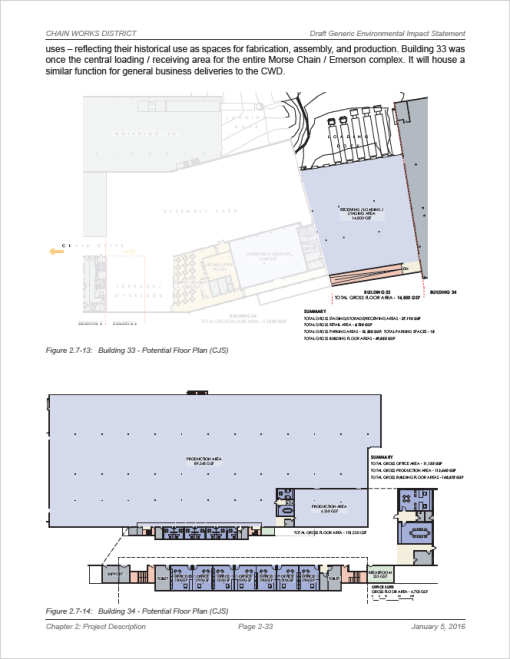
cwd_bldgs33&34

The industrial space envisioned for Buildings 33 and 34 requires minimal renovation, according to the DGEIS (page 2-33). Combined, they offer about 170,600 SF of industrial space, for manufacturing, warehousing, or related uses. Most parking (110 spaces) will be on adjacent surface lots, with a little more (15 spaces) created by the removal of Building 6A, and another 95 overflow spaces shared with CW3 structures. Part of the logic is that since workers and residents use parking spaces at different times (working the 9 to 5, vs. those who do their 9 to 5 in other parts of the city), they can share parking spaces somewhat.

Part 3 will take a look at some of the project impacts.
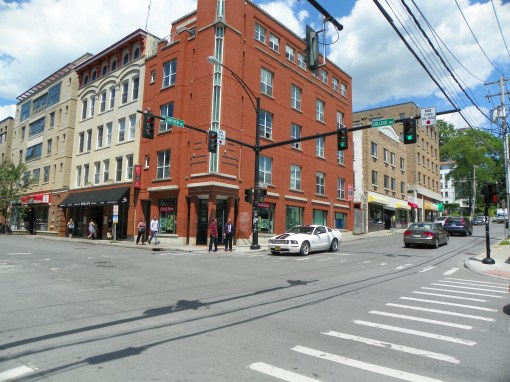


New Tidbits 5/14/16: A Land Subdivided

14 05 2016

6-29-2014 162

1. This week, the city rolled out a strategy memo for “Design Guidelines” for Collegetown and Downtown. The city held focus meetings back in March with Winter & Company, a Boulder-based urban design and planning firm with experience in cities and college towns from coast to coast. No specific individuals are mentioned as being part of the focus groups, but the focus group meetings consisted of “residents, property owners, developers, architects, design professionals, Planning and Development Board members, Common Council members, and City staff.” The memo is meant to help guide continued discussion of design standards, and to identify key issues in each area that could arise with planning and implementation.

The feedback from the focus groups shouldn’t come as a surprise – use high quality materials, respect historic character but don’t emulate it, recognize that development costs in Ithaca are very high, promote walkability and active street use, encourage parking lot infill, define transition areas between smaller-scale neighborhoods and denser cores, and so forth.

One of the major components being reviewed is whether design guidelines should be mandatory or just a set of recommendations. The city has a design review process that comes into play for certain projects like those on the Commons, but otherwise it’s non-binding unless the BZA or planning board mandates it as part of approval. Regardless, more meetings are expected as the guidelines are fleshed out.

al-huda_1

2. The Ithaca Times is checking in with the Al-Huda Islamic Center plan for Graham Road in Lansing. Fundraising is still underway for the 4,828 SF mosque, which according to a member of the Al-Huda board of Trustees, is expected to cost between $650,000 and $1 million, per contractor estimates.

Fun fact of the day, Islamic law prohibits mosques being paid for with funds that collect interest (tainted by usury). Everything must be paid for up-front and in full.

The village of Lansing has already signed off on the mosque plans, and the vacant land at 112 Graham Road is bought and paid for. Pretty sure the above drawing is outdated, but I haven’t seen an image of the latest plan available online. The Times has an interior shot of the current plan to accompany their story.

20141227_134549

3. The town of Ithaca passed the nine-month moratorium on two-family dwellings by unanimous vote at its meeting this week. Anyone seeking to build a duplex in the town of Ithaca will now have to wait until February 2017 for a building permit, unless “unnecessary hardship” is demonstrated by the law’s imposition. The law was driven by the construction of multiple 2-6 unit student-oriented structures east of Ithaca College in the Kendall/Pennsylvania avenue area, which they felt was undermining the neighborhood’s character. Earlier versions of the law called for a year’s length, but the town received numerous complaints that a year would actually hit two construction seasons, 2016’s and 2017’s.

100_1281

4. Also in lawmaking, the bike lanes proposed for the 300 and 400 blocks of Tioga Street in downtown have been shot down in favor of sharrows, 3-2. This comes after strong advocacy by city bicyclists and some planning and sustainability groups, and strong opposition from some elderly and disabled advocacy groups, suburban neighborhood residents and the town of Ithaca’s town board.

benderson_1

5. One of the many issues that faces large-scale planning and development in Tompkins County is that, over the many decades, land has been heavily subdivided and sold off between many different owners, with the properties often passed down or even traded, leaving records piecemeal. With so many owners, some untraceable, it can become logistically difficult, especially if not everyone is on board with a plan.

In front of Moe’s down in big box land, the county owns a 0.3 acre parcel of land previously a part of the flood relief channel. Since 2005, Benderson Development has rented the land as part of its shopping complex – now they just want to simplify things and buy the land from the county. With an offer of $112,500, which is $17,500 over the county’s assessment, and with the county’s 2005 confirmation and 2016 re-affirmation that they have no public use for that slice of land anymore (much of the channel’s land has already been incorporated into other parcels), they’re planning to finalize the sale at the Legislature’s meeting next week.

6. If you glanced at the Voice, you know there’s a plan cooking for 36 townhouse units east of Varna. But according to Dryden’s town planner, that’s not the only project that’s been brought forth to the town. A different applicant brought forth a plan for 20 single-family homes on 9 acres near the intersection of Route 13 and Mineah Road, a rural stretch between Varna and the village of Dryden. The units, expected to be rentals, are allowed as of right in Dryden’s mixed-use zoning – if it’s under 4 units/acre, it doesn’t need a special use permit, or even site plan review. A check of property records reveals several parcels owned by Ryszard Wawak, a Lansing businessman who picked up the land a number of years ago and has already built a duplex (2-bedrooms each) and a 5-bedroom house on subdivided parcels.

If you happen to start seeing houses popping up between Dryden and Varna, it’s probably this project slipping under the radar.

elmira_savings_v2

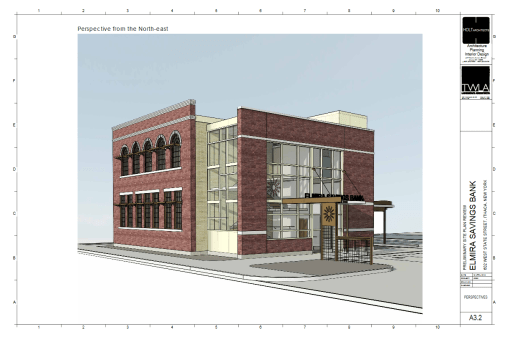
7. Taking a glance at the Ithaca Projects Review committee meeting agenda, the Elmira Savings Bank and 201 College Avenue projects will be undergoing review before heading to the planning board meeting later this month, and the subdivision/reconfiguration to build two two-family houses at 312-314 Old Elmira Road will also be reviewed. There are also a boatload of zoning variances being sought for various projects – Marriott signage, an apartment reconfiguration on Farm Street, a basement home salon on Center Street, a home addition on Cobb Street, parking variances for 121 West Court and a area variance for an existing carport on Grandview Avenue that was apparently never approved by the city when built in 1973. In total, there are nine. It’s times like this that the city would benefit from a simplified zoning code.


Simeon’s Reconstruction Update, 4/2016

28 04 2016

After the metal stud walls and fireproof gypsum board went up, it looks like another layer has been applied to the exterior. On portions of the structure that will be covered by brick, a closed-cell spray foam was used. Architect Jason Demarest provides a link to Goodale Construction of King Ferry on his Twitter account, so that might have been the subcontractor. Closed-cell spray foam, made with polyurethane and applied a few inches thick, provides insulation under the brick. On areas that will be covered by metal panels and details, Huber ZIP panels have been attached. Some of the original cast iron was salvaged after the accident and will be reused, but I haven’t seen anything that indicates if all the exterior trim will be cast iron, or if the exterior will be finished with metal panels that have a similar appearance.

Simeon’s, which is being built under a different contractor, is expected to reopen in June. Five apartments on the upper floors will hit the market later this year.

20160414_121110

20160414_121054

20160414_121009

20160414_120934

20160414_120426

20160414_120056

20160414_121141

simeons_v2_2


The Chain Works District DGEIS, Part One: Introduction

20 04 2016

chain_works_rev3_3

Chain Works is, without a doubt, the single largest project currently being considered in the Ithaca area. It’s a very large project in terms of square footage, in terms of cost, in terms of length of build-out. Being such a large and important, it needs to be examined carefully – it could help propel Ithaca’s economy and ambitions to a higher quality of life, or it could serve as 95 acres of dead weight.

Between March 29th and May 10th, the city is receiving public comments on the Draft Generic Environmental Impact Statement, the DGEIS. The city’s website appears to be outdated, but the Chain Works District website is up to date – any comments readers might have, any questions or concerns, are submitted to the City of Ithaca Planning Board as lead agency for environmental review. UnChained Properties LLC, the developer, offers a blank form here, or if one prefers, comments can be sent directly to Ithaca senior planner Lisa Nicholas at lnicholas@cityofithaca.org.

What a DGEIS does is evaluate the potential impacts of growth on local resources and facilities, such as traffic, water supply systems, utilities infrastructure, social and aesthetic impacts. The DGEIS, which will need to be finalized, is part of New York State’s Enviromental Quality Review (SEQR, pronounced “seeker”) and a necessary precursor to any planned/contemplated construction and development of the site.
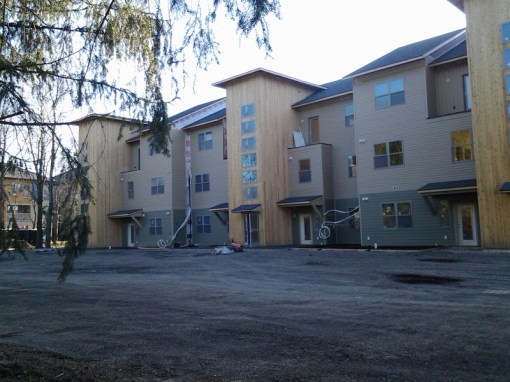
So, the DGEIS main body is 422 pages, with about 3 GB’s worth of appendices. Although 45 days is allotted for public comment, not a whole lot of people want to read through 422 pages, but the table of contents allows people to jump around if there’s one or two thing they’re more keen to read about. A link to the DGEIS is offered by project partner Fagan Engineers here, but you might need to submit an email and name before being able to see it.

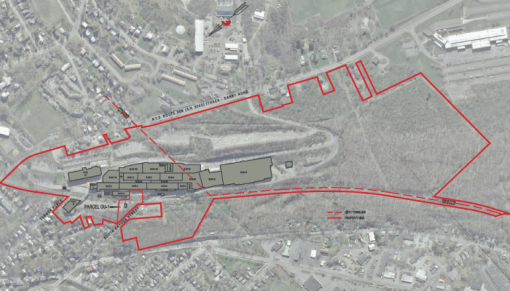
chain-works-map

So, basic details, per the “Description of Action”:

Chain Works District Project is a proposed mixed-use development consisting of residential, office, commercial, retail, restaurant/café, warehousing/distribution, manufacturing, and open space within the existing 95-acre Site which traverses the City and Town of Ithaca’s municipal boundary . Completion of the Project is estimated to be over a seven-to-ten year period. The first phase, referred to henceforth as Phase I, will consist of redeveloping four buildings generally located at the northernmost and southernmost ends of the complex of existing buildings. These first four buildings are approximately 331,450 square-feet (SF), and will house office, a mix of office and residential, and industrial uses. Subsequent phases of development will be determined as the Project proceeds and will include new structures to complete a full build-out of 1,706,150 SF.

So, just based off that, anything that gets developed, is as the market and NYS Dept. of Environmental Conservation (DEC) allows. If the market isn’t amenable or the cleanup plan isn’t approved, don’t expect the plans to move forward all that fast, if at all. If the market is good and the DEC signs off on plans, expect the build-out to be on the shorter end of the 7-to-10 year time-scale.

chainworks-before-771x441

chainworks-after-771x441

Related infrastructure work for the Project will include: (1) removing select buildings to create courtyards and a network of open spaces and roads; (2) creating pedestrian, bicycle, and vehicular connections through the Site from South Hill to Downtown Ithaca; (3) improving the existing roads within the Site while creating new access points into the Site; (4) mitigating existing environmental impacts from historic uses; (5) fostering the development of a link, the Gateway Trail, to the Black Diamond Trail network; and (6) installing stormwater management facilities, lighting, utilities, and plantings.

No big surprises – some buildings in the interconnected complex will come down, shared road concepts will dominate the internal transportation system of the neighborhood, the site will be more fully integrated into South Hill and trails, and usual site details like stormwater plans and landscaping are going to be incorporated into the project.

Given its complexity, the project team is pretty broad – eleven organizations, from the Ithaca, Elmira, Corning and Rochester areas. Local firms include STREAM Collaborative, which helped draw up the design standards and rezoning, Randall + West for more rezoning work, and Brous Consulting, which is handling public outreach. UnChained Properties is headed by David Lubin of Horseheads (suburban Elmira). From what I’ve been told, project development to-date has cost somewhere around $2 million dollars.

Likewise on the approvals – the project will need something like fifteen approvals from a dozen different government groups and agencies.

chain_works_history

Let me share an introduction and summary comparable but maybe more approachable than theirs – a background primer on why this is happening can be found on the Voice in my introduction article here, and Mike Smith’s summary article here.

Much of Chain Works reuses what was once the Morse Chain / Emerson Power Transmission (EPT) factory, which employed thousands from the 1900s, up until the last workers were let go and the facility shut its doors in 2011. During the mid 20th century, industrial processes used chemicals and compounds that are known to be toxic – Trichloroethylene (TCE) being the best known, but also heavy metals and oils. These not only affect the site and its building, they’re also in the soil and groundwater of South Hill.

chain_works_contamination

The site is classified as Class 2 Superfund site, which the DEC describes as “a significant threat to public health and/or the environment and requiring action”. While EPT is responsible for clean-up, they’re only responsible for the bare minimum (the industrial standard, what can be safely exposed to for 8 hours) unless otherwise specified by a proposed reuse, in which case they have to clean to a higher standard like residential use.

So that leaves us at present – a vacant 95.93 acre, 800,000 SF industrial site split between municipalities and with varied terrain and conditions. One of the most basic goals of CWD is to get the city and town to rezone the land to allow a mix of uses – PUD/PDZ, which give flexibility in site development based off of standards the developer, the city/town, and in this case NYSDEC mutually agree to.


chain_works_form_districts_1

So, in the PUD/PDZ, one of the broad takeaways is that each of the four form code has its own design standards – height, width, window-spacing, setbacks and most physical details, even signage. Unlike typical zoning, it’s the appearance that is more thoroughly managed, not the use. Those can be found in detail here. The design standards utilize what’s called LEED ND (Neighborhood Development), design standards created for large-scale green, well-integrated and sustainable development. A gated community it ain’t.

The goal of these design standards is to mitigate some of the adverse impact the new and renovated buildings will have on the community – promoting alternate transit reduces traffic, limiting floors and floor heights reduces visual impacts, and so on.

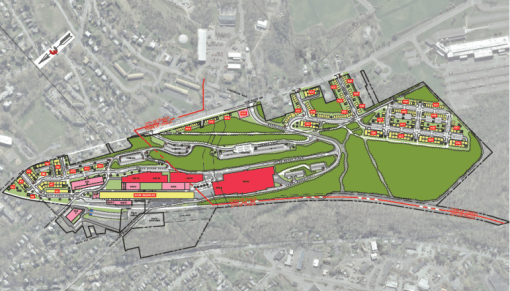
Build-out falls under four general form zones: (1) CW1- Natural Sub-Area, 23.9 acres of old woodland to be limited to passive recreation. (2) CW2- Neighborhood General Sub-Area, 21.2 acres of townhouses, stacked flats and similar moderately-dense development, mostly in Ithaca town; (3) CW3- Neighborhood Center Sub-Area, 39.7 acres of mixed-use, in a combination of renovated and new buildings towards the northern end of the property in the city, and (4) CW4, Industrial Sub-Area, a 10.3 acre zone for industrial uses in existing buildings at the Emerson site. The site borders Route 96B, single-family and multi-family homes, natural areas and steep terrain.

About 0.91 acres will be subdivided off and maintained by Emerson for active groundwater treatment. The other 95.02 acres would be sold to UnChained Properties.

chain_works_form_districts_2

The re-development is fairly multifaceted. Some buildings will be renovated, a few will come down, a couple will receive additions, an quite a few others, like those in the all-residential CW2 zone, will be brand-new. Specifically in Phase One, four buildings – 21, 24, 33 and 34, will be renovated.

In Part Two, we’ll take a closer look at the neighborhood design standards and detailed plans for Phase One.


Village Solars Construction Update, 4/2016

19 04 2016

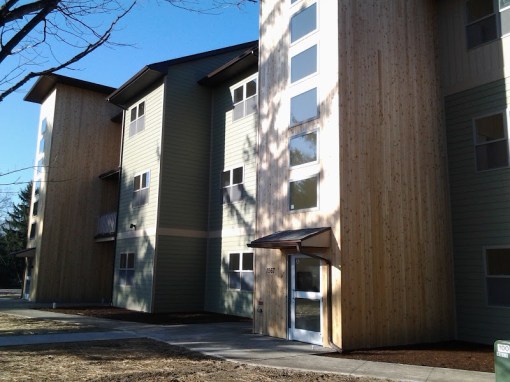
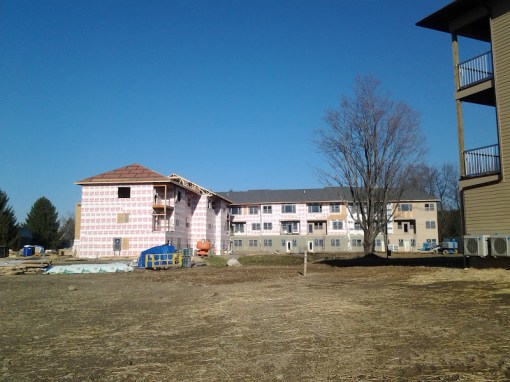
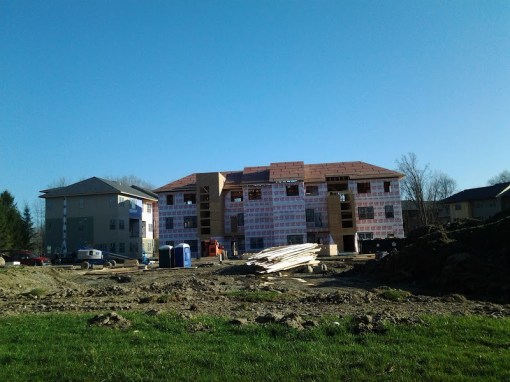
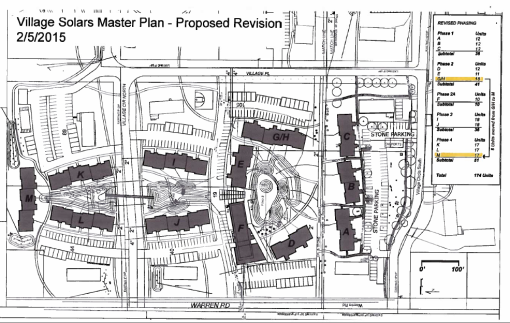
Heading into the spring, it looks like the Village Solars project off of Warren Road in Lansing has made some pretty substantial progress with its second phase.

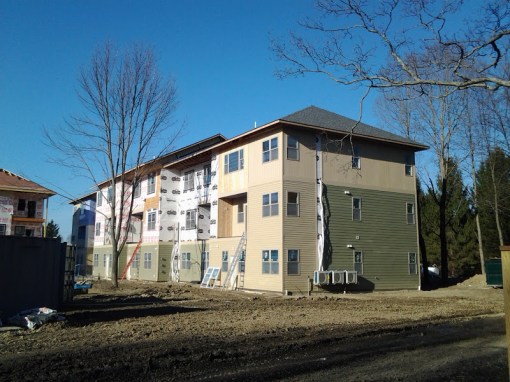
Building “D”, which contains 12 apartments, is essentially complete inside and out, though not yet occupied.

Building “G/H”, which holds 18 units, is fairly far along from the outside – cement boards have been attached to most of the east face, and some more wood siding has been applied to the west face. Exterior details like balcony railings and trim boards have yet to be installed.

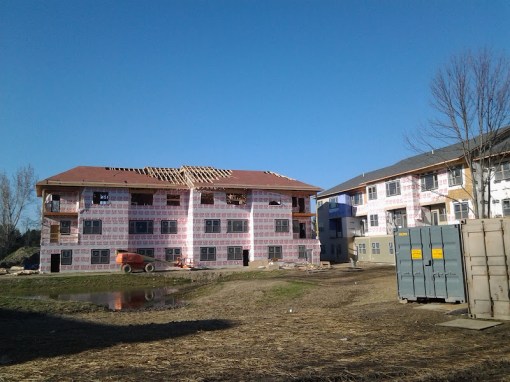
Building “E” is topped out, and the roof rafters are being sheathed with Huber ZIP panels. The stairwells are still being framed out. Windows have been fitted in most of the rough openings on the first and second floors, but have yet to reach the third floor. Housewrap covers most of the plywood walls, with the exception of the stairwells. “E” will have 11 apartments.

From observation, it looks like Lifestyle Properties (the Lucente family) could start renting out Building “D” tomorrow if they wanted, Building “G/H” towards the end of the Spring (possibly Mid-July from the Craigslist posting), and have Building “E” ready for occupancy before the semester starts. Phase two of the 174-unit apartment project is being built with a $6 million loan from Tompkins Trust. Phase one’s 36 units opened last year.
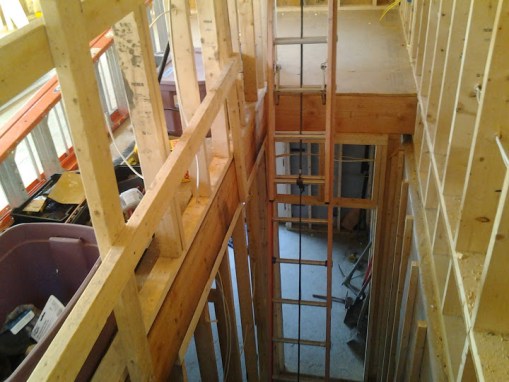
EDIT: From Rocco Lucente the younger – “We will have our first move ins for 1067 Warren Road (Building D) on May 1st. The other two buildings are currently scheduled for June 15th and July 15th completion. We did get our Certificate of Occupancy for Building D around two weeks ago, but with the various cleaning and landscaping work we set our target for May 1st.”

No loans have been secured yet for the three later phases, and plans are still in the works for an addition across Village Place that would bring the total number of new apartments to over 300.

20160414_174742 20160414_174754 20160414_174809 20160414_174852 20160414_174921 20160414_175002 20160414_175115 20160414_175233 20160414_175611 20160414_175618 20160414_175729

village_solars_2 village_solars


A Construction Tour of a Net-Zero Energy House

6 04 2016

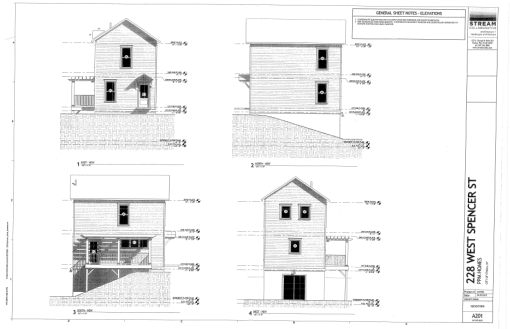
A couple of weeks ago, Noah Demarest was kind enough to give a tour of the new net-zero energy single-family house underway at 228 West Spencer Street in the South Hill neighborhood.

Most readers of the blog will be familiar with Noah Demarest’s name – he’s the head architect of STREAM Collaborative, which has been involved in projects like 902 Dryden Road, 201 College Avenue, State Street Triangle and the Franklin proposal for condos at the Old Library site.

228_w_spencer_1

Noah’s a little more involved in this project than most – he’s in charge of the build-out, and the cost of construction is coming out of his own pocket. Local landlord Ed Cope is a silent partner in the project, having purchased the land from the previous owner for $15,000 last February. The sale came with a different set of house plans, and the unique topography and constraints of the site made it such that the BZA had to approve virtually any new construction proposed on the parcel – Noah drew up plans for a different design, and those were later accepted by the board.

20160319_130922

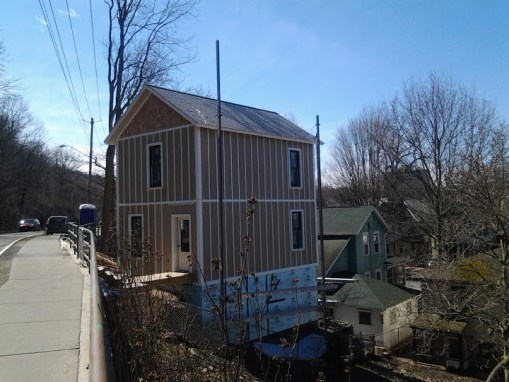
You can see how that unique site topography plays in here. The framing, sheathing (ZIP system), roofing and panelling of the house was done by local company Ironwood Builders. With much of the exterior work completed, activity has shifted largely to the interior spaces, which Noah is doing with his own construction team.

20160319_130936

My initial impression was that they were going for an exposed wood trim look similar to the framework of Tudor-style houses, but Noah says the trim will be painted the same color as the fiber cement siding. The shingles are a nice, Craftsman-style touch.

20160319_131043 20160319_131055

First photo is looking down, second is looking up. The house, just under 1,000 SF, has living space on three levels – the kitchen and living room will be on the second floor, and a bedroom and bathroom are on the first and third floors. This will be put up on the market for sale once it is ready – not a rental. Noah envisions this being the type of house that would be great for a young couple or even a deep-pocketed grad student.

By the way, just mentioning for the sake of acknowledgement – I’m not a fan of ladders.

20160319_131113 20160319_133609

As work moves closer to completion, a porch pergola will be built here.

20160319_133613 20160319_133748

This will be a net-zero energy house, meaning zero net energy consumption – what gets taken from the grid also gets returned to the grid. In the case of this home, an off-site set of solar panels will offset the energy that is taken from the grid. The house will also achieve a very high degree of energy efficiency. One of the ways that’s being accomplished here is the use of an air source heat pump, which transfers heat from outside to inside a building (and vice versa) via a refrigeration compressor and condenser. The system can absorb heat from the outside air and transport it into the home, and can work in reverse during the summer, absorbing heat from inside the home and transporting it outside.

According to Noah, the system tends to be somewhat less efficient in extremely cold weather (-10 F or so; at that point it becomes difficult to extract usable heat energy), but is otherwise very capable for providing heating and cooling needs. Appliances will be all-electric, no gas.

20160319_133939

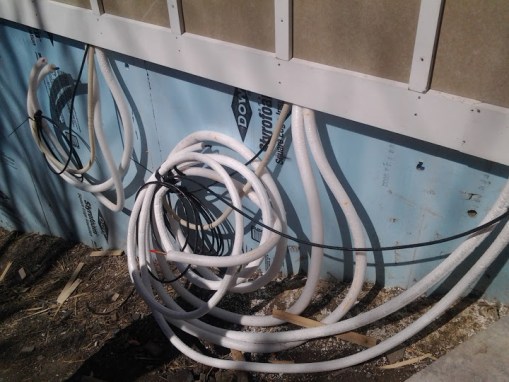
The house is also very heavily insulated – 2.5 inches of foam, with the fiber cement siding on top of that.

20160319_134029 20160319_134056
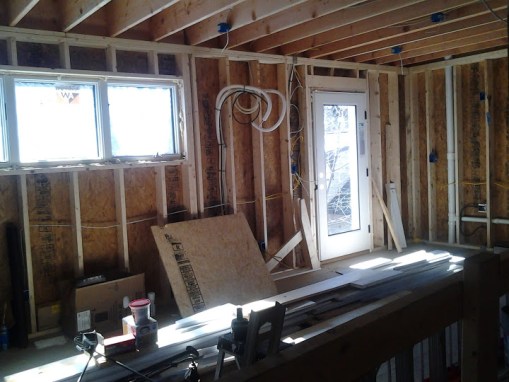
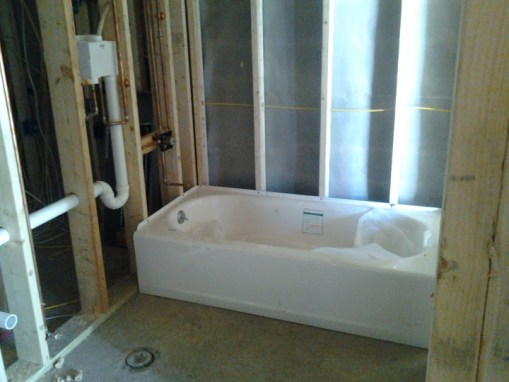
These last couple shots are from the bottom level – bathroom plumbing is in the process of being installed in the basement bathroom unit. The plan is to have the house ready for sale later this year.

One of the things that I personally am looking forward to is that Noah plans on making the costs of construction available to the city, as an example of what construction costs tend to look like for infill on an inner-city parcel. Having more examples to rely on, and a clear description of cost per square foot, gives the city more information to help guide its approach to planning and development. Noah noted during the tour was that the zero net-energy aspect is a relatively minor component in the expenses of the project.


News Tidbits 3/26/16: Big Plans and Small Town Intrigue

26 03 2016


201_college_1

1. Starting with with the new project of the week. In case it was missed, the write-up for the new 5-story apartment building proposed for 201 College Avenue can be found here. 201 College is being proposed by Todd Fox under his new development entity, Visum Development Group; Modern Living Rentals will continue to exist as a rental property management company. Excluding perhaps a small question with where the average grade is to determine the 70′ max height, is looks like the proposal fits the MU-1 zoning; and apart from a couple of the usual grumblings against students and/or density, there isn’t likely to be too much of an issue with the proposal. Noah Demarest of STREAM Collaborative is responsible for the design, which will make be faced with colored metal panels.

On a related note, the Journal broke this before the Voice, and it appears they may have used to the city’s Site Plan Review pre-application as a source. That’s not online for public viewing; someone would have had to give it to them. Which seems a bit dodgy, given one of the goals of the now-mandatory pre-application is to offer initial thoughts to make sure a project is palatable, and to avoid another public controversy like State Street Triangle.

312_spencer

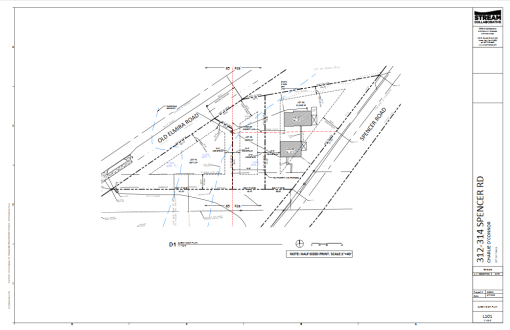
2. Meanwhile, the other partner in Modern Living Rentals, Charlie O’Connor, is pursuing a small project of his own on the other side of the city. O’Connor has submitted subdivision plans to merge two lots at 312 and 314 Spencer Road, and subdivide two legally-buildable lots from the merged property for a total of three, one of which will contain the existing houses. The new lots would be on vacant land behind the existing houses, which are currently owned by the Lucatellis (the same folks who ran Lucatelli’s next door). O’Connor would be purchasing the home and land pending approval of the subdivision. Each of the two new lots would then be developed into a 2-family home. Noah Demarest of STREAM Collaborative is handling the application. Drawings can be found here.

biggs_1

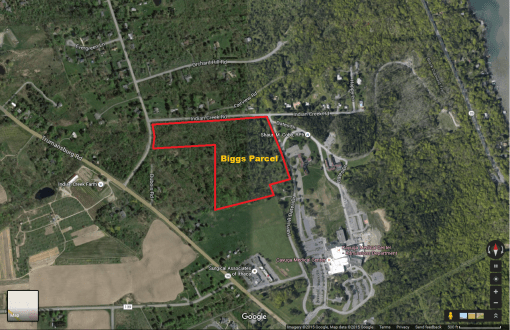
3. The Biggs Parcel will be put up for sale. As the county notes in its press release, the county administrator has been given permission to procure a realtor and market the property on the condition that any offers from the Indian Creek Neighborhood Association and/or the town of Ithaca be entertained (though not necessarily selected). The ICNA had offered some unknown amount for the property, which they have sought to keep undeveloped, but the offer was rejected. Previously, the site was the location of a proposed 58-unit affordable housing development, but the project was discontinued when more extensive wetlands were discovered on the property.

One of the big sticking points has been whether or not the 25.5 acres would be taxable – the county wants to sell to a private owner that will pay taxes, but proposals to preserve the land often dovetailed with plans to donate it to an organization like Finger Lakes Land Trust, which would render the property tax-exempt. The land had been valued at $340,000 before the discovery of the additional wetlands, and the reassessment value will become available on May 1st.

Realtors will apply to the county to list the parcel, and a realtor is expected to be chosen by the county by May 4th.


4. A large property in Trumansburg village noted for development potential has sold after being on the market for two and a half years. Local architect Claudia Brenner picked up the 19.27 acres in two adjacent parcels for $240,000 on the 22nd, about 25% off its original $300k asking price. 18.77 acres is registered to 46 South Street, the other 0.5 acres is a small L-shaped lot between 209 and 213 Pennsylvania Avenue. The previous owners used the property as cropland, and it had been in the same family since the 1940s.

In an email, Brenner said it’s too early to comment, but that future plans are being considered. The site has the village’s R-1 zoning, which allows home lots as small as 15,000 SF (~0.35 acres), and small scale multi-family residential and commercial services.

tfc_v2_1
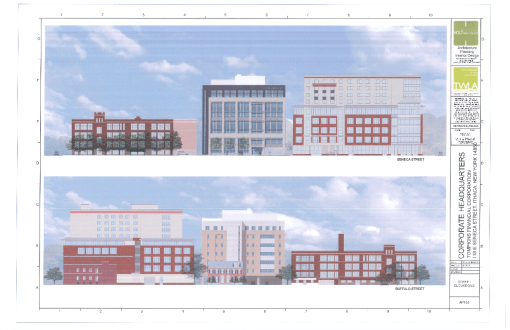
5. Talk about big delays. Tompkins Financial will be pushing their $26.5 million project back a whole year, according to an interview a Cornell Sun staffer conducted with JoAnn Cornish, the city’s planning director. The project was supposed to start this quarter and be completed in Q1 2017. Now it will be completed in Q1 2018.

summit_danby_1

6. A few months ago, the Summit Enterprise Center proposal in Danby was described in one of the weekly news roundups. Docs filed by STREAM Collaborative’s Noah Demarest on behalf of owner David Hall call for modifications of a Planned Development Zone for the property at 297-303 Gunderman Road. Danby’s PDZ is not unlike the city’s PUD and town of Ithaca’s PDZ, where the form and layout is regulated rather than the use. The original PDZ for the property dates from the mid-1990s.

Well, after months of vociferous debate, the project has officially gone into bureaucratic Hell, complete with political turmoil and accusations a-flyin’. My colleague Mike Smith has the full story on the Voice. Rather than rehash Mike’s detailed explanation, let’s just leave it at this – Summit probably isn’t moving forward anytime soon.


Boiceville Cottages Construction Update, 3/2016

21 03 2016

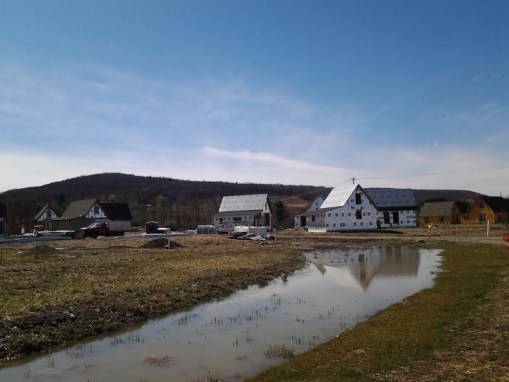
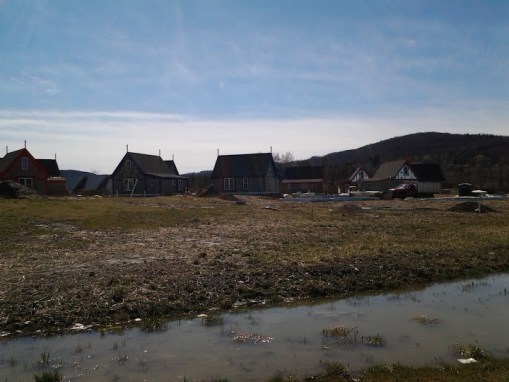
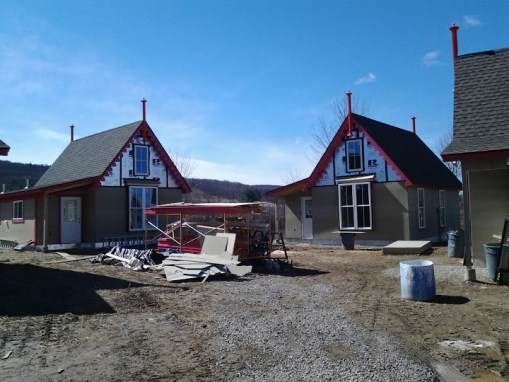
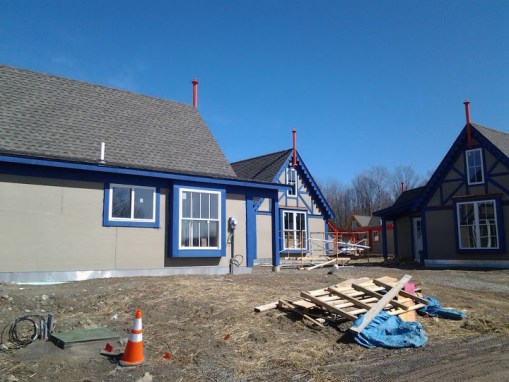
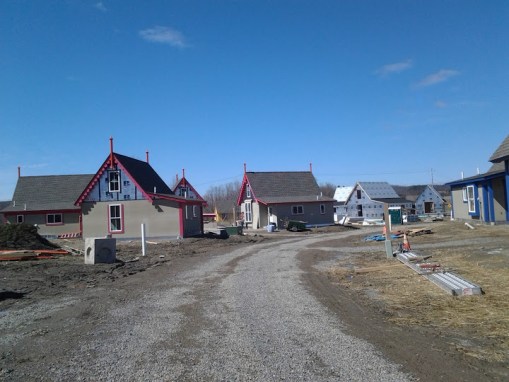
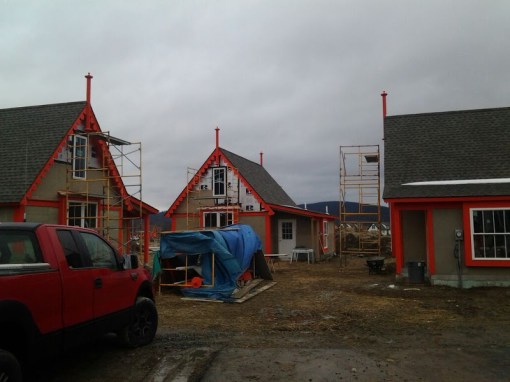
Some good progress has been made with the new cottages over at the Boiceville Cottages site. the cottages with the red-orange trim appear to be fully finished and occupied, while those with the blue trim have some interior finish work left before they can be rented out to tenants.

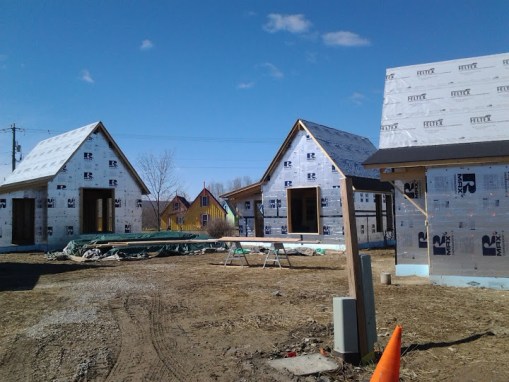
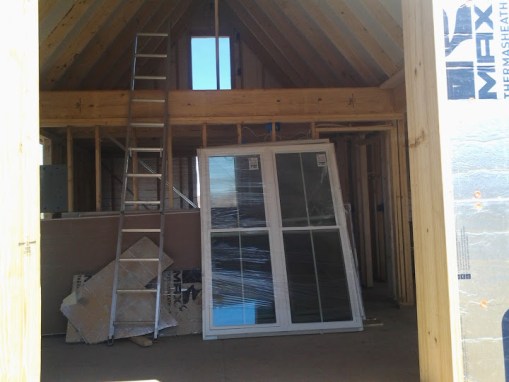
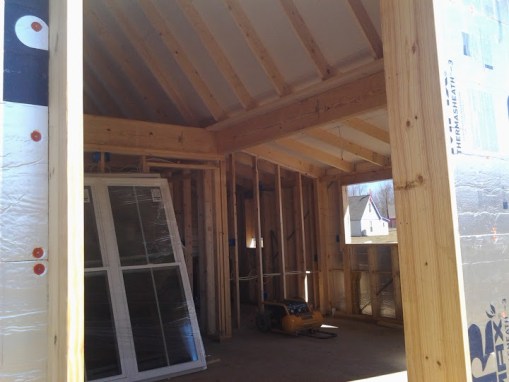
Newly risen since the last visit in January are a set of fuchsia-trimmed cottages that have been framed, sheathed, and partially stucco’d, and a fourth set of cottages that are still at the sheathing stage. Peering inside, you can see the interior stud walls and windows yet to be fitted into their openings.

That leaves a fifth and final batch of cottages that remain foundation slabs for the time being, but will likely start construction as we head through spring. Rents for the houses range from $1,095-$1,725/month, depending on the unit.

Bruno Schickel hosted congressman Tom Reed on a visit to the construction site a couple of weeks ago (more about that here and here). The $2.2 million last phase, which consists of 17 cottages, is expected to be completed this summer, bringing the total number of units on the site to 140. The cottages have been built in phases – 36 in 1996/97, 24 in 2006/07, and about 80 in multiple sub-phases since 2012.

Once the project wraps up, Schickel Construction plans to turn their attention to finishing their newly-acquired Farm Pond Circle project in Lansing.

20160319_123813 20160319_123819 20160319_123922 20160319_123930 20160319_123949 20160319_124119 20160319_124140 20160319_124150 20160319_124200 20160319_124228 20160319_124237 20160319_124241 20160319_124319 20160319_124455 20160319_124500

boiceville_1


News Tidbits 3/19/16: A Taxing Problem

19 03 2016

20160109_115414

1. Apart from controversial presidential endorsement, Congressman Tom Reed paid a visit to the development community last week at the Boiceville Cottages project out in Caroline. According to Dan Veaner at the Lansing Star, the meeting was touted as an opportunity for developers, builders and contractors to express their concerns with onerous government procedures, specifically the local level.

Bruno Schickel, speaking at the event, noted that Boiceville could only have been done in Caroline because the 3,000 person town has no zoning (but they do have some type of commission that acts as a planning board). The lack of layers and conflicting comments from different interests allowed Schickel to get the latest 75-unit expansion approved in just two meetings back in 2012, something that he notes would have likely taken two years in other municipalities.

Then there’s this quote from another developer.

“After the site tour Reed spent time chatting with builders about regulations, mandates and costs that prevent some projects from ever being built.  One developer told Reed about an incident that killed a project before it even got started.

‘I tried to build a mixed use residential retail commercial building and I needed more residential units to make the economics work for lending,’ he said.  ‘I wanted six more apartments and the Town of Ithaca wanted an environmental impact statement.  the deal with these impact statements is that you pay an expert $20,000 so he can produce a 50 page report.  They look at it and read it and if they don’t like it they want to hire their own expert and they make the developer pay for it.  I backed out right away.  I pulled the plug and walked out of the meeting.'”

In case anyone was wondering, that was Evan Monkemeyer and his never built College Crossings project on the corner of 96 and East King Road. Which, to be honest, didn’t get re-approved because the window of opportunity closed as soon as the town updated its Comprehensive Plan and decided it wanted dense mixed-use. It’s an uncomfortable situation for all parties.

Obviously, there are two sides. Schickel is a very thoughtful and responsible builder/developer, but others may not be, which is why guidelines need to be in place. But, having watched the battles over affordable housing, and seeing the battles over wind and solar power now erupting in the western half of the county, it does give pause. I never thought I’d hear Black Oak investors such as County Legislator Dooley Kiefer and Caroline town board member Irene Weiser described like greedy Wall Street corporate villains, but that’s the current state of affairs. Using the same point from last week, the county can’t afford to be self-defeating, and having too many rules and regulations can keep a lot of good things, like green energy and affordable housing, from happening. The big, hotly-debated question is, where is the balance?

On a final note, the Star confirms that Schickel will finish build-out of the late Jack Jensen’s Farm Pond Circle project in Lansing, as soon as the Boiceville Cottages are finished later this year.

20151011_134147

2. It’s that time of the year for property re-assessment. The county gives a rundown of their process and goals for this year here. Most places handle assessment on the city/town/village level, so being that Tompkins County is solely responsible here makes it unique in the state.

tc_assessment_1

The report notes that high demand and low supply has kept sales prices on an uptick, and as those get factored into assessments, the values of property are due to go up as well. There aren’t as many sales as in the mid 2000s, but county home values are appreciating at an uncomfortably fast clip – median price went up 4.2% in just the past year, much greater than wage growth. The Voice has gotten some emails from people extremely upset that the county is doubling their land value, and there have been similar emails getting shared on neighborhood e-mail listserves, so there will probably be a story coming out on that soon.

Certain areas are facing certain challenges. For example, Collegetown’s land value is so high that it’s often worth more than the building that sits upon it, making much of the neighborhood a redevelopment target. Fall Creek is seeing home value appreciation much faster than the rest of the county, making it ground-zero for rapid gentrification. The county’s not pulling these values out of the ether; assessments are based in part on what people will pay for similar neighborhood properties. Fall Creek is walkable, centralized and a strong fit to the rustic, crunchy vibe buyers are often looking for in Ithaca. There are signs that the North Side and South Side neighborhoods are seeing similar impacts, but they’re not as noticeable because those neighborhoods were traditionally less well-off, so the gross home values aren’t as high, even if they’re appreciating at similar rates.

Out in the towns, the county feels Caroline is being under-assessed, which they hope to change in 2017, and there have been wildly high-priced sales in Ulysses that the county attributes to “excited” lakefront buyers. About the only area where the county is concerned about falling land values is Groton, where poorly-maintained properties are taking their toll on the tax base.

On the commercial end, Commons businesses and county hotels can expect a 5% assessment increase.

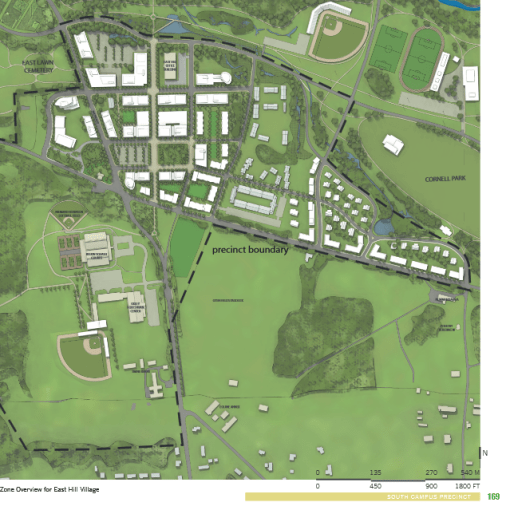
east_hill_master_plan

3. Looks like the town of Ithaca released their annual planning board summary. Only 15 new of modified proposals were reviewed in 2015, down from 27 in 2014, and 32 and 41 in 2012 and 2011 (2013 is excluded for some reason). Nevertheless, the town’s planning department has been busy trying to translate the 2014 Comprehensive Plan into form-based zoning code, at least some of which they hope to roll out this year. A couple sources seem to have taken to referring to it as the “Ithacode”.

Also in the pipeline – reviewing Maplewood (with the city as secondary), reviewing Chain Works (with the city as primary), and possibly, Cornell rolling out plans for East Hill Village (early design concept shown above), the first phases of which are expected to be unveiled within the next year.

902_dryden_v4_1

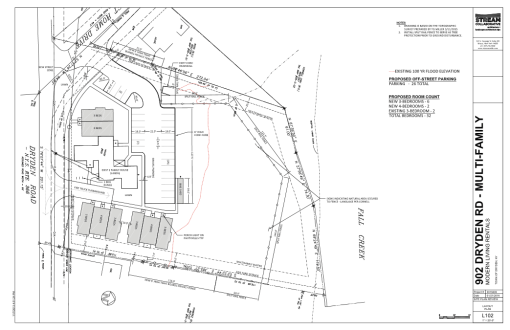
4. The townhouses at 902 Dryden Road in Varna have been approved. The Dryden town board voted 4-0 to approve the project at their meeting on the 17th. The 8 new units and 26 new bedrooms should begin construction this July and be completed by June 2017. Local company Modern Living Rentals will be developing the site, and the townhouses (no updated render, sorry) are being designed by STREAM Collaborative.

Also relevant to the Varna discussion, the planning department memo notes a pre-application meeting was held for a proposal to subdivide and build 16 “small homes” at the corner of Freese Road and Dryden Road currently owned by Dryden businessman Nick Bellisario. No other information is currently available about the project.

hughes_cornell_3

5. Let’s wrap this up with a look at the city of Ithaca Planning Board agenda next week. Quick reminder, the general order is: sketch plan, Declaration of Lead Agency, Public Hearing, Declaration of Environmental Significance, BZA if necessary, prelim approval, final approval. Here’s the formal rundown:

Site Plan Review
A. 210 Hancock – project update, no decisions
B. 424 Dryden, rear parking lot for 5 cars – prelim and final approval
C. Hughes Hall Renovations, Cornell University – Determination of Environmental Significance, prelim and final approval
D. Ag Quad Renovations, Cornell University – Determination of Environmental Significance, prelim and final approval
E. The Cherry Artspace, 102 Cherry St. – Declaration of Lead Agency and Public Hearing

F. Sketch Plan – 301 E. State Street, the Trebloc Building.

Don’t know if this is a continuation of State Street Triangle or something else (it would be a surprise if someone could create a new plan in such a short time), but we’ll find out on Tuesday. Zoning is CBD-120, meaning commercial or mixed-use, no parking required, up to 120 feet in height.

G. Sketch Plan – 201 College Avenue

201 College Avenue sits on the corner of College Avenue and Bool Street in inner Collegetown, and is presently occupied by a well-maintained though unremarkable 12-bedroom student apartment house owned by an LLC associated with the director of a local non-profit recreational center. The property is currently assessed at $545k. Zoning for the property is Collegetown MU-1, allowing for a 5-story, 70′ tall building with no on-site parking required. A quick check of neighboring properties indicates that the owner only owns this property, so whatever is planned will likely be limited to just this house.


Carey Building Construction Update, 2/2016

28 02 2016

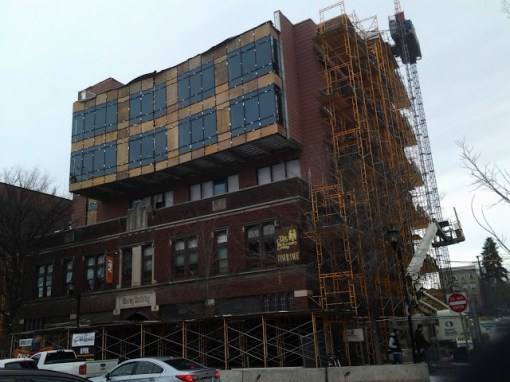
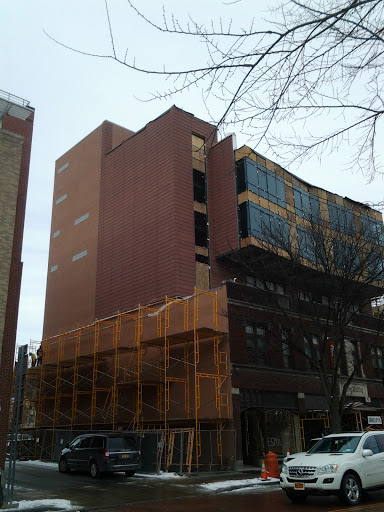
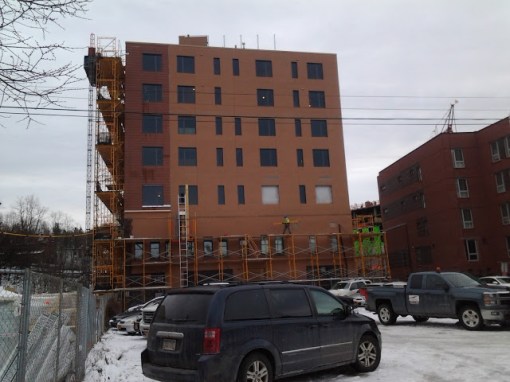
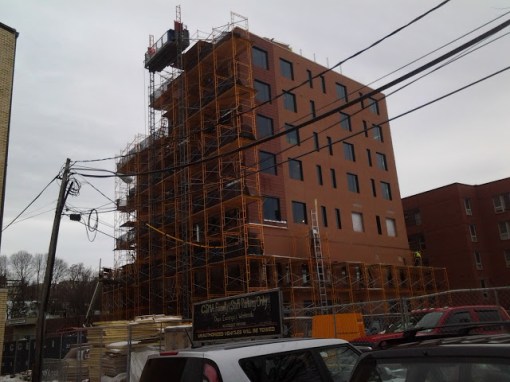
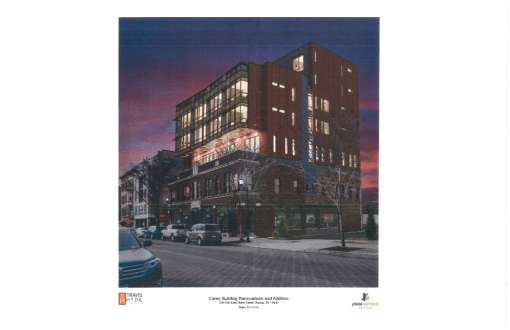
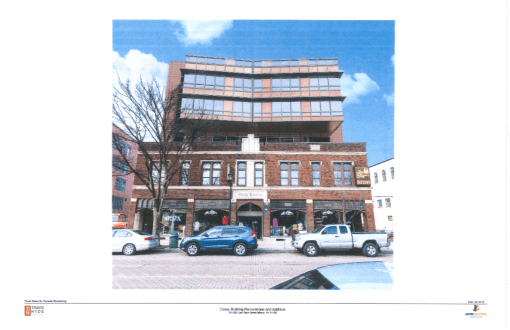
To be 100% honest, I was a little worried about how the building would look before the exterior materials started to go on. But thankfully, those worries seem to have been overblown. The terra cotta that graces the front and side looks good, and being a similar color to the original mid 1920s building allows the new five-story overbuild to pay its respects without mimicking the original brick.  The peach-colored material is NuTech Direct Applied Finishing System (DAFS) stucco. While not as visually interesting perhaps, the rear of the building will be mostly hidden by the new Hilton Canopy hotel when that begins construction later this spring. There have been plans for a mural on the Carey’s western wall as well.

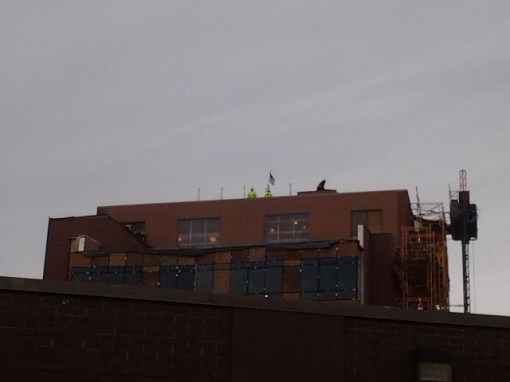
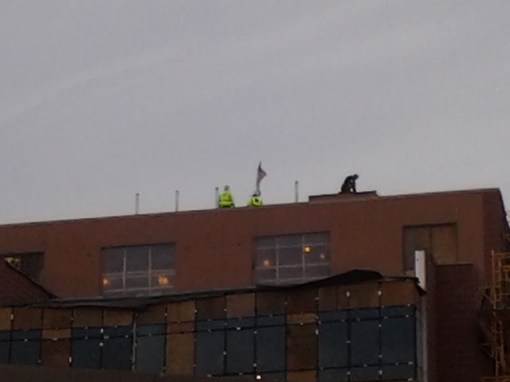
Many of the new windows have been fitted, although in some areas like the third floor, the window openings were more likely to be covered in plastic sheets rather than panes of glass. Someone familiar can correct me if I’m wrong, but the boards on front of the curtain wall are placeholders a brown or dark brown-tinted glass. The small openings on the west face will have a clear, marble-block glass. Roofing still needs to be taken care of, and taking a guess, drywall and interior finishing is underway in the more complete areas (I want to write lower floors, but I wonder if the lower residential floors are actually further along than Rev’s third-floor space), and utilities rough-ins on the floors/spaces that aren’t as far along.

Although it’s a fairly modern shape in a city that loves its historic designs, it looks like it will be a nice addition to the downtown skyline.  Local firm John Snyder Architects penned up the design, Travis Hyde Properties is the developer, and those guys hoisting the Old Glory are either direct or indirect employees of general contractor LeChase Construction.

20160219_135310 20160219_135334 20160219_135410 20160219_135538 20160219_140004 20160219_140039

20160219_135224 20160219_135216

carey_rev5_1 carey_rev5_2 carey_rev5_3