Ithaca Marriott Construction Update, 6/2015

14 06 2015

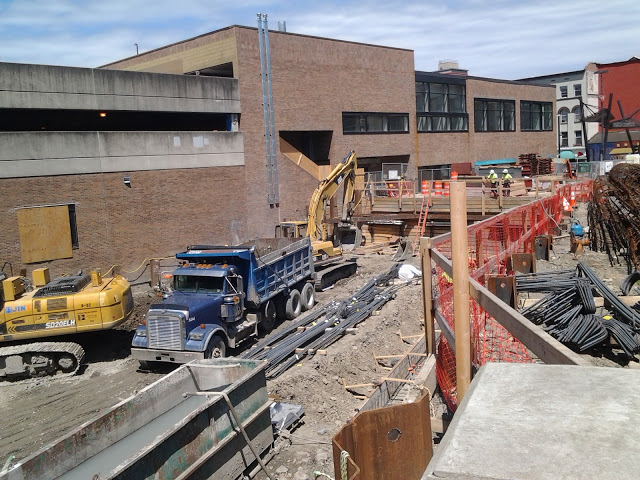
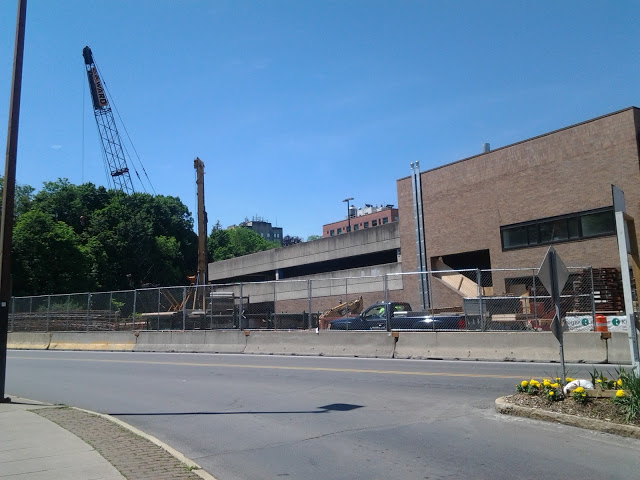
The pile driving work continues at the Marriott project site downtown. Quoting an anonymous source familiar with the project, about 10 more caissons are left to be piled, and grade beams are being built.  Per wikipedia, a grade beam is a reinforced concrete beam that transmits the load from a bearing wall into spaced foundations such as pile caps or caissons; a grade beam spans the the space between the caissons, distributing the weight among the caissons and ensuring the hotel’s structural stability. In image three, you can see the pile driver at work drilling a caisson, using a rotary bore so that it can more easily penetrate deep into the soil. The expectation is that the project will begin to rise starting in just a couple weeks, and builds its way skyward over the course of the summer and fall.

On a side note, check out that new window inserted into the Rothschild Building. Much better than the blank brick wall that was previously there.

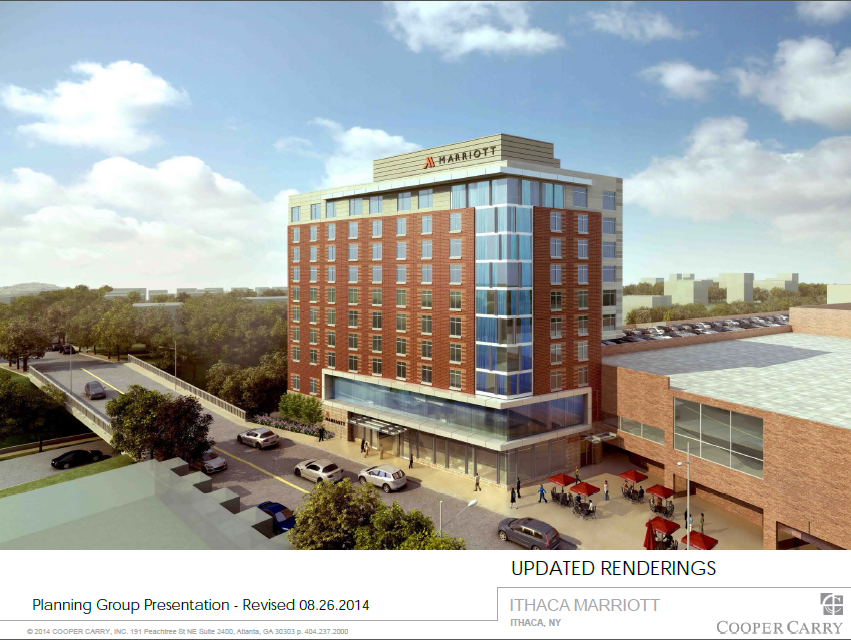
The $32 million, 10-story, 159-room hotel is slated for an opening in Q3 of 2016 (July-September). The hotel will include a fitness center, a restaurant with indoor and outdoor seating, and 3,000 sq ft of meeting space.

The hotel has been designed by Atlanta-based Cooper Carry Architecture and development is a joint venture of Urgo Hotels of Bethesda and Ensemble Hotel Partners, a division of Ensemble Investments. Urgo’s portfolio includes at least 32 other hotels totaling 4,500 hotel rooms. Interior design will be handled by Design Continuum, W.H. Lane of Binghamton is the general contractor, and Rimland Development contributed the land to the joint venture and is a partner. Long Island-based Rimland was the original firm that pitched the project in 2008 as the “Hotel Ithaca”, before the old Holiday Inn downtown went independent.

20150605_114642 20150605_114629 20150605_114501 20150605_114439 20150605_114431 20150605_114345

marriott_rev1_1


News Tidbits 6/13/15: Things that make you go Hmm

13 06 2015

travis_hude_libe_libe_v3

1. We’ll start this week’s round-up with the 800-pound gorilla in the room – the Old Library decision. The general, non-partisan rundown can be found in the article I did for the Voice. Rather than rehash that, I’ll give my own thoughts and opinions here.
In what should be no surprise to anyone, there’s a lot of acrimony flying around. The unavoidable problem here is that everyone has a different expectation for the site. To be honest, I was a little surprised that the Travis Hyde proposal was the winner. The Cornerstone and Franklin proposals were running about even when it came to public sentiment – many of the Voice commenters were stressing the need for affordable senior housing, just like the county did in the RFEI. Others used online petitions to push for the condos and saving the old library, but I personally felt that that was always going to be a stretch simply because the condos are a double-edged sword; they’re a needed commodity, but that “air of elitism” associated with the sale of a public asset for high-end homes would hound the legislators all the way to the voting booth.

The truth is, the RFP was designed to be unattainable, and I called it out for that last fall. There was no way a project was going to incorporate all the things it requested. Franklin couldn’t renovate the building and make their units at the affordable level. Cornerstone was able to make their units affordable but wasn’t as environmentally friendly as the others (it also requested a large PILOT). And I guess Travis Hyde was in the middle. Which on that 0-5 scale they used to score the projects, gives a simplified sort of 5-0 (2.5), 0-5 (2.5), 3-3 (3). With unrealistic expectations, of course the legislators were going to be disappointed, and they set up everyone else to be disappointed too. But the thought of holding onto a vacant building with its mechanical systems at the end of their useful lives, ready to put the county on the hook for hundreds of thousands of dollars in replacement costs, is probably the worst option out there.

TL;DR: There was going to a large contingent angry with the legislature’s decision, whatever it was. It’s times like this I wonder if the county should’ve just sold the site to the highest bidder.

Just for the record, because the three proposals were so different, and I thought all of three of them were good community assets, I honestly didn’t have a favorite. I had a slight preference towards DPI early on, but when they dropped out I became neutral about the whole process. But it’s only the Franklin supporters that are accusing me of subversively undermining them in the Voice write-ups, and it’s making me really cold to their cause.
inhs_pride_v3_elevations_2

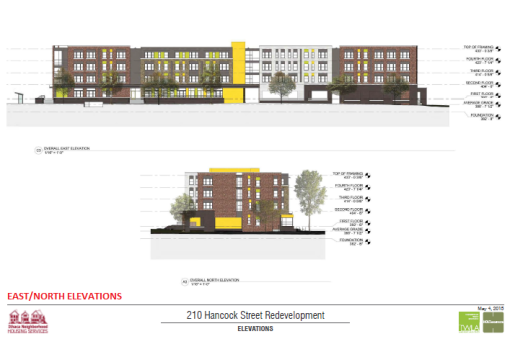
2. From the Common Council’s Planning and Economic Development Committee (PEDC) agenda, more talk this week about removing the setbacks from Nate’s Floral Estates (more on that in a moment), and a Memorandum of Understanding that both the city and Cornell will be chipping in $100k from their affordable housing funds to help finance INHS’s 210 Hancock affordable housing project (specifically, the 53 apartments – the 12 for-sale townhomes are being financed separately).

As covered by Jeff in the Voice, concerns have been raised that the site is unfit for new development due to the possibility of environmental contamination. Nate’s is partially on the site of the old city landfill, and has been for 40 years. But concerns raised by Ithaca city councilwoman Cynthia Brock, Ithaca town board member Rich DePaolo, and environmental activist Walter Hang have tabled the zoning change for now until the Department of Health can re-review their previous correspondence on the park’s expansion and determine if the extra 30 feet is safe to build on. The expansion may still happen, and we’ll just have to wait on the DOH’s decision before any zoning changes move forward.

On a separate note, there’s this line from the March minutes, which are rolled into the agenda for approval:

Alderperson Brock would like to see an increase in owner-occupied housing in the City. She does agree that affordable housing is needed, but the need is for “for sale” housing.

The last I checked, Ithaca is the 11th most expensive city in the country for rents as a proportion of income. The city needs affordable housing, for-sale housing, and affordable for-sale housing.

tfc_v3_1

tfc_v3_2

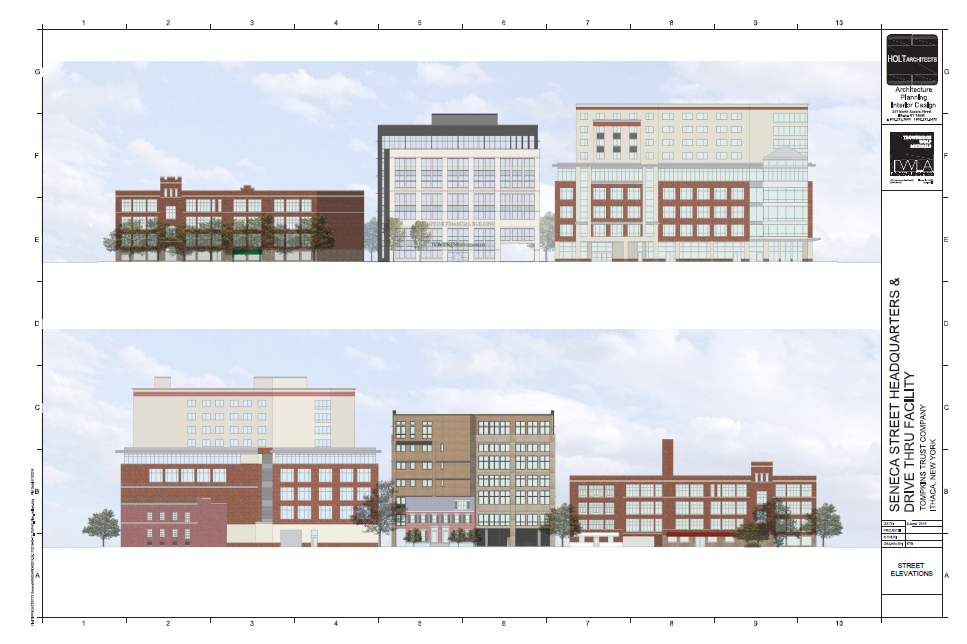
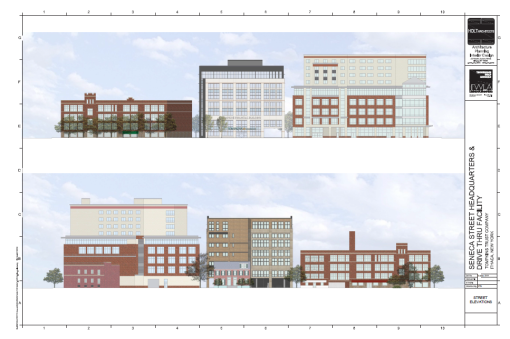
3. Fresh renders of the Tompkins Financial HQ. This one’s had some pretty substantial revisions from the initial bland brick box. A little more character and a more varied use of materials. More drawings here, cover letter here. This project’s just scooting right along, the applicants hope to have preliminary site approval granted at the June 23rd Planning and Development Board meeting. Construction is now expected to start in August and wrap up in February 2017.

A traffic study conducted by SRF Associates of Rochester determined that with only 20 employees moving from the suburbs into downtown, that the impact to the vehicular traffic on East Seneca (thousands of cars per day) will be negligible. A long-term increase in traffic is likely if other entities move into the rented space TFC vacates, but that’s well outside the scope of a traffic study.

The initial work calls for site clearing, demo of the existing drive-thru branch on site, then excavation down to the first sub-floor, thenceforth pile driving shall commence. It’s anticipated the sandy soils will make the pile-driving move along faster, but the other buildings nearby will necessitate temporary support installations during the excavation process.

On a related note, Tompkins Financial has filed an application with the IDA for a 10-year tax abatement. The application for the $35 million project (of which $28 million is for construction of the new building) states that the requested abatement would save the project $4.06 million in property taxes, and $2.112 million in sales taxes. New taxes generated and paid over the same time period would equal $3.782 million.

In the application, TFC states that it would be a few million dollars cheaper to build at “a generic rural site”, and in order to make downtown headquarters more financially acceptable, they decided to apply for tax breaks.

The application only suggests 6 new jobs over the next three years, paying $37k-$84k annually. Given previous estimates of 77 new jobs over 10 years, this lack of major job growth early on forces the later years to pick up the slack.

tfc_v3_3

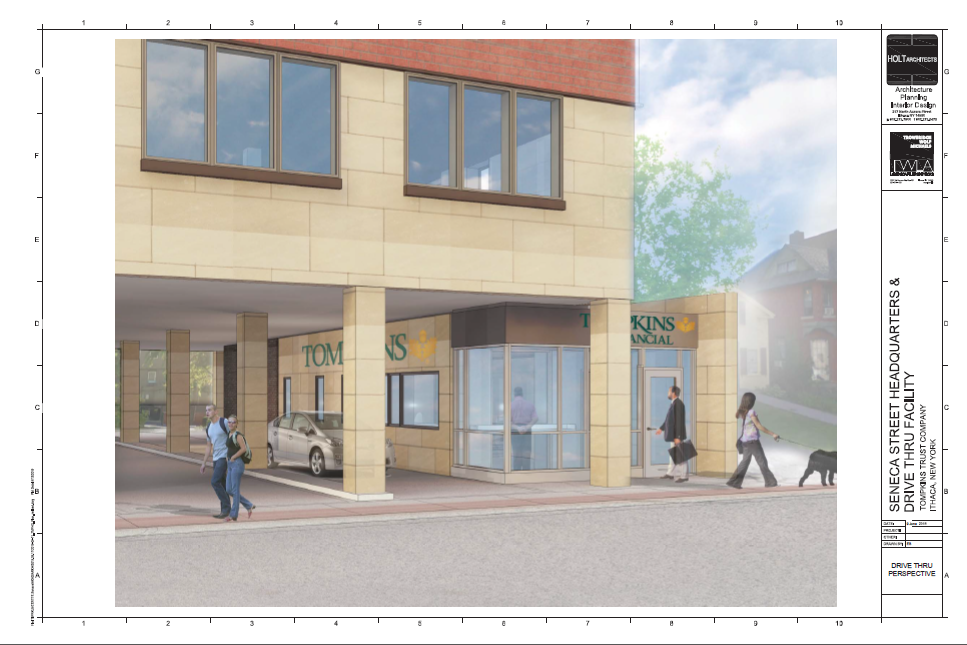
Of course, we also have a render of the new drive-thru across the street, which is nice but not nearly as exciting.

20150607_090520 20150607_090534

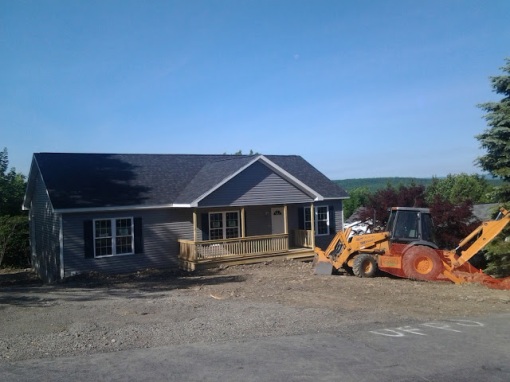
4. Sometimes I feel like I should do a random house of the week feature. Here we have a modular home being built on the 200 Block of Eastern Heights Drive in the town of Ithaca. It looks nearly finished at this point; permits for the home were filed back in March, so this one seems to have followed a normal building schedule with no major hangups.

Some modular homes are done on the cheap and look the part; others, like the Belle Sherman Cottages, do a great job with the finishes. This one may not look as great the Belle Sherman project, but it looks like a decent infill home for the Eastern Heights neighborhood. And it has great views to boot.

5. According to the town of Ithaca’s May 11th minutes, a developer has expressed interest in buying fire Station No. 9 at 309 College Avenue in Collegetown. An appraisal has been done and the City has hired a consultant to look into it. Fire Station No. 9 was built in 1968 to replace the original station, which is now The Nines. It sits in Collegetown’s densest zone, MU-2, so a potential replacement could be six floors with no parking requirement. There’s a lot to be looked at here, especially with the potential public safety impacts. But it’s something worth paying attention to over the next several months.
120_brindley_1

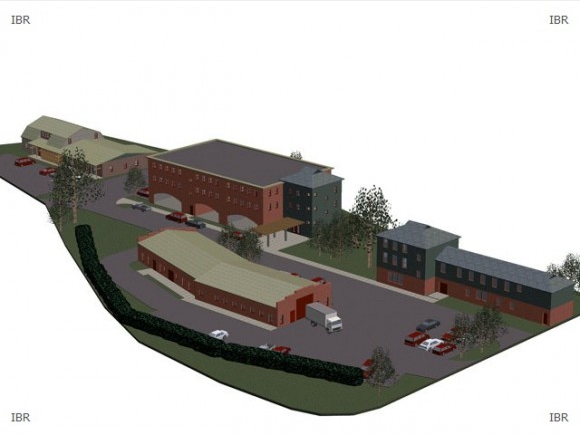
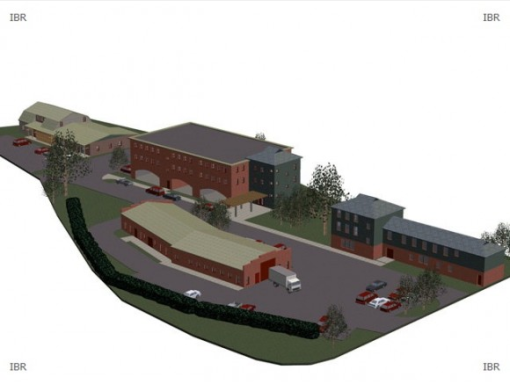
6. It’s unusual in Ithaca to see real estate advertisements posted with speculative commercial build-out plans. The above computer drawing is from the online posting for the sale of 120-140 Brindley Street in the West End. The three smaller buildings already exist – the “Aeroplane Factory” on the right and the other two properties comprise ~18,000 sq ft of flex office space. The drawing also shows an unbuilt 3-story office building; I don’t know how serious plans were for it, but it’s probably just conceptual. The real estate ad itself notes that a live/work building is possible, as well as a 6-story building of 25,000 sq ft.  The 2.38 acre site’s for sale for $2.79 million.


Lofts at Six Mile Creek Construction Update, 6/2015

12 06 2015

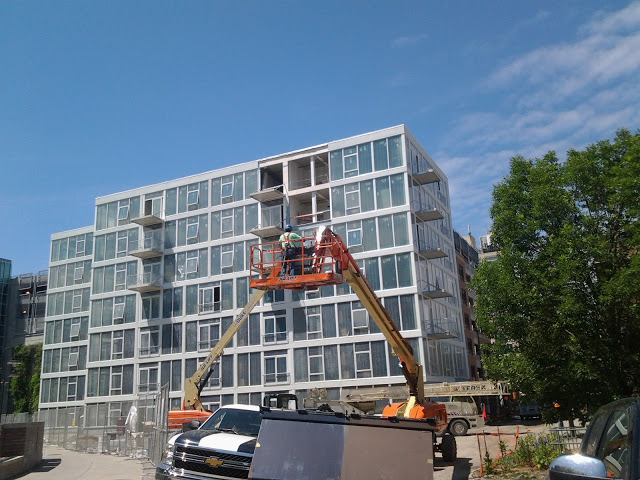
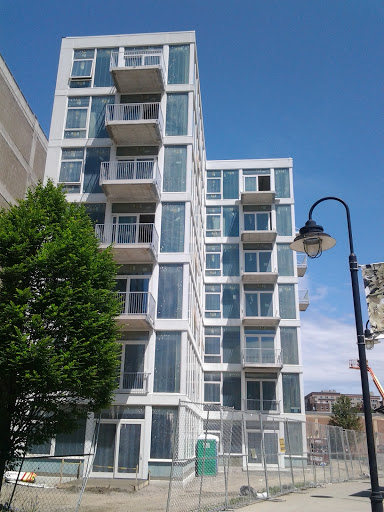
It won’t be long now, this project is in the home stretch. The protective plastic wrap is off and the product is almost ready to hit the market. The work at the “Lofts@Six MileCreek” site is mostly interior finishing at this point. A few of the exterior panels/window glazing had yet to be finished in these photos from last Friday, but a glance at the project’s facebook page shows that the windows have been installed, but the panelling has yet to be hung. Some other exterior finishes, such as balcony railings, are only partially completed as of now. A formal opening by late summer seems likely, thus completing the last phase of a 15-year project.

Looking at the rental agreement, tenants are allowed to have pets (for a $500 refundable fee and a $50 monthly rent surcharge), no more than two tenants may share a bedroom, and income is expect to be three times rent. 12 month leases only, 1 month’s rent as a security deposit.

With rents ranging from $1,220/month and up, that means that the minimum a tenant can make and live in the building is $43,920/year. A top end 2-bedroom unit, at $2,655/month, requires $95,580/year. The three studios range from $1,220-$1,460/month, one-bedrooms from $2,160-$2,355/month, and two bedrooms from $2,095-$2,655/month. There’s no doubt these are premium prices, and as discussed in the last update on this project, that’s not necessarily a bad thing for everyone else.

The Lofts at Six Mile Creek project consists of a a 7-story, 49,244 square foot structure that will contain 45 rental apartment units: 3 studios, 21 1-bedroom and 21 2-bedroom units. The building is being developed by Bloomfield/Schon + Partners out of Cincinnati, and construction is being handled by Turnbull-Wahlert Construction, also based in Cincinnati.

Leasing is being handled by CSP Management, and interested readers can apply for an apartment here or call 607-277-6961 if they feel so inclined. Questions can be directed to info@IthacaLofts.com.

20150605_114748 20150605_114809 20150605_114830 20150605_114902 20150605_114923 20150605_115108

cayugaplace_v5


140 College Avenue Construction Update, 6/2015

11 06 2015

Just up the street from 114 Catherine and a couple blocks from 202 Eddy is 140 College Avenue, also known as the John Snaith House. Since last fall, work has been underway on a 3,800 sq ft, 12-bedroom addition to the 1874 structure.

John Snaith was an English builder, stone cutter and architect who came to Ithaca in 1869 to do work on Ezra Cornell’s Llenroc mansion (under construction at the time) and other buildings for the nascent university. Snaith lived in Ithaca for over a decade. He built the original Ithaca High School (destroyed by fire in 1912) and did work on the Sage Mansion, where he was fired by the ever-impatient Henry Sage.

After Snaith moved to Albany, the house was used as a boarding house, a B&B in the 1980s, and a private single-family home. The house was rented out to a landlady and her boarders when it was partially destroyed by fire in 1894. Snaith rebuilt the home shortly before his passing in 1896, but redesigned the top floor with mansard trusses and added dormer windows. Today, it’s student-oriented housing.

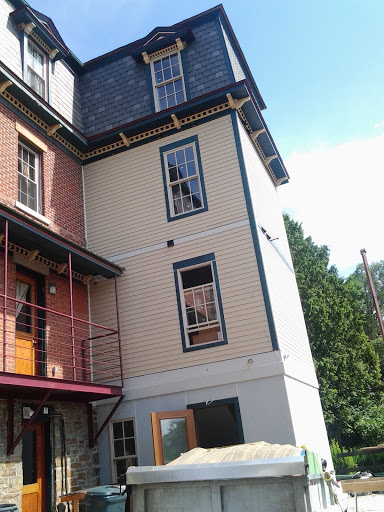
The addition is a sympathetic design approved by the Ithaca Landmarks Preservation Council (the house was designated a historic structure in 2011), separated from the original house by a glass “hyphen” connector. In the photos below, the exterior work is virtually complete, with the lap siding fully installed, as are all the windows and doors. Interior finishing is seemingly all that is left. This one should be ready for its first 12 occupants shortly. As someone who had reservations about the addition, I will admit that it came out nice.

The project is designed by local architect Jason Demarest and developed by Po Family Realty, a smaller Collegetown landlord.

None of the larger projects in Collegetown are underway just yet. Hopefully in the next few months we’ll see work start at 307 College (96 beds), 327 Eddy (64 beds) and 205 Dryden (40 beds), and Collegetown Terrace is expected to start construction of its 300+ bed phase III this year. A quick check of the neighborhood showed that construction has not yet started on a 6-bedroom duplex planned behind 424 Dryden.

Then of course, we have Novarr’s demolition work on the 200 Block of Dryden Avenue. Once demolition is complete, the site will remain empty until whatever he proposes is approved and financed.

20150605_155313 20150605_155333 20150605_155416 20150605_155435


114 Catherine Street Construction Update, 6/2015

10 06 2015

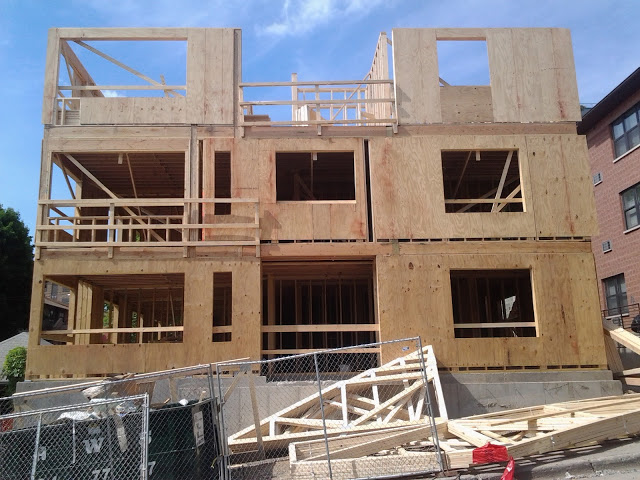
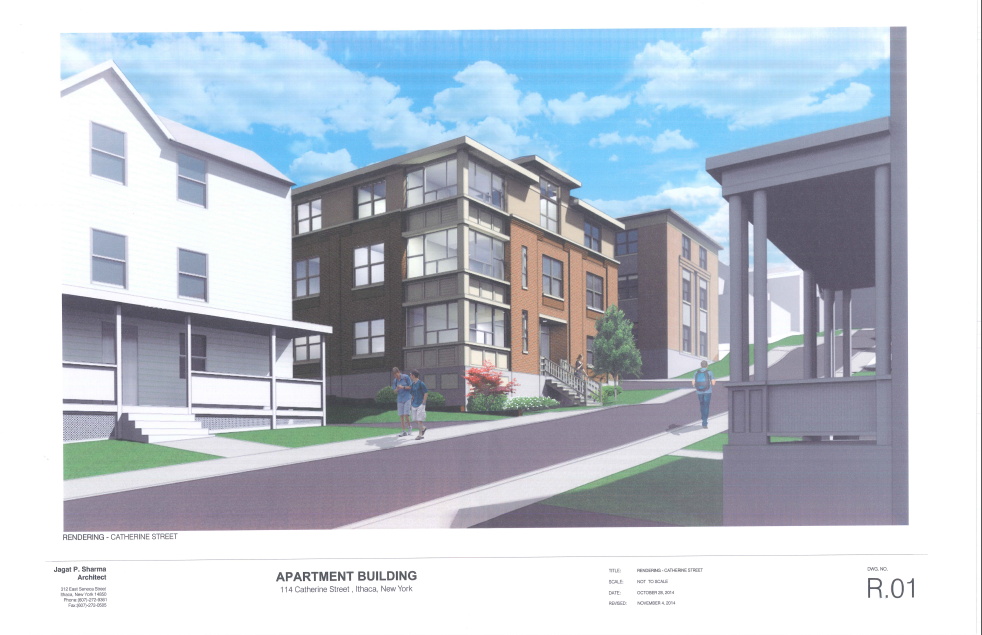
Workers have been busy at the site of 114 Catherine Street in Collegetown. On Friday, a flatbed truck was parked just off-site, delivering the roof gables for the 3-story, 17-bedroom apartment building. Framing for the structure is actively underway, with recently-created rough openings showing the position of the windows and doors in the new 3-unit structure.

The architect behind this project is local architectural firm Jagat Sharma, and he building is being developed by Ithacan Nick Lambrou of Lambrou Real Estate. Plans call for the replacement of a parking lot with a 3-story, 4,180 sq ft structure with a 5-bedroom apartment on the first floor and a 6-bedroom apartment on the second floor and on the third floor. Building loan documents filed with the county establish the construction costs to be $1.3 million.

If construction stays to schedule, the building should be completed in time for Cornell’s fall semester.

20150605_155847 20150605_155912 20150605_155919 20150605_155943 20150605_160037

114_catherine_rev4_1


202 Eddy Street Construction Update, 6/2015

9 06 2015

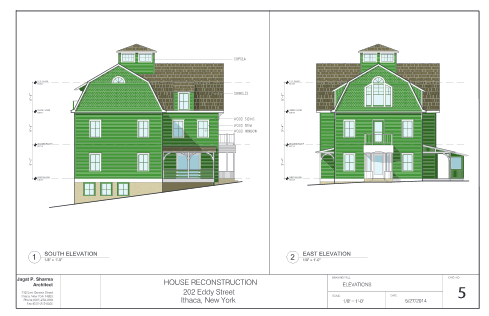
Work is progressing at 202 Eddy Street in Collegetown, where a reconstruction is underway to replace a historic building destroyed by fire in March 2014. Owner/developer Nick Lambrou announced plans to rebuild on the site shortly after the fire, with every intent of capturing the original home’s character. Being a part of the East Hill Historic District, the design of the replacement structure had to be approved by the Ithaca Landmarks Preservation Council (ILPC). After thorough review, the ILPC approved plans for a new 12-bedroom apartment building that completely replaces the fire-damaged building.

The new structure is a faithful interpretation of the original building, though it’s not an exact copy. An entrance door was repositioned, exterior emergency stairs will be internalized, and a chimney will not be rebuilt, but otherwise, its a close approximation of the original 19th century home. The architect is Ithaca-based Jagat Sharma, who has previous experience from the reconstruction of Sigma Pi’s house when it burnt down in 1995.

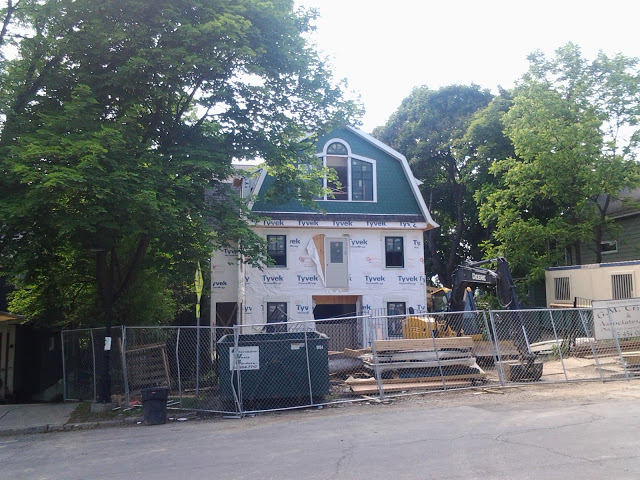
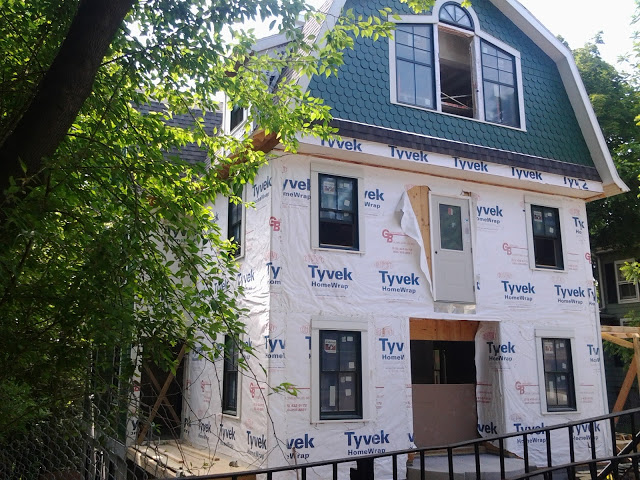
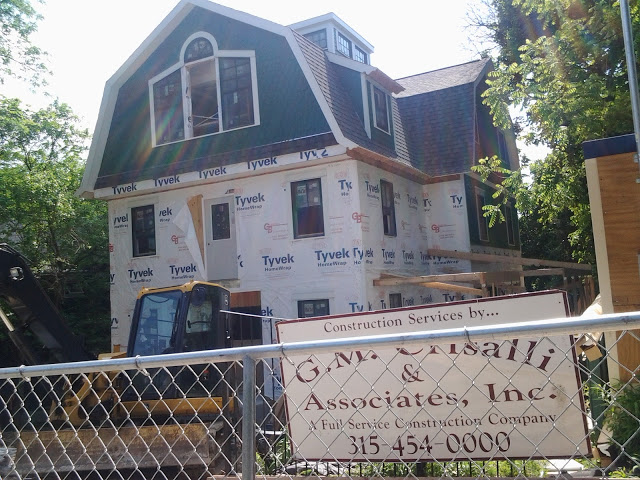
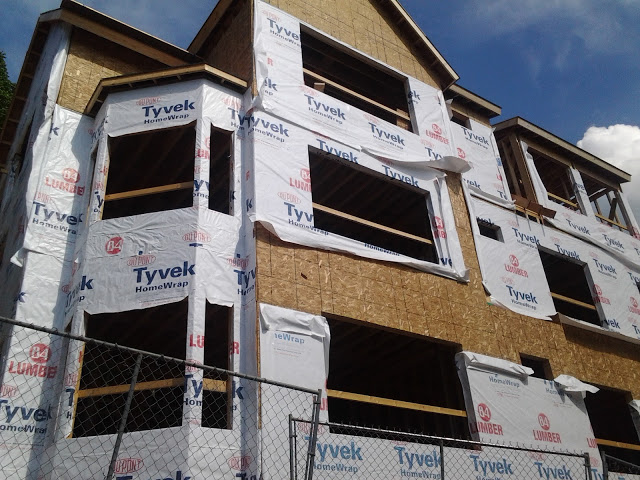
In these photos from Friday, most of the windows at least one of the doors have been fitted, and the exterior plywood is sheathed in Tyvek. The third floor, with its distinctive cupola, gives us a preview of the trim and siding – HardiePlank lap siding and half-round shingle siding, both in shades of green reminiscent of the original house, and “Arctic White” trim boards. Looking through the third floor window, there might be some drywall hanging underway, and judging from the first floor rough door opening, the interior lower floors may still be rough-ins phase.

202 Eddy is on the agenda this month by the ILPC; the council will conduct an inspection of materials just to make sure all is in good order, and as a prerequisite for issuing a Certificate of Appropriateness in July.

County records indicate the cost of construction is estimated at $750,000. Plans call for the new building to be completed and ready for occupancy by August, in time for the fall 2015 semester.

20150605_155608 20150605_155636 20150605_155702 20150605_155712

202_eddy


707 East Seneca Street Construction Update, 6/2015

8 06 2015

In and near the Collegetown neighborhood, several smaller construction projects are currently underway. One of those is 707 East Seneca, an urban infill project in the East Hill Historic District. Since the project was located in a historic district, the design had to go through the Ithaca Landmarks Preservation Council for approval, along with getting approval from the planning board, and the zoning board for an area variance (the lot was too small). After informational and voting meetings by different boards throughout the fall and winter, all the approvals were granted.

The design of the 3-story building is intended to be compatible with the historic homes from the late 1800s and early 1900s that surround the site. 707 East Seneca was originally the playground area for the now-closed East Hill School, and the lot was given to the city in 1982. The property fell into disuse, and the playground into disrepair.  The city voted to put the lot up for sale through the Ithaca Urban Renewal Agency (IURA) in summer 2014, and the vacant lot was sold for $130,000 last December. A building loan agreement filed with the county last Friday estimates the total “hard” construction cost for the building at $752,350. Hard construction costs leave out legal fees, permit fees, and other costs not directly related to construction.

When completed, the apartment building will have 6 units and 18 bedrooms. Four garage parking units will be located under the building and tucked into the hillside, in addition to five surface parking spaces. The building is expected to be completed before students return this August.

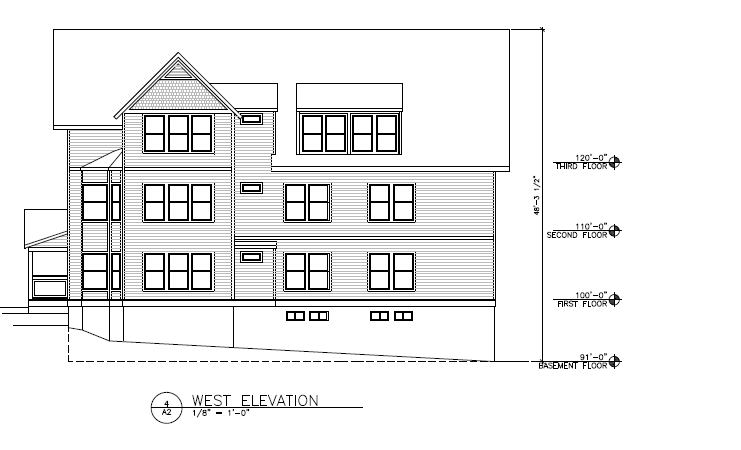
Note for the included renders, the black-and-white image with the small basement windows is the final design, but the colors are the same as the lead rendering.

In these photos taken last Friday, it appears that the building has been faced with plywood, topped out to its final storey and roofed. The exterior walls have been almost fully wrapped with Tyvek water barrier wrap. Some interior framing can be seen from the outside.

The design of the building is by Schickel Architecture of Ithaca, and the developer is Ithacan Todd Fox.

20150605_160815 20150605_160833 20150605_160902 20150605_160918 20150605_160932

707_E_Seneca_2

707_E_Seneca_rev1_1


News Tidbits 6/6/15: I Give This Week A Frowny Face

6 06 2015

215-221_spencer_v2_2

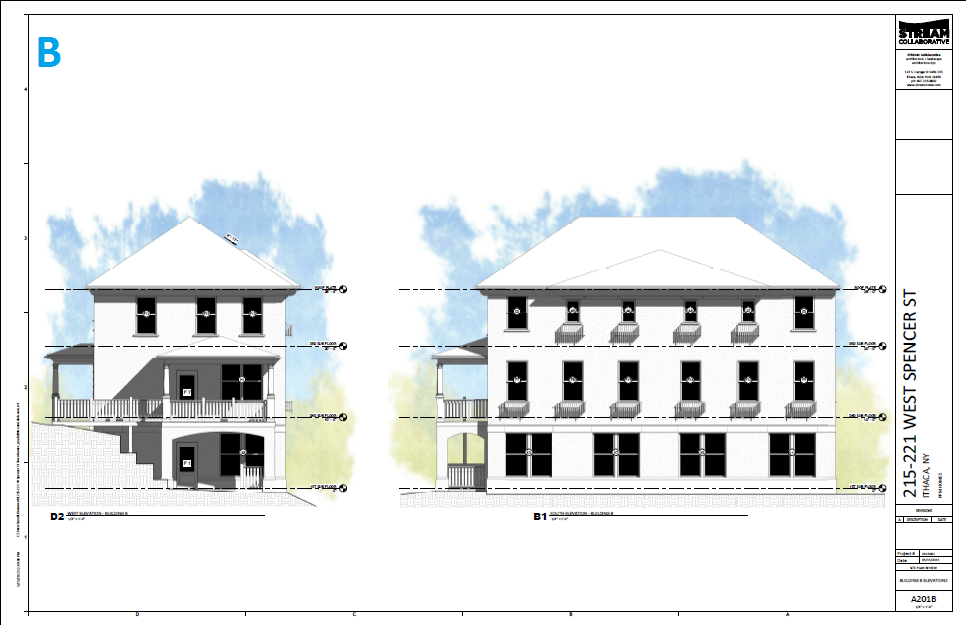
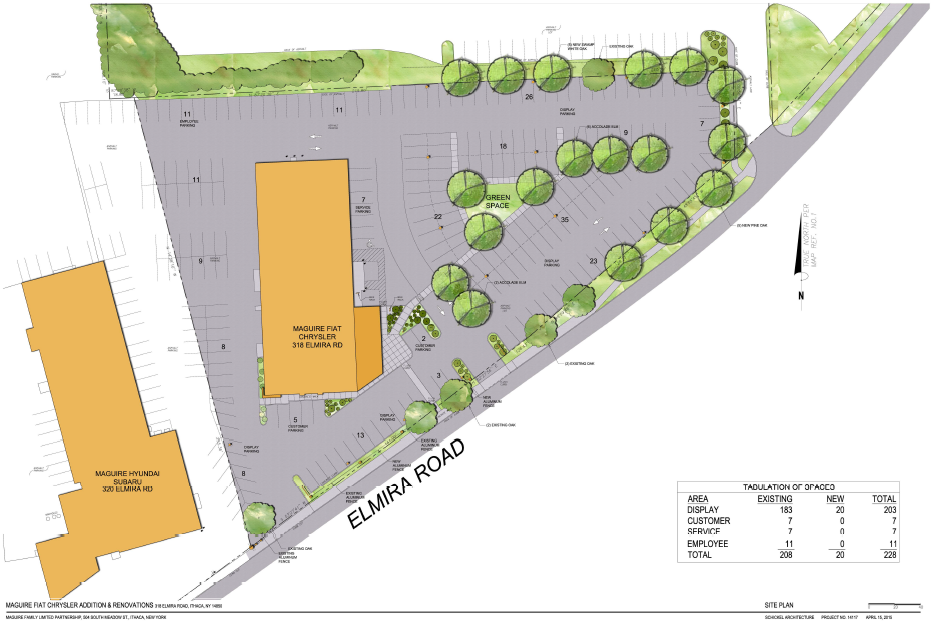
1. I’m thinking there is a genuine lull in the pipeline at the moment. The city’s projects memo, which is the document that city departments receive and comment on before the actual Planning Board meeting, doesn’t have much for consideration for this upcoming month. The one projects that is being “newly” considered is the 12-unit, 26-bedroom PPM Homes proposal at 215-221 W. Spencer Street. That project is expected to receive declaration of lead agency (in other words, the planning board formally agrees to review it) at the June meeting. Being carried over from the previous months are the two duplexes for 804 E. State Street, the Tompkins Financial HQ, INHS’s 210 Hancock project and the Maguire Fiat/Chrysler expansion. None of those are up for final approval.
Smaller projects and subdivisions will often first show up in the memo ahead of the meeting, but not this month. What will be, will be.

tfc_v2_1

2. On the other end of the scale, this looks to be a busy month for the Ithaca Landmarks Preservation Council. Most of their agenda focuses on window repairs and other minor details, but they will be reviewing the Tompkins Financial HQ and the new drive-thru across the street. Although neither is within a historic district, I suppose it’s being reviewed for the sake of feedback and the possibility of a visual impact on the skyline as seen from historic districts.

Cayuga-Meadows-Shot

3. In Old Library news, a decision was expected last Tuesday…but, the decision was postponed. After committee members started sharing their differences in opinion. Pardon my cynicism, but that’s a perfect microcosm of those whole process. Frequently delayed and bound to infuriate someone come decision time.
In a perfect world, all three of those would be built in the city, because they all address different housing needs in Ithaca, and they would all likely be successful. But of course, there can only be one. We’ll find out next Tuesday morning.

4. The Ithaca town Planning Committee is verifying two things already noted in previous news round-ups. One, the 68-unit Cayuga Meadows project hopes to begin construction in the very near future, and two, the Troy Road housing project is dead.

The committee also brought up the possibility of a moratorium for certain parts of town – two areas described as having significant student populations. One is almost certainly the area of South Hill next to IC, the other is not stated (but likely has to do with Cornell). This is part of a larger conversation to keep IC students from living off-campus in student rentals. Students aren’t a protected class, so whatever extra bureaucracy or laws the town wants to adopt are technically fair game. I would imagine, however, it would much easier to do that to IC’s undergrads than the professional and doctoral students attending Cornell. Looking at the numbers, one has been increasing much more than the other, and it’s not the undergrads. This, I suspect, is where potential laws become problematic.

Anyway, the moratorium is seen as a last-ditch effort. But the possibility of it should be enough to raise eyebrows.

815_s_aurora_1

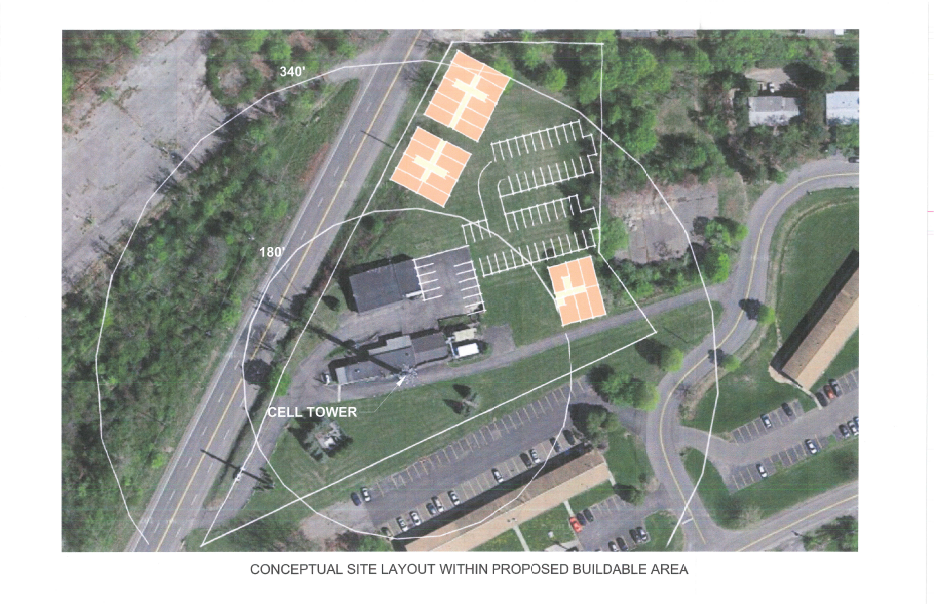
5. Time for some more unhappy – the city Board of Zoning Appeals isn’t touching the 815 South Aurora Street application.  To recapitulate the salient details, local developer Todd Fox would like to build apartments on the land but can’t because the vast majority of the property is within the “fall zone” of a cell tower, which the city defines as twice the height of the tower. At 815 South Aurora, a 170′ tower creates a 340′ radius of no-man’s land (outer circle above), making the parcel virtually undevelopable. Fox had two private engineering companies (TAITEM Engineering and Spec Consulting) analysis the case and they determined that an appropriate fall zone is the height of the tower plus 10 feet for a little wind/bounce – so 180′ total. With this info in hand, Fox is trying to get the city to refine the zoning to allow the decrease in fall zone and therefore permit the land to be open for development.

The BZA said it was acting on the city attorney’s advice that the committee can’t override a council-approved law. Which means that Noah Demarest, the architect appearing on behalf of Todd Fox, will either have to go to the Council to have the law amended, or he and Fox will have to go through a full sketch plan and review process, and apply for an area variance for whatever firm plans they have proposed. Meeting with the BZA was seen as way to avoid having to shell out all that time and money and risk still being rejected because of the cell tower issue. There’s a risk with moving forward at this point, and it’ll depend on just how much risk the developer is willing to take on this potential project.

6. We’ll wrap up with something positive – FormIthaca, the citizen group advocating for form-based zoning, is doing their design charettes this week. I’m writing this on Thursday night since I will be doing 5-year Cornell reunion stuff on Friday, but I do plan on being in attendance Friday afternoon meeting and am looking forward to seeing/hearing what ideas the presenters have to share.

I can assure a certain town of Ithaca board member that I have a personal preference to small street setbacks, and it sure as hell isn’t because they’re “hipper”.


The Evolving Plans For West Hill

2 06 2015

West Hill is, in a sense, Ithaca’s final frontier. The least developed of the hills, it isn’t nearly as built out as South Hill or East Hill, and what is there are mostly single-family homes.

For clarity’s sake, this post is about the part of West Hill within city lines.

While looking up something else, I stumbled across West Hill’s Master Plan from 1992. Which, given its been over 20 years since it was written, gives an interesting perspective on how the city has wanted development on West Hill to fill out. The West Hill plan was created in response to strong developer interest in West Hill sites in the late 1980s, both in Ithaca city and Ithaca town. The plan notes that seven major projects were proposed during 1988 alone, in an area more accustomed to annual construction in the range of a few to several homes, and the very occasional apartment building or business.

west_hill_1992_1

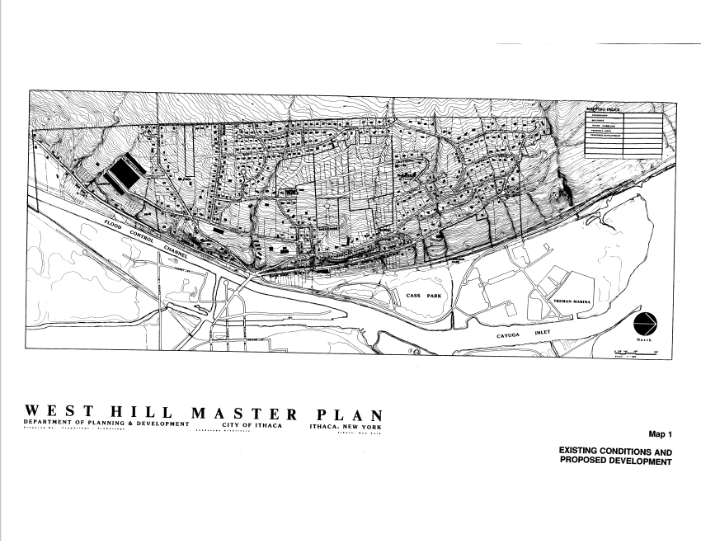
The map above shows both the current and proposed projects at the time, There were eight in total, with dozens of units and lots. It’s hard to read even when blown up, but the proposed projects, which have a heavier lot outline and blurry labels, included subdivisions for single-family housing tracts in the proposed Deer Creek, McPherson and Sunrise Terrace projects, and individual sites with multi-unit potential like INHS and Overlook Park.

west_hill_2015_1

As seen in this 2015 map from the county, the majority of those late ’80s plans were never built, probably because the local economy tanked in the early 1990s. The four housing tracts in the middle of West Hill are still vacant today and under various private ownerships. The Overlook Park site eventually morphed into the 44-unit Bella Vista proposal in the 2000s, but that project was also never built.

A few plans did come to fruition, however. A site just east of West Village (380-90 Floral Avenue), called “LoPorto” on the 1992 map, became a 28-unit townhome development in 1995 that was sold to INHS five years later. The INHS site indentified in the 1992 map (310 Floral Avenue) became the 39-unit Cedar Creek Apartments in 2009, 17 years after the master plan was published. The last site, called “Clynes” after the owner, was subdivided into two lots, a currently vacant lot, and a house at 131 Haller Boulevard that was built in 1999.

Also, note the very different street configuration over on Inlet Island – this was the time of the original Ithaca “Octopus”, a jumble of streets feeding into one bridge, and infamous for its traffic problems. That’s a story for another day, but there are rundowns here and in a 1989 NYTimes article here.

west_hill_1992_2
The 1992 Master Plan called for a number of new roads criss-crossing West Hill, two new parks (one by West Village, the other in the undeveloped lands in the middle of the map), and a new bridge at the southwest edge of the city. Sidewalks were recommended for the large majority of residential streets, new feeder roads would be built with Ithaca town, and Cliff Street was to be upzoned, while most of West Hill would stay the same or be downzoned to “preserve character”. Here’s the current zoning map, but without a 1992 map it’s hard to cross-check and see what, if any zoning was changed. About the most I can ascertain is that swaths of West Hill near West Village were downzoned from R-3 to R-2 at some point.

The plan also notes the abnormally large lot size used by single-family homes on West Hill, which were less dense than even the city’s lowest-level R-1 zoning; but decided it was best to keep precedent and the plan suggested narrowing all residential streets as a character-protecting and traffic calming measure. Interestingly, a number of the newly-built or currently vacant single-family lots in West Hill are recent creations from subdivisions of larger parcels by their owners. So the streets are filling in via “organic growth”.

ith_big_plan_map

Now a look at the 2015 Comprehensive Plan. A large conservation swath (natural area with no permitted development) runs through the Floral Avenue and Cliff Street corridors, and chunks of medium density residential are put forth south of Hook Place and east of Chestnut Street. The 2015 plan notes that the undeveloped tracts in the middle of West Hill present significant opportunities for new single-family housing. The 2015 Plan notes that, just like 23 years ago, the lack of sidewalks is an issue. The cul-de-sacs, utility capacities, and “sensitivity of development to existing character” (a.k.a. be wary of neighborhood opposition) also pose issues and concerns that both existing homes and new projects need to address.

Off-hand, there haven’t been any major projects announced recently in the city’s portion of West Hill, and I haven’t heard any through the rumor mill (I can think of a couple homes I’ve heard about and that’s it). But it’ll be interesting to see how West Hill evolves in the next twenty or so years.