Cornell Veterinary School Expansion Construction Update, 9/2016

1 10 2016

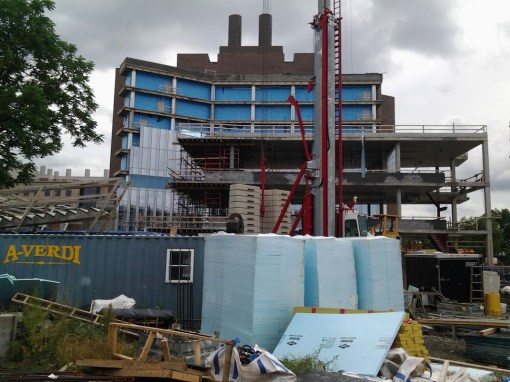
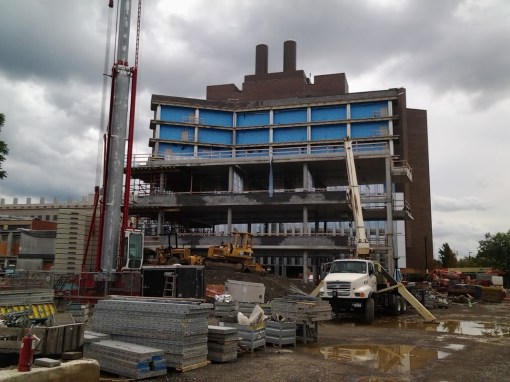
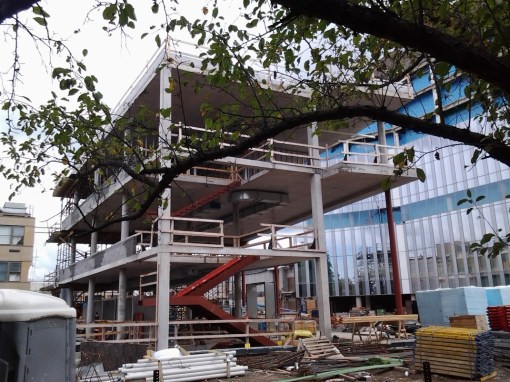
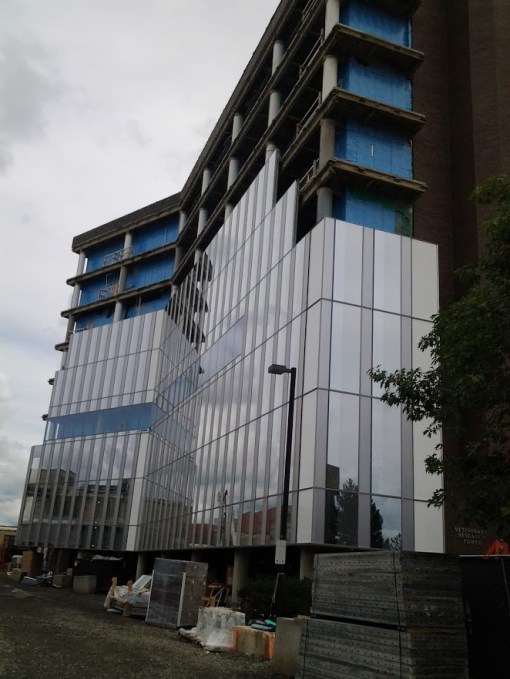
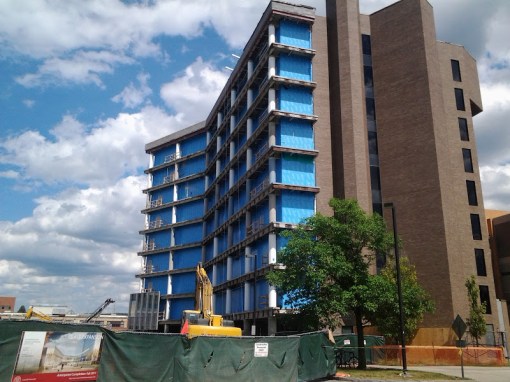
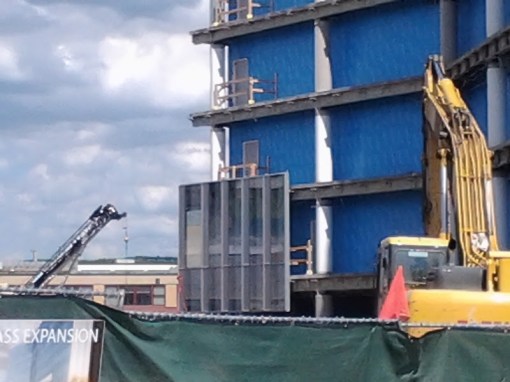
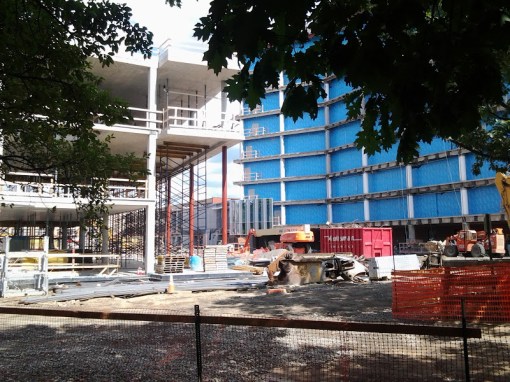
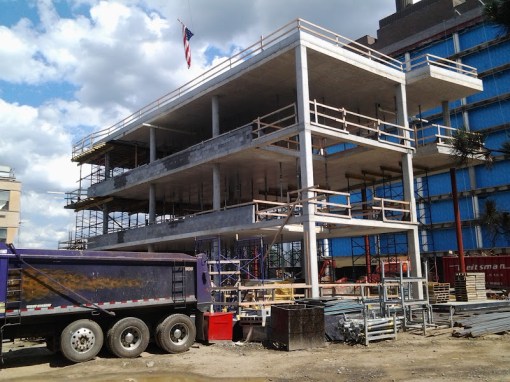
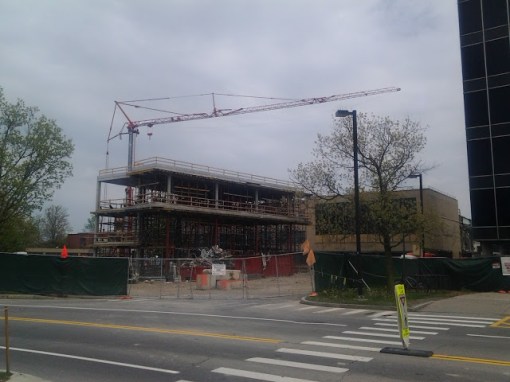
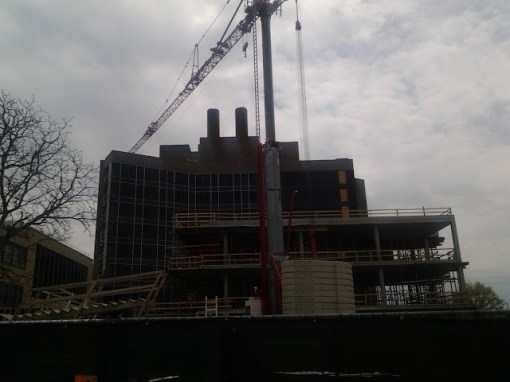
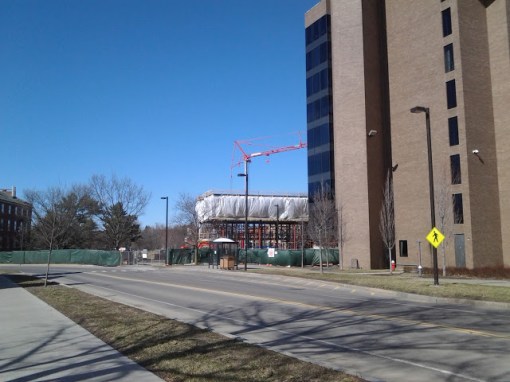
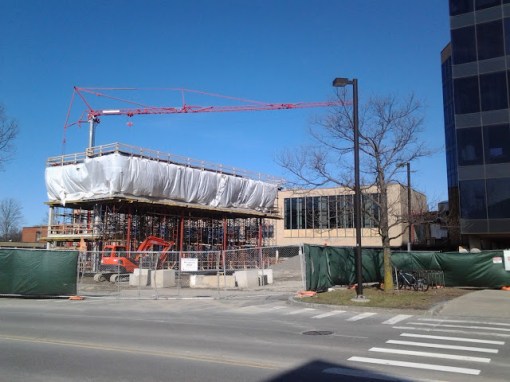
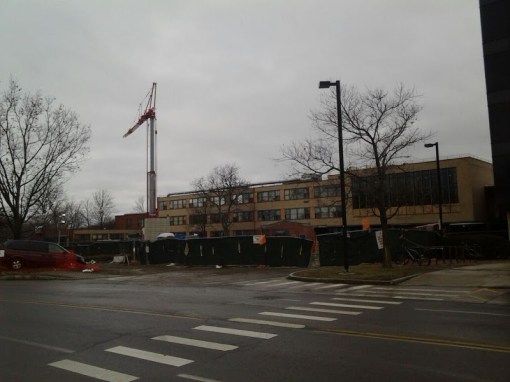
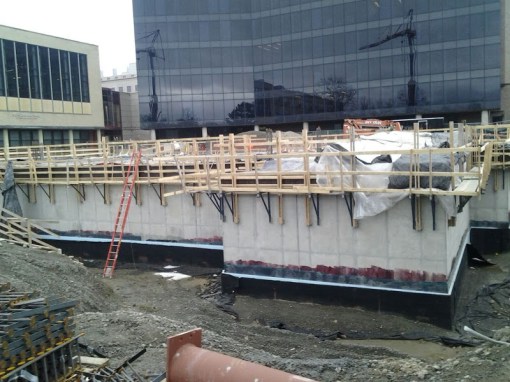
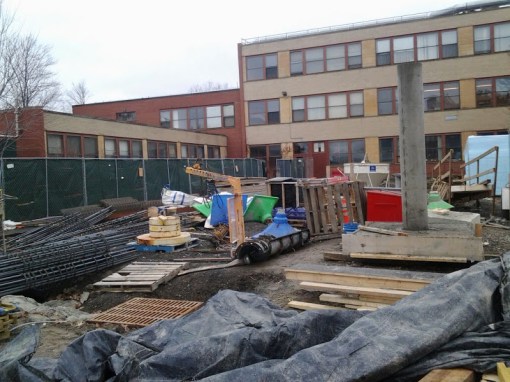
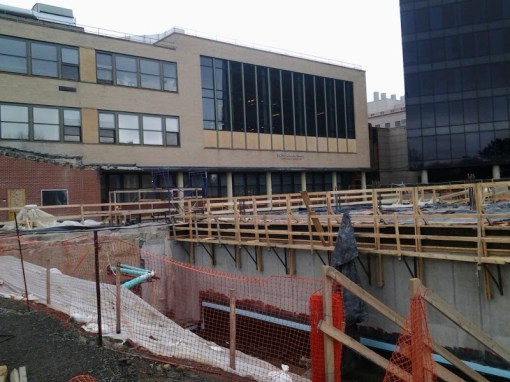
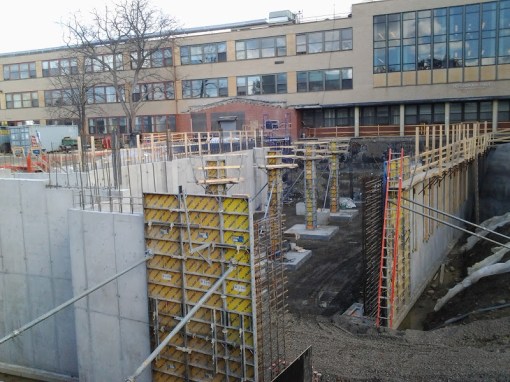
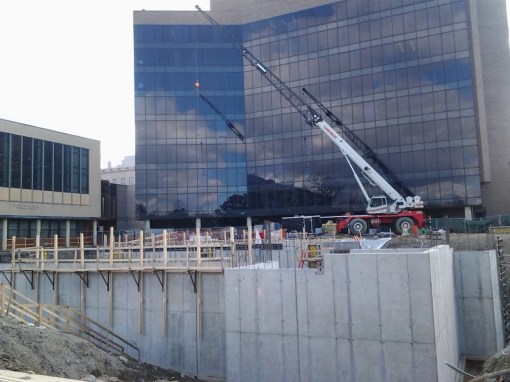
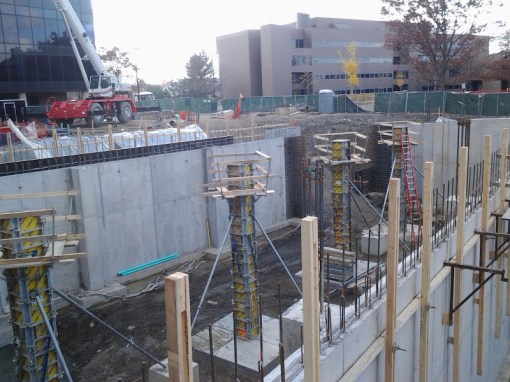
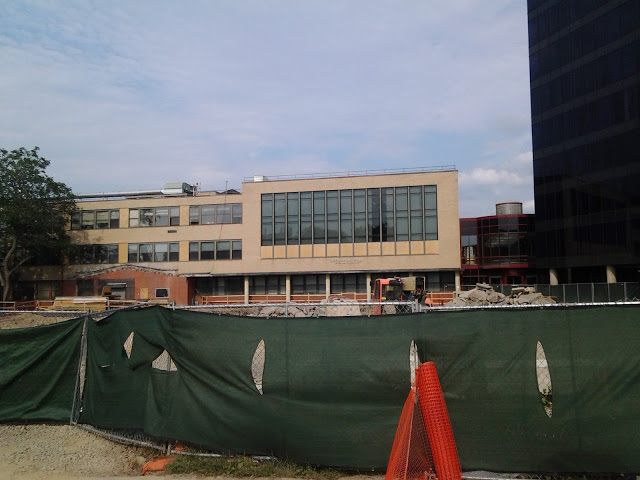
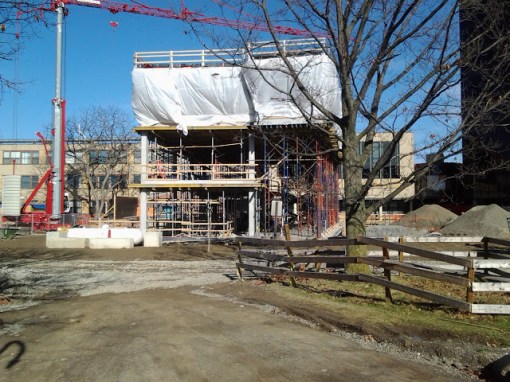
Check out that glass curtain wall going up on the Vet Research Tower. The lighter hues vs. the original dark glass gives the building a airier, less ominous presence. We’re starting to see some HVAC rough-ins going in the new library/administration building. The deconstruction of existing wings appears to be wrapped up and it looks like works has started on the frame of the new academic building to go between Schurman Hall and the VRT. Although not visible from these photos (because it is a pain to maneuver around the vet school), Cornell and its contractor Welliver have been working on the foundation and underground utilities, and construction of a new second-floor cafeteria space.

A separate project, the Community Practice Service Building, is in the design phase. CPS is what you think it is – fourth-year students, as part of their final year of education, provide low-cost veterinary services to the greater Ithaca area. It will replace the Poultry Virus Lab, which will come down in December. The CPS Building will take just under a year to build.

For those with some serious dough lying around, the new academic building’s naming rights are available for $20 million, and the administration building’s naming rights are being offered for $7 million. For the rest of the 1%, a lecture hall goes for about $1.5 million, and regular classrooms for $250,000. The most inexpensive options appear to be tutorial rooms for $75,000.

20160918_130307 20160918_130105 20160918_130035 20160918_130024 20160918_130005 20160918_125934 20160918_125838 20160918_125829 20160918_125806 20160918_125726

20160522_131445 20160522_131417

3f5656954f5a3ef1021519c03b4abe9f

cad048742a281097e5667382eced4233 eea787361994de9625f74b19aa50d91e


Cornell Veterinary School Expansion Construction Update, 7/2016

31 07 2016

Over at the Cornell Vet School, one of the biggest changes since the last update in May has been the removal of the old glass curtain wall on the ca. 1974 Vet Research Tower. The insides have been temporarily walled off just inside the support columns. The support system for the glass wall has to be modified in order to support the replacement glass curtain wall, which should be fully installed by the fall. A small section of the new curtain wall, with a much lighter tint and trim and more transparent than the first, can be seen in photos two and three.

Most of the building demolitions should be finishing up at this point, which will allow construction of the new dean’s wing and library (reinforced concrete structure below) to extend back and connect with the rest of the vet school complex. The Poultry Virus Lab on the corner of Campus Road and Caldwell Road is the last major demolition planned, and will come down later this year to allow a new Community Practice Service building to take its place. Technically, that $7 million project is considered to be separate from the vet school expansion.
20160717_152109 20160717_152137 20160717_152145 20160717_152232 20160717_152256 20160717_152304 20160717_152351 20160717_152407

eea787361994de9625f74b19aa50d91e

20160522_131344


Cornell Veterinary School Expansion Construction Update, 5/2016

25 05 2016

From Tower Road, it doesn’t appear a whole lot has changed since the last construction update in March. Work has shifted away from new construction somewhat, and towards the demolition of underused academic space to make way for the rest of the Vet School reconfiguration and expansion. The reinforced concrete frame of the new library and dean’s wing has advanced a bit, and new curtain wall glazing appears to be going in on the Vert Research Tower. The project is a bit disjointed because of the needs of academic space and surging at various times of the year.

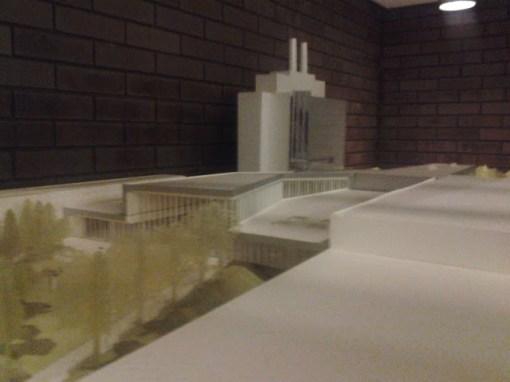
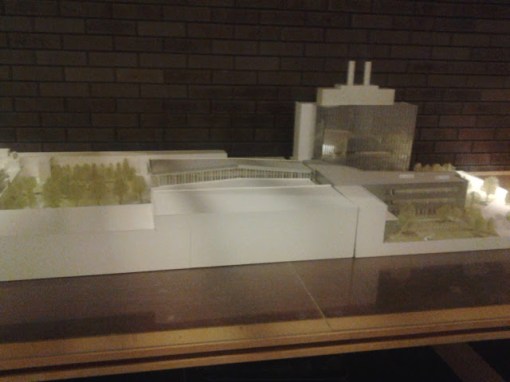
Thanks to the kindness of a woman in blue scrubs, I was able to enter the building. While trying to find a good angle of the new demolition (couldn’t, but there’s a photo on the Vet School website here), I stumbled upon a model and timeline of the project, pictures below. According to the timeline here, the project completion is January 2018, not June 2017 as reported on the website. Dunno which one is more accurate. The model does a great job illustrating the full breadth of the project in relation to the rest of the vet school complex.

20160522_130612 20160522_130756 20160522_130851 20160522_130922 20160522_131344 20160522_131403 20160522_131417 20160522_131428 20160522_131445 20160522_131554 20160522_131846

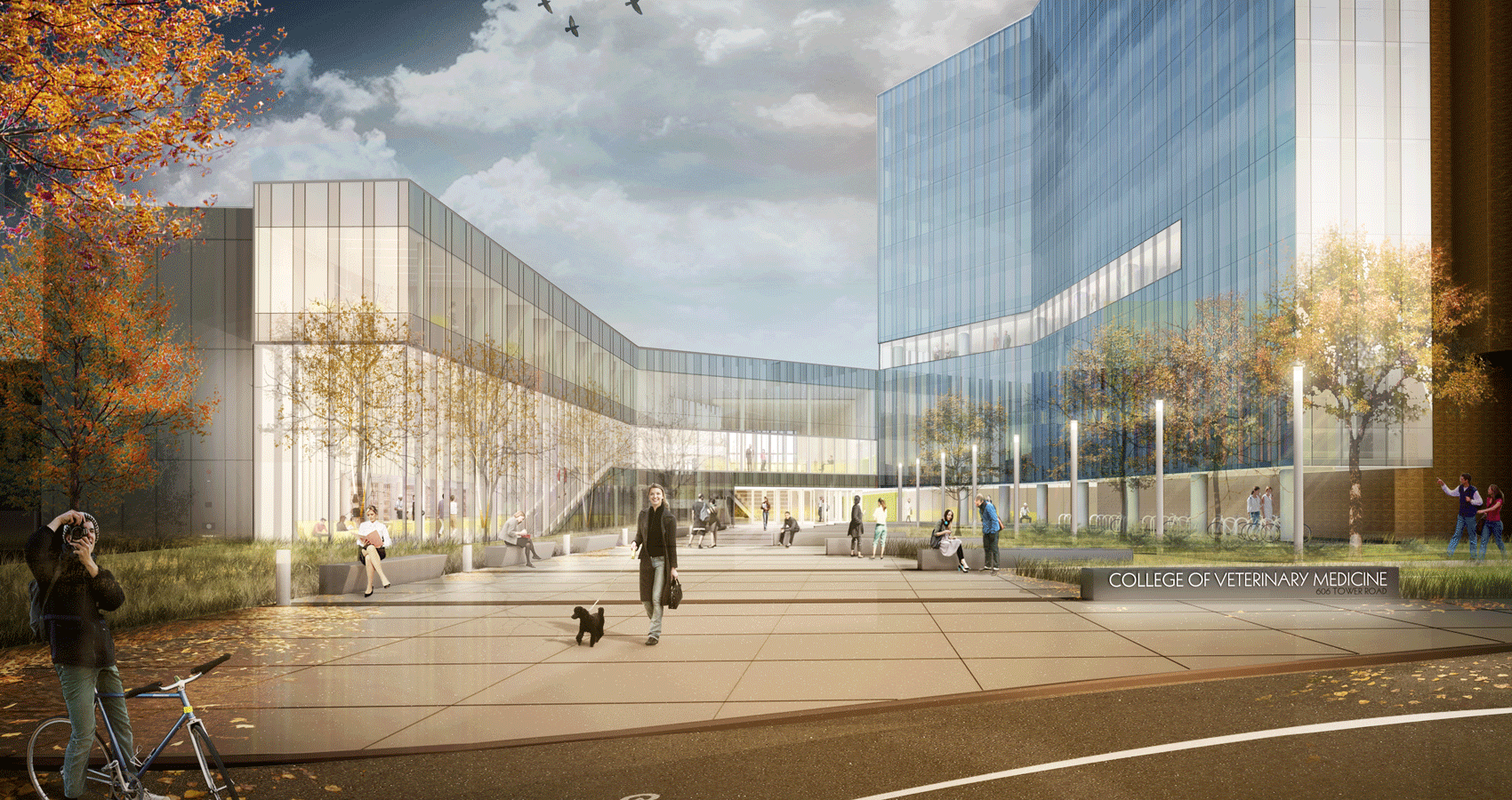
Looking east from Tower Avenue. Rendering property of Cornell.

Looking east from Tower Avenue. Rendering property of Cornell.

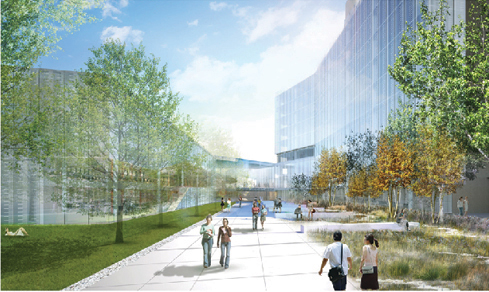
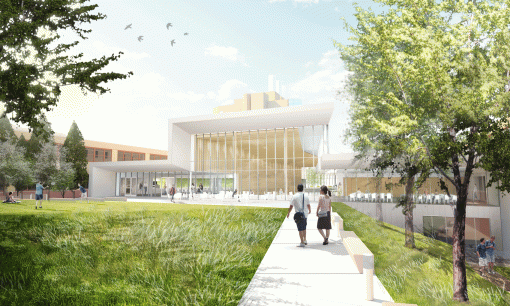
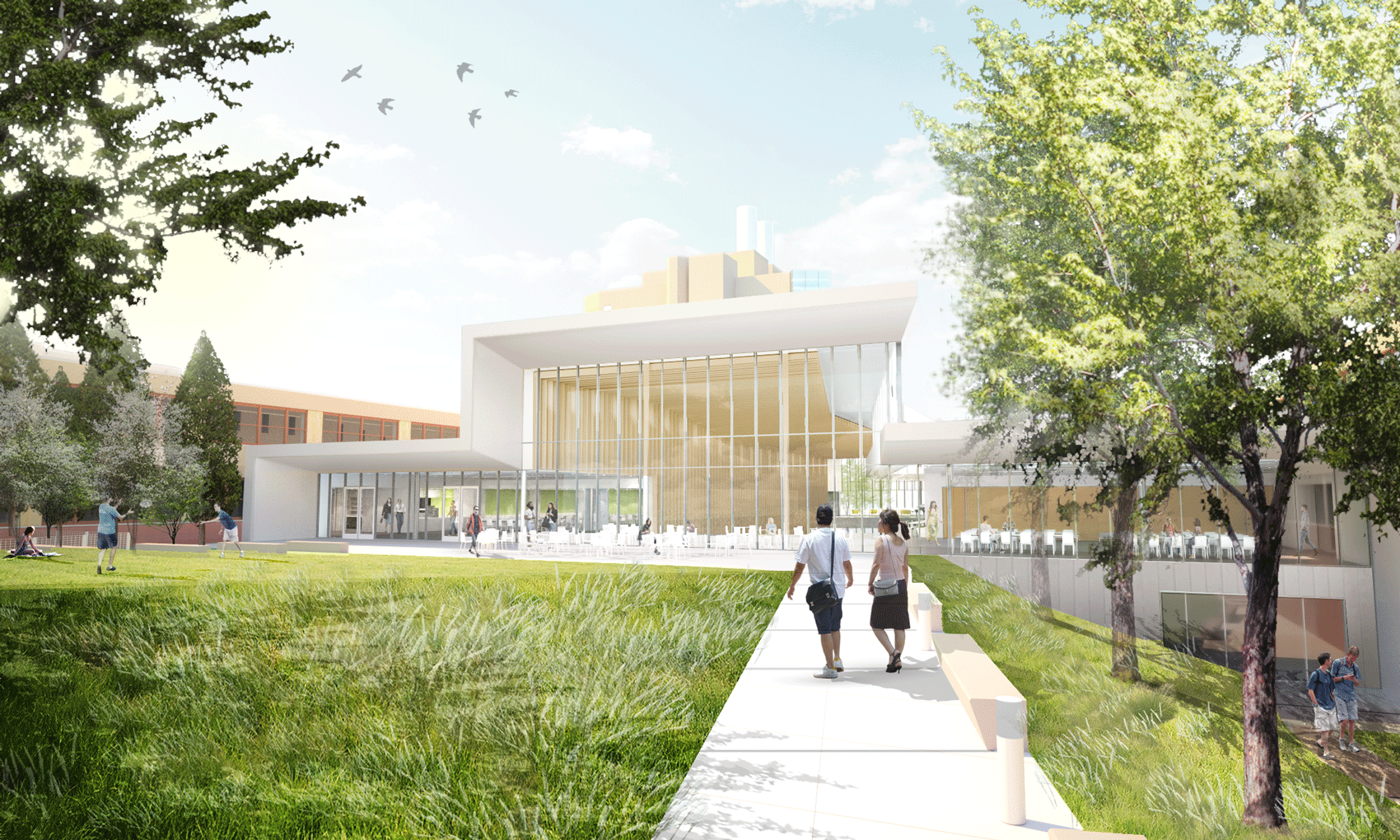
Looking west from new courtyard. Rendering property of Cornell.

Looking west from new courtyard. Rendering property of Cornell.


Cornell Veterinary School Expansion Construction Update, 3/2016

30 03 2016

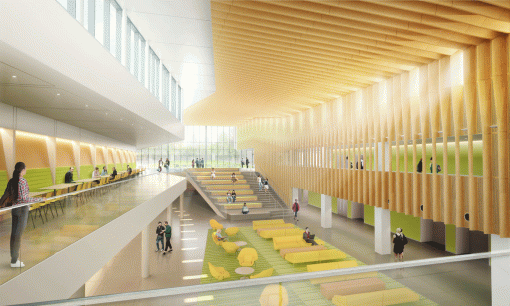
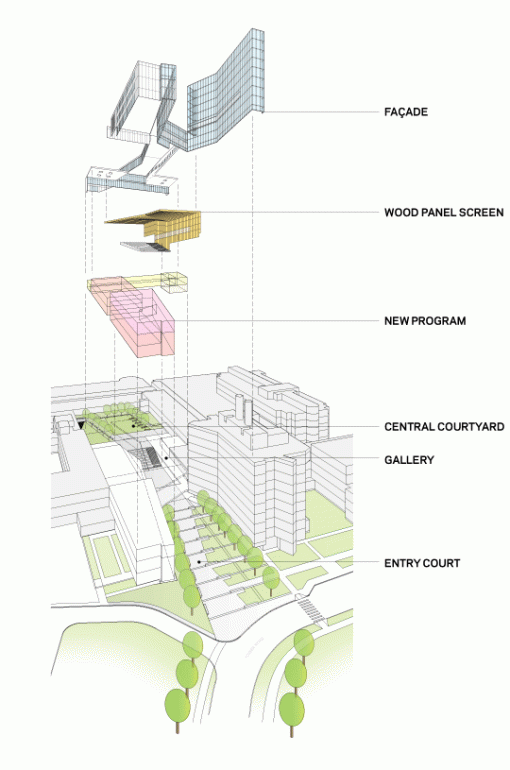
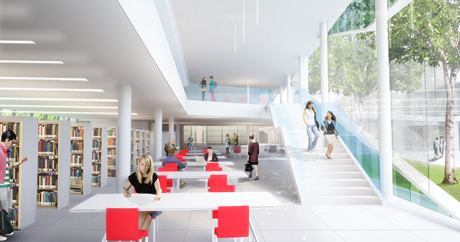
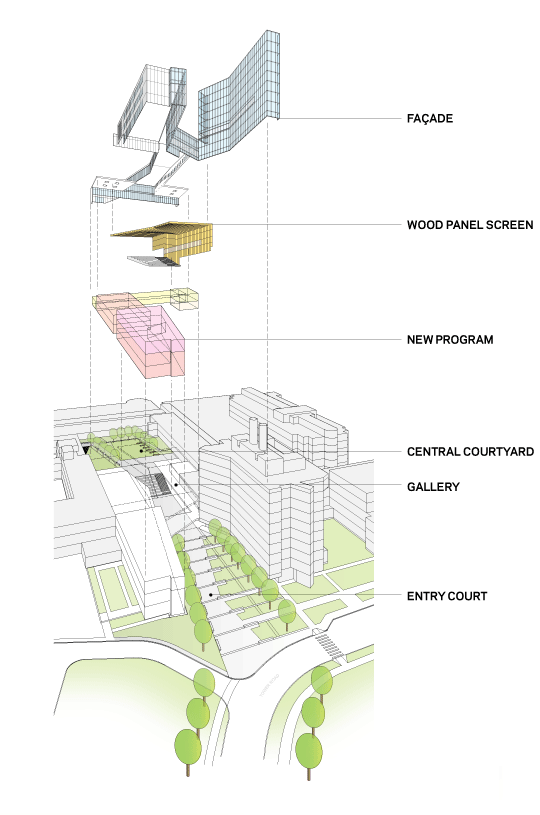
A generalized summary can be found on the Voice here. The concrete frame for the Veterinary School expansion is up to the third and final floor of what will be the new Flower-Sprecher library. As build-out continues, the existing building behind (east) of the new construction will come down and be replaced with new program space; the second floor will sit above an entry court and pedestrian walkway that leads to an indoor gallery space and central courtyard. The open space on the right (south) side of the structure will be a two-story atrium space. The addition will have a glass curtain wall, and the academic spaces that face the gallery will be faced with wood panels.

Cornell and general contractor Welliver will be looking to bring the project to completion by June 2017. Weiss/Manfredi is the project architect.

20160319_155209 20160319_155242 20160319_155305 20160319_155319 20160319_155335 20160319_155345

EntryPlaza10-2 LibraryReadingRoom10-2

3f5656954f5a3ef1021519c03b4abe9f 8f098b7e26544f579eb7411b9a1716aa

eea787361994de9625f74b19aa50d91e


Cornell Veterinary School Expansion Construction Update, 1/2016

12 01 2016

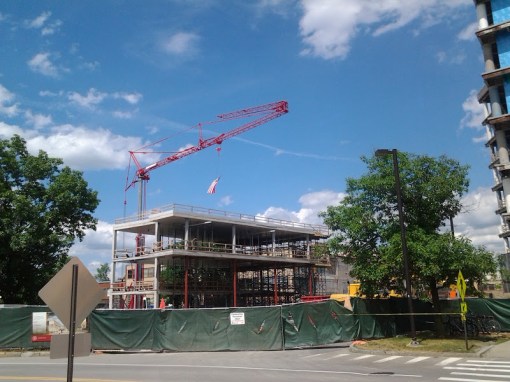
Over at the Vet School, it looks like the expansion project is now at surface level. With the foundation completed, the only direction for the project to go is up, which the Manitowoc Potain self-erecting crane should help with. Phase I interior renovations should be completed by this time, and the Phase II new construction will be moving ahead to a June 2017 completion. Like Klarman Hall, Welliver is the general contractor of this $74.1 million construction project.

20160109_121541 20160109_121607 20160109_121617 20160109_121646 20160109_121718 20160109_121739 20160109_121743 20160109_121756 20160109_121825


Cornell Veterinary School Expansion Construction Update, 11/2015

12 11 2015

The site of the future west wing of the Cornell Veterinary School expansion has been excavated and the foundation is being poured for what will be a 3-story building with the new Flower-Sprecher Library, and additional program space. Look along the outer edge of the newest foundation section and you’ll see wooden forms pressed against the concrete. These forms provide stability and shape while the concrete hardens, and they provide support to the reinforcing rods embedded in the concrete. They will move further along the perimeter as pouring continues.

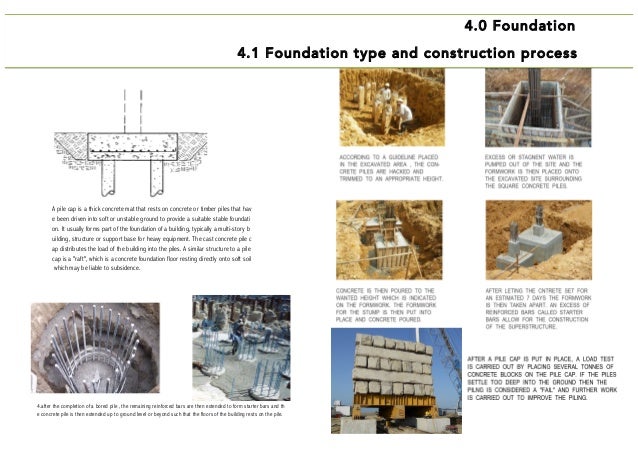
Without being all that knowledgeable about deep foundations, the structures in the middle of the excavated foundation might be pile caps. Piles are driven into the ground, trimmed to a predetermined height, formwork is set up around the piles and the concrete is poured and left to cure. So the piles are underneath the caps, and columns extend from the base of the cap. The load of the structure’s will be transferred to the pile caps and distributed to the piles below, providing stability for the building.

EDIT: Quoting commenter Drill Deep, who is knowledgeable about foundations: “No deep foundations at this one. Just very wide spread footers. East Hill and the Cornell campus usually has ground that can be made to do the job. The basement here is very tall and something like a hangar. Lots of headroom to run utilities.”

More information on the background and details of the expansion can be found in the September update here.

NYC-based architecture firm Weiss/Manfredi designed the expansion, and regional construction firm Welliver is the general contractor.

20151108_122245 20151108_122249 20151108_122256 20151108_122317 20151108_122355 20151108_122421 20151108_122457

cad048742a281097e5667382eced4233

LibraryReadingRoom10-2


Cornell Veterinary School Expansion Construction Update, 9/2015

2 09 2015

In an attempt to avoid the correct but lengthy word jumble this is, I’m just going to refer to this as the Vet School Expansion. Even then, in terms of physical square footage, expansion is something of a misnomer. The plan calls for the demolition of 68,000 SF of space, the addition of 65,000 SF of space, and the renovation of 33,000 SF. In sum, 3,000 SF less space than which the vet school started with.

However, it’s less about space and more about efficiency. The plans include renovation and expansion of classrooms, teaching laboratories, cafeteria, locker rooms and shower facilities, and a combined Tower Road entrance. In the photos below, the entry plaza and the James Law Auditorium have been torn down. In its place will rise a new three-story addition that will house the vet school’s Flower-Sprecher Library. Parts of Schurman Hall will also be demolished and replaced with a new 2.5 story gallery/courtyard space. Extensive interior renovation will cluster classrooms, labs and service space, improving circulation through the numerous interconnected buildings that comprise the Vet School. The Vet Research Tower will be reclad in lighter, more transparent glass to match the new additions. The design of the expansion is a product of NYC firm Weiss/Manfredi, a Cornell favorite.

Renovations will increase the class size from 102 DVM students to 120 DVM students. Since a DVM degree takes four years, that means an additional 72 students.

Phase one for the vet school expansion is well underway, having a roughly January 2015- January 2016 time frame. The second phase will pick up immediately after the first and run from January 2016 to June 2017.

The budget for both phases is $74.1 million, with funds coming from the SUNY Construction Fund and private sources.

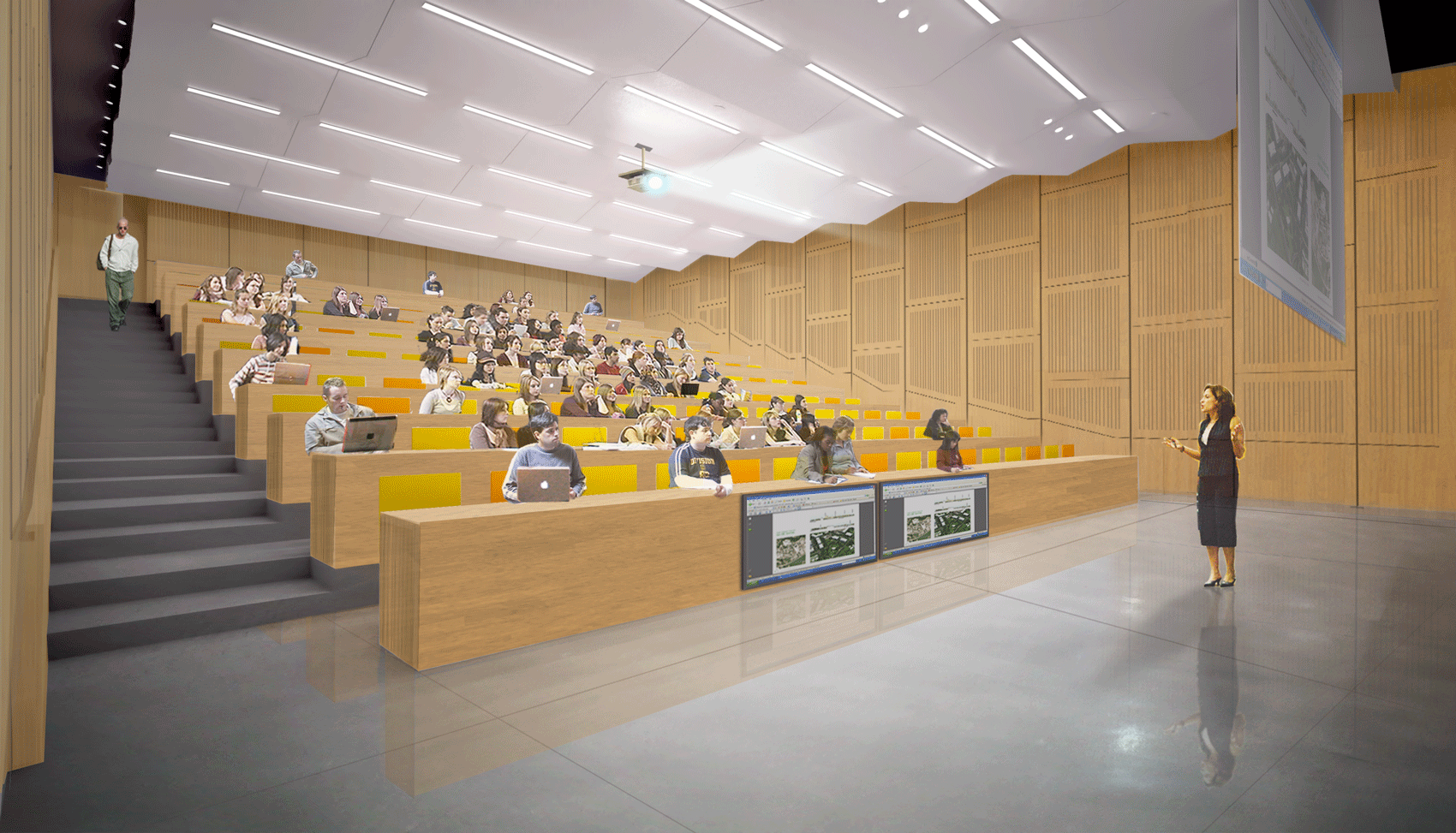
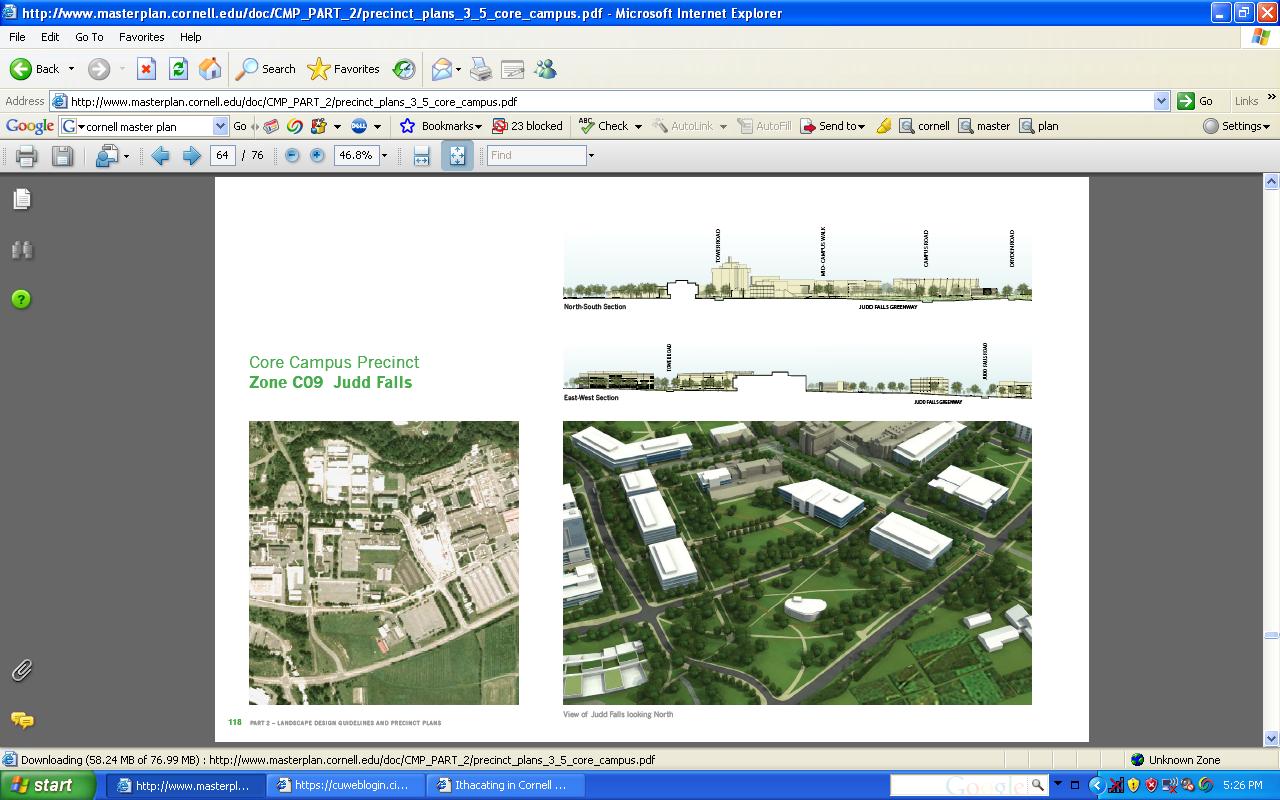
On a humorous note, while going through the project page on the architect’s website, I found an image of a lecture hall with some token presentation slides (last image). The placeholder image is a screenshot I had taken of the Cornell Master Plan back in 2008. Surprise surprise. For the record, I’m totally okay with it (even though I hate the screenshot, dating from the days before I thought to crop images).

20150829_162541 20150829_162526 20150829_162517

cad048742a281097e5667382eced4233

LibraryReadingRoom10-2

8f098b7e26544f579eb7411b9a1716aa

eea787361994de9625f74b19aa50d91e

655113b60367a0343c31545937948d57


A Bigger Vet School

10 10 2013

cropped-100_1794.jpg

I’ve only ever been in the vet school once, to deliver an invitation for a wine and cheese event to an alum of my fraternity house who worked as a researcher at the vet school.  When it came to getting photos, I would just take advantage of my Bradfield perch, take my photos, and that was that.

The vet school is not unlike the rest of the school in that it’s been built in spurts. The original vet school was in James Law Hall, where Ives Hall stands now (and even prior to that, it shared space in the north wing of Goldwin Smith Hall, the old dairy science building). The vet school moved further east with the construction of Schurman Hall in 1957, and expanded with the Vet Research Tower in 1974, the Vet Education Center and Vet Medical Center in 1993 and 1996, and the East Campus Research Facility and Vet Diagnostic Lab in 2006 and 2010 respectively.  Essentially, the vet school is like many human hospitals, a mish-mash of additions and new wings/buildings, incoherent and even incompatible. The completion of the the  VDL building left a large amount of vacant space in Schurman Hall that was difficult to repurpose, hence the approved plan – demolish 68,000 square feet of space, build 65,000 square feet of new space, and renovate 33,000 square feet of existing space, to be done in two phases with a combined cost of $63 million.

Looking east from Tower Avenue. Rendering property of Cornell.

Looking east from Tower Avenue. Rendering property of Cornell.

Given those stats, it seems like a misnomer to call it an expansion, but one of the effects of the reconstruction will be to increase the number of matriculating vet students in a year from 102 to 120 – and given Cornell’s #1 vet school ranking, they will not be lacking in applicants. Over four years, you have 72 more professional students – you’re welcome, Ithaca landlords. Among the details, the old auditorium will be torn down, and in its place comes the new Flower-Sprecher library, two new lecture halls, a new dining hall, large gathering spaces (i.e. yet another open atrium) offices, an expanded anatomy lab, and a green roof. The architects of this plan are New York-based Weiss/Mandfredi, who specialize in hypermodern glassy spaces.

Looking west from new courtyard. Rendering property of Cornell.

Looking west from new courtyard. Rendering property of Cornell.

As for the time frame, Phase I, which comprises the tear-down and new construction, will start in April 2014 and be completed in a 12-month time frame. Phase II, the renovation component, will commence at that time and proceed towards a tentative completion in October 2016. I will already be beyond my 5-year reunion, so that kinda freaks me out.

Straying a bit here, but I’ve heard from my vet school friends that the market isn’t absorbing new grads like it used to, and not at the salaries that it used to. A for-profit school planned for Buffalo was recently cancelled. But, I suppose for the #1 school, these are concerns that the college is reasonably shielded from. Adopting a dog in the next couple years is on my priorities list (if I can ever establish enough of a schedule that makes me feel like I’d have adequate time to love it), so in my totally uneducated opinion, more vets is fine by me.


The Story of the Vet School Incinerator

18 09 2008

So, I enjoy telling a good story as much as the next guy, and this one was actually the subject presented by my professor in an air pollution course I’m enrolled in. I might have been the only one taking notes on this, because it was meant to merely illustrate an argument, it’s historical, and an interesting piece of history worth sharing.

So, in the early 1990s, The Vet School over on the East Campus had a problem. A large number of carcasses were being generated daily. Dissections, disease studies, putting some of the farm animals to sleep, etc. So on any given day, thousands of pounds of carcasses were being produced, and they had to be disposed of.

Well, Cornell, for all the things it does have, does not have an incinerator for cremation on any of its properties. So they would have to ship the carcasses out in container trucks with hazard labels and send them to an incinerator elsewhere in the county, where they could be properly disposed. As you might imagine, this built up quite a hefty amount of fees over time. So Cornell began to explore their options to alleviate the problem.

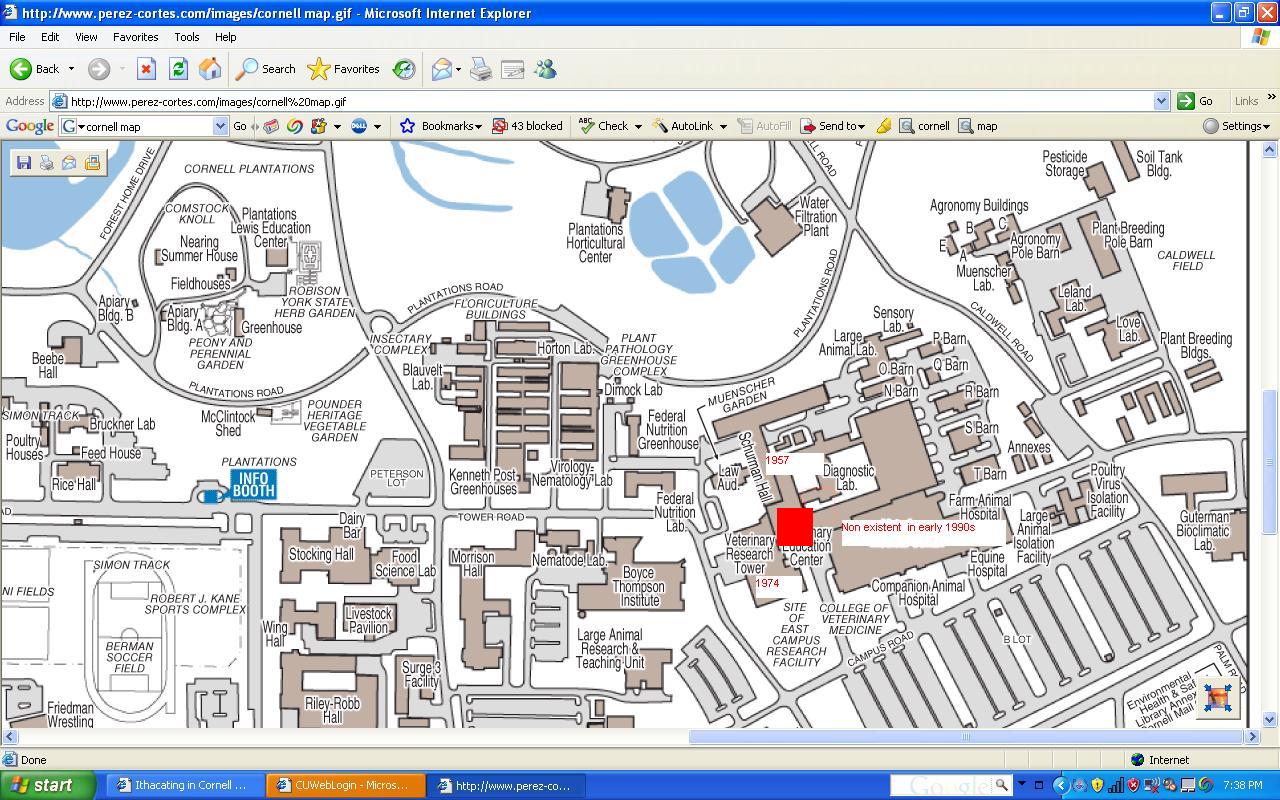
Well, the proposal that seems to work best was to build a waste disposal facility for the animal carcasses directly on the property. The site that was determined to be the best fit was just to the east of the Vet Research Tower. At this time, the Vet Hospital’s main building and the East Addition didn’t exist, so the complex was mostly barns, the tower, Schurman Hall and the scattered add-ons that comprised the property. The red square below was the approximate location for the project.
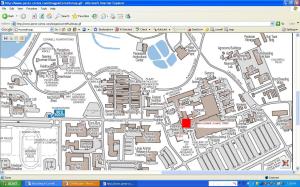
 The Vet Tower is a fairly large building, as it stands about 140 feet tall. So, in order to build the smokestack, the design had the smokestack stand about 180 feet tall, more than enough to clear the building.

Well, it went ahead in front of the town of Ithaca, and the residents of the neighboring hamlet of Forest Home had a fit. They’d be damned if they had to look at a giant smokestack from Cornell. So Cornell paid an engineering firm to survey the land from notable viewing radii to see if the structure would impose on the residents of Forest Home. Sure enough, if did, but only just barely. It was determined that if the design was shorter, it’d be okay.

So, Cornell proposed changing it to 160 feet. But, there was another issue with that. Bradfield Hall, just up the road, stands 167 feet tall. And the top floor has windows (ironically enough, the atmospheric science department is housed at the top).  So, that wasn’t going to fly unless Cornell did an air pollution study to prove it wouldn’t affect the occupants of Bradfield.
Well, here’s where we get into an issue. The company they hired, a New York-based engineering firm, decided that the air circulation patterns in Ithaca were the same as Syracuse. Syracuse built a power plant only a couple years earlier, so they decided to reuse the same data and apply it Ithaca. Essentially, they tried to swindle Cornell by selling them false data from another location.

Winds generally blow out of the west in Ithaca. However, in the situation where they would blow out of the east, as during some stormy days caused by east-coast lows, the pollution cloud was going to push over to Bradfield Hall and towards central campus. This pollution would have particulate matter that would drift down onto Tower Road and the Ag Quad. Well, no ones wants to be snowed on by cremated animal ash. Even worse, if it blew out of the northwest at a particularly strong clip, it was going to drift right over Forest Home. The increased height would have allowed it to carry farther away, but the new shorter height would cause particulates to fall a shorter diestance away, and they would be more concentrated, to unhealthy levels.

Well, the university didn’t know that at the time, so they bought the data. And it wasn’t until the final stages of the project that the mistake was realized (through an interdepartmental study independent of the project). The Town of Ithaca wouldn’t give final approval in light of the news. Well, Cornell was just a little upset, so they decided to bring a lawsuit onto the company for their actions, and Cornell had to scrap the 160-foot plan.

Well, due to the air ciruclation patterns and sight lines, a large smockstack just wouldn’t be suitable for their desired location. And Cornell was already set for a major expansion of the Vet School, so they scrapped the plan entirely. The Vet Education building, built in 1993, was the final incarnation of the incinerator project, in which there was no incinerator at all. And the large Vet Hospital would be built four years later, dooming any future proposal nearby.

So, some of you might be wondering about the heating plant, which is to the south. The smokestacks there are outfitted heavily with scrubbers, so the vast majority of the smoke is water vapor, and not nearly as toxic as the smoke from the vet school smokestack would have been.

~~~~

And in other news, House 5 has been deemed “Flora Rose House”, after a professor who was among the first to staff the school of Home Economics (Human Ecology).