A Walk Down Varick Street

4 03 2014

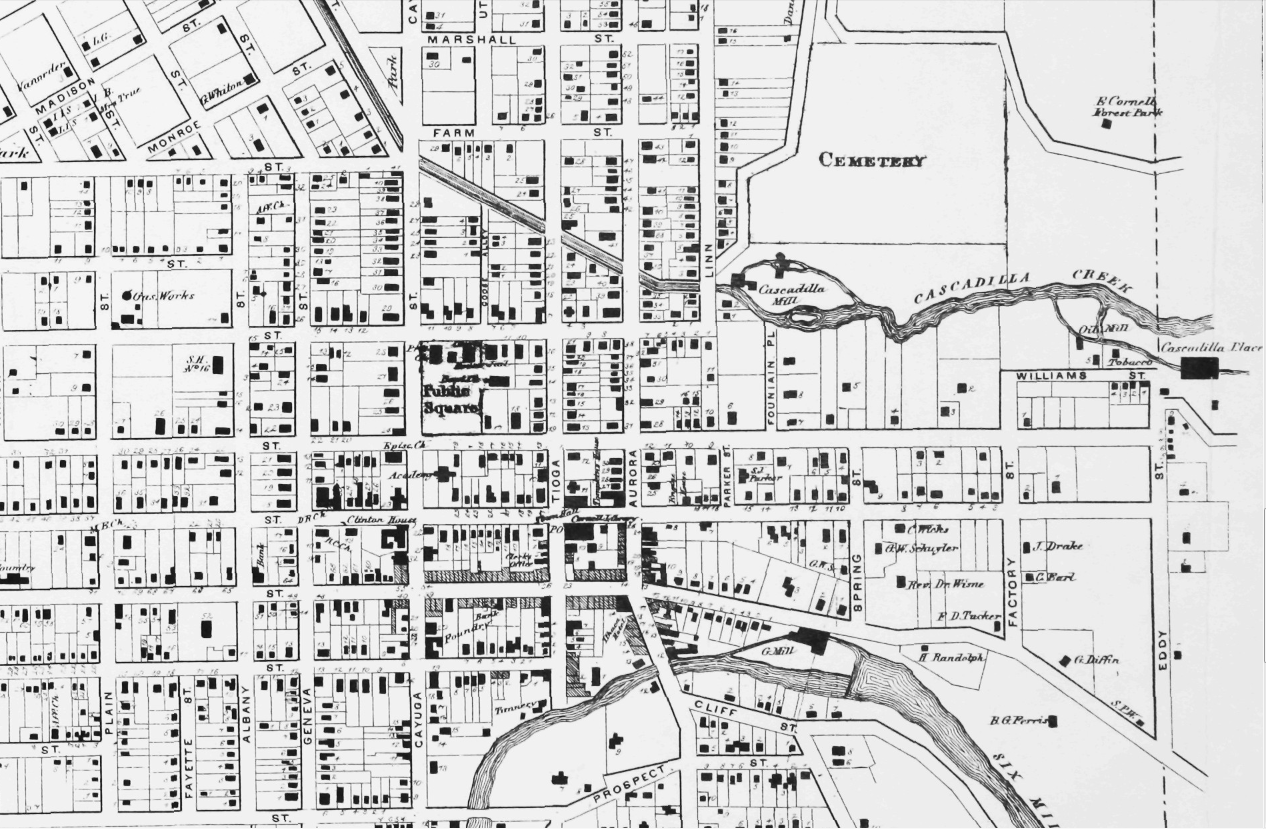
I try and keep in track of the hotlinks to this site from other blogs. A while back, I noticed a link from a little-used community blog for Ithaca’s Lower Northside, aptly named lowernorthside.org. I decide to check it out, and stumbled upon a map it had included in one of its (few) posts. It’s an atlas of the Ithaca area dating from 1866. When Cornell U. was still a dream under construction, and Ithaca had yet to be incorporated as a city (something that wouldn’t happen until 1888). A lot has changed in 128 years, and it’s really a fascinating look back on an older incarnation of the city of gorges.

ithmap1

Clicking on the image will pull up the fine print, or just follow the link above. Unfortunately, the commercial version of wordpress this blog uses doesn’t allow for embedded PDFs, otherwise I’d have cut out the extra step. Of course, for the sake of following along, here’s a map of the current-ish city of Ithaca.

In 1866, Ithaca was much smaller, posting a population in 1870 of 8,462, a number that probably had a bit of help from the newly opened Cornell U. and its 400 or so students. Tompkins county was only one-third of its present population, with about 33,000 people. The county had seen a massive population decline in the 1850s and was only just beginning to recover during this decade.

Ithaca was, as today, “centrally isolated”, having been bypassed for a major railroad in favor of Syracuse. However, the Cayuga branch of the Delaware, Lackawanna and Western railroad had its terminus in the city, and there were steamboats one could take down Cayuga if they were coming out of the north. Ithaca was still expanding in all directions, yet to fill out Fall Creek or the Northside, and barely reaching where Collegetown is today. The small hamlet of Forest Home was still known by its original name, Free Hollow, and at the cruxes of dirt roads, small clusters of houses, churches, and small schoolhouses can be seen. A nice asset here is the inclusion of homeowners’ names; we see names that still live on as place and street names in Ithaca today, like Bryant (Park neighborhood), Coddington (Road), Renwick (Place/Drive/Heights Road), and Mitchell (Street). Ezra’s land is nearly vacant except for his own home, his farmland having but a few roads; and IC and South Hill are barer still.  Cascadilla Place is there, completing construction the year this map was made; the water-cure sanitarium was never used as such since Ezra Cornell, its biggest investor, swooped in and repurposed the structure.

Another notable name on the larger map, though perhaps not as important today, is Heustis. College Avenue used to be called Heustis Street, after landowner Lorenzo Heustis. The name was changed at the urging of local property owners in 1908. Similarly, Collegetown’s Linden Street, not yet in existence but forthcoming, had to beg the city and line their road with linden trees to get their name change from Hazen Street approved in 1924.

ithmap2

Looking a little closer at Ithaca itself, a little re-orienting is required in some neighborhoods. The county fairgrounds were north of the city on Railroad Avenue (now Lincoln Street), in what is today a mostly residential area. No King or Queen Streets yet in Fall Creek, then a sparsely populated if growing neighborhood. Steamboats had their dock near where 13 passes the Sciencenter today. Llenroc (then “Forest Park”) shows up here near the cemetery, the grandiose mansion in the midst of construction in 1866, nine years from completion. Other streets had different names as well;  among them, Park Place was Varick Street (for Richard Varick DeWitt, local landowner; also an infinitely cooler name than a Monopoly space), Hillview Place was Mechanic Street, Esty Street was New Street, Cleveland Avenue was Wheat Street, and Court Street was Mill Street (residents despised it so much it was changed to Finch Street, then Court Street in 1924). Most prominently, State Street went by Owego Street at the time (the name change would come next year, in 1867). The contemporary Ithacan asking for directions might get a little confused.
ithmap3

Some noted landmarks still stand – the Clinton House (1829), and the old County Courthouse (1854) on the public square. Others have seen the wrecking ball, some not all too long ago – the Cornell Library, brand new in 1866, made it to 1960, the old city hall to 1966. Urban renewal took its toll on the city, though perhaps not as extreme as Albany or Syracuse.

The area that would become the Commons is already dense with buildings, though it steadily tapers in any direction and peters out after several blocks. Collegetown is hardly Collegetown, with only a few homes on Spring Street (Schuyler Place, 1924), Factory Street (Stewart Avenue, 1888), and Eddy Street. A tobacco barn, grist and cotton mills, and foundries provided local employment, as well as brewery just south of the current-day police station. Ithaca was a growing large town in upstate New York, with small industries and a developing core.

I’ve heard students derisively say that without Cornell (and presumably IC), Ithaca would be as small and unimportant as Watkins Glen. I think that’s an extreme judgement. Maybe Cortland-sized, or maybe it would have ended up like Elmira; but there was a village here before there was a university here, a village that is fascinating to examine on an old map.


News Tidbits 2/10/14: A Big Project Scouts Out South Hill

10 02 2014

troyrd1

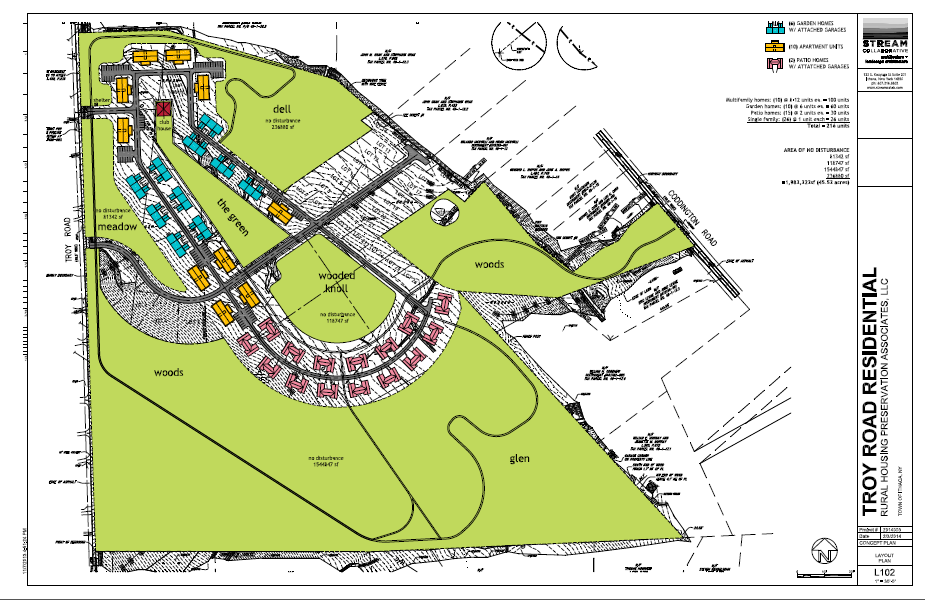
Well, I suppose if there’s demand, and a lack of easily developable to the north, west and east, suburban developers would have targeted South Hill for big projects sooner or later. Fresh from the press comes news of a proposed 216-unit development for the town of Ithaca, on two lots  just east of Troy Road, a little north from its intersection with King Road. The PDF of the plan is here, in the town agenda.

troyrd2

The proposed project is virtually all residential, divided up into 26 single-family lots, 80-120 apartments, 60 garden homes, 30 patio homes, and a 5,000 sq ft clubhouse with your lease office and a few office spaces for rent. To me, it has the airs of a cut-and-paste suburban development. For the record, a garden home is a cute way of saying townhome,  and patio homes are (in this case) one-story duplexes. The architecture theme is “rural agricultural” style: the apartment buildings will look similar to barns, and the patio homes will resemble small farmhouses. The target markets are empty nesters, and twenty-and thirty somethings (grad students and young professionals).

As easy as it to poo-poo this, there is a worse alternative – that which is currently okay under the zoning, which is 70 to 90 lots of low-density residential sprawl. This project, if it gets to proceed as a Planned Development Zone (PDZ) a la Ecovillage, would only disturb about 22 of the 67 acres the two lots comprise.  The project is being developed by Rural Housing Preservation Associates, which looks to be an awkward corporate offspring of a few development companies in the Northeast and Mid-Atlantic, and has enlisted the help of local companies STREAM Collaborative, Whitham Planning & Design, and Hunt EAS. Honestly, the armchair architecture critic in me is okay with those choices.

Something like this will have a multi-year buildout, and there’s been considerable development on South Hill in the past several years. But not anything on this scale. It’ll be interesting to watch this project evolve as it moves through the bureaucratic process.


Belle Sherman Cottages and Boiceville Cottages Progress, 12/2013

3 01 2014

Over my New Year’s holiday, I passed from Albany to Binghamton to Ithaca, to meet with someone and carpool west to Buffalo. This gave me a few hours to kill waiting for that person to arrive, so…carpe diem.

1-2-2014 300

1-2-2014 299

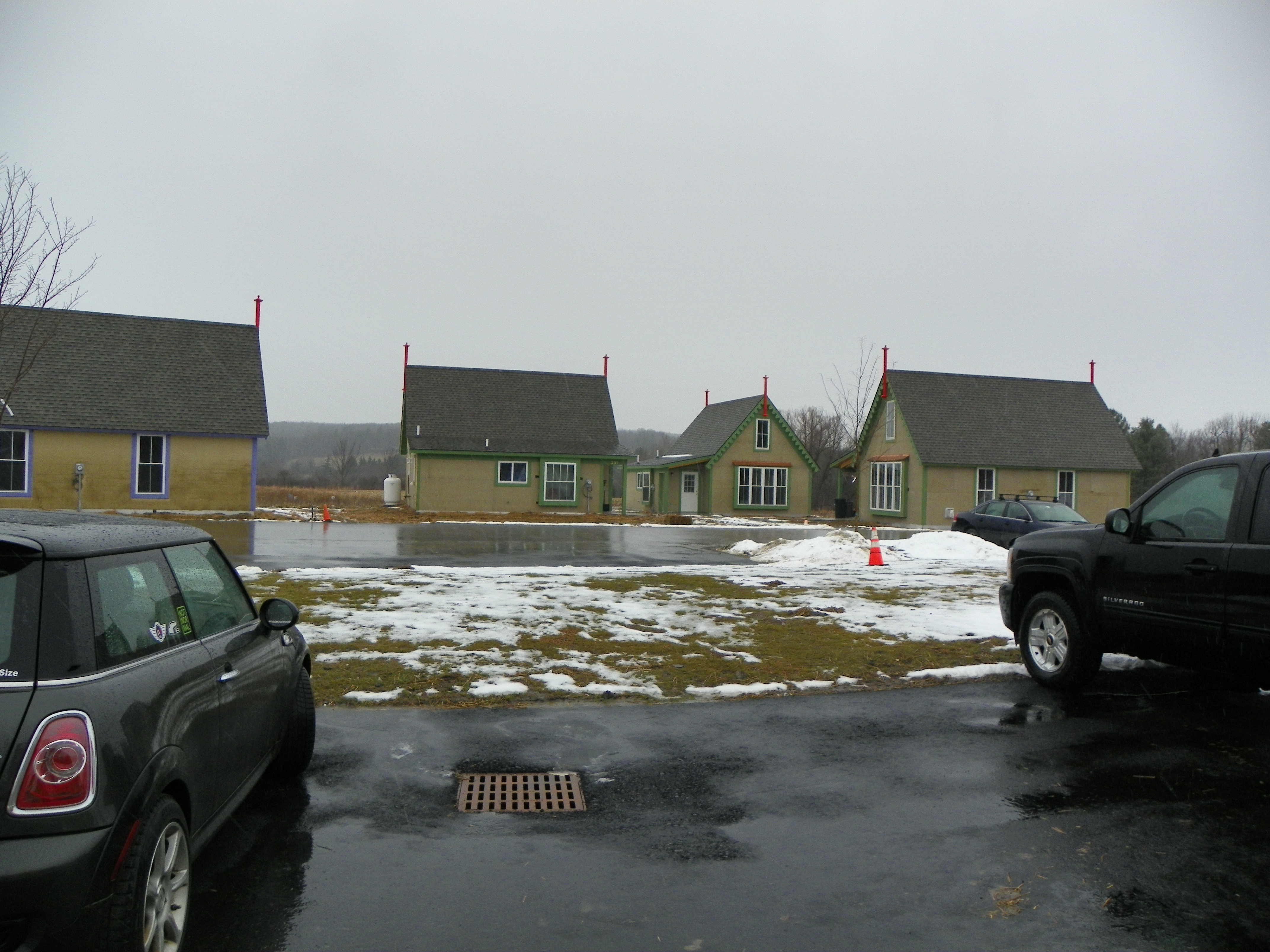
I really don’t care for the finish on the new cottages. It makes them look prematurely aged and gives them a less inviting appearance vs. their older cohorts.

1-2-2014 302

1-2-2014 301

Compared to the last photos, the cluster in the left of the second photo from top is now complete, with slab foundations in place for the next dozen cottages. I suspect these will mostly be built during the spring.

1-2-2014 304

Notably, when this day started, it was raining and in the low 40s.

1-2-2014 307

Next up were the Belle Sherman Cottages (a.k.a. Vine Street Cottages) on the east edge of the city.

1-2-2014 306

The “craftsman bungalow” on lot 19 is nearing completion, from the looks of it.

1-2-2014 308

Meanwhile, another house will be starting construction in the near future. This one looks to be lot 14, another “Victorian Farmhouse”, like the beige home in the lead-in photo. I wonder how many homes will have to be sold before marketing starts for the townhouses?

1-2-2014 305

As a quick side note, I noticed the grassy lot next to where I usually to park my car is now occupied by a two-story home. It’s not the same as the spec home proposed in the initial ad (the lot sold last August), but this house doesn’t look half bad (the entryway seems a little spartan).


Just Passing Through

28 09 2013

9-24-2013 066

So I made the annual pilgrimage back to Ithaca and Cornell for Homecoming. I’d love to say something about how I go back to reminisce about the quality education and think fondly of the many opportunities provides.

But I don’t. I could care less about football, and that plastic wine-glass thing that gave out as a Homecoming gift struck me as so unnecessary in my own home (where we be all fancy and use real glass) that I never even bothered checking in. I went back to see some old faces and attend my fraternity’s annual meeting, where I like to give uncomfortable glances whenever I hear/read things that are disconcerting, like steep increases in expenses, or membership decline, or things in those vein. Since none of their current membership were students while I was, I am able to get away with being a 24-year old curmudgeon. I also had a chance to see a pair of friends (one works at IC, the other is a Cornell PhD student), do acts of young alumni drunkery, and go to the Cornell Orchards for the first time ever.

Since I kept busy, I kept noticing things that I would otherwise hold off on commenting on. Like when I was doing a 4-mile morning run with my best friend, who is a Cornell employee, and we went past the Vine Street Cottages (I did not see any new homes in construction from the trail-side, but I am hopeful they’ve sold another lot or two). I could’ve went running with a camera. Could’ve cancelled lunch plans or dinner plans. But I didn’t. I know Ithaca Builds has a pretty firm grasp on these things. I passed a random house under construction near Honness Lane, and another later in the day on Hanshaw, near Freese Road. As my day went on, I kept taking mental notes, driving past the Goldwin Smith site work, Gates Hall, Seneca Way, Collegetown Terrace, into the city and past Breckenridge Place, and in an attempt to find parking for a West End restaurant, ended up seeing the structural framework going up for the new Planned Parenthood building. For better or worse, this is how my mind is wired. Two of my friends asked if I knew anything about Collegetown Terrace, and I was able to rattle off enough “fast facts” in twenty seconds that they commented that they were surprised and impressed.

It occurred to me in previous years, I would’ve been busting my hump trying to find time to dig out my camera and do a photo tour. But this year was different. I took it easy, I knew I had my stories, and Ithaca Builds has theirs, and they complement each other well. So I could take a deep breath. I could enjoy the extra time. I spent the afternoon before I left not running around like a man on a mission, camera in hand, but at my old fraternity, gathered around the open-porch lounge with about 15 of my contemporaries, some of whom I hadn’t really had a chance to talk to in ages.

It’s odd to say I don’t regret not coming back with a metric ton of photos, but this time around, I feel like my trip back was more fulfilling without them.

But, on my way out of town on 79, I did take photos of the Boiceville Cottages, since they’re outside of Ithaca Builds‘s usual haunts. Comparing to my April photos, Looks like they’ll have built at least 15 units this year.

9-24-2013 095 9-24-2013 096 9-24-2013 097 9-24-2013 098


Cayuga Heights Wants A Real Community Center

16 05 2013


5-1-2012 184

So the folks in Cayuga Heights are getting in on the development game. In this case, local developers are interesting in taking one of the few mixed-use areas of the wealthy bedroom community, and densifying it.

chmap

The focus of this proposal is the Community Corners area, the small, mostly commercial parcel next to the awkward intersections of Triphammer, Hanshaw and East Upland Roads. According to the Ithaca Journal, Most of the new construction would be focused on the grassy parcel at lower left, while some of the buildings already exist would be expanded upon with additional floors, such as the Island Fitness in the lower left of the commercial patch. The two parcels, although owned by separate groups (The Ciaschi Family, the same ones for whom the corner of College and Dryden is named, own Community Corners; the grassy parcel by Mark Mecenas). Notably, this building only finished renovation last year; the bank in the lead image and the two-story office building at Triphammer and Upland are only about three years old.

chproposal1

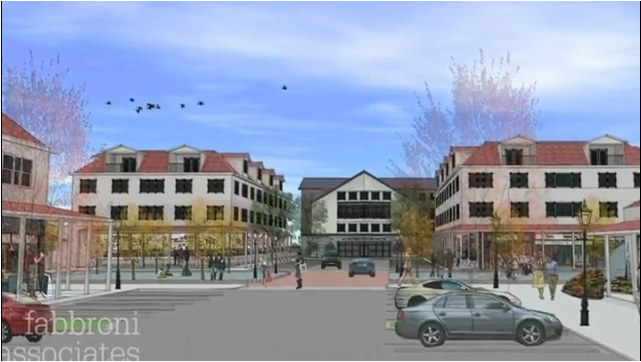
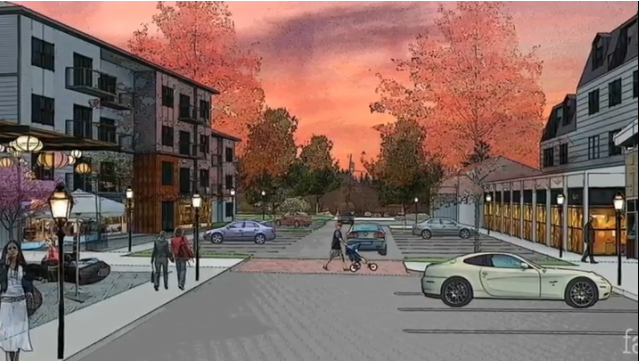
Incorporated into the proposal – more lower-level retail and office space, and about 100 units of housing, up to four floors in height. this would require a zoning variance, as the maximum height for Cayuga Heights is about 30 feet. The design thrown out there is from (Larry) Fabbroni Associates, who tend to be called on much more to discuss the civil engineering aspects of development projects rather than actual designs. I prefer to think of the above designs as more of a scheme than anything concrete.

chproposal3

Oh look, they even threw the vaguely hipster-like musician in there! How quaint!

chproposal2

Mecenas notes in the IJ article that build-out for this project would likely take a few years, and that’s after the village approves the zoning changes. But, a pedestrian-friendly mid-rise core to Cayuga Heights would definitely make it feel more like its own community rather than a wealthy branch of the Ithaca tree.


The EcoVillage

9 05 2013

4-8-2013 350

Although I take a lot of jabs at “hippies”, the reason I never made it to Ecovillage before now had less to do with any personal stance and more to do with the fact it was just out of my way. Rachel Carson Way lies about a mile and a half westward of Inlet Island, nestled in the hills opposite from Cornell. This means that when I past through, it’s farthest out of my way, so time often being a priority, it always sat on the bucket list. Finally, I made the conscious effort to take a trip up on my last photo tour.

4-8-2013 353

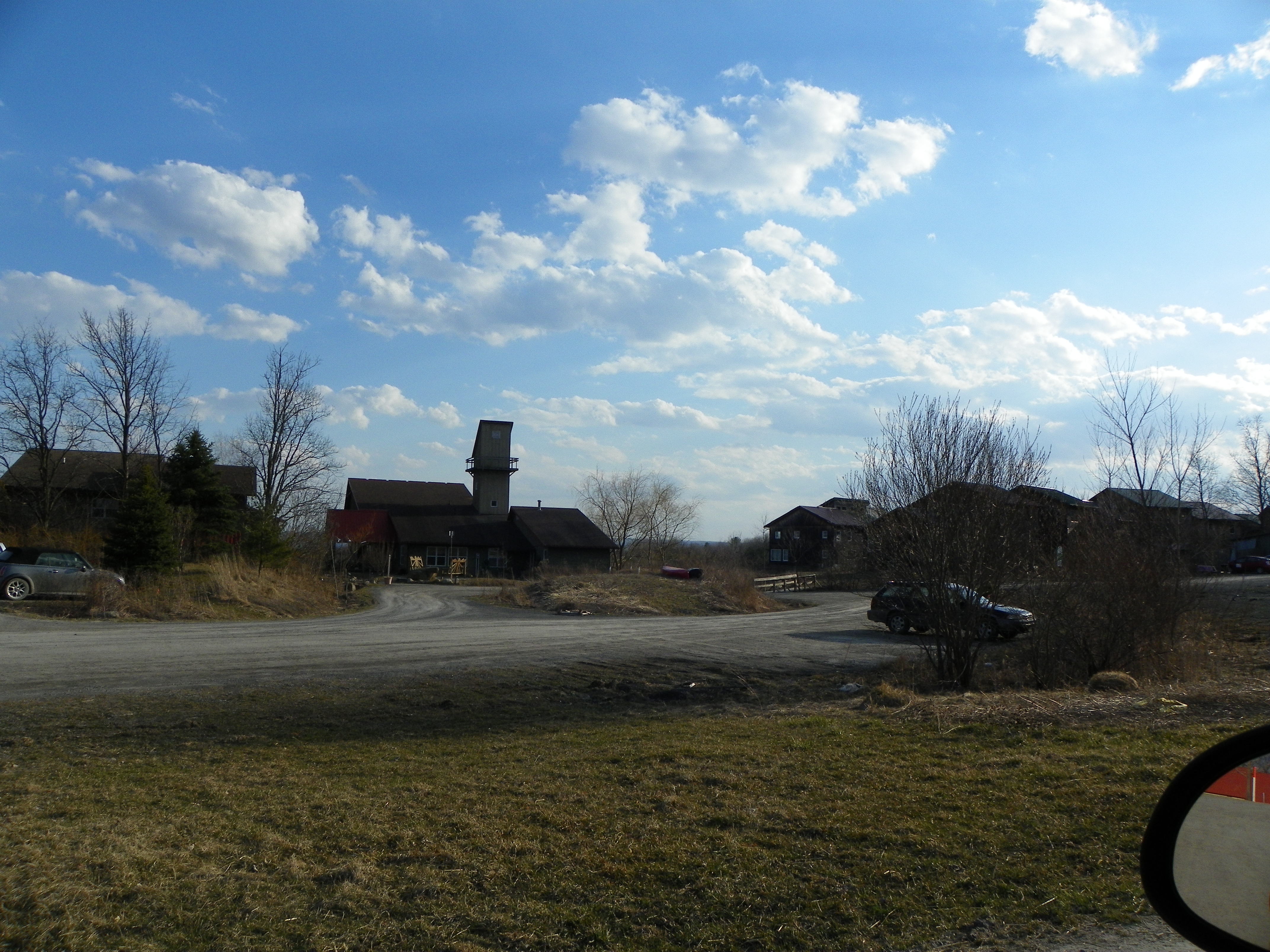
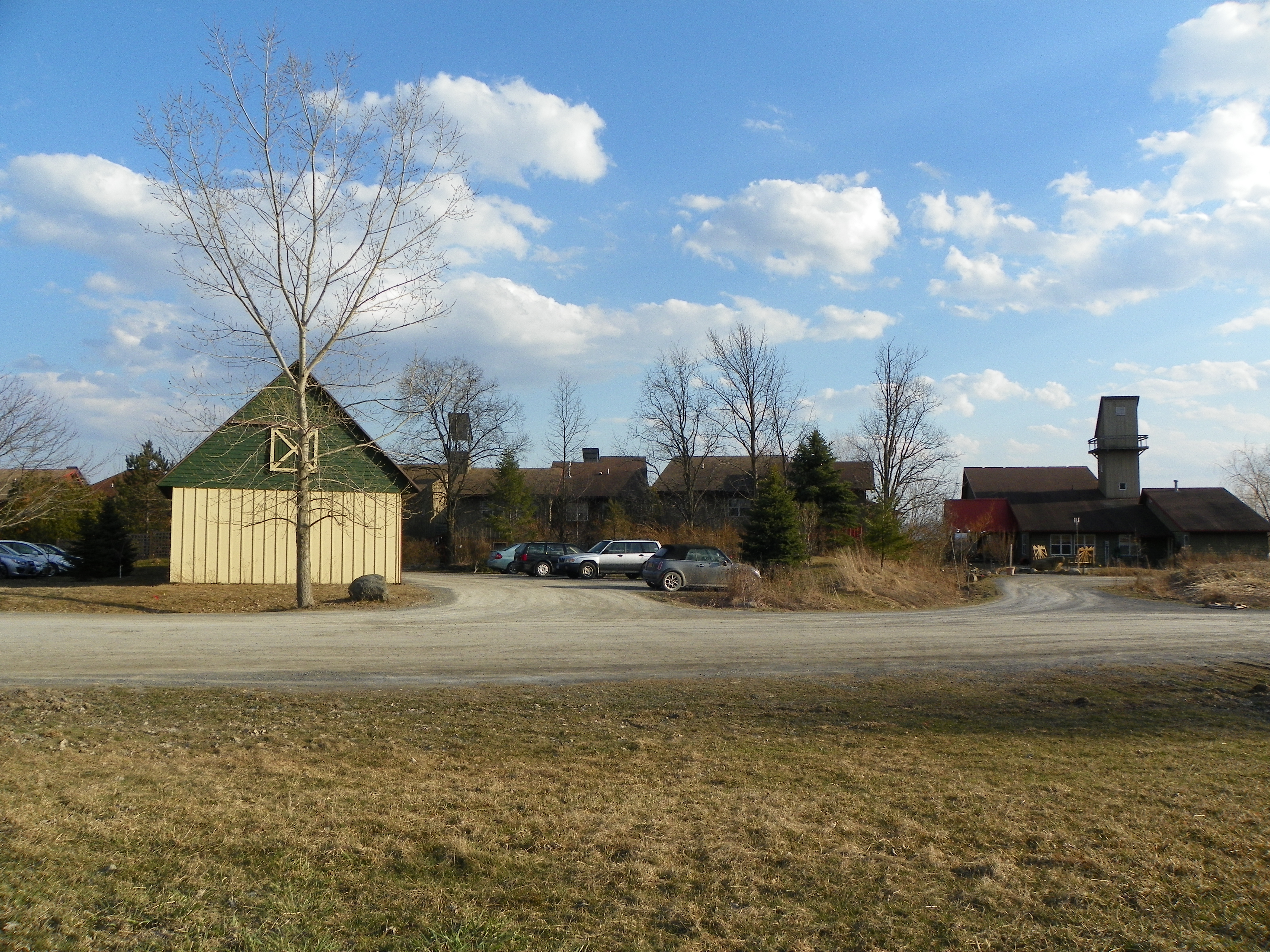
Ecovillage runs on the concept of co-housing, which in many ways runs close to most people’s idea of a commune (and mentally, I still find myself referring to it as a commune). There are optional shared dinners, a community-based work system, and of course, being in tune with the natural environment. Hence, solar arrays, housing designed to minimize energy use, foods grown on the property,  and so forth. Ecovillage isn’t unique, not even in Tompkins County (White Hawk in Danby is a smaller but similar concept). But it is probably one of the best known developments of its kind.

4-8-2013 354

Ecovillage began planning in 1992-1993, when stakeholders purchased a former farm with the intent of launching an eco-friendly community.  The first neighborhood, FROG (First Resident Group), began construction in 1995 and was completed two years later. The second community, SONG (Second Neighborhood Group), received site plan approval in 2001, and was built in three phases over five years. Each of these neighborhoods has 30 units with a community center. The community also has a few other bells and whistles, like a passive bus shelter, a root cellar, carports and a berry farm. The pre-Ecovillage farmhouse and barn are now a separate property holding an antique shop and the City Lights B&B.

4-8-2013 352

Ecovillage is well underway with its third neighborhood, TREE. At 40 units, TREE is slightly larger than the first two neighborhoods. Construction is definitely underway, and the majority of the community should be complete before the end of the year. Also worth a quick note, a 900 sq ft “Gourd Workshop” was under construction when I passed through. More additions, like an education center and a roadside farm stand, are in the works.

4-8-2013 351

If you don’t want to be a creeper like me, Ecovillage opens itself up for a free public tour at 3 PM on the first Saturday of each month. That way, you can avoid being like me, trying to take photos when kids keep wandering in front of them, and having that awkward realization that you look like a child predator.


The Storybook Cottages

26 04 2013

4-8-2013 155

Several months ago, my best friend landed his dream job in Ithaca. Within the day, he was looking for places to live. I being his roommate, and trying to be as discreet as possible given my borderline-unhealthy interest in Ithaca real estate, was more than happy to listen in and offer advice.

4-8-2013 162

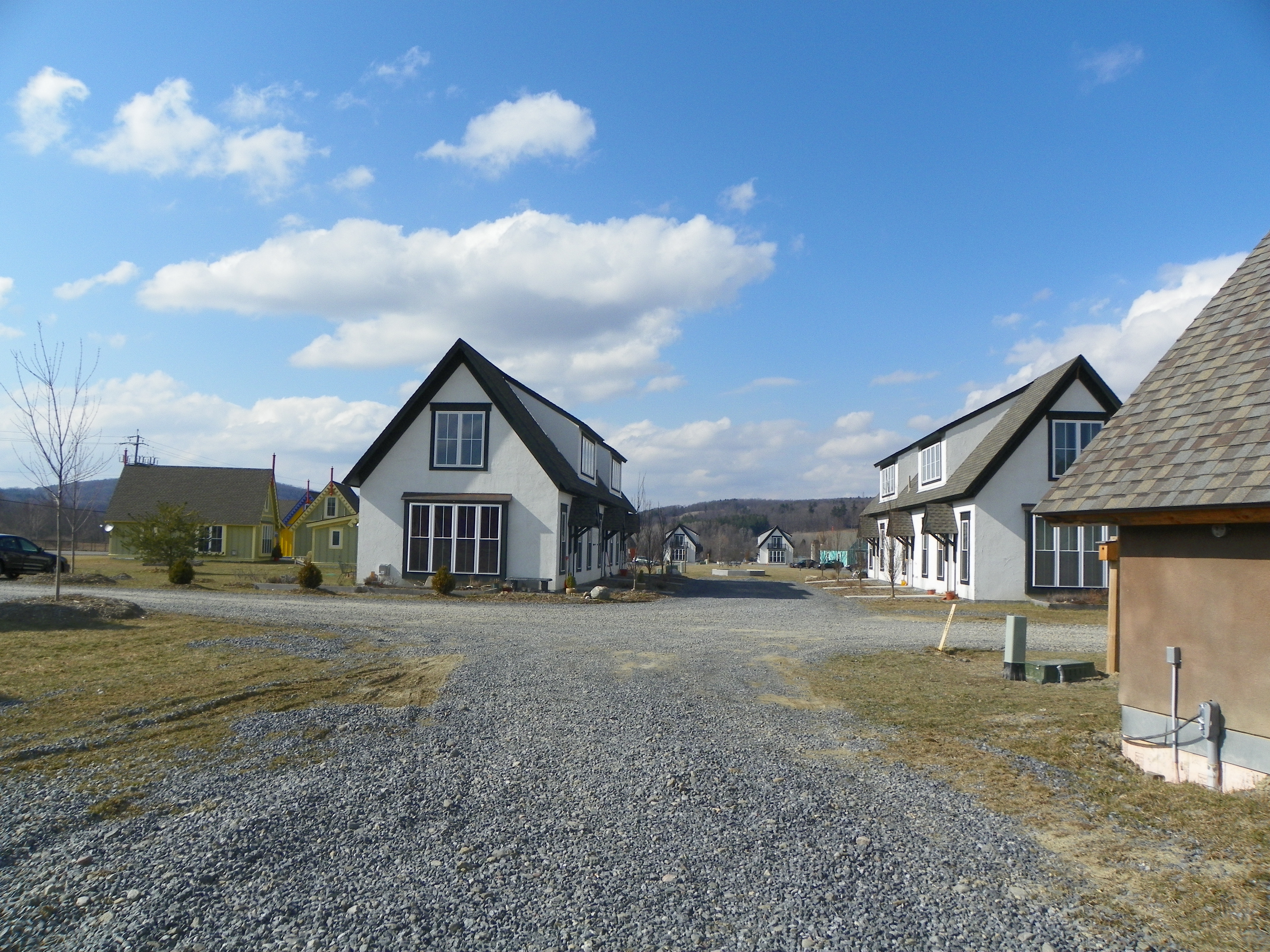
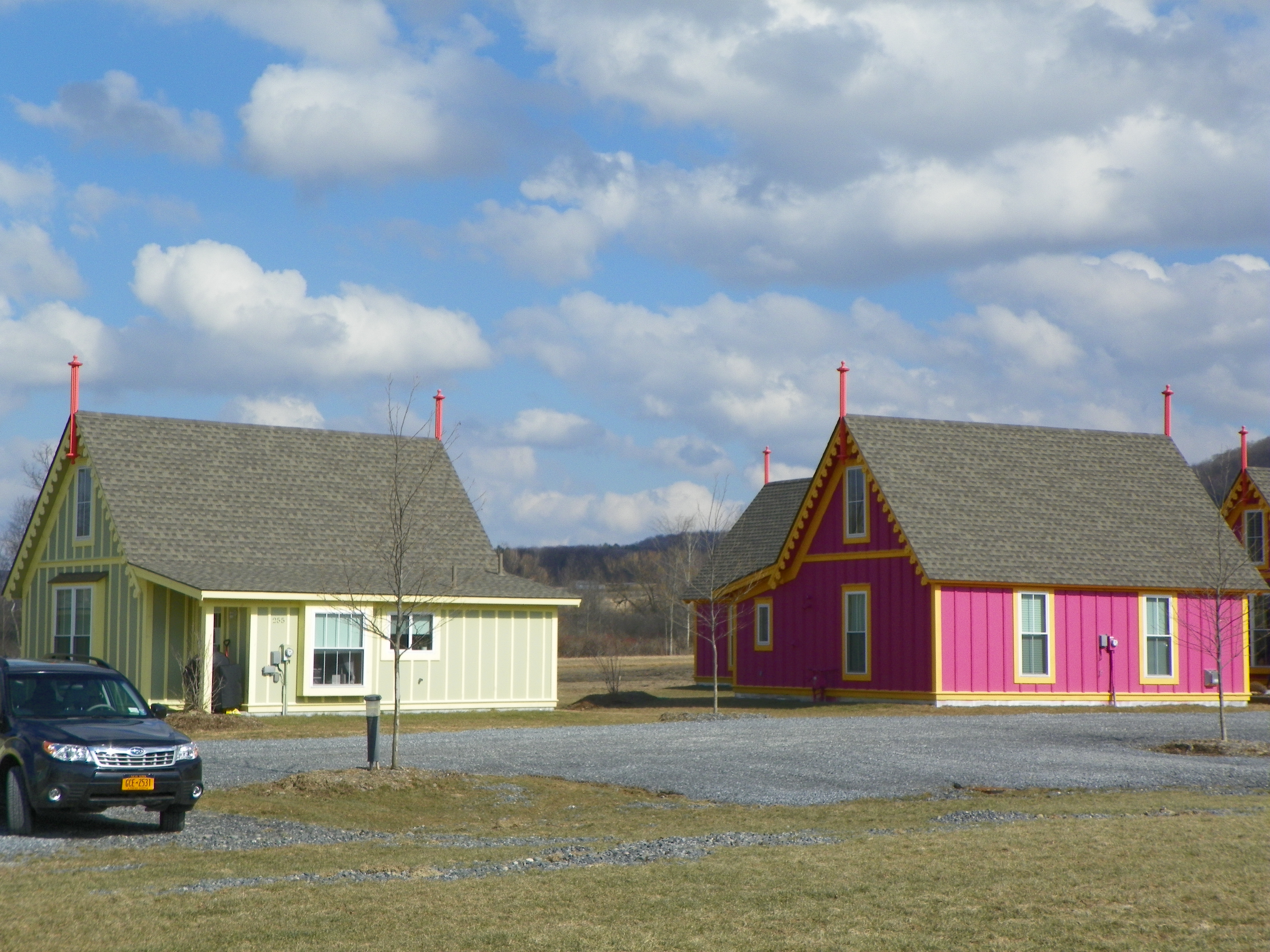
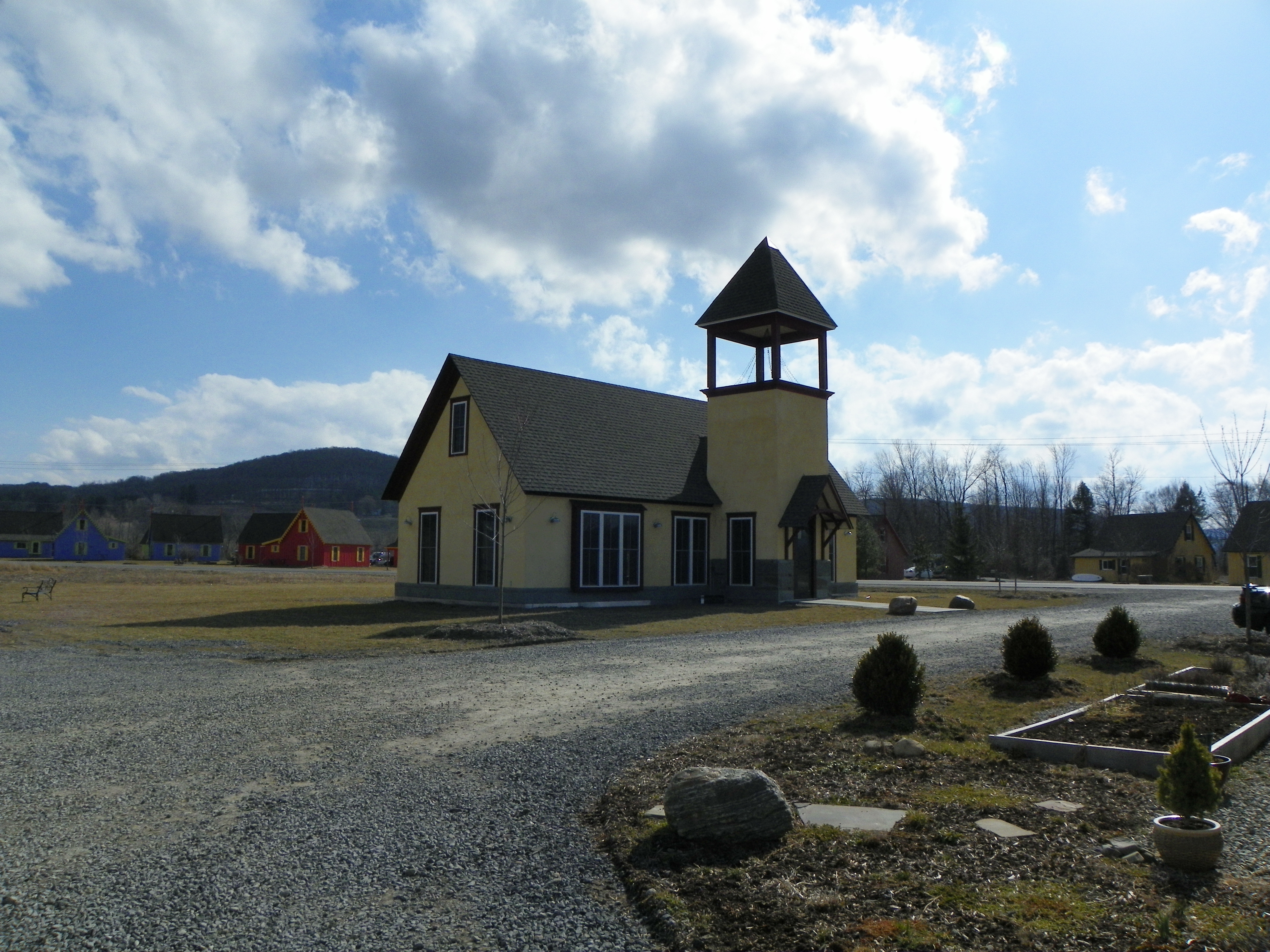
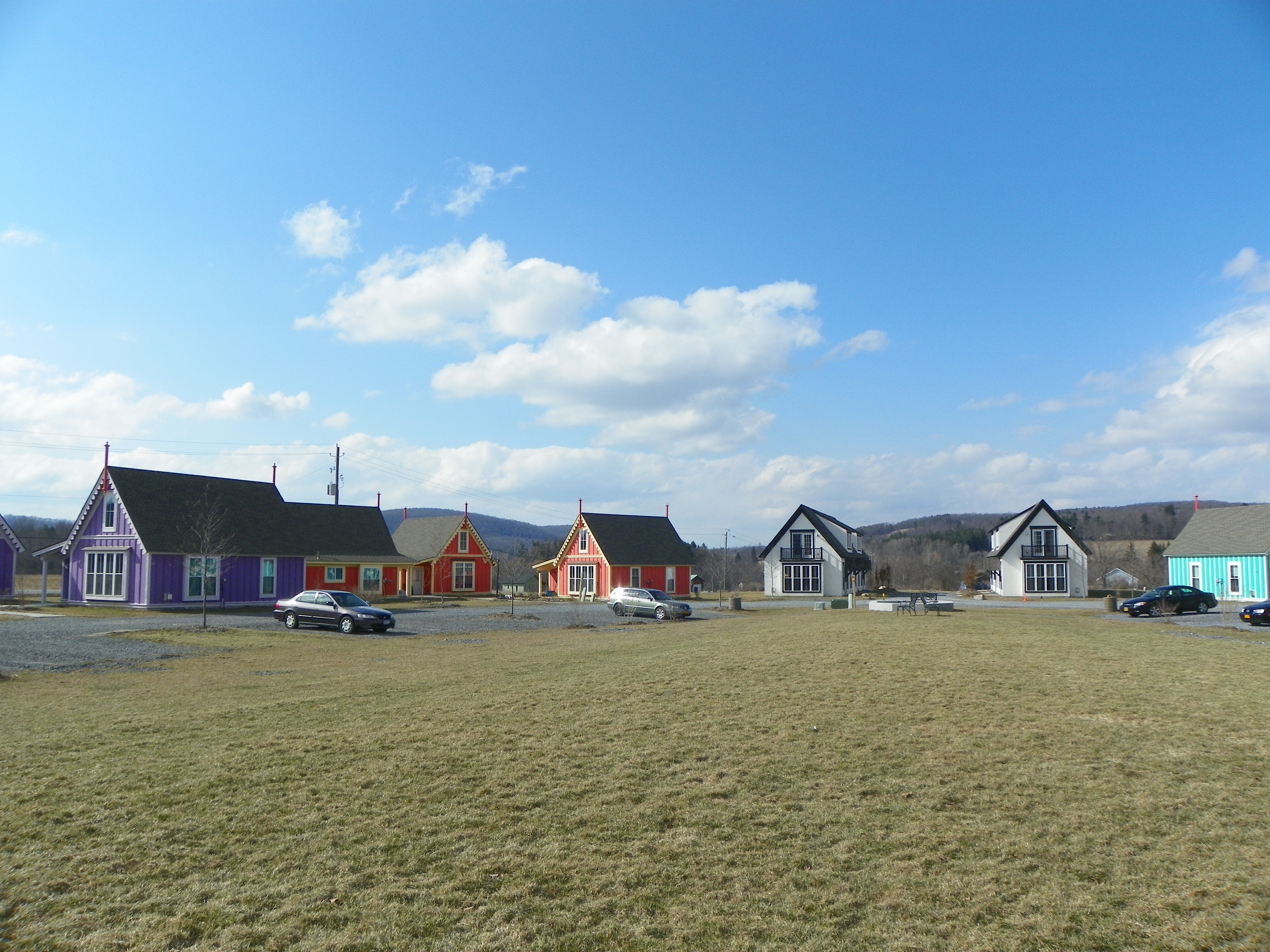
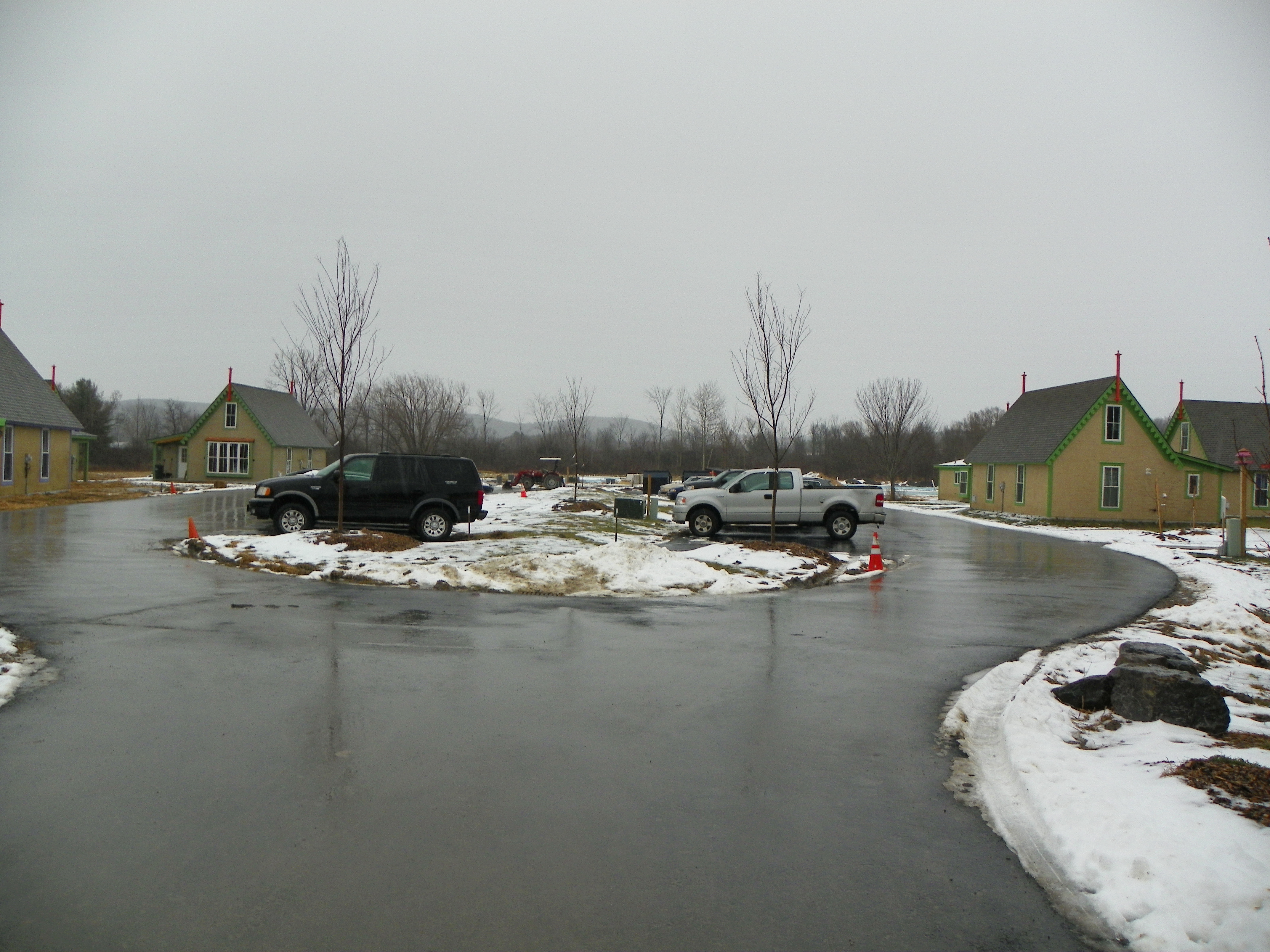
One of the places he checked out was The Boiceville Cottages (I’ve always assumed this is pronounced like “Boy-ss”, like the Boyce Thompson Institute on Cornell’s campus).  As multi-unit housing goes, they’re quite unusual. In general, housing is set up in single-unit cottages, clustered in groups of three. More recently, a few three-unit buildings, and a church-like meeting house have been erected. Perhaps the most obvious details are the colors. It’s like someone looked at a bright cheery children’s storybook and went to town.  Apparently, such tales were at least part of the inpsiration for their appearance, with the intricate eaves and vivid paint-jobs.

4-8-2013 157

The project is a little out of the way, about a mile south of the Caroline town hall and Route 79. So it took me a little while to swing out for a visit, and see them firsthand (my friend settled in Eastern Heights. Boo). This development further caught my attention because of the expansion underway. The Boiceville Cottages development was first initiated in 1996, and from what I can tell, it took about ten years to build the first 24 units.  Around 2007, a second phase was initiated, with 36 units. As of last year, this phase is complete (so, they definitely picked up the pace on construction…). Recently, they were granted approval for the construction of 75 more units, doubling the size of the complex.

4-8-2013 163

When I finally made it out that way a few weeks ago, I was going around taking photos, when an older gentleman in a pickup stopped and asked if I could be helped. Generally, I’m extremely cautious when I go on photo tours – on previous occasions, both Ithaca and elsewhere, I’ve been threatened with the law and with violence, so I regard every interaction where I have a camera in my hands with extreme prudence.

4-8-2013 159

The gentleman turned out to be the builder/developer, Bruno Schickel. About a month earlier, I had asked if there were any renderings or site plans online (the answer at the time was “only what’s on the website”; the link above is a site plan from a town review of the project). So I wasn’t a complete stranger. We chatted politely for a couple minutes, I told him how I thought he had a unique and creative development. He invited me to check out a display unit (which due to a long to-do list, I politely declined). All in all, I’m glad I did not get chased off the property, and my thanks to Mr. Schickel for  tolerating this random guy taking photos of his property.

4-8-2013 158


Motivation for New Construction: 2012 Census Estimates

15 03 2013

11-24-2012 194

With over 2,500 housing units planned within the  county, and only so many increasingly spendthrift college students to exploit, local developers kinda need further justification to launch into such a building boom. The census is certainly supportive of their plans.

Following the new April 2012 census estimates (file here), from April 2010 to July 2012, Tompkins County has likely added another 990 residents, bringing the local population to 102,554. Interestingly enough, Tompkins and the bordering counties serve as a little growth pocket in otherwise declining upstate New York – Broome County, home to Binghamton, lost the most residents of any county, with about 2,540 shipping out, a drop of 1.3%. The largest increases upstate came in from Jefferson County (home to the growing Fort Drum), and Saratoga County (home to the very large and very new computer chip plant), with Tompkins in third with 1.0% growth. Given the 5.2% growth of the last decade, Tompkins is on par with its growth rate in the 2000s.

I should issue the token disclaimer that there are estimates, and the actual numbers can be a surprise when they come out in 2020. For instance, it was thought in the 2000s that Onondaga County/Syracuse lost 4,000 people over the decade – they gained 9,000. And I’m not sure how much I believe the rapidly suburbanizing Dutchess County, which hasn’t lost population since the 1890s, is believed to have lost people over the two year span. For Tompkins County in 2010, the original estimates were too high by a little over 200 (an error of about 4%).  Also, perhaps this comes as no surprise, the New York portion of the New York metro added about 160,000 people, cementing their belief that they are the center of the world and the rest of us just live in it.

Two of the numbers I like to throw around for a housing unit is that Tompkins averages 2.4 occupants for non-college housing, 2.0 for college housing. If we use that 990 figure, it can be broken down to 413 traditional units or 495 college student units – and that’s additional units required in two years, in a county already experiencing a housing shortage.  I’d say builders have all the justification they need for development in the near-term.