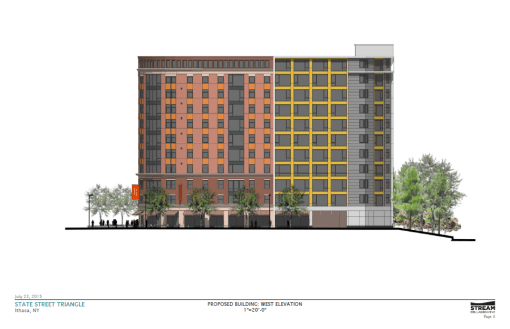
1. I asked someone familiar with the State Street Triangle how the presentations went this week. “About as well as could be expected” was the diplomatic response received in turn.
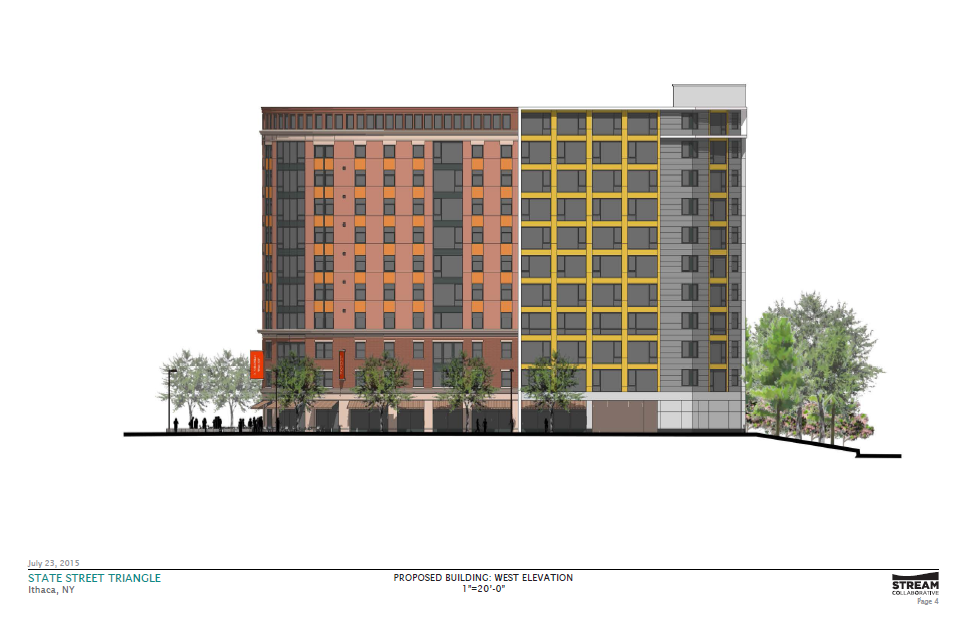
The Times, Journal and Voice all devoted coverage to the controversial project this week since its CIITAP application was up for review, as well as revised plans being brought forth to the planning board. The project draws detractors from different angles – some because of size, some because it’s student housing, some because of the tax abatement.
The tax abatement is what confuses me somewhat, for reasons related to the theory I wrote up a few weeks ago, which no longer holds water. My own personal thought was that a sort of economy of scale would kick in with greater site efficiency, negating the need for a tax abatement. That isn’t to say that they still couldn’t try for one, because it meets all the CIITAP requirements, just that they didn’t need it (it would have been proverbial “icing on the cake” if granted). But now they’re saying it’s the only way to move forward. I don’t know the financials and what their necessary ROI is (and probably never will), but I’d happily listen to an explanation.
But the point I made in the piece still holds true – if Jason Fane’s project a couple blocks away was rejected for not having enough of a community benefit, market-rate student housing, even that which generates an extra $7.36 million in taxes over a decade, is going to be a big stretch, unless they plan on using the sheer size of it as a selling factor. The city planning board doesn’t have to worry about the controversy, because the project conforms wholly to a central business district zone. It’s going to be the tax abatement issue that makes or breaks this proposal.
2. As part of its 10th anniversary feature, the Lansing Star did a nice retrospective of what’s changed in the past ten years in Lansing. When it comes to development, it isn’t especially kind:
“Lansing hasn’t changed much in ten years. While grand plans for the future of the Town have been explored, not many have been realized.”
The article then goes on to detail how after the sewer initiative was defeated by public vote, a few developers banded together to try and fulfill the town center that Lansing was pushing for. Quoting the article, “the town government couldn’t get its act together to make that happen, even though it wouldn’t be footing the bill for the infrastructure (including sewer)”. About the only development initiative that has taken off is the Warren Road corridor, which was spurred mostly by threats of a major employer (Transonic) leaving the town (and Transonic paid for the sewer study). Meanwhile, the Star characterizes the village government as simply existing for “maintenance” purposes.
The paper notes some successes with parks and wildlife initiatives, but the highlight of the piece seems to be that Lansing is routinely failing to achieve its municipal planning and development goals.
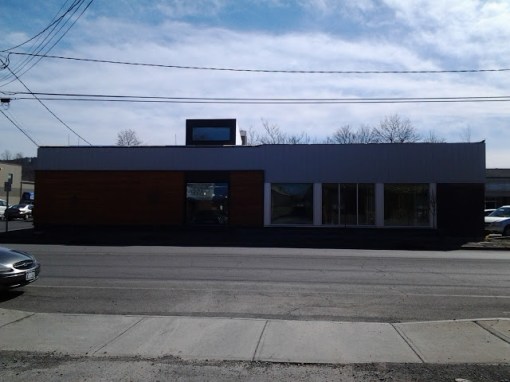
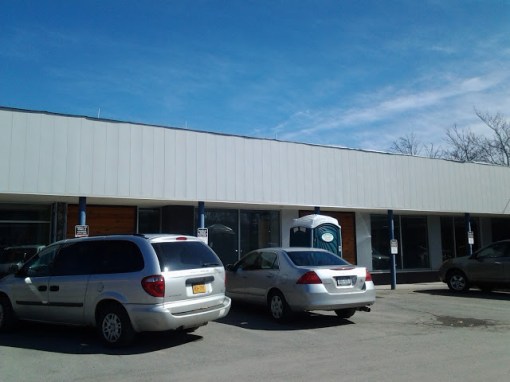
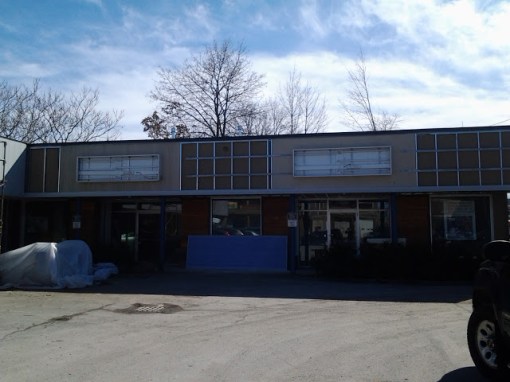
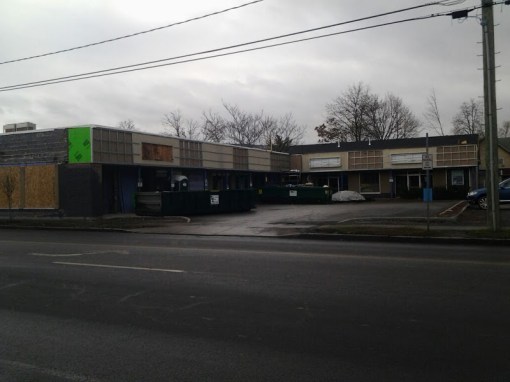
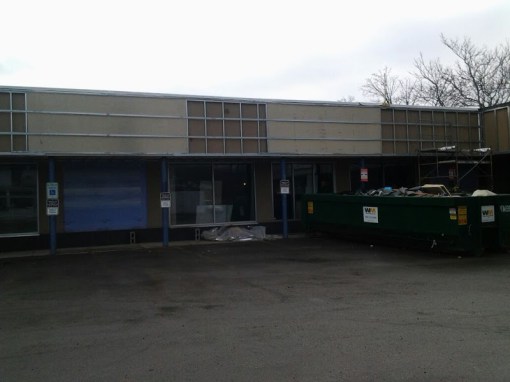
3. Back in Ithaca city, plans are underway for the major renovation of a shopping plaza into professional office space for a local architecture firm. According to documents filed with the county, an LLC associated with HOLT Architects is spending $897,500 on the renovation, and another $415,000 for acquisition costs. The renovations will start in late August should be completed by March 2016. Tompkins Trust Company is providing the financing, and local company McPherson Builders is in charge of general construction.
From the press release published late Friday, HOLT chose the West End location for its walk-ability and centralized location. The building will be renovated into a net-zero energy structure for the 30-person architecture firm. No renders yet, but they’ll be included in a future news roundup when they become available.

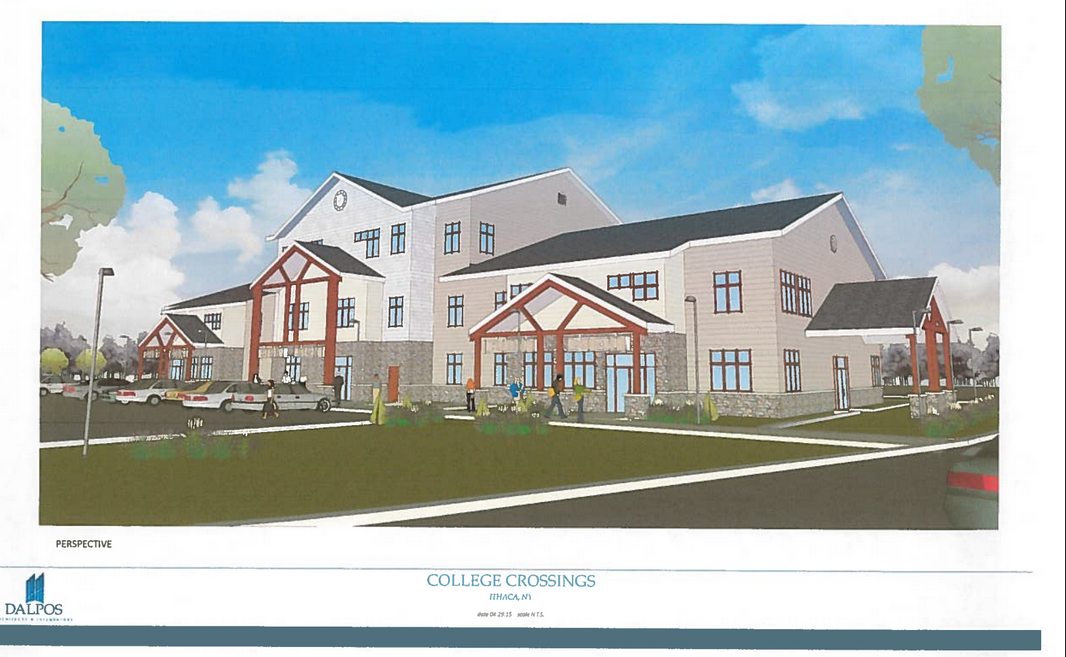
4. As written in the Voice, College Crossings at the corner of East King Road and Rt. 96B in Ithaca town is back to the board for revision number three. This one increases the project by a floor, 13,000 square feet and six more apartments. It’s been no big secret that developer Evan Monkemeyer’s had difficulties getting the project off the ground (he resorted to Craigslist for marketing the retail spaces), and given a total of 18,000 SF spread among 8 apartments (doing the standard 15% deduction for circulation/utilities, one gets over 1,900 square feet per apartment) these units are almost certainly geared towards IC students. A solid market since they’re next door, though not likely to elicit warm fuzzies from the neighbors (although based off the response on the Voice’s facebook, most people just don’t care; if only 210 Hancock had it this easy). Previous plans can be found here.
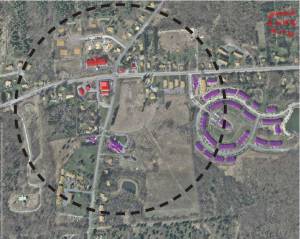
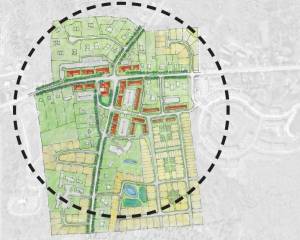
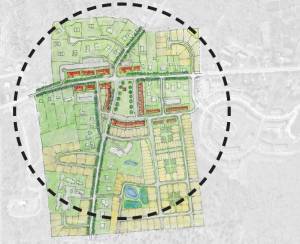
Personal opinion, I’m a little disappointed in the revision. The mixed-use aspect is fine, but I was hoping the developer would tap into some of the ideas presented for the land by Form Ithaca instead of plopping a building in the middle of a 120-space parking lot. Monkemeyer owns a lot of acreage in adjacent land parcels, so this doesn’t bode well for a “walkable center” in Ithaca town.

5. Ithaca Neighborhood Housing Services (INHS) is armed with more 210 Hancock studies and analysis as it prepares to go in front of the city Board of Zoning Appeals next Tuesday. With the commercial loading space question settled, it leaves the height variance of 6.5 feet (40 feet zoned, 46.5 feet requested), and the parking variance of 20 spaces (84 required, 64 given). Original/full application here, new addendum analyses here.
The board requested additional information about pile driving and the parking situation. In response, INHS has conducted further analysis and shown that, 40′ or 46.5′, piles would be required either way. INHS has offered in its application to use a “vibratory oscillating” method of pile driving, where piles are vibrated into the ground rather than driven. This reduces noise (no hammer-like banging) and produces less overall vibration. Further parking studies found that 210 Hancock offers a greater percentage of parking than similar buildings like McGraw House, the Cayuga Apartments and Lakeview on Third Street, INHS’s parking study of its tenants was reiterated, and an analysis of its commercial tenants was given – the occupants will have 16 designated spaces from 7 AM to 5 PM, when the daycare and non-profit offices are in operation. After hours, they’ll serve as potential overflow parking.
It’s frustrating to think that a suburban market-rate project surrounded by a parking lot has no opposition, but a transparent project with affordable housing and a lot of community benefits gets so much grief.
6. For home-builders or those looking to build a palatial estate, here’s your latest opportunity – 5.45 acres at the end of Campbell Avenue in Ithaca city are up for sale. The area’s zoned for single-family homes, and the city is encouraging owner-occupied houses in that area. Previously, the property was seen as a potential 10-lot development in the late 1980s/early 1990s, but the plan was never carried out. The biggest barrier is probably that it’s West Hill, where neighbors have taken to going after their neighbors to keep them from subdividing and building homes.
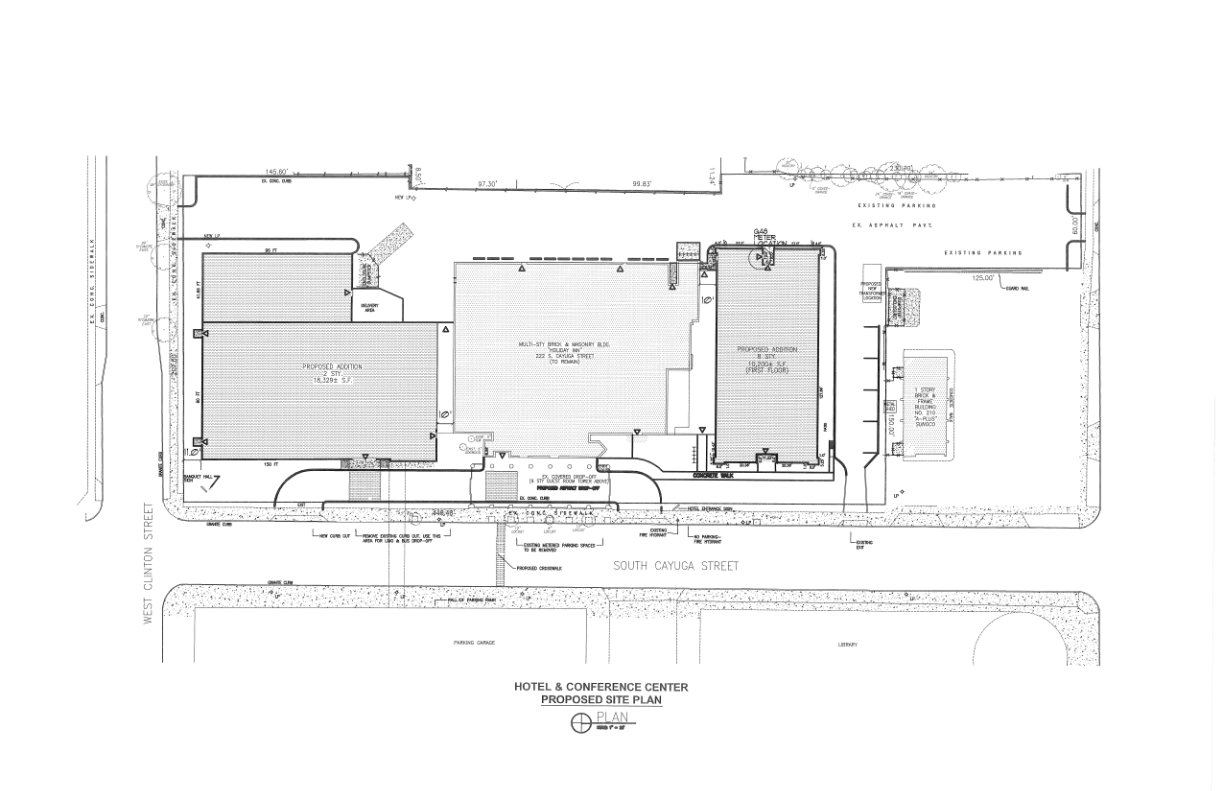
7. Initially, this was going to be a Voice article, but when the revised plans were presented, no renders were included. The Voice’s more general audience wouldn’t be as interested in this piece. But if you’ve read this far, and you read this blog frequently enough, then you won’t mind clickable, expandable site plans (pdf here).
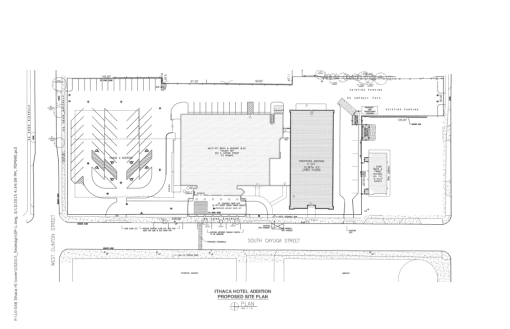

The Hotel Ithaca is once again seeking to expand its offerings.
But this time around, it’s proposing to do in phases. Sketch plans presented at the Planning Board last Tuesday evening call for demolition of the two-story wings as before, but then the construction will be broken up into two phases.
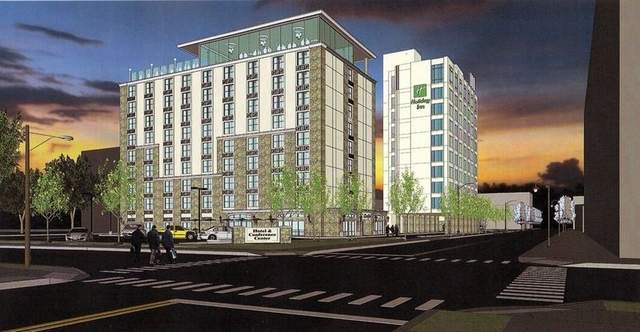
The first consists of a five-story, 51,835 SF wing build on the northern side of the property, next to the gas station on the corner; the second phase, at a later, undetermined date, calls for three more floors on the hotel wing (bringing the new wing to eight stories and 81,600 SF), with a two-story, 18,300 SF conference center to be built on the corner of South Cayuga and West Clinton Streets.
The number of rooms in the addition has been unconfirmed, but given previous plans, it is likely to be little to no change from the current hotel, once the two-story wings are demolished. Until phase two is built, a parking lot would sit on the site of the future conference center.
The hotel is operated by Hart Hotels of Buffalo. Like several other Hart Hotels properties throughout the Northeast, the hotel has no chain affiliation, although the property was a Holiday Inn until the end of 2013. The 181-room hotel initially opened as a Ramada Inn in 1972, and the 10-story “Executive Tower” was completed in 1984.
Zoning at the site is CBD-100 (Central Business District), meaning that a proposed structure can be up to 100 feet (two floors at the least) with minimal required setbacks and no required on-site parking.

Under plans previously presented three years ago, the Hotel Ithaca sought to demolish the two-story wings of the hotel, and in their place the hotel would would build a new 9-story, 115-room tower, a kitchen addition, and a 15,000 SF conference center. The demolition would have resulted in a loss of 100 rooms, so the net gain was a total of 15 hotel rooms.
The then-$18 million project had significant local support from business owners, because Ithaca lacks the ability to host mid-size conferences and conventions (midsize meaning about 500 attendees), which sends conventioneers elsewhere. Currently, the lack of meeting space limits conferences to about 250 guests. The addition of a convention facility is seen as a major benefit to downtown retail, as well as other hotels that would handle overflow guest traffic. Convention traffic typically happens during weekdays, when regular tourist traffic is lowest.
However, the project, which was initially slated to start in November 2012, has failed to obtain financing for construction. The project applied for and received a property tax abatement for the new construction, and the Ithaca Urban Renewal Agency (IURA) even offered the possibility of a $250,000 loan if it would create a financial package that would allow the convention center to be built. But until now, there had been no indication of any plans moving forward.









 Ithacating in Cornell Heights

