An Exercise in Mapping

24 04 2011

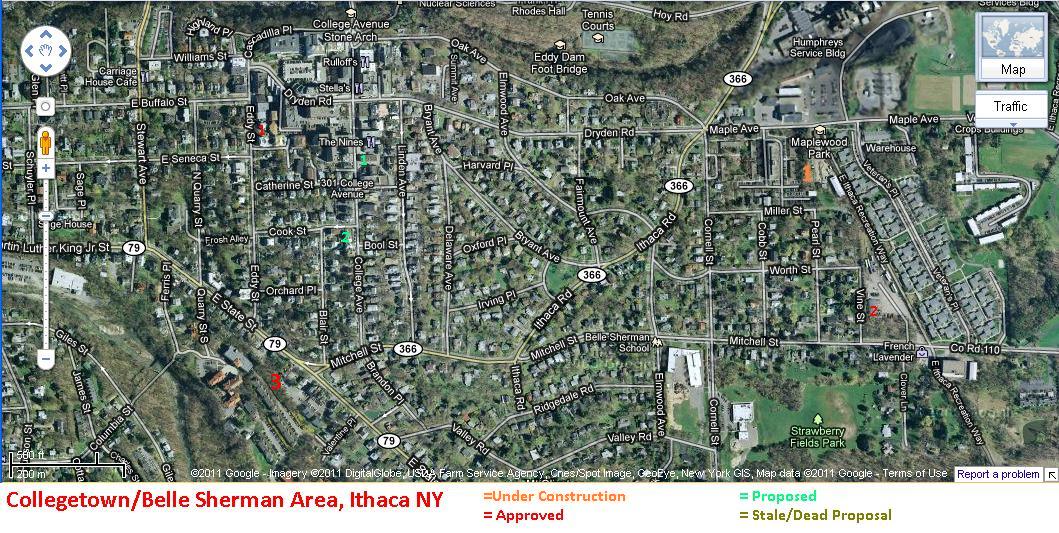
So, I figured that since I write about Cornell, IC and Ithaca-area construction projects as much as I do, it might be nice to include some form of a map. Depending on time and motivation, I might get around to putting ones together for South Hill and Downtown.

So, Cornell Campus, used here primarily as a test bed (click the image to expand its size).

Under Construction:

1 – Milstein Hall 2- Johnson Art Museum addition 3- Human Ecology Building 4- Stocking Hall Addition

Approved:

1- Wilson Lab / Synchotron Expansion (CU ERL Project)

Proposed:

1- Gates Hall

Stale Proposals (i.e. been around a while, little notable progress in the past several months-plus)

1- Goldwin Smith Hall Addition 2- Gannett Health Center Addition 3- Holley Center (Soil Lab) Expansion (most likely dead, given federal budget cuts).

Heading south into Collegetown –

Under Construction

1- Coal Yard Apartments Phase II – A 4-story, 25-unit building off of Maple Avenue.

Approved:

1 – 309 Eddy Street (5 stories, 41 units) 2- Vine Street Cottages (19 house, 10 townhomes) 3- Collegetown Terrace (several buildings, 2-6 stories, 589 units)

Proposed:

1- 307 College Avenue (5 stories, 60 units), Snaith House addition (12 bedrooms)

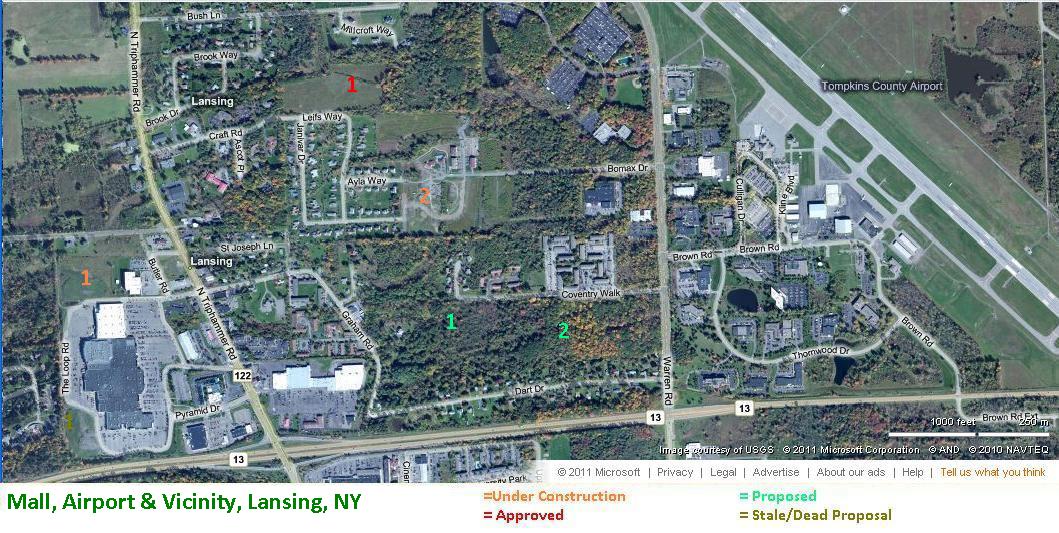
Mall, Airport and Vicinity –

Under Construction:

1- BJ’s wholesale Club (82,000 sq ft) and 12 senior living units 2- Heights of Lansing (~17/80 units complete).

Approved:

1- Millcroft Housing Development (~19 lots in phase II).

Proposed:

1- Lansing Reserve Project (65 units) 2-  NRP Group Project (80 units)

Stale Proposal

1- Behind the mall, a mix of additional shops and 40 apartments, in a lifestyle-center setup, were proposed about three years ago. The recession may have killed the project; at the very least, it’s been shelved.

***

This isn’t to say there aren’t plenty of other projects in the area, I just wanted to experiment with presenting local projects in a different, more visual format.


The (All Too Late) Ithaca Projects Update

24 11 2010

Since I have no life as a grad student, following progress in the Ithaca has been a little difficult. But, I figured it was time to do an updated brief list. Ithaca has made it through the recession largely unscathed (thankfully), thanks to the stable college-based economy, and various projects are in various planning and development stages throughout the area. For the purposes of this entry, I’m ignoring the projects going on at Cornell and IC.

First off, most of the larger projects are delayed. The Hotel Ithaca is waiting for a bank loan, but given the market that could take a good year or two before a loan is secured for the 10-story hotel.  In a similar boat, the 7-story Cayuga Green condos are delayed until sales pick up and financing is secured.  The six-story, 52-unit apartment building planned for the site of the Women’s Community Building is also delayed, having failed to get a grant from the state. It will be at least one year before financing is secured and construction can begin for that project.About the only going on in the heart of the city right now are the redevelopment of the Petrune Building and the starting phases of a renovation of the Ithaca Commons.

Land remediation and site prep is still underway for the Ithaca Gun condos, which are slowly (barely) progressing towards construction of what may now be either 33 units, or increased to 45 units of “market-rate” housing. On the 600 block of West Seneca Street, a 24-unit, 3-story apartment building has been approved and site prep is to begin in the near future.The Kitchen Theatre finished construction and moved into their new digs on West State Street.

Over in Collegetown, works continues on the 589-unit Collegetown Terrace proposal, which is still making its rounds after agreeing to preserve the Williams House on State Street in exchange for getting permission to demolish the old nurse’s dormitory (Delano House). Even if the project starts this summer, full build-out will take 22 months, so expect no earlier than a mid-2013 completion.  Over on Eddy Street, plans have been approved for a24-unit, 41-bedroom 5-story apartment building next to the Souvlaki House, and construction will begin next summer. A 5-story building on the 300 block of College Avenue remains in the proposal stages. Closer to East Hill, the 4-story Coal Yard Apartments expansion is in site prep, and the now-approved Vine Street Cottages project removed three homes from its plan, leaving 19 houses and 10 townhouse units for the parcel near Mitchell Street.

Down in big-box land, Walmart has finished their expansion into a Supercenter, and Tim Horton’s is seeking approval for a store on what is now a parking lot near Buttermilk Falls.The parcel where Olive Garden was proposed is once again up for grabs. Local rumor mill had it that the land was still contaminated (it was once the site of an auto repair shop, and gas and oil and other hazardous compounds might’ve seeped into the soil deeper than first thought).

Out in the West Hill area and the town, Ecovillage is in the home stretch for approval for their third 30-unit village (TREE), and 106 townhome units (Holochuck Homes site) are approved for Route 96 near the medical center. A couple of suburban subdivisions (the Goldenrod 30-unit division, and a 22-unit INHS project called Holly Creek) are planned/approved. 22 units of senior housing are to be built near Ithaca College, and it was confirmed that the 82-unit, rather terrifying and Soviet-looking Maple Hill Apartments on Maple Avenue will be demolished when the property is returned to Cornell in 2013. Cornell has long-term goals to redevelop the site into mixed use, according to its master plan.

Over in suburban Lansing, there’s some small housing developments and a new locally-owned supermarket planned, but the big thing out there is the proposal for an 82,000 sq ft BJ’s Wholesale Club next to the mall, with 12 units of senior housing and a bird sanctuary on adjacent property (basically because the project is seeking tax-exempt status and need to offer a community benefit to get the break). The 69-unit Woodland Park project doesn’t look like it will be approved anytime in the near future.

Hopefully I’ll have more and more substantial news to write about in the tidbits entries in the upcoming months. I need a distraction from my life. Especially when I grade exams and a student thinks it’s cute to bubble “C” 40 times (he received a 15%).


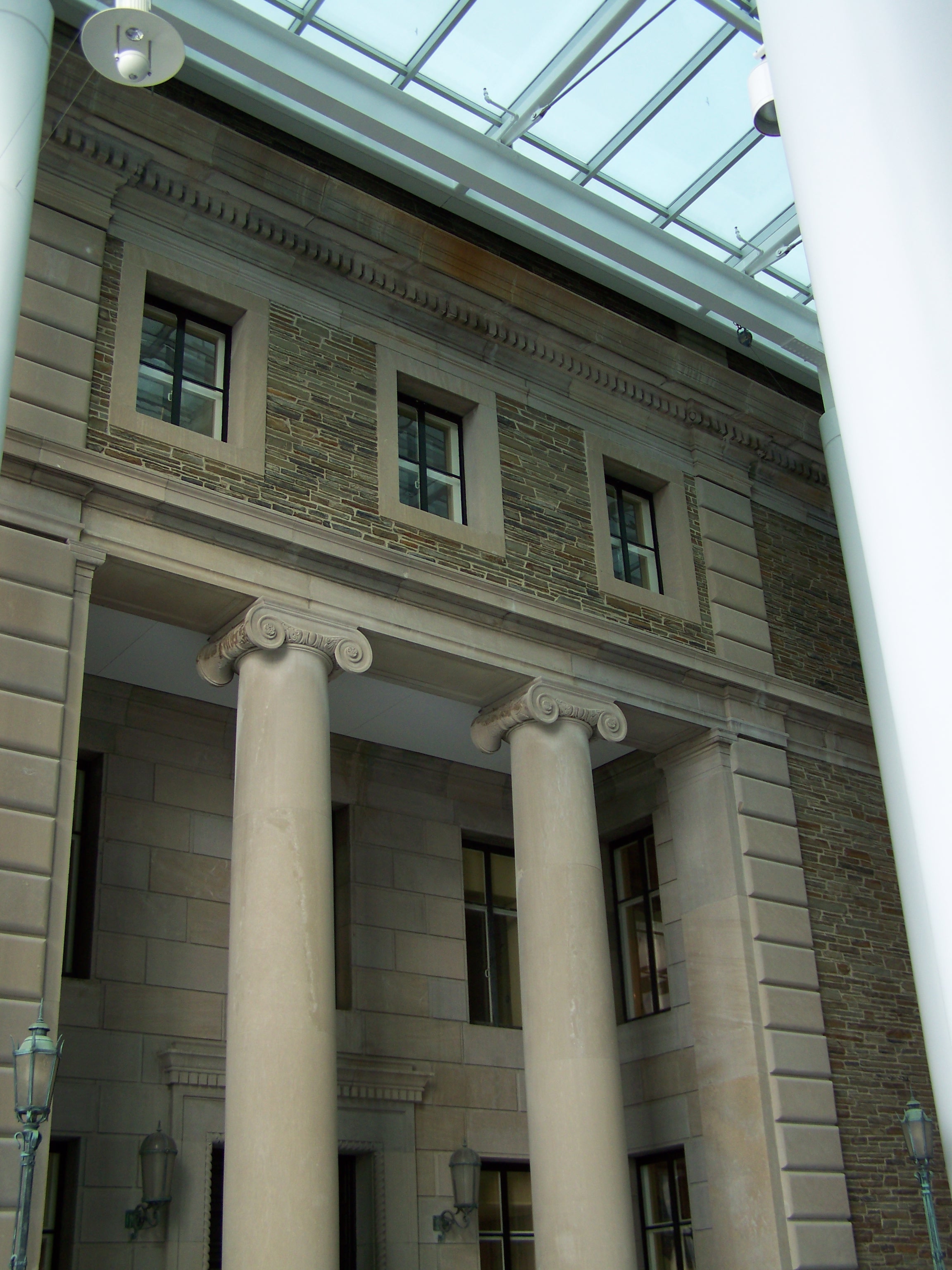
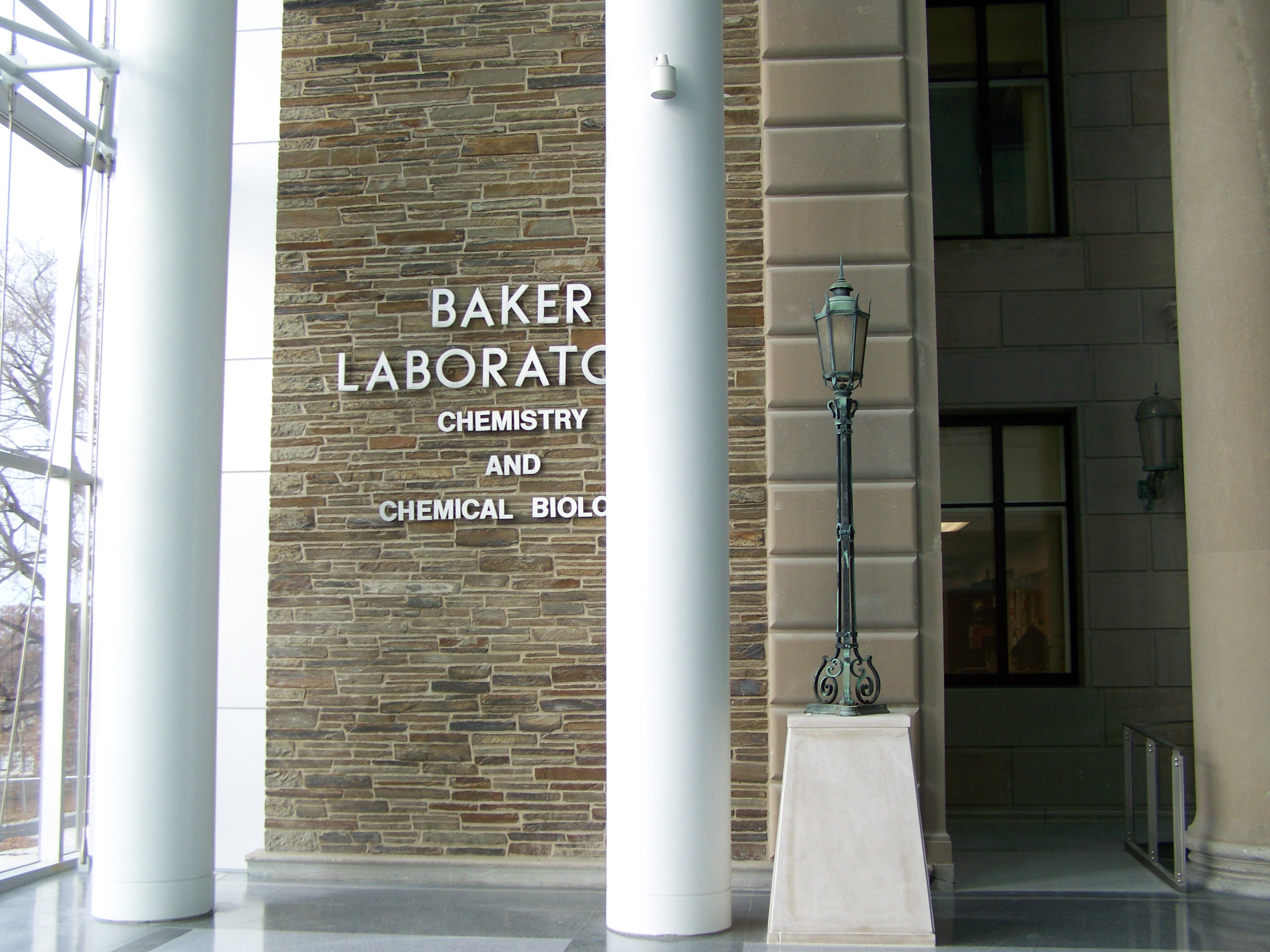
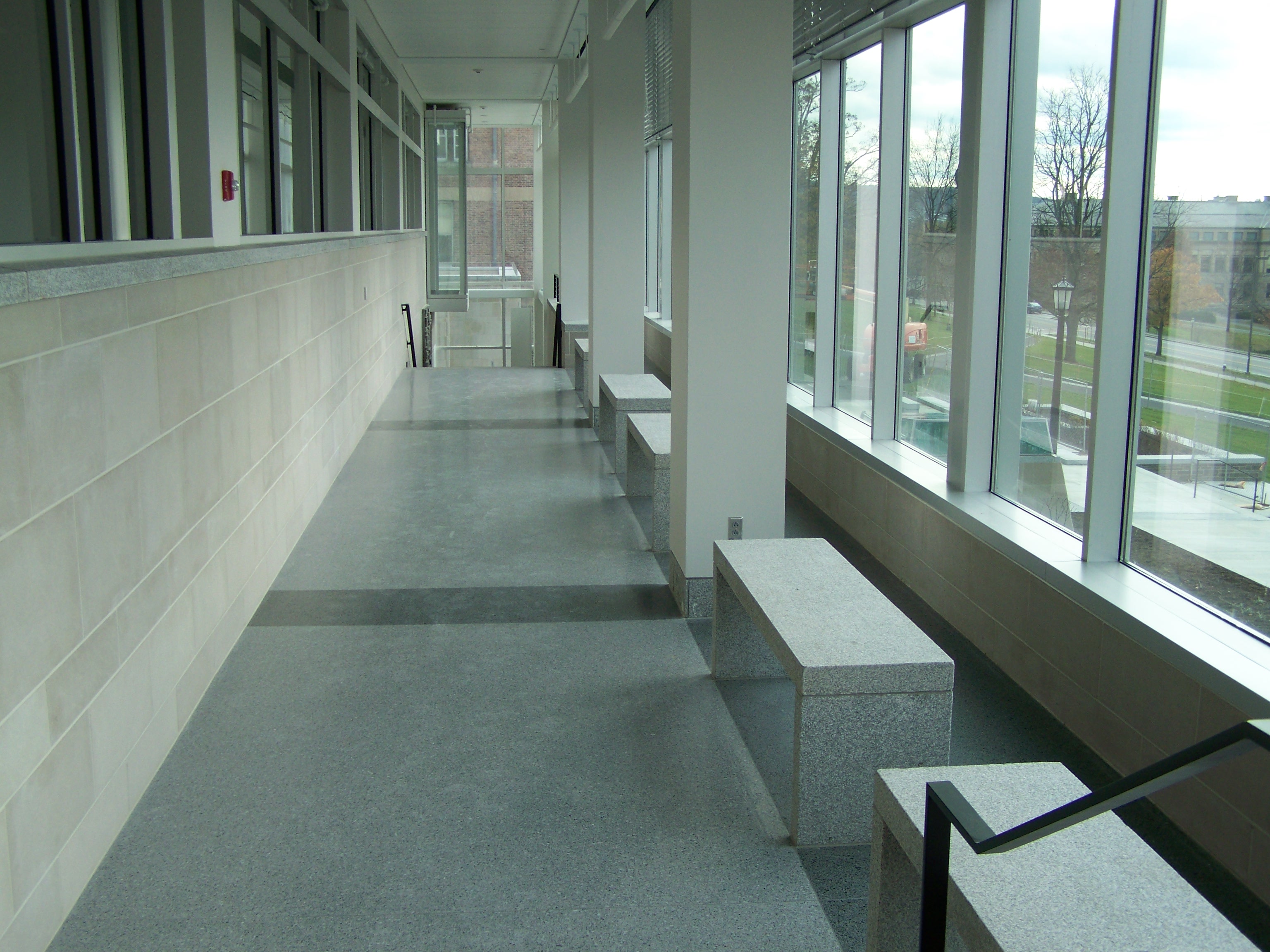
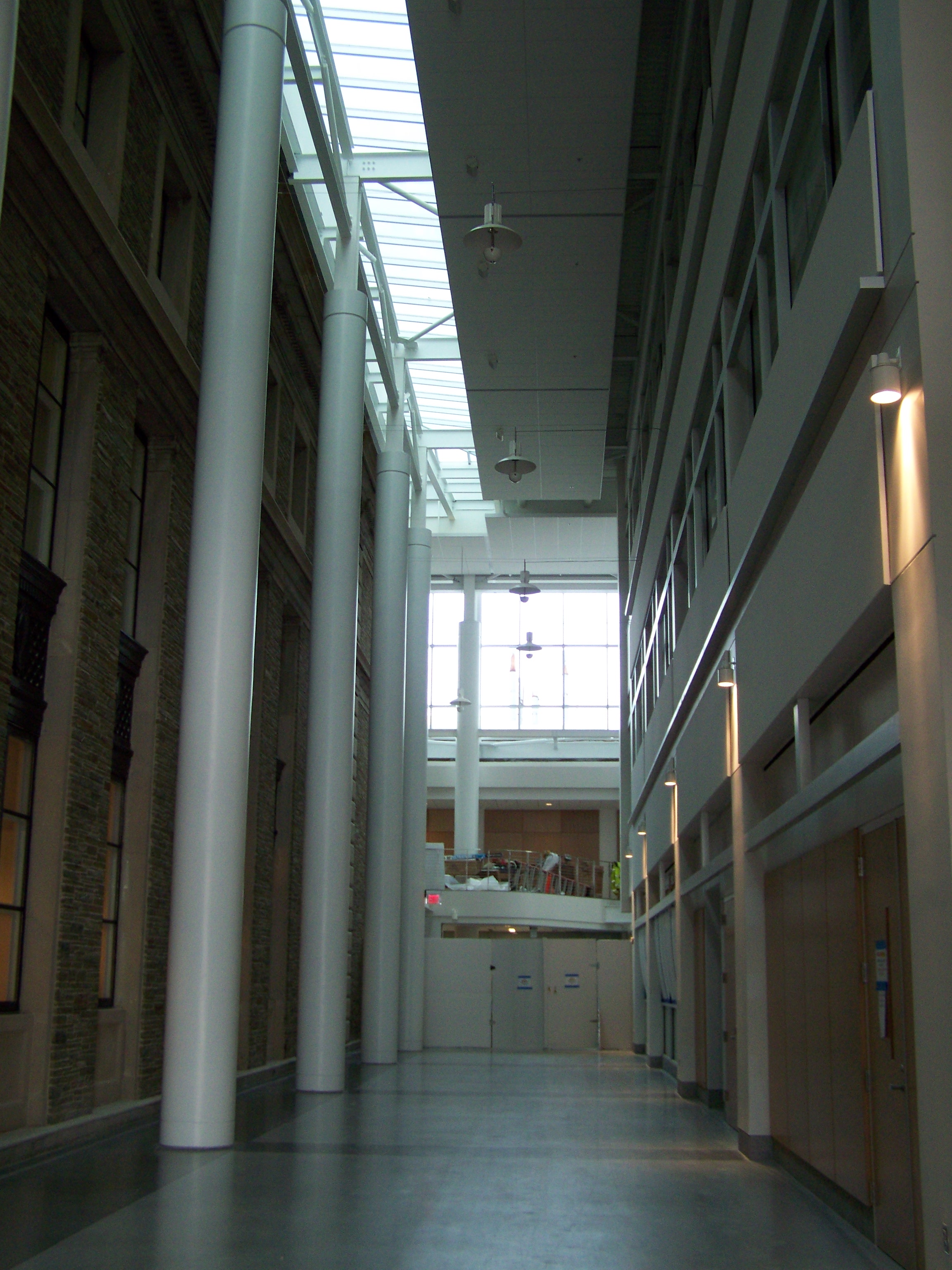
A Look Inside the Physical Sciences Building

11 11 2010

I’ll write more substantial posts in the near future. In the meanwhile, here’s some photos I took recently on a trip back to Cornell’s campus (the joy of living only a few hours away is that weekend trips are feasible – for the record, if you asked me last year where I was going, it was to a school out in the Mountain West…but that was before their funding was cut. The next best solution just happened to be in the Northeast).

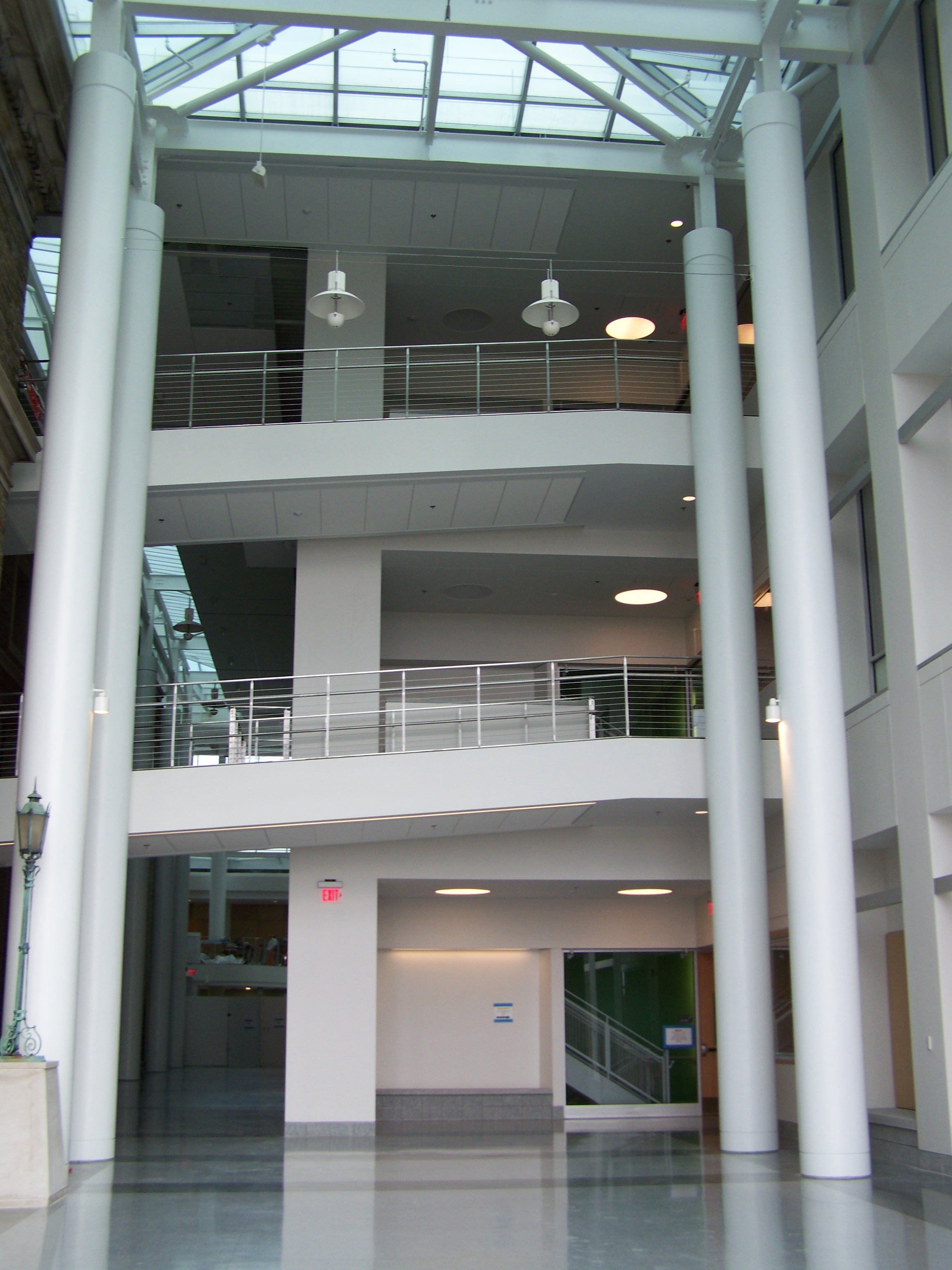
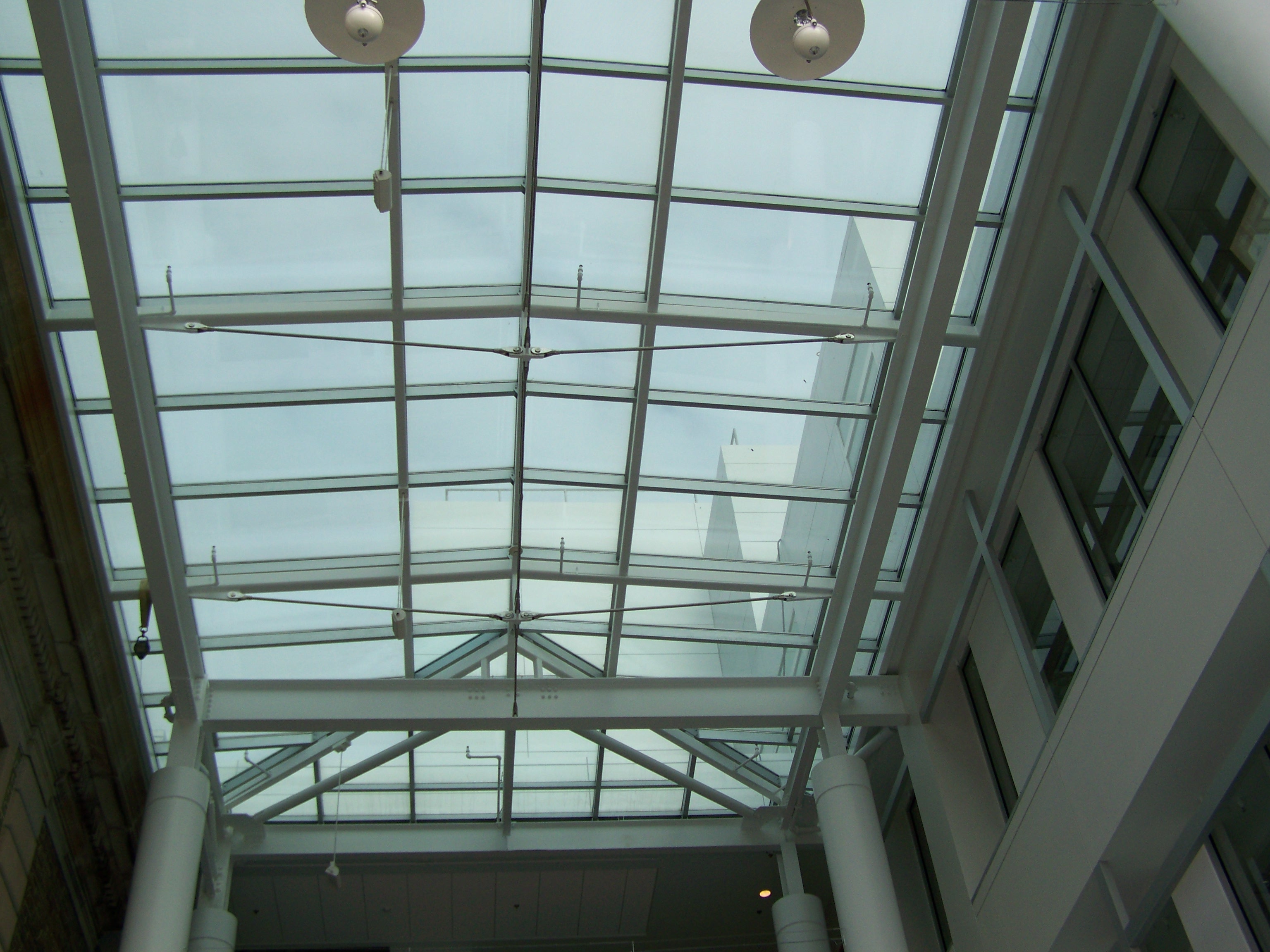
So, anyways, the work is virtually complete, with part of the building opened for light use, but the whole building is still not yet fully accessible.  As if that’s ever stopped me before.

.

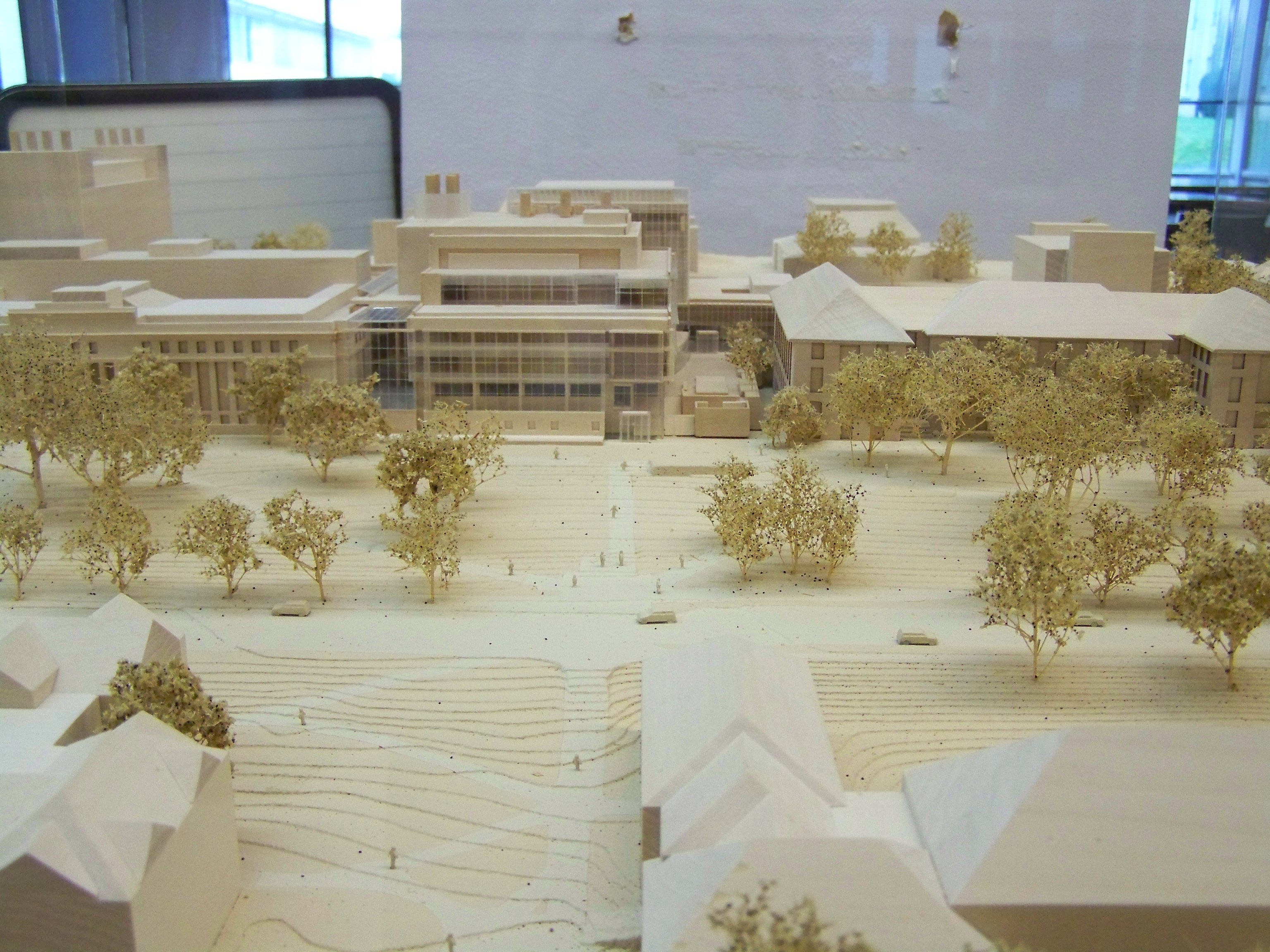
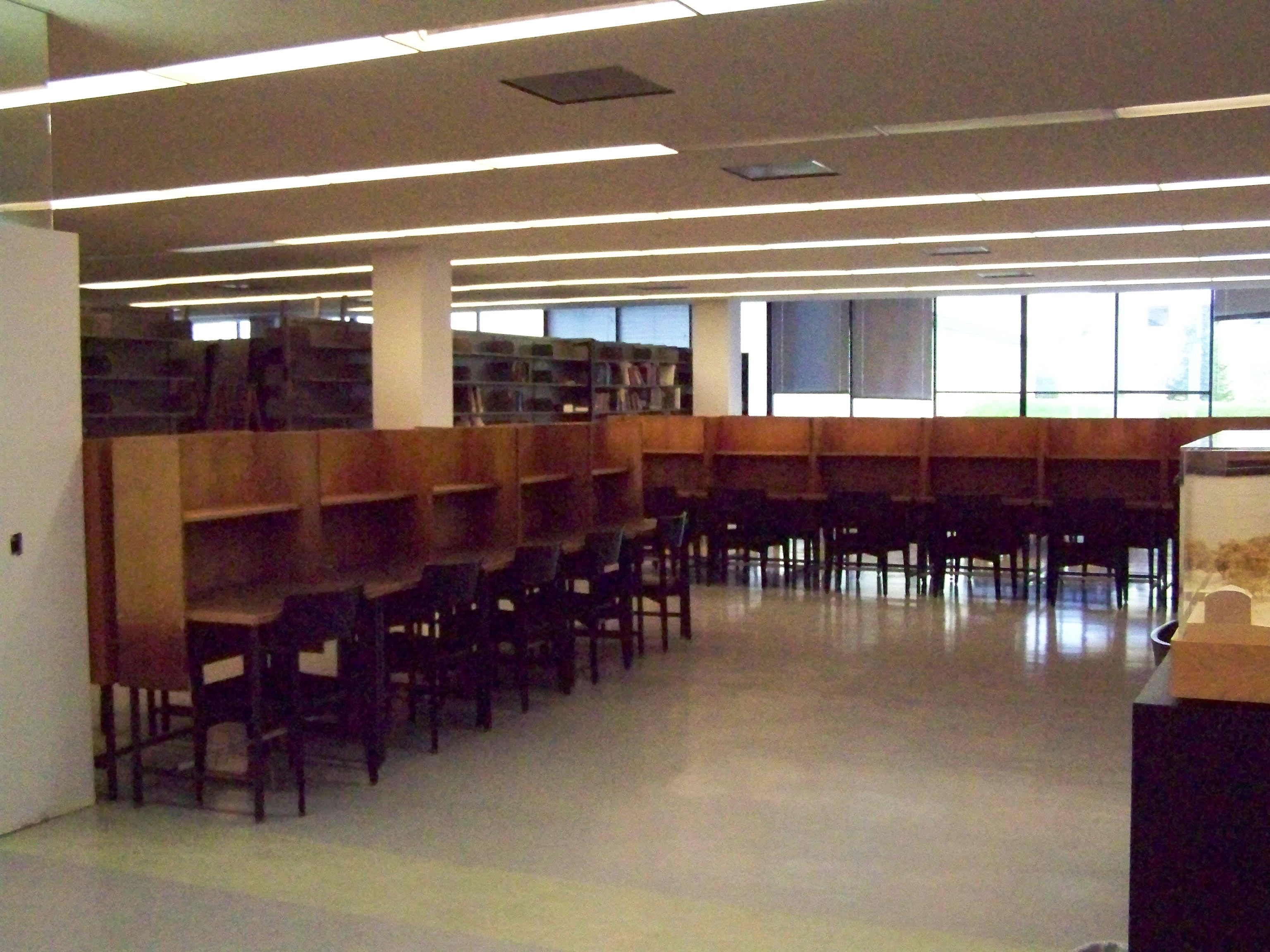
This mock-up, some empty carrels and a couple of bare desks are all that is left of the Physical Sciences Library in Clark Hall. I noticed one of the pillars an eulogy tot he library that Munier Salem had written in the Sun on March 26, 2009, yellowed but encased in a simple black picture frame. I thought it was a nice gesture to the library that once was. Although I opted to not take a photo of the column, here’s a link to its online version.

Insert your name here…for about $35 million. Could be you…

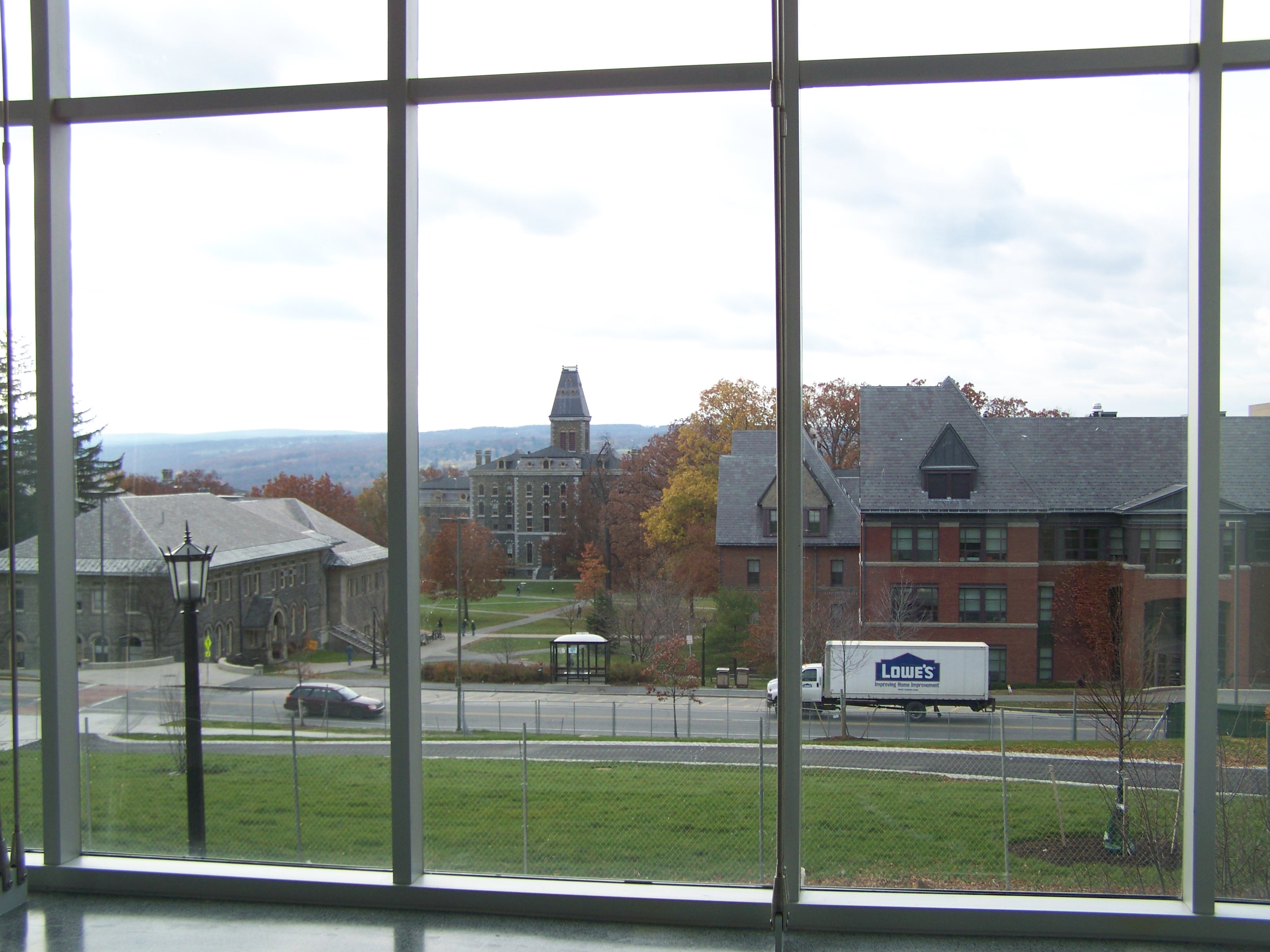
Leaving the oxidized copper lampposts was a nice touch.


Homecoming Construction Photos

29 09 2010

If I free up enough time between proctoring exams, I might write something more substantial. Until then, he are the physical highlights of Homecoming weekend.

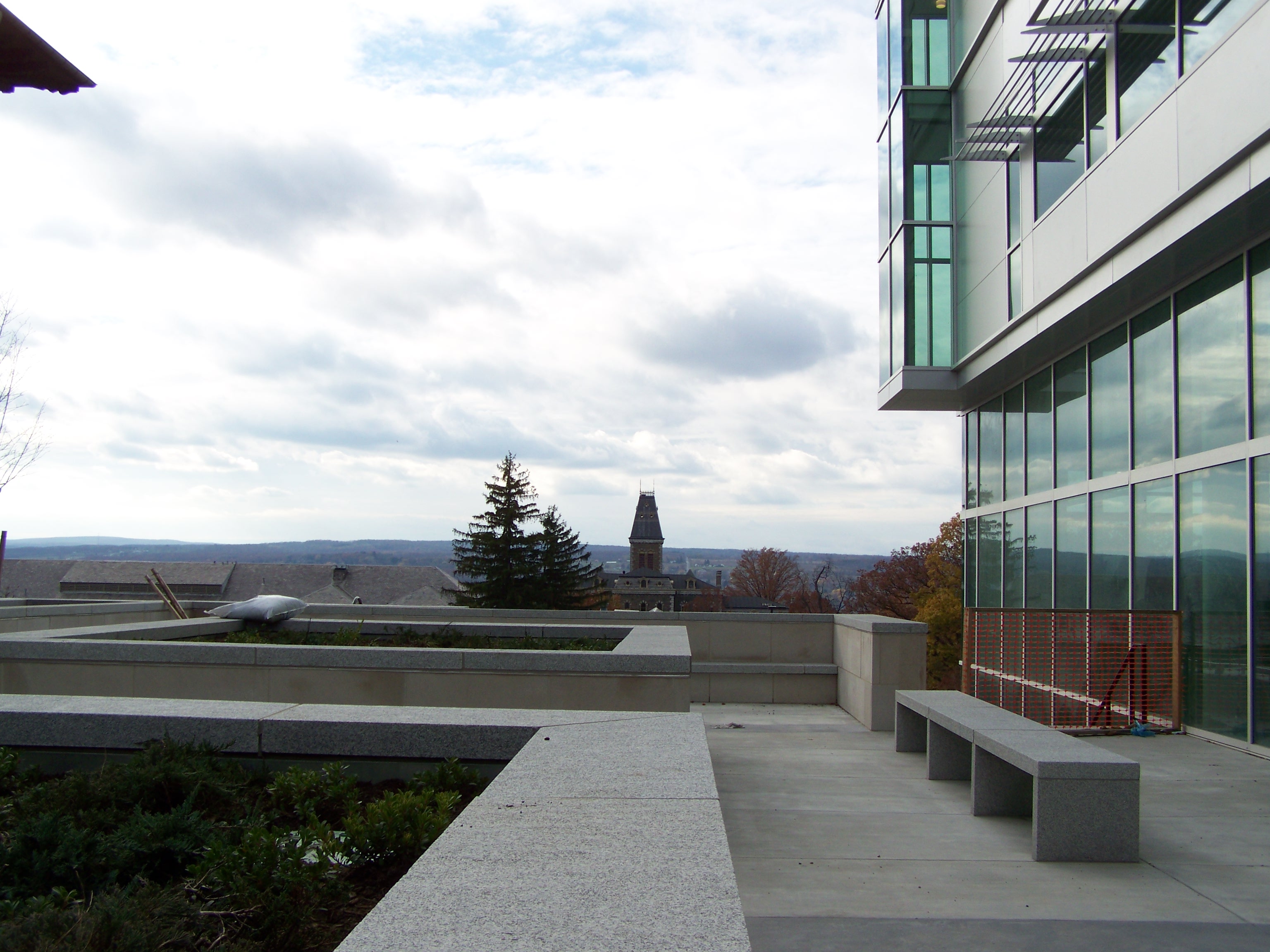
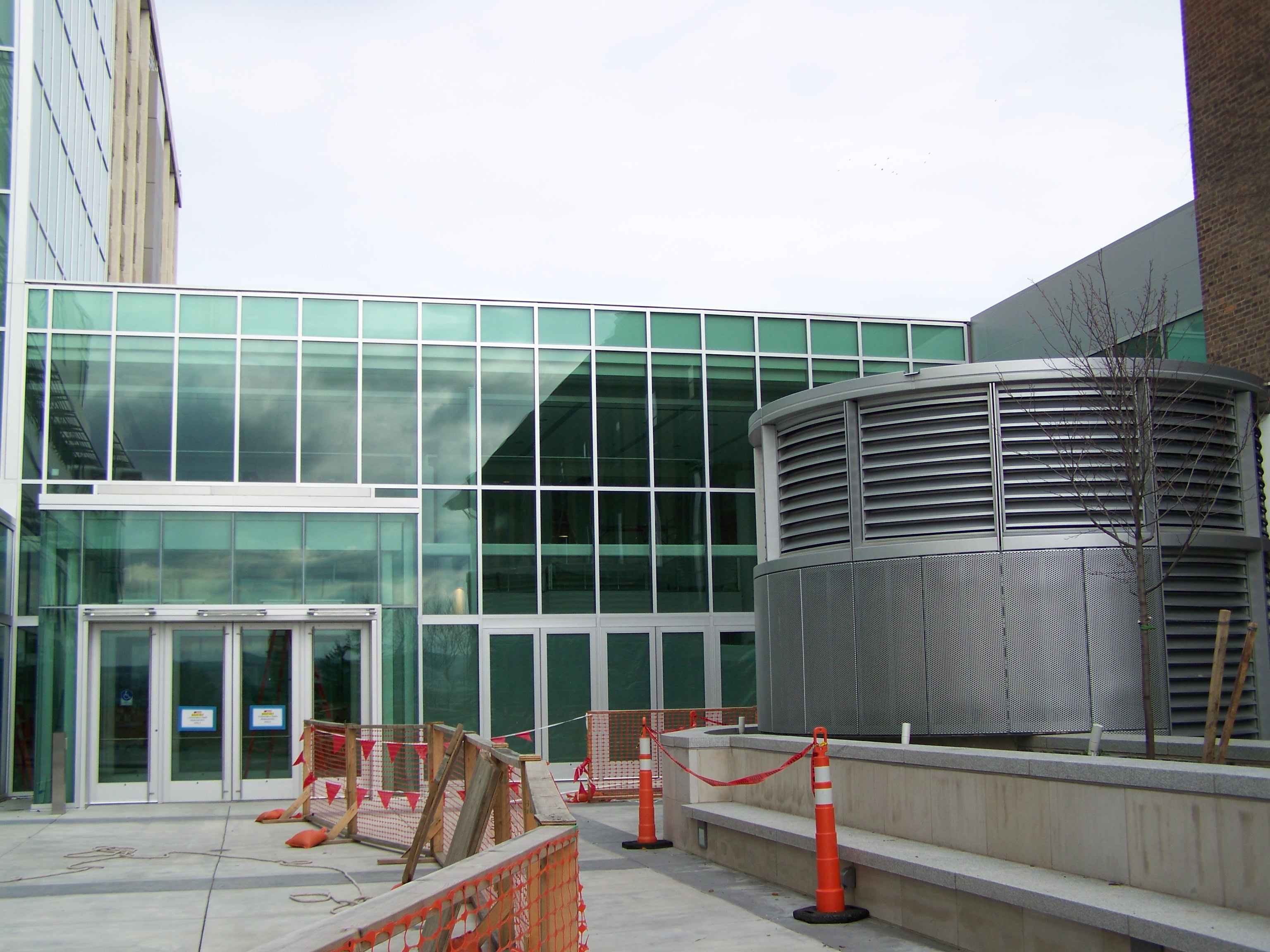
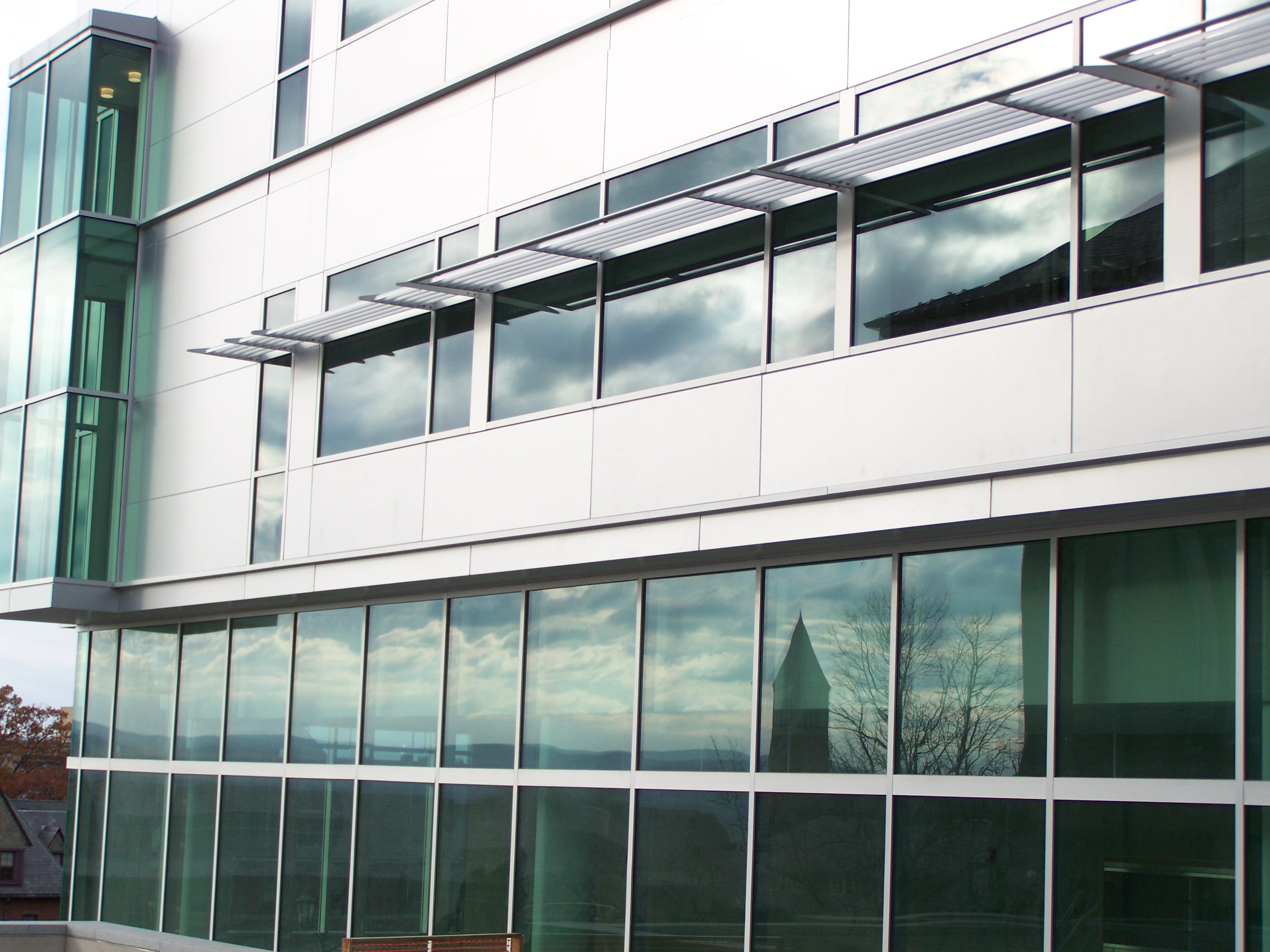
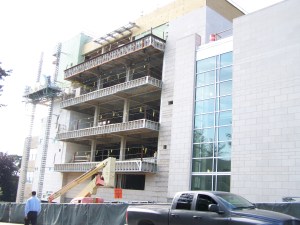
The 197,000 sq ft Physical Sciences Building is nearly complete, with a soft opening planned for next month. Although still fenced, the landscaping is nearly completed. The glass isn’t as clear as the old renderings suggested, but otherwise it’s pretty faithful to the sketches.

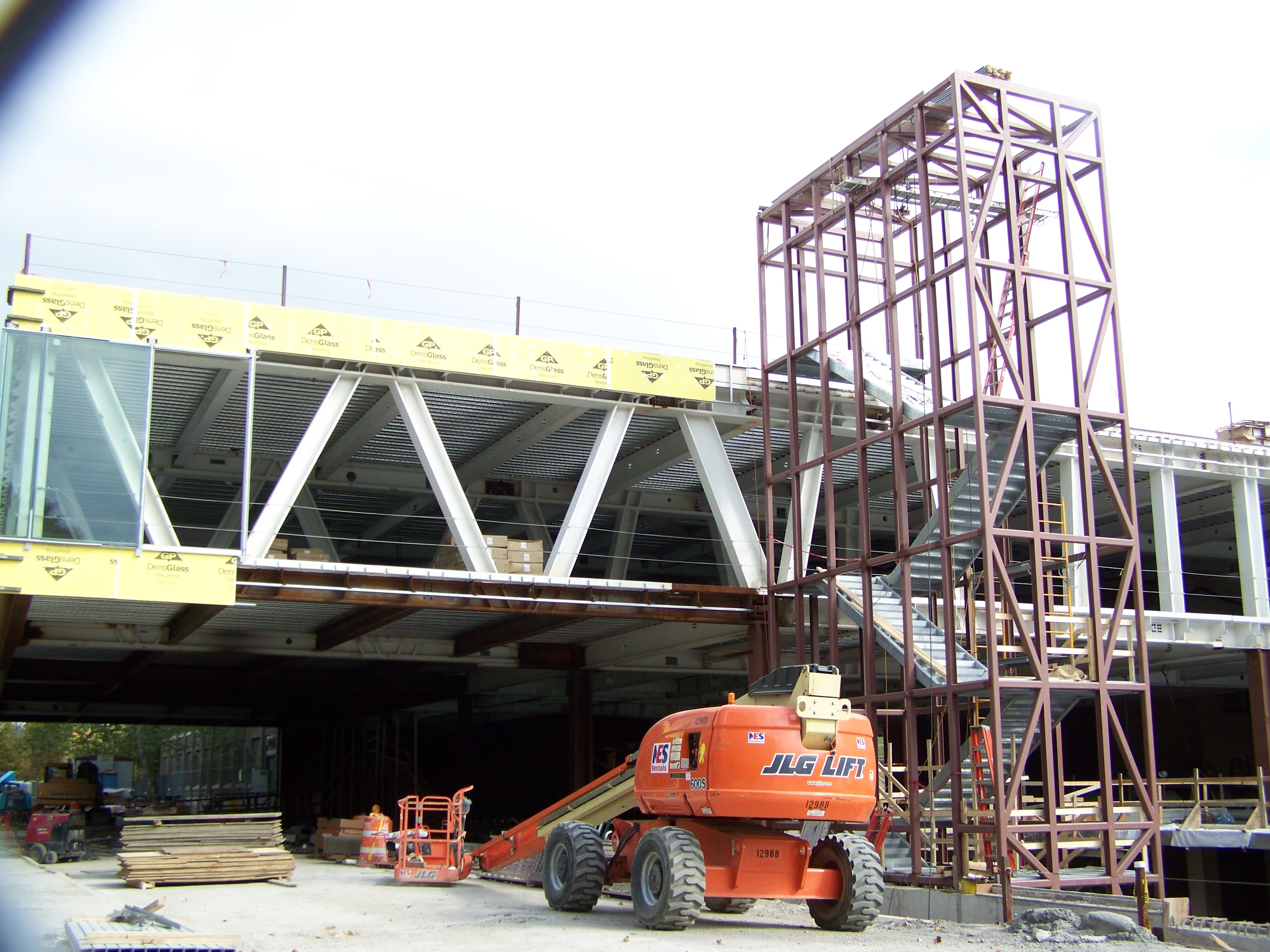
Regarding work on Milstein Hall, a taste of what to come was shown with the installation of a small amount of glass on the northwest corner. Slightly greenish-blue in hue, which to me was slightly unexpected but not something I feel strongly about (I imagined a bluish tint if any at all). The 43,000 sq ft building is set to be complete by this time next year.

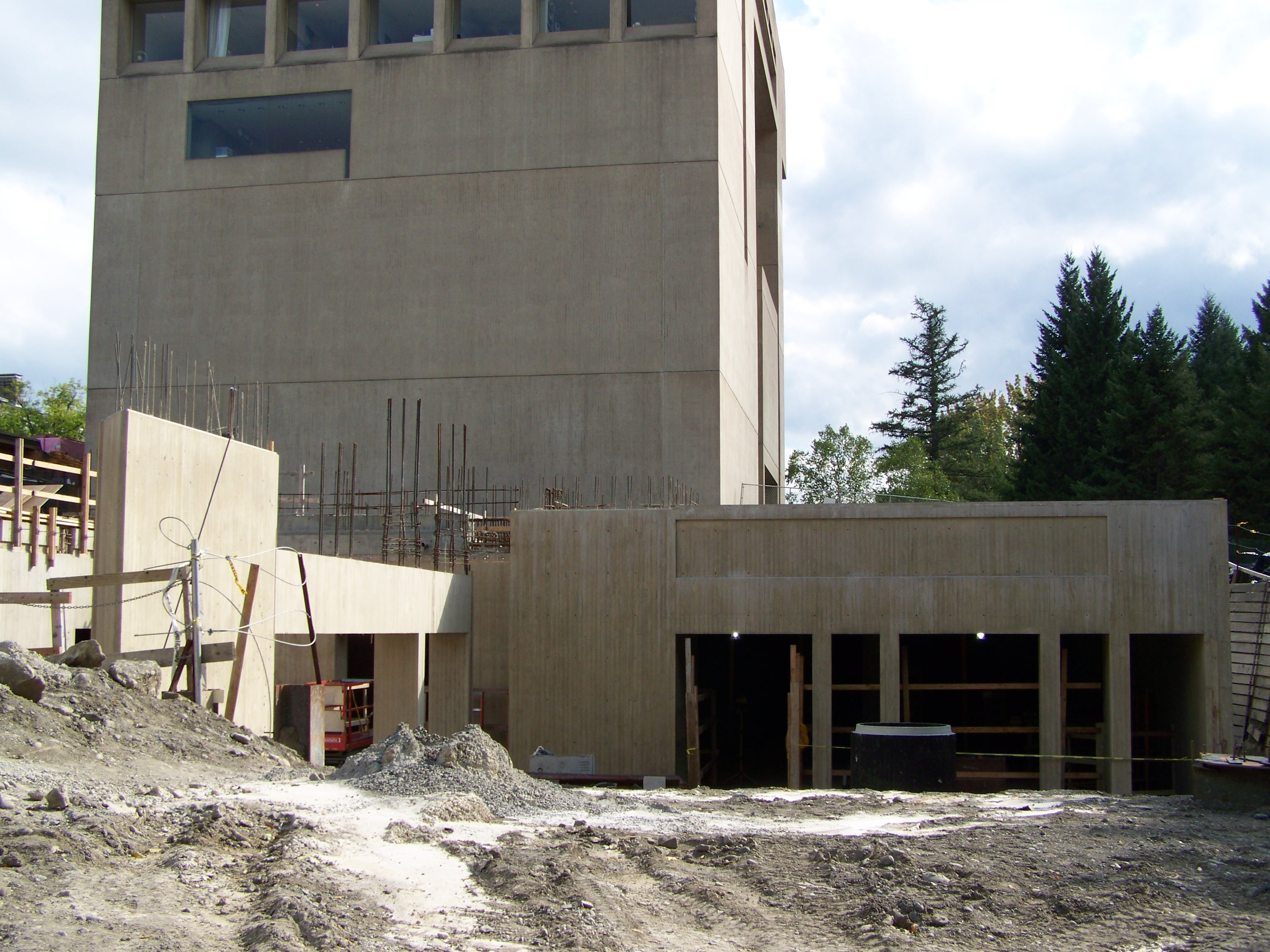
The Johnson’s addition is mostly underground, but some of the concrete work will build out to an above ground complimentary structure to the main building. It would appear that work has advanced quite a ways, with the rebar on the left indicating more pouring is yet to come for the east side of the 16,000 sq ft addition.

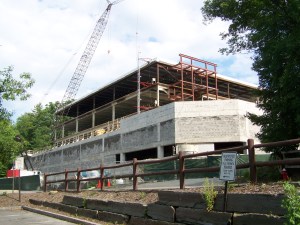
MVR North continues construction, though externally it hasn’t made too much progress in the past few months. The stone facade on the parking garage has been finished and work has been done on the exterior stairwells. The 87,000 sq ft building is set to be complete by the end of the winter.


News Tidbits 9/25/10: Development Planned for 307 College Avenue

25 09 2010

This is slightly annoying. I was away from my computer yesterday and today as a result of my graduate work and then coming straight out to Ithaca, so I never bothered to read my Ithaca/Cornell newsfeed. So it’s bothersome that I found out about this relatively later than usual. Anyways, here’s the article from the Daily Sun:

http://cornellsun.com/section/news/content/2010/09/24/developer-seeks-approval-new-c-town-building

September 24, 2010
By Jeff Stein

A proposal to transform the middle of College Avenue hinges on developer Josh Lower’s ’05 controversial request for a Board of Zoning Appeals variance, which would exempt a building’s development from city parking laws.

Lower said his proposed development project at 307 College Avenue –– next to Jason’s Grocery & Deli –– would demolish the existing building and create more than 60 new apartment units. Lower also hopes to remake the area into a highly trafficked “pedestrian arcade,” filled with street-level storefronts that would connect College and Linden Avenues.

City officials are divided on whether the Board should grant Lower the variance. Under the city’s current parking ordinance, every two housing units built must be matched by the creation of one parking spot.

Lower said that building the parking spaces, which must be within 500 feet of the site, was “not practically or financially possible.”

“We’ve tried to meet the law but cannot,” Lower said.  “There’s just not enough space.”

Ithaca Councilmember Ellen McCollister (D-3rd Ward) expressed concern that there would be a lot of “spillover” for surrounding neighborhoods if the variance was given.

McCollister also said the variance would establish a dangerous precedent: “If you grant a variance to one property owner, how do you not grant [it] to any other property owner?”

If one developer is granted an exception, “all hell breaks loose,” as other developers would expect the same treatment. “We need to treat every developer consistently and equally,” McCollister said.

Lower said his plan would compensate for the lack of new parking spaces by providing his residents with a car-share membership and free bus passes as part of the lease.

“We’ll create a building that fosters … sustainable modes of transportation and encourages people to bike more, walk more,” Lower said. In reference to a proposed pedestrian walkway, Lower said, “We’re making privately-owned space accessible and usable for all.”

McCollister was not convinced. She called Lower’s replacement for parking spaces a “very ill-defined, nebulous proposal,” saying it was “not a real plan for how he is going to do it, in perpetuity, for every resident.”

Partly because there is “more supply in retail than there is demand” for Collegetown, McCollister is “not convinced the pedestrian arcade is as valuable an amenity as it’s being portrayed.”

Board of Zoning Appeals member James Marshall shared McCollister’s skepticism about Lower’s replacement plan in exchange for a variance, calling the lack of parking spaces in his proposal a “significant deficiency.”

“He’s proposed some measures that might encourage people to use public transportation or bicycles, but no one knows how successful he’ll be,” Marshall said.

Stephen Beer, chair of the Board of Zoning Appeals, said he worried that there was no provision for enforcing Lower’s suggested replacement for the parking spaces.

Lower responded that “it would be a requirement written in the lease.”

Eddie Rooker ’10 (D-4th Ward) said he and Svante Myrick ’09 (D-4th Ward) both supported the project.

Rooker said the development is “going to be beneficial to students and the city,” naming studies that “point to the fact that we need more housing in the city” given “pretty high pricing all over the city.”

Rooker said the project would fix the need for a “well-lit pedestrian walkway connecting College and Linden Avenue,” where “people now have to go between people’s yards when they’re not well-lit.”

Rooker said the proposal could make the area in front of 307 College Avenue a new hub for TCAT, shifting the center of Collegetown further south.  He said that TCAT wrote a letter to the city in support of the project.

Lower, who lives in the neighborhood, said that “we really looked at a lot of scenarios to try to do something else with the property,” but that nothing else was viable. He said that he is currently losing money on the property.

McCollister responded that one of the considerations for the Board of Zoning Appeals was that the variance request not be in response to a “self-imposed hardship.”

“I think he does have a financial hardship, but that’s because he paid too much for it … rather than some externality that created that financial hardship,” McCollister said.

McCollister added that the Board of Zoning Appeals should wait until a decision is made about an “in-lieu of parking fee” suggested in the 2009 Collegetown Urban Plan & Conceptual Design Guidelines. The proposal, which is currently being developed, would specify a fee below the cost of providing on-site parking that developers could pay the city in lieu of building parking spaces. The Collegetown plan says the fee could then be used to help the city fund alternative transportation modes.

“I can only base my plans on what is law today,” Lower responded.

Rooker agreed, saying, “We can’t constantly rely on what might be happening,” and that he “would rather see something like this than a one time donation to general fund” anyway.

Lower added that waiting for the law to pass could have a big impact on his finances, since “the building has to be done based on the academic year.”  “If the building is not ready to have [residents in it] before classes start, it sits empty for the rest of the year.”

If approved, his plan is to start construction in June 2011 and have the building ready for residents in the Fall of 2012.

***

So, the summary is this:The guy wants to build a medium-sized apartment building but doesn’t want to include parking. The issue lies with the possibility that residents would just park their vehicles on the streets and clog local roads, and finding viable options to keep that from happening. A zoning variance is required due to the lack of parking, and without it the project will not proceed.

A few extra details; the development would be a 60-unit building with a retail base. Guessing from the rendering and from the height limit there, it would be about five stories. The current building on the site used to be occupied by a drugstore, but the store closed in late 2006. With the exception of the space occupied by Ithaca Carshare, the retail portion has been empty since.

The argument on the parking issue is reasonable and legitimate. A lot of students maintain cars, and the overly entitled ones may still try and maintain a vehicle nearby, thus creating parking issues for the building’s neighbors. While the project would definitely add density and needed residential space to inner Collegetown (and definitely makes use of New Urbanist planning), the lack of parking is a major hurdle. Personally, I like the idea of the project, but unless he can make absolutely clear what he’s going to do to keep students from bringing vehicles to an area with no space for them, and be held to that “in perpetuity”, I would be leery of its approval.

The architect is a small local Ithaca firm founded about seven years ago, John Snyder Architects.  Looking at the website, it seems most of their work has been for educational facilities or interior spaces, and the style tends to be modernist with limited detailing, instead playing off of the geometric forms of the structure itself. I’m very curious to see the whole design of what would seem to be the firm’s first large residential building. At the very least, it least it won’t be another Sharma Architects proposal; a little variety does wonders.


News Tidbits 7/9/10: Thom Mayne to Design Gates Hall

9 07 2010

I consider this a very bad sign.

http://www.news.cornell.edu/stories/July10/GatesHallArchitect.html

According to the Chronicle, Gates Hall will be located on the parking lot north of Hoy Field. This may or may not include demolition of the Grumman Squash Courts, as the article doesn’t clarify that. It will also be about 100,000 square feet and have a construction cost around $60 million. So, among other things, this means I shouldn’t pay attention to Cornell’s budget statements as they relate to building size, since it suggested 70,000 sq ft. More importantly, the site has been moved from its original location behind Thurston Hall. Schematic designs are expected by December, with completion by early 2014.

Now, Thom Mayne is another “starchitect”; which is nice, but shouldn’t be the big idea that’s being touted. Mayne’s firm is a rather small but highly respected company named Morphosis Architects. Morphosis has made their name doing really edgy, deconstructivist designs.

Uh oh.

For those unfamiliar with architecture, here’s the proposal that Morphosis submitted for Milstein Hall:

 That’s Lincoln Hall on the left. This proposal called for the demolition of Rand Hall and this…monstrosity to be built in its place. This isn’t pretty. It won’t even grow on you. This is outright hideous. It reminds me of Lady Gaga’s outfits — screams for attention, but wholly lacking in taste and functionality. This building actually makes me like Uris Hall.

Some might argue that they were purposely edgy since it was an architecture school building they were designing. I would love to believe that, but unfortunately that’s untrue.


This is one of their tamest designs, the Cahill Center for Astrophysics at Caltech. It’s bearable maybe. It sure as hell isn’t attractive. I wouldn’t dare point this out to prospective students and visitors if I were a tour guide. At least Weill and Milstein are inoffensive. This is analogous to mooning a bus full of orphans.

The San Francisco Federal Building? Another statement-maker of the unattractive kind. Thom Mayne is a great architect, but his designs are more for making statements than for being attractive. I want to know why Cornell thinks edgy design is the way to go. Many people have a strong avoidance of deconstructivism, and if MIT’s Stata Center is any clue, these buildings are so much more prone to rapid deterioration. To each their own I suppose. But I have a sinking feeling that Gates Hall is going to be a architectural blight onto the campus.


A Preview of Future Construction Projects

14 05 2010

A look at Cornell’s Capital Plan is a good source for the vague beginnings of any large-scale construction projects to occur down the Cornell pipeline in the next four to five years. Looking at the projects approves or under way, most have already been covered by this blog in previous entries (the ones that aren’t just renovations anyway — Warren Hall’s going to be virtually gutted over the next few years, but there will be no extensive changes to its exterior appearance). I know that Weill Cornell (WCMC) is about to start on a new 14-story, $650 million biomedical building down in the city, but I’ve always preferred to focus on the Ithaca area (because honestly, most Ithaca-based Cornellians could care less about the facilities in Geneva or New York City).

Projects seeking approval for FY (Fiscal Year) 2010 are clearly underway. The initial steel frame just went up for Milstein and the Statler’s rooms are being renovated. The Johnson Museum expansion is well underway (still in the giant hole in the ground stage, which makes sense since it’s mostly an underground expansion) and the Plantations Welcome Center is currently starting to undergo external facade work now that the frame and much of the insulation have been applied. Under the projects for future consideration section, the Olin Library improvements are in the pipeline as are the feasibility studies for the Cornell Rowing Center Renovation and Expansion and the Central Avenue Parking Garage (renders included below).

Central Ave. Parking Garage Proposal

Perhaps the most intriguing projects are the deferred major projects. Granted, they’re deferred, but they’ll likely come back online once budget conditions improve. One of these major projects is a $183 million engineering building. This could quite possibly be the one shown on the Cornell Master Plan that replaces Hollister and Carpenter Halls, especially since the master plan indicates the project is underway in some form.

However, the only probably with that theory is that there’s three buildings, all in the planning stages, in the vicinity of the engineering quad. Based off of old press releases, Site 2 as numbered in the image (the smallest circle) is almost certainly Gates Hall, which is described as a $65 million dollar project in the capital plan (makes sense; smaller building = lower cost). So, the question is, is the approved project number 1 or number 3? I doubt it’s both because then they would have to be filed separately since they are separate structures.

Another project of question is the East Hill Data Center, a $100 million project. Unfortunately, there are no rendering anywhere, and it’s impossible to use the master plan to figure out which building this might be, as the master plan totally redevelops this area, so this one is anyone’s guess.

The University Health Building and the Helen Newman expansion have been bandied about for some time. The new health building will have roughly the same footprint as the current structure, but maybe a floor taller. Helen Newman has been awaiting an expansion that will add a second pool and additional exercise space, but the original price tag was $15 million, instead of the $30 million listed in the capital plan. One wonders whether this is due to rising costs or more ambitious plans.

Hughes Hall and Myron Taylor Hall (the Law School) are due for $28 million in expansion and upgrades. If it’s anything like what is suggested in the master plan, it’s a modern-looking (i.e. clashes with everything around it) building with alot of below-grade parking. However, I have yet to see any true renderings for this project.

Last on the deferred list is an addition to the 4th floor of Phillips Hall, worth almost $6 million. Don’t expect this to be more than a few thousand square feet at most.

Well, my time at Cornell may be almost complete, but it seems like the construction will never be. It’s okay, I could always use another excuse to come back when I’m an alumnus.


Construction Photos of the New MVR North

1 11 2009

I do not condone sneaking into private property to take construction photos. That being said, if I receive them I’m more than happy to post them as the ones seen below. Most of the photos would appear to be of the parking structure in the lower floors of the building. Too bad some of the exterior photos are a little blurry.100_1848100_1849100_1865100_1850100_1854100_1862

 100_1853100_1855


Dear Ithaca, How I Missed You…

28 07 2009

I suppose that most people, on their first arrival back to the place they call home, would call their friends and make their presence known. I on the other hand decided to avoid my overcrowded sub-subletted apartment by taking photo of the campus construction projects.

100_1105

100_1050

I have to come back to 107 weeks of this? I just lost one of my main walking paths to class. This is almost like coming back to my girlfriend in bed with someone else.  I s’pose I should be glad I’ll only be affected by this for a year before I head elsewhere.

100_1051

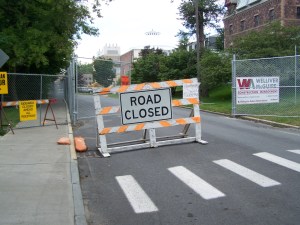
Well, I guess if they were going to close off the street, they might as well take advantage to do soil testing for the Johnson addition. Speaking of which, am Ithaca Journal article mentioned that mercury was found at the site [1]. Considering that the building was a chemistry building, and its first incarnation burnt down back in the days before WWI, this shouldn’t be too much of a shock.

100_1104

The physical sciences building continues on its merry way towards completion.

100_1098

MVR North is also well into its construction. I’m personally hoping the concrete and mortar parking base receives an attractive stone veneer to reduce some of the brutalist qualities of the north facade.

100_1099

The Vet School’s Diagnostic Center has received part of its brick facade, on track for its opening within the next year.

100_1102

Meanwhile, Barton Hall and anabel Taylor (not pictured) are being renovated, mostly with replacement stone for the facade, and roof repairs. Barton has been particularly needy for a reno because the stone on the tower was getting to a point where it was liable to crumble away, and it reasonably couldn’t be put off any longer.

100_1103

The Hotel School addition is on target for its winter completion date. For a 12,000 sq ft addition, it really sticks out, especially when approaching from the north on East Avenue. Where the Beck Center used to clash with the south facade, now the new addition clashes with the older southwest wing of the hotel school. I don’t think it’ll do much for Statler Hall, aesthetically speaking.


[1]http://www.theithacajournal.com/article/20090720/NEWS01/907200328/Mercury+buried+on+CU+campus


Buildings No One Really Cares About

17 01 2009

So, I had hardly any internet access while I was gone, but it would appear this blog had more than its fair share of hits this past week. It’s probably due to rush, and considering the content of ICH,  I’m not surprised.

But today we’ll just do another photo tour.

100_2496

Since someone asked about it, I decided to make a trip out to Ward Labs on the southern edge of the campus and the engineering quad. Ward Labs, or more properly the Ward Center for Nuclear Sciences, was completed in 1963. At this time, nuclear engineering was experiencing great interest. But after Three Mile Island and Chernobyl, the nation experienced a serious decline in interest in nuclear studies, and the engineering school disbanded it’s Nuclear Science and Engineering program in 1995 [1].  On May 4, 2001, Cornell announced that it would decomission the TRIGA Mark II nuclear reactor inside the facility, due to underutilization and unwanted liability concerning the handling, use and transport of nuclear materials. The reactor was a 500 kilowatt facility used strictly for research and teaching. A dry irradiation facility that uses the radioactive Cobalt-60 was recommended to be maintained at the facility. The building still contained radioactive waste, so when 9/11 happened, road blocks were installed around the facility [2].

Then we fast forward to October 2008. There was a very interesting article written by Munier Salem for the Daily Sun highlighting the increased interest in building new facilties and a revived interest in the field as the energy crisis affected the nation, and how some view the decomissioning as a huge mistake.

Today, with the exception of some offices and little-used labs, the Ward Center is largely abandoned. The building is slated to be torn down under the master plan (assuming our endowment holds out).

100_2497

I felt that since I was there, I should take a photo of Grumman Hall too, if but just to say I have one.

100_2509

I make a big deal about Bradfield, but I never have really mentioned Emerson Hall. Emerson, the low-rise portion of the Bradfield complex, was also completed in 1968 and houses labs and offices for the department of Crop and Soil Sciences. The building is named for Rollins Emerson, who was the head of the Plant Breeding Department for a few decades in the first half of the 20th century.

100_2508

Riley-Robb Hall. This building was built in 1956 and is designed in the stripped classical style [4]. Very, very stripped. The emphasis with this building was on materials, primarily limestone, yellow brick, and marble. Two bas-relief limestone heads flank the entry stairs, the one on the north side being Ceres and the one on the south being Pomona. The building currently houses the Biological and Environmental Engineering program.

Also worth noting is the $6 million dollar renovation for the east wing set to be completed in March. This lab will focus on biofuels research [5].

***

100_2503

Bartels Hall, originally known as Alberding Field House, was completed  in 1990. The building houses the Lindseth Cimbing Wall (the alrgest indoor wall in the country, Cornell claims [6]), basketball courts, artificial turf practice areas and a 5,000 seat indoor sports facility. The building was renamed in 2000 as a thank-you for a $15 million donation from Hank and Nancy Bartels of the class of 1948.  Charles Alberding ’23 was a major benefactor of Cornell athletic programs, but the building was never formally named for him [7].

[1]  http://theuniversityfaculty.cornell.edu/forums/pdfs/Wardrelease.pdf

[2]http://cornellsun.com/node/33101

[3]http://www.genetics.org/cgi/content/full/169/4/1787

[4]http://www.fs.cornell.edu/fs/facinfo/fs_facilInfo.cfm?facil_cd=1062

[5]http://www.news.cornell.edu/stories/March08/biofuels.lab.lm.html

[6]http://www.cornell.edu/search/index.cfm?tab=facts&q=&id=313

[7]http://ezra.cornell.edu/posting.php?timestamp=944542800                        – see Question 11