Cornell and Carl Sagan

26 01 2013

100_1714

When I came up for the idea of this topic, I was originally a little hesitant to write an entry. Unlike A.D. White or Dear Uncle Ezra, there are probably a number of readers who can remember when Sagan was alive and active on campus (Sagan passed away in December 1996). If the number of hits I receive for his old house at 900 Stewart Avenue are any clue (~600 hits since this blog’s inception), the late astronomer and Cornell professor remains a relatively popular figure. As someone who was just a kid when Carl Sagan passed away, it’s a little harder for me to identify, and in Sagan’s place, figures such as Bill Nye and Neil DeGrasse Tyson fill different niches not-too-distant from Sagan’s public role.

With all that in mind, I decided to take an approach similar to what I did with my “Founding Fathers” entries, and provide a smorgasbord of tidbits. I have no intention of delving into his interests of extraterrestrial life, agnosticism/humanism, or marijuana use, but the wikipedia entry would be a fine substitute for those interested in those topics.

-First off, the basic facts. Carl Sagan arrived at Cornell in 1968. We should only be so lucky that the high minds of Harvard decided to deny him tenure the previous year, because they were unhappy with his “pandering to the public”. Sagan became a full professor of the astronomy department in 1971, and remained so (the David C. Duncan Professor in the Physical Sciences) until his untimely death from pneumonia while recovering from cancer a quarter-century later.

-Carl Sagan might have been an excellent publicist for science, but few would call him a focused academic. The filming of his Cosmos  television series in Los Angeles in the late 1970s forced the university to cancel several of his courses, and several grad students under his advisory had to move into the research groups of other department faculty. His astronomy colleagues were unimpressed with this shirking of duties and attempted to have his lab kicked out of the Space Science building.

-Things were not a whole lot better upon return to campus, the blessing and curse of the success of his television series and associated NYT bestseller. While Sagan garnered much favorable publicity and considerable wealth, he was also subject to death threats from those in vehement disagreement to his views. Police regularly patrolled his home, and his name was removed from the Space Science directory and from his front door, out of safety concerns (this policy must have relaxed late in his career). Some of his colleagues remained unenthused about him, accusing Dr. Sagan of being an egotist, blurring the lines between fact and fiction, and failing to give other scientists due credit.

-While at Cornell, Sagan began a critical thinking course (ASTRO 490). This course was under his guidance until he was hospitalized in 1996, when other faculty filled in. The course was discontinued after his death, but was brought back under the tutelage of other faculty a few years later. Under Sagan’s time, the course could only be enrolled into after completing a rigorous interview process for one of the 20 available slots.

-On the note of Neil deGrasse Tyson, Sagan tried to recruit him to do his undergrad at Cornell. Unfortunately, the future Dr. Tyson chose to go to Harvard instead. Bill Nye had Sagan as a professor, so perhaps Sagan has had more of a hand in the science communication to Generation Y than we realize.

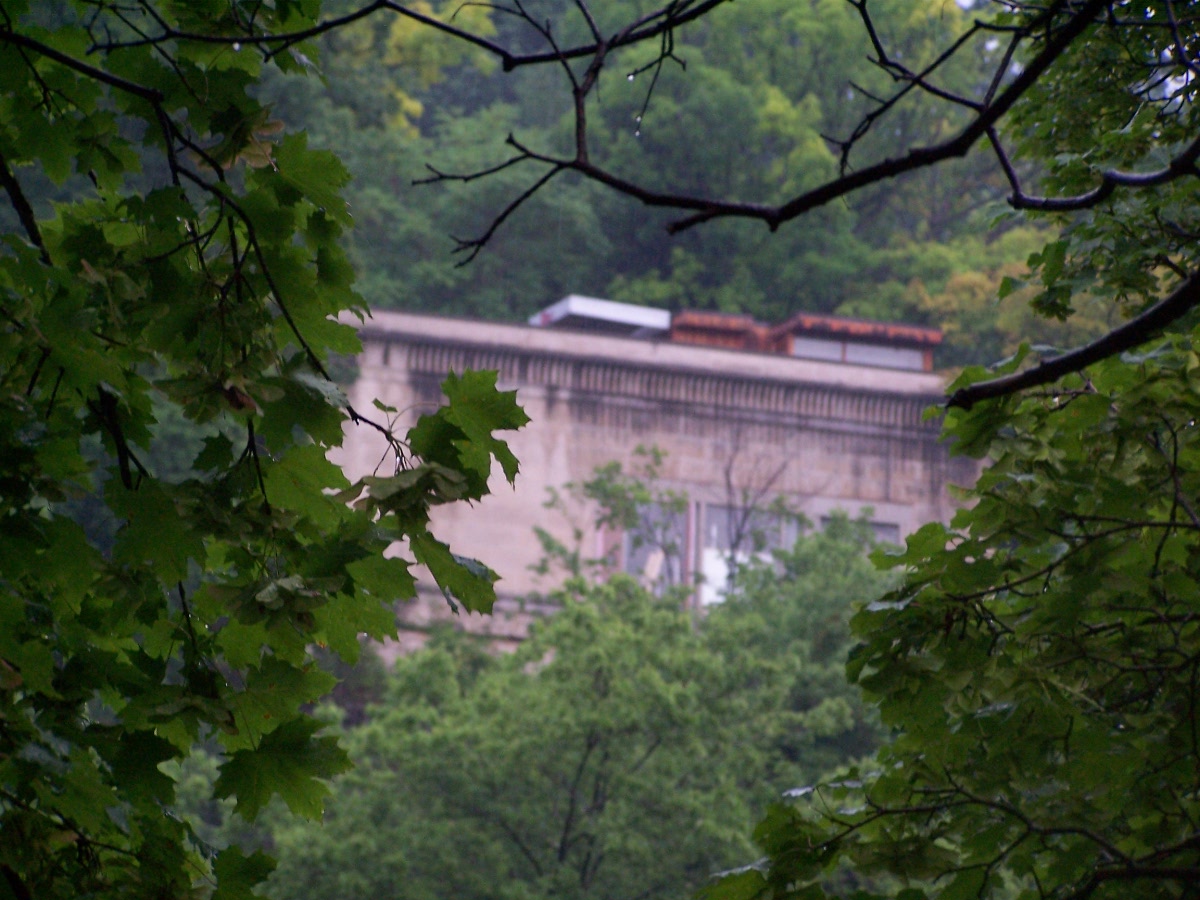
-One of the more whimsical tales of Sagan is that during the height of his popularity, he had a secret tunnel from his home to campus, where he could drive his Porsche away from prying eyes. In reality, he would walk some of the back-trails along the gorge.

-Another reason to seek anonymity – Sagan used a vanity plate inscribed with “PHOBOS”, a Martian moon. These vanity plates became a hot souvenir for anyone with a screwdriver and ten minutes, since 900 Stewart has no driveway or garage (rather, it has a deep curb). Sagan eventually caved and asked the DMV for a more anonymous plate.

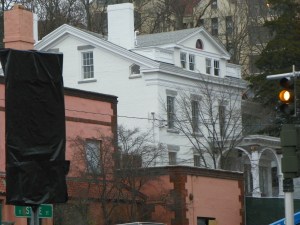
-I’ve already covered Sagan’s home a couple of times previous, but a quick rehash – built in 1890 as the meeting place for the Sphinx Head secret society, who sold it their neighbor, Dr. Robert Wilson, in 1969. The building went relatively unused, and was once again, this time to Dr. Stephen Mensch, in 1979. Mensch renovated the property into a home, and actually allowed Sphinx Head to make occasional use of the property. Sagan acquired the property in the 1980s, and the house is still a part of his estate, though it is vacant. According to a 1993 DUE, Sagan likely did not live in the property towards the ends of his life.

Although vacant, it would be ill-advised to try to trespass – the property is covered with security cameras, one of which is right above the entrance-way (the not-visible corner in the below photo).

On a personal note, when I had taken the photos of the former Sagan residence, I had not known this was his home. I just thought it was a highly unusual building in an area of mostly early 20th-century homes. It was not until I typed the address into my search bar when I came home that I discovered the building’s significance.

100_1690


The Cornell Stories

18 01 2013

cornell_postcards_1933

Back in the day, before the internet, TV and even radio, the best way to indulge one’s interest was by the printed word. Novels,  serials and newspaper articles were much more valued. It was also around a hundred or so years ago, when the idea of college went from the dank halls of seminaries and obscure studies of little practical worth, to a sort of idyllic playground of stories and mischief, casting collegiate life into a much more positive light.

During this time, several publications focusing on the wonders of college life were produced. Perhaps the best known are the Frank Merriwell serials, and his exploits at Yale. There were several other works of various quality produced around the same time.

Here, I offer The Cornell Stories (1898), written by James Gardner Sanderson, Class of 1896. The stories are light-hearted and fictional, but the setting and the descriptions conjure up images of a simpler, slower time, the Ithaca of a century ago.

Here’s my recommendation – make a cup of hot chocolate, settle into your favorite chair or couch with a blanket, and enjoy a good read.


When Things Don’t Work Out

17 01 2013

Frequent readers of this blog are aware that I cover two things – Cornell (its history and physical plant) and new projects and real estate development in the Ithaca area. Now, I’m not going to say I’m beating a dead horse with the former, but I would be lying if I didn’t say it hasn’t been easy coming up with new topics to write about, that aren’t widely available already (ex. the Willard Straight Takeover of 1969), or previous written in this blog.

Fortunately, Ithaca has been undergoing a veritable boom in construction. Just today, I checked the town of Ithaca planning board notes to find yet another multi-unit housing project proposed – “Hawk’s Nest at Springwood”, a 3-story, 50-unit building to be built at the Springwood Townhomes area just east of the intersection of 96B and King Road. The project will be marketed to the 55+ crowd.

hawks nest

This area has seen a cluster of (mostly suburban-style) development in the past few years, with the Holly Creek Townhomes, College Crossings, the Namgyal Monestery, The Country Inn and Suites, The College Circle Apartments (IC) expansion, and a number of private homes. Which, counting that all of the top of my head, gives 184 more beds at IC, and 74+ other housing units. Quite the little burst of activity south of IC.

So, considering the question in a previous entry about historical construction trends, this latest development pushes the private residential units number from 2011-2016 over the 1,000 mark, nothing to sneeze at when the total number of units in the entire metro is just under 42,000. In considering the planned developments north of Ithaca, and single-family homes, the number of units planned in those five years could very well be in the 2000+ range, a proportion highly unusual for upstate New York, and probably only comparable to the Albany metro, where a massive computer chip factory has been underway.

Now, time for the Debbie Downer – I have no expectation all these projects will come to fruition.

In the past, several projects have been downsized, modified, or cancelled. Take Ithaca Gun, a project constantly being re-evaluated due to rapidly increasing costs associated with the site cleanup. The project started off with 160 units, but neighbors complained. It was decreased to 80, then 33, than upped to 45. The final result seems to be a shot in the dark. Because of the uncertainty, I did not include it in the unit count.

Other projects, both current and old, were modified in the planning. The Trebloc Building downtown was originally supposed to be two floors (and I will personally donate a very nice bottle of Finger Lake wine to any developer who proposes to knock that abomination down and replace it with something more fitting). Cayuga Green, covered previously, has been redesigned four times. Collegetown Terrace has undergone at least one major revision and a couple minor ones.

Some projects never see the light of day. The McGraw House, an assisted living facility downtown, considered an expansion in 2009/2010. Then they shelved it. A 400-unit development was planned for West Hill (Carrowmoor), but this also appears to have gone stale.  Cornell’s West Campus was slated to be bedecked in Collegiate Gothic – killed by the Great Depression (among other Cornell proposals and plans that can be found using the search bar). Wal-Mart was once slated for Lansing. The most outlandish serious proposal goes toward a city-sponsored urban renewal plan proposed for Collegetown in 1968. The project would have tore down the heart of Collegetown, and in its place put up an eleven story office building, and 6 to 8 high-rise apartment towers (total 375 units), the tallest being 18 to 21 stories. It also would have included a 600-space parking garage and retail venues.

It’s sort of like “survival of the fittest”. The projects with the most stable funding, and the strongest proposals, tend to win out. Some projects are clearly underway, some go through revisions, some will remain pie-in-the-sky. I do, however, look forward to as many of these projects coming to fruition as possible.


More Than Just Cherries On Top: The Purity Redevelopment Plan

11 01 2013

Now, a part of me was tempted to write something up about a Cornell fraternity that just was thrown off campus for “sexually humiliating” hazing…but then, I realized I’m too far out to care for the stupid crap of the current crop of students. No matter how absolutely, unfathomably asinine it is. Stay classy TEP, it’s a miracle your trashed house didn’t collapse first.

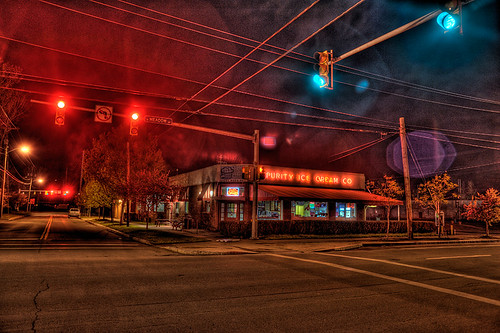
So onto something that catches my interest in a more positive way. I have to issue a slight mea culpa on this, because the news regarding the Purity Ice Cream project has been floating around for a good six weeks already. For those who have yet to experience it, Purity is a fairly well-known local ice cream company, in operation since 1936. The current building, a rather plain one-story brick structure, was completed in 1953.

Of note and of particular relevance here, Purity is in a high-traffic but fairly low density area, on the Corner of Meadow and Cascadilla Streets, west-northwest of downtown. In what I would describe as a rarity for Ithaca, I don’t believe I’ve ever taken a photo of the store. Thank Heaven for aerials and Flickr.

purity1

Purity’s parcel is outlined in red in the above image from Bing Maps. It lies on the cusp of low-to-moderate density residential district (Northside), part of a small commercial district of mostly retail and warehousing. So it lies quite a ways outside the traditional dense clusters of development.

The plans are still pretty conceptual at this point. The owners, Bruce and Heather Lane, seek to keep the original structure and build vertically; rental office and retail space on the lower floors, with 13 to 26 1 and 2-bedroom apartments on the third and higher floors. The facade, in keeping with the original structure, will be brick. The number of stories is to suggested at 4-5, but the first floor would have 16′ ceilings, so it would be fairly likely to top out around 60′, and the new building would be a visual focus point in the generally low-rise neighborhood. Although the area is less built up than some other parts of the city, the owners are seeking to tap into new urbanist concepts, touting the walkability to Greenstar and the Waterfront Trail. The goal is to get the project underway in fall 2013, and the ice cream store will remain open throughout the duration of construction. A structure like this would have a 12-to-18 month time frame.

Not all of the structure would be saved, as the manufacturing space for the Ice Cream would be eliminated; but then, Purity has contracted out the ice cream manufacture to Byrne Dairy since 2006. It seems it would be a loss of underused space at worst.

Now here’s the consequence of my inattentiveness; the rendering is missing. I can come up with some ideas, since John Snyder Arch. is in charge, and they’ve been prolific in the area as of late (their flavor of choice being geometric forms/ modern design). But even with that knowledge, and knowing it was just a sketch plan, I would have liked to have seen the render. But unfortunately, it is missing from the IJ and its sister pubs, and even the article has been deleted (at least there were cached versions; but those did not have the render). Granted, it’s not like I’d be able to post it anyway, given the whole paid subscription thing. But, as the project continues to evolve over the next couple of months, I will attempt to stay on top of this for once, and post a rendering as a soon as a free version becomes available.

Update 1/17: And in fact one has, from Google image search. Sweet. Pun intended.

purity2


An Ever-Expanding Ithaca Apartment Hunt

4 01 2013

11-24-2012 167

So, this post relies on a question originally posed by “Steve” on the welcome page:

I wonder if you can comment on the number of new apartments being built in Ithaca from a historical perspective? It seems like there are many coming online but I don’t have a long enough perspective.

As a matter of fact, I had obtained this info several months ago for reference, from a report given to the DIA by the Danter Company regarding the Ithaca housing market’s trends, needs and projections. But I had never made much use of that data until now. Even to the casual observer, there has been an uptick in construction around and about the Ithaca area as of late. As the metro has expanded a little over 5% (~5,500 people) in the past decade, some growth is to be expected. The Ithaca market (mostly defined as Ithaca city/town with some parts of Lansing) is believed to be capable of absorbing about 1,350 units over the next five years, 25% owner-occupied (most likely condos) and 75% rental units.

As of April 2011, there were 4,793 units in 75 developments (5 others with 270 units of subsidized housing are excluded from analysis). 49% of all those units are occupied by, no surprise, students at IC or Cornell. Borrowing a table from the report itself shows the number of multi-unit projects built within Ithaca proper, broken down into separate time periods.

danter1

So, adding up the 2000s gives 654 units 14 projects. This is a substantial increase from the 454 units built in the 1990s, but somewhat less than the 824 units in the 1980s, and less than half of the 1,604 units built in the 1970s. For the curious, the project built in 2009 was INHS’s Cedar Creek on the west side of the city. West Hill accounts for over half of the new multi-unit housing built in the 2000s, with Overlook at West Hill (128 units, 2006), Linderman Creek (128 units in 2 phases, 2000/2004) Cayuga View (24 units, 2005) and Conifer Village (70 units, 2008). Collegetown also makes up a small portion, with projects like 407 College (25 units, 2006) and Coal Yard Apartments Phase I (10 units, 2007).

Now, starting around the time this left off, there have been a number of major projects. Within the 2011-2016 time frame, here’s a sample of what’s completed/under construction/planned (I’m not going to link to each one for this entry, but the curious can make use of the search bar to pull up more info from other entries):

Collegetown Terrace (U/C; usually defined with “beds”; but in terms of units, the construction company in charge suggests 246 units, but that may just be one phase). EDIT – 610 units. That’s…a lot.

309 Eddy (completed, 24 units)

Coal Yard Apartment Phase II (completed, 25 units)

107 Cook (U/C, 4 units)

Breckinridge Place (U/C, 50 units)

Collegetown Crossing (in review, 60 units).

Thurston/Highland (in review, 36 units)

Seneca Way (U/C, 38 units)

619 West Seneca (U/C, 24 units)

Cayuga Green (approved, 39 units)

Fane Properties/ 100 E. Clinton (proposed, 36 units)

Harold Square (proposed, 60-70 units)

Cascadilla Landing (in review, 134 units)

Stone Quarry Apartments (in review, 35 units)

Conifer Phase II (72 units, senior housing, site prep)

Purity Ice Cream Redevelopment (proposed, 13-26 units)

Hawk’s Nest at Springwood (proposed, 50 units)

Cinema Drive (proposed, Lansing village south of 13, 39 units)

Lansing Reserve (proposed, on the north edge of what the Danter study calls “Ithaca” proper; 65 units)

College Crossings (U/C, 2 units)

So in the Ithaca area proper, in a span from 2011-2016, I’m estimating at least 1,415 units in 20 projects. This assumes the townhomes with the Vine Street Cottages and Holochuck Homes projects are not rentals (and not included in this tally), excludes the several hundred units of housing planned in the town of Lansing (town center, Village Solars, etc.). Also, Ithaca Gun and its 45 units are not being included until that project leaves limbo.

So to answer Steve’s question- Ithaca is running well above average, and is on a pace not seen since the 1970s. Quite the uptick indeed.


Yet Another Hotel for Downtown Ithaca

24 12 2012

12-29-2011 041

It seems downtown Ithaca is in a building frenzy, even beyond sleepy upstate standards. From the Ithaca Times:

At its meeting December 20, the Ithaca Urban Renewal Agency unanimously approved the designation of Lighthouse Hotel, LLC as “a qualified and eligible sponsor” for acquiring properties at 320-324 East Martin Luther King Jr./East State Street through a negotiated sale for the purpose of an urban renewal project. The proposal by Lighthouse Hotel is to develop a $16 million, six-story Hampton Inn & Suites with 92 rooms. The project site would cover four parcels including parking lots owned by the city and the IURA, the Carey Building and 310-312 E. MLK Jr./E. State Street.

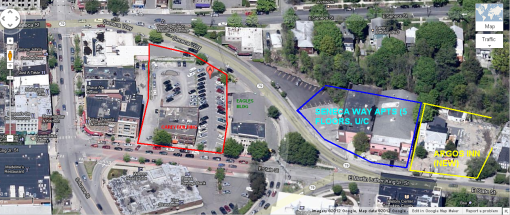
Now, this could be a little contentious. The area covered is highlighted below:

lighthouse_hampton

Of the four parcels, two have been parking lots for a long time, and I would not be surprised to see a garage of some sort would be a component of this project (probably above ground, given the water table…otherwise, there is a rather underutilized garage a few blocks south, if the city presses them enough and the developers are willing to play along).

Then there’s the Carey Building. The Carey Building is a two-story structure built in 1922 and named for its developer, broker Henry A. Carey. The building, with its Egyptian Art Deco accents, was designed to match the Strand Theatre to its west.  The Strand Theatre, or what was the Strand, comprises the last parcel. The theatre was built in 1917, closed in 1975, and although attempts were made to save the building, it was torn down in 1993, a victim of poor maintenance. As seen in the aerial, the site is now a parking lot. For practical purposes, the Carey Building is in good structural shape, and is maintained by the locally prominent Travis Hyde properties. The Eagles Building on the SE corner is not a part of the project.

Now, I tend to not be a big fan of Hampton Inns, a middle-rung hotel chain infamous for half-assed design on the cheap. Although a slight improvement over the years, most Hamptons built in the past decade could be described as beige boxes with oversized pillasters and raised parapets. One only has to look towards big-box land for an example – The Hampton Inn “designed” by Sharma Architecture and built in 2003.  Chain hotels are often the architectural equivalent of “fill-in-the-blank”, and as cheaply as possible. Still, one can hope – the average Hampton cost $6-8 million (~$60,000/room) to develop in the mid 2000s, and the budget for this project is $16 million. Hopefully, some of that will go towards something fitting for the city of gorges. In my mind’s eye, it has a more unique look, subtle or off-site parking, and incorporates the Carey Building, or at the very least its street-facing facade.

So in sum, any proposed demolition of the Carey Building might cause a lot of problems for the developer. The IURA’s decision a couple days ago only makes the developer a qualified buyer for the IURA parcel, and does not guarantee any development. And I’m sure there will be many, many meetings ahead for this one before any approvals are granted.

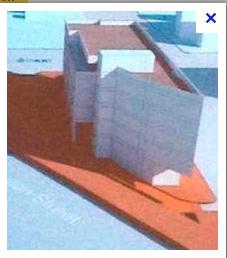
Update 1/9: And courtesy of the agenda comes this rendering and site plan, hosted online by “Ex-Ithacan”:

So much for preserving the Carey Building and subtle parking.


The Keyword Bar XVIII

22 12 2012

11-24-2012 141

So, I wish I had had more time to put some thought into an entry. But an unusual event took place in the past few weeks.

After a series of phone interviews, I was flown out to California for a meet-and-greet/any final interview details for the research lab of a defense contractor. And up to my arrival, I was 99% sure I was going to accept the offer. It was a step up in my field, and the pay was also a nice boost.

Then I got out there, and they showed me the projects I’d be working on. Oddly enough, in all of those phone interviews, so much time had been spent asking me questions and going over my background that we had maybe discussed the projects for a few minutes. As they’re showing me the work, a know settled in my stomach – I’ve done this work before. I only did it before because I had to and it paid my bills. Luckily, and unluckily, I left with a verbal offer, and the paperwork to arrive in my email that Monday.

So on the sleepless flights back to NY, which thanks to a mechanical failure took 27 hours, I went through a career crisis. I could continue at my current work, which had some rewards but wasn’t doing any big favors for my career or pocketbook; or I could accept the lucrative job out west, which strayed even further from my interests.

In the end, I decided to stay. I’m optimistic other opportunities will come up if I keep searching.  And hopefully, one of those will elicit a feeling of excitement when I see the work involvement, rather than a feeling of dread. I managed to step out of the situation with enough grace that I was able to set up a colleague with an interview for the position I passed up, so hopefully there’s some good karma in that.

Anyway, since my time has been tight, the tried-and-true keyword bar entries come in handy, where I look at the search bar to see if there anything worth a little more discussion.

1. “are co-ops like fraternities” 12-20-2012

From my recollection as a recent alum, the answer is generally no, but some a bit more fraternal than others. Some had a personality that was more similar to a small dorm, where members only moved in because it was cheaper or they were going abroad for a semester, and there was little in the way of camraderie; others did parties and tended to keep members over multiple years (thinking of one instance of a costume party at Von Cramm where the only thing one girl was wearing was paint). I remember that Whitby, Von Cramm and Watermargin tended to be a bit close-knit when I was a student, but I think two years is enough to make my conceptions fairly outdated.

2. “gamma alpha cornell” 12-20-2012

Gamma Alpha is a professional society for graduate students pursuing scientific disciplines. It’s not officially recognized by the university, but they continue to maintain a presence on the edge of the gorge at 116 Oak Avenue. According to a 1965 Sun article, their initiation is “something like 2 minutes“, and they have few fraternal activities. So it’s one of those unusual organizations that straddles the functions of a fraternity and a co-op.

3. “the sphinx head tomb cornell” 12-18-2012

The original Sphinx Head tomb, at 900 Stewart Avenue, served as their windowless meeting chamber from 1926 to about 1969, when it was sold to a professor who owned the adjacent property. The next buyer built a house on the property in the style of the tomb, and from here, Carl Sagan purchased the house. So Carl Sagan lives on the site of the tomb, but he did not live in the tomb. It has been rumored that contemporary Sphinx Head constituents meet in a room within Sage Hall.

4. “argos inn ithaca” 12-16-2012

The Argos Inn is a small boutique hotel that recently opened on the east end of downtown. The building it inhabits (known as the Cowdry House) has a long and storied history – built in the 1780s, and used as a home of Ithaca’s political elite, the building was home to the world headquarters of Duncan Hines in the 1950s, and the Unity House nonprofit prior to its conversion to a small hotel. I hear it has a nice bar.

5. “what is more difficult to get in engineering or cals at cornell” 12-14-2012

In almost every circumstance I can imagine, the answer would be engineering. The gap widens if you’re an in-state resident, thanks to the ag school’s contract college status, versus the engineering school’s endowed status. But the two are different enough that they compete for different students usually. Some programs, like Biological/Environmental Engineering, may start off with students in CALS that transition into the engineering school. Others, like Atmospheric Science, allow majors from both schools, and have some general coursework in the engineering school. But otherwise, the interests of a CALS candidate and an Engineering candidate differ widely.

6. “heigth of tallest builiding at ithaca college” 12-07-2012

Officially, the  Events Center is the tallest at the school and in the county, at 174 feet.

11-24-2012 189


Thanksgiving Construction Update, Part II

11 12 2012

11-24-2012 188

It still surprises me just how prominent Collegetown Terrace is from some parts of the city. It truly is a massive project for a city of Ithaca’s size.

11-24-2012 193

It looks like the first floor of concrete has been poured for Breckinridge Place. The project seeks completion in fall 2013.

11-24-2012 196

Renovation is just as important as new construction.

11-24-2012 174

One of the INHS new builds. Sometimes, they renovate. Other times, when the house is too far gone, or has been severely compromised from a historical perspective, then a tear-down may commence. This duplex is an example of the latter.

11-24-2012 177

The Iacovelli apartment project on West Seneca is topped out, with initial facade work complete on the faux dormers, and windows recently installed.

11-24-2012 182

I had expected external work to have begun for the new hotel tower for the Holiday Inn, but it appears this is not the case. I was wondering if it was interior asbestos removal, but the low-rise portion slated to be demolished looks to be fully occupied. I am honestly unsure what the time frame for initial site prep is.

11-24-2012 186

Likewise, the Ithaca Marriott / Hotel Ithaca site isn’t fenced off yet, so this will probably see a late winter/ early spring construction start.

11-24-2012 178

A row of homes, all set to be demolished. Two are for Planned Parenthood’s new building, but I’m unsure the reason for tearing down the other two. Parking?

11-24-2012 181

The new Fairfield Inn down in big box land. Framing is underway, so completion in six to eight months is feasible.

11-24-2012 185

Cayuga Place, with only vestigial site prep at best. This one probably won’t start until the Spring anyway.

11-24-2012 187

Finally, something that is well underway. Asbestos removal and demolition of the former Challenge Indsutries buildings to make way for the new Seneca Way apartment building.

11-24-2012 191

Site of what could be the future Harold Square. The Home Dairy and Benchwarmers buildings (the Sage Block and Miller Block, I think offhand) would be renovated, while the three smaller buildings at right would see the wrecking ball. It’s hard to imagine an 11-story building standing in the background.


That Time Ithaca Almost Had A Nuclear Power Plant

1 12 2012

100_2496


Let’s play a word association game. Think of a stereotypical resident of Ithaca. Now think of five words or behaviors that you would use to describe them.

I’m suspecting that most readers may have used “hippie”, “eco-friendly”, “green”, “environmentalist” for at least one of their five.

Back in the early 1970s, when the environmental movement was really taking off post-Rachel Carson, the state of New York, along with certain large power companies, was looking to build a few power plants, technologically-advanced nuclear facilities. A few of these plants were commissioned – Fitzgerald and Nine Mile Point, for instance.  I bring up these two facilities because I grew up in their geographic shadow. Certainly, the locals are glad for the hundreds of job provided; but there’s also the implicit acceptance that if something really major gets fouled up, you and all of your neighbors are screwed, and you’re reminded of this when the postings for iodine pill distribution are sent out. For anyone living in the span from Oswego down to Syracuse, you know they are there, you know they are dangerous, but you shrug it off and accept them for the economic benefits. Maybe not the best attitude, but that is what it is.

Well, the attitude was more cavalier in the swinging ’60s. The state was considering sites, and thought it would be great to place one near Ithaca – in Lansing, to be exact. In 1968, NYSEG announced their intention to build the “Bell Station Nuclear Power Plant” on the shores of Cayuga Lake, in the northwest corner of Lansing, about twenty minutes’ drive north of Cornell. The facility would have been just to the north of the Milliken Station coal plant. The Tompkins County Board of Supervisors approved the project.

Well, the public reaction was not as effusive. A grassroots group, “Trumansburg United to Save Cayuga Lake”, was formed, with the express purpose of derailing the project (it was claimed that thermal pollution from the plant would destroy the ecological habitat of the lake). Dozens of professors and environmental scientists at Cornell and IC spoke out against the project. The sour public opinion caused the proposal/approval to drag on for years (yet, the negativity was not as widespread as the local editorials made it seem). The Trumansburg folks probably would not have stopped the Ward Center Nuclear Reactor at Cornell, which was smaller and built several years earlier, because initially the concern was the lakeside location, not nuclear power. But by 1973, as the dangers of nuclear activity moved into the scrutiny of the public eye, the negative attention turned towards plants themselves.

On June 15, 1973, NYSEG decided to give up on the Lansing location, the public sentiment against the project being a major factor in their decision. As a result, they pursued a location in the town of Somerset, in Niagara County. In the early stages of construction, it was discovered that a fault line lay 40 miles away, which would have made retrofitting necessary, and the nuclear plant infeasible. So the facility was changed to a coal power plant, and this opened as the Kintigh Generating Station in 1984.

As for the land the plant was to be built on in Lansing, the state leased some of it out to neighboring farms, and the other half remained undeveloped woodlands. Recently, the town has been considering taking over management of the site, with a proposal being considered that would turn its 490 acres into a lakeside wildlife and recreational area.


Beating a Photo Limit

30 11 2012

So apparently, wordpress limits the number of images included in a post now; swell.

11-24-2012 170

This wooded plot of land at Thurston and Highland is slated to become another apartment complex, this one housing 36 units.

11-24-2012 171

First covered in one of my very first entries, and then again when Warren Real estate earned the (in my opinion, unenviable) task of selling it. A former Sigma Alpha Mu fraternity house, the building was more recently home to Phi Delt’s annex and Theta Xi’s failed colony. The structure has been renovated and appears to be a large apartment house at this point. Not too shabby.

11-24-2012 163

11-24-2012 166

11-24-2012 164

11-24-2012 165

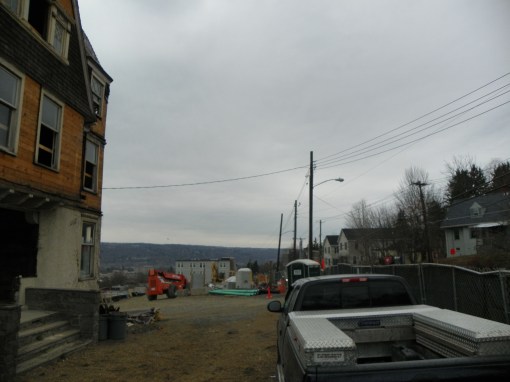
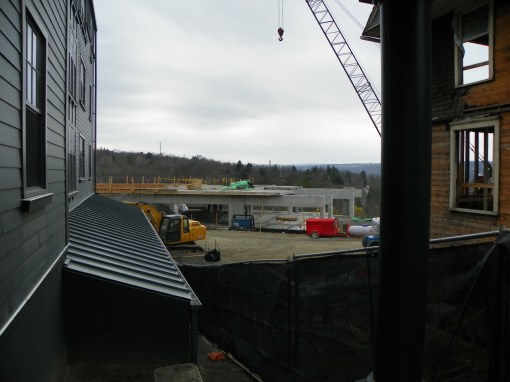
Collegetown Terrace. Perhaps the biggest visual change from the street was the stripping down of the historic Williams House, which is being renovated to its original dimensions and revitalized as part of the project. Further in, the foundation and parking garage facilities are being laid for the larger, more adventurous apartment buildings of Phase II. This section will be completed by next August, with phase III, with more shiny and overly modern apartments, completed  the following year.