How Does One Fill A Former Sorority House

8 12 2013

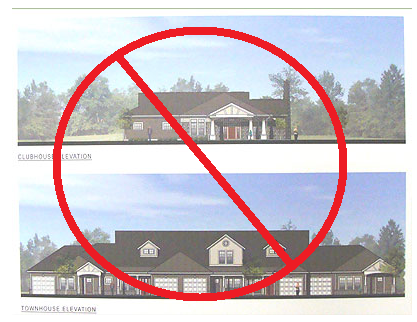
Image property of O’connor Apartments

This one was forwarded to me by an observant reader, L.D. It’s a listing on Craigslist for rentals available for June 2014 at 114 the Knoll (I always thought it was 115 the Knoll, but the listing photo matches my photos), which has served as a chapter house for a few different sororities over the years, the last being Alpha Xi Delta, which moved to another house on Ridgewood Road in 2010. More recently, the house has been occupied by a campus Christian group, Chesterton House. Chesterton’s house website notes a 2014 goal for purchasing a property near campus to serve as their permanent home, and I’m assuming that if this posting is up, then there’s a strong chance they succeeded in achieving that goal (if anyone knows where they decided to settle, feel free to comment or email me).

Quoting the listing:

“Beautiful arts and crafts house on North Campus available for June 2014. $750 per bedroom for 16 bedrooms plus utilities. Can hold up to 22 for the same price. Large living room with leather furniture. Banquet size dining room. Cook’s kitchen. You have to see to believe. Use [sic] to be a sorority. Email or call [redacted]”

This seems like a more unusual, and perhaps somewhat more difficult way to fill a large group home. Although the email links to the O’Connor Apartments property group, I don’t see it in their property listings, and I think they’re only handling the rental aspect of the house on behalf of another entity. My guess is that Delta Phi Epsilon sorority still owns the property, and with no short-term prospects of restarting their chapter, they need some way to try and keep revenue coming in for upkeep of the house. On one hand, they could sell to Cornell, which takes care of the tax issue, but then they’re at Cornell’s mercy – the house most likely becomes a dorm and there’s nothing Delta Phi Epsilon would be able to do, especially since they’ve gone a decade without an active chapter (there were attempts to re-colonize about three years ago, which did not materialize – the whole process being the subject of enough gossip at the time that one could have written a book about it). Yet another option is another private sale, like the home at 210 Thurston that was sold a couple years ago to the wealthy parents of a Cornell wrestler, renovated, and now serves as the home of Cornell wrestling team.

This is one of those houses that seems to routinely pass between groups at Cornell. I’ll be curious to see what happens.

Edit 1/23/14: Maybe I’m wrong about DPhiE still owning the property. I forgot that it was listed in July 2009 and sold in January 2010. Perhaps now the O’Connor Apartments firm owns the building.


Fast Facts: Tuition Rates

26 11 2013

To go with your Thanksgiving meals, here’s some food for thought, courtesy of the university factbook.

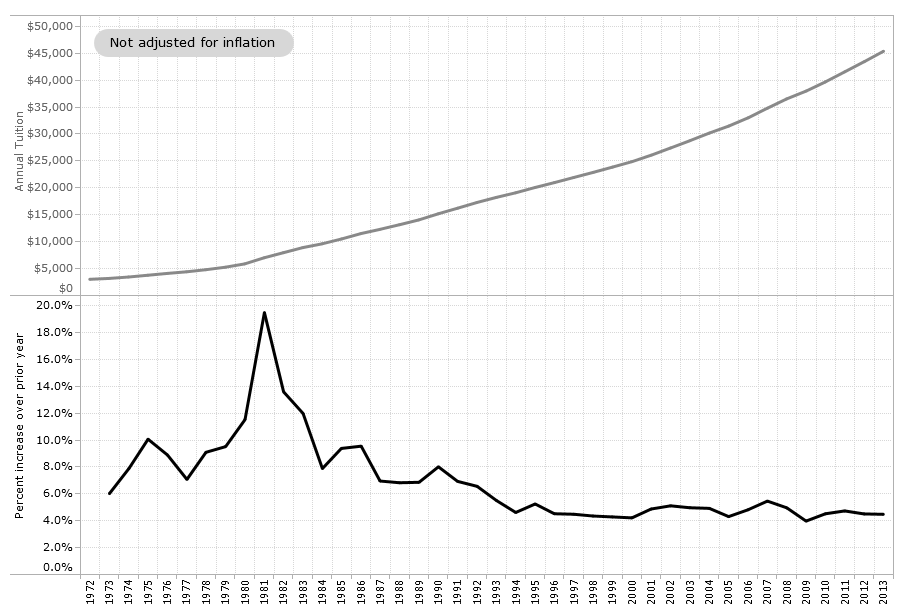
Tuition goes up in fits and starts. Consider the graph for the endowed colleges shown below.

Endowed_tuition

In 1973, tuition and fees added up to about $3,180, a 6% increase over the previous year. According to the inflation calculator from the Bureau of Labor Statistics, this is equivalent to about $16,727 dollars today. Put into further perspective, that was about the same price as a brand-new Chevy Chevelle Laguna Colonnade sedan. You know it’s a great car when it has that many names. Median household income was $9,226, so tuition was about 34.5% of the mean household’s annual income.

If the annual tuition hikes seem a bit high in the 1970s and early 1980s, it’s for good reason – this was a period known for stagflation, where the economy grew at anemic rates (if it all), while inflation continued to rise near 10% yearly. Fall 1981 was particularly shocking, with a 19.5% increase in tuition and fees over the previous academic year, from $5,860 to $7,000. Still, compared to today, that BLS calculator says $7,000 in 1981 has about as much buying power as $17,985 dollars today. Put another way, that was about 36.7% of annual household income in 1981 ($19,074). Or to illustrate the advances in computers, a top of the line IBM 5150 PC cost about $6k, with color graphics and a 256kb hard drive.

Since 1983, there have been no annual increases greater than 10%. By 1993, tuition and fees went up a relatively modest 5.5% to $18,226. With the exception of the 5.5% increase in Fall 2007, all other years in the two decades since have been less than 5.5%, falling somewhere between 4% and the low 5’s. Fall 2009 is the lowest at 4%, likely an effect of the Great Recession. Inflation-adjusted, tuition cost about $29,458 in 2013 dollars. Keeping with the theme, household income was $30,210 in 1993, or about 60.33% of annual household income. So through the 80s and early 90s, we’re starting to see this rapid relative rise in tuition vs. income, even though the annual increases have dropped off as inflation lessened.

Fast forward ten more years to 2003. The mean household annual income was $42,560. Knowing my own family’s finances, we were about a little below that average. Tuition in 2003 had increased 5% over the previous year to $28,754, or 67.6% of mean household annual income. Or to a working-class family like mine, it meant being told at a young age that if you didn’t get scholarships, you weren’t going to college.

The most recent estimate for mean household annual income is about $51,017. Tuition at an endowed college is $45,358 this year, a 4.5% increase over 2012. 88.9% of the mean household’s income in a year. There’s a reason why college debt gets so much attention these days.

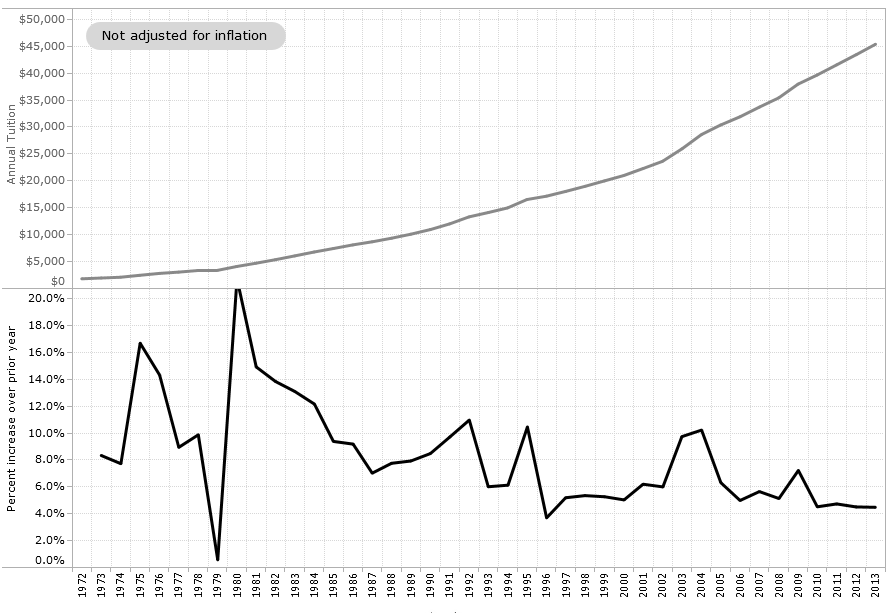
For the purpose of being all-encompassing, in-state tuition for the contract colleges, followed by non-resident tuition at those schools, is included below:

contract_nys_tuition

contract_non_nys_tuition

Year   Tuition (NYS/non-res)  nys:non-res   MHAI         Tuition as % of MHAI

1973   $1,350/2,100                  0.642              $9,226           14.6%/22.8%

1981   $2,800/4,700                 0.596              $19,074         14.7%/24.6%

1993   $7,426/14,106                0.526              $30,210         24.6%/46.7%

2003  $14,624/25,924             0.564              $42,560         34.4%/60.9%

2013   $29,218/45,358             0.644              $51,017          57.3%/88.9%

Note that 1981 is a little misleading, as in-state tuition was jacked up $500 dollars for Fall 1982. Everything moves slower in state government. Except the tuition hikes themselves, those seem to be increasing at a pretty good clip.

Now, all of this information sounds pretty scary, and sticker shock certainly is. But the mean household income would get a full ride to Cornell on grants and scholarships. I was fortunate enough that Cornell’s revised program kicked in before my junior year, and even before that, my contributions were very modest. My debt load is small enough that it will be paid off by next spring. Cornell enabled a working class kid like me to go to a top college. For that I am thankful. Have a Happy Thanksgiving.


News Tidbits 11/17/13: Hotels and Hazing

18 11 2013

100_1699

After a lull in new development proposals in the city of gorges, something new has come to the table.  Down in big box land, another hotel seeks to join the ten-year old Hampton Inn (66 rooms) and the recently-completed Fairfield Inn (106 rooms). According to Jason over at Ithaca Builds, the proposed “All Suites Hotel” at 371 Elmira Road calls for a 4-story, 54′ tall, 11,769 sq ft hotel with approximately 76 rooms, proposed for the site of a vacant office building and an auto body shop (both of which would be demolished). Looking at the aerial below, its proximity to the new Fairfield (upper right) is quite clear. Planning board agenda here, map of site here, site plans here, elevations/renderings here.

allsuites1

Although no brand is stated in the proposal, I suspect it might be a part of the Holiday Inn Express brand owned by Intercontinental Hotels Group. For one, the hotel is in the 60-80 room range as recently-built HIE hotels (see the recently-opened 74-room Holiday Inn Express in Cortland for example).  Reason number two, Intercontinental Hotels Group will lose its Ithaca presence once the license with the downtown property expires in January, and the Ithaca hotel market is generally strong enough that they might wish to maintain a slice of the hospitality market.

allsuites2

Although it’s pretty standard chain hotel fare, architectural work is being handled by Buffalo-based Silvestri Architects. Additional work will be undertaken by Optima Design and Engineering, also out of Buffalo (no surprise, the developer’s LLC also has a Buffalo address). Both organizations have previous experience with chain hotel construction and design.

Apart from that, other proposals in the city include a small amount of infill at the Statler Hotel, a two-family home on West Hill, and a 10,384 sq ft commercial building on Cherry Street. Ithaca Builds notes the Cherry Street proposal is a Crossfit Gym, to be housed in a rather industrial-looking 1-story structure with a pitched roof.

In other news, Cornell has beaten a proverbial hornet’s nest with a stick. The Cornell Sun published an article last Friday that the men’s lacrosse coach would be dismissed from his position.  The decision is widely suspected to be related to the suspension of the Lacrosse team from fall exhibition games after a hazing incident where allegedly freshman were forced to chug beer by senior team members. Unlike fraternities, where one merely has to wait before some chapter does something stupid, the lacrosse team is respected by its peers and a moneymaker for the university, so this seems unreasonably harsh. Given the commentary on the article, Cornell’s heavy-handed approach appears to have its share of critics. As a personal opinion, I feel the lacrosse team is being made an example of, to scare the other teams into playing nice. In the long run, I don’t think there will be much uproar until the university starts to go after large student groups outside the Greek system and athletics.  The more students who feel Cornell breathing down their necks, the more they’ll raise a hue and cry.

UPDATE 1/30/14: And it is in fact a Holiday Inn Express. I’m giving myself a gold star.


Fast Facts: Academic Staff and Faculty Trends

10 11 2013

100_5551

In the entry, faculty are defined as “part-time, clinical and acting assistant, associate and full professors”, while academic staff are defined as “instructors, lecturers, senior lecturers, teaching associates, research and senior research associates, research scientists and principal research scientists, extension and senior extension associates, librarians, associate librarians, senior assistant librarians, assistant librarians and archivists”. All data is taken from the Cornell University Factbook:

Total Aca Staff

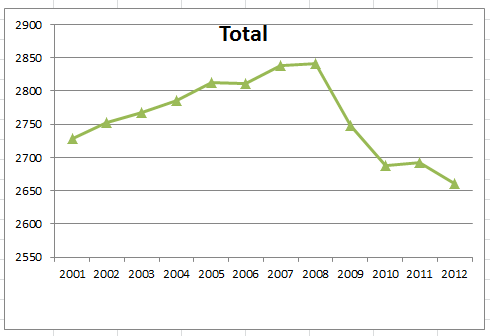
Fact number one – the number of academic staff has decreased, from 2,728 in 2001 to 2,660 in 2012. The number peaked at about 2,841 in Fall 2008, and has largely declined since then, as the Great Recession took its toll. CALS and Engineering appear to still be declining, with staff reductions near 10% in the past five years alone (704 to 654, and 306 to 280 respectively).  AAP has lost 14 positions in the same span, reducing academic staff from 69 to 55. Some schools, like the Hotel School and Law School, never really saw declines, while others such as HuMec and Arts & Sciences have started to rebound.

Faculty and Aca Staff

Let’s break down these numbers a little more, into faculty and academic professionals. Faculty numbers went from 1551 in 2001, to 1647 in Fall 2007 (its peak), to 1587 in Fall 2012. Academic staff went from 1,177 in 2001, to a peak of 1,219 in Fall 2005 (and a secondary peak of 1,208 in Fall 2008), and had decreased to 1,073 in Fall 2012. Let’s note that the student population has increased substantially since 2001, especially among the graduate student and professional student sub-groups.

Faculty Percentages

Overall, the faculty proportions haven’t changed too much. Slightly less assistant and full professors, and slightly more associate professors. It has been noted 47 percent of professors are over age 55, and 15 percent over age 65. Cornell had set a goal in Fall 2011 to bring in new blood and expand its faculty base by hiring 100 new faculty per year, but given these numbers, I’m doubtful that is occurring.

Aca Staff Percentages

With academic staff, the big decrease has been with those working in extension (Cornell Cooperative Extension). Some of these cuts were publicized, like the 17 staff that were laid off from ILR Extension in February 2009 (apparently, the Sun link no longer works since their website had to be rebuilt). Cornell Cooperative Extension comprises university outreach and research conducted as part of the university’s land-grant commitment to the state, mostly in agricultural concerns and community programs.

Aca Staff vs. Time

The drop in extension is illustrated further here. In 2001, it had 290 staff. In 2012, 0nly 213. The research staff went from 410 to 392 in the same span (note that there 454 researchers in fall 2008), and 126 to 110 librarian staff. Academic instruction staff increased from 351 to 358. Note that academic instruction staff does not include post-docs, as they are considered temporary employees of the university. Off-hand, given the salaries posted on sites like Glassdoor, I wonder if lower-cost lecturers and teaching associates are being hired in place of professors, and if the university has become more dependent on the cheap labor provided by grad students as their budget has tightened.


The Keyword Bar XX

2 11 2013

1. “pearl buck house ithaca” (10-27-2013)

That’s a bit of a tricky question. Pearl S. Buck, Nobel-winning author of “The Good Earth”, lived in Ithaca in 1924-1925 (she completed her M.A. at Cornell in 1925). Her first husband, John Lossing Buck, did a BS at Cornell in ag economics in 1914, and an MS in the same subject that was completed in 1925, and finally, a PhD in 1933. It would appear, based off a Cornell Sun article, that she once again lived in Ithaca from about summer 1932-1933. So most likely, one looking for the house she lived in would be looking for two different places in the Ithaca, the one from the mid-1920s when she was doing her degree, and the second in the early 1930s, when her increasingly-distant husband was completing his PhD. Not sure which time time this pamphlet refers to, but at least some of that time appears to have been spent in Forest Home.

2. “carl sagan’s secret tunnel” (10-27-2013)

One of the stories that enhances Carl Sagan’s mystique is that he somehow had a tunnel from his house to campus. That’s not feasible (there’s a gorge in the way), and perhaps some of its inspiration came from Ezra Cornell’s utility tunnel across the gorge from Sagan’s property at 900 Stewart Avenue. It seems he just preferred to you the back trails along the gorge to walk to his office and back.

3. “cornell prelims” (11-1-2013)

A word fairly unique in its use at the university, prelim is shorthand for “preliminary examination“, and in American usage, are normally applied as a synonym for the qualifying exam one takes to become a PhD candidate. The use of the term at Cornell, as a substitute to describe all non-midterm and final exams, dates back at least to the early 1900s.

4. “does cornell cals accept mostly ny state students?” (10-23-2013)

Cornell in general has about 29 to 30 percent of its freshman class arrive to its door from elsewhere in New York state. This SUNY 2013-2014 guidebook seems to peg CALS’s NYS enrollment proportion at 47 percent. I’ve had it understood that the difference in proportion was more because of the state tutition discount than it being “easier”, but it does look like the SAT scores in the contract schools in the 2013-2014 guidebook are lower than the university average. Speaking strictly from a numbers standpoint. I have no interest in humoring Ann Coulter’s wet dreams.

5. “where was zinck’s, ithaca, ny” (10-21-2013)

Zinck’s, or at least the Zinck’s referred to in “Give My Regards to Davy”, refers to “The Hotel Brunswick” lager beer saloon and restaurant that Theodore Zinck ran from about 1880 until his suicide in 1903. Zinck’s was located in the old Ithaca Hotel at 108-110 North Aurora Street; the building was torn down in the late 1960s, a victim of urban renewal.


Cornell Graduation Rates

25 10 2013

4-8-2013 231

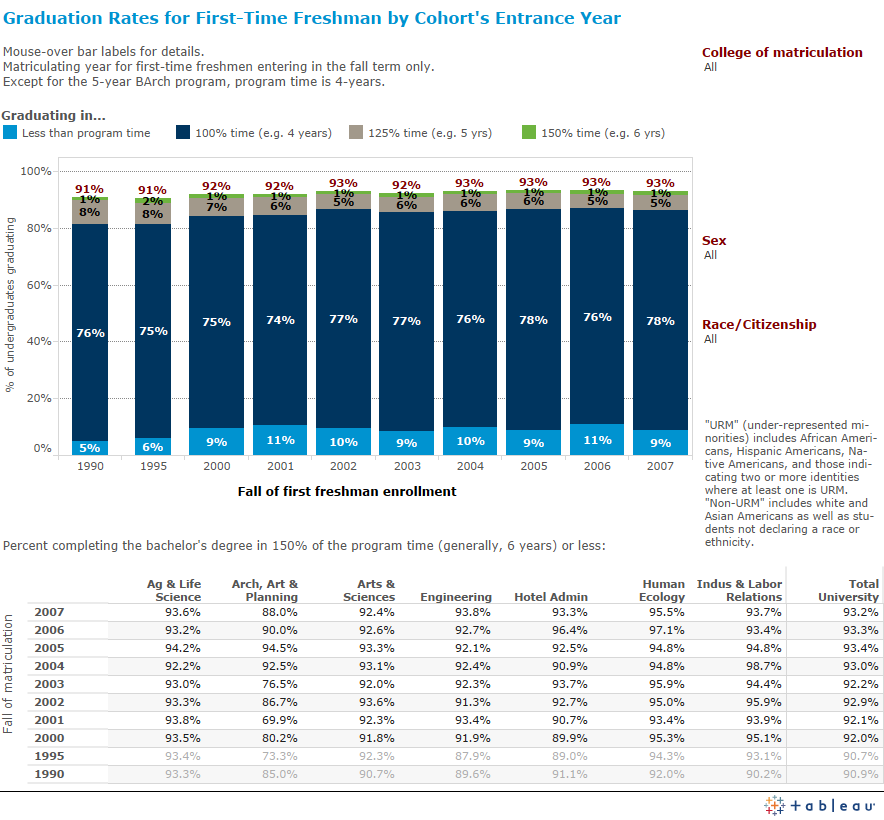
Graduation; perhaps the most important part of the Cornell experience. Facts are from the university factbook, as is the image below:

Freshman_grad_rate_trends

-For freshman who started in Fall 2007 (graduating 2011-2013), the overall university graduation rate (frosh who finish in six years or less) was 93.2%. Human Ecology set the standard at 95.5%, with most of the other schools clustering near the average, except for AAP, which polled at only 88%. Arguably, AAP’s number are more prone to skewing, since they’re the smallest college and it takes 5 years to complete architecture degrees; but the facts are what they are, AAP usually ranks below average, and is often the worst of the seven colleges for graduation rates.

-Over the decade, graduation rates jumped in the first half from 92 to 93.4%, but have dipped slightly since. The number still poll better than the 1990s, when graduation rates were just under 91%. The localized max is 98.7% for Fall 2004 ILR freshman, and the local min is the 69.9% for fall 2001 AAP freshmen. Compared to the 1990s, students seem to averaging a slightly quicker completion of their courses of study, with an increase in the less-than-4 year path, and a decrease in the percentage of super-seniors.

-Women consistently graduate at slightly higher rates than men. In 2007, 95% of women graduated within six years, vs. 91% of men. This is consistent across schools and in most years, though in some years the gap is as low as 1%, but the gap has trended slightly larger in the past few years.

-University-Recognized Minorities (URMs, referring to non-white and non-Asian students) graduate at slightly lower rates, 88% for those starting in fall 2007 (the value has been in the upper 80s for most of the past decade). URM males fare worse, at 85% for fall 2007’s freshman class. For African-American males, the rate has been as low as 75% in recent years.

-International student finish at rates not substantially different from the general student body, but they finish in less than 4 years at much higher rates – 20 to 30% of those freshmen will finish early. If I remember correctly (i.e. I can’t seem to find anything to back this up), certain countries, like Singapore, push their students to finish as quickly as possible.

-About 1 out of every 8 students will graduate from a college different than the one they were enrolled in as a freshman (ex. started in Arts and Sciences, finished in CALS). There’s no real trend over time, or for school transfers (evidence that AEM is trying to become more exclusive?)

-Transfer students graduate at rates virtually identical to those who started at Cornell as freshmen, with the exception of AAP, where they do not do as well. Once again, small incoming transfer numbers can skew this figure easily.

-About 3-4% drop out after freshman year. From there on, about 1-1.5% who finish their sophomore or junior year will not come back for the subsequent year of their matriculation.


News Tidbits 10/15/13: Ithaca’s Had Better Weeks

16 10 2013

purity_design_dead

It’s weeks like this that make me want to crawl into bed.

News piece one – The only piece of news that isn’t bad.  the Holiday Inn-turned-Hotel Ithaca will be taking a little longer than expected. Not a bad thing, just the schedule being re-arranged; the old hotel portion will be renovated in phase one (November 2013 – May 2014) and keep its 90 employees throughout the process. The conference center will now begin construction in March 2014, and the new hotel tower will start construction in May. If it keeps people employed, then I’m certainly not going to complain.

News piece number two – the Purity Ice Cream apartment project is dead, as Ithaca Builds reported yesterday. The reasons cited were “market conditions”, which I’m disinclined to believe, but then, I don’t know what numbers they’re running with. The building will still be renovated and add about 2,600 square feet of office space on the second floor, including a little rooftop terrace. You’re right IB, this is a bummer.

The latest planning board agenda suggests nothing particularly new or exciting, unless you count adding space down in big-box land.

News piece number three, four, etc – The Syracuse Post-Standard seems to be having a field day running all these crime reports from Ithaca.  The nutjob looking for his lily-white nymphs seems to be a hit with the commentariat.

So…better luck next week, I guess.


A Bigger Vet School

10 10 2013

cropped-100_1794.jpg

I’ve only ever been in the vet school once, to deliver an invitation for a wine and cheese event to an alum of my fraternity house who worked as a researcher at the vet school.  When it came to getting photos, I would just take advantage of my Bradfield perch, take my photos, and that was that.

The vet school is not unlike the rest of the school in that it’s been built in spurts. The original vet school was in James Law Hall, where Ives Hall stands now (and even prior to that, it shared space in the north wing of Goldwin Smith Hall, the old dairy science building). The vet school moved further east with the construction of Schurman Hall in 1957, and expanded with the Vet Research Tower in 1974, the Vet Education Center and Vet Medical Center in 1993 and 1996, and the East Campus Research Facility and Vet Diagnostic Lab in 2006 and 2010 respectively.  Essentially, the vet school is like many human hospitals, a mish-mash of additions and new wings/buildings, incoherent and even incompatible. The completion of the the  VDL building left a large amount of vacant space in Schurman Hall that was difficult to repurpose, hence the approved plan – demolish 68,000 square feet of space, build 65,000 square feet of new space, and renovate 33,000 square feet of existing space, to be done in two phases with a combined cost of $63 million.

Looking east from Tower Avenue. Rendering property of Cornell.

Looking east from Tower Avenue. Rendering property of Cornell.

Given those stats, it seems like a misnomer to call it an expansion, but one of the effects of the reconstruction will be to increase the number of matriculating vet students in a year from 102 to 120 – and given Cornell’s #1 vet school ranking, they will not be lacking in applicants. Over four years, you have 72 more professional students – you’re welcome, Ithaca landlords. Among the details, the old auditorium will be torn down, and in its place comes the new Flower-Sprecher library, two new lecture halls, a new dining hall, large gathering spaces (i.e. yet another open atrium) offices, an expanded anatomy lab, and a green roof. The architects of this plan are New York-based Weiss/Mandfredi, who specialize in hypermodern glassy spaces.

Looking west from new courtyard. Rendering property of Cornell.

Looking west from new courtyard. Rendering property of Cornell.

As for the time frame, Phase I, which comprises the tear-down and new construction, will start in April 2014 and be completed in a 12-month time frame. Phase II, the renovation component, will commence at that time and proceed towards a tentative completion in October 2016. I will already be beyond my 5-year reunion, so that kinda freaks me out.

Straying a bit here, but I’ve heard from my vet school friends that the market isn’t absorbing new grads like it used to, and not at the salaries that it used to. A for-profit school planned for Buffalo was recently cancelled. But, I suppose for the #1 school, these are concerns that the college is reasonably shielded from. Adopting a dog in the next couple years is on my priorities list (if I can ever establish enough of a schedule that makes me feel like I’d have adequate time to love it), so in my totally uneducated opinion, more vets is fine by me.


News tidbits 10/2/13: Old People and Affordable Housing

2 10 2013

A smattering of news articles worth noting, but not worth going to the trouble of giving their own articles…

lanpres_canc

1. Lansing Reserve is dead. The 65-unit project slated for a wooded parcelnorthwest of the intersection of 13 and Warren Road has been bought out by the village of Lansing, which intends to use the space as a “park”. The project, originally proposed in early 2011, has been beset with issues since the first public meeting, with concerns of traffic and wetland protection and “ruining the unique of [the] village”. Apart from Wal-Mart, it’s probably the only project I’ve seen proposed in recent years that the locals created their own websites and exaggerated figures/renderings in their efforts to oppose the project. Lansing town and village seemed to have struck an anti-development tone in the past several months, with this and the cancellation of the town’s sewer project (again).

2. Meanwhile, the same two groups that proposed Lansing Preserve are now looking to develop a parcel in the town of Ithaca, on West Hill near the hospital (aka the Biggs property). The town put out a request for bids on the parcel in late summer 2012, which I covered previously. Nothing formal proposed yet, but the project is expected to contain about 60 townhomes in the affordable housing market range (30-90% of local median income). Shades of Lansing playing out here, as the anti-development Ithaca West neighborhood group has been opposed to the sale of the parcel, let alone its development (the reasons cited – traffic and an increase in crime). However, their stance pits them against Ecovillage and their connections, so this should be an entertaining show. Ithaca Builds provides more coverage here.

3. Deep-pocketed retirement facility Kendal at Ithaca is preparing an expansion of its own. The 212 unit (indepedent living) and 71-bed (assisted/skilled care) facility plans to add 24 more indepdent living units (the parcel allows a max of 250) and 13 more beds to its skilled care group. This would be achieved with the construction of a new 2-story apartment building and three new 1-story wings for the reconfigured skilled care space. Chiang O’Brien are the architects and the project should be completed in the spring of 2014. Kendal at Ithaca first opened in 1995. to by Cornell-centric readers, the only reason you might care about this is that the facility hosts a sizable number of retired CU faculty/staff.

-65+60+24 = +19 units. Well noted.

Kendal_1


Just Passing Through

28 09 2013

9-24-2013 066

So I made the annual pilgrimage back to Ithaca and Cornell for Homecoming. I’d love to say something about how I go back to reminisce about the quality education and think fondly of the many opportunities provides.

But I don’t. I could care less about football, and that plastic wine-glass thing that gave out as a Homecoming gift struck me as so unnecessary in my own home (where we be all fancy and use real glass) that I never even bothered checking in. I went back to see some old faces and attend my fraternity’s annual meeting, where I like to give uncomfortable glances whenever I hear/read things that are disconcerting, like steep increases in expenses, or membership decline, or things in those vein. Since none of their current membership were students while I was, I am able to get away with being a 24-year old curmudgeon. I also had a chance to see a pair of friends (one works at IC, the other is a Cornell PhD student), do acts of young alumni drunkery, and go to the Cornell Orchards for the first time ever.

Since I kept busy, I kept noticing things that I would otherwise hold off on commenting on. Like when I was doing a 4-mile morning run with my best friend, who is a Cornell employee, and we went past the Vine Street Cottages (I did not see any new homes in construction from the trail-side, but I am hopeful they’ve sold another lot or two). I could’ve went running with a camera. Could’ve cancelled lunch plans or dinner plans. But I didn’t. I know Ithaca Builds has a pretty firm grasp on these things. I passed a random house under construction near Honness Lane, and another later in the day on Hanshaw, near Freese Road. As my day went on, I kept taking mental notes, driving past the Goldwin Smith site work, Gates Hall, Seneca Way, Collegetown Terrace, into the city and past Breckenridge Place, and in an attempt to find parking for a West End restaurant, ended up seeing the structural framework going up for the new Planned Parenthood building. For better or worse, this is how my mind is wired. Two of my friends asked if I knew anything about Collegetown Terrace, and I was able to rattle off enough “fast facts” in twenty seconds that they commented that they were surprised and impressed.

It occurred to me in previous years, I would’ve been busting my hump trying to find time to dig out my camera and do a photo tour. But this year was different. I took it easy, I knew I had my stories, and Ithaca Builds has theirs, and they complement each other well. So I could take a deep breath. I could enjoy the extra time. I spent the afternoon before I left not running around like a man on a mission, camera in hand, but at my old fraternity, gathered around the open-porch lounge with about 15 of my contemporaries, some of whom I hadn’t really had a chance to talk to in ages.

It’s odd to say I don’t regret not coming back with a metric ton of photos, but this time around, I feel like my trip back was more fulfilling without them.

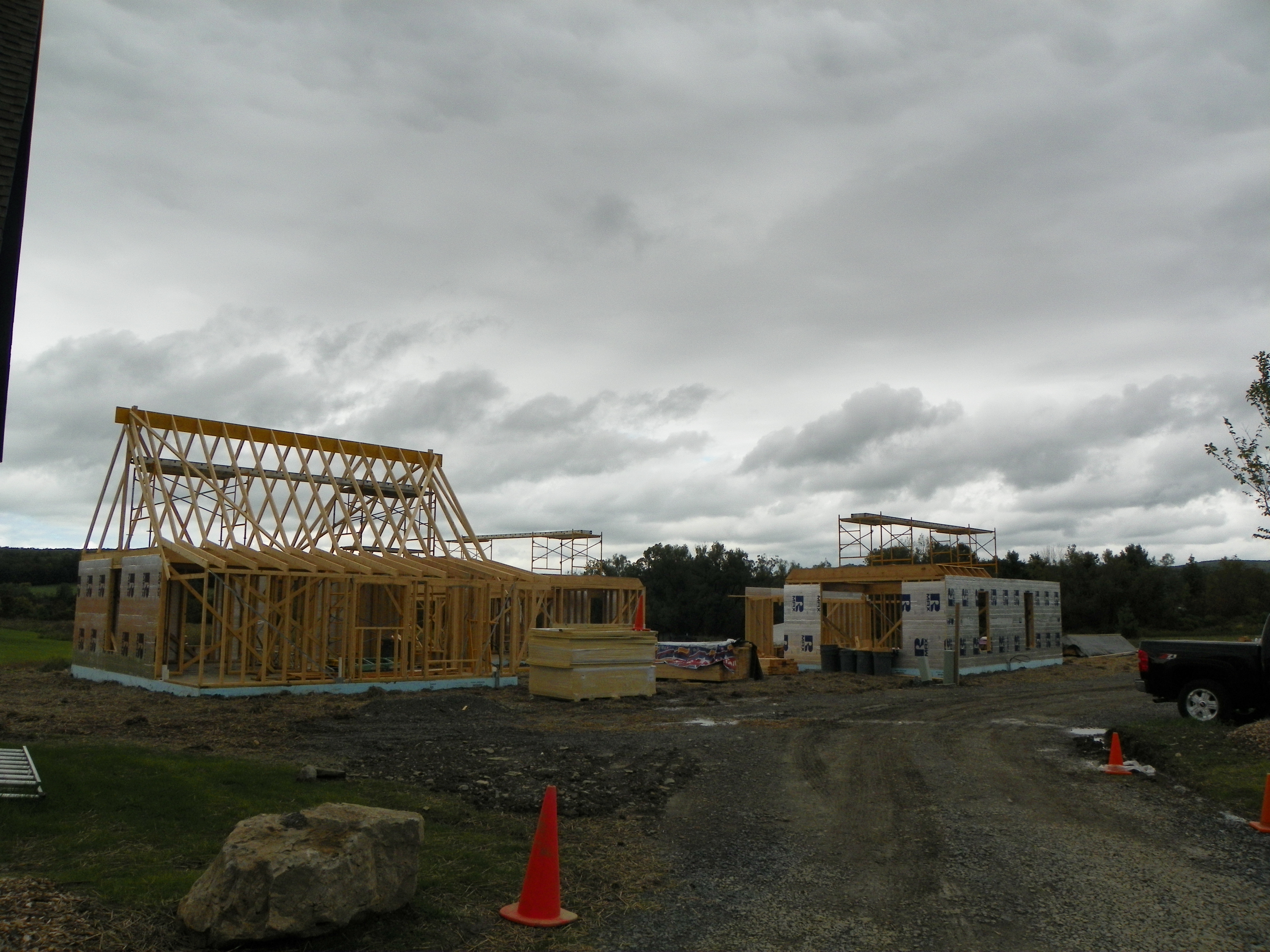
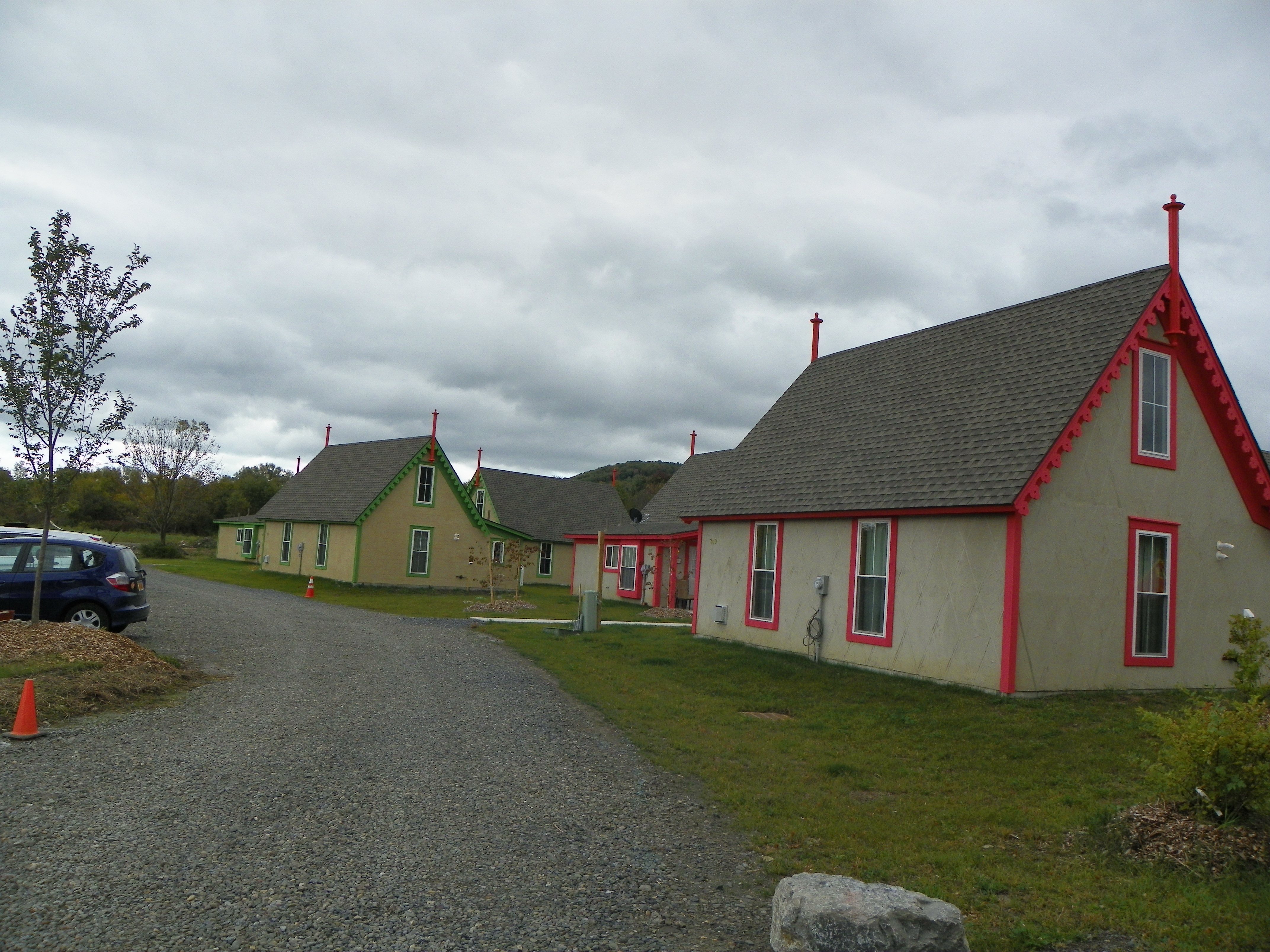
But, on my way out of town on 79, I did take photos of the Boiceville Cottages, since they’re outside of Ithaca Builds‘s usual haunts. Comparing to my April photos, Looks like they’ll have built at least 15 units this year.

9-24-2013 095 9-24-2013 096 9-24-2013 097 9-24-2013 098