News Tidbits 11/21/15: Building and Rebuilding

21 11 2015

inhs_pride_design_v5_2 inhs_pride_design_v5_3

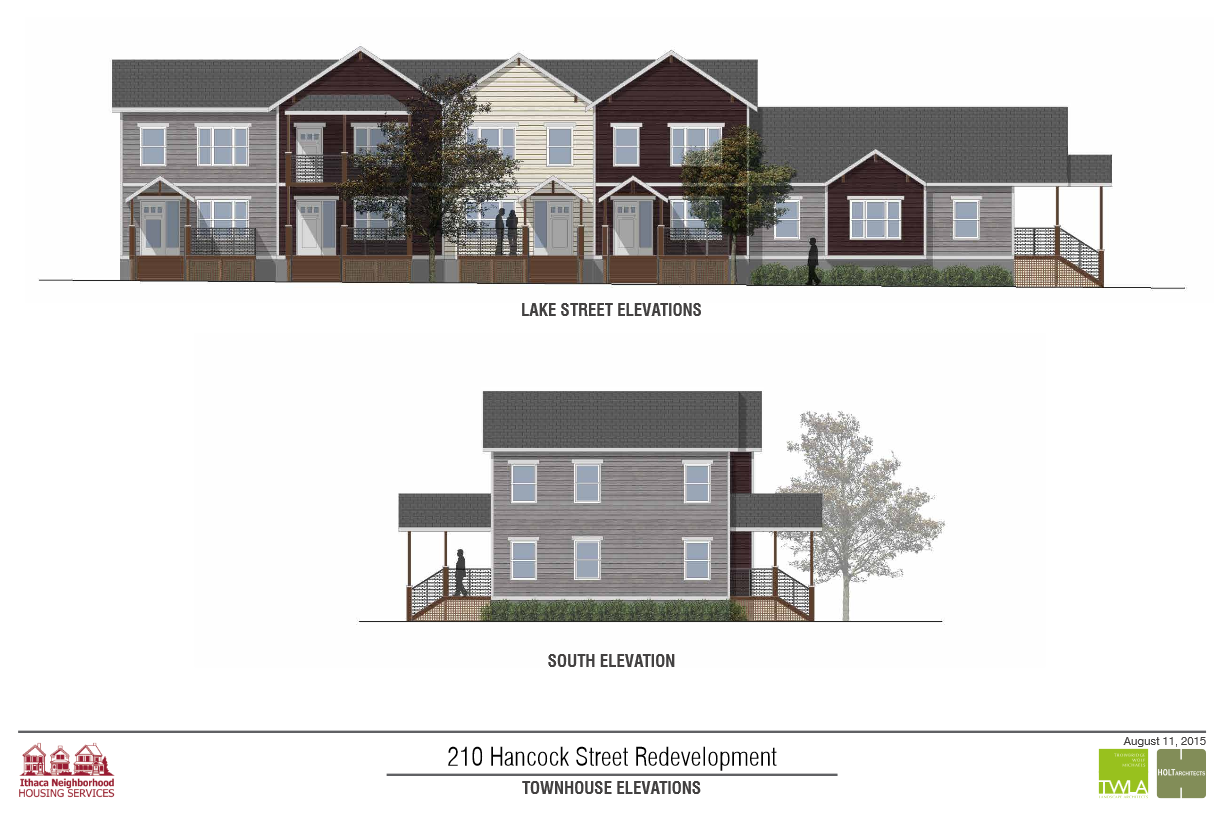
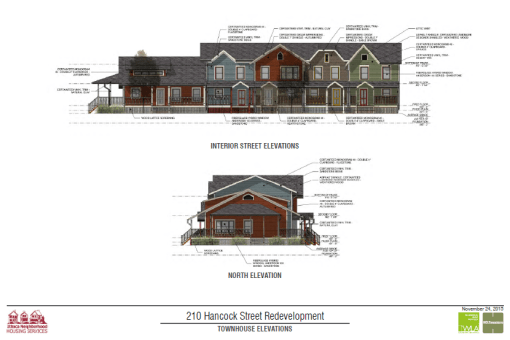
1. Starting off this week with some eye candy, here are some updates renders of the townhouses proposed for INHS’s 210 Hancock project in the city’s North Side neighborhood. Details and project status here. 210 Hancock has been approved by the Planning Board, and Cornell, the city and county do have dedicated funds ($200,000 total) going towards the affordable housing units, but still needs to be seventeen conditions prior to receiving a construction permit, one of which required revised townhouses to better reflect the neighborhood. The Common Council also need to vote to discontinue using the sections of Lake Avenue and Adams Street on which the new greenways and playground will be constructed, which apart from the time needed and paperwork generated, isn’t expected to encounter any obstacles, with formal conveyance to INHS anticipated by March 2016. INHS is shooting for a May construction start.

The Planning Board will be voting on “satisfaction of site plan approval” at its meeting next Tuesday, which should be a fairly smooth procedure, if the paperwork’s all correct.

Personal opinion, the townhouses, with more color and variation in style, appear to be an improvement over the previous version. These five will be rentals, while the other seven will be for-sale units, and built in a later phase (government funding for affordable rentals is easier to obtain than it is for affordable owner-occupied units, so it could take a year or two for those seven to get the necessary funding). The apartments have not had any substantial design changes since approval.
inhs_pride_design_v5_1

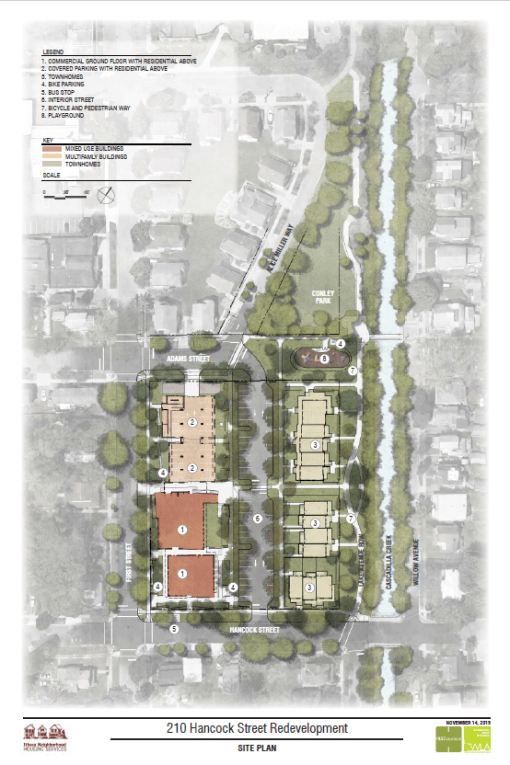
For what it’s worth, here’s the final site plan. The rental townhomes will be on the north corner of the parcel, furthest from Hancock.

2. Turning attention to the suburbs, someone’s put up some sizable chunks of land for sale in Lansing village. The properties consist of four parcels – 16.87 acres (the western parcel) for $500,000, right next to a previously-listed threesome of 28.07 acres (the eastern parcels) for $650,000. The eastern parcel also comes with a house, which the listing pretty much ignores. Lansing has it zoned as low-density residential, and given the prices (the western parcel is assessed at $397,600, the eastern parcels at $561,100 (1, 2, and 3)) and being surrounded by development on three sides, these seem likely to become suburban housing developments, possibly one big 30-lot development if the parcels are merged. For the suburbanites out there, it’s something to monitor.

20151108_133542 20151108_133710

201_w_clinton_1

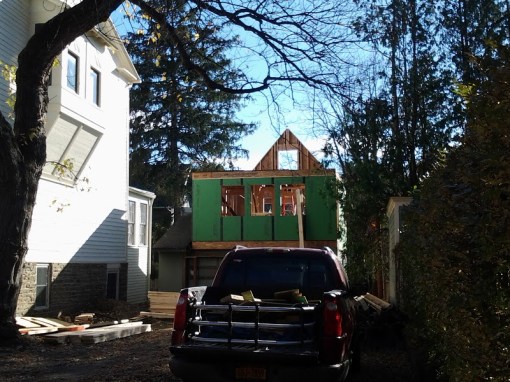
3. House of the week – or in this case, tiny house of the week. The 1-bedroom, 650 SF carriage house underway at 201 West Clinton Street draws inspiration from 19th century carriage houses, which makes sense given that it’s in Henry St. John Historic District. It and the main house are owned by former Planning Board member Isabel Fernández and her partner, TWMLA architect Zac Boggs. The two of them did a major and meticulous restoration of the main house, which used to house the local Red Cross chapter, a couple of years ago (more info on that here).

Anyway, the framing is underway and some ZIP System sheathing has been applied to the exterior plywood. No roof yet and probably not much in the way of interior rough-ins, but give it a couple of months and that 1960s garage will be given a new life as a tiny house.

travis_hude_libe_libe_v3

4. Time to take a look at the Planning and Development Board agenda for next Tuesday. For reference, here’s what a typical project guideline looks like:

PDB (Sketch Plan) -> PDB (Declaration of Lead Agency) -> PDB (Determination of Env’tal Signif., PDB BZA reccomendation if necessary) -> BZA (if necessary) -> PDB (prelim/final approval).

Here’s the meat of the agenda:

A. 210 Hancock – Satisfaction of Conditions of Site Plan Approval (see above)
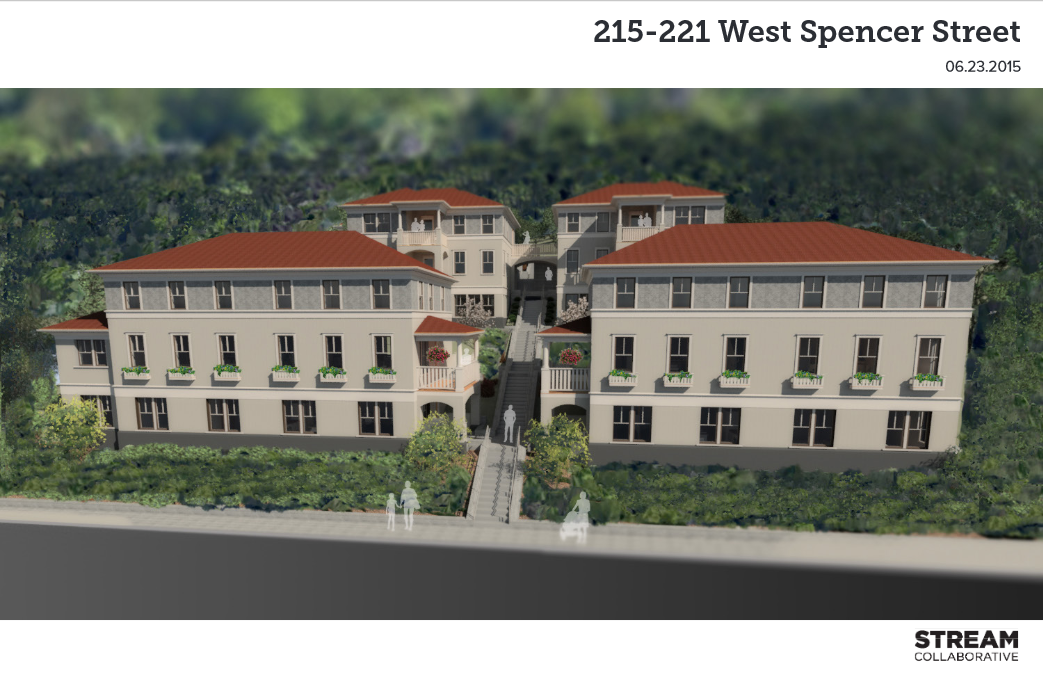
B. 215-221 Spencer St. – Consideration of Prelim/Final Site Plan Approval  – this one was first presented as sketch plan in March, to give an idea of how long this has been in front of the boards
C. 416-418 East State Street – Determination of Environmental Significance and Recommendation to the BZA – “The Printing Press” jazz bar is a proposed re-use for a former printshop and warehouse that has seen heavy neighbor opposition. The bar has changed its emphasis, redesigned the landscape and moved itself to a more internal location to mitigate concerns, but the opposition is still strong, mostly focusing on noise and traffic. The board has simply and succinctly recommended that the BZA grant a zoning variance.
D. 327 Elmira Road – Determination of Environmental Significance and Recommendation to the BZA – The Herson Wagner Funeral Home project. This one’s had pretty smooth sailing so far, only a couple complaints that Elmira Road isn’t appropriate for a funeral home. The Planning Board, however, applauds the proposal, which replaces a construction equipment storage yard, for better interfacing with the residential neighbors at the back of its property. It has been recommended for BZA approval.
E. Simeon’s on the Commons Rebuild – Presentation & Design Review Meeting – Before anyone throws up their arms, this is only to talk about the materials and design of the reconstruction, and to get the planning board’s comment and recommendations.
F. The Chapter House Rebuild – Sketch Plan – The Ithaca Landmarks Preservation Commission (ILPC) must have come to some kind of acceptance on the proposed rebuild if the Chapter House is finally at the sketch plan stage. the Planning Board will have their own recommendations, which will have to be coordinated to some degree with the ILPC (the ILPC is arguably the much stricter of the two). We’ll see how it looks next week.
G. Hughes Hall Renovations – Sketch Plan – more on that in a moment
H. DeWitt House (Old Library Site) – Sketch Plan – originally slated to be seen a couple months ago, but pulled from the agenda. The 60-unit project is not only subject to Planning Board review, but ILPC review since it’s in the DeWitt Park Historic District.

5. So, Hughes Hall. Hughes Hall, built in 1963, has dorm housing and dining facilities for Cornell students attending the law school, but those 47 students will need to find alternative housing once the hall closes in May 2016 (yes, with Maplewood closing as well, Cornell is putting 527 graduate and professional students out on the open market next year…it’s gonna be rough). However, this has kinda been known for a while. Cornell has intended to renovate Hughes Hall since at least 2011, as Phase III of its law school expansion and renovation. The building was used as swing space while Phase I was underway, and then the phases were flipped and Phase II became Hughes Hall’s renovation, while Phase III became Myron Taylor Hall’s renovation. According to Boston-based Ann Beha Architects, who designed the law school addition (Phase I), the Hughes Hall renovation will “house offices, administrative support spaces, academic programs and meeting spaces.” Well see how the renovated digs look at Tuesday’s meeting.


The Swinging Pendulum of the CIITAP Program

17 11 2015

20151011_144907

If I had seen this before the Friday news roundup, I’d have included it there. But since I have no Monday night post scheduled this week, discussing the latest changes to CIITAP will be a fair substitute.

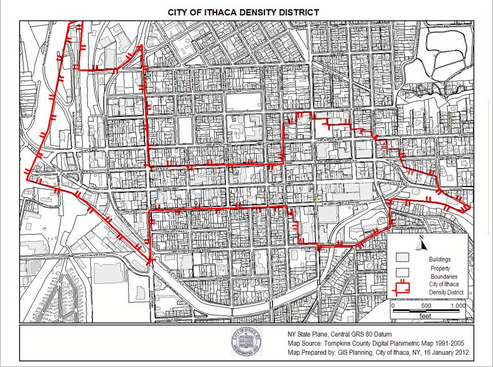
So, background. CIITAP stands for Community Investment Incentive Tax Abatement Program, and it’s a property tax abatement program that gives developers the opportunity to apply for abatement for a portion of their property taxes for a period of up to 7 years, or for an enhanced abatement of up to ten years if they can demonstrate financial hardship (i.e. without the abatement, there’s no way the project will be cost-effective; if it’s not cost-effective, a bank won’t offer construction loans, and the project doesn’t happen). Basically, it’s a tool designed to promote development in certain parts of the city where density is expected and/or encouraged, rather than lose tax-generating and job opportunities to the suburbs. A more substantial description can be found in a write-up for the Voice that I did back in January here.

The first version, which went into effect in 2001 as the Downtown Density Program, led to five projects being built, six if you split Cayuga Green into its garage and mixed-use components. The projects were worth about $62 million, and the earliest ones are now paying full taxes. Then the city decided it wanted more from the density incentive, and it created the CIIP Program, which was created in 2006. Over the following six years (2006-2012), that led to just one project, the $3.5 million Ital Thai renovation on the Commons. Part of it was that from 2006-2007, there was a moratorium on abatements, and another part was the recession. But another part of that was that CIIP was really lengthy and burdensome it had 48 stipulations, and a project had to meet 15 for partial assistance, and 23 for full assistance. It was so much paperwork that developers were disinterested and opted for other parts of the county.

ciitap_map

Onto round three, the current CIITAP – much more simplified, it initially had three stipulations – one, that it be in the density district; two, that it was a $500,000 investment in either a new building, or in the renovation of a historic building; and three, that if a new building, that it be at least three floors. A fourth was later added that said that all your other properties had to be up to code and have no outstanding violations, which arguably was a tacit response to Jason Fane’s application for 130 East Clinton while he let the Masonic Temple rot. However, in the past couple of years there have been complaints from various groups that the city wasn’t getting enough out of the bargain. You can kinda see how the pendulum swings – the political consensus is that the first version was too generous, the second version two burdensome, and the third version too generous.

The city put together a study group to examine revisions to CIITAP, chaired by a Common Council member (Ellen McCollister of the 3rd Ward), and consisting of City Planning and IURA staff, a representative from TCAD, a representative from a local labor union, a developer, and a representative from the Coalition for Sustainable Economic Development. In short, the city’s trying to get a broad spectrum of perspectives. The revised CIITAP is to presented at the PEDC meeting Tuesday night.
Here are the goals:

1. Retain the program as an effective tool to incentivize smart growth and discourage sprawl
2. Improve the program’s ability to deliver broad community benefits that may include:
*** An increased use of local labor
*** An increase in living wage job creation
*** More environmentally friendly building
*** Increased economic opportunities for people of all backgrounds

Note that given the previous versions, they’re easier said than done.

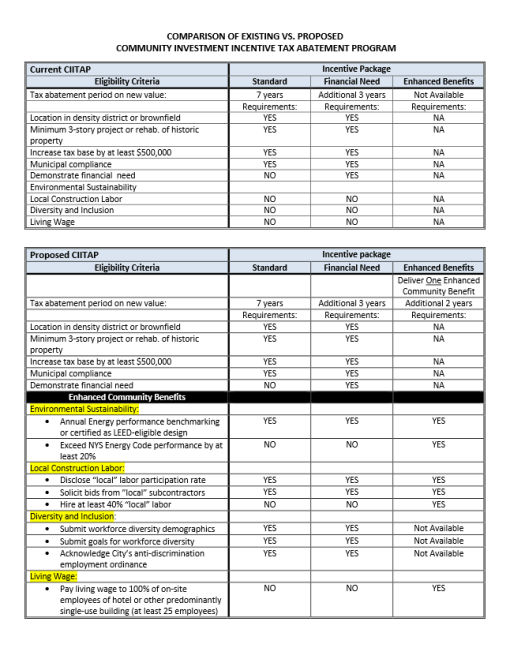
ciitap-revision

In addition the standard 7-year and 10-year abatement, there’s also a new very stringent “enhanced” 12-year abatement option. All the 7-year and 10-year stipulations carry over, but now there’s a few more requirements on the list in four categories – “Environmental Sustainability”, “Local Construction Labor”, “Diversity and Inclusion”, and “Living Wage” .

  • In the “Environmental Sustainability” category, the new rule on the standard 7-year abatement and 10-year abatement is one of two two choices. The first choice is an annual benchmarking of energy usage during the abatement period using free software from the EPA. The report would be given to the city, IDA and made public, to prove the building is using energy at the level designed. The second choice is that they could submit paperwork indicating they’re pursuing LEED Certification, and provide proof of certification upon completion.
  • The “Local Construction Labor” category defines “local” as tompkins or any of the counties it borders (Cayuga, Seneca, Schuyler, Chemung, Tioga, and Cortland Counties — so no Syracuse, Rochester or Binghamton). In order to be eligible for a tax abatement, an applicant must commit to the City in writing and submit to the IDA proof that the general contractor has solicited bids from local sub-contractors for all major trades required for the construction project, such as HVAC, electrical, plumbing, carpentry and masonry. Secondly, they must submit a copy of their monthly payroll monthly payroll reporting of all workers on site during construction with a summary of how many employees are “local”, using the address, zip-code, and total payroll amount per employee. I’m not sure if all this will be public info – privacy advocates might push for keeping the employee address and payroll information confidential to the city and IDA.
  • In the “Diversity and Inclusion” category, the new requirement for all applicants is a company or primary tenant’s workforce demographic analysis by gender, race/ethnicity, age, disability, job class with gender, and job class with race/Hispanic ethnicity; as well as acknowledgement they have read and understood the City’s Anti-Discrimination employment ordinance; and a statement of their company’s or the major tenant’s goals for workforce diversity.
  • The program does touch on an affordable housing fund or mandate, but it’s stated that members don’t feel CIITAP can adequately address affordable housing, and the committee recommends exploring inclusionary zoning.

Under this plan, the number of stipulations for the 7-year and 10-year abatements goes from four to seven. The rest of the procedure is as before – the city holds a public meeting, then decides whether or not to endorse the project, and it goes to the county (TCIDA) for their vote, which is typically in line with the city’s recommendation.

Now, a new option is the 12-year “super-abatement”. Along with the demonstrated financial need, a project must also commit to one of the following – 40% local labor, energy usage 20% less than NYS Energy Code Requirements, or living wages for single-use entities like hotels. This is in addition to the previous stipulations for 10-year abatements.

So now’s the magic question? Will it be acceptable to the broader community? The city’s HR director wrote in an email attached to the PEDC agenda that the program doesn’t do enough for diversity, and needs to mandate rather than encourage it. Without a doubt, this whole program, as we’ve seen in the past fifteen years, is a delicate balance between encouraging density while getting community benefits. Hopefully, the abatement pendulum stops swinging and it finally comes to rest in a comfortable middle ground.


Klarman Hall Construction Update, 11/2015

15 11 2015

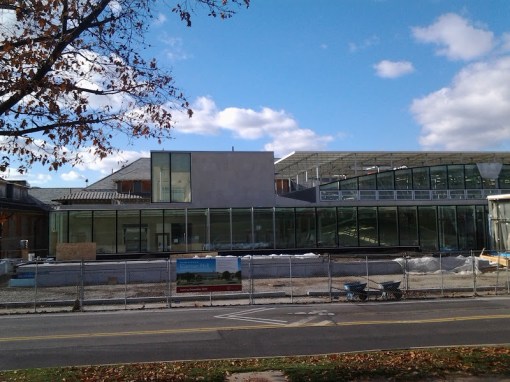
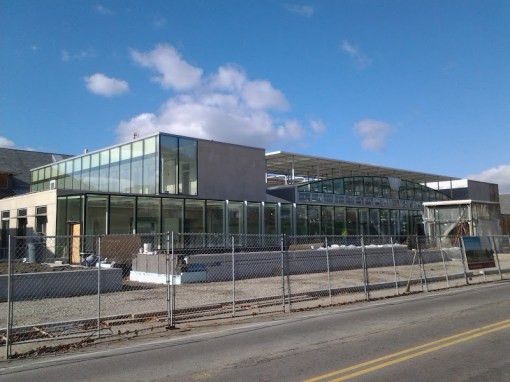
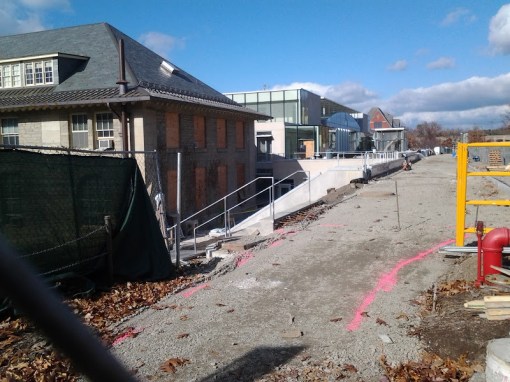
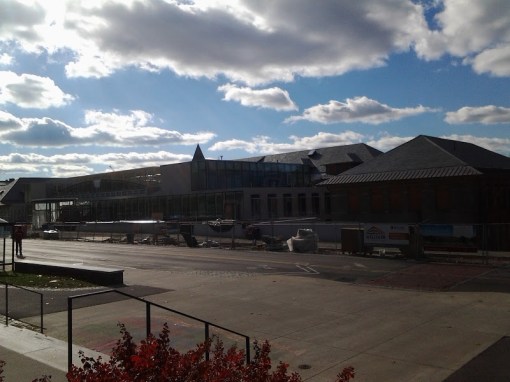
Klarman Hall is nearly ready to open its doors. The atrium’s being painted, some glass on the East Avenue entrance needs to be installed, and landscaping still needs to be done, as well as some work putting windows back into the construction-facing walls of Goldwin Smith. But apart from that and some finishing work on the inside, this project is almost done. New trees won’t be planted until the Spring, so that they don’t have to fight for survival through the winter while adjusting to a new environment.

Additional images of the project (including aerials!) can be found on Landmark Images here. Additional project information is available on Cornell’s website, or the umpteen million posts discussing this project over the past two years that it’s been under construction. Welliver and LeChase Construction were the contractors for this project, and Boston-based Koetter | Kim & Associates is the project architect.

This is just meant to be a short thing, but there might be an expanded Voice piece once this project approaches its ribbon-cutting in January.

20151108_125420 20151108_125449 20151108_125526 20151108_125601 20151108_125621 20151108_125703 20151108_125726

klarman_1


News Tidbits 11/14/15: To Plan or Not to Plan

14 11 2015

It’s another slow week. There was no PEDC meeting in Ithaca city, and no new projects hit the airwaves. But there might be some interesting things moving forward.

1. The Lansing Star has an insightful interview this week with newly elected Lansing town supervisor Ed LaVigne, who unseated incumbent Kathy Miller for the seat. From a development standpoint, it’s very interesting. From the interview, it sounds as if, given the possible loss of their biggest taxpayer, the $60 million Cayuga Power Plant, he kinda wants to throw the door open to developers in an attempt to soften the blow of its closure. In Lansing, there was a political divide when it came to planning – the Democrats wanted a full-time planner, but the Republicans wanted a part-time planner. The budget item for a full-time planner was eliminated along town board party lines, 3-2, and Lansing is currently served by part-time planner Michael Long.

20151011_124916

“That’s why it’s so critical to start moving some dirt, getting things built.  One of the things I’ve already told developers is that Lansing is in business.  How can we make you more prosperous?  We believe in prosperity.  And if you’re prosperous we all will benefit.  I don’t care how much money they make.  I hope they make more money than they ever dreamed of, because if they put their money in Lansing, Lansing wins.”

If I didn’t know where the quote was coming from, I wouldn’t believe it was from an elected official in Tompkins County. Most local officials are very measured in their comments on growth, if they welcome newcomers at all.

Just as a thought exercise, Lansing builds about 25 houses per year per HUD SOCDS, and a variable number of apartments, which right now is a few dozen per year thanks to the Village Solars project off Warren Road. Take about $300k per house, and $6 million for each major phase of the Village Solars, and one gets $13.5 million in new development. Not factoring in additional infrastructure or service costs or taxes from commercial/industrial construction, it would take four and a half years to make up the tax revenue lost from the closure of the power plant.

20151011_125007

Of course, development in Lansing is tricky – without sewer, houses have to be on at least one acre of land. After all the busted dreams with the town center proposal, the town will be more likely to stick with conventional suburban development and rural homesteads. On the one hand, Lansing has given a yes to development. On the other hand, the question of “smart” growth is still up in the air, and it’s not looking good.

By the way, the photos, which are a few weeks old, are of homes underway on Lansing’s Oakwood Drive. Cardamone Homes is the builder. The top one is for sale for $670,000.

***

college_crossing_2 plan-1

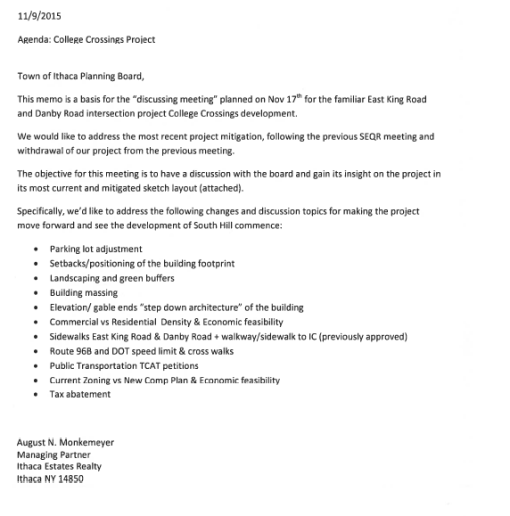
2. There’s nothing too exciting in the agenda for the Ithaca town planning board meeting next Tuesday. There’s a couple of legal clarifications required, one for a single-family home subdivision, the other to let Brookdale (formerly Clare Bridge / Sterling House) move forward with their 32-unit expansion project. The town planning board will also be reviewing some solar panels and changes to the sign law. Really, about the only noteworthy thing on the agenda is an open, informal discussion on College Crossings. After have a few months to take a deep breath, the developer, Evan Monkemeyer of Ithaca Estates Realty, would like to discuss what needs to be done in order to make the project fit with the town’s comprehensive plan, while keeping his plans economically feasible. A copy of the letter is below:

college_crossings_v4_letter

This is potentially a major opportunity for the town to show good stewardship. Ideally, the two sides will find a common ground that meets the town’s goal for a less auto-centric, mixed-use South Hill, while allowing the developer to move forward. A tax abatement isn’t going to fly with the IDA let alone the planning board, but there are other options that can be considered – density, height, and setbacks come to mind. The town’s comprehensive plan considers the site “TND [Traditional New Development] High Density” – one of the few high density spots in the town. The plan recommends 8-16 units per acre as an average (it’s a 3.75 acre site, so picture 30-60 units), and 10-20% open space. A project in a TND-HD area should be dense, transit-oriented, porous and walkable. The door is open, not only to the town, but members of the public interested in helping find that common ground (looking at you, Form Ithaca). It should be an interesting chat.

chain_works_rev3_1

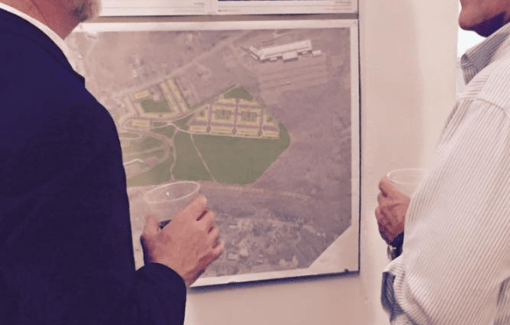
3. Local architecture firm STREAM Collaborative held an open house last Friday, and for those unable to attend, they shared photos online.

Look closely and you’ll find a copy of a conceptual build-out of the Chain Works District, which is still going through environmental site assessment (the ESA document is said to be tens of thousands of pages). The South Hill Business Campus is to the upper right, so the top of the image is directed south. Note that there’s nothing formal, and even the renovation of buildings 21, 24, 33 and 34 has yet to reach the boards (rumor mill says the renovations might start in 2017). But it’s great eye candy.

20151011_134013 20151011_134031

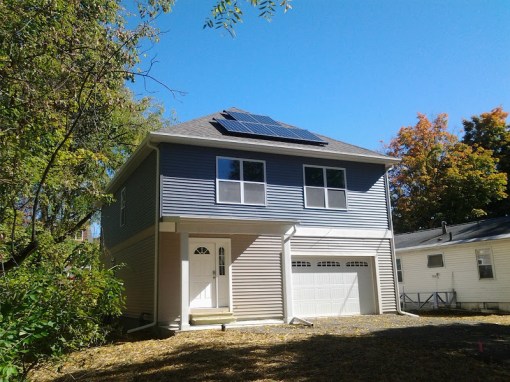
4. House of the week. Since I hit this house a couple of times while it was underway, I figured I would include a couple shots of the finished 3-bedroom, 1,276 SF home at 203 Pearl Street in Ithaca’s Belle Sherman neighborhood. Oddly enough, the builders, Gil and Naama Menda of 201 Pearl, used the same exterior trim colors as on the Belle Sherman Cottages a block away.

The lot is the result of a subdivision approved by the city during the spring; 203 Pearl had previously been combined with 201 Pearl and used as an in-ground swimming pool, which was filled in at some point.


Gannett Health Center Construction Update, 11/2015

13 11 2015

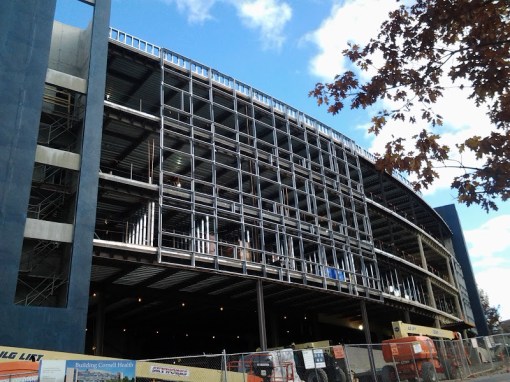
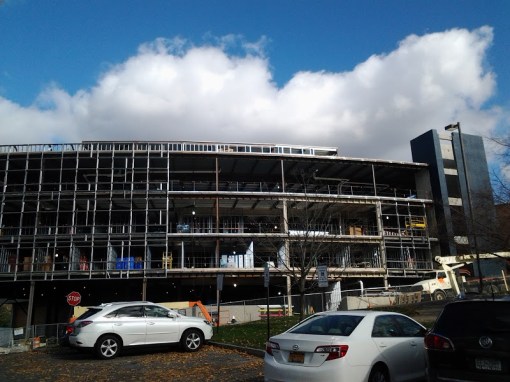
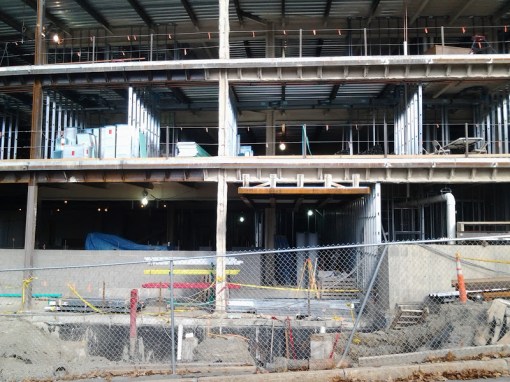
A lot of progress has been made with the Gannett Health Center addition on Cornell’s campus. The new addition has been framed up and topped out. Some of the interior walls have been framed with metal stud walls, with more work yet to come. The primary glass curtain wall is still being framed out, but some of the smaller sections to the north and east have some window panels installed. The variety of glass color used in the facade isn’t quite apparent just yet, since many of the panes are still covered with a blue cellophane wrap for protection.The dark blue material on the concrete stairwells is likely a water-resistant barrier, not unlike that used on the Planned Parenthood Building when that was under construction a couple years ago. The addition, which is phase one of Gannett’s three-phase expansion and modernization program, should be open for its first patients and staff next summer.

The Pike Company‘s Syracuse office is serving as general contractor for the $55 million project. Local architecture firm Chiang O’Brien designed the renovation and addition, and Ithaca firm Trowbridge Wolf Michaels Landscape Architects will be doing the site landscaping.

20151108_123644 20151108_123829 20151108_123925 20151108_124019 20151108_124118 20151108_124215 20151108_124224 20151108_124249 20151108_124313 20151108_124326

gannett5 gannett3

gannett2


Cornell Veterinary School Expansion Construction Update, 11/2015

12 11 2015

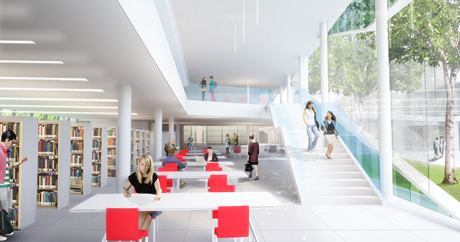
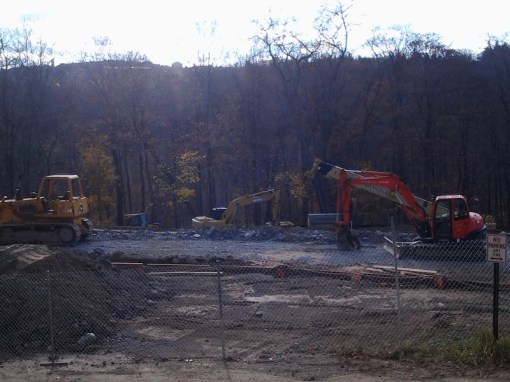
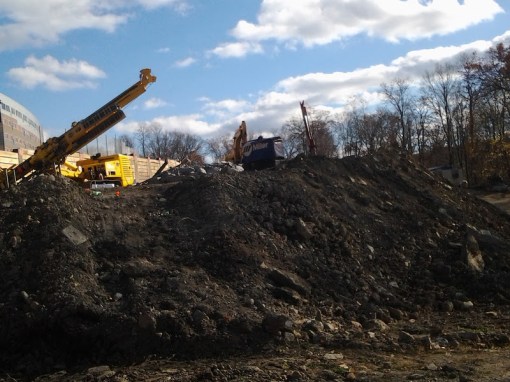
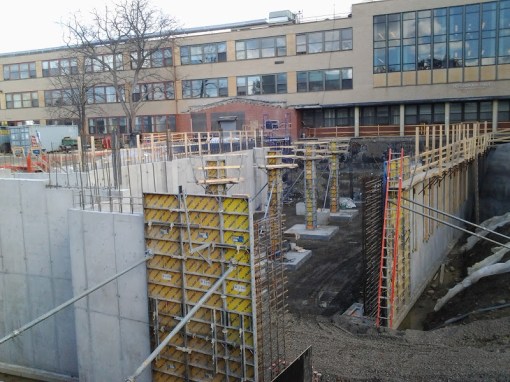
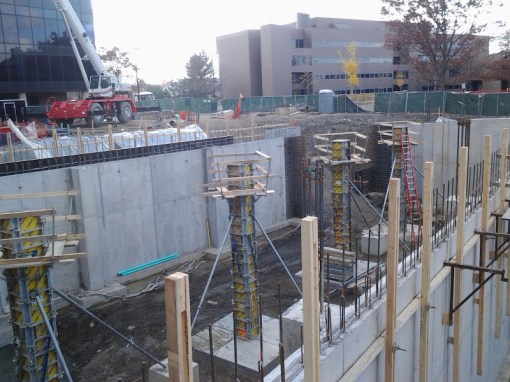
The site of the future west wing of the Cornell Veterinary School expansion has been excavated and the foundation is being poured for what will be a 3-story building with the new Flower-Sprecher Library, and additional program space. Look along the outer edge of the newest foundation section and you’ll see wooden forms pressed against the concrete. These forms provide stability and shape while the concrete hardens, and they provide support to the reinforcing rods embedded in the concrete. They will move further along the perimeter as pouring continues.

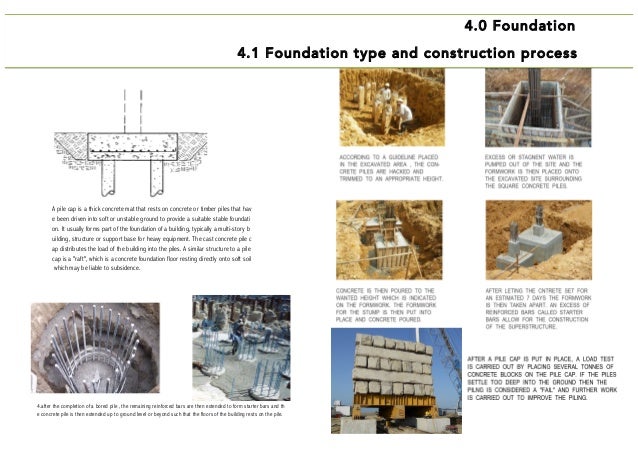
Without being all that knowledgeable about deep foundations, the structures in the middle of the excavated foundation might be pile caps. Piles are driven into the ground, trimmed to a predetermined height, formwork is set up around the piles and the concrete is poured and left to cure. So the piles are underneath the caps, and columns extend from the base of the cap. The load of the structure’s will be transferred to the pile caps and distributed to the piles below, providing stability for the building.

EDIT: Quoting commenter Drill Deep, who is knowledgeable about foundations: “No deep foundations at this one. Just very wide spread footers. East Hill and the Cornell campus usually has ground that can be made to do the job. The basement here is very tall and something like a hangar. Lots of headroom to run utilities.”

More information on the background and details of the expansion can be found in the September update here.

NYC-based architecture firm Weiss/Manfredi designed the expansion, and regional construction firm Welliver is the general contractor.

20151108_122245 20151108_122249 20151108_122256 20151108_122317 20151108_122355 20151108_122421 20151108_122457

cad048742a281097e5667382eced4233

LibraryReadingRoom10-2


1325 Taughannock Boulevard Construction Update, 11/2015

11 11 2015

Single-family homes tend to be more of a featurette on Ithacating, rather then full-fledged posts of their own. Then again, most homes aren’t multi-million dollar lakeside mansions.

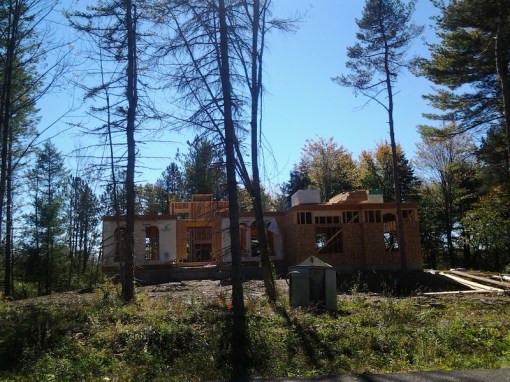
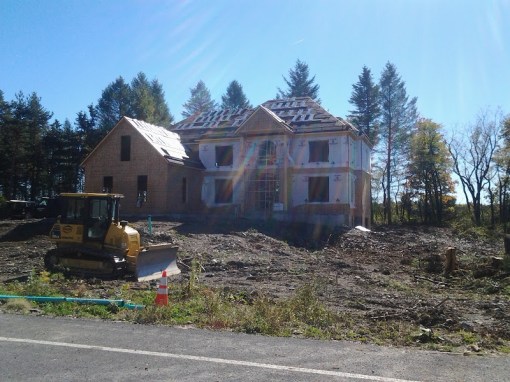
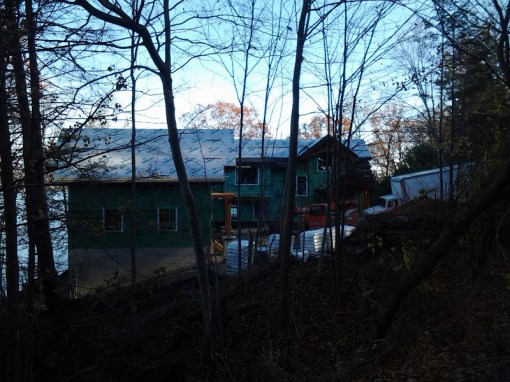
Looking at the house underway at 1325 Taughannock Boulevard in the town of Ulysses (pulling off of the road is a bit harrowing, given that it’s a 55 MPH zone on a narrow road with marginal visibility), the roof has been sheathed but not shingled, and Kingspan Green Guard Raindrop 3D housewrap drapes the exterior of the building. The black material on the roof looks like felt paper (also known as tar paper), which helps protect the roof from water that may get under the shingles form ice melt of gusty winds, and protects the asphalt shingles from resins in the wood decking. Felt paper also increases a roof’s fire rating and helps keep the house dry in case of rain during the construction period. Windows have been fitted, and masonry work on the chimney is underway. The timber frames stand out against the housewrap, but the actual finishing materials (wood, with wood and concrete or stone trim) should complement the timber frames nicely.

As previously reported, a construction loan for $2.25 million was filed on August 13th, with Tompkins Trust Company providing the financing. The property was previously home to two smaller lakeside cottages. the two small houses once on the properties have been demolished. The homeowner is a New York senior investment banker with ties to Cornell. The house is expected to be completed by May 2016.

New Energy Works, the project architect, specializes in timber frame structure, with offices in suburban Rochester and Portland, Oregon (the Pacific Northwest and the Appalachians are two of the most popular parts of the country for timber frame homes; in New York, it’s often coterminous with “Adirondack Style“). Locally, New Energy Works designed the Namgyal Buddhist monastery on South Hill, and the Ithaca Foreign Car (Ithaca Volvo) building on West State Street.

20151108_144426 20151108_144456  20151108_144530

20151108_144517


Collegetown Terrace Construction Update, 11/2015

10 11 2015

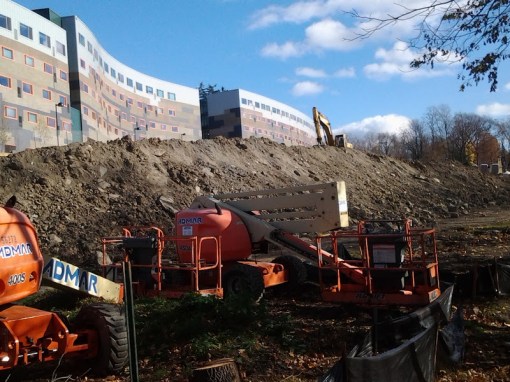
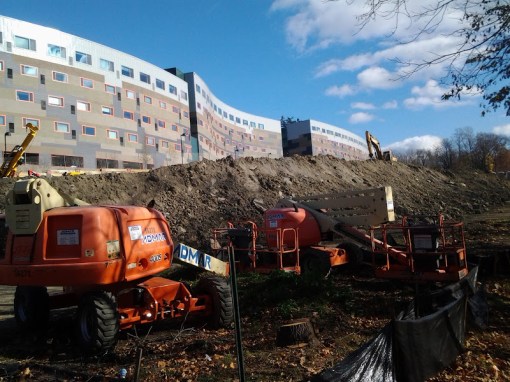
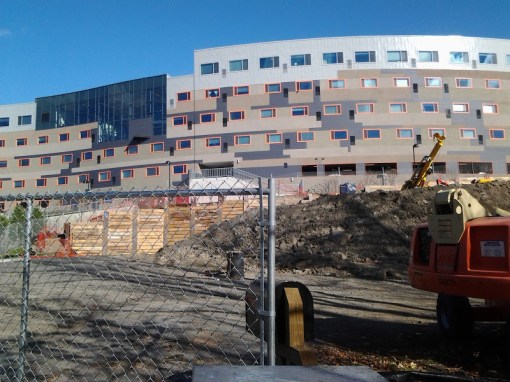
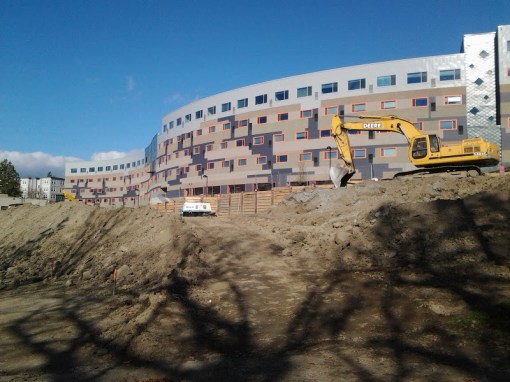
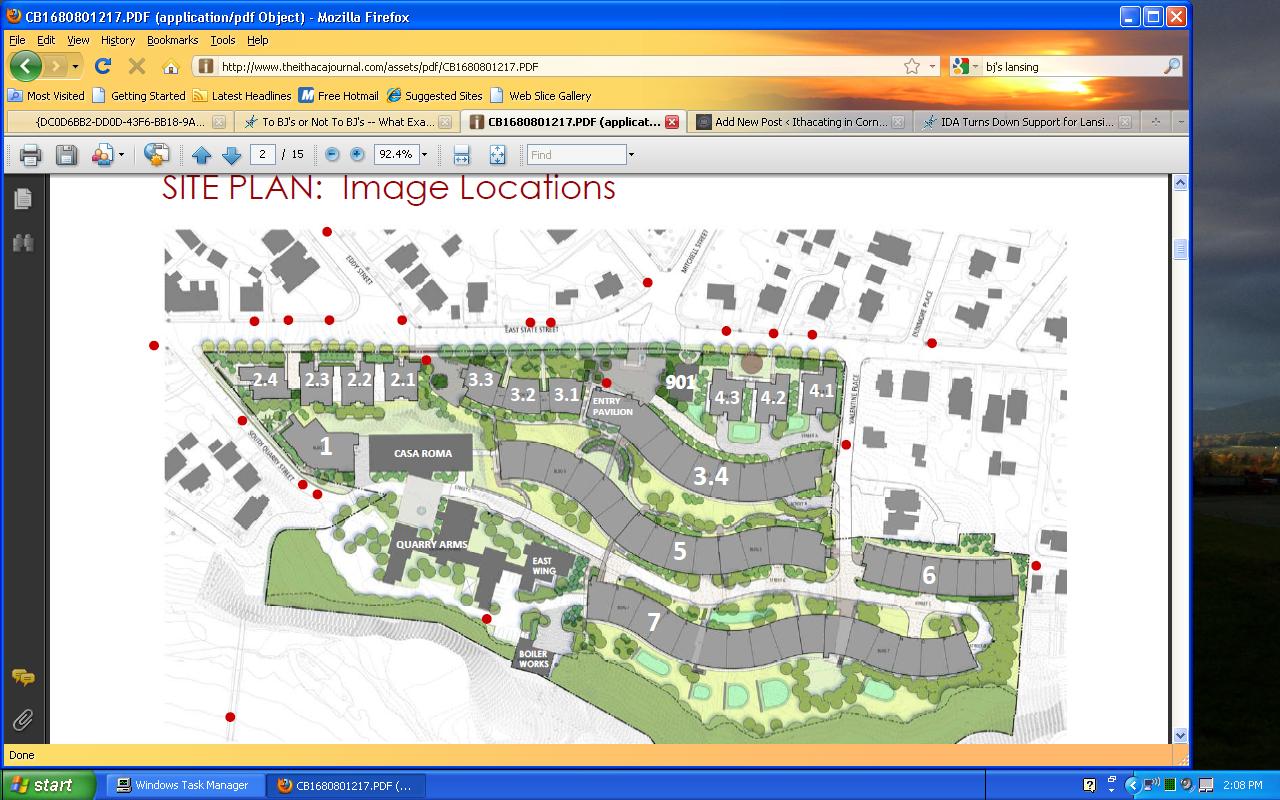
Well, this one can finally be counted as “underway”. Site prep has begun for the last building at the Collegetown Terrace site, on the 900 Block of East State Street south of Collegetown. Being just a few weeks underway (work commenced in late October), the primary tasks in the short-term are clearing the site and building shoring walls (the steel H-beams with wood lagging). The H-beams are drilled or driven in at regular intervals, and hold the soil back while the foundation is excavated. This building is going to have a deep foundation and a large footprint, so foundation work is likely to take a while, we’ll be well into 2016 before steel starts to rise from the ground.

The last phase of Collegetown Terrace (Phase III) is expected to be completed by August 2017. Phase III will focus on the construction on the last building, #7 (formally known as 120 Valentine Place), a long, curving building very similar to  the completed Building #5. Funding for the new building comes from part of a $50 million loan extended to developer Novarr-Mackesey in 2013 by Pittsburgh-based PNC Bank, and revised in December 2014. As this project demonstrates, even though a proposal might be approved, it can take years for something to actually get off the ground — if ever. Initial approvals were granted all the way back in 2011.

Building 7 is expected to have 247 units, and 344 bedrooms once it’s completed. About 80 of the units will be set up “dormitory-style”, where all tenants get their own bedroom and bathroom, but share kitchens and community lounge spaces. Novarr-Mackesey had found after the previous phases were completed that parking was only being utilized by 50% of tenants, so rather than build a floor of parking that would more than likely go unused, the firm applied to the city Board of Zoning Appeals for a parking variance (652 spaces for the whole complex, which is 51 less than required by zoning) to change one floor of parking planned for Building 7 into the “dorm-style” living space. The variance was granted by the BZA in Spring 2014. The dorm-style units are expected to rent at half to two-thirds of the cost of a studio unit, and to appeal to graduate and professional students on a budget. The current layout calls for parking on the first floor, then the dorm floor, then regular studio-3 bedroom units on floors 3-6.

With this project underway, it’s the single-largest residential building under construction in Tompkins County. Hopefully, one that will make a dent in the city and county’s housing crunch.

20151108_131029 20151108_131142 20151108_131223 20151108_131447 20151108_131708 20151108_131713 20151108_131746 20151108_131750 20151108_131756 20151108_131944 20151108_132024 20151108_132033 20151108_132045 20151108_132141 20151108_132223 20151108_132236 20151108_132320

ctown_terr_phase3


Boiceville Cottages Construction Update, 11/2015

9 11 2015

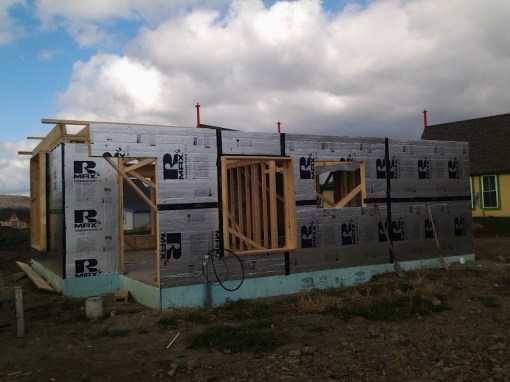
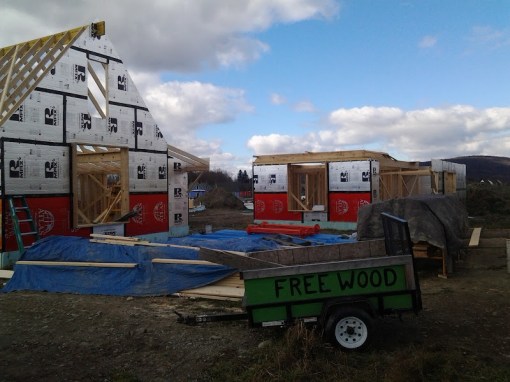
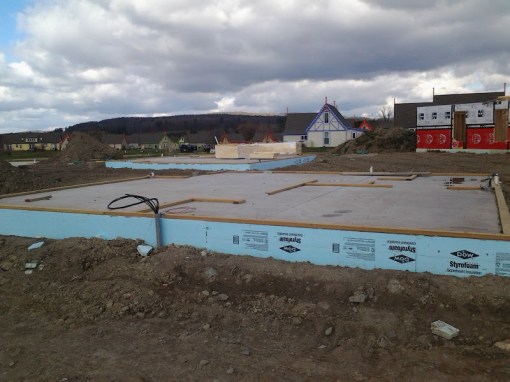
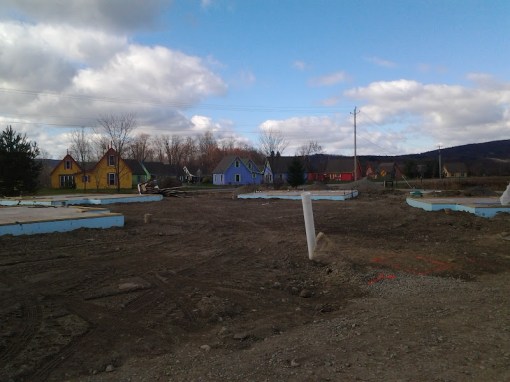
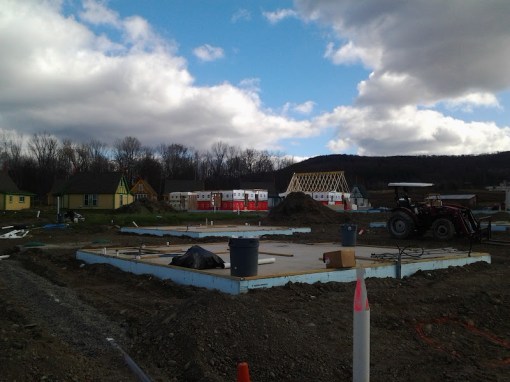
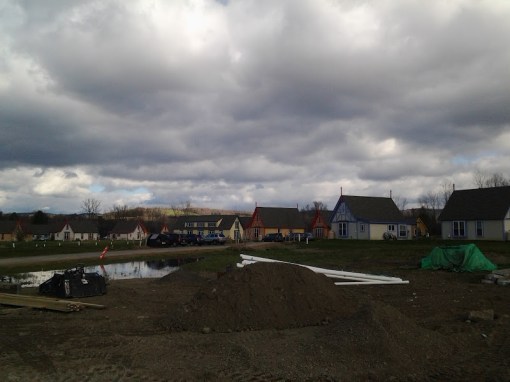
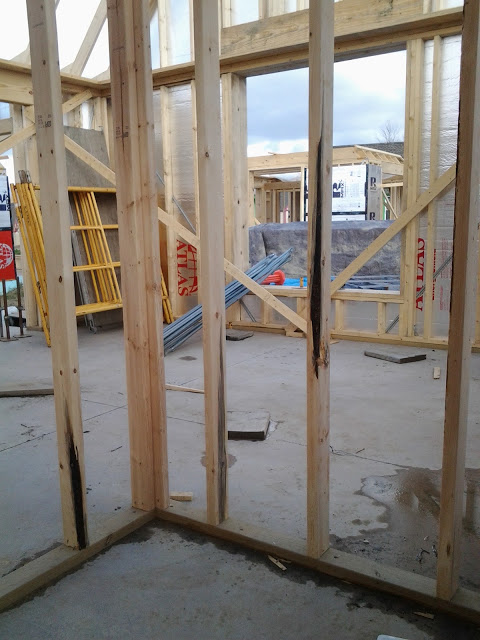
It looks like construction has started in earnest on the last phase of the Boiceville Cottages. All the concrete slab-on-grade foundations have been poured, with the blue exterior insulation to be covered later by a little backfill. Atop the foundations are utility connections and wood sill plates, which is where the wood stud walls will go. From a quick walk-through, it looks like rough framing and sheathing has begun on at least three of the cottages, and that all the units to be built in this final phse will be stand-along cottages. According to the Boiceville Cottages facebook page, the last septic tank was installed last week.

Without knowing too much about Caroline’s tax base, this is arguably the largest residential tax-contributor to the town, if not the largest tax-contributor to Caroline period. The current phase calls for 17 units at a cost of $2.2 million, $2,098,479 of which goes towards hard construction costs (materials/labor). The cottages are part of the 75 unit addition approved by the town of Caroline back in 2012. Altogether, those 75 units have hard construction costs of $7,477,671, according to construction loan documents filed with the county. The 2015 assessed value for the property was $10.3 million for 122 units in 2015, and that number is likely to climb a couple million higher in the next year or so.

The Boiceville Cottages began with a first phase of 24 units in 1996/1997, with a second phase of 36 units ten years later. Now, a few things have been tweaked along the way, because the build-out no longer matches the 2012 construction documents – some triplet cottage clusters on the engineer’s map have been replaced with “gatehouses” and quadruplet cottage clusters during build-out. For the longest time, I’ve been using 135 units as the total (24+36+75), but given this statement from their facebook page, it looks like the final count will actually be 140 units. The Boiceville Cottages expansion will finally wrap up its years of construction next summer.

Apart from some early concerns about site drainage, there haven’t been too many objective issues with the project. Subjectively, some love the bright colors, others can’t stand them. Heck, even Simon St. Laurent gives them a little appreciation on the “Living in Dryden” blog.

For those interested in visiting the cottages, they sit on 37.7 acres on either side of 300-334 Boiceville Road, just west of the hamlet of Slaterville Springs. Rents range from $1,050 for a studio to $1,750 for a three-bedroom gatehouse unit. Most of the units are 1 and 2-bedroom cottages, built in clusters of three, with a few “gatehouse” rowhouses that offer studios and 3-bedroom units. The cottages fall in the 850-1050 SF range.

Schickel Construction is headed by Bruno Schickel of Dryden, following in the footsteps of generations of Schickels living and building in Ithaca. In some circles, Bruno Schickel is better known as the husband of the famous columnist Amy Dickinson.

20151108_115800 20151108_115832 20151108_115849 20151108_115928 20151108_120036 20151108_120046 20151108_120056 20151108_120131 20151108_120156 20151108_120223 20151108_120232 20151108_120411 20151108_120421


News Tidbits 11/7/15: All the Small Things

7 11 2015

chapter_house_v2_1

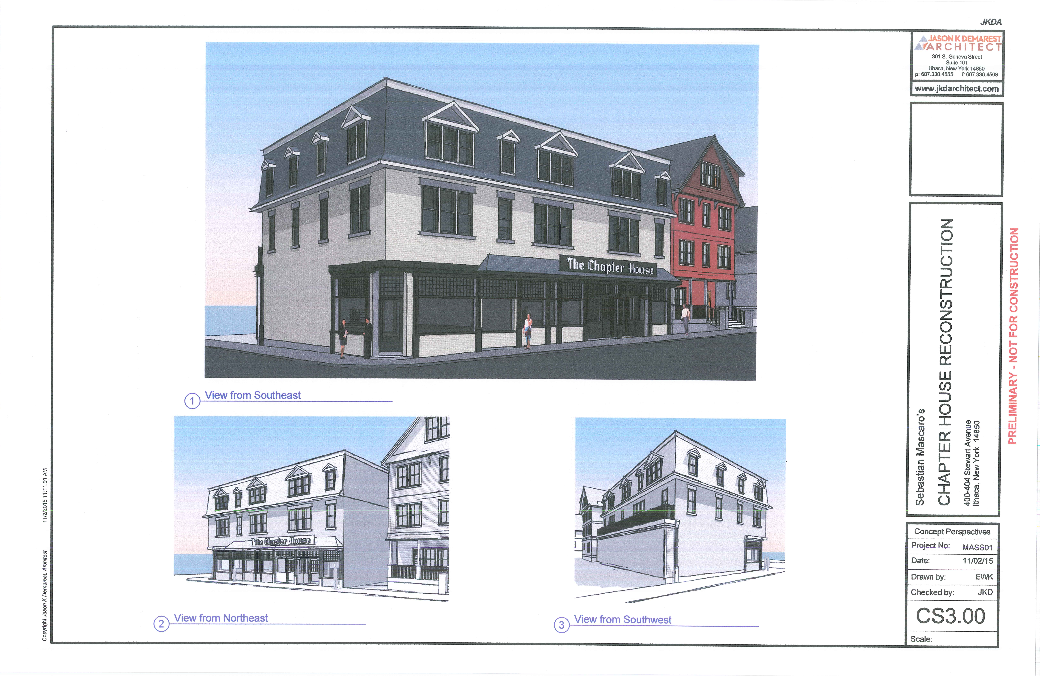
1. The Chapter House project is finally beginning the first stages of design review with the ever-stringent (or picky, pending your view) Ithaca Landmarks Preservation Council. As seen in the render above, gone is the fourth floor, and gone for now are plans to build a new structure at 408 Stewart, after some members of the ILPC expressed opposition to a tear-down, even though the exterior has been butchered and the architect called it a “fire trap”.

The committee also had disagreements over which version of the Chapter House is more historic, the original ca. 1903 design evoked above, or the 1920s renovation that everyone remembers. The September minutes showed intent towards the four story design seen previously, but the design shown above is three floors – whether that be to the committee’s persuasion, or concerns over a zoning variance isn’t clear. It might be in October’s minutes, but those haven’t been approved, and are therefore not available yet.

Also at Tuesday’s meeting, the committee is planning “Property Condition Review and Potential Action” for the decayed carriage house at 312 West State Street. The board was also set to provide “Early Design Review” for a project at 315 North Cayuga Street, probably some kind of renovation/restoration of the First Presbyterian Church, but the item has since been pulled.

11-24-2012 171

2. Wait long enough and history repeats itself. In March 2009, I did a post called “Warren Real Estate Tries to Sell a Frat House“. It looked at 210 Thurston Avenue in Cornell Heights, when it was on the market for $950,000. The house has historically been a Cornell fraternity house, built around 1900, re-purposed not long thereafter for the Delta Sigma Phi fraternity until WWII, when the brothers left for service and the chapter never reopened. It was then used by other GLOs over the decades (Alpha Omicron Pi in the 1940s, Sigma Alpha Mu from the late 1940s to early 2000s, and Phi Delta Theta’s annex in the late 2000s).

After sitting on the market for a couple of years, the house sold in December 2011 for $677,500 to an LLC representing the wealthy parent of a Cornell wrestler, who had the house renovated for the team in 2011/12. The legal occupancy increased from 33 to 40 persons as a result of the reno.

So now it’s on the market again, this time for $2,750,000. That must have been quite a renovation. An open house will be held 1-3 PM this Sunday.

I’d recommend it to the Phi Mu ladies given their recent rejection by Cayuga Heights’ zoning board, but the asking price is almost four times the house they were looking at 520 Wyckoff. The house on Wyckoff was also intended for 16 occupants rather than 40. Oh, and I suppose those urinals the owners installed would be a bit out of place.

We’ll see what happens. This one could be on the market for a while. Again.

3. Also new to the market this week, two parcels in the town of Ithaca that have the potential for development.

The first, 1564 Slaterville Road. The sale includes four parcels – 1564 Slaterville Road itself, a 19th century home on 1.52 acres, and the other three are vacant parcels with frontage on Slaterville Road and Park Lane, which serves as an entrance to the Eastern Heights neighborhood, and has seen a number of higher-end single-family homes in the past several years (there have been plans for a 16-lot housing development on the adjacent land to the north, but nothing has been approved). Altogether, the sale comprises 9.2 acres of land, on the market for $995,000. The properties are valued at $297,300 total, so if the owner is asking such a high price, either they’re delusional, or purposely going after developers. The land currently falls under Ithaca town’s Medium-Density Residential (MDR) zoning, which is single-family homes and duplexes only. The Comprehensive Plan calls for “Established Neighborhood” use, with an average of 2-4 units/acre, either homes, townhomes or apartments (sensitive to neighboring uses), and the possibility of low-intensity commercial (home office). Expect any potential form-based code to accommodate those details.

The other parcel up for sale is 969 East Shore Road, one of the few properties in the town’s lakeshore exclave. This one is also asking a huge premium, $1.45 million for a 2.09-acre property assessed at $300,000. The property was used as the headquarters for the John C. Lowery construction company until they moved to Freeville; it had been built in the 1960s for a chemical company. The seller, the CEO of a local manufacturer, picked up the property for $300,000 in December 2013.

Although it falls under the town’s Lakefront Commercial (LC) zoning, which in itself says only marinas and wind turbines are okay, special use permits allow for mixed-use, hotel, and other non-water options. Like the Slaterville parcel, this one also falls under the “Established Neighborhood” use guidelines.

If they sell, and it bears mentioning, it’ll be mentioned in a later news roundup.

20151011_142719 20151011_142734 20151011_142746

424_dryden_rd_1

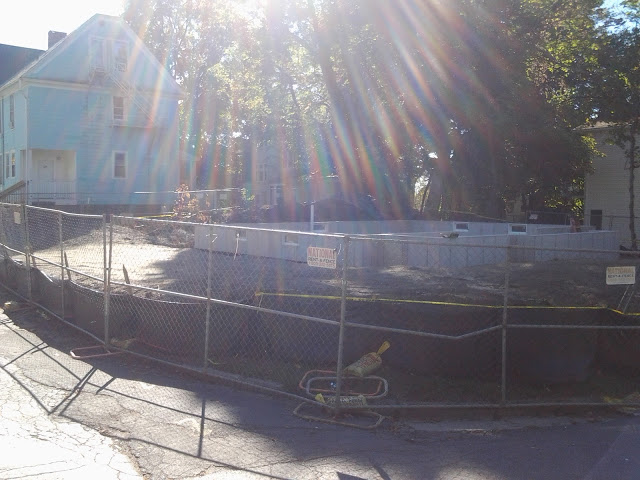
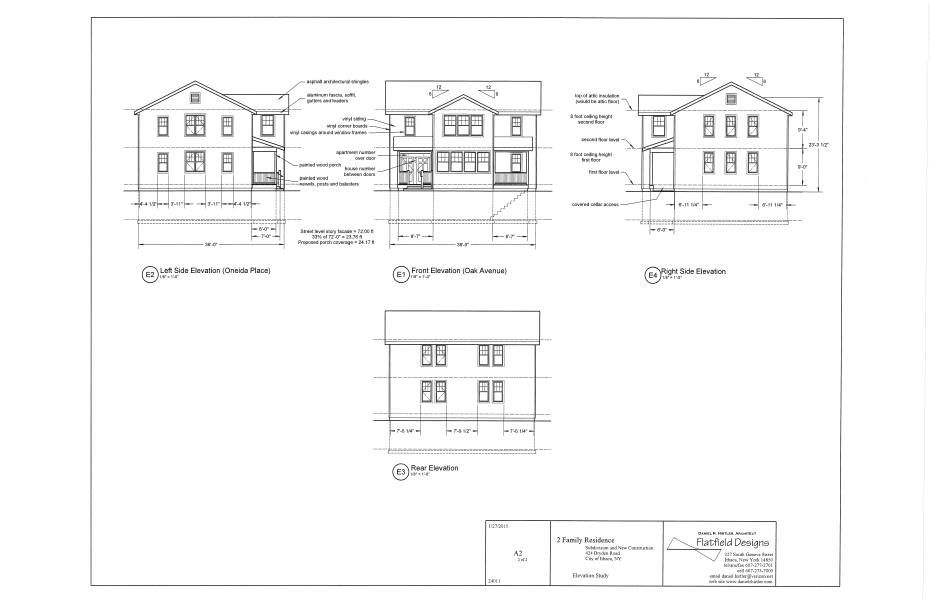
4. It’s house of the week. This week, 319 Oak Avenue in Collegetown. The lot was created by a subdivision of the existing lot, 424 Dryden Road, in February of this year. What was once a parking lot is now the foundation for a duplex with 3-bedrooms each. Foundation and stem walls have been poured and cured, and given that this photo is a couple weeks old, the foundation has probably been backfilled already, and rough framing may even be underway.

The site falls into the CR-2 Zone of the Collegetown Form District, meaning 2-3 floors, and pitched roofs and porches are required. The architect is Daniel Hirtler of Ithaca, and the developers are William and Angie Chen, also of Ithaca.

5. It’s a quiet week. The city of Ithaca’s projects memo has absolutely nothing new (not even new attachments to the three projects subject to review), and the town of Lansing has nothing interesting either. So we’ll wrap this up with some economic news:

A Lansing technology firm will be seeking sales tax abatements this month as part of a planned expansion project.

Advanced Design Consulting USA (ADC), located in a 15,000 SF facility at 126 Ridge Road in the town of Lansing, has submitted an application to the Tompkins County Industrial Development Authority (TCIDA) for review at their November 12th meeting.

The company is applying for a one-time sales tax abatement on the cost of construction materials, and is valued at $54,880.

ADC specializes in the design and manufacture of high-precision scientific instruments, especially those used in physics research. The firm states in their IDA application that their small size has limited their ability to gain large contracts, and it is necessary for them to expand in order to expand their business. The 5,000 SF expansion is valued at $910,000, and would retain 14 jobs and create 7 additional jobs in their Lansing facility, with a median salary of $40,000. If approved, the expansion project would be completed by June 2016. With the expansion, ADC’s revenues are predicted to increase from the current $2 million, to $2.7 million in three years. The company did not commit to local construction labor in their application.

In an interview in 2014, ADC President Alexander Deyhim explained that the company declined a business incentive to move to Oak Ridge, Tennessee because of Tompkins County’s high quality of life, and proximity to Cornell’s nano-fabrication facilities.

For ADC, which was founded in Tompkins County in 1995, it will be the third expansion in twelve years. The company had previously applied for and received tax abatement approvals for a larger, 20,000 SF expansion project, but according to the current application, the firm reassessed its needs and decided to go with a smaller plan for the time being. The original abatement was never utilized. Supplemental documents indicate the town of Lansing has approved the physical plans for the expansion.
***
So does one force the company to use local labor, or does one risk turning the company down and sending the whole operation to Tennessee? Tax abatements are hardly ever a black-and-white decision.