Ithaca Marriott Construction Update, 4/2015

16 04 2015

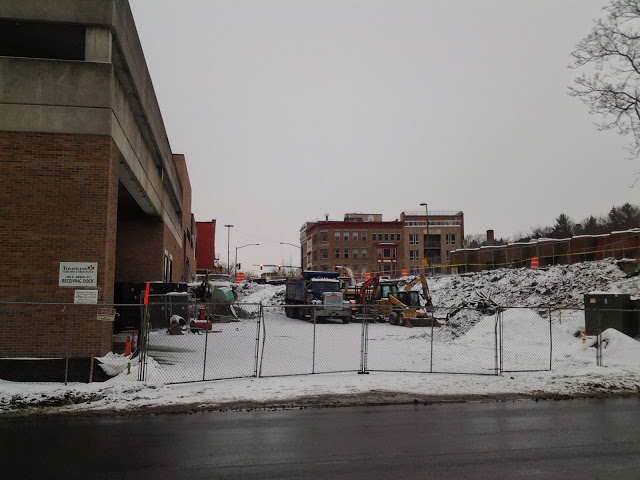
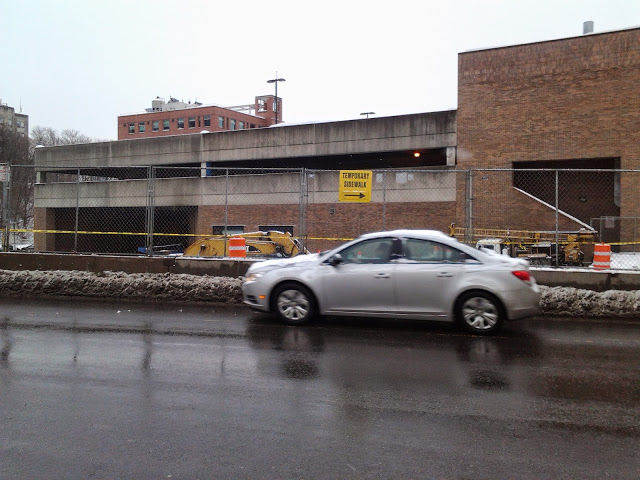
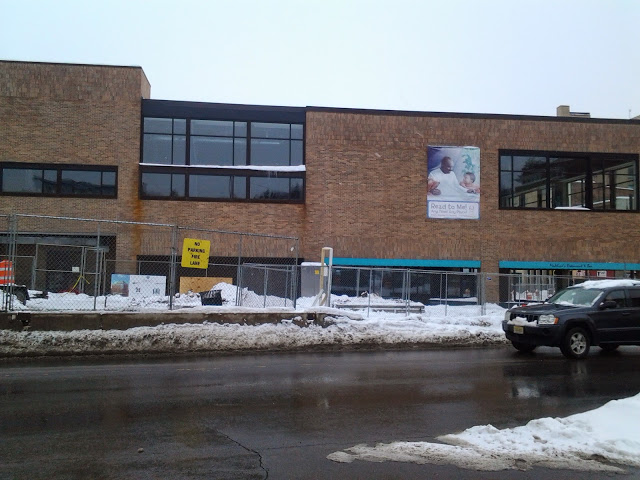
It may not look like a whole lot has happened at the Marriott site downtown, but it is a very complex undertaking. One anonymous reader close to the project wrote in to describe the work being done on site in the past couple months:

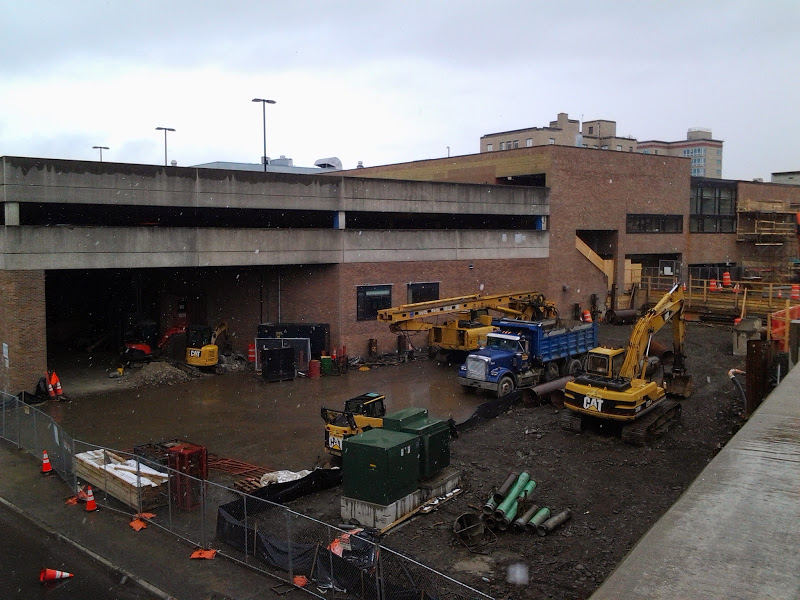
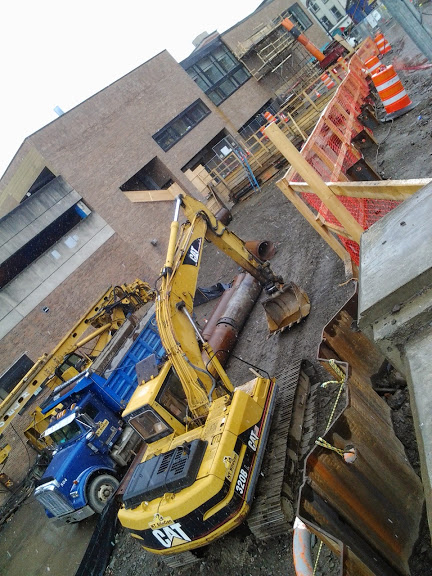
“Foundation work is progressing nicely despite the weather. Contractors have installed steel H piles to [the] bedrock along the perimeter. Wood cribbing has been installed within the piles. The wood panels slide into the web of the H. The cribbing is backfilled and remains forever, securing the bridge area once complete. Another contractor is drilling tie backs to hold the cribbing in place. The rods are grouted in place to a depth of 20 feet or more. The rods anchor the wall in place so the structure can be built within the opened area. Caissons will be drilled in a few days. The caissons are massive open pipes that are socketed into bedrock, 25 to 30 feet below grade. The hollow caissons are filled with concrete and rebar. Concrete beams will be formed from the top of each caisson similar to floor joists. Then a few million tons of hotel will be constructed on top. The cantilevered design is impressive and makes for some very difficult design constraints. This building is a big sail that is side heavy.”

To paraphrase, and hopefully I have this right, the bridge is being secured by H-shaped steel bars, wood cribbing and filling material, and steel tiebacks are being used to stabilize the retaining wall. Per wikipedia, grouted tiebacks can be constructed as steel rods drilled through the cribbing out into the soil or bedrock on the other side. Grout is then pumped under pressure into the tieback anchor holes so that the rods can utilize soil resistance to prevent tieback pullout and wall destabilization. With the bridge and retaining wall established, caissons can now be drilled. Caissons are piles drilled to a sufficient depth to allow the weight of the hotel to be transferred from the weak soil above, to the stronger bedrock 25-30 feet below. The weight will be spread out over the piles with concrete beams on top of the caissons, allowing for the hotel above to be stable and secure.

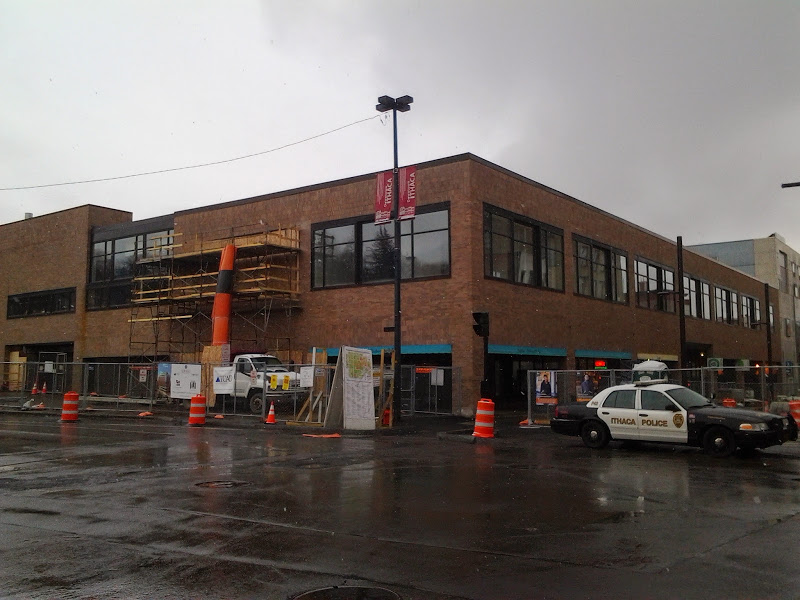
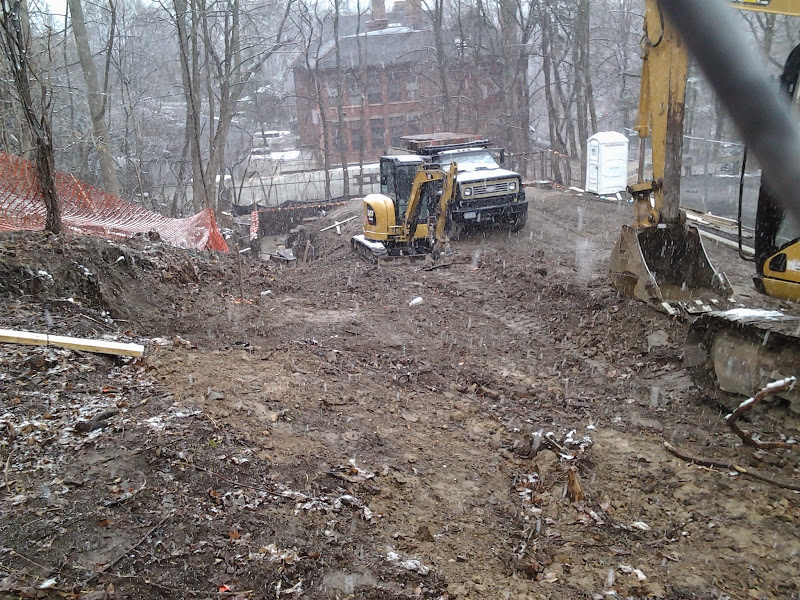
The photos don’t show the level of work involved with building the retaining wall, and as of April 5th it doesn’t look like the caissons were being drilled just yet. But those look like caisson liners next to the excavator, so pile drilling will be underway soon.

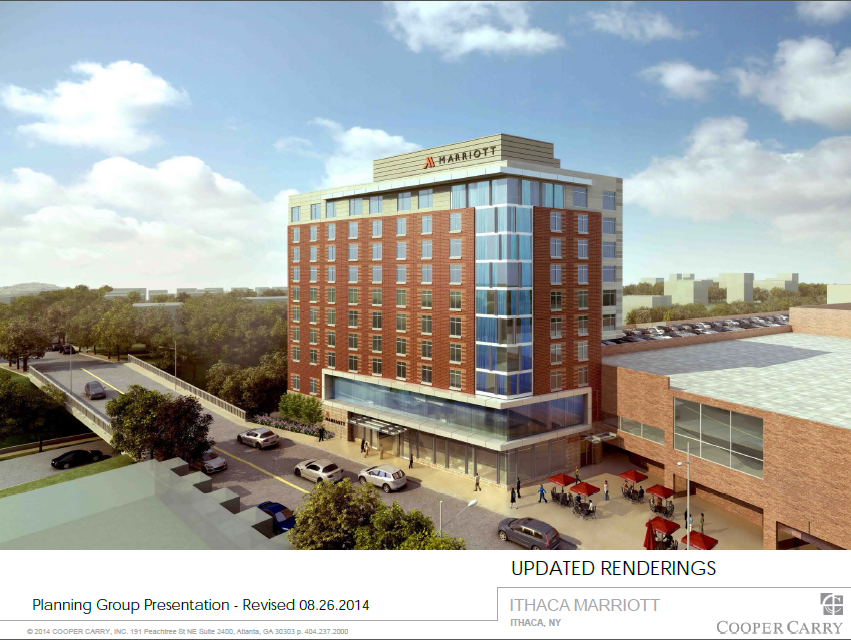
The $32 million, 10-story, 159-room hotel is slated for an opening in Q3 of 2016 (July-September). The hotel will include a fitness center, a restaurant with indoor and outdoor seating, and 3,000 sq ft of meeting space.

The hotel has been designed by Atlanta-based Cooper Carry Architecture and development is a joint venture of Urgo Hotels of Bethesda and Ensemble Hotel Partners, a division of Ensemble Investments. Urgo’s portfolio includes at least 32 other hotels totaling 4,500 hotel rooms. Interior design will be handled by Design Continuum, W.H. Lane of Binghamton is the general contractor, and Rimland Development contributed the land to the joint venture and is a partner. Long Island-based Rimland was the original firm that pitched the project in 2008 as the “Hotel Ithaca”, before the old Holiday Inn downtown went independent.

20150405_133412 20150405_133416 20150405_133422 20150405_133513

20150405_133115

marriott_rev1_1


Stone Quarry Apartments Construction Update, 4/2015

15 04 2015

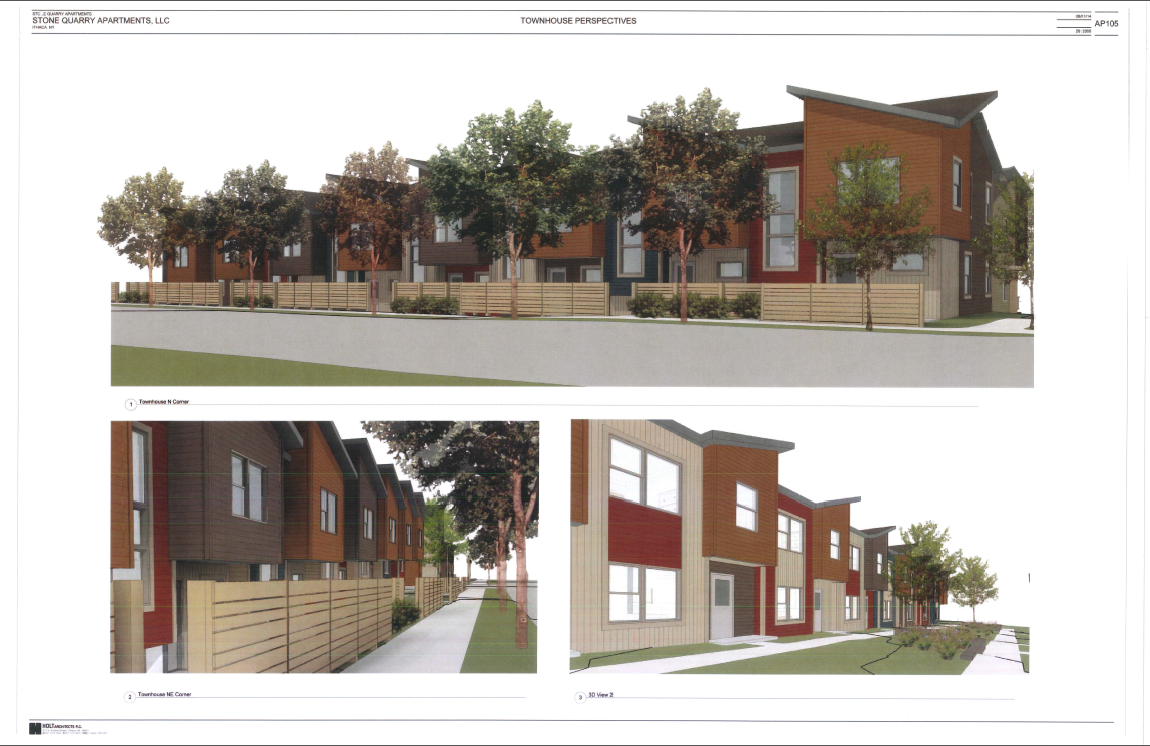
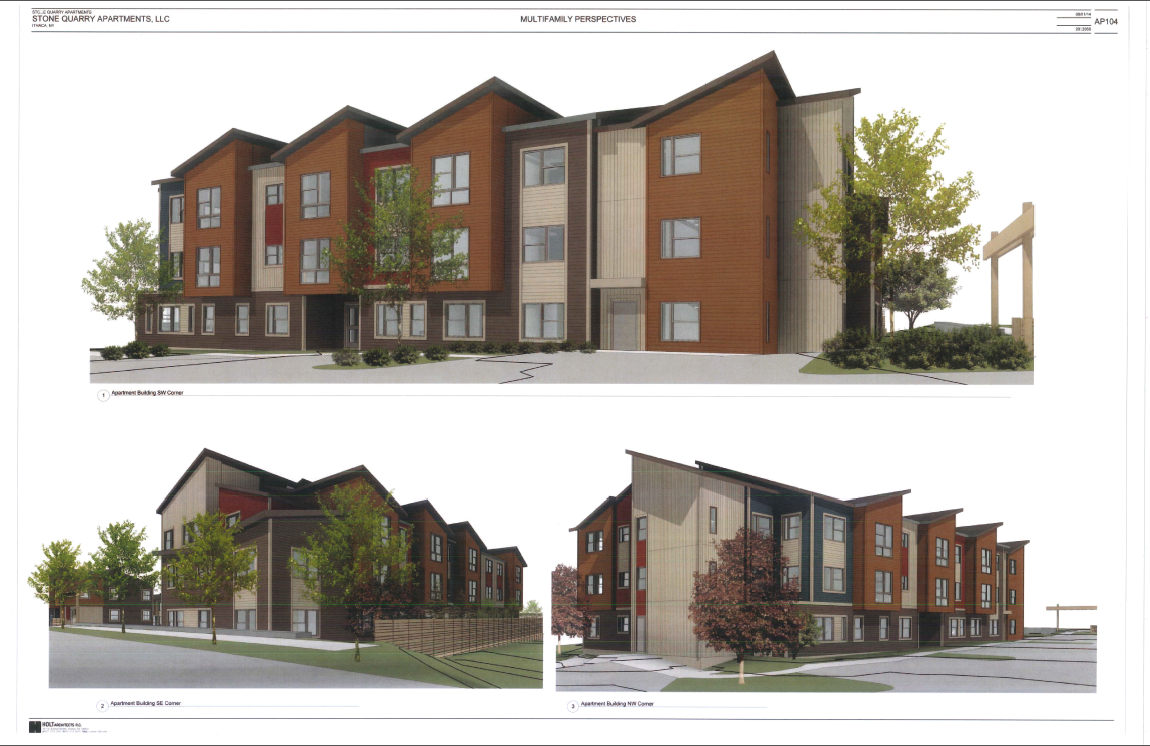
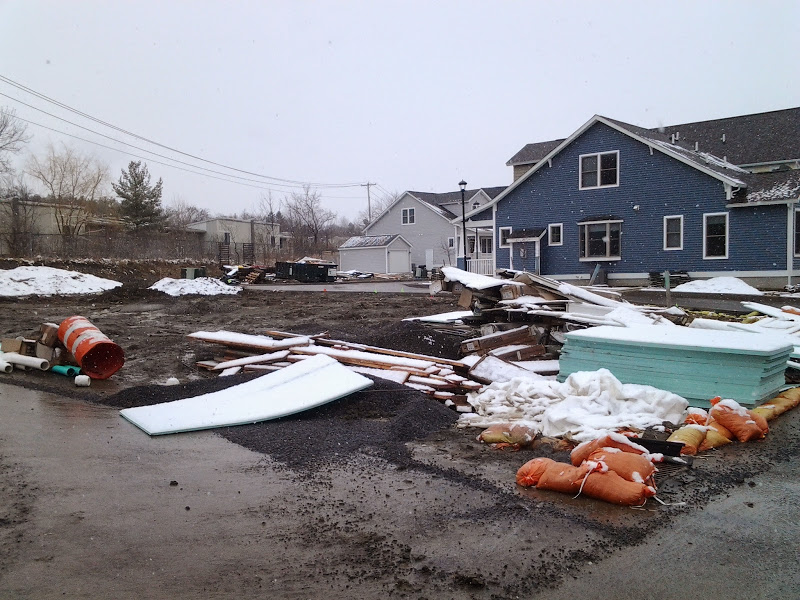
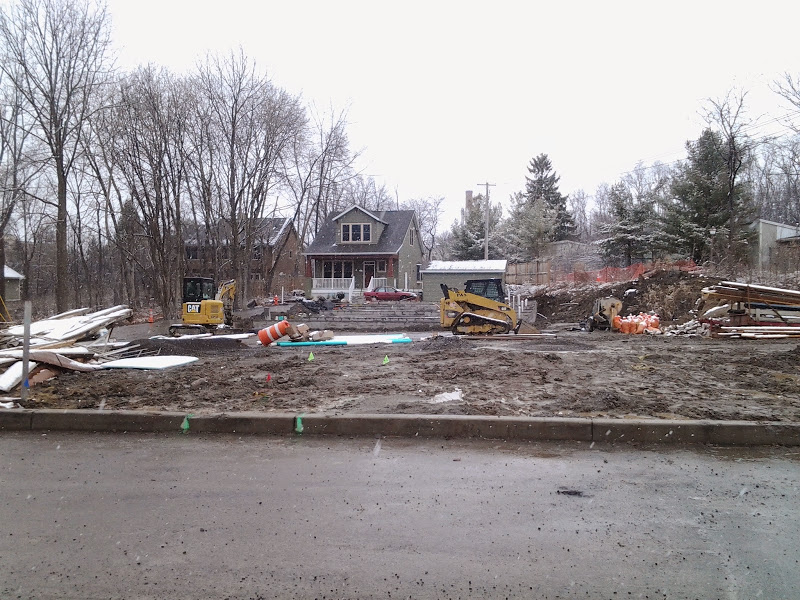
Substantial progress has been on Ithaca Neighborhood Housing Service’s (INHS) Stone Quarry Apartments project on Spencer Street on South Hill. Photos from April 5th show that the sixteen 2-story townhomes and 19-unit, 3-story apartment building have been fully framed, sheathed with Tyvek weather wrap, and have windows installed.

Exterior work continues as clapboard siding is installed on the new units. The color selections here are in many cases the same as those found at the Belle Sherman Cottages on the east side of town – the beige-tan window trim is the previously mentioned “Savannah Wicker”, and the brown-orange color is “Mountain Cedar”. “Light Maple”, “Autumn Red”, “Pacific Blue” and “Sable Brown” round out the color selections.

Without actually going inside, it’s a safe bet that interior is moving along with rough-ins and wall framing, maybe even drywall and finish work on the lower floors. The apartments are expected to be completed in October 2015.

The Stone Quarry project consists of 16 two-story townhouses (2 rows, 8 each), and a 19-unit, 3-story apartment building on the northern third of the property. Specifically, the breakdown of unit sizes is follows:

16 three-bedroom Townhouses
2 three-bedroom Apartments
11 two-bedroom Apartments
6 one-bedroom Apartments

As with all projects by INHS, the units are targeted towards individuals with modest incomes, with rents of $375-$1250/month depending on unit size and resident income. While affordable housing is generally welcome and sorely needed, Stone Quarry had a number of complaints due to size, location and lingering environmental concerns.

The build-out is being handled by LeCesse Construction, a nationwide contractor with an office in suburban Rochester. The design is by local firms HOLT Architects and Trowbridge Wolf Michaels Landscape Architects.

20150405_140249 20150405_140330 20150405_140634 20150405_140638 20150405_140701

inhs_stone_quarry_rev_4 inhs_stone_quarry_rev_3


Belle Sherman Cottages Construction Update, 4/2015

12 04 2015

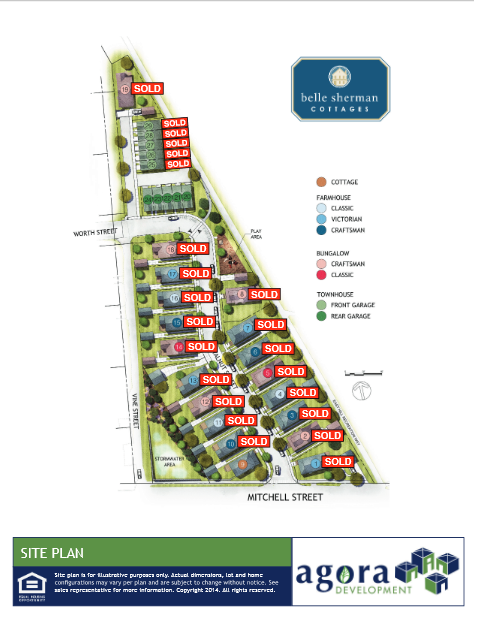
Over at the Belle Sherman Cottages off of Mitchell Street, work is underway on the first set of five townhomes, lots 25-29. The CMU block wall foundations have been assembled and look ready for the Simplex modular pieces to be brought onto the site and fitted. The houses are built using four modules, but the size of the townhouse lots suggests these might have only two modules per unit. The townhouse units sold out fairly quickly, just a few weeks. Sales are underway for the second set of townhomes (lots 20-24), which are expected to be built this year as well.

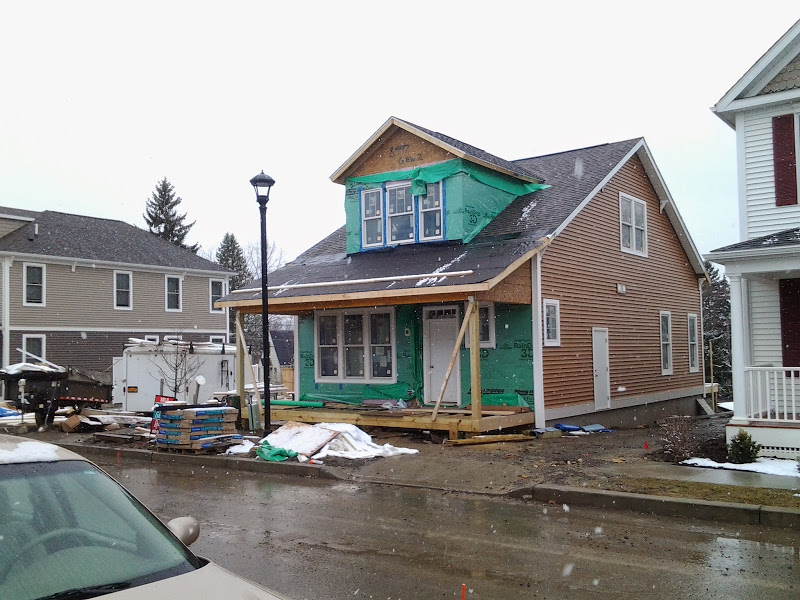
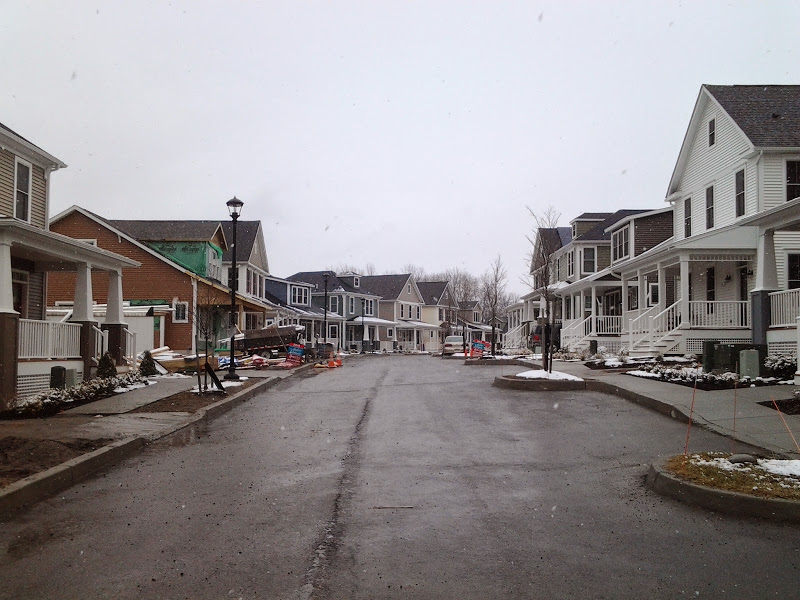
Elsewhere on the site, the “Classic Bungalow” on lot 12 has been assembled and is undergoing lap siding installation (“Mountain Cedar” color, with a lighter “Savannah Wicker” tan color planned for the dormer). The porch is being assembled and exterior trim is being installed. If you’re interested in learning more about the construction process, there’s a little more info in my previous post here, and on Ithaca Builds here and here. Once completed, there will only be two unbuilt home lots, the already-sold “Autumn Yellowfarmhouse planned for lot 11, and the unsold and un-marketed lot 9.

20150405_123303

20150405_123319 20150405_123326 20150405_123401 20150405_123430 20150405_123512 20150405_123540 20150405_123610 20150405_123621

belle_sherman_townhouses_2

belle_sherman_cottages_102714


707 East Seneca Street Construction Update 4/2015

10 04 2015

Another infill project is underway in the East Hill Historic District between Downtown and Collegetown. 707 East Seneca, like 202 Eddy Street and 140 College Avenue, had to go through the Ithaca Landmarks Preservation Council for approval, along with getting approval from the planning board and zoning board for an area variance (the lot was too small). After informational and voting meetings by different boards throughout the fall and winter, all the approvals have been granted.

The ILPC-approved design is made to be compatible with the historic homes from the late 1800s and early 1900s that surround the building. 707 East Seneca was originally the playground area for the now-closed East Hill School, and the lot was given to the city in 1982. The property fell into disuse, and the playground into disrepair.  The city voted to put the lot up for sale through the Ithaca Urban Renewal Agency (IURA) last summer, and the lot was sold for $130,000 on December 22nd (the market asking price was $175,000, and the assessed value of the land is $100,000, so the final price looks pretty reasonable).

The apartment building planned is a 3-story, 6-unit, 18-bedroom structure with 4 garage parking units in a basement built into the hillside, and five surface parking spaces. According to documents filed with the city, target completion is July of 2015. Note for the included renders, the black-and-white image with the small basement windows is the final design, but the colors are the same as the lead rendering.

Without getting a good look at the back of the now fenced-off property, it looks like the site has been cleared and excavation is underway for the retaining walls and foundation. Being a sloped site, retaining walls will be built on the west edge of the property (right side of the photos) and for tree wells, and the east portion will use a sloped bank built using fill material. Offhand, I think I remember seeing that the building itself will be assembled from modular pieces, craned into place on the foundation over a day or two, not unlike the method used at the Belle Sherman Cottages.

The design of the building is by Schickel Architecture of Ithaca, and the developer is Ithacan Todd Fox.

20150405_131545 20150405_131553 20150405_131611

707_E_Seneca_2

707_E_Seneca_rev1_1


140 College Avenue Construction Update 4/2015

9 04 2015

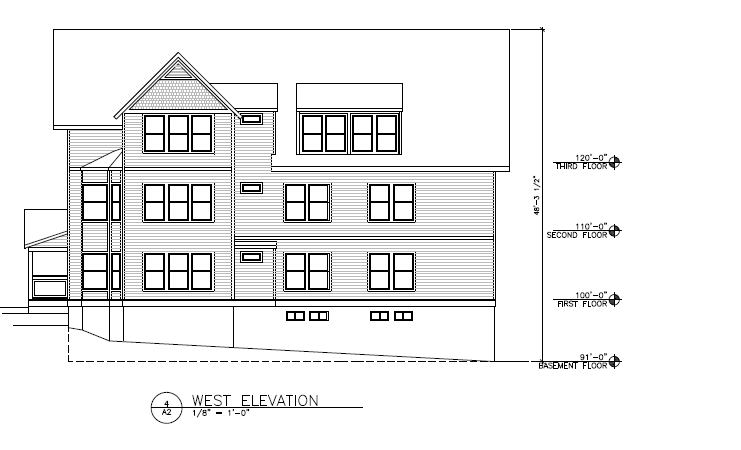
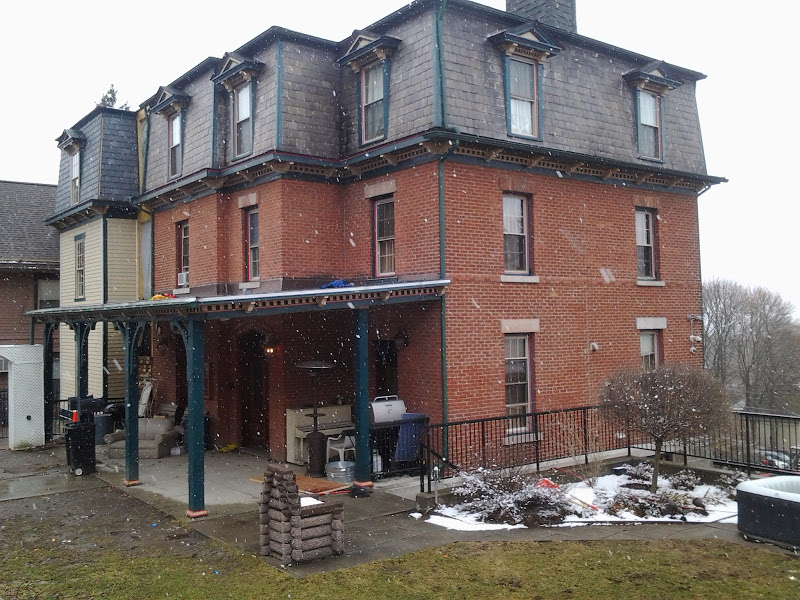
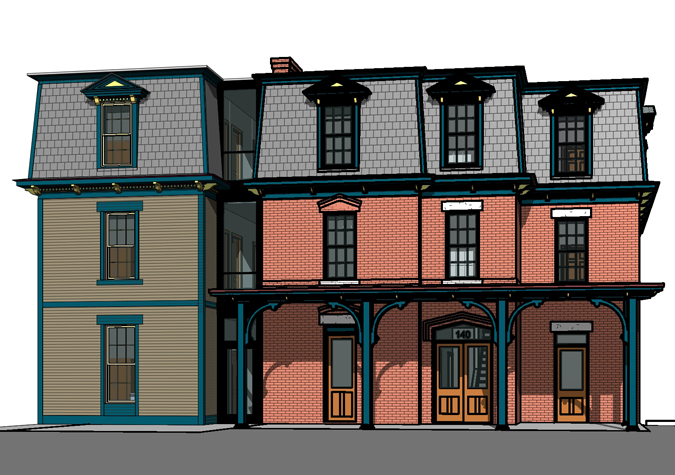
Just up the street from 114 Catherine and a couple blocks from 202 Eddy is 140 College Avenue, also known as the John Snaith House. Since last fall, work has been underway on a 3,800 sq ft, 12-bedroom addition to the 1874 structure.

John Snaith was an English builder, stone cutter and architect who came to Ithaca in 1869 to do work on Ezra Cornell’s Llenroc mansion (under construction at the time) and other buildings for the nascent university. Snaith lived in Ithaca for over a decade. He built the original Ithaca High School (destroyed by fire in 1912) and did work on the Sage Mansion, where he was fired by the ever-impatient Henry Sage.

After Snaith moved to Albany, the house was used as a boarding house, a B&B in the 1980s, and a private single-family home. The house was rented out to a landlady and her boarders when it was partially destroyed by fire in 1894. Snaith rebuilt the home shortly before his passing in 1896, but redesigned the top floor with mansard trusses and added dormer windows. Today, it’s student-oriented housing.

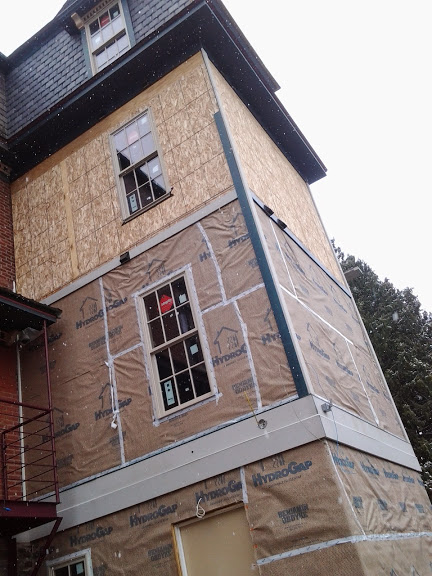
The addition is a sympathetic design approved by the Ithaca Landmarks Preservation Council (the house was designated a historic structure in 2011), separated from the original house by a glass “hyphen” connector. In the photos below, lap siding has been installed on the street-facing east wall, and uncovered plywood and house wrap can be seen in the rear. The slight variation in the mansard roof tiles are a nice touch. Windows have been installed, and I’d venture a guess that interior framing is complete and rough-in (plumbing, electrical) is underway in the addition.

The project is designed by local architect Jason Demarest and developed by Po Family Realty, a smaller Collegetown landlord.

None of the larger projects in Collegetown are underway just yet, but that will likely change when their current tenants’ leases are done June 1st. The following year or so should be very hectic in the neighborhood, with 307 College (96 beds), 327 Eddy (64 beds) and 205 Dryden (40 beds) all expected to start this summer, and Collegetown Terrace expected to start construction of its 300+ bed phase III this year. A quick check of the neighborhood showed that construction has not yet started on two other small projects, the 6-bedroom duplex planned behind 424 Dryden and the 18-bed 3-building project at 804 E. State Street.

20150405_124856 20150405_124921 20150405_124939 20150405_124953 20150405_124841

140College_2


114 Catherine Street Construction Update 4/2015

8 04 2015

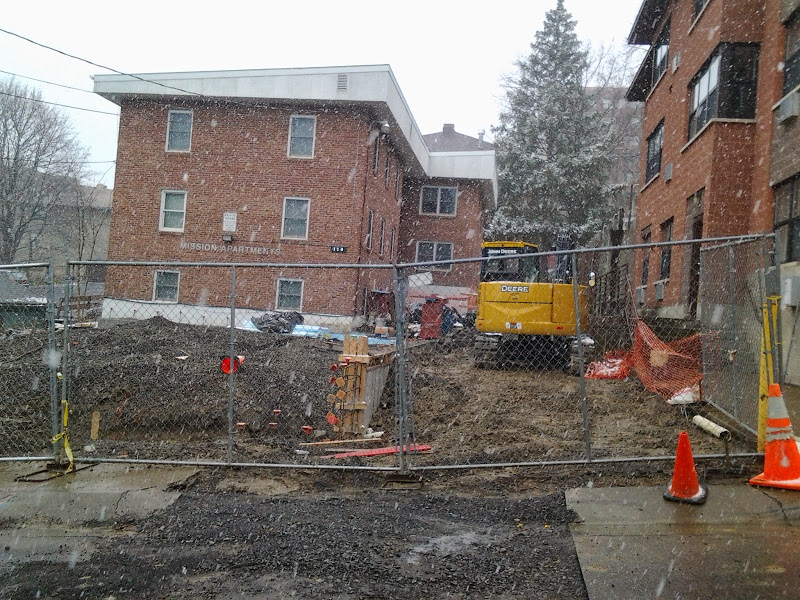
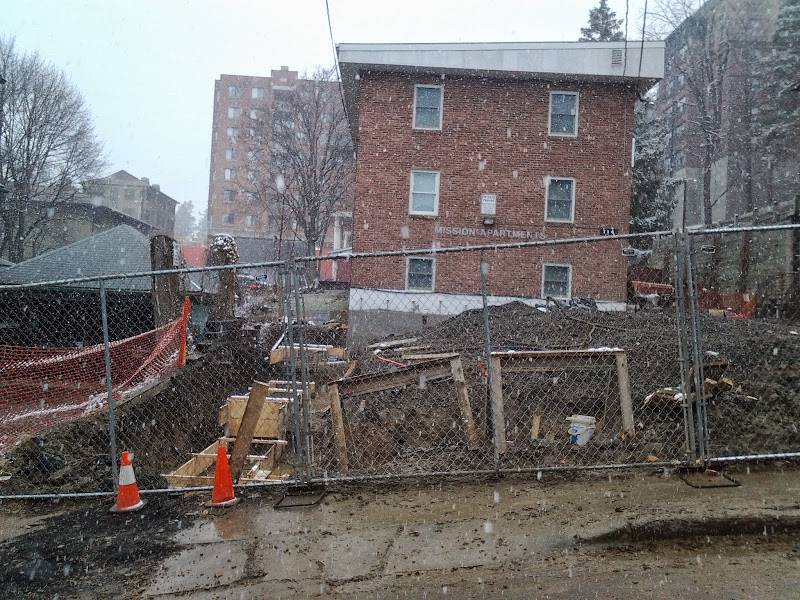
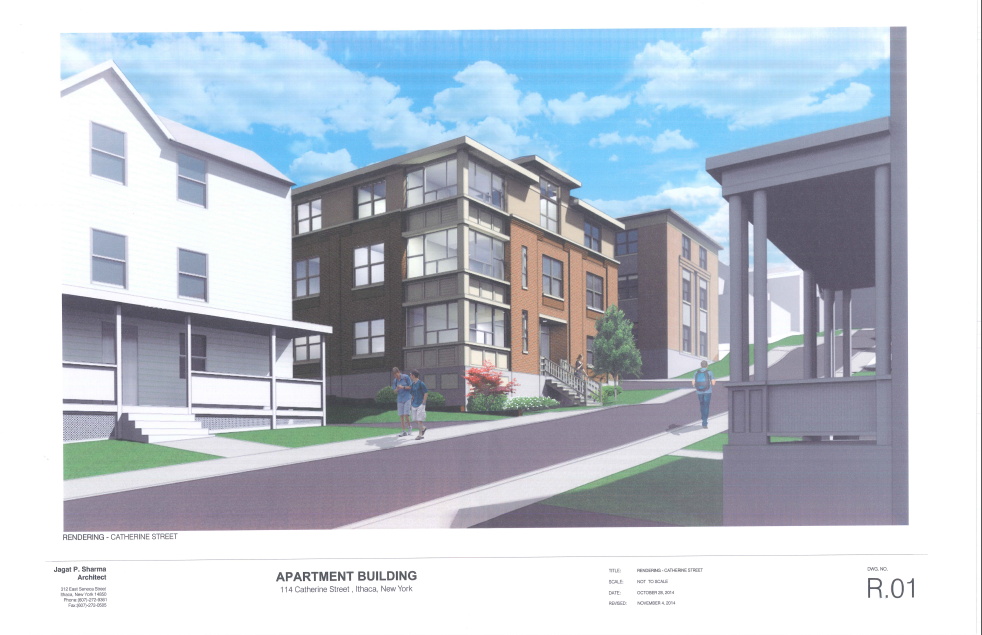
Work has commenced on the foundation for the new 3-unit, 17 bedroom apartment building at 114 Catherine Street in Collegetown. Plans were approved by the city of Ithaca late last year, and with the worst of winter over (though snow in early April definitely makes one second guess that), construction has been able to proceed on the new building.

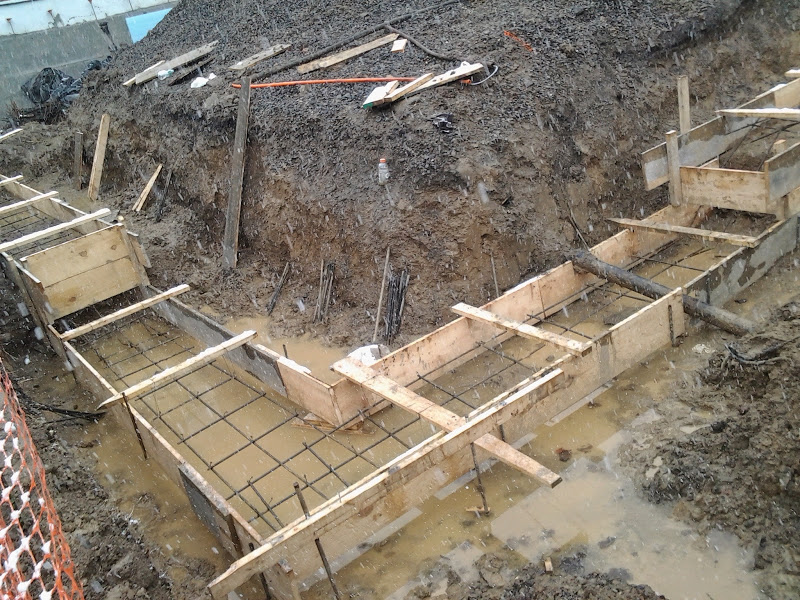
The parking lot that once fronted the street is gone. Wooden forms are in place for holding the concrete once it is poured, and rebar criss-crosses the space between the forms. Rebar is used to strengthen and reinforce concrete, the concrete bonds with the steel bars as it hardens. It looks like the east wall of the foundation has already been poured. A blue waterproof membrane can be seen on the concrete in the last photo.

The architect is a Collegetown favorite, local architectural firm Jagat Sharma. The building is being developed by Nick Lambrou of Lambrou Real Estate. Plans call for a 3-story, 4,180 sq ft structure with a 5-bedroom apartment on the first floor and a 6-bedroom apartment on the second floor and on the third floor. If construction stays to schedule, the building should be completed by August in time for the fall semester.

20150405_130821 20150405_130835 20150405_130845 20150405_130853

114_catherine_rev4_1


202 Eddy Street Construction Update 4/2015

7 04 2015

20150405_125117 20150405_125151 20150405_125203

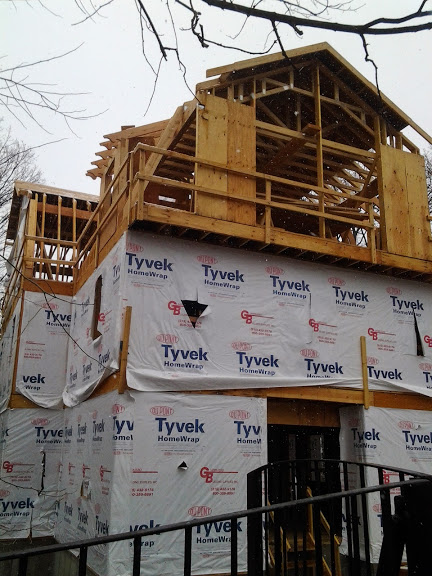
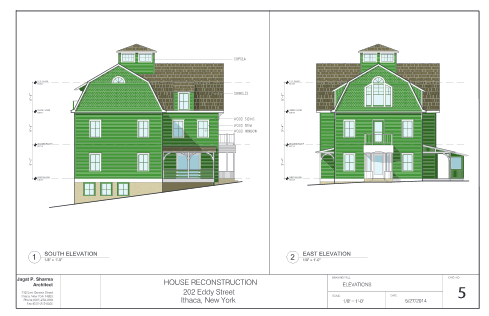
After being destroyed by a fire last March, reconstruction is underway at the site of 202 Eddy Street in Collegetown. Following the disaster, developer Nick Lambrou vowed to rebuild on the site. Being a part of the East Hill Historic District, any new structure needed to be approved by the Ithaca Landmarks Preservation Council. After thorough review, the ILPC approved plans for a new 12-bedroom apartment building that completely replaces the fire-damaged building.

The new structure is a faithful interpretation of the original building, though it’s not an exact copy. An entrance door was repositioned, exterior emergency stairs will be internalized, and a chimney will not be rebuilt, but otherwise, its a close approximation of the original 19th century home. The architect is Ithaca-based Jagat Sharma, who has previous experience from the reconstruction of Sigma Pi’s house when it burnt down in 1995.

In these photos from last Sunday, the concrete foundation has been poured, and the first two floors are framed with plywood and covered in Tyvek house wrap to keep out moisture. Rough framing is underway on the top floor and cupola, and the mansard roof trusses are complete but the roof itself is still in progress. Rough openings in the walls indicate future window locations, although some spots are not as obvious since they’re covered by the house wrap.

Plans call for the new building to be completed and ready for occupancy by August, in time for the fall 2015 semester.

202_eddy


Klarman Hall Construction Update, 2/2015

17 02 2015

Time to take another look at Cornell’s Klarman Hall for a progress report. It was low 50s F when I stopped by in late December and I thought that was pretty awesome. I completely and totally regret saying anything and will next time reserve to complaining about how cold it is, in an effort to spite Mother Nature.

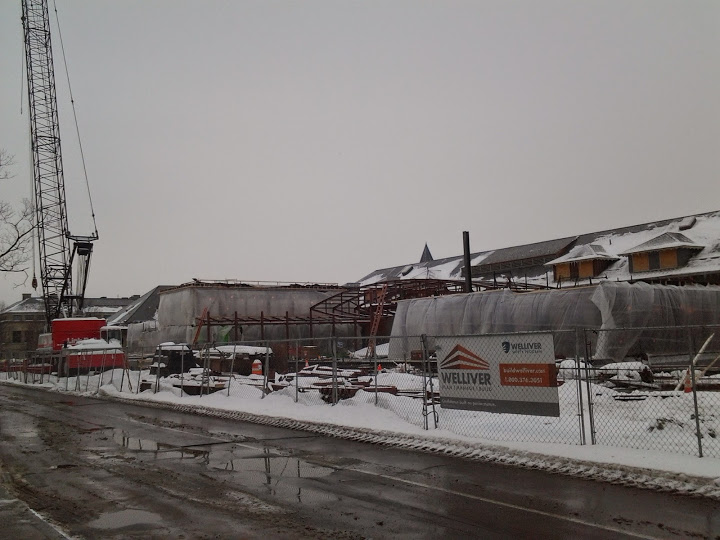
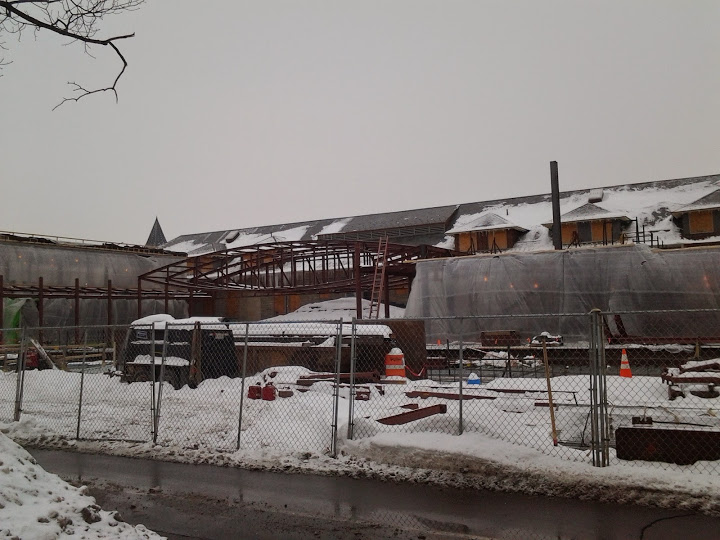
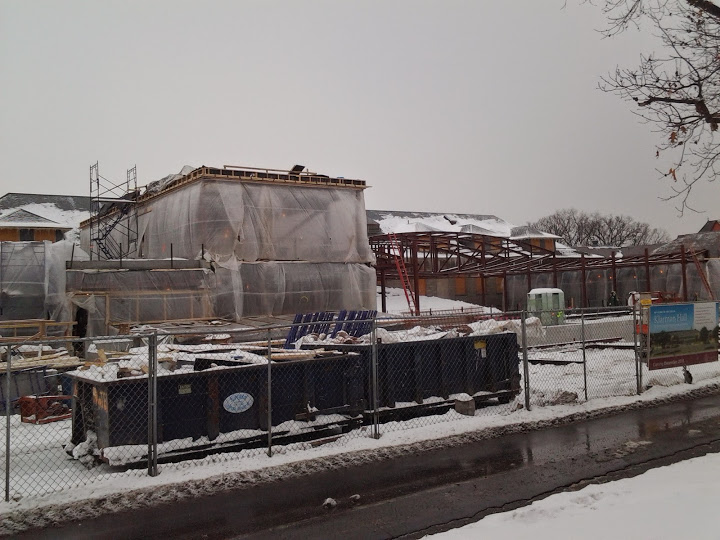
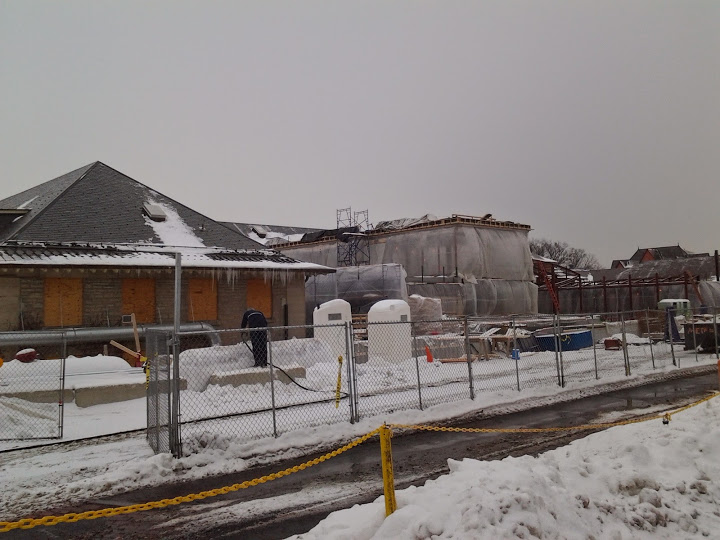
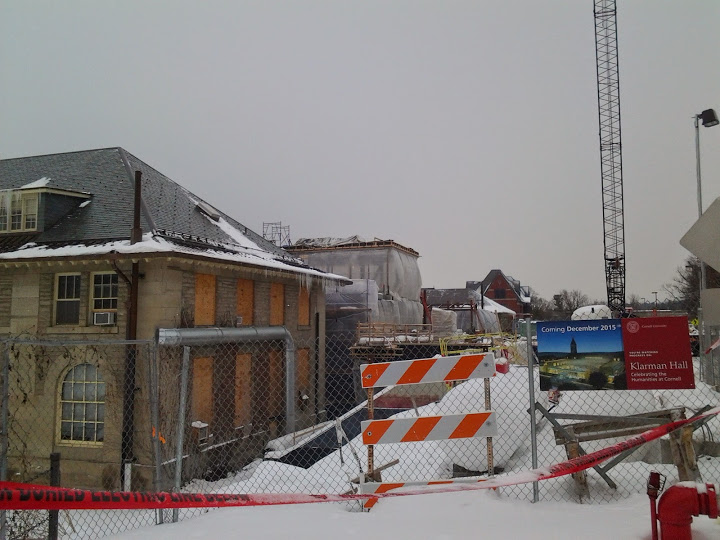
Anyway, construction firm Welliver has been busy craning the new steel atrium trusses into place, with at least four installed when these photos were taken the weekend before last. My laymen’s mind would call the shape almond-like or a pinched oval, but wikipedia tells me the proper terms are “vesica piscis” or “mandorla”, both of which sound like alien species doing battle with Captain Kirk. One of the site cranes has completed its work and has been removed, while the other will stay in place until all the structural steel has been erected. On the lower floors, fireproofing, mechanical and electrical rough-in (plumbing and wiring) is underway, while concrete pouring is taking place in parts of the upper levels. Some of this work would be visible from the fences, were it not for the plastic sheeting put up to keep the frigid winds at bay.

Over the month of February, construction schedules indicate that fireproofing will wrap up on the south side of the ground level, leading the way for sheetrock installation and exterior and interior wall framing. At the same time, fireproofing will begin on the north side of the ground level, and concrete will continue to be poured for the auditorium space and upper levels.

The 33,250 sq ft building was designed by Koetter | Kim & Associates, and is due to open in December 2015. Construction cost is estimated at $61 million.

20150207_143719 20150207_143654 20150207_143557 20150207_143533 20150207_143505 20150207_143426


Lofts @ Six Mile Creek Construction Update, 2/2015

13 02 2015

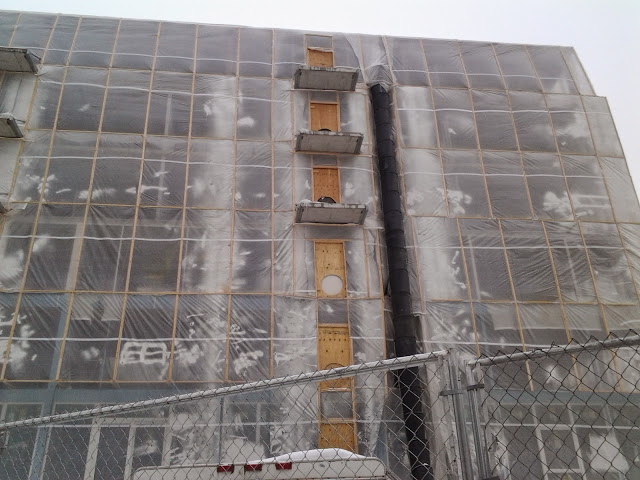
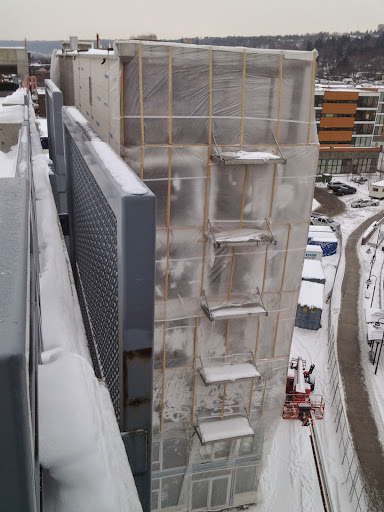
Even during these chilly days, work continues inside the Lofts @ Six Mile Creek apartment building in downtown Ithaca. Walking up to the building, the first thing that sticks out is that the building looks like it’s trapped in a bubble. The plastic sheeting is there for the simple reason of it’s winter in Ithaca, and its effing cold. The plastic keeps some of the sting of the wind away, and also seems to be convenient as a drawing surface. The plywood covers holes where doors will lead out to exterior balconies. Lower floors will have Juliet balconies, while upper floors and some lower-level side units will have full balconies.

A closer look shows that the first two floors do in fact have bands of Pella windows installed, separated with bands of sheathing that will eventually be covered by the exterior finishing material. According to the project’s facebook page, interior wall construction for the apartment units is currently underway. Plumbing, most electrical rough-in and fireproofing are complete, the metal frames of the apartment walls already erected; now comes hanging sheet-rock, flooring and ceiling finishes. Apartments will consist of studios, 1-bedroom units and 2-bedroom units, with some of the studios and 1 bedroom units having bonus rooms. Square footage per unit will range from 555 to 1202 sq ft. The facebook page notes that tentative rents will be posted in the next couple of weeks.

The 7-story, 49,244 square foot building will contain 45 rental apartment units. The building is being developed by Cincinnati-based Bloomfield/Schon + Partners, with construction by Turnbull-Wahlert Construction. Completion of the apartments is expected during the second quarter (April-June) of this year, wrapping up the last phase of a 15-year project.

20150207_151831 20150207_151911 20150207_151950 20150207_151954 20150207_152026 20150207_152252

cayugaplace_v5


Ithaca Marriott Construction Update, 2/2015

10 02 2015

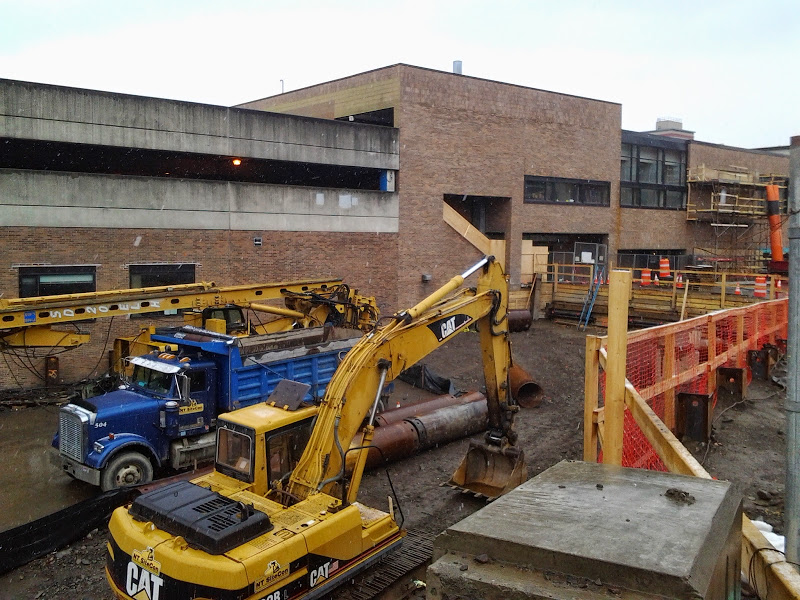
The land for the new Ithaca Marriott exchanged hands on January 13th, the groundbreaking ceremony was January 22nd. With those events filed away, there appears to be some real site prep going on at the site, located at the intersection of E. State and S. Aurora Streets. The site has very clearly been disturbed, although last Saturday appeared to be a day off for the construction workers. The sidewalk on S. Aurora Street is closed, and excavators and dump trucks are ready and waiting. The first major step in this project will be to clear the asphalt and soil on site and dig deep enough to enable foundation work to take place. Expect that work to take place for the rest of the winter and into the spring.

The $32 million, 10-story, 159-room hotel is slated for an opening in Q3 of 2016 (July-September). This is pushed back from the previously given date of Spring 2016. While this new date misses the lucrative graduation season, it will still be able to take advantage of the summer crowds and back-to-school visitors, if all goes to plan (and we’ll see if it does). The new date also places the opening of the Marriott a couple of months behind the opening of the new 123-room Canopy Hilton a couple blocks away. With 282 more hotel rooms downtown, businesses that cater to tourists and other travelers will welcome the boost in business. Who knows, perhaps the Commons will finally be done with reconstruction by then.

According to a press release from developer Urgo Hotels (or the Ithaca Journal paraphrase), the hotel will include a fitness center, a restaurant with indoor and outdoor seating, and 3,000 sq ft of meeting space. While the hotel is underway, some details are still being ironed out – the hotel signage (which requires a zoning variance) was derided as too generic and bright, and Urgo Hotels withdrew the proposed design. Urgo has a year or so to figure out what kind of signage they and Marriott would like to install, and don’t expect any delays just because of signage.

The hotel has been designed by Atlanta-based Cooper Carry Architecture and development is a joint venture of Urgo Hotels of Bethesda and Ensemble Hotel Partners, a division of Ensemble Investments. Urgo’s portfolio includes at least 32 other hotels totaling 4,500 hotel rooms. Interior design will be handled by Design Continuum, W.H. Lane of Binghamton is the general contractor, and Rimland Development contributed the land to the joint venture and is a partner. Long Island-based Rimland was the original firm that pitched the project in 2008 as the “Hotel Ithaca”, before the old Holiday Inn downtown went independent.
Off the record, have we settled that it’s 159 rooms and not 160? Because this is confusing me to no end.

20150207_152836 20150207_153021 20150207_153027 20150207_153100 20150207_153118

marriott_rev1_1