Call it the big news round-up. This is what I get for not writing my weekly roundup last week.
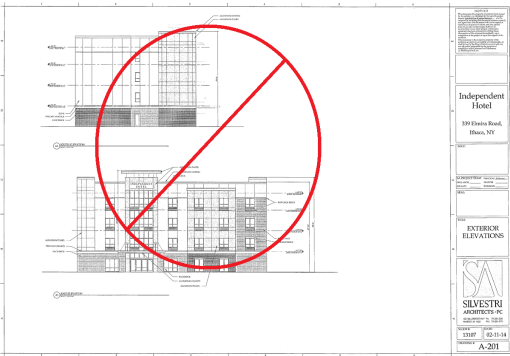
1. We’ll start off with some bad news. The plans for a boutique hotel at 339 Elmira are very likely done and over with. The 37-room, 6,468 SF hotel announced in February 2014 was planned for the 0.59 acre former Salvation Army property on the Southwest side of the city. For whatever their reasons were, the developer, (Rudra Management and Rosewood Hotels of Buffalo, decided put the property up for sale for $395,000. After several months, it finally sold at the discounted price of $300,000 to its next door neighbor, Arizona-based Amerco Real Estate, the parent company of U-Haul. Discounted is a relative term, by the way – Rudra had acquired the vacant property for $143,000 in a land auction in 2013. Back when Salvation Army was still there in 2009, the site sold for $175,000.
So with that sale to Amerco, it’s likely the property will be used for an expanded U-Haul parking lot. It’s unfortunate, but them’s the breaks. For what it’s worth, Rudra has commenced work with the other hotel they had planned, the 79-room Holiday Express at 371 Elmira Road, just down the street.
2. In modest but notable projects, the William George Agency in Dryden received a $2 million construction loan to conduct renovations and roof repairs to its cafeteria area. The non-profit residential treatment center for adolescents had secured building material sales tax abatements from the county to help cover their expenses (the project has originally been planned to start in Q1 2015). The agency, established in the 1890s, employs over 340, making it one of the larger private employers in Tompkins County.

3. Thanks to Nick Reynolds over at the Journal for reminding readers that not every construction project is private. Noted in his writeup of projects that the city intends to fund this year – $430k in road repair projects, another $407k for parking stations, $1.3 million to replace Cass Park rink’s roof, $214k for design work for the new North Aurora street bridge, and $735k for design work for city dam reconstructions.
Perhaps most interesting to readers here will be the $500k that the city intends to spend on design and planning the new Station No. 9. With the awarding of funding from the Upstate Revitalization Initiative, the city can formally explore the possibility of a new fire station on a Cornell parking lot at 120 Maple Avenue. Once a new station is complete, the city could then sell the current Station No. 9, nearly 50 years old and in need of major renovations, to a private developer for redevelopment (the developer who expressed interest in the site is still unknown, but given Collegetown’s expensive real estate market, they must have really deep pockets).
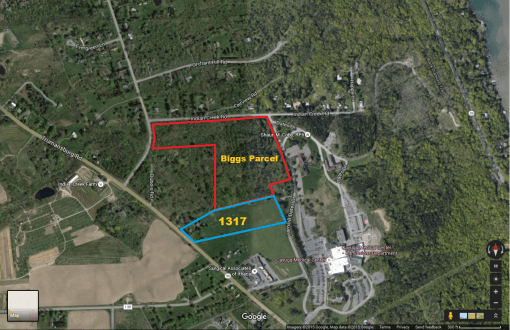
4. More talk of the Biggs Parcel. Jaime Cone at the Ithaca Times provides more details regarding neighbor Roy Luft’s proposal to build for-sale senior housing using the site. Luft is arguing his project is more environmentally friendly than the NRP project, it would take two to three years to come to fruition, that the units would be 700-1,000 SF, and he’s serious about building the senior housing, which is an under-served market. The Indian Creek Neighborhood Association, which has actively fought any sale, seems to at least be open to the idea, if not necessarily a fan of it.
For the record, since the ICNA doesn’t clarify it in their blog post, the county didn’t develop the NRP project. The county put out a request for proposals (RFP) just like they do with every other large development study or offering. Better Housing for Tompkins County and NRP happened to think they had a good project idea and responded to the RFP. It’s been made clear, multiple times, that the county has approached neighbors, Cayuga Medical, INHS and others for months, shopping the land around, and no one has made offers. To be completely honest, even if this land hit the real estate listings, it’s not as if anyone is clamoring to snatch this up; there’s demand to live in and near Ithaca, but land still takes several months to sell on average, and it’s not a stretch to think that developers would avoid this one after the NRP flaying. The county plans to start the listing process later this month if the ICNA doesn’t make an offer by the 15th.
Just a thought, but if $340,000/25.52 acres = $13,333/acre, and the acreage closest to Dates Road is probably developable, than shouldn’t that allow a ballpark fair-value estimate? I know NRP was to pay $500,000, but that had some transit and pedestrian cotingencies attached. Has the ICNA contacted NRP to ask how extensive the wetlands were, is the information on file with the county?
1317 Trumansburg is 10.17 acres, The Biggs parcel 25.52. Combined, they would be 35.69 acres. From the sound of it, Luft would like to reform the parcel boundaries to let his project, however big it may be, to move forward. The site is zoned low-density residential, which means a cluster subdivision can be 2.3 units/acre at maximum. Each structure can have up to 6 units. Taking a guess here, but Luft may be looking at more than 20 units, because anything less than 20 could be done with a subdivision of his current property. For comparison’s sake, the BHTC/NRP project was 58 units.
There is at least the potential that the county gets additional tax dollars from Luft’s project, and the woods would be protected, and there would be a happy ending to this story. But that’s dependent on both sides’ goodwill. Given the years of acrimony, that’s a big leap of faith.
5. For the restaurant-goers out there – Fine Line Bistro’s old spot at 404 West State has a new tenant called “The Rook” opening this month. Mark Anbinder provides the foodie rundown at 14850.com. Mid-tier American bistro/pub fare.
More importantly to this blog is the economic rundown, provided thanks to their application for a loan courtesy of the Ithaca Urban Renewal Agency (IURA). The three co-owners, all local restaurateurs, are seeking a $40,000 loan (3.5% interest, 6 year length) to complement their own dollars and a private loan. 8 hired staff (cooks/servers/dishwasher), but none living wage. With cash flow statements, restaurant plans, the menu, loan filings and resumes of the owners, this looks like a Cornell Hotelie’s senior class project.
It’s the IURA’s decision make, but at least it’s nice to know that good restaurant space in Ithaca is in strong demand.

6. Out for bid, Cornell’s Ag Quad renovations. The bid filing estimates the budget at $6.6-6.8 million, and a construction timetable of late March 2016 to Summer 2017. Quoting the first write up from October:
“The $9.6 million project will be broken down into two phases, one that focuses on infrastructure, and one phase on landscape improvements (and being that much of the infrastructure is underground utilities, phase one could be described as churning up the ground, and phase two is making the upturned dirt pretty again). The renovations, which are set to start next summer and run through 2017, will include additional emergency phones, a rain garden, and outdoor gathering spaces in front of Mann Library and Roberts Hall (upper right and lower left in the above render).”

7. Folks love a good rumor, and the Times’ Josh Brokaw had an interesting one to report in his 2016 futurecast regarding State Street Triangle –
“Don’t think that the Austin-based developer is abandoning Ithaca, though a look at their previous projects shows this sort of downtown, mixed-use development is a new frontier for a company accustomed to building student housing mostly in green fields in the South and Midwest. CEO Mike Peter was spotted downtown at Mercado in December talking to consultant Scott Whitham; it wouldn’t surprise if the company came back this year with something conceptually similar—lots of rooms, ground-floor retail—but a much different look.”
Brokaw makes a reference to the inclusionary zoning slated for discussion next month, which is rumored to mandate affordable units in return for a larger footprint (rundown of how that works here). I also wonder if it will make reference to the “pillar” that Myrick mentioned previously – a taller, skinnier building, not as massive and perhaps only 3-4 floors over most of the site, and maybe a quarter of the site has a taller tower that’s 12 or 13 floors, whatever is permitted by the inclusionary zoning (strictly hypothetical, just one guess of many). Campus Advantage has plenty of time since they missed their original start date, but maybe later this year in the spring.
8. It’s always a brow-turner when a real estate listing is advertised as “a large corner lot ideal for a multi-unit development“. In this case, it’s a 0.2 acre double lot at 404 Wood Street in Ithaca’s South Side neighborhood. The listing offers the ca. 1938 house and lot for $250,000 (tax rolls say the property is assessed at $125,000; the current owner picked it up for just $34,000 in 1993).
Playing with some numbers a little bit, there are a couple of options if a buyer wanted to build something. The first and probably easier option would be to subdivide the lot and build on the vacant corner parcel. That would give, per R-3b zoning regulations of 40% lot coverage and 4 floors, about 1400 SF per floor. That gives 5600 SF, and if one assumes 15% off for circulation/utilities and 850 SF per unit, you get a 5 or 6 unit building at theoretical maximum.
If one were more brazen and tear down the 1938 house, one gets about 3,485 SF per floor, 13,940 SF at max height. That allows about 14 units using the same figures as above. But that might be tougher for neighbors to swallow. Anyway, if it sells and it looks like there’s a possibility, it’ll get a followup in a future news post.
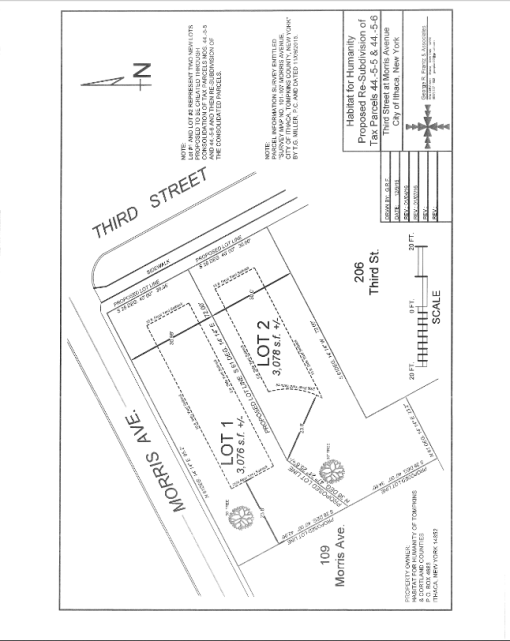
9. Nothing to exciting on municipal planning agendas this week. The town of Lansing cancelled their meeting, and all the town of Ithaca had was a cell phone tower on West Hill. The city has a little more interesting. The duplex at 424 Dryden is examining unusual parking arrangements to save trees, and Habitat for Humanity is planning an affordable-housing owner-occupied duplex for vacant lots at 101-107 Morris Avenue in the city’s North Side neighborhood.
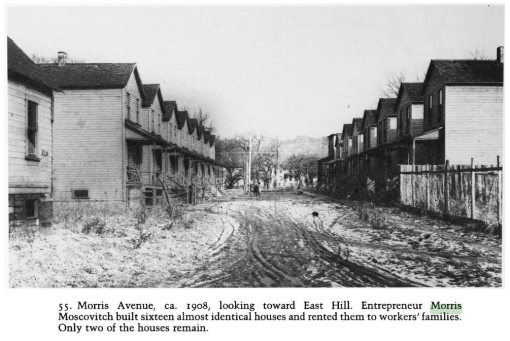
Morris Avenue has always had a focus on worker housing. As described in Ithaca’s Neighborhoods by Carol Sisler (1988), local businessman Morris Moscovitch built 16 nearly identical houses in 1908 to house worker’s families. But, with the effects of urban decay and urban renewal, only one of those 812 SF houses (109 Morris) is still standing today.
What Habitat for Humanity is proposing is to take the vacant lots at 101-105 Morris and 107 Morris (total 0.138 acres), combine them and create two new lots that will face Third Street. The new lots would need a zoning variance since they’re not wide enough (30′ and 30.98′, 35′ required). Being Habitat, these might take a little while to build and they probably won’t wow anyone design-wise, but there’s a lot of value to be placed in their “sweat equity” approach, and affordable owner-occupied housing is in severe need in Ithaca. Planner George Frantz is handling the application.

10. Lastly, for what is a very long post, the Hotel Ithaca’s revised CIITAP application to the Tompkins County IDA. Now that the project is approved by the city, they can work on a revised tax deal. According to the project memo, the sales, mortgage and property tax abatements will total $1.781 million on the $15 million project. The property tax abatement is the standard 7-year abatement, and will generate almost $1 million in new tax revenue during the abatement period. The project would retain 71 positions and create 21 new jobs, most of which appear to be less than living wage. The application does note, perhaps ominously, that non-approval would result in functional obsolescence – the hotel shuts down. The IDA plans to examine the application at their meeting in the county office building next Thursday.



























 Ithacating in Cornell Heights