Carey Building Construction Update, 2/2015

9 02 2015

I was originally going to schedule this for later in the week, but I figure I’ll run it now, since the recent twitter chatter is observant but mistaken. The Canopy Hotel is not under construction. At least, not yet. The hotel is expected to start in early Spring. But the work on the Carey Building addition is just beginning.

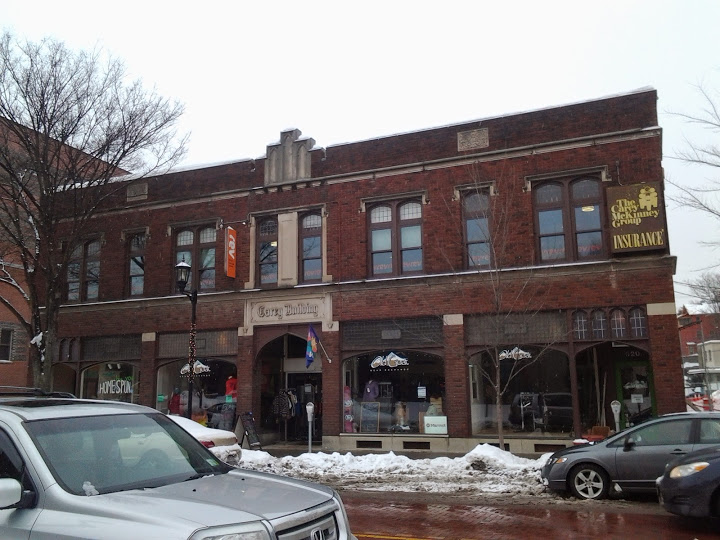
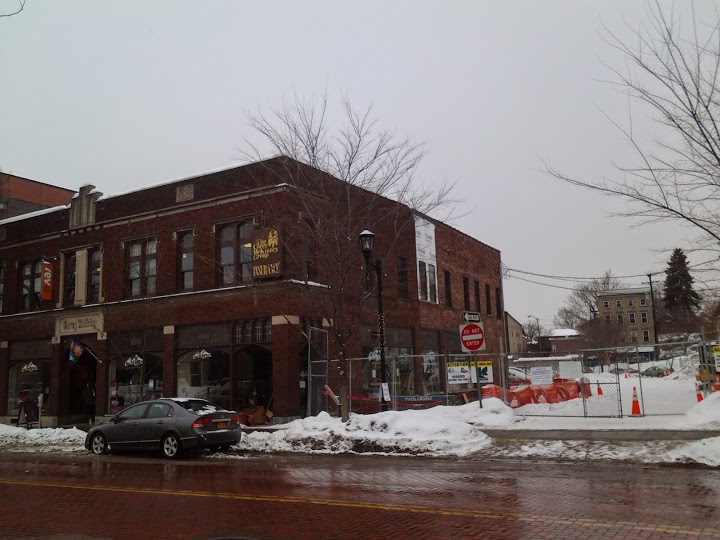
According to Jason Henderson at Ithaca Builds, building contractor LeChase Construction is currently conducting underpinning work on the Carey Building. Underpinning is the name of the process by which a foundation is strengthened – certainly necessary when one is about to add five floors onto a 2-story building. The second to last photo here shows some of the underpinning work on the eastern foundation wall, and the tarp is on the roof indicates prep-work for the upcoming expansion. LeChase will also be handling the construction of the Canopy Hotel next door.

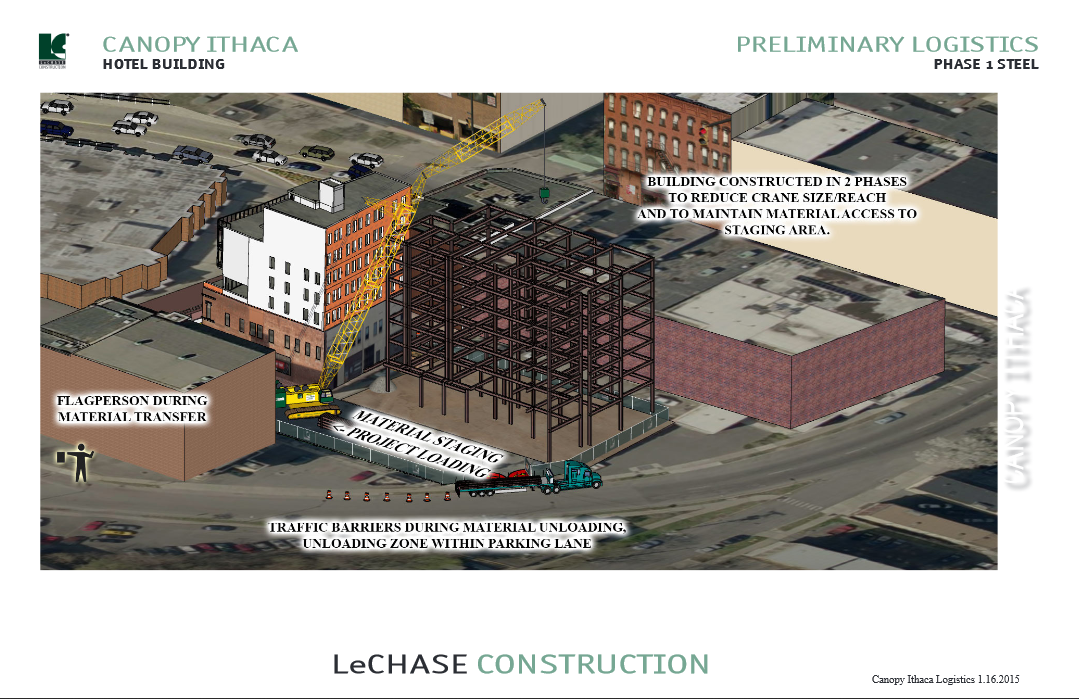
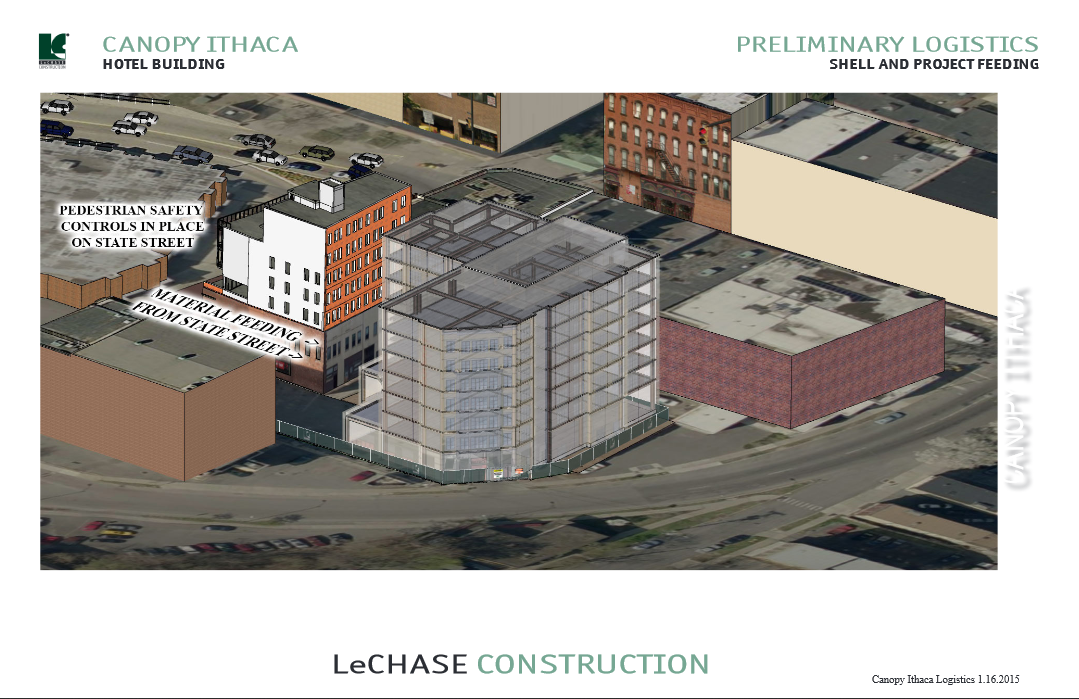
It’s quite unusual in a place like Ithaca to have two separate large projects right next to each other under construction at the same time. This will be logistically complicated. In a letter to the Canopy developers, LeChase’s large trucks will have their brakes inspected before entering State Street, and will be escorted down the hill to a designated area on Seneca Street, and will leave the city via Seneca Street. According to construction phase diagrams, The steel for the Carey Building will be erected first; then, using the same crane, LeChase will begin installing steel for the new hotel. Sharing the crane will result in a cost savings to both owners.

When most of the western side of the hotel has had its steel structure craned into place, LeChase will transition to a smaller crane and switch the material unloading and staging area to East State Street. This is because the hotel occupies most of the site, so the crane is reduced and East State street will be closer to the location of the new crane. Cladding and interior materials will continue to be fed in via E. State Street through the project’s completion in Spring 2016. The Carey Building will have been completed by then, finishing by the end of summer 2015.

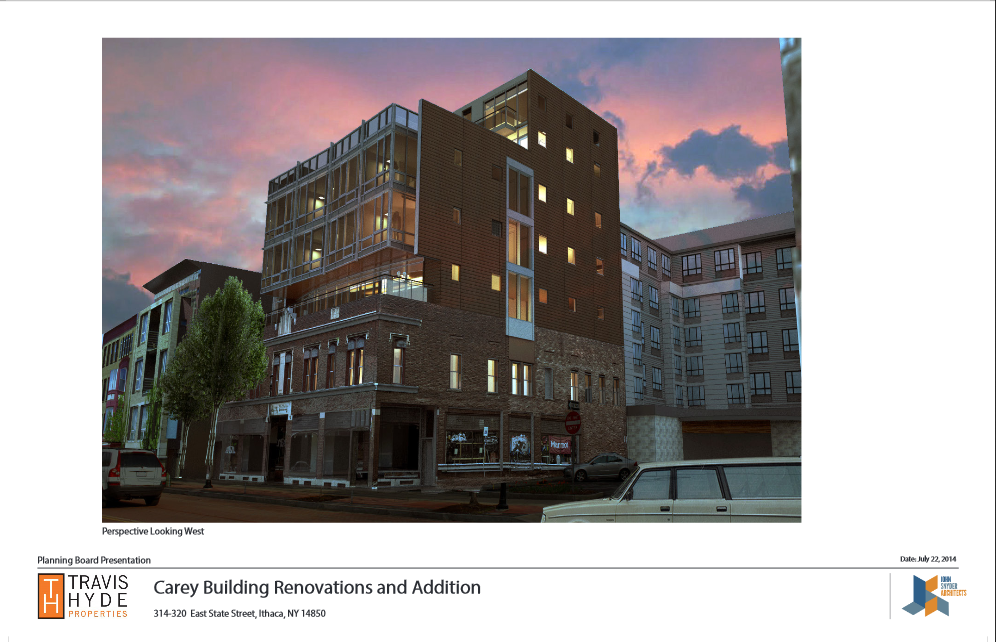
The Carey Building addition will add a third floor and 4,200 sq ft to the Rev business incubator (nearly doubling it to 8,700 sq ft), and on floors 4-7, there will be 20 apartments. Floors 4 and 5 will have 16 studio apartment units that average only 400-500 sq ft, their small size enabling them to be rented at a lower price. The 4 units on floors 6 and 7 will be larger 2-bedroom units. The $4.1 million project is being developed by local firm Travis Hyde Companies.

20150207_153142 20150207_153223 20150207_153246 20150207_153412 20150207_153422

carey_rev4_2

canopy_carey_logistics_1 canopy_carey_logistics_2 canopy_carey_logistics_3 canopy_carey_logistics_4


Boiceville Cottages Update, 2/2015

8 02 2015

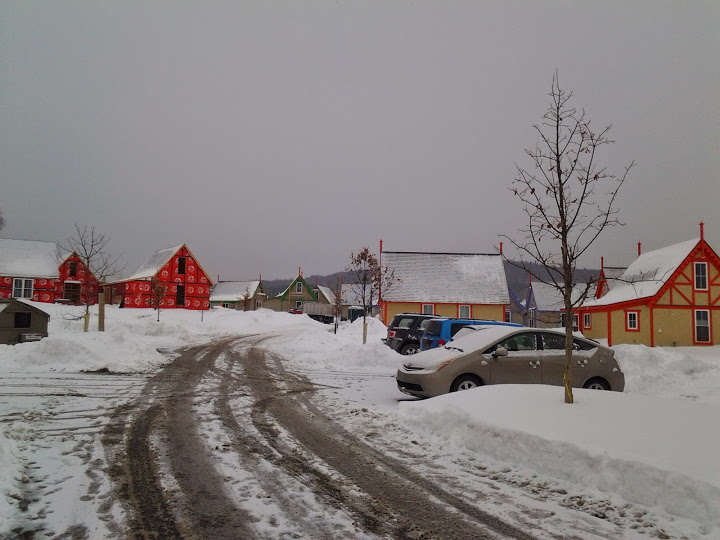
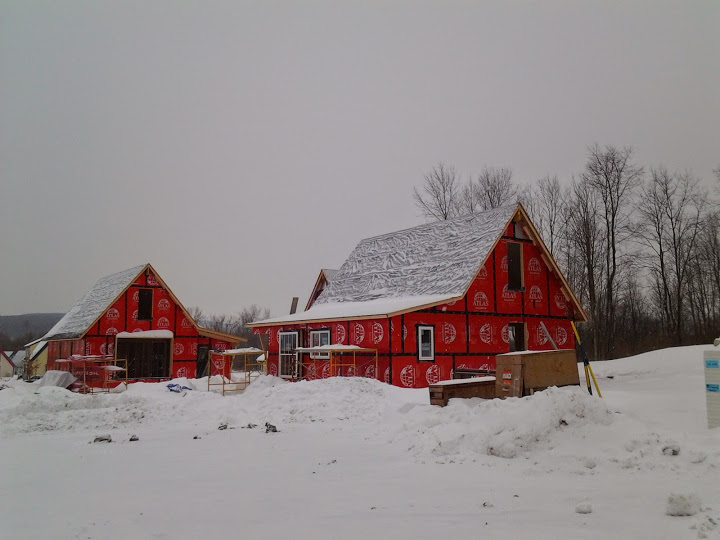
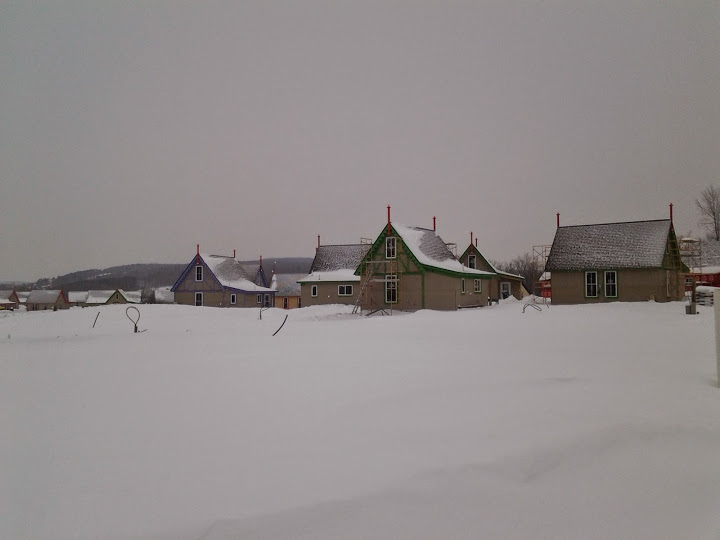
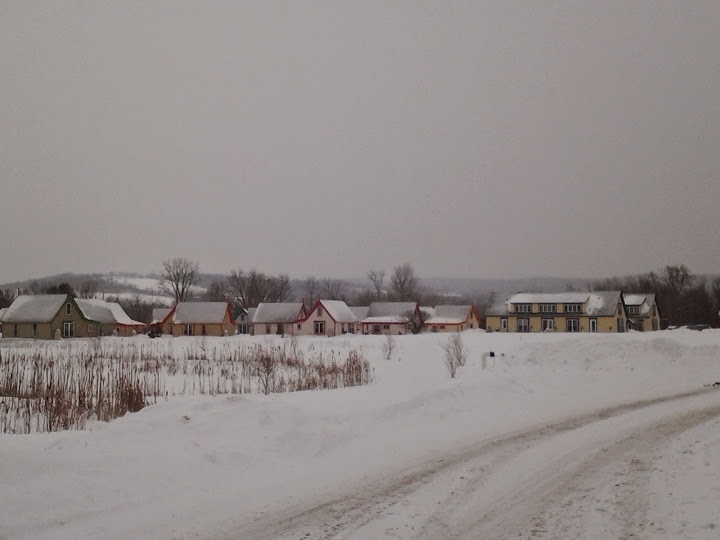
It’s been about 2.5 months since my last trip through the Boiceville Cottages, but given that it’s winter (and a particularly cold and severe winter since the jet stream reconfigured in January), there has only been slow if steady progress with its 75-unit expansion. Since December, the timber homes with purple trim have been completed, four houses that were undergoing exterior build-out have now progressed to exterior detailing and interior finishing (the ones with green timber trim), and windows are being fitted into three homes that have sprouted from their slab foundations since the previous visit.

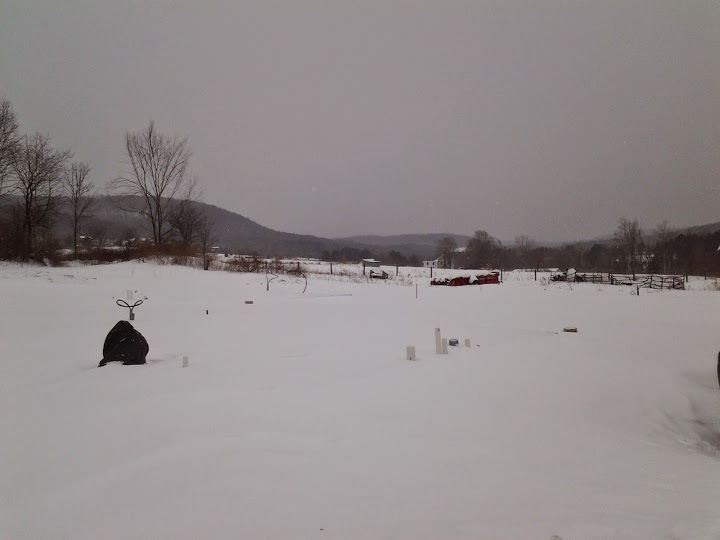
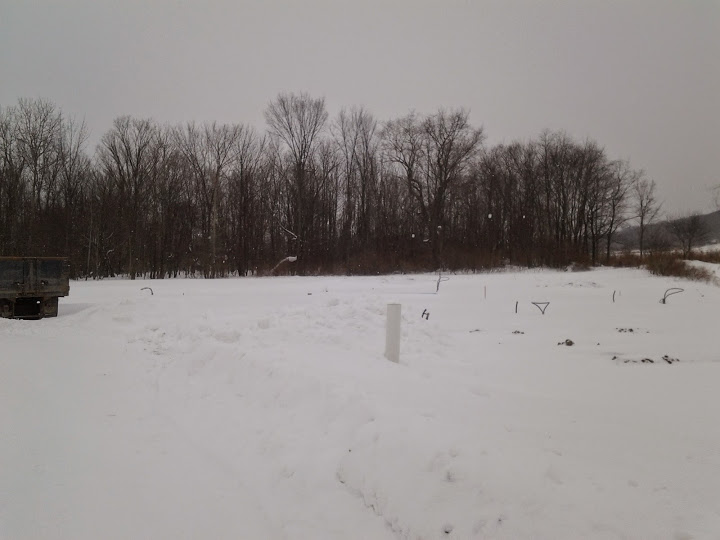
One of the things that stood out on this visit was that it’s now possible to walk all the way through the new phase thanks to the construction. Looking around at the snow on the ground, edges of the blue waterproof covering (which might be the covering of cement board being used to protect the slab insulation) could be seen poking out among the drifts. Using the (gas utility?) loops coming out from the foundations as a guide, there are perhaps a dozen poured concrete foundations, ready for construction as time and weather provide. There were approximately 25 units that were built in 2014, and with probably 10 complete by the end of March, 2015 looks to be on the same construction pace, maybe even greater. It might even be possible that the expansion will be completed this year. Inquiring minds would like to know if Bruno Schickel has any other expansions or colorful villages planned.

The Boiceville Cottages, built and managed by the Schickel family, are rather unusual as apartment complexes go. For one thing, there are the bright paint jobs, a sort of hallmark of the cottage units since the first set of 24 houses was built in 1996/97. The bright paint and the ornate woodwork have led to a nickname, “The Storybook Cottages“, which holds some weight, according to an article in Life in the Finger Lakes:

“Schickel said he was inspired to build his colorful cottages by a children’s book he read to his daughters almost 20 years ago. The book, Miss Rumphius, by Barbara Cooney, tells of a girl who, at her grandfather’s urging, travels to faraway lands seeking adventure. Later she moves to a cottage by the sea and works to make the world more beautiful by spreading seeds of blue and purple lupine. An illustration by the author shows the Lupine Lady’s house on a hill overlooking the sea. The small cottage is replete with finial and gingerbread. Seeing that illustration was the eureka! moment, Schickel recalled. “I said, ‘I’ve got to design something like this!’”

Since the initial 24 units were built, a further phase of 36 units was undertaken pre-recession, and in the past couple of years the town of Caroline signed off on the next phase, a group of 75 that would more than double the size of the complex. The cottages have been built out at a steady pace, and at completion of this current phase, 135 units will be present on the Boiceville property. Most of the units are 1 and 2-bedroom cottages, built in clusters of three, although a few “gatehouse” rowhouses offer studios and 3-bedroom units. The Boiceville complex may be the largest population center in the 3,300 person town.

20150207_124102 20150207_124139 20150207_124147 20150207_124213 20150207_124234 20150207_124303 20150207_124308 20150207_124336 20150207_124344 20150207_124416 20150207_124421 20150207_124434  20150207_124553 20150207_124836 20150207_124847 20150207_125032


News Tidbits 2/7/15: It Snows In Ithaca, But Verizon Makes It Rain In NYC

7 02 2015

1. As relayed by several outlets, Cornell just received a very generous $50 million donation from telecommuncations giant Verizon. I might make more news about this, but this donation is strictly for the shiny new tech campus down in New York City. The “Verizon Executive Education Center”, in the left of the above render, will be part of the first phase of the campus, set to open in 2017. This goes along with a 6-story, 236,000 sq ft building design by Weiss/Manfredi, and a 4-story, 188,600 sq ft building by Morphosis Architects, both of which are already underway. The skyscraper on the right of the render is a 26-story, 500-room dormitory for students and staff designed by Handel Architects; while not yet underway, it is also slated for a 2017 opening. A design for the tall building on the far left has not been released.

I’d like to see a breakdown of what proportion each campus received from Cornell’s $546.1 million in donations.

2. Looks like some Sun writers decided to do some digging regarding the potential Fine Arts library relocation and expansion. There’s not a whole lot more to add since the Ithaca Voice article; just that the timeline and final design haven’t been set, although the renovation is a “key academic priority”. Students of the AAP school also have mixed opinions about the growth of the library and the possible loss of studio space. But don’t fret dear readers, if a render comes out, it and any pertinent info will be shared here.

424_dryden_rd_1

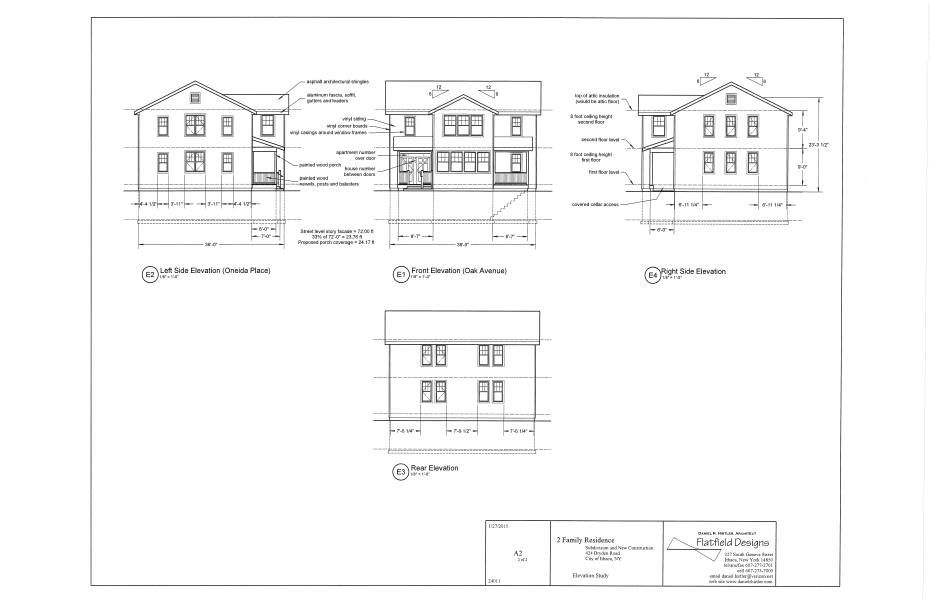
3. A subdivision filed with the city of Ithaca indicates plans for a new two-family, 6-bedroom home at the intersection of Oak Avenue and Oneida Place. The house would be built on land that currently serves as a rear parking lot for 424 Dryden Road. Application here, drawings here. The site falls into the CR-2 Zone of the Collegetown Form District, meaning 2-3 floors, and pitched roofs and porches are required. The architect is Daniel Hirtler of Ithaca, and the developers are William and Angie Chen, also of Ithaca. While not particularly notable, it’s an example of how the form-based zoning applied to Collegetown helps maintain the character of the less-dense outer neighborhood, while still allowing for new construction.

canopy_hampton_rev4_1

4. As with virtually every other sizable project in downtown Ithaca, the canopy Hotel by Hilton is filing an application requesting a tax abatement through the CIITAP program, making it the sixth applicant since the revised program was put into affect in 2013. Application here, and the notice of  public meeting, set for 5 PM February 9th at City Hall, is here. A refresher/review of CIITAP can be found here.

The applicant, “Ithaca Downtown Associates LLC”, a.k.a. the Patel Family of the Baywood Hotels Inc., notes that the 7-story, 123-room hotel project has an estimate cost of $20.15 million. Although the value of the tax abatement is not recorded in the city’s application (it will be written out, when reviewed by the county IDA), it looks like they’re seeking the standard 7-year abatement, which will save them something in the ballpark of a couple million dollars over those 7 years.

As with the previous Marriott and Hotel Ithaca applications, the applicant will only pay one-third to one-half of its projected employees a living wage, which is probably going to earn them the scorn and opposition of the Tompkins County Worker’s Center. But the city and Downtown Ithaca Alliance have been supporters of the project. Neighboring businesses seem to be have mixed opinions about the project, with some seeing a potential business source, and others mourning the loss of a convenient parking lot.

The 74,475 sq ft project is expecting to start construction during the spring, with completion in Spring 2016. Local firm Whitham Planning and Design is the architect.

For those already planning a stay, expect room rates of $160+/night, according to the Journal.

inhs_pride_alleydesign_v2

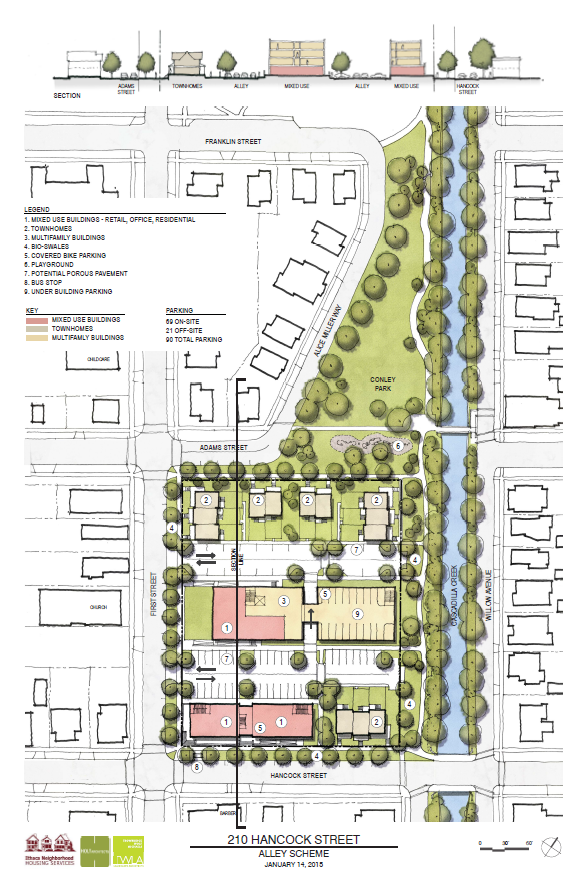
5. It’s PSA time again – INHS is planning meeting #4 for its proposed Neighborhood Pride redevelopment at 4:30 PM Wednesday the 11th, inside the vacant Neighborhood Pride grocery store. The one and only final design concept, shaped by community feedback, will be presented at this meeting. Keep an eye on the Voice for an article (and maybe a rerun here) next Thursday or Friday.

lake_st_bridge

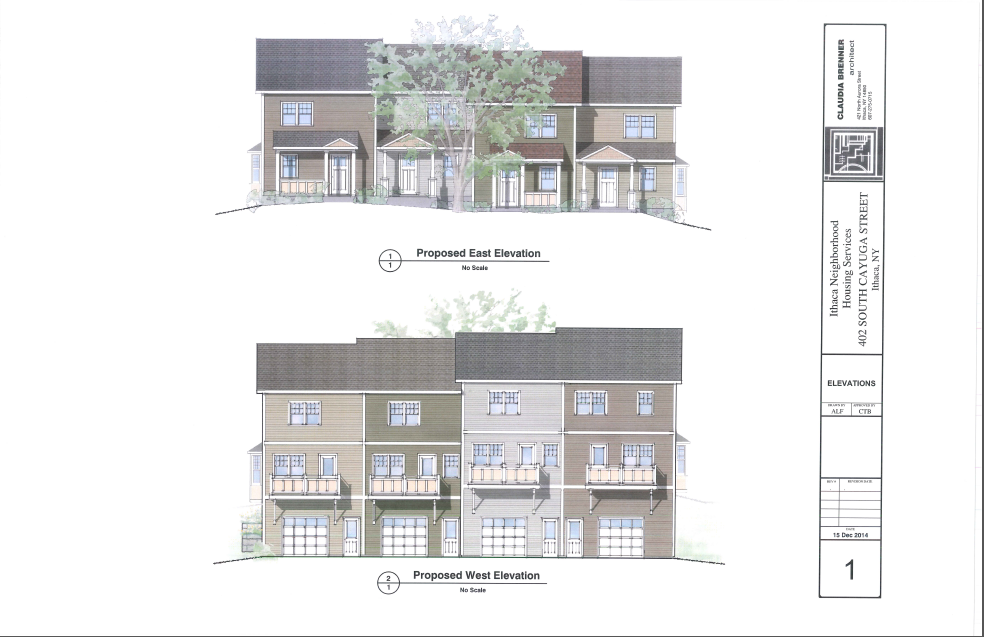
6. Looking at the city’s project memo going out to its departments, it doesn’t look like a whole lot needs to be reviewed this month. Cornell’s Upson hall renovation, the 6-unit building at 707 E. Seneca, and the 4 for-sale townhomes INHS wants to build at 402 S. Cayuga Street are ready for final approval this month. The 3-building, 6-unit project for 804 E. State (112 Blair) still needs to be reviewed by the zoning board, and will be completing environmental review (SEQR determination of significance).

The only new projects of note are the new house at 424 Dryden, and renovations to the Lake Street Bridge. The bridge project consists of rebuilding the current deteriorated bridge with a new deck and refurbished abutments (base supports), as well as scour reinforcements (to protect from creek erosion), a bumpout for viewing Ithaca Falls, some cute light-posts, and a bridge span that isn’t so degraded that it’s liable to collapse into the creek. That project has a $1,000,000 price tag, and is expected to run from June to November of this year.

For those that use this bridge, start prepping for a detour route – the bridge will be closed during construction, to both vehicles and pedestrians. The city estimates the detour will be an extra 1.7 miles for cars, and 0.7 miles for bikes and walkers.


Tompkins County’s Comprehensive Plan

3 02 2015

5-1-2012 120

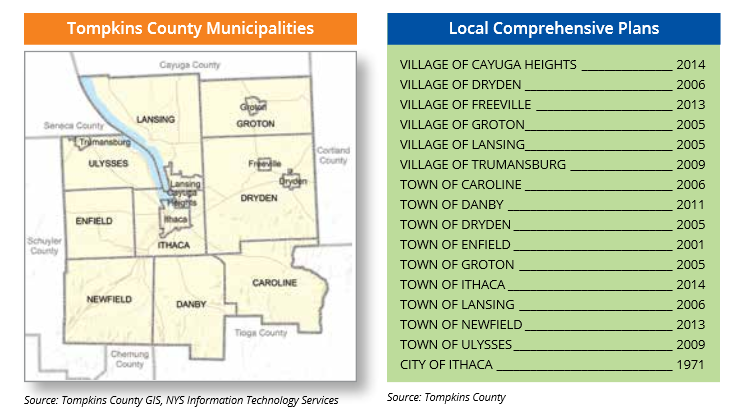
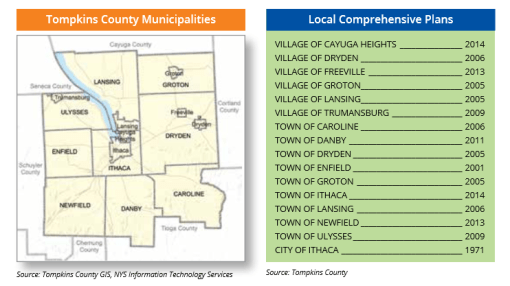
In keeping with the recent talk of Comprehensive Plans, Tompkins County has just released their new plan, their first since 2004. That might not seem like a big deal, but in that time period, the county has probably added 4,500 residents and a couple thousand housing units, so it’s more important than it might seem at first glance (for the sake of comparison, every county community except Ithaca city has made a plan since 2000; the city’s dates from 1971). Currently, the plan is in review and up for adoption by the County Legislature at their meeting on the 17th. The 109-page document has been in the works since the fall of 2013.
tc_compplan_1

Generally, the county doesn’t play a big role in what does and doesn’t get built in its constituent villages and towns. Building projects are required to get county input, but the county isn’t about to stop anything, nor does it have much authority to (unless you’re applying for tax breaks, like Jason Fane’s 130 E. Clinton project). Perhaps the largest point of contention at the moment is the intermunicipal NYSEG natural gas pipeline, which Lansing wants and needs to sustain its growth, but the county has issues with, saying it could upset their green energy goals. On the opposite end of the scale was the Cayuga Ridge project for the Biggs parcel, which the county planned to sell to an affordable housing developer, but received significant blowback from the West Hill community. Cayuga Ridge was later cancelled when a site check by the developer revealed more wetlands than previously thought.

Anyway, back to the plan. It’s available in small chunks on this page, or for those whose internet connection can handle all 109 pages at once, here it is.

The general theme here from a housing standpoint is to fill in the spaces within the city, villages and hamlets. There’s a strong push on the county level to keep farmland from being scooped up for new development – a major threat, considering some of the cheapest land to develop in the county happens to be far-flung agricultural properties, where a relative lack of neighbors and shoestring small town planning boards can make for a quick and easy process. The logic is, if development takes place in communities that are already settled and already have employers and amenities, it limits the need for getting into a car for every trip, and makes for a more “sustainable” environment and stronger communities. Urban/infill development also makes for a lower tax burden per new unit added – there’s no need to pave new roads or extend utility lines.

The county is also becoming a bigger proponent of mixed-use development – apartment buildings with retail on the first floor, projects that have space for both homes and offices, and so forth. The logic is the same as before – if it’s convenient, people are more likely to walk, and patronize their own community. Trends in smaller households leads to the county’s suggestion of smaller housing units, as well as more senior housing for the greying population that chooses to “age in place”.

This all sounds great on paper, but there are many issues in practice. Anti-development sentiment, the ideal candidates for development aren’t for sale, outdated municipal zoning and so forth.

Economically, the county plans on sustaining its biggest contributors, education and healthcare, while making an effort to diversify with incentives towards manufacturing, high-tech/tech startups, food processing, agriculture and tourism. Specifically, they’re hoping to leverage the Cornell tech scene into permanent jobs and new economic development, which has met with some success, though nothing on the scale of, say, Silicon Valley or the Research Triangle. The high taxes, isolated location and lack of access to capital are major hurdles in an area that has plenty of brain power to tap into. The county is hoping to alleviate some of the burden by utilizing the state’s STARTUP NY program, and supporting resources like the new Rev business incubator in downtown Ithaca.
tc_compplan_2

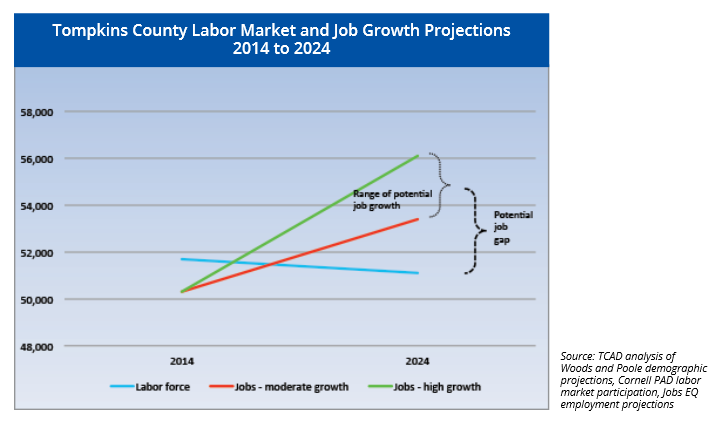
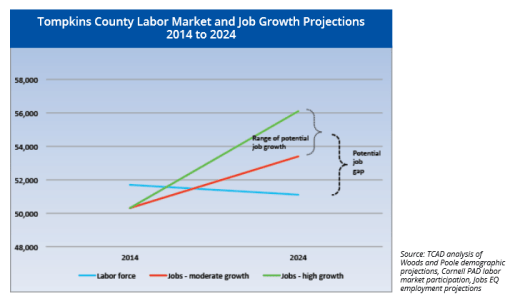
The county only seems to be expecting 3,000-6,000 new jobs in the next ten years – a number that seems a little conservative, if recent growth is any indicator. The county (aka the Ithaca metro, following the Federal BLS) has added 8,400 jobs since December 2004 (63,700 jobs in December 2004 to 72,100 in December 2014).

On an individual scale, the county is seeking to expand broadband internet infrastructure and maintain the airport, which has seen a sharp decrease in travelers over the past year, putting its long-term feasibility at risk. There will also be continued funding towards planning studies (a study examining the NYS DOT relocation from the waterfront is the latest example), tourism advertising and tax abatements when appropriate.

Finally, the county expounds the affordable housing issue, noting that 38% of renters and owners are above the “affordable” threshold, there are over 15,000 in-commuters, and very low vacancy rates creates a disincentive for slumlords to fix up their overpriced properties, which in turn makes communities less energy-efficient. Unfortunately, the county doesn’t offer many solutions. They note an affordable housing fund paid into by itself, the colleges and the city of Ithaca, put the partnership is set to expire this year, and the future is uncertain. The other is “increasing community support for the construction of more housing units”, which is much easier said than done.

There also sections on encouraging mass transit and alternative (non-car) commuting, natural resource preservation and wetland management, but those are too close to my day job for me to want to write about. But in sum, the theme is infill development in the hamlets and established areas, make the area more eco-friendly, preserving farms and green space, trying to expand affordable housing options and continue growing the economy. All of which are great goals, but given that these interests can conflict with each other, there will likely be many debates over the next several years.