News Tidbits 3/6/13: Another Project, Another Closed Door

6 03 2013

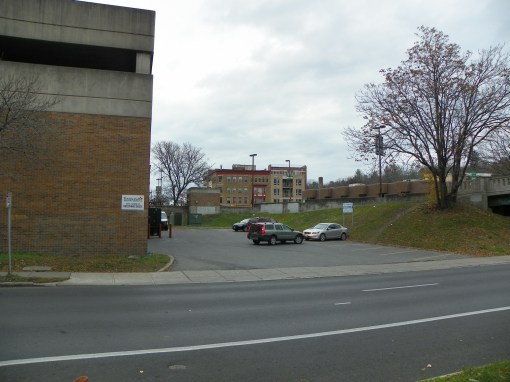
A superstitious part of me can’t help but feel like I jinxed something when I wrote about cancelled projects in the Ithaca metro not long back. The latest victim is particularly unfortunate – Collegetown Crossing, the six-story mixed-use project proposed for the 300 block of College Avenue, in an area sorely in need of redevelopment.

In this case, the fault was not the developer’s. The Zoning Board of Appeals (ZBA) thought the project was asking for too much with its parking variance (there were lot size variances as well, but those are not the issue here). As much as I hate to admit it, I’m not surprised, as the variance was for 95% less parking than required, which is a steep order to ask for, even with the community benefits and the proposed mitigation. Granted, I tend to be a bit cynical when I think about details such as the head of the zoning board being a stakeholder in a competing developer, but the primary drivers of the rejected variance were permanent residents who felt that students would try and smuggle their cars and park on their streets several blocks away (and this I can’t argue with – I personally feel that there are many Cornell students that walk around with a sense of entitlement, and would think that they’re being “clever” and “beating the system” by bringing their cars and trying to be discreet about it). The phrase “dead in the water” is fairly appropriate, because the project cannot move forward unless the parking is added (unlikely) or the city amends its parking requirements (slightly more likely, but this would take a support of the Common Council, and a stretch of time to be approved and implemented).

***

On a slightly more optimistic note, the IJ notes that $250 million in private development is underway in 71 large projects and a number of smaller works through FY 2015. Notably, following the breakdown, the vast majority of these are apartment and hotel projects, with another chunk under the vague title of “mixed-use” – proof that tourism and education are big drivers locally. Of these, 30 are in Ithaca City and 18 are in the town; I can guarantee at least half are discussed on this blog, most with renderings. Lansing reports another 18 projects, most of which could be broken down into three categories: apartments and retail near 13, housing developments (of which I’m aware of about 5 off the top of my head), and projects tied into Lansing Town Center. The article never defines what constitutes a major project, and this could be responsible for some of the discrepancy in the number of projects.

Off the cuff, I don’t write about single-family housing developments for three reasons – suburbia tends to look fairly homogenous, I’m not a fan of sprawl, and they take years to build out anyway. The article notes 516 residential lots in some phase of execution.  Give me a Kentlandsstyle proposal and I’ll get the keyboard a-tapping.

Of further interest, 27 are purely apartment projects, with about 2,100 units. This doubles the number I estimated a couple months back. Some of this is because I only counted Ithaca proper, which was Ithaca city and town, Cayuga Heights, and Lansing village. Adding the 72 units in Dryden’s Poet’s Landing, the 75 units proposed with the Boiceville Cottage expansion in Caroline, and the few hundred units in Lansing town’s Town Center definitely bring the two figures two closer. The project in Danby I think is a factory consolidation.

Of the 4 hotels and 450 rooms – offhand, there’s the 106-room Fairfield Inn, the Holiday Inn addition (13 new rooms in gross or 195 newly built rooms, depending on your perspective), the Hotel Ithaca and its 160 rooms, and maybe the Hampton Inn proposal for 92 rooms, but the combined room total is off, so I dunno what’s being counted.

It’s a boom by most standards, and certainly welcome from the perspective of this blog. I just hope to avoid seeing more projects end up “dead in the water”.


Cornell’s Office Park

1 03 2013
Image Property of Cornell Real Estate

Image Property of Cornell Real Estate

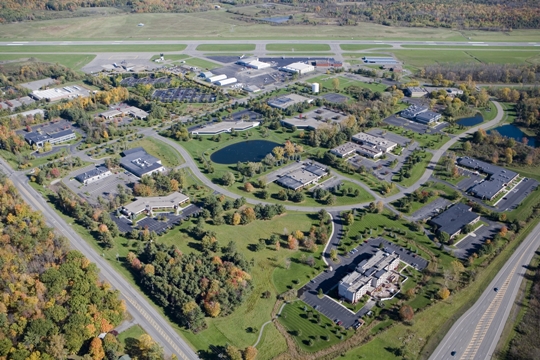
Previously, I’ve mentioned how Cornell almost had a convention center/hotel, a large hand in the airport, and a particle accelerator under the stadium. It seems almost without saying that Cornell would have a stake in an office park as well, and perhaps such a mundane asset would fly under the radar. As it has on this blog for years, not for lack of knowledge but for lack of interest.

For the uninitiated, business parks are clusters of office/commercial buildings, popular in suburban areas. In my hometown with its almighty 6,000 residents, we had one, which was so terribly stuck in the 1980s one might as well have parked a DeLorean in front of it for marketing purposes (then again, growing up in an upstate rust belt town, I can count on one hand the number of new buildings I’ve seen built there since moving away for college in 2006).

Cornell’s is just a little bit older, though most of the construction occurred in the 1980s and 1990s.  In 1951, Cornell decided to partner up with General Electric to establish a research lab near the airport. Public-private partnerships on research are nothing new. While Cornell assisted in the research, the lab was leased by GE. Unlike some of its involvements, Cornell actually owned the land and buildings for this endeavor, using old property and the lands from its airport. Cornell sold off the airport in 1956 but still owned the land to the south, donating some to the state when Route 13 was constructed in the late 1950s.

Things were a bit of a roller coaster at first. GE was the only tenant when they decided to leave in 1964, leaving the recently-completed Langmuir Lab vacant. TCAD took over development of the park while the lab building was donated to Cornell (development rights were relinquished back to Cornell in the ’80s), and CU housed some of its functions in Langmuir to keep the space occupied, with the last major university back-office leaving in 1987. The complex sort of languished through the 1970s, only taking off in the late 1980s when the trustees allowed the development of office buildings and limited commercial enterprises, rather than just research/industrial structures. It was in 1988 that its current name, the Cornell Business & Technology Park, was adopted.

Here’s an easy guide for the park – if the street name is Arrowwood or Brentwood, it’s a medical office building. If Thornwood, Brown or Warren, office or research/industrial.

The breakdown for build-out over time has been as follows:

Start-up (83 Brown Road, a former aeronautical lab renovated to start the business park in 1951, expanded ’53, ’55)

1960s: 3 structures, Langmuir Lab [1960] and 777 Warren Road [1967], 61 Brown Road [1969, addition 1997].

1970s: Diddly squat.

1980s: 6 structures: 9 Brown Road [1985],747 Warren Road [1987], 20 Thornwood Drive [1988], 33 Thornwood [1989], 579 Warren [1989], 10 Arrowwood [1989, additions 1993, 1997]

1990s: 10 structures, quite the boom:  55 Brown Road [1990], 767 Warren [1990], 757 Warren [The USPS Main Office, 1992], 53 Brown [1993], 22 Thornwood [1995], 15 Thornwood [1997], 20 Thornwood [1997], 22 Thornwood [1997, addition 1999], 10 Brentwood [1998], 30 Brown [1998]

2000s: 6 structures: Marriott Hotel [2000], 36 Thornwood [2001], 10 Brown [2001, addition 2007], 35 Thornwood [2003], 19 Brown [2006], and … It should be noted 83/85 Brown were demolished in 2005. The last building to be built was 16 Brentwood, in 2009.

So that gives about 25 structures, which total about 700,000 square feet, spread out over 200 acres. As far as I’m aware, the park has 100 acres of residential that remain undeveloped. The park has about 80 tenant companies, 1600 workers, and does in fact pay property taxes. It comes with most of the corporate amenities – outdoor picnic areas, daycare, a restaurant, over-manicured lawns and ponds, and enormous amounts of parking, bringing a little bit of everyday homogenous suburbia to the ITH. A few lots are still undeveloped, mostly parcels next to 13.

So add this to the list of developments Cornell has had its hands in. At the very least, it encourages gives Ithaca room for suburban offices….although personally I’d prefer they try downtown first.


Can a Polluted Past Have A Future?

21 02 2013
Image Property of Welch Construction Inc.

Image Property of Welch Construction Inc.

Real estate in Ithaca is fairly warm as markets go (I refuse to call it hot). But there are still some gaping issues in the metro market.  One of the biggest examples is one that can be seen from just about any southward vantage point above the lake lowlands – Emerson Power Transmission.

The property started as Morse Chain, which dates back to 1880 and began the manufacture of automobile chains in 1906.  Morse Chain was acquired by locally prominent BorgWarner in 1929, and the facility continued industrial production until BorgWarner built a new facility near the airport in 1983, selling the factory to Emerson Power Transmission. Throughout the 1960s and 1970s, several chemicals were used for “cutting oils”, removing oils from the manufactured automotive gears, shafts and chains at the tail end of the process. One of those was trichloroethylene, or TCE. TCE is a known carcinogen, and I’ll come back to this in a moment.

Unfortunately, the era of traditional manufacturing was fading in the Ithaca area. Emerson Power Transmission moved about 55 of its corporate senior staff to a suburban Cincinnati facility in 2007 (and I remember reading about it while a student at Cornell). The death knell came in August 2009, when Emerson announced it was closing up shop in Ithaca, putting 228 people out of work (the factory had over 500 people on site as recently as the mid-2000s, and had received tax incentives not long before closure). The closure was recent enough that this blog was already going, and the original entry is here.

At first glance, the property would appear to be potentially salable. It’s a large property in a well-populated and growing area with a substantial uptick in the real estate market. However, there’s one very, very big issue – the TCE contamination.

Although TCE use stopped by the late 1970s, the damage was done, and unknown quanities of it leaked into the groundwater and sewers. The site was declared contaminated by the state in 1988.

Since then, it’s been a series of long and contentious debates about who to hold responsible for what degree of clean-up. The city, the state DEC, and BorgWarner and Emerson had volleyed back and forth on who pays for what. 35 years after the chemical usage is stopped, yet nearby sewers have had to be replaced, soil tested constantly and excavated if contaminated, and groundwater / vapor testing in nearby properties. Essentially, a major environmental headache.

Although the brunt of the burden has fallen on government and Emerson to clean up (BorgWarner gets blame but seems to carry little if any of the cleanup cost), the site has been marketed for sale – $3.9 million for 94 acres plus structures (note that just the groundwater is contaminated, not the structures themselves – this isn’t Ithaca Gun). It was no surprise that with the remediation and continual testing, the site has been a tough sell.

All the more interesting, then, that the local chamber of commerce announced at a recent luncheon that someone is agreeing to purchase the property. Emerson’s in the final steps of reviewing the offer.  The property could be host to a variety of activities – the IJ article mentions a possible small business incubator like the one at the South Hill Business Campus (itself a former factory). Given the location, any number of industrial or commercial applications are possible, maybe even partial/total tear-down and redevelopment. The biggest obstacle apart from the lingering environmental concerns might be the fact that the property is split along the city and town of Ithaca, so both would have to accept any proposed redevelopment.  But still, any progress on the looming, decaying facility would be one of the surest signs of a “reinvention” of the area.


News Tidbits 2/8/13: Even Small Projects Deserve A Blurb

8 02 2013

11-24-2012 195

I held off on posting anything last week (opting instead to post early), because of a hectic work schedule. It seems wrong at first glance that a meteorologist should have a day off during what will be by most accounts a powerful snowstorm; but I work weekends and I already hit my OT limit for the week. So seeing as how most of my “weekend” plans are cancelled, here’s a smattering of news tidbits.

70 new units of eco-friendly housing are planned for West Hill. The complex would be a mixed-income development of townhomes and apartments, clustered for pedestrian ease. Notably in the article, a town councilman asserts that the land was intended for industrial development under the comprehensive plan, not residential, and “it’s not clear to me at this point how it (the proposed housing development) fits in with our overall concept of development in that area”.

Fine and all, except the town put the parcel out to bid six months ago with the goal of residential development of an eco-friendly, mixed-income nature. With a starting bid of $500,000. I guess someone ponied up. I also guess there would be a very costly lawsuit if the town tried to change the rules now. But then, this councilman has always been a notable opponent of West Hill development, so we’ll see how this plays out with the planning board.

– Funds are in place to purchase property for the construction of Ithaca’s first mosque; the Sun article suggests a small parcel near the mall. Kudos, Ithaca, and best of luck to the future house of prayer. I have every faith in Ithaca’s residents and culture to avoid another Murfreesboro from happening.

– An ensemble of small projects form some minor blips on the radar. Two duplexes to built in the Eastern Heights neighborhood. The Palms’s water pipes burst, furthering the building’s inexorable move towards demolition, probably when Novarr-Mackesey’s time frees up with the completion of Collegetown Terrace in 2014. Lansing’s new fire station is near completion, and in a total failure on my part, I had no clue what it was when I took a photo of it in trying to find the senior housing that was supposed to be built with the new BJ’s.


When Things Don’t Work Out

17 01 2013

Frequent readers of this blog are aware that I cover two things – Cornell (its history and physical plant) and new projects and real estate development in the Ithaca area. Now, I’m not going to say I’m beating a dead horse with the former, but I would be lying if I didn’t say it hasn’t been easy coming up with new topics to write about, that aren’t widely available already (ex. the Willard Straight Takeover of 1969), or previous written in this blog.

Fortunately, Ithaca has been undergoing a veritable boom in construction. Just today, I checked the town of Ithaca planning board notes to find yet another multi-unit housing project proposed – “Hawk’s Nest at Springwood”, a 3-story, 50-unit building to be built at the Springwood Townhomes area just east of the intersection of 96B and King Road. The project will be marketed to the 55+ crowd.

hawks nest

This area has seen a cluster of (mostly suburban-style) development in the past few years, with the Holly Creek Townhomes, College Crossings, the Namgyal Monestery, The Country Inn and Suites, The College Circle Apartments (IC) expansion, and a number of private homes. Which, counting that all of the top of my head, gives 184 more beds at IC, and 74+ other housing units. Quite the little burst of activity south of IC.

So, considering the question in a previous entry about historical construction trends, this latest development pushes the private residential units number from 2011-2016 over the 1,000 mark, nothing to sneeze at when the total number of units in the entire metro is just under 42,000. In considering the planned developments north of Ithaca, and single-family homes, the number of units planned in those five years could very well be in the 2000+ range, a proportion highly unusual for upstate New York, and probably only comparable to the Albany metro, where a massive computer chip factory has been underway.

Now, time for the Debbie Downer – I have no expectation all these projects will come to fruition.

In the past, several projects have been downsized, modified, or cancelled. Take Ithaca Gun, a project constantly being re-evaluated due to rapidly increasing costs associated with the site cleanup. The project started off with 160 units, but neighbors complained. It was decreased to 80, then 33, than upped to 45. The final result seems to be a shot in the dark. Because of the uncertainty, I did not include it in the unit count.

Other projects, both current and old, were modified in the planning. The Trebloc Building downtown was originally supposed to be two floors (and I will personally donate a very nice bottle of Finger Lake wine to any developer who proposes to knock that abomination down and replace it with something more fitting). Cayuga Green, covered previously, has been redesigned four times. Collegetown Terrace has undergone at least one major revision and a couple minor ones.

Some projects never see the light of day. The McGraw House, an assisted living facility downtown, considered an expansion in 2009/2010. Then they shelved it. A 400-unit development was planned for West Hill (Carrowmoor), but this also appears to have gone stale.  Cornell’s West Campus was slated to be bedecked in Collegiate Gothic – killed by the Great Depression (among other Cornell proposals and plans that can be found using the search bar). Wal-Mart was once slated for Lansing. The most outlandish serious proposal goes toward a city-sponsored urban renewal plan proposed for Collegetown in 1968. The project would have tore down the heart of Collegetown, and in its place put up an eleven story office building, and 6 to 8 high-rise apartment towers (total 375 units), the tallest being 18 to 21 stories. It also would have included a 600-space parking garage and retail venues.

It’s sort of like “survival of the fittest”. The projects with the most stable funding, and the strongest proposals, tend to win out. Some projects are clearly underway, some go through revisions, some will remain pie-in-the-sky. I do, however, look forward to as many of these projects coming to fruition as possible.


More Than Just Cherries On Top: The Purity Redevelopment Plan

11 01 2013

Now, a part of me was tempted to write something up about a Cornell fraternity that just was thrown off campus for “sexually humiliating” hazing…but then, I realized I’m too far out to care for the stupid crap of the current crop of students. No matter how absolutely, unfathomably asinine it is. Stay classy TEP, it’s a miracle your trashed house didn’t collapse first.

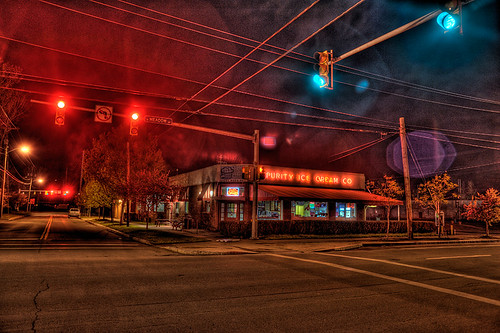
So onto something that catches my interest in a more positive way. I have to issue a slight mea culpa on this, because the news regarding the Purity Ice Cream project has been floating around for a good six weeks already. For those who have yet to experience it, Purity is a fairly well-known local ice cream company, in operation since 1936. The current building, a rather plain one-story brick structure, was completed in 1953.

Of note and of particular relevance here, Purity is in a high-traffic but fairly low density area, on the Corner of Meadow and Cascadilla Streets, west-northwest of downtown. In what I would describe as a rarity for Ithaca, I don’t believe I’ve ever taken a photo of the store. Thank Heaven for aerials and Flickr.

purity1

Purity’s parcel is outlined in red in the above image from Bing Maps. It lies on the cusp of low-to-moderate density residential district (Northside), part of a small commercial district of mostly retail and warehousing. So it lies quite a ways outside the traditional dense clusters of development.

The plans are still pretty conceptual at this point. The owners, Bruce and Heather Lane, seek to keep the original structure and build vertically; rental office and retail space on the lower floors, with 13 to 26 1 and 2-bedroom apartments on the third and higher floors. The facade, in keeping with the original structure, will be brick. The number of stories is to suggested at 4-5, but the first floor would have 16′ ceilings, so it would be fairly likely to top out around 60′, and the new building would be a visual focus point in the generally low-rise neighborhood. Although the area is less built up than some other parts of the city, the owners are seeking to tap into new urbanist concepts, touting the walkability to Greenstar and the Waterfront Trail. The goal is to get the project underway in fall 2013, and the ice cream store will remain open throughout the duration of construction. A structure like this would have a 12-to-18 month time frame.

Not all of the structure would be saved, as the manufacturing space for the Ice Cream would be eliminated; but then, Purity has contracted out the ice cream manufacture to Byrne Dairy since 2006. It seems it would be a loss of underused space at worst.

Now here’s the consequence of my inattentiveness; the rendering is missing. I can come up with some ideas, since John Snyder Arch. is in charge, and they’ve been prolific in the area as of late (their flavor of choice being geometric forms/ modern design). But even with that knowledge, and knowing it was just a sketch plan, I would have liked to have seen the render. But unfortunately, it is missing from the IJ and its sister pubs, and even the article has been deleted (at least there were cached versions; but those did not have the render). Granted, it’s not like I’d be able to post it anyway, given the whole paid subscription thing. But, as the project continues to evolve over the next couple of months, I will attempt to stay on top of this for once, and post a rendering as a soon as a free version becomes available.

Update 1/17: And in fact one has, from Google image search. Sweet. Pun intended.

purity2


An Ever-Expanding Ithaca Apartment Hunt

4 01 2013

11-24-2012 167

So, this post relies on a question originally posed by “Steve” on the welcome page:

I wonder if you can comment on the number of new apartments being built in Ithaca from a historical perspective? It seems like there are many coming online but I don’t have a long enough perspective.

As a matter of fact, I had obtained this info several months ago for reference, from a report given to the DIA by the Danter Company regarding the Ithaca housing market’s trends, needs and projections. But I had never made much use of that data until now. Even to the casual observer, there has been an uptick in construction around and about the Ithaca area as of late. As the metro has expanded a little over 5% (~5,500 people) in the past decade, some growth is to be expected. The Ithaca market (mostly defined as Ithaca city/town with some parts of Lansing) is believed to be capable of absorbing about 1,350 units over the next five years, 25% owner-occupied (most likely condos) and 75% rental units.

As of April 2011, there were 4,793 units in 75 developments (5 others with 270 units of subsidized housing are excluded from analysis). 49% of all those units are occupied by, no surprise, students at IC or Cornell. Borrowing a table from the report itself shows the number of multi-unit projects built within Ithaca proper, broken down into separate time periods.

danter1

So, adding up the 2000s gives 654 units 14 projects. This is a substantial increase from the 454 units built in the 1990s, but somewhat less than the 824 units in the 1980s, and less than half of the 1,604 units built in the 1970s. For the curious, the project built in 2009 was INHS’s Cedar Creek on the west side of the city. West Hill accounts for over half of the new multi-unit housing built in the 2000s, with Overlook at West Hill (128 units, 2006), Linderman Creek (128 units in 2 phases, 2000/2004) Cayuga View (24 units, 2005) and Conifer Village (70 units, 2008). Collegetown also makes up a small portion, with projects like 407 College (25 units, 2006) and Coal Yard Apartments Phase I (10 units, 2007).

Now, starting around the time this left off, there have been a number of major projects. Within the 2011-2016 time frame, here’s a sample of what’s completed/under construction/planned (I’m not going to link to each one for this entry, but the curious can make use of the search bar to pull up more info from other entries):

Collegetown Terrace (U/C; usually defined with “beds”; but in terms of units, the construction company in charge suggests 246 units, but that may just be one phase). EDIT – 610 units. That’s…a lot.

309 Eddy (completed, 24 units)

Coal Yard Apartment Phase II (completed, 25 units)

107 Cook (U/C, 4 units)

Breckinridge Place (U/C, 50 units)

Collegetown Crossing (in review, 60 units).

Thurston/Highland (in review, 36 units)

Seneca Way (U/C, 38 units)

619 West Seneca (U/C, 24 units)

Cayuga Green (approved, 39 units)

Fane Properties/ 100 E. Clinton (proposed, 36 units)

Harold Square (proposed, 60-70 units)

Cascadilla Landing (in review, 134 units)

Stone Quarry Apartments (in review, 35 units)

Conifer Phase II (72 units, senior housing, site prep)

Purity Ice Cream Redevelopment (proposed, 13-26 units)

Hawk’s Nest at Springwood (proposed, 50 units)

Cinema Drive (proposed, Lansing village south of 13, 39 units)

Lansing Reserve (proposed, on the north edge of what the Danter study calls “Ithaca” proper; 65 units)

College Crossings (U/C, 2 units)

So in the Ithaca area proper, in a span from 2011-2016, I’m estimating at least 1,415 units in 20 projects. This assumes the townhomes with the Vine Street Cottages and Holochuck Homes projects are not rentals (and not included in this tally), excludes the several hundred units of housing planned in the town of Lansing (town center, Village Solars, etc.). Also, Ithaca Gun and its 45 units are not being included until that project leaves limbo.

So to answer Steve’s question- Ithaca is running well above average, and is on a pace not seen since the 1970s. Quite the uptick indeed.


Yet Another Hotel for Downtown Ithaca

24 12 2012

12-29-2011 041

It seems downtown Ithaca is in a building frenzy, even beyond sleepy upstate standards. From the Ithaca Times:

At its meeting December 20, the Ithaca Urban Renewal Agency unanimously approved the designation of Lighthouse Hotel, LLC as “a qualified and eligible sponsor” for acquiring properties at 320-324 East Martin Luther King Jr./East State Street through a negotiated sale for the purpose of an urban renewal project. The proposal by Lighthouse Hotel is to develop a $16 million, six-story Hampton Inn & Suites with 92 rooms. The project site would cover four parcels including parking lots owned by the city and the IURA, the Carey Building and 310-312 E. MLK Jr./E. State Street.

Now, this could be a little contentious. The area covered is highlighted below:

lighthouse_hampton

Of the four parcels, two have been parking lots for a long time, and I would not be surprised to see a garage of some sort would be a component of this project (probably above ground, given the water table…otherwise, there is a rather underutilized garage a few blocks south, if the city presses them enough and the developers are willing to play along).

Then there’s the Carey Building. The Carey Building is a two-story structure built in 1922 and named for its developer, broker Henry A. Carey. The building, with its Egyptian Art Deco accents, was designed to match the Strand Theatre to its west.  The Strand Theatre, or what was the Strand, comprises the last parcel. The theatre was built in 1917, closed in 1975, and although attempts were made to save the building, it was torn down in 1993, a victim of poor maintenance. As seen in the aerial, the site is now a parking lot. For practical purposes, the Carey Building is in good structural shape, and is maintained by the locally prominent Travis Hyde properties. The Eagles Building on the SE corner is not a part of the project.

Now, I tend to not be a big fan of Hampton Inns, a middle-rung hotel chain infamous for half-assed design on the cheap. Although a slight improvement over the years, most Hamptons built in the past decade could be described as beige boxes with oversized pillasters and raised parapets. One only has to look towards big-box land for an example – The Hampton Inn “designed” by Sharma Architecture and built in 2003.  Chain hotels are often the architectural equivalent of “fill-in-the-blank”, and as cheaply as possible. Still, one can hope – the average Hampton cost $6-8 million (~$60,000/room) to develop in the mid 2000s, and the budget for this project is $16 million. Hopefully, some of that will go towards something fitting for the city of gorges. In my mind’s eye, it has a more unique look, subtle or off-site parking, and incorporates the Carey Building, or at the very least its street-facing facade.

So in sum, any proposed demolition of the Carey Building might cause a lot of problems for the developer. The IURA’s decision a couple days ago only makes the developer a qualified buyer for the IURA parcel, and does not guarantee any development. And I’m sure there will be many, many meetings ahead for this one before any approvals are granted.

Update 1/9: And courtesy of the agenda comes this rendering and site plan, hosted online by “Ex-Ithacan”:

So much for preserving the Carey Building and subtle parking.


Thanksgiving Construction Update, Part II

11 12 2012

11-24-2012 188

It still surprises me just how prominent Collegetown Terrace is from some parts of the city. It truly is a massive project for a city of Ithaca’s size.

11-24-2012 193

It looks like the first floor of concrete has been poured for Breckinridge Place. The project seeks completion in fall 2013.

11-24-2012 196

Renovation is just as important as new construction.

11-24-2012 174

One of the INHS new builds. Sometimes, they renovate. Other times, when the house is too far gone, or has been severely compromised from a historical perspective, then a tear-down may commence. This duplex is an example of the latter.

11-24-2012 177

The Iacovelli apartment project on West Seneca is topped out, with initial facade work complete on the faux dormers, and windows recently installed.

11-24-2012 182

I had expected external work to have begun for the new hotel tower for the Holiday Inn, but it appears this is not the case. I was wondering if it was interior asbestos removal, but the low-rise portion slated to be demolished looks to be fully occupied. I am honestly unsure what the time frame for initial site prep is.

11-24-2012 186

Likewise, the Ithaca Marriott / Hotel Ithaca site isn’t fenced off yet, so this will probably see a late winter/ early spring construction start.

11-24-2012 178

A row of homes, all set to be demolished. Two are for Planned Parenthood’s new building, but I’m unsure the reason for tearing down the other two. Parking?

11-24-2012 181

The new Fairfield Inn down in big box land. Framing is underway, so completion in six to eight months is feasible.

11-24-2012 185

Cayuga Place, with only vestigial site prep at best. This one probably won’t start until the Spring anyway.

11-24-2012 187

Finally, something that is well underway. Asbestos removal and demolition of the former Challenge Indsutries buildings to make way for the new Seneca Way apartment building.

11-24-2012 191

Site of what could be the future Harold Square. The Home Dairy and Benchwarmers buildings (the Sage Block and Miller Block, I think offhand) would be renovated, while the three smaller buildings at right would see the wrecking ball. It’s hard to imagine an 11-story building standing in the background.


That Time Ithaca Almost Had A Nuclear Power Plant

1 12 2012

100_2496


Let’s play a word association game. Think of a stereotypical resident of Ithaca. Now think of five words or behaviors that you would use to describe them.

I’m suspecting that most readers may have used “hippie”, “eco-friendly”, “green”, “environmentalist” for at least one of their five.

Back in the early 1970s, when the environmental movement was really taking off post-Rachel Carson, the state of New York, along with certain large power companies, was looking to build a few power plants, technologically-advanced nuclear facilities. A few of these plants were commissioned – Fitzgerald and Nine Mile Point, for instance.  I bring up these two facilities because I grew up in their geographic shadow. Certainly, the locals are glad for the hundreds of job provided; but there’s also the implicit acceptance that if something really major gets fouled up, you and all of your neighbors are screwed, and you’re reminded of this when the postings for iodine pill distribution are sent out. For anyone living in the span from Oswego down to Syracuse, you know they are there, you know they are dangerous, but you shrug it off and accept them for the economic benefits. Maybe not the best attitude, but that is what it is.

Well, the attitude was more cavalier in the swinging ’60s. The state was considering sites, and thought it would be great to place one near Ithaca – in Lansing, to be exact. In 1968, NYSEG announced their intention to build the “Bell Station Nuclear Power Plant” on the shores of Cayuga Lake, in the northwest corner of Lansing, about twenty minutes’ drive north of Cornell. The facility would have been just to the north of the Milliken Station coal plant. The Tompkins County Board of Supervisors approved the project.

Well, the public reaction was not as effusive. A grassroots group, “Trumansburg United to Save Cayuga Lake”, was formed, with the express purpose of derailing the project (it was claimed that thermal pollution from the plant would destroy the ecological habitat of the lake). Dozens of professors and environmental scientists at Cornell and IC spoke out against the project. The sour public opinion caused the proposal/approval to drag on for years (yet, the negativity was not as widespread as the local editorials made it seem). The Trumansburg folks probably would not have stopped the Ward Center Nuclear Reactor at Cornell, which was smaller and built several years earlier, because initially the concern was the lakeside location, not nuclear power. But by 1973, as the dangers of nuclear activity moved into the scrutiny of the public eye, the negative attention turned towards plants themselves.

On June 15, 1973, NYSEG decided to give up on the Lansing location, the public sentiment against the project being a major factor in their decision. As a result, they pursued a location in the town of Somerset, in Niagara County. In the early stages of construction, it was discovered that a fault line lay 40 miles away, which would have made retrofitting necessary, and the nuclear plant infeasible. So the facility was changed to a coal power plant, and this opened as the Kintigh Generating Station in 1984.

As for the land the plant was to be built on in Lansing, the state leased some of it out to neighboring farms, and the other half remained undeveloped woodlands. Recently, the town has been considering taking over management of the site, with a proposal being considered that would turn its 490 acres into a lakeside wildlife and recreational area.