2013 Census Estimates: Say Hi to the New Neighbors

30 03 2014

7-26-2013 067

Every late March, the U.S. census releases their new population estimates for counties. So, I causally checked in to see how the Tompkins County numbers were doing. The county typically shows a modest addition of a few hundred each year – from 2010 to 2012, the estimated addition was 990 residents, from 101,564 to 102,554, which if carried out evenly, it would be an expected 4.9% increase for the decade (and roughly on par with the 5.2% in the 2000s).

I was a little taken aback when I saw the numbers for this year. For one thing, somewhere along the way, they revised 2012’s number up to 102,713. For another thing, this year’s number is a relative spike in the trajectory – 103,617.  In addition of 904 from the revised 2012 figure, and 1,063 from the original 2012 estimate. So, the change from 2012 to 2013 is about as much or more than the gain of the previous two years. Using the 2013 figure and extrapolating the three years’ estimates out to the end of the decade, the county would be projected to grow 6.74% to about 108,400 residents in the year 2020.

In many states, this would not seem an overly impressive figure. But it is worth noting that this is economically-depressed upstate New York. Last year, the only counties that were growing faster than Tompkins (as a percentage) were Jefferson County (Watertown, with the economic engine of Fort Drum) and Saratoga County (Saratoga Springs, with the massive Global Foundries computer chip plant in suburban Malta).  With the 2013 figures, Tompkins County moves into the second-place slot, behind Jefferson County (I note that the population estimates gave Jefferson a population decrease this year; the army base up there is expected to see a loss of 1500 to 2000 soldiers as it loses a brigade over the next few years, as part of army cutbacks). I’m also leaving out downstate counties/boroughs – Kings County/Brooklyn Borough is projected to have added 88,000 people for 3.5% growth since 2010. Almost all of Tompkins’s population, in three years. New York City gains ever-more reason to view it and its boroughs as the center of the world. On the other end of the scale, Schoharie (sko-hair-ee) County has the biggest estimated percent loss, at -2.8%. Schoharie is a rural county just west of Albany; it suffered a major hit from Hurricane Irene.

Echoing my comments from last year, estimates should be used with caution, as they don’t always reflect the true population. From the housing units perspective, using the number of 2.29 residents per unit estimated for 2008-2012, one gets justification for about 395 more units of housing for the past year, or about 897 units since 2010. I’m cautious about using these number as much more than curiosities, but they’re intriguing, and seem to bode well for the health of this county. Even when the jobs numbers aren’t.



Two Sides to an Argument

18 03 2014

ridgewoodapts_v2_2

I generally try to stay on the sidelines when it comes to promoting or opposing for Ithaca projects. I’m not about to get involved in favor of the West Falls Street proposal, the Stone Quarry proposal, or Cayuga Meadows, or any other local project that neighboring residents want shot down. NIMBYism (NIMBY is short for “not in my backyard” , a reference to when people accept a community has a need for a project but they oppose it in their neighborhood) is ever-present, just about every project in the city and town has had some degree of opposition (the only exception I can think of offhand is the convention center/hotel planned for downtown). My own opposition arises when I feel a proposal threatens something of historic value. Regardless, the planning board is good at staying neutral. I may not always agree with the planning board, but I generally respect their judgement.

I’m going to make an exception to my non-partisan stance for 1 Ridgewood, thanks to Walter Hang.

As much as it bothers me to do it, to explain my issues, it is best if I provide a link to the petition and its partially-labelled map of square footages.  A large chunk of those appear to be people who have little or no connection to Ithaca. Token disclaimer: I’m not for or against his fracking work, my concern is focused squarely on this project. In an attempt to keep this project from being railroaded, I decided to examine the petition’s arguments.

chhd1

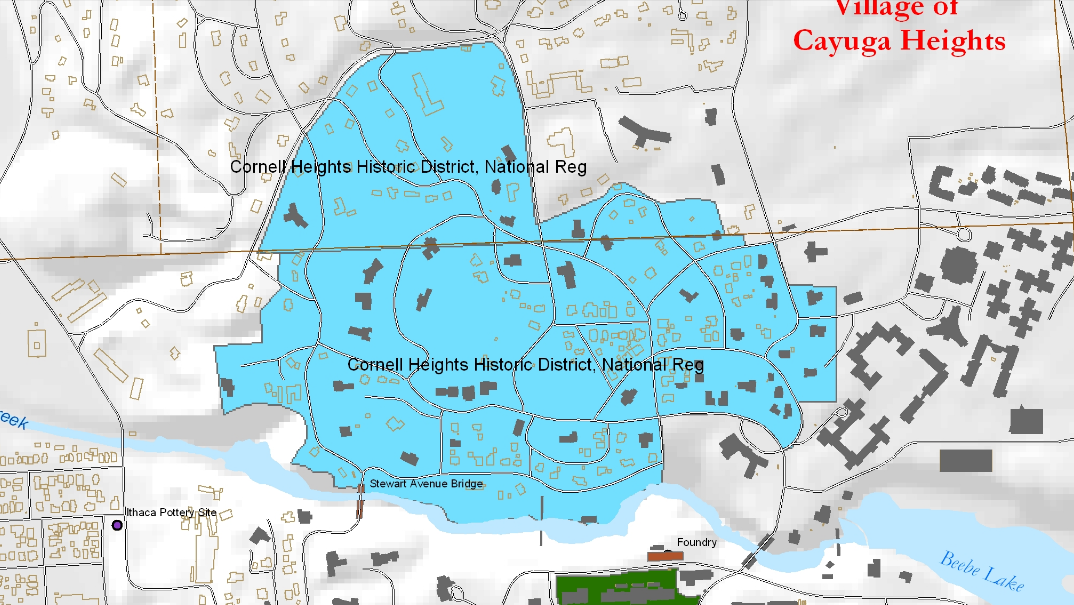
Here’s the area Mr. Hang wants his moratorium, Cornell Heights, split between the city and Cayuga Heights. For the record, the dark grey represents Cornell-affiliated properties, mostly GLOs and a few Co-Ops in the CHHD. Looking at the city section specifically:
chhd2

The red X is the Ridgewood apartment parcel, for three buildings between 5578, 5710 and 6662 square feet, with mostly below-grade parking. One of my issues is that some of Mr. Hang’s assertions are misleading. For example:

Due to recent development, the Historic District is clearly transitioning from its original turn-of-the-20th century “residential park” to a densely developed area that bears little resemblance to the community that warranted special historic district protection approximately 25 years ago.”

It’s hardly changed. There have been two three projects built since 1989. A single-family home at 116 Dearborn Place that was built in 2005, the Tudor house of the Bridges Cornell nursing home was built in 2005, and the new apartments currently going up on Thurston. If you want to push the envelope, Alpha Zeta (214 Thurston) replaced half of its original structure in 1992-1993 when it was renovated. A couple buildings (Kappa Delta, and 111 Heights Court) have received renovations, which were approved by the Ithaca Landmarks Preservation Council (ILPC).


Approval is being sought for an apartment complex proposed for 1 Ridgewood Road. Three buildings would be built on the largest undeveloped property in Cornell Heights, a spectacular forested setting enjoyed by hundreds of local residents who walk along and through it each day.

The proposed buildings would dwarf nearby structures. Figure One illustrates that the buildings would be 300% larger than the adjoining structure on Highland Avenue and at least 200% larger than all the immediately surrounding structures.

Out of a total of more than 200 structures in the Cornell Heights Historic District, only six are bigger than all three proposed buildings. Those six were built before the Historic District designation.

What’s not being told about that “spectacular forested property” is the abandoned swimming pool or dilapidated poolhouse. Also, as seen in at Mr. Hang’s map, the project is shifted to the west (left side) of the parcel, where many its nearby neighbors tend to be larger, ranging from 3000-8600 square feet (Westbourne to the north is a contiguous complex with 10,800 sq ft of space). To call this “dwarfing” is to take it out of its full context.

It concerns me that a petition with emotionally-charged language, gathering signatures from people that are not stakeholders in the Ithaca community, is being pushed by someone who has a history of aggressive tactics. It bothers me that an underutilized parcel with great public transit access in a highly populated area is going to have its zoning changed after the developer has been sensitive to planning board concerns and returned with a proposal within current regulations, which sets a terrible precedent for the community and opens up the possibility of legal action against the city. Lastly, in a period where Cornell continues its enrollment growth, I’m worried that if projects like this will be prohibited, it will only encourage more rental conversations of existing housing, more subpar housing situations, higher rents and increased sprawl.


Progress in Collegetown?

9 03 2014

cafd3

Given the chance to look back at high-value projects over the past 30 years, one would find that, until the past several years, the list would be dominated by projects in Collegetown. Reasons abound- quoting developers, students “are looking for quality“, while increasing land values (comparable to downtown Los Angeles) have persuaded property owners to upgrade their stock and maximize their returns. The city has in general promoted Collegetown redevelopment since its slummier days, with relaxed policies in the 1980s and a couple of brief moratoriums allowing for reassessment (ex. the moratorium of 1999/2000, when the newly-built 312 College Avenue rubbed some locals the wrong way).

As of late, though, development in the Collegetown area has tapered down. There have been a couple projects over the past several years: 309 Eddy was completed in 2012, and 320 Dryden in 2008. If you want to stretch it, you can add 107 Cook, but that has less bedrooms than the building that burnt down. The big glaring omission here is Collegetown Terrace, but that is being built just outside of what is traditionally considered Collegetown.

A big factor in all of this has been the uncertainty in Collegetown’s zoning. Since about 2008, Collegetown’s zoning has been in flux. The city and Cornell paid about $200k for an urban planning company (Goody Clancy) to design a plan, which came out in 2009. The  project freaked out some residents and local politicians, who saw it as too dense and too much, period. Then the planning board went and took it in the opposite direction, proposing zoning that would force smaller buildings and reduced density. I made a b*tchy little rant when that happened. Since the old images can’t be blown up (I had an issue with that for a while back in 2009 or so), the numbers for the Goody Clancy plan can be seen better here on page 161. I’ve been unable to find another copy of the first revision, not that it specially matters since the plan was accepted, repealed in 2011 after a potential lawsuit from landowners, and has been revised seemingly a dozen times since, debating everything from the necessity of porches in certain zones, to the tremendous fight over maximum heights on the intersection of College and Dryden (90′ in the GC plan, 60′ for first revision, now 80′), to parking and encouraging townhouses. After much back and forth, something is now finally in place.

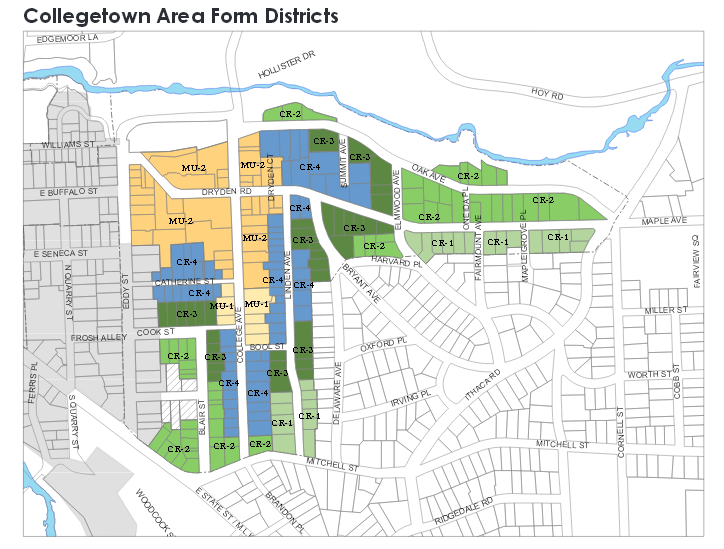
The final version is the Collegetown Area Form Districts guideline, the implemented form of the plan. The key thing with the is plan is the form-based zoning; traditional zoning focuses on regulating use and overarching parameters (lot size, density), form-based zoning scrutinizes design. Form-based zoning has been popular in new urbanism for encouraging walkable, mixed-use communities, an early example being Florida’s Seaside community.

cafd1

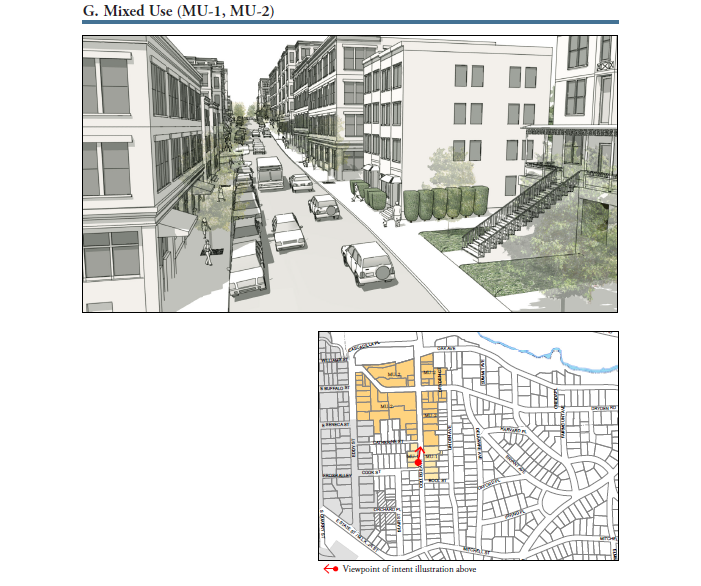
The plan has six zone types, each with its own tweak on the design guidelines. CR-1 to CR-4 are increasingly denser forms of “Collegetown Residential”, MU-1 and MU-2 are mixed use, with active street engagement through ground floor commercial or public uses.

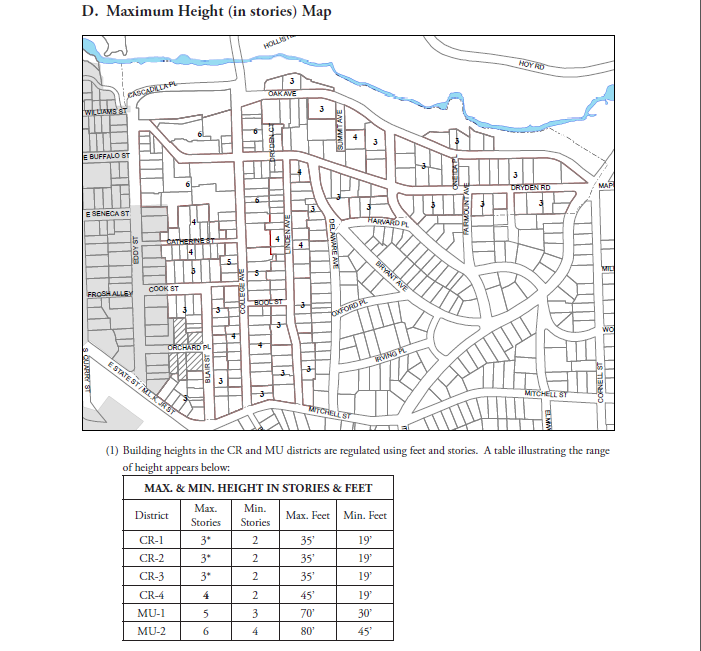
cafd2

Compared to the Goody Clancy plan, the Dryden/College core isn’t as dense, but the floor count and maximum heights are even higher than suggested in some spots, for instance College at Bool Streets. But the primary focus of the plan is on the design of buildings. CR-1 and CR-2 will be large house forms with pitched roofs, CR-3 for 2-3 unit large homes/duplexes. CR-4 accommodates large houses, townhomes, and small-to-medium size apartment buildings. MU-1 welcomes medium-sized mixed use structures, while MU-2 is for the largest mixed-use buildings, up to 6 floors and 80 feet in height (think 403 College for example). Worth noting, most of Collegetown Crossing falls into MU-2, but the back end edges into a CR-4 Linden Avenue property also owned by developer Josh Lower. Since CR-4 is residential only, the difference would force him to make a redesign to reduce the building’s footprint, but at least parking will no longer be a concern. This December 2013 article says that required off-street parking was removed from CR-4 and the MUs, but I still see it listed in the guidelines as “required off-street parking” under accessory uses. Hopefully it’s just my paranoia; the IJ also said the parking reqs were also waived for the MUs when the plan was adopted.

The Sun, the IJ and other articles note the “strong support” for the plan. I can only hope, after six years and hundreds of thousands of dollars and countless meetings, that the city will have something to show for its efforts. Housing is only getting tighter in Collegetown, and developers are simply looking outside the core for their projects, so to have some guideline in place will hopefully spur some investment into Collegetown’s poorly-maintained and underutilized properties.


A Walk Down Varick Street

4 03 2014

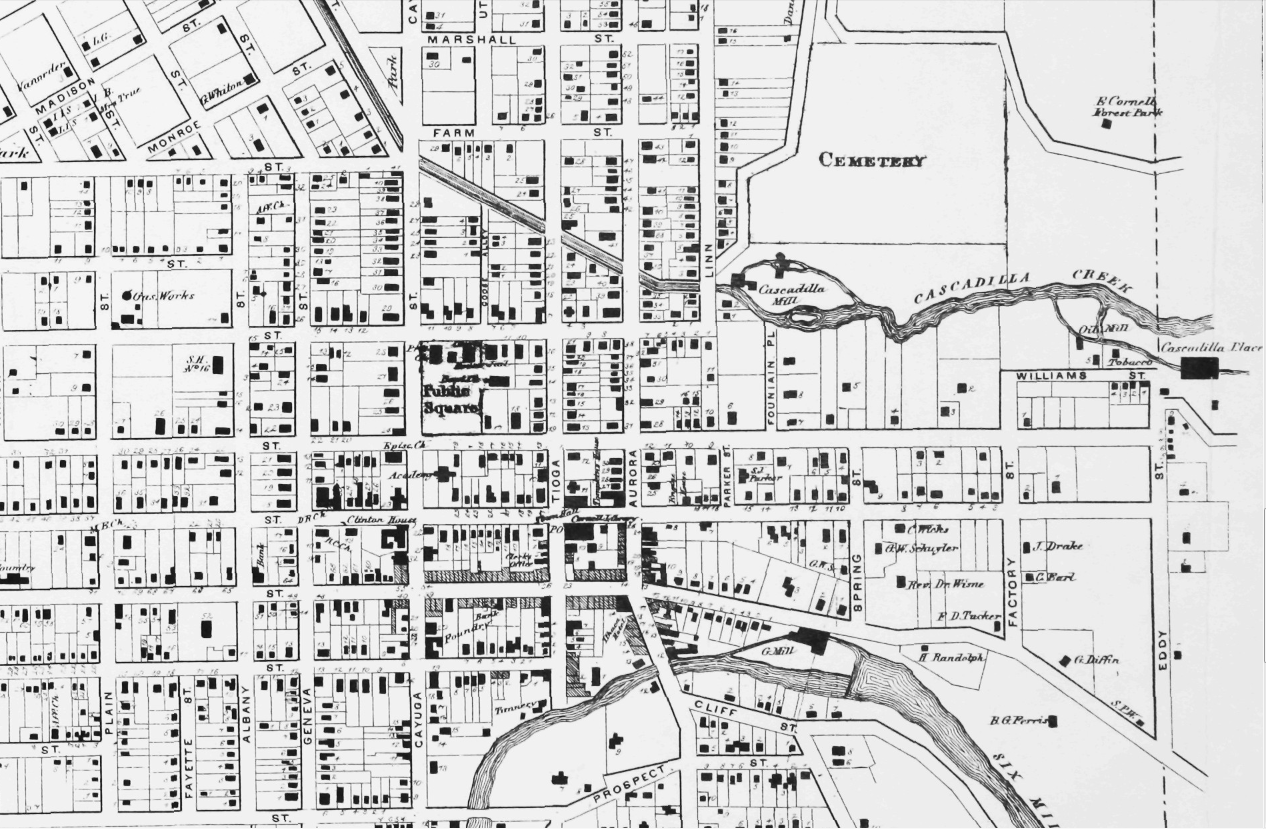
I try and keep in track of the hotlinks to this site from other blogs. A while back, I noticed a link from a little-used community blog for Ithaca’s Lower Northside, aptly named lowernorthside.org. I decide to check it out, and stumbled upon a map it had included in one of its (few) posts. It’s an atlas of the Ithaca area dating from 1866. When Cornell U. was still a dream under construction, and Ithaca had yet to be incorporated as a city (something that wouldn’t happen until 1888). A lot has changed in 128 years, and it’s really a fascinating look back on an older incarnation of the city of gorges.

ithmap1

Clicking on the image will pull up the fine print, or just follow the link above. Unfortunately, the commercial version of wordpress this blog uses doesn’t allow for embedded PDFs, otherwise I’d have cut out the extra step. Of course, for the sake of following along, here’s a map of the current-ish city of Ithaca.

In 1866, Ithaca was much smaller, posting a population in 1870 of 8,462, a number that probably had a bit of help from the newly opened Cornell U. and its 400 or so students. Tompkins county was only one-third of its present population, with about 33,000 people. The county had seen a massive population decline in the 1850s and was only just beginning to recover during this decade.

Ithaca was, as today, “centrally isolated”, having been bypassed for a major railroad in favor of Syracuse. However, the Cayuga branch of the Delaware, Lackawanna and Western railroad had its terminus in the city, and there were steamboats one could take down Cayuga if they were coming out of the north. Ithaca was still expanding in all directions, yet to fill out Fall Creek or the Northside, and barely reaching where Collegetown is today. The small hamlet of Forest Home was still known by its original name, Free Hollow, and at the cruxes of dirt roads, small clusters of houses, churches, and small schoolhouses can be seen. A nice asset here is the inclusion of homeowners’ names; we see names that still live on as place and street names in Ithaca today, like Bryant (Park neighborhood), Coddington (Road), Renwick (Place/Drive/Heights Road), and Mitchell (Street). Ezra’s land is nearly vacant except for his own home, his farmland having but a few roads; and IC and South Hill are barer still.  Cascadilla Place is there, completing construction the year this map was made; the water-cure sanitarium was never used as such since Ezra Cornell, its biggest investor, swooped in and repurposed the structure.

Another notable name on the larger map, though perhaps not as important today, is Heustis. College Avenue used to be called Heustis Street, after landowner Lorenzo Heustis. The name was changed at the urging of local property owners in 1908. Similarly, Collegetown’s Linden Street, not yet in existence but forthcoming, had to beg the city and line their road with linden trees to get their name change from Hazen Street approved in 1924.

ithmap2

Looking a little closer at Ithaca itself, a little re-orienting is required in some neighborhoods. The county fairgrounds were north of the city on Railroad Avenue (now Lincoln Street), in what is today a mostly residential area. No King or Queen Streets yet in Fall Creek, then a sparsely populated if growing neighborhood. Steamboats had their dock near where 13 passes the Sciencenter today. Llenroc (then “Forest Park”) shows up here near the cemetery, the grandiose mansion in the midst of construction in 1866, nine years from completion. Other streets had different names as well;  among them, Park Place was Varick Street (for Richard Varick DeWitt, local landowner; also an infinitely cooler name than a Monopoly space), Hillview Place was Mechanic Street, Esty Street was New Street, Cleveland Avenue was Wheat Street, and Court Street was Mill Street (residents despised it so much it was changed to Finch Street, then Court Street in 1924). Most prominently, State Street went by Owego Street at the time (the name change would come next year, in 1867). The contemporary Ithacan asking for directions might get a little confused.

ithmap3

Some noted landmarks still stand – the Clinton House (1829), and the old County Courthouse (1854) on the public square. Others have seen the wrecking ball, some not all too long ago – the Cornell Library, brand new in 1866, made it to 1960, the old city hall to 1966. Urban renewal took its toll on the city, though perhaps not as extreme as Albany or Syracuse.

The area that would become the Commons is already dense with buildings, though it steadily tapers in any direction and peters out after several blocks. Collegetown is hardly Collegetown, with only a few homes on Spring Street (Schuyler Place, 1924), Factory Street (Stewart Avenue, 1888), and Eddy Street. A tobacco barn, grist and cotton mills, and foundries provided local employment, as well as brewery just south of the current-day police station. Ithaca was a growing large town in upstate New York, with small industries and a developing core.

I’ve heard students derisively say that without Cornell (and presumably IC), Ithaca would be as small and unimportant as Watkins Glen. I think that’s an extreme judgement. Maybe Cortland-sized, or maybe it would have ended up like Elmira; but there was a village here before there was a university here, a village that is fascinating to examine on an old map.


Route 13 Is Becoming Suburban Hotel Row

26 02 2014

patel_hotel2

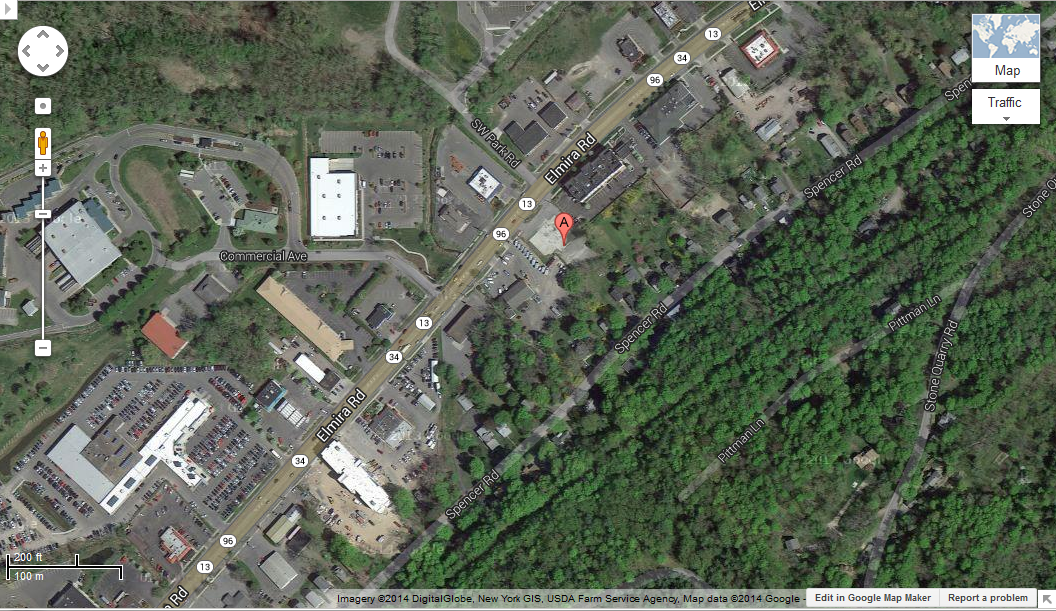
The best part about this project is, I was totally confused when I first saw it, and thought that someone had changed up the Holiday Inn Express proposed for 371 Elmira Road. But I think I can be forgiven for the error – both projects are 4-story, 54′ tall hotels prepared by Optima Design and Engineering out of Buffalo. However, the two projects diverge from there. Project description here, elevations and lot layout here, project application here. The hotel as proposed for 339 Elmira Road is a small one, 37 rooms, current being described as “independent” (no chain affiliation), which given its size is no big surprise. The 6,468 sq ft building is situated for an empty 0.59 acre lot, what was once home to the Salvation Army store before they moved down the road a few years ago and the building was demolished. Jason over at Ithaca Builds reported that the land sold for $143k last summer.

patel_hotel1

The project’s application predicts a time frame of construction from June to December of 2014, and a project construction cost of $1.7 million. What Ithaca gets for that $1.7 million is a typical suburban-style box hotel, a smaller version of what you typically find at highway exits. In a way, that’s what this stretch of Elmira Road/Route 13 is becoming – previously, it was just the Comfort Inn, then the Hampton Inn in 2003, the Fairfield Inn last year, and now this and the Holiday Inn Express are in the proposal stages. That would mean 219 more hotel rooms in this area then there was in 2012.

On a completely unrelated note, the infill project by Heritage Builders at 128 West Falls Street continues their fine tradition of developing underused city/town parcels, even if the designs are a bit ungainly.


Making Room(s) at Collegetown Terrace

21 02 2014

7-26-2013 018

Here’s an interesting concept coming out of Collegetown Terrace: A proposal to exchange some of the interior parking for more housing. This info comes courtesy of the city of Ithaca, which will have to grant a zoning variance in order to let such a change proceed.

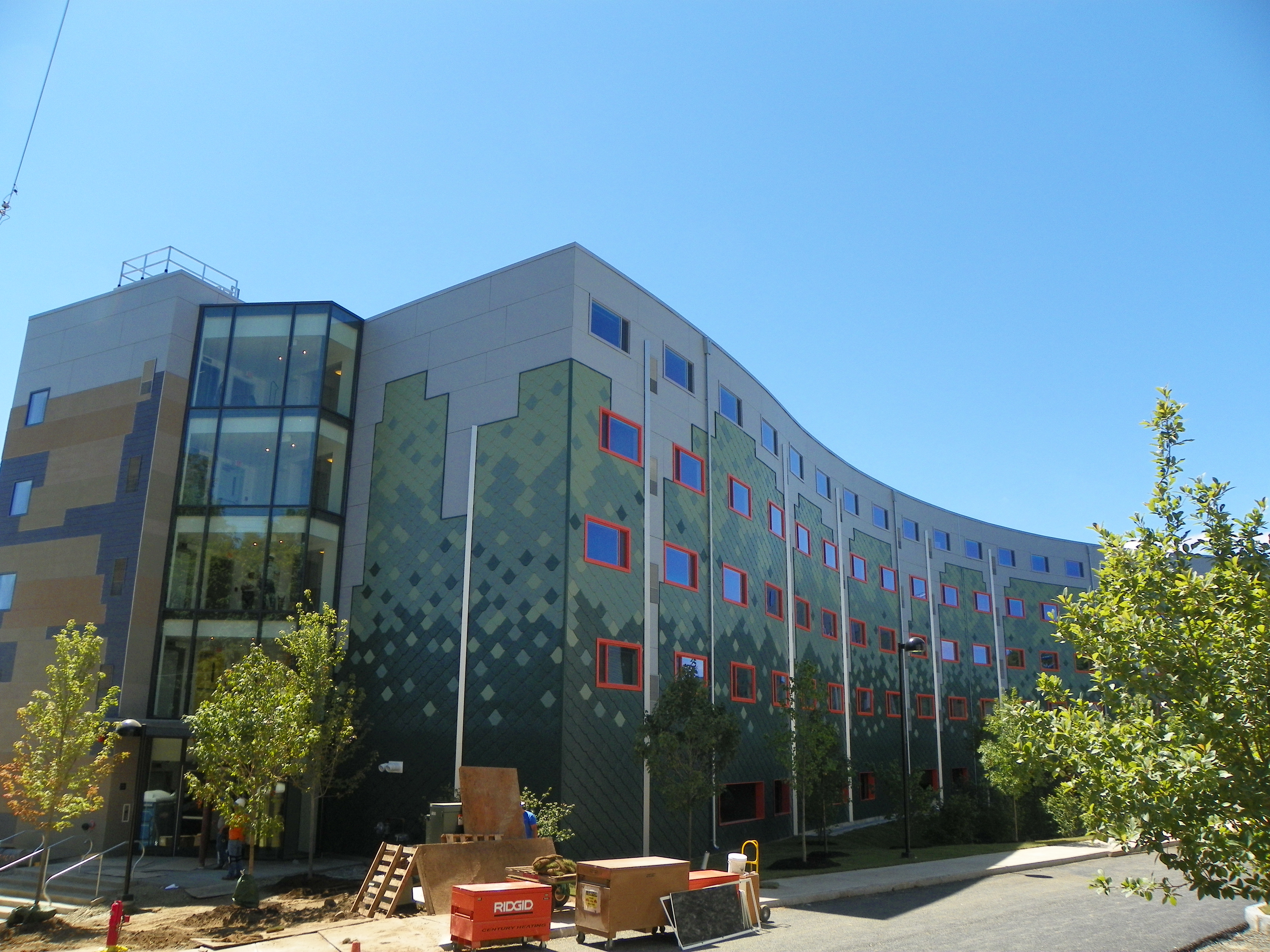
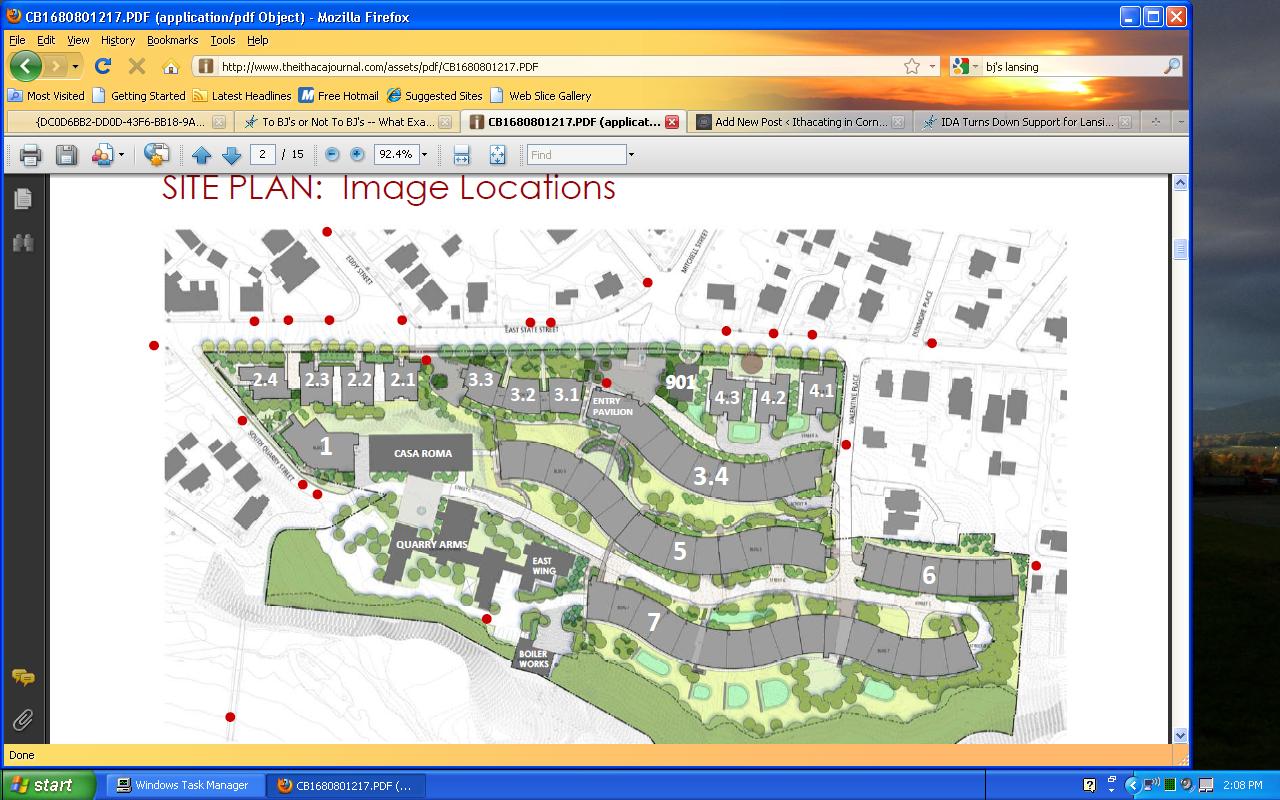
The last phase of Collegetown Terrace (phase III)  is slated to begin later this year, with construction complete by summer 2015. Phase III is supposed to focus on the construction on the last building, #7 (formally known as 120 Valentine Place), a long, curving building very similar to  the currently underway #5. The whole complex as-is provides 1177 bedrooms and 699 parking spaces (5 more than legally required). However, the developer (Novarr-Mackesey) has noted that only about 50% of tenants utilize parking, which means about 100 will go unused (guest parking tends to only make up a very small % of lot use). They have put forth a rather unusual proposal where the second floor of parking for building 7 would instead be 80 units of dorm-style housing: all tenants get their own bed and bath, but share kitchens and community spaces. After reconfiguring some two-bedrooms to three-bedrooms, the net gain of units is 69 (from 178 to 247 in Bldg. 7).  The current buildings, #5 (112 Valentine, 167 units) and #6 (113 Valentine, 71 units) would be unchanged. Zoning calls for 703 parking spaces in the new setup, the develop wants to put in only 652, which they claim it would still result in 50 underused spaces. So here we are. I know even the regulated 9 additional spaces for 80 more units seems a little unbalanced, but the unit reconfiguration and the small square footage of those “dorms” allow it to be so. Changes to the exterior are expected to be minimal.

At a glance, this is a nifty idea – the dorm units are expected to rent for about 50-67% the cost of a typical studio or one-bedroom in the complex (which looks to be around $1000, so $500-$670 for these). Since Collegetown Terrace mostly appeals to wealthier echelons, this sort-of mixed-income aspect is appealing, and it gives a different group of landlords increased competition for tenants; also, it makes for a denser parcel, and does a favor to those seeking to buoy business in Collegetown, and avoid more home-to-rental conversions. However, I doubt the neighbors will be amused (some are not fans of having so many college students gathered in one complex), and the parking discussion (which so far is based only off “experience”) will be reviewed with a figurative magnifying glass. I feel like this project could be a major test-bed of the city’s evolving views on parking requirements.


It Pays To Read: The INHS Pipeline

15 02 2014

11-24-2012 174

I think the biggest thing I learned from Ithaca Builds is the importance of searching for and reading city documents. Since they’re rapidly digitized and made available for public knowledge, it’s not a necessity to stop in city hall anymore. Even better, it has an option to check out the most recent docs, so it’s like one-stop shopping for news. All the extra knowledge is a curse and a blessing. For instance, the latest Common Council agenda, which proposes additional restrictions on an intended rezoning of Cornell Heights, all of which is geared towards keeping the 1 Ridgewood apartment project from happening (I wonder what legal grounds the developer would have in such an event). This isn’t the first time something like this has happened – the vacant lot at 121 Oak Avenue in Collegetown was slated for a 3-story, 6 unit (20 bedroom) building in the late 2000s, but Josh Lower put the kibosh on that project once the city started the endless discussion with the Collegetown rezoning, and the planning board wouldn’t support his project because of the debate. On another note, Josh Lower might have the worst luck of any developer in Tompkins County.

On the other hand, readers get an idea of projects in the pipeline. It’s what allowed me to beat the Daily Sun to the punch on the Gannett Health Center plans. Then there’s all sorts of little projects, like a lot subdivision on Auburn Street that shows the design of the new house, or the proposal for three more houses on West Falls Street. On a larger scale, it also shares big outlines, like what INHS plans to do over the next couple of years, which I’ll discuss here.

The INHS pipeline comes courtesy of this Ithaca Urban Renewal Agency agenda. Most of the stuff is, for the purpose of this blog, “babble”; filings needed to designate INHS with some special privileges. But among this babble is a recently completed and underway projects list, on page 47. In the past year, the 72-unit Poets Landing project in Dryden (a Conifer LLC project they assisted with), Breckenridge Place, and a house purchase/remodel on Hawthorne Place were completed. Go back a little further and you see Holly Creek Phase I and a few small developments, like the duplex on East Falls Street in the lead image. In the future list, for 2014 there are only 14 units – two houses (one a duplex), and Phase II of Holly Creek. A few months ago, I googled the architect of Holly Creek to see her other work, and instead found out her back-story is traumatizing. Congrats to her for surviving it and being able to move on with her life. Anyway, in 2015, INHS has 148 units planned for completion – four townhomes and a house, the Stone Quarry apartments and its 35 units, 62 units in Cayuga Meadows (I guess it dropped from the 68 Jason first reported on IB), and the irksome Greenways project, which has dropped from 67 to 46 units. I have no idea what to make of it anymore. The big projects should all be completed by October 2015, but make of that what you will; Breckenridge came in behind schedule, and non-profit/government building projects are well known for building delays.


A Revised, Resized Plan For Ridgewood

13 02 2014

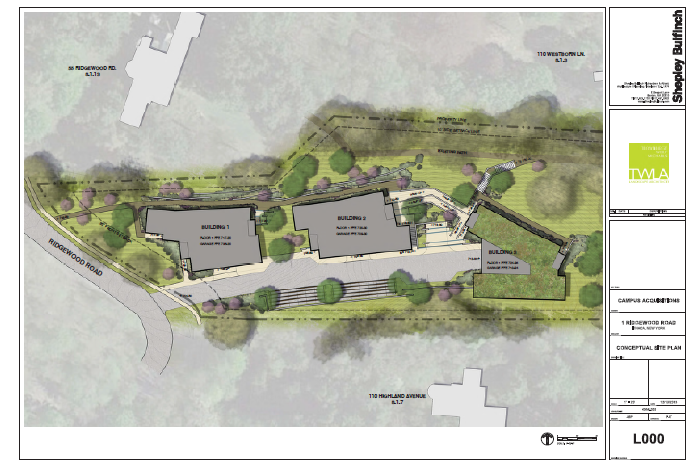
Things are getting a little complex with the development planned at 1 Ridgewood, a Cornell Heights parcel squished between Ridgewood and Highland Avenues. First, the revised plans for the smaller project. While the original plan had 64 units in one large building, this proposal has shrunk it down to 45 in three buildings. Notably, even with the size change, the overall design is not all too different, materials and massing look to be the same as before. One floor has been removed, giving three floors over an underground parking garage (a small surface lot would also be built on the property).

ridgewoodapts_v2_1

The focus is now more on the western side of the property facing Ridgewood, with less attention given to the Highland Avenue side of the property in this updated plan. Since the tendency with student-focused projects is to count the bedrooms, the 45 units contain 114 bedrooms for occupancy.

ridgewoodapts_v2_2

One of the complicating factors in this project is the zoning change proposed for the property. Currently, it’s R-U, which is less restrictive than the R-3aa they are proposing to rezone the parcel to. At its best, it’s an attempt to mitigate increasing developer interest in the historic district; at its worst, its a heavy-handed attempt to stunt development. For the record, this and the Thurston Avenue Apartments project seem to be (have been?) the only two underutilized parcels in the affected area. The revised 1 Ridgewood project PDF goes out of its way to note that this project just barely meets the R-3aa requirements, so even with the zoning change, no variance would be required. This is important, because some neighbors are fiercely opposed to any development of the parcel whatsoever. They would be able to shut the project down much easier if it were seeking a variance, but since it doesn’t, it gets a lot harder. We’ll see what happens as this makes it through the bureaucratic rounds.

EDIT: Ha ha, silly me to think they might let this one go. The Common Council is voting on additional restrictions to the R-3aa zone that would effectively kill this project. The proposed language adds a special amendment for historic districts such as Cornell Heights that says that any new building can’t have a footprint more than 120% of the average footprint of the historic structures on a block. Cornell Heights historic structures are mostly mansions in the 1,500-2,000 sq ft footprint range, which these exceed. This amendment seems to be explicitly targeted to keep this project from happening.


News Tidbits 2/10/14: A Big Project Scouts Out South Hill

10 02 2014

troyrd1

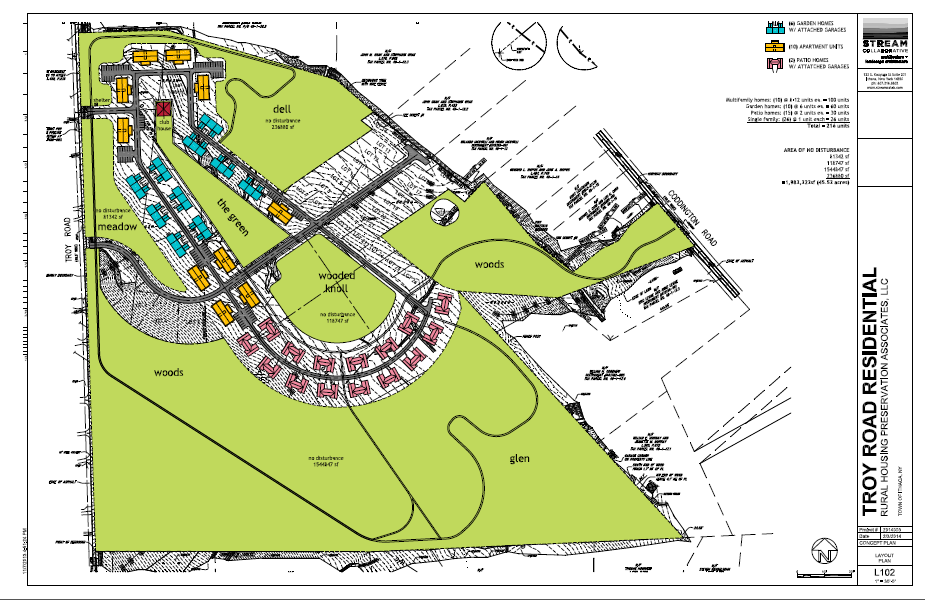
Well, I suppose if there’s demand, and a lack of easily developable to the north, west and east, suburban developers would have targeted South Hill for big projects sooner or later. Fresh from the press comes news of a proposed 216-unit development for the town of Ithaca, on two lots  just east of Troy Road, a little north from its intersection with King Road. The PDF of the plan is here, in the town agenda.

troyrd2

The proposed project is virtually all residential, divided up into 26 single-family lots, 80-120 apartments, 60 garden homes, 30 patio homes, and a 5,000 sq ft clubhouse with your lease office and a few office spaces for rent. To me, it has the airs of a cut-and-paste suburban development. For the record, a garden home is a cute way of saying townhome,  and patio homes are (in this case) one-story duplexes. The architecture theme is “rural agricultural” style: the apartment buildings will look similar to barns, and the patio homes will resemble small farmhouses. The target markets are empty nesters, and twenty-and thirty somethings (grad students and young professionals).

As easy as it to poo-poo this, there is a worse alternative – that which is currently okay under the zoning, which is 70 to 90 lots of low-density residential sprawl. This project, if it gets to proceed as a Planned Development Zone (PDZ) a la Ecovillage, would only disturb about 22 of the 67 acres the two lots comprise.  The project is being developed by Rural Housing Preservation Associates, which looks to be an awkward corporate offspring of a few development companies in the Northeast and Mid-Atlantic, and has enlisted the help of local companies STREAM Collaborative, Whitham Planning & Design, and Hunt EAS. Honestly, the armchair architecture critic in me is okay with those choices.

Something like this will have a multi-year buildout, and there’s been considerable development on South Hill in the past several years. But not anything on this scale. It’ll be interesting to watch this project evolve as it moves through the bureaucratic process.


News Tidbits 1/23/2014: Cashing in One’s Chips

23 01 2014
Property of O'Connor Apartments

Property of O’Connor Apartments

About six weeks ago, I made a quick little news tidbit entry regarding 115 The Knoll, which had turned to Craigslist to try and fill its quarters starting this June. Now, we can also mention that the house is not only looking for renters, it’s also looking for buyers. From Warren Real Estate:

Gorgeous arts & crafts mansion steps from Cornell. Built circa 1915 with up-to-date sprinkler & fire alarm. Living room, chapter room, dining room, commercial kitchen. 13 rooms for up to 25 occupants. There is also [a] 1 bedroom cottage with a separate driveway. Approximately 18 parking spaces.

The real estate listing uses the same photo from the rentals website, so this is indeed the same house (the listing agent is Edelman Real Estate’s John O’Connor, who by my guess is likely associated with the family-run O’Connor Apartments). If interested, this house could also be yours for a cool $1.35 million (Ex-Ithacan take note). Taking a stab in the dark, my assumption is that the current owners have finally given up the ghost, and no longer want to be responsible for the property and its taxes.

Notably, this isn’t the first time the house has been on the market, but in summer 2009, it was only asking for $795,000. The house waited until January 2010 for a sale to be finalized. Whether it ends up a private home, home to another GLO, or yet another parcel owned by Cornell, remains to be seen. If 210 Thurston was any indicator, this one could be on the market for a while.

Around and around and around she goes, where she ends up, nobody knows.