News Tidbits 7/9/10: Thom Mayne to Design Gates Hall

9 07 2010

I consider this a very bad sign.

http://www.news.cornell.edu/stories/July10/GatesHallArchitect.html

According to the Chronicle, Gates Hall will be located on the parking lot north of Hoy Field. This may or may not include demolition of the Grumman Squash Courts, as the article doesn’t clarify that. It will also be about 100,000 square feet and have a construction cost around $60 million. So, among other things, this means I shouldn’t pay attention to Cornell’s budget statements as they relate to building size, since it suggested 70,000 sq ft. More importantly, the site has been moved from its original location behind Thurston Hall. Schematic designs are expected by December, with completion by early 2014.

Now, Thom Mayne is another “starchitect”; which is nice, but shouldn’t be the big idea that’s being touted. Mayne’s firm is a rather small but highly respected company named Morphosis Architects. Morphosis has made their name doing really edgy, deconstructivist designs.

Uh oh.

For those unfamiliar with architecture, here’s the proposal that Morphosis submitted for Milstein Hall:

 That’s Lincoln Hall on the left. This proposal called for the demolition of Rand Hall and this…monstrosity to be built in its place. This isn’t pretty. It won’t even grow on you. This is outright hideous. It reminds me of Lady Gaga’s outfits — screams for attention, but wholly lacking in taste and functionality. This building actually makes me like Uris Hall.

Some might argue that they were purposely edgy since it was an architecture school building they were designing. I would love to believe that, but unfortunately that’s untrue.


This is one of their tamest designs, the Cahill Center for Astrophysics at Caltech. It’s bearable maybe. It sure as hell isn’t attractive. I wouldn’t dare point this out to prospective students and visitors if I were a tour guide. At least Weill and Milstein are inoffensive. This is analogous to mooning a bus full of orphans.

The San Francisco Federal Building? Another statement-maker of the unattractive kind. Thom Mayne is a great architect, but his designs are more for making statements than for being attractive. I want to know why Cornell thinks edgy design is the way to go. Many people have a strong avoidance of deconstructivism, and if MIT’s Stata Center is any clue, these buildings are so much more prone to rapid deterioration. To each their own I suppose. But I have a sinking feeling that Gates Hall is going to be a architectural blight onto the campus.


A Preview of Future Construction Projects

14 05 2010

A look at Cornell’s Capital Plan is a good source for the vague beginnings of any large-scale construction projects to occur down the Cornell pipeline in the next four to five years. Looking at the projects approves or under way, most have already been covered by this blog in previous entries (the ones that aren’t just renovations anyway — Warren Hall’s going to be virtually gutted over the next few years, but there will be no extensive changes to its exterior appearance). I know that Weill Cornell (WCMC) is about to start on a new 14-story, $650 million biomedical building down in the city, but I’ve always preferred to focus on the Ithaca area (because honestly, most Ithaca-based Cornellians could care less about the facilities in Geneva or New York City).

Projects seeking approval for FY (Fiscal Year) 2010 are clearly underway. The initial steel frame just went up for Milstein and the Statler’s rooms are being renovated. The Johnson Museum expansion is well underway (still in the giant hole in the ground stage, which makes sense since it’s mostly an underground expansion) and the Plantations Welcome Center is currently starting to undergo external facade work now that the frame and much of the insulation have been applied. Under the projects for future consideration section, the Olin Library improvements are in the pipeline as are the feasibility studies for the Cornell Rowing Center Renovation and Expansion and the Central Avenue Parking Garage (renders included below).

Central Ave. Parking Garage Proposal

Perhaps the most intriguing projects are the deferred major projects. Granted, they’re deferred, but they’ll likely come back online once budget conditions improve. One of these major projects is a $183 million engineering building. This could quite possibly be the one shown on the Cornell Master Plan that replaces Hollister and Carpenter Halls, especially since the master plan indicates the project is underway in some form.

However, the only probably with that theory is that there’s three buildings, all in the planning stages, in the vicinity of the engineering quad. Based off of old press releases, Site 2 as numbered in the image (the smallest circle) is almost certainly Gates Hall, which is described as a $65 million dollar project in the capital plan (makes sense; smaller building = lower cost). So, the question is, is the approved project number 1 or number 3? I doubt it’s both because then they would have to be filed separately since they are separate structures.

Another project of question is the East Hill Data Center, a $100 million project. Unfortunately, there are no rendering anywhere, and it’s impossible to use the master plan to figure out which building this might be, as the master plan totally redevelops this area, so this one is anyone’s guess.

The University Health Building and the Helen Newman expansion have been bandied about for some time. The new health building will have roughly the same footprint as the current structure, but maybe a floor taller. Helen Newman has been awaiting an expansion that will add a second pool and additional exercise space, but the original price tag was $15 million, instead of the $30 million listed in the capital plan. One wonders whether this is due to rising costs or more ambitious plans.

Hughes Hall and Myron Taylor Hall (the Law School) are due for $28 million in expansion and upgrades. If it’s anything like what is suggested in the master plan, it’s a modern-looking (i.e. clashes with everything around it) building with alot of below-grade parking. However, I have yet to see any true renderings for this project.

Last on the deferred list is an addition to the 4th floor of Phillips Hall, worth almost $6 million. Don’t expect this to be more than a few thousand square feet at most.

Well, my time at Cornell may be almost complete, but it seems like the construction will never be. It’s okay, I could always use another excuse to come back when I’m an alumnus.


Bob Saget Loves Seal and Serpent

22 04 2010

So, some folks might have noticed today that Bob Saget is on campus (again). Their seems to be some buzz going about as to what he’s doing far above Cayuga.

Well, first things thing. According to former (retired?) Ivygate editor Max Wasserman,

“…he’s filming for his new A&E show about interesting subcultures. So the specific subculture he’s covering at Cornell is fraternities and the plan is that he will actually go through initiation. The reason why he’s in Ithaca following Seal & Serpent  is that the producers approached national fraternities about filming, but the national chapters were reluctant to have their secret rituals filmed at any of their houses. The producers then decided to look at independent fraternities as they don’t have to deal with national chapters. They approached S&S (oldest independent fraternity in the country) who agreed. The producers were present at the frat’s initiation dinner a few weeks ago.

So that’s why Bob Saget is at Cornell. He’ll be there through the weekend when I believe he will go through initiation himself (though I could be wrong). There also may be another going-on at the frat related to the filming, but I’m not sure about that yet.”

Well, one of my best friends at Cornell happened to make it the topic of our lunch discussion, before I even heard Bob Saget was on campus. Originally I included how they knew so much. I removed it in case some hypersenstive brother goes on a witch hunt (ed.) Apparently, the program is paying for Seal to do a formal Friday night, tuxes, dates and all. Opinions of Seal aside, just about any fraternity (I’m not even humoring the thought of it being anything else but a normal Cornell fraternity) would love to have the cost of a formal covered. Also, though perhaps stereotypically so, the program is paying Seal to host a toga party Saturday night. I have no idea whether that is open or not.

Yeah, so, congrats to Seal. I think.


Cornell in the Limelight for Recent Spate of Deaths

18 03 2010

A short list:

Fox News, CNN, BBC News, MSNBC, Slate (who tied it into an older article from 2006), The New York Times, The London Times,

Fox News, ABC and CBS and the L.A. Times are all running the same written article regarding Cornell’s recent losses. According to CNN, six of our student fatalities since August have been suicides.

Of course, most news outlets give registered users an uncensored chance to express their opinion on articles such as the Cornell events. Some of these are so offensive that they should never be reproduced. But to sum it up, apparently, some combination of allowing women on campus/not being a good Christian school/too much emphasis on grades/natural selection/recreational drug use/Greek life/no social life/the weather/it’s in upstate New York/ caused it to happen. This reminds me why I usually avoid the comments section on these websites. The most embarrassing part is watching posters claim they’re Cornell alumni and then argue about how great or terrible the school is/was during their time of attendance.

Cornell loves to be in the news, but I’m sure they’d rather be in the headlines for almost anything but the recent series of tragic deaths.


The Great “Snowicane” of 2010

27 02 2010


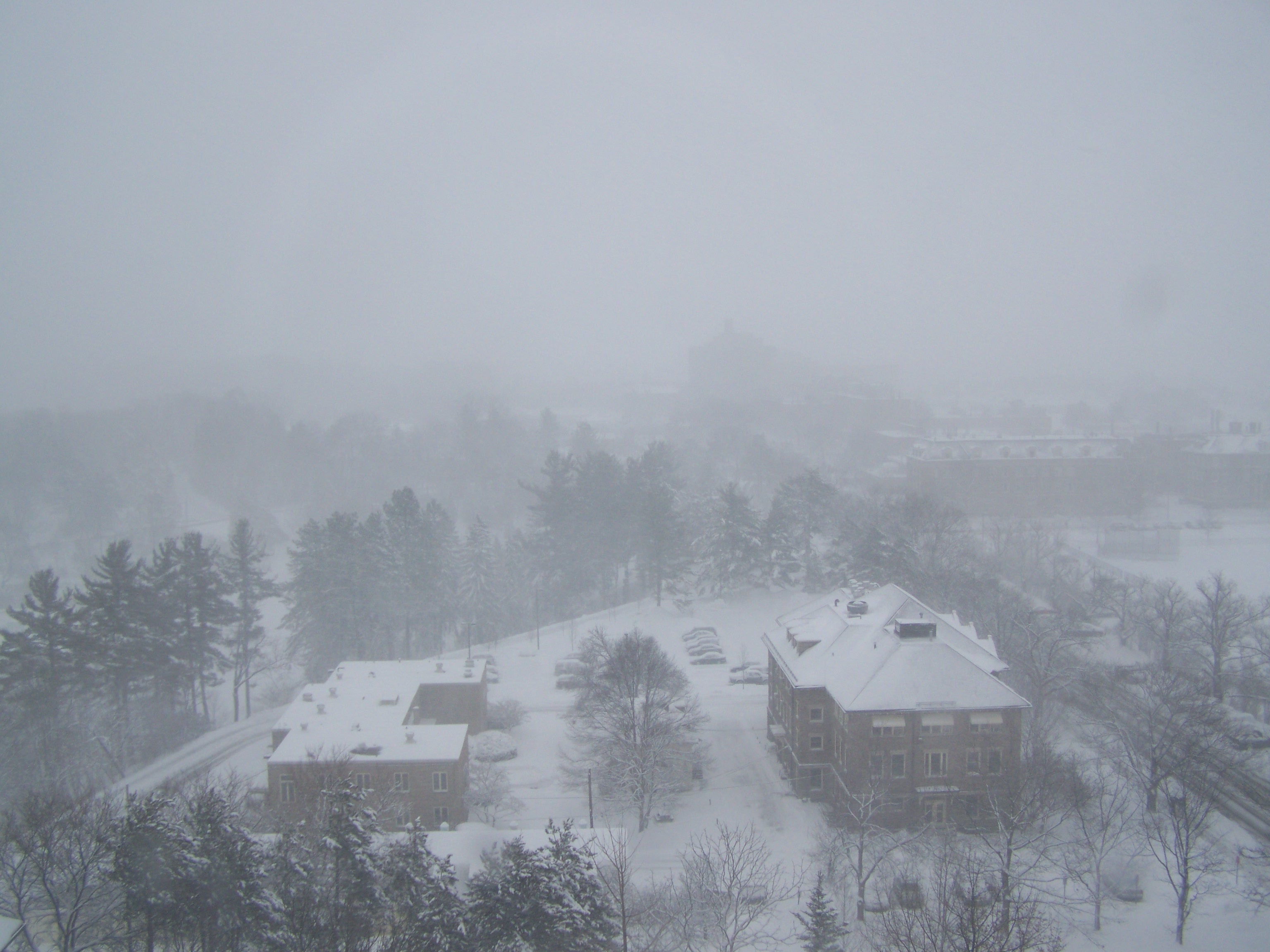
So this is storm is notable for two reasons; the snowfall amounts here and some high wind gusts reported in New England (the storm had dumped 18 inches onto Ithaca’s Game Farm Road weather station by 8 AM Friday morning, probably about 20-24 inches when all is said and done by the end of Saturday), and for letting professional sensationalism rear its ugly head.

From the meteorological perspective, this thing wasn’t even a blizzard for us, as winds were never above 35 mph. In some parts of the northeast it qualified for blizzard status, but only in a few locations. Most of the windy places were rainy. Most of the snowy places didn’t have strong winds. Only a few spots (excluding mountain tops) had both.

The storm bottomed out around 972 mb. That’s a pretty intense Nor’Easter. A strong storm is typically below 984 mb. The great Superstorm of 1993 had a central pressure of 960 mb. This was a powerful storm by any means, but certainly not the mother of all winter storms as depicted by some media outlets.

By that, I mean calling this a “snowicane”. First of all, let me start by saying that calling this a “snowicane” is completely inaccurate and irresponsible. The term was being used by the Ithaca Journal and a few commercial weather websites like Accuweather.com to describe (what was at the time the impending storm) the snowstorm that that passed through our area. The term is misleading and sensationalist. Hurricanes and snowstorms are like apples to oranges; combining the two into a catchy portmonteau because of high winds is complete bullshit. So, first came all the news headlines about the coming snowicane; then came the panic and confusion as people didn’t know what the hell was going on. Over in Bradfield, people were calling or emailing, asking what they should do about the snow hurricane. At first it was funny in a pathetic sort of way, and the NWS and a lot of broadcasting stations chastised a certain private company for trying to incite a panic. The first follow-up article on the Ithaca Journal read like this:

This is not a “snowicane.”

“That is garbage,” New York State climatologist Mark Wysocki said of the word AccuWeather.com and several news outlets are using to describe the storm. “This is really a typical storm. It’s nothing unusual. We’ve had them before, we’ll have them again.”

Of course, then I find lovely little comments like this one on the Ithaca Journal:

From TheZuneLune:

Garbage…Wysocoki’s [sic] misrepresentative critique is what’s garbage….Accuweather clearly explained that their rationale for comparing it to a hurricane was the strength of the low, and guess what? They were right as the storm is currently 978mb and strengthening.

Wyscoki [sic again] and the NBC owned Weather Channel (weather.com) are bitter because Accuweather’s meteorologists have fought the tide of meteorologists forecasting based on politics rather than science. Accuweather’s Joe Bastardi, in particular, has been assailed for refuting the notion that the recent stormy weather in the Mid-Atlantic was based on other factors than “man-made” climate change.

Ithaca Journal, please do a better job researching both sides of a story before perpetuating the far left agenda.”

Part of me is willing to wager that the poster has an affiliation of some sort to Accuweather. They’re only based two hours away in State College, PA (home of Penn State, and where its previous and current CEOs earned their meteorology degrees).

But really, what the hell does the weather have to do with politics? Like the two couldn’t be any less related. I’m a moderate Republican, but maybe because I study meteorology I don’t just write off sensationalism as an attempt of slander by the liberal media. I swear, it sounds like something right out of wingnut playbooks (if you don’t understand something, don’t worry about being uneducated, just blame it on people you hate). This is an issue of a company trying to capitalize on the fad of snow neologisms like “Snowmageddon” and “Snowpocalypse”, and being called out by other outlets for being irresponsible. No one expects Armageddon or the apocalypse with a snowstorm. But get a few people who don’t know better to hear “snowicane”, and suddenly they have thoughts of Katrina and blizzards meshed into some horrible monster of a weather system (speaking of which, Accuweather was also chastised for calling this storm “a monster”).

Interacting with people in meteorology has shown me that there is an expected level of professionalism and objectivity in forecasting, and that many in the field saw Accuweather’s descriptions as crossing the line. Yet people are twisting this argument from an issue of professionalism in a scientific field to an argument based on political bickering.

This is going to make me so bitter in a few years.

On a final note, Cornell last closed in 1993 for the aforementioned Superstorm (also known as the Storm of the Century — and these were posthumous titles). Cornell will only close if the Tompkins County sheriff shuts down the main roads like Route 13 due to extreme inclement weather conditions. Seriously, I was astounded that Cornell even gave a two-hour delay. I haven’t had those since high school.


Cornell’s Morbid History II: A (Sadly) Busy Year

30 01 2010

Glancing over at Elie Bilmes’s Fast Lane Blog, he made mention of the most recent student fatality from Cornell University, that of sophomore Mark von Bucher, who succumbed to injuries sustained in a skiing accident in Utah over winter break. He goes on to note that this is the eighth student fatality this year.

Offhand, let’s goes through that list. The Daily Sun makes it easy because it all gets placed on the “tragic” node. Respectfully, the Sun does not display ads in this node either due to the nature of its content.

1. David Yang ’11 was killed in a car accident in Missouri in late August.

2. Warren Schor ’11 succumbed to complications related to contracting the H1N1 “Swine Flu” Virus in mid September.

3. Boon Jim Lim ’13 was found dead in his dorm room in late October. The family has chosen to not disclose the cause of death.

4. Rion Wight ’09, who had been on academic leave for the past two years, died unexpectedly in late October, a week after the death of Boon Jim Lim. No cause of death was released.

5. Lucas Wooster, a 32-year-old Ph.D. student, died unexpectedly in early November. His death has been speculated by some to be a suicide.

6. Adam Frey ’11 lost a two-year-long battle to cancer the day after Christmas.

7. Clayton DeFisher ’11 died after suffering cardiac arrest at a New Year’s celebration.

8. Oliver Schaufelberger ’11 died at home around January 13th. The family has chosen to keep the cause of death private.

9. The aforementioned Mark von Bucher ’12.

If you count the Ph.D. student, that makes for nine fatalities. Comparably, the tragic node records three student fatalities for the entirety of the previous academic year.

This has been a truly unfortunate year for the student body of Cornell.


The Dealings of the AEM Program

22 11 2009

For almost every day of the past semester, there has been something in the news about proposed budget cuts or streamlining of the university in the name of efficiency. The AEM (Applied Economics and Management) Program is probably the biggest target of the streamlining arguments, and not without good reason. Someone could effectively obtain a business major through AEM in CALS, PAM in Human Ecology, or by concentrating on a particular field within the Hotel School. The engineering school has a program set up with CALS where engineering students can minor in business through AEM.  Some aspiring entrepreneurs take classes at the Johnson as undergraduates. Point is, anyone whose interested in business (if at least because of the big financial rewards) can do so.

AEM hasn’t always been the fast track to I-banking as it is often seen today. The AEM of competing business fraternities, Wall Street ambitions and pre-MBAs is largely a recent phenomenon.The history of AEM shows how much of a radical departure the program has made in recent years, and thankfully a professor emeritus of the department recorded it in a written book about the history of the department that is available online in its entirety.

AEM started in CALS for good reason — it was first known as agricultural economics. The program has its earliest roots from around 1903, when Ag school dean Liberty H. Bailey hired Prof. Thomas Hunt, who taught the first courses on farm management. By 1907, Hunt left to become a dean of the Penn State Ag school and George Warren took over most of his duties, becoming a full professor of the Farm Crops and Farm Management Department by 1910 (the sister department at the time was Rural Economy). George Warren by and large shaped much of the early development of the program, hence Warren Hall’s dedication to him when it was built in the early 1930s. In 1919, the two sister majors were merged into one department to be called Agricultural Economics, as ordered by the Board of Trustees.

For the next several decades, Ag Economics was a major usually taken by farm kids who planned on going back to the farm or engaging in some other form of agricultural operations. By the 1970s, the program had begun to diversify somewhat, and by the 1980s the program offered a substantial number of courses that didn’t focus as much on the agriculture portion of ag economics (mostly these new offerings were in environmental and managerial economics — the managerial portion could be seen as a predecessor to today’s AEM). To reflect this, the department changed its name to Agricultural, Resource, and Managerial Economics (ARME) in 1993.

Unfortunately, the book ends off in early 2000, and a lot has changed in the past nine years. The program changed its name from ARME to AEM in 2000.  The undergraduate business program was accredited in January 2002. Doing this required a significant financial infusion on CALS’s part, one example being the hiring five key staff members that were required for full accreditation (for ratio purposes and course requirements needed for accreditation). Depending on the year, AEM has offered anywhere from six to ten concentrations, some ag based and some not. This is where the blurring has resulted from.

So, we have the kids who come straight from the farm and want to pursue agricultural objectives. That’s right in line with CALS’s objectives. But then you have the kids who are completely set on Wall Street and Wharton. the ones who scowl when you mention that CALS is state funded or poo-poo most of their intraschool brethren (I know that they’re not all like that, but all it takes is a few to set a bad example and garner a poor image). The department has definitely become more diverse, but some argue that it comes at the cost of diluting the mission of the school (of course, who am I criticize when CALS also includes atmospheric science [meteorology, which grew from crop and soil science], landscape architecture and and communication)?

Should AEM be streamlined? It would seem appropriate when you consider the variety of business programs Cornell offers. But to be frank, CALS does not give a damn what Cornell as a whole thinks when it comes to AEM. CALS invested heavily in the program in the late 1990s and early 2000s to get it accredited and propel it into the top ten in recent years. Why would they let someone deprive them of lucrative business majors (who become lucrative alumni) after they worked some hard to lure them into the program? This is more of a problem than people seem to realize. Unfortunately for me, my adviser rants about AEM’s high-and-mighty attitude roughly twice a week, so I won’t be seeing an end of those complaints anytime soon.


The Keyword Bar VI

7 09 2009
 100_1281

Yeah, I’ve been lax about updating lately. I have some things in queue, but I also have research going on, so things are a little hectic. Naturally I’m turning to my favorite cop-out of fielding responses to some of the search entries that have led people to the entries in this blog.

1. “alpha gamma cornell” (9/5/09)

This could be in reference to a fraternity or defunct sorority that the individual failed to incluse the whole name of, or it could be a reference to the research report “Hazed and Confused” by Adam Zwecker [1]. In Zwecker’s report of hazing within the Greek system of Cornell, he uses the psuedonym “Alpha Gamma (Phi)” in reference to a house that he was pledging that committed a series of hazing violations in flagrant disregard of system and campus policies. Rumor mill tends to associate the psuedonym with two or three different houses, and the actual house was reported to have been reorganized after the report to remove such dangerous activities.  I’ve heard the report used more than once as a reason why Cornell students avoid becoming part of the Greek system, which is unfortunate but I can definitely see the reasoning behind their decision.

2. “tke blackballed from lehigh” (9/4/09)

This one is interesting not because of who it deals with, but the term “blackballing”.  According to the fountain of information that is Wikipedia [2], blackballing is a rejection technique used in elections to decline membership in fraternities and gentlemen’s clubs. Typically, in Greek orgainzations, some method similar to blackballing or dinging is used to decline membership to potentially undesirable candidates. The name hails from the black balls used to signify opposition in elections in the fraternal orders of days long past.

Since the IFC at Cornell has made use in the recent past of an electronic system to keep in track of rushees visiting houses during Rush Week, and that the site includes the capability to record comments on these individuals submitted by houses, a person could be blackballed not just from a house, but from most/all Cornell fraternities if the comments are strongly negative. I imagine that would take an outstanding showing of stupidity.

3. “ithaca cornell share frat scene” (9/3/09)

I’m going to take this as a a question regarding whether Ithaca College and Cornell have uniform membership in greek houses. The answer is no for IFC and PanHel. Ithaca College banned Greek Life in 1980, and while there may be some underground groups, they operate separately from Cornell chapters. However, MGLC has found a way around this by creating “citywide chapters” which draw members from multiple colleges in the same geographic area. I’m aware of at least one MGLC sorority that has roughly half of its members from Cornell and half from Ithaca College. The legitimacy of these organizations with regards to Cornell’s greek affairs alone is debatable, but since most MGLC organizations are quite small, it probably doesn’t come up very often.

4. “three side dormitory cornell”  (8/30/09)

Donlon, but technically not correct, since it actually has six exterior sides. It’s just that the three curved sides are much more prominent.

100_1603 
Photo Courtesy of Cornell Facilities

Mary Donlon Hall was completed in 1961 as an all women’s dormitory, the last of the all women’s to be built on north campus before it went co-ed [3]. Mary Donlon Alger (class of 1915) was a prominent federal judge who served on the Board of Trustees for 29 years [4].

5.  “maximum building height town of ithaca”

Really depends on the zoning, but most residential zoning only allows a maximum height of 36 feet before a zoning variance is required. The two current projects beofre the board fall below that though; a 106-unit townhouse development by Holochuck Homes off of Route 96, and a 13-unit housing development called Cleveland Estates that will be south of Ithaca College off of Danby Road. The townhouse units might see some trouble because of traffic concerns and opposition to what the West Hill community feels would be an increase in crime if the housing is “affordable” (believe it or not, this is a leigitimate concern. The 128-unit Overlook at West Hill development has been plagued with what neighborhood residents feel are unreasonably high crime rates [5]). The town is looking into a moratorium on West Hill, which would effectively kill the proposal.

According to the West Hill Civic Association, this is the list of proposed and potentially developable properties that are under study:


1. Carrowmoor, 400 units, commercial space

2. Conifer (Linderman Builders), 100 more units (this is in addition to the 180 or so units already in place)

3. Holochuck Development, 106 units near hospital

4. Cornell Parcels, 33 acres off Trumansburg road

–Assisted care interested, 50 units of senior housing, (probably similar to Alterra)

–nothing formal before town

5. Land that can be developed, nothing set yet, Medical Center parcel

Tompkins County

6. Property off Bundy Rd. (67 acres)

7. Perry Farm (60 acres)

8.Kaderli Trade Inc. (100 acres)

9. Eco Village 3rd Neighborhood


***

[1]http://www.ilr.cornell.edu/smithers/docs/hazed_and_confused.pdf

[2]http://en.wikipedia.org/wiki/Blackballing

[3]http://www.fs.cornell.edu/fs/facinfo/fs_facilinfo.cfm?facil_cd=3026

[4]http://en.wikipedia.org/wiki/Mary_Donlon_Alger

[5]http://www.theithacajournal.com/apps/pbcs.dll/article?AID=/20090808/NEWS01/908080343


News Tidbits 6/16:A Preservationist’s Trick

16 06 2009

I’m so glad she’s not running for re-election.

http://www.theithacajournal.com/article/20090616/NEWS01/906160334/1126/news/Some+owners+balk+at+historic+designation
100_1754

Some Collegetown property owners are calling the potential historic designations of their buildings unsafe, unfair and an attempt to stop development.

The city officials behind the list of historic resources in Collegetown say they’re trying to protect a legacy of beauty that will ultimately strengthen the city’s culture, economy and desirability as a tourist destination.

Planning Board Chairman John Schroeder and Common Council Alderwoman Mary Tomlan, D-3rd, have compiled a list of 31 “Collegetown Historic Resources Worthy of Detailed Research.” Both the 2007 Collegetown vision statement and the proposed Collegetown Urban Plan call for identifying historic resources in Collegetown.

The 31 resources, primarily buildings, are being studied this summer for a variety of historic recognitions, including potentially formal historic designation, which would prevent a property owner from tearing a building down and redeveloping it. Both the Ithaca Landmarks Preservation Commission and Common Council have to approve new historic designations.

Joe Leonardo, owner of the Royal Palm Tavern, said some of the identified properties could be worthy of historic designation, but the Royal Palm is not one of them.

Tomlan said the Royal Palm is historic in part because “it’s not like any other bar in Collegetown.”

“It’s a very distinctive facade with its round windows and with its distinctive entranceway,” Tomlan said. “And it has been so well kept up; I mean, they do such a good job of keeping it painted. It’s been an image on the Collegetown streetscape for many decades.”

Leonardo said he paints the facade so often because “every year the front of it falls off.”

“Why didn’t she (Tomlan) come to me and ask me what I thought? It’s going to decrease the value of my property because no one can develop on it if it becomes a historic landmark,” Leonardo said. “Is that my reward for keeping this business in the family for the past 70 years? They’re just anti-development, and it’s pretty transparent what they’re trying to do.

Historic recognition is a part of good planning, tourism and economic development, Schroeder argued.

“I’ve said throughout this that I strongly want and desire redevelopment of certain areas of Collegetown to happen,” he said, citing the 300 block of College Avenue as one he’d love to see redeveloped, and the east side of the 400 block as one that should be preserved.

“Appreciating historic resources is part of what makes a community a community,” Schroeder said. “It helps us understand our links to past generations, what they bequeathed to us. It helps link, especially in a college town, past generations of Cornellians, perhaps the parents of current students, to current generations and future generations of Cornellians and Ithacans. It’s part of what attracts tourists to a community. It’s part of what gives a unique sense of place, a special sense of character.”

Historic preservation is important, but so is providing an adequate supply of safe housing close to campus, argued property owner George Avramis. His building at 403 College Ave. is on the list of historic resources.

“(Having) older wood-frame buildings in that kind of densely populated area is, I think, a very dangerous approach to take,” he said.

The building next door, 407 College Ave., burned to the ground in 1998 when a fire that started in a first-floor restaurant spread quickly through the building, he said.

“Someday I would like to tear it (403 College Ave.) down and put up a nice, new, triple-A-fire-rated building, fully ADA handicap accessible, like 400 College Ave., the Starbucks building,” Avramis said.

Sarah Iams lives at 116 Oak Ave., which is cooperatively owned by the Gamma Alpha Graduate Scientific Association. Iams said her biggest concern with the possibility of a historic designation is the extra time and effort involved in getting city approval for maintenance issues.

Once a building is designated historic, any exterior maintenance or lot changes have to be approved by the Ithaca Landmarks Preservation Commission. Interior maintenance does not require approval.

“As a graduate student co- operative that maintains the property ourselves, processes that might seem like small administrative hassles for a typical landlord or homeowner are a strong barrier to our successful operation,” Iams said by e-mail.

Tomlan said she’s talking with city staff about setting up a public meeting in Collegetown sometime this summer for property owners and others to come learn about and provide input on the historic resources proposal.

Alderman Svante Myrick, D-4th, is the only student on Ithaca’s 10-member Common Council, and he’s been the most vocal proponent for redevelopment in Collegetown.

“I think some of the sites are absolutely worth historic preservation, mainly Cascadilla (Hall) and the (College Avenue) bridge,” Myrick said. “But I’m glad they’re doing more research on this because I’m not convinced that this is not a thinly veiled effort to stop development in the areas where the zoning’s going to change.”

Tomlan, an architectural historian, said she views the historic resources list “as a positive thing, not an obstructionist thing.”

“I would not want to see it as stopping development,” Tomlan said. “It is a recognition that our community is layered by its history and that our lives can be enriched by knowing and seeing pieces of that history. There’s nothing thinly veiled about it. It is a positive statement about the value of our aesthetic and cultural past.”

At 7 p.m. this Wednesday, Common Council’s Planning Committee will hear a report on the Collegetown Historic Resources list. They’re also scheduled for a public hearing and a vote on the Collegetown Urban Plan. The meeting is at City Hall, 108 E. Green St.

The most recent version of the Collegetown plan is at www. cityofithaca.org.

***

For the record, I want to say that I am not anti-preservation. I wholly agree with preserving Cascadilla Hall and the College Avenue Bridge, because of the historic and aesthetic qualities that they bring to the Collegetown area. That being said, the Palms is historic in the same way that a Ford Pinto is a classic car.

100_0649
A beauty it ain’t.

So, I decided to have some fun and look to see which designations I agreed with on the historic recommendation PDF. As much as I dislike Tomlan’s views, I give her a lot of credit to her and John Schroeder (who works for the Sun?) for digging up the history behind the structures she recommended for preservation.

If I didn’t write anything, it means I wholly agree with historic landmark status.
1. College Avenue Bridge
2. Grandview House (209 College Avenue)
3. Cosmopolitan Club (301 Bryant Avenue) –  This apartment house was the clubhouse for international students in the early years of Cornell, I wholly agree on its preservation, but maybe not on full designation, since that tends to make renovation difficult, and this building is severely worn down and could really use some work.
4. Royal Palms – Little historic value, apart from taking up a space. Extremely run down, possibly unsafe since it’s an old, large wooden structure, and a fire could be disastrous. Not only does it not deserve preservation, it deserves to be torn down.
5. A.D.White’s Eddy Gate – Derided in its own time for being an obstruction and for being ugly (see Bishop’s History of Cornell), this is already designated.
6. The Johnny’s Big Red Grill Sign – Already gone.
7. Cascadilla Hall
8. Sheldon Court
9. The Nines – What used to be the Collegetown fire station.
10. Snaith House (140 College)
11. Flagg House (210 Mitchell)
12. Cascadilla Prep (Wait Hall)
13, 14 ,15. 113, 116, 120 Oak Avenue. 113 is one of the few actual fraternity houses that existed in Collegetown (Alpha Chi Sigma, from 1920-1955, when they moved to north campus). Today, the house is rented mostly by members of one of the honors fraternities. 116 and 120 face the gorge, and 116 is home to the biology grad student honors co-op Gamma Alpha. However, I have to disagree with historic designation. The two houses next to gorge would be extremely difficult to redevelop, and designation would make renovation difficult.  As for 113, I would think it a shame to be torn down, but I wouldn’t argue against it.

16. The Larkin Building (403 College). Personally, I always considered this one part of the Ciaschi Block. Although Mr. Avramis argues that he wants to build a new building on the site, the current one fits in so well that he would have to go through raging hellfire to try and tear it down. My personal hope would be that he tear down the two-story brick s–tbox across the street where his offices are located.

17. Chacona Block (411-415 College Avenue) . Same case as above. I can imagine the preservationists would come out in droves if they tried to take this one down.

18-23. 103, 119, 121, 125, 127, 129 College Avenue. I can understand the historic value, but I fear that designation would harm the ability to renovate these structures. I would rather seen this handled such that if someone proposed something, that all due discretion is exercised.

24-27. 117, 119, 121, 123 Linden Avenue. Wholly against. My hometown, which built out in the 1920s and 1930s, is filled with these types of homes. They are of little historic value, and certainly not a “historic resource”. My inclination is to believe they selected these houses because there was recently a large property transaction in this area, so they’re trying to stop development here before it’s even proposed.

28. 120 Linden Avenue. At 140 years old, this may be the only house they have designated on this street that is worth giving landmark status.

29-32. They didn’t count the Big Red Grill Sign in the final total, so there were actually 32 desired landmark designations. The last four are trails and ruins, of little overall merit but of considerable aesthetic value.

So, I completely disagree with five designations. I feel that many of the buildings have historic merit, but that historic landmark status might be going too far. However, this is why we have planning boards, so that people can vote down projects is they stand to be detrimental to the neighborhood.


The Keyword Bar IV

27 05 2009

100_3482

Yeah, it’s a cop out. I’ll do a more substantial entry in the next day or two. After that, I’ll be 800 miles from Ithaca for my summer work, so updates might be sparse in June and July.

1. “collegetown terrace apartments architect” (5-22-09)

Well, let’s look at the May 26, 2009 Ithaca planning board agenda:


The applicant proposes to construct rental housing aimed at students with approximately 1,260 bedrooms (a net gain of 625 bedrooms) in new and existing apartment buildings on a contiguous site of approximately 16.4 acres. The proposed new building design calls for seven new structures, six of which will be 65’ wide with three stories of apartments and up to two levels of parking at grade or below. Site development will require the demolition of all existing buildings and associated structures, roadways, vegetation, and landscaping on the project site, with the exception of those buildings within the East Hill Historic District. The project is on the R-3A and P-1 Zoning Districts and a portion the site is in the East Hill Historic District. This is Type I Action under both the City of Ithaca Environmental Quality Review Ordinance (174-6 (B)(1)(d), (h)[2], [3] & [4] & (k), (n), & (3) ) and the State Environmental Quality Review Act (617(b)(5)(iii) and is subject to environmental review. An Environmental Impact Statement is anticipated for this project.

Collegetown Terrace Apartments, East State Street, Trowbridge and Wolf LLP, Applicant for Owner, Collegetown Terrace Apartments LLP (c/o John Novarr). Intent to Declare Lead Agency.

In case anyone’s wondering, the board agenda is largely the same as last month, with the addition of two proposed duplexs in the city, and the 121 Oak Avenue Project, which was initially proposed for C-Town before the moratorium went into effect, and is now once again being considered. Offhand, I believe that calls for a three-story, six-unit apartment building.

Trowbridge and Wolf, as mentioned previously, does most of its work for educational and healthcare facilities, as well as forays into urban planning and trail design [1]. Since the closest thing they’ve done to a residential project is Cornell West Campus (which design-wise you either like or hate, and I fall into the latter), it’ll be worth looking at the renderings when they’re released.

2. “direction to teagle hall from anabel taylor” (5-23-09)

Oh, I love graduation season. For the record, the direction would be almost directly east. I’ll admit, it was kinda sad to see some of my senior friends bid their farewells to the place far above Cayuga, but it’s just one more chapter in the history of Cornell. As Skorton said in his speech to the seniors, “we’re counting on you” [2].

3. “cornell gates hall” (5-8-09)

Yes, it has been a while since we last checked in on that. It’s still in the concept phases, i.e. needs more money. [3]

4. “cornell agr hazing” (5-1-09)

Maybe. If there’s three things that always seem to get hits for this blog, they are “suicide”, “hazing” and “average <engineering, aem, hotel…> gpa”. It might reflect poorly, but I don’t feel strongly about it either way, I just think that those topics are the things that people go to the internet for because they tend to be sensitive issues, so people seek anonymity by looking online. Just my two cents.

5. “can i be in 2 frats at the same time” (5-14-09)

Back in the day, yes. In the older days of the late 19th century and early 20th century, many a “college man” could call himself a member of two social fraternities, as well as multiple honoraries and service fraternities. However, the practice was largely shut down by the 1920s and 1930s, as many national organizations wrote additions to their bylaws prohibiting co-membership with other social organizations. Most hononaries and service groups still allow for membership in multiple organizations, as long as they don’t directly interfere with one another’s purpose of activities (ex. you can’t be a member of two business fraternities, but being a member of a professional, a service, and a social is okay).

6. “is a c+ a bad grade cornell” (5-10-09)

Depends on the course, I’d think. Everyone has their own challenges and difficulties in a course, so if you worked your tail off for a C+, then that’s just how it plays out, and you do the best you can, even if it isn’t the best grade in class. Don’t know what else to say.

100_3700

[1]http://www.twla.com/projects/

[2]http://www.cornell.edu/president/speeches/20090524-convocation-address.cfm

[3]http://www.pdc.cornell.edu/project_management/project_management_projects.cfm