The Case For More Housing

7 07 2015

Last week, Ithaca mayor Svante Myrick and county Legislator Martha Robertson issued an opinion piece on the need for more housing, and especially affordable housing, in the city and county. There were two, fairly simple reactions to the article – readers believed it and agreed there was a housing issue, or they thought it was bunch of lies.

Being a data-driven person, I decided to delve a little deeper into the numbers behind Myrick and Robertson’s claims.

Let’s start with the 2006 housing study that was cited in the article. According to that study, performed by Vermont-based Economic & Policy Resources Inc. (EPR), 2,127 rental units and 1,767 owner-occupied units would be needed by the end of 2014, for a total of 3,894. These numbers were determined using the 2005 housing deficit (871 units), economic trends and population/demographic trends.  Some readers may remember the quote of “4,000 units of housing” cited in news pieces back in the mid-2000s, and this is where it comes from.

permits_tc_2006_2014

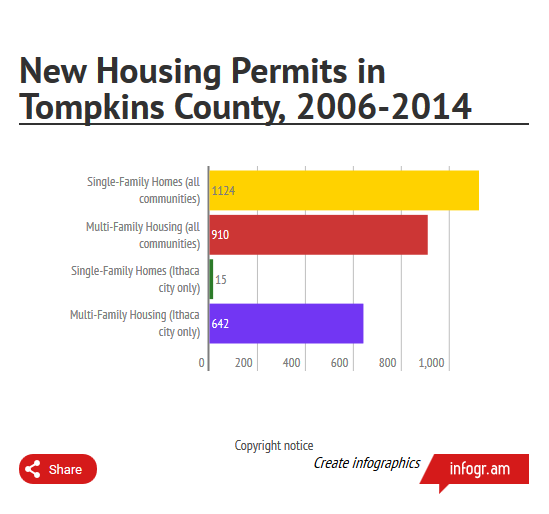
Using data from the U.S. Housing and Urban Development’s State Of the Cities Systems (SOCDS) Database, new housing permits were pulled for the same time period as the study’s projection, 2006 to 2014. From 2006 to 2014, Tompkins County added 1,124 single-family homes and 910 multi-family housing units (apartments and maybe a few co-ops or condos), for a total of 2,034 housing units. In what is a surprise to no one, the majority of multi-family housing was built in the city of Ithaca, and the majority of single-family homes were built in surrounding towns. The county had 40,069 housing units in 2006, so in that nine-year span there was about 5.1% growth in housing units, to 42,103.

The EPR study stated that 3,894 housing units would be required. With 2,034 units actually built, that means only 52% of the housing needs identified by the study were met. Breaking it down further, homeowners, occupying mostly single-family properties, fared a little better – with 1,124 built of the 1,767, that meant 63.6% of the homes that were needed based on 2006-2014 projection were built. However, for rental units, which are mostly multi-family housing, it was only 910 of the 2,127 needed – 42.8%. Not even half.

This wouldn’t be a problem if the economy slowed down or population growth leveled off, but neither of those occurred. Even with the recession a few years ago, job totals have increased quite a bit, with over 6,000 jobs have been added to the county since 2006. The population has also increased – Tompkins County had 99,997 residents in 2006, and in 2014 it was estimated to be 104,691. Rather oddly, the county added 3,049 housing units from 1997-2005, the previous nine-year period, but only 3,482 residents. Population growth has climbed even as housing construction has dropped.

Perhaps most importantly, the 2006 EPR study never accounted for changes in student population. It assumed net zero change for the purpose of the study, which focused on permanent residents. Unfortunately for the housing situation, there’s been a huge growth in student population. Cornell added 2,040 students from 2006 to 2014. Ithaca College added a more manageable 178 students. According to the U.S. Census Bureau, the average rental unit in Tompkins County houses 2.14 people. The county’s staring down 1,036 units it didn’t plan for, and as noted in the opinion article, Cornell plans on increasing its enrollment further.

For the record, IC has added student housing in the period from 2006 to 2014 – an addition to the Circle Apartments south of campus, which opened in 2012 and increased campus housing capacity by 138 beds. While South Hill students are driving up housing demand, the overall impact is minor.

In contrast, when Cornell rebuilt its West Campus Housing during the 2006-2014 time period, there was no net increase in the total number of beds. The Big Red has had no gain in student housing since new dorms opened on North Campus in 2001. With the impending closure of the 480-bed Maplewood Park student housing complex, the situation may get worse. No one can force Cornell to build new housing, but their burgeoning student population does add a substantial strain to the market.

housing need_tc

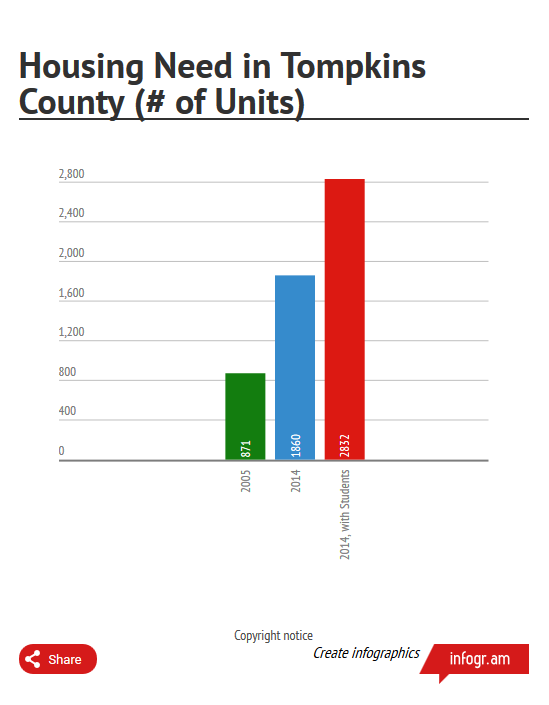
Given the numbers above, Tompkins County fell 1,860 units short of its 2014 housing goal; add in the unexpected influx of college students, and the number rises to 2,832. It wasn’t good to have some affordability problems when the county was 871 units short of a balanced market in 2005; at the 2014 deficit of 2,832 units, the impacts become much more severe, which is why housing affordability has become such a big issue.

Myrick and Robertson’s column might be an opinion, but the statistics give their opinion a lot of weight.


News Tidbits 6/20/15: Big and Far, Small and Near

20 06 2015

Cornell Tech Passive Residential Building
1. In something not Ithaca but Ithaca-related, it seems like Cornell’s New York City-based Tech school is having quite a good week. Cornell announced that construction began earlier this month on a $115 million residential building at the Cornell Tech campus. the 26-story, 270′ tower is being built to passive house standards, the largest passive house building in the world.

According to an article in the New York Times –

“That means the building is able to maintain a comfortable interior climate without active heating or cooling systems, through the use of, among other things, an airtight envelope and a ventilator system that exchanges indoor and outdoor air. In climates like that of New York, however, standards allow small heating and cooling systems.

Making the Roosevelt Island tower airtight — creating what is essentially a giant thermos — was one of the biggest challenges, said Blake Middleton, the principal in charge and partner at Handel Architects, the building’s designer.”

The 350-unit, 530-bed building will house mostly graduate students, with some research staff and faculty also living in the tower. The apartments, designed by Handel Architects of NYC, are due to be completed sometime in 2017.

cornell_tech_v2

As noted at Curbed, to celebrate the groundbreaking, partner/developer Forest City Ratner released new renders of “The Bridge“, the tech incubator building on the right that looks like and ice cube cleaved into two pieces. As one might imagine, the new renders come with token florid language and eye-rolling descriptions (“an ecosystem of companies”). The Bridge, designed by New-York based Cornell alums Weiss/Manfredi, is being designed to LEED Silver standards, which is still better than about 99.5% of Ithaca. Construction permits were filed in January.

tech1

Last but not least, the $100 million Bloomberg donation, to name the first building “The Bloomberg Center”. The Bloomberg Center, designed by Thom Mayne of Morphosis Architects, will also open in 2017. To date (i.e. about three years since inception), philanthropy to the tech campus has totaled $685 million – and absolutely none of them care where you think the money would be better spent. Cornell hopes to raise $ 1 billion ($1,000,000,000) for the school by 2021.

For comparison’s sake, all of Cornell, Ithaca campus, Weill and Tech, raised $546.1 million in donations in 2014, and $474.9 million in 2013.
dibellas_v2_2

dibellas_v2_1

2. Now to go from something big and far away to something small and local.  It’s been a while since we’ve heard about DiBella’s, the Rochester-based sub sandwich chain that had been eying Ithaca last November. They’re back, and the proposal has has some pretty substantial tweaks.

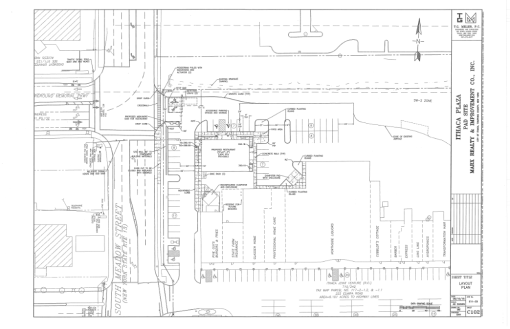
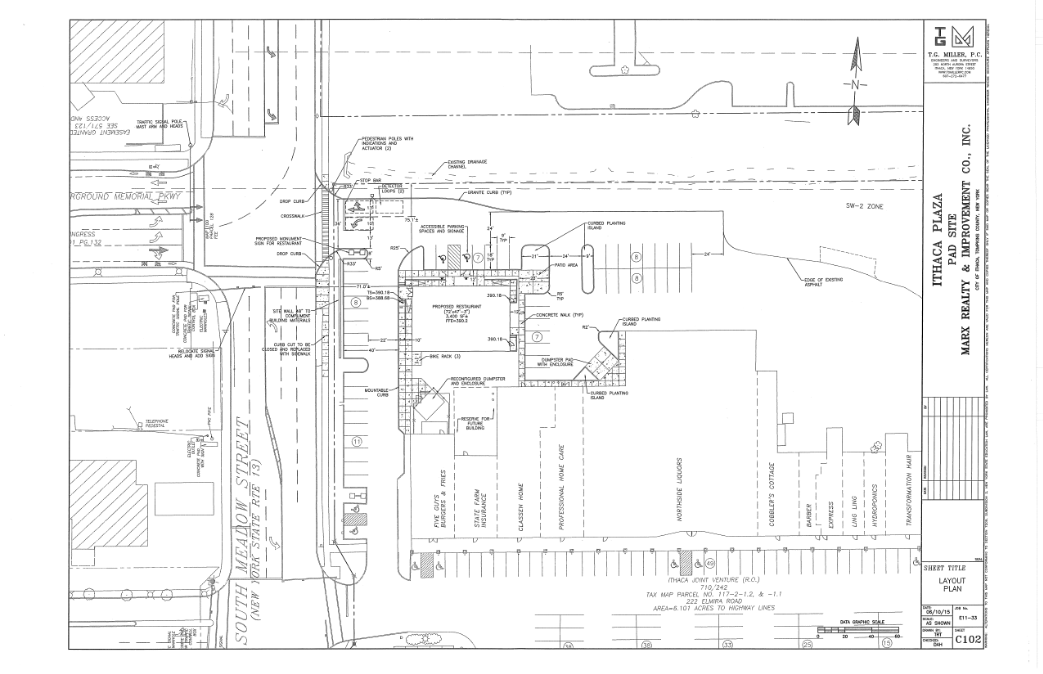
The building itself is still about the same size (~3,400 sq ft), but the design of the building has been reworked to a brick facade with an asymmetrical door/window configuration. The building is now contiguous with the main shopping strip, no longer isolated from the rest of the stores by a driveway. No decisions are expected to be made at the June Planning Board meeting, it’s more of an update for the board as to what’s going on, and to solicit input.

Marx Realty of NYC is developing the pad property, and local architect Jason Demarest (brother of STREAM Collaborative’s Noah Demarest) is handling the design.

3. Shifting out to Dryden now; I don’t tend to write much about Dryden, since a lot of the local development is limited to single-family homes in semi-rural areas (and separately, bad things happen when I write about Dryden).

First, Dryden village. The village has seen quite a jump in population in the past couple of years thanks to the opening of the 72-unit Poet’s Landing affordable housing complex (affordable here meaning that it’s income restricted and rents range from the $600s/month for a 1-bedroom to about $900/month for a 3-bedroom). At least as far back as 2010, a second phase, at the time a 72-unit senior apartment building, was planned by Rochester-based developer Conifer LLC.

Glancing at the village’s outdated webpage, there were meetings in October about phase II. A little searching online shows the negative SEQR determination (meaning no major adverse impacts expected) was issued in February of this year. The determination announcement says that 48 more apartment units are planned for the land directly west of the current complex. The Poet’s Landing facebook page says that funding wasn’t allocated for the expansion this year, but they are hopeful for 2016.

It’s not the best location; affordable housing developments often vie for land outside of developed areas simply because the land is cheaper, but the trade-off is that residents are often isolated, especially if they don’t have money to maintain a car. Here at least the village’s main drag is close enough that residents aren’t totally isolated. And any affordable housing in Tompkins County is welcome.

4. Meanwhile, in Dryden town, there are a couple of projects going on. One involves the construction of 8 duplexes (16 units) at a 5 acre parcel on Asbury Road. Working with that piece of information, there was only one parcel that met the provided description – a property just east of the Lansing-Dryden town line that sold for $30k last August to “SDM Rentals”. Scott Morgan is given as the developer in the town documents.

SDM Rentals does have at least one other recently-developed property, the Meadowbrook Apartments, a set of at least 7 duplexes at 393 Peruville Road in Lansing for which he received a $1,000,000 construction loan in 2013 (2 were built in 2010), and rent for $995/month. The ones on Asbury Road will probably look similar.

The town notes that although the SEQR is still being prepared, the site was already being prepped with dirt fill, resulting in not one but two stop work orders. Looking online, it appears Morgan has a history of being a problem for local government, including a case in Lansing town where he was using a broken-down school bus for a pig barn.

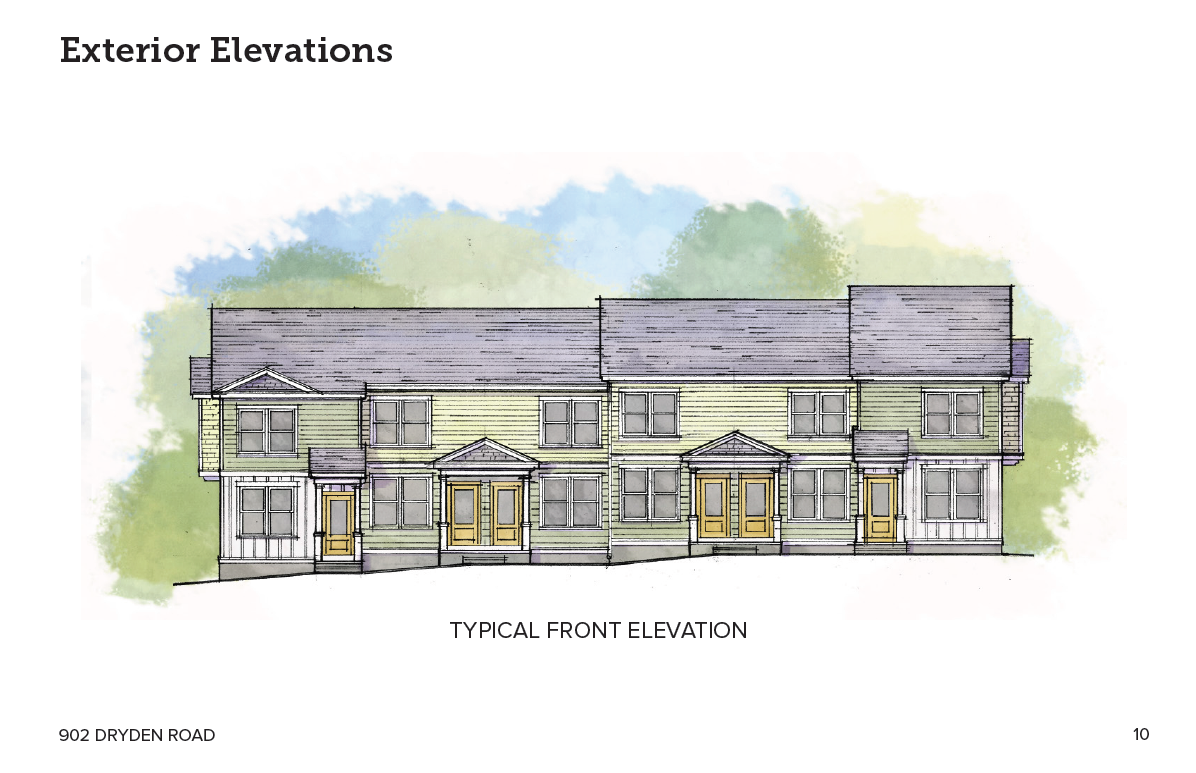
5. Now for project two, a multi-unit project at 902 Dryden Road. I’m just going to link to the Ithaca Voice article in an effort to save time. 15 units, (2 renovated, 13 new), 42 beds, and a $1.5 million investment.

902_dryden_2

I plan on touching on a couple of other minor Modern Living Rental projects at some point, but we’ll save those for a slower week.

20150613_180636 20150613_180659

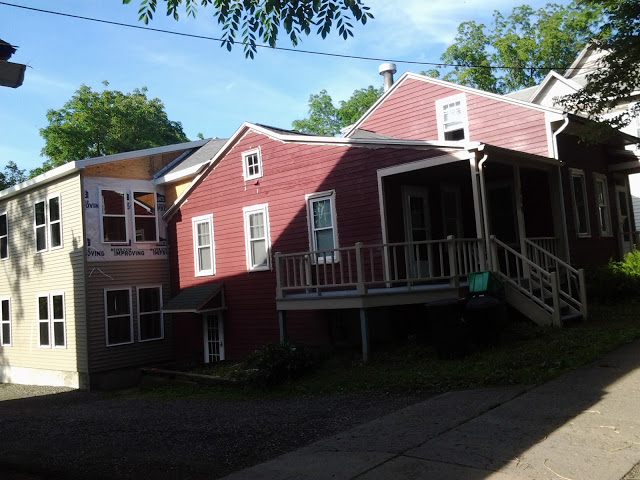
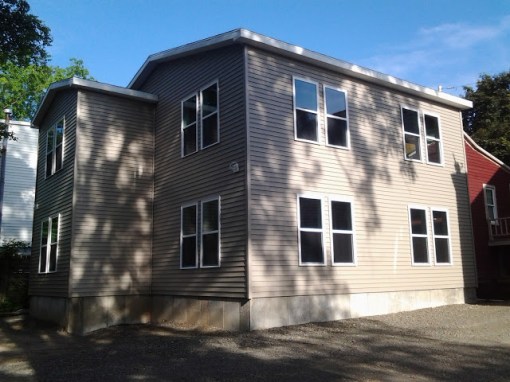
6. This week’s house of the week feature is 318-320 Pleasant Street on South Hill. The rear portion (foreground) is an addition, a duplex with 3 bedrooms each. Exterior siding is nearly complete, though some housewrap and plywood is still visible on the south (front) wall of the addition. A peek inside the interior showed that the drywall has been hung-up, but final details like carpeting have yet to be installed (several rolls of neutral-colored carpets lay stacked on the floor).  The owners of the 105-year old house are members of the Stavropoulos family, who run the Renting Ithaca rental company and the State Street Diner.

On a side note, the 200 Block of Pleasant Street must be one of the worst hills in the city. Walking it must be terrifying on icy days.
oldlibe_franklin_proposal

travis_hude_libe_libe_v3

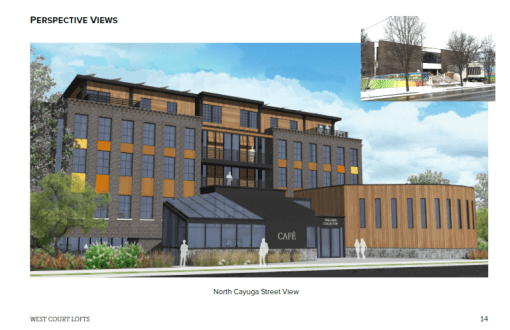
7. The Old Library vote made quite a splash in this week’s news. With a 6-6 hung vote, everything’s up in the air. This is what I feared would happen.

There’s a couple of options to break this. Two legislators, Kathy Luz Herrera (D- District 2, Ithaca City/Fall Creek and Cornell Heights) and Peter Stein (D-District 11, Ithaca Town/East Ithaca), weren’t in attendance, and could call the measure back up for a vote. Herrera’s District is two blocks from the Old Library site, and Stein’s a retired Cornell professor, so although I shouldn’t be guessing people’s judgement, I don’t think it’s a stretch to imagine which of the two projects they’ll be swayed by. But if either one of them decides they dislike all three options, or if they split their votes, then everything will be stuck in limbo. At that point, it’s anyone’s guess – the building could be mothballed, or given that its HVAC and utility systems are at the end of their mechanical lives, it could even be demolished as a long-term cost-saving measure.

If the county does decide in favor of one proposal, it’s still a long road ahead – ILPC approval, Ithaca city planning board approval, and a variety of other measures, which could break the winning proposal. Both projects have potential challenges – with Travis Hyde, ILPC or the Planning Board may try and whittle down its units, removing the density lauded by some legislators, and perhaps the project will no longer be financially feasible. With the condos, one starts with a building that’s had asbestos and air quality issues in the past – one bad surprise in the renovation, and the project could be jeopardized, or at least priced well above the quoted $240-$400k. There are a lot of variables in either equation, and since they can’t all be quantified, both will have their risks.

I’m just going to hope that someone is able to bring new life to the site. I don’t want to see two years go to waste.

state_st_triangle_3

8. Almost to the end. Here’s your monthly look at the Planning Board Agenda for next Tuesday:

– No subdivisions this month, but there will be a 15-minute public comment period on the city’s new Comprehensive Plan.

A. 210 Hancock will be giving an update on its plan and up for recommendation for the Board of Zoning Appeals for parking (64 spaces vs. 84 required) and height variances (46.5 feet vs. the legal 40 feet). Quoting the pre-prepared document, “The Board strongly recommends granting the requested variances.”

B. An update on DiBella’s as described above

C. Tompkins Financial Corp’s Headquarters will be open for public comment, determination of environmental significance (SEQR negative/positive), and preliminary approval for both phases

D. 215-221 W. Spencer will be reviewed for Declaration of Lead Agency (Planning Board agrees to conduct of State Environmental Quality Review)

E. “Collegetown Housing Project at Dryden and Linden – Update”. A.k.a. whatever John Novarr’s planning for that five-building stretch of Dryden and Linden he just deconstructed. Readers might remember this site was part of his Collegetown Dryden project proposed last July, but there’s no indication if it’s a revision of that, or a totally different approach. The one thing that is constant is the zoning – MU-2 for the three properties on Dryden and 240 Linden, and CR-4 for 238 Linden. Neither zone requires parking, MU-2 allows six floors and necessitates mixed-use (often interpreted as ground-floor commercial), and CR-4 does not have mixed-use requirements but the height is limited to four floors. Expect an urban-friendly six-story building fronting Dryden with a four-story setback on Linden.

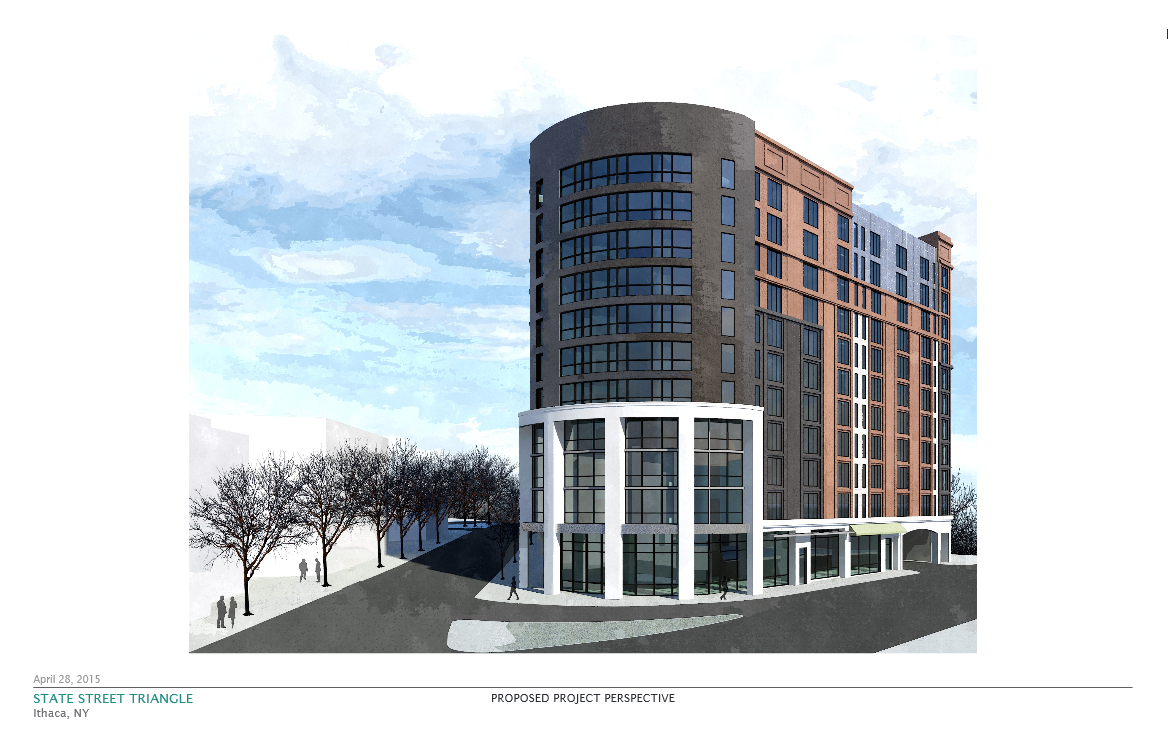
F. “State Street Triangle (Trebloc) Mixed-Use Project – Update” Anything could happen. Height decrease, site redesign, fewer units, major design changes…we’ll just have to wait and see how the 11-story, 600-bedroom tower has evolved given the initial recommendations of the Planning Board.
simeons_v2_1

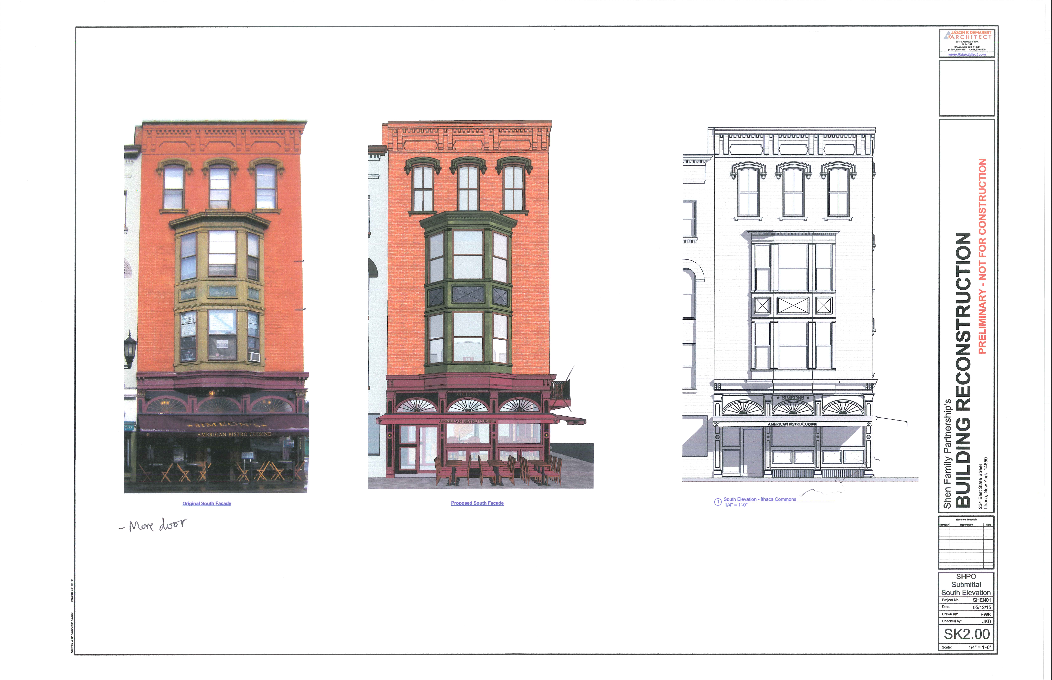
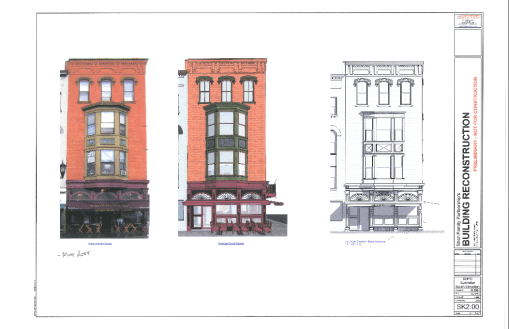
9. We’ll end this week on a happy note. Shen Properties LLC plans on launching their Simeon’s rebuild shortly; first and second floor restaurant space for Simeon’s, and five luxury apartments. The exterior will be a near-replica of the original facade of the Griffin Building, but the interior will be renovated to hold an elevator and a sprinkler system. In a quote to the Journal, property manager Jerry Dietz says to look for a reopening in the very late 2015 or early 2016 timeframe.


Stone Quarry Apartments Construction Update, 6/2015

17 06 2015

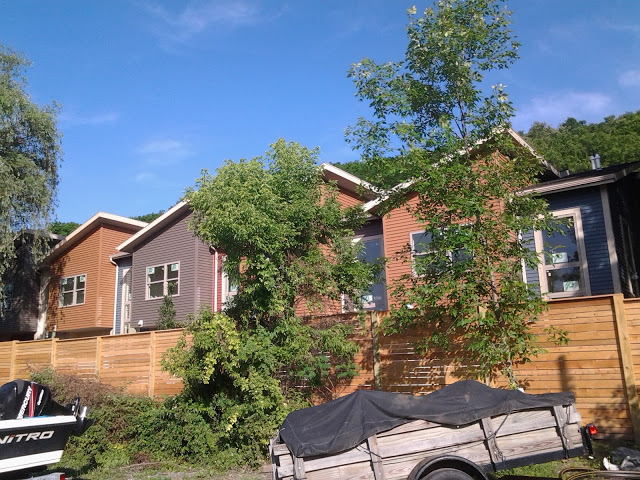
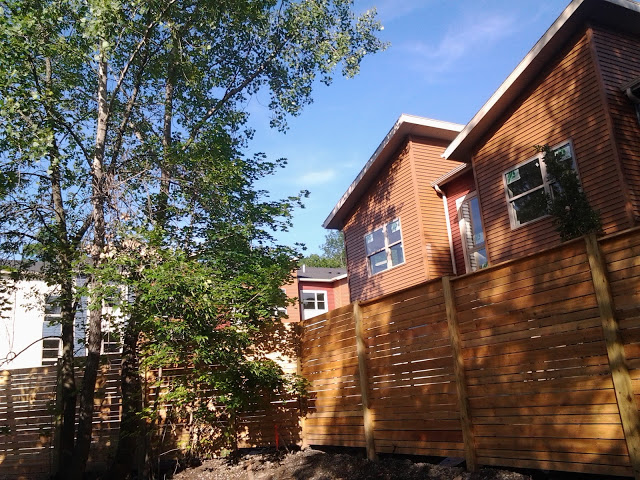
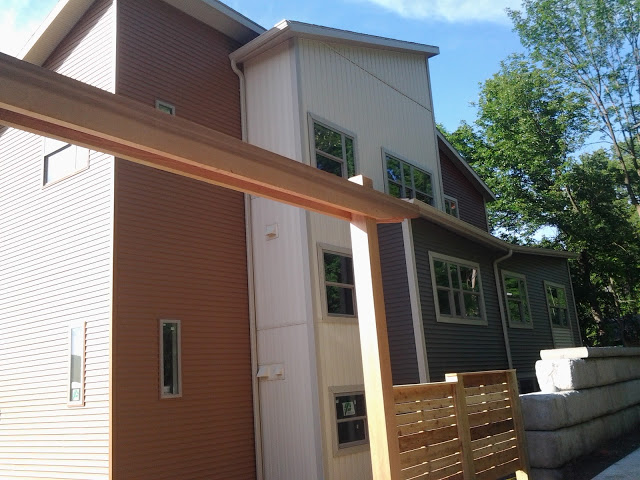
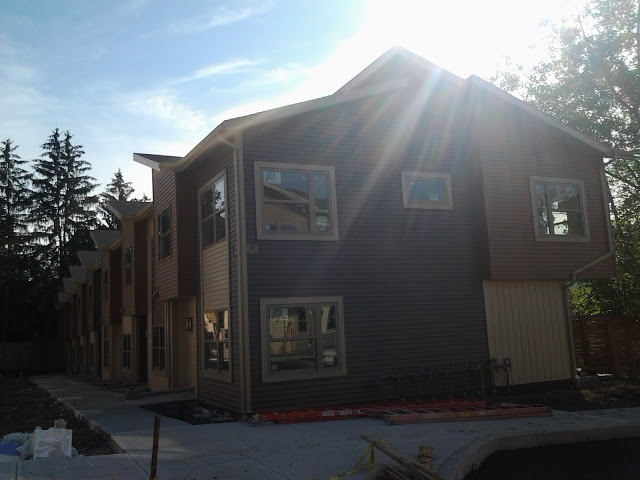
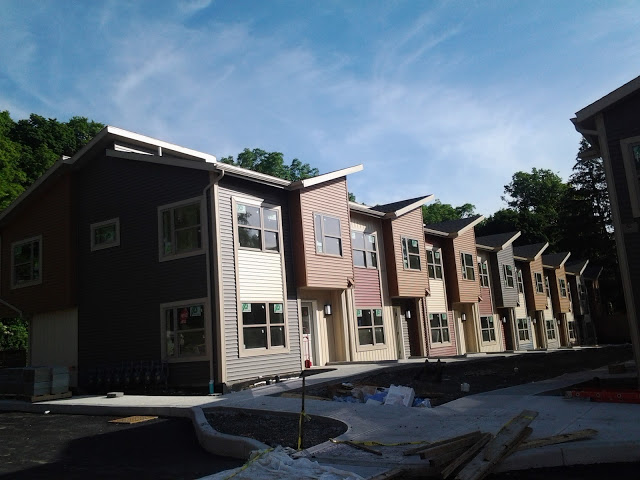
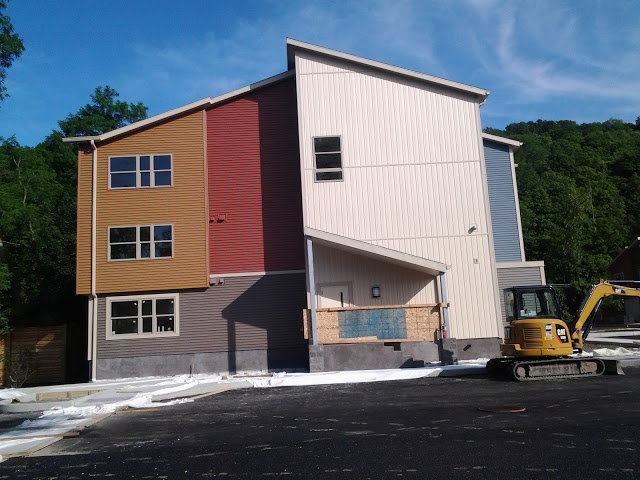
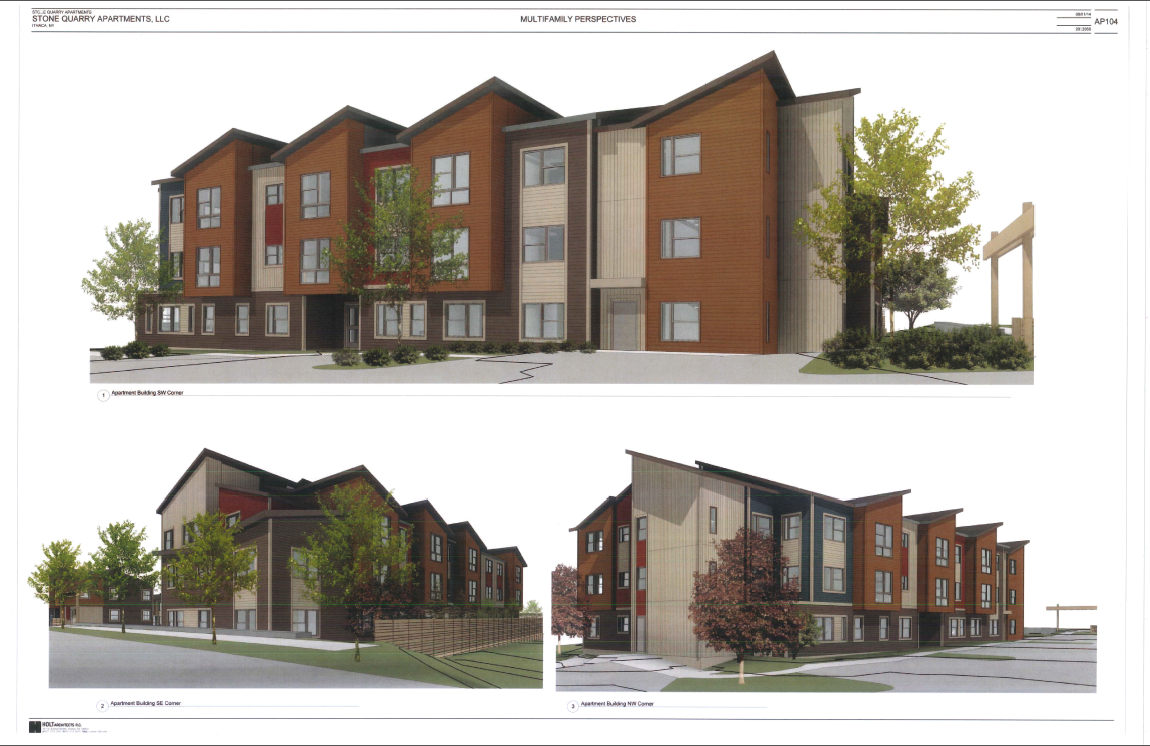
Here’s another project that’s in the home stretch – INHS’s 35-unit Stone Quarry Apartments project on Spencer Road. On the outside, the buildings themselves are pretty much done. A small playground has been installed and the asphalt for the parking area has been laid. A few sidewalk slabs still need to be poured, light poles still need to be erected and the landscaping still needs to be finished out, but otherwise, this is very close to the final product.

A look at the interior of one of the townhome units (not included because the image also included my reflection in the glass) showed that the drywall has been hung, but carpeting and interior finishes are still on the to-do list. Tenants can expect to move in during September 2015.

As this project wraps up, INHS will still be carrying a full schedule for the near future – their townhouse project in East Ithaca, Greenways, will be starting construction shortly. And while Greenways builds out its three phases over the next few years, work will begin on 210 Hancock‘s 53 apartments at some time well into 2016 (assuming no big hangups occur).

___

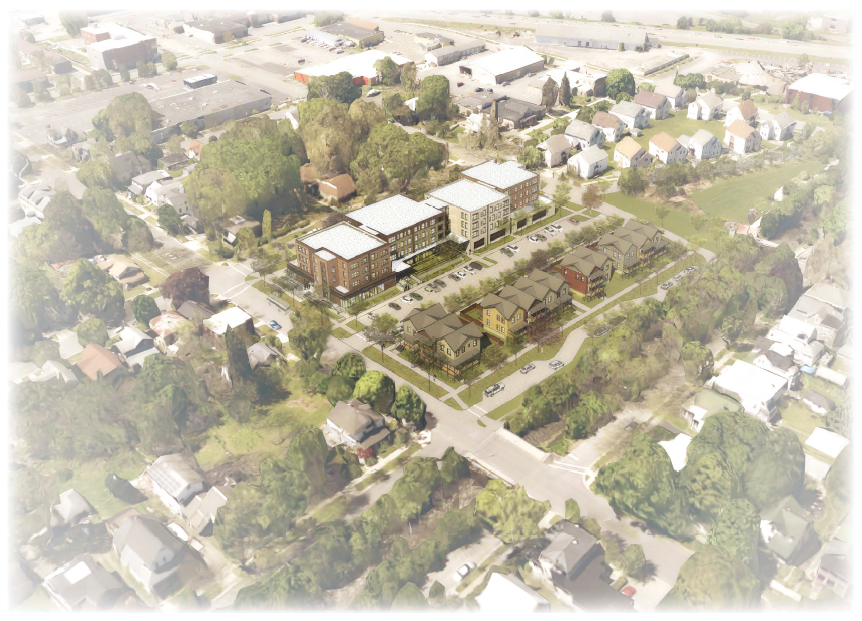
The Stone Quarry project consists of 16 two-story townhouses (2 rows, 8 each), and a 19-unit, 3-story apartment building on the northern third of the property. Specifically, the breakdown of unit sizes is follows:

16 three-bedroom Townhouses
2 three-bedroom Apartments
11 two-bedroom Apartments
6 one-bedroom Apartments

As with all projects by INHS, the units are targeted towards individuals with modest incomes, with rents of $375-$1250/month depending on unit size and resident income. While affordable housing is generally welcome and sorely needed, Stone Quarry had a number of complaints due to size, location and lingering environmental concerns.
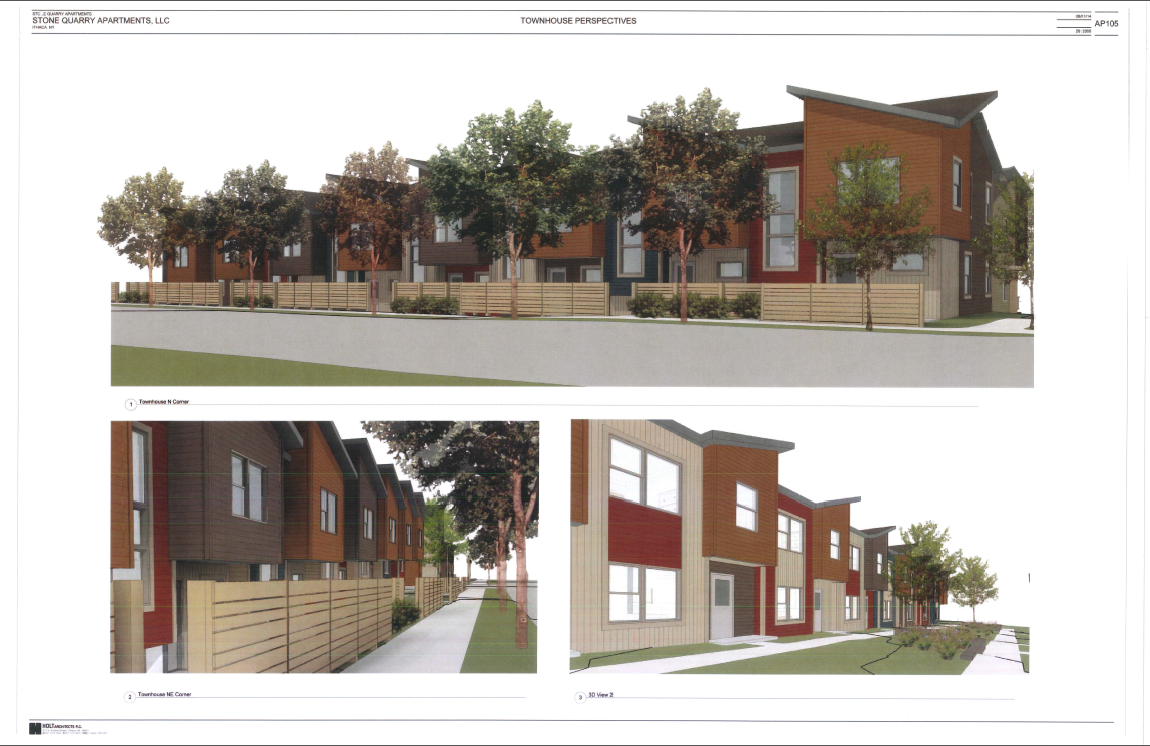
The build-out is being handled by LeCesse Construction, a nationwide contractor with an office in suburban Rochester. The design is by local firms HOLT Architects and Trowbridge Wolf Michaels Landscape Architects.

20150613_174416 20150613_174450 20150613_174818 20150613_174932 20150613_174956 20150613_175009 20150613_175034 20150613_175047 20150613_175126 20150613_175143 20150613_175158


Stone Quarry Apartments Construction Update, 4/2015

15 04 2015

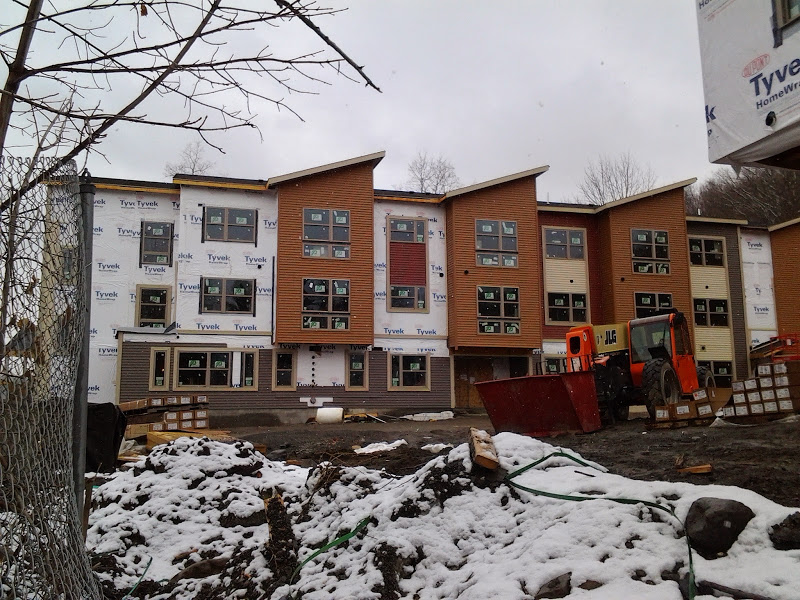
Substantial progress has been on Ithaca Neighborhood Housing Service’s (INHS) Stone Quarry Apartments project on Spencer Street on South Hill. Photos from April 5th show that the sixteen 2-story townhomes and 19-unit, 3-story apartment building have been fully framed, sheathed with Tyvek weather wrap, and have windows installed.

Exterior work continues as clapboard siding is installed on the new units. The color selections here are in many cases the same as those found at the Belle Sherman Cottages on the east side of town – the beige-tan window trim is the previously mentioned “Savannah Wicker”, and the brown-orange color is “Mountain Cedar”. “Light Maple”, “Autumn Red”, “Pacific Blue” and “Sable Brown” round out the color selections.

Without actually going inside, it’s a safe bet that interior is moving along with rough-ins and wall framing, maybe even drywall and finish work on the lower floors. The apartments are expected to be completed in October 2015.

The Stone Quarry project consists of 16 two-story townhouses (2 rows, 8 each), and a 19-unit, 3-story apartment building on the northern third of the property. Specifically, the breakdown of unit sizes is follows:

16 three-bedroom Townhouses
2 three-bedroom Apartments
11 two-bedroom Apartments
6 one-bedroom Apartments

As with all projects by INHS, the units are targeted towards individuals with modest incomes, with rents of $375-$1250/month depending on unit size and resident income. While affordable housing is generally welcome and sorely needed, Stone Quarry had a number of complaints due to size, location and lingering environmental concerns.

The build-out is being handled by LeCesse Construction, a nationwide contractor with an office in suburban Rochester. The design is by local firms HOLT Architects and Trowbridge Wolf Michaels Landscape Architects.

20150405_140249 20150405_140330 20150405_140634 20150405_140638 20150405_140701

inhs_stone_quarry_rev_4 inhs_stone_quarry_rev_3


News Tidbits 3/28/15: It’s Affordable Housing Week

28 03 2015

The unplanned theme of the week: affordable housing projects.

1. This week and next, the Ithaca Urban Renewal Agency will be holding public hearings as part of the process to determine who will receive money from the Housing and Urban Development (HUD) grants awarded to the city. The 21 applicants ranges from jobs training to community services to the development of affordable housing. In total, $1.78 million has been requested, and there’s $1.215 million available, just a little over two-thirds of the total requested.

Without discounting the value of the other applications, the focus here will be on the real estate development projects. For the record, writing about a project is neither an endorsement or opposition from this blog.

inhs_pride_design_3

A. INHS is requesting $457,326 dollars for its 210 Hancock Street redevelopment project (also known as the Neighborhood Pride site). The total cost of the project as stated in the application is now up to $17.3 million. The application only applies to the apartment buildings, not the townhouses. The townhouses and apartments are going to be subdivided into separate parcels, because certain affordable housing funds are targeted towards renters and others towards homeowners. Subdividing the Neighborhood Pride parcel into the apartment and owner-occupied parcels will make for a smoother application process, and they’ll be separate projects within the larger framework of the 210 Hancock property.

210 Hancock will have 53 apartments – the 3 bedrooms have been eliminated and split into 1 and 2 bedroom units, so the number of units has gone up but the total number of bedrooms remains the same (64). The units are targeted towards renters making 48-80% of annual median income (AMI). The AMI given is $59,150 for a one-bedroom and $71,000 for a two-bedroom. The one-bedroom units will be rent for $700-1,000/month to those making $29,600-$41,600, and the two-bedroom units will rent for $835-$1300/month to individuals making $34,720-$53,720. Three of the units will be fully handicap adapted.

One of the commercial spaces will be occupied by local social welfare non-profit Tompkins Community Action for use in an early head-start program for approximately 30 children from lower-income households. The other two spaces have strong interest but do not have tenants lined up yet.

flatiron_1

B. This second project is something new. Alpern & Milton LLC (local buisnessman Ishka Alpern and his brother, Franklin Milton) are requesting $250,000 towards a $1,285,000, 12-unit project proposed for Inlet Island called “The Flatiron”. The project seeks a renovation of 4,900 sq ft at 910 W. State/MLK Street (shown above) and a 3,700 sq ft addition onto the neighboring parcel at 912 W. State/MLK. The finished project will resemble the triangular form of the famous Flatiron Building in NYC. the application says “the project will be of a historic nature, but the structure being proposed is not currently, nor will it be, deemed ‘historic’ in terms of housing or building code”. Ten of the units will be available to 30-50% AMI, and the other two will be available to those making 50-80% AMI.

The brothers do have some small projects to their credit, according to the filed paperwork. They handled the renovation of Brookton’s Market and 514-516 W. State/MLK Street. Judging from the google maps dating back to 2012, some renovations have already been done to 910 W. State.

2. In this week’s Journal, there was an article that gave a rundown of recipients of the Tompkins County Affordable Housing fund paid for by a combination of the city of Ithaca, Tompkins County and Cornell. Most of them I recognized – Holly Creek, the Habitat for Humanity duplexes in Groton and Trumansburg, Breckenridge Place and so on.

There was one I didn’t recognize. The Amici House proposal, which is being planned by Tompkins Community Action. I vaguely remember coming across this during the Stone Quarry debate last year, but at the time I couldn’t even verify if it was a real proposal. TCAction is proposing to build approximately 15 units affordable townhouses at 661-665 Spencer Road, just east of the Salvation Army store. There haven’t been any formal plans presented yet, but the project did receive $75,000 from the fund to pay for a pre-development feasibility study.

Farm Pond Site RES'D & LOT s 010414

3. Like single-family home development? Have lots of extra money lying around? The second phase of Lansing’s 21-lot Farm Pond Circle development is up for sale. Jack Jensen, the original developer, passed away last fall. Of the ten lots in phase two, four have already been reserved; there are also two lots left in phase one. The second phase is being offered for $155,000.

The Farm Pond Circle development is fairly stringent. Current deed restrictions limit the size of each housing unit to 2600 sq ft, vinyl or aluminum siding isn’t allowed, and only very specific subsections of the lots can be developed. Buyers aren’t limited to green energy, but there is a strong push in that direction. Also, at least four of the lots are earmarked for affordable housing (single-family or duplexes, buyers muse make  less than 80% of median county income of $53k)). The affordable units, at least two of which have already been built, are being developed in partnership with Jack Jensen’s non-profit, Community Building Works!.

4. It’s back again. The county’s Old Library committee will be meeting next Friday the 3rd at 9 AM in the legislature chambers. The goal of this meeting will be to review the formal proposals received for the Old Library site, which is likely the same four remaining from the RFEI, but in theory it could one or a hundred. Whereas the RFEI submissions were general, the proposals get into the nitty-gritty – site plan, architectural details, funding, time frame, proponents, all of it. Expect revisions to the previous four designs as a result of commentary from the public and legislators.

Since most folks can’t make Friday meetings, if anyone has general comments, conflicts or concerns about the proposals, I’ll just leave the committee’s contact info here: Legislature@tompkins-co.org. Use “Old Library” as the subject.


The Neighborhood Pride Site (210 Hancock Street)

15 02 2015

inhs_pride_design_1

Avid readers will note that I’ve been writing about the Neighborhood Pride site on the Voice, keeping only brief notes here on Ithacating until a final design was unveiled. Now with that taken care of, here’s a description of what we’re working with, based on documents filed with the city on February 13th. There’s a brief application summary and cover letter here, or the 764-page FEAF (Full Environmental Assessment Form) here. I swear, no one reads those giant PDFs in their entirety, users only look for specific sections based on their prerogative. The rest is just there for gluteus maximus coverage.inhs_pride_design_2

Perhaps a little bit to my dismay, the project is not going to be complete until September 2020, tentatively. This isn’t a huge surprise though, INHS is a non-profit and dependent on grant disbursements. The buildout will begin in September 2016 and consist of three phases – my guess of the breakdown is the townhouses are one phase, the 2 southern apartment buildings are a second phase, and the northern two apartment buildings are the third phase, though not necessarily in that order. At some point, INHS anticipated subdividing the parcel into apartment and for-sale portions, which might be useful when applying for affordable housing grants.

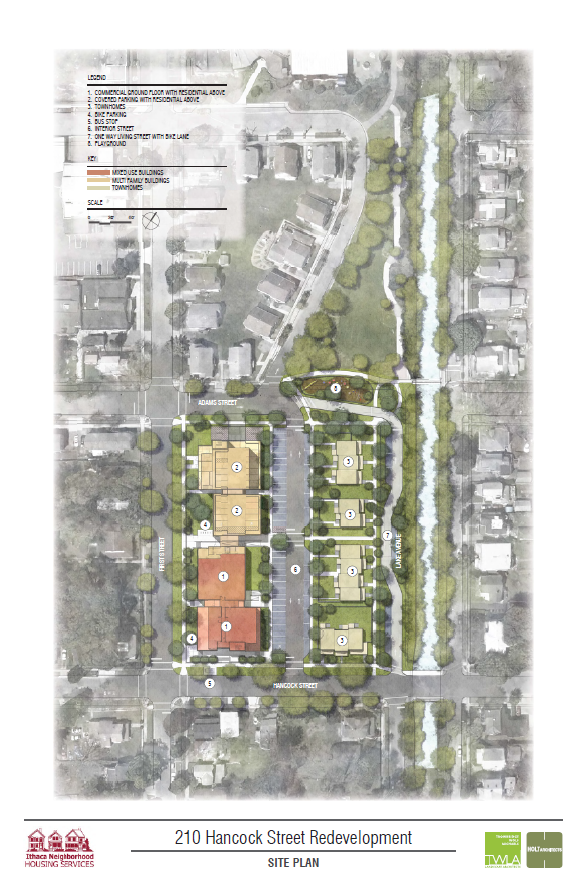
The apartments call for ~50 1 and 2-bedroom units, and 13 for-sale townhouses, although it still looks like 12 in the renders (who knows, maybe one is a small duplex). So about 63 units total, and about 8,200 sq feet or rentable commercial space in three spaces (proposed at 1,800, 2,500 and 3,900 sq ft, for a total of 8,200 sq ft). The apartment buildings will be 65,000 sq ft, 4 stories and 48′ tall (zoning max 4 stories/50′). The demolition of a one-story office building (built 1975) and a vacant grocery store (built 1957) will be required. Total construction cost is anticipated to be about $13.8 million.


inhs_pride_design_3

Interestingly, what looks like the community favorite (the street scheme) doesn’t read as the county’s favorite (which reads as the alley scheme). But the county only advises, the city decides. Lake Avenue will be what they call a one-way “living street” – a low-speed, low-capacity street shared by bikers and vehicles. With those features, it’s designed in a way that you’d only drive on the road if you live in one of the townhouses. Conley Park’s southern boundary will be opened up to flow freely into the property (it was blocked off with vegetation to begin with because of its proximity to the old P&C loading dock, which made for a loud, smelly experience).

As an honest personal opinion, the design – inspired by local 1900s industrial and manufacturing buildings, according to the application – is pretty nice. It’s contextual, it’s appropriate, it fits in without being a total historical throwback. The townhouses are well-designed as well. I think INHS’s willingness to have heavy community input, and the community’s willingness to help shape the project, really came together to create a nice product.inhs_pride_design_5

A parking variance will be required from the city – the site will have about 70 parking spaces, but zoning requires 86. Will a new TCAT bus shelter and on-street parking nearby, INHS anticipates that they will be able to obtain the parking variance without too much hassle. INHS also needs to be be mindful of the flood zone, which they seem to have accounted for in the site plan. The only portion of the site especially vulnerable to a 1-in 100 year flood event has covered parking on the first floor. The townhouses, which are in the 500-year zone, will be built two feet above the ground, and the commercial space, also in the 500-year zone, will be one foot above the ground.

In sum, we have a project that removes a vacant supermarket, fits well in the urban fabric and provides affordable housing. It might take forever and a day to build, but it’s a welcome resource in the city of Ithaca.

inhs_pride_design_4