News Tidbits 2/13/16: A Week of Uncomfortable Prospects

13 02 2016

lansing_cmt
1. We’ll start off this week with some zoning and land-use discussion. the village of Lansing, which tends to have a very tight grip on their zoning, modified their code for a new addition, called “Commercial Medium Traffic” (CMT). The zone, which has taken about two years to get to this point, will override what is currently zoned a Commercial Low Traffic (CLT) area. As a result of the rezoning, some previously-okayed uses in their CLT zone – clinics, group homes, construction storage, sit-down restaurants – have been removed, but adds cafeterias and assisted living facilities. Splitting hairs, one supposes. Looking at the use guidelines, about the only big use the CMT allows that CLT doesn’t is “small-scale sales” like boutique shops, and “low-traffic food and beverage”, which covers bars and sit-down restaurants.

The reason for this change comes from a couple of angles – the village has a number of vacant or underutilized parcels in the affected area, which they feel is detracting. Developers have approached the board about building retail/restaurant space on some of the land, but that would have required rezoning to commercial high traffic. But the high traffic zone also allows “hotels and big boxes”, so the village needed an in-between. Now it’s finally in place.

ithaca_eddy_land

2. Now for another land use debate. The town of Ithaca has authorized doing an analysis on what a fair bid would be for the development rights of 33 acres of land off of Seven Mile Drive and Route 13. These parcels are currently farmed by the Eddy family, and a mini-golf facility was previously proposed on one of the properties. Before that, they were to be included in the 2014 Maguire development before the Maguires pulled their project, partially because the town said the dealership and headquarters proposal wasn’t in line with their new Comprehensive Plan.

The problem is, neither is this. The town would buy this with the intent on keeping all of it farm fields. The comprehensive plan called for TND Medium Residential (townhouses, elder cottages, small apartment buildings and compact single family) and the “Inlet Valley Gateway” (quoting the plan, “intended to be a setting for a mix of office, small-scale retail, hospitality, and tourism and agritourism uses, with low-impact light industrial, artisanal industrial, and skilled trade uses”). The concern is, if the town starts displacing development from the areas recommended, developers will start looking at areas where it’s not recommended.

For the record, the 22.38 acre parcel is for sale for $425,000, and the 10.59 acre parcel is for sale at $325,000. The assessed value is only $188,800 total. The development rights will probably fall somewhere between. This definitely isn’t as cut-and-dry as the 62 acres the town picked up for $160k in December. The town will have an idea of the cost for the rights later this year.

simeons_v2_2

3. A few notes from this week’s TCIDA agenda. The Hotel Ithaca project is up for final approval of its tax abatement, which given that the public meeting drew not a single commenter, shouldn’t have any issues going forward. 210 Hancock also has some slight tweaks to its agreement, and Simeon’s is applying for a sales tax exemption on construction materials and refurbishment. The $660,000 project’s exemption would be worth $27,079 by their calculation. Simeon’s estimates 27 jobs at opening, and 14 new positions over 3 years, about half of which appear to be living wage. The tax exemption amount is small enough that it seems like a non-issue, but we’ll see what happens if the application is accepted and a public hearing scheduled.

tmpud_waterfront_1
4. From the city Planning and Economic Development Committee – the Commons street-level active-use ordinance and the waterfront Temporary Mandatory Planned Unit Development (TM-PUD) were moved to go ahead to the Common Council next month. More on the Commons ordinance here, and the TM-PUD here.

Committee members were favorable to an amendment to the cell phone tower fall-zone law, though perhaps not in the most ideal way for Modern Living Rentals’ 87-unit 815 South Aurora proposal. On the bright side, a draft law for circulation could be ready by April. On the not so bright side, the city’s going with the 120% value used by other municipalities – that would give the 170 ft. tower near the project site a 204 ft. no-build fall zone instead of the current 340 ft. (200%), but it’s still greater than the 180 ft. MLR requested. This means the project would probably need to be revised somewhat if that’s the version of the law that moves forward. But, something would be better than nothing.

Oh, and the chicken law was voted for circulation, which opens the possibility of a council vote in April, for 20 test subjects in a pilot program.

402_s_cayuga_st_rev2_1

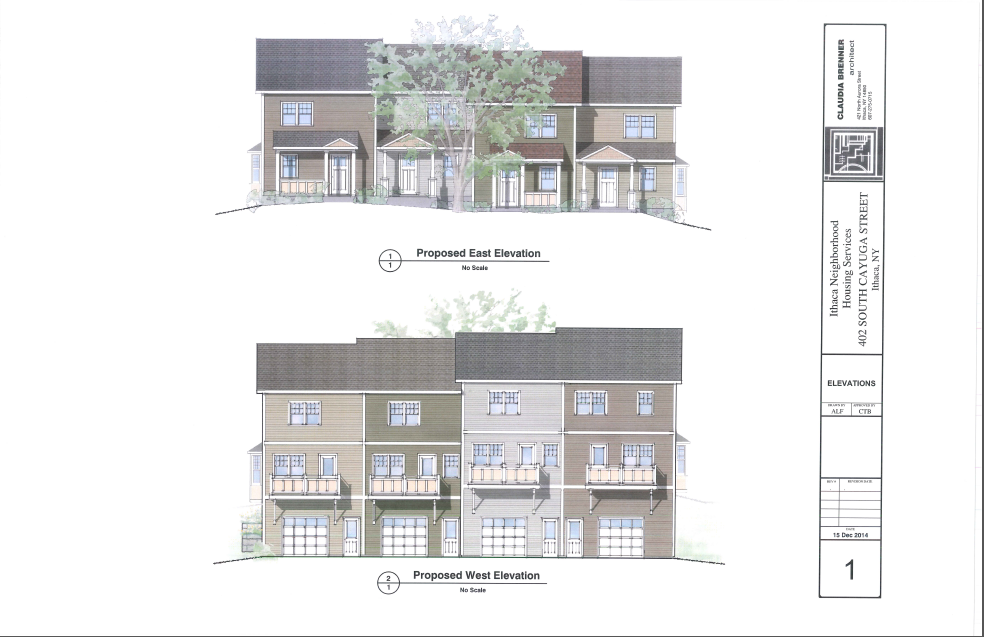
5. The Ithaca Urban Renewal Agency is in a bit of a dilemma. INHS’s 402 South Cayuga project, which has 4 units of affordable owner-occupied housing, is stalled. The construction costs are rapidly rising out of the range of feasibility. The only way it moves forward is if it’s a rental project, which is easier to finance.

402_s_cayuga_st_boggsfernandez

Ostensibly, the IURA would like owner-occupied housing. And a rival proposal has been offered by local architect Zac Boggs and his partner, former Planning Board member Isabel Fernández. It would offer four rentals for 2 to 5 years, and then go up for sale – in the $180-$230k range, which is somewhat more than the $110-$130k range typically offered by INHS. So what do you do? Sacrifice some affordability for some home ownership, or vice-versa? The IURA needs to figure that out. Additional renders and cover letter here.

hilton_canopy_v9_1

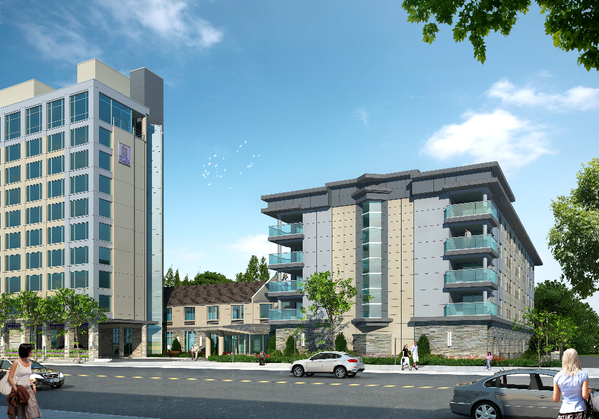
6. I think this is the ninth iteration of the Canopy hotel; quite possibly the most version of a single project I have on file. What’s changed since last time? Well, the inset panels in the northwest wall are back. Some cast stone was added to the base,  the second floor rood deck was tweaked, a cornice element was added to the mechanical screen, and the trellis and driveway pavers were revised. It looks like an improvement, and hopefully one that Baywood Hotels can bring to reality after being stuck in finance limbo for so long. Additional imagery here, cover letter from local architectural consultant Catherine de Almeida here.

varna_plan

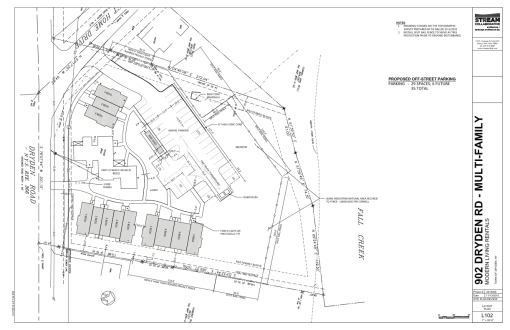
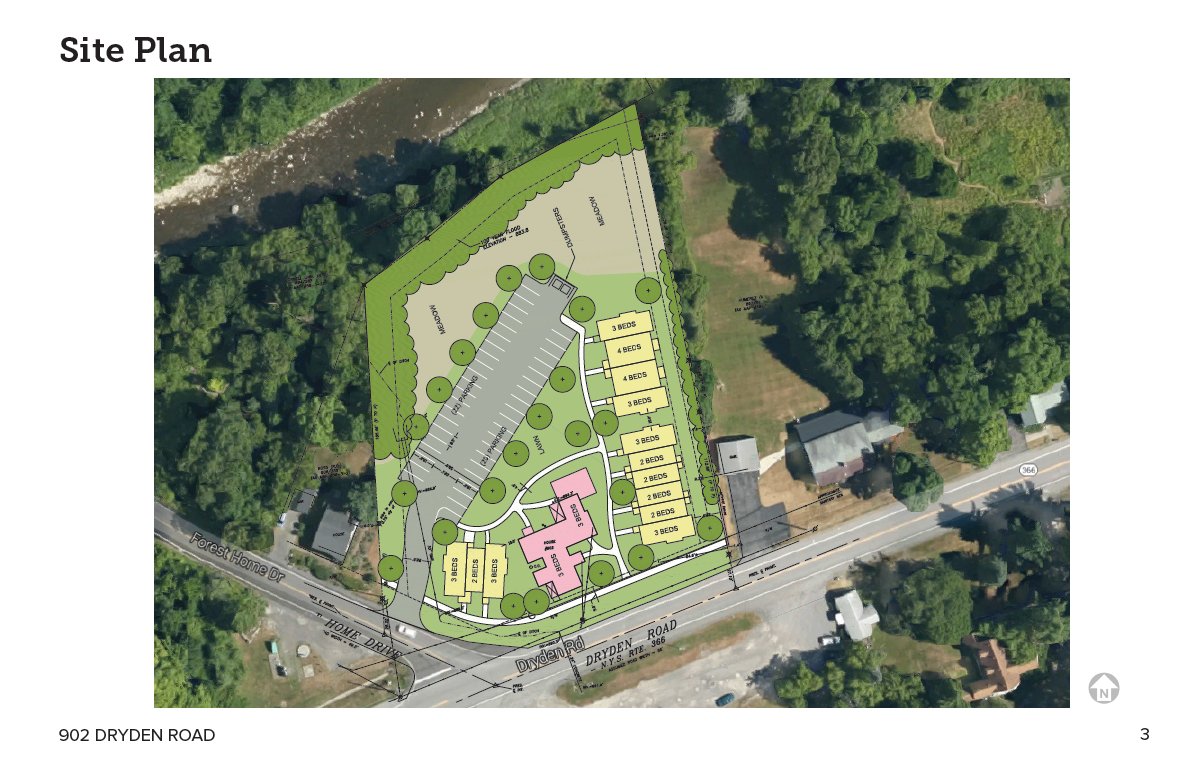
7. The Times’ Michael Nocella ran a really nice piece this week looking at the past, present and future of development in Varna. According to the article, Modern Living Rentals (my sympathies to Charlie O’Connor and Todd Fox, since all of their projects seem to be wrapped up in one debate or another) needs a unanimous vote of approval for the 8-unit, 26-bed addition to 902 Dryden Road to be able to move forward (a 6-bed duplex already exists on the property). In Dryden, the five-member town board does the vote, and the current Dryden town supervisor helped close the sale of the parcel to MLR, so he must recuse himself. Shooting it down at this point, after the project’s cut its size by 40% from 18,000 SF to 11,000 SF, would be very unfortunate, and create an uncomfortable disconnect between the Varna Master Plan designed with community input, and what the board thinks Varna should have.

5_Freese_2013

As mentioned in the article, the northeast corner of Rt. 366 and Freese Road is one of those parcels where the town and Varna residents think development should happen, but really isn’t feasible. I remember when Todd Fox shared his proposal (STREAM Collaborative’s drawing above) with the town for that corner, and the reception was very positive, much more so than the owner’s earlier plan for 20 modular townhomes. Then not long after, everything ground to a halt. MLR decided not to buy the parcel after it turned out the land was incredibly unstable (there used to be a huge pile of material on the site, dubbed “Mount Varna”; the story of which gets written about extensively on the Living in Dryden blog, since Simon St. Laurent and the owners had quite the feud going). The chances of anything but grass growing on that corner is pretty low.

So, with the former “Mount Varna” land in mind, a master plan is not an exact thing; if it shows for three sets of five townhouses on a parcel, that’s not what may necessarily may happen. It just indicates the kind of density and scale of development the plan deems appropriate. 902 Dryden isn’t drawn on the master plan, but the plan welcomes the idea of townhouses on Forest Home Drive, which 902 abuts. So a vote in favor of the 8 new townhouses is, indirectly, a vote of support in the Varna Master Plan.

20151108_154139

8. The town of Ithaca’s Planning Committee will be looking into writing up and establishing a moratorium on all 2-unit residential buildings at its meeting next week. Doesn’t specify location, or rental vs. owner-occupied; just a ban on buildings with two units.

On the one hand, this is probably an attempt to curb student housing being built near IC; the town’s Planning Committee chair is someone with a long history of fighting development, and is seeking greater input on the Planning Board’s discussions. Students and student-amenable housing are just his favorite topics as of late. But the agenda doesn’t specify the type of unit or location, and that is very concerning. From a number of reasons, a broad-brush moratorium, without regard to neighborhood or owner occupancy, doesn’t seem like a good idea.

1) If the goal is to limit student housing, only a small geographic subset of the town is really necessary. IC students, which seem the primary cause of concern, congregate only in the neighborhood adjacent to campus.
2) The moratorium could harm affordable home-ownership. In a number of cases, one unit is occupied by the owner, and the other is rented out as a source of income.
3) Limiting new supply keeps housing costs high and pressures them to rise higher, since demand will not be altered by the moratorium.
4) The town only permits a small number of units each year. In 2014, it was 10 single-family and 2 2-unit properties (so, 14 units total). In 2013, it was 25 single-family, 10 2-unit. The preliminary 2015 numbers are 21 single-family, and 3 2-unit. There were no permits for structures with 3 units or more.

I asked Ithaca town planner Dan Tasman, and while his email notes that it’s targeted at student rentals, it doesn’t assuage my concerns of being too broad of an execution.

“The Town’s zoning code allows accessory apartments in some zones.  The intent is to let a resident have a close family member or friend live with them, or a tenant to help pay the mortgage, in a space that’s more private.  Basically, an in-law apartment.  However, a few builders are taking advantage of the privilege.  They’ll build a house with an accessory apartment, and rent out both units, with student tenants in mind.

There’s also concern about a growing number of “student specials” — very utilitarian duplexes, purpose-built for student rental.  There’s quite a few of them on Pennsylvania Avenue and Kendall Avenue, near Ithaca College.  Their design and siting can often seem institutional, and out of place with the neighborhood’s residential character.”

I’m not a proponent of moratoriums at all, but I’m hopeful this proposal isn’t as broad as it looks. If the net is cast too wide, this is going to do a lot more harm than good.


News Tidbits 2/6/16: Good Ideas and Bad Ideas

6 02 2016

maplewood_site_plan_concept
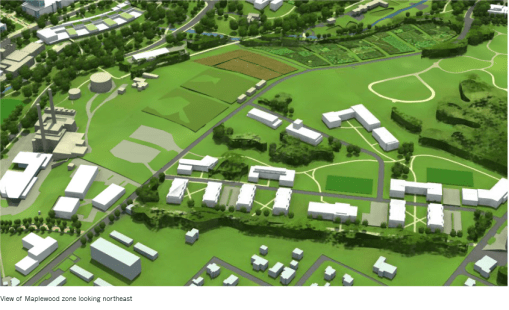
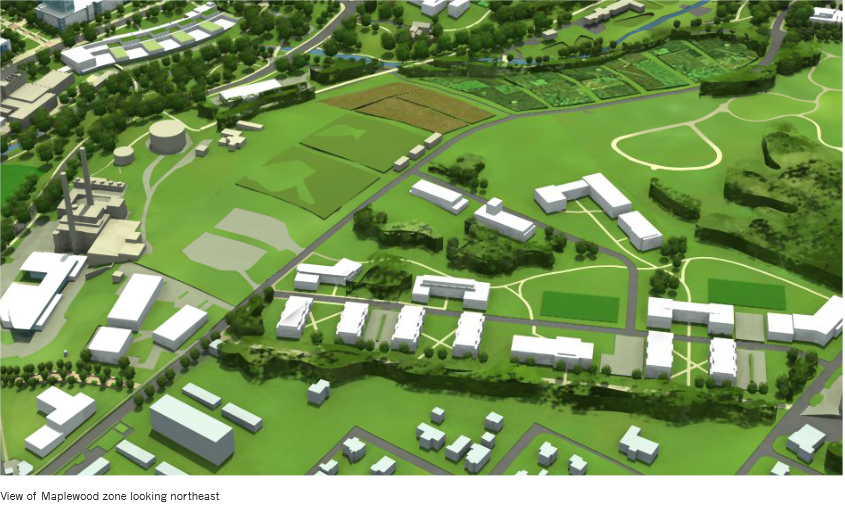
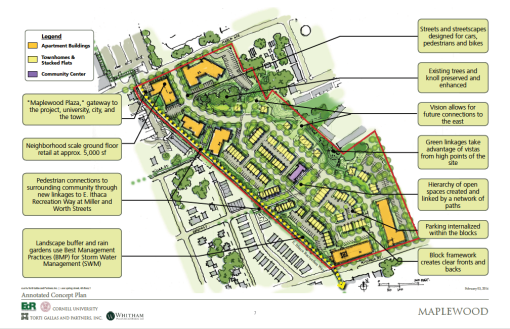
1. Let’s start with the big news this week, Cornell’s long-incubating plans to redevelop Maplewood Park. Official write-up on the Voice here. Personally, looking at the viewer stats, I’m a little disappointed that this has gotten as little attention as it has, since it’s a very large, very important project. But I suppose it’s a double-edged sword, because invariably, when a project does get a lot of attention, it’s because it’s a huge controversy (State Street Triangle, Black Oak wind farm, 210 Hancock, and so on).

There’s a lot to like about the plan (found here on the town’s website). Dense, walkable, a little mixed-use (more office or retail would be nice, but given that it’s tax exempt space, the more space there is the more controversial this project would likely be). Buildings aren’t too likely to cause controversy, since they’re 4 floors at most and they’ll be designed to blend in (“echo the surrounding neighborhood with the use of contemporary features”, per the narrative). Most of the comments on the Voice article describe Cornell as the great Satan, but one reader did express desire for the bigger, taller buildings to be central to the parcel, with townhouses on the outside. As a relatively untrained observer, it would seem that would be best from the perspective of trying to minimize appearance as much as possible, but it would also encourage vehicular traffic towards the center of the parcel, and negatively impact its pedestrian orientation. I haven’t seen any reactions from local planners, but I am curious what their first impressions are.

When writing up Tuesday’s article, my thought was that this was “Phase I”, Ithaca East/Maple Hill was “Phase II”, and East Hill Plaza/East Hill Village was “Phase III” with a 2019 or later start; but the rumor mill is circulating that work on the first parts of East Hill Village may be concurrent with Maplewood Park. We’ll see what arises in the coming months.

304_hector_inhs

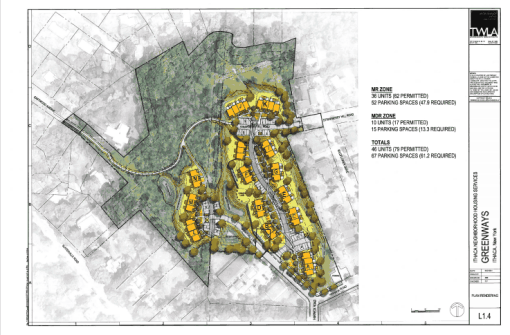
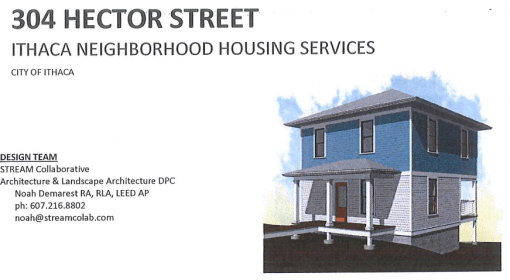
2. When those units come online in 2018, it’ll be a big step towards reducing the deep housing deficit. But in the meanwhile, the housing market will be uncomfortably tight. Which is why it’s good to see some pooled city/county/Cornell money being disbursed for affordable owner-occupied housing. The Community Housing Development Fund proposes that the city give $80,000 towards Habitat for Humanity‘s “Breaking Ground” duplex at 101-107 Morris Avenue in Northside (208/201 Third Street), and $85,000 to INHS for the seven moderate-income owner-occupied townhouses at 210 Hancock, and an affordable 1368 SF single-family home at 304 Hector Street on West Hill. Cornell will give $235,000 towards the townhouses and Hector Street home, but $100,000 of that is a re-allocation of funds from the cancelled Greenways project. The county is giving $100,000 towards six rental units at 210 Hancock.

Claudia Brenner has designed most of INHS’s homes in recent years, but this time around it looks like Noah Demarest of  STREAM Collaborative penned the home design. This is a revision of the previous render, if memory serves correctly; INHS had wanted to build the home last year, but construction costs as high as they are, the non-profit held off.

biggs_2

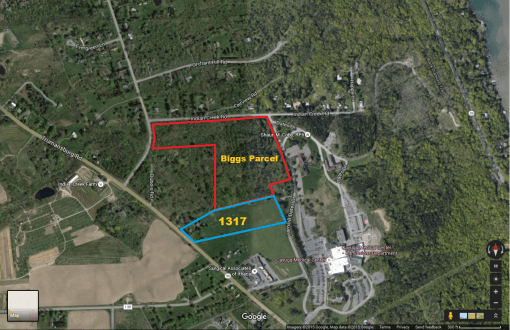
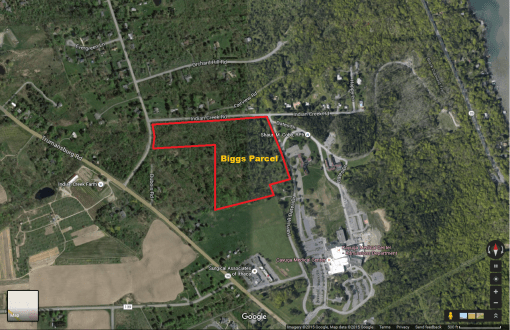
3. In other news, the county’s Government Operations Committee was to make a decision on the Biggs Parcel this week, but decided not to. It’s set to the return to the county’s agenda at the meeting on March 2nd. The ICNA has submitted a purchase offer (sum undisclosed) for the 25.5 acre parcel. The offer from Roy Luft to combine the parcel’s cluster zoning rights to build senior housing on his property at 1317 Trumansburg Road still stands, as far as I’m aware. Update – From the ICNA’s Linda Grace-Kobas, the Luft proposal has been dropped due to “size and complexity”.

Pg-3-Rendering

ag_quad_2

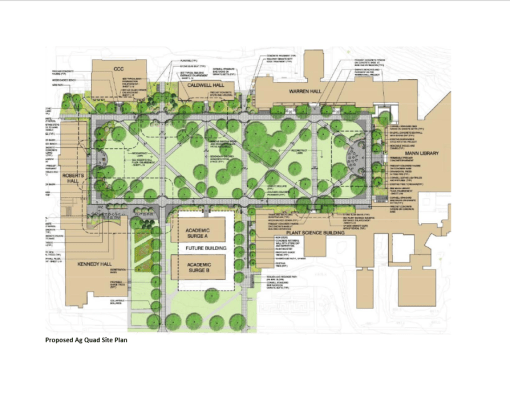
4. Courtesy of the city, some more details on Cornell’s Ag Quad renovation. Site Plan Review (SPR) application here, Full Environmental Assessment Form (FEAF) here, project specs here, drawings here. Formally, the project is referred to as the “Cornell Ag Quad Utility & Landscape Project”, since the project also involved major utility upgrades and repairs under the quad. The work planned calls for new steam lines, a telecom duct bank, new sanitary piping and water lines underground, and above ground there will be new paths, light posts, pedestrian plazas with stone benches, fire apparatus access path, blue light phones and a loosening of the soil compacted by other construction projects (such as the staging area for Warren Hall while it was under renovation). Most trees will be preserved, except for a few that stand where the new utilities and fire lane will go.

The project cost is $3 million on the SPR, with a rehabilitation period from April 2016 to July 2017, divided into two phases. No new permanent jobs, but about 25 construction jobs will be created. MKW + Associates LLC of New Jersey is serving as the consulting landscape architect.

On a side note, at least we can be fairly sure now that Cornell does plan on taking down the surge academic buildings at some point for a future permanent building.

5. Ithaca wants to build bridges. Physically, anyway. The city will hold a public information meeting next week 2 PM Wednesday on replacing the deteriorated single-lane Brindley Street bridge on the west side of the city. The bridge, which dates from 1938 and was last modified in 1952, is functionally obsolete and in dire need of rehabilitation.

Currently, the city is weighing two plans – a $2.43 million replacement of the old one-lane steel bridge with a two-lane bridge with sidewalks and shoulders for walkers and bikers, and a $2.59 million plan that extends two-lane Taughannock Boulevard through a parking lot, over a wider span and intersecting with Taber Street, leaving Brindley a single-lane bridge. While more expensive, this option diverts most traffic away from the awkward six-way intersection Brindley has with West Seneca and West State Streets. The nitty-gritty can be found in the design report here. It would also be of significant benefit to the Cherry Street industrial park and future waterfront development by improving access to the area.

Whichever plan moves forward will be decided by April, with construction from May-November 2017. Most of the project costs will be covered with federal funds, with some state funds and municipal bonds covering the balance (80/15/5% respectively).

902_dryden_v3
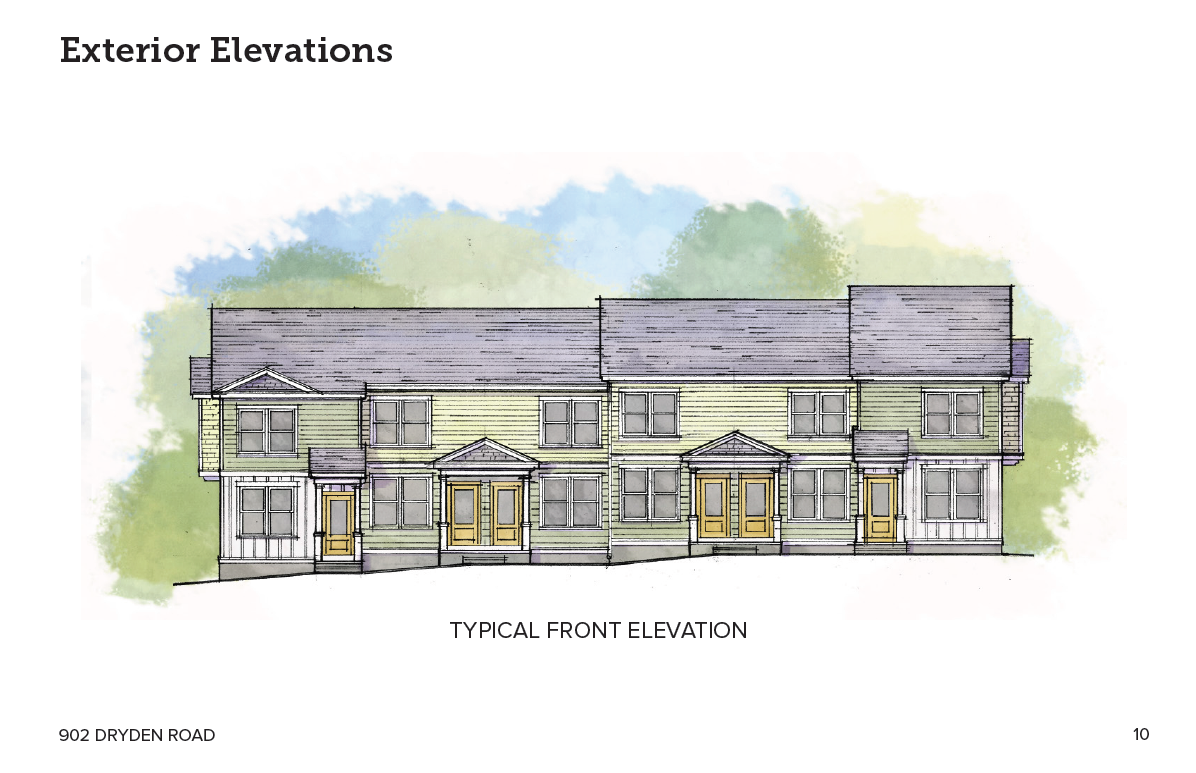
6. Some progress on 902 Dryden, perhaps. From the town of Dryden Town Board minutes, The number of new units is down, from 12 to 8, and only 26 new bedrooms from the previous 38. The overall square footage is also down, from 18,000 to 11,000 SF, with 26 parking spaces, 1 per bed. So that render above from December is outdated (although the color scheme is nice and bright, hopefully that carried over), there are two units on the right and six on the left, as well as the existing duplex.

As a result of the smaller project, one of the casualties is the net-zero aspect, because the initial cost for installing the solar panels outweighs the decreased revenue. Heat will be all-electric with the opportunity to install solar at a later date, if it pencils out. As for the opposition, it definitely sounds more muted in the town minutes, one neighbor seems intent on forcing enough site studies to break the bank, but overall the commentary reads muted to positive. The minutes don’t indicate if the public meeting is finally closed and if a vote to approve the project can be taken later this month.

7. Looks like Josh Brokaw at the Ithaca Times was able to get the Maguires to open up about their plans for Caprenter Business Park. In a phone call with Brokaw, Phil Maguire confirmed plans for a $12 million, 40,000 SF Ford/Lincoln/Nissan dealership, which will then allow them to proceed with renovations of their properties down by Wegmans. While they estimate about 70 jobs would be created and that it will be designed to be “inlet-worthy”, the problem remains that a car dealership flies in the face of the mixed-use urban environment that the city had been envisioning for the waterfront. One valid point does get raised though – side-by-side NYSEG power lines overhead would have to be buried for many building projects on the Circle (but not for parking lots), which gives any developer an extra several hundred thousand dollar expense in the development process.

Sketch plans are expected to be shown at the March Planning Board meeting later this month, about the same time the Common Council is expected to adopt the temporary PUD zoning that would give them say over any projects proposed in the waterfront area. Expect this dealership proposal to be a very heated and occasionally uncomfortable debate.

cherry_2

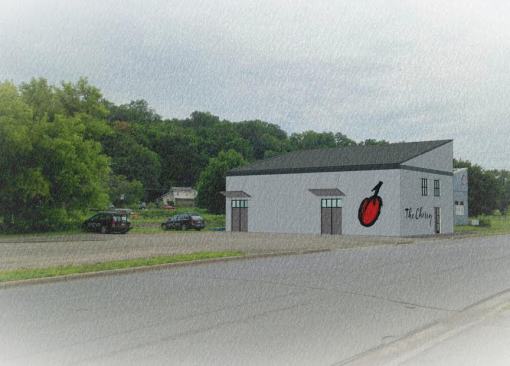
8. What’s on the agenda for next week? Not a whole lot new. The city’s projects memo doesn’t have any new projects, unless you count Island Fitness redoing their parking lot. There are a few more renders for the Cherry Artspace, as well as some project details – $200,000 construction cost, 1,944 SF building by Claudia Brenner with seating for up to 164 on the lower level, 2 jobs created, May – October 2016 buildout.

The Ithaca Landmarks Preservation Commission has some minor old business to attend to, and what likes some discussion over the recently-purchased home at 410 North Cayuga will be introduced (chances are, it’s something like window or roof replacement, maybe an add-on room). Discussion is planned for 311 College Avenue, the old firehouse home of the Nines, but this is also likely to be minor.

The town of Lansing’s planning board also has a meeting next week, but the only item of discussion is the Mirabito petroleum storage facility on Town Barn Road.


News Tidbits 11/30/15: It’s like the 1990s All Over Again

30 11 2015

maplewood

1. I want to start this oddly-timed roundup with a big thanks to the readers and commenters who encouraged me to write last Monday’s op-ed. If it wasn’t for you guys, I would have held off. I’m not looking to make waves, but there is a significant, valid concern over Cornell’s housing shortage, and it merited a rebuke.

I also want to thank you guys because the emails I received (about 10 separate readers) were pretty much offloading on how much they hate Cornell, which completely missed the point the article. Worse still, one went into a rant on not only students, but on how much they hate racial minorities, and a second went off into a density rant (followed by stomach-churning quote “if nurses, police and teachers can’t afford to live here, they shouldn’t be living here”). If I thought they were representative of Ithaca for even a moment, I’d hang up my keyboard. But I know that there are good people like the readers here, who are more thoughtful, knowledgeable and arguably less crazy.

So, with all that noted, here’s the actual news – someone familiar with the Cornell Campus Planning Committee wrote in to say that the Maplewood replacement is expected to have 600-700 beds, and that the committee is still hopeful for an August 2017 opening, which would mean it would have to presented fairly soon (that would still leave a year-long gap in housing, but better late than never). They also acknowledged that “Cornell didn’t do such a good job” with planning for a possible housing shortage, which although not an official statement, seems as good of a justification for Monday’s piece as any.

gways_rev_1

2. Then there was the other piece that dovetailed the affordable housing setbacks last week – Greenways, INHS’s 46-unit affordable owner-occupied townhouse project in the East Ithaca neighborhood, is being abandoned. A part two article with some hard data is being planned. There’s no real silver lining here. It’s Cornell land and the university could potentially revive it, but there’s no indication that will ever happen.

It’s just been a crappy week for housing affordability in Ithaca.

3. Over in Collegetown, several rental homes are being offloaded at once. The properties, 120-134 Linden Avenue, consist of six student apartment houses, with a listed price of $6.5 million. A check of the county website indicates the properties are assessed at $2.75 million, and a cross-check of the Collegetown Form Zoning shows most of these properties are CR-1 (the southern two homes) and CR-3 (the four northernmost homes). CR-1 is the least dense zoning, and CR-3 is a little denser, but mostly maxed out by the existing properties. In short, the code suggests significant redevelopment is unlikely, so the price seems to be based off of potential rental income.

The Halkiopoulos family currently owns the properties, which make up a sizable portion of their multi-million dollar Collegetown portfolio (they’re one of the medium-sized landlords). The Halkiopouloses’ M.O. has been to buy single-family homes and convert the property to student rentals, rather than building their own apartment buildings. It seems likely that the high price indicates they’ll go to one of the other big landlords, or to someone with really deep pockets looking to break into the Collegetown market.

4. A couple folks might be concerned this week after Jason Tillberg’s latest piece about Ithaca’s deflating economy. But there’s a caution light before this data is taken to be hard truth. Frankly, the BLS estimates suck.

A lot.

The numbers are subject to big revisions. Case in point, here are the pre-revision and post-revision 2013 and 2014 data:

ith_initial_1314 ith_revised_1314

It’s not uncommon for the numbers to be changed by thousands, because it’s based on a random sampling of non-government multi-person employers. 500,000 are sampled over the whole country each month, but only about 55 of the 3,300 or so orgs in Tompkins and Cortland Counties are included in the Ithaca metro sample (Cortland’s jobs numbers are included with Ithaca’s because jobs are measured by Combined Statistical Area [CSAs]. However, Ithaca is considered a separate metropolitan area [MSA] from the Cortland micropolitan area [µSA], so population stats are always distinct). The overall trend of the selected orgs is then applied to a base number. For places like Ithaca where the local economy is dominated by a few employers, random sampling isn’t the best approach because it misses crucial components of the local economic picture. But the BLS sticks with its current approach for consistency’s sake across regions and time periods.

During the first quarter of each year, the BLS conducts a full analysis and re-analysis of data going back the last three years. The general rule is, the data from three years ago is very good, the data from two years ago is okay, and the data from the previous year is…very, very preliminary. Tompkins County hasn’t had any large layoffs reported the state’s WARN database this year, and the only major retail closings recently have been A.C. Moore and Tim Horton’s.

In short, don’t let it keep you up at night, and wait until March before passing judgement on the 2015 economy.

902_dryden_v2_1

902_dryden_3
5. Over in Dryden town, the townhouse project proposed by local firm Modern Living Rentals (MLR) at 902 Dryden Road in Varna is a little smaller – 13 units and 40 bedrooms, versus the previous 15 units and 42 bedrooms; these numbers include the duplex with 6 bedrooms that currently exists on the site. Meanwhile, the procession of hate continued at the latest town meeting. The arguments are the same as before. To the earlier, larger proposal, some town councilpersons had given a tentative positive response, while at least one was opposed to the original proposal (in Dryden, the Town Board votes on projects rather than the Planning Board). MLR hopes to request approval at the town’s December 17th meeting – if approved, the construction period is planned for January-August 2016.

For those interested, the Stormwater Plan (SWPPP) is here, revised Full Environmental Assessment Form (FEAF) here, revised site plan here, project description courtesy of STREAM Collaborative here. No new renders, but presumably it still looks the same in terms of materials and colors.

biggs_1

6. Next up on the suburban tour, the fighting over the Biggs Parcel in the town of Ithaca. The Indian Creek Neighborhood Association (ICNA) presented a plan for the property – and the plan is, maybe we can find a way to force the county to keep it, but if not please don’t sell the land to anyone who will build on it. All the county wants is to sell the land so it pays taxes, and the ICNA plan seems to have failed to really address that point. Tompkins officials countered by saying that they’re not keeping it and that if the ICNA cares about this parcel of land so much, buy it. There was then some back and forth about doing a new assessment to account for the developmentally-prohibitive wetlands on site – in other words, decreasing its current $340,000 assessment, with the exact amount to be determined by the county assessment department. At 25.52 acres, of which some is still developable, the price will likely stay above six figures.

So the county’s doing its new assessment, because all it wants is to sell the land so that someone is paying taxes on it. Meanwhile, the ICNA has taken to venting on their web page, angry that the county still plans to sell, and that they may have to actually buy the land in order to dictate its future use.

327_w_state_demo

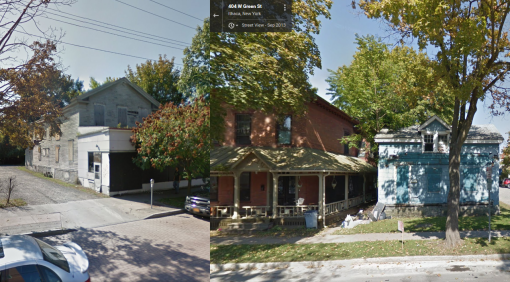
7. To wrap up a thoroughly depressing week, a couple of demolitions by neglect. 327 West State Street and 404 West Green Street will both be demolished by the end of the year, according to the Ithaca Times. Both are older, likely century-old structures, but too far gone to be salvageable. According to county records, the City Health Club, which abuts and owns both properties, purchased 404 West Green in 1987, and 327 West State Street in 1993. The porch on 404 came down sometime in the late 1990s or early 2000s, and the only change since then was painting the plywood on the boarded-up door and windows. County photos suggest 327 was in bad shape but possibly occupied up until 2000 or so, and steadily grew worse from there. Offhand, the procedure is to bill the owner for the demo. 404 West Green is B-2d zoning, 327 West State is CBD-60. But don’t expect any redevelopment anytime soon.

Hmmm…bad economic news, projects being cancelled, decay and demolitions in the city and fighting over suburban projects. For Ithaca and Tompkins County, it’s like the 1990s recession all over again.


News Tidbits 10/31/15: The word of the week is “No”

31 10 2015

hotel_ithaca_final_1

1.  We’ll start off with about the only affirmative news this week, that of the city of Ithaca Planning and Development Board Meeting last Tuesday. The tweaks to the now 79-room Holiday Inn proposal at 371 Elmira Road were approved, and the project expects to have building permits in hand next week, according to the Times‘ Josh Brokaw. When I spoke to the development company’s president, he said “the project is already underway”, but it seems he meant demolition permits for the existing buildings, rather than construction permits. Expect a construction update sometime next month.

Also approved was the new north wing for the Hotel Ithaca at 222 South Cayuga Street in downtown. A tweak of the facade, glazing and balconies was enough to placate the board into approving the revisions for the $9.5 million, 90-room project, which replaces a two-story wing dating from 1972. The north wing will have the potential for another three floors, and on the other two-story wing, the long-awaited Conference Center may come to be if financing plays in developer Hart Hotels’ favor. The Buffalo-based company hopes to start construction early next year and have the new wing ready for its first guests in Fall 2016.

416_e_state_v2_1

Meanwhile, in the strike column is the proposed jazz bar at 416 East State Street just east of downtown. According to the Cornell Daily Sun, a decision is being deferred until updated, more thorough information is provided regarding sound attenuation of bar patrons gathering outside the building while getting their fresh air or nicotine fix. Neighbors have mounted substantial opposition to the project for being out of character and for parking concerns, but the planning board has played neutral, receptive but cautious. The project is a legal use and will not change the square footage of the one-story warehouse/office building, but will need zoning variances.

2. The county had discussion, but made no judgements on the Biggs Parcel next to Cayuga Medical Center. The county is mulling plans to sell the parcel on the open market after years-long and heavily-fought plans to sell it to affordable housing developers NRP and BHTC fell through on the discovery of extensive wetlands on-site in 2014. As written about in the Voice this week, the county wants the 25.52 acres of land (previously valued at $340k) back on the tax rolls, while the neighbors and some other West Hill residents, under the umbrella of the Indian Creek Neighborhood Association, want the county to hold it as “public woodland”. The county has countered (time and again) the land has no use for the public.

Depending on which account one chooses to follow (ICNA’s or the county’s, the two vary on the details), the county’s Government Operations Committee is giving the neighbors one month to come up with a viable alternative for the land. The ICNA wanted an RFP for land preservation, but the county’s planning commissioner, Ed Marx, says the county doesn’t have time to write-up another RFP. They also pushed for subdivision of the land, which the planning department is also discouraging. The county has wanted the ICNA, Cayuga Medical or BHTC to buy the land, but no one’s made offers.

To this semi-trained eye, the only “happy” solution would be for the ICNA or someone sharing its interests to buy the property for the re-assessed value and arrange to donate it to an organization like the Finger Lakes Land Trust. The county gets their tax money, and the neighbors get to keep the land undeveloped. Outside of that option though, either the neighbors are going to feel shorted, or the county’s tax watchdogs will be up in arms.

EDIT: And now I’ve been informed that the land would be tax-exempt if given to the land trust. So there’s no happy solution unless a private landowner buys it agrees to not develop it. Which, given the property tax, is not very likely.

Farm Pond Site RES'D & LOT s 010414

3. Farm Pond Circle is still for sale. Only now, it’s on the market for $125,000, $30,000 less than the original listing. As previously written here back in March:

“The second phase of Lansing’s 21-lot Farm Pond Circle development is up for sale. Jack Jensen, the original developer, passed away last fall. Of the ten lots in phase two, four have already been reserved; there are also two lots left in phase one. The second phase is being offered for $155,000.

The Farm Pond Circle development is fairly stringent. Current deed restrictions limit the size of each housing unit to 2600 sq ft, vinyl or aluminum siding isn’t allowed, and only very specific subsections of the lots can be developed. Buyers aren’t limited to green energy, but there is a strong push in that direction. Also, at least four of the lots are earmarked for affordable housing (single-family or duplexes, buyers muse make less than 80% of median county income of $53k)). The affordable units, at least two of which have already been built, are being developed in partnership with Jack Jensen’s non-profit, Community Building Works!.”

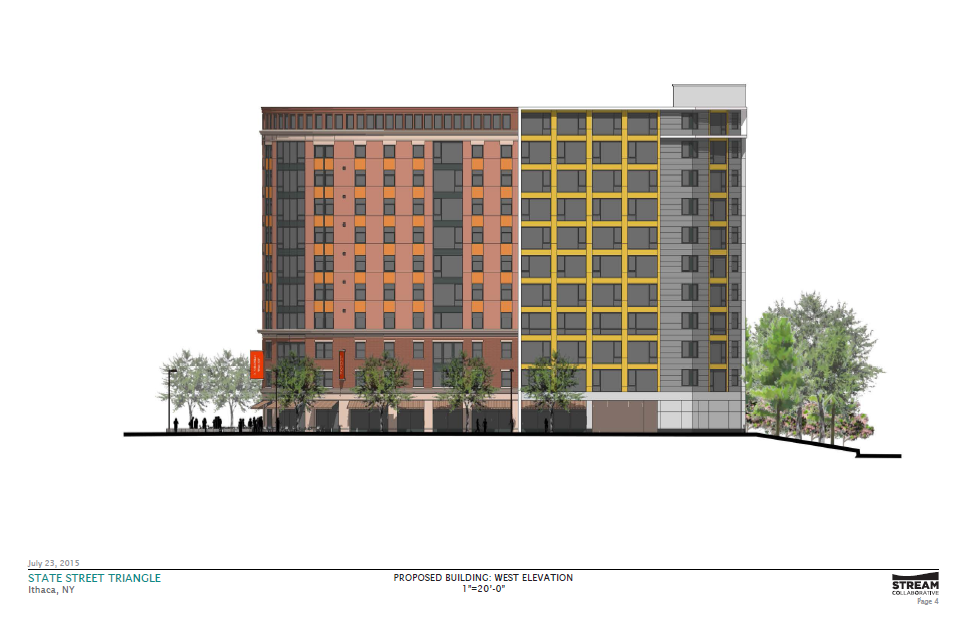
state_st_triangle_v5_1

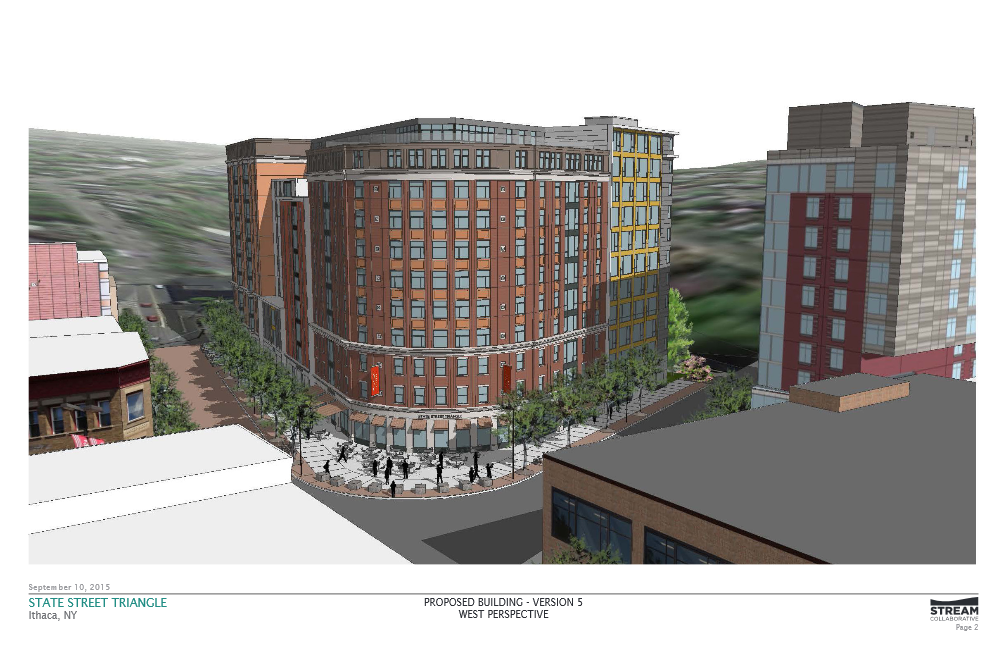
4. Mayor Myrick made some thought-provoking comments (or provocative, depending on your view) in a phone interview with the Times’ Josh Brokaw about State Street Triangle. For one, the inclusionary zoning topic has come up again, something likely to make an appearance in his second term. And for two, calling for a distinctive “pillar” with fewer units, and smaller units sizes to appeal to a wider, non-student part of the market. As previously stated, the 11-story height isn’t the issue.

I wrote about inclusionary zoning as part of an interview with Community Planner Lynn Truame in the Voice – it can be done one of two ways, either saying a builder/developer can’t build anything without having units or paying into a fund, or by giving them an extra incentive, like reduced permit fees, being able to build one floor higher or a reduction in parking requirements if they include affordable housing. Most opt for the latter approach.

The pros are an integration of affordable units into market-rate developments and a supply of affordable housing. The cons are that, if handled the wrong way, it can stop all development, affordable and market-rate, and on the other end of the spectrum, if the benefits are too generous than it can reduce the supply the affordable housing by tearing down older, lower-cost buildings in favor of new higher-cost ones with a small number of affordable units. In sum, nothing in an inclusive zoning ordinance can be taken lightly.

An inclusionary zoning program requires the support of neighboring communities so that developers don’t just skip to the next town over to escape the burden, and the program must be designed to encourage developers to build while ensuring there’s plenty of affordable units on the market. For example, here’s Burlington, Vermont’s ordinance:

“The program applies to all new market-rate developments of 5 or more homes and to any converted non-residential structures that result in at least 10 homes.  The affordable housing set aside is 15 to 25% of the units, depending on the average price of the market-rate homes – with the higher percentage placed on the most expensive developments.  The ordinance does not allow fee in-lieu payments or land donations, but will allow developers to provide the affordable housing off-site at 125% of the on-site obligation.  The ordinance provides a range of incentives including fee waivers and a 15-25% density and lot coverage bonus. Affordable homes are targeted to households earning 75% or less area median income (AMI) and rented at 65% or less AMI.  Developers can sale or rent the homes for more as long as the average of affordable homes sold or rented are at or below the target household income.  Affordable homes are price controlled for 99 years.

Burlington partners with a nonprofit – the Champlain Housing Trust – in the administration of its program and is able to minimize in-house administrative staff time for the program (committing only 10% of one full time employee). However, more funds are needed to support the monitoring and enforcement of affordable homes.”

So if this were Ithaca for the sake of equivalent example, let’s say a developer downtown is thinking of a 40-unit market-rate non-luxury apartment building, that maxes out the lot area and height of a currently-existing (hypothetical) zone. They would be able to build 46 units/15% larger as a bonus, but 6 units would have to be affordable housing. They could also build 46 market-rate units on-site, and build 8 affordable units off-site at a location okayed by the city.

The affordable units would be targeted at individuals making 65% or less of AMI, which in Tompkins is 65% of about $53k, or $34,500/year. Some units could be more or less affordable, as long as they average to 65% AMI. It stays that way for 99 years. The units would be managed by an organization like INHS.

Or, the developer could build a hotel, office, or non-residential building without giving up money or space for affordable housing, but they also get no zoning bonus. Burlington’s law isn’t designed to be a barrier for development, it’s designed to be an incentive to include affordable housing in new projects. However, there are definitely opponents to inclusionary zoning even among affordable housing advocates, who say that a revised and expanded Section 8 program would be more effective.

Note that Burlington’s law is just one example. No one ordinance fits all municipalities, and each community has its own aspects to address  – in Ithaca’s case, that means tailoring the inclusionary zoning for each neighborhood, determining what size and types of projects have to pay into the fund (because Cornell will probably file a lawsuit if it affects their projects), establishing affordability guidelines that encompass both poor and middle-income families, and whether fees can be paid into a housing fund in lieu of housing. What works in Downtown probably won’t work in Belle Sherman, and what works in Fall Creek wouldn’t be effective in Collegetown. It’s going to be an intensive design process.

So, back to the original question – is Campus Advantage willing to play? It’s not one that anyone can answer just yet. The Austin-based company is still determining their next move. The Times, as well as commenters on this blog, have raised the possibility that this might be the mayor playing politics to stave off his write-in opponent and the anti-development crowd that supports many of the independent candidacies. But, barring some left-field shocker on Tuesday, expect Myrick to be sharing more of his and his staff’s zoning ideas in the next couple years.

20151011_145007

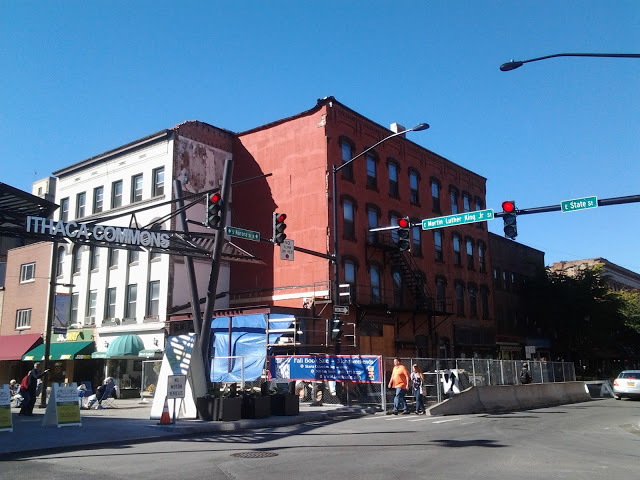
5. Speaking of zoning, the city is mulling over a zoning tweak to make buildings on the Commons have mandatory active street-level uses. A copy of the memo is here, Full Environmental Assessment Form (FEAF) here, county memo here,  copy of code revision here. It seems like an easy sell from both the angle of developers and the city, but the steps to codify it are only now underway.

It will be similar to inner Collegetown’s MU-2 zoning. Permitted are stores, restaurants, banks, entertainment venues, public assembly areas, libraries, fire stations, and anything approved by the Planning Board on a case-by-case basis. The last part comes into play because the Finger Lakes School of Massage proposes a student-staffed massage parlor on the first floor of the Rothschild’s Building. Not included – schools, certain office lobbies and apartment/condo lobbies. But most building owners moved to active-use on the Commons a long time ago. The public hearing will be November 19th.

902_dryden_1

902_dryden_3

6. Looks like there are still some hang ups with the Storage Squad and 902 Dryden projects out in Dryden, according to the town’s latest meeting. For the Storage Squad project, it has to do with their concerns with a stream that showed up on a DEC map in 1940 but hasn’t appeared since (they have to prove doesn’t exist, and proving it requires DEC acknowledgement). The business owners were also concerned about spending $30k on a Stormwater Pollution Protection Plan, with the possibility that the town may have them redo it at no small price.

Now, the Dryden town board is feeling a little heat right now because there have been accusations the town isn’t doing enough to help small businesses, allegations the “rainy day” fund’s depleted, and there’s a 13% tax levy increase planned, none of which sit well with voters. Plus. lest anyone forget, elections are coming up. So it’s perhaps with those things in mind that the town board is making an effort to try and help the owners of the Storage Squad before they throw in the towel. They invited them to the town’s meeting on the 29th to discuss the SWPPP further, and we’ll find out if it was fruitful.

Also, the 13-unit, 36-bedroom (15 units/42 bedrooms if you count the existing duplex) 902 Dryden project was berated by its potential neighbors once again. There are a couple comments attacking the potential students that would live there, but most seem to be against the location and concerns about flooding. Then you have the guy who called it a cancer.

One speaker says that residential development is a tax burden on the town, but really that depends on the type of housing – infill lots and denser acreage can be cost-efficient. New, low-density “greenfield” housing requires more pipes, power lines, new roads…infill has much of that already in place, and less acreage per unit can yield greater cost efficiencies. Plus, the commercial development the speaker touts also requires police and fire, and indirectly schools for its employees’ families. Yet, he didn’t offer a single word of support for the Storage Squad proposal.

Then the talk turns to taxes, and a guy references how we took land from Native Americans, Socialism will cause our nation’s collapse, and how Muslims are trying to institute Sharia Law. Now, how does one type those town board minutes and keep a straight face?

7. One last no for the week, this one for the Phi Mu sorority from Cornell. I still have a soft spot for the histories and houses of Greek Letter Organizations (GLOs), although I’ve happily aged out of college life.

The sorority (technically a fraternity), which arrived to Cornell’s campus last year, had intended to buy the $725,000 house at 520 Wyckoff Road, but the village board shot down the change of use required. Noise, traffic and “detriment of character” were cited as reasons not to let the ca. 1924, 3,473 SF home be used for group housing.

The Ithaca Journals’ Nick Reynolds offers this passage in his write-up:

Following the decision, the board broke protocol and began a philosophical dialogue between its members and the public.

Board member Sean Cunningham suggested the village has become anti-change and anti-sorority, and was at risk of “burying their heads their heads in the sand” to the point where the village wouldn’t be able to maintain its quality of life from an unwillingness to change.

Jeff Sauer, of 107 Overlook Road, offered the residents’ stance:

“The issues brought up tonight were the right issues,” Sauer said. “It’s not that we’re opposed to change; we’re for managing change.”

Historically, the neighborhood of Cornell Heights, split between the city and the village, has been fiercely opposed to any change of uses, let alone new buildings. Cornell sued residents in the 1980s, and won, over a similar issue. The university had planned to move its 15-member “Modern Indonesia” research program and literature collection from 102 West Avenue to a house on Fall Creek Drive, but neighbors convinced the city of Ithaca that it would greatly damage the neighborhood’s character. The state supreme court disagreed.

Cornell Heights and Cayuga Heights have been used as a textbook study in Blake Gumprecht – The former, for which this blog is named after, was founded as an elite faculty and businessmans’ enclave. But after the Alpha Zeta fraternity was donated a house in 1906 (for which the developer threatened legal action to no avail), and Cornell built the all-ladies Risley Hall in 1912, the local elite turned their noses and mostly turned tail for Cayuga Heights, selling out to Greek organizations but making deed restrictions in their new community to keep them from moving in. Cayuga Heights refused annexation in Ithaca by 1954 in part because they didn’t wish to attract students, and even prohibited a restaurant from opening for fear it would attract students as well. While the village isn’t as virulent as it once was, the sorority never really stood much of a chance. One long-term problem may be that if the existing GLOs do ever sell their properties, it’ll be to Cornell and Cornell only, where the use will be maintained, but the taxes won’t.

Well ladies, better luck next time around. You could always ask Cornell about those houses on University Avenue.

9. PSA? Sure.

Vote. Local elections matter. Your vote on Tuesday could make the difference for a lot of things –  for another 210 Hancock, waterfront development plans, zoning changes, or if a future downtown project gets an abatement. It will play a role in whether Ithaca, the county and other govs make an effort on affordable housing. Tuesday’s decisions will affect the city and county’s decisions.

Polling sites here, sample ballots here.


News Tidbits 9/5/15: Ithaca the Diva

5 09 2015

cornell_novarr_1

1. John Novarr’s project at 209-215 Dryden Road has been given the green light. The city of Ithaca’s Planning and Development Board approved the $12 million project at their August meeting. With approvals in hand, Novarr is free to start construction as soon as he has his construction loans, which should be no problem given that Cornell’s MBA program has agreed to occupy the whole building (though only about 70% of the space will actually be used at initial completion; the MBA program will fill out the building as their needs require). Conveniently, Novarr won’t have to worry about site demolition and asbestos removal because he cleared the site in May.

The 6-story, 73,000 SF building will begin construction in “four months” per the end-of-August Sun article, or November if the Site Plan Review (SPR) paperwork is still accurate. Completion of the building is anticipated for the second quarter of 2017. ikon.5 of Princeton, New Jersey is the project architect.

When filled out, the building will house 250 employees of the university, and 450 students of the Executive MBA program, who only attend classes in Ithaca during traditionally slow periods of the year (winter break and summer break; during the rest of the year, students attend weekend classes in the town of Palisades in Rockland County). To that effect, the project would go a long way in easing the strongly cyclical consumer traffic that makes it hard to do business in the largely-student neighborhood. Students also stay at the Statler while on campus, and staff and students will walk over from Cornell faculty/staff parking to get to the building.

Last month, the Tompkins County IDA approved a 50-year tax abatement for the project, in the form of a PILOT agreement. With the other option of Cornell buying the property and making it tax-exempt, the county has decided that something is better than nothing.

The project joins a slew of mostly residential projects under construction in the Collegetown neighborhood. 205 Dryden, 327 Eddy and 307 College are all underway, and several smaller projects were recently completed. The new investments total over $36 million, and with the exception of Novarr’s project, all the other projects will be taxed at full value.

902_dryden_2

902_dryden_1

2. Meanwhile, there have some mild hang-ups with another project. The solar-powered townhomes in Dryden are seeing some resistance, mostly from the nearby Cornell Plantations, and from neighbors opposed to rental housing in Varna. The Ithaca Times piece uses this dandy of a line:

“Resident Cheryl Humerez, whose family and in-laws both own homes that neighbor the proposed project, was disgusted by the thought of a rental development, which might attract college students, becoming her neighbor.”

Going beyond the “disgusted” comment, most of the students that would live this far from Cornell’s campus would be graduate and professional students. Undergrads are less likely to have cars and tend to live in the neighborhoods immediately adjacent to Cornell’s core (Collegetown, Cornell Heights and parts of East Hill). Graduate and professional students tend to be like any other 20 or 30-something living on modest wages. The chances of a “keggers on Tuesday” kinda place are virtually nil. Also worth pointing out, Dryden’s town supervisor called Humerez out on that comment, saying she was saddened that renters were being described as a problem.

Cornell Plantations, as represented by Todd Bittner, has more legitimate concerns about litter, the driveway location and stormwater drainage; but glancing at the town minutes, it looks like the “I know we need development, just not in this neighborhood” argument also makes an appearance.

The town board (in Dryden, it seems the town board oversees public hearings of the planning board’s agenda) is taking a more level approach; acknowledging that it’s a decent project, community input is important for good development, and by incorporating mitigation measures to assuage worried neighbors, this has the potential to be a worthy community asset. Expect this project to evolve as we go through the next couple of months.

Also noted in the town minutes are plans for a 78,000 SF storage facility next to NYSEG at 1401 Dryden Road. Plans from a Cornell startup named “Storage Squad” call for “high quality, attractive self-storage” with 400 storage units in the first phase. The project will need site plan review.

402_s_cayuga_st_rev2_1

3. To anyone who’s passed by the vacant lot at 402 South Cayuga Street and wondered when INHS will start those for-sale townhomes: I’ve taken the liberty of checking. INHS director Paul Mazzarella stated in an email that “[t]he project is out to bid for a general contractor. The bids will be due next week. If the numbers are OK, we will start as soon as possible.” So barring any nasty shocks in the bids, the four-unit project (1 3-bedroom, 3 2-bedroom) will start in just a few weeks. As with other INHS projects, the units will be sold to qualified first-time homebuyers with modest incomes (anecdotally, that means the $40k-$50k range…it seems like half the buyers in the past year or so have been teachers in the ICSD).

4. In a rare bit of bad economic news in Ithaca, Ithaca College has announced its intent to slash about 40 staff positions from its workforce. This follows 47 job cuts in academic year 2014-2015, 39 of which were vacancies.

The cuts are part of an effort to bring tuition costs and help the college stabilize enrollment numbers, which have been sliding down lately. No faculty positions will be eliminated as part of the layoffs. IC currently has about 1,070 staff and 730 faculty, about 200 more than they employed a decade ago.

harolds_square_taylor

5. The rumor mill said that a reporter from the New York Times was in town last Friday, and apparently they liked what they saw; the piece in the NYT takes a very positive and gracious approach with Ithaca and its recent urban developments. If you haven’t read it already, the link is here.

[What follows is a spark-notes version of the Voice piece – I’ll update with links after the weekend holiday.]

More importantly are some useful details in the piece – one of which is that we now know the revised mix of uses for the 11-story Harold’s Square project calls for 86 apartments, up from 46 when it was first approved in 2013. The apartment units will be a mix of 1-bedroom and 2-bedrooms. Readers may recall that the project dropped two floors of office space in favor of two floors of apartments. The project also includes about 11,000 SF of retail on the Commons.

In a phone conversation with developer David Lubin, the current plan is to start construction of the $38 million project in early 2016:

“Rev will be out at the end of September. We’ll probably begin demolition after the first of the year, after the holiday shopping season, we don’t want to be a nuisance to Christmas shoppers. We’ll have pop-up store space available during the holidays. They’re not solid, but those are out plans. We’ll see how it goes”.

Also, the project will be going back to the planning board.

“The planning board re-approved the current design [last month]. However, there will be changes to the design, as we’ve changed the office space to apartments and they have different needs, window placement, things like that. When we’re ready, we’ll present those to the planning board. Not September and probably not the October meeting, but before the end of the year.”

The project was originally approved in August 2013, with a CIITAP tax abatement package approved two months later. However, putting a financial package together has been a task.

“These things take time,” Lubin stressed. “The Marriott, that needed 3 or 4 years before they started. It can be a slow process.”


simeons_1

6. For those keeping an eye on the Simeon’s reconstruction, expect to see some progress in the next couple of weeks. That’s according to an interview the Sun conducted with Simeon’s co-owner Rich Avery. The timeline has yet to be finalized, but the new restaurant space and luxury apartments are anticipated for completion by late next summer, with the resturant re-opening as early as February.

maplewood

7. Gosh, it’s nice to have the Sun back in session. Also from the Sun, incoming Cornell president Elizabeth Garrett has formally announced plans for new student housing, among other graduate student initiatives. From the Sun:

“Following her discussion on maintaining and promoting diversity among graduate students, Garrett announced the creation of new graduate student housing.

“My team and I are committed to working with the GPSA to create an inclusive and rewarding [graduate and] professional student living environment,” she said. “Most immediately, I am working now with my team to work on critical housing needs.”

According to Garrett, since the University’s Maplewood Park Apartments — a graduate student housing facility located near the Veterinary School — is closing, the University is currently collaborating with private partners to create new graduate-student housing at the Maplewood site and to develop additional housing in the East Hill Village.”

Heads up folks, East Hill Village isn’t even a thing a yet, it’s just a concept from the master plan. Anyway, this goes along with Ithaca town supervisor Herb Engman’s comments to the county that Cornell is engaging with consultants to bring a plan forward. There’s nothing else known about the plans, and it’ll be a few years before any students start moving in to new Cornell-sponsored digs, but everything has to start somewhere, and Cornell’s created quite a deficit for itself when it comes to providing adequate amounts of graduate housing.

Also, note the “collaborating with private partners” bit – these may or may not be tax-exempt, we shall see what happens.

state_st_triangle_v3_3

8. Here’s the latest update on State Street Triangle, courtesy of the Ithaca Times. I have to admit, although I technically compete for eyeballs via the Voice, I like Josh Brokaw’s writing, he tends to be a bit of a wiseass and it’s entertaining.

The big hang-up is massing. Not height, not tenant mix. A couple of ideas floated or suggested include height setbacks or overall reductions, and a redesign of the facade to make it appear more like separate buildings built next to each other.

According to Brokaw’s piece, some landlords are even questioning the need for new units, saying that all these new units could drive prices down.

Captain Obvious just arrived into port. By the way, given the recent growth in general and student populations and corresponding increase in demand for living space, if a landlord is having trouble filling their units right now, it’s probably not the city’s fault.

Campus Advantage has already spent $500,000 on the project, but it doesn’t seem like they’re going to throw in the towel just yet. They were probably hoping for an approvals process as easy as their Pittsburgh apartment tower, but…live and learn.


When Varna Needed A New Plan

14 07 2015

A couple of weeks ago, I wrote up a piece regarding new solar-powered townhomes proposed for 902 Dryden Road in the hamlet of Varna, located on the west side of Dryden town. There was a temptation to expand the piece quite a bit by looking at Varna’s 2012 development plan, but that would have been another article in itself. So here we are.

As with a lot of development plans and rezonings, the impetus for many participants was a large, politically divisive project. A lot of the details I’m featuring here come courtesy of blog posts or the links posted within the posts of the “Living in Dryden” blog written by Simon St. Laurent, though this retrospective comes without his vehement opposition.

varna_ii_2010

In February 2010, the Lucente family (locally large-scale developers who run Lifestyle Properties) began discussions for a new, very large project in the hamlet of Varna. Dubbed “Varna II”, the proposal called for 260 units of housing and 30,000 SF of commercial space off of Mount Pleasant Road and Route 366. The plan called for a build-out over ten years in three phases, and the residential units were mostly townhouses that would be sold in the $150k-$200k range. It wasn’t the first time the Lucentes had targeted Varna for a major project – a 170-unit project proposed in 2000 had previously been shelved. The zoning in Varna allowed projects of 2.5 units/acre, comparable to a lot of older suburban neighborhoods. The Varna II project, at about 16 units/acre, the project was much denser than what Varna was accustomed to – and permitted, for that matter, since the town zoning law had a maximum of about 14.5 units/acre. The project would be going forward as a Planned Unit Development.

Geographically, Varna is in an awkward position – it’s a hamlet of about 800 people just east of Cornell’s campus, which puts it in the figurative line of fire for development interests, one that greatly interferes with the bucolic lifestyle touted by some residents. On the other hand, Varna is not without need of major improvementsit’s a very auto-centric area, a lot of what is developed is underutilized, and some of the street-fronting properties have potential for redevelopment into a more walkable, cohesive community.

Timing-wise, the project was well-suited; Dryden was looking at revised zoning to reflect its 2005 comprehensive plan. The possibility of a large residential complex was definitely enough to draw more attention to the new zoning, especially its impacts on Varna. The old Varna zoning (R-C and R-D residential) wasn’t dense at 2.5 units/acre, but it also allowed for a whole range of uses from residential to commercial and farming; a proverbial grab-bag. The Lucente project made it clear that maybe it was time to give the future of Varna some real thought.

As with any divisive project, Varna II went through community meetings, hosting a meeting with the Varna Community Association during the summer. The VCA was a little more even-handed about the whole thing – they knew that development in Varna was inevitable, but they wanted a greater role in shaping it. The VCA stated that it was comfortable with doubling the density to 4-5 units/acre in some areas, as well as owner occupied homes, more walkable spaces, and smaller development sites.

The project never went through formal review – the initial PUD application appears to have been rejected, because Dryden’s PUD requires at least 100 acres – this project involved only 16.3 acres. The rejection was appealed to the town Zoning Board of Appeals in December 2010, issues with State Environmental Quality Review (SEQR) and procedural issues delayed the meeting on the project, and by spring 2011, the town had an unofficial moratorium in place on large-scale development, at least until the new plan for Varna was drawn up and approved (expected to be about 9 months).

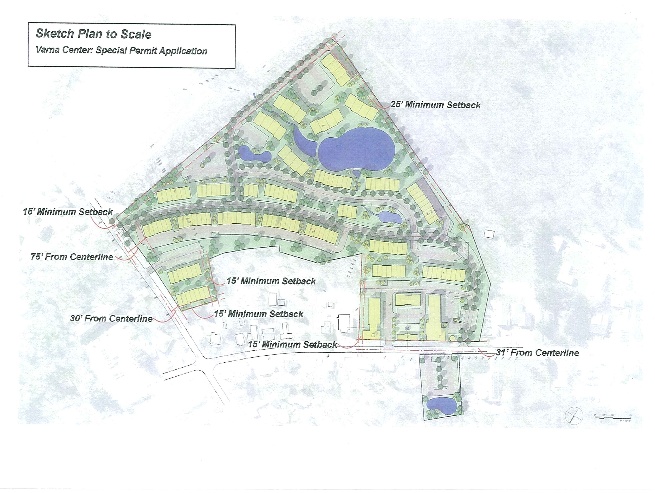
varna_plan

Fast forward some months and meetings later, and the plan, created by Behan Planning and Design, was adopted in December 2012. The conceptual plan calls for New Urbanist guidelines – sidewalks, garages on side-streets, pocket parks, and mixed-use. The conceptual build-out above adds about 450 bedrooms to the hamlet. Some of the short-term goals called for improving bus stops and finalizing the Varna Trail in the short term (identified as 2012-2014), reworking the 366/Freese Road intersection into a roundabout during the medium term (2015-2017), and incentives for projects to follow the plan. The plan also suggests implementing complete streets in the 2015-2017 timeframe. The revised Varna zoning allows for units 6-10 units per acre, with density bonuses for LEED and certain forms of redvelopment.

Well, we’re in 2015 now, let’s see where things are at. The town applied for grants in 2013 for the “complete streets” multi-modal corridor on 366. But apart from that, not much else on the town’s end, something that Varna residents have noted with some distress. The town responded that plans are underway, they’re just going slower than anticipated.

902_dryden_1 902_dryden_2

On the private end, Modern Living Rentals’ 15-unit, 42-bedroom project for 902 Dryden is the first major project to hit the dirt since the plan was adopted. The 902 Dryden parcel is about 2.42 acres, so the project comes about to about 6.2 units/acre (based off of the zoning, I think 13 units/acre were possible with the green bonus for being solar-powered). Being 2-story townhouses, it’s in scale with Varna, and is a sizable but not large project, the type that the VCA expressed preference for back in 2010. 902 Dryden includes proposed street-facing sidewalks for when the town gets to that phase. Since it’s been approved, I would guess that the town is satisfied with the project.

As for the Lucentes, they’ve focused on other endeavors, such as their Village Solars apartment project in Lansing. They still own the land that Varna II was proposed for. There’s no indication if anything will happen here or if they’ll eventually sell it off, but it’s something to keep an eye on in the long-term.