
1. It looks like the plans for 107 South Albany Street are getting a major revision. Readers might recall that previously approved plans called for a rear addition onto an existing house to create a 9-unit, 11-bedroom apartment building. The latest plans are a little more substantial.
For one thing, the existing house would be no more under the new plan. In its place looks to be a 3.5 story, 8,427 SF, 11-unit apartment building, all one-bedroom apartments. Developer Stavros Stavropoulos has once again turned to local architect Daniel Hirtler for design work; for each of them, this is the largest project they’ve worked on to date. Hirtler came up with a design that offer contextual features like a cornice and an orthodox window arrangement, but adds a modern vertical stair element in the middle of the structure to keep the design from being an imitation. Zoning is CBD-60, so no parking is required, 100% lot coverage is allowed, and the 40.5′ proposal is comfortably within the 60-foot height limit. According to the SPR filing, the construction cost will be about $900k and the construction period will be from September 2017 to June 2018.
As much as I dislike seeing attractive old houses come down, the new design fits well into an older urban context. Plus, if the medical practice on State ever gets redeveloped, 3.5 floors offers a nice transition to the lower-density structures further south. I’m not a super big fan of the blank wall next to the recessed entry, although the intent is to make it interesting with light fixtures, a brick pattern and an iron trellis that will be grown over with vines. Fiber cement will be used on the upper floors, with brick veneer and granite accents at street level.
On another note, it looks like the city will be looking at a one-lot subdivision next month at 109 Dearborn Place in the Cornell Heights Historic District – the owners, a married couple who are renovating the old PRI into a historically appropriate two-family residence, are looking to sell some of the land as part of the “partnership dissolution”. The PRI renovation is expected to continue. The application says a house was previously located on the undeveloped portion of the property (a glance at old maps indicate a schoolhouse was located on-site in the 1920s). It’s worth noting that the wife is also the owner of Bridges Cornell Heights, a high-end senior living facility on the next block. Bridges previously subdivided a Cornell Heights lot in 2005 to build a second residence to serve its deep-pocketed clients. Any new house would need to go through ILPC review.

2. Meanwhile, the Ithaca Common Council had their monthly Planning and Economic Development Committee meeting. It looks like the revised 323 Taughannock project has been caught up in the TM-PUD, so it will have to get Common Council approval. Apart from a certain councilor’s general objections to housing near or on the waterfront, this one isn’t likely to stir up much controversy. The construction timeline for Steve Flash’s 8-unit , 16,959 SF owner-occupied townhouse project is June 2017 – January 2018, with an estimated value of $2-$3 million. Potentially, there could be 16 units, since each townhouse comes with a live/work space that could be converted to a separate studio apartment unit.
Also included at the meeting was a session on electric car infrastructure, votes to send laws allowing dogs in Stewart Park and a temporary altar to the Common Council, votes to circulate a zoning amendment to allow brewpubs in business zones, and a discussion of tree plantings. The Maguires also discussed possibly shifting their project to Southwest Park behind Wal-Mart, which is covered on the Voice here.
3. The city of Ithaca has been awarded funding to build a replacement bridge for North Aurora Street over Cascadilla Creek. Continuing the city’s heavy infrastructure investments of the past few years (for instance, the bridges as Lake Street, East Clinton Street, and the work planned for Brindley Street/Taughannock Boulevard), the state is giving $1.178 million towards the replacement span. Engineering work and public meetings will take place in 2017 and early 2018, with construction and completion by 2019.

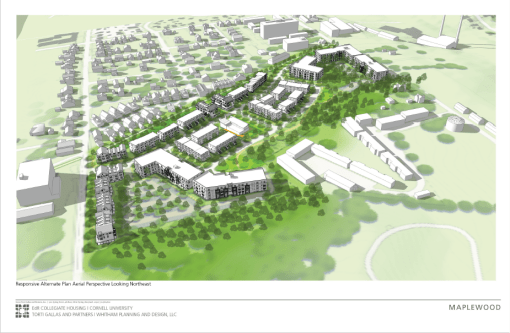
4. Over in the town of Ithaca, final approval has been granted to Cornell and EdR’s Maplewood project, meaning that everything is good to go and barring any unforseen circumstances, the 441-unit, 872-bed complex should be open for graduate and professional students by the end of July 2018. The difference between preliminary and final approval is that in preliminary, the concept is greenlighted but there needs to be additional filings completed – tree planting schedules, revised labels on diagrams, construction staging plans, and proof of final approval from the city for their portion. For those who are wondering, the 150-200 workers on-site will be parking at a temporary lot behind the Kinney Drugs at East Hill Plaza, and will be walking the five minutes down Mitchell Street to get to the job site. The first building should start to rise in late Spring of this year, with new structures rising in stages as we go through the rest of 2017.

The town planning board also reviewed revised plans for the Rodeway Inn at 654 Elmira Road, where the old wings will now be torn down and rebuilt on the same footprint and an enclosed corridor will be built into the new wings. The final result will have a net increase of four motel rooms, to 44 (the previous plan added only two motel rooms). The plan for renovating the single-family home on the property into a community center is unaffected by these changes and moving forward as originally planned.
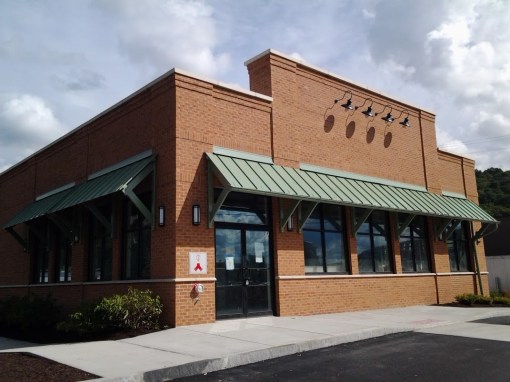
5. It’s been behind schedule a few months, but DiBella’s Subs is expected to open at 222 Elmira Road on February 16th.


6. It seemed a little odd when The Computing Center stated in their IDA application that their plans had already been approved, and there was nothing on file. Turns out they’re hoping to get approval for their 4,600 SF HQ from the town of Lansing next week.
The full suite of documents can be found on the town of Lansing’s website here. It looks like the farmhouse next door to 987 Warren Drive will be spared from the wrecking ball; although The Computing Center bought the property, it’s being subdivided and the barn-turned-garage is the only building that will be torn down. Lansing has one of the more lenient planning boards, so although this probably won’t be fully approved next week, there’s a good chance this project will receive final approval by the end of March.

7. Over on West Hill, a large vacant parcel on Bundy Road just exchanged hands. The 66.98 acre parcel has been marketed for the past few years as a development opportunity – it has municipal water and sewer, and it’s a stone’s throw from Cayuga Medical Center, Overlook and the Conifer/Cornell developments off of Route 96/Trumansburg Road. Its previous ownership, a family that has owned it in some form since 1964 (moving between members in 1984 and 1991), had it on the market for $359,900.
The buyers, a husband-and-wife pair of medical doctors who live nearby, paid $305,000 for the deed, according to a filing on the 9th. An online search for future hints doesn’t really give much guidance – the doctors have donated modest amounts to Finger Lakes Land Trust and have signed some anti-fracking petitions, and while they own undeveloped properties around them, this parcel isn’t adjacent to their house. It doesn’t really fit the Land Trust’s ideal land donations either, since it’s been substantially subdivided with medium-density residential, and borders a growing corridor. So, it’s hard to gauge just what exactly is planned here. For the record, the land is currently zoned medium density residential (max 3 floors, up to 2.9 lots/acre), but the town’s new comprehensive plan sees the property as new urbanist medium density (5-8 units/acre small-scale mixed-use), with undeveloped open space towards the southwest corner of the parcel.
8. Let’s finish this week off with a talk about energy. Good news first – there might be a solution to the West Dryden pipeline issue. Background here, but the nutshell is, Lansing has tapped out their natural gas capacity, and in order to accommodate new development that would need natural gas, NYSEG needs to build a higher capacity pipeline from their current facilities in the town of Dryden. This new pipeline would go along West Dryden Road, but has run into fierce opposition, mostly because Dryden residents are famous for being anti-natural gas – this was the town that took on the fracking companies and won. Keep in mind, these folks aren’t just disdainful of natural gas, they are adamantly opposed. So using their property to accommodate something they don’t like is a bit like asking to build an abortion clinic next to an evangelical church because that just happens to be where the land is cheapest, but they would have to share a driveway.
Unsurprisingly, the town of Dryden enacted a moratorium on large-scale pipeline installation. The town of Lansing is not happy because it stymies their development, and they’re extra-concerned that their biggest property taxpayer, the Cayuga Power Plant, is about to go belly up and leave the town with $100 million less on its tax rolls. The county wants to move away from fossil fuels, but it also wants to encourage development and not leave Lansing in the lurch.
This week, a plan was put forth that might accommodate both needs. A small compressor station would be built to keep pipe pressure from falling too low during times of peak demand, so that guarantees service for existing customers. The second prong is to wean existing development off natural gas and encourage new development to use other means – electric heat pumps, like those to be used in Maplewood and City Centre. This encouragement would be given through subsidies or tax breaks. The compressor station and the incentives would be in effect by late 2018.
It looks promising, but the feasibility studies are still ongoing, and Lansing is not totally on board. Both Lansing Village and Lansing Town feel they were not represented during these discussions with NYSEG, and that heat pumps are a major financial burden to saddle homebuilders with. They also wonder if the electrical grid would be capable of supporting so many heat pumps.
Speaking strictly from my experience, I’ve visited construction projects with heat pumps, and while they are a cost increase, it’s a couple percent more than the same structure with conventional heating – there’s a recently-built single-family house I can think of offhand where the cost of heat pumps was about $5,000 more on the $200,000 construction cost. If it’s incentivized, one could make it financially sensible, at least for residential options if not all. Also, I’m wary of Lansing’s reasoning because they piddled away the three town center projects five years ago – if they had stayed on top of it, they’d have $50 million more in property value and this wouldn’t be such a pressing issue now.
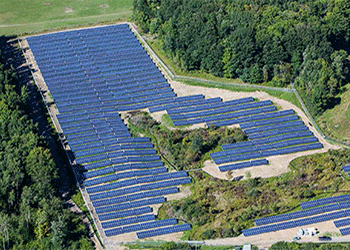
That being said, there are problems with this area’s approach to alternative energy. Newfield is the big culprit here – they’re about to put in a moratorium on commercial solar panel installations, which is worrying since this is the same town that redesigned their wind turbine law to ban them in essence. If municipalities are limiting residents’ abilities to turn to alternative energy sources (many urban areas have to turn to commercial arrays or turbines because there’s not enough room/too much demand on-site), then the community will be unsuccessful in weaning the population off of fossil fuels. But Dryden, which is in the process of changing their laws to accommodate large-scale solar arrays, is at the forefront of this issue – those panels could provide the electricity for the heat pumps and help turn the tide on energy sources. It only works if everyone cooperates.

 Ithacating in Cornell Heights