The Keyword Bar XXI

11 04 2014

4-13-2014 077

I figured I had two options at the moment – write about all the Chain Works District news, or do one of my tried-and-true keyword bar articles, where I examine and comment/answer on searches that led folks to this site. Well, I’m holding off on the Chain Works discussion, until some of the materials presented start floating around one of the local government websites (city of Ithaca, town of Ithaca, or county), and can be reused here. So in the meanwhile-

1. “what frat can ithaca college students join” 4-9-2014 and “ithaca college sorority options” 4-2-2014
Officially, IC offers a few professional music fraternities, but there are a couple of social Greek chapters that are based at IC but are not officially affiliated with the college. Rarely, IC students join Cornell University Greek organizations, though it’s normally no more than 10 IC students per year. Many of these are in the MGLC, fraternities and sororities that focus on minority groups, but a couple do join chapters affiliated with Cornell’s IFC (I don’t know if Pan-Hellenic allows sororities to recruit IC students; maybe in the informal fall rush). These students aren’t allowed to serve in leadership positions in most chapters, and I imagine the trek between campuses gets old after a while.
2. “cornell snow graduation” 4-8-2014

Thankfully, there’s nothing to worry about. According to the NRCC, the latest snow of any amount (trace or higher) in Ithaca occurred on May 18th (1973). With graduation traditionally at the end of May, the possibility of snow is very remote. Winter graduation is a different story.

3. “proposed south hill development town of ithaca” 4-7-2014.

That would be the Troy Road development. Which from a planning/land use perspective, I become less and less a fan of every time I see it. But then, I prefer New Urbanist planning, not suburban cut-and-paste development. I just keep reminding myself that the current zoning is worse, and the town has a poor track record in raining in sprawl.

4. “is there any problem of construction in collegetown terrace” 4-4-2014

Jason over at Ithaca Builds would know this better than I, but as far as I’m aware, there’s been no indication of construction issues. Perhaps the parking isn’t being utilized as much as they thought it would, but that has more to do with planning than construction.

5. “the cradit-moore house” 4-1-2014

Actually, this one has a pretty cool story attached. The Cradit-Moore house dates from 1817, with an addition built in 1860-61. The older north wing was built by Issac Cradit, and the south wing by Peter Kline (the Kline family were locally prominent farmers who held a lot of land, and its where Kline and Klinewoods Roads take their name from). The house was bought in 1938 by Dr. and Mrs. Norman Moore. Dr. Moore was the director of the Cornell U. infirmary, and in 1948, the Moores sold the house to Cornell but with the condition that they could live out the rest of their days in the home. When Cornell began plans to expand North Campus with CKB and Appel back in the late 1990s, the original intent was to demolish the house. This caused substantial protest, and working with the non-profit preservation group Historic Ithaca, Cornell donated the house away in 2000 and Historic Ithaca loaded the house, all in one piece, onto a flatbed truck and hauled it .3 miles to a new foundation on a lot donated by Cornell further up Pleasant Grove Road. The house was then sold to a private owner to recuperate the moving costs, the new foundation and landscaping.

Image property of Historic Ithaca

Image property of Historic Ithaca

6. “tunnel barton teagle” 3-25-2014

It exists, though like many of Cornell’s tunnels, it doesn’t appear to be open for public use.


College Towns As Retirement Communities

5 04 2014

100_2009

Growing up in upstate New York, retiring and moving to south Florida was considered a rite of passage. You worked for forty years, you retired with your company or government pension, you moved to a gated condo community in Florida, and then you complained about how much worse everything is these days and how terrible drivers are in Florida for the rest of your days.

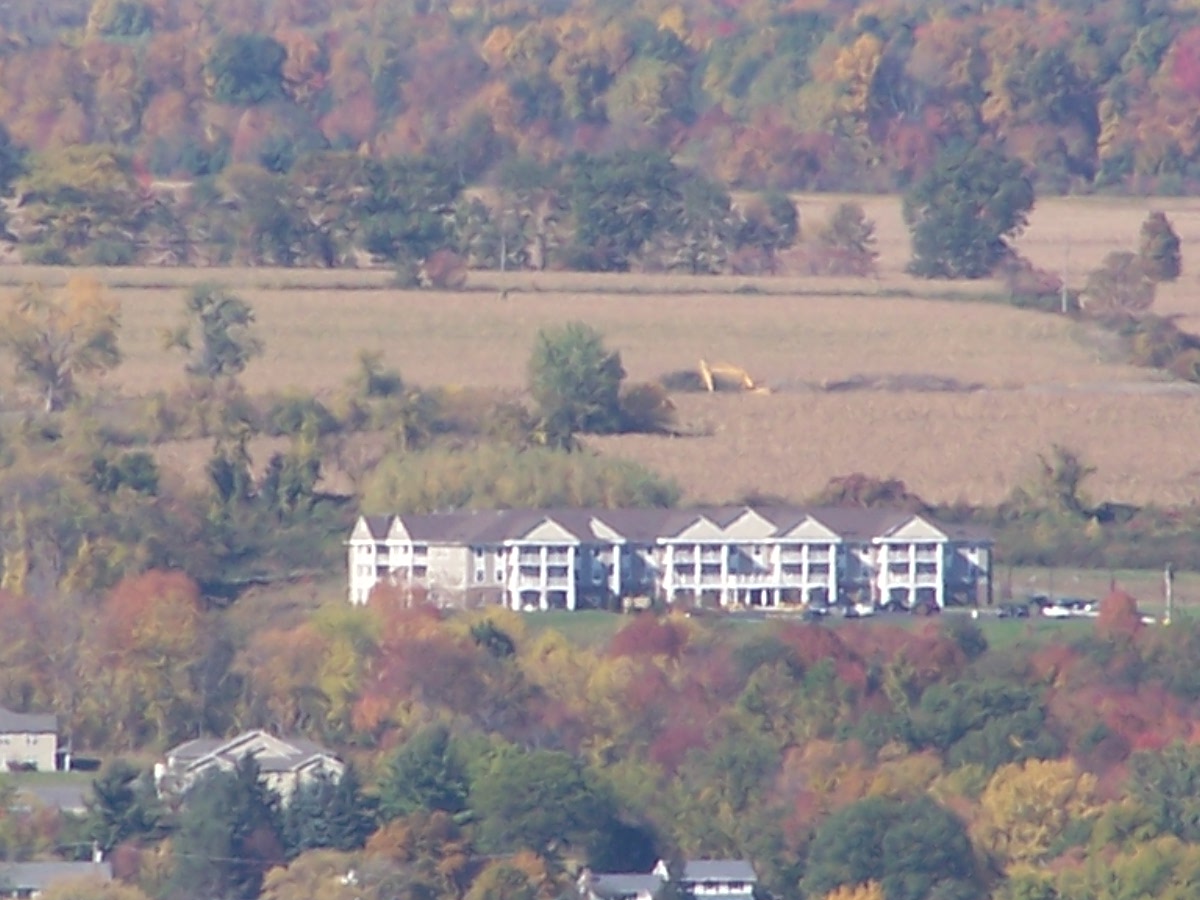
I imagine that still tends to be a big draw (considering the New York to Florida population pipeline is the largest in interstate migration), but an increasingly-popular alternative in recent years has been to retire to college towns, enough that mainstream publications like USA Today and the New York Times have devoted articles to the topic.  it’s usually ascribed to some combination of a modest cost of living with expansive cultural and recreational amenities. Without having any numbers directly in front of me, I imagine Ithaca in a sort of second-tier in this category, if only because of the climate, which is a little cooler and snowier than the most popular college town retirement destinations. Still, I’ve been thinking about this topic a little bit because a number of the projects in the Ithaca area are targeted towards the retirement crowd. The individual trigger for this article was a Lansing Star article discussing review of a ~$17 million, 110-unit senior apartment building proposed for the forever-discussed Lansing Town Center development. The more I think about it, the more I realized a number of local projects, both recently built and proposed, are explicitly geared towards the 55+ age group:
Hawk’s Nest at Springwood (50 units)

Cayuga Meadows (62 units)

Longview Patio Homes (22 units)

Conifer Village at Ithaca (72 units)

The Kendal at Ithaca expansion (24 apartments and 13 “skilled care” units)

-The Old Tompkins County library site (likely)

Some of the news stories focus on collegiate affinity (i.e. living near the old alma mater) and offerings at the universities as a draw for retirees. To that end, Cornell offers summer courses for seniors and the local community college allows residents over 60 to audit courses (I don’t see anything described for IC). Those offerings along with the open lectures and Ithaca’s fairly active community engagement seem to provide some draw for those in their later years. I find college students and retirees an odd mix (even if they live in different neighborhoods for the most part), but if it works, I have nothing against it.


Ithaca is Cold

3 04 2014

100_2688

It probably doesn’t take a meteorologist to realize that this year was a long, cold and harsh winter. But let’s give it some perspective. All data comes courtesy of the Northeast Regional Climate Center (NRCC).

Records go back to 1893 for the Ithaca area. If we look at just snowfall, this was a fairly average year. The typical Ithaca winter averaged 64 to 67 inches, depending on your source, with accumulations on 19 days. Barring any freak spring snowstorms (God forbid), this year will finish up at 63.3 inches tallied from 20 days of accumulating snow, virtually par for the course.

Then we take a look at the cold. That was the news maker this year – the cold, not the snow. Let’s put this into perspective and look at the period from November 1 to March 31st – what most folks would describe as the cold season, rather than just calendar or meteorological winter (we’ll hit met winter in a minute).

This was tied for the second coldest cold season since 1893. The average temperature was 24.8 F. Tied with the winter of 1969/1970, and 0.3 F short of the record holder, 24.5 F set in the winter of 1903/04. Even the detestable cold of the winter of 1993/1994 wasn’t as bad as this year (though it holds fourth at 25.0 F). The average coldest temperature in a year is about January 18th, with a high of 30 F and a low of 17 F.  23.5 F. In other words, the temperatures seen on what is usually the coldest day in a year could very nearly be applied to a five month period. It was that bad.

Now let’s look at meteorological winter, December 1 – February 28th/29th. 21.4 F. This is, surprisingly, not awful. It’s the 15th coldest meteorological winter on record. Below average, but not awful. 2002-2003 was worse (21.2 F). The winter of 1917-18 is worst, with an average of 19.0 F. So winter was cold, and seems to be shifting the blame to November and March.

In that respect, we have to hand it to March for being an epic piece of frigid dung. Fourth coldest March on record, at 24.5 F. Only March 1900 (24.4 F), 1984 (23.8 F) and 1960 (21.5 F) were worse. November 2013 averaged 35.7 F, which is once again below average, as the 16th coldest November on record. To sum up this season, it wasn’t just the cold, it was duration that truly made it a memorable year.

To touch upon the cold a little more thoroughly, the number of subzero temperatures in the cold season was 23. 23 subzero days ties second place for the most subzero days in a cool season. Tied with 1947/48, and one short of the record holder, 1960/61 (change it to met winter and it moves to third, behind 1960/61 and 1962/63). In terms of maxima, it still has yet to hit 60 this year, the last time Ithaca was above the “jacket line” was December 23rd. You know, because everyone wants a green Christmas, followed by three months of polar conditions.

So there you have it. Persistent troughing in the east gave us one of the coldest cool seasons in decades. If you want to blame someone, look at California and their persistent ridge out west, giving them their warmest winter ever recorded. But then, given the drought, and given that the fringe suburbs of SoCal may go through this again in six months, maybe blame’s not the right word.


2013 Census Estimates: Say Hi to the New Neighbors

30 03 2014

7-26-2013 067

Every late March, the U.S. census releases their new population estimates for counties. So, I causally checked in to see how the Tompkins County numbers were doing. The county typically shows a modest addition of a few hundred each year – from 2010 to 2012, the estimated addition was 990 residents, from 101,564 to 102,554, which if carried out evenly, it would be an expected 4.9% increase for the decade (and roughly on par with the 5.2% in the 2000s).

I was a little taken aback when I saw the numbers for this year. For one thing, somewhere along the way, they revised 2012’s number up to 102,713. For another thing, this year’s number is a relative spike in the trajectory – 103,617.  In addition of 904 from the revised 2012 figure, and 1,063 from the original 2012 estimate. So, the change from 2012 to 2013 is about as much or more than the gain of the previous two years. Using the 2013 figure and extrapolating the three years’ estimates out to the end of the decade, the county would be projected to grow 6.74% to about 108,400 residents in the year 2020.

In many states, this would not seem an overly impressive figure. But it is worth noting that this is economically-depressed upstate New York. Last year, the only counties that were growing faster than Tompkins (as a percentage) were Jefferson County (Watertown, with the economic engine of Fort Drum) and Saratoga County (Saratoga Springs, with the massive Global Foundries computer chip plant in suburban Malta).  With the 2013 figures, Tompkins County moves into the second-place slot, behind Jefferson County (I note that the population estimates gave Jefferson a population decrease this year; the army base up there is expected to see a loss of 1500 to 2000 soldiers as it loses a brigade over the next few years, as part of army cutbacks). I’m also leaving out downstate counties/boroughs – Kings County/Brooklyn Borough is projected to have added 88,000 people for 3.5% growth since 2010. Almost all of Tompkins’s population, in three years. New York City gains ever-more reason to view it and its boroughs as the center of the world. On the other end of the scale, Schoharie (sko-hair-ee) County has the biggest estimated percent loss, at -2.8%. Schoharie is a rural county just west of Albany; it suffered a major hit from Hurricane Irene.

Echoing my comments from last year, estimates should be used with caution, as they don’t always reflect the true population. From the housing units perspective, using the number of 2.29 residents per unit estimated for 2008-2012, one gets justification for about 395 more units of housing for the past year, or about 897 units since 2010. I’m cautious about using these number as much more than curiosities, but they’re intriguing, and seem to bode well for the health of this county. Even when the jobs numbers aren’t.


Fast Facts: Cornell Employee Headcounts

25 03 2014

All figures come from the Cornell University Factbook.

I’ll lead off with a breakdown of overall number of employees. Faculty and academic staff have been discussed previously, but for consistency’s sake, their numbers are included here in their separate sub categories. In other words, the total number of Cornell employees is faculty + academic staff + non-academic staff. These figures don’t include Weill Cornell, but do include the Geneva research facility and the tech campus in New York City, (the tech campus had 7 employees in 2012 and 15 in 2013). Student and temp employees are not counted either. All figures were taken from November 1 of the year displayed.

cornell_headcount_total
In terms of raw numbers and in percentage, it’s pretty clear that non-academic staff were the ones that decreased the most in the midst of the Great Recession. The big plummet comes from 2008 to 2009, where the number of non-academic staff dropped from 7,707 to 7,038, an 8.7% drop. Combined with the losses in employment in faculty and academic staff, the drop in employment that year was from 10,548 to 9,786. Today, the number of total employees is even lower, at 9,731. Meanwhile, student enrollment has continued to climb.

Cornell had a few different tricks up its sleeve to decrease the numbers so sharply. The primary constituent was a retirement incentive package. If you worked at Cornell for over 10 years and were 55 or older, the university was willing to give an employee a lump sum payment (one year’s pay) and an enhanced retirement account payment (30% of what was in the account), provided that the individual retired by the end of June 2009. According to their press release, 432 people accepted the offer. As I recall from my job at the Cornell Store, at least three of the full-time store employees had accepted the package. Another 200 accepted in 2009-2010. Of the 669 positions, at least 105 were layoffs. A Sun article from 2011 details the results of these cuts, including concerns of low morale and overburdening certain departments. It also notes that cuts were expected to continue through 2015, which given the numbers out since then, looks to be pretty accurate. For the curious, the average salary of a non-academic full-time staffer at Cornell was $33,885 in 2007.

Looking at the numbers in greater detail, we can take further nuggets of information from the figures. For fall 2013, for instance, there were 7,070 non-academic staff. Of those 7,070, 4,130 (58.42%) are female, and 6,193 (87.60%) are white. There are 479 part-timers, or 6.78% of the total non-academic staff workforce.

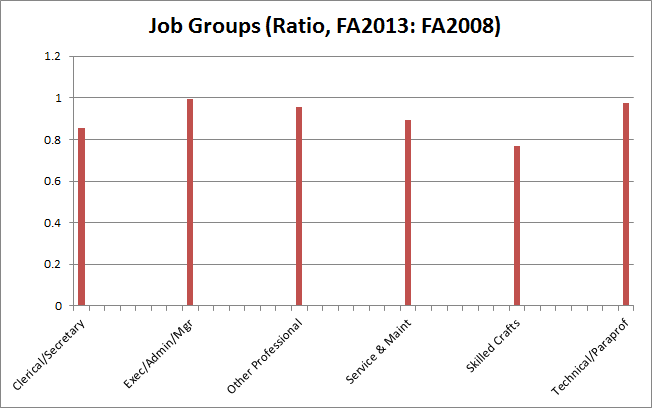
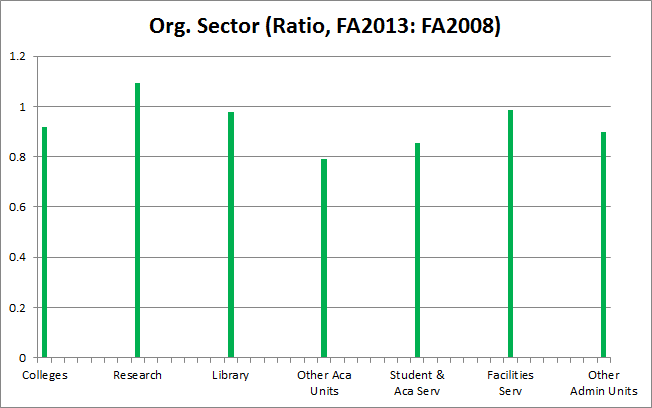
The types of non-academic staff can be broken down into subcategories, both for occupational group and by organizational sector. For occupational groups, the subdivisions are clerical/secretary, executive/admin/managerial, other professional, service and maintenance, skilled crafts, and technical/paraprofessional. For organizational sector, the subdivisions are “Colleges, Research, Library, Other Academic Units, Student and Academic Services, Facilities Services, and Other Administrative Units”.

Job Groups

Org Sector

Speaking broadly and looking at proportions alone, if you work in research or in an administrative position, you’ve fared pretty well since the big slimdown five years ago. If you’re a skilled craftsman or fall into the vague term of “other academic unit”, the prospects haven’t been as sunny. The big employers in gross are secretaries and the grab-bag called “other professionals”, in colleges and “other administrative units”. I presume a lot of secretaries have been replaced by Ms. Google and her friends.

colleges_headcount

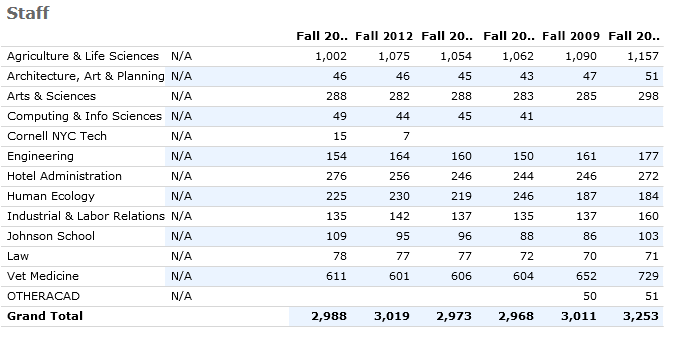
In this Cornell-provided chart, if you split up the colleges by headcount, the Vet School and CALS appears to have taken the biggest cutbacks, although AAP took a big hit percentage-wise. Hotel, HumEc, the Johnson and the Law Schools employ more now than they did at the 2008 peak.

cornell_employee_age

Lastly, even with the retirement incentive, the employee population continues to grey. In 2001, 12.4% of non-academic staff were 55 or older; by fall 2013 it’s doubled to over 25%. In sum, while the student population goes up, the staff population is generally decreasing and trending older.


Two Sides to an Argument

18 03 2014

ridgewoodapts_v2_2

I generally try to stay on the sidelines when it comes to promoting or opposing for Ithaca projects. I’m not about to get involved in favor of the West Falls Street proposal, the Stone Quarry proposal, or Cayuga Meadows, or any other local project that neighboring residents want shot down. NIMBYism (NIMBY is short for “not in my backyard” , a reference to when people accept a community has a need for a project but they oppose it in their neighborhood) is ever-present, just about every project in the city and town has had some degree of opposition (the only exception I can think of offhand is the convention center/hotel planned for downtown). My own opposition arises when I feel a proposal threatens something of historic value. Regardless, the planning board is good at staying neutral. I may not always agree with the planning board, but I generally respect their judgement.

I’m going to make an exception to my non-partisan stance for 1 Ridgewood, thanks to Walter Hang.

As much as it bothers me to do it, to explain my issues, it is best if I provide a link to the petition and its partially-labelled map of square footages.  A large chunk of those appear to be people who have little or no connection to Ithaca. Token disclaimer: I’m not for or against his fracking work, my concern is focused squarely on this project. In an attempt to keep this project from being railroaded, I decided to examine the petition’s arguments.

chhd1

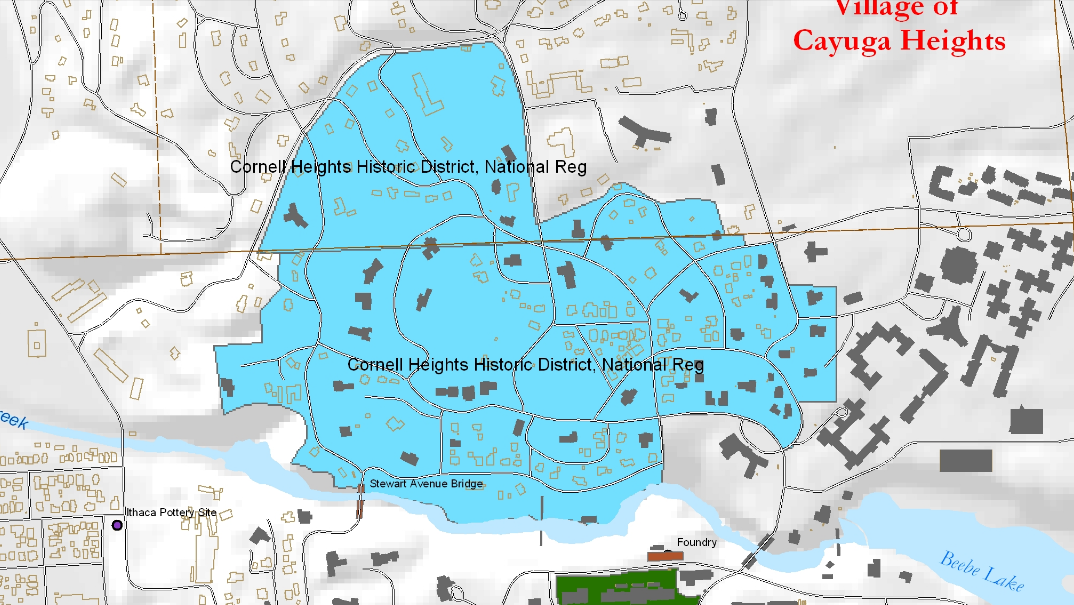
Here’s the area Mr. Hang wants his moratorium, Cornell Heights, split between the city and Cayuga Heights. For the record, the dark grey represents Cornell-affiliated properties, mostly GLOs and a few Co-Ops in the CHHD. Looking at the city section specifically:
chhd2

The red X is the Ridgewood apartment parcel, for three buildings between 5578, 5710 and 6662 square feet, with mostly below-grade parking. One of my issues is that some of Mr. Hang’s assertions are misleading. For example:

Due to recent development, the Historic District is clearly transitioning from its original turn-of-the-20th century “residential park” to a densely developed area that bears little resemblance to the community that warranted special historic district protection approximately 25 years ago.”

It’s hardly changed. There have been two three projects built since 1989. A single-family home at 116 Dearborn Place that was built in 2005, the Tudor house of the Bridges Cornell nursing home was built in 2005, and the new apartments currently going up on Thurston. If you want to push the envelope, Alpha Zeta (214 Thurston) replaced half of its original structure in 1992-1993 when it was renovated. A couple buildings (Kappa Delta, and 111 Heights Court) have received renovations, which were approved by the Ithaca Landmarks Preservation Council (ILPC).


Approval is being sought for an apartment complex proposed for 1 Ridgewood Road. Three buildings would be built on the largest undeveloped property in Cornell Heights, a spectacular forested setting enjoyed by hundreds of local residents who walk along and through it each day.

The proposed buildings would dwarf nearby structures. Figure One illustrates that the buildings would be 300% larger than the adjoining structure on Highland Avenue and at least 200% larger than all the immediately surrounding structures.

Out of a total of more than 200 structures in the Cornell Heights Historic District, only six are bigger than all three proposed buildings. Those six were built before the Historic District designation.

What’s not being told about that “spectacular forested property” is the abandoned swimming pool or dilapidated poolhouse. Also, as seen in at Mr. Hang’s map, the project is shifted to the west (left side) of the parcel, where many its nearby neighbors tend to be larger, ranging from 3000-8600 square feet (Westbourne to the north is a contiguous complex with 10,800 sq ft of space). To call this “dwarfing” is to take it out of its full context.

It concerns me that a petition with emotionally-charged language, gathering signatures from people that are not stakeholders in the Ithaca community, is being pushed by someone who has a history of aggressive tactics. It bothers me that an underutilized parcel with great public transit access in a highly populated area is going to have its zoning changed after the developer has been sensitive to planning board concerns and returned with a proposal within current regulations, which sets a terrible precedent for the community and opens up the possibility of legal action against the city. Lastly, in a period where Cornell continues its enrollment growth, I’m worried that if projects like this will be prohibited, it will only encourage more rental conversations of existing housing, more subpar housing situations, higher rents and increased sprawl.


ATO and Campus Living Are Awkward Partners

13 03 2014

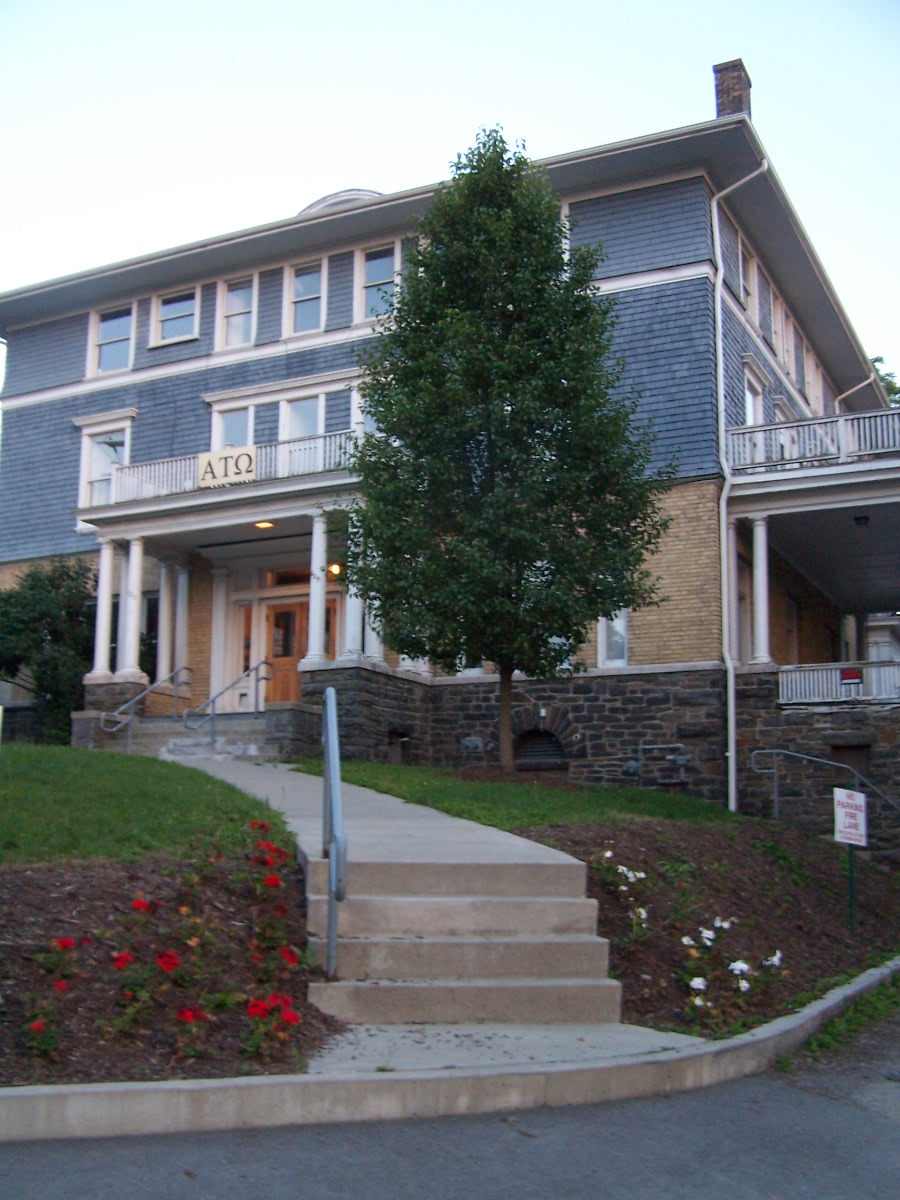
When this blog started, I think Alpha Tau Omega (henceforth ATO) was the first renovation in progress that I had ever taken note of, in mid-summer 2008. Here was a before pic, which dates from July 3rd, 2008.

100_1368

Here’s an after pic, which dates from August 15th, 2008.
100_18091

The house had had structural issues that were fixed before this blog started, and the external renovations were finishing up when the first photo was taken. I assume the repaint was all that was left to do.

ATO was one of two fraternities that closed in the summer of 2013, the other being Zeta Beta Tau (ZBT). In both cases, the closing was called for by their nationals, who were displeased with the quality and conduct of their Cornell chapters. This article notes that ATO’s alumni group hoped to rent the house to graduate students while they wait for the chapter’s return (generally, that means that all the once-current members have graduated). ZBT is targeting a return in 2014/2015. The process isn’t new, Kappa Sigma did the same thing from 2010 to 2012. I’ll even go as far as to suggest that someday, another couple years from now, Sigma Alpha Epsilon will make a return to Cornell, though Hillcrest is being used as a dorm in the meanwhile (I dunno if they’ll ever be back in 122 McGraw, which is owned by Cornell; I tried checking Kappa Sig’s house for reference, and couldn’t find anything. But I do see that they liked my photo so much it’s on the front page of their website, guy standing on the roof and all).

100_1167

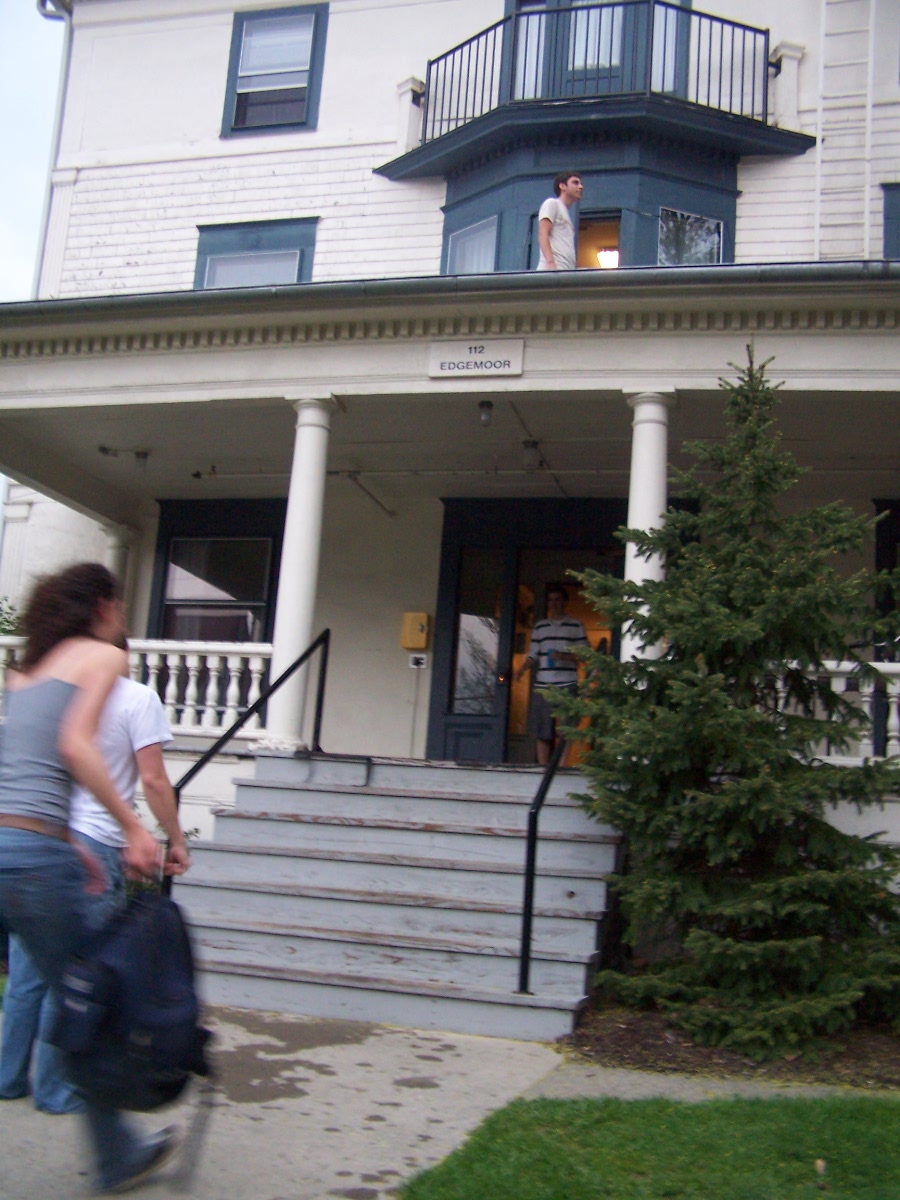
Anyway, reading the Cornell is leasing the house for the upcoming year is no big surprise. In fact, it brings back memories of my friends in 112 Edgemoor. Edgemoor was a fraternity house until 1985, when Triangle closed. Being purchased by Cornell some time earlier, it became a small dorm. The fact that most of my meteo friends even ended up in Edgemoor is kinda my fault. A bunch of my meteorology classmates wanted to go in together on a suite on West Campus. When I found out I would have to be on a Cornell meal plan, I balked; I wanted to be on my fraternity’s meal plan for dinners and manage my own (cheaper) lunches. When I caused that suite plan to fall through, a lot of them went into Edgemoor, and a couple others gravitated towards that group and moved in as well. I think meteorologists and their friends made up about half of Edgemoor’s residents, and there were about 21 at the time. I spent more time there than my own dorm (and Cascadilla and Edgemoor were close to each other at least). It was a nice house, but from my own observation, almost everyone else in Edgemoor saw it as just a place to sleep.  For the student in the article that hopes for more intimate social connections, I would set the expectations low but hope for the best. For the record, I don’t have high opinions of ATO either. Some years back, ATO thought it was a good idea to take my freshman roommate to Kuma Charmers as a rush activity. He came back with bruises on his legs from what he described as the worst lap dance ever. My roommate ended up joining a different house. Furthermore, I went there once to meet him after one of their events, and the inside of the house was in shambles, with a giant pile of wood furniture tossed helter-skelter in a corner, and broken glass everywhere. So someone describing the house as a health hazard is no surprise either.

I think that unless people already have connections to their housemates, that the intimacy of non-specialized small group housing is overrated; upperclassmen have generally built their social networks and have their coteries. I don’t imagine Cornell’s thrilled to have to clean house, nor ATO to have it occupied by someone that’s not an active membership. But this is better than an empty house, the cleanup is appreciated, and I suppose that at least a couple dozen fewer people won’t have to do the manic search for off-campus housing.


Progress in Collegetown?

9 03 2014

cafd3

Given the chance to look back at high-value projects over the past 30 years, one would find that, until the past several years, the list would be dominated by projects in Collegetown. Reasons abound- quoting developers, students “are looking for quality“, while increasing land values (comparable to downtown Los Angeles) have persuaded property owners to upgrade their stock and maximize their returns. The city has in general promoted Collegetown redevelopment since its slummier days, with relaxed policies in the 1980s and a couple of brief moratoriums allowing for reassessment (ex. the moratorium of 1999/2000, when the newly-built 312 College Avenue rubbed some locals the wrong way).

As of late, though, development in the Collegetown area has tapered down. There have been a couple projects over the past several years: 309 Eddy was completed in 2012, and 320 Dryden in 2008. If you want to stretch it, you can add 107 Cook, but that has less bedrooms than the building that burnt down. The big glaring omission here is Collegetown Terrace, but that is being built just outside of what is traditionally considered Collegetown.

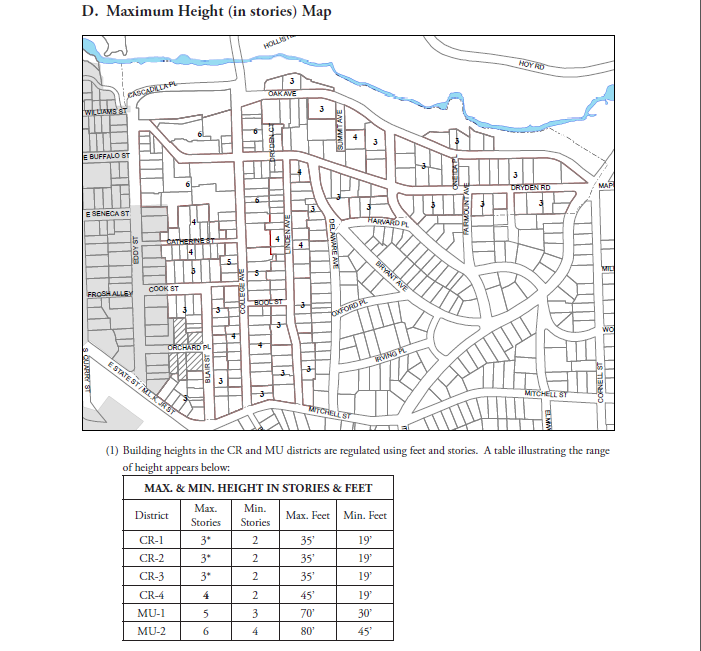
A big factor in all of this has been the uncertainty in Collegetown’s zoning. Since about 2008, Collegetown’s zoning has been in flux. The city and Cornell paid about $200k for an urban planning company (Goody Clancy) to design a plan, which came out in 2009. The  project freaked out some residents and local politicians, who saw it as too dense and too much, period. Then the planning board went and took it in the opposite direction, proposing zoning that would force smaller buildings and reduced density. I made a b*tchy little rant when that happened. Since the old images can’t be blown up (I had an issue with that for a while back in 2009 or so), the numbers for the Goody Clancy plan can be seen better here on page 161. I’ve been unable to find another copy of the first revision, not that it specially matters since the plan was accepted, repealed in 2011 after a potential lawsuit from landowners, and has been revised seemingly a dozen times since, debating everything from the necessity of porches in certain zones, to the tremendous fight over maximum heights on the intersection of College and Dryden (90′ in the GC plan, 60′ for first revision, now 80′), to parking and encouraging townhouses. After much back and forth, something is now finally in place.

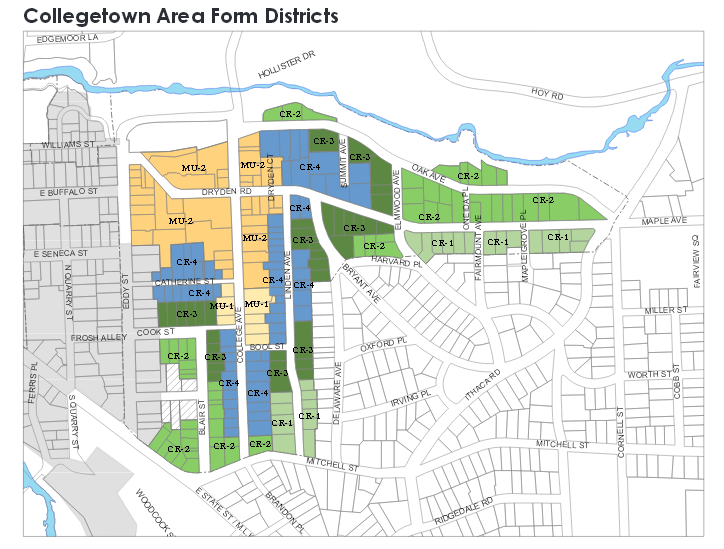
The final version is the Collegetown Area Form Districts guideline, the implemented form of the plan. The key thing with the is plan is the form-based zoning; traditional zoning focuses on regulating use and overarching parameters (lot size, density), form-based zoning scrutinizes design. Form-based zoning has been popular in new urbanism for encouraging walkable, mixed-use communities, an early example being Florida’s Seaside community.

cafd1

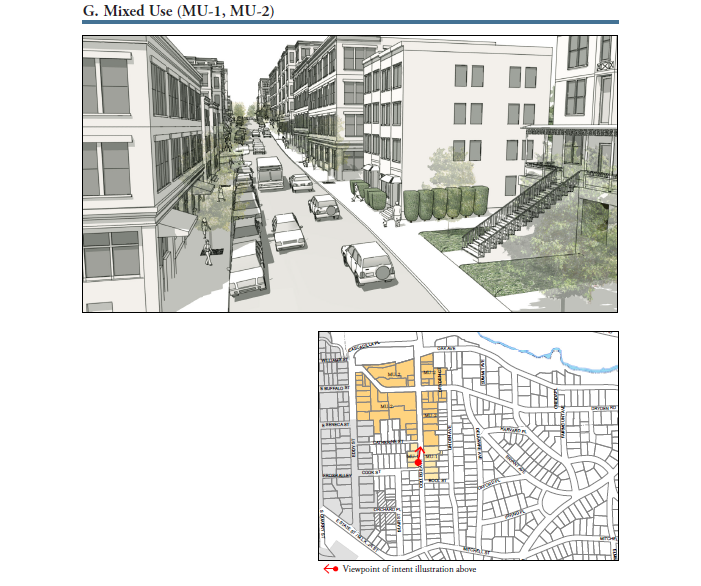
The plan has six zone types, each with its own tweak on the design guidelines. CR-1 to CR-4 are increasingly denser forms of “Collegetown Residential”, MU-1 and MU-2 are mixed use, with active street engagement through ground floor commercial or public uses.

cafd2

Compared to the Goody Clancy plan, the Dryden/College core isn’t as dense, but the floor count and maximum heights are even higher than suggested in some spots, for instance College at Bool Streets. But the primary focus of the plan is on the design of buildings. CR-1 and CR-2 will be large house forms with pitched roofs, CR-3 for 2-3 unit large homes/duplexes. CR-4 accommodates large houses, townhomes, and small-to-medium size apartment buildings. MU-1 welcomes medium-sized mixed use structures, while MU-2 is for the largest mixed-use buildings, up to 6 floors and 80 feet in height (think 403 College for example). Worth noting, most of Collegetown Crossing falls into MU-2, but the back end edges into a CR-4 Linden Avenue property also owned by developer Josh Lower. Since CR-4 is residential only, the difference would force him to make a redesign to reduce the building’s footprint, but at least parking will no longer be a concern. This December 2013 article says that required off-street parking was removed from CR-4 and the MUs, but I still see it listed in the guidelines as “required off-street parking” under accessory uses. Hopefully it’s just my paranoia; the IJ also said the parking reqs were also waived for the MUs when the plan was adopted.

The Sun, the IJ and other articles note the “strong support” for the plan. I can only hope, after six years and hundreds of thousands of dollars and countless meetings, that the city will have something to show for its efforts. Housing is only getting tighter in Collegetown, and developers are simply looking outside the core for their projects, so to have some guideline in place will hopefully spur some investment into Collegetown’s poorly-maintained and underutilized properties.


A Walk Down Varick Street

4 03 2014

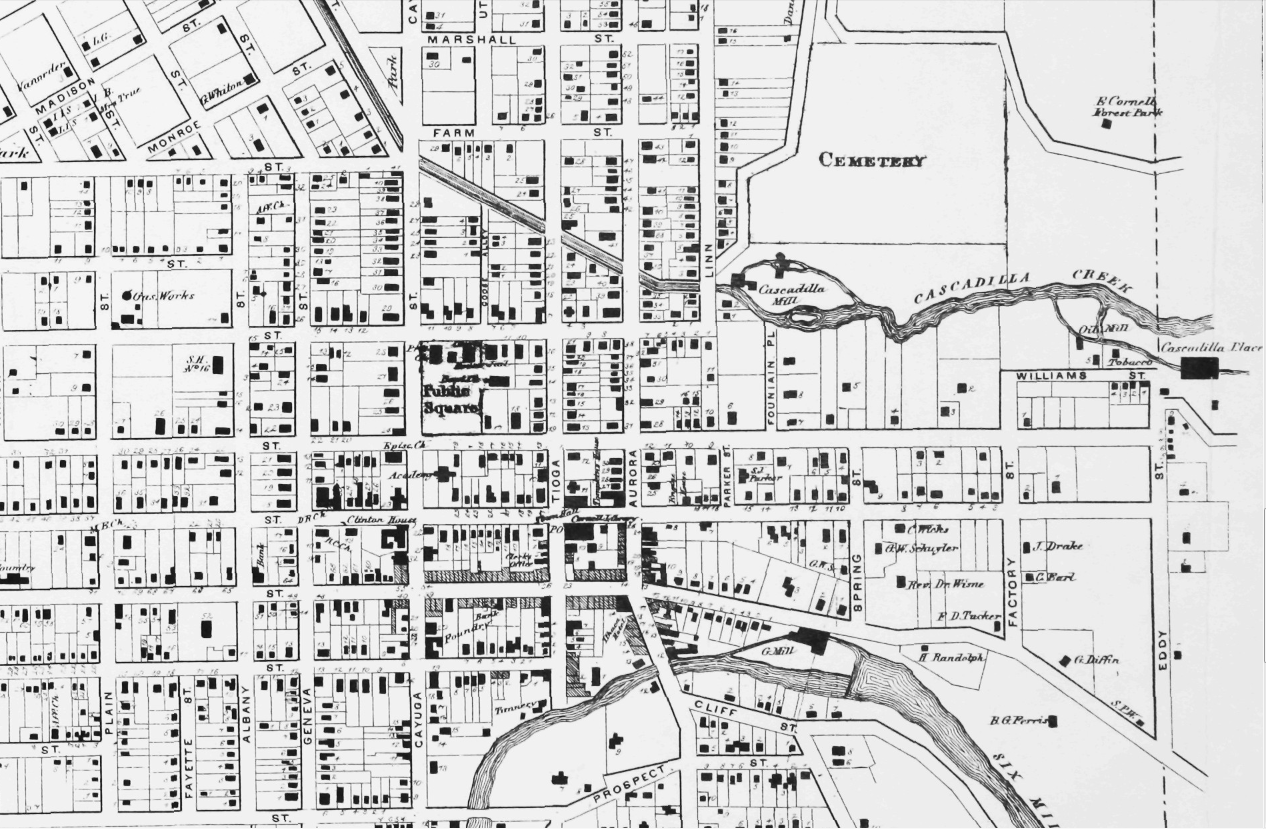
I try and keep in track of the hotlinks to this site from other blogs. A while back, I noticed a link from a little-used community blog for Ithaca’s Lower Northside, aptly named lowernorthside.org. I decide to check it out, and stumbled upon a map it had included in one of its (few) posts. It’s an atlas of the Ithaca area dating from 1866. When Cornell U. was still a dream under construction, and Ithaca had yet to be incorporated as a city (something that wouldn’t happen until 1888). A lot has changed in 128 years, and it’s really a fascinating look back on an older incarnation of the city of gorges.

ithmap1

Clicking on the image will pull up the fine print, or just follow the link above. Unfortunately, the commercial version of wordpress this blog uses doesn’t allow for embedded PDFs, otherwise I’d have cut out the extra step. Of course, for the sake of following along, here’s a map of the current-ish city of Ithaca.

In 1866, Ithaca was much smaller, posting a population in 1870 of 8,462, a number that probably had a bit of help from the newly opened Cornell U. and its 400 or so students. Tompkins county was only one-third of its present population, with about 33,000 people. The county had seen a massive population decline in the 1850s and was only just beginning to recover during this decade.

Ithaca was, as today, “centrally isolated”, having been bypassed for a major railroad in favor of Syracuse. However, the Cayuga branch of the Delaware, Lackawanna and Western railroad had its terminus in the city, and there were steamboats one could take down Cayuga if they were coming out of the north. Ithaca was still expanding in all directions, yet to fill out Fall Creek or the Northside, and barely reaching where Collegetown is today. The small hamlet of Forest Home was still known by its original name, Free Hollow, and at the cruxes of dirt roads, small clusters of houses, churches, and small schoolhouses can be seen. A nice asset here is the inclusion of homeowners’ names; we see names that still live on as place and street names in Ithaca today, like Bryant (Park neighborhood), Coddington (Road), Renwick (Place/Drive/Heights Road), and Mitchell (Street). Ezra’s land is nearly vacant except for his own home, his farmland having but a few roads; and IC and South Hill are barer still.  Cascadilla Place is there, completing construction the year this map was made; the water-cure sanitarium was never used as such since Ezra Cornell, its biggest investor, swooped in and repurposed the structure.

Another notable name on the larger map, though perhaps not as important today, is Heustis. College Avenue used to be called Heustis Street, after landowner Lorenzo Heustis. The name was changed at the urging of local property owners in 1908. Similarly, Collegetown’s Linden Street, not yet in existence but forthcoming, had to beg the city and line their road with linden trees to get their name change from Hazen Street approved in 1924.

ithmap2

Looking a little closer at Ithaca itself, a little re-orienting is required in some neighborhoods. The county fairgrounds were north of the city on Railroad Avenue (now Lincoln Street), in what is today a mostly residential area. No King or Queen Streets yet in Fall Creek, then a sparsely populated if growing neighborhood. Steamboats had their dock near where 13 passes the Sciencenter today. Llenroc (then “Forest Park”) shows up here near the cemetery, the grandiose mansion in the midst of construction in 1866, nine years from completion. Other streets had different names as well;  among them, Park Place was Varick Street (for Richard Varick DeWitt, local landowner; also an infinitely cooler name than a Monopoly space), Hillview Place was Mechanic Street, Esty Street was New Street, Cleveland Avenue was Wheat Street, and Court Street was Mill Street (residents despised it so much it was changed to Finch Street, then Court Street in 1924). Most prominently, State Street went by Owego Street at the time (the name change would come next year, in 1867). The contemporary Ithacan asking for directions might get a little confused.

ithmap3

Some noted landmarks still stand – the Clinton House (1829), and the old County Courthouse (1854) on the public square. Others have seen the wrecking ball, some not all too long ago – the Cornell Library, brand new in 1866, made it to 1960, the old city hall to 1966. Urban renewal took its toll on the city, though perhaps not as extreme as Albany or Syracuse.

The area that would become the Commons is already dense with buildings, though it steadily tapers in any direction and peters out after several blocks. Collegetown is hardly Collegetown, with only a few homes on Spring Street (Schuyler Place, 1924), Factory Street (Stewart Avenue, 1888), and Eddy Street. A tobacco barn, grist and cotton mills, and foundries provided local employment, as well as brewery just south of the current-day police station. Ithaca was a growing large town in upstate New York, with small industries and a developing core.

I’ve heard students derisively say that without Cornell (and presumably IC), Ithaca would be as small and unimportant as Watkins Glen. I think that’s an extreme judgement. Maybe Cortland-sized, or maybe it would have ended up like Elmira; but there was a village here before there was a university here, a village that is fascinating to examine on an old map.


Route 13 Is Becoming Suburban Hotel Row

26 02 2014

patel_hotel2

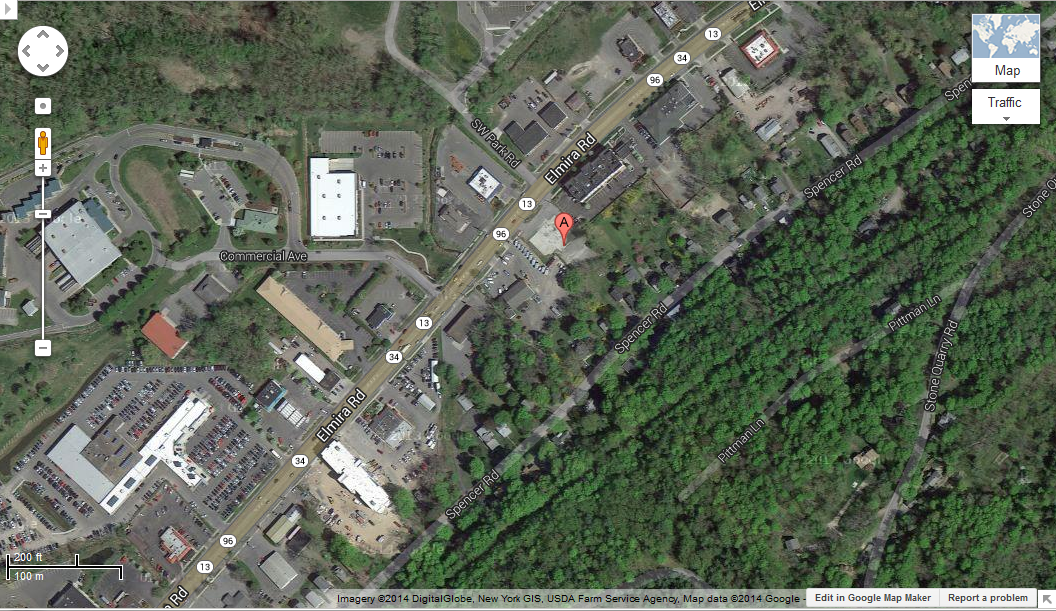
The best part about this project is, I was totally confused when I first saw it, and thought that someone had changed up the Holiday Inn Express proposed for 371 Elmira Road. But I think I can be forgiven for the error – both projects are 4-story, 54′ tall hotels prepared by Optima Design and Engineering out of Buffalo. However, the two projects diverge from there. Project description here, elevations and lot layout here, project application here. The hotel as proposed for 339 Elmira Road is a small one, 37 rooms, current being described as “independent” (no chain affiliation), which given its size is no big surprise. The 6,468 sq ft building is situated for an empty 0.59 acre lot, what was once home to the Salvation Army store before they moved down the road a few years ago and the building was demolished. Jason over at Ithaca Builds reported that the land sold for $143k last summer.

patel_hotel1

The project’s application predicts a time frame of construction from June to December of 2014, and a project construction cost of $1.7 million. What Ithaca gets for that $1.7 million is a typical suburban-style box hotel, a smaller version of what you typically find at highway exits. In a way, that’s what this stretch of Elmira Road/Route 13 is becoming – previously, it was just the Comfort Inn, then the Hampton Inn in 2003, the Fairfield Inn last year, and now this and the Holiday Inn Express are in the proposal stages. That would mean 219 more hotel rooms in this area then there was in 2012.

On a completely unrelated note, the infill project by Heritage Builders at 128 West Falls Street continues their fine tradition of developing underused city/town parcels, even if the designs are a bit ungainly.