News Tidbits 8/13/09: Ithaca’s Economy Gets a Dose of Reality

14 08 2009

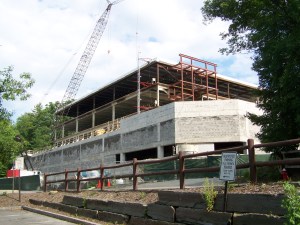
Image property of Welch Construction Inc.

Well, the simplest way to put it is that the sh*t has hit the proverbial fan. Emerson Power Transmission, the company that owns the factory on South Hill, will be shutting its doors next year, putting 228 people out of work [1]. Not to mention the 200+ people they have laid off in the past year.

Name your reason. Energy costs. Cheaper alternatives from overseas factories. Losing a major customer as Magna Int’l shuts down its massive factory in Syracuse. An anti-business local political climate. Oppressive taxes due to an incompetent state government (which I agree with, but I digress). In the end, the jobs are still gone.

Yet, Ithaca continues to survive. A major setback for sure. But Ithaca has been through economic horror stories before.  Consider Smith-Corona.

Smith-Corona was once a large company based out of Cortland, which is 25 miles northeast of Ithaca. Founded in Syracuse in the 1880s, the once employed as many as 10,000 people [2].  Groton, a town just north of Ithaca, was home to a large Smith-Corona factory. They manufactured calculators and appliances, but their speciality was typewriters.

If you’re reading this blog entry right now, I think you can guess where this is going.

Well, with the rise of computers and pocket calculators, their business went belly up. They started to shut down their lines in the early 1980s, with the factory in Groton shutting down in 1983, with the loss of 400 jobs. At the time, 2,800 people were still employed in the factories in Cortland [3]. In 1992, they decided to eliminate 900 jobs from the area, moving them to Mexico [4]. That ended up being a waste too, as the company shut down the Mexican factories five years later. The company originally shifted the Groton jobs to Signapore, to a factory they owned there that had 1500 employees. That shut down a few years later. Today, there’s little left of Smith Corona. Maybe 100-150 employees at a “headquarters” in Cortland, working in consumer electronics services.

Well, life didn’t end in 1983 or 1992. The local communities have continued to survive, perhaps even reinvent themselves to some extent. The loss of jobs always hurts the community. But people get by. Some might move, embittered by the economic loss; others might find other gainful pursuits. Companies such as Advion and Incodema have grown and picked up some of the slack. The wine industry here has grown by leaps and bounds in the past twenty-five years. The area continues to evolve, although it may not always to everyone’s liking.

I’m not trying to diminish the importance of the loss of a major manufacturer. However, I’m trying to make a point that as long as there’s local business talent and people who are willing to take a risk and start new business ventures, then this area will continue to survive, perhaps even thrive in the long run.

[1]http://www.theithacajournal.com/apps/pbcs.dll/article?AID=/20090812/NEWS01/90812029

[2]http://findarticles.com/p/articles/mi_qa3718/is_199901/ai_n8834821/

[3]http://www.nytimes.com/1982/07/01/business/scm-will-close-plant-in-groton.html?scp=2&sq=groton%20smith%20corona&st=cse

[4]http://www.highbeam.com/doc/1G1-13286094.html


Cornell Criticism

12 08 2009

100_3851


What inspired this post were the none-too-charming rankings released recently by Forbes on their “Best Colleges” list [1]. The article itself wasn’t the trigger, but the comments, however…

Where’s Cornell? Where it belongs, behind a lot of small LAC’s where teaching undergrads is actually a priority.”

“…another thing I considered: Cornell has one of the highest suicide rates of all colleges/universities in the U.S. actually, at one point, it was the highest…”

(not true according to the New York Times, but that’s beating a dead horse…)

Now, I could really care less about overall school rankings. Cornell is one of top-rated schools in my field of study, so that’s about the only ranking I ever cared to know. But, there’s a little bit of dark humor to be found in the lengths that people will go to criticize other institutions.

Cornell, of course, is not new to criticism.  The school was maligned in its early years for being co-ed, for not having a religious affiliation, and for some faculty that ran dangerously awry from the norms of the time (one of which included a professor that was an atheist, which in the religiously driven nineteenth century was truly shocking and tabloid worthy). Even today, remarks of “SUNY Ithaca” and “the safety school of the Ivies” still manage to bother some of our thinner-skinned students and alumni. Read Ivygate’s comment section for examples [2].

In the early 1940s, there was “The Dilling Affair”. A student by the name of Kirkpatrick Dilling was brought before the Student Conduct committee and put on parole for engaging in stunts such as blowing dormitory fuses and filling ceiling lights with water. Well, his parents were extreme right-wingers who were convinced that their son was put on parole due to the committee’s underlying communism. Mrs. Dilling came to Ithaca, launched her own investigation, and published a scathering magazine report detailing how the reds has infiltrated the institution from President E. E. Day down. (Bishop, 568)

Sometimes, Cornellians are their own worst enemies. Consider the little feud between Ann Coulter and Keith Olbermann earlier this year. For anyone who wasn’t living under a rock, Metaezra has the full story [3], so I’ll take the liberty of abridging the drama. Coulter, a bastion of invective conservatism, made the remark that liberal mouthpiece Keith Olbermann didn’t go to the same Cornell, but rather state school Cornell (CALS). Most of us who went to Cornell, while aware of the difference (and that the only significant differences between them are source of funding and in-state tuition), but also know that criticism is about as bad an idea as sticking a knife in an electrical socket. But, Olbermann responded back by showing off his diploma on air and bragging about his Cornell degree, Coulter just had to respond back, and the catfight resulting in nothing more than embarassing just about everyone else who ever went to school far above Cayuga’s waters. 

Here’s some of my favorites – building criticisms, as recorded from respondents in the Cornell Alumni News:

Sibley Dome – “the breast of campus”

Rockefeller Hall – “public grammar school No .16”

Baker Lab – “A U.S. Post Office Conferred by a Republican administration”

Olin Hall – “might suit a department of alchemy better than chemical engineering”

…and that was before the sixties and seventies rolled around. The aesthetic critics must be rolling in their graves.

I s’pose Cornellians are their own worst enemies. To quote one more commenter from Forbes:

Wow! A lot of references to Cornell in these comments! As a Cornell graduate, I see that “complex” is still there for many Cornellians.

[1]http://www.forbes.com/lists/2009/94/colleges-09_Americas-Best-Colleges_Rank.html

[2]http://www.ivygateblog.com/2009/03/cornell-fan-admits-cornell-does-not-belong-in-the-ivy-league/#comments

[3]http://www.metaezra.com/archive/2009/03/ann_coulter_is_an_idiot.shtml


News Tidbits 8/5: Ithaca Gun Redevelopment in Financial Hell

6 08 2009

This is really funny, because I passed by the site when I arrived back into Ithaca last week, and thought it was curious that no work appeared to be underway even though it was weekday afternoon. However, I didn’t have the camera with me, so I didn’t bother taking photos of the site before I left for places further north.

On the bright side, the blight that was the main building has been torn down; all that remains on the site currently are the debris/soil piles that need to be moved off-site, and of course the Ithaca Gun smokestack that is to be incorporated into a small pocket park when the property is fully redeveloped. So it could be worse.

One thing should be made clear; although there are cost overrruns with the cleanups of the site, the project to rebuild on the site isn’t cancelled. However, results may be late in coming, and may end up different from the initial plans.

http://www.theithacajournal.com/article/20090805/NEWS01/908050328&referrer=FRONTPAGECAROUSEL

The removal of demolition debris at Ithaca Gun has stopped because the development team apparently doesn’t have the money to pay its contractors.

A series of surprises, increased state oversight and community involvement has resulted in cost overruns totaling almost $1 million, according to a letter from property owner Wally Diehl, project engineer Pete Grevelding and developer Frost Travis sent to Mayor Carolyn Peterson on June 30.

The development team initially estimated demolition and cleanup would cost $1.46 million. They now estimate it will cost $2.3 million, according to the letter, which Peterson provided to the Journal on Tuesday.

The cash-flow situation apparently is so tight, the development team can’t afford to dispose of the remaining debris.

“I think there’s basically an issue of having the money in hand to pay people to do the work,” Peterson said. “My focus right now is not to have those piles sitting there.”

She submitted a resolution, which Common Council will consider tonight, asking that the $840,000 in state money intended for redevelopment go instead toward cleanup.

The city earned a $2.3 million state Restore NY grant to subsidize the developers’ project to clean up the site and redevelop it into 33 high-end condos and a public walkway to the Ithaca Falls overlook.

Appointment of a Community Advisory Group, a lengthy asbestos-removal process and “unanticipated environmental procedures, review and approvals” all led to cost overruns, according to the developers’ letter.

Peterson said it cost more than expected to preserve the smokestack and its foundation, deal with some potentially contaminated bricks, and more strictly monitor of the air at and near the site.

Before Travis’ 2007 proposal, Diehl twice proposed condo projects that would have covered cleanup costs without state help, but they were rejected by neighbors as too large. With no subsidy on the redevelopment side, the project “will require some creativity on the part of Travis & Travis and their architects,” the letter stated.

Peterson said she hadn’t heard any discussion about a bigger project or more condo units.

“Certainly, with working with the neighborhood, the preference was the proposed project. So I don’t know if there’s a proposal in mind, but I wouldn’t be entirely surprised if there needs to be some re-thinking,” she said.


News Tidbits 8/1/09: Edelman Realty Puts Sorority House on the Market

2 08 2009

http://aedelman.com/search.php?mls=129820&startat=20&price1=&price2=&area=&elemsch=&school_district=&new=1&luxury=

Realtor Description:
Own a piece of Cornell History. Delta Phi Epsilon Sorority is an arts & crafts style stone & stucco building on The Knoll. Built circa 1915 with up-to-date sprinkler, fire alarm & other safety systems. Compliant w/all inspection by the City and Fire Department. Living room, chapter room, paneled dining rm, commercial kitchen. 15 rooms for up to 25 occupants.There is an also a one bedroom two-story caretaker’s cottage with a separate driveway. Approximately 18 parking spaces+driveway to cottage.

The house’s list price is $795,000. Technically, the property has two units, the second being the small building in the second photo (both of these photos are from the listing).

100_1359

Personally, I think my photo is more flattering.


News Tidbits 7/29: Hotel Ithaca Gets Green Light; C’Town Terrace Not So Lucky

30 07 2009

In the city of Ithaca, when the only thing standing in the way of construction is a parking/bus stop issue, that means things are looking pretty good for construction in the near future. As for the Collegetown Terrace Project, the anticipated summer 2010 construction start may be more of a pipe dream than a reality.

http://www.theithacajournal.com/article/20090729/NEWS01/907290338/1126/news/Terrace+proposal+raises+historical+issues

ITHACA – Ithaca’s Planning Board has given preliminary approval to the Hotel Ithaca project and has begun the environmental review process for the Collegetown Terrace Apartments.

 At their Tuesday night meeting, planning board members approved a document that laid out concerns on issues such as traffic and historic resources related to the apartment project. 

 The proposal calls for demolishing all but three buildings in the 16.4-acre area bounded by Quarry and State streets, Valentine Place and Six Mile Creek and replacing them with seven buildings that would house approximately 1,270 people. The site currently houses about 635 people. 

 The three buildings that will remain are all within the East Hill Historic District. At Tuesday’s meeting, planning board members and city planning staff said there may be other buildings in the area that are not historically designated but that merit further research on their historic value during the environmental review process. 

Board member Tessa Rudan highlighted the former nurse’s residence, which “may be dedicated” to Finger Lakes native Jane A. Delano. Delano founded the American Red Cross nursing corps, led the entire nursing corps during World War I, and is buried in Arlington National Cemetery, Rudan said.
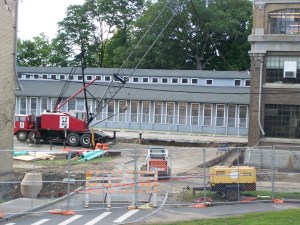

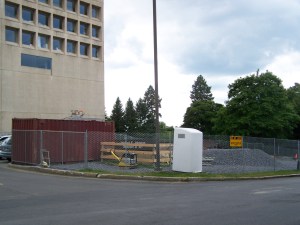
She also has been featured on a stamp in the African Republic of Mali because “she figured out the mosquito netting technique before there was scientific evidence to explain why it worked,” board Chairman John Schroeder said.

Members of the public will have the opportunity to weigh in on issues they think should be addressed in the project’s environmental impact statement at a meeting scheduled for 7:30 p.m. Thursday, Sept. 10, at City Hall, 108 E. Green St. The city planning department will also accept written statements on the project.

For Hotel Ithaca, the proposed $27 million hotel at the eastern edge of the Commons, the biggest outstanding issue is where to locate the bus stop, project architect Scott Whitham said.

While the hotel is under construction, the stop is scheduled to move around the corner to East State Street, near the Community School of Music and Arts. Hotel developers, the city and Tompkins Consolidated Area Transit officials have discussed the idea of moving the bus stop there permanently so that the stop and the hotel drop-off don’t interfere with each other.

The move would require eliminating two metered parking spots, which half a dozen merchants and property owners said Tuesday would spell disaster for their businesses. Property owner Donald Dickinson said he rents to four tenants on the block and two have said that if the new bus stop goes there, they’ll leave.

But keeping the bus stop on Aurora Street could result in hotel guests parking in the bus pull-off, Whitham said.

Schroeder said he wants to make sure the Hotel Ithaca doesn’t mimic the situation at the Hilton on Seneca, where the guest pull-off squeezes out the sidewalk.


Dear Ithaca, How I Missed You…

28 07 2009

I suppose that most people, on their first arrival back to the place they call home, would call their friends and make their presence known. I on the other hand decided to avoid my overcrowded sub-subletted apartment by taking photo of the campus construction projects.

100_1105

100_1050

I have to come back to 107 weeks of this? I just lost one of my main walking paths to class. This is almost like coming back to my girlfriend in bed with someone else.  I s’pose I should be glad I’ll only be affected by this for a year before I head elsewhere.

100_1051

Well, I guess if they were going to close off the street, they might as well take advantage to do soil testing for the Johnson addition. Speaking of which, am Ithaca Journal article mentioned that mercury was found at the site [1]. Considering that the building was a chemistry building, and its first incarnation burnt down back in the days before WWI, this shouldn’t be too much of a shock.

100_1104

The physical sciences building continues on its merry way towards completion.

100_1098

MVR North is also well into its construction. I’m personally hoping the concrete and mortar parking base receives an attractive stone veneer to reduce some of the brutalist qualities of the north facade.

100_1099

The Vet School’s Diagnostic Center has received part of its brick facade, on track for its opening within the next year.

100_1102

Meanwhile, Barton Hall and anabel Taylor (not pictured) are being renovated, mostly with replacement stone for the facade, and roof repairs. Barton has been particularly needy for a reno because the stone on the tower was getting to a point where it was liable to crumble away, and it reasonably couldn’t be put off any longer.

100_1103

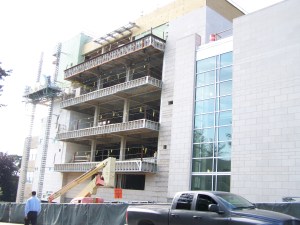
The Hotel School addition is on target for its winter completion date. For a 12,000 sq ft addition, it really sticks out, especially when approaching from the north on East Avenue. Where the Beck Center used to clash with the south facade, now the new addition clashes with the older southwest wing of the hotel school. I don’t think it’ll do much for Statler Hall, aesthetically speaking.


[1]http://www.theithacajournal.com/article/20090720/NEWS01/907200328/Mercury+buried+on+CU+campus


The Keyword Bar V

17 07 2009

100_0619

…because I’m too lazy at the moment to go from computer programming and into an entry that requires research on my part. Here’s a sampling of some of the search queries from the past few weeks.

1. “cornell honors fraternity” 7-17-09

Numerous and varied in their scope and goals. Like with social fraternities, the number of honors fraternities at Cornell seems to have decreased over the years as different organizations merged (often because they became co-ed and redundant) or closed. Here’s some current organizations that I can find (strictly professional fraternities are not included here):

A. Phi Sigma Pi – A general honors fraternity (3.0 standard) [1]

B. Alpha Chi Sigma – Honors chemistry fraternity (discussed previously in this blog)

C. Alpha Epsilon Delta – Pre-Med honors society

D. Eta Kappa Nu – Honors fraternity for compuer and electrical engineers

E. Golden Key – A general honors society for upperclassmen

F. Order of Omega – Honor Society for students in social fraternities or sororities. This one is more about who you know than it is about your GPA.

G. Phi Alpha Delta – Pre-Law honors fraternity

H. Phi Tau Sigma – Food Science honors fraternity

I. Pi Alpha Alpha – Honors Society for Public Administration and Affairs.

J. Pi Sigma Alpha – Government Honors Society

K. Psi Chi – Psychology Honors Society

L. Tau Beta Pi – General engineering honor society

For more info, just head over to http://sao.cornell.edu

2. “modern school no windows” 7-16-09

Windowless buildings have tended to be the product of kneejerk reactions to the energy crisis of the 1970s, or because they were (and in some cases still is) a relatively cheap way to maintain a climate-controlled facility (the lower floors of Bradfield, for example, which protect the plant genetics labs and cold-hardiness experiments). A personal example is that my mother went to a “new” high school in the 1970s that had no windows…by the time she graduated, they had already resolved that artificial lighting was too expensive in the long run, so they renovated it hardly five years after construction.

3. “cornell ilr looked down upon?” 7-13-09

Ask Matthew Nagowski over at MetaEzra. I look forward to his response.

4. “james gallagher, walmart architect” 7-13-09

Really? I didn’t realize Wal-Mart actually hired architects.

On a less facetious note, Wal-Mart has made attempts to diversify store facades to appease locals [2] — Ithaca’s is a good example [3].

5.”cornell couldiest place on earth” 7- 15-09

Ignoring the spelling, the question is still ridiculous. The number of cloudy days in Ithaca in a given year is 206 [4]. While there seems to be some debate as to the cloudiest place on earth, Anchorage, Alaska has 239 cloudy days in a given year, and St. John’s. Newfoundland records 255 cloudy days in a given year. From what I hear, Ben Nevis, a mountain in Britain, records about 290 cloudy days. As an atmospheric science major and as a CNY native, questions like this irritate the hell out of me.

6. “urban outfitters ithaca opening” 7-11-09

This question has appeared in some form about a dozen times in the past two weeks. based off of job postings, the target season seems to “Summer 2009”. According to the CNY Business Journal, the target date is/was July 2, so if someone wants to verify that, that would be great.

7. “redneck castle” 7-10-09

A double-wide trailer with turrets. The royal carriage is a rusted 1976 Chevy Nova.

8. “chi omega coming to cornell” 7-3-09

Possibly, possibly not. Logically, it wold make sense for either Chi Omega, Alpha Omicron Pi or Delta Phi Epsilon to revitalize their dormant Cornell chapter, as they were the last ones to leave campus. However, I’m fairly sure it depends on whether they submit intent to Panhel, who then chooses who they think would be best suited for campus. Using Alpha Xi Delta for example, the more recently closed sororities may not  be the ones invited back to campus. It’s something to keep an eye on in the upcoming year.

9. “married at sage chapel 2009” 7-9-09

Many, many weddings take place in a given year at Sage. I hear that getting a marriage set up in Sage is a bit like Thanksgiving shopping; the best days go to those who are ready earliest, which often requires hours of waiting in anticipation for the annual schedule to open. The rental fee is $300 [5].

10. “cornell’s secret societies” 7-5-09

I’m responding to both this and a comment from a reader suggesting I post them anyway. I was approached face-to-face, which was enough of an impetus for me to remove them. That being said, my work was copied by another website (without my permission, but I gave up trying to get them to remove it). If you look hard enough, you’ll find what you’re looking for, but it won’t be on this blog.

_____________________________________________________________

[1]http://rso.cornell.edu/psp/cms/?q=node/15

[2]http://www.interiordesignschoolreview.com/news/2004/06/walmart_uses_architecture_to_defuse_opposition.html

[3]http://cornellsun.com/section/news/content/2008/12/01/wal-mart-remodeling-moves-forward

[4]http://www.123syracuse.com/cloudycities.html

[5]http://www.cornell.edu/search/index.cfm?tab=facts&q=&id=630


Devil’s in the Details: Fraternity GPAs

16 07 2009


Since this is one of the more clicked-upon data sets on this blog, I figured I would include the latest update: Fraternity House GPAs.

sp09acagreek


So, let’s see what we can pick out concretely from the data:

1. In the fall, Pi Kappa Phi had the highest average GPA, and Sigma Alpha Mu took the academic crown this past spring. 

2. Number of IFC members: 2220. Number of organizations in IFC: 42. Number of people per house: about 53 on average (52.8). The largest IFC house is Sigma Alpha Epsilon with 91 members, and the smallest is Sigma Chi Delta with 12 members. Perhaps unsurpringly, Sigma Alpha Epsilon also saw the largest increase from fall to spring, adding 27 members, and Lambda Chi Alpha (26) and Theta Delta Chi (25) also posted large membership gains (I had been hearing about Theta Delta Chi’s big success since February).

3. The recently reinstated Theta Xi and Kappa Alpha Society continue to eke out a small but notable presence beside larger houses. I hope they continue to thrive.

4. Statistically, the MGLC members have lower GPAs. The average MGLC GPA is about 2.993, and only one organization, Pi Delta Psi, is in the top half of the general fraternal body academic list. Historically black fraternities fare much worse, averaging about 2.73. This data is only readily apparent when pulled from the rest of the values.

Here’s some thoughts:

A. Considering the IFC’s big push for higher GPAs within houses (epsecially during pledging), one imagines that the drop in GPA during the spring will not be looked upon kindly when members reconvene in the fall.

B. The MGLC’s academics are lacking. An average of only 2.99? Only would be acceptable if they were all engineering students.

C. Assuming about 6850 male undergrads (assuming a school that’s half male and has 13,700 students in total), fraternity membership rate approximately stands at 33.99%. However, since two of the house are co-ed, we’ll assume that they’re half-and-half and take off accordingly (-33), reducing our percentage to 33.50%.


Ithaca Really is 10 Square Miles Surrounded by Reality

14 07 2009

So, CNN released its annual “Best Places to Live” articles in its business section (Money Magazine, [1]). Normally, I don’t care much for the highly variable “Best Places” lists that appear in so many published reports, in many different variations, including best places for singles and best places for beer drinkers.

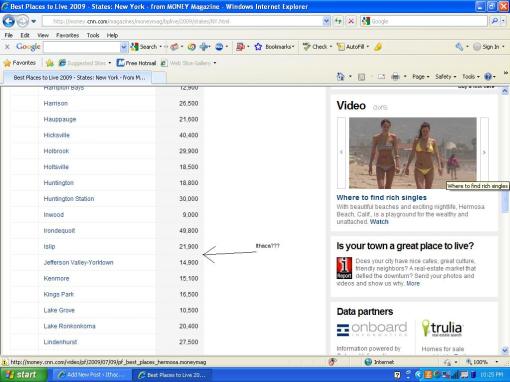
So, the decision making is one thing, and to each their own. But according to CNN Money, Ithaca apparently doesn’t exist. I first noticed this last year, but decided it was probably a glitch, and it would be recognized as the 30,000 person city that it is when they finally came around to updating their lists. But apparently, I was wrong.

http://money.cnn.com/magazines/moneymag/bplive/2009/top100/

Typing in Ithaca says the city doesn’t exist. Examining the list of New York State cities, the disappearance of Ithaca is quite conspicuous.

ithaca

I mean, it would be nice if CNN actually acknowledged Ithaca’s existence. I’m not saying it’s deserving of any awards, but hell, if they’re going to throw in Inwood, an ambiguous town that’s effectively part of NYC, you would think that a regionally distinct city of 30,000 would at least get a footnote in their list of towns and cities.

But, CNN be damned. Some people do think it exists after all, and even deserving of some recognition: http://www.visitithaca.com/Top-10s.html


The Halls of Presidents

7 07 2009

So, I was in an online correspondence with someone, and the comment was made that “apart from donating a s–tload of cash, the only other way to get a building named after you at Cornell is to be the [school] president”. Technically, that’s not true, as Lincoln Hall was named for Abraham Lincoln, and many other buildings were named for important college presidents, like Mann Library and Thurston Hall.

But, I decided to explore the topic a little further and check the “win/loss record” for Cornell presidents [listed at [1]]. Here’s the results.

1. Andrew Dickson White (1866-1885)

A.D. White is perhaps the most important president in this university’s history, so it seems fitting he had a building that was dedicated to him. North University Hall (built in 1866) was renamed White Hall in 1883 in his honor[2].

Result: WIN

2. Charles Kendall Adams (1885-1892)

Charles Kendall Adams was a student of A. D. White who served seven tumultuous years at the university. Unfortunately, although he was more than capable, no building was ever named for him. This could be for several reasons, according to Cornell historian Morris Bishop; for one, the trustees never really liked him; for two, the students weren’t particularly fond of him either. When he did resign, it was under strong persuasion from old Henry Sage, who had developed quite an interest in Jacob Schurman. On the bright side, Adams would accept the presidency at the University of Wisconsin, where a dorm was named after him[3].

Result: LOSS (for Cornell anyway)

3. Jacob Gould Schurman (1892-1920)

Jacob Schurman saw Cornell through the Gilded Age and a period of rapid growth, and during his presidency Cornell was for a short time the second largest college in the country (Bishop 352). However, the building that was named for him, Schurman Hall of the Vet School, was built in 1957 [4]. Jacob Schurman died in 1942 [1]. I guess this one is technically a win, but it’s not like Schurman lived to enjoy the recognition.

Result: WIN (postmortem)

 4. Livingston Farrand (1921-1937)

Our fourth president, while described as a very likable man in A History of Cornell (451), never had any building named after him. The Farrand Garden near A.D. White house is as close as one gets; even then, although it is formally dedicated to Mr. Farrand, his wife was a very avid gardener, so it might be seen as more of  homage to her [5]. 

Result: LOSS (but tell your wife Cornell says thanks)

5. Edmund Ezra Day (1937-1949)

A fairly obvious win on this one. Day Hall, the Cornell administrative building, was named for Edmund Ezra Day, right around the time he decided to retire due to ill health. Not bad, considering this time perios saw very little permanent construction. Up until his death in 1951, Day served as chancellor of Cornell, a largely ceremonial position [6].

Result: WIN

6. Deane Waldo Malott (1951-1963)

Deane Malott oversaw another construction boom on campus. Malott Hall is named in his honor, perhaps because the main person who financed its construction, William Carpenter 1910, already had a building named after him, so they opted to name the building for the retiring president [7]. Even better, Deane Malott had a building named after him on the University of Kansas campus (where he was president before coming to Cornell [8]), so he deserves a double win.  

Result: WIN

7. James Perkins (1963-1969)

For the record, James Perkins was not a bad guy. He just happened to resign in disgrace after the public relations disaster that was the Willard Straight Takeover [9]. Frankly, he was going up sh*t creek when he realized it was too much for him to handle.

Result: LOSS

8. Dale Corson (1969-1977)

Dale R. Corson, who made his nut working in the field of physics [10], dutifully served out close to a decade at Cornell, before resigning the presidency position, sitting in as chancellor for a couple of years before the trustees gave him title of president emeritus. Corson Hall, just off the ag quad, was named in his honor when it was completed in 1981 [11].

Result: WIN

9. Frank H.T. Rhodes (1977-1995)

Frank Rhodes, a 6’7” Englishman, served 18 years as president of Cornell university. Right as his retirement was approaching, the trustees voted to rename the Engineering and Theory Center building Frank Rhodes Hall in his honor (the building was completed in 1990 [13]).

Result: WIN

10. Hunter Rawlings III (1995-2003)

Hunter Rawlings overtook several large capital campaigns for the university’s endowment, and oversaw construction of much of North Campus [14]. The North Campus effort earned him his name on the large semicircular field between Helen Newman and CKB/Mews. Still, it’s not a building.

Result: LOSS (but only on technicality)

11. Jeffrey Lehman (2003-2005)

Well, serving only two years, and then resigning after citing irreconcilable differences with the trustees isn’t going to help your cause [15]. However, while the trustees may never allow a building to be named after him, the $1,000,000 of hush money they paid out to him in 2006 provides a little consolation.

 Result: LOSS (but enjoy the consolation prize)

So, our final tally indicates 6-5. If Skorton rides it out a few more years, maybe we’ll be hearing about the dedication of Skorton Hall someday in the alumni news.


[1]http://www.news.cornell.edu/campus/presidents.bios.html

[2]http://www.cornell.edu/search/index.cfm?tab=facts&q=&id=798

[3]http://www.housing.wisc.edu/halls/history.php

[4]http://www.fs.cornell.edu/fs/facinfo/fs_facilInfo.cfm?facil_cd=1150C

[5]http://en.wikipedia.org/wiki/Cornell_Central_Campus

[6]http://en.wikipedia.org/wiki/Edmund_Ezra_Day

[7]http://www.cornell.edu/search/index.cfm?tab=facts&q=&id=487

[8]http://www.kupedia.org/wiki/index.php?title=Deane_Malott

[9]http://74.125.47.132/search?q=cache:u79OrjoFVGkJ:en.wikipedia.org/wiki/Willard_Straight_Hall+willard+straight+hall+takeover&cd=1&hl=en&ct=clnk&gl=us

[10]http://en.wikipedia.org/wiki/Dale_R._Corson

[11]http://www.fs.cornell.edu/fs/facinfo/fs_facilInfo.cfm?facil_cd=1019E

[12]http://en.wikipedia.org/wiki/Frank_H.T._Rhodes

[13]http://www.cornell.edu/search/index.cfm?tab=facts&q=&id=624

[14]http://en.wikipedia.org/wiki/Hunter_R._Rawlings_III

[15]http://en.wikipedia.org/wiki/Jeffrey_S._Lehman