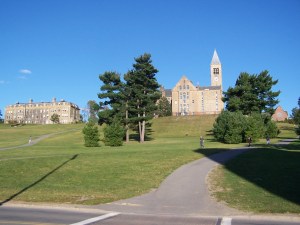
Cornell’s Founding Fathers: Andrew Dickson White

29 06 2009
100_2070
Continuing the Founding Fathers entries, we’ll stop at the other man who helped the university go from a pipe dream to a stone and mortar reality, the illustrious Andrew Dickson White. Once again, the primary source is Bishop’s History of Cornell, with the page numbers in parentheses.

In terms of upbringing and character, White was quite much Cornell’s opposite. White was born in 1832 in Homer, which is also in Cortland County (30). The family moved to Syracuse when he was seven, and his father was a prominent banker. He rejected his Episcopalian upbringing, so his father tried to rectify that by sending him to a church school, Geneva College (now Hobart and William Smith), where he was a sophomore at the age of 16. Since the school was esssentially a bunch of drunken partiers (31), he left after one year (try to imagine studying for an exam while your classmates had barricaded themselves in a room and were attacking the president’s house. It was really that bad).  Although, I find it odd that the entire college had 37 students, and he still joined a fraternity (Sigma Phi). Frats were different animals in those days. Anyways, his father wanted him to go back, but when he showed up, he promptly left school and hid with a former teacher of his while he studied up for Yale’s entrance exams. At this point, old Horace White was furious, and said he would’ve rather received news of his son’s death. Well, A.D. passed the exams with flying colors, and entered Yale as a sophomore, spending a few happy years there, being a member of Skull and Bones and Alpha Sigma Phi (which was a class society back then, before it became a social fraternity — although, he was a tremendous asset to both fraternities as they established themselves at Cornell). After graduation, he hung out in Europe for a couple years, attending German and French schools and becoming all worldly and multifaceted. He arrived back in New Haven in 1856, where he obtained an M.A. and almost became professor, were it not for his anti-church sentiment. He was accepted as a professor at the progressive University of Michigan in 1857 (35), and married Mary Outwater of Syracuse that same year (38). After Horace White died (leaving him $300,000, an astonishing sum in 1860) and the Civil War broke out, White took a long leave of absence and came back to Syracuse in 1862 (41). Being politically inoffensive yet well known in Syracuse, he was nominated for and elected to the State Senate in 1863, hardly 31 years old. Here he met Ezra Cornell.

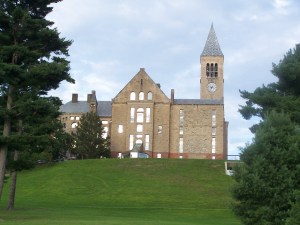
Skipping the university and focusing on White, he served as university president from 1866 to 1885. During and after that time, he served as ambassador to Germany, minister to Russia, and comissioner to Santo Domingo in the Dominican Republic. He was suggested for the Republican presidential nomination in 1884, and for vice-president in 1900. White passed away in November 1918 at the age of 86.

A.D. White’s oddities are so quirky to provide juicy details to any biography about him.

-For one, he was quite short, about 5 feet 5 inches. He was really sensitive about his height, and likely wore elevator shoes (he never admitted it) (43).

-White loved the ideals behind a great university, loved designing buildings and promoting Cornell qualities in print and in speeches—but he hated running the day-to-day affairs. Such work bored him. For a guy know to be excitable, nervous and emotional, routine affairs were not in line with his interests.

-He often dreamed of being an architect or journalist (his architectural designs were based off of  his adored Oxford, which he would’ve made sweet love to in a hypotheical world). He felt that red brick made a building look cheap, hence his distaste for Lincoln and Morse. This is why they were built when he was abroad. [5]

-He only really considered three men his social equals – Goldwin Smith, Willard Fiske, and W.C. Russel (the vice-president of Cornell in the 1870s and 1880s) (45). He hated to be overshadowed and outdone (47), and while he was a sucker for flattery, he would dwell on criticism for days at a time.

-He was known for being very high-minded. One student publication (47) in the 1870s referred to him as “Andy Deity White”. Friends and accquaintances would mockingly refer to him as “You Majesty” and “Saint Andrew”. This high-mindedness was probably why he hated pranks.

-His wife hated Ithaca. Prior to 1874, he used to go up to Syracuse on the weekends. In those days, that involved a steamer on the lake during the warmer season, or in winter a buggy trip to Cortland to catch a train. This was no fun in the CNY blizzards. (100)

-He threatened to resign many times: in 1870, 1871, 1872, 1873, 1879 and 1883. Even when he didn’t resign, he was abroad so often that trustees and staff were begging for him to come back and actually do this job (200).

-Although he was an avid rower at Yale, he never watched Cornell sports matches. He never saw a football, baseball or basketball game (he considered football barbaric), and only saw a Cornell crew race five years after he left the presidency (48).

-He loved animals. He expelled a student in the 1880s for killing a chipmunk with a cane (49). He would allow squirrels to run through his library, even when they chewed on his books.

-His commisioner job in Santo Domingo was because he had to decide whether or not the U.S. should annex the Dominican Republic and make it into a “refuge for colored people” (103). We’re going to assume that his progressive nature, and the fact that the Dominican Rep, was never made into a second Liberia, to mean that he recommended a “no”.

-White’s ultimate grudge came from where he felt he wasn’t given enough credit. When Charles Adams took over as president, he gave an 86-minute inaugural speech, of which 12 were dedicated to White. He was gravely offended because he felt his work was ignored (he expected Adams, a former student of his at Michigan, to glorify him). (258)

-A.D. White met Leo Tolstoy while working in Russia. Tolstoy shared his fascination with Mormonism with White, who then also became fascinated, and amassed a collection of Mormon literature second only to that of LDS and Brigham Young U. itself. This was possible beause the Mormon faith was founded near Rochester, hardly an hour drive from Ithaca, so he raided local collections. [2,3]

 He was a great man, of course. But White would’ve been the old guy to tell lone, rambling stories that would put people to sleep, full of his own pomp and circumstance and still trying to share his ideals with anyone who had two ears and half a heart to pay attention. He was rather needy and attention seeking, and begrudged those whom he felt didn’t give him proper credit.

Our founders are only human.

[1]http://www.cornell.edu/president/history_bio_white.cfm

[2]http://www.absoluteastronomy.com/topics/Andrew_Dickson_White

[3]http://en.wikipedia.org/wiki/Life_of_Joseph_Smith,_Jr._from_1827_to_1830

[4]http://www.fullbooks.com/Autobiography-of-Andrew-Dickson-White1.html

[5]http://www.chem.cornell.edu/history/laboratories/Morse.htm
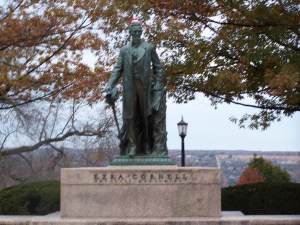


Cornell’s Founding Fathers: Ezra Cornell

27 06 2009


100_2075

So, one of the comments received recently on this blog suggested I write an article on an individual. I thought about it, and then  decided against it. I’m limited in what I can say, as I’m sure people have both good and bad opinions of this person, as they would anybody. I write about Cornell and groups that comprise it, but with the extraordinary exception of Mary Tomlan ’71, I generally limit myself in comments on individuals.

However, I decided to take the idea and run with it in another direction, by revealing a little of the history of the founders who shaped much of the university in its formative years. This entry will cover Dear old Ezra Cornell himself. Any citations within the entry will refer to Morris Bishop’s History of Cornell unless otherwise noted.

A lot of Cornellians know bits and pieces about the founders of Cornell. Dear old Ezra himself, born in 1807 in downstate New York to a quaker family (Bishop 8), moving to the Cortland County town of DeRuyter at 12, and then to the boomtown of Ithaca in 1828. According to Bishop, he was a tall, gaunt gentleman, disinclined to show emotion or to talk more than necessary. He married Mary Ann Wood in 1831 (12). Initially, Ezra made his living operating a flouring mill for Col. Jeremiah Beebe (flouring mills would ground up gypsum to be used in fertilizer). After the Panic of 1837 (akin to today’s economic crisis, only craploads worse), he lost his job and tried his hand at several ventures, including selling plows in Maine and Georgia, which failed (15). When he went back on another trip to Maine in 1843, he lucked out, and an accquaintance asked him to design a machine to lay telegraph lines. Being a self-taught mechanic, he built it, received a contract to lay the wire, became convinced it was bad method, and read up on electricity, coming to the conclusion that overhead wires were best (16).

As a builder of wires, he made his fortune, and by 1849 had laid one-third of telegraph wires operating in the U.S. (17). Since he took his payment in stock, when Western Union bought him out around 1855, he was a made man. He went back to Ithaca, bought the land where CU sits today, and ran a model farm. He became president of the NYS Agricultural Society, and used some of his money to donate a library to Ithaca City (which was built at the SE corner of Seneca and Tioga it was demolished in 1960 as part of urban renewal. It was turned into a parking lot). He was the oldest member of the State Senate when he was elected in 1863 (persumably in the days before they had political gridlocks that accomplished nothing but gave everyone a mighty headache). It was here that he met A.D. White, when he was getting a bill of incorporation for the library (White, as the head of the Literature committee, had to approve the bill). I’ll be covering Andrew Dickson White in an entry in not too near future.

So anyways, the basic facts are great and all, but Ezra also had his oddities and faults. These are the facts Cornell probably doesn’t share so much. Can’t blame them-

~Ezra was extremely self-righteous, which led to him being scorned by most of the Ithaca community. He was also extremely forgetful with regards to his debts, and his family’s needs (Bishop 13). People did not trust him, especially with money. For many years, his wife and kids had to live off her father thanks to his lack of provisions.

~He was apparently quite tactless as well. Col. Beebe, and later Samuel Morse (of Morse code fame) would have a hard time dealing with his demeanor. Beebe called him “coarse and impudent” (13), and Morse referred to him as “the plague” (17).

~Carl Becker just out-and-out called him a bad businessman. The fact that he managed to make a fortune in the telegraph industry was astounding to even his own family and friends. He beat competitors by “starving them out”, even if it meant keeping himself in the poorhouse. (18)

~Family and friends did not pronounce his last name Cor-nell. They pronounced it Corn’ll. His own pronounciation of his name changed sometime in the late 1840s or early 1850s. (19)

~Cornell hated Syracuse. He referred to as “that Gomorrah” (11) after he was cheated out of some wages when he was young. Kinda funny that A.D. White represented Syracuse in the State Senate. When White proposed using a large hill to the south of Syracuse, Cornell threatened to withdraw from the proposal unless the university was moved to Ithaca, which he had hopes of becoming a major city. Well, it didn’t, and the proposed hill was where Syracuse University established itself in 1870.

~Cornell’s vision of the campus was that of an industrial campus, egalitarian in nature. Namely, anyone could work their way through school, in the chair factory and shoe factory he proposed to set up on campus (126),like a trade school. One could not have been farther from the classical college educations of that time, or from A.D. White’s vision of CU.

~Perhaps tying to Cornell’s unorthodox nature, a Rochester newspaper concocted a story in October 1869 that Cornell sought to make a huge personal profit out the university (183). Doesn’t sound too different from the stories you find in editorials in the Ithaca Journal about how Cornell ruins the city. It came up again in 1873, when a Schuyler County legislator accused Cornell of defrauding the Morrill Act in order to make a $22 million profit, which resulting in a formal state invesitgation (it cleared Cornell in April 1874[186]).

~Cornell loved to invest in railroads as much as he did his own university. His desire to make Ithaca a major city resulted in a constant investment in new railroads in and around the area, such as the Elmira-Ithaca-Cortland route and a proposed route to Auburn. He invested so much that White and Cornell’s attorney thought he might go bankrupt if something were to happen, like the Panic of 1873. Uncle Ezra lost a lot on those failed railroads (187).

~In what I can only describe as completely creepy, Ezra had nine kids [1], and sadly, one of them, Charles Carroll Cornell, died at the age of 4 in 1837. So Two years later, his wife had another son. They named him Charles Carroll Cornell. This child died at two years of age, so at least he never had to realize the utter sketchiness associated with named after one of your dead older brothers.

Long story short, Cornell could be stereotyped as the rather crotchety old man who would scare small children at a glance and launch into stories of “when I was your age” to be shared with the students.

http://en.wikipedia.org/wiki/Ezra_Cornell

http://rmc.library.cornell.edu/Ezra-exhibit/time/ECfa.timeline.html

[1]http://www.nndb.com/people/456/000135051/


One Year Later

18 06 2009

So, here it stands. It has been almost exactly one year since this blog was launched (add about four hours, and we’re there).  I’m not big on statistics for the site, but here’s some numbers:

Number of hits: 29,800 (about 82 hits/day)

Monthly stats:

graph

 The highest month, with 4,080 hits, was March 2009. It’s trailed off since then, probably due to a number of reasons, most of which have nothing to do with this blog itself.

Consider the following (and not nearly complete list of) events from the past year:

~Weill Hall was formally dedicated, the last West Campus houses opened, Milstein was (formally?) approved, and the Animal Diagnostic Center, Hotel School Addition, and Physical Science building continue their trek to completion (as for the ERL project, I have no idea where that stands with regards to our economic issues). Speaking of which, a new construction freeze was announced, and $2 billion evaporated from the endowment.

~Over at I.C., the Williams Gateway building was completed, and the new indoor fitness facility is now awaiting the first signs of construction. IC and the city also learned that fireworks near the new Park School of Business building weren’t the best idea.

~In the city, the Cayuga Green Apartments were completed, while the condos still await construction. A 9-story hotel was announced for downtown, and the Collegetown moratorium expired, allowing the proposal of a 1200-bed project off of State Street. The Ithaca Gun plant was finally torn down, but not without persisting environmental concerns.

~In Greek Life, Alpha Omicron Pi deactivated its Cornell Chapter. Theta Xi moved around, and Psi Upsilon was reopened after its alumni had concerns with the current membership. Right now, it looks like Alpha Xi Delta might be moving around as well.

A lot changes within a year.


I hope that this blog has helped answer questions that people may have concerning Cornell U and its environs. To me, if this blog makes someone a little more knowledgeable or at least an interesting diversion, then it has done its job.


News Tidbits 6/16:A Preservationist’s Trick

16 06 2009

I’m so glad she’s not running for re-election.

http://www.theithacajournal.com/article/20090616/NEWS01/906160334/1126/news/Some+owners+balk+at+historic+designation

100_1754

Some Collegetown property owners are calling the potential historic designations of their buildings unsafe, unfair and an attempt to stop development.

The city officials behind the list of historic resources in Collegetown say they’re trying to protect a legacy of beauty that will ultimately strengthen the city’s culture, economy and desirability as a tourist destination.

Planning Board Chairman John Schroeder and Common Council Alderwoman Mary Tomlan, D-3rd, have compiled a list of 31 “Collegetown Historic Resources Worthy of Detailed Research.” Both the 2007 Collegetown vision statement and the proposed Collegetown Urban Plan call for identifying historic resources in Collegetown.

The 31 resources, primarily buildings, are being studied this summer for a variety of historic recognitions, including potentially formal historic designation, which would prevent a property owner from tearing a building down and redeveloping it. Both the Ithaca Landmarks Preservation Commission and Common Council have to approve new historic designations.

Joe Leonardo, owner of the Royal Palm Tavern, said some of the identified properties could be worthy of historic designation, but the Royal Palm is not one of them.

Tomlan said the Royal Palm is historic in part because “it’s not like any other bar in Collegetown.”

“It’s a very distinctive facade with its round windows and with its distinctive entranceway,” Tomlan said. “And it has been so well kept up; I mean, they do such a good job of keeping it painted. It’s been an image on the Collegetown streetscape for many decades.”

Leonardo said he paints the facade so often because “every year the front of it falls off.”

“Why didn’t she (Tomlan) come to me and ask me what I thought? It’s going to decrease the value of my property because no one can develop on it if it becomes a historic landmark,” Leonardo said. “Is that my reward for keeping this business in the family for the past 70 years? They’re just anti-development, and it’s pretty transparent what they’re trying to do.

Historic recognition is a part of good planning, tourism and economic development, Schroeder argued.

“I’ve said throughout this that I strongly want and desire redevelopment of certain areas of Collegetown to happen,” he said, citing the 300 block of College Avenue as one he’d love to see redeveloped, and the east side of the 400 block as one that should be preserved.

“Appreciating historic resources is part of what makes a community a community,” Schroeder said. “It helps us understand our links to past generations, what they bequeathed to us. It helps link, especially in a college town, past generations of Cornellians, perhaps the parents of current students, to current generations and future generations of Cornellians and Ithacans. It’s part of what attracts tourists to a community. It’s part of what gives a unique sense of place, a special sense of character.”

Historic preservation is important, but so is providing an adequate supply of safe housing close to campus, argued property owner George Avramis. His building at 403 College Ave. is on the list of historic resources.

“(Having) older wood-frame buildings in that kind of densely populated area is, I think, a very dangerous approach to take,” he said.

The building next door, 407 College Ave., burned to the ground in 1998 when a fire that started in a first-floor restaurant spread quickly through the building, he said.

“Someday I would like to tear it (403 College Ave.) down and put up a nice, new, triple-A-fire-rated building, fully ADA handicap accessible, like 400 College Ave., the Starbucks building,” Avramis said.

Sarah Iams lives at 116 Oak Ave., which is cooperatively owned by the Gamma Alpha Graduate Scientific Association. Iams said her biggest concern with the possibility of a historic designation is the extra time and effort involved in getting city approval for maintenance issues.

Once a building is designated historic, any exterior maintenance or lot changes have to be approved by the Ithaca Landmarks Preservation Commission. Interior maintenance does not require approval.

“As a graduate student co- operative that maintains the property ourselves, processes that might seem like small administrative hassles for a typical landlord or homeowner are a strong barrier to our successful operation,” Iams said by e-mail.

Tomlan said she’s talking with city staff about setting up a public meeting in Collegetown sometime this summer for property owners and others to come learn about and provide input on the historic resources proposal.

Alderman Svante Myrick, D-4th, is the only student on Ithaca’s 10-member Common Council, and he’s been the most vocal proponent for redevelopment in Collegetown.

“I think some of the sites are absolutely worth historic preservation, mainly Cascadilla (Hall) and the (College Avenue) bridge,” Myrick said. “But I’m glad they’re doing more research on this because I’m not convinced that this is not a thinly veiled effort to stop development in the areas where the zoning’s going to change.”

Tomlan, an architectural historian, said she views the historic resources list “as a positive thing, not an obstructionist thing.”

“I would not want to see it as stopping development,” Tomlan said. “It is a recognition that our community is layered by its history and that our lives can be enriched by knowing and seeing pieces of that history. There’s nothing thinly veiled about it. It is a positive statement about the value of our aesthetic and cultural past.”

At 7 p.m. this Wednesday, Common Council’s Planning Committee will hear a report on the Collegetown Historic Resources list. They’re also scheduled for a public hearing and a vote on the Collegetown Urban Plan. The meeting is at City Hall, 108 E. Green St.

The most recent version of the Collegetown plan is at www. cityofithaca.org.

***

For the record, I want to say that I am not anti-preservation. I wholly agree with preserving Cascadilla Hall and the College Avenue Bridge, because of the historic and aesthetic qualities that they bring to the Collegetown area. That being said, the Palms is historic in the same way that a Ford Pinto is a classic car.

100_0649
A beauty it ain’t.

So, I decided to have some fun and look to see which designations I agreed with on the historic recommendation PDF. As much as I dislike Tomlan’s views, I give her a lot of credit to her and John Schroeder (who works for the Sun?) for digging up the history behind the structures she recommended for preservation.

If I didn’t write anything, it means I wholly agree with historic landmark status.
1. College Avenue Bridge
2. Grandview House (209 College Avenue)
3. Cosmopolitan Club (301 Bryant Avenue) –  This apartment house was the clubhouse for international students in the early years of Cornell, I wholly agree on its preservation, but maybe not on full designation, since that tends to make renovation difficult, and this building is severely worn down and could really use some work.
4. Royal Palms – Little historic value, apart from taking up a space. Extremely run down, possibly unsafe since it’s an old, large wooden structure, and a fire could be disastrous. Not only does it not deserve preservation, it deserves to be torn down.
5. A.D.White’s Eddy Gate – Derided in its own time for being an obstruction and for being ugly (see Bishop’s History of Cornell), this is already designated.
6. The Johnny’s Big Red Grill Sign – Already gone.
7. Cascadilla Hall
8. Sheldon Court
9. The Nines – What used to be the Collegetown fire station.
10. Snaith House (140 College)
11. Flagg House (210 Mitchell)
12. Cascadilla Prep (Wait Hall)
13, 14 ,15. 113, 116, 120 Oak Avenue. 113 is one of the few actual fraternity houses that existed in Collegetown (Alpha Chi Sigma, from 1920-1955, when they moved to north campus). Today, the house is rented mostly by members of one of the honors fraternities. 116 and 120 face the gorge, and 116 is home to the biology grad student honors co-op Gamma Alpha. However, I have to disagree with historic designation. The two houses next to gorge would be extremely difficult to redevelop, and designation would make renovation difficult.  As for 113, I would think it a shame to be torn down, but I wouldn’t argue against it.

16. The Larkin Building (403 College). Personally, I always considered this one part of the Ciaschi Block. Although Mr. Avramis argues that he wants to build a new building on the site, the current one fits in so well that he would have to go through raging hellfire to try and tear it down. My personal hope would be that he tear down the two-story brick s–tbox across the street where his offices are located.

17. Chacona Block (411-415 College Avenue) . Same case as above. I can imagine the preservationists would come out in droves if they tried to take this one down.

18-23. 103, 119, 121, 125, 127, 129 College Avenue. I can understand the historic value, but I fear that designation would harm the ability to renovate these structures. I would rather seen this handled such that if someone proposed something, that all due discretion is exercised.

24-27. 117, 119, 121, 123 Linden Avenue. Wholly against. My hometown, which built out in the 1920s and 1930s, is filled with these types of homes. They are of little historic value, and certainly not a “historic resource”. My inclination is to believe they selected these houses because there was recently a large property transaction in this area, so they’re trying to stop development here before it’s even proposed.

28. 120 Linden Avenue. At 140 years old, this may be the only house they have designated on this street that is worth giving landmark status.

29-32. They didn’t count the Big Red Grill Sign in the final total, so there were actually 32 desired landmark designations. The last four are trails and ruins, of little overall merit but of considerable aesthetic value.

So, I completely disagree with five designations. I feel that many of the buildings have historic merit, but that historic landmark status might be going too far. However, this is why we have planning boards, so that people can vote down projects is they stand to be detrimental to the neighborhood.


Rumor Mill: Alpha Xi Delta’s New House?

9 06 2009

Being in another part of the country sort of limits my ability to keep this blog as active as it usually is. That being said, occasionally some tip or rumor comes along, and if it piques my curiosity, I’ll sooner or later get around to addressing it.

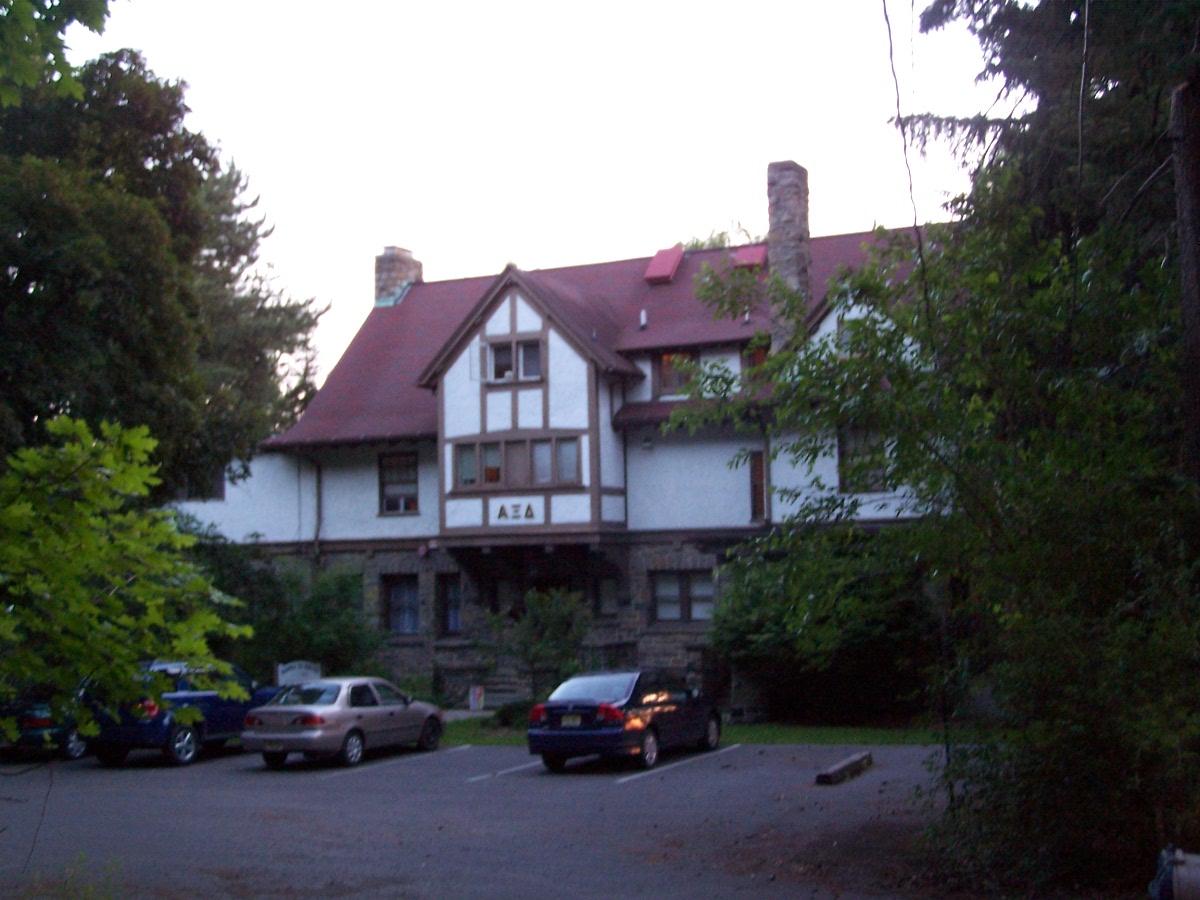
In this case, it would appear that popular rumor is ciruclating that Alpha Xi Delta sorority would be moving into Alpha Omicron Pi sorority’s old house. To make a long story short, AOPi closed this past year for a number of reasons, leaving their recently renovated (and rather luxurious, if I dare say) house on Ridgewood Road open. The house itself has a long storied history of being involved in the Greek system, with no less than four different Greek organizations calling at home at some point or another in its nearly one-hundred year history (see other entries).

The rumor has its plausible points. For one, Alpha Xi Delta doesn’t own their house at 115 The Knoll. That house is still owned by Delta Phi Epsilon sorority, which closed about six years ago [1]. Rumor mill seems to suggest that Alpha Xi Delta’s moving to Ridgewood may not be permanent, as AOPi stated that once the last sisters graduate (2011?), the sorority is hoping to reactivate itself, persumably in the house it owns.

I guess my question is, if the rumor turns out to true, then what’s being done with 115 The Knoll? Is Delta Phi Epsilon reactivating, or is the house intended for another purpose? I s’pose only time will tell on this one.

 [1]http://www.rso.cornell.edu/DPhiE/DRhistory.html


Campus Comodes

31 05 2009

The running title for this one was “The Best Seats on Campus”, but I thought that one was already used by the Sun. 

Anyone who has ever been on campus knows that at one time or another, nature’s calls have to be answered. It helps to have a completely subjective and not all that extensive guide to consider when using them. The idea for this entry came from an eight-mile run I went on last week, where somewhere on mile four I was hit with the intense pressures of the excretory system, which left me hobbling half a mile to the southeast edge campus, trying six different academic buildings before I could find an unlocked door and make my way to a bathroom to relieve myself (it was about seven p.m., hence the problem with the locked doors). But look, it provided a lovely conversation topic.

Unless otherwise stated, all bathrooms are first floor or the main bathrooms for a given building. All bathrooms are also mens’ rooms, since being arrested is not high on my list of things to do before I leave Ithaca.

For those who may recall, the Sun did a nice little piece rating bathrooms some time ago, which I’m unable to find a link for online (if anyone does know the URL, I’ll be more than happy to post it here). I’ll be using the same three-star system.

100_0655

100_0654

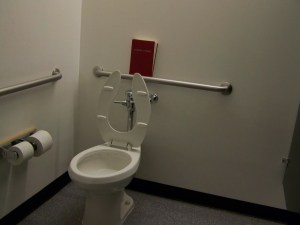
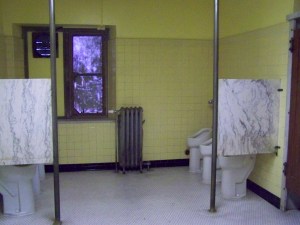
Our first pit stop is Olive Tjaden. Tjaden satisfies the basic needs by being a clean, well-lit room, and amply stocked. the decor is (surprisingly) sparse for an arts building, and the panoply of pipes up at the ceiling leaves something to be desired in terms of aesthetics. But holy crap does this room have a lot of space. Like, as much space as the big bathroom in Olin Libe that should really only be used by handicapped people, only this one you don’t risk getting yelled by some woman in a wheelchair as soon as you open the door.  I threw in Bishop’s History of Cornell book to give a sense of space.

Rating: * * *

100_0656

100_0657

Likewise, McGraw is adequately equipped to handle bathroom needs, but lacks the spaciousness of Tjaden, and we all know that space can be a big plus if you’re carrying a lot of crap (no pun intended). However, it does have a nice cheap-looking pillar running throught the stalls, as if to make a half-hearted appeal to be different.

 Rating: * *

 100_0658

100_0659

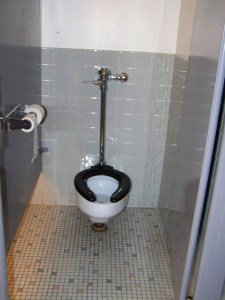
Uris Library is designed to be a high-capacity facility, so as a result, the frills are lacking. I maintain that the bookshelf against the wall of the urinals probably has some of the least-used shelves on campus. My one complaint is that on particularly wet and muddy days outside, all that just gets tracked into here, since the bathroom is so close to the entrance. Therefore, the rating changes depending on the day – decent (* *) on a good day, poor (*) on a messy day outside.

Rating: * * (dry weather day)  / * (wet and/or muddy day)

100_0660

Getting a photo of Olin’s bathroom was notoriously difficult thanks to the high volume traffic, even during this time of the year (these photos were taken during last week). Olin Libe’s main bathroom is in the basement, so it benefits from being a farther walk, as people have a chance to shake the mud and water off their shoes before they make it to the bathroom. While most restrooms make use of a privacy hallway to prevent peepers, Olin makes use of a second door , which can be both a blessing and a curse if someone is coming from the other direction.

Of course, in the 1980s, Olin Library bathrooms were much more invasive; here’s a DUE from Janurary 1987 [1]:

“DEAR UNCLE EZRA:

WHY ARE THERE NO DOORS ON THE MEN’S ROOM STALLS IN OLIN LIBRARY?

                                            ????????


Dear Wondering About No Privacy,
Apparently, a few years ago a University Librarian learned that the downstairs public men’s room in Olin had become a preferred meeting place on campus for gay men.  This person freaked out and ordered the men’s room closed.  This was strongly protested by some of the male staff members. The compromise was to reopen the men’s room, but remove the doors from all the stalls so there wouldn’t be any privacy.
        When you raised this question, and I consulted a current member of the staff about the issue, he volunteered to write a letter to the new University Librarian, Alain Seznec, about this matter and see whether he will order the doors re-installed.  Hopefully, privacy may return to Olin. “
 
Yeah…so thankfully, we have stall doors.
 
Rating: * *
 
100_0664
100_0665
 
When Willard Straight was completed in 1925, not only did men and women have seperate bathrooms, they also had seperate entrances (women came in through the south entrance [2]).  The men’s bathroom is just tired-looking and worn down, the sole redeeming trait being the well-used antique scale sitting outside the main bathroom, in the corner of the privacy hallway. Really, if you can afford to wait, walk over to the other side of the building and you the cleaner and much more spacious unisex bathroom (be sure to lock the door). Be advised, the unisex room comes with a giant mirror, so you find yourself seeing more of yourself than you normally care to.
 
Rating: * (men’s room) * * * (unisex restroom)
  
100_0666
100_0668
  
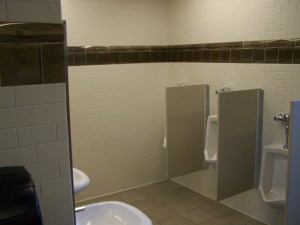
Here’s one for the engineers. As those who have had classes on the engineering quad may have noticed, men’s rooms outnumber ladies’ rooms by a considerable number (a fair guess is 3:1), thanks to the majority male engineering student population. That being said, the men’s rooms of Thurston have nice little assets like privacy barriers between urinals, but they also have those incredibly obnoxious sensors to flush the toilets. You know, the ones that go off as you stand up to wipe, or fail to go off at all and you’re left there trying to figure out how to finish business. I have a personal vendetta against automatic flushers, because I think the technology simply hasn’t been refined enough to be useful. Regardless, this is an adequate facility.
 
Rating: * *
 
100_0669
100_0670
 
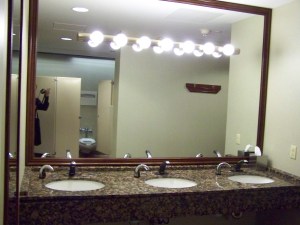
The Statler Hotel is all about impressing the visitor. They do a great job with the bathrooms. The bathrooms are nothing short of luxurious, and make you feel like you’re somebody. There’s even a vanity mirror and polished stone counters. The trick to getting to using this bathroom is to walk in and appearing more like a guest and not a student; that way, the employees won’t give you dirty looks when you’re heading back out.
 
Rating: * * *
 
100_0671
100_0673
 
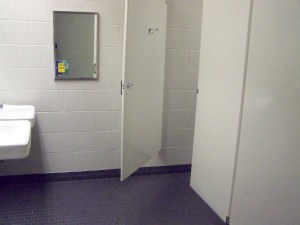
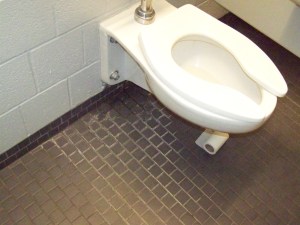
Somehow, I had this expectation going into Ives that the bathrooms would have extra safety and specialty features. To my dismay, they weren’t all that different from any other bathroom on campus. While the rooms were spacious, I can’t give three stars beceause of a slight amount of water damage to the tiles near where the toilet is hinged to the wall. Yes, the t.p. was under the toilet when I arrived here.
 
Rating: * *
 
 
100_0675
 
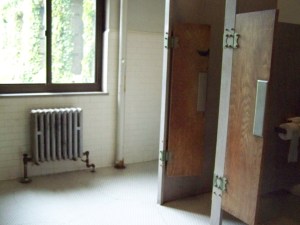
Plant Science must have the scariest bathroom on campus. Rotting tileworks, mildew stains, old fashioned doors and frickin’ bath towels hanging over one of the stalls were enough to give this room a bad rep. It doesn’t help that this was the bathroom that was claimed by some to have cockroach infestation issues not too long ago.  Let’s think about that for one moment. Cockroaches while you’re on the crapper.


 Use at your own risk.
 
Rating: *
 
100_0676
 
 100_0678
Last but not least, we come to our newest bathrooms, the ones installed on the first floor in Weill Hall. They’re installed rather conspicuously near the atrium, which might make for some uncomfortable rendezvous, but otherwise, they’re well appointed.
 
Rating: * *


[1]http://ezra.cornell.edu/posting.php?timestamp=538462800

[2]http://www.fs.cornell.edu/fs/facinfo/fs_facilinfo.cfm?facil_cd=2020


The Essentials of Campus III: Sage Chapel

29 05 2009

100_0923100_3407

Moving on to yet another fixture of the Cornell Campus, we have the first religious building constructed for the university, Henry Sage Chapel.

So, most Cornellians are at least aware of why the chapel was built- Cornell, being founded as a nonsectarian university, was often attacked by its detractors for its lack of religious emphasis, earning itself the nickname “the heathens on the hill”, or “infidel Cornell”. A.D. White could’ve cared less, as he was enormously proud that the university touted nonsectarianism and voluntary church attendance (White always made the claim that Cornell was the first to have voluntary chapel, but that distinction actually goes to the University of Virginia (140). Regardless of opinion, however, the vast majority of students at the time were church-goers, so Henry Sage, one of the original trustees (and an enormously wealthy benefactor of the university), donated money to construct a chapel so that students may be able to attend church services on campus rather than having to venture down to the various houses of worship in the city.

Lore has it that when Mrs. Sage was looking through the plans for Sage College in 1872, she noticed a small corner of the building was to be set aside for a chapel. Supposedly, she turned to her husband and exclaimed, “is that the only provision in that great university which is made for chapel services?”, and the following day her husband approached A.D. White with the idea of build a proper chapel (193). Look ins back towards the facts, Sage had originally proposed a university chaplain, which White staunchly opposed (194), suggesting a lecture series in Christian ethics (along with other faiths) instead. So when the chapel was first built, it had a lecture series given by both local and well-travelled preachers, but no permanent clergyman.

The original Sage Chapel was completed in 1875, about the same time the first student handbook finally suggested that services were merely voluntary. Over subsequent years, Sage was remodeled and expanded numerous times (1884, 1903, 1939) before the construction of Anabel Taylor in 1953 did away with the need for further expansion. The original Sage looked something like this:

Sage Chapel as it appeared in the late 1870s.

Sage Chapel as it appeared in the late 1870s.

The original construction was less than half the size of the current Sage Chapel, and sat 500 worshipers (194). The house to the right (east) was home to Professor Charles Babcock, who also happened to be the person who designed Sage Chapel. According to Morris Bishop, morning services were usually poorly attended as students preferred churches closer to their boarding houses in the city, but afternoon services were often packed. Electric lights were installed in the belfry of Sage Chapel in 1879, the first in the Ithaca area (a fact that they included in the free agendas you picked up at the registrar—or (202)). The Mortuary Chapel, where John and Jennie McGraw, Mr. and Mrs. Henry Sage, Willard Fiske Ezra Cornell, A.D. White and E. E. Day all lay at rest, was completed in 1884 (all are bodies except Day, who was cremated and had his ashes interred in the chapel in 1951). A.D. White was known for giving much attention to the details of the chapel exterior, so that students would have a good moral impression (236). It should be noted that Fiske, who died seven years after Henry Sage, was interred during a football game with Penn, so hopefully no one would pay much attention (356). This was an epic fail, because Sage’s two sons were a little angry that their father’s enemy was allowed to be interred in the same mortuary room, so they resigned their trustee positions four days later in disgust, and severed all ties to the university.

So, that largely fulfills our little history portion. Cornell has a nice little book out there for those who are interested in some of the finer points of Sage Chapel, but for those of a more casual interest, going inside the ornate chapel is a real treat, especially if you can sit in on a session on the organ.

100_3408

Many of the windows are dedicated in memoriam to those whose lives were cut short. Among examples are students who died during the smallpox outbreak of the late 1800s, and the Cornellian who was killed during the Civil Rights protests, Michael Schwerner ’61 [2].

100_3400

I’ll be honest; as someone who doesn’t regularly attend services here in college but still considers himself a Christian, I do not nor have I ever been greatly comfortable with even taking photos in churches, because to me it feels disrespectful. Hence the relative lack of them.

[1]Morris Bishop, A History of Cornell. Ithaca: Cornell University Press, 1962.

[2]http://en.wikipedia.org/wiki/Mickey_Schwerner


The Keyword Bar IV

27 05 2009

100_3482

Yeah, it’s a cop out. I’ll do a more substantial entry in the next day or two. After that, I’ll be 800 miles from Ithaca for my summer work, so updates might be sparse in June and July.

1. “collegetown terrace apartments architect” (5-22-09)

Well, let’s look at the May 26, 2009 Ithaca planning board agenda:


The applicant proposes to construct rental housing aimed at students with approximately 1,260 bedrooms (a net gain of 625 bedrooms) in new and existing apartment buildings on a contiguous site of approximately 16.4 acres. The proposed new building design calls for seven new structures, six of which will be 65’ wide with three stories of apartments and up to two levels of parking at grade or below. Site development will require the demolition of all existing buildings and associated structures, roadways, vegetation, and landscaping on the project site, with the exception of those buildings within the East Hill Historic District. The project is on the R-3A and P-1 Zoning Districts and a portion the site is in the East Hill Historic District. This is Type I Action under both the City of Ithaca Environmental Quality Review Ordinance (174-6 (B)(1)(d), (h)[2], [3] & [4] & (k), (n), & (3) ) and the State Environmental Quality Review Act (617(b)(5)(iii) and is subject to environmental review. An Environmental Impact Statement is anticipated for this project.

Collegetown Terrace Apartments, East State Street, Trowbridge and Wolf LLP, Applicant for Owner, Collegetown Terrace Apartments LLP (c/o John Novarr). Intent to Declare Lead Agency.

In case anyone’s wondering, the board agenda is largely the same as last month, with the addition of two proposed duplexs in the city, and the 121 Oak Avenue Project, which was initially proposed for C-Town before the moratorium went into effect, and is now once again being considered. Offhand, I believe that calls for a three-story, six-unit apartment building.

Trowbridge and Wolf, as mentioned previously, does most of its work for educational and healthcare facilities, as well as forays into urban planning and trail design [1]. Since the closest thing they’ve done to a residential project is Cornell West Campus (which design-wise you either like or hate, and I fall into the latter), it’ll be worth looking at the renderings when they’re released.

2. “direction to teagle hall from anabel taylor” (5-23-09)

Oh, I love graduation season. For the record, the direction would be almost directly east. I’ll admit, it was kinda sad to see some of my senior friends bid their farewells to the place far above Cayuga, but it’s just one more chapter in the history of Cornell. As Skorton said in his speech to the seniors, “we’re counting on you” [2].

3. “cornell gates hall” (5-8-09)

Yes, it has been a while since we last checked in on that. It’s still in the concept phases, i.e. needs more money. [3]

4. “cornell agr hazing” (5-1-09)

Maybe. If there’s three things that always seem to get hits for this blog, they are “suicide”, “hazing” and “average <engineering, aem, hotel…> gpa”. It might reflect poorly, but I don’t feel strongly about it either way, I just think that those topics are the things that people go to the internet for because they tend to be sensitive issues, so people seek anonymity by looking online. Just my two cents.

5. “can i be in 2 frats at the same time” (5-14-09)

Back in the day, yes. In the older days of the late 19th century and early 20th century, many a “college man” could call himself a member of two social fraternities, as well as multiple honoraries and service fraternities. However, the practice was largely shut down by the 1920s and 1930s, as many national organizations wrote additions to their bylaws prohibiting co-membership with other social organizations. Most hononaries and service groups still allow for membership in multiple organizations, as long as they don’t directly interfere with one another’s purpose of activities (ex. you can’t be a member of two business fraternities, but being a member of a professional, a service, and a social is okay).

6. “is a c+ a bad grade cornell” (5-10-09)

Depends on the course, I’d think. Everyone has their own challenges and difficulties in a course, so if you worked your tail off for a C+, then that’s just how it plays out, and you do the best you can, even if it isn’t the best grade in class. Don’t know what else to say.

100_3700

[1]http://www.twla.com/projects/

[2]http://www.cornell.edu/president/speeches/20090524-convocation-address.cfm

[3]http://www.pdc.cornell.edu/project_management/project_management_projects.cfm


News Tidbits 5/20: More Info on the Collegetown Terrace Project

20 05 2009

http://www.theithacajournal.com/article/20090519/NEWS01/905190332/Collegetown+developer+plans+2011+opening&referrer=FRONTPAGECAROUSEL

The proposed Collegetown Terrace Apartments are scheduled to break ground in summer 2010, open in summer 2011 and house primarily graduate students.

On traffic and parking – a major concern for Collegetown residents – the project would provide more parking spaces than required by city zoning, as well as amenities intended to reduce car dependence, such as a shuttle to Cornell and Wegmans.

Ithaca developer John Novarr submitted his full review application report to the city’s Planning and Development Board last week, and he provided a copy to the Journal. Site plan review is scheduled to begin at the city’s Planning Board meeting at 6 p.m. May 26.

Ed Strong, a graduate student representative on the Cornell University Assembly, said graduate student housing is sorely needed and the apartments will be well-received among students.

While Cornell has recently added undergraduate housing on West Campus, on-campus graduate student housing is still inadequate, Strong said. The Maplewood complex is made of modular buildings that are already past their life expectancy, he said.

The Collegetown Terrace project calls for removing all but three buildings in the 16.4-acre area bounded by Quarry Street, East State Street, Valentine Place and Six Mile Creek. The historically designated Quarry Arms, Casa Roma and Boiler Works Apartments buildings would remain.

Seven buildings would be built on the site. The full site, including the three historic buildings, would contain 1,260 bedrooms and 860 parking spots.

The area currently contains 635 bedrooms and 430 spots.

On East State Street, plans call for four-story buildings that meet height restrictions imposed by city zoning.

As the topography slopes downhill toward Six Mile Creek, buildings are proposed to increase to five and then six stories, which would require a zoning variance.

Parking is housed in one or two stories underground and at ground level to minimize surface parking lots. In the initial presentation before the planning board, Novarr said his upper-floor apartments always rent out before ground-floor apartments, because students find them safer and more private.

Novarr plans to charge tenants separate rent for parking spaces and apartments, a measure intended to force people to consider the cost of having a car.

At the Casa Roma complex, parking is rolled into the rent.

Novarr told the planning board rent would be similar to the buildings to remain on-site.

They average between $1,500 and $1,800 for a two-bedroom apartment, according to listings available online.


The Essentials of Campus II

14 05 2009

100_3846

I knew that sooner or later, I would have to cover what is perhaps the most iconic building on campus. So here we are.

All citations, unless otherwise noted, are from Morris Bishop’s A History of Cornell (Cornell University Press, 1962).

Prior to renovation in the 1960s, the building was simply known as “The University Library”, even as other libraries were built across campus. It was Andrew Dickson White’s belief that “A large library is absolutely necessary to the efficiency of the various departments. Without it, our men of the highest ability will be frequently plodding into old circles and stumbling into old errors.” (77) The library was appropriated in September 1867 to the tune of $7,500 (175).  The amount was up to $20,000 by 1880 (213).

Daniel Willard Fiske was appointed the first librarian. He was also head of the university press and an instructor in German, Swedish and Icelandic. It was his belief (and rather progressive for the time) that the library should be a reference library, open to enhance both faculty studies and student interests. As a result, his goals was to obtain, by purchase or gift, extensive book collections, such as the library of Goldwin Smith (6,000 books), Charles Anthon (3400 books) and the like. A.D. White was also known for buying rare books on his overseas trips (both with his own funds and with university money). As a result, by 1873, there were 34,000 books and 8,000 pamphlets in the libe—a substantial figure for an American university. When it first opened, the library boasted that it was open longer than any other U.S. university — nine hours a day.  (108)

Fiske himself was easy to irritate and known for holding deep grudges from insults or perceived slights. Because the first university Vice-President William Russel was known for a gift of mockery, the two absolutely despised each other.  However Fiske was also very kind and generous; he was particularly fond of the Psi Upsilon fraternity men, and was once chastised by White for giving an inordinate portion of his salary to the chapter and its needy brothers (108). He also was chastised for offering a glass of ale to a student, to which he responded that the student interrupted him in his drinking time with a friend, and he felt obliged to offer a glass (108).

Since Fiske was in Egypt when the university opened in October 1868, the actual first librarian was a prominent local lawyer, Thomas Frederick “Teefy” Crane, of “Give My Regards to Davy” fame. Crane studied languages in his private time, and as a result he also was the German instructor at opening.  Crane enjoyed the experience enough that he himself went abroad, came back and switched places with another professor to become the instructor of French, Spanish and Italian in 1870. (109)

So, now we get to the “Great Will Case”. Jennie McGraw, aged 37, received a large inheritance after her father’s death in 1877. Already battling tuberculosis, a number of men offered to marry her, some of which were gold diggers I’m sure. One of the men who courted her was Willard Fiske. He wrote love poems to her, but he never showed them for fear of being called out as a gold digger. Anyways, as the rich and bored are wont to do, McGraw arranged to have a fabulous house built off of University Avenue, bordering Fall Creek, and then bought thousands of dollard of furnishing for it (224). In the meanwhile, both McGraw and Fiske went abroad to different parts of Europe in 1879. There is no record of contact in Europe between the two prior to April 1880. During this time however, Fiske used his influence on A.D. White to work over affairs back at Cornell. Locals assumes that because White was known to have lent Fiske money, and the two were close, that he and Sage were buttering him up so that if he and Jennie were to get hitched, that her fortune would be given someday to Cornell. (225).

In April 1880, Fiske went to Rome to join Jennie, now invalid and near death. The courtship between 48-year-old Fiske and the dying 40-year-old McGaw was short. They became engaged in Venice. Fiske announced it in a letter in May 1880 to A.D. White (along with a request for money). As one can imagine, some people looked upon Fiske’s behavior as mercenary. The two were married in Berlin on July 14, 1880 (226). At the time, Fiske signed a letter giving up his rights to Jennie’s property, under Prussian law.

The two spent the winter on the Nile, and then returned to Europe. By June 1881, the two were informed in Paris that Jennie had only a few weeks to live. Her dying wish was to pass on in Ithaca, so they made the trip back by September. I know, more than a few weeks, but whatever. She saw her mansion, newly built, and said (as she was propped up from her pillows) “it surpasses all my expectations”. It was the only time she ever saw the mansion, as she died September 30, 1881. When she died, Judge Boardman (of Boardman Hall) asked for the will. No one could find it, which would really suck for all parties because then they would have to use John McGraw’s will, and then the inheritance would go to John McGraw’s brother and his five kids since Jennie had no hubby or progeny.  Luckily, they found it in a secret pocket in a handbag that had been dumped off as junk in Fiske’s attic (227).

100_1769

The will stated that Fiske would get $300,000, $550,000 to her uncle and his kids, and $200,000 for a library at Cornell, $50,000 for McGraw Hall improvements, and $40,000 for a university hospital. The university also gained her land estate, including the mansion (valued at $600,000+), which A.D. White thought would be a dream home for an art gallery (227). Fiske, as custodian of the mansion, was to continue to occupy the house, and this raised issues. Namely, that he was known for being very needy financially; he offended Henry Sage by having parties in the room she died in no more than two months after her death; and Boardman simply didn’t like him, perhaps because of a rumor that Fiske suffered from marital indiscretions while in Europe. (228).

Here’s where the real fun begins. In May 1882, the state changed Cornell’s charter a little bit, but in one embedded section, it removed a portion detailing that the university couldn’t receive or hold personal property equal to or more than $3 million dollars. This was very convenient. In June 1883, Fiske was about to settle his affairs by going abroad, when an apprentice lawyer in Elmira told him of the change, and that state law said that a wife can’t leave more than half of her property to charity. As you might guess, the sh*t hit the fan. (228).

So, we have two lawsuits, one to break the will by Fiske on the grounds of Cornell’s underhanded actions, and then another one by Jennie’s cousins, out for more of the fortune. Fiske sailed for Europe, leaving a surrogate to handle things (Judge Marcus Lyon). White sailed after him to beg him to reconsider, but then Sage cabled White to tell him he was to make no offer to Fiske. Most of the Ithaca and Cornell crowd hated Fiske now anyway. After much media attention (like an OJ Simpson trial for the 1880s), in May 1886, the ruling was in favor of Cornell. White wanted to let Fiske save face by offering concessions; Sage would hear none of it. Fiske appealed the judgment, and it was overturned in August 1887, so Fiske won the suit, and the McGraws won theirs. So Cornell appealed to the Supreme Court (231). Meanwhile, the friendship between White and Boardman/Sage had deteriorated to animosity, although Sage made an offer to build a library himself if they failed to get the inheritance. All the while, Fiske was living in a luxurious Italian villa.

In May 1890, the Supreme Court ruled against the university. However, they did say that Cornell’s endowment could be used for any university purpose, which was a small consolation. in the end, Cornell paid $180,000 in legal fees to David Hill, the apprentice lawyer of Elmira, and $100,000 for the McGraws’ counsel. One of Jennie’s cousins bought the mansion for $35,000, much to White’s anger. The house was sold by the McGraws to Chi Psi fraternity in 1896. Its furniture was auctioned off, mostly purchased by the other McGraws. Fiske’s lawyer never took another case—it was rumored he drank himself to death during the celebration (232).  Henry Sage donated $500,000 for the library to be built, as was done in 1891. Willard Fiske returned to hobnobbing with the rich and famous, and book collecting. When he passed in 1904, he donated his library as well as his estate to the university. He also requested to be buried with his wife in the mortuary of Sage Chapel; when the university granted the request, the Sage family severed all ties to Cornell.  (232).

***

100_1950

Long-winded, isn’t it? Well, I’ll go on for a just a little while longer. I have to make up for some lost time.

The actual cost of the libe was $227,000, with room for 400,000 volumes (Cornell owned about a quarter if that at the time) (271).  When received ,the Fiske fund was used for salaries and upkeep, and later book expenses; the library was already overcrowded by 1906. The library expanded in 1936 with the construction of more stacks on the south and west wings. The Great Depression was quite hard on the libe, and the head librarian at the time, Dr. Otto Kinkeldey, frequently complained about the lack of space and funding.  A special library fund would be set up in 1941 (531).  The library was internally reorganized in the late 1940s (576), and the Cornell University archives were created about the same time (600).

The library was renamed for Harold Uris ’25 in 1962, since he donated significant amounts to its renovation. In 1982, the glassy west wing was added, adding 214 seats , and was paid for my the Uris Brothers Foundation [1]. The 173-ft tall Library Tower was renamed “McGraw Tower” for Jennie McGraw in 1962.

As for the Chimes and more details about the tower, we’ll save that for another entry. For the Clocktower Pumpkin, we’ll leave that to a wikipedia quote:

“On October 8, 1997 a pumpkin appeared atop the spire of McGraw Tower. Because of the danger involved in retrieving it, administrators decided to leave it until it rotted and fell off. However, the pumpkin rapidly dried out in the cold air and remained on the tower until it was removed with a crane on March 13, 1998 (it was planned that Provost Don M. Randel would remove it, but in a practice run the crane basket was blown by a gust of wind and knocked the pumpkin off). Some people had claimed that a real pumpkin could not stay up that long without rotting and that it must be artificial. However, subsequent morphological, chemical, and DNA analysis by both faculty members and undergraduates confirmed that it was indeed a pumpkin.

In April 2005, a disco ball was attached to the top of the tower. A crane was hired to remove the offending orb in an operation which cost the university approximately $20,000.” [2]

[1]http://www.cornell.edu/search/index.cfm?tab=facts&q=&id=767

[2]http://en.wikipedia.org/wiki/Cornell_Chimes