News Tidbits 10/17/15: Pressing the Issue

17 10 2015

amabel_v4_1

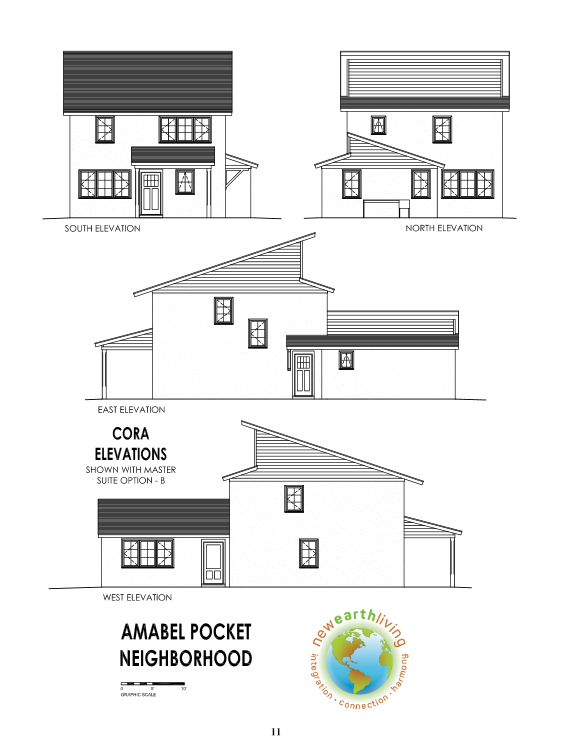
1. It looks like the Amabel housing development has another site plan. New pedestrian paths, a relocated community garden, and some substantial tweaks to the layout of the house, including a small access road for three homes near the southern termination of the loop road with Five Mile Drive (older plans here).

Marketing for the project hasn’t officially started, but New Earth Living LLC’s (Susan Cosentini’s) website does have interior renders for one of the proposed house styles, as well as an informational PDF. Plans call for Net-Zero energy efficiency homes, meaning that the amount of energy generated on site will power all the project’s energy needs. Example homes included in the PDF range from 1,184 SF to 2,083 SF – it looks like there will be four home models with alternate configuration options. Prices have yet to be announced.
amabel_v4_2

The Amabel project, proposed for 619 Five Mile Drive just southwest of the city of Ithaca’s boundary line, has been in the works for the past couple of years, a sort of grand follow-up to New Earth Living’s Aurora Street Pocket Neighborhood in Fall Creek. The project will have about 30 single-family homes at full build-out.

I know some of the more pessimistic readers here may call this suburban sprawl with a green sheen, but it’s a lot better than a cul-de-sac.

20151011_130755

2. The village of Lansing sent off their updated Comprehensive Plan to the county planning department this week for review and approval. Now, planning should be the village’s forte, since the village of Lansing was founded in the 1970s as a backlash against the construction of commercial and residential properties along Triphammer and Route 13, including what’s now The Shops at Ithaca Mall. The plan was last updated in 2005, and draft of the new plan can be found here.

The village seems to note with some distress that although population growth has slowed, traffic has continued to increase (due in large part to significant growth in Lansing town; many town residents pass through the village to get to employment centers in Ithaca). North Triphammer Road has already been widened, but there are concerns about the ability of infrastructure to handle further traffic increases. The village also notes a strong rise in the 55+ population, as well as the same affordable housing issues that plague Ithaca and much of the county; in Lansing’s case, the median household income can afford a $171,000 home by their estimate (2.5 x $54,721 = $136,800 qualifying mortgage, + 20% down-payment), but the average house in Lansing costs $258,000 (affordable to a household making ~$82,500; note all the numbers are 2010 values). The plan also shows that fair market rent in Lansing increased 64.1% from 2005-2015, meaning that unless a renter had an annual wage increase of 5.8%, they paid more of their income towards housing year after year.  29.4% of homeowners and 39.1% of renters pay above the HUD’s 30% of total income threshold for affordability. The village is concerned it will price aged residents right out of their homes.

In an effort to combat the growing problem, the village wants to focus new housing along main thoroughfares with easy bus access and bike infrastructure, and is aiming for smaller homes and apartments geared towards aging-in-place and senior communities. The village notes that 500 to 600 units of housing could potentially be developed over the next few decades (note Lansing averages ~10 units per year), mostly on the large, low-density home lots near the lake. These would almost certainly be geared towards the highest income brackets, but the benefit of greater supply might relieve pressure on other homes.

On the business end, the village would also like to encourage Cornell to relocate back-office and research operations to village sites. There’s also a push for senior-oriented businesses and a possible rethinking of the malls, not an uncommon thought in this age where malls are struggling and dying off.

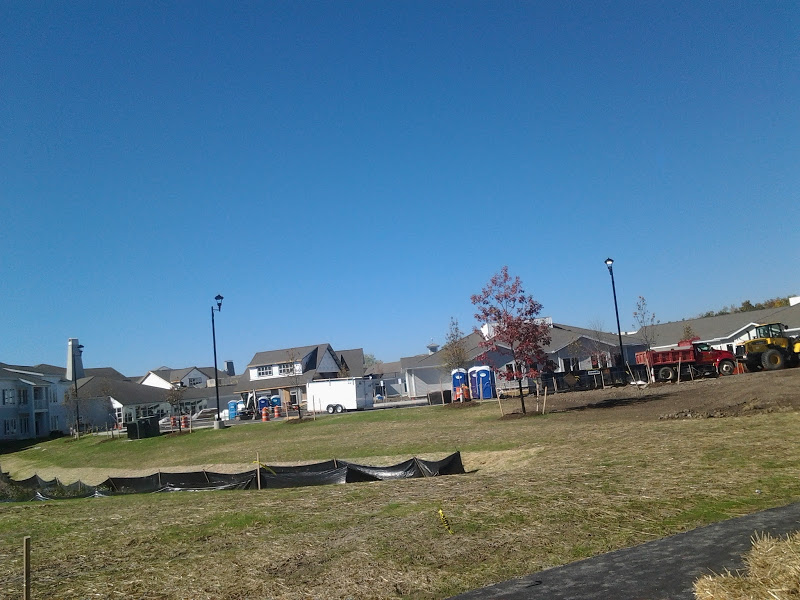
There are arguably two senior developments planned that already fit their “want” category – the 12 senior units planned for the Lansing Meadows PDA (the ones planned next to BJ’s on Oakcrest Road), and 62 senior units for the CU Suites site on Cinema Drive (photo from last week above). Other residential growth will be fairly “organic”, with new homes built at the whim of owners and mom-and-pop builders. A new commercial medium-traffic zone along Hickory Hollow Drive might open some more business opportunities; as for Cornell, they seem to be more focused on their East Hill Village plans, but research park tenants are always a possibility.

The village plans to update its comprehensive plan again by 2025.
402_s_cayuga_st_rev2_1

3. On the topic of plans, here’s a progress report just released by the Ithaca Urban Renewal Agency regarding its five-year plan.

If you wanted another reason why housing in Ithaca is so expensive, the plan alludes to it here:

“A spike in local construction costs has delayed the start of construction on a planned four-unit first-time homebuyer project and a public facilities project that will improve a public recreational area. We anticipate these projects moving forward once they have been able to close their funding gaps.”

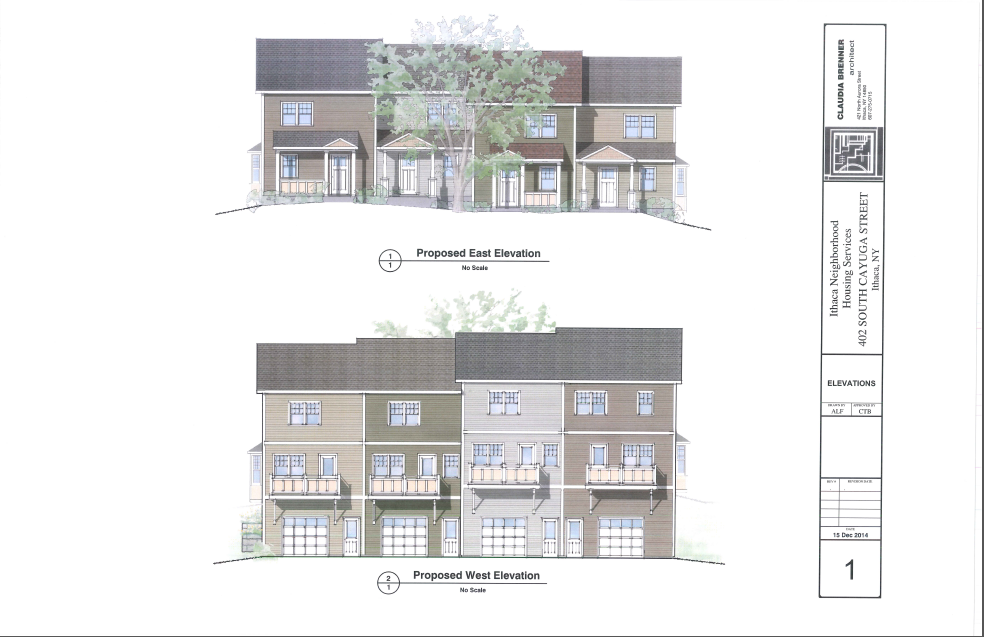
The four-unit homebuyer project is the townhouse project planned by INHS for 402 South Cayuga Street (shown above). INHS director Paul Mazzarella said the project was due to receive bids last month, and if they were within INHS’s budget, it would start construction. It hasn’t started.

Ithaca’s a small labor pool, so you either truck in labor from elsewhere and incur the wrath of construction unions, or you go local and pay a premium. But even then, with the relative burst in activity as of late, the local pool is getting tapped out and that’s driving prices up. Non-profits like INHS don’t have a lot of wiggle room in their budgets, and city government just won’t build if they can’t get affordable bids for infrastructure work. It also impacts programs that provide low-cost home repairs to those with low and fixed-incomes, because those low-cost repairs are no longer low-cost, and fewer people are able to be served.

One could one look at this as either a reason to limit approvals (which the construction trade unions are opposed to) or introducing more out-of-town labor to the market (which the trade unions are also opposed to). Stuck between two metaphorical rocks.

So long story short, in a region where the cost of housing is climbing dangerously fast, the city has a lot of work left to do meeting its affordability goals, with many actions/programs falling well short of annual numbers needed to meet the 5-year goal statistics. Hopefully some progress will be made in the upcoming year.
state_st_triangle_v5_1

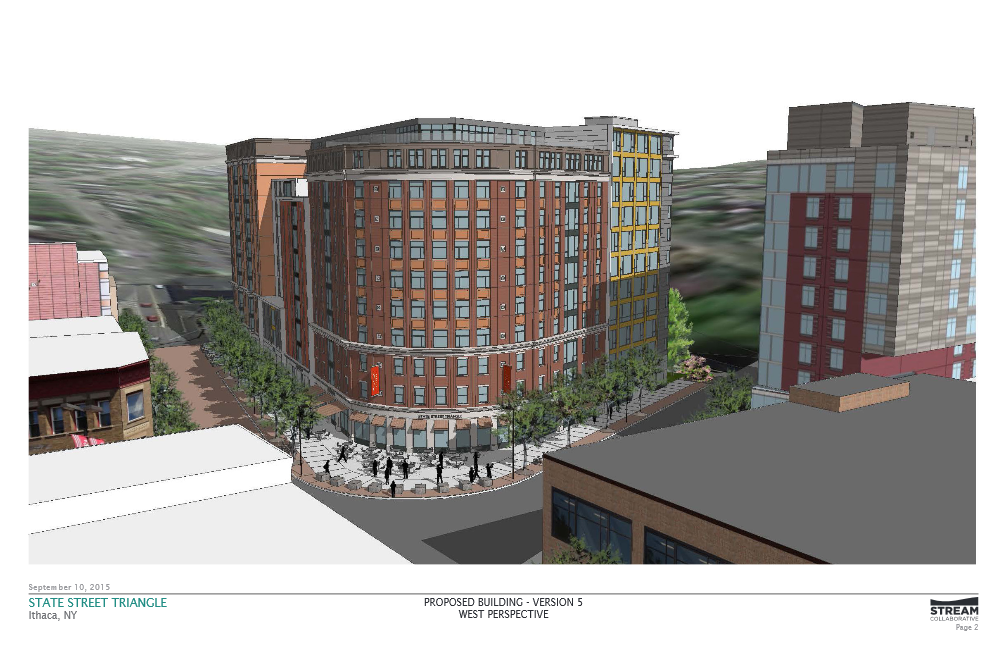
4. The mayor has dealt State Street Triangle a serious blow by announcing his opposition to the State Street Triangle, first reported on his facebook page and picked up by every news outlet in town, Svante Myrick cited the student housing focus and massing concerns for his opposition (he explicitly stated the height, 11 stories and 116 feet, was appropriate for its location, the 300 block of East State Street in the heart of downtown Ithaca). This is a big setback because apart from his social influence, the mayor sits on the county IDA, which is the governing body that votes on tax abatements.

A couple of the outlets have reached out to Campus Advantage, which is busy trying to formulate a response. They’ve hired a PR firm for whenever they’re ready. It could be the end of the project, it could still go on, it could be drastically altered. The chips have been tossed into the air, let them fall where they may.

20151011_121733 20151011_121800

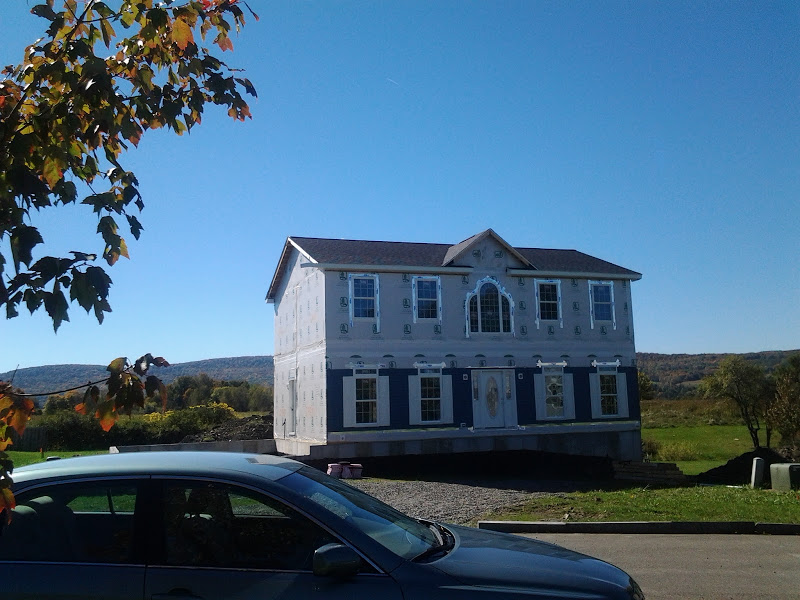
5. House of the week. This week, a trip out to Maple Ridge in Dryden. Maple Ridge is a housing development within the village that had the unfortunate luck of launching right before the Great Recession. After struggling, it’s been picking up in the past couple of years with five houses built since 2013. This modular home is the “Cayuga Lake” model offered by American Homes in Dryden. The pieces have been assembled and fastened together on top of the poured foundation, and some finish work has started. The uncapped foundation section is most likely a future garage. Modular homes tend to move through construction pretty quick, and this one will likely be finished in time for the holidays.

waterfront_rfp

6. The county and city hosted a meeting discussing possible waterfront re-development plans for the NYS DOT site on Thursday night. Three plans were presented, two mixed-use commercial and residential, and a third that the Journal describes as just being “hotel”, but given the 7.66 acres on site, is probably mixed-use with a hotel component.

The third option is a little bit of a throwback because the city long-saw the waterfront as prime for a hotel. But the market has shifted towards downtown and Route 13, and with the market adding new hotels at a pretty good clip over the next few years (Marriott, Canopy, Holiday Inn Express), a hotel in that area is pretty unlikely. Local lawyer/developer Steve Flash proposed a five-story hotel on Inlet Island in 2007, but in the days before the waterfront zoning allowed five floors, the project was opposed and shelved.

An initial cost of the move is being pegged at $14 million, but it isn’t clear if a potential buyer would pay that directly, or the county/city, who then get reimbursed by a buyer. $14 million is quite an amount, but given the site’s potential, it’s feasible (but don’t expect any outside-the-box thinking; a developer will want to minimize risk since they have to make such a huge initial investment).

If anything is clear, it’s that, contrary to the opinion of at least one speaker at the meeting, most folks would like the snow plows and road salt stored somewhere else.
20150727_145000

6. I don’t comment on politics. I don’t comment on candidates. But I will comment on issues. And, probably no surprise to readers here, I find it worrisome when anti-development candidates come forward.

By and large, development in Ithaca isn’t happening “for the sake of development” like in the 1990s, when the local economy was mired in recession. It’s happening because the Ithaca area has added 6,000 jobs in ten years, mostly in healthcare and education. Cayuga Medical Center has added over 500 positions in 10 years, and while Cornell’s direct employment hasn’t changed much, the university has added nearly 2,500 students. That has created demand for thousands of units, but when combined with the slow pace of development within the county over the past decade, the result has been a critical housing deficit.

This is one of the major reasons behind the current affordable housing crisis – high demand, plus insufficient increases in supply, have resulted in very low vacancy rates and have made it a seller’s paradise when it comes to housing.

If you plan on selling your house or rental property and retiring to Florida in the next couple of years, you’re in for serious bank! Everyone else, whether through rents or increased tax assessments, ends up with a much greater burden. Housing costs are a big player in how Ithaca became the 8th most expensive city in the country.

If there are thousands of people coming here for work or retirement, and new housing isn’t there to absorb them, the wealthier folks moving in will simply pay a premium on what exists, and price out the existing working and middle class who can’t afford those premiums. Which some people are okay with.

Ithaca doesn’t need to “slow down” development, because that’s one of reasons why the affordability crisis is as bad as it is. What Ithaca needs is to be proactive about development, and generally it has been under Mayor Myrick. The city has actively worked to reformulate general guidelines like the Comprehensive Plan (first all-new plan since 1971!) and is starting work on part II, working on neighborhood-specific themes. Myrick’s government has also identified and maintained targeted development areas, like Collegetown’s Form Zoning and downtown density. The mayor has even come to bat for the $30k-$50k/year working class folks that “breed trouble” and need affordable housing, like with INHS’ 210 Hancock project.

Affordability is a long-term effort and a multi-pronged approach, by keeping vulnerable families in their homes, and providing new homes to accommodate the growing economy and population.

There’s still a lot of work to do, but hell, it’s a start. Sticking fingers in ones’ ears isn’t going to make the housing crisis go away.


Kendal at Ithaca Construction Update, 10/2015

13 10 2015

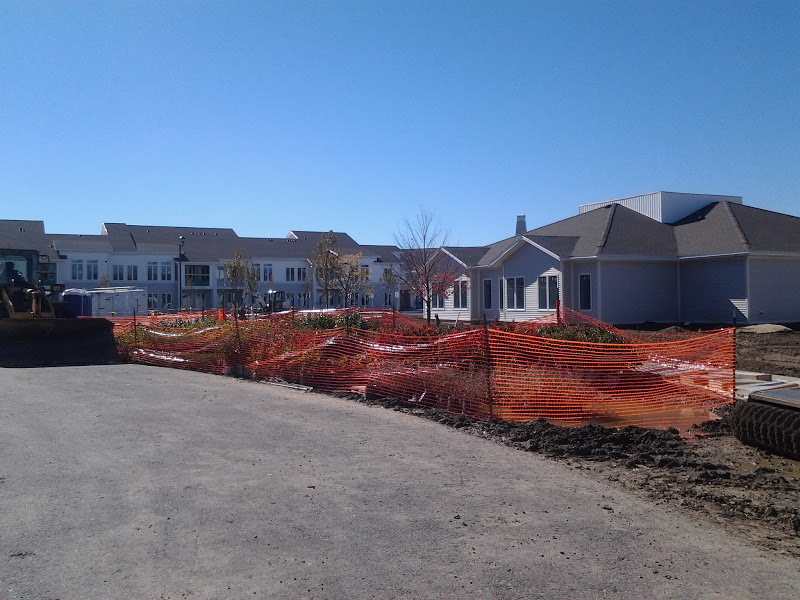
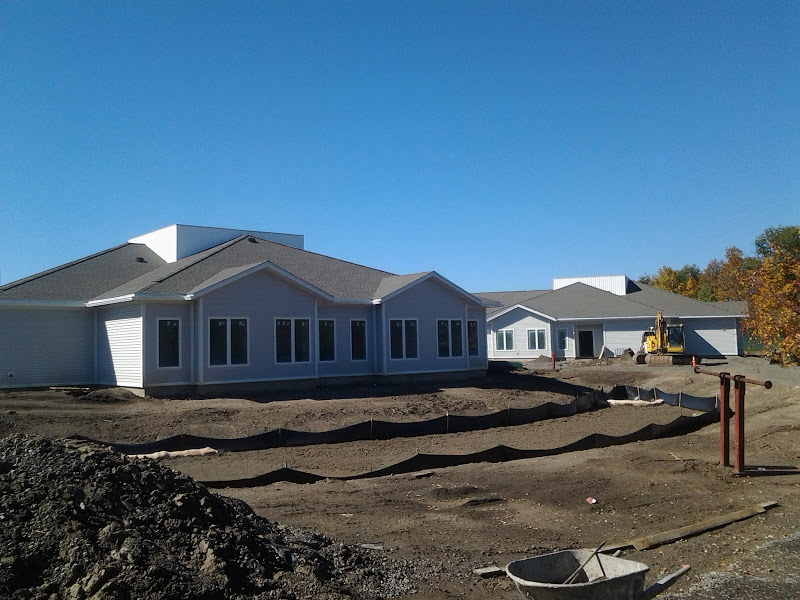
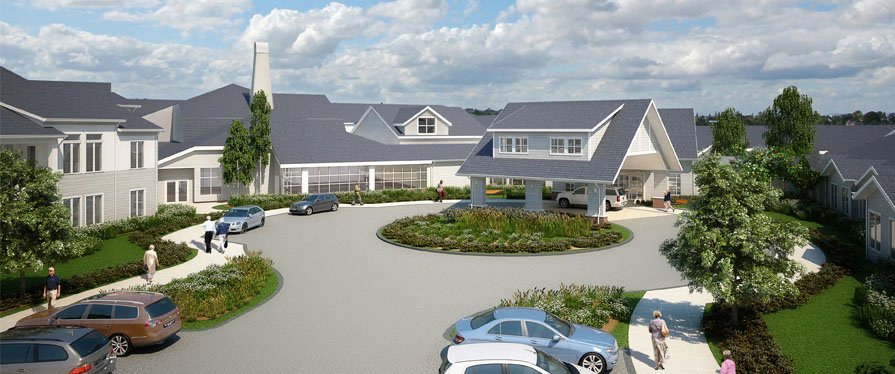
In Cayuga Heights, work is ongoing at the Kendal at Ithaca site as the project marches steadily towards its January 2016 opening date. The senior apartment wing is nearly complete, with just some minor exterior trim (balcony railings) and facade work left. New garages have been built for future tenants of the apartments. The skilled nursing facilities are largely finished from the outside, but are missing the decorative roofs and trusses, which will be installed later this fall. At least from the outside looking in, the new entrance circle/porte-cachere (photos four and five) looks like it has the most work left on its to-do list – windows have been fitted but the new entry and second-floor administrative offices have yet to have trim or facade materials installed. However, given that’s it’s one of the smaller additions, the project should pose no huge hurdle moving forward.

With the January opening date, landscaping work may not finish until the spring, when new trees and grass seeding can be done without fear of inclement weather.

Kendal at Ithaca is currently in the midst of a $29.3 million expansion. Three new wings will be built on the northeast side of the property as part of a new 48-bed skilled nursing center, an increase from the 35 beds currently available. On the southeast side of the complex, a new 2-story, 24-unit apartment wing is being built for independent seniors (16 one-bedroom, 8 two-bedroom). A new entrance, cafe, fitness center, and health center are also included in the additions, as well as major interior renovations. Landscaping additions and a 26-car parking lot are also planned. The construction project is aiming to achieve LEED Gold certification.

Construction began this past January. An estimated 20 to 25 new jobs will be created by the expansion, most of those in service positions that pay $24-$45k. The Kendal website seems to sidestep the discussion of costs, but a New York Times piece from when it opened in 1996 stated the entry fee was about $80,000 for a single person in the smallest unit, rising up to $267,000. Strictly calculating from inflation, the entrance fee may start around $120,000-$125,000 today.

Kendal was granted the privilege to issue tax-exempt municipal bonds by the county legislature to finance the construction of their new wings, but is not seeking any property tax abatement.

Local architecture firm Chiang O’Brien has partnered with the NYC office of Perkins Eastman to design the Kendal expansion. National contractor Lecesse Construction, with an office out of suburban Rochester, is in charge of general construction.

20151011_131238 20151011_131339 20151011_131344 20151011_131410 20151011_131433 20151011_131528 20151011_131532 20151011_131553

Kendal_1

expansion_banner


News Tidbits 7/25/15: To Reuse and Rejuvenate

25 07 2015

travis_hude_libe_libe_v3 oldlibe_franklin_proposal

1. Let’s just outright say it – the Tompkins County Legisltaure’s Old Library decision is a complete mess at this point. As covered last week, there were three separate individual resolutions – one from legislator Mike Lane for the Travis Hyde proposal (first image), and one each from legislators Dooley Kiefer and Leslyn McBean-Clairborne for the Franklin proposal (second image).

They all failed. 8 yes’s are required. The Travis Hyde proposal failed with 5 yes and 7 no’s. The Franklin proposal failed with 5 yes and 7 no’s on Kiefer’s resolution, and 4 yes and 8 no’s on McBean-Clairborne’s resolution. Martha Robertson, a supporter of the Travis Hyde proposal, recused herself because she had received donations from Frost Travis during her failed congressional campaign in 2014. Legislator Glenn Morey, also a supporter of the Travis Hyde proposal, was absent from the meeting.

I don’t see any way this will ever get the eight votes required. Kathy Luz Herrera voted against the proposals because the resolution has a ground lease (meaning the county still owns the land but leases the property), and Dooley Kiefer has stated she refuses to support any of the projects unless they have a ground lease – in other words, these two have mutually exclusive votes. By voting against McBean-Clairborne, Kiefer’s made it clear she will vote against the Franklin project unless it meets her exact specifications. Shinagawa voted against Travis Hyde for not being what the community wanted, but won’t vote for the Franklin proposal unless they guarantee Lifelong’s involved. And Stein has come out in favor of the Travis Hyde proposal. There’s no solution on the horizon.

So now it heads back to the Old Library Committee. Sale to the highest bidder and demolition of the library are real options on the table.

cayugafarms_2

cayuga_farms_1
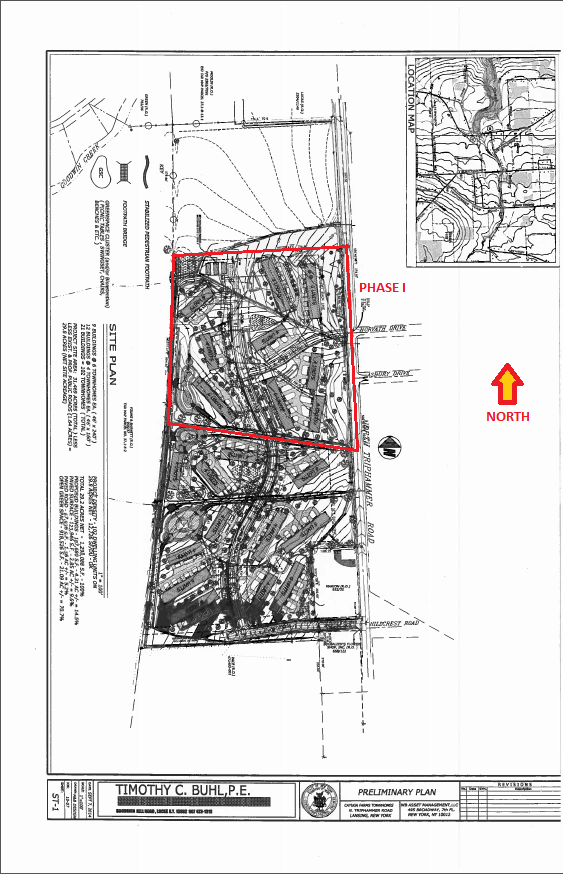
2. Turning to Lansing town, the planning board there has approved plans for the 102-unit Cayuga Farms townhouse project for a 31.4 acre parcel off of North Triphammer Road near Horvath Drive. First reported last Friday by the Lansing Star, the project received negative SEQR determination (meaning that, following the state’s environmental review guidelines, that the planning board decided the project will have no serious detrimental impact on the community) and issued preliminary site plan approval.

However, one issue still remains to be resolved before any shovels hit the dirt – sewer. The project currently has a modular package sewer treatment proposal that would work in place of the voter-defeated municipal sewer, and allow for denser development than the town’s rule on septic tanks. But the DEC’s interest in that type of treatment has been mixed. It could be a while before the situation gets sorted out.

Readers might remember this project because it’s one of the few I’ve openly derided. The 102 units are townhouse-style apartments marketed towards the upper end of the market. They would be built in phases over a period of several years.

cornell_novarr_5 cornell_novarr_6

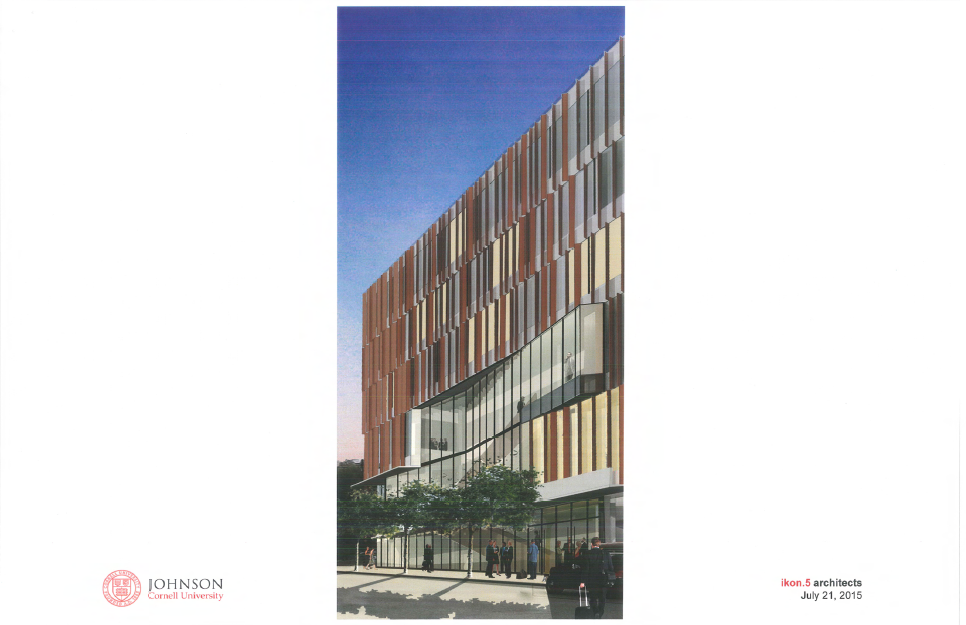
3. Now for some eye candy. Included with this week’s planning board project review committee agenda are additional renderings for John Novarr’s project at 209-215 Dryden Road. Doing a quick visual cross-check with the initial renderings, there don’t appear to be any substantial design changes, and the colorful metal cladding appears to retain the same pattern as before. Getting a little poetic here, the cascading metal bars are reminiscent of water running down a wall.

The city’s Full Environmental Assessment Form doesn’t express many worries about the project; some concerns have been raised about too many pedestrians on the street (the building would add 420 people to Collegetown’s sidewalks at the outset, 600 when fully occupied), but that seems to be about it for now.

The $12 million project is moving right along in an effort to start construction this fall. Declaration of Lead Agency and some CEQR discussion (the city’s more stringent version of SEQR, State Environmental Quality Review) are expected at the July planning board meeting. Plans call for 76,200 SF building with three floors of classrooms and three floors of offices for Cornell’s Johnson School Executive MBA program. The building would be ready for the Big Red’s B-students in April 2017. The property would remain on the tax rolls.

20150605_114431

4. A couple of interesting news notes courtesy of the Ithaca Urban Renewal Agency (IURA) Agenda:

First, popular downtown restaurant Madeline’s is looking to obtain an agency loan as part of a renovation project. The $470,000 project would add three jobs, only one of which pays living wage. The restaurant on the first floor of the Rothschild Building (the two-story building in the above photo) hopes to take advantage of the new hotels going up, and law firm Miller Mayer moving its 60 employees into the Rothschild Building. Previously the firm was in the Chemung Canal Trust Company building further up the Commons.

Second, the Finger Lakes School of Massage has applied for an agency loan to facilitate a move from West Hill to downtown. The school would move its ~34 staff and 75-95 students into 10,804 SF of leased space on the Rothschild Building’s second floor, with a further 1,700 SF on the ground level for a retail store and alumni massage clinic. The space would be renovated at a cost of about $194,300.

Although both projects come with risks (Madeline’s being a restaurant, FLSM having some worrying financial statements), both projects have been recommended for loan approval. The FLSM and Miller Mayer news suggest that most of the office space in the old Rothschild Building, left vacant when Tetra Tech moved to Cornell’s office park in 2010, has now been refilled.

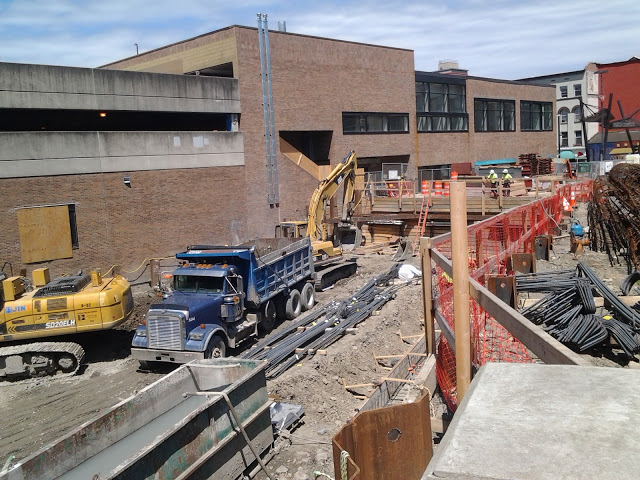
The new window cut out built recently into the Rothschild Building’s east facade is part of the space where FLSM is moving into.

416_e_state_1

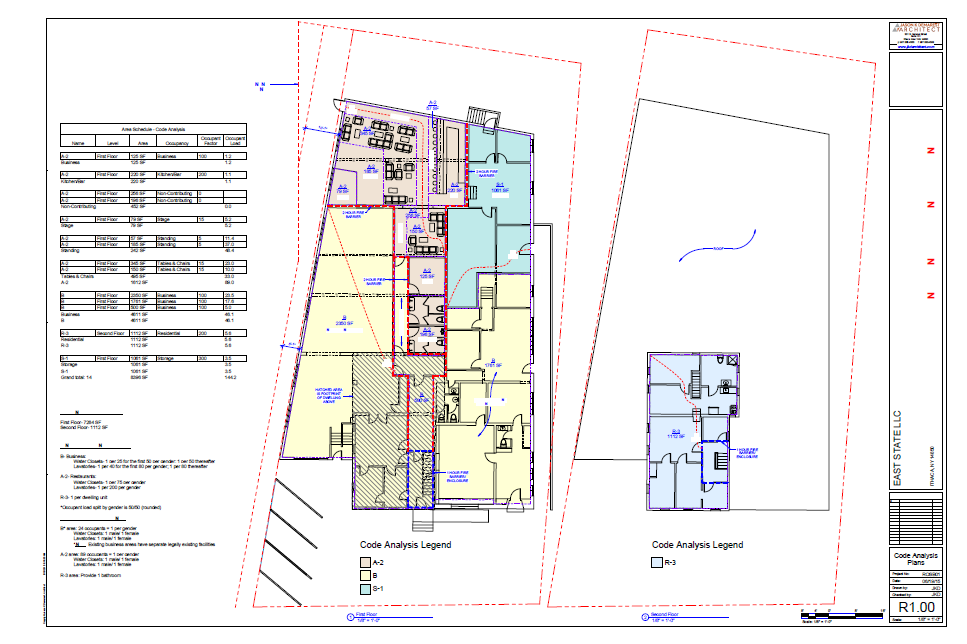
5. And now another reuse project – at 416-418 East State Street, currently home to an underused 7,600 SF office and a connected manufacturing/storage building. The house dates from the 19th century, with various additions as recent as the 1970s. According to plans filed with the city, an LLC linked to Argos Inn architect Ben Rosenblum has plans to convert the old manufacturing space into a bar and storage space, with renovated offices and a 2 bedroom apartment in the original house. The project will include an accessory parking lot, revised landscaping and handicap access. Area and setback deficiencies have resulted in the need for a zoning variance, but a parking variances won’t be required because the bar will have after hours parking across the street at Gateway Plaza. The building itself won’t change dimensions, but the change in use triggers the city zoning laws.

There have been some concerns expressed about this project – at least one neighbor is vociferously opposed to a bar, citing noise problems and concerns about smokers, and the county planning department is not a fan of the traffic and parking arrangement. Offhand, I think a bar is legal in B-4 zoning, but the noise impacts will merit further scrutiny.

The project is definitely something of interest to the Voice’s audience, but in an email, Rosenblum said that details are still being worked out and that he’d prefer to discuss the plan at a later date.

Scott Whitham is serving as a consultant, and local architect Jason Demarest is designing the renovation.

state_st_triangle_v3_1 state_st_triangle_v3_2 state_st_triangle_v3_3

6. Some very substantial changes are in store for Campus Advantage’s $40 million, 240-unit State Street Triangle project at 301 East State Street in downtown Ithaca.

The Texas-based developer has recruited the assistance of Ithaca architecture firm STREAM Collaborative to help redesign the 240-unit project. And there’s clearly been a lot of work since the previous planning board rendition.

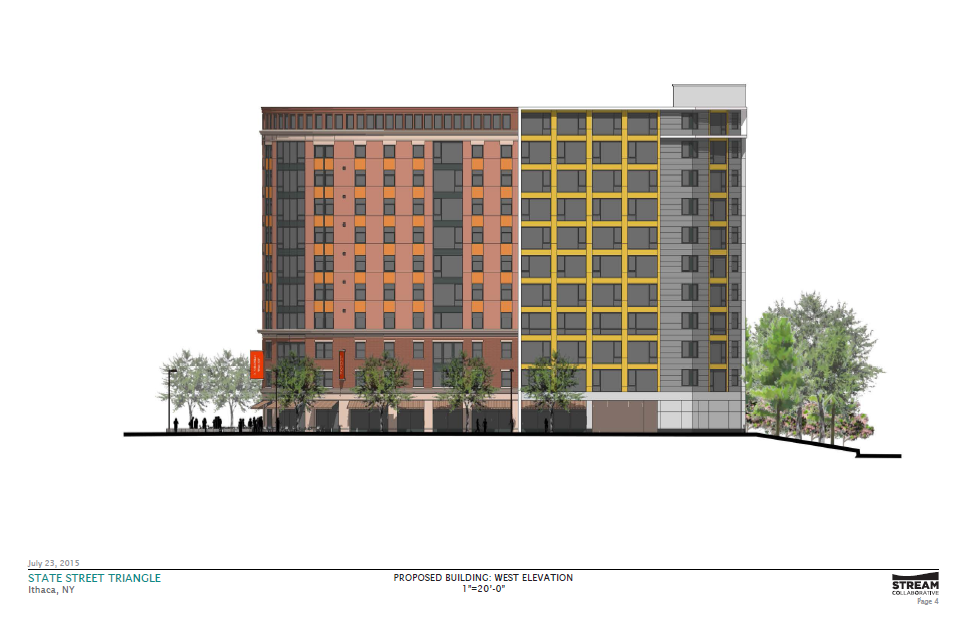
In this revision, a much greater emphasis has been placed on the street interaction and active street uses. Gone is the soaring corner, and in its place is a design with a greater use of horizontal elements (like the decorative belt above the third floor) in order to give the building a more human scale – crucial when you’re planning one of the largest buildings in Ithaca.

The developer is also seeking to remove the northbound turning lane from Aurora onto State Street, and replacing it with a pedestrian area with widened sidewalks, outdoor seating and dining spaces. The land would have to be procured from the city, or some other type of collaboration would have to take place with city officials and engineers.

In documents provided in the city’s planning board agenda for next Tuesday, the developer notes that the project remains student-oriented, but in order to play down comments of it being a massive dorm, 10 4-bedroom units were reconfigured into 40 studio apartments that the developer hopes will be appealing to non-student tenants looking for a less expensive, modestly-sized space.

The State Street Triangle project is also exploring LEED certification.

The project still has a lot of details to be addressed – city transportation engineer Tim Logue has expressed concerns that the traffic study underestimates the number of car trips, and has asked for a revised study. The project is also under closer analysis because the potential addition of 600 residents into downtown Ithaca would put a greater stress on utilities and infrastructure.

These and other questions are likely to be topics of discussion at next Tuesday’s meeting.

The State Street Triangle may be pursuing a CIITAP tax abatement (so much for my theory a couple weeks ago), but the city has not uploaded the application at the time of this writing.
7. Looks like a busy meeting next week for the Ithaca city planning board. In order:

1. A subdivision at 106-108 Madison Street on the Northside. The applicant wishes to create a new lot on the east side of the existing lot, for the purpose of building a new-single-family home.

2. A. Declaration of Environmental Significance and BZA recommendation for the Dibella’s sub shop proposed at 222 Elmira Road

B. Declaration of Environmental Significance, BZA recommendation and potential approval for the 1,100 SF addition to the Maguire Chrsyler/Fiat dealership in Southwest Ithaca

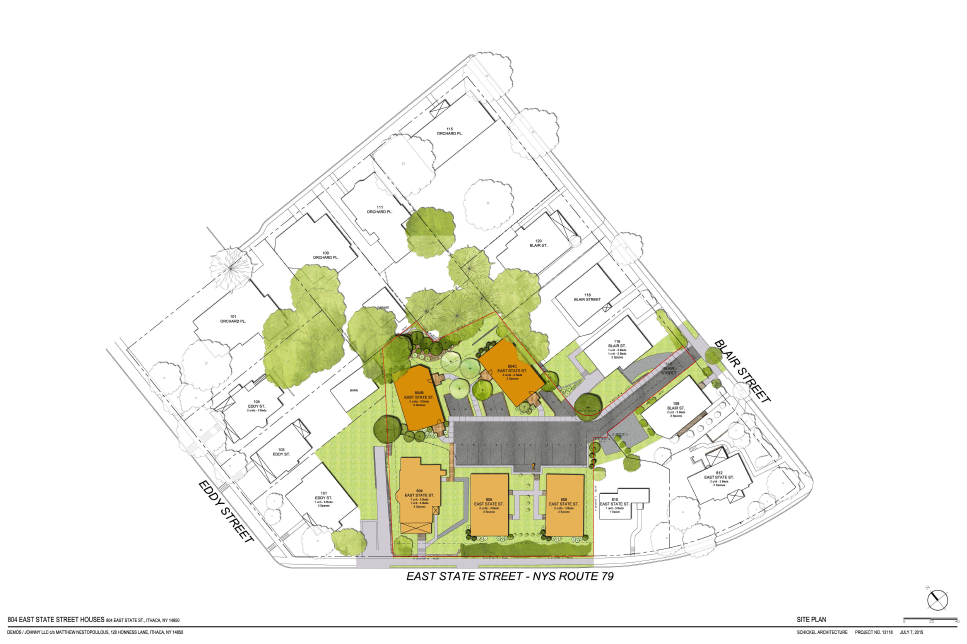
C. Declaration of Environmental Significance, and potential approval for the two duplexes proposed at 112 Blair/804 East State Street

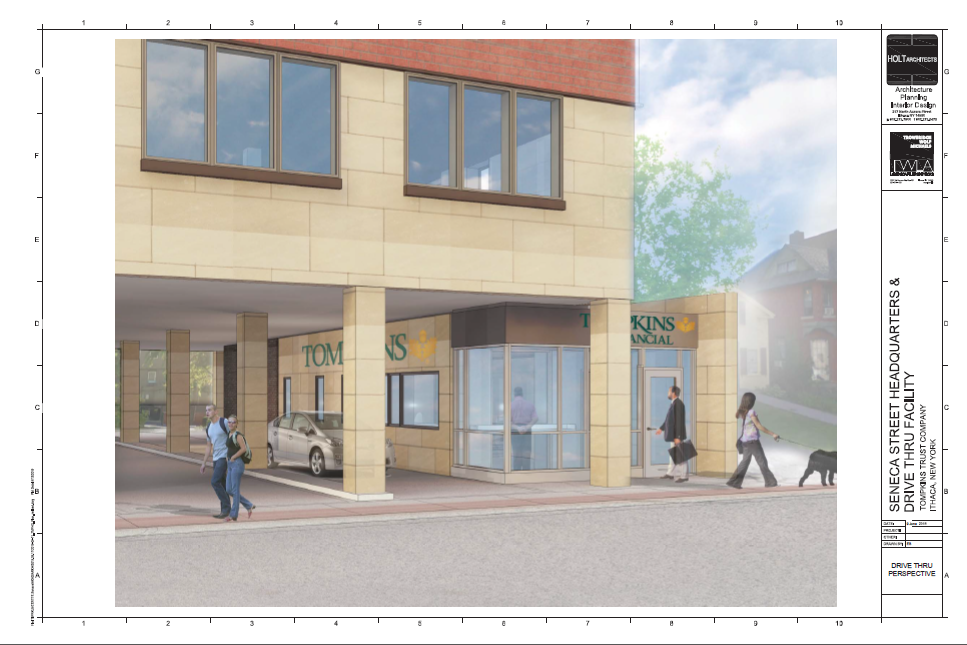
D. Site-plan approval for the first phase of the Tompkins Financial HQ (the new drive-through in the current HQ’s parking lot)

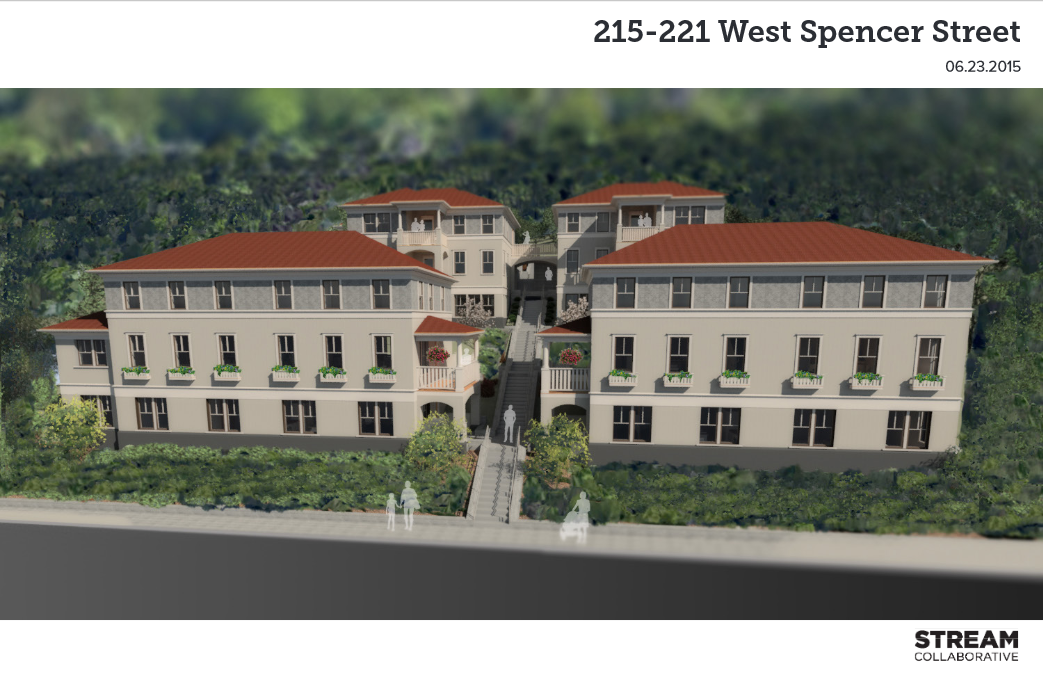
E. CEQR (the city’s version of SEQR) discussion for 215-221 W. Spencer Street

F. Declaration of Lead Agency and CEQR discussion on 209-215 Dryden (the Novarr project noted above)

G. Declaration of Lead Agency and CEQR discussion on State Street Triangle (

noted above)

holiday_inn_expansion_1

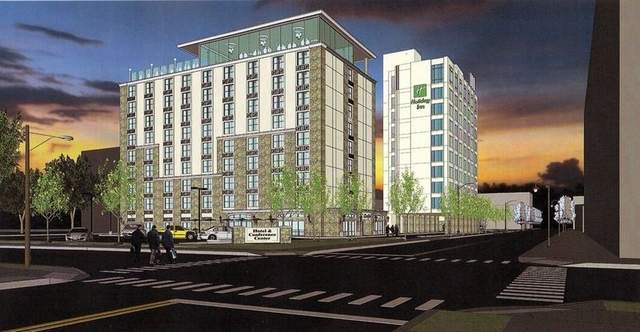
H. Sketch Plan – Hotel Ithaca Expansion. Readers might remember a 9-story addition and convention center were approved for the Hotel Ithaca almost two years ago (shown above). Nothing has happened with the expansion plans, for reasons which had been attributed to financing. Dunno what we can expect this time around, but we’ll find out next week.


News Tidbits 7/18/15: Two Steps Forward, Two Steps Back

18 07 2015

oldlibe_franklin_proposaltravis_hude_libe_libe_v3

1. The Old Library conundrum continues. At last Friday’s meeting, the committee was unable to come up with an endorsement. As it also turns out, absent legislators Peter Stein and Kathy Luz Herrera can no longer re-introduce the preferred developer vote because absent legislators can  only re-introduce a resolution for the subsequent county meeting – in other words, they didn’t put it up for a re-vote on the 7th, so that option is no longer available. Stein didn’t make a resolution, and Luz Herrera was once again absent from the meeting.

Now things get a little more haphazard. Individual legislators can introduce resolutions for a preferred developer, which Dooley Kiefer and Leslyn McBean-Clairborne are doing for the Franklin/STREAM proposal (the 22 condos and medical office space, first image), and Mike Lane for Travis Hyde (the 60 apartments with space for Lifelong, second image). Either one would require eight votes in favor. Martha Robertson’s recusal makes the Travis Hyde proposal a little less likely to hit that magic number, but unless anyone’s had a change of heart, if Kathy Luz Herrera and Peter Stein don’t both vote in favor of the Franklin proposal, nothing moves forward. The county gets left with a building they can’t make a decision on and don’t want to keep.

The building needs hundreds of thousands of dollars in renovations at this point, not to mention routine maintenance; the lack of a decision could be a weight on any legislator’s re-election prospects. If there is no decision, what happens next is anyone’s guess; spending money to mothball the building, demolition, or even selling the property on the open market. whatever the case, this is definitely not a comfortable position for the county to be in.

amabel_v3_1

2. Looks like the Amabel housing development in Ithaca town is undergoing some site plan changes once again. Quoting the web page, “[w]e recently came to the conclusion that it is far better to park the cars at each house then to have car parks within the common space, allowing 2 cars per house if needed. This also allowed for more guest parking spaces.” Rather than having a road go through the middle of the housing development, the development is now encircled by the road coming in and out of Five Mile Drive. I asked developer Sue Cosentini of New Earth Living LLC if those were garages facing the driveways, and the reply was “no, [but] they may be carports though.” As a result of the revised site plan, the project would need to go back in front of the Ithaca planning board for re-approvals.

fingerlakes_reuse_v2_1

3. Recently, Finger Lakes ReUse has been working on plans to open a new “downtown” branch and HQ at the site of the former BOCES Building at 214 Elmira Road on the edge of big-box land. The plans for the gut renovation of the ca. 1950 building (Ithaca’s first big-box supermarket) have been in the works for a while, and grants have been awarded to fund the project.

One thing that appears to be a recent addition, though, is a three-story, 20,000 SF office building. The building, described as the “Main Headquarters”, is strictly a conceptual proposal. The grant announced in December funds two new buildings,  the renovation and what could be either be the proposed 5,000 SF warehouse to the west of the existing building, or the “tenant space” occupied by Boris Garage at 210 Elmira.

The office building is an interesting idea, adding density to the often-underutilized Southwest Corridor and showing what future plans might be in store for the non-profit.

tfc_v3_1

4. It seems like there was an unpleasant surprise at this month’s IDA meeting – the motion from committee member Will Burbank to put a moratorium on all tax abatements until a county CIITAP is in place for local labor/construction unions and prevailing wage policy. For those unfamiliar, a moratorium is in this case a temporary prohibition of all new tax abatements. After considerable debate and a split opinion from committee members, the motion was rescinded until next month.

Speaking as a matter of opinion, it might seem like a good idea on the surface, but an all-out moratorium sounds more like a case of “throwing out the baby with the bath water,” as one of my professors used to say. Generally, the policy for businesses to hire the contractor with the best price and a strong record for quality, on-time work. Sometimes that’s a local business with local labor; sometimes it’s a company in Binghamton, Syracuse or Rochester. Hence the debate.

The problem with a moratorium is that it stops everything applying for a tax abatement, including projects that already have plans to use local labor. And to be frank, local governments have a terrible track record with moratoriums, frequently extending them because of bureaucratic red tape. I think the unions support the CIITAP idea, but a moratorium that could place even larger numbers of their membership out of work for 12 or 18 months is undesirable and politically damaging. Local labor is important, but a moratorium isn’t the best approach.

On another note, the IDA did unanimously approve the tax abatement for the Tompkins Financial Headquarters project.The 7-story, 110,000 SF building proposed for 118 East Seneca Street in downtown Ithaca will likely start construction later this year.

ithaca_beer_2 ithaca_beer_1

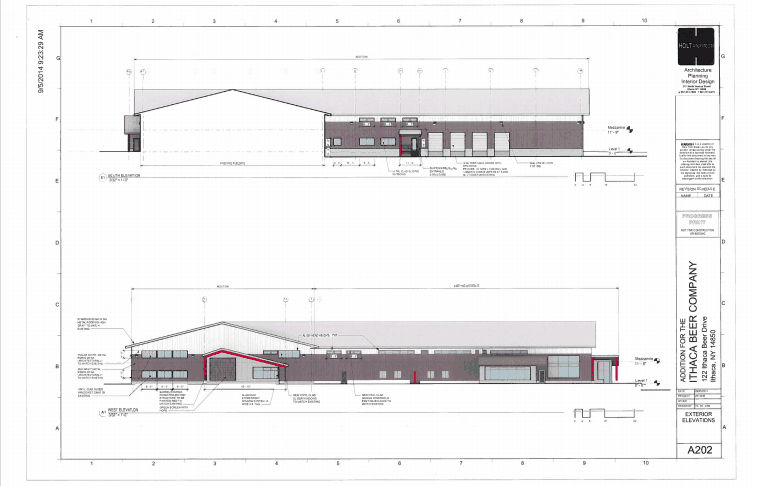
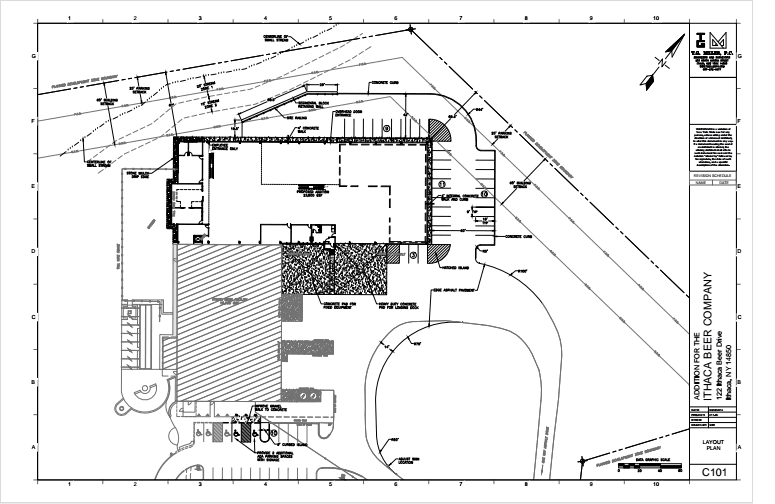
5. In economic news, Ithaca Beer had its informal groundbreaking Thursday the 16th for its expansion. The 23,800 SF addition by HOLT Architects will triple brewing capacity when it is completed in approximately eight months. The expansion at their site in Ithaca town is expected to create 22 new jobs.

clarebridgecrossings_2 clarebridgecrossings_1

6. Also in Ithaca town, a senior living facility is looking to receive final approval on its expansion. Brookdale Senior Living is looking to obtain final site plan approvals for its 32-unit Clare Bridge Crossings expansion at 101 Bundy Drive on West Hill. Brookdale is planning to start construction of the one-story 23,200 SF addition this October, with the first tenants moving in around October 2016. There’s no mention of job creation in the application, but there is a letter of opposition from a Cornell professor concerned that new construction will be detrimental to current residents.

Noted previously here back in May, the Brookdale site is a PDZ that consists of two facilities at the moment – Sterling House is a 48-unit assisted living facility, while Claire Bridge Cottage is a 32-unit facility specializing in memory care (Alzheimer’s and dementia). The new building, “Clare Bridge Crossings”, is designed to bridge the gap between the two – patients who might be in early stages of illness and experiencing mild symptoms, but otherwise still capable of some degree of personal independence. The whole complex is in the process of being renamed to Brookdale of Ithaca.

The new building will be tucked between the other two structures, so it won’t be visible from the street. Along with the new building, there will be updates to parking, landscaping stormwater facilities, and the addition of a couple of courtyards between the buildings. The architect is PDC Midwest, a Wisconsin firm that specializes in memory care facilities.

7. Let’s end off this week on a high note. Chances of a Chapter House rebuild are looking good. The owner’s looking into reusing the walls that remain standing, and even what’s left of the floorplates. The idea is to have the building look like it did before (though perhaps with a modern fire suppression system, one imagines). Looking forward to sharing renderings as they become available.