(UPDATED) Cornell’s Library Shutdown Count Up to Three

23 06 2010

So, I log into facebook and find this page being posted into my news feed.
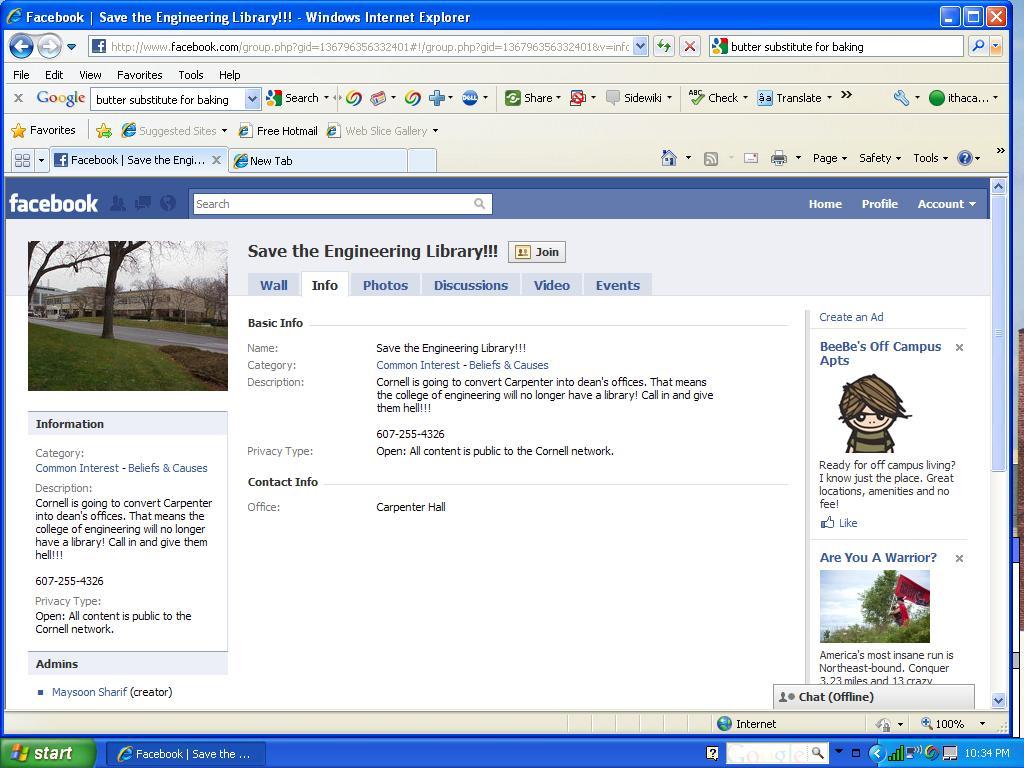
So, this comes as a bit of surprise. But I don’t buy into it. First of all, there’s nothing online — nothing on the Daily Sun, nothing on the engineering website, no data to back this up at all. Secondly, decisions like this are usually made over the span of months, even years (for example, the physical sciences library’s shutdown was formalized in March 2009 (an attentive reader of this blog actually told me about it before the Sun even had published the story); the library did not shut down until nearly a year afterwards (and no offense to Munier, but that library was definitely one of the lesser-used and therefore more expendable library facilties on campus). Decisions like this aren’t just “made” without a great deal of debate beforehand.

The one grain of truth I can throw into this is that the master plan indicates that the facilty to replace Hollister and Carpenter is under way — but that would suggest Carpenter getting demolished, not reappropriated. Plus, that’s still in the planning phases. Maybe a library would be in the Gates Hall plans, which are currently at the very beginning of the funding and approvals process; but I doubt it at this time.

I call bullcrap on this one until some information is published that indicates otherwise (see update). If there is any truth to it, going all alarmist  and calling the office staff (like the page suggests) is just going to make matters worse.
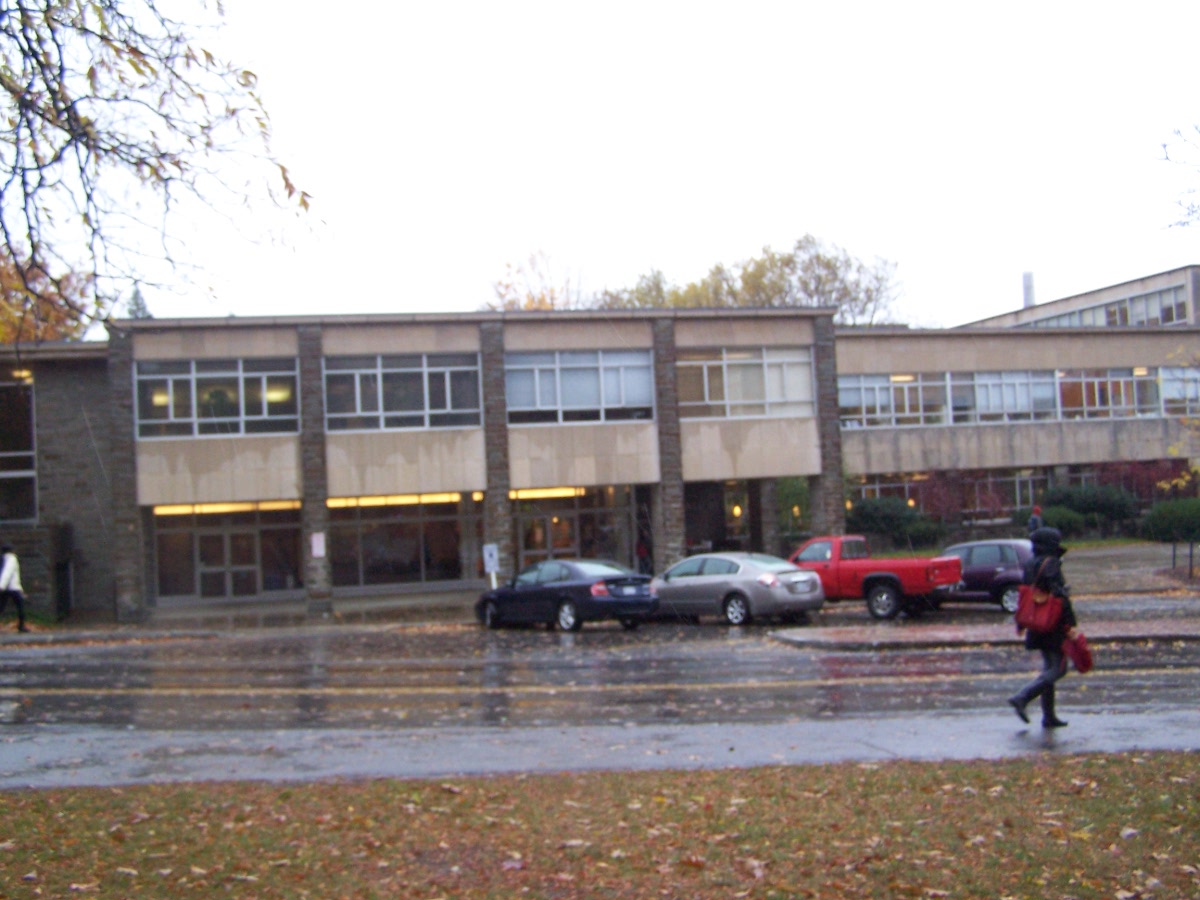
(UPDATED) So the author of the facebook page attached several official-lloking documents detailing the removal of the library’s book to Olin and Uris. IT would appear that the ACCEL computer labs would be kept and the labs would be made into a 24-hour unit (but isn’t that the lab in Upson exists?). Meanwhile, Munier has posted onto their page a link from Mann Library saying that the Entomology Library will be shut down and merged with Mann. So it would appear Cornell’s cost-cutting will shut down two more libraries they consider “less-used”.

I hope Cornell doesn’t release any more ads touting their expansive library system anytime soon.



News Tidbits 5/21/10: Beware of Water Mains

22 05 2010

…especially if the building it runs under sits next to the gorge. Long story short, Cornell reports that the Foundry building (the long wooden structure across the street from Sibley Hall) is off limits to everyone because the gorge is collapsing due to extreme erosion from a water main break (which probably was the result of something Milstein-related). The Ithaca Journal reports the Foundry’s edge is within ten feet of the gorge’s edge at the present time. Civil engineers are working to stabilize the building and gorge. According to facilities, the 11,000 sq. ft building was designed by Prof. Charles Babcock and built in 1883, and is used as studio space for fine arts students. In contrast, the AAP website says it was originally built in the 1860s as a blacksmith shop, and was incorporated into the Sibley School of Mechanical Engineering by 1890. According to the AAP department’s website, the interior houses sculpture work space and a bronze-casting facility.

From the AAP website


Collegetown Construction Project Watch: 309 Eddy Street

20 05 2010

So, reviewing monthly planning board agendas turned up a proposal for 309 Eddy Street in Collegetown set to be discussed this month. Unfortunately, I can never make it to the meetings and Ithaca is terrible at posting the minutes online. However, applying a little knowledge and logic, we can get a good idea of what is proposed for the site.

First, let’s go over the site itself. This is a little ways down from Dunbar’s on the east side of the street, next to Souvlaki House. The current building is a large student apartment house dating from about 1900:

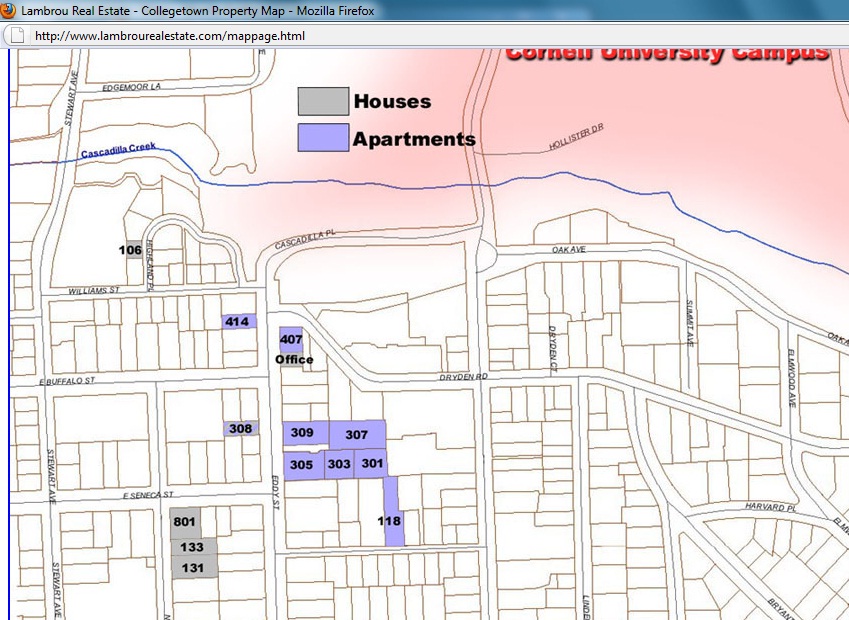
The house sits the in the middle of a series of large apartment buildings – the Fontana Apts (327-407 Eddy), and the four buildings that make up the Collegetown Park Apts. (301 Eddy-307 Eddy). All of these buildings were built in a time period from the late 1980s to early 2000s (the last was about 2002). All properties, including the house, are owned by Lambrou Real Estate, one of the major players in the Collegetown rental market with a couple dozen properties in the area (not all properties are shown in the map below).

Lambrou Real Estate seems to have a figurative love affair with the local architecture firm Jagat Sharma, which has a very distinct style but its readily apparent in all their buildings (postmodernist with extensive brick work and subtle contrasts within the facade, but otherwise not really daring). All of Collegetown Park, as well as the Fontana Apts, was designed by Sharma & Associates. It would be logical to assume that a future Lambrou project would have Sharma as the architecture firm in charge.

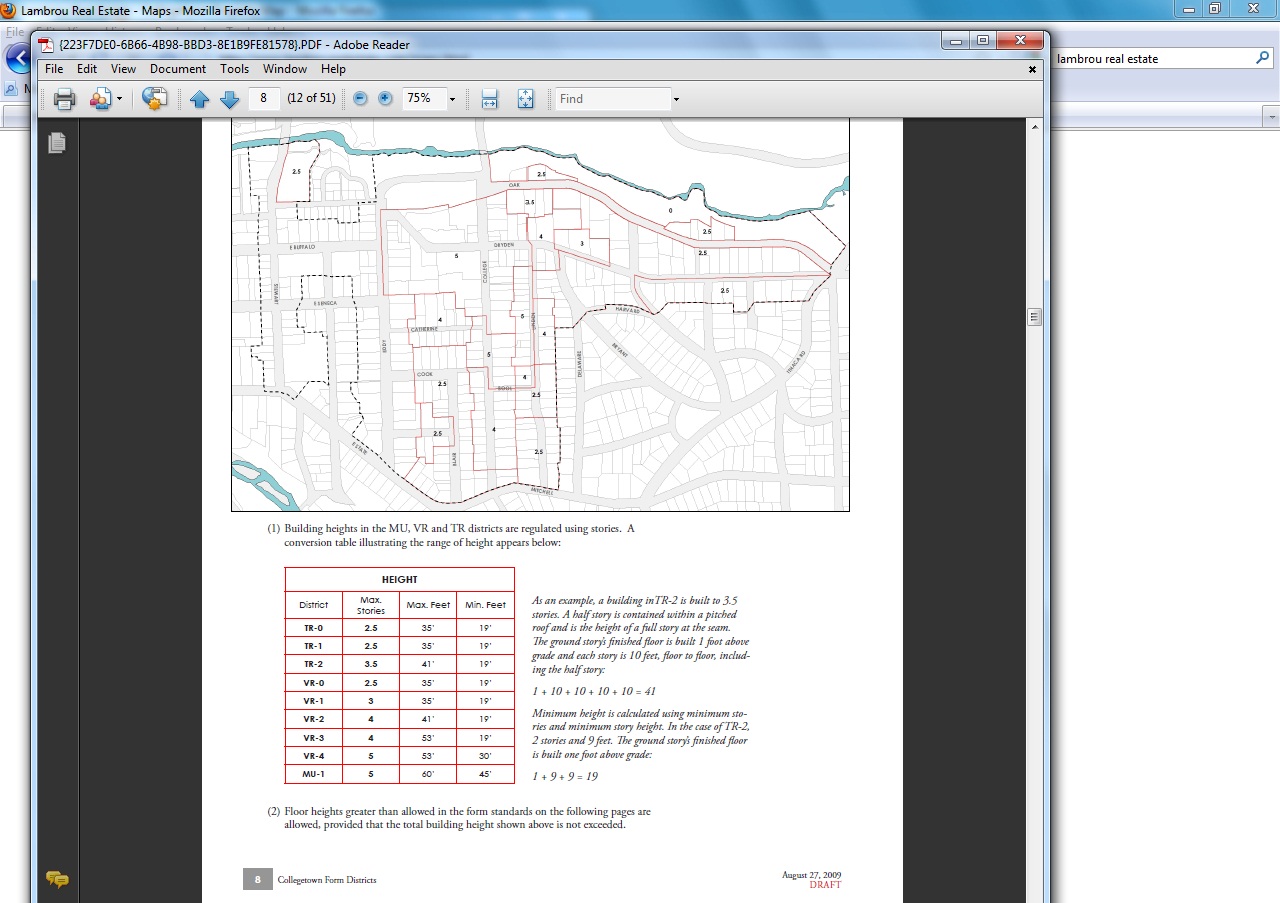
From a zoning and massing perspective, a review of the Collegetown zoning (which I’m not even completely sure it it was ever changed according to the guidelines of the $150k clusterf*ck that was the Collegetown Vision Draft Plan)

Assuming it is, the lot is zoned for a 4 or 5 story building with a maximum height of 60 feet, and at least 45 feet encouraged. Street-front commercial retail is virtually a must for approval.

So, here’s my verdict. Within the next few months, there will be a full proposal for a 4 to 5 story building pushing between 50 and 60 feet, with retail in its base and apartments on the upper floors. It will most likely be designed by Sharma Architects, and as I’m checking the Lambrou website and not seeing this place for rent next year (possibly because it has not been updated), this place could get final approvals and construction permit for fall of 2010 with construction lasting at least six months (if it does turn out to be rented, a construction start date of summer 2011 will be far more likely).

UPDATE 9/29/10: Now we have renderings:

Not a bad design. Fits in rather well with the immediate surroundings. A little more work on that street and it could become as popular as the 400 block of College Avenue.


Cornell Proposes Further Development for West Hill

14 05 2010

http://www.theithacajournal.com/article/20100514/NEWS01/5140326/1126/news/Cornell-proposes-senior-center–hotel-school-institute-on-West-Hill

Cornell University is developing plans for a major new project on Route 96 that could include senior housing, offices, small-scale commercial, and an institute for its hotel school.

Town planners have been discussing the idea with Cornell for several months, and Thursday afternoon, Ithaca’s town planning committee voted unanimously to recommend the town board consider re-zoning the parcel to accommodate the development.

Cornell owns 35.86 acres on Route 96 between Overlook apartments and the West Hill fire station. Though plans are still preliminary, Cornell is looking to partner with developers Conifer LLC to build 72 senior living apartments and 60 assisted-living units for low-income seniors, Town Supervisor Herb Engman said.

“And this would be Medicaid eligible, which we badly need in this community because we have lots of places where people can age in place … but none that I know of for those who are Medicaid-eligible,” he said.

Link to site proposal options:

In late 2007 and early 2008, developers Paul and Chris Vitale asked the town to rezone a parcel they purchased across from Robert H. Treman State Park to accommodate a Medicaid-eligible assisted living center, but town board members declined. The Vitales will likely operate the proposed West Hill assisted living center, Town Planning Director Jonathan Kanter said.

Cornell Real Estate Director Tom LiVigne said the hotel school has not yet been decided on the exact size and shape of a new institute building, but it would study issues related to seniors in terms of food service and housing, and likely interact with the on-site senior housing.

To maintain “maximum flexibility,” LiVigne said he hoped the town would rezone based on the maximum possible build-out. John Caruso, senior vice president of Passero Associates, presenting Cornell’s plans, suggested a planned development zone should allow 130 to 170 senior and multi-family units, up to 90,500 square feet for the Hotel School institute, 10,000 to 15,000 square feet of office space, and 20,000 to 28,000 square feet of small-scale commercial and retail development.

The parcel is currently zoned medium-density residential, which allows approximately 3.5 homes per acre, Kanter said. That’s roughly 122 units.

The northern entrance to the development would join the traffic-signaled light that intersects Overlook and Cayuga Medical Center, plans show. A southern entrance road would be built just north of the West Hill fire station, directly across from the road proposed to enter the 106-unit Holochuck Homes development. That development is still undergoing environmental review with the town’s planning board, Kanter said.

Cornell’s plans also include a 106-space park-and-ride lot, “which, again, we feel is badly needed for West Hill, so people coming in from Trumansburg, as well as people who might live on this site and nearby people could park their cars there and then take the bus down through town, rather than clogging up the Route 96 corridor from there on down,” Engman said.

The small-scale commercial component is very important to the town, and the town board could make that piece of the development a requirement, Kanter said.

Cornell’s proposal is scheduled to come to the full town board June 7 at 5:30 p.m. in Town Hall, 215 N. Tioga St.

***


A Preview of Future Construction Projects

14 05 2010

A look at Cornell’s Capital Plan is a good source for the vague beginnings of any large-scale construction projects to occur down the Cornell pipeline in the next four to five years. Looking at the projects approves or under way, most have already been covered by this blog in previous entries (the ones that aren’t just renovations anyway — Warren Hall’s going to be virtually gutted over the next few years, but there will be no extensive changes to its exterior appearance). I know that Weill Cornell (WCMC) is about to start on a new 14-story, $650 million biomedical building down in the city, but I’ve always preferred to focus on the Ithaca area (because honestly, most Ithaca-based Cornellians could care less about the facilities in Geneva or New York City).

Projects seeking approval for FY (Fiscal Year) 2010 are clearly underway. The initial steel frame just went up for Milstein and the Statler’s rooms are being renovated. The Johnson Museum expansion is well underway (still in the giant hole in the ground stage, which makes sense since it’s mostly an underground expansion) and the Plantations Welcome Center is currently starting to undergo external facade work now that the frame and much of the insulation have been applied. Under the projects for future consideration section, the Olin Library improvements are in the pipeline as are the feasibility studies for the Cornell Rowing Center Renovation and Expansion and the Central Avenue Parking Garage (renders included below).

Central Ave. Parking Garage Proposal

Perhaps the most intriguing projects are the deferred major projects. Granted, they’re deferred, but they’ll likely come back online once budget conditions improve. One of these major projects is a $183 million engineering building. This could quite possibly be the one shown on the Cornell Master Plan that replaces Hollister and Carpenter Halls, especially since the master plan indicates the project is underway in some form.

However, the only probably with that theory is that there’s three buildings, all in the planning stages, in the vicinity of the engineering quad. Based off of old press releases, Site 2 as numbered in the image (the smallest circle) is almost certainly Gates Hall, which is described as a $65 million dollar project in the capital plan (makes sense; smaller building = lower cost). So, the question is, is the approved project number 1 or number 3? I doubt it’s both because then they would have to be filed separately since they are separate structures.

Another project of question is the East Hill Data Center, a $100 million project. Unfortunately, there are no rendering anywhere, and it’s impossible to use the master plan to figure out which building this might be, as the master plan totally redevelops this area, so this one is anyone’s guess.

The University Health Building and the Helen Newman expansion have been bandied about for some time. The new health building will have roughly the same footprint as the current structure, but maybe a floor taller. Helen Newman has been awaiting an expansion that will add a second pool and additional exercise space, but the original price tag was $15 million, instead of the $30 million listed in the capital plan. One wonders whether this is due to rising costs or more ambitious plans.

Hughes Hall and Myron Taylor Hall (the Law School) are due for $28 million in expansion and upgrades. If it’s anything like what is suggested in the master plan, it’s a modern-looking (i.e. clashes with everything around it) building with alot of below-grade parking. However, I have yet to see any true renderings for this project.

Last on the deferred list is an addition to the 4th floor of Phillips Hall, worth almost $6 million. Don’t expect this to be more than a few thousand square feet at most.

Well, my time at Cornell may be almost complete, but it seems like the construction will never be. It’s okay, I could always use another excuse to come back when I’m an alumnus.


Kappa Sigma Closes its Doors

6 05 2010

…and the Greek sh*tshow continues.

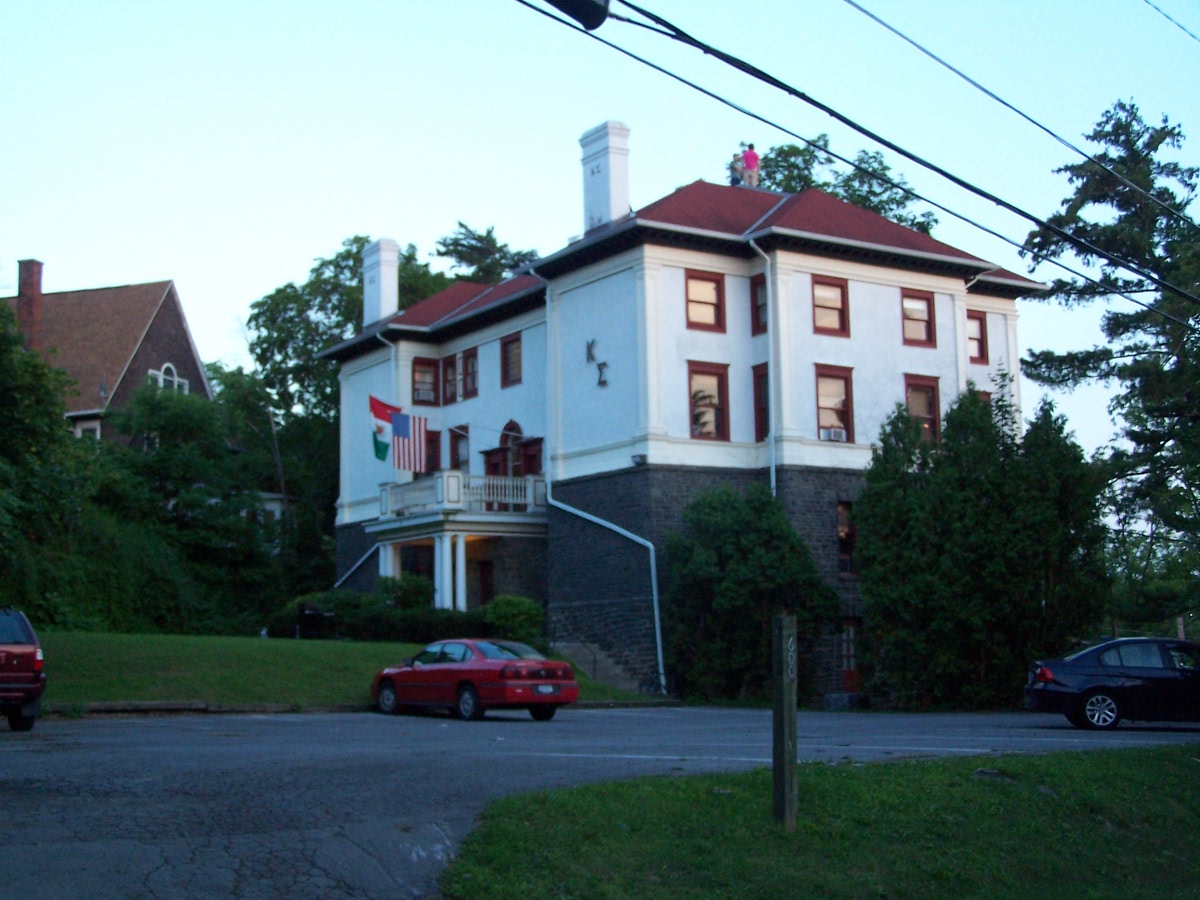
Kappa Sigma fraternity will be shut down at the end of the academic year by their national governing body, according to Associate Dean of Students for Fraternity and Sorority Affairs Travis Apgar. He added that the chapter would cease to be recognized by the University. The fraternity will be closed after violating sanctions that were imposed on them by their national organization just over a year and a half ago.

Apgar said that approximately a year and a half ago, Kappa Sigma was found in violation of their national organization’s “risk management policy” and were told that they could no longer host events with alcohol, among other sanctions. When they violated this order sometime afterward, their national organization placed them under a “trusteeship,” which required them to have any events approved by a regional manager from the national organization, according to Apgar.

Apgar said that the fraternity, however, violated this sanction too. He said that a couple of weeks ago, Kappa Sigma hosted a party with alcohol without alerting their regional manager or registering it with the Interfraternity Council — in violation of both their national’s sanctions and IFC regulations. When the Office of Fraternity and Sorority Affairs found out, they alerted the chapter’s national, who decided to shut them down.

While leaders in the chapter do not dispute these facts, they did express disappointment at how their national governing body found out about the incident.

At their most recent party, a fire alarm went off and the fire department came to investigate. Rather than allow the OFSA to learn about the incident themselves, the fraternity came forward and told the OFSA. Kappa Sigma President Eduardo Garcia ’11 said that he was assured by Assistant Dean of Students Kara Miller that the OFSA would not alert the national governing body about the party unless a judicial hearing was held.

Though no hearing was ever scheduled, Garcia received an e-mail shortly after from the chapter’s national governing body that they would be closed down.

“We were blindsided,” Garcia said. “The OFSA didn’t even have the decency to send us an e-mail telling us that they were planning on alerting national.”

Apgar, however, denied that the agreement ever took place, adding, “It was not something I was ever aware of.” Miller could not be reached for comment.

In any case, the fraternity will likely remain closed for at least the next few years, though Apgar said that he believed the fraternity would be back, just “not in the immediate future.”

“This chapter has been around for many years and there are a lot of people who have put a lot of time and money into it, I think it will eventually be back,” he stated.

***

This one came almost out of the blue. I began to suspect something was up when I began to see facebook statuses yesterday from Kappa Sigs I know expressing sympathy for the chapter (my first thought was that there was a casuality of some sort). But this…Kappa Sigma was to my knowledge a fairly well-respected, low-key chapter. I don’t think anyone would’ve seen this coming.

Speaking as someone from a chapter whose national and local always seemed to have had strained relations, I am strongly sympathetic towards the Kappa Sigs sudden shutdown, but it doesn’t seem it came without its warnings. The decision to throw a party when you could be shut down for doing so is incredibly irresponsible. But I’m also appalled by the OFSA though. While Travis Apgar is head of the office, Kara Miller is usually the primary contact for houses. For her to give her word and for Apgar to notify the national either means there was horrific miscommunication or someone just got the shaft. Whatever the case, this has been handled poorly and is a big breach of trust between chapters and the OFSA. I wonder if they did it anyway as a show of force to prove that they could put the hammer down on unruly chapters. Regardless, poor display of authority, and poor decision-making on Kappa Sigma’s part.


Unsurprising News: Pike To Be Shut Down

2 05 2010

As many expected, Pi Kappa Alpha will be shut down by the university. After an undetermined length of time, they will be able to reapply for recognition by the university. Considering they have a very expansive and influential alumni organization, expect that to take only a year minimum, until the last current members are graduated at the latest (which would be summer 2012). Still, sucks to be associated with Pike right now.

Then again, it isn’t a good idea to be associated with Alpha Delt right now either. Especially in an age where “tips” can get you a page on the Huffington Post for hazing pledges. I doubt Alpha Delt will receive much of a punishment though. When your alumni include John Dyson ’65 (for whom a number of scholarship and part of Mann Library are named), Kent Hubbell ’67 (Dean of Students), and Knight A. Kiplinger ’69, you’re pretty well assured that punishment will be a figurative slap on the wrist.


Bob Saget Loves Seal and Serpent

22 04 2010

So, some folks might have noticed today that Bob Saget is on campus (again). Their seems to be some buzz going about as to what he’s doing far above Cayuga.

Well, first things thing. According to former (retired?) Ivygate editor Max Wasserman,

“…he’s filming for his new A&E show about interesting subcultures. So the specific subculture he’s covering at Cornell is fraternities and the plan is that he will actually go through initiation. The reason why he’s in Ithaca following Seal & Serpent  is that the producers approached national fraternities about filming, but the national chapters were reluctant to have their secret rituals filmed at any of their houses. The producers then decided to look at independent fraternities as they don’t have to deal with national chapters. They approached S&S (oldest independent fraternity in the country) who agreed. The producers were present at the frat’s initiation dinner a few weeks ago.

So that’s why Bob Saget is at Cornell. He’ll be there through the weekend when I believe he will go through initiation himself (though I could be wrong). There also may be another going-on at the frat related to the filming, but I’m not sure about that yet.”

Well, one of my best friends at Cornell happened to make it the topic of our lunch discussion, before I even heard Bob Saget was on campus. Originally I included how they knew so much. I removed it in case some hypersenstive brother goes on a witch hunt (ed.) Apparently, the program is paying for Seal to do a formal Friday night, tuxes, dates and all. Opinions of Seal aside, just about any fraternity (I’m not even humoring the thought of it being anything else but a normal Cornell fraternity) would love to have the cost of a formal covered. Also, though perhaps stereotypically so, the program is paying Seal to host a toga party Saturday night. I have no idea whether that is open or not.

Yeah, so, congrats to Seal. I think.


A Critique of Cornell’s Constructions

20 04 2010

For an architecture junkie like myself, Munier Salem’s column in the Sun today was a must-read. The article briefly went over the previous eras of architecture of Cornell’s campus, and then zeroes in on the Arts Quad and the perceived blight that Milstein Hall will bring to this part of campus.

Not that I disagree. Well before I started this blog I can remember a long discussion about campus architecture Munier and I had in Cascadilla Hall. Munier has never hidden an opinion that almost anything built after 1955 has been either par for the  course or an eyesore. That being said, the architecture of Cornell buildings could be said to be distinctly to the taste of the time period. As Munier pointed out, Romanesque and Collegiate Gothic dominated Cornell’s first 75 or so years, followed by the rapid rise of modernism, in part because it was now en vogue, in part because it was cheap. The U-Halls were the  sign of things to come (inversely, Teagle Hall could probably be considered the last of the Collegiate Gothic era, as both the U-Halls and Teagle were constructed in the early 1950s). They certainly weren’t attractive, but they weren’t ugly. They were  utilitarian, like the Old Stone Row, but with ninety years of technological advancement, design trends and expectations of medicority to fall back on.

Don’t get me wrong, Old Noyes, seen on the left of this photo, was a brutalist piece of crap. But it wasn’t built until 1967. Olin Lab was famed for mediocrity (found elsewhere on this blog). Bradfield grows on you at best, and gives you cataracts at its worst. They were built to the style of the times and on tight budgets, ornamentation and “fine” taste be damned. Much of it has aged terribly, as dated as vinyl clothes.

Today, as Munier also pointed out, we live in the era of postmodernism, which at least attempts to blend the taste of older structures with newer engineering and materials.  Done right, this turns out to be typical “cake” architecture that, while not anything to write home about, also avoids being offensive. If done really well, such as Princeton’s new Whitman College, it can look as good as the old Gothic (although one could argue about craftsmanship).

However, that being said, we live in an era of “Starchitects”. where a name carries more weight than a building. I. M. Pei, Cesar Pelli, Robert A. M. Stern, Sir Norman Foster, Kenzo Tange, the A-list has at least a few dozen architects who could churn out steaming piles and yet because their name is attached to it, it wins renown. Here’s where Rem Koolhaas come into the picture. Designing a building for an architecture school carries with it the expectation of being edgy, avant-garde. So of course, to varying degrees of distaste we have had three edgy designs for Milstein Hall by Steven Holl, Barkow Leibinger and Associates, and Koolhaas. Koolhaas only wins in my book for being boring and unimpressive, versus downright ugly for the other two.

Is it a good practice to let Starchitects have free reign? Probably not. The name has power now, but who now remembers Gordon Bunshaft or Minoru Yamasaki? One designed Lever House in New York City, which hearalded the rise of glass boxes; the other designed the old World Trade Center in New York. It would seem the weight of a name decreases with time. Some people feel that the power of Gothic structures can do wonders for a school’s reputation.

I dunno if there’s any truth in that. But if it is, can we please hire this firm?


News Tidbits 4/14/10: South Hill Expands

15 04 2010

Two things, one dealing with IC and the other with the neighboring South Hill business campus. IC is looking to expand student housing (partially due to the record number of students they enrolled) by adding 280 units of apartment housing to its South Hill campus. Meanwhile, the South Hill Business Campus is seeking approval to construct three buildings totalling 190,000 square feet, which would be built as needed. The business campus was once the regional headquarters of the National Cash Register company (NCR) and was completed in 1957 with an addition in 1975. While it once housed over 1,000 employees, the building was sold to a French company (Axiohm) in 1991, and in a fine showing that they never really cared for local interests, outsourced most of the manufacturing work. By 2004, the factory was only 25% occupied, so a group of investors made an offer to buy the place and operate it as a sort of business incubator for company needing a varying amount of office and maufacturing space. Today, the facility is 84% occupied, so it looks like they did a good job marketing and updating the building. One building would be up by 96B, the second attached to the west end of the current building, and the last just south of the current building.

***

From the Ithaca Town Planning Board agenda:

Consideration of a sketch plan for the proposed South Hill Business Campus Master Plan located at 950 Danby Road (NYS Route 96B), Town of Ithaca Tax Parcel No.’s 39-1-1.2 and 39-1-1.1, Planned Development Zone No. 12 and Office Park Commercial Zone. The Master Plan includes the development of three new buildings (totaling +/- 197,000 GSF), a new loop road, additional storm water facilities, and new landscaping. The new buildings would contain a mix of office, manufacturing, and research and development uses, and would be phased in one at a time as needed. South Hill Business Campus LLC, Owner/Applicant; Miles G. Cigolle, A.I.A., HOLT Architects, P.C., Agent.

Consideration of a sketch plan for the proposed Circle Apartments Expansion located at 1033 Danby Road (NYS Route 96B), Town of Ithaca Tax Parcel No.’s 43-1-2.2, 43-1-2.3 and 41-1-30.2, Multiple Residence and Medium Density Residential Zones. The project includes the demolition of four existing apartment buildings (32 bedrooms) along with the removal of multiple existing parking spaces on the property to allow for the construction of 78 four bedroom apartment units in nine new buildings (net increase of 280 bedrooms), construction of an approximately 2,500 square foot expansion to the Community Building, and a net addition of 106 parking spaces on the property. The project will also include new storm water facilities, walkways, drives and landscaping. College Circle Associates, LLC and Ithaca College. Owners/Applicants; Herman Sieverding, Integrated Acquisition & Development Corp., Agent.