Dear Ithaca, How I Missed You…

28 07 2009

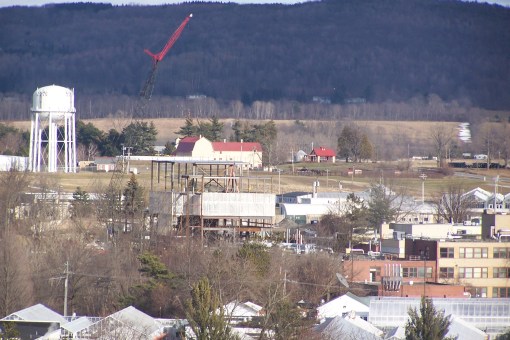
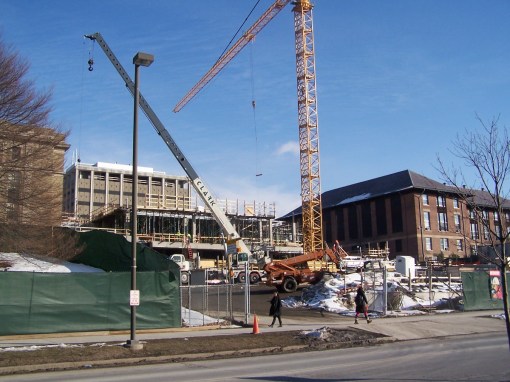
I suppose that most people, on their first arrival back to the place they call home, would call their friends and make their presence known. I on the other hand decided to avoid my overcrowded sub-subletted apartment by taking photo of the campus construction projects.

100_1105

100_1050

I have to come back to 107 weeks of this? I just lost one of my main walking paths to class. This is almost like coming back to my girlfriend in bed with someone else.  I s’pose I should be glad I’ll only be affected by this for a year before I head elsewhere.

100_1051

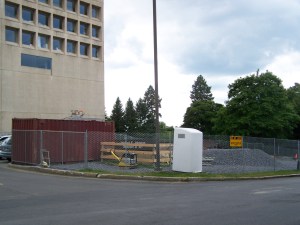
Well, I guess if they were going to close off the street, they might as well take advantage to do soil testing for the Johnson addition. Speaking of which, am Ithaca Journal article mentioned that mercury was found at the site [1]. Considering that the building was a chemistry building, and its first incarnation burnt down back in the days before WWI, this shouldn’t be too much of a shock.

100_1104

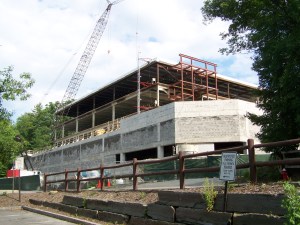
The physical sciences building continues on its merry way towards completion.

100_1098

MVR North is also well into its construction. I’m personally hoping the concrete and mortar parking base receives an attractive stone veneer to reduce some of the brutalist qualities of the north facade.

100_1099

The Vet School’s Diagnostic Center has received part of its brick facade, on track for its opening within the next year.

100_1102

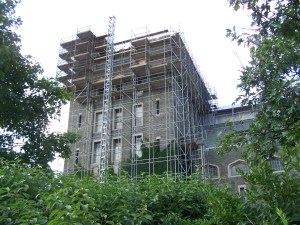
Meanwhile, Barton Hall and anabel Taylor (not pictured) are being renovated, mostly with replacement stone for the facade, and roof repairs. Barton has been particularly needy for a reno because the stone on the tower was getting to a point where it was liable to crumble away, and it reasonably couldn’t be put off any longer.

100_1103

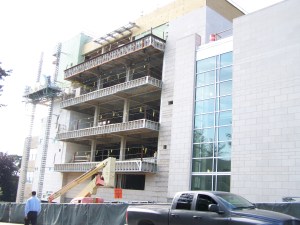
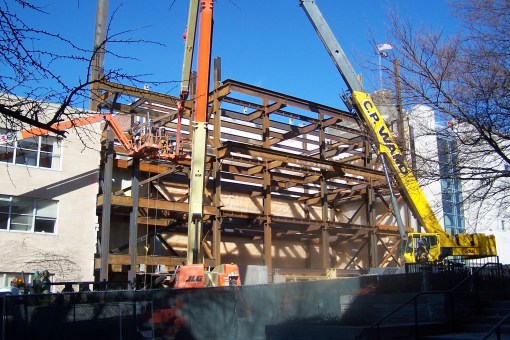
The Hotel School addition is on target for its winter completion date. For a 12,000 sq ft addition, it really sticks out, especially when approaching from the north on East Avenue. Where the Beck Center used to clash with the south facade, now the new addition clashes with the older southwest wing of the hotel school. I don’t think it’ll do much for Statler Hall, aesthetically speaking.


[1]http://www.theithacajournal.com/article/20090720/NEWS01/907200328/Mercury+buried+on+CU+campus


News Tidbits 5/20: More Info on the Collegetown Terrace Project

20 05 2009

http://www.theithacajournal.com/article/20090519/NEWS01/905190332/Collegetown+developer+plans+2011+opening&referrer=FRONTPAGECAROUSEL

The proposed Collegetown Terrace Apartments are scheduled to break ground in summer 2010, open in summer 2011 and house primarily graduate students.

On traffic and parking – a major concern for Collegetown residents – the project would provide more parking spaces than required by city zoning, as well as amenities intended to reduce car dependence, such as a shuttle to Cornell and Wegmans.

Ithaca developer John Novarr submitted his full review application report to the city’s Planning and Development Board last week, and he provided a copy to the Journal. Site plan review is scheduled to begin at the city’s Planning Board meeting at 6 p.m. May 26.

Ed Strong, a graduate student representative on the Cornell University Assembly, said graduate student housing is sorely needed and the apartments will be well-received among students.

While Cornell has recently added undergraduate housing on West Campus, on-campus graduate student housing is still inadequate, Strong said. The Maplewood complex is made of modular buildings that are already past their life expectancy, he said.

The Collegetown Terrace project calls for removing all but three buildings in the 16.4-acre area bounded by Quarry Street, East State Street, Valentine Place and Six Mile Creek. The historically designated Quarry Arms, Casa Roma and Boiler Works Apartments buildings would remain.

Seven buildings would be built on the site. The full site, including the three historic buildings, would contain 1,260 bedrooms and 860 parking spots.

The area currently contains 635 bedrooms and 430 spots.

On East State Street, plans call for four-story buildings that meet height restrictions imposed by city zoning.

As the topography slopes downhill toward Six Mile Creek, buildings are proposed to increase to five and then six stories, which would require a zoning variance.

Parking is housed in one or two stories underground and at ground level to minimize surface parking lots. In the initial presentation before the planning board, Novarr said his upper-floor apartments always rent out before ground-floor apartments, because students find them safer and more private.

Novarr plans to charge tenants separate rent for parking spaces and apartments, a measure intended to force people to consider the cost of having a car.

At the Casa Roma complex, parking is rolled into the rent.

Novarr told the planning board rent would be similar to the buildings to remain on-site.

They average between $1,500 and $1,800 for a two-bedroom apartment, according to listings available online.


News Tidbits 4/29: Massive New Development Slated for Collegetown

29 04 2009

This is a very large project for this area. The proposed location is in southwest Collegetown, an area currently occupied by mostly student houses, with a couple small apartment complexes already in the area.

***

http://www.theithacajournal.com/article/20090429/NEWS01/904290336/1126/NEWS

The Collegetown Terrace Apartment project would remove almost all buildings in the area bounded by Valentine Place, East State Street, Quarry Street and Six Mile Creek, and replace them with 1,100 new rental beds.

Developer John Novarr presented plans for the massive, 16-acre project at Tuesday night’s city Planning and Development Board meeting.

Quantcast

The historically designated Quarry Arms, Casa Roma and Boiler Works Apartments buildings would remain on the site, said Kathryn Wolf, principal with Trowbridge & Wolf. Every other building on the site would be removed, she said.

The area now houses 650 rental beds, and when completed, there would be 1,250 beds and 820 parking spaces, Novarr said.

Novarr explained his long history with East Hill, beginning with growing up in Collegetown, to his purchase of land from Ithaca College in 1982, to his decision in the last couple years to buy the last 14 properties in the site area.

Novarr said that by 2007, he had already purchased several properties on the 800 block of East State Street and planned to begin re-developing them into apartments when the city’s Collegetown moratorium went into effect.

The year-and-a-half moratorium forced him to think about long-term planning, resulting in the Collegetown Terrace Apartments concept, Novarr said.

The project will meet the four-story height limit required by zoning on East State Street, but the developer will seek height variances to allow taller buildings as the land slopes downward toward Six Mile Creek, Wolf said.

The project would “meet or exceed” existing parking requirements, she said.

Parking would be placed in one or two stories on the ground floor, with apartments above, based on drawings presented to the planning board.

Above-ground pedestrian walkways would connect some of the buildings.

The project will come before the Planning Board again in May.

***

The proposed location, with rough boundaries of the site in question.

ctown-terrace1

Trowbridge and Wolf is the firm responsible for the design of West Campus and the Health and Science building at IC, so they’re a fairly reputable choice [1].

In other news, the Ithaca Hotel is up to 124 rooms and 12 stories, according to the April 28, 2009 Planning Board minutes. Two outparcels are to be built near Uncle Wally on the flats (a drive thru restauant and another retail parcel, totaling 11,00 sq. ft and 17,000 sq ft), a 25,000 Maine’s warehouse to be built at the south edge of the city on Commercial Drive, and an eco-friendly three-dwelling development off of the 500 block of Aurora Street that is to be marketed as a co-op.

[1] http://www.twla.com/projects/education/


News Tidbits 4/16/09: Little Ithaca Grows Up

17 04 2009

Looks like Ithaca’s downtown area is seeing some long awaited expansion.

http://www.theithacajournal.com/article/20090416/NEWS01/904160358&referrer=FRONTPAGECAROUSEL

Major downtown construction projects are slated to move forward this year, a sign of Ithaca’s relative resilience in troubled economic times, city officials say.

The Hotel Ithaca project at the eastern end of The Commons should break ground this fall, and construction is scheduled to start by summer on the Cayuga Green condominiums between the Cayuga garage and Six Mile Creek, Downtown Ithaca Alliance Executive Director Gary Ferguson said.

This summer should also see the completion and opening of the new Cinemapolis in the ground-floor of the Green Street garage and Urban Outfitters on the ground-floor of the Cayuga Green apartment complex.

Hotel and condos

The $30 million, 100-room Hotel Ithaca project this month received city approval for zoning variances, and Common Council approval to jut several feet over the top of the Green Street garage. It’s scheduled to come for site plan review to the Planning and Development Board April 28.

The $12 million, 7-story Cayuga Green luxury apartment/condo project is the last piece of the years-long Cayuga Green downtown development. It already has needed approvals.

Ferguson said when he talks with fellow economic development planners around the state, “they’re just green with envy.”

“One, we’ve been planning them for some time so it’s not like these are just popping out of the ground. But secondly, while the economy’s been rough, this still is a very strong economy relative to other parts of the state, other parts of the country,” he said. “I think this malaise, if you will, is worse in a lot of other places and actually makes Ithaca look even more attractive to people.”

Bankers still seem to have faith in Ithaca, said Phyllisa DeSarno, deputy director for economic development for the city. This is evidenced by the fact that Cayuga Green developer Ken Schon has retained his financial backing.

“We were all crossing our fingers . . . because so many developers are losing their funding and banks are not going with projects,” she said. “But he said it does not look like that’s going to be his issue. He is moving ahead.”

The Hotel Ithaca was proposed to go up to the limit of 85 feet allowed by zoning, but the project developer received approval to go up an additional 21 feet, in order to enclose the building’s heating, ventilation and air conditioning systems. Under the city’s zoning, that kind of equipment is never considered part of a building’s height.

“This was a very, very major coup, really,” DeSarno said. “We were so thrilled that this happened because it sets a bar now I think for other developers, other builders to do something about mechanicals, which are really such a blight. When you’re coming off any of the hills, coming down from Ithaca College or Cornell (University), it’s going to be so much more aesthetically nice to have that screening there.”

The rooftop enclosure will also include meeting and conference space “to offset the cost of the structure,” according to information provided to the city’s Board of Zoning Appeals.

Openings

Construction continues on the future homes of Cinemapolis and Urban Outfitters on either side of Green Street.

Cinemapolis is scheduled to open in late May, potentially in conjunction with Ithaca Festival, said Lynne Cohen, one of the executive directors of Seventh Art, which oversees Cinemapolis.

Construction is scheduled to be complete in about a week, then all that will be left is to paint and install seating, projection equipment and refreshment equipment, Cohen said.

“With a little imagination, you can see what the theater’s going to look like,” she said.

Compared to the existing Cinemapolis theaters in Center Ithaca and at Fall Creek Pictures, the new location will have “fewer seats but better allocated,” Cohen said.

Cinemapolis’ contract at Fall Creek Pictures runs through the end of this year, but Seventh Art has not yet decided whether they’ll continue showing films there once the new location opens, said Rich Szanyi, Cohen’s husband and another Seventh Art executive director.

Tsvi Bokaer, founder of Fall Creek Pictures, could not be reached for comment.

Urban Outfitters, which will occupy the eastern half of the ground floor under the Cayuga Green apartments, is on schedule to open July 2, project architect David Levy said by email.

“Now obviously Urban Outfitters will be a big draw and all of the neighbors around Urban Outfitters, including The Commons, will benefit from them being here,” DeSarno said.

Ithaca will be the second Upstate New York location for college-age focused Urban Outfitters. The other is in Buffalo.

Tompkins Consolidated Area Transit also plans to rent space on the ground floor of the apartments, and Schon is in discussion with two local small businesses about filling the remaining area, DeSarno said.

“Obviously there are cuts throughout our city and the county in our businesses and in our employers,” she said. “But we certainly, like Bob Sweet from National Development Council always says to me, ‘(Ithaca is) an oasis amongst a muck and mire.’ ”

The Hotel Ithaca was proposed to go up to the limit of 85 feet allowed by zoning, but the project developer received approval to go up an additional 21 feet, in order to enclose the building’s heating, ventilation and air conditioning systems. Under the city’s zoning, that kind of equipment is never considered part of a building’s height.

“This was a very, very major coup, really,” DeSarno said. “We were so thrilled that this happened because it sets a bar now I think for other developers, other builders to do something about mechanicals, which are really such a blight. When you’re coming off any of the hills, coming down from Ithaca College or Cornell (University), it’s going to be so much more aesthetically nice to have that screening there.”

The rooftop enclosure will also include meeting and conference space “to offset the cost of the structure,” according to information provided to the city’s Board of Zoning Appeals.

~~~

For the record:

commons

Red box is part of the Hotel Ithaca site, green box is the Cayuga Green Condos site. Cayuga Green Apts, shown as under construction in this map, are where Cinemapolis and Urban Outfitters are going to be located. As Mr. Nagowski noted, Cinemapolis will be in the garage side of the construction area. Urban Outfitters is on the first floor of the apartment building.

Hotel Ithaca proposal:

http://www.gemstoneresorts.com/Properties.aspx

Cayuga Condos

http://www.josegarciadesign.com/images/cayuga-condo00.jpg

For reference, the height of Seneca Place is 121 feet, according to Emporis. The new apartment building on Green Street is 60 feet.


Ithaca Construction Isn’t Ending…Yet

3 03 2009

With all the doom and gloom associated with the current economic times (rightfully so), it’s easy to forget that there are still some projects in the pipeline outside of Cornell, but in the surrounding Ithaca area. Since it’s been a while since I chronicled those, let’s do a quick overview.

Lansing

Ithaca’s northern suburb has a number of different projects  planned. Currently going through the pipeline are the Lansing Commons project (~50 units) and the Cayuga Farms projects (~138 units). The projects are typical suburban development, consisting of single-family homes, townhouses, and a few apartment buildings and commerical office buildings. The buildout would be over a period of several years.

Ithaca (town)

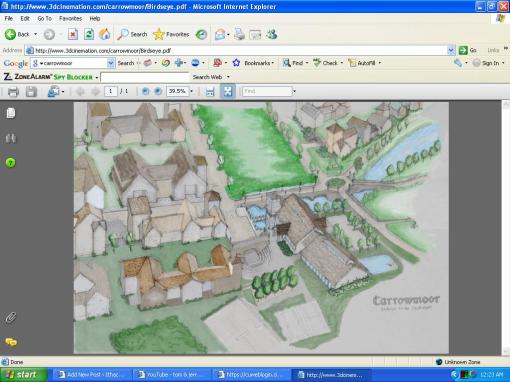
Apart from some minor subdivisions, an electrical substation and a wireless tower, the big project in the town of Ithaca is the Carrowmoor project [2].  The 400-unit project is an eco-friendly development of houses and a small village center of retail and office space. The residential units are a mix of single-family houses, townhouses and apartment buildings. The buildout is also over a period of several years. Building designs are meant to be a throwback to the days of Tudor England (for better of for worse [3 -The website for the development looks like it was built in 2000, and takes a long while to load]).

carrow1

Ithaca City

Two outparcels (small-box retail no doubt) are planned for the SW commerical district. One is in front of the Tops Plaza, the other is next to Wal-Mart. Renovation for the Hangar Theatre, finalized drfats for the Ithaca College Athletics Center, and construction for Urban Outfitters planned downtown location are also going through the board. The Hotel Ithaca is still underway- technically. The 10-story, 100 ft. building is currently being held up because the building has a nine-foot overhang over the Green Street Garage—meaning it’s in city air space, and has to go in front of the board to get approval for that air space [4]. A little bit ridiculous, perhaps, but that’s how it’s done. anyways, the preliminary design has been brought in front of the board, but no image is widely available as of yet.

Technically, the Southwest neighborhood plan is still active too, but that one might just as well be considered in hibernation given the economic situation.

Heck, since I’m writing this, I might as well include progress photos of some of the campus projects.

100_3181

Veterinary School Animal Health Diagnostic Center

100_3100

Physical Sciences Building

100_3102

MVR North expansion

100_3318

 Hotel School Expansion

[1]http://www.lansingstar.com/content/view/4601/66/

[2]http://www.ithaca.com/main.asp?SectionID=16&SubSectionID=83&ArticleID=8385

[3]http://www.3dcinemation.com/carrowmoor/index.html

[4]http://www.theithacajournal.com/article/20090220/NEWS01/902200317/1002


Miracles Do NOT Happen…

12 02 2009

http://www.theithacajournal.com/article/20090211/NEWS01/902110328/1002#pluckcomments

So, let’s start with the article:

http://www.theithacajournal.com/article/20090211/NEWS01/902110328/1002#pluckcomments

“A group of Cornell professors is urging the university to hold off on construction of Milstein Hall, citing concern about the economic recession and the building’s environmental footprint.

In response, a group of Cornell architecture faculty is urging the university to move forward, saying the new building is needed to keep its top-ranked department accredited.

The ultimate decision on whether to go forward with Milstein Hall lies with University President David Skorton, and he has not yet made that decision, Cornell spokesman Simeon Moss said Tuesday.

Skorton announced a university-wide construction “pause” in October. The pause extends through the end of the fiscal year in June.

“Basically all projects that don’t have a shovel in the ground are subject to the pause, and the president and the executive vice president are reviewing those projects,” Moss said. On whether Cornell will move forward with Milstein Hall, Moss said, “That decision by the president hasn’t been made yet.”

Throughout its city approval process, Cornell officials repeatedly said that Milstein Hall is not subject to the construction pause.

On Monday Mark Cruvellier, chair of the Department of Architecture, sent The Journal a joint statement in favor of Milstein.

“This is a building that is urgently needed by the Department in order to maintain our accreditations as a professional school of architecture,” reads the statement signed by 13 architecture professors. “The building permit is in hand, bids have been reconciled, and it is, in today’s parlance, shovel-ready. Given the current low cost of materials and competitive bidding situation, to delay construction of Milstein Hall yet again will only add to its cost.”

Cruvellier could not be reached for comment Tuesday.

Milstein Hall has spent 10 years in the design and approval process, including two years gaining approvals from a variety of city boards. The city’s planning board and landmarks preservation commission have both signed off on the project.

Milstein Hall is proposed as a modern, glass structure that will physically connect with Rand and Sibley halls and stretch across University Avenue toward the Foundry. Another cantilevered extension would extend out into the arts quad.

A group of at least 25 Cornell faculty and alumni have petitioned the university to halt construction of Milstein, using The Cornell Daily Sun, other media and, today, the university’s faculty senate, government professor Elizabeth Sanders said.

Those opposed include an architecture professor, Jonathan Ochshorn, and music professor Martin Hatch, who has spoken against Milstein before a variety of city boards over the last two years.

Sanders contrasted the process and design for Milstein with Ithaca College’s new Park Center.

The Park Center received the highest rating possible from the U.S. Green Building Council, a LEED Platinum, and cost $19 million, according to the Ithaca College Web site.

“And we’re going to spend $60 (million) and get less space and much lower sustainability and a lot of offensive aspects?” Sanders said. “If Ithaca College can do this, why can’t Cornell do this?”

Andrew Magre, project manager for Milstein Hall and the Central Avenue Parking Garage, said last month the total project cost would be approximately $54 million.

Milstein Hall would be roughly 50,000 square feet, according to information presented to Ithaca’s planning board, and will include studio, gallery, meeting and exhibition space, and a 275-seat auditorium. The parking garage will include two underground levels and one surface level for a total of 199 parking spaces.”

***

Let’s consider the Park Center for a moment.

Photo by Granger Macy

Photo by Granger Macy

The Park Center was a $19 million dollar project to build a 38,800 sq ft building [1] on the Ithaca College campus that was completed in early 2008 (it’s also the building that caught fire during the fourth of July celebrations).

So, let’s consider some key differences between the Park Center and Milstein Hall.

-Milstein is cantilvered and is connected to two structures that are a century old (Rand Hall) and ~110 years old (East Sibley). Park Center isn’t. The area was home to a green space that bordered a parking lot (and oddly enough, was not a suggested building site on the Ithaca College master plan [2], and to the contrary seems to throw off the master plan by cutting off the proposed green avenue through the main campus).

-Milstein had to go through red tape hell after Paul Milstein’s original $10 million donation in 2000. Park Center was launched with a major donation from Dorothy Park in 2002 [1]. The cost has gone from somewhere in the 20 million dollar range when first proposed to $40 million from a couple of years ago to about $54 million today. I wonder if that total includes the $2 million Cornell paid for University Avenue so they could actually build the damn building.

-Milstein incorporates a parking garage, auditorium, and bus stop. Park Center has a large atrium, but otherwise it’s mostly offices and smaller lacture spaces [1]. Park Center is LEED platinum (highest ranking), and Milstein is gold (second highest ranking).

My issue is that the comparison does an unfair presentation of facts. If we were to plop Milstein out on the alumni fields or near the vet school, I bet it would be a lot of cheaper too. Park Center didn’t have the red tape issues or ambient environment issues that Milstein Hall has to deal with.

My other issue is that some people are finding fault with the modern design. Let’s not start that crap again. In my own opinion. this is probably the least offensive design of the three that have been planned, if but just because it spares Rand from the wrecking ball. I’ll admit I’m no fan of it, but it’s less jarring than the previous two proposals. For one thing, architecture schools have a habit of wanting to be on the cutting edge of design (makes sense, considering building design is much of their field). Plus, the design is going to be different, because if people want to preserve Rand and Sibley the building has to build up or out. Being on the Arts Quad, I’m willing to wager some passionate people would rather burn the construction site down than let it build up.

As much as this site is a Cornell construction monitor, and as I much as I actually like seeing new projects go forward, I’m really torn opinion-wise. Yes, I’d like to see the the architecture build-out so it can have more (badly-needed) space. However, with operations cuts across the board, I don’t see a good reason this should be spared. My concern, however, is that prices will continue to skyrocket, costs will be prohibitive and the project will have to go back to the drawing board again, and AAP will have a crisis due to its trip through red tape hell.
[1] http://www.ithaca.edu/news/release.php?id=2501
[2]http://www.ithaca.edu/masterplan/reports/sept_2002_content_pages.pdf


News Tidbits 1/8/09: Miracles Do Happen

8 01 2009

All I can say is, it’s about time.

http://www.theithacajournal.com/article/20090108/NEWS01/901080319/0/NEWSFRONT2

ITHACA – Cornell’s Milstein Hall project will benefit Cornell and the public while minimizing negative impacts, Ithaca’s Planning Board decided.

The Board voted unanimously Tuesday night to grant preliminary site plan approval to the $54 million project that includes a new, 59,000-square-foot building that will connect Rand and Sibley halls and stretch over University Avenue toward the Foundry.

A new Central Avenue Parking Garage will also provide 199 parking spaces on three levels, two of them underground.

The project has been delayed for at least five years with various designs and, most recently, a dispute between the university and the city’s Board of Public Works over the proposal to place part of the building over University Avenue.

After months of disagreement, the university decided to use a cantilever design rather than columns, which would have required an easement from the city. Separately, Cornell and the city later agreed that Cornell would pay to rebuild and maintain the badly deteriorated University Avenue in exchange for the city’s decision to give up its public right of way on the road.

The planning board has been reviewing an environmental impact statement on Milstein for the past two months and has heard comments from Ithacans and Art, Architecture and Planning faculty and students for and against the project.

Cornell and those in favor of the project have argued that the additional space is needed to maintain the Art, Architecture and Planning College’s accreditation and to programmatically connect the three buildings.

Planning Board Chairman John Schroeder said the existing conditions leave the Foundry disconnected and looking “like a maintenance building.” Milstein Hall would move the center of activity more toward the middle, better linking the buildings, he said.

Those against the project have argued that the very modern design of Milstein Hall will be jarring next to the historic Rand and Sibley halls.

Ithaca’s Landmarks Preservation Commission will review historic preservation concerns related to the project at their meeting at 7 p.m. Wednesday, Jan. 14 in City Hall, 108 E. Green St. The commission would have to grant a Certificate of Appropriateness for Milstein Hall to be built, Acting Planning Director JoAnn Cornish said by e-mail.

Cornell also needs final site plan approval from the Planning Board, which could come at its Jan. 27 meeting, Cornish said.

John Gutenberger, director of community relations at Cornell, said if the final approvals are granted, construction could start by early spring. Milstein Hall is not subject to the university’s construction pause, he said.

The project would be complete by December 2010, project manager Andrew Magre said.

***

In other news, the massive (by Ithaca standards) development called “Carrowmoor” continues to clear the political hurdles. From the town of Ithaca’s 1/6/09 minutes:

Consideration of designation of the Town of Ithaca Planning Board to act as Lead Agency, and the determination of a Positive Declaration of Environmental Significance for the proposed Carrowmoor development project located off Mecklenburg Road (NYS Route 79), north of Rachel Carson Way, Town of Ithaca Tax Parcel No. 27-1-14.2, Agricultural and Medium Density Residential Zones.  The proposal includes the development of 400 +/- residential condominium units, a community center complex, up to 36,000 square feet of neighborhood oriented commercial uses, up to 32 living units in an elderly residential building, a child care center, and other mixed-use development on 158 +/- acres.  The project will also include multiple new roads and walkways, open recreation areas, stormwater facilities, and community gardens.  Town of Ithaca actions also include consideration of adoption of a proposed local law to enact a Planned Development Zone in conjunction with the Carrowmoor proposal.  The Planning Board may also begin discussions of the draft scoping document for the Environmental Impact Statement (EIS).  John Rancich, Owner/ Applicant; Steven Bauman, Agent; Mary Russell, Attorney.”

Still some hurdles left though. The Planning Board must approve both the environmental review and site plan review before Carrowmoor could be built. The Town Board also has to pass a local law changing the zoning to allow for the project’s development.

***

No entries for the next week, as I’ll be mostly internet-less at a conference. For those of you planning to attend Rush Week, good luck and have fun.


News Tidbits 12/10/08: Ithaca’s “Fancy New” Wal-Mart

10 12 2008

So, recently, although the national and state economies are sinking like a stone in a lake, there has been one slight bright spot here in little Ithaca. The local Wal-Mart is continuing its expansion plans, and apparently the giant retailer plans to use Ithaca as its first test market for a more socially conscious image for the retailer. To quote the Ithaca Journal article:

“Wal-Mart is trying out a new branding campaign characterized by smaller signs, earth tones, and more pedestrian-friendly amenities like awnings outside the store, said Jim Gallagher, an architect with PB2 Architecture and Engineering and a Wal-Mart consultant.”

I’d post the Daily Sun photo if I could find it, but locating any image of the redesign has been a royal pain in the ass, so we’ll go without it for now.

A facadectomy isn’t going to change the image of a store so despised by fringe locals that they planted a bomb (yes, it was an actual improvised explosive device [3]). But, hey, if that’s how they want to spend their money, then let them do stonework and vestibules in the hope that people stop associating them with corporate greed.

A Wal-Mart was first proposed in Ithaca for the property in the early 1990s where the Home Depot sits today, but it was shot down by community opposition (the site was planned by Widewaters Development Group out of the Syracuse area). The current store wen through an untold number of hoops while trying to avoid the barbs of angry locals who did not want a Wal-Mart in the area, The current Wal-Mart, approved in 2002, opened in early spring of 2005 [6].

Meanwhile, Cornell is still planning the 6,000 sq. ft. Plantations Welcome Center [4] , and a new water tank off of Hungerford Hill Road. Student Agencies is seeking approval for the construction of a 10,000 sq. ft warehouse off of Sheffield Road to expand their capacity for the storage of student items during the summer months.

Apart from that, nothing really new from the planning board agendas of the town or the city. Some cosmetic work and a few more large parcels of land being subdivided for future house development.


[1]http://www.theithacajournal.com/article/20081029/NEWS01/810290317

[2] http://cornellsun.com/node/33711

[3]http://walmartwatch.com/battlemart/go/cat/crime_safety

[4]http://www.fs.cornell.edu/fs/projects/fs_project_overview.cfm?project_id=125

[5]http://www.ithacahours.com/archive/9406.html -Wal-Mart Attack

[6]https://cornellsun.com/node/12711


The Goldwin Smith Hall Addition

20 11 2008

Perhaps I’ll still have some construction tidbits to write about after all. So, up for review for the Ithaca Planning Board this month is a sketch review of the Goldwin Smith Addition. The “Goldwin Smith Annex” is a $45.1 million, 60,000 sq. ft addition in the back of the building [1], facing East Avenue, a la the Lincoln Hall addition in 1998. The GA Annex is set for a targeted completion date of Summer 2011, but given the current economic situation, we’ll see if that changes down the line. To quote the capital budget plan (first link):

“This project will design and build a new building adjacent to Goldwin Smith Hall to provide approximately
30,000 to 35,000 net square feet of new humanities and social science classroom and academic department space on the Arts Quad. The new space will address partially a chronic shortage of academic space that has characterized this area of campus and which has been exacerbated by recent and projected growth in faculty and programs in response to university initiatives. The current shortage of space has resulted in: (a) some faculty sharing offices or rotating among offices based on the pattern of temporary faculty leaves; (b) a lack of adequately sized classrooms and lecture halls; and (c) inadequate space for lecturers, graduate students, and staff.”

Where’d they get the 60,000 sq. ft figure from? My personal guess is renovated space in Goldwin Smith.  I’m not a fan of inconsistencies. However, the old budget plan indicates that an architects should have been selected in fall 2007.

So, unfortunately, the sketch plan brings no mention of the architectural firm, which makes the task of getting a rough idea of the design a veritable hell. However, thanks to the master plan, we actually have an idea of the massing:

untitled

So, the rough massing concept seems to be three connected but otherwise independent structures, all of similar massing (and therefore roughly the same square footage). If we use the 60,000 sq. ft figure, except three two-and-a-half story buildings with footprints of about 7500 sq. ft each, which fits the area rather snugly. If it’s the 30-35,000 figure, we can except the footprint to be smaller, but the height massing will likely be about the same to maintain massing consistency with the main building.

In the meanwhile, I have requests filed in with the contact person for this project asking for any possible rendering or at least the architectural firm responsible, so I’ll come back to edit this post, hopefully in the not too distant future.

[1]http://dpb.cornell.edu/documents/1000383.pdf —page 54

[2]http://www.ci.ithaca.ny.us/vertical/Sites/%7B5DCEB23D-5BF8-4AFF-806D-68E7C14DEB0D%7D/uploads/%7BF4A05E59-733D-480A-A8C0-37224316CFF6%7D.PDF

“D. Sketch Plan, New Humanities Building, Cornell University (materials to be distributed at
meeting)”


(Bad) Sign of the Times

30 10 2008

This is going to take away a fairly large amount of my writing material…

http://www.theithacajournal.com/article/20081030/NEWS01/81030012

Cornell announces hiring pause, construction moratorium
Moves in response to state budget news
October 30, 2008

 Cornell University is taking steps to prepare for blows to the budget, including a pause in hiring, a 90-day construction moratorium, and a university-wide review of all operations, Vice President for Communications Tommy Bruce said today.

The “pause” in hiring means no external applicants will be appointed to any open positions, according to a statement released by the university.

This is intended to provide slots for any employees who may be “dislocated in the near term” by funding cuts, and to find, through attrition, any positions that can be eliminated to minimize the need to lay off staff in the future.

Though a private university, Cornell operates four schools on the Ithaca campus established by the state and that receive public operating and construction funding. It is also New York’s land-grant institution and operates agricultural experiment stations in Ithaca and Geneva. Gov. David Paterson announced earlier in the week that the state faces a $1.5 billion budget gap for the current fiscal year and $12.5 billion for the fiscal year that starts April 1. About a fifth of state revenues are tied to the New York City financial industry.

Bruce emphasized that there will be no across-the-board cuts or layoffs, saying, “We have been having to deal with very real cuts coming from the state, and what we’re dealing with is loss of revenue in the wake of the Wall Street situation. What this means going forward is that we may be facing a situation in terms of reduced personnel. What we have to do at this point, not knowing the full impact of the current economic situation, is taking the precautionary step of pulling back on posting open positions and hiring externally.”

The hiring pause will be in effect until March 31 and applies only to non-professorial positions.

The 90-day construction pause will halt progress on any development project on which construction has not already started or which does not have a contract commitment on it.

Physical infrastructure, information technology capital investment, and local transportation and housing projects are included in the moratorium. Bruce said there will be a review of all projects to determine how to proceed most efficiently.

The university-wide review of operations will help the administration pinpoint areas that can be streamlined and where costs can be contained.

Bruce offered an example from his office, which produces more than 1,000 publications a year. These publications can be produced electronically, he said, saving the cost of paper and publication.

An electronic suggestion box has been set up at www.cuinfo.cornell.edu for members of the Cornell community to offer ideas.

~~~

City of Ithaca’s doing the same thing. The state’s severe defecits as a result of the crisis on Wall Street are finally hitting home…and it’s hitting hard.

http://www.theithacajournal.com/article/20081030/NEWS01/810300321

My question is which projects that are not underway have a contract commitment. I suspect Milstein is largely safe, but the addition to the Johnson Museum is likely shelved.