Everyone Loves Historical Throwbacks

2 10 2008

So, if you haven’t been living under a rock in the past year, there are plans for a 9-story, 102-room hotel just off the commons, to be designed by Scott Whitham of Thomas Group Architects in conjunction with Ithaca Properties LLC / Rimland Associates. Well, it looks like they have a hotel operator in Gemstone Hotels & Resorts, a boutique hotel operator based out of Utah [1]:

Hotel Ithaca

Hotel Ithaca, currently in final planning and approval, is expected to open in 2011. The property will be a nine-story, full-service boutique hotel at the intersection of State and Aurora Streets. The hotel will feature 125 luxury rooms and suites and 2,000 square feet of flexible meeting space. The hotel will be built on the same site as the original Hotel Ithaca. In addition, the hotel will be the home of the original Zinck’s Bar, a cherished icon of the city’s past.

“We welcome the opportunity to be involved with the first luxury boutique hotel in the Ithaca area,” said Thomas Prins. “Because the city is also home to the world renowned Cornell Hotel School, we are very excited to set a new standard in concept and operations and set an example for students and the many hotelier alumni who visit the school.”

I have no clue where they had the idea it was a 125-room hotel. Everything I’ve read has stated 102 rooms.

That being said, since the last Zinck’s closed over forty years ago, the only things most of us modern Cornellians know about it is from “Give My Regards to Davy” [/We’ll all have drinks at Theodore Zinck’s/]. Cornell’s alumni associations make use of the Zinck’s nostalgia in its alumni events:

“Theodore Zinck was a saloonkeeper in Ithaca, and his pub, the Hotel Brunswick, was a popular gathering place for Cornellians in the 1890s. After his death in 1903, several bars using his name continued to provide a haven for students. When the last Zinck’s closed in the mid-1960s, celebrating the spirit of Zinck’s became a favorite Thursday night Collegetown tradition for undergraduates. It wasn’t long afterward that Cornellians began to continue the tradition in their hometowns. This year, alumni will celebrate this uniquely Cornell event in more than 90 cities around the world. So wherever you are, remember your days at Cornell on October 16. [2]”

Currently, the University uses “the Spirit of Zinck’s night” as a way to promote alumni involvement (e.g. solicit donations). With the historical name being reused at a drinking establishment once again, it looks like they might be able to celebrate at Zinck’s a couple of years from now.

[1]http://www.wishtv.com/Global/story.asp?S=9097563&nav=menu35_8

[2] http://www.alumni.cornell.edu/zincks/index.cfm


The Story of the Vet School Incinerator

18 09 2008

So, I enjoy telling a good story as much as the next guy, and this one was actually the subject presented by my professor in an air pollution course I’m enrolled in. I might have been the only one taking notes on this, because it was meant to merely illustrate an argument, it’s historical, and an interesting piece of history worth sharing.

So, in the early 1990s, The Vet School over on the East Campus had a problem. A large number of carcasses were being generated daily. Dissections, disease studies, putting some of the farm animals to sleep, etc. So on any given day, thousands of pounds of carcasses were being produced, and they had to be disposed of.

Well, Cornell, for all the things it does have, does not have an incinerator for cremation on any of its properties. So they would have to ship the carcasses out in container trucks with hazard labels and send them to an incinerator elsewhere in the county, where they could be properly disposed. As you might imagine, this built up quite a hefty amount of fees over time. So Cornell began to explore their options to alleviate the problem.

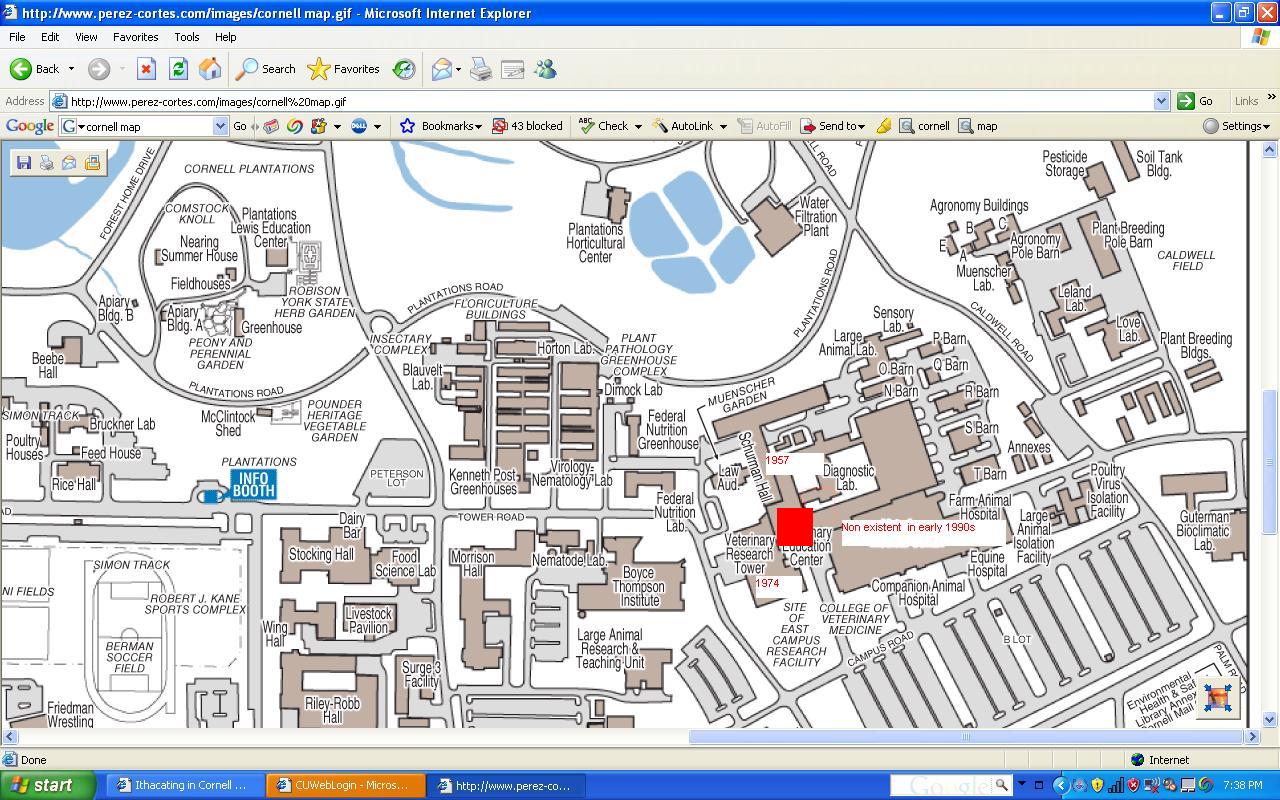
Well, the proposal that seems to work best was to build a waste disposal facility for the animal carcasses directly on the property. The site that was determined to be the best fit was just to the east of the Vet Research Tower. At this time, the Vet Hospital’s main building and the East Addition didn’t exist, so the complex was mostly barns, the tower, Schurman Hall and the scattered add-ons that comprised the property. The red square below was the approximate location for the project.

 The Vet Tower is a fairly large building, as it stands about 140 feet tall. So, in order to build the smokestack, the design had the smokestack stand about 180 feet tall, more than enough to clear the building.

Well, it went ahead in front of the town of Ithaca, and the residents of the neighboring hamlet of Forest Home had a fit. They’d be damned if they had to look at a giant smokestack from Cornell. So Cornell paid an engineering firm to survey the land from notable viewing radii to see if the structure would impose on the residents of Forest Home. Sure enough, if did, but only just barely. It was determined that if the design was shorter, it’d be okay.

So, Cornell proposed changing it to 160 feet. But, there was another issue with that. Bradfield Hall, just up the road, stands 167 feet tall. And the top floor has windows (ironically enough, the atmospheric science department is housed at the top).  So, that wasn’t going to fly unless Cornell did an air pollution study to prove it wouldn’t affect the occupants of Bradfield.

Well, here’s where we get into an issue. The company they hired, a New York-based engineering firm, decided that the air circulation patterns in Ithaca were the same as Syracuse. Syracuse built a power plant only a couple years earlier, so they decided to reuse the same data and apply it Ithaca. Essentially, they tried to swindle Cornell by selling them false data from another location.

Winds generally blow out of the west in Ithaca. However, in the situation where they would blow out of the east, as during some stormy days caused by east-coast lows, the pollution cloud was going to push over to Bradfield Hall and towards central campus. This pollution would have particulate matter that would drift down onto Tower Road and the Ag Quad. Well, no ones wants to be snowed on by cremated animal ash. Even worse, if it blew out of the northwest at a particularly strong clip, it was going to drift right over Forest Home. The increased height would have allowed it to carry farther away, but the new shorter height would cause particulates to fall a shorter diestance away, and they would be more concentrated, to unhealthy levels.

Well, the university didn’t know that at the time, so they bought the data. And it wasn’t until the final stages of the project that the mistake was realized (through an interdepartmental study independent of the project). The Town of Ithaca wouldn’t give final approval in light of the news. Well, Cornell was just a little upset, so they decided to bring a lawsuit onto the company for their actions, and Cornell had to scrap the 160-foot plan.

Well, due to the air ciruclation patterns and sight lines, a large smockstack just wouldn’t be suitable for their desired location. And Cornell was already set for a major expansion of the Vet School, so they scrapped the plan entirely. The Vet Education building, built in 1993, was the final incarnation of the incinerator project, in which there was no incinerator at all. And the large Vet Hospital would be built four years later, dooming any future proposal nearby.

So, some of you might be wondering about the heating plant, which is to the south. The smokestacks there are outfitted heavily with scrubbers, so the vast majority of the smoke is water vapor, and not nearly as toxic as the smoke from the vet school smokestack would have been.

~~~~

And in other news, House 5 has been deemed “Flora Rose House”, after a professor who was among the first to staff the school of Home Economics (Human Ecology).


Going Downtown

3 09 2008

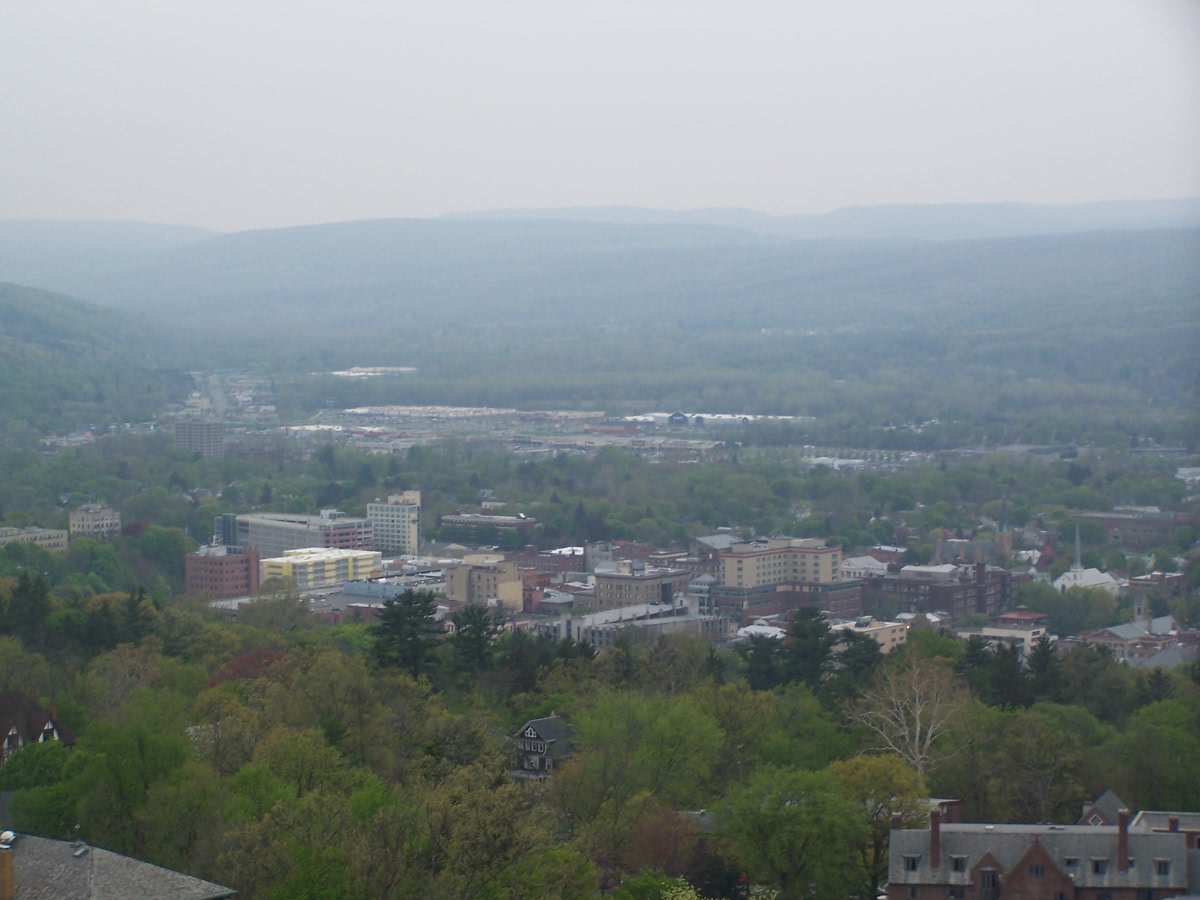
Information that might be worth knowing about Downtown Ithaca, so you can impress your friends by making it sound like you actually leave Cornell and Collegetown.

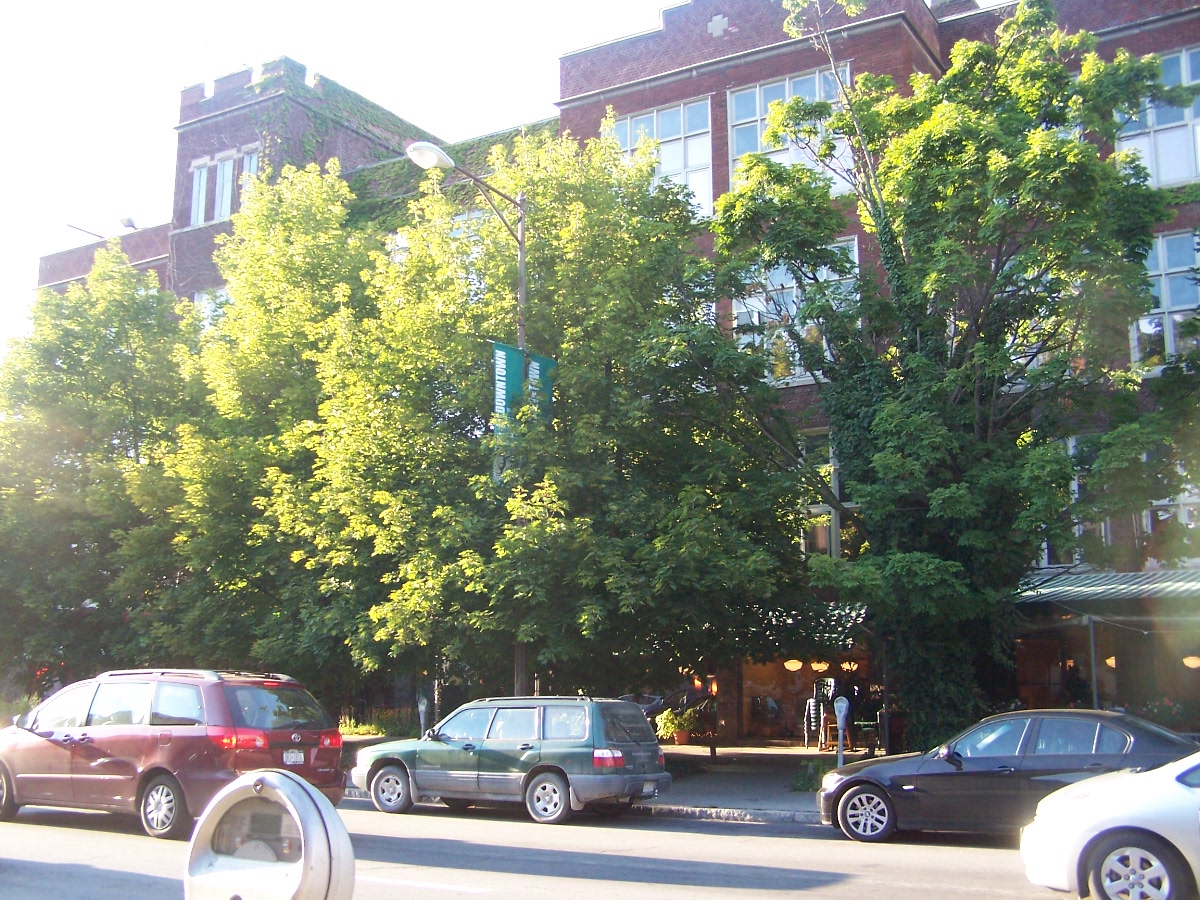
Built in 1914, the quirky DeWitt Mall (named for Dewitt Clinton) formerly served as the city’s high school before the new facility on Lake Street was built in 1960-61. Apart from having a bunch or quirky shops and stores, the building’s sub-street storefront is home to Moosewood Restaurant (est. 1973 [1]) of vegetarian dining fame.

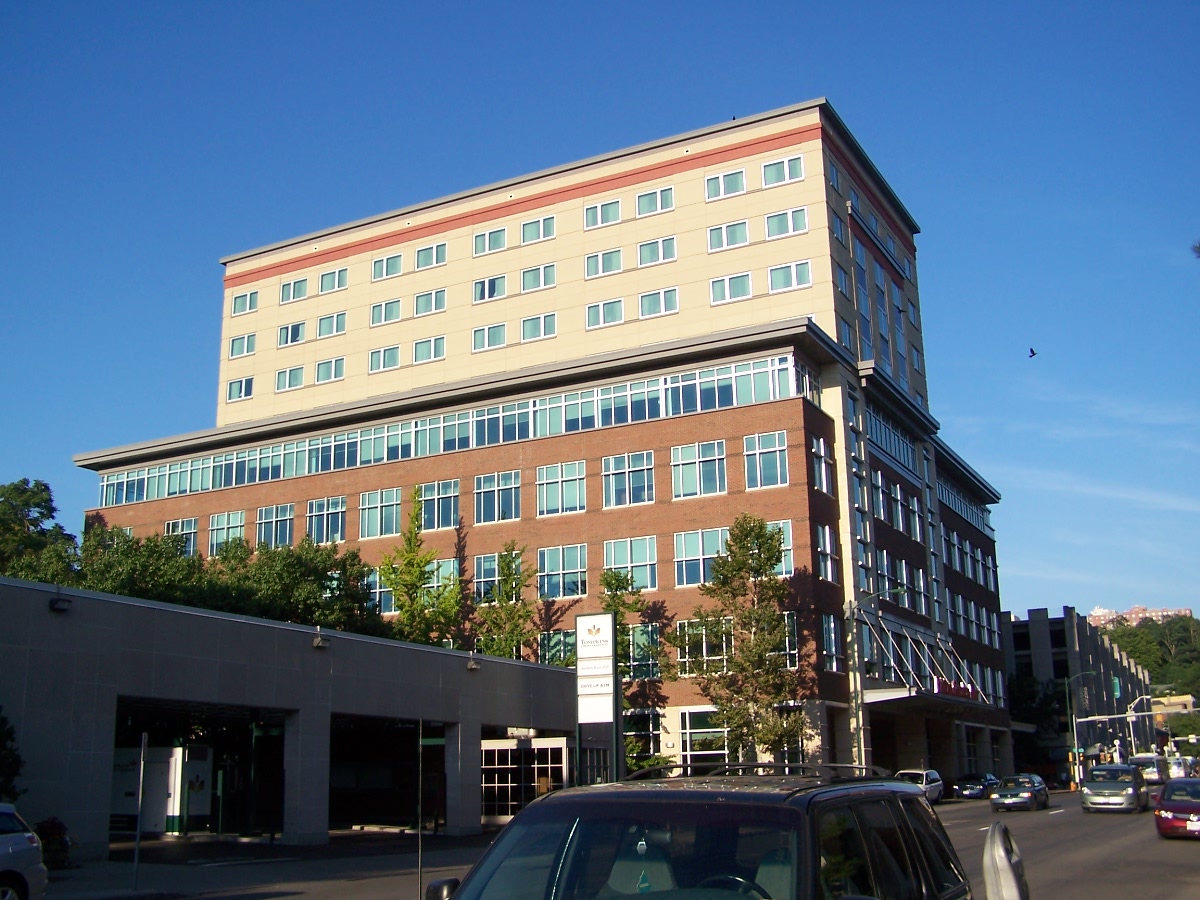
Seneca Place on the Commons is one of the largest buildings by gross area in downtown Ithaca. The 121-ft. tall, $32 million building was completed in 2005 by Criminelli Development [1]. It houses 100,000 sq. ft. of offices (Cornell is the primary tenant at about 70,000 sq. ft.) and a 104-room Hilton Garden Inn [2]. Starbucks and Kilpatrick’s faux-Irish pub make up the ground floor retail. The site was previous home to a parking area and two low-rise buildings.

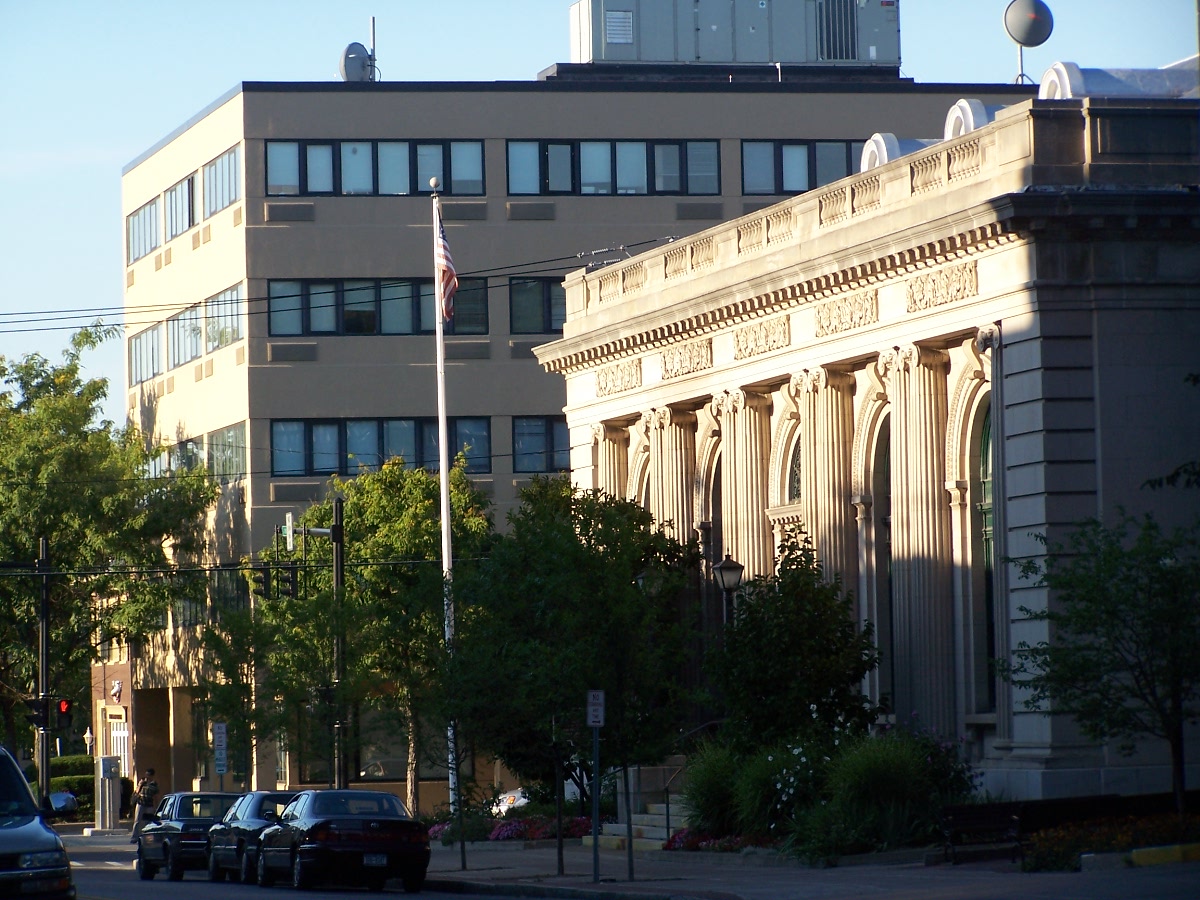
The beige box on the left is the Community Bank Building, which was built about 1981. The previous structure on the site, a four-story YMCA building, burnt down in a reported arson in 1978. The building on the right is the older portion of the Ithaca Town Hall (not that it’s not Ithaca City Hall, which is another building), which dates from 1858[3]. Prior to renovation in 2000, it was the (vastly underused) main Post Office in Ithaca.

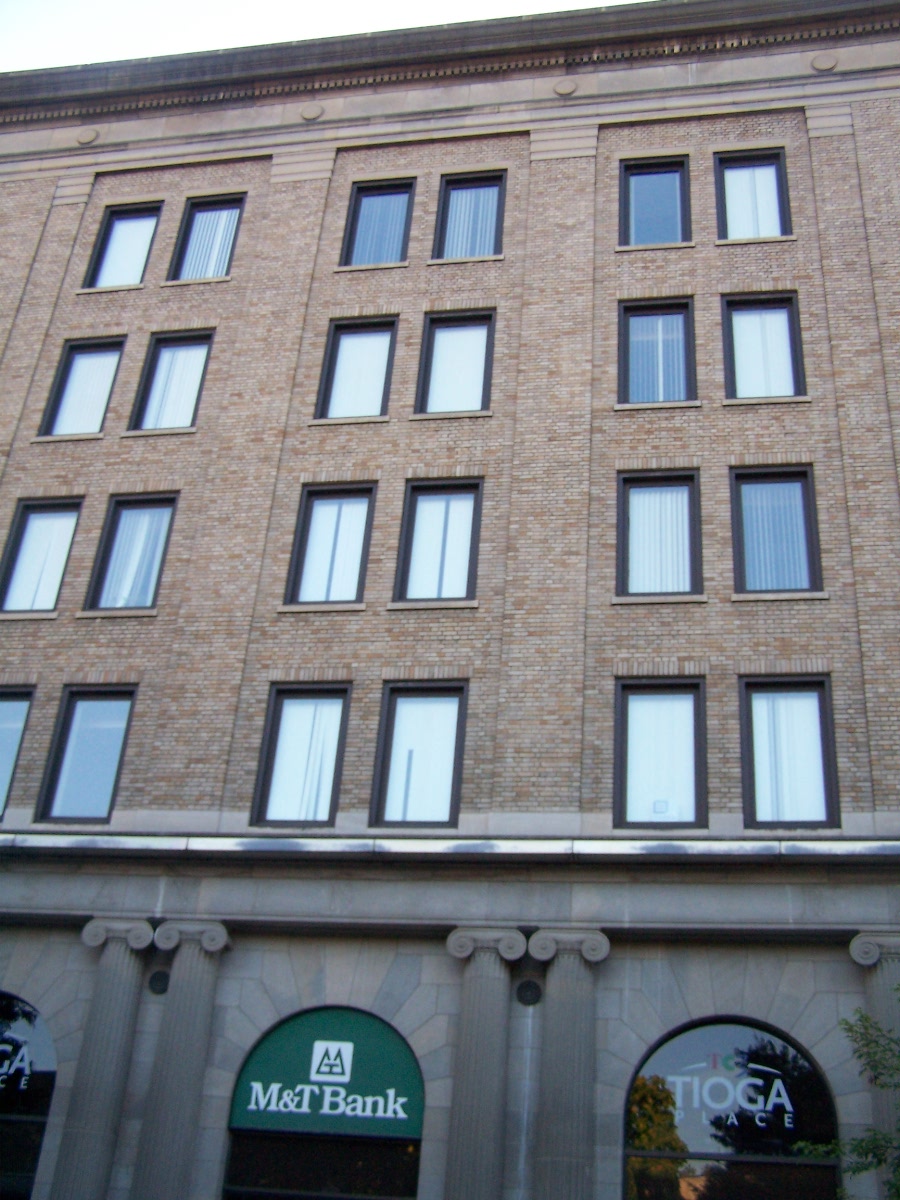
The M&T Bank Building, formally known as Tioga Place, was originally built in 1924 [4]. The awkward addition, like a piece of food stuck between someone’s two front teeth, was built on a half century later.

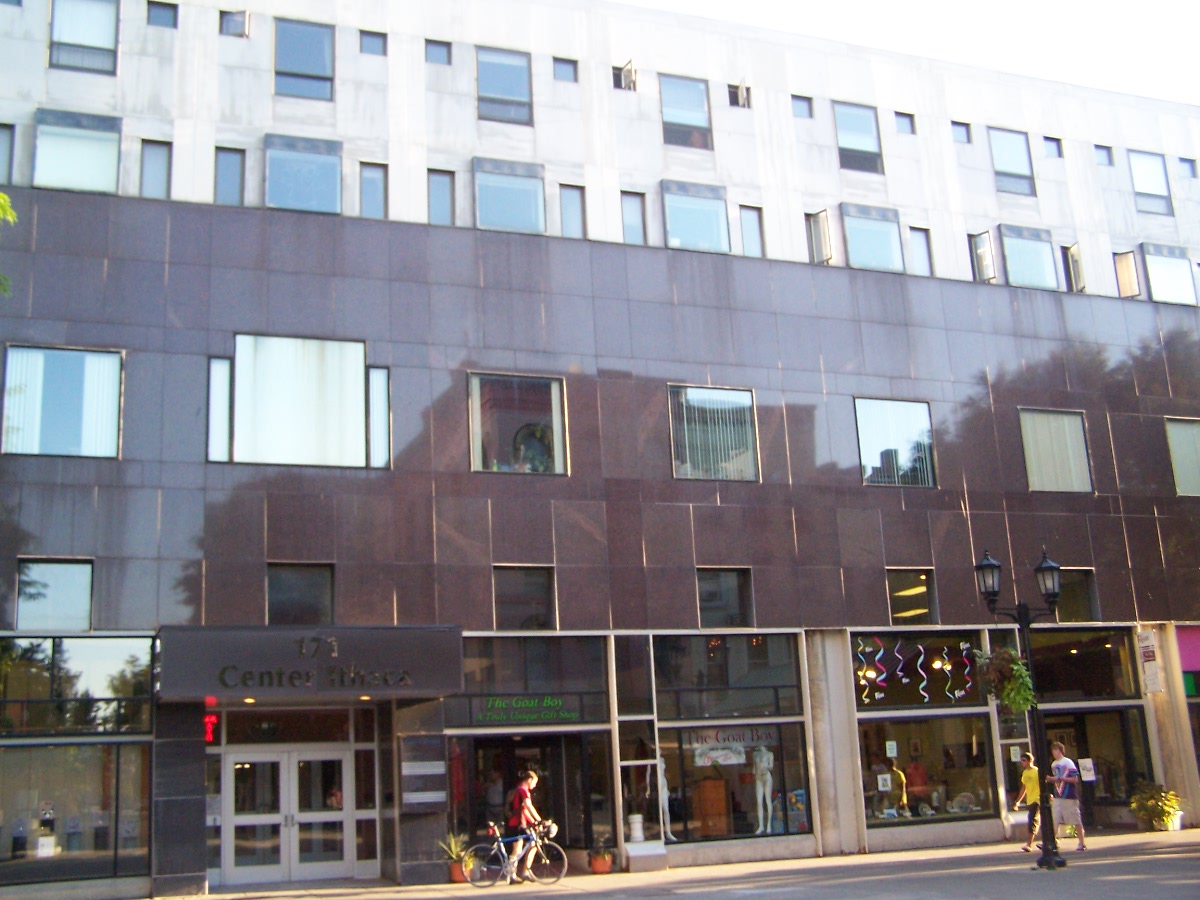
Center Ithaca, on the Commons. The building was built in 1981. It was an early attempt at a mixed-use structure designed to take advantage of the Commons and to make the area more lively. Well, didn’t really work out as planned. Rothschild’s, a department store that was the ground-floor anchor, closed early on. The 62 apartments were difficult to rent out at a time when downtowns were still considered dangerous places to be. And it ran over-budget, pushing its developer and the cash-strapped city into financial hell. Today, the building has worked out most of its kinks, but it didn’t fulfill its original goal, so it worked with mixed results.

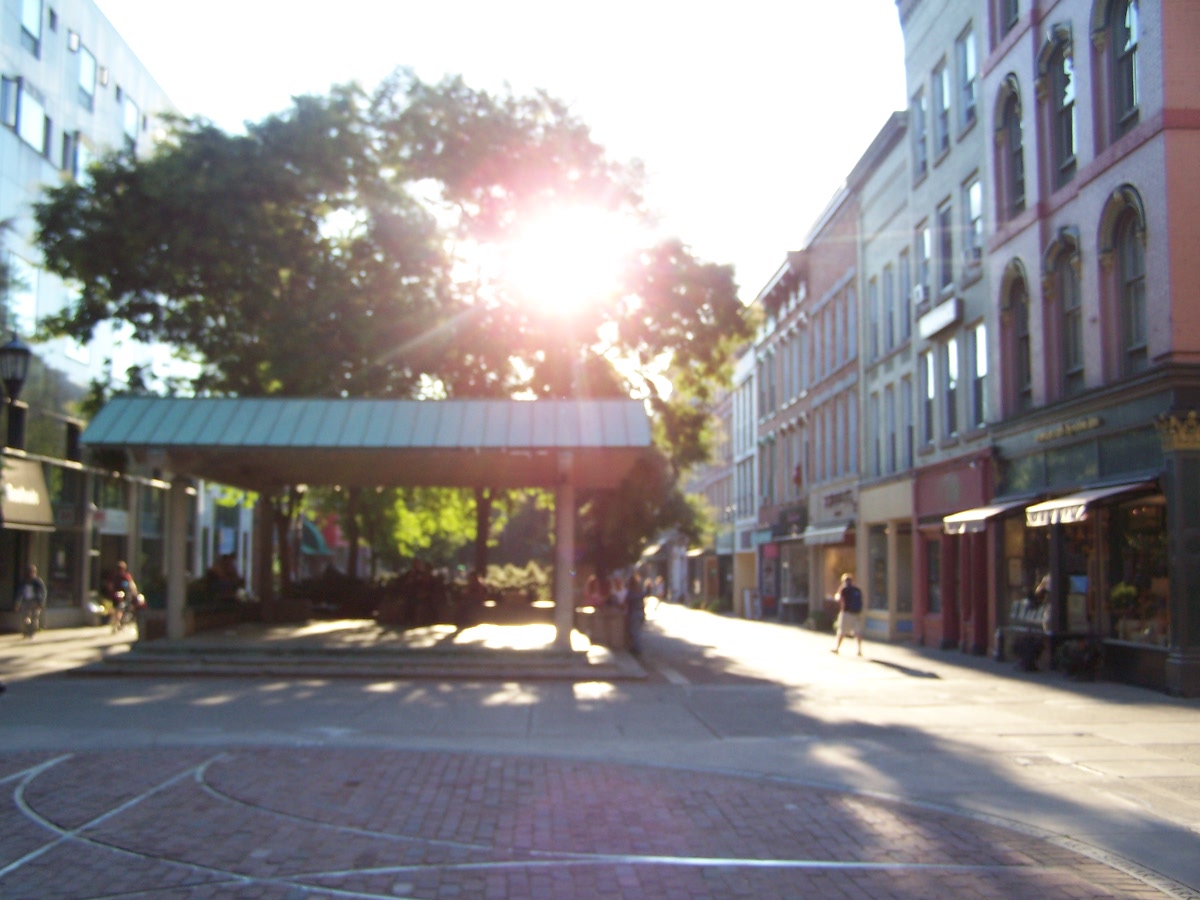
Token Commons shot. Completed in 1974 on what was a part of State Street, the Commons was the brainchild on Thys Van Cort, the recently-selected city planner. Pedestrian malls were all the rage in the 1970s; most closed down within a few years. Ithaca’s has persisted, much to the delight (or loathing) of locals. Talk around, and you’ll find some adore the Commons, and some want it turned into a street with parking on the sides. Whichever you prefer, it’s there for the time being. The tracks in the foreground mark where the streetcars used to turn in the downtown area before they closed in 1935/36.

The foreground building that houses Viva Taqueria is the Wanzer Block, which dates from 1905. The building that hugs it in an L-shape is the Roy H. Park building, which was built in the 1990s. Roy H. Park was an Ithaca-residing executive for Proctor & Gamble who was also a substantial donor and investor in Ithaca College and  the surrounding area.

For now, it’s a parking lot. By 2010, as long as things stay on schedule, this will be the site of a 9-story, $17 million,  102-room Radisson hotel by Rimland Associates (rumors have it to be a Radisson, but it will be a recognized chain that occupies the new building) [6].

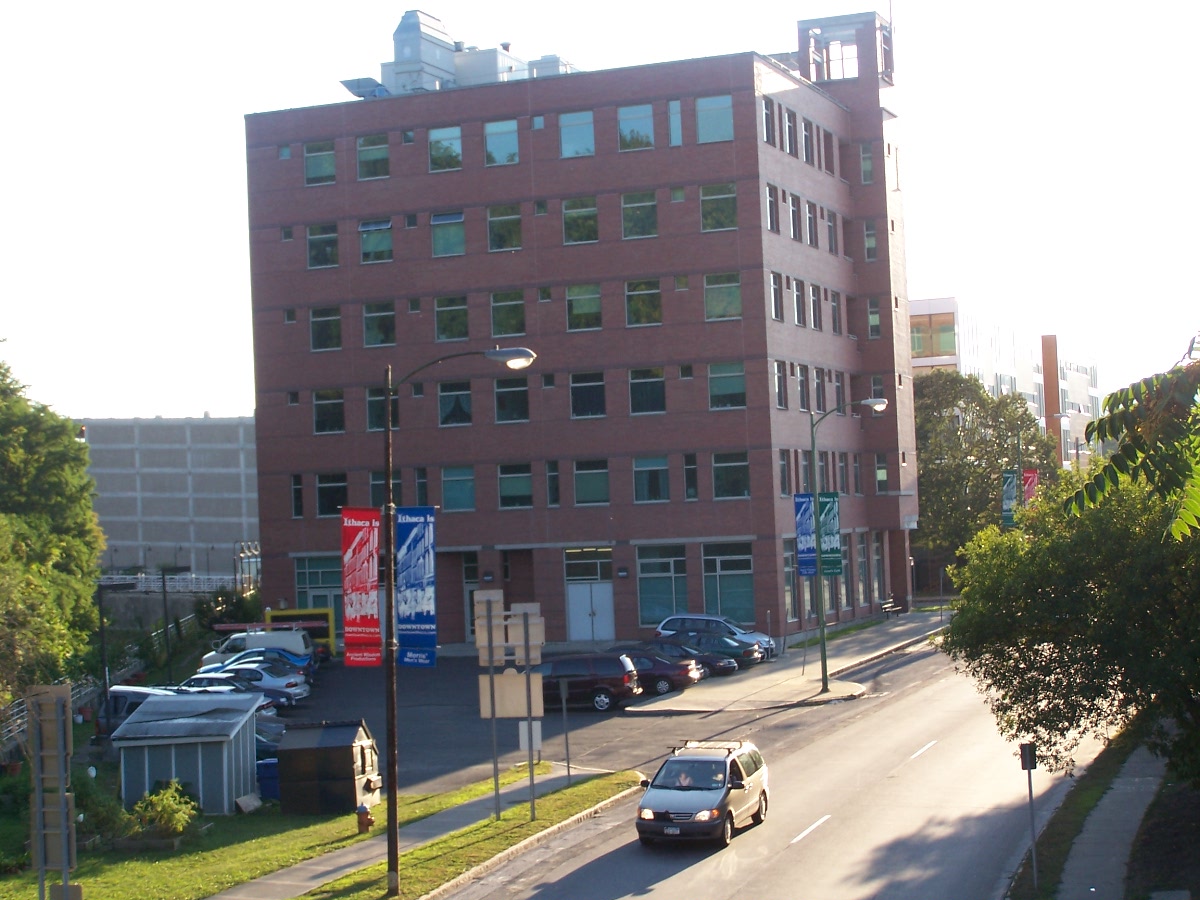
The center building is the Tompkins County Health Services Building, constructed in 1990 [7]. On the right is the nearly-finished Cayuga Green Apartments, a 59-unit building that will house Cinemapolis on the streetfront. The Parking garage on the left (built in 2005), will see the addition of a seven-story, 30-unit condo tower (Cayuga Green Condos) on the backside (the side facing this photo).

I know, bad photo, but it’s visible most everywhere else in Ithaca City. Limestone Tower, built in 1932, is slated for an apartment conversion and renovation by the Ithaca Rental Company and its head, Jason Fane. The building  was originally built for the G.L.F. Exchange Farmers’ Association.

Just outside of downtown is the William Henry Miller Inn. William Henry Miller, of course, was one of the first Cornell architect graduates, and also designed Uris Libe and Boardman Hall. He designed this house and its carriage house, which were built in 1880 and 1892 respectively [8].


[1]http://www.moosewoodrestaurant.com/aboutus.html

[2]http://www.re.cornell.edu/senecaplace.htm

[3]http://www.town.ithaca.ny.us/newtown.htm

[4]http://www.emporis.com/en/wm/bu/?id=tiogaplace-ithaca-ny-usa

[5]http://en.wikipedia.org/wiki/Roy_H._Park

[6]http://findarticles.com/p/articles/mi_qa3718/is_20080418/ai_n25443972

[7]http://www.kwikfold.com/Pictures-PhotoWork/Hascup.jpg

[8]http://www.millerinn.com/inn.htm


News Tidbits 8/26/08

25 08 2008

So, perusing through the planning board meeting, this nifty little addition appeared for the city’s meeting Monday evening:

5. Site Plan Review
A. Site Plan Review, Delta Chi Fraternity Parking Lot Expansion, 102 The Knoll, Jagat P. Sharma,
Applicant for owner DCEF Cornell LLC. Lead Agency and Public Hearing. The applicant proposes to
expand the existing 10 car gravel parking lot along Barton Place to accommodate a total of 22 parking spaces. The proposed parking is one way, maintaining the current access and adding an egress point at the northern driveway on Barton Place. Proposed site work and improvements include removal of 2,700SF of trees, shrubs and vegetation, grading, new curbing at entrance and egress, relocation of guy wire, relocation of signage, landscaping, and installation of a masonry retaining wall approximately 4′ high and 80′ long along the northwest side of the parking area. Proposed surface of parking area is compacted gravel. This project received ILPC approval on 3-13-08. This is a Type 1 Action under both the City of Ithaca Environmental Quality Review Ordinance §176-4 B. (1) (h) [2] & [4] and an Unlisted Action under the State Environmental Quality Review Act and is subject to environmental review. (Materials sent previously)

~~~

Are you serious? Jagat Sharma, the architect of the project, has made his name by designing the apartment towers in Collegetown and some of the luxurious lakeside mansions in the Ithaca area. And Delta Chi hired his firm to design…a gravel parking lot expansion? I mean, couldn’t you get a standard construction company to just tear a base into the ground and lay the gravel without paying all the extra money for a bigger-name architectural firm to design it? If Delta Chi were building an addition, I could understand, but a gravel parking lot? Talk about money to burn.

I was wondering why there were construction permit signs going up over there with Sharma’s name listed as the architect. I honestly thought at first they were building a gatehouse or something. The other items for the meeting are nothing special; a house, roofwork on Eddygate, and a subdivision.

 EDIT 8/27: It’s a news tidbit, so I though I ‘d throw it in here.

http://cornellsun.com/node/31200

It’a a sun article talking about how Cornell gets bashed and we should give our detractors a f*ck off farewell. While I agree with the article’s sentiment wholeheartedly, I should point out one little fallacy- those pins with the “I’m the Hottest” crap were free. We gave them out as a promo to get you to buy random crap, and we still have a sh*t ton of them somewhere in our warehouse across town.


Ithaca College Master Plan

21 08 2008

So, I know recently I devoted five entries and several hours of my life to coverage of the Cornell Master Plan. But, while I back the Big Red in the spotlight, it wouldn’t be fair if I didn’t give a little attention to the neighbors on South Hill.

Ithaca College has also completed a master plan, created by Sasaki Associates and finalized in September 2002 [1]. The plan is available for perusing online, but it comes in a rather crappy resolution pdf that makes it almost impossible to pick out some of the finer features. But, let’s give it a try anyway.

Note one thing as we glance through this: The Park Business School (architect Rober A.M. Stern) , the Gateway Center (HOLT architects), and the new Athletic Center have been recently built or are currently underway in some stage of approval or construction.

Park Business School (L) Gateway Center (R)

So, a brief history on the physical plant of Ithaca College; the first five dorms and the student union were built in 1961 (previously, the college occupied rented spaces in downtown Ithaca; classes were taught in the dorms and union from 1961-63). The first academic building, Friends Hall (it was paid for by the organization Friends of Ithaca College), was built in 1963. Five more residence halls and a health center were completed by the end of the year.

A little side note; for those unaware of the living arrangements of Ithaca College, it is an all-residential college, meaning that with the exception of seniors who choose to do so, all housing is on-campus. So they have more dorms than we at Cornell would be likely to suspect.

The campus expanded rapidly in the late 1960s, but saw very little construction in the 1970s, with the exception of a few smaller projects at the beginning of the decade and the end of the decade. The next wave of construction began with Smiddy Hall, which was completed in 1981. Ithaca College tends to play favorites with architects; Tallman & Tallman designed their first twenty or so buildings up to 1971, and then with a few exceptions, HOLT architects has designed most of the rest since the mid-1980s.

Go on and tell me the sixties weren't a bad decade for architectural design. I'm all ears for any justification.

Go on and tell me the sixties weren’t a bad decade for architectural design. I’m all ears for any justification.

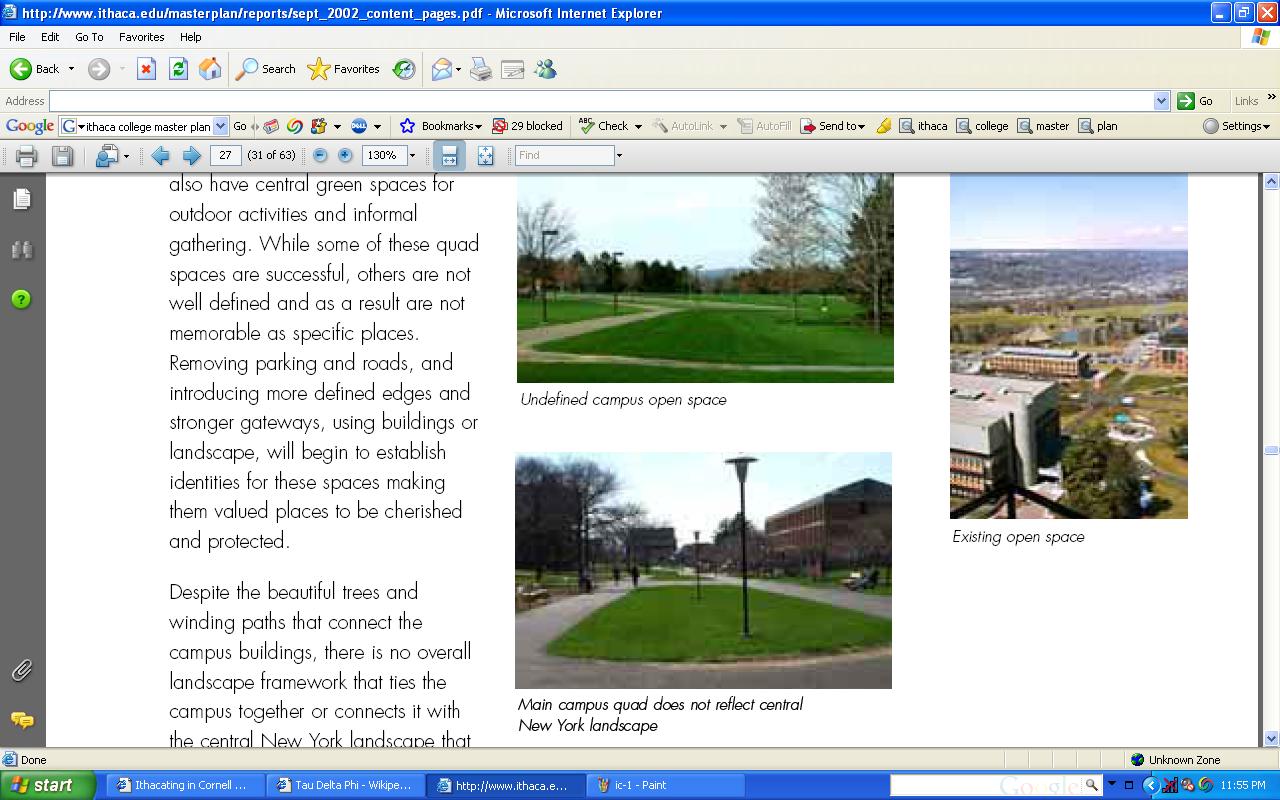
The master plan identifies the need for about 170,000 sq. ft of office space immediately, and another 200 parking spaces. It also says that despite the stunning local topography, that the campus’s open spaces fail to utilize the area properly and are unmemorable as a result.

In the Ithaca College master plan, new development is identified in a darker shade of orange, as compared to the lighter shade used to denote existing buildings in 2002.

One of the goals of the plan is to have everything on central campus within a 10-minte walk from any given location. As a result of this pursued ideal, the central campus is much denser.

The total academic/office space to be built is around 500,000 square feet, with an additional 380,000 sqaure feet of additional dorm space.

The central campus also features a “main street” connecting many of the important area of the campus.

In case anyone’s wondering, here’s a massing of the new athletic center in its location next to the rest of the campus:

So, it’s towards the Cornell-far-side, but I still think that due to its massive size, Collegetown residents will still be able to pick it out on the southern skyline.

So while we have our plans going to work, IC’s already implemented theirs and has been trying to meet their goals for a little while now. Here’s hoping that the plan is as successful as they hope it will be.

P.S. I wanted to write about the IJ article extending the Collegetown moratorium and limiting building heights even further in Collegetown (on the five or six parcels that would’ve actually been raised), but I’ve just decided that councilwoman Mary Tomlan isn’t worth the time and effort of deriding her as a backwards-thinking malcontent.


[1]http://www.ithaca.edu/masterplan/reports/sept_2002_content_pages.pdf


News Tidbits 8/15- CU ERL Project

15 08 2008

So, I’m writing this as I’m sitting at a desk within the hotel; granted, I’m on the job, but it would help if I had more than one customer every forty-five minutes. It’s a bit of a running joke among Cornell Store employees that the Statler requires a dress shirt, tie and a really long book. Luckily, one of the few benefits to working the Statler Hotel gift shop over the main store is that we actually are permitted to browse the internet (with discretion).

So, doing as I often love to, I was perusing the planning board notes for the August 19, 2008 meeting of the Town of Ithaca planning board. And lo and behold, look what pops up:

8:00 P.M.        

Consideration of a sketch plan for the proposed Cornell University Energy Recovery Linac (ERL) project located north of the Pine Tree Road and Dryden Road (NYS Route 366) intersection, Town of Ithaca Tax Parcel No.’s 63-1-8.2, 63-1-2.2, 63-1-12, 63-1-3.1 and 63-1-3.3, Low Density Residential Zone.  The proposal involves construction of an underground accelerator tunnel (14-foot diameter and 2 km long), a cryogenic facility and associated electric substation (+/- 15,000 square foot footprint), and an extension to the existing Wilson Laboratory (+/- 185,000 gross square feet of building space).  The project will also involve new stormwater facilities, parking, outdoor lighting, and landscaping.  Cornell University, Owner; Steve Beyers, P.E., Engineering Services Leader, Agent.

The other agenda items aren’t notable (a radio tower, continued discussion about the IC Athletic Complex, and the continued use of an equestrian facility).

So, the construction of 200,000 sq. ft of physical plant, a cryogenic facility and an accelerator tunnel require a bit of investigation.

The first thing I came across is this week-old Cornell Chronicle item. The particle accelerator has a planned timeframe of construction that would allow for the beginning of operations in 2011 [2].

Rather than try and explain the operations of the particle accelerator itself, I’m just going to quote the article (I’m excusing myself on the grounds that I study thermodynamics, not quantum physics).

The ERL would accelerate electrons to nearly the speed of light in a linear accelerator (linac) made of two straight tubes, each about 330 meters (0.2 miles) long, then feed them into the Cornell Electron Storage Ring, Hoffstaetter said. After a single rotation around the ring, the electrons would return to the linac, where their energy would be recovered and used to accelerate the next batch of electrons.

Meanwhile, at various points around the ring, the Cornell High Energy Synchrotron Source would use the electrons to produce ultra-bright, ultra-fast pulsing X-ray beams capable of imaging structures just a few atoms wide, and whose oscillations would be resolved with sub-picosecond resolution (less than a millionth of one millionth of a second). [2]”

On another note, the building is visible in the master plan diagrams, as the large expansion that exists to the east of the current Wilson Lab structure:

So, our physical plant will continue to expand for some time yet.

[1]http://www.town.ithaca.ny.us/

[2]http://www.news.cornell.edu/stories/Aug08/ovp.forum.erl.html


The Cornell Master Plan, Part 5 of 5

10 08 2008

Well, it’s about time I wrap this up. I meant to do this a little earlier, but I became a little sick towards the end of last week, so feeling better was more important than maintaining the IiCH blog.

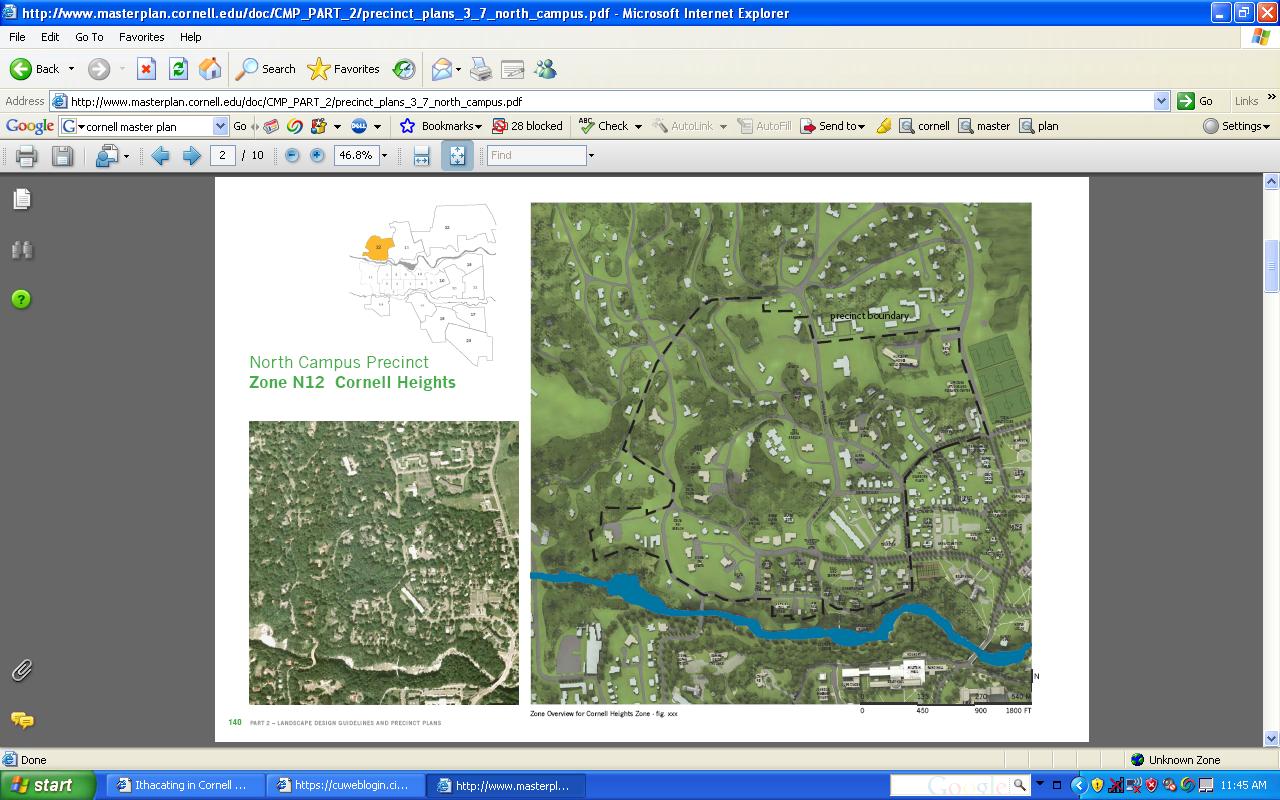
The Cornell Heights precinct sees change listed under the “although no specific development sites have been identified, additional development may be considered on and(sic) case-by-case basis.” Since this is a nationally-recognized histroic district, I wouldn’t expect anything out of character with the current sttuctures in the neighborhood.

Also, to tie this in with the disppearing suspension bridge incident, the image above has also apparently washed out the Stewart Avenue bridge, making it more likely it was just some half-fast work on the image.

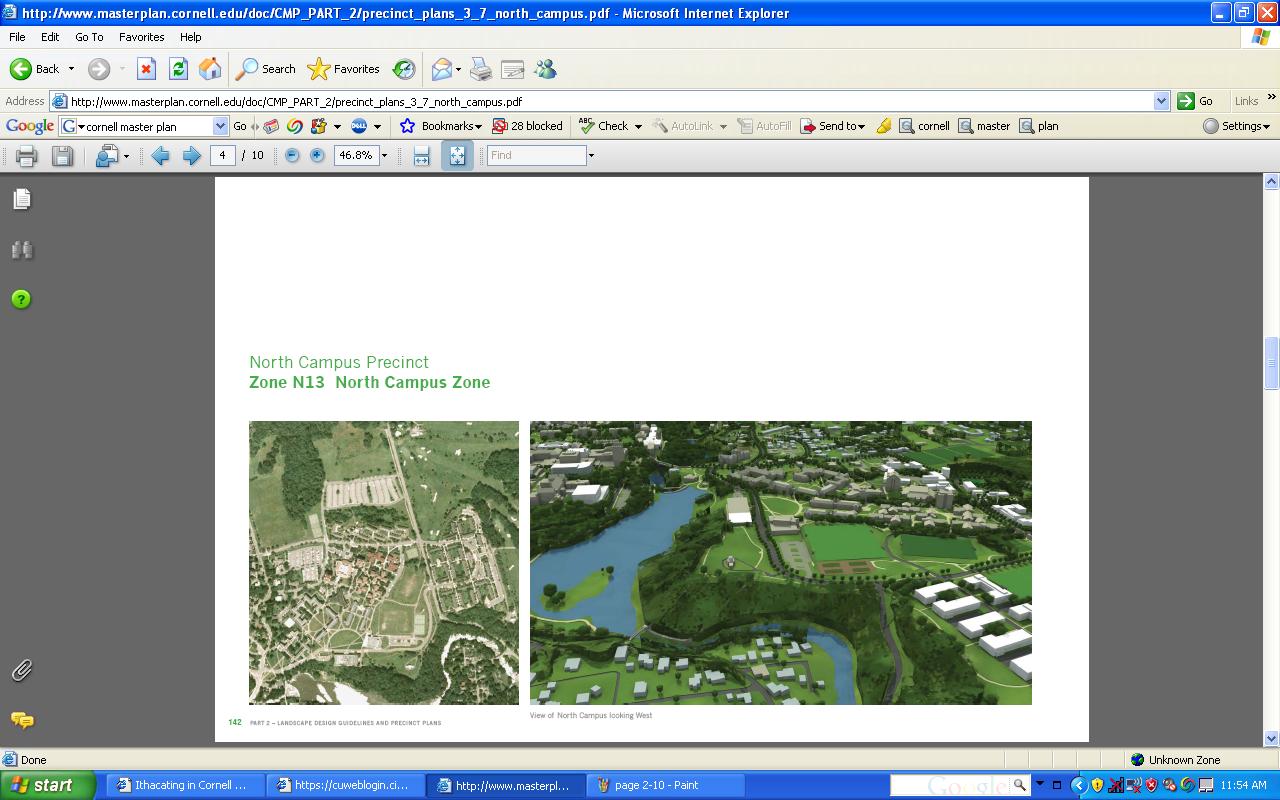
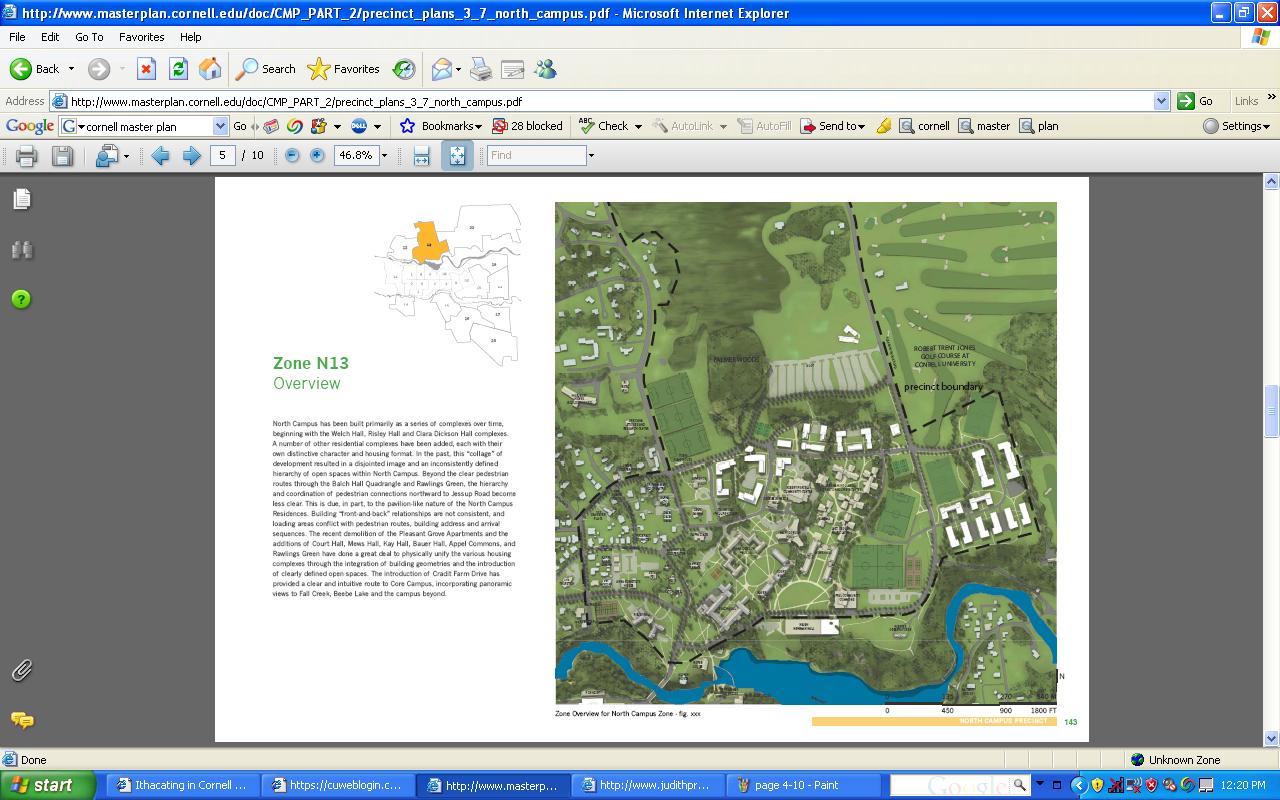
For North Campus proper, there are some notable, but not really controversial changes in the physical plant. The only thing currently underway is the $15 million renovation expansion of Helen Newman designed by architectural firm Dagit-Saylor (they also designed Appel Commons[1]). If the site ever goes back online, you can view the exterior plans for the expansion at this website:

http://residential.alumni.cornell.edu/n_helennewman.cfm

Some of the propsed changes include developing the CC parking lot into dorms, replacing the townhouses with a different set of dorms, and replacing Hasbrouck with some other form of housing. A new dorm would also be built across from the north-facing corner of RPU. I don’t hold much weight for plans for North Campus, probably because the plan developed by Richard Meier in the ’80s was eventually dropped[2], and Cornell just seems to decide spur-of-the-moment what will be built.

The plan suggests that dorm plans be two to four floors in height, but higher heights may be considered depending on the location. The hodge-podge necessitates that new constructions manage to make the North Campus more cohesive without interrupting intuitive pedestrian traffic flow. Which is big and fancy language just to say that it shouldn’t make getting around North more difficult than it already is.

I look at the designs for the more cluster-style developed to reaplce the townhouses and Hasbrouck, and I see a lot of opprotunities to name buildings. I’m sure Cornell could tote that to wealthy alumni that for only $3 million or $5 million, you could get a ten-unit dorm on North named after you. But, they didn’t really do it with the low-rise/high-rises, so they might just leave them nameless. Regardless, it seems rather poor planning that the townhouses, which were built as upperclassmen housing in 1989, would be torn down so soon. More athletic fields would be developed on the sapce freed up by the demolition of Hasbrouck, and some intersections would be realigned to better define the area and improve traffic flow. The idea is thrown out there that further development on Jessup Road have a “main street” character to it.

As for Collegetown, relatively little is mentioned. The plan hinges more on the recommendations of the Collegetown Vision Statement and finalized plan to be released in October of this year. The two primary itmes that are suggested are preserving the housing stock on Linden Avenue, and creating a pedestrian bridge from Eddygate and across the gorge to South Avenue. As someone who frequently commuted between Edgemoor Lane and Cascadilla last year, it wouls have been wonderful if this bridge has existed already. It was a little annoying that to walk a thousand feet as the crow flies, I had to walk up to College Avenue, cross that bridge, and then go down the steep and often icy hill next to the law school. A bridge from Eddygate to South Ave. would have been really nice, and it would definitely serve to make the neighborhood more cohesive with the far southwest portion of campus.

***

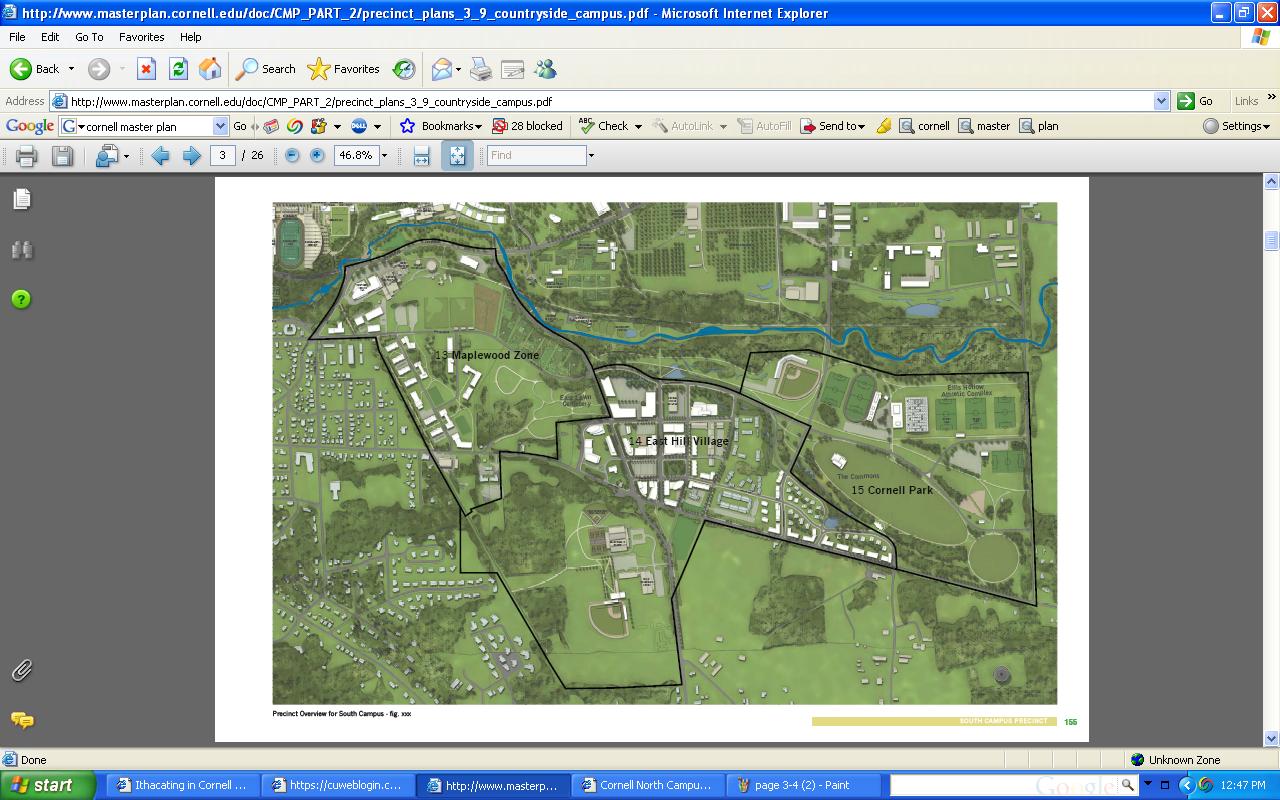
However, plans for a “South Campus” between Maplewood Park and East Hill are extensive. The area is devided into three zones- Maplewood, East Hill Village, and Cornell Park.

In the Maplewood Zone, the Maplewood Park Apartments are entirely replaced with “higher-quality”, more cohesive development. A site for townhouses also exists to the east of Maplewood Park. These areas are expected to be developed in the short-term (perhaps some of the $20 million Cornell is giving to Ithaca for affordable housing should go here?).

The total developed square footage will be between 450,000 and 1,000,000 sq. ft. With 240-480 residential units in the zone.

East Hill Village is an entirely different animal than its predecessor. The East Hill Plaza we currently know is essentially a strip mall, some apartments and a few outlying retail and office buildings (and Oxley Equestrian Center, if you count that). The plan wants to change that.

The area typifies a New Urbanism style development. Mixed-use buildings with an internal grid define most of East Hill Village. Active-use structures, like a grocery store, restaurants and retail stores are encouraged on the street level, with residential and/or office uses on the upper floors.

***

Meanwhile, the little-used fields to the east of East Hill become the site for Cornell’s new athletic fields and facilities (Ellis Hollow Athletic Complex). The park itself might be a large lawn or meadow that is used for general recreation or as a concert venue.

Cornell has big plans and big dreams. However, like any plan, conditions and preferences might change, so it would be unwise to consider everything to be set in stone. Still, it’s interesting that our insitution has such grand aspirations.


[1]http://www.judithpratt.com/Helen%20Newman%20Hall%20Proposal.pdf

[2]http://en.wikipedia.org/wiki/Cornell_North_Campus


News Tidbits 8/5/08: The Development of Ithaca Gun

6 08 2008

http://cornellsun.com/section/news/content/2008/07/30/city-ithaca-pledges-overhaul-contaminated-gun-factory-site


City of Ithaca Pledges to Overhaul Contaminated Gun Factory Site

July 30, 2008 – 12:35am
By Molly OToole

On May 30, the New York State Department of Environmental Conservation announced a final resolution for the Ithaca Gun Factory Site, closing a long and precarious chapter in the City of Ithaca’s history. However, many Ithacans feel the future of the site may still be up in the air.

The DEC — in cooperation with Mayor Carolyn Peterson, the City of Ithaca, developers Frost Travis, owner Wally Diehl and a previous pledge by the state — has authored a plan to dissolve the old Ithaca Gun Factory, which has been left stagnating above the rushing waters of Ithaca Falls for the past 125 years.

The $3.02 million public-private partnership — which includes the state’s Restore N.Y. grant contribution — aims to not only fully remediate the site, but to also return it to the public eye by putting in a new public park. A pledge of over $11 million from a voluntary cleanup program and private donations will fund 33 luxury condominiums to be built over this hazardous history with the hope of giving the site a healthier future.

The DEC intends to cover 90 percent of the investigation and remediation of Ithaca Falls Overlook Park with its pledged $700,200 from the 1996 Clean Water/Clean Air Bond Act, which is part of the Environmental Restoration Program. Dianne Carleton of the DEC described the program as a “funding mechanism to protect or improve water issues.” These funds join the $2.3 million Restore N.Y. Grant presented to the City in January by former governor Eliot Spitzer for demolition of the factory buildings.

According to a project file of the Ithaca Gun site provided by the New York State Department of Health, demolition is slated to begin in early August.

Optimistically, the new condos could be available for purchase sometime in late 2009 or mid-2010, according to Travis, but he added, “I can tell you the start and complete dates are somewhat of a moving target with respect to development and construction. We won’t know until we’re in the process.” (cont.)

***

So, I’m always curious about what a new construction will look like. Unfortunately, nothing’s been released for the time being, and probably won’t for the next several months. However, that doesn’t stop speculation.

Consider the developer, Travis and Travis Inc. The firm is responsible for one other major new construction in the Ithaca area; Gateway Commons, a six-story apartment building on East State Street that was completed in early 2007.
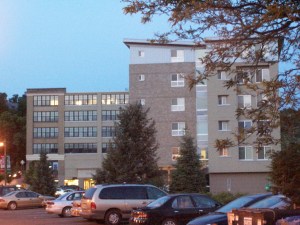
The building on the right.


The building was designed by HOLT architects. Now, some developers end up forming a preference for a certain architectural firm. If this were the case with Travis and Travis, then they might seek a continued professional relationship with HOLT architects.

 In this case, the design is for 33 condominiums, limited in height to no more than about 50 feet. This was the end deal of an arduous and exasperating phase in its planning. Developer Wally Diehl wanted to develop the property in 2003, and turn it into a seven-story, 160-unit building with a two-story parking garage [1]. Needless to say, neighbors raised out, citing lost views and a loss of neighborhood character (apparently, the factory that was there 100 years was perfectly acceptable). Diehl tried an 80-unit, 50 ft. tall proposal (no higher than the old factory), but he complained that it was not privately feasible anymore, so the property sat, and a fire in August 2006 served as a wake-up call that the property had to be demolished ASAP (hobos and vandals go in all the time, so sit back and imagine the lawsuit on Ithaca city if someone went in and died inside, even though the factory is considered a hazardous site).

By hazardous site, a couple of things worth noting. The factory made guns for 126 years, closing in 1986. They used a lot of lead. This directly lead to the high lead levels in Fall Creek, where it flows next to the site, and where it was (is?) 500 times beyond the EPA safety level. An effort in 2004 to clean it was attempted by the EPA for 4.8 million dollars in Superfund money. But, lo and behold, they failed to adequately clean it, as lead levels were 460 times higher than the EPA’s goal. Ouch. Oh, and the IJ revealed in 2000 that the site was used to test uranium tubes, so there was uranium contamination as well [2]. So, the site was about as environmentally screwed up as it can get (with the exception of the Love Canal and Chernobyl).

 So the third proposal, backed by a $2.3 million dollar state grant and a $700,200 grant to reclean the site (and $10 million in private funding, through a partnership of Frost Travis and Wally Diehl), offers 33 high-end condos,a public promenade and a small public overlook that includes the smokestack of the factory. Finally, the majority of the opposed now appeased, it looks like everything is ready to go. One hopes.

So back to my curiosity about the design. Picking around the HOLT website [3], one finds their healthcare and higher ed portions of their portfolio. But, they designed student dorms for a couple of schools. So let’s profile those, since they were small-scale living units.

Townhouses, Colgate
Apartments, U. of Vermont

Apartments, U. of Vermont

 So, a rough idea of their design guidelines seems to be postmodern, with rustic influences. It helps that this company seems to have a strong attachment to Cornell; Carpenter Hall renovations, Tatkon Center, Sigma Chi renovations, Goldwin Smith reno, Donlon reno, among others. And they did several designs for IC buildings, so they just love it here (and considering they’re HQ’ed on N. Aurora Street, makes plenty of sense).

So, what might a high-end condo look like? I venture pitched roofs, dormers, and pillared entryways, with a height around 3 of 4 floors. The design will definitely not be a classic, but will have traditional elements, not too unlike the neighboring Gun Hill Apartments.

 [1]http://cornellsun.com/node/26431

[2]http://cornellsun.com/node/26384

[3]http://www.holt.com/S.html


Cornell Master Plan, Part 4 of 5

2 08 2008

Now that I’ve said my piece on the East Campus redevelopment, I’m going to move into the far east campus towards the vet school.

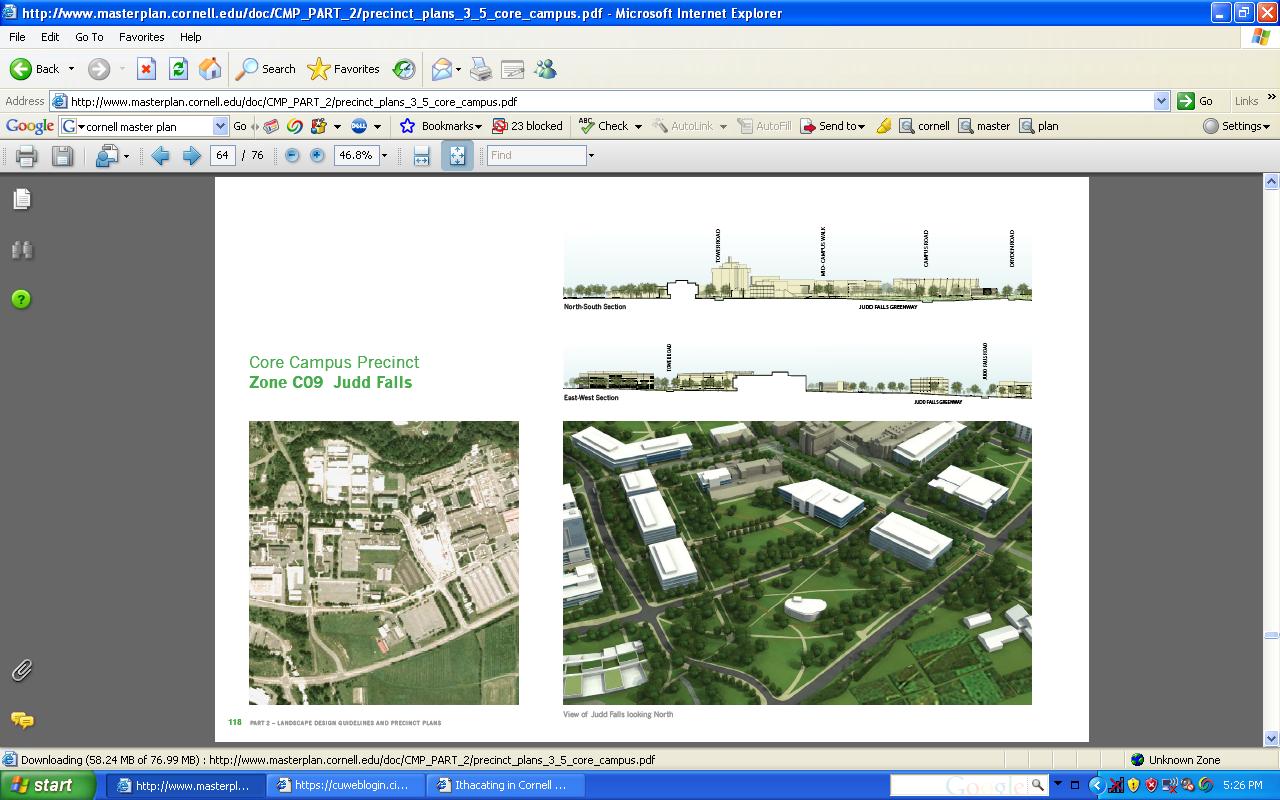
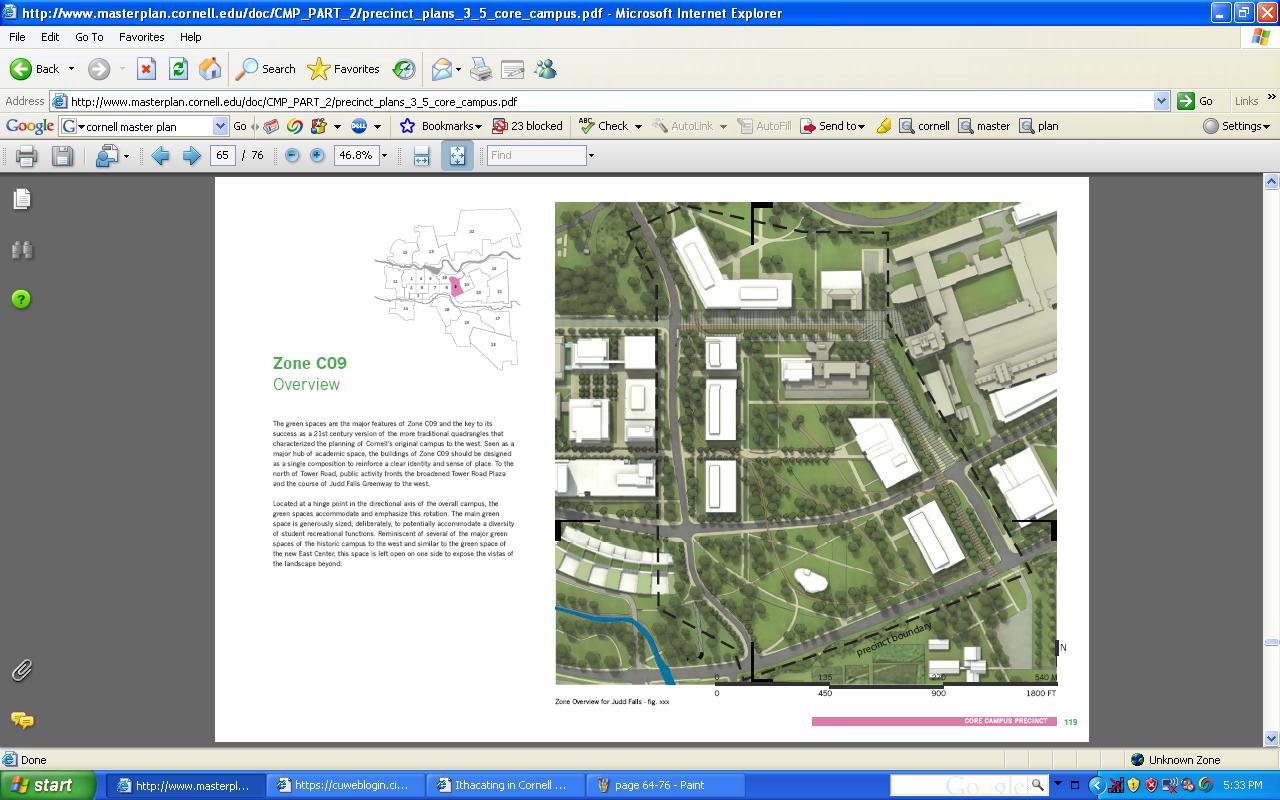
Precinct 9 is referred to in the master plan as the Judd Falls Precinct. For those of you who have never gone out towards the vet school for anything other than a prelim, Judd Falls is the name of the north-south road that passes through here, hence the name. The areas is home to some greenhouses, the U.S. Soils Lab (and its $51 million planned addition, to be completed in 2013 [1]), and Morrison Hall. The hideous piece of architecture known as the Boyce Thompson Institute (1978 ) also stands in this area.

Now, this area is almost wholly used for CALS and vet school activities. For the rest of us, it’s a relative dead zone; you’ll go to the Dairy Bar once in your time at Cornell just for the hell of it, decide its too far out from everything and not come back except for the rare event your exam was shoved in here because this was the only space available (you wanted the Statler Aud for your exam room, but you’ll be sweating it out in Morrison).

The plan to redevelop it is a praiseworthy one. Several buildings would be developed, and the area seems to be much more integrated into the rest of campus.

Because of the relative lack of use of this area, and its underdevelopment, the architects/design teams will have carte blanche to do as they wish with any future properties in this precinct. As a result, Morrison would see the wrecking ball; for some demonic reason, they decided to leave the wound on campus that is BTI. Seriously, it makes even Uris look attractive.

Photo obtained from facilities website

Photo obtained from facilities website

And this is the attractive side.

The buildings designed in the Judd Falls area should all maintain the same architectural style to enhance uniformity in the area. Considering its just a mish-mash of styles now, it would be interesting to see how this turns out. Lobby areas would be glassy and transparent. Total development space would be between 730,000 nd 1.33 million sq ft, and the buildings would average four floors (56 ft.) in height, give or take a floor. If they were to develop here, my personal hope would be that other academic uses are considered; moving some of the other departments out a little farther to fill up these buildings, perhaps. Or secondary space for the East Campus.

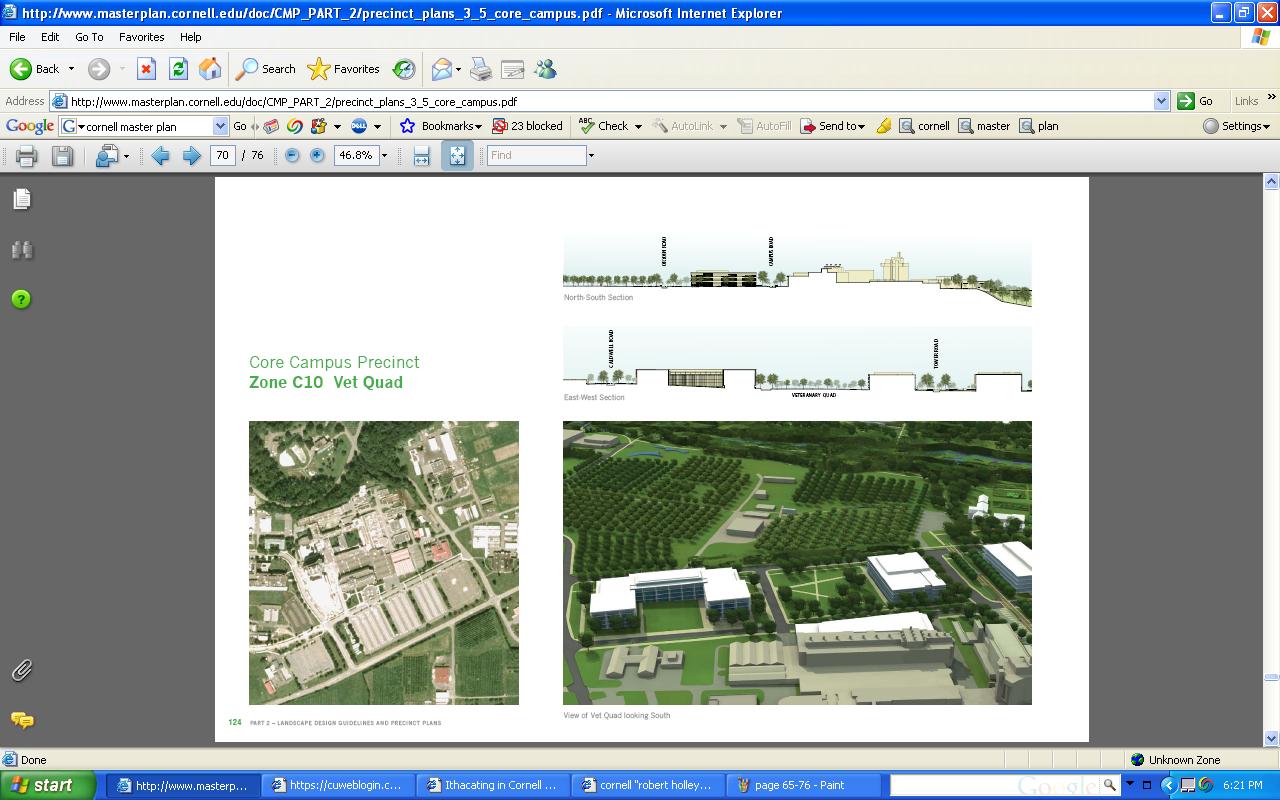
Precinct 10 is referred to as the Vet Quad. The new Vet Quad occupies an area dominated at the current time by parking lots; as the general rule seems to be in the Master Plan, parking lots should be hidden underground whenever possible, so this would never fit in if they didn’t do something with it.

A large building occupies the eastern end, possibly a centerpiece building to serve as an administrative building with some academic use mixed in. The building to the northeast is already under construction, an $80.5 million, 126,000 sq. ft Animal Diagnostic Hospital [2].

I like the plan here, for the most part. I feel it provides a dingified entryway for those coming into the university from the east, along Rt. 366. I’m not as fond of the random building they shoved in front of the animal hospital, because it strikes me as not being the best place to place another building and make the vet complex even more difficult to navigate than it already is. Things started to get confusing with Schurman Hall, and with the Vet Tower, Hospital and new wing, it’s just difficult to navigate within the Vet School (I for one became lost while trying to cut through to make it to a charity XC race on the other side of the vet school property). The total amount of space developed here would be between 400,000 and 700,000 sq. ft.

No surprise, but West Campus has no identified development parcels and the plan suggests treating developments here on a case-by-case basis. It also suggests restoring the cemetery, which I find humorous in a punny sort of way (restore the cemetery eh? Well, go to the morgue and pick up some shovels on the way over…). Yes, I’m aware that it actually means plantings and headstones.

Part 5 will cover Cornell’s New Urbanist development and North Campus. To be continued…

[1]http://forum.skyscraperpage.com/showthread.php?t=81652&page=47

[2]http://www.news.cornell.edu/stories/May08/AHDCGroundbreaking.kr.html


The Cornell Master Plan, Part 3 of 5
27 07 2008

So, picking up where we left off, we’ll be covering some of the more eye-opening parts of the Core Campus master plan.

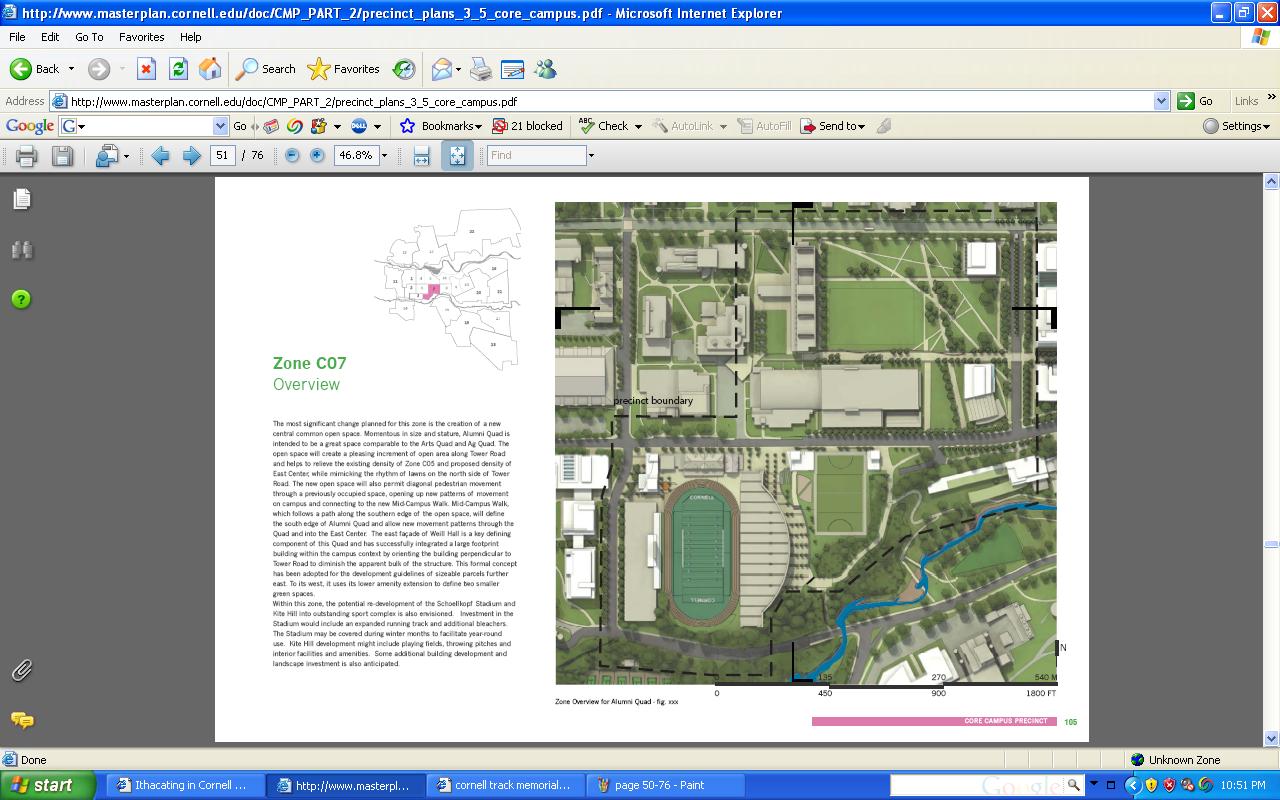
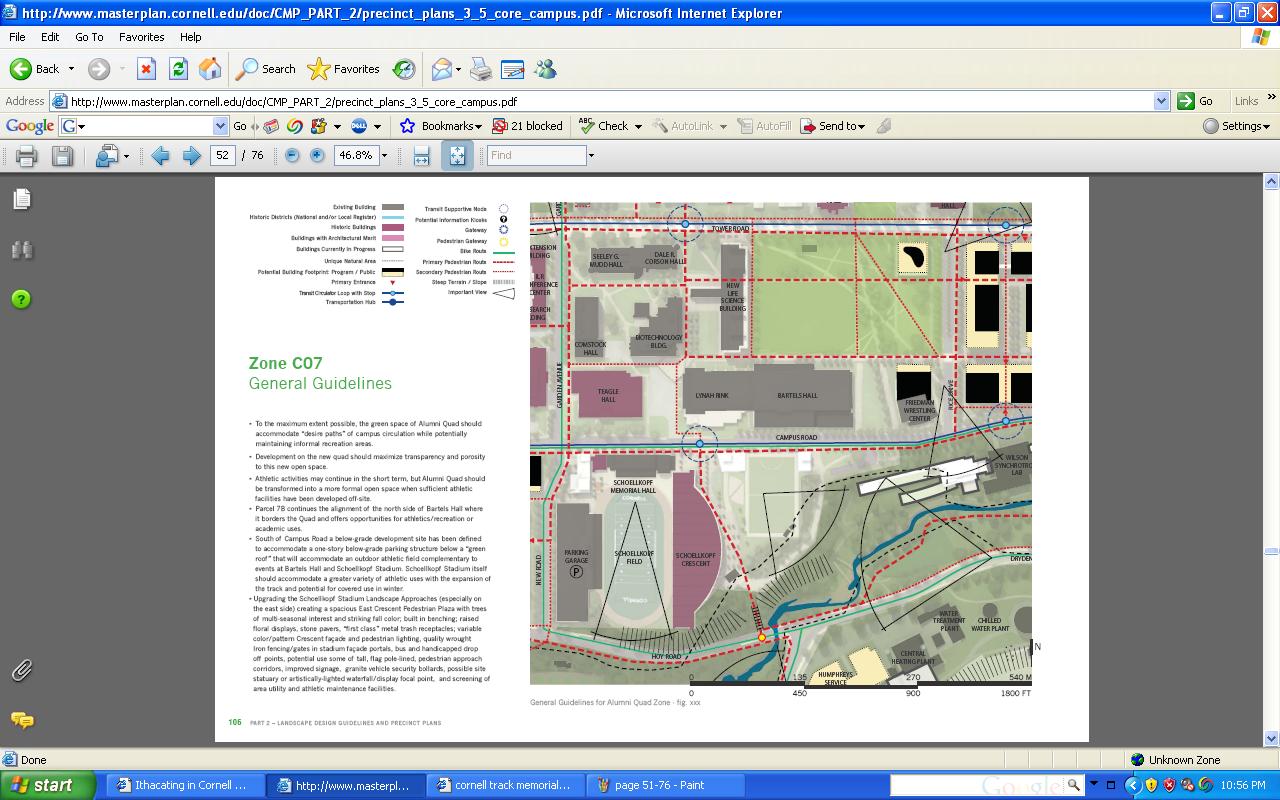
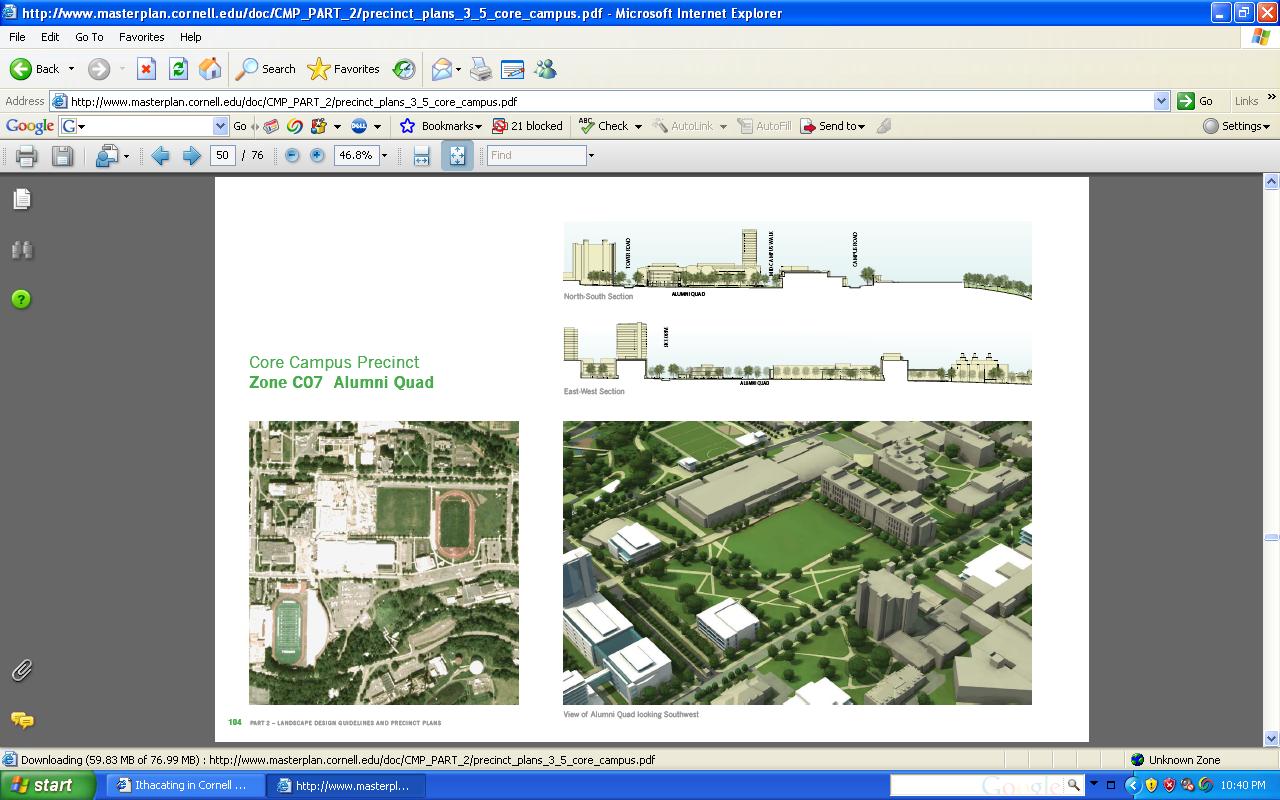
So, this is one of the brand new ideas being churned out by the brains designing the master plan. Precinct 7 is known as the Alumni Quad (my brown-nosing sensors are going off). As most may be aware, the alumni quad is currently the site of the atheltic fields (Robison). A new road (Rice Drive) is built where the western edge of the track currently sits, and so Friedman Wrestling Center ends up sitting at an intersection. The proposed mid-campus walk runs through the alumni quad, and renovation of Schoellkopf’s facilities are suggested to accomodate some of the athletic uses lost due to the elimination of the track. Additional facilities would be built at Kite Hill (which even I have barely heard of).

Apparently, the master plan thought it would be pretty cool to put Schoellkopf’s parking lot underground and build athletic facilities (not to mention their would be a huge parking lot below the alumni quad). I wish them the best of luck, because with all of their planned subterranean parking, I’m sure hell will be raised at some point (ex. safety concerns).

Like with the building planned for Day Hall’s site, they gave one of the two new buildings defining the quad an odd footprint to minimize its usage of space. their goal in the design of this quad was to break up the density between the ILR-Biology Quad area and the proposed East Campus. Also, it would appaear that whatever that is planned next to Wilson Lab is currently in currently underway at some level, and another building, the 16,000 sq. ft addition to the heating plant, is also shown to be underway at the edge of the slide. The other building appears to be an addition to Friedman, which is quite curious considering Friedman is less than six years old [1]. Neither building would be more than a couple of floors, with a sq. footage between 37,000 and 93,000 sq. ft. total.

here’s my one minor critique; the backside of Bartels, which would be facing this quad, is neither interesting nor visually appealing. unless some renovation of the backside is planned, I’m not sure I would want that fronting the new campus green space. You might just as well but up a stone fence on the entire southern edge.

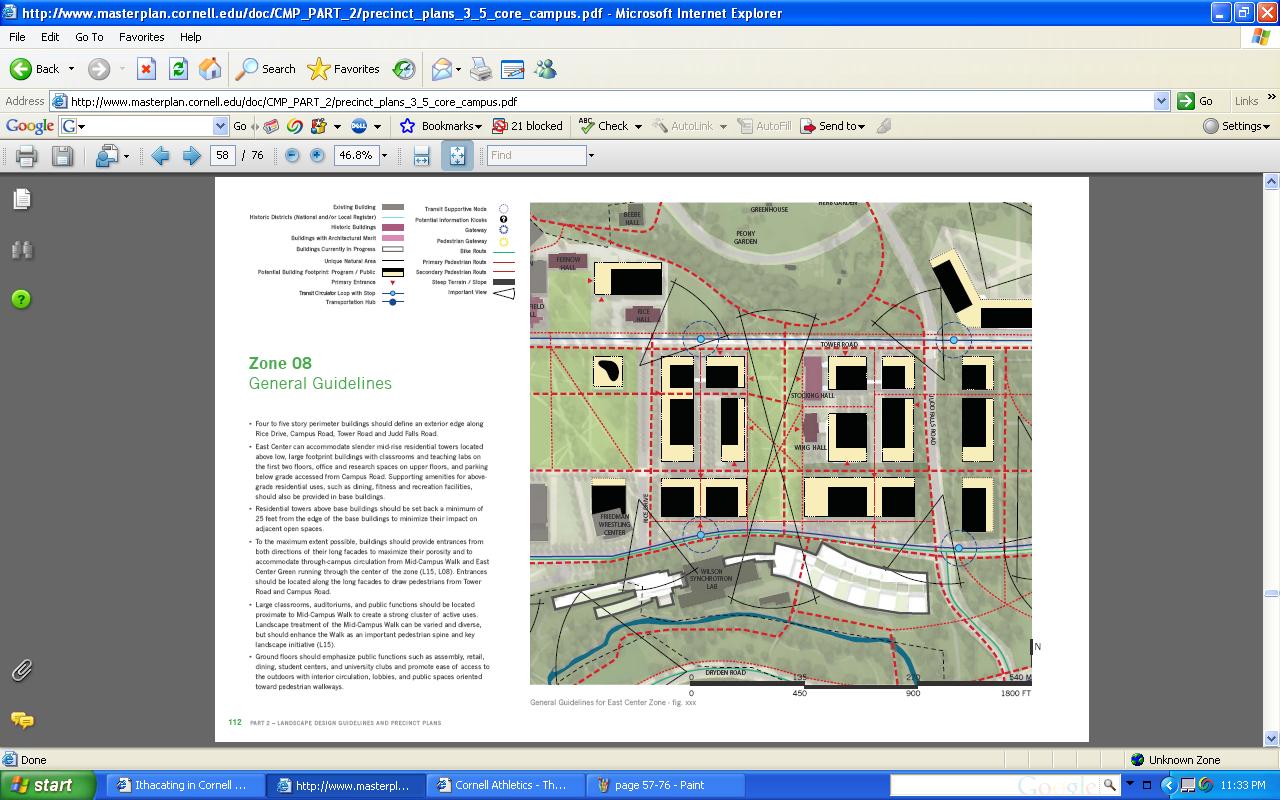
I look at precinct 8 and I don’t even know where to start. The proposed east center is a very large, massive set of new facilities that by any guess would run into the billions.

Footprint-wise, the area East Campus would cover is the area from the track field to Judd Falls Road, which is the next intersection just beyond the Dairy Bar. That’s a fairly large chunk of real estate. Withthe exception of the historical front portions of Stocking Hall and Wing Hall, all other current structures in that area would be demolished to make way for the new complex.

Most of the ten buildings in the complex have large footprints, and four of them feature tall, slender towers of slightly varying heights. Even before checking the parcel listings, you can look at the elevations and determine that they are slightly taller than Bradfield. With four to five story buildings on its perimeter, the place would be built up like a fortress, yet they try to maintain spaces between the buildings “to maintain porosity”.

Now, I remember hearing on one occasion that after the monstrosity of Bradfield Hall, Tompkins County would never allow any more tall buildings to be built on Cornell Campus. But, I’ve yet to see anything distinctly say as much, and I doubt that Tompkins County could reasonably exclude tall structures as long as they are not in the way of takeoff or landing patterns over at the airport. If you never noticed, look up at Bradfield during the night, and you’ll see the red warning lights on the roof to warn planes of its presence.

This isn’t the first time a building taller than Bradfield has been proposed either.  Fomr Blake Gumprecht’s Fraternity Row and Collegetown study (he studied Cornell for his research):

“Collegetown has undergone profound changes over the last quarter century.City officials began to press for the redevelopment of the neighborhood in 1968. The following year, a city-sponsored urban renewal plan called for theheart of Collegetown to be demolished and replaced with a massive, multipurpose development. It recommended construction of a large building on College Avenue that would include 375 apartments, 600 parking spaces, retail on the first and second floors, two movie theaters, a restaurant, and nine floorsof office space. It also called for the construction of six to eight high-rise apartment towers, the tallest eighteen to twenty-one stories. The plan went nowhere [2].”

The master plan states that the buildings would consist of classrooms and academic space on lower floors and residential/dorm space in the residential towers. Although I applaud the concept of “mixed-use”, I’m not exactly sure how well the idea would go over with the potential residents. However, it would seem the residential towers are meant for grad students, post-docs and professors. I’m not sure if this sounds more like an educational area or a self-enclosed research facility (I would sit back and watch as the city starts demanding taxes on it because they come to the same conclusion). The ground floors of the  building would have restaurants and cafes, and lounge spaces; the intention is for this area to be a vibrant 24-hour space. I would hope that all of the eating areas wouldn’t all be run my Cornell dining- the same set of baked goods and drinks gets real old, real fast.

There would be 85 to 120 units per resident building. Take that through eight to ten floors, and you have ten to fifteen units per floor. A major question that would have to be answered in the deisgn phases would be how much residentil space will be provided per unit; I can imagine that grads, post-docs and professors would want more living space than the 200 sq. ft rooms in some of the dorms. The max height of a single building entity would be about 210 feet, the same as a typical 20-story apartment tower, or a fifteen-story office building, to put it into perspective. The final square footage would be 1.5-2.2 million sqaure feet, at least six times the amount of space in Weill Hall (which is 262,000 sq. ft.).

At least 850 parking spaces will be located underneath the East Campus. The primary purpose for them is to provide parking fore the residents of the complex, but the plan also suggests that when they empty out in the evenings, they can be used by others in the Cornell community to maintain the vibrancy of the area. I just can’t get through the impression I’m getting that this isn’t so much academic as it is research, and while we are a research institution, I wonder if how much we’re trying to blur the line between Cornell the school and Cornell the research organization.

To be continued…part 4 will cover the last of the Core Campus.

[1]http://www.cornellbigred.com/Sports/general/2007/FriedmanWrestlingCenter.asp

[2]http://www.adphicornell.org/adphicor/files/FraternityRow.pdf