The Cornell Master Plan: Part 2 of 5

24 07 2008

So, picking up where I left, part 1 was meant to only cover the arts quad and provide an introduction. In part two, we’ll reach a little deeper into the details of the plan.

The next section focuses on the Ho Plaza area. The primary components of the plan for this area include the reconstruction of Gannett and Day Hall and the demolition of the Cornell Store. I’m going to say that because I’m an employee of the store, there’s a certain sense of attachment one develops after a couple years, so I wasn’t very pleased to see this. Also, Olin Hall and Willard Straight are set to gain additions. The massive new development to replace Hollister and Carpenter Halls will be discussed later.

Here’s a surprise; all the proposals on this page are currently in development already, with the exception of the Straight addition and Day Hall’s demolition. There’s the law school additions, which first appear on page 21; the courtyard-plan makes me raise an eyebrow, because you never know what Cornell is exactly planning. The Law School has seen major construction in four decades (Myron Taylor, 1930s, Anabel Taylor, 1950s, Hughes Hall, 1960s, and the Foster addition to Myron Taylor, 1980s). They have remained relatively cohesive in appearance and massing, and I would hope that any further plans keep it that way.

Then there’s Gannett. Gannett was built in 1958 with an addition in 1979 that sticks out like some cancerous growth from the main building (off topic a little, but when designing new buildings, I hope Cornell never hires Frank Gehry. Look at what he did at MIT as a warning[1]). The discussion for the replacement structure suggests it work with the neighboring intersection to engage activity, which seems to me like it would probably have a plaza in front of it. The replacement structure would be 4-5 floors.

The addition to Olin isn’t a surprise, and will probably blend in with the structure as the east addition did in 1987. I’m not up in arms over that one. I admit that I’m none too cheery about the store’s demolition, but that’s because the main reason seems to be sight-lines. What the hell, demolishing a 53,000 sq. ft facility because it obstructs views. The store was built in 1968-69, and was originally supposed to be 10 feet deeper, but they didn’t expect to hit shallow bedrock. So they compromised. I’ve talked about this with customers, and the concern seems to be where else can they put the store where it is still easily accessible. Moving it out east won’t work unless there’s a lot more out there by that time. But, at work they’re already talking of looking at locations to move to within the next couple years; Collegetown is coming up a lot.

The Day Hall proposing is laughable. Curving the base to match with Wee Stinky Glen is probably not going to be as harmonious as suggested. The idea of student activity at the base of Day sounds nice, but I doubt Day Hall’s staff will appreciate it. Day Hall is administrative, so trying to mix the functions of the student union with the administration in one footprint is not going to go over well. My thought anyway.
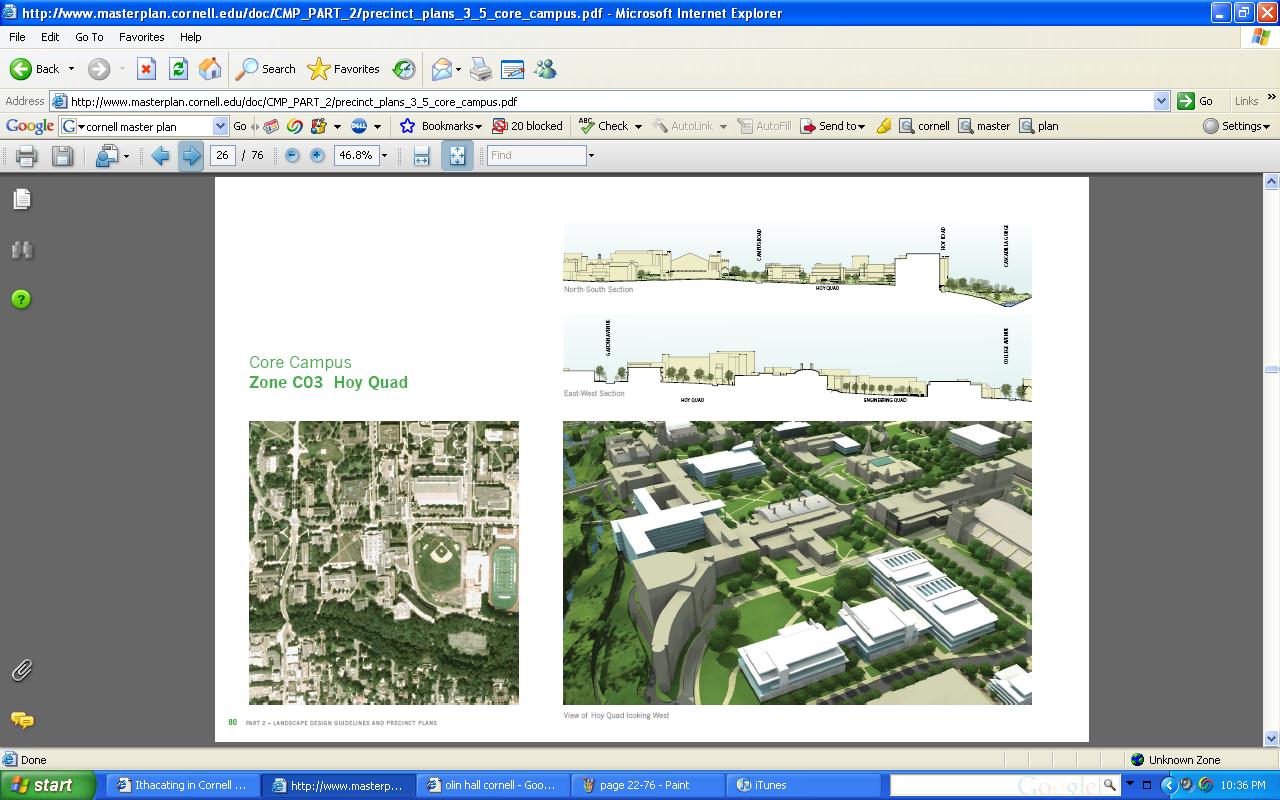
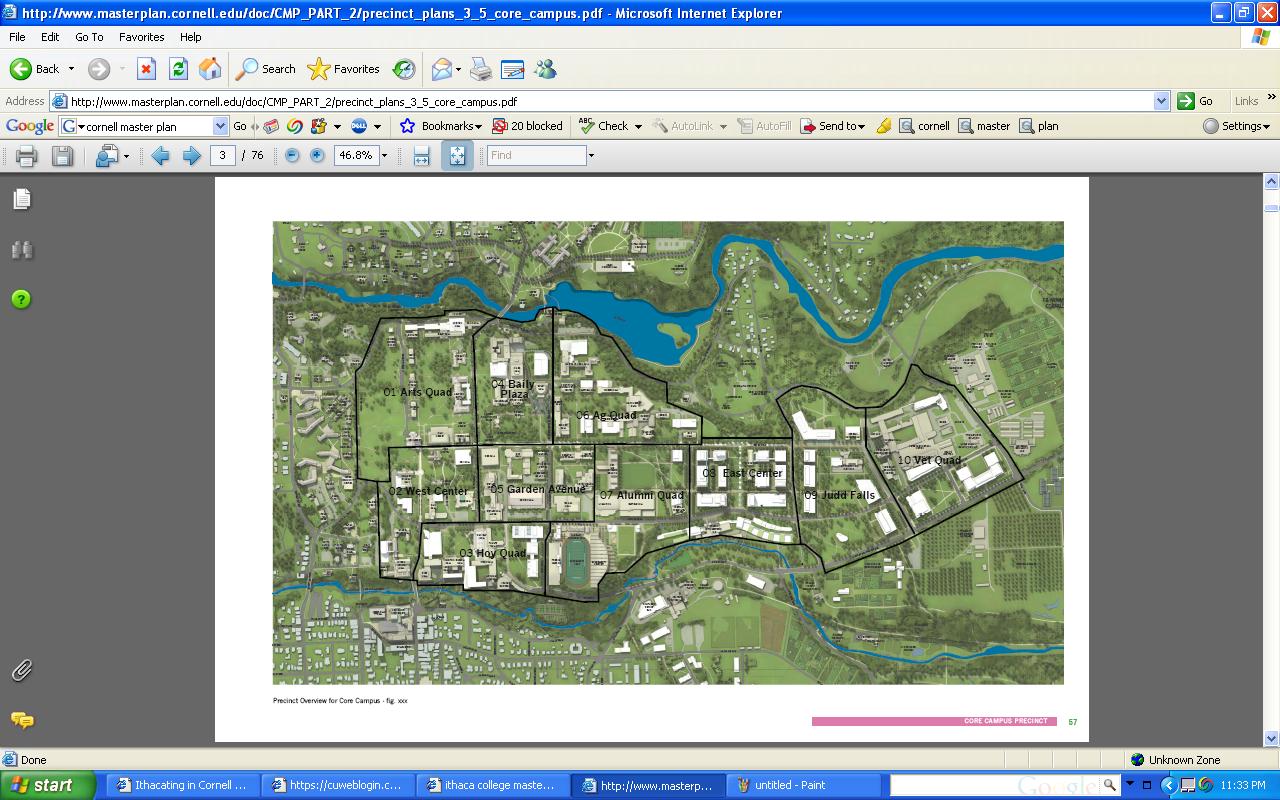
Precinct 3 is the Engineering Quad and Hoy Field, referred to in the plan as the “Hoy Quad”. Compared to the previous two precincts, the changes here are numerous. Hollister, Carpenter, and part of Thurston are gone (so is Ward Center, but I’ve met engineers who didn’t even know that was there). A massive building replaced the former two, and the latter is incorporated as part of a new set of building, a large addition next to Grumman Hall and a small slender building directly behind Thurston (a design massing of Gates?). Hoy field is gone, replaced by four medium-sized-footprint structures making up a partial quad.
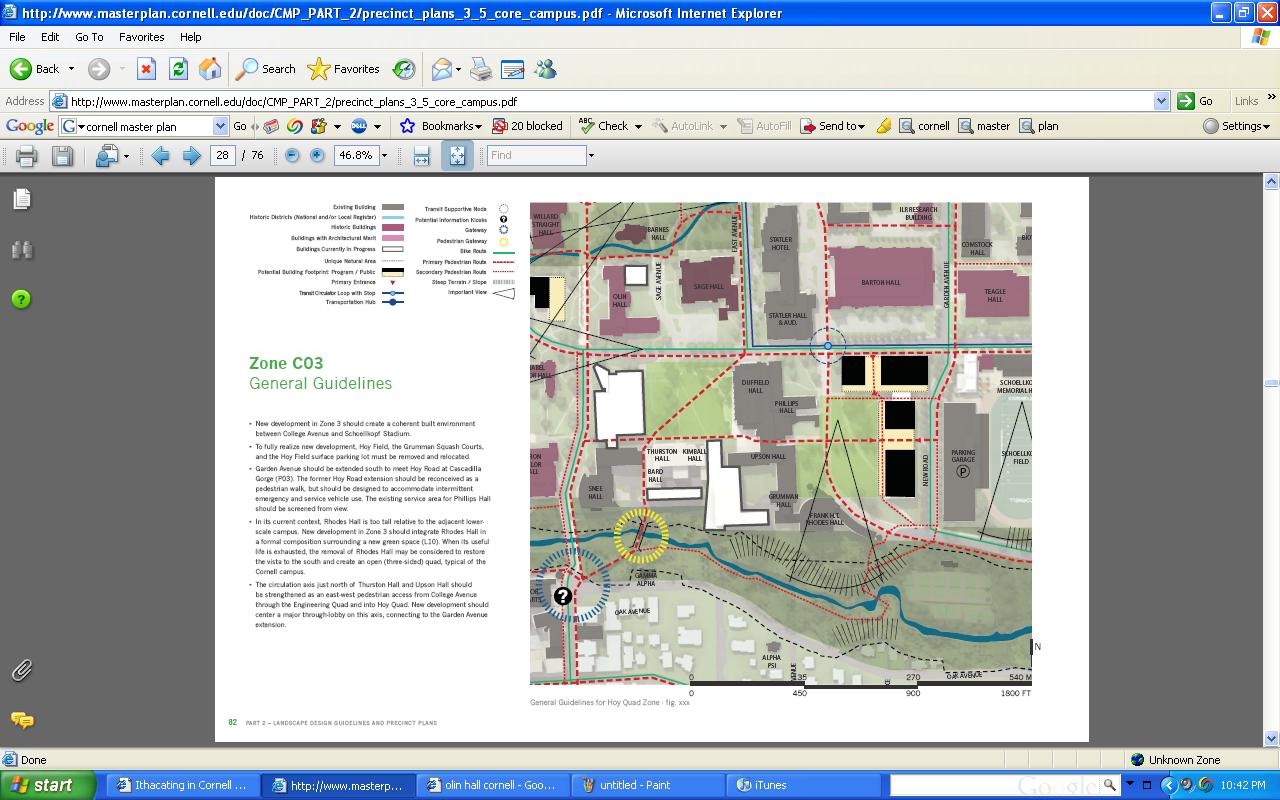
The plan suggests Rhodes is too tall for its location, so the new development next to Grumman builds up to it. At the end of its useful life, the demolition of Rhodes is suggested. Wow, not even twenty years old and Rhodes Hall is already having its demolition suggested. Garden Avenue would be extended between the parking garage and the new quad. The space created in the new quad would be between 249,000 and 378,000 sq. ft of space- about the same if you combined the new Physical Sciences. I’m kinda fond of Hollister Hall,  (I know, it’s a box, but it’s a decent international style box), so I’m a little disappointed to here it’s slated for demolition, but in general I’m more concerned with who Cornell hires to design the new building (I vote for Robert Stern).
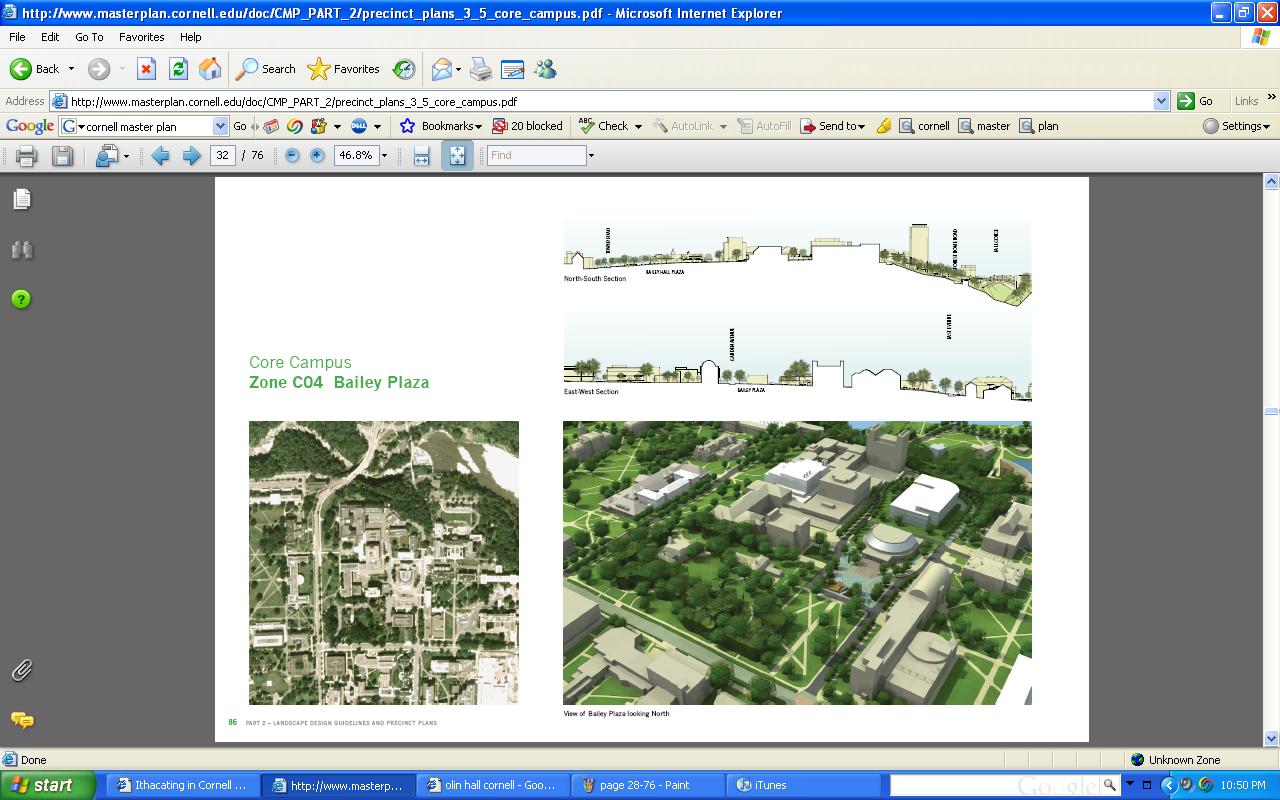
Precinct 4 is the Bailey Plaza precinct. Here, Malott Hall has been demolished. I’m not too fond of that; I find the north wing to be a great example of 1960s architecture (to hell with the south wing). Again, it’s because of sight-lines; they want Bailey Hall and Plaza to be the focal point of this area. The plan goes even further to suggest the demolition of Roberts Hall once it goes beyond its useful life to enhance sight-lines even further.

Much to the disappointment (or delight, in some cases) of nutri sci majors, Savage and Kinzelberg would be demolished for a new structure, around 150,000 sq. ft in size and 3-4 floors. Newman Lab would also see the axe. The new building could be either research labs or a performing arts center to complement Bailey. But at the research institution that is Cornell, I have an idea which one would be preferred.

Precinct 5, the Garden Avenue area, has nothing new planned, nor nothing planned for demolition. Here’s an idea; use some of the steel and aluminum from Duffield’s facade and put it on Uris. But, I’m being unfair. Uris, built in 1972, was named for Percy and Harold Uris ’25; the libe was also dedicated to them in 1962, the first time it was renovated. Well, story goes that when Cornell gave them carte blanche on design preferences, they were in Pittsburgh, and noticed how amazing the (then new) U.S. Steel tower’s facade looked (which uses cor-ten steel). They wanted to see that on the new building [2]. So that’s why it was chosen. Cor-ten steel turns gold-yellow when it reacts with common air pollutants; well if Ithaca can claim anything, the air is pretty clean. So, no gold hues anytime soon (the last I heard, maybe 100 years).

Fully Weathered COR-TEN steel

Fully Weathered COR-TEN steel

The last precinct I’ll cover tonight is the Ag Quad. The Ag Quad is important to me because this is where I spend a good chunk of my life (that and the bowels of the engineering school, where engineers remind me every day why I study meteorology and not engineering). In particular, I live at the top of Bradfield. We think it’s the best view because of the height and the fact we don’t have to look at it. It’s like a pug, so ugly you can’t help but love it (it grew on me over months…okay, years). The additions to the ag quad are a new building over the gravel lot currently between Kennedy and Plant Sci, and the front of south side of Plant Sci. Really, we wouldn’t even need a new building on the parking lot if they hadn’t demolished East Roberts Hall in the late 1980s.

L to R: Roberts, Stone, East Roberts Halls

As for the Plant Sci addition, I was never fond of the front anyway. It was built in the depression, and it looks that way too. But no glass box, please. This precinct also includes the new MVR north, being built right now (there was an old MVR north; just search this blog for the story). It looks life Caldwell and Warren get back additions on their parking lots, and Bruckner Lab sees the wrecking ball to make room for a building that dwarfs neighboring Rice and Fernow Halls. They say Cornell builds in a style is fashionable at the time. If that’s the case right now, then stay off the Ag Quad. My trust with Cornell’s building proposal designs is quite low.

Thankfully, none of the plans are currently underway. I admit, if William Henry Miller were alive today, I’d be begging for the university to hire him. I’m not big on progressive architecture, but maybe that’s because I just don’t understand it. I like the traditional styles just fine.To be continued…[1]http://en.wikipedia.org/wiki/Stata_Center

[2]http://ezra.cornell.edu/searched.php – see 12/27/2005


The Cornell Master Plan: Part 1 of 5

22 07 2008

So, now that I’m done with the fraternity rush booklet, I’m going to do a new multi-part feature, this one focusing on the Cornell master plan. Look at it this way; I love reviewing the additions to Cornell’s physical plant, so this is the equivalent of giving a hit to a crack addict (okay, maybe not as detrimental to my health. But anyways…)

So, a little background. The plan was first initiated in late 2005 and took about two years to complete the final product [1], which was the culmination of the third and final phase of development. Up to that point, some open sessions were held at Willard Straight and at the Hilton Garden downtown (in Sept. 2007) for members of the community to comment on the findings, needs and projected developments of the university. The work was done by a Toronto-based planning firm, Urban Strategies Inc.

The plan tries to encompass the needs and concerns of the university and its physical plant. Among the primary issues, transportation and parking were major concerns, as well as maintaining a cohesive campus community and spatially harmonious design concepts in the planning of space throughout the campus. Also important was the development of additional facility to maintain Cornell’s capacity to be a top research institution.

So, the plan is set on the time scale of the next 10 to 25 years. The plan considers some of the following parameters; an increase of faculty from 1,600 to 1,700-1,800; an increase in graduate student population from 6,000 to 6,500-7,000; an increase of 700 staff from 8,400 to 9,100; and undergraduate to hold steady arond 13,500. The plan accomodates for 1-2 million more square feet of space, to be constructed in and around the Ithaca campus.

So, my goal is to pick this plan apart, piece by piece, and analyze the crap out of it. But if you want to see and read through the process that led them to create the parameters and design guidelines for the comprehensive master plan, here’s the link: http://www.masterplan.cornell.edu/ (click on part I).

Clicking on part II’s “Core Campus” link, and sitting through the time that it takes for 76.99 MB to download, it opens up to a picture of Olin Libe and McGraw Tower. How pretty. Anyways, it talks about the importance of Central Campus as the hub of university activity. Here, they first mention the new 24-hour hub on the east side; that’ll be discussed more thoroughly in a later entry. One last thing- unless otherwise noted, no building is a concrete plan; they are merely suggestions as to a good way to develop the site. If master plans were always carried out to a tee, we’d have completely gothic west campus [3].

Yay for Prnt Scrn buttons! I’m not doing this with every page, just ones i’m going to focus on. Seriously, I suggest you go to the masterplan website, click on “part II”, “core campus”, and take a look. Or go to the listed source [2].

So, this is the overall plan. It worries me just a teeny bit when they mispell Bailey as “Baily”, since it is a whole area of discussion for them; but I can’t comment, my blog entries are filled with typos.

The page for demolished buildings and removed parking lots. the general goal of the master plan seems to be to hide the parking as much as possible, since it isn’t good for aesthetics, and isn’t pedestrian friendly. However, we still need it, so they shove it underground where possible. Milstein Hall would be a good example of that.

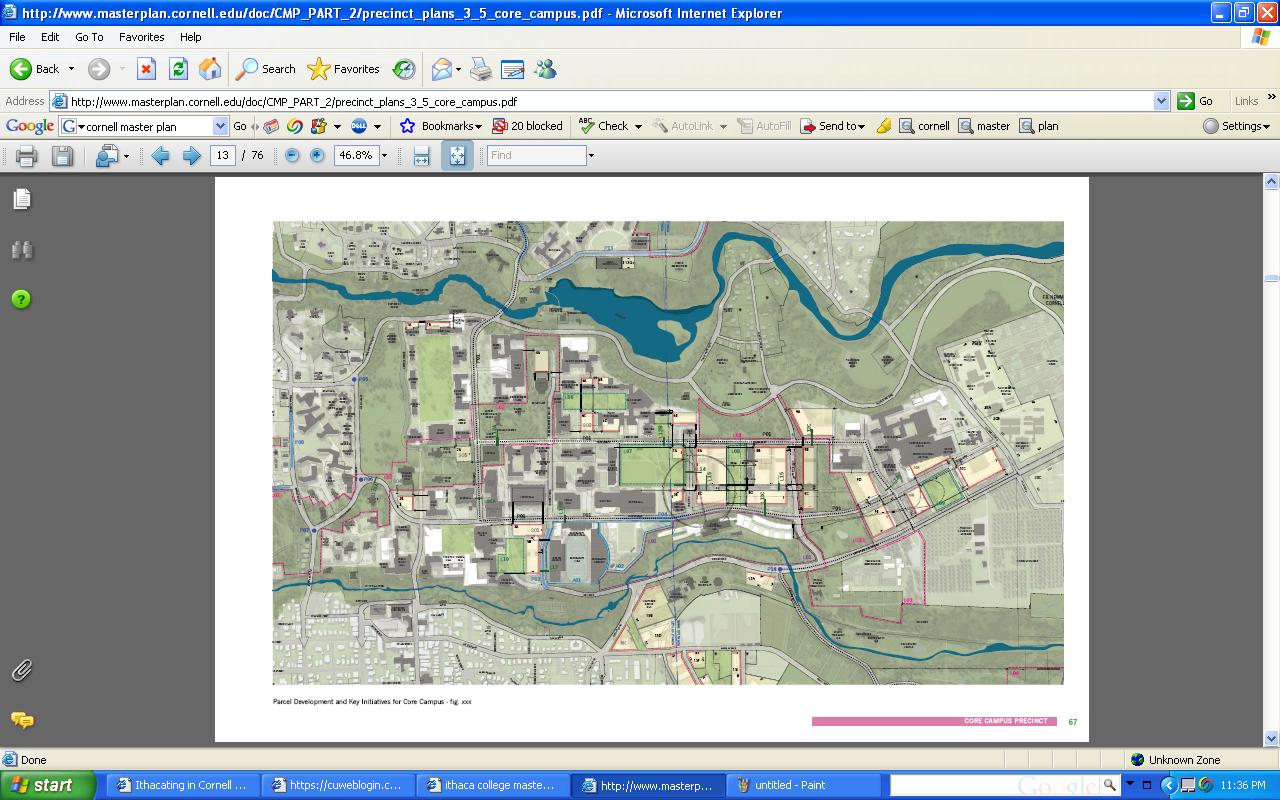
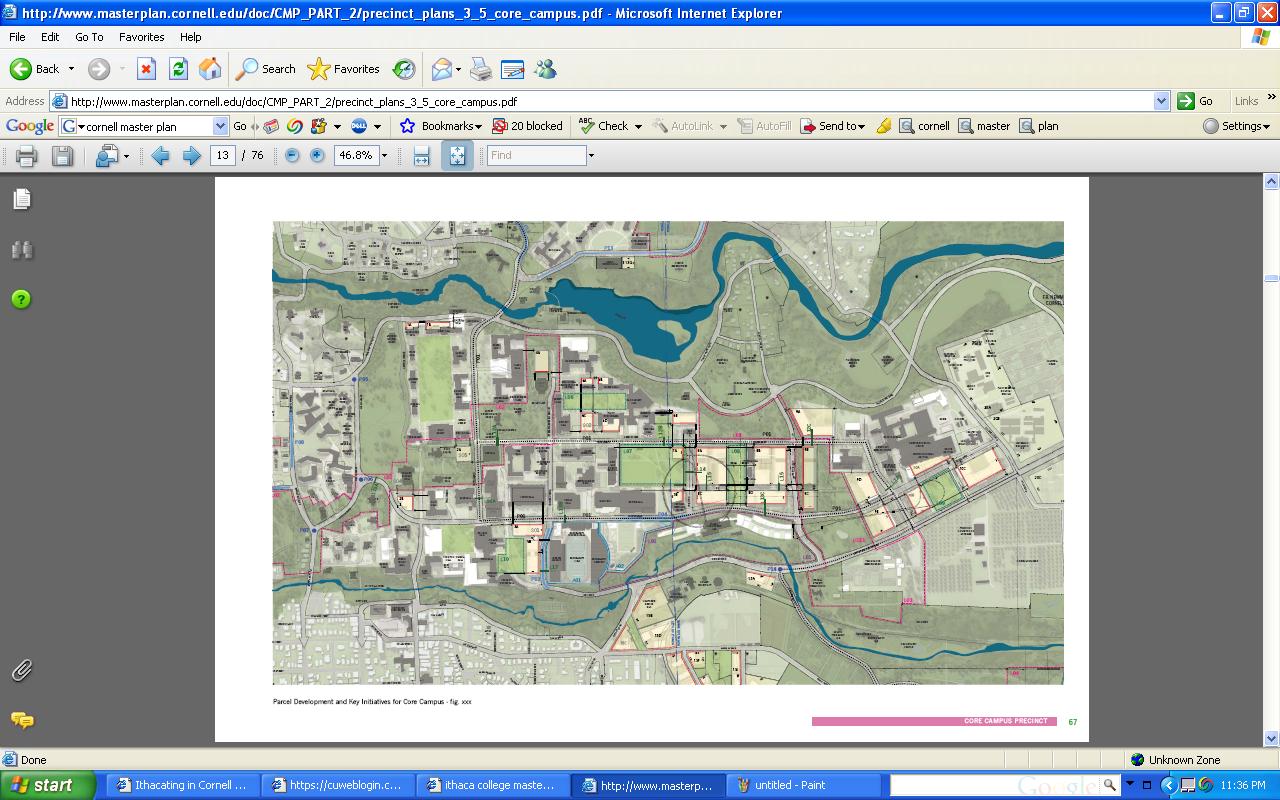
Development focus areas! Notice the massive changes on the east side of campus. Like I said, I’ll discuss those later, but they really stand out here.

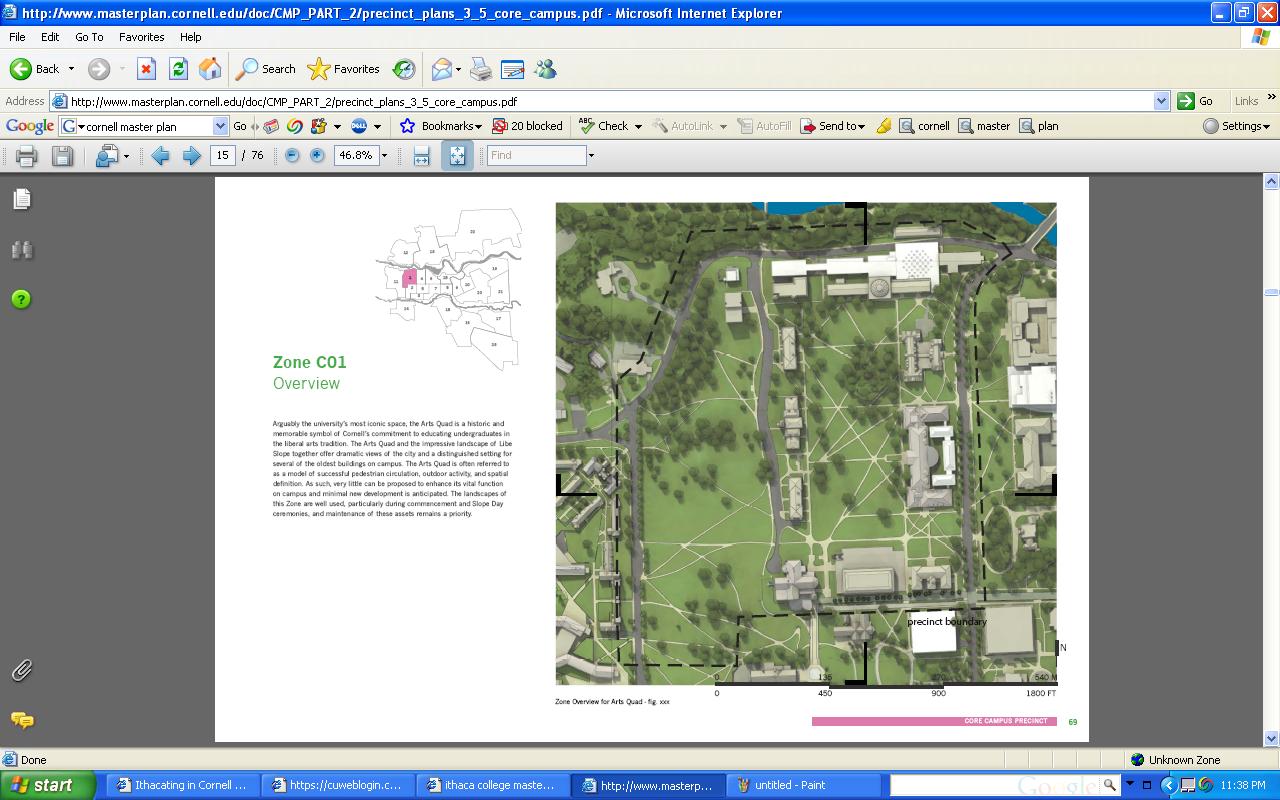
The 3-D image of the improved Arts Quad. Mistein sticks out like an ugly chick in a beauty contest, but there’s hope for the Goldwin Smith extension, for  which planning is currently underway. I’m holding out for something modern yet respectful to the older architecture, like the addition to Lincoln Hall in 1998. 

The overhead. As you’ll notice in the pdf, Milstein has these symmetrical roof features at the top; I feel as if that was an attempt to spice up the miracle box. I’m still not impressed, but you can notice an extension that goes behing Sibley and behind Tjaden. I really hope the arrow means you can still walk between them. An extension of Milstein’s design is perhaps nto the most ideal, but maybe Cornell can come up with something good for the back areas of Tjaden and Sibley. You can also just make out the Johnson Museum addition, which area-wise looks small and quaint compared to the rest of the buildings. At a mostly subterranean 16,000 sq. ft, I s’pose it is.

New stuctures with the thick gray border have been given the go-ahead for planning. The footprints in blacks are areas of potential development suggested by the plan. As we see, the area behind Sibley and Tjaden is seen as the only reasonable space left to develop without disrupting the harmony of the ag quad. The next page states that these buildings would have the same height and massing as their older counterparts, but considering they’re home to Arts and Architecture, I would not be surprised if Cornell were to push for cutting-edge designs if they ever developed those plots, being artistcially daring and all. However, it’s amazing how cutting-edge can be so offensive to the eyes sometimes.

Buildings in mauve-purple? They’re historic. As much as I have a personal vendetta against Rockefeller Hall, particularly Room 203, it would be a major hassle to structurally change it. No demo there anytime soon (I think the story goes that the money John Rockefeller gave to the building went mostly to the interior mechanics, and little on the exterior and finishings, hence the spartan design. He hated it so much when he saw it he vowed never to donate money to Cornell again). My personal wonder is how the hell could Uris Hall be architectually significant. Is that like the equivalent of a massacre monument, to mark that something terrible happened on the land and we should all know about it? Uris Hall could be taken as a massacre on the eyes.

Also on this page are the noted sightlines for the Arts Quad; sightlines will play a bigger role in some others buildings on campus, as to whether they remain or not.

to be continued…

[1]http://www.masterplan.cornell.edu/doc/CMP_Executive_Summary_FINAL-2.pdf

[2]http://www.masterplan.cornell.edu/doc/CMP_PART_2/precinct_plans_3_5_core_campus.pdf

[3]http://en.wikipedia.org/wiki/Cornell_West_Campus


Milstein Hall: Just Build the Damn Thing

16 07 2008

So, continuing with my ongoing fascination with proposed facilities for the university, it would be impossible to forget Milstein Hall. Wait…yes it would. The building has been through so many redesigns and so many hold-ups that if it takes any longer, I won’t be here to enjoy the finished product. And that makes me sad.

But anyways a brief review. Milstein Hall is the proposed addition to the neverending red tape architecture school, curently in its third rendition, a $40 million, 43,000 sq. ft box [1].

In Koolhaas’s own words, “It is a box that is contaminated by its neighbors and will contaminate its neighbors.” Um, I’m not exactly sure that’s the best way to put it. I’m no architecture student, but I get this vague uneasiness of another Uris Hall situation.

But this is the third rendition. And the other two weren’t exactly pretty either. The saga starts in 2000, when Paul Milstein, a prominent NYC developer, donated $10 million towards the construction of a new facility in February 2000 [6]. Milstein himself did not attend Cornell, but two of his kids did (a third sorta did, she transferred to Yale).

The first design was chosen in a four-way competition that concluded in April 2001. The winner was Steven Holl, for his proposal to build a seven-story cube on the location of Rand Hall, which would have been demolished. The project was set at $25 million, and to be completed in late 2004 [2] (fun tidbit: chair of the selection jury was James Polshek of Polshek Architects, the same firm responsbile for the design of Gates Hall).

Well, the demolition of Rand Hall didn’t sit too well with people, and a lot of people had some critiques for the design (more renderings at http://www.stevenholl.com/project-detail.php?type=educational&id=73). It was a box with cutouts on the west side. Once again, I’m not an architect, but it looks to me like taking a pair of scissors to a paper cube and calling it a design. This is cutting edge…?

So, the university dropped their deal with Holl in July 2002, and by November had selected Barkow Leibinger Architects as the firm to design the building. With a pegged completion date of fall 2006 [3]. Once again, the design was rather…interesting.

For a larger photo, go to www.barkowleibinger.com, and go under competitions, 2003. There you can see that this cutting-edge building also planned to tear down Rand Hall. And once again, there were issues with the design. I can’t say I’m personally too fond of it either, though I like it more than Holl’s design. It says this was to be 6000 sqm, or about 65,000 sq. ft.

Well, that didn’t pan out either, so by September 2006, Rem Koolhaas, the designer of the much celebrated (and 15x more expensive) CCTV tower in Beijing, was announced as the lead architect of the Milstein Hall Project. The square footage had shrunk by a third, and the price tag was up 75%, but there was hope that the damn thing might be built by 2010 [4]. Well, until the City of Ithaca and Cornell decided to have a fight over who controls University Avenue [5].

Long story short (unless you like hearing about SEQR determinations and environmental reviews), the fact that Milstein is designed to stand on both sides of University Avenue 15 feet above the ground kinda posed some issues. Namely, who owns University Avenue, since the current design doesn’t fly with city guidelines. After much arguing, the city decided to sell Cornell the portion of University from Chi Psi up to the intersection with Thurston for the price of $2 million, provided that much needed repairs were completed. Also, Milstein would be cantilevered over the street, to avoid building on both sides. Hopefully, now all the obstacles have been cleared.

So here we are, eight years later and nothing done but a lot of hot air being blown around nevertheless. While I would hope that something is done eventually, I can’t say I’m holding out much hope (especially for a design that I like, but I guess I just don’t understand architecture).

[1]http://cornellsun.com/node/18396

[2]http://www.news.cornell.edu/Chronicle/01/4.26.01/Holl_Architects.html

[3]http://www.news.cornell.edu/releases/Nov02/Milstein.Hall.arch.html

[4]http://www.news.cornell.edu/stories/Sept06/Milstein_design.dea.html

[5] http://cornellsun.com/node/27051

[6]http://www.news.cornell.edu/chronicle/00/2.3.00/Milstein_gift.html


Gates Hall

10 07 2008

Okay, so in my observations of Cornell and local construction ,there is one thing that continues to be just a bit bothersome; two and a half years after it was announced [1],  there has not been one single rendering of Gates Hall. So, let’s review what we do know.

1)The building is meant to house the Dept. of Computer and Information Sciences (CIS). Gates is allowed to name it because he’s forking over half the expected construction cost (plus, the guy gets around around- UW and Stanford have Gates Halls as well).

From the article: “According to Kenneth Birman, professor of computer science and chair of the CIS building committee, the information campus project is still in the feasibility study stage. Gates Hall is estimated at 100,000 square feet and projected to cost about $50 million.”

2) So, now we know it’s supposed to be about 100,000 square feet. For comparison, Duffield’s gross area is about 150,000 sq. ft. [2]. Further investigation of the facilities website indicates that the architect will be Polshek Architects [3].

3) A review of Polshek’s firm shows some of their previous work:

Polshek Work 1 

Basically, it’s a firm that likes glassy, boxy designs.

4) Lastly, from the Master Plan, we see that CIS is behind Thurston, but there’s two buildings, and it’s a little confusing to tell which is Gates, since they are both listed as “in progress”.

My conclusion: Expect Gates to have a foot ptint between 25,000 and 50,000 square feet, 2-4 floors in height, with a boxy, glassy design not too unlike the Beck Center behind Statler Hall.


[1] http://www.news.cornell.edu/stories/Jan06/GatesCIS.ws.html

[2]http://www.fs.cornell.edu/fs/facinfo/fs_facilInfo.cfm?facil_cd=2000

[3]http://www.fs.cornell.edu/fs/projects/


News Tidbits 6/26

26 06 2008

from the IJ:

http://www.theithacajournal.com/apps/pbcs.dll/article?AID=/20080626/NEWS01/806260342

“* The housing supply project calls for developing “quality, affordable and sustainable residential communities for the benefit of Cornell employees.”

The proposal is to build “new affordable townhomes” on Cornell property by 2010.

This property could include land at East Hill Plaza, in Collegetown and potentially anywhere else Cornell owns land, Johnson said. New housing would be built within easy biking or walking distance to Cornell or along public transportation lines, he said.

Cornell proposes to spend $600,000 on the housing supply project in 2009.”

Have to keep an eye on that.  $600,000 isn’t much to build with though. Although Cornell already owns the land, and intends for it to be affordable (i.e. not big or loaded), I could see at most four or five townhomes being built with $600,000. Whether or not they continue to add as much each year is a big question.

Example townhomes