News tidbits 1/16/2016: The Not-So-Best Laid Plans

16 01 2016

elmira_savings_1

1. It isn’t exactly a shock that Elmira Savings Bank is pursuing plans for the $1.7 million in properties it just acquired on the west 100 block of Meadow Street between West State and West Seneca Streets. That being said, sending out 30-day eviction notices wasn’t a very good idea from a public relations standpoint.

Technically, it’s all above the law – the three tenants affected were on month-to-month leases, according to Nick Reynolds over at the Journal, and one had an expired lease and was in the process of relocating. The bank wasn’t interested in renting out the properties and decided to clear them out. That is plausible, if a little brusque – even if they had put forth a proposal for something at the next Planning Board meeting, approval would take months, in which case they could eased the tenants out of the current property. But instead, they ended up with a petition that, while mostly reading like a speech from the Politburo, does make the valid point that this was conducted poorly. Then it hit the airwaves, and the bank has gone into major damage control mode, giving the tenants until the end of March and reimbursing them $1,000 for the trouble.

Looking at some of the comments on the Voice, there is a lot of outcry against gentrification, but there’s not a whole lot the city can do to prevent that – even if Elmira Savings Bank didn’t build a thing and sold the buildings to someone else, the rapidly rising property values around the city would push the renters out, albeit more subtly, and the city can’t make a law that says someone can’t move in. Plus, as seen during the 210 Hancock, Stone Quarry and Cayuga Ridge debates, there’s a lot of pushback locally against affordable housing. Arguably the best solution going forward is to work an inclusionary zoning ordinance into law so that when Elmira Savings Bank does decide to build (and it’s more of a when than an if), that a few of the units be made available to those on more modest incomes.

Just to touch on that real quick, according to the Journal, the old Pancho Villa building at 602 West State Street will become a bank branch for ESB in the short-term, and plans are being considered for a mixed-use project at some point down the line (two months, two years, who knows). The zoning is WEDZ-1a, allowing for a five story, 65′ building, but there might be tweaks to that depending on the inclusionary zoning ordinance.

tmpud_waterfront_1

2. Keeping a focus on the west side of the city, the Planning and Economic Development Committee voted to circulate a proposal for a “Temporary Mandatory Planned Urban Development” (TM-PUD) over the waterfront. The reason for this is one part proactive, and one part reactive.

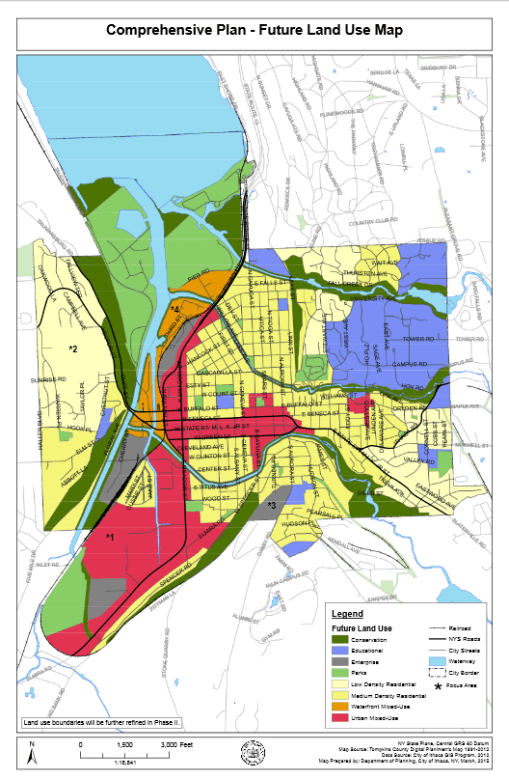
What the TM-PUD does is, for an 18-month period starting the day of Common Council approval, it gives the Common Council the right to oversee and if necessary vote down projects that it thinks will not be appropriate for the waterfront. The study area is currently a mix of zones: Waterfront (WF-1, WF-2), Southwest Mixed-Use (SW-2), Park (P-1) and Industrial (I-1). When the Comprehensive Plan was passed in 2015, it promoted a more walkable, dense, mixed-use waterfront. Therefore, some of the zones are outdated.

The city’s planning department is still in the process of drawing up specifics for how to implement the Comprehensive Plan’s walkable urban waterfront, but in the meanwhile, some of the zones don’t match up with the direction the city wishes to proceed. Take, for example, the industrial space on Cherry Street and Carpenter Circle. By zoning, residential uses aren’t allowed, although the city would like to see mixed-uses with condos and apartments in their vicinity. The planning department needs time to figure out the what and where on zoning so that those uses can be proposed without a developer spending extra months in front of the Planning Board and BZA, which can drive up costs and make construction financing more uncertain.

So that’s the proactive, benign part – the city needs time to plan out the zoning laws for the dense waterfront they want. Now comes the reactive, cynical part.

It’s a not-so-secret secret at this point that the Maguires are looking hard at Carpenter Circle for their car dealership headquarters and multiple sales outlets. Since Carpenter Business Park is zoned industrial, and Ithaca city zoning allows commercial uses in industrial space so long as they’re two floors, there’s a good chance they could build dealerships without the need of the BZA, and it would be an uncomfortable position for the planning board to have to debate a project that is totally legal but is something the city and much of the community doesn’t really want. So as a way to stall for time, the city’s pursuing this TM-PUD and giving the Common Council the authority to shoot down any unwelcome plans should they arise.

For comparison’s sake, there’s a similar scenario that is playing out in Ithaca town. The College Crossings project on South Hill was welcomed under the zoning and previous iterations had been approved, but after the town passed its 2014 Comprehensive Plan and attended the Form Ithaca charettes last summer, the planning board realized that a shopping center with a couple apartments above and in the middle of a large parking lot wasn’t something they really wanted anymore. While the project has been withdrawn, the process and debate has created a lot of discomfort, confusion and uncertainty, which is rather problematic given the area’s housing shortage. The town hopes to have some form-based zoning code ready this year.

So, looking back to the city, the occupants of 108 E. Green Street want things that are still illegal in much of the study area, but they don’t want a full-on moratorium because some spots like the Waterfront zones actually do accommodate what the city and many of its constituents want. The TM-PUD is an attempt to stave off the legal but undesirable projects until the revised West End zoning can go into effect.

Worth pointing out, at the meeting the boundary was changed to midway through the Meadow Street and Fulton Street blocks, rather than along Fulton Street. It may or may not affect Elmira Savings Bank’s parcels as mentioned above, but those long-term plans are in alignment with the city’s, so probably not.

south-hill-area

3. On a related note, the town is holding workshop sessions for those interested in designing a ped-friendly, mixed-use community for South Hill. The meetings are planned for 6:30 p.m. to 8 p.m. Jan. 26 to 28 at the Country Inn and Suites hotel at 1100 Danby Road in Ithaca. An open office has also been scheduled for 12 p.m. to 1 p.m. Jan. 27. Form Ithaca will be in attendance at the sessions to help formulate the form-based character code proposed for the neighborhood.
815_s_aurora_4 815_s_aurora_1

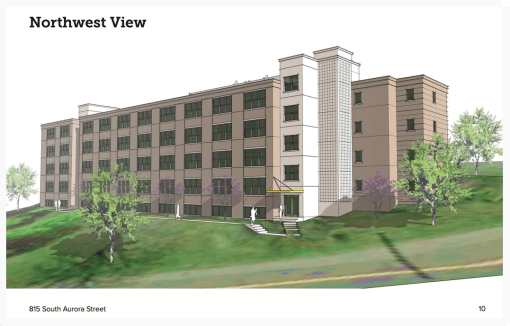
4. A revision to the cellphone tower law has taken one step closer to becoming reality. The city’s Planning and Economic Development Committee voted 4-1 to circulate a revised law that would reduce the size of the tower’s fall zone, where construction of any structures is prohibited. A revision to the current city law, which is twice the height of a tower, could potentially allow the 87-unit 815 South Aurora apartment project to proceed with planning board reviews and other BZA variances if necessary. Developers Todd Fox and Charlie O’Connor of local company Modern Living Rentals have been pushing for a fall zone radius of 180 feet for the 170-foot tall tower, rather than the 340 feet as the current law mandates.

From the discussion, it sounds like the concern has less to do with this parcel, and more to do with the possibility of cell phone companies pursuing towers on open land in the northern part of the city where spotty reception has to be weighed against the aesthetics of the lake shore. Anyway, we’ll be hearing more about possible changes to this law in a month, but for back reading, here’s the Voice article from a few months back.

5. In quick news, CBORD’s move to the South Hill Business Campus looks like a go. A $2.45 million construction loan was extended on the 8th by Tompkins Trust Company. CBORD, a software company founded in Ithaca in 1975, will move 245 employees into 41,000 square feet of freshly renovated SHBC space from the Cornell Business Park later this year. The project, which totals $3.7 million, was granted $296,000 worth of sales tax abatements.
409_college_avenue

ehub_1

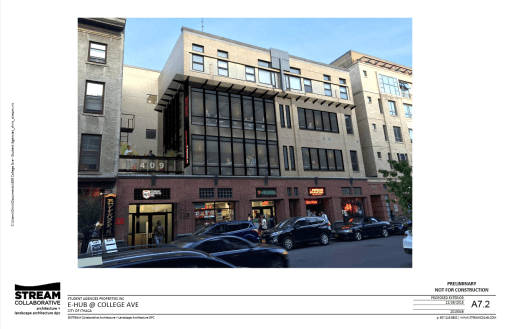
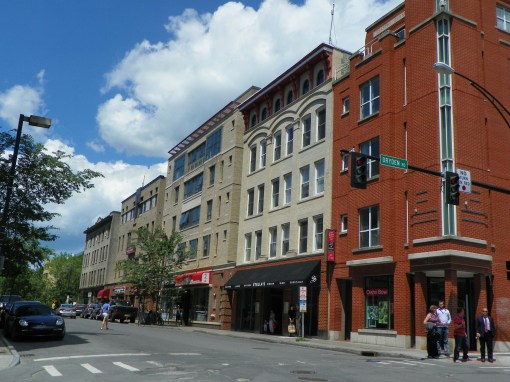
6. From the city’s Project Review Agenda next Tuesday, plans for a facadectomy of the 1980s Student Agencies Building at 409 College Avenue. Student Agencies, in collaboration with Cornell, plans on dropping $183k on the facade work, as well as the $2.8 million or so for the interior renovations of the second and third floors for the new eHub business incubator space. Prolific local architecture firm STREAM Collaborative is in charge of the design work, including the 9,660 SF of interior space. The work would go from January to April (the loan is already approved and most of the work is interior).
6-29-2014 163

If I may play armchair architecture critic, which I have no credentials to do, I think the patio area is great, but I’m opposed to the brise-soleil, the wing like feature that serves as a sunscreen. I feel like that its location above the third floor throws off the rhythm of the block, by being lower than the cornices on adjacent structures. It might be fine over the glass curtain wall alone, but as is it feels a little out-of-place. Just one blogger’s opinion.

20160109_135258 20160109_135338


228_w_spencer_1

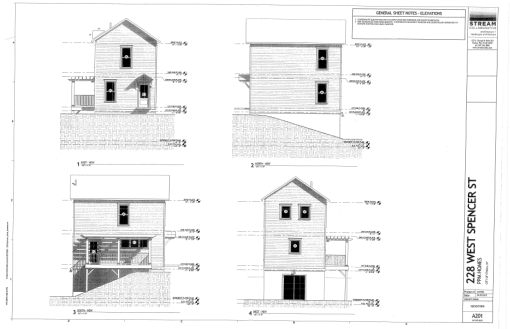
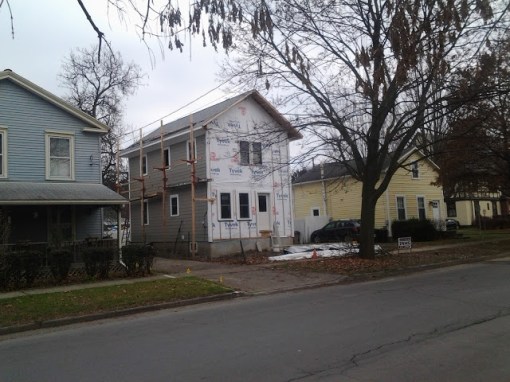
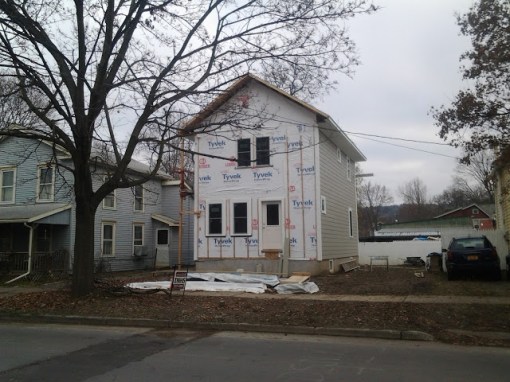
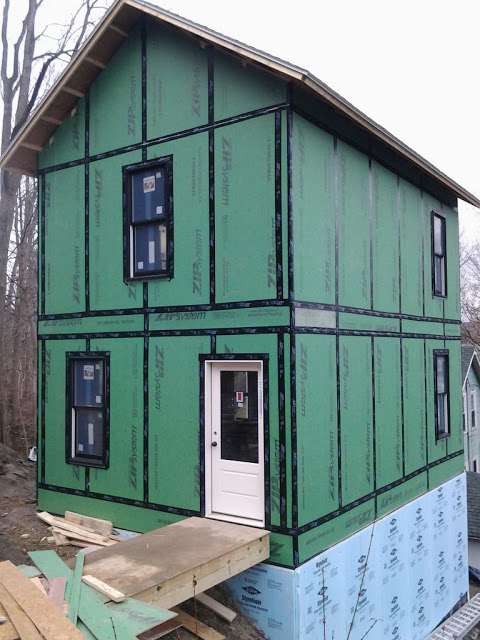
7. House of the week. 228 West Spencer Street in the city of Ithaca. Zero energy new construction, 2-bedrooms, on a rather difficult site. In the above photos from last weekend, the house has been framed and sheathed with Huber ZIP System plywood panels, the roof has been shingled, and doors and windoes have been fitted. The blue material on the concrete basement wall is Dow Styrofoam Tongue and Groove Insulation which protects against moisture and helps keep the heat loss to a minimum. The house should blend in nicely with its neighbors.

Ed Cope of PPM Homes is the developer, and Noah Demarest of STREAM Collaborative is the architect.


News Tidbits 12/12/15: Money Money Money Money

12 12 2015

canopy_hampton_rev4_1

1. Time to do a little rumor-killing. There’s been some confusion as to whether or not the Hilton Canopy is actually happening, since it was supposed to have started construction by this time and it hasn’t. There was also an article in the Ithaca Times that suggested that construction costs much higher than original estimates had caused the project to be cancelled.

Well, the project has definitely been delayed, but it looks like it will still be moving forward. According to a utility easement resolution at the Ithaca Urban Renewal Agency’s Economic Development Committee (IURA EDC) meeting, a project financing commitment has been secured and the developer of the Hilton (Neil Patel of Lighthouse Hotels LLC) is planning a construction start in the first quarter (Jan-Mar) of 2016, which would suggest a mid-2017 opening.

inhs_pride_design_v5_3

2. Also in financial news, INHS looks to have secured grant funding that will allow it to move forward with its 210 Hancock project in the next four months, according to INHS Executive Director Paul Mazzarella. The grants were officially awarded in an announcement from the governor’s office on Tuesday. $3.6 million will come from the state’s Housing and Community Renewal program, $500,000 from the state low-income housing tax credit (LIHTC) program, and $1.03 million from the U.S. Department of Housing and Urban Development’s LIHTC program. In total, the award is valued at $5.13 million, about a quarter of the estimated $20 million development cost. The project has received about $17 million in grants and tax credits to date.

The money awarded covers only the rental units – 54 apartments in the four-story mixed-use building, and five townhouses. The seven owner-occupied townhouses remain unfunded.

The apartments, which include a 30-child low-income daycare facility and commercial office space for non-profits, will welcome their first tenants in Summer 2017. They will rent from 27% to 105% of local median household income, depending on the unit. Descriptively, it’s a mixed-income project with residents’ incomes ranging from $25,000-$60,000 per year.

ith_big_plan_map_v2

3. From the Common Council’s Planning and Economic Development Committee, there are a few things of note this week –

A. The city seems to be looking towards greater encouragement and flexibility with redevelopment of waterfront parcels by making WF-1 and WF-2 zones Planned Unit Developments (PUDs). What a PUD does is allow greater flexibility in uses and design by removing or loosening zoning constraints on site use, and being more accommodating to mixed-use projects (the Chain Works District proposal is a PUD, for example). Previously, PUDs could only be applied to industrial sites. The other stipulation, however, is that the applicant would have to work with the Common Council to determine appropriate development of the site.

The Waterfront Zoning allows up to 5 stories and 100% lot coverage. The PUD will give flexibility beyond that, dependent on what the Common Council is comfortable with for a given site and proposal.  So if Applicant X shows up with a huge apartment building or a big industrial building, it’s probably not going to get very far. But if it’s well designed and has affordable units? Maybe the council will grant a little more density or another floor. It depends on a developer showing up with something that they feel offers some kind of community benefit and fits with the Comprehensive Plan, and whether the Common Council agrees with the developer’s reasoning.

There is great potential in the waterfront – those views can fetch a premium (i.e. higher land values, and more tax dollars), it’s far enough removed from the colleges that students would be unlikely residents, and many of the properties are underutilized, with only marginal public benefit.  So potentially, if someone wants to work with the Common Council (one can count on at least 8 or 9 of the 10 being willing to cooperate), there could be some benefits in the long-term.

B. The Commons first-floor active-use zoning ordinance looks to be heading for a Common Council vote in January. More about that ordinance here, Item 5.

C. That damned backyard chickens thing again. Only this time, it might be moving forward with a pilot program involving 20 families.

D. Per the Times’ Josh Brokaw, expect incentive/inclusionary zoning to be up for PEDC review in January.

tfc_comparo

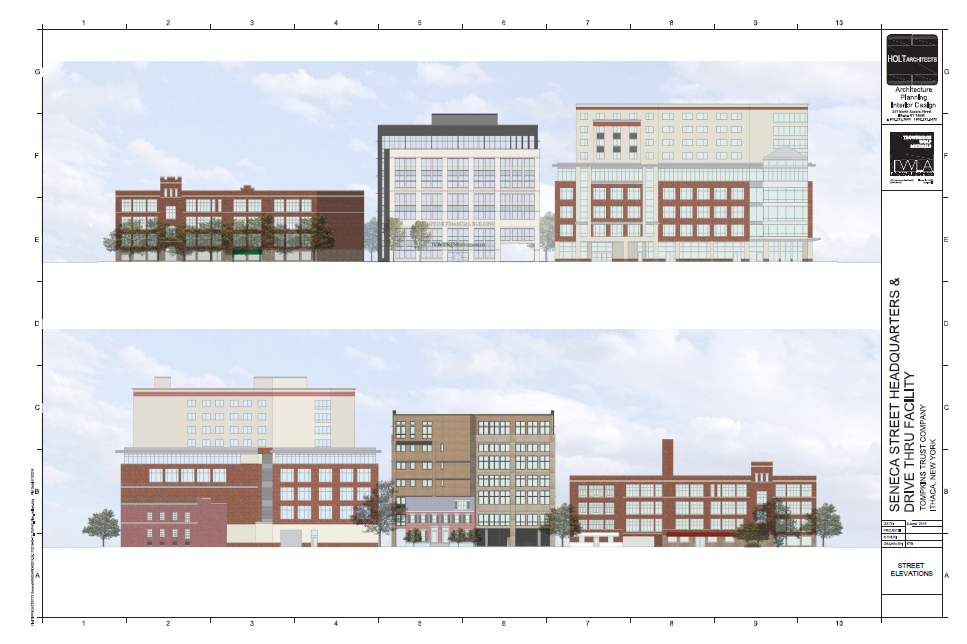
4. Hey look, this week’s eye candy. Tompkins Financial Corporation’s proposed downtown Ithaca Headquarters at 119 East Seneca Street will be reviewed for final project approval at this month’s Planning Board meeting. As part of that, here’s the final project design, part of the final Site Plan Review submission here.

From the front, it looks like some of the window layout has changed on the top floor and southwest corner, and there are fewer sunshades above the windows. There’s a third tree in the planting plan, and there’s variation in the cladding materials on the west wall facing the DeWitt Mall.

tfc_v3_1

In fact, it’s the non-primary facades that have changed the most, with different (and generally lighter-colored) brick and aluminum panels when compared to the previous rendition. Although there’s less glass than before, the lighter colors and greater variation in materials de-emphasize the bulk from the perspective of its townhouse neighbors at the rear. The 7-story, 110,000 SF commercial office building should begin construction in early 2016 with an eye towards completion the following spring.

elmira_savings_1

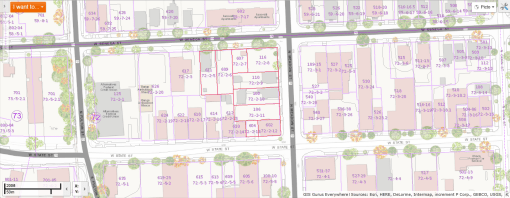
5. There was quite a sale on Ithaca’s West End last Friday. Nine properties outlined in red on the map above – 106, 108, 100 and 116 North Meadow Street, 607, 609 and 611 West Seneca Street, and 602 and 604 West State Street – were sold for $1,725,000 to Elmira Savings Bank.

Now, there are a few reasons why this is worthy of attention. For one, banks don’t typically shell out almost two million dollars without some kind of plan. For two, Elmira Saving Bank has been moving forward with expansion plans in the Ithaca area in hopes of capitalizing on the growing local economy. For three, there has been a lot of development in this neighborhood as of late – the Iacovelli Apartments (2013) and Planned Parenthood (2014) are right across the street, and it’s worth noting that the 18,000 SF HQ for Alternatives Federal Credit Union (2002) is on the other side of the block.

The properties are currently home to parking lots, several older, non-historic houses (most in poor condition) and a two-story 4,500 SF commercial building previously home to the Pancho Villa Mexican restaurant. The restaurant building had been on the market for $699,900.

The zoning here is all WEDZ-1a. West End Zone 1a allows for 2 to 5 story buildings, 90% lot coverage in the case of large assemblages such as this, and no off-street parking requirement. That means these parcels have a lot of potential. The previous owner had been rumored to be planning a mixed-use building on some of the properties, but nothing official ever came forth.

Two phone calls were placed to Elmira Savings Bank’s headquarters in Elmira, and two voicemails were left, but neither received a response. But these properties are definitely something to keep a close watch on over the following months.

6. That 9100 SF store being developed on the corner of East Shore and Cayuga Vista Drives in Lansing that was mentioned last week (here, Item 4)? It’s going to be a Dollar General. Not sure if that’s better than the auto/tire store speculated last week.

20151108_152102

7. Lest it be forgotten, it appears Lady Luck and some state bureaucrats smiled at the Southern Tier this week, awarded the region one of the three $500 million prizes of the Upstate Revitalization Initiative, known colloquially as the Upstate “Hunger Games”. Rochester/Finger Lakes and Syracuse/Central are the other $500 million winners. Seven regions competed, and the four losers will receive $80-$100 million for their priority projects. The money will be paid out in five annual installments of $100 million. A copy of the Southern Tier’s plan is here.

I wrote about Ithaca’s plans for its share on the Voice here. The first year projects alone will have a range of impacts, ranging from job creation and training to municipal construction projects to quality of life projects like museum expansions. Potentially, it could result in hundreds of jobs in Tompkins County, financial capital for several major projects, and make the area more attractive for investment for both local and external entities. As these projects move forward, they’ll receive their due write-ups here and on the Voice.

Of course, the key things are that the community can manage this monetary award, and that someone can track and guide these projects to completion – something the Southern Tier has struggled with, when one looks at the result of previous, much smaller awards.

8. The state’s just shoveling money into Ithaca this week. The New York State Office of Community Renewal (part of the state’s HUD equivalent, the Homes and Community Renewal agency) has awarded $500,000 towards the rehabilitation of the Masonic Temple at the corner of East Seneca and North Cayuga Streets in downtown Ithaca.

The Masonic Temple was built in 1926 and designated a local historic landmark in 1994. The property is owned by Ithaca Renting Company (Jason Fane), who purchased the building from the Masons in 1993. Fane’s never been a fan of the historic designation because the ILPC can be expensive and onerous to work with, nearly everyone else hasn’t been a fan of his long-deferred maintenance of the 90-year old building (if you have ever wondered why that CIITAP rule was added about an applicant being in building code compliance with all their other properties…now you know). A few years ago, Fane had not been shy in his interest in demolishing the building.

After rejecting a purchase offer to turn the building into a community center and space for the New Roots charter school, Fane decided to go the preservation route earlier this year and apply for a grant to renovate the interior and add an elevator to the building to make it ADA-compliant. This would make the building much more marketable to commercial tenants, many of which have shunned the 17,466 SF building. Fane laid out a few different options this past summer, including one where four commercial spaces (rental, office, restaurant) would be created. Based on the grant announcement, it looks like that will be the option pursued.

The Downtown Ithaca Alliance backed the application, as did the Common Council by unanimous vote at their July meeting.

The renovation will cost at least $1 million, and according to the grant announcement, seeks to start construction in summer 2016. Expect more info when it hits the ILPC and Planning Board at a later date.

20151205_121714 20151205_121736

9. House of the week. This week, INHS’s new 2-bedroom, 1150 SF single-family home underway at 203 Third Street in the city of Ithaca’s Northside neighborhood. The house is framed, roofed and sheathed. Siding (Hardie board?) and trim is being attached on the sides, and one can expect a nice gracious porch to be attached once exterior materials are installed on the front. A home of the design was previously built at 507 Cascadilla Street.

203 Third Street was a vacant that the city seized in a tax foreclosure in 2011. It was transferred to the Ithaca Urban Renewal Agency, who sold it to INHS for $17,000 in December 2014. The process is pretty similar for a lot of the home lots that INHS builds on – the non-profit buys dilapidated or vacant properties from the IURA, which they build or renovate into affordable single-family and duplex houses. In the case of 203 Third Street, INHS competed for the site, outscoring Habitat for Humanity’s submission in an IURA examination of proposals.

As with all INHS homes, this one will be sold to a buyer of modest means, which means someone making at or a little less than the county’s median household income of $53k/year (I think 80% of MHI is the low bound offhand, so about $42k/year). The houses will be a part of INHS’s Community Housing Trust, limiting the price it can be sold for and requiring that if put up for sale, it is sold to another family of modest means. It may just be one house, but it will mean a lot to one family.

Claudia Brenner is the architect, with Rick May Construction and Mike Babbitt in charge of construction (thanks to Claudia for the builder info).


News Tidbits 2/15/09: The Collegetown Zoning Proposal

15 02 2009

http://cornellsun.com/section/news/content/2009/02/13/collegetown-neighborhood-council-details-building-plans

Collegetown Neighborhood Council Details Building Plans

It has been almost a year since consultants visited Collegetown to develop a vision for renewal and nearly six months since an entire book was compiled to lay out the plans that will bring make that vision a reality. Last night, the Collegetown Neighborhood Council devoted its bimonthly meeting to update the status of the Collegetown development plan.

The meeting had approximately 30 attendees. According to Mary Tomlan ’71 (D-3rd Ward), co-chair of the CNC, the meeting had a much larger turnout than usual, attesting to the interest on the development plan.

Tomlan introduced the meeting; she described the “wish to make Collegetown more lively, more diverse and more beautiful” and explained the complexity of the zoning plans. The proposed zoning includes requiring pitched roofs and side porches. Other proposed legislation includes reducing building heights from 40 ft to 35 ft, limiting the number of stories in a building from four to three and reducing the maximum percentage of lot coverage from 35 percent to 30 percent.

Leslie Chatterton, head of historic preservation and neighborhood planner, detailed the plan. She explained that a more diverse and a less cyclical population needed to be encouraged in order to attract more retailers. The plan is intended to significantly increase the density of central Collegetown while maintaining and restoring the residential feel of the outer Collegetown areas. It is also meant to improve the aesthetics of the area through the gradual lowering of buildings heights as one moves from central Collegetown towards the outer areas.

The building plan divides Collegetown into six areas. The center of Collegetown, which extends down to Catherine Street, is given the most attention. Building heights will be increased to 90 ft and there will now be a seven-story limit. It will also be mandatory that the ground floors of these buildings be used for retail, and it will be encouraged to make this central property and its rent the most expensive.

The second area in Collegetown discussed is called the Village Residential area. According to the plan, this area is supposed to adjoin townhouse styled homes with a four-story limit. Chatterton explained that this area is intended to attract graduate students, younger couples and new Cornell faculty, rather than undergraduate students.

The rest of Collegetown will be less dense and is meant to have a residential feel. Building heights will be limited to two-and-a-half stories and the structures of the houses are supposed to remain the same. However, Leslie Chatterton, historic preservation and neighborhood planner, also mentioned that many of these homes are rundown and need to be redeveloped for health and safety reasons.

Jennifer Dotson, a member of the neighborhood council and chair of the common council’s planning committee, spoke about the plan for the new transportation moratorium, which includes parking, busses and regular car traffic. The transportation subcommittee has not yet met, so few details are available.

Some developers at the meeting were unhappy with the plans. John Yengo, commercial manager of the Ithaca Renting Company, said that although he “support[s] growth and planning” he is frustrated by the length of time that the building rules are in limbo.

Sharon Marx, Property Manager of Ithaca Renting Company, agreed.

“It is very frustrating because developers can’t develop. The city has had a year and a half to do this and they still have not made their rules. In the meantime everyone’s hands are tied,” Marx said.

Yango explained that nobody wants to buy property because they are still waiting to see what the new rules will be.

Tessa Rudan ’89, a former Collegetown business owner who has lived in the area since 1967 said she did not trust the research of the hired consultants.

“It seems like they extrapolated a lot of data from all over the place and just applied it to Collegetown,” Rudan said.

Tomlan, however, seemed more optimistic.

“It has been a lot of work and I am hopeful that we will make Collegetown better than ever,” Tomlan said.

***

Well, considering the city and Cornell forked over $75,000 each, and Goody Clancy is a fairly reputable firm, I don’t think Ms. Rudan has to worry so much.

Now, for the sake if discussion, let’s consider the latest zoning guidelines derived from the plan (pulled from the city website [1]).

untitled

The zoning shown on the properties is for the maximum number of stories allowed on a proposed structure without having to request a zoning variance (which would give Mary Tomlan a heart attack cause a lot or red tape, possibly killing a project or dragging it out for years). The corresponding heights are given and explained in the red box below. Theoretically, the tallest building in Collegetown under the new guidelines would be either 7 stories OR 92 feet in gross height (this included any mechanical or decorative structures on the rooftop). This is relatively appropriate; commercial structures typically have 14/15 foot floor-to-ceiling heights per floor, and residential floors typically are around 10 feet (a 30-story condo tends to average around 290-320 feet, while a 30-story office building without decorative spires, etc. tends to be around 400-450 feet).

Approximately 24 properties fall into this highest category. Of these, roughly have are already developed into large structures. Since it doesn’t make a whole lot of sense to replace a five-story from the 1980s building with a six-story building, those properties are unlikely to be redeveloped in the near future (example properties: Eddygate Park, 402 College Avenue [Starbuck’s], Sheldon Court, the east block of 400 College Ave, Collegetown Plaza). Only a few instances of financially sound redevelopment could be proposed under the highest category (possible properties would be 404 College [M&T Bank], the old Kraftee’s building, the new Kraftee’s building, the Green Café [currently under construction on the corner], the liquor store, and perhaps the Korean restaurant). Keep in mind that beyond the fifth floor, a 12-foot setback is required before the building can continue adding floors.

Collegetown “canyon”? For about a 1,000 feet down the road, if you call seven stories a canyon.

The surrounding ~35 properties to this central core have a max height of 5 stories or 68 feet. Keep in mind, this is on the assumption that the building will be mixed use, meaning retail at the bottom (technically, office space counts towards mixed use too, but it seems odd to imagine office buildings in Ctown).

2

Most of the surrounding zones fall into the other two categories under the current zoning proposal: Village Residential (VR) and Traditional Residential (TR). OS is for open space, which considering the proximity to the gorges, someone would have to be out of their mind to build there anyway. Traditional residential represents single-family detached houses (in other words, no change to the current structures in those areas). These strcutues are expected to have porches and hipped roofs (I think I can hear the modernist architects crying from Rand Hall). Village Residential refers to townhouses, rowhouses, apartment buildings of comparable mass to rowhouses, and very large detached houses.

Notably, under these zoning laws, Cornell’s parking at the corner of Stewart Avenue and Williams Street would have to be VR- rowhouses or a lowrise (apartment style maybe?) dorm.

One more note: parking is largely reduced. The parking garage on Dryden might be expanded, but otherwise, it’s an at your own risk kinda thing. With higher density and more prominent mass transit to a denser living area, the need for cars tends to diminish anyway.

***

So, enough analysis. Here’s my opinion.

Tomlan graduated from Cornell in 1971. And she’s stuck in a Collegtown mindframe from 1971. When it was still largely a student slum of crappy tenement houses (like the ones on Linden, Cook and any other street close to the College/Dryden intersection). Development came. Demand came for luxury housing, and developers obliged.

Do I want to see Collegetown become a series of highrises? No. That was actually proposed in the late 1960s (which I mention elsewhere on this blog). but 90 feet is not going to end the world. It’s not going to make a whole lot of difference in a small, centralized area that’s largely developed anyway. Trying to preserve a bunch of dated, inefficient student slums by limiting developers’ ability to redevelop is not the way to go. I think the proposed plan is largely successful in fulfilling the needs of the area. The argument about mixed-demographics is off base; Cornell Heights, Bryant Park and later Cayuga Heights all developed thanks in part to the fact that many professors and staff prefer to live away from students, especially those with families. One group tends to prefer to get wasted at a bar on a Friday night, the other prefers to go out to a family restaurant and catch a movie. Students and permanent residents are inherently different in terms of schedules and needs from the ambient environment (ex. good schools, variety of shopping). Mixing the two will be like trying to mix oil and water, and it strikes me as a wasted effort. Families are not going to shop in Collegetown, that’s why we have Target at the mall and Wal-Mart down on the flats. The only place to two might mix is Fontana’s.

[1] http://www.ci.ithaca.ny.us/index.asp?Type=B_EV&SEC={36F5C077-C105-4305-8538-321DC13B1180}&DE={6998A392-D898-4BB1-B708-564C98F3F936}