News Tidbits 3/7/15: All is Not Well on East Hill

7 03 2015

hsrqev1

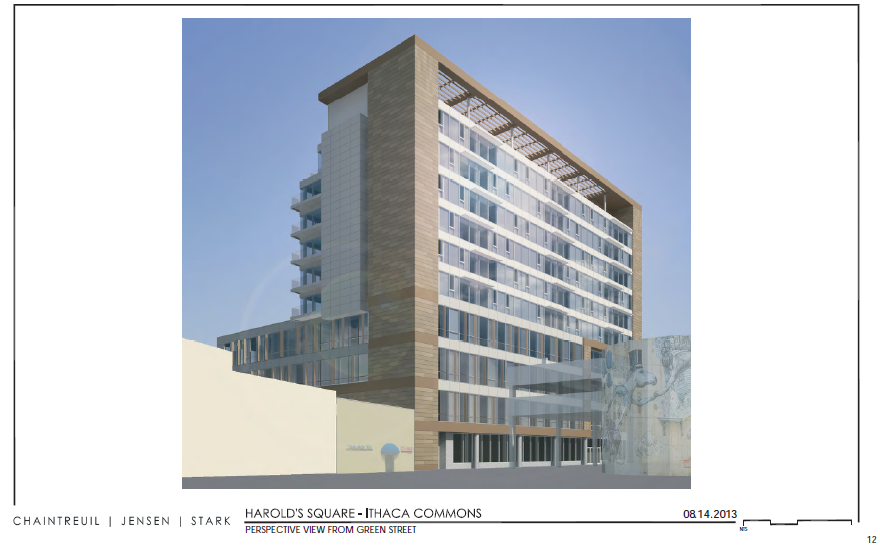
1. Leading off this week with a note of optimism – David Lubin, the developer of the proposed Harold’s Square mixed-used building in downtown Ithaca, says that plans for the 11-story building are still underway, according to a comment he made to the Ithaca Journal. Lubin says he’s currently in the process of lining up investors to finance the construction of the project, a challenging process once one tells investors that the project is in upstate New York. It’s not impossible to have a private project financed in Ithaca (if the Marriott underway down the street is any indication), but for a project costing $38 million, it’s no surprise that it’s taking a while. It’s easy to think that this one has slipped into the dustbin, but fortunately it has not.

Meanwhile, Ithaca Builds woke from its winter slumber to give an update regarding Lubin’s other big project, the Chain Works District for the old Emerson site on South Hill. Currently, the Chain Works District is in the process of writing up its Draft Generic Environmental Impact Statement (DGEIS). A DGEIS is part of the State Envrionmental Quality Review (SEQR), where the leading agency looks at a project, determines if any adverse project impacts are properly mitigated, and if so, issues a statement giving a negative declaration (approval). In this case, the NYS DEC also needs to be on board, approving the contaminated site for residential use. This is a pretty complicated project. There’s 800,000 sq ft of space to be removed or re-purposed, in an environmentally compromised site split between two political entities who are conducting joint meetings with their planning boards in an effort to try and move this project forward (the town of Ithaca board deferred to the city of Ithaca for lead agency; and both have rezoned the site to their respective specialized mixed-use zones). According to IB, the Phase I and Phase II Environmental Site Assessments (ESAs) contain about 60,000 pages of paperwork. The official timeline (already behind schedule, according to city docs) hopes to have the DGEIS submitted shortly, with a declaration of significance sometime in the Spring. In theory, Phase I site prep could start this year, but who knows if that will happen in practice.

franklin_libe_0414 travhyde_libe_0414 roccorner_libe_0414 dpi_libe_0414

2. The ILPC (Ithaca Landmarks Preservation Council) had a chance to review the four proposals for the Old Library site. Perhaps no surprise, the favored proposal was the Franklin/O’Shae proposal at top, which keeps the 1960s library and its “intrinsic historic value”. Members did, however, express some concern with the current building’s environmental contamination (asbestos). As for the other proposals, council members generally liked the Travis Hyde plan, and felt the Cornerstone and DPI projects were insensitive to the site (although one member expressed appreciation that at least the Cornerstone plan had affordable housing). It sounds like there will be some major tweaks to the building renders in the full proposals due later this month, so it’ll be best to hold off on judgment until those revised plans are published.
100_3080

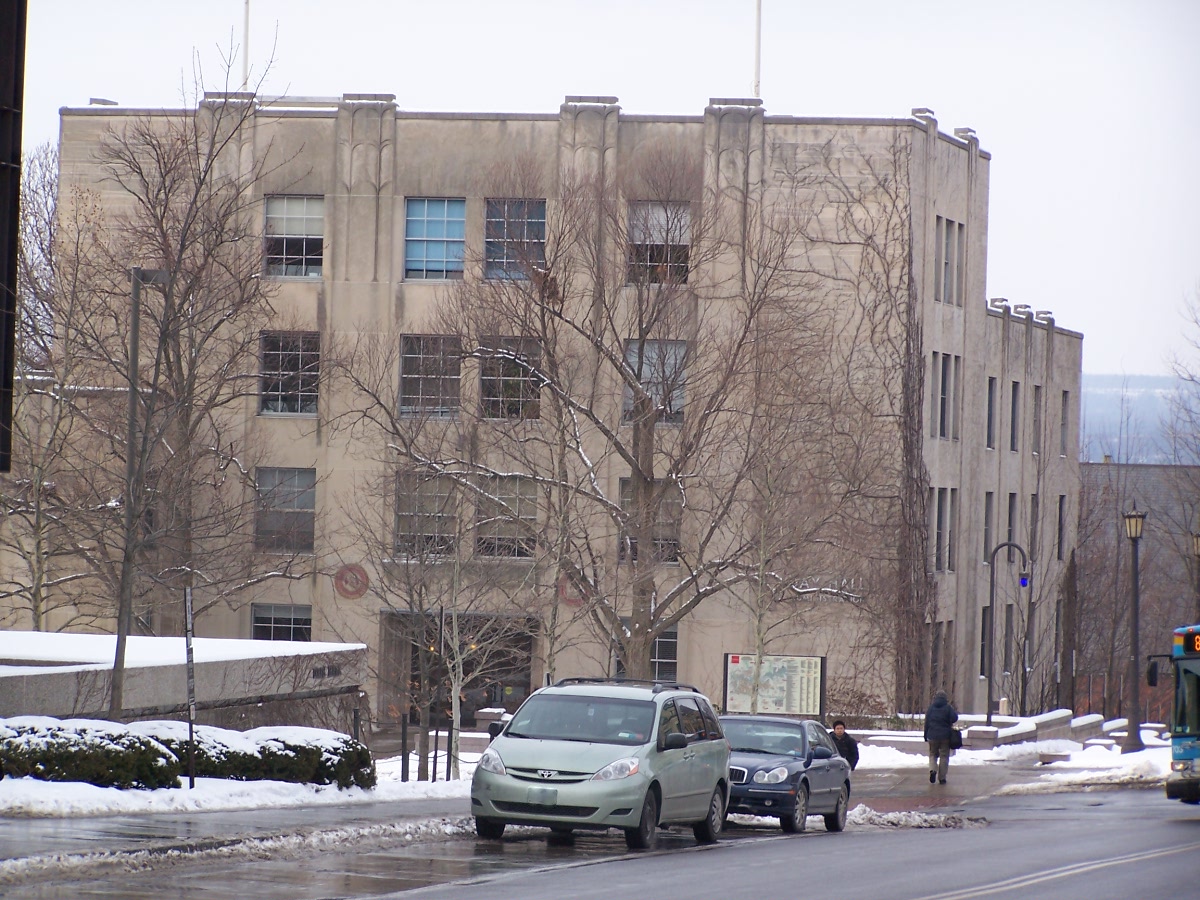
3. Now for some bad news- Cornell is running into major financial problems, to the tune of a $55 million deficit. About half of that, $27.5 million, is expected to be reconciled with budget cuts (the other half will be covered by tuition increases). Considering the very large role Cornell plays in the local economy, this could have a chilling effect on local businesses that depend on Cornell or its employees. There are shades of 2009 here, when a projected $150 million deficit over 5 years resulted in 432 voluntary retirements, and hundreds of jobs lost.  The cut from 2008 to 2009 was a 5% reduction for the 2009-10 fiscal year, while the cut to go into effect for 2015-16 is estimated at 2-2.3%. Quoting an interview the Sun did with Skorton:

“[In the 2008 financial crisis,] We froze everybody’s salary for a year, paused construction, slowed down on hiring, developed a voluntary staff retirement incentive and 8 percent of the staff force was reduced … and [we had] a couple hundred layoffs, which is very, very hard to do,” Skorton said. “So that’s how the University acted in the worst crisis that ever happened. And so that’s a predictor of how it’s going to happen in this case.”

An article in the Sun a couple of days later notes that faculty employment is at an all time high. With 1,652 faculty in Fall 2014, Cornell has now passed 2007’s 1,647. – but one observant commenter, who I will happily buy a drink if I ever meet in person, notes that Cornell’s total enrollment is up 2,050 students since 2007. Devil’s in the details, folks – Cornell could use this “all-time high” as an excuse to not hire more faculty during its latest financial crisis, even though the student-faculty ratio have been increasing for years. Let’s not forget that faculty-student ratios are a crucial part of college rankings.

All of this is rather disconcerting news, especially in a time where the national economy has been picking up. Cornell has real potential to not only cause a localized recession, but also fall behind its peer institutions.

4. On a somewhat brighter note, even with this appalling winter, the construction of Klarman Hall is only nine days behind schedule, according to the Sun. Atrium glass installation should begin in April, and East Avenue will be reopened to two-way traffic around that same time. Although this project is well underway towards a December 2015 completion, one has a right to wonder if it is wise for Cornell to pursue the Gannett expansion and Upson renovation (valued at over $100 million combined) during these perilous financial times.

village_solars_3

village_solars_2

5. The town of Lansing’s planning board is set to review some slight changes to the massive Village Solars apartment project at its Tuesday meeting.

First, a quick primer – while the whole plan is for about 300 units, the approved phases account for only 174 units, and are being built in phases. The photo updates I’ve previously featured here on the blog show the first phase underway, buildings “A”, “B” and “C” on the right (south), with 36 units total. There are four phases, with two sub-phases in phase 2. Phase 2 consists of D, E, G and H with their 41 approved apartment units, and phase 2A is building F, which has the community center as well as 10 more units.

The revised plan calls for moving 6 units from buildings G and H to building M, which is in phase 4. G and H are combined into one apartment building (G/H), leaving 35 units in Phase 2. There are a couple reasons cited for this change – when working with NYSEG to lay out the utilities, it was decided to make phase 2 all electric services, due to concerns that Lansing may not be able to provide gas service if the tense situation with the gas pipeline proposal on West Dryden Road doesn’t go in the town’s favor. One of the results of the utility infrastructure change was a difference in utilities layout, and it was deemed prudent to shirt the walkway northward. This impacted the site design, which is why the Lucentes are seeking to revise the PDA (planned development area, similar to the city’s PUD and the town’s PDZ).

The change isn’t huge, and isn’t likely cause too much consternation among board members. This is actually the first site plan I’ve seen for the project, since it was approved before the town uploaded supplemental docs to its webpage. More importantly, it’s much clearer how future phases could build out – if the ~300-unit project takes 8-10 years as projected, then estimating the construction of phase 2 and 2A from summer 2015-16 seems reasonable.

simeons_1

6. Planning board members had mixed reviews about the Simeon’s rebuild, according to the Ithaca Times. While some members were excited about the rebuild, others expressed concern with the proposed addition of a second-floor balcony, seen in the above render by architect Jason Demarest. The project is eligible for state tax credits designed to renovate historic buildings, but if the credits are granted, then the balcony would not be built. If the credits are not granted, the building owners are looking not only at a balcony, but the possibility of widening the bay windows a little (it turns out the bay windows were an early renovation to the original Griffin Building, and larger bay windows would benefit a planned expansion of Simeon’s to the second floor). Regardless, cast-iron ornamentation that was salvaged before demolition will be incorporated into the rebuild.

During the same meeting, the planning board accepted revised signage for the Marriott, and there was further discussion about the Canopy Hilton. Nearby residents expressed concerns that a downtown hotel will increase traffic, and complaints were made about the ingress/egress plan for both the hotel and the CSMA next door. No word on the land swap CSMA wants, but it doesn’t seem like they’re budging on their property’s all-important utility easement quite yet.


Village Solars Apartments Construction Update, 2/2015

11 02 2015

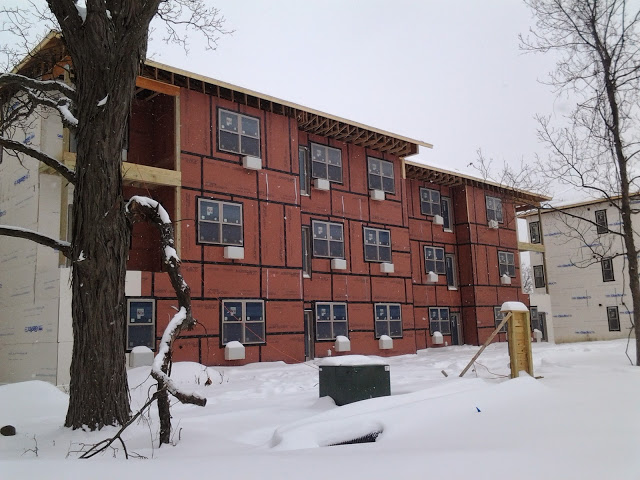
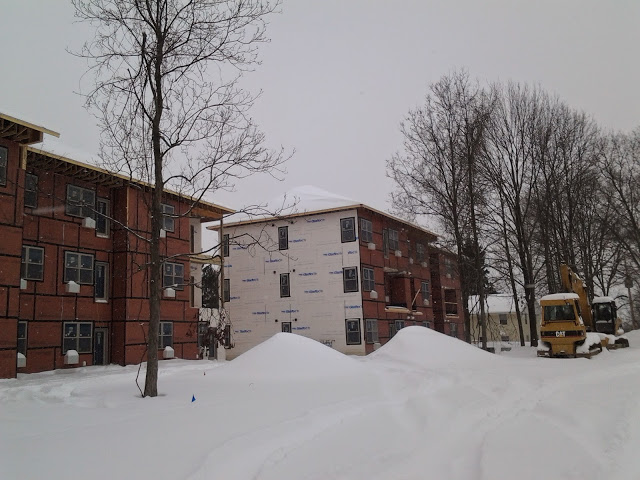
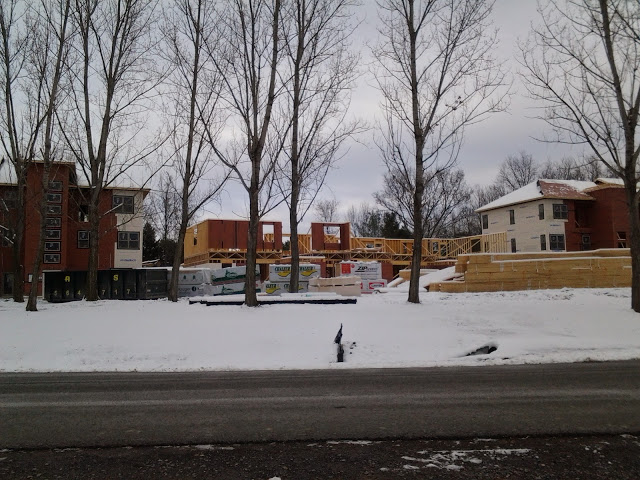
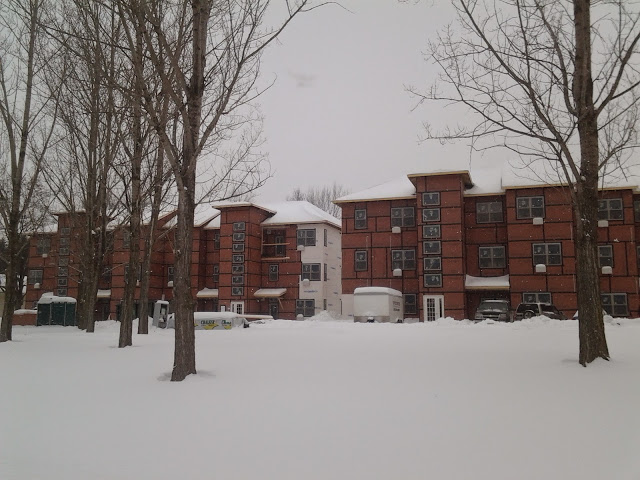
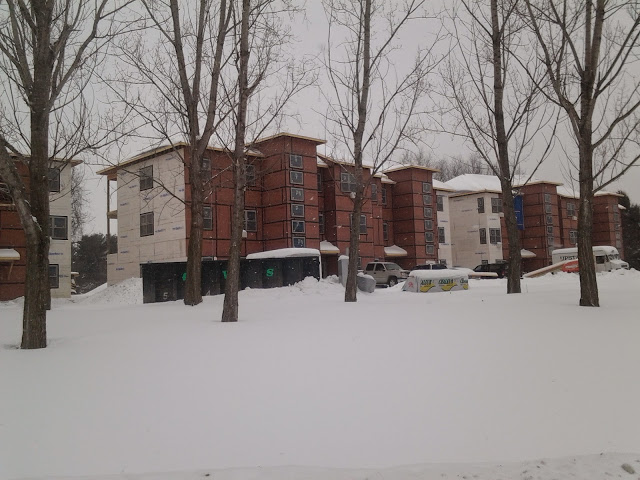
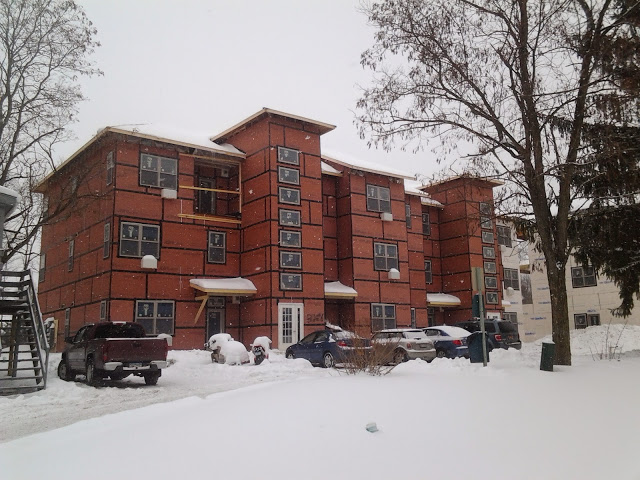
The first three apartment buildings of the Village Solars apartment project in Lansing are fully framed, sheathed (I’m assuming the red panels are sheathing material), roofed, and windows and doors have been installed in most locations. The light-colored material might be a breathable wrap for weather/moisture resistance. It will be a little while before exterior finishes are applied and balconies are installed. When I visited last Saturday, the site was buzzing with the sounds of construction workers busy with tasks inside (probably rough-ins for things like plumbing and electrical), and ’80s hair metal streaming from a radio somewhere from within. Nothing like installing pipes while rocking out to Twisted Sister.

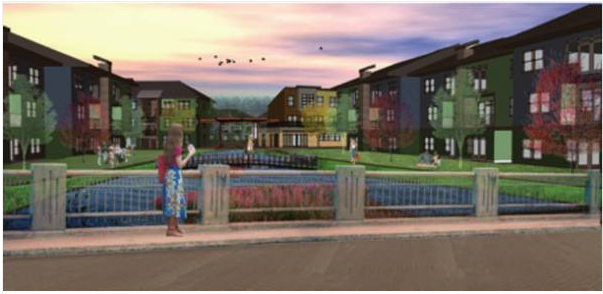
The Village Solars get their name from what the craigslist sales pitch calls “their passive solar design and energy saving features”. As far as I’m aware, they won’t have solar panels. According to Thomas Bobnick, the rental agent for the apartments, the first phase shown here will consist of 36 units (the final buildout will be close to 300 units). The design of the complex calls for at least eight, maybe ten buildings to surround a new pond that will be dug out of the undeveloped middle of the property – the advertisements call it “waterfront”, which it is, technically.

From the craigslist advertisements, one-bedroom units will rent for $1050-$1145 and be ready for occupancy by June 1st, two-bedroom units will rent for $1235-$1369 and be ready for tenants on May 1st, and three-bedroom units will rent for $1565-$1600 and be available on June 1st. These dates are pushed back a little from initial plans, which called for March and April occupancy; no doubt the severe winter has complicated the schedule. Looking at the photos, the two buildings under construction on the west and east ends look to be one style (balconies in the middle), while the center building is a different layout and design (end balconies). The price range for the two bedrooms is a little above the average two-bedroom unit in Ithaca ($1,165), but after accounting for the premium on new construction, the developer seems to be pricing for the middle tier of the market.

The Village Solars are being developed by local company Lifestyle Properties. Lifestyle is run by Steve Lucente of the Lucente family, who have been major builder/developers in Ithaca since the 1950s. No one word on the architect. Upstate Contractors of Syracuse appears to be handling the construction work.

20150207_131607 20150207_131610 20150207_131613 20150207_131646 20150207_131715 20150207_132225 20150207_132231 20150207_132320 20150207_132335 20150207_132338

village_solars


News Tidbits 12/20/2014: Many Homes, One Community

20 12 2014

5-8-2012 347

1. Starting things off, here’s an update on Ithaca College’s Master Plan-in-progress, courtesy of the Ithacan. According to a presentation given by representatives of lead planning firm Perkins Eastman, the master plan will include a climate-controlled walkway connecting several buildings from the Gannett Library through the Center for Health Sciences, the removal of the upper and lower dorm quads and replacing them with academic lab/research space, an amphitheater just below the Dillingham Center fountain and a new entrance on Danby Road closer to Ithaca’s downtown.

Now, before residents in South Hill begin to panic that their neighborhood is about to be invaded by students displaced by IC’s decreased housing, I’d like to point out that master plans are rarely built out as designed, but are great for identifying academic needs. I don’t imagine that IC will start tearing down 11 buildings and 1,235 beds unless they really feel like getting into a fight with the town, or throwing up temp housing, neither of which ranks high on the to-do list. At least I get something to write about for a week or two when the new plan comes out this Spring.

2. What is known about Manos Diner’s future occupant: They’re leasing the space from Bill Manos, not buying. It’s a restaurant with owners who already own several restaurants, all outside NYS. It’s not necessarily a chain. It’s apparently a family operation and the food will be Mexican. And whoever it is must have really, really wanted to pry their way into the Ithaca market. I don’t see why they wouldn’t have chosen any number of other sites they could renovate…it seems really strange that an offer so fortuitous would come up that Manos would close his diner with hardly a notice to his employees (which is completely tasteless, for the record). New restaurants in Ithaca aren’t usually big news-makers by themselves, but the entry of this Manos replacement draws more questions than answers.

amabel_rev1_1

amabel_rev1_2

3. Looks like New Earth Living LLC has released some updated site plans and sketches of their approved Amabel project just southwest of the Ithaca city-town line. The houses on the northern two-thirds have been rearranged from the previous site plan, and if it’s still 31 units, then the center buildings must be two-family houses. I’ve been told that there will be six different house designs available, so don’t expect all the houses to look the same as in the concept sketch. One thing that the all designs will share are roof configurations that will allow enough solar panels to result in net zero energy use for each home. The city has approved the sale of its surplus land to the developer, and this project is due to start marketing in summer 2015.

http://public.tableausoftware.com/shared/XKG7RHY5H?:toolbar=no&:display_count=yes

4. Here’s a map, courtesy of real estate website Zillow, that prices out how much it would take to afford the median rent in a given metropolitan area, if paying no more than 30% of monthly income to rent (the federal affordable housing standard). Ithaca/Tompkins County comes in at $32.74 an hour, assuming a 40-hour week and 50-weeks working in a year. In other words, $65,480 ($1,637/month average rent). The number is skewed high from the number of expensive multi-bedroom units in Collegetown, but it’s still high when compared to Elmira ($28.08) or Syracuse ($27.74). For comparison’s sake to Ithaca-type communities, Boulder ($41.72) and Ann Arbor ($34.28) are higher, Charlottesville ($29.24), Madison ($27.54) and Asheville ($22.98) are lower.

village_solars

20141129_125556

5. Would you believe this is actually the first render I’ve ever seen for the Village Solars project in Lansing? This comes courtesy of their Craigslist ads. The Village Solars take their name from being designed with passive solar design with large amounts of natural light; I don’t know if they will have solar panels. For being a large project, this one has sailed under just about everyone’s radar, partially because it was approved 18 months before construction started. Since there has been so little news about this project, info comes in the form of government and business memos. Depending on the source, final build-out is between 292 and 320 units, which is enormous for the Ithaca area.

Rent’s not cheap with these new units – the minimum is $1235 for a first-floor 2-bedroom, going up to $1369 for a “penthouse” third floor 2-bedroom unit. The Craigslist ad says the first units (36 of them) will be ready for occupancy by March 1st 2015.

402_s_cayuga_st_rev2_1 402_s_cayuga_st_rev2_2

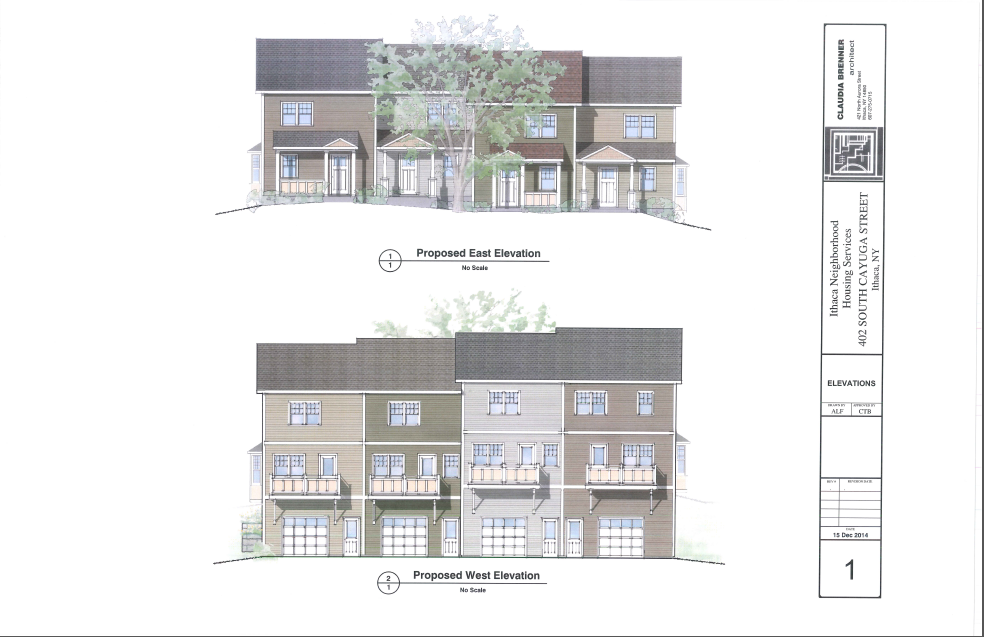
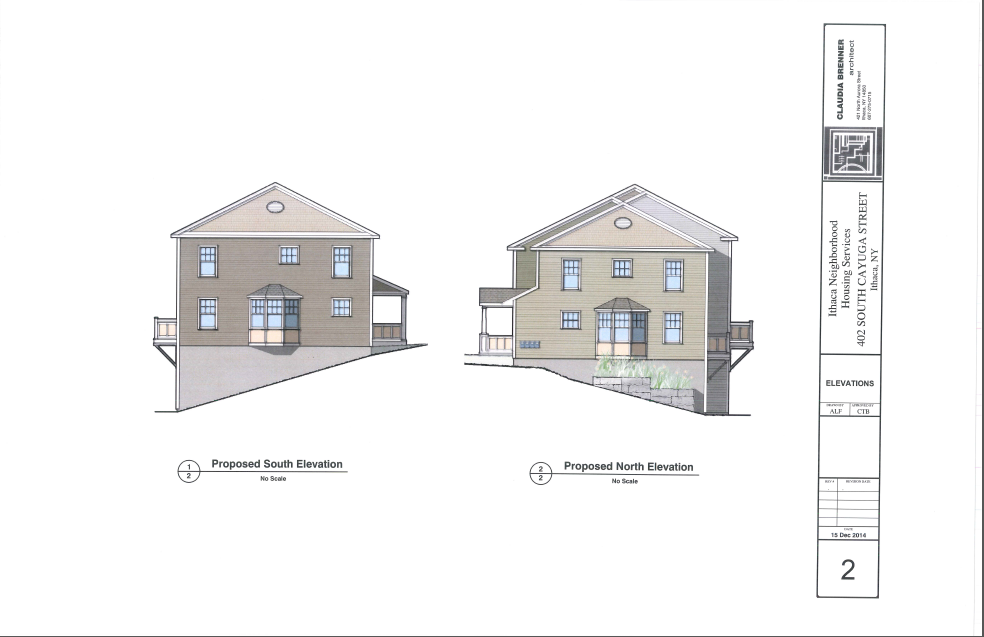
6. Updated doc and drawings for INHS’s 402 South Cayuga Street have been filed with the city. Application, FEAF and project description here, drawings here. According to the docs, the cost of construction will be $740,000 for the four units, and go from Spring 2015 to Spring 2016 (March 2016 in the FEAF). Some slight metal pollution from Emerson/Morse Chain has been noted in soil tests from below the foundation area, due to the Morse Chain subterranean pollution plume (metals, VOCs) that affects much of South Hill. Although the DEC requires no further action at this time, there will be an active sub-slab depressurization system in place as a safeguard. In other words, a fan blows air into the basement, and it gets vented back out.

The design of the townhomes has been revised by architect Claudia Brenner to include more architectural detail – bay windows on the north and south ends, and larger/full porches vs. the stoops of the previous design. The siding has also been changed to all earth-tones. It’s an improvement, but I’d rather see two separate windows above the porches. This project will be presented at the January Planning Board meeting.

707_E_Seneca_1

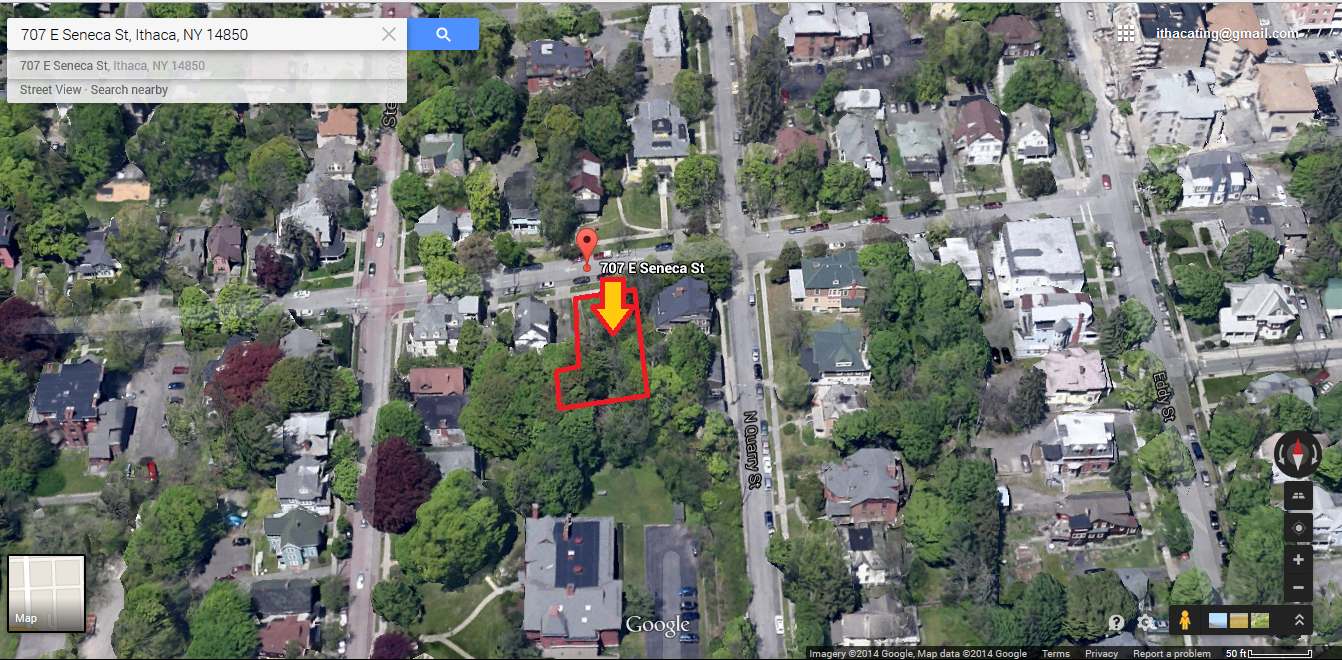
7. Here are some drawings for 707 E. Seneca. Readers might remember this is the 6-unit building proposed by Todd Fox for a derelict playground recently sold off by the city. The 18-bedroom design by local firm Schickel Architecture has already been critiqued thoroughly by the Ithaca Landmarks Preservation Council, since the site is within a historic district and needs to look the part. I’d say that they’ve done well, it’s a bit bulky but otherwise a tasteful addition. An area variance will be required from the Board of Zoning Appeals. Construction is expected to cost $220,000 and run from April to July 2015. For more info, the application is here, drawings here.

112_blair_1 112_blair_2

8. Since we’re talking about East Hill housing, here‘s the project application and here are the drawings for the duplexes proposed for the parking lot at 112 Blair Street. The Blair Street site will be combined with 804 East State Street, and the duplexes will have State Street addresses. The spartan design of these buildings is also by Schickel Architecture, and will add 12 bedrooms in 4 units. Cost is estimated at $213,000 and construction will start in April for a summer completion. The developer is Matthew Nestopoulos.