News Tidbits 1/10/15: Where Will All the Students Go?

10 01 2015

student_housing_table

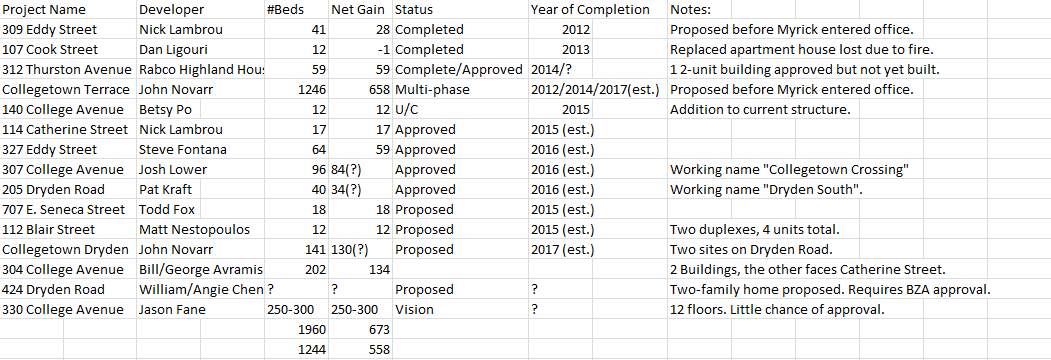
1. I’ll lead off with this supplement to the Voice opinion article I wrote. Here’s the work sheet I used for the bedroom tally for student-centric housing. I chose to leave it out of the submitted article because 95% of readers checking the Voice would find it obscure or just wouldn’t be interested. If you’re coming here, then you’re probably in the other 5%. Question marks are present because the county’s online records provide total number of units in mixed-use buildings, but not bedrooms (yet residential-only structures have bedroom numbers, go figure). Anyway, there is the off-chance that enough new projects will be proposed in the next 12-18 months that we could still meet the projected need by 2018, since it’s about 500 rooms short at the moment…but I’m not optimistic. There are few large sites left in Collegetown, and even fewer sites in other adjacent neighborhoods. If Fane comes back down to Earth with a project that fits zoning for 330 College Avenue, and Travis Hyde’s Ithaca Gun apartment project ends up being student-centric, then perhaps there will be another 200 or 250 bedrooms to the total. The rest of the balance will need to come from small or medium-sized projects. Anyway, that’s all speculation. We’ll just have to wait and see what happens.

I wasn’t being totally facetious with the suggestion of Cornell building more dorms though. A few hundred rooms could take some of the edge of the housing problem, and it’s less Cornell has to pay out in rent stipends to financial aid recipients. But even if Cornell was mulling it over, it would take years to go through planning and construction.

tech2

2. If this were in Ithaca, I’d have splurged pages of writing over it. But it’s not. Construction permits have been filed for Cornell’s second academic building at its new tech campus on Roosevelt Island in NYC – a 189,000 sq ft structure designed by some of Cornell’s favorite alumni architects, NYC firm Weiss/Manfredi. They’re the same ones who are handling the Vet School renovation, and who designed the Sesquicentennial Commemorative Grove that opened last fall. The building is the one on the right in the above image, the one that looks like an ice cube breaking apart. Building number one, the design in the left foreground, is already underway.

For the record, I’m still not a fan of the tech campus.

3. The Ithaca Times has done an interview with Bill Manos that’s worth a read. It has your standard anti-regulation rant (the same one you get from your retired Fox News-watching uncle), and he calls the sale an “opportunity from Heaven” that he didn’t see coming. He says the sudden closure was so the new lessees could renovate the diner and have their new restaurant (called “Old Mexico“) ready for the Spring. I don’t think that exonerates the “bad manners” of giving his employees only eight days’ notice, but hopefully they’ve all been able to move on like he claims in he interview.

707_E_Seneca_2

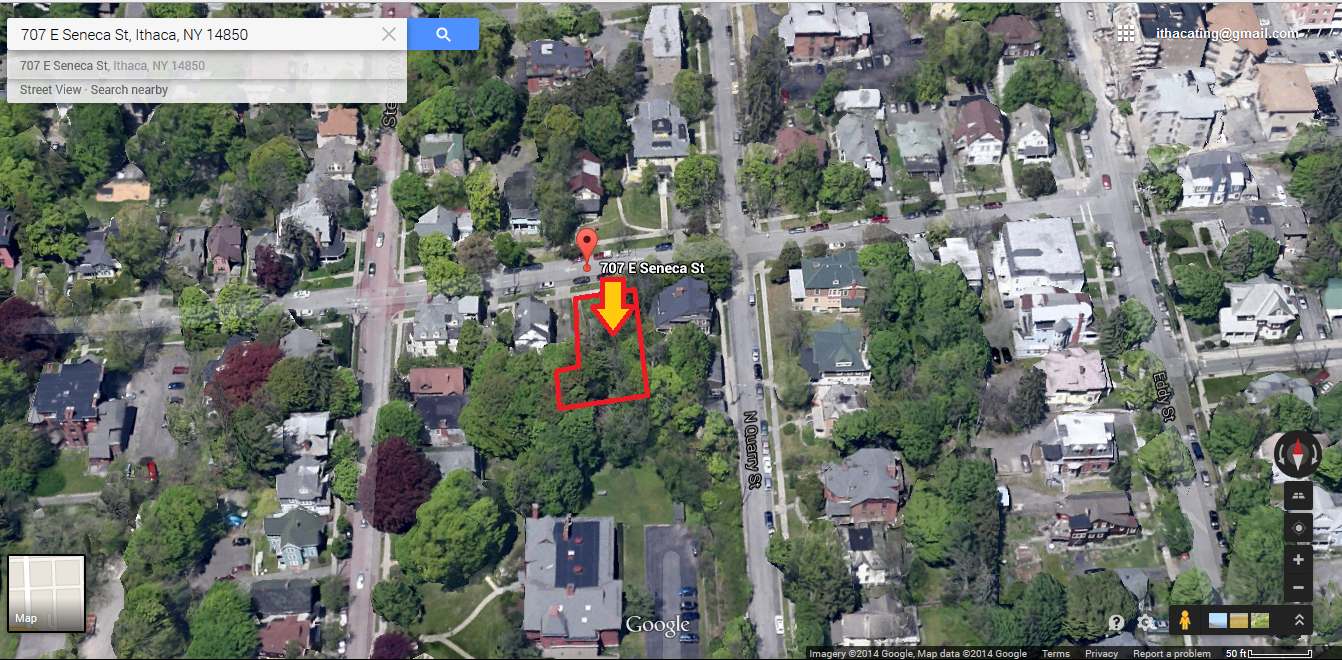
4. Looks like the 6-unit, 18-bedroom project for 707 E. Seneca has seen some slight revisions as it goes to the ILPC (Ithaca Landmarks Preservation Council) for further review (agenda here). About the only notable change I can find from the previous render is in the spacing of the dormer windows. Although the lot is undeveloped, it’s in a historic district, hence the extra step of ILPC approval. A lot of the major details have already been hashed out, so I imagine the council will only have minor suggestions, but we’ll see what happens. The ILPC is also set to review the Old Library proposals, and given their exacting approach, my inner cynic tells me it will be less about which project they like the most, but rather which one they dislike the least.

804Estate_112blair_rev1_1 804Estate_112blair_rev1_2

5. On another note, the two duplexes proposed for 804 E. State Street (formerly 112 Blair) has been upped to three. Details and drawings here. All are two units each with three bedrooms in each unit, so 18 total. They also look about as utilitarian as one can get away with; the easternmost house (building “D”) has a chamfered corner, and that’s about the only interesting architectural detail I see. Parking will now be shoehorned into the basement level  of all three buildings (12 spaces total; it’s a hilly site). The construction cost has been upped to about $600,000, but the construction timeframe of late Spring/summer 2015 is still the same. Although the lot is being cobbled together from slices of adjoining properties, it will still require an area variance from the zoning board because of how close the houses are to each other. Looking on the bright side, this development will replace a parking lot and works as appropriate infill for lower Collegetown.
20141227_144707

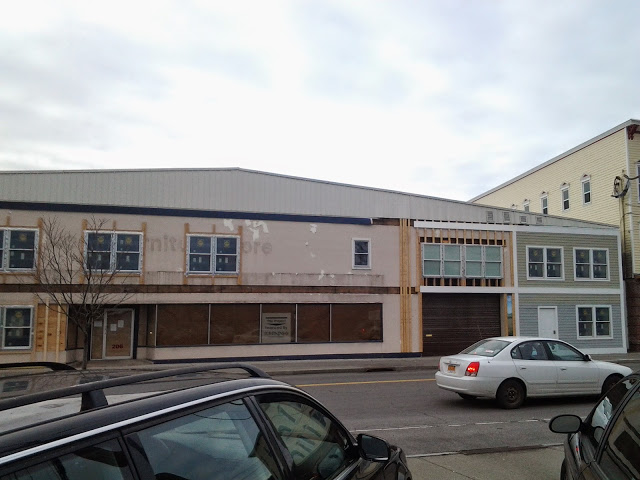
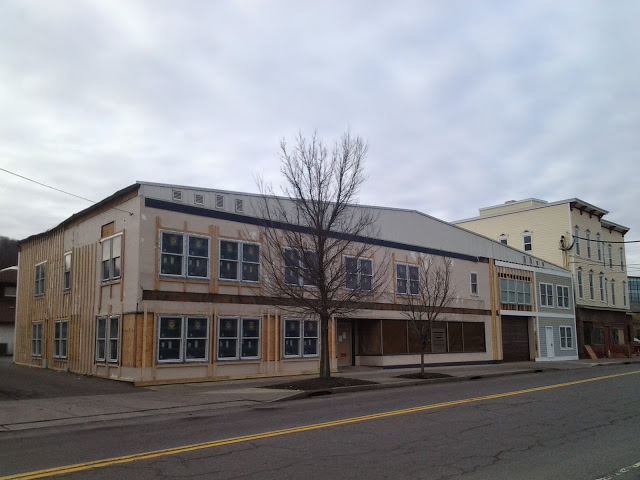
6. I finally received an email response from the Zaharises regarding what’s underway at their old furniture store at 206 Taughannock Boulevard. Unfortunately, it’s not very descriptive:

We’re renovating the building into apartments. It looks quite different doesn’t it?!

Yes. Yes it does.


More Student Housing for South Hill?

31 12 2014

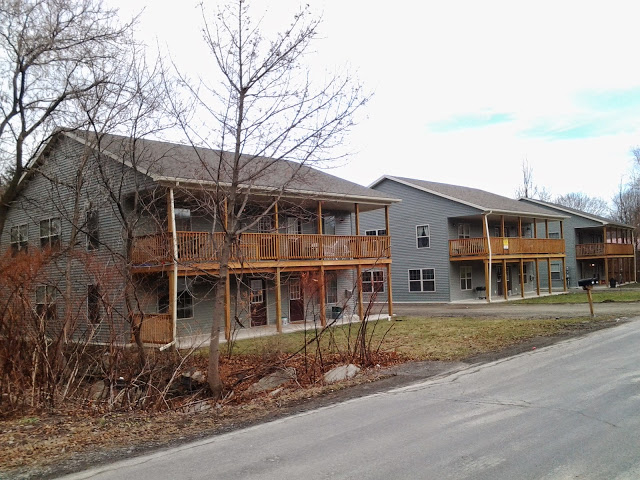
Polite observation – South Hill has two types of housing being built these days: luxury single-family housing (Westview, Southwoods), and student housing. Most of the student housing tends to be concentrated close to Ithaca College, in the vicinity of Pennsylvania and Kendall Avenues. There have been a number of new, small apartment buildings built in recent years, many of them by local company Heritage Builders. I’d estimate offhand that in the past three years, Heritage has added about 60 bedrooms to the neighborhood, and while they aren’t explicitly student housing, I don’t think it’s a stretch to say that’s their purpose.
20141227_134402 20141227_134549 20141227_135531 20141227_135604

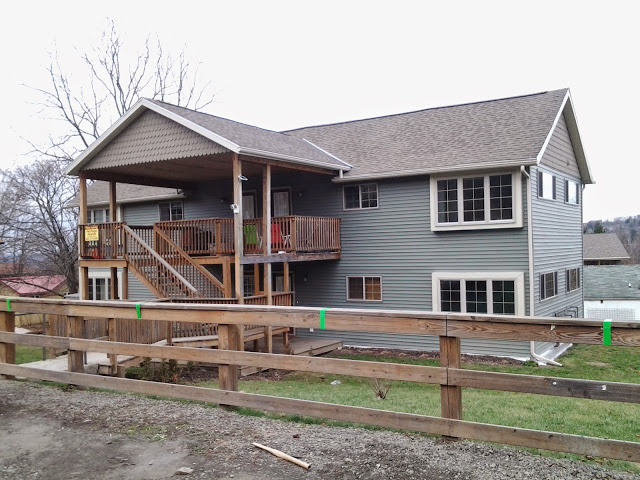
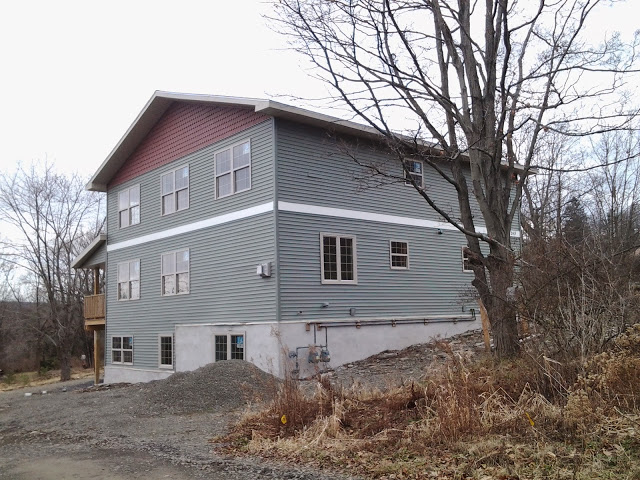
I initially photographed these buildings as part of another post planned for some construction updated for South Hill. But then I noticed something earlier this week that changed my mind.

pennsylvania_ave_1

According to the county records for the 29th, someone bought an unusually high number of building lots. All but 2 of the 9 tax parcels (totaling 14 lots) are undeveloped, the remainder being a house and swimming pool. All of the sales were registered to an entity called “Kendall Avenue Corporation”. Kendall Avenue Corporation was created in November, according to the Ithaca Journal, with a registered address at 680 Ridge Road in Lansing – an address used by Heritage Builders. The undeveloped lots sold for $5,000-$9,000 each because they’re small and lack road access. But lots can be consolidated per zoning board approval, and new roads can be built by a developer and deeded to the town, which the town board typically accepts so long as they meet certain requirements.

I’m going to take a stab at this and say that Heritage is planning a lot more student housing over the next few years, at least enough to fill several small apartment buildings. Given previous complaints, I don’t think the permanent residents of South Hill will be pleased about the new neighbors.


206 Taughannock Boulevard Construction Update, 12/2014

30 12 2014

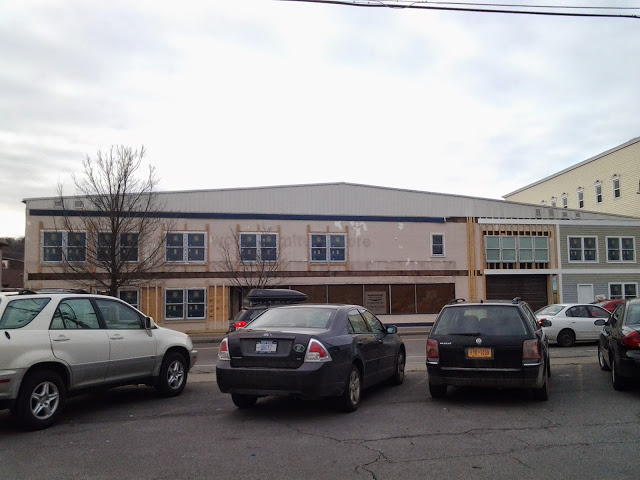
Okay, I’ll be completely honest – I don’t know what’s going in here. I don’t know what the mix of uses is, or many residential units there are. Here’s what I do know.

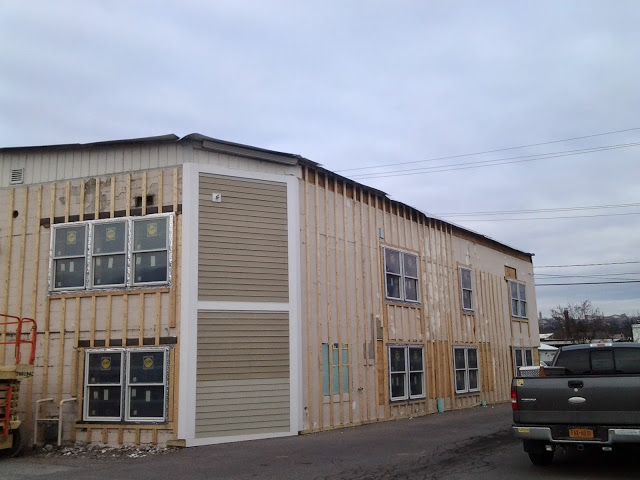
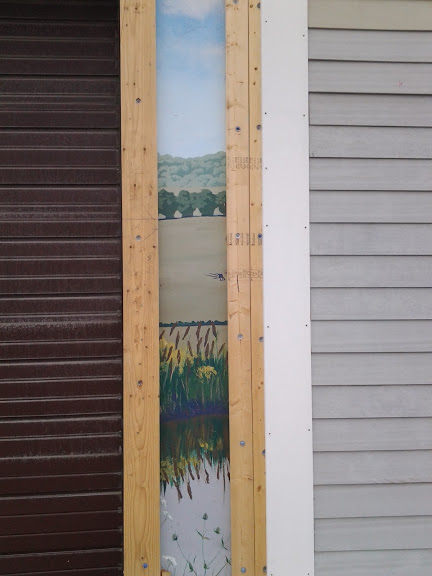
206 Taughannock was until earlier this year the site of the Unfinished Furniture Store (otherwise called the “Real Wood Furniture Store“) owned and operated by the Zaharis family. From the county records, the building itself is a 9,156 sq ft structure originally used for retail and warehouse space and dated to sometime in the 1970s. The store closed in April when its owners retired, and a building permit shown in a ground-floor window was issued in July to the Zaharises. I ran this past IB’s Jason on Twitter, and his guess was about as good as mine; residential units on top and maybe some of the bottom, with a reduced retail space. Photos of the store before renovation can be seen here at Ithaca Builds – the Lehigh Valley House next door is being renovated by its owner (Tim Ciaschi) into 6 condos and ground-floor commercial space. With the 323 Taughannock project approved just up the road, Inlet Island has been seeing increased interest from both current owners and prospective developers. Perhaps the biggest loss is the removal of a rather attractive mural from the front of the structure.

The work itself looks like a complete gutting of the original two-story building, with new windows punched into the walls and sedate exterior (fiber cement?) siding attached to the more complete exterior sections.

I reached out to the owners but have yet to hear a reply; if anyone has some info to share, feel free to reply to this post or send an email. These projects are the most fun for me, because they go without fanfare, but are just as important as any other project of equal size; they lie in wait for discovery and publication.

20141227_144617 20141227_144631 20141227_144707 20141227_144748 20141227_144755 20141227_144900


EcoVillage Construction Update, 12/2014

29 12 2014

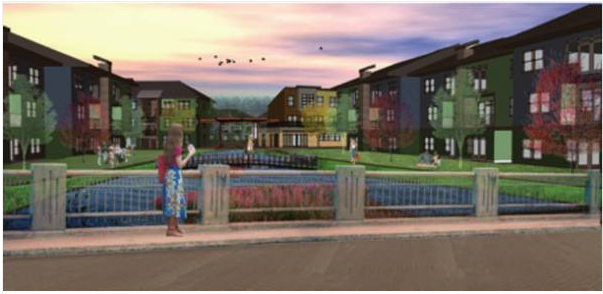
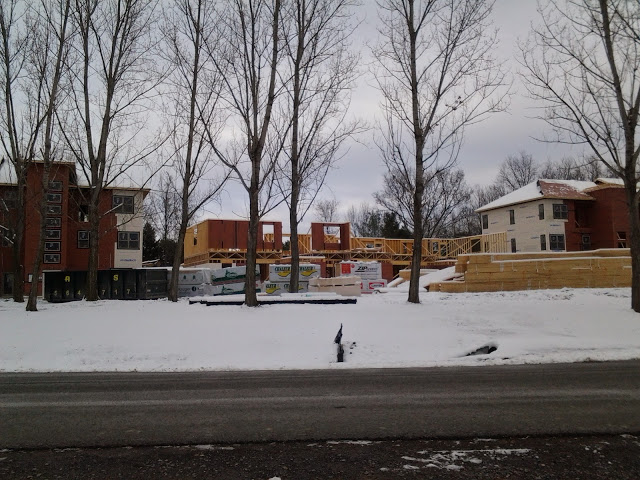
Heading over to West Hill, construction continues slowly but steadily on EcoVillage’s 4-story Common House/apartment building as part of its third neighborhood, TREE (Third Residential Ecovillage Experience, following its first two, FROG and SONG).  I can’t seem to find any specific values for the number of bedrooms in the apartment building, but there are 15 units ranging from studios to 3-bedrooms. However, using a little math and deduction, a rough estimate can be established. EcoVillage claims 160 residents in its first two neighborhoods, which have 30 units each (total 60), and they expect 240 residents when the 40-unit TREE neighborhood is complete. That gives 80 residents in 40 units, of which 25 of those units are houses. Houses tend to have more occupants than apartments (2.1/house vs. 1.7/apartment from the 2010 county census), so I think 25-30 residents is a fair estimate for the apartment building.

Interior work is underway and all the windows and doors are fitted into place. Exterior finishes and balconies have yet to be installed. The houses are all complete and occupied. Construction is being handled by a local firm, AquaZephyr, which received an award from the U.S. Dept. of Energy for a “zero energy ready” home constructed as part of TREE. The apartment building is scheduled to be finished this spring. Setbacks stemming from building code requirements pushed it away from its original fall 2014 completion date.

20141227_150247 20141227_150051 20141227_150040 20141227_150002 20141227_145916 20141227_145843

treenh1


News Tidbits 12/20/2014: Many Homes, One Community

20 12 2014

5-8-2012 347

1. Starting things off, here’s an update on Ithaca College’s Master Plan-in-progress, courtesy of the Ithacan. According to a presentation given by representatives of lead planning firm Perkins Eastman, the master plan will include a climate-controlled walkway connecting several buildings from the Gannett Library through the Center for Health Sciences, the removal of the upper and lower dorm quads and replacing them with academic lab/research space, an amphitheater just below the Dillingham Center fountain and a new entrance on Danby Road closer to Ithaca’s downtown.

Now, before residents in South Hill begin to panic that their neighborhood is about to be invaded by students displaced by IC’s decreased housing, I’d like to point out that master plans are rarely built out as designed, but are great for identifying academic needs. I don’t imagine that IC will start tearing down 11 buildings and 1,235 beds unless they really feel like getting into a fight with the town, or throwing up temp housing, neither of which ranks high on the to-do list. At least I get something to write about for a week or two when the new plan comes out this Spring.

2. What is known about Manos Diner’s future occupant: They’re leasing the space from Bill Manos, not buying. It’s a restaurant with owners who already own several restaurants, all outside NYS. It’s not necessarily a chain. It’s apparently a family operation and the food will be Mexican. And whoever it is must have really, really wanted to pry their way into the Ithaca market. I don’t see why they wouldn’t have chosen any number of other sites they could renovate…it seems really strange that an offer so fortuitous would come up that Manos would close his diner with hardly a notice to his employees (which is completely tasteless, for the record). New restaurants in Ithaca aren’t usually big news-makers by themselves, but the entry of this Manos replacement draws more questions than answers.

amabel_rev1_1

amabel_rev1_2

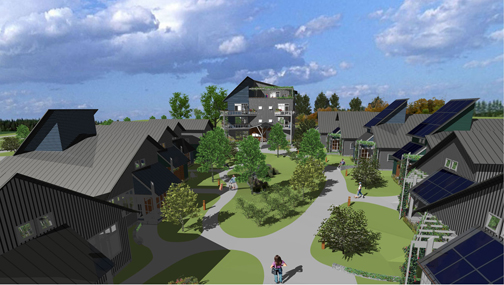
3. Looks like New Earth Living LLC has released some updated site plans and sketches of their approved Amabel project just southwest of the Ithaca city-town line. The houses on the northern two-thirds have been rearranged from the previous site plan, and if it’s still 31 units, then the center buildings must be two-family houses. I’ve been told that there will be six different house designs available, so don’t expect all the houses to look the same as in the concept sketch. One thing that the all designs will share are roof configurations that will allow enough solar panels to result in net zero energy use for each home. The city has approved the sale of its surplus land to the developer, and this project is due to start marketing in summer 2015.

http://public.tableausoftware.com/shared/XKG7RHY5H?:toolbar=no&:display_count=yes

4. Here’s a map, courtesy of real estate website Zillow, that prices out how much it would take to afford the median rent in a given metropolitan area, if paying no more than 30% of monthly income to rent (the federal affordable housing standard). Ithaca/Tompkins County comes in at $32.74 an hour, assuming a 40-hour week and 50-weeks working in a year. In other words, $65,480 ($1,637/month average rent). The number is skewed high from the number of expensive multi-bedroom units in Collegetown, but it’s still high when compared to Elmira ($28.08) or Syracuse ($27.74). For comparison’s sake to Ithaca-type communities, Boulder ($41.72) and Ann Arbor ($34.28) are higher, Charlottesville ($29.24), Madison ($27.54) and Asheville ($22.98) are lower.

village_solars

20141129_125556

5. Would you believe this is actually the first render I’ve ever seen for the Village Solars project in Lansing? This comes courtesy of their Craigslist ads. The Village Solars take their name from being designed with passive solar design with large amounts of natural light; I don’t know if they will have solar panels. For being a large project, this one has sailed under just about everyone’s radar, partially because it was approved 18 months before construction started. Since there has been so little news about this project, info comes in the form of government and business memos. Depending on the source, final build-out is between 292 and 320 units, which is enormous for the Ithaca area.

Rent’s not cheap with these new units – the minimum is $1235 for a first-floor 2-bedroom, going up to $1369 for a “penthouse” third floor 2-bedroom unit. The Craigslist ad says the first units (36 of them) will be ready for occupancy by March 1st 2015.

402_s_cayuga_st_rev2_1 402_s_cayuga_st_rev2_2

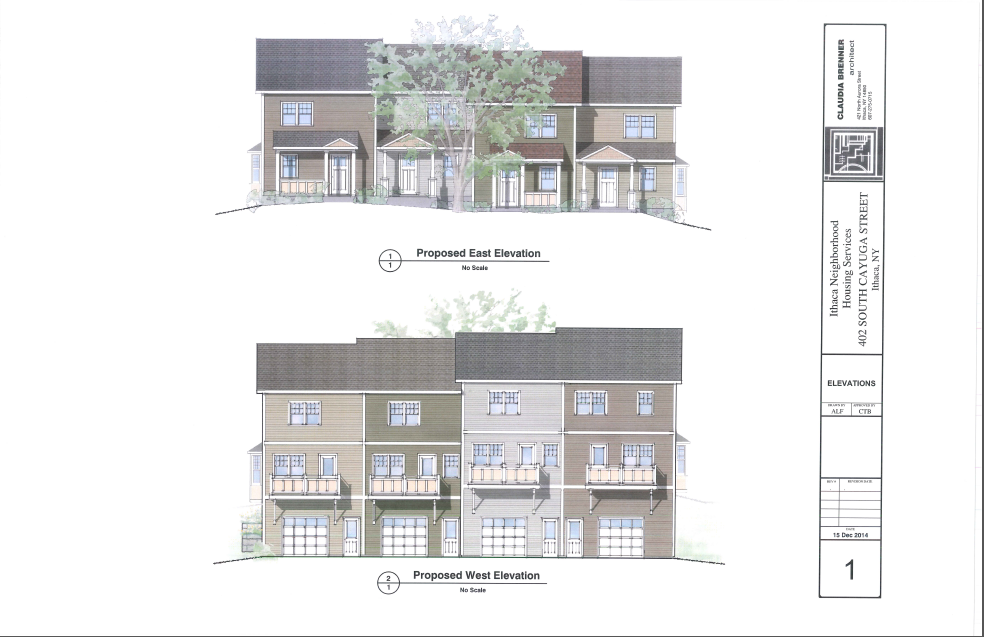
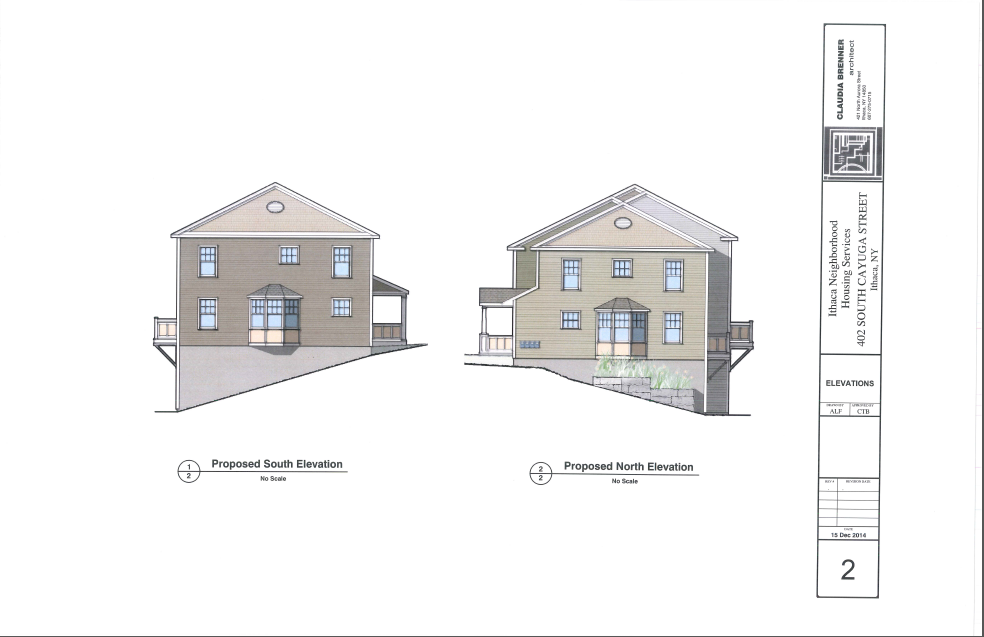
6. Updated doc and drawings for INHS’s 402 South Cayuga Street have been filed with the city. Application, FEAF and project description here, drawings here. According to the docs, the cost of construction will be $740,000 for the four units, and go from Spring 2015 to Spring 2016 (March 2016 in the FEAF). Some slight metal pollution from Emerson/Morse Chain has been noted in soil tests from below the foundation area, due to the Morse Chain subterranean pollution plume (metals, VOCs) that affects much of South Hill. Although the DEC requires no further action at this time, there will be an active sub-slab depressurization system in place as a safeguard. In other words, a fan blows air into the basement, and it gets vented back out.

The design of the townhomes has been revised by architect Claudia Brenner to include more architectural detail – bay windows on the north and south ends, and larger/full porches vs. the stoops of the previous design. The siding has also been changed to all earth-tones. It’s an improvement, but I’d rather see two separate windows above the porches. This project will be presented at the January Planning Board meeting.

707_E_Seneca_1

7. Here are some drawings for 707 E. Seneca. Readers might remember this is the 6-unit building proposed by Todd Fox for a derelict playground recently sold off by the city. The 18-bedroom design by local firm Schickel Architecture has already been critiqued thoroughly by the Ithaca Landmarks Preservation Council, since the site is within a historic district and needs to look the part. I’d say that they’ve done well, it’s a bit bulky but otherwise a tasteful addition. An area variance will be required from the Board of Zoning Appeals. Construction is expected to cost $220,000 and run from April to July 2015. For more info, the application is here, drawings here.

112_blair_1 112_blair_2

8. Since we’re talking about East Hill housing, here‘s the project application and here are the drawings for the duplexes proposed for the parking lot at 112 Blair Street. The Blair Street site will be combined with 804 East State Street, and the duplexes will have State Street addresses. The spartan design of these buildings is also by Schickel Architecture, and will add 12 bedrooms in 4 units. Cost is estimated at $213,000 and construction will start in April for a summer completion. The developer is Matthew Nestopoulos.


News Tidbits 12/13/14: ‘Tis the Season For Development Slowdown

13 12 2014

finger_lakes_reuse_ith_1

1. Leading off, the NYS Regional Economic Development Council Awards. In other words, the annual event where the state takes its economic aid money and an impartial committee is supposed to examine and decide who gets more or less money. It’s supposed to be competitive. I’d rather see the taxes not be collected in the first place.

Tompkins County gets placed in the “Southern Tier” category, which has been in the middle of the pack most years (as has its regional neighbor, “Finger Lakes”). Those two were 3rd and 4th this year out of 10, with a little over $80 million each. Most of it is going towards job training programs and studies/plans, but a few funded items stick out:

-$2.8 million for Cornell to expand its vet school classes by 30 students each (120 total). The goal is to “Expand Rural Veterinarians”.

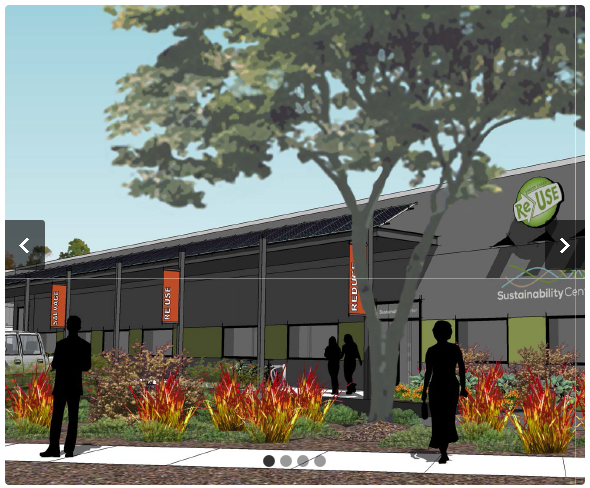
– $1.9 million for Finger Lakes ReUse to “construct two additional buildings”. I suspect one of those is the renovation of 214 Elmira Road for the new HQ (shown above).

– $250,000 for the Chain Works District to help pay for energy efficiency and feasibility studies for the project.

130eclinton_rev3

2. Am I happy about the decision with 130 E. Clinton? No. This has little to do with mixed-use or steep hillsides. I firmly believe that it became a popularity contest and a referendum of Fane’s character. My concern is that this risks becoming the norm, and has the potential to be a lawyer’s paradise. I also don’t look fondly on frequent and fervent opposition to development when housing costs are spiraling upward.

Opposite side of the coin, it couldn’t have happened to a more deserving person. Other contentious projects – Stone Quarry, the Marriott, Collegetown Terrace, Cayuga Green, just about every other project built in the past 20 years – squeak by at least in part because the developers don’t come across as combative, conniving assholes. Plus, Fane himself is quite wealthy, which doesn’t exactly help an argument for tax breaks.

Well, I’ll move this one into the “mothballed/dead” column. With this and the Maguire proposal hitting a dead end, this has not been a good couple weeks.

carey_rev4_2

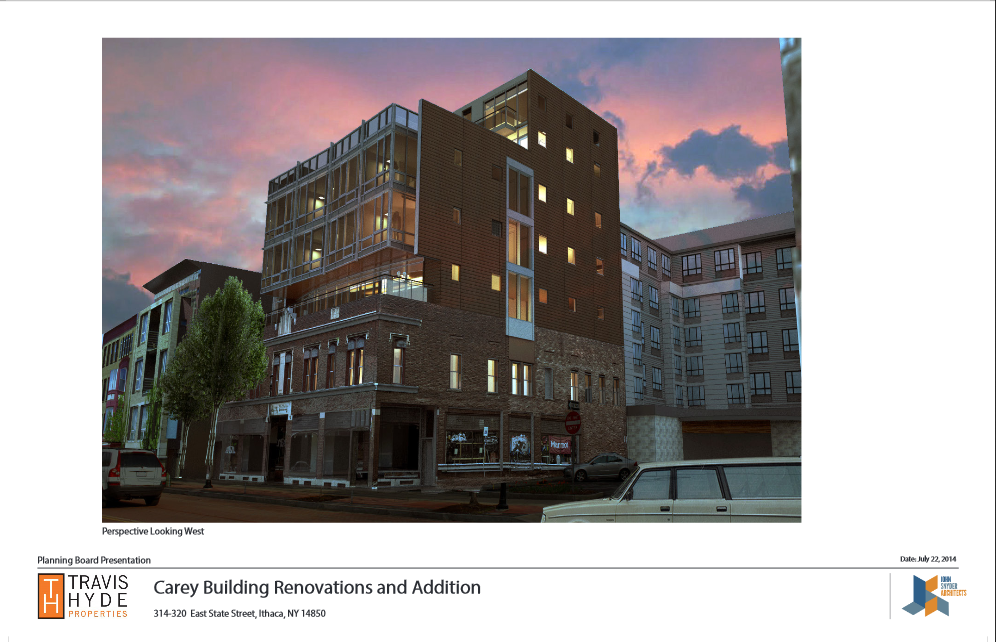
3. On a different note, the Carey Building tax abatement was approved unanimously. At least some developers know how to play nice. Look for the additional REV incubator space and 20 apartment units to start construction shortly and open for renters in August 2015.

4. Down in big box land, the former Kmart space looks to be filling out with new tenants. Discount clothing store chain TJ Maxx has agreed to take 21,770 sq ft of space, and Five Below (a teen retailer specializing in products $5 or less – it sounds like the product of a one-night stand between Dollar Tree and H&M) has agreed to take 8,208 sq ft of space. The old garden center will be replaced with a 16,200 sq ft addition, a revision of the previously-approved 14,700 sq ft. Benderson Development is redoing the front facade for TJ Maxx, and needs a couple of minor area variances. Readers might recall the Ithaca Kmart closed in 2011, and its sister store, Sears, is closing this winter. If this is any indicator, then there’s hope that the Sears space will be re-occupied soon enough.

Not much else of note for zoning trifles from the city’s Planning Board meeting – someone wants to build a new 2-family home at the corner of Oak Avenue and Oneida Place in outer Collegetown, and a house on Heights Court in Cornell Heights is trying to get increased occupancy for unrelated tenants. For the first time in several months, no new sketch plans are due to be presented at a Planning Board meeting; the holiday and earlier-than-usual monthly meeting are probably a big part of that.

5. Not much to report for Ithaca town’s Planning Board meeting either – a proposal for a new duplex at 636 Coddington Road, and an expansion of the East Hill Plaza branch of Collegetown Bagels into adjacent empty retail space. That winter slowdown is in full swing.


Cornell Updates Upson Hall

31 10 2014

Fresh from the planning board’s first look, here are the renovations Cornell plans to do on Upson Hall. Upson Hall, named for long-time trustee and big donor Maxwell Upson 1899, was built in 1956, and is part of the interconnected octopus of buildings that makes up the eastern half of the engineering quad, connected directly with Grumman and Duffield (with which it shares walls), and Phillips and Rhodes. 5-story Upson occupies about 160,000 sq ft, of which 142,000 sq ft is usable space, which has most recently been occupied by the computer science and mechanical/aerospace engineering departments.

100_2099

The renovations to Upson are just one more step in many taken, or to be taken, to update and expand facilities Cornell’s engineering school. The plans have been underway since Duffield was built 10 years ago, and have evolved with the changing needs of the school. For instance, the original plan had Hollister and Carpenter Halls being demolished to make way for a larger building, which can be seen in the Cornell Master Plan of 2008. But, this plan was tabled as a result of the recession, and that individual proposal was never revived. Similarly, early Gates Hall plans had a building site just south of Thurston, facing the gorge. Currently, work is underway to renovate Kimball Hall, with a summer 2015 completion and $15 million price tag. There is also work planned for a new biomedical engineering building, design and construction TBD, but with a price tag of about $55 million (for comparison, Gates cost $60 million).

upson_1

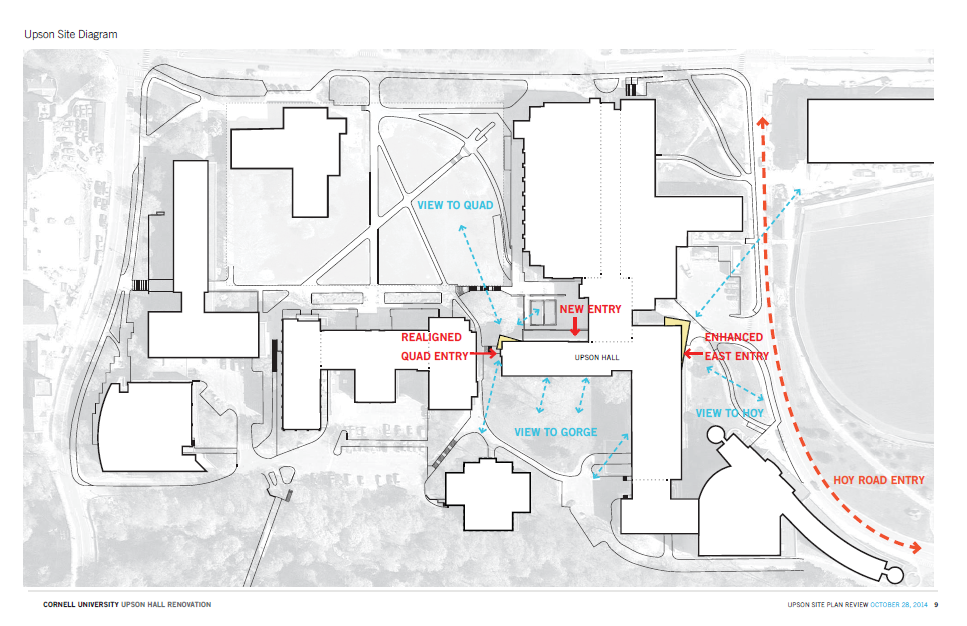
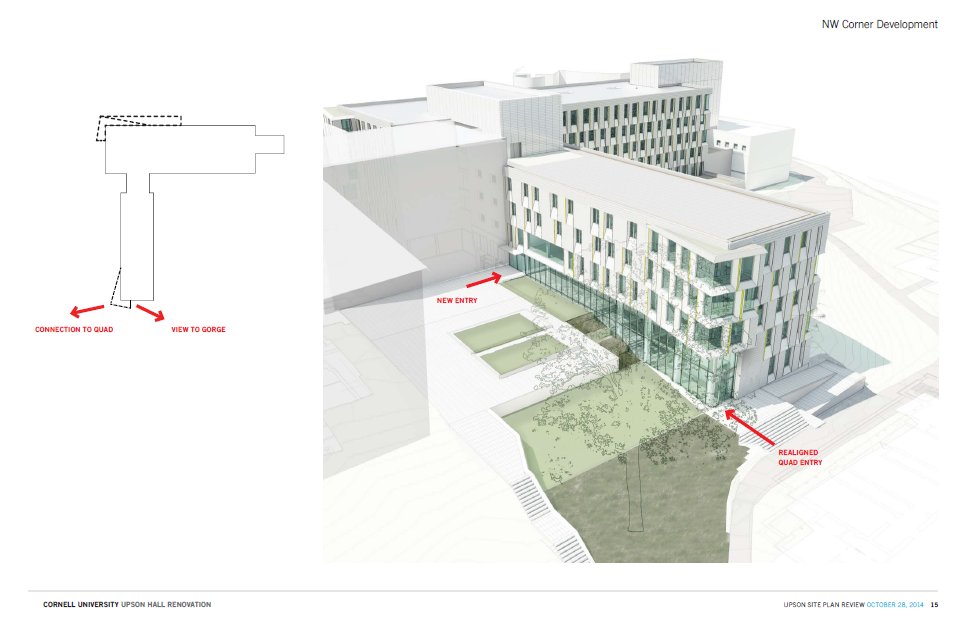
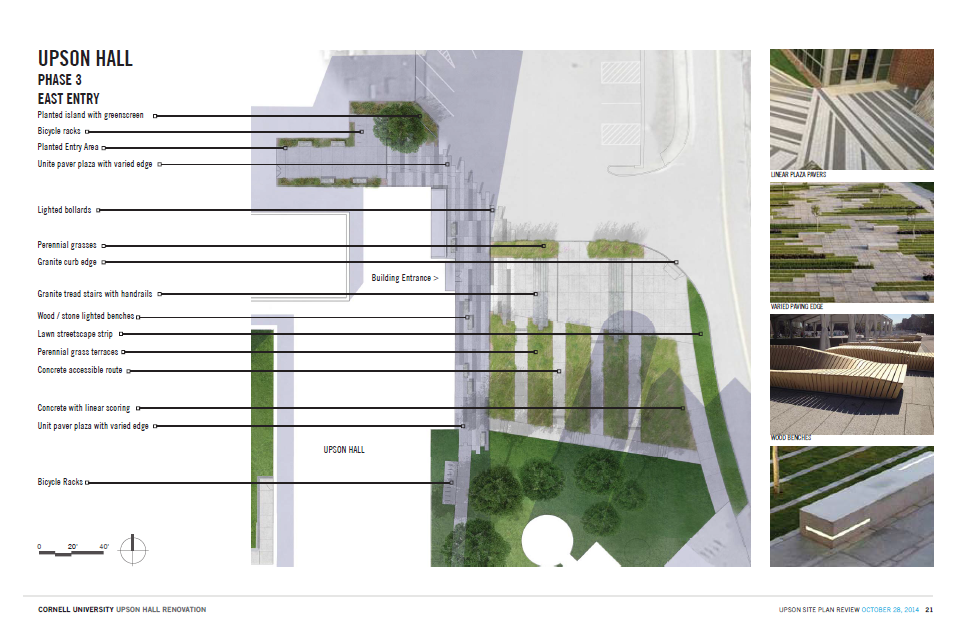
In the proposed $63 million renovation, Upson retains its current footprint, A new entry is established at the intersection with Duffield, and small bump-outs are built over the other two entryways. Better entries and landscaping are strongly emphasized in the proposal.

upson_2 upson_3

upson_4

The design is standard 2010s fare – whereas the current Upson is a box with bands of windows (“International Style”) much celebrated in the days of I Love Lucy and early seasons of Mad Men, the current is the metal-and-glass of all sorts of sizes and shapes. I expect it to age about as well (i.e. poorly). Coincidentally, the design of the building is by internationally-acclaimed firm Perkins + Will, who also designed the original Upson in the early 1950s.

I feel the real draw here is the landscaping. The initial landscaping isn’t all that special, put the Phase III landscaping is a treat. Cornell is way too trendy when it comes to new buildings, but if it’s one thing the university excels at, it’s landscape architecture.

upson_land_1 upson_land_2


The Collegetown Boom Continues: The Plans for 302-306 College Avenue

30 10 2014

304_college_2

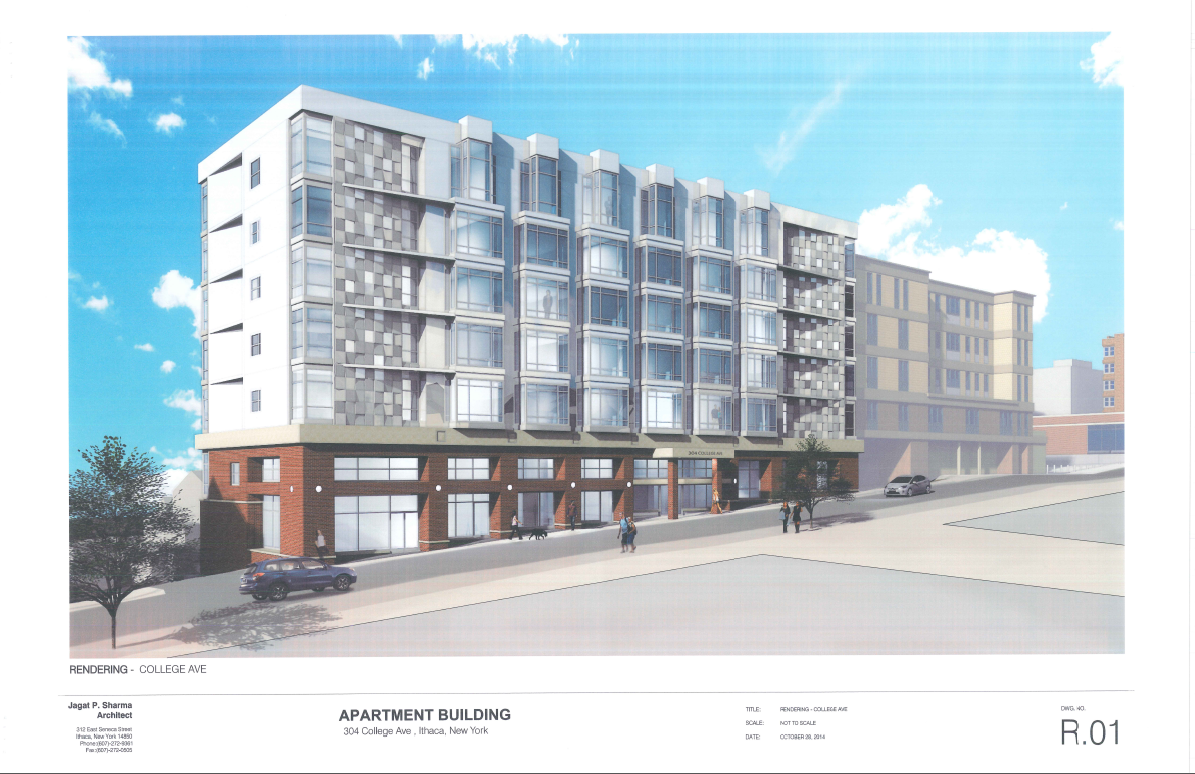
I touched on this one in last week’s news updates, but now I have some images to go along with it. Plans brought forth by Avramis Real Estate and designed by Collegetown favorite Sharma Architecture show not one but two buildings, one 6 stories and one 4 stories. The sketch plan can be found here. The buildings are split up according to zoning – one occupies the 6-story MU-2 zone, the other the 4-story CR-4 zone. Neither requires parking, although a small amount is provided between the two structures.

101_4858

The buildings on the MU-2 portion consist of three older homes originally built around 1900-1920, and periodically updated to reflect a changing Collegetown, such as the bump-out in front of 306 College that houses Collegetown Liquor. Not exactly devoid of charm, but the alterations have been enough to compromise their historic value. These house 36 bedrooms.

The CR-4 portion has 4 homes, all late 1800s to early 1900s, and house 32 bedrooms. Once again, not without their charms, but pretty run down.

304_college_1


The MU-2 building, called “304 College Avenue”, will house 64 apartments with 117 bedrooms. The CR-4 building will house 38 apartments with 85 bedrooms. So the site will see a net gain of 134 bedrooms (202-68).

304_college_2

304 College almost doesn’t look like a Sharma to me.  The mosaic tiling is a feature that makes it stand out, although I personally am not the biggest fan. It’s boxy and bulky, but not offensive.

304_college_3

Not much to say about the Catherine Street building, the design still has yet to be fully rendered. But it looks pretty standard for Jagat Sharma’s work, the Fontana Apartments or 211 Linden come to mind.


Cornell Provosts Climb the Ladder

21 10 2014

100_3080

It’s pretty clear the the president of Cornell is first in command of the university. However, being that Cornell is a university with tends of thousands of students, thousands of employees, and multiple campuses, it stands to good reason to have a chief academic officer of sorts, a general supervisor of college affairs while the president represents the university’s “public image” and acts as chief fund-raiser. In comes the provost, a position created in 1931 by the Board of Trustees to manage the university’s myriad affairs. The provost is a sort of COO while the president is CEO.

Many of Cornell’s provosts haven’t been content with being second in command, the latest example being Provost Kent Fuchs leaving to become president of the University of Florida. Fuchs (pronounced “fox”) has been in the provost position since 2009. His predecessor, Carolyn “Biddy” Martin, who left to take over as president of  the University of Wisconsin at Madison.

Let me run down the list of provosts since WWII and see what happened with each provost:

Arthur S. Adams (1946-1948): Bid adieu to Cornell when he was appointed president of the University of New Hampshire. He may not have liked UNH much, because he left in 1950 to head the American Council on Education, and from there on a number of other academic leading roles. He passed away in 1980.

Before someone calls me out for not including the provost in 1945, there was no serving provost from 1944-1946. Former Ag school dean Albert Mann (1931-1936) and former Packard Motors executive H. Wallace Peters (1936-1943) both retired after serving as provost.

Cornelis de Kiewiet (1948-1951): Departed when he was selected as president of the University of Rochester, a position that he served in from 1951-1961, from which he retired and spent the rest of his years working as a proponent of investing in higher education programs in Africa. A rather unattractive brutalist dorm at the UofR is named after him.

Forrest Hill (1952-1955): I should note that provosts under President Mallott seemed to have less power than more recent ones; Mallott enjoyed his authority, something that also led to the student riots of 1958. Hill left to head the Overseas Development for the Ford Foundation, and established rice-breeding institutes that increased yields substantially, and helped propel the “green revolution” of the mid-20th century. Forrest Hill retired to Ithaca in 1976 and passed away 12 years later.

Sanford Atwood (1955-1963): Left in 1963 to serve as president of the prestigious southern college Emory University, where he was president from 1963-1977 (and where has a building named in his honor). While at Emory, Atwood became best-known for standing behind a professor who declared a belief that “God is dead”, which didn’t go over very well at the traditionally Methodist institution. He retired from Emory and passed away in 2002.

Dale Corson (1963-1969): The only recent case of a provost becoming president, as a result of James Perkins’s resignation following the Willard Straight takeover. Corson, for whom Corson Hall is dedicated, served as Cornell’s leader from 1969-1977, and lived in Ithaca up to his passing in 2012 at the age of 97.

Robert A. Plane (1969-1973): Left Cornell to serve as president and CEO of Clarkson University, where he served from 1974-1985. After he retired from that position, he became a winemaker, and eventually came back to work for Cornell as head of the university’s Ag Experiment Station in Geneva from 1986-1990. After he retired again,  he served as president of Wells College from 1991-1995, though the college was still all-female at the time. He’s totally, completely retired now, and still kicking at the age of 87.

David Knapp (1974-1978): Left to become the president of the University of Massachusetts, where he served as president from 1978-1990, and retired from his professorial duties in 1993. It was Knapp who suggested changing the name of the College of Home Economics to the College of Human Ecology, while he was dean of the college.

W. Keith Kennedy (1978-1984): For whom Kennedy hall on the Ag Quad is named. He retired at the end of his term, but served on a number of Cornell committees and Ithaca-based foundations and boards for the rest of his life. Kennedy passed away in Ithaca in 2011 at the age of 92.

Robert Barker (1984-1991): Retired from Cornell in 1995, according to the Office of the Provost website, and moved to Washington State.

Malden “Mal” Nesheim (1989-1995): Note the overlap with Robert Barker; Barker served as “senior provost and COO”, the only time that position has ever existed, from 1989-1991. Nesheim became provost emeritus in 1995, and is a professor emeritus of the Nutritional Science department, taking part in various committees well into the 2000s.

Don Randel (1995-2000): Left in 2000 to become the president of the University of Chicago. Left U. Chicago in 2005 to take over as president of the Mellon Foundation. It appears he’s since retired.

Carolyn “Biddy” Martin (2000-2008): Left to take over of the University of wisconsin at Madison. Left that position in 2011 to become president of Amherst College, a small but prestigious liberal arts school in Massachusetts.
W. Kent Fuchs (2009-2014): Leaving to take over as president of the University of Florida.

So, since WWII and excluding Corson, 8 of the 12 provosts have gone on to serve other schools, and only 3 of 12 stayed with Cornell through retirement. The position is often a high-level stepping stone for administrators with grand aspirations. Not to say they don’t care about Cornell, not true at all; but there’s a good chance that Cornell won’t be throwing a retirement party for the next provost.


Cornell’s Madam President

30 09 2014

101_4825

As announced over at the Ithaca Voice, Cornell’s 13th president will also be its first female leader. Univ. Southern California provost Helen Elizabeth Garrett has been selected to take over the helm from David Skorton starting in July 2015.

In keeping with a Cornell trend to have presidents who’ve spent time in flyover country, 51-year old Elizabeth “Beth” Garrett started her academic career in Oklahoma. According to her curriculum vitae, she received a BA in history from the University of Oklahoma in 1985, where she was active in student government and Chi Omega sorority, and she has a JD from the University of Virginia in 1988, where she was valedictorian.  Following law school, Garrett clerked for judge Stephen Williams on the U.S. Court of Appeals for the DC Circuit (1988-1989), and for U.S. Supreme Court Justice Thurgood Marshall (1989-1990). She also served as legislative director and tax and budget counsel in the early 1990s to retired Democratic U.S. senator David L. Boren (D-Oklahoma; back in a time when Oklahoma elected more Democrats). Since that time, she’s been firmly ensconced in academia. She has served as a visiting law professor at UVA, Harvard, Caltech, the Interdisciplinary Center Law School in Israel and Central European University in Budapest. She has served as a law professor at U. Chicago (1995-2003), where she was deputy dean for academic affairs from 1999-2001.  In 2003, she left for USC, where she would go on to serve as the vice provost for academic affairs (2005-2006) and then vice president for academic planning and budget (2006-2010). Garrett became provost, the second-in-command position for the university, in October 2010. Her tenure as USC provost has had its share of problems. It includes the failed merger of the Scripps Insitute with USC, and a series of high-profile crimes near the university where USC students were attacked.

As a lawyer, Garrett’s specialty is with government affairs and tax policy. In March 2009, she was nominated by Barack Obama to serve as assistant treasury secretary for tax policy, but withdrew that May for family reasons. It was suggested that she did not wish to put her family under the intense scrutiny that the vetting process required. She has been the target of the political right-wing’s fury in the past, for not doing enough to curtail a USC professor who used derogatory terms to describe Republicans.  Along with that nomination, her other government involvements includes serving on a number of government advisory panels and boards, include George W. Bush’s 2005 Panel on Federal Tax Reform,  and as the Commissioner of the California Fair Political Practices Commission since 2009. Like any other high-flying professional, she sits, or has sat on more advisory panels, had more professional memberships, and chaired more specialized committees and programs than you can shake a stick at. Her husband, USC law and philosophy professor Dr. Andrei Marmor, will be offered a position at Cornell.

A female lawyer with deep political and academic connections seems like a pretty safe choice for Cornell president. Although this will be her first time as a college president, she has strong enough credentials that, at a glance, her appointment appears to be a wise move.