News Tidbits 9/25/10: Development Planned for 307 College Avenue

25 09 2010

This is slightly annoying. I was away from my computer yesterday and today as a result of my graduate work and then coming straight out to Ithaca, so I never bothered to read my Ithaca/Cornell newsfeed. So it’s bothersome that I found out about this relatively later than usual. Anyways, here’s the article from the Daily Sun:

http://cornellsun.com/section/news/content/2010/09/24/developer-seeks-approval-new-c-town-building

September 24, 2010
By Jeff Stein

A proposal to transform the middle of College Avenue hinges on developer Josh Lower’s ’05 controversial request for a Board of Zoning Appeals variance, which would exempt a building’s development from city parking laws.

Lower said his proposed development project at 307 College Avenue –– next to Jason’s Grocery & Deli –– would demolish the existing building and create more than 60 new apartment units. Lower also hopes to remake the area into a highly trafficked “pedestrian arcade,” filled with street-level storefronts that would connect College and Linden Avenues.

City officials are divided on whether the Board should grant Lower the variance. Under the city’s current parking ordinance, every two housing units built must be matched by the creation of one parking spot.

Lower said that building the parking spaces, which must be within 500 feet of the site, was “not practically or financially possible.”

“We’ve tried to meet the law but cannot,” Lower said.  “There’s just not enough space.”

Ithaca Councilmember Ellen McCollister (D-3rd Ward) expressed concern that there would be a lot of “spillover” for surrounding neighborhoods if the variance was given.

McCollister also said the variance would establish a dangerous precedent: “If you grant a variance to one property owner, how do you not grant [it] to any other property owner?”

If one developer is granted an exception, “all hell breaks loose,” as other developers would expect the same treatment. “We need to treat every developer consistently and equally,” McCollister said.

Lower said his plan would compensate for the lack of new parking spaces by providing his residents with a car-share membership and free bus passes as part of the lease.

“We’ll create a building that fosters … sustainable modes of transportation and encourages people to bike more, walk more,” Lower said. In reference to a proposed pedestrian walkway, Lower said, “We’re making privately-owned space accessible and usable for all.”

McCollister was not convinced. She called Lower’s replacement for parking spaces a “very ill-defined, nebulous proposal,” saying it was “not a real plan for how he is going to do it, in perpetuity, for every resident.”

Partly because there is “more supply in retail than there is demand” for Collegetown, McCollister is “not convinced the pedestrian arcade is as valuable an amenity as it’s being portrayed.”

Board of Zoning Appeals member James Marshall shared McCollister’s skepticism about Lower’s replacement plan in exchange for a variance, calling the lack of parking spaces in his proposal a “significant deficiency.”

“He’s proposed some measures that might encourage people to use public transportation or bicycles, but no one knows how successful he’ll be,” Marshall said.

Stephen Beer, chair of the Board of Zoning Appeals, said he worried that there was no provision for enforcing Lower’s suggested replacement for the parking spaces.

Lower responded that “it would be a requirement written in the lease.”

Eddie Rooker ’10 (D-4th Ward) said he and Svante Myrick ’09 (D-4th Ward) both supported the project.

Rooker said the development is “going to be beneficial to students and the city,” naming studies that “point to the fact that we need more housing in the city” given “pretty high pricing all over the city.”

Rooker said the project would fix the need for a “well-lit pedestrian walkway connecting College and Linden Avenue,” where “people now have to go between people’s yards when they’re not well-lit.”

Rooker said the proposal could make the area in front of 307 College Avenue a new hub for TCAT, shifting the center of Collegetown further south.  He said that TCAT wrote a letter to the city in support of the project.

Lower, who lives in the neighborhood, said that “we really looked at a lot of scenarios to try to do something else with the property,” but that nothing else was viable. He said that he is currently losing money on the property.

McCollister responded that one of the considerations for the Board of Zoning Appeals was that the variance request not be in response to a “self-imposed hardship.”

“I think he does have a financial hardship, but that’s because he paid too much for it … rather than some externality that created that financial hardship,” McCollister said.

McCollister added that the Board of Zoning Appeals should wait until a decision is made about an “in-lieu of parking fee” suggested in the 2009 Collegetown Urban Plan & Conceptual Design Guidelines. The proposal, which is currently being developed, would specify a fee below the cost of providing on-site parking that developers could pay the city in lieu of building parking spaces. The Collegetown plan says the fee could then be used to help the city fund alternative transportation modes.

“I can only base my plans on what is law today,” Lower responded.

Rooker agreed, saying, “We can’t constantly rely on what might be happening,” and that he “would rather see something like this than a one time donation to general fund” anyway.

Lower added that waiting for the law to pass could have a big impact on his finances, since “the building has to be done based on the academic year.”  “If the building is not ready to have [residents in it] before classes start, it sits empty for the rest of the year.”

If approved, his plan is to start construction in June 2011 and have the building ready for residents in the Fall of 2012.

***

So, the summary is this:The guy wants to build a medium-sized apartment building but doesn’t want to include parking. The issue lies with the possibility that residents would just park their vehicles on the streets and clog local roads, and finding viable options to keep that from happening. A zoning variance is required due to the lack of parking, and without it the project will not proceed.

A few extra details; the development would be a 60-unit building with a retail base. Guessing from the rendering and from the height limit there, it would be about five stories. The current building on the site used to be occupied by a drugstore, but the store closed in late 2006. With the exception of the space occupied by Ithaca Carshare, the retail portion has been empty since.

The argument on the parking issue is reasonable and legitimate. A lot of students maintain cars, and the overly entitled ones may still try and maintain a vehicle nearby, thus creating parking issues for the building’s neighbors. While the project would definitely add density and needed residential space to inner Collegetown (and definitely makes use of New Urbanist planning), the lack of parking is a major hurdle. Personally, I like the idea of the project, but unless he can make absolutely clear what he’s going to do to keep students from bringing vehicles to an area with no space for them, and be held to that “in perpetuity”, I would be leery of its approval.

The architect is a small local Ithaca firm founded about seven years ago, John Snyder Architects.  Looking at the website, it seems most of their work has been for educational facilities or interior spaces, and the style tends to be modernist with limited detailing, instead playing off of the geometric forms of the structure itself. I’m very curious to see the whole design of what would seem to be the firm’s first large residential building. At the very least, it least it won’t be another Sharma Architects proposal; a little variety does wonders.


News Tidbits 9/1/10: Firm Selected to Design Bridge Barriers

2 09 2010

According to the latest updates from the Cornell Chronicle, architect Nader Tehrani of the firm “Office da” has been selected to design the bridge barriers for six of the gorge bridges, effectively trying to put a prettier face on suicide prevention. Two public forums will be held during the design and proposed implementation process, with the final proposal to be ready no later than May 2011.

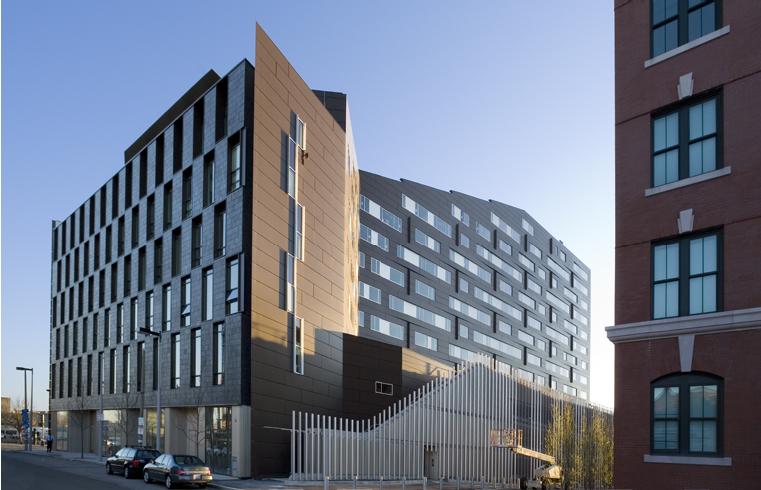
The firm, like many selected recently by the university for its projects, is known for edgy ultermodern architecture. Normally, as readers who tolerate me are aware by now, this would be the point where I go into a rant about how such architecture fails to fit in with the surrounding environment, often fails to live up to standards, etc etc. Well, for the record, here’s a sample of their previous work, the McAllen Building in Boston:

Photo Property of Office da (www.officeda.com)

But, I don’t have a reason to complain, for three reasons. For one, they’re designing bridge barriers, which tend to have less of an impact on their surroundings than buildings. For two, it has to be cleared by public forums in conjunction with the city of Ithaca and its residents, who won’t be so gung-ho for wild design features. To be honest, the train of thought in my mind is “can they really screw this up aesthetically? Not really. ” For three, nothing can be as bad the metal behemoths we were treated to last Spring, which gave the impression of being locked into a prison yard. When you’ve already hit the lowest lows in appearance, the only way to go is up.

I’m going to be  very interested to see what comes out of their studios in the coming months.


News Tidbits 7/22/10: Collegetown Terrace Goes Back to the Drawing Board (UPDATED)

22 07 2010

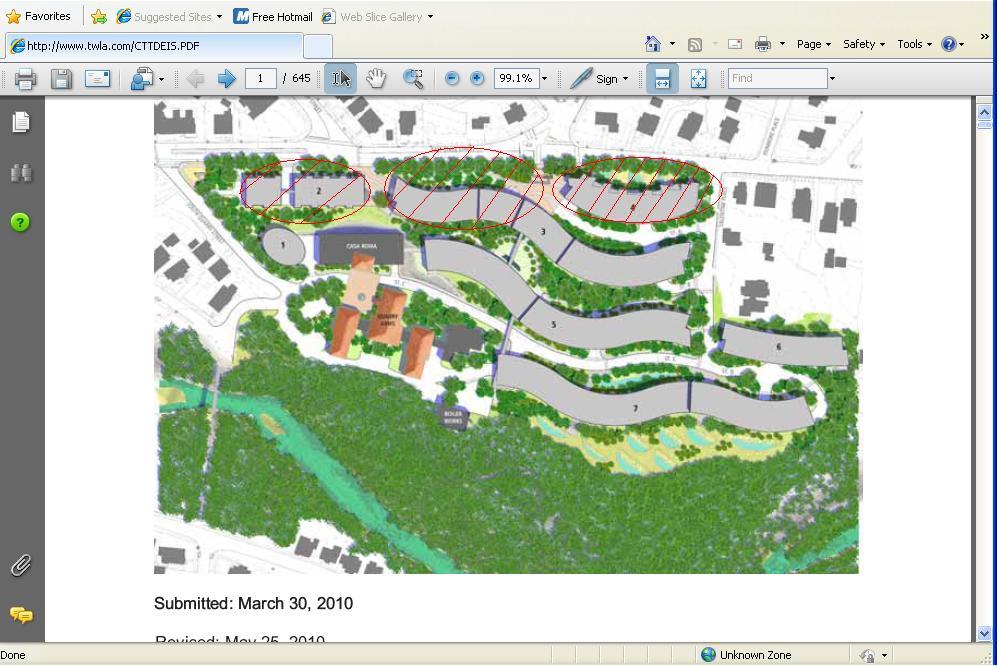
UPDATED: A sketch rendering of the new design has been released. Small, house-like apartments have designed along East State Street in place of buildings 2 and 4. Building 3 is still one continuous building, but the exterior breaks into subsections to minimize bulk and give the impression of multiple strcutures. The Delano House is still under consideration for preservation, but is more of a suggestion at this point (unless the preservation committee and the Common Council give it historic designation). I actually like it more than I did the original design. 

Also, Ithaca is getting a BJ’s Wholesale Club next to the Shops at Ithaca Mall, and a Tim Horton’s/Cold Stone Creamery is planned to be built near Buttermilk Falls. Which makes me wonder how mainstream Ithaca is going to become over the next few years. 

http://www.theithacajournal.com/article/20100721/NEWS01/7210425/City+reverses+on+Novarr+re-zoning  

So, for those who might’ve been following the news over the past few months, it’s been no big secret that Novarr-Mackesey Group’s Collegetown Terrace project has been rather contentious, drawing crowds of angry neighbors to planning board meetings who were upset with the sheer size and scale of the project. In response, the planning board voted to promote rezoning (which is done by the city council) the part of the property along East State Street, which would heavily alter the project. Plus, it was recommended that historic designation be sought for the Delano House, a former nurses’ dorm. Of course, if these actions were taken, then Novarr’s lawyers would be having a field day filing a lawsuit against the city.  

Well, it seems as if that potential issue has been averted. Talks between the board and John Novarr have resulted in something of a compromise. In exchange for not rezoning the area, Novarr will submit a redesign that will allow thirteen separate structures on East State Street. This has been one of the most contentious aspects on the original design, that the three structures that were originally proposed made State Street feel like “a wall”, “prison” or “fortress”.  The original design schematics and proposal can be found here, in a 645-page PDF.  


Delano House, photo property of Novarr-Mackesey Properties


Therefore, buildings 2 and 4 will be completely redesigned as designated by the agreement. Building 3 will also be redesigned, but only the north half is affected. To what extent the plans will change regarding the landscape of the development and the other buildings is uncertain. Also, some of the Ithaca preservationists might still be trying to push for special designation for Delano House, which is at 113-115 Valentine Place. That space would be occupied by buildings 6 and 7, so I don’t see the issue being completely settled just yet. But at least the two sides are willing to compromise. Personally, while I like some of the aspects of the project, I’ve kinda felt indifferent due to the sheer size, and the design hasn’t exactly won over my heart (for the record, I still don’t dislike it as much as I dislike anything by Thom Mayne, so I feel no urge to go on a rant like I did with Gates Hall). But trying to make it a smooth transition and trying to at least appease the neighbors while increasing density – I consider that a step in the right direction.  


Whatever Happened to the CU ERL Project? (UPDATED)

14 07 2010

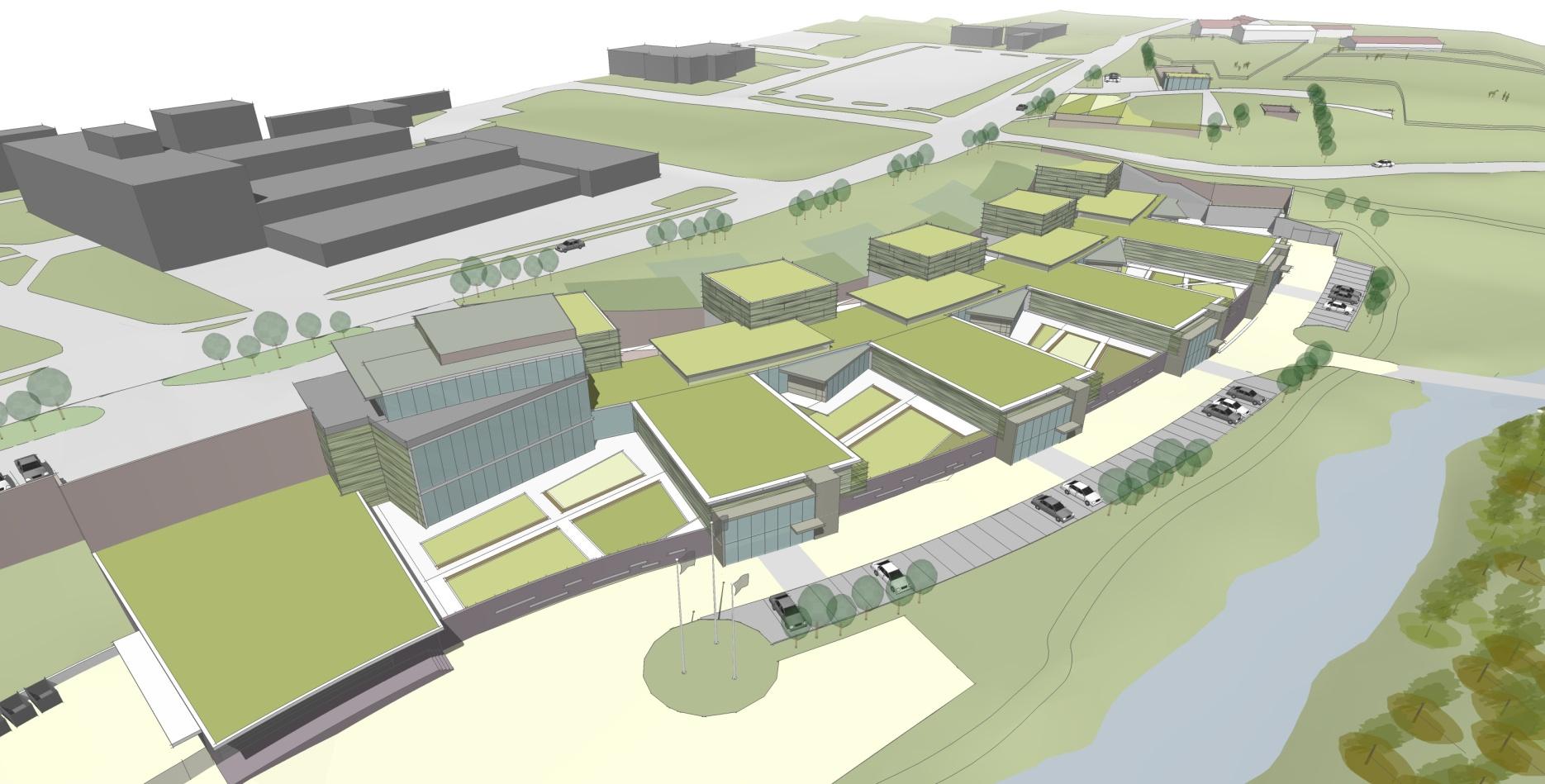
Renderings have been released through the Ithaca Journal’s website:


For reference, Riley-Robb Hall is in the upper level. This rendering is looking to the northeast. The cryogenic facility is to the upper right. More renderings can be found in the document attached to the main article.

***

About two years ago, I wrote an entry discussing the proposal of the Cornell University Energy Recovery Linac (ERL) X-Ray machine and how it was sechduled to start operation in 2011. Well, things kinda stalled when the Great Recession reared its ugly head far above Cayuga. In between compiling at my work computer, I decided to look at the the town of Ithaca’s latest planning board agenda. Lo and behold, it appears the project is back on. From the agenda:

Consideration of a revised sketch plan for the proposed Cornell University Energy Recovery Linac (ERL) project located north of the Pine Tree Road and Dryden Road (NYS Route 366) intersection, Town of Ithaca Tax Parcel No.’s 63-1-8.2, 63-1-2.2, 63-1-12, 63-1-3.1 and 63-1-3.3, Low Density Residential Zone. The proposal involves construction of an underground accelerator tunnel (14-foot diameter and +/- 1 km long), a cryogenic facility, and an extension to the existing Wilson Laboratory (+/- 185,000 gross square feet of building space). The project will also involve new stormwater facilities, parking, outdoor lighting, and landscaping. The Planning Board may also discuss the draft scoping document for the Environmental Impact Statement.

Now, long story short, the project consists of a massive extension to the Wilson Synchrotron and a large addition to the Wilson Lab, illustrated in the diagram (which I am virtually certain sure was designed by Munier Salem, as it shares similarities to his previous works and it’s part of an article he wrote for the Daily Sun back in the fall of 2008):

The article also goes into much greater detail about how it’s supposed to work; much more detail than I am going to go into here. Economically speaking, the project has considerable potential for the region: the University and project affiliates estimate over 200 jobs would be created and the facility would bring nearly a billion dollars in economic contribution in the five years of construction and ten years of operation. It’s certainly much better than the alternative, which would be the Synchrotron unit shutting down and taking away 200 jobs.

So, it’s good to see things are moving forward once again. Let’s hope that things can stay on track from here on out.


Collegetown Construction Project Watch: 309 Eddy Street

20 05 2010

So, reviewing monthly planning board agendas turned up a proposal for 309 Eddy Street in Collegetown set to be discussed this month. Unfortunately, I can never make it to the meetings and Ithaca is terrible at posting the minutes online. However, applying a little knowledge and logic, we can get a good idea of what is proposed for the site.

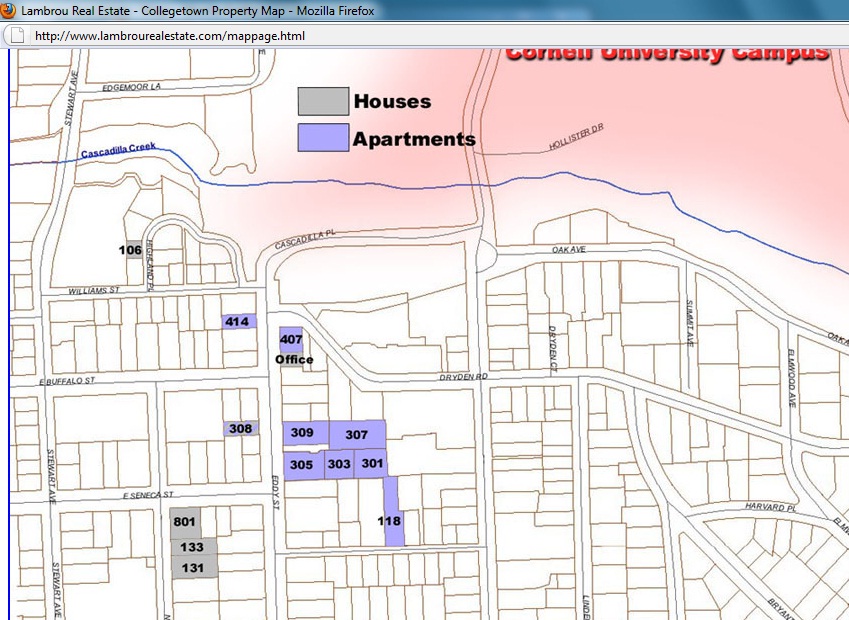
First, let’s go over the site itself. This is a little ways down from Dunbar’s on the east side of the street, next to Souvlaki House. The current building is a large student apartment house dating from about 1900:

The house sits the in the middle of a series of large apartment buildings – the Fontana Apts (327-407 Eddy), and the four buildings that make up the Collegetown Park Apts. (301 Eddy-307 Eddy). All of these buildings were built in a time period from the late 1980s to early 2000s (the last was about 2002). All properties, including the house, are owned by Lambrou Real Estate, one of the major players in the Collegetown rental market with a couple dozen properties in the area (not all properties are shown in the map below).

Lambrou Real Estate seems to have a figurative love affair with the local architecture firm Jagat Sharma, which has a very distinct style but its readily apparent in all their buildings (postmodernist with extensive brick work and subtle contrasts within the facade, but otherwise not really daring). All of Collegetown Park, as well as the Fontana Apts, was designed by Sharma & Associates. It would be logical to assume that a future Lambrou project would have Sharma as the architecture firm in charge.

From a zoning and massing perspective, a review of the Collegetown zoning (which I’m not even completely sure it it was ever changed according to the guidelines of the $150k clusterf*ck that was the Collegetown Vision Draft Plan)

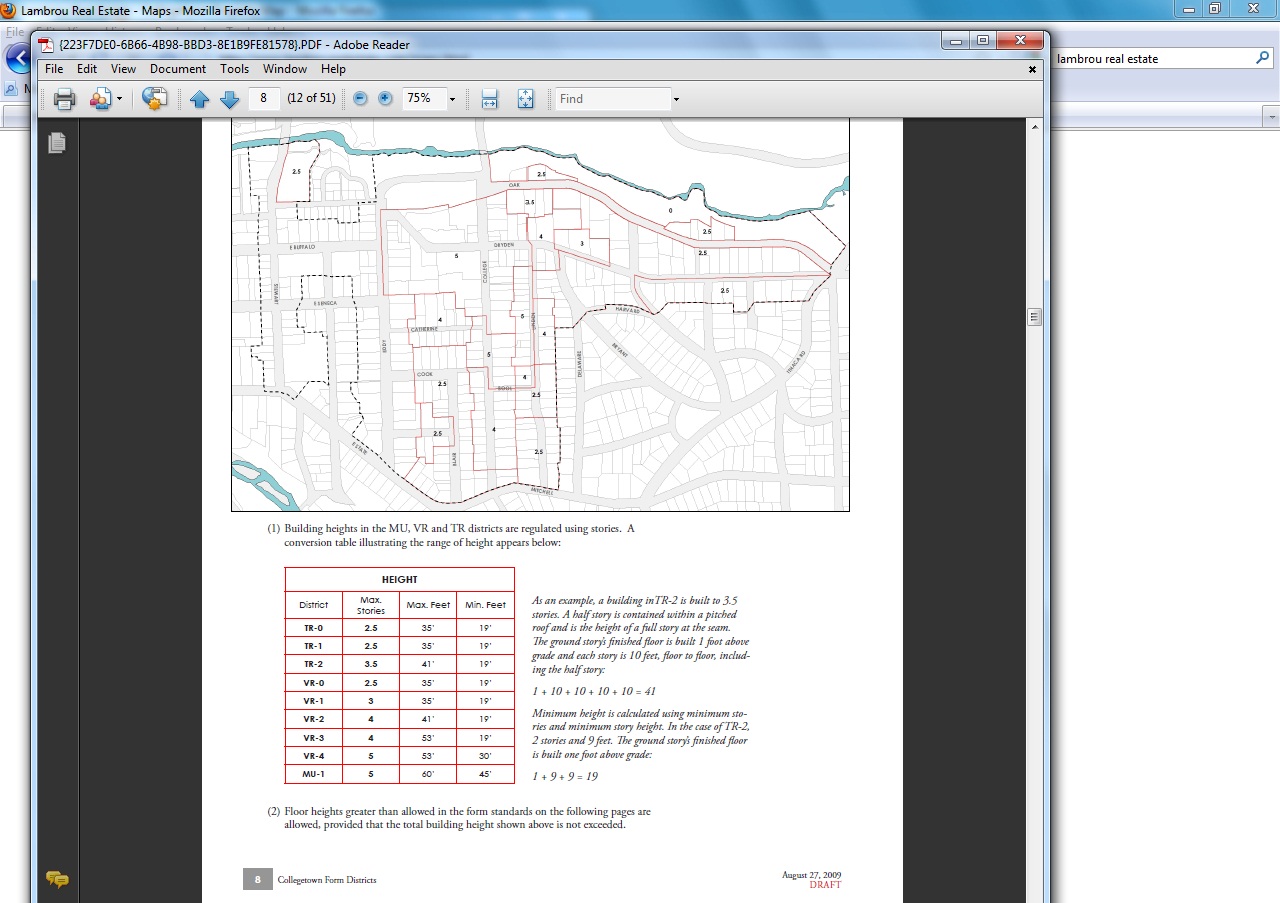
Assuming it is, the lot is zoned for a 4 or 5 story building with a maximum height of 60 feet, and at least 45 feet encouraged. Street-front commercial retail is virtually a must for approval.

So, here’s my verdict. Within the next few months, there will be a full proposal for a 4 to 5 story building pushing between 50 and 60 feet, with retail in its base and apartments on the upper floors. It will most likely be designed by Sharma Architects, and as I’m checking the Lambrou website and not seeing this place for rent next year (possibly because it has not been updated), this place could get final approvals and construction permit for fall of 2010 with construction lasting at least six months (if it does turn out to be rented, a construction start date of summer 2011 will be far more likely).

UPDATE 9/29/10: Now we have renderings:

Not a bad design. Fits in rather well with the immediate surroundings. A little more work on that street and it could become as popular as the 400 block of College Avenue.


Cornell Proposes Further Development for West Hill

14 05 2010

http://www.theithacajournal.com/article/20100514/NEWS01/5140326/1126/news/Cornell-proposes-senior-center–hotel-school-institute-on-West-Hill

Cornell University is developing plans for a major new project on Route 96 that could include senior housing, offices, small-scale commercial, and an institute for its hotel school.

Town planners have been discussing the idea with Cornell for several months, and Thursday afternoon, Ithaca’s town planning committee voted unanimously to recommend the town board consider re-zoning the parcel to accommodate the development.

Cornell owns 35.86 acres on Route 96 between Overlook apartments and the West Hill fire station. Though plans are still preliminary, Cornell is looking to partner with developers Conifer LLC to build 72 senior living apartments and 60 assisted-living units for low-income seniors, Town Supervisor Herb Engman said.

“And this would be Medicaid eligible, which we badly need in this community because we have lots of places where people can age in place … but none that I know of for those who are Medicaid-eligible,” he said.

Link to site proposal options:

In late 2007 and early 2008, developers Paul and Chris Vitale asked the town to rezone a parcel they purchased across from Robert H. Treman State Park to accommodate a Medicaid-eligible assisted living center, but town board members declined. The Vitales will likely operate the proposed West Hill assisted living center, Town Planning Director Jonathan Kanter said.

Cornell Real Estate Director Tom LiVigne said the hotel school has not yet been decided on the exact size and shape of a new institute building, but it would study issues related to seniors in terms of food service and housing, and likely interact with the on-site senior housing.

To maintain “maximum flexibility,” LiVigne said he hoped the town would rezone based on the maximum possible build-out. John Caruso, senior vice president of Passero Associates, presenting Cornell’s plans, suggested a planned development zone should allow 130 to 170 senior and multi-family units, up to 90,500 square feet for the Hotel School institute, 10,000 to 15,000 square feet of office space, and 20,000 to 28,000 square feet of small-scale commercial and retail development.

The parcel is currently zoned medium-density residential, which allows approximately 3.5 homes per acre, Kanter said. That’s roughly 122 units.

The northern entrance to the development would join the traffic-signaled light that intersects Overlook and Cayuga Medical Center, plans show. A southern entrance road would be built just north of the West Hill fire station, directly across from the road proposed to enter the 106-unit Holochuck Homes development. That development is still undergoing environmental review with the town’s planning board, Kanter said.

Cornell’s plans also include a 106-space park-and-ride lot, “which, again, we feel is badly needed for West Hill, so people coming in from Trumansburg, as well as people who might live on this site and nearby people could park their cars there and then take the bus down through town, rather than clogging up the Route 96 corridor from there on down,” Engman said.

The small-scale commercial component is very important to the town, and the town board could make that piece of the development a requirement, Kanter said.

Cornell’s proposal is scheduled to come to the full town board June 7 at 5:30 p.m. in Town Hall, 215 N. Tioga St.

***


News Tidbits 4/14/10: South Hill Expands

15 04 2010

Two things, one dealing with IC and the other with the neighboring South Hill business campus. IC is looking to expand student housing (partially due to the record number of students they enrolled) by adding 280 units of apartment housing to its South Hill campus. Meanwhile, the South Hill Business Campus is seeking approval to construct three buildings totalling 190,000 square feet, which would be built as needed. The business campus was once the regional headquarters of the National Cash Register company (NCR) and was completed in 1957 with an addition in 1975. While it once housed over 1,000 employees, the building was sold to a French company (Axiohm) in 1991, and in a fine showing that they never really cared for local interests, outsourced most of the manufacturing work. By 2004, the factory was only 25% occupied, so a group of investors made an offer to buy the place and operate it as a sort of business incubator for company needing a varying amount of office and maufacturing space. Today, the facility is 84% occupied, so it looks like they did a good job marketing and updating the building. One building would be up by 96B, the second attached to the west end of the current building, and the last just south of the current building.

***

From the Ithaca Town Planning Board agenda:

Consideration of a sketch plan for the proposed South Hill Business Campus Master Plan located at 950 Danby Road (NYS Route 96B), Town of Ithaca Tax Parcel No.’s 39-1-1.2 and 39-1-1.1, Planned Development Zone No. 12 and Office Park Commercial Zone. The Master Plan includes the development of three new buildings (totaling +/- 197,000 GSF), a new loop road, additional storm water facilities, and new landscaping. The new buildings would contain a mix of office, manufacturing, and research and development uses, and would be phased in one at a time as needed. South Hill Business Campus LLC, Owner/Applicant; Miles G. Cigolle, A.I.A., HOLT Architects, P.C., Agent.

Consideration of a sketch plan for the proposed Circle Apartments Expansion located at 1033 Danby Road (NYS Route 96B), Town of Ithaca Tax Parcel No.’s 43-1-2.2, 43-1-2.3 and 41-1-30.2, Multiple Residence and Medium Density Residential Zones. The project includes the demolition of four existing apartment buildings (32 bedrooms) along with the removal of multiple existing parking spaces on the property to allow for the construction of 78 four bedroom apartment units in nine new buildings (net increase of 280 bedrooms), construction of an approximately 2,500 square foot expansion to the Community Building, and a net addition of 106 parking spaces on the property. The project will also include new storm water facilities, walkways, drives and landscaping. College Circle Associates, LLC and Ithaca College. Owners/Applicants; Herman Sieverding, Integrated Acquisition & Development Corp., Agent.


News Tidbits 3/9/09: It’s Just An Olive Garden

9 03 2010

Let’s be honest – Ithaca is maybe, ever so slightly, insulated from much of the world around it. The joke of “Ten square miles surrounded by reality” has just a little truth supporting it.

Well, down by Wal-Mart (the benignly named “South Meadow Square”) two outparcels are currently being developed. One is slated to be a Panera Bread. The other is going to be an Olive Garden.

That’s fine and all, but people are just getting too damned excited over this. By people, I mean locals who have lived an worked in the area for much of their lives. My boss and her full-time staffers just about did a tap dance on the counter when the Journal confirmed an Olive Garden was coming (in an exclusive story no less). I was shopping at Tops and the topic du jour was “when’s the Olive Garden gonna open up?”

Really? Endless salad and breadsticks are nice, but you can get the same at Joe’s further up the road near Inlet Island. I’ve been to Olive Gardens before, the last one being in Virginia back in July of last year. The food was decent, certainly nothing I’d write home about. Not exactly the most bang for the buck either (for that, there’s a mildly sketchy Chinese buffet next to the Ithaca Mall in Lansing). Getting all worked up over an Olive Garden planning to open in late summer/early fall is about as worthy an event to get excited for as a buy one get one sale on yogurt at Wegman’s.

Yeah it’s nice. You can sit down now.


Development Proposed for Eastern Collegetown

9 02 2010

http://www.theithacajournal.com/article/20100208/NEWS01/2080360/1126/news/Developer+seeks+town+re-zoning+in+Belle+Sherman

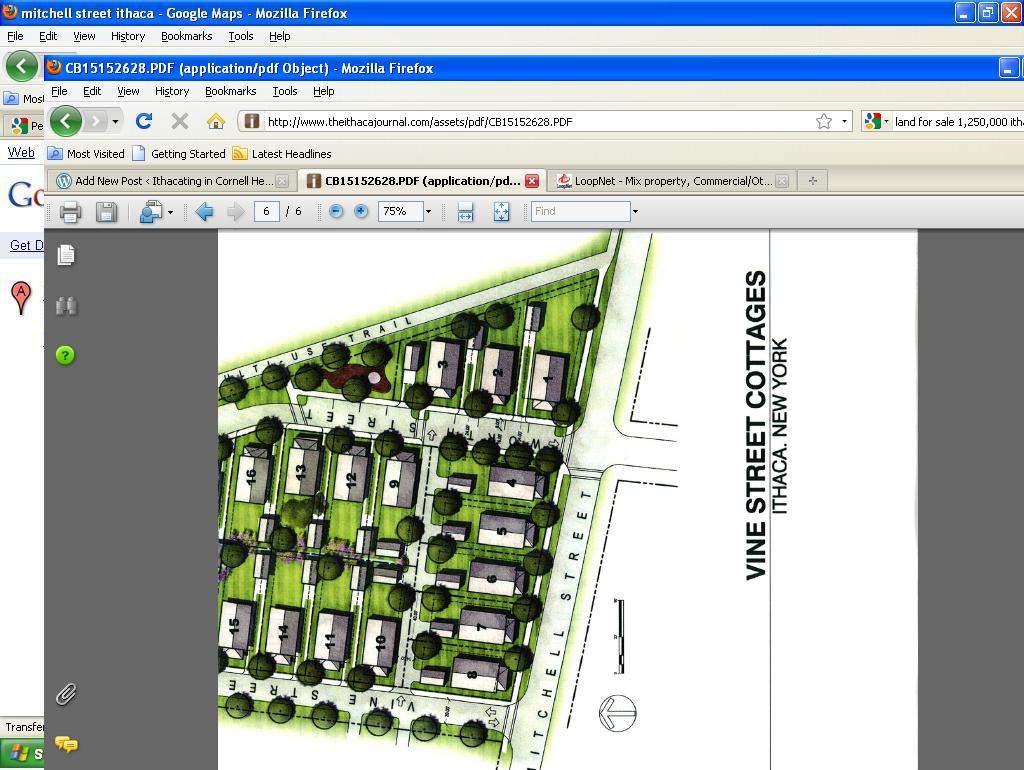
An underdeveloped piece of land between East Hill and Collegetown is the site of a proposed 26-unit single-family housing development to be called “Vine Street Cottages”. The land has been used by a trucking company since 1980, and was previously the site of an asphalt plant. The land has been marketed for the past year or so by several real estate agencies as a site for dense housing (suggested sale price: a cool $1.25 million for 3.4 acres. Mind you, this is Ithaca, so those prices are quite steep).

Photo Courtesy of Google Images

The housing is to be designed similar to the older homes in the nearby Fall Creek neighborhood, and sell for about $300k. However, the land is only zoned to hold ten lots, not 26, so a zoning appeal has to be filed and public discussion has to be undertaken. Which leads to comments like this one:

“…whose parents live on Vine Street, said the proposed development would be too dense, and the asking prices ‘are unrealistic for this area.'” A mature tree line currently buffers neighbors from the trucking operation, but all the trees would have to be removed to accommodate that many units, he said…”

I’ll give it one thing – the asking price is steep. A 1900 sq ft., 3-bedroom, 2.5 bath house that is LEED certified seems like it should only go for 200k-250k in the area. As for being too dense, apparently the joys of the frequent traffic of 18-wheelers up and down Mitchell Ave. outweigh 26 single-family houses. It’s also next to Maplewood Park, which is owned by Cornell and much denser (Maplewood Park is on the site where Vetsburg, Cornell’s housing for vets and their families, was originally placed after WWII). Cornell has its own plans to redevelop Maplewood Park within the next several years (assuming the budget kinks are worked out).

Speaking of which, the company that wants to develop the site, Agora LLC, is headed by Toby Millman, Cornell Class of 1992.

It would seem to be that this is a big win for Ithaca. The housing is intended for permanent residents and follows new urbanist principles, so it’s eco friendly and responds to concerns of students overrunning the area. But apparently, some folks think that a trucking company is better.


What the Hippies Are Driving These Days

23 12 2009

I figured that it would have been fun to do a little piece on the most common vehicle models in Tompkins County. Unfortunately, the statistics carried by the NYS Department of Transportation and the DMV only keep in track of the types of vehicle (basically, there are about 51,000 registered private vehicles in Tompkins County). Checking with the state department of finance didn’t reveal much, nor was there anything on the U.S. census data website (which is unusual, given that the census page usually has billions pf pieces of seemingly useless data). This is made even more frustrating when you consider that some states actually do bother to keep in track of this data, or that MSN had a “most popular vehicle by zip code” article that covered ten zip codes and then offered no means for anyone to check their own zipcodes. Lame.

It’s not like one can sit next to a window and keep track of the number of vehicles passing by. A green 2002 Honda Accord looks like any other green 2002 Honda Accord for the most part, so there’s little ability to distinguish whether two cars of the same make are genuinely unique or if it’s the same person driving by twice. Plus, most of the students driving around town aren’t registered through Ithaca zipcodes, they’re registered through their family’s permanent addresses (so, all those Audi A6s and BMW 3-series you see buzzing around campus are probably registered in Westchester, northern New Jersey or any token upscale suburb in the northeastern U.S.)

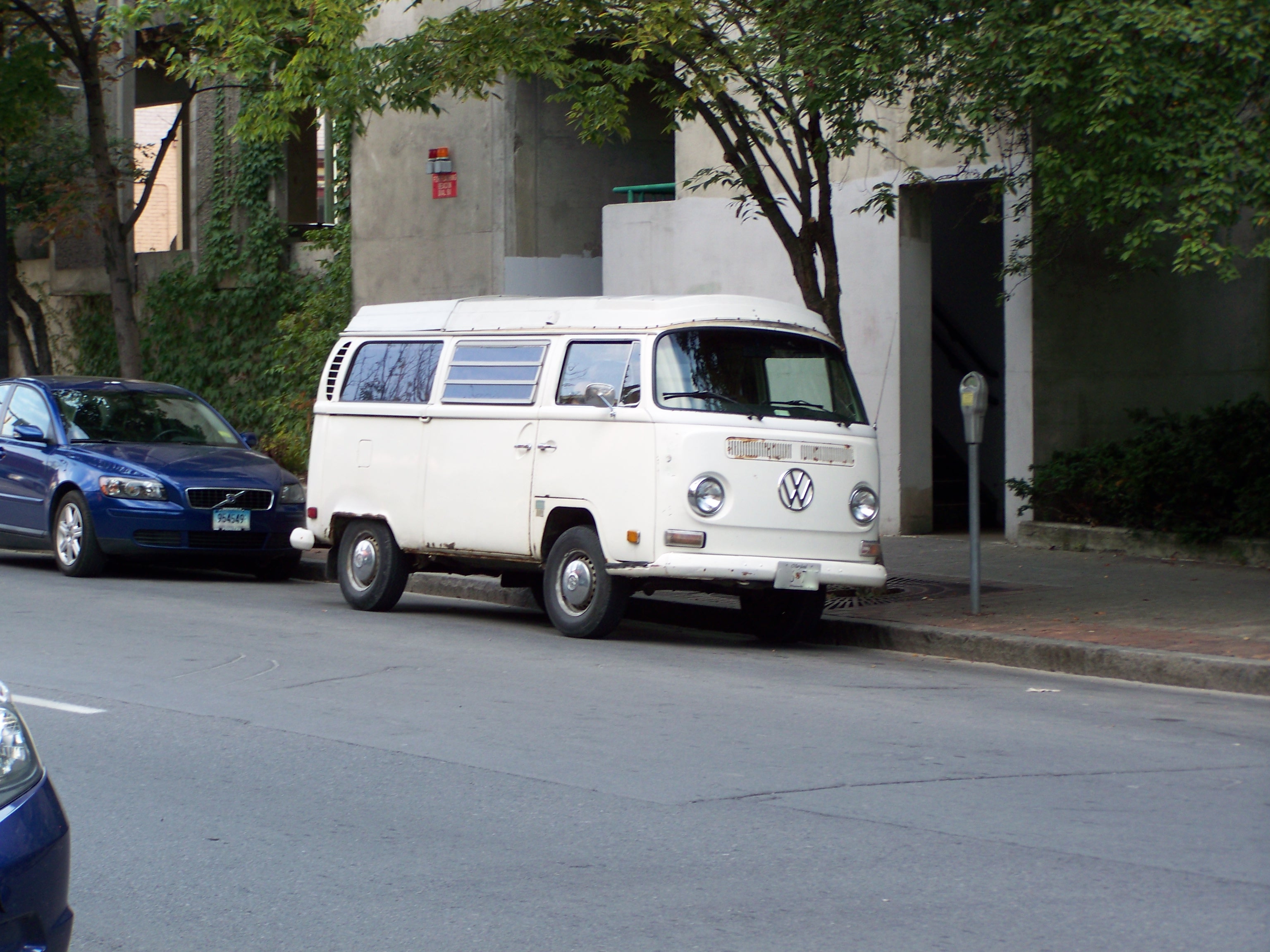
That being said, I’m willing to take a few somewhat educated guesses of the most commonly registered vehicles in Ithaca.  For one, the ubiquitous Volvos that can be found in the Ithaca area. If any particular models stand out, it’d probably be the 240 models from pre-1993, 800 series models from the mid 1990s and maybe some of the 900 series models of the later 1990s.  I’d be impressed if anyone travelling through the greater Ithaca area can go five minutes on the road without seeing the pride of Sweden in the next lane. Not to say that Volvos don’t have their attractions. They’re known for their safety and for great heating systems that prove useful for Ithaca’s long winters. Plus, in terms of cars defining people, Volvo tends to be one of those brands popular with the college faculty crowd, i.e. liberals with higher incomes.Volvos are so ingrained into the community culture that the Ithaca festival features a Volvo ballet, where they decorate the cars in “tutus” and perform on city streets.

Another brand of vehicles popular with the collegetown crowd would be Japanese automaker Subaru (fun fact of the day:  Subaru is the Japanese name for the Pleaides star cluster. This becomes readily apparent once you consider the Subaru emblem). The most popular model by my guess would be the Outback wagon of the mid 2000s or the post-2000 Subaru Forester.  What makes Subaru popular is that it tends to attract the same New Age crowd that Ithaca tends to attract. To quote a Denver paper that noted they were the most popular car in college town Boulder:

“More hip than a mini-van. Very useful. Great in snow. It’s a cool station wagon. Minivans aren’t cool. We know that. The Outback has all of the safety that an SUV doesn’t have and all the utility that the Camry does have. So I see it as a common middle ground kind of ride. It’s kind of like pilates mom instead of soccer mom…”

Lastly, if you consider things from a county level, then somewhere in the top five there have to be at least one of two truck models. Ithaca town and city make up about half the county’s populations, and probably less than half of the registered vehicles once you consider those that walk, bike or use public transit. The surrounding towns are more rural areas where agriculture is king, and many of these residents use Ford F-150s or Chevy Silverados to get around. Case in point, look in Alpha Gamma Rho’s parking lot, and you’ll see twenty trucks, five SUVs and an old Chevy Cavalier.

Seeing as their are no readily available figures, I’d love to hear other opinions on this one. Priuses, Accords, Saabs maybe? Write in and let me know.